


Abstract
Background: This systematic review determines the levels of physical activity (PA) during school hours in children and adolescents. Methods: Studies carried out from January 1987 to December 2019 were retrieved from four databases (Web of Science, Pubmed, Scopus and SportDiscus). Results: Twenty-nine studies were included in this systematic review. Most of them used accelerometers and showed that male and female children accumulated a mean of between 14 and 68 min of moderate-to-vigorous PA (MVPA) during school hours (3–22% of this daily segment), and male and female adolescents accumulated a mean of between 13 and 28 min of MVPA during this daily segment (3–8% of the school hours). Less than a quarter of children and adolescents reached the recommended 30 min of MVPA during school hours, with notable differences between sexes. Conclusions: These results suggest that the levels of PA during school hours are not enough, and consequently, schools should develop strategies for helping children and adolescents reach the school PA recommendation.
1. Introduction
High levels of physical activity (PA) in children and adolescents are recognized as an indicator of subsequent physical, social and mental health [1]. Consequently, children and adolescents are recommended to engage in at least 60 min of moderate-to-vigorous PA (MVPA) per day [2]. However, there is some evidence that many children and adolescents worldwide do not meet this recommendation [3].
Although it depends on the country’s educational system and school’s resources, schools have a certain potential to help children and adolescents reach the daily PA recommendations because millions of children and adolescents spend a large proportion of their awake hours in school [4,5]. However, sedentary activities are still the most common within the school setting [6]. The American Heart Association indicated that children and adolescents should perform at least 30 min of MVPA during school hours [4]. A few studies have measured the compliance rate of this recommendation and have obtained mixed results [7,8,9]. This recommendation, in fact, sets a goal in an absolute value (minutes of MVPA), and school hours are not the same in all countries [9,10,11,12]
Traditionally, school leisure time (i.e., time periods of noncurricular activities in school, such as recess, breaks or lunchtime) and physical education lessons have been considered the most propitious periods to help students meet the aforementioned school-based PA recommendations [13,14,15]. For this reason, levels of PA during both periods have received considerable attention and have been the subject of prior systematic reviews [16,17]. However, in most countries, recess time is limited (approximately 30 min per day), and physical education is given relatively little time in the curriculum (approximately 2 h per week) [18]. Moreover, recent studies have shown that less than half of recess time and physical education lessons are spent in MVPA [9,16,17] and that there are more ways to accumulate MVPA during school hours (e.g., breaks, lunchtime or during academic lessons) that have been undervalued to date [19].
To the best of our knowledge, there is no systematic review that examines the quantity of PA or MVPA that children and adolescents accumulate during school hours without intervention. Likewise, it is important to examine the proportion of school hours spent in PA or MVPA, especially because school hours often differ between countries. The findings on both issues could clarify whether the recommendation of 30 min of MVPA during school hours is being met and if it is adapted appropriately to countries with different school schedules. Therefore, the aim of this systematic review was to determine the levels of PA during school hours in children and adolescents.
2. Materials and Methods
This study follows the PRISMA guidance [20]. A comprehensive search of four databases (Web of Science, PubMed, Scopus and SportDiscus) for items published from January 1987 to the end of 2019 was undertaken. In addition, reference lists were snowballed for reports citing identified studies. Table 1 shows the search terms and search threads that were used: (i) physical activity (physical activity, exercise, sport); (ii) school (school time, school schedule, school hours, primary school, secondary school); and (iii) students (students, children, schoolchildren, adolescents, teenagers, youth).
Table 1.
Search strategy in databases.
2.1. Selection Criteria
Papers retrieved during the searches were checked against the following inclusion criteria: (i) full-text original report published in a peer-reviewed journal; (ii) the study participants had no physical disability or health problems that might limit levels of PA; (iii) conducted in school on children and adolescents aged 6–18 years; (iv) showed device-measured PA levels during all school hours (not only during recess time or physical education lessons) and without intervention; (v) indicated the quantity of school hours in the educational system or, failing that, this information was provided by the corresponding author; and (vi) written in English or Spanish. There was no exclusion criterion in relation to ethnicity.
2.2. Data Extraction and Reliability
The search was conducted by three independent reviewers (A.G.-C., M.J.V.-R. and F.R.-R.). They read the titles and abstracts of all articles retrieved. A meeting was held to resolve disagreements about eligibility. Information about the author, title, aim, sample size, age, country, design, measurement, school hours, main results and conclusions was extracted from all studies. The results of studies that met the selection criteria were screened for retrieval.
2.3. Assessment of Quality and Level of Evidence
The quality of the selected studies was scored using a quality assessment list, on the basis of other standardized assessment lists. The list consisted of six items dealing with the sample, measurement, design and reporting of results. Items were rated as follows: 2 = reported in full; 1 = partially reported; 0 = not reported or unclear. Total quality scores for the studies were calculated by summing the scores for individual items (range: 0–12) and were used to categorize the level of evidence provided: (i) studies were defined as high quality if they had a total score of 9 or higher; (ii) a total score of 5 to 8 was defined as medium quality; and (iii) a score of less than 5 was defined as low quality (Table 2). Three reviewers (AGC, MJVR and FRR) evaluated the quality of the studies, separately. A consensus meeting was arranged to sort out possible differences between reviewers.
Table 2.
List of included studies with quality scores.
3. Results
3.1. General Findings
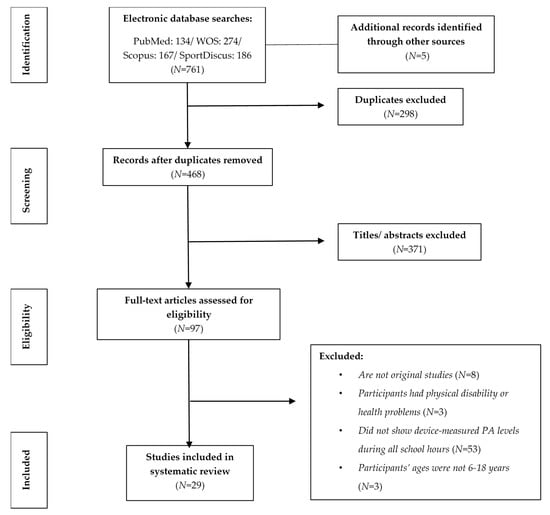
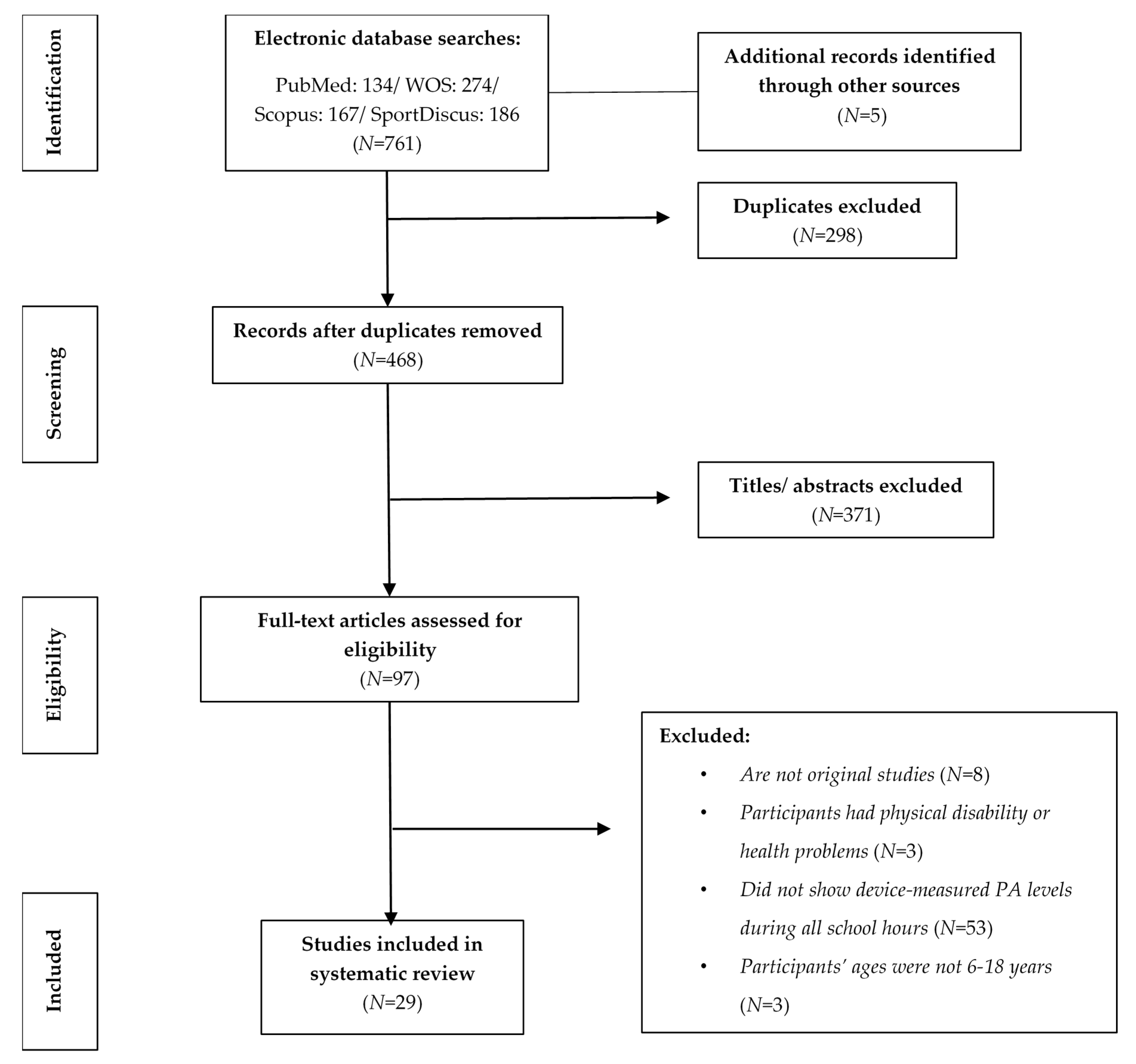
The flow of search results through the systematic review process is shown in Figure 1. The initial search retrieved 761 papers, and more than five identified in their reference lists, which was reduced to 468 by the removal of duplicates. The titles and abstracts of these 468 studies were screened, resulting in the exclusion of an additional 371 studies. In the last step, 68 papers were excluded because the population, age, language or design did not meet the inclusion criteria. Thus, 29 studies were included in the systematic review. Twenty-three (79%) of these were developed in primary schools, two (7%) studies were developed in secondary schools, and the rest (14%) included both primary and secondary schools. Twenty studies (69%) were cross-sectional, five (17%) studies involved interventions (only their baseline data were used, according to the selection criteria), three (10%) involved case studies, and one was a longitudinal study. Eleven (38%) studies were classified as being of high quality, seventeen (59%) were classified as medium quality, and one (3%) was classified as low quality (see Table 2).
Figure 1.
Flow of articles through the search process.
This review covers data from 11,984 children and adolescents, of whom 9304 (77.6%) were primary school students and 2680 (22.4%) were secondary school students. The sample size of the studies varied from 21 [41] to 3040 participants [26]. The samples were from 20 different countries: six studies were conducted in the United Kingdom, three in the USA, two in Spain, two in Ireland, two in Switzerland, two in Hong Kong, one in France, one in Norway, one in Finland, one in Canada, one in Australia, one in New Zealand, one in Japan, one in Italy, one in Cyprus, one in Qatar, one both in France and Spain, one multicenter study in five European countries (Belgium, Greece, Hungary, Netherlands, and Switzerland). Table 3 and Table 4 show the main features of the selected studies with participants in primary school and secondary school, respectively.
Table 3.
Characteristics of the analyzed studies with participants of primary school.
Table 4.
Characteristics of the analyzed studies with participants of secondary school.
3.2. Characteristics of the School Schedules
The number of school hours in the selected studies ranged in primary school from 240 min [22,26] to 480 min [11,24,34], with the most typical primary school time being approximately 360–390 min. In secondary school, the number of school hours ranged from 300 min [26] to 540 min [21] and in most cases was approximately 360 min. Twelve (41%) papers indicated the school leisure time. They showed that school recess ranged from 15 min [43] to 150 min per day [34], typically 30 min plus 60 additional minutes in schools with lunchtime. Twelve studies (41%) indicated the number of days per week with physical education lessons or if in the days measured there was physical education. In these studies, the weekly physical education time ranged from 44 min [10] to 240 min [9,33] and was typically 90–120 min distributed in one or two lessons.
3.3. Measures of Physical Activity
All selected studies included device-measured PA, of which 23 (79%) used accelerometers, four used pedometers (14%), one (3%) utilized both accelerometers and pedometers, and one (3%) used heart rate monitors with an integrated accelerometer. The studies that included accelerometer-based PA established different cut-off values to define the PA intensity categories. Most of these estimated the MVPA using cut-off values of ≥2000 counts per minute (cpm) or similar.
3.4. Absolute Physical Activity Levels during School Hours
Eighteen studies developed in primary schools showed the total PA as number of steps, cpm or minutes of PA. Children accumulated between 4358 steps and 7479 steps during school hours, without analyzing sex differences [11]. During that daily segment, boys accumulated from 3827 steps [30] to 8103 steps [42], and girls accumulated between 3420 steps [30] and 6963 steps [42]. Children’s cpm ranged from 129 cpm to 366 cpm on school days without and with physical education lessons, respectively [25]. According to sex, boys reached a mean of 145 cpm during school hours and girls reached a mean of 108 cpm [27]. Children spent between 104 min and 186 min in PA during school hours [11]. Boys accumulated from 86 min [33] to 178 min [43] in PA during school hours, whereas girls spent between 75 min [33] and 166 min of their school hours in PA [43].
Twenty-one studies developed in primary schools examined children’s MVPA during school hours. Children spent from 16 [8] to 61 min [11] of school hours in MVPA. The studies that analyzed their results separately by sex showed that boys accumulated between 20 min [43] and 68 min [42] of MVPA during school hours, while girls accumulated from 14 min [43] to 67 min [42] of MVPA during this daily segment.
Regarding secondary schools, three studies showed total PA data during school hours. Adolescents’ cpm during school hours ranged from 236 cpm [33] to 393 cpm [26]. Boys accumulated from 67 min [33] to 95 min [26] of PA during school hours, whereas girls spent between 54 min [33] and 76 min [26] of school hours in PA. The six studies that included secondary school students identified MVPA levels. During school hours, adolescents accumulated 23 min in Spain and 28 min in France [21] of MVPA. Boys spent between 16 min [23] and 26 min [26] of school hours in MVPA, whereas girls accumulated from 13 min [9,33] to 20 min [26] of MVPA during this daily segment.
3.5. Percentage of Physical Activity Levels during School Hours
Where the papers did not show the percentage of PA during school hours, we calculated this percentage wherever possible (e.g., % of school hours in MVPA = (minutes of MVPA/school minutes) × 100). In primary school, studies that did not analyze sex differences indicated that children spent from 4% [10] to 11% [41] of school hours in MVPA. The studies that analyzed their results separately by sex showed that boys spent between 5% [43] and 22% [42] of their school hours in MVPA, whereas this percentage for girls ranged from 3% [43] to 22% [42]. In secondary schools, adolescents spent between 4% [32] and 6% [21] of school hours in MVPA. Boys spent from 4% [23] to 8% [26] of their school hours in MVPA, whereas girls spent between 3% [9,23,33] and 6% [26] of their school time in MVPA.
3.6. Compliance with the School Physical Activity Recommendation
Four studies (14%) analyzed compliance with the school PA recommendation. In primary school, 7%–8% of European and American children reached the recommended 30 min of MVPA during school hours [8,36]. However, the studies that analyzed their results separately by sex showed higher compliance in boys than girls. Twenty-four percent of Spanish boys [9,33] and 8% of Spanish girls [9] met this recommendation. In secondary schools, 18% of Spanish boys and 2% of Spanish girls reached the 30 min of MVPA during school hours [9]. In both primary and secondary school, the percentage of compliance decreased with age [33].
4. Discussion
The aim of this systematic review was to determine the levels of PA during school hours in children and adolescents. A total of 29 studies conducted from January 1987 to the end of 2019 met the inclusion criteria and were heterogeneous with each other in their methods. Consequently, their results were also heterogeneous. They showed that male and female children accumulated a mean of between 14 and 68 min of MVPA during school hours, and male and female adolescents accumulated a mean of between 13 and 28 min of MVPA during this daily segment. Less than a quarter of children and adolescents reached the recommended 30 min of MVPA during school hours, with notable differences between sexes. These findings suggest that the current school settings might not generate a sufficient amount of MVPA in children and, especially, in adolescents. In spite of this, the results should be taken with caution because of the small number of studies (29), and only six studies included secondary school students. Moreover, the majority of the selected studies in the review were carried out in Europe, others in North America and in high-income countries from Oceania (Australia and New Zealand) and Asia (Japan, Hong Kong and Qatar). Most of them are developed and democratic countries, with a consolidated welfare state, where children and adolescents have access to education, in decent facilities and with teachers trained in universities. As a consequence, the results may not be generalizable to middle- and low-income countries.
Primary and secondary students’ PA levels were mixed between the selected studies. Only considering studies that employed an accelerometer—the most frequently used device in our systematic review—the average PA during school hours ranged from 75 min to 178 min in children and from 54 min to 95 min in adolescents. In these studies, children spent between 14 min and 68 min in MVPA, and adolescents spent between 13 min and 28 min. These levels of MVPA suggest that children spent between 3% and 22% of their school hours in MVPA and that adolescents spent between 3% and 8% of this daily segment in MVPA. Given that the school hours were not the same in all the selected studies, as we would expect, we attach particular importance to these percentage PA data. They confirm that PA levels are more varied in children than in adolescents. The most likely explanation is the higher number of studies developed in primary school among the selected studies, particularly because the methods of these studies are mixed (e.g., the study in which children reached the higher levels of PA [42] estimated the MVPA using a cut-off value of 1500 cpm, an amount significantly less than most of the studies).
Likewise, the data clearly show higher levels of PA during school hours in children than in adolescents. In secondary schools, it is most common to sit during academic activities [46], whereas in primary school, the environment is more propitious to active learning. Primary school students move more during non-curricular breaks [9,33] because there are more sport opportunities and greater encouragement from teachers [47].
However, these PA differences between educational stages are not only attributable to the schools, it is known that PA levels are influenced by a large amount of biological (e.g., age), behavioral (e.g., substance use), psychosocial (e.g., social support) and environmental factors (e.g., sport facilities) [48,49,50]. It is well documented that increasing age is a biological factor that is negatively associated with PA during childhood and adolescence [51,52], even without changing the educational stage [53]. It has been suggested that different social or behavioral factors may contribute to this decrease of PA with age [49], but it is not clear yet what set of reasons explains this change [49,54].
Our results also showed that boys were more active during school hours in both primary and secondary schools. Part of the reason for this is that boys accumulated more minutes of MVPA during school recess than girls [9,33], who spent more time performing sedentary activities [46]. This is evidence that transcends school hours and is due to socio-ecological factors at the individual, family, school, and environmental levels. Some individual attributes associated with PA are less favorable in girls than boys (lower cardiorespiratory fitness, lower eye–hand coordination, higher percent body fat and lower perceived competence in physical education). This is possibly due to the persistence of gender stereotypes, families are less supportive of girls’ PA than boys’ PA. Likewise, the opportunities for PA offered by school and community are more attractive to the boys than the girls [55].
Both age and sex differences were also observable in the scarce studies that analyzed compliance with the school’s PA recommendation. Less than a quarter of children and adolescents reach 30 min of MVPA during school hours, and this result is especially worrisome in adolescents and girls. However, many selected studies developed in primary schools (that did not show data on compliance with this recommendation) showed a mean MVPA during school hours higher than 30 min [24,26,28,37,41,42,44,45]. This might indicate that the situation in primary school is not so worrisome, but this is not the case for studies developed in secondary schools. In any case, this systematic review showed significant differences between the school schedules of the selected studies. Consequently, we think that a recommendation of PA within a school expressed in minutes is not the most advisable, because this goal would be easier to reach in schools with longer schedules. We propose a recommendation as a percentage of school hours, as is the case for the specific PA recommendation during recess [56,57] and PE lessons [58]. We understand that the American Heart Association established 30 min of MVPA for the American educational system, whose typical duration is 6 h per weekday [59]. These minutes suggest approximately 8% of school hours (not necessarily including a physical education session), which could be a realistic goal considering the results of this review.
There are different evidence-based strategies that schools can develop to help children and adolescents reach this goal of PA during school hours [9]. The results from the selected studies suggest that increasing the weekly hours of physical education and school recess would be useful for this purpose because children and adolescents are more active during these times than in other academic lessons [29,31,33]. Likewise, outdoor learning seems to be better for accumulating MVPA minutes than traditional indoor learning [41]. Moreover, other strategies could increase students’ PA during academic lessons (e.g., MVPA in the classroom while maintaining academic time [60,61]), school recess (providing access to outdoor school facilities and providing sports equipment [62,63,64]) and physical education lessons (reducing transition and management time during PEC [65]), and they are more viable.
This systematic review shows the heterogeneity in the methodology of the selected studies as its main weakness. Even between studies with the same design and devices to assess PA, there were differences in their data collection and processing criteria, which may bias the results. Some studies do not detail the number and duration of recess and physical education lessons, which may also influence the results. These issues make it difficult to compare the selected studies. Moreover, the review has some limitations linked to the device used to assess PA in the studies (mostly accelerometers), such as the lack of sensitivity to capture upper body movements, water-based activities, cycling or other complex movements. Another limitation was that the used quality assessment list does not have validation references, although it is conducted on the basis of other standardized assessment lists. Despite the above, this is the first systematic review to examine the quantity of PA that children and adolescents accumulate during school hours. Moreover, the possible bias due to differences between school schedules was minimized by providing percentages of PA in relation to school hours. Another strength is that the scope of this review was limited to studies that included device-measured PA and shows PA data during school from both primary and secondary schools. Future studies that focus on device-measured PA during school hours should use strategies that may help to ensure comparability between studies and maximize the potential for data harmonization [66,67]. Multilevel studies that examine school effects on children and adolescents’ PA during school hours [68] are also recommended to explain the differences observed between schools.
5. Conclusions
This review identified 29 studies of PA during school hours. Their methods and results were heterogeneous and indicated that children spent a mean of between 14 min to 68 min of MVPA during school hours, which represents between 3% and 22% of this daily segment, whereas adolescents accumulated a mean of between 13 min to 28 min of MVPA, a 3%–8% of the school hours. A very low percentage of children and adolescents reached the recommended PA levels for school hours, and consequently, schools should develop strategies to increase the levels of PA during school hours.
Author Contributions
Conceptualization A.G.-C., M.J.V.-R., F.R.-R.; Methodology, A.G.-C., M.J.V.-R., F.R.-R.; Investigation, A.G.-C., M.J.V.-R., F.R.-R.; Supervision, A.G.-C., F.R.-R.; Writing—Original draft preparation, A.G.-C.; Writing—Review and editing, A.G.-C., M.J.V.-R., F.R.-R. All authors have read and agreed to the published version of the manuscript.
Funding
This research received no external funding.
Conflicts of Interest
The authors declare no conflict of interest.
References
- Poitras, V.J.; Gray, C.E.; Borghese, M.M.; Carson, V.; Chaput, J.P.; Janssen, I.; Katzmarzyk, P.T.; Pate, R.R.; Connor Gorber, S.; Kho, M.E.; et al. Systematic review of the relationships between objectively measured physical activity and health indicators in school-aged children and youth. Appl. Physiol. Nutr. Metab. 2016, 41, S197–S239. [Google Scholar] [CrossRef] [Scilit]
- Piercy, K.L.; Troiano, R.P.; Ballard, R.M.; Carlson, S.A.; Fulton, J.E.; Galuska, D.A.; George, S.M.; Olson, R.D. The physical activity guidelines for Americans. J. Am. Med. Assoc. 2018, 320, 2020–2028. [Google Scholar] [CrossRef] [Scilit]
- Guthold, R.; Stevens, G.A.; Riley, L.M.; Bull, F.C. Worldwide trends in insufficient physical activity from 2001 to 2016: A pooled analysis of 358 population-based surveys with 1·9 million participants. Lancet Glob. Health 2018, 6, e1077–e1086. [Google Scholar] [CrossRef] [Scilit]
- Pate, R.; O’Neill, J. Summary of the American Heart Association scientific statement: Promoting physical activity in children and youth: A leadership role for schools. J. Cardiovasc. Nurs. 2008, 23, 44–49. [Google Scholar] [CrossRef] [Scilit]
- Institute of Medicine. Educating the Student Body: Taking Physical Activity and Physical Education to School; National Academies Press: Washington, DC, USA, 2013. [Google Scholar]
- Egan, C.A.; Webster, C.A.; Beets, M.W.; Glenn, R.; Russ, L.; Michael, D.; Nesbitt, D.; Orendorff, K.L. Sedentary time and behavior during school: A systematic review and meta-analysis. Am. J. Health Educ. 2019, 50, 283–290. [Google Scholar] [CrossRef] [Scilit]
- Nettlefold, L.; McKay, H.A.; Warburton, D.E.R.; McGuire, K.A.; Bredin, S.S.D.; Naylor, P.J. The challenge of low physical activity during the school day: At recess, lunch and in physical education. Br. J. Sports Med. 2011, 45, 813–819. [Google Scholar] [CrossRef] [Scilit]
- Van Stralen, M.M.; Yildirim, M.; Wulp, A.; te Velde, S.J.; Verloigne, M.M.; Doessegger, A.; Androutsos, O.; Kovács, É.; Brug, J.; Chinapaw, M.J.M.M.; et al. Measured sedentary time and physical activity during the school day of European 10-to 12-year-old children: The ENERGY project. J. Sci. Med. Sport 2014, 17, 201–206. [Google Scholar] [CrossRef] [Scilit]
- Grao-Cruces, A.; Segura-Jiménez, V.; Conde-Caveda, J.; García-Cervantes, L.; Martínez-Gómez, D.; Keating, X.; Castro-Piñero, J. The role of school in helping children and adolescents reach the physical activity recommendations: The UP&DOWN study. J. Sch. Health 2019, 89, 612–618. [Google Scholar] [PubMed]
- Cheung, P. School-based physical activity opportunities in PE lessons and after-school hours: Are they associated with children’s daily physical activity? Eur. Phys. Educ. Rev. 2019, 25, 65–75. [Google Scholar] [CrossRef] [Scilit]
- Pau, M.; Corona, F.; Leban, B.; Piredda, S.; Vacca, M.M.; Mura, G. Influence of school schedules on physical activity patterns in Primary School Children: A case study in Italy. J. Phys. Act. Health 2017, 14, 501–505. [Google Scholar] [CrossRef] [Scilit] [PubMed]
- Parrish, A.M.; Tremblay, M.S.; Carson, S.; Veldman, S.L.C.; Cliff, D.; Vella, S.; Chong, K.H.; Nacher, M.; Del Pozo Cruz, B.; Ellis, Y.; et al. Comparing and assessing physical activity guidelines for children and adolescents: A systematic literature review and analysis. Int. J. Behav. Nutr. Phys. Act. 2020, 17. [Google Scholar] [CrossRef] [Scilit] [PubMed]
- Mayorga-Vega, D.; Parra Saldías, M.; Viciana, J. Comparison of moderate-to-vigorous physical activity levels between physical education, school recess and after-school time in secondary school students: An accelerometer-based study. Kinesiology 2017, 49, 242–251. [Google Scholar] [CrossRef] [Scilit]
- Martínez, J.; Contreras, O.R.; Aznar, S.; Lera, Á. Niveles de actividad física medido con acelerómetro en alumnos de 3° ciclo de Educació Primaria: Actividad física diaria y sesiones de Educación Física. Rev. Psicol. Deport. 2012, 21, 117–123. [Google Scholar]
- Martínez, J.; Aznar, S.; Contreras, O. The recess school space and time as an opportunity healthy. Int. J. Med. Sci. Phys. Act. Sport 2015, 15, 419–432. [Google Scholar] [CrossRef] [Scilit]
- Reilly, J.J.; Johnston, G.; McIntosh, S.; Martin, A. Contribution of school recess to daily physical activity: Systematic review and evidence appraisal. Health Behav. Policy Rev. 2016, 3, 581–589. [Google Scholar] [CrossRef] [Scilit]
- Hollis, J.L.; Sutherland, R.; Williams, A.J.; Campbell, E.; Nathan, N.; Wolfenden, L.; Morgan, P.J.; Lubans, D.R.; Gillham, K.; Wiggers, J. A systematic review and meta-analysis of moderate-to-vigorous physical activity levels in secondary school physical education lessons. Int. J. Behav. Nutr. Phys. Act. 2017, 14, 52. [Google Scholar] [CrossRef] [Scilit]
- Agencia Española de Consumo Seguridad Alimentaria y Nutrición. Estudio ALADINO 2013: Estudio de Vigilancia del Crecimeinto, Alimentación, Actividad Física, Desarrollo Infantil y Obesidad en España 2013; Madrid, 2014; Ministerio de Sanidad, Servicios Sociales e Igualdad, Madrid, Gobierno de España. Available online: http://www.aecosan.msssi.gob.es/AECOSAN/docs/documentos/nutricion/observatorio/Estudio_ALADINO_2015.pdf (accessed on 5 March 2019).
- Daly-Smith, A.; Quarmby, T.; Archbold, V.S.J.; Routen, A.C.; Morris, J.L.; Gammon, C.; Bartholomew, J.B.; Resaland, G.K.; Llewellyn, B.; Allman, R.; et al. Implementing physically active learning: Future directions for research, policy, and practice. J. Sport Health Sci. 2019. [Google Scholar] [CrossRef] [Scilit] [PubMed]
- Beller, E.M.; Glasziou, P.P.; Altman, D.G.; Hopewell, S.; Bastian, H.; Chalmers, I.; Gøtzsche, P.C.; Lasserson, T.; Tovey, D. PRISMA for abstracts: Reporting systematic reviews in journal and conference abstracts. PLoS Med. 2013, 10, e1001419. [Google Scholar] [CrossRef] [Scilit] [PubMed]
- Aibar, A.; Bois, J.E.; Zaragoza Casterad, J.; Generelo, E.; Paillard, T.; Fairclough, S. Weekday and weekend physical activity patterns of French and Spanish adolescents. Eur. J. Sport Sci. 2014, 14, 500–509. [Google Scholar] [CrossRef] [Scilit] [PubMed]
- Bürgi, R.; Tomatis, L.; Murer, K.; De Bruin, E.D. Spatial physical activity patterns among primary school children living in neighbourhoods of varying socioeconomic status: A cross-sectional study using accelerometry and Global Positioning System. BMC Public Health 2016, 16, 282. [Google Scholar] [CrossRef] [Scilit] [PubMed]
- Bürgi, R.; Tomatis, L.; Murer, K.; de Bruin, E.D. Localization of physical activity in primary school children using accelerometry and global positioning system. PLoS ONE 2015, 10, e0142223. [Google Scholar] [CrossRef] [Scilit] [PubMed]
- Clark, A.F.; Wilk, P.; Gilliland, J.A. Comparing physical activity behavior of children during school between balanced and traditional school day schedules. J. Sch. Health 2019, 89, 129–135. [Google Scholar] [CrossRef] [Scilit]
- Dale, D.; Corbin, C.B.; Dale, K.S. Restricting opportunities to be active during school time: Do children compensate by increasing physical activity levels after school? Res. Q. Exerc. Sport 2000, 71, 240–248. [Google Scholar] [CrossRef] [Scilit] [PubMed]
- Dalene, K.E.; Anderssen, S.A.; Ekelund, U.; Thorén, A.K.H.; Hansen, B.H.; Kolle, E. Permanent play facility provision is associated with children’s time spent sedentary and in light physical activity during school hours: A cross-sectional study. Prev. Med. Rep. 2016, 4, 429–434. [Google Scholar] [CrossRef] [Scilit] [PubMed]
- Eyre, E.L.J.J.; Duncan, M.J.; Smith, E.C.; Matyka, K.A. Objectively measured patterns of physical activity in primary school children in coventry: The influence of ethnicity. Diabet. Med. 2013, 30, 939–945. [Google Scholar] [CrossRef] [Scilit]
- Fairclough, S.J.; Butcher, Z.H.; Stratton, G. Whole-day and segmented-day physical activity variability of northwest England school children. Prev. Med. 2007, 44, 421–425. [Google Scholar] [CrossRef] [Scilit]
- Fairclough, S.J.; Beighle, A.; Erwin, H.; Ridgers, N.D. School day segmented physical activity patterns of high and low active children. BMC Public Health 2012, 12. [Google Scholar] [CrossRef] [Scilit]
- Galloway, R.; Booker, R.; Owens, S. Factors leading to discrepancies in accumulated physical activity during school hours in elementary school students. J. Teach. Phys. Educ. 2019, 38, 338–346. [Google Scholar] [CrossRef] [Scilit]
- Gao, Y.; Wang, J.J.; Lau, P.W.C.; Ransdell, L. Pedometer-determined physical activity patterns in a segmented school day among Hong Kong primary school children. J. Exerc. Sci. Fit. 2015, 13, 42–48. [Google Scholar] [CrossRef] [Scilit]
- Gidlow, C.J.; Cochrane, T.; Davey, R.; Smith, H. In-school and out-of-school physical activity in primary and secondary school children. J. Sports Sci. 2008, 26, 1411–1419. [Google Scholar] [CrossRef] [Scilit]
- Grao-Cruces, A.; Sánchez-Oliva, D.; Segura-Jiménez, V.; Cabana-Sánchez, V.; Martínez-Gómez, D.; Rodríguez-Rodríguez, F.; Moreno, L.; Castro-Piñero, J. Changes in compliance with school-based physical activity recommendations in Spanish youth: The UP&DOWN longitudinal study. Scand. J. Med. Sci. Sports 2019, 29, 554–565. [Google Scholar] [CrossRef] [Scilit] [PubMed]
- Guinhouya, B.C.; Lemdani, M.; Vilhelm, C.; Hubert, H.H.; Apété, G.K.; Durocher, A.; Vilhelm, C.; Hubert, H.H. How school time physical activity is the “Big One” for daily activity among schoolchildren: A semi-experimental approach. J. Phys. Act. Health 2009, 6, 510–519. [Google Scholar] [CrossRef] [Scilit] [PubMed]
- Hardman, C.A.; Horne, P.J.; Rowlands, A. V Children’s pedometer-determined physical activity during school-time and leisure-time. J. Exerc. Sci. Fit. 2009, 7, 129–134. [Google Scholar] [CrossRef] [Scilit]
- Hubbard, K.; Economos, C.D.; Bakun, P.; Boulos, R.; Chui, K.; Mueller, M.P.; Smith, K.; Sacheck, J. Disparities in moderate-to-vigorous physical activity among girls and overweight and obese schoolchildren during school- and out-of-school time. Int. J. Behav. Nutr. Phys. Act. 2016, 13, 39. [Google Scholar] [CrossRef] [Scilit]
- Kidokoro, T.; Shimizu, Y.; Edamoto, K.; Annear, M. Classroom standing desks and time-series variation in sedentary behavior and physical activity among primary school children. Int. J. Environ. Res. Public Health 2019, 16, 1892. [Google Scholar] [CrossRef] [Scilit]
- Loucaides, C.A. Seasonal differences in segmented-day physical activity and sedentary behaviour in primary school children. Early Child Dev. Care 2018, 188, 410–420. [Google Scholar] [CrossRef] [Scilit]
- Martin, R.; Murtagh, E. Active classrooms: A cluster randomized controlled trial evaluating the effects of a movement integration intervention on the physical activity levels of primary school children. J. Phys. Act. Health 2016, 14, 290–300. [Google Scholar] [CrossRef] [Scilit]
- Murtagh, E.; Mulvihill, M.; Markey, O. Bizzy break! The effect of a classroom-based activity break on in-school physical activity levels of primary school children. Pediatr. Exerc. Sci. 2013, 25, 300–307. [Google Scholar] [CrossRef] [Scilit]
- Romar, J.E.J.E.; Enqvist, I.; Kulmala, J.; Kallio, J.; Tammelin, T. Physical activity and sedentary behaviour during outdoor learning and traditional indoor school days among Finnish primary school students. J. Adventure Educ. Outdoor Learn. 2019, 19, 28–42. [Google Scholar] [CrossRef] [Scilit]
- Rush, E.; Coppinger, T.; Obolonkin, V.; Hinckson, E.; McGrath, L.; McLennan, S.; Graham, D. Use of pedometers to identify less active children and time spent in moderate to vigorous physical activity in the school setting. J. Sci. Med. Sport 2012, 15, 226–230. [Google Scholar] [CrossRef] [Scilit]
- Taylor, S.L.; Curry, W.B.; Knowles, Z.R.; Noonan, R.J.; McGrane, B.; Fairclough, S.J. Predictors of segmented school day physical activity and sedentary time in children from a northwest England low-income community. Int. J. Environ. Res. Public Health 2017, 14, 534. [Google Scholar] [CrossRef] [Scilit] [PubMed]
- Watson, A.J.L.L.; Timperio, A.; Brown, H.; Hesketh, K.D. A pilot primary school active break program (ACTI-BREAK): Effects on academic and physical activity outcomes for students in Years 3 and 4. J. Sci. Med. Sport 2019, 22, 438–443. [Google Scholar] [CrossRef] [Scilit] [PubMed]
- Zimmo, L.; Farooq, A.; Almudahka, F.; Ibrahim, I.; Al-Kuwari, M.G. School-time physical activity among Arab elementary school children in Qatar. BMC Pediatr. 2017, 17, 76. [Google Scholar] [CrossRef] [Scilit]
- Grao-Cruces, A.; Sánchez-Oliva, D.; Padilla-Moledo, C.; Izquierdo-Gómez, R.; Cabanas-Sánchez, V.; Castro-Piñero, J. Changes in the school and non-school sedentary time in youth: The UP&DOWN longitudinal study. J. Sports Sci. 2020, 4, 1–7. [Google Scholar]
- Wechsler, H.; Devereaux, R.S.; Davis, M.; Collins, J. Using the school environment to promote physical activity and healthy eating. Prev. Med. 2000, 31. [Google Scholar] [CrossRef] [Scilit]
- Carlin, A.; Perchoux, C.; Puggina, A.; Aleksovska, K.; Buck, C.; Burns, C.; Cardon, G.; Chantal, S. A life course examination of the physical environmental determinants of physical activity behaviour: A “Determinants of diet and physical activity” (DEDIPAC) umbrella systematic literature review. PLoS ONE 2017, 12, e0182083. [Google Scholar] [CrossRef] [Scilit]
- Aleksovska, K.; Puggina, A.; Giraldi, L.; Buck, C.; Burns, C.; Cardon, G.; Carlin, A.; Chantal, S.; Ciarapica, D.; Colotto, M.; et al. Biological determinants of physical activity across the life course: A “determinants of diet and physical activity” (DEDIPAC) umbrella systematic literature review. Sport Med. 2019, 5, 1–26. [Google Scholar] [CrossRef] [Scilit]
- Cortis, C.; Puggina, A.; Pesce, C.; Aleksovska, K.; Buck, C.; Burns, C.; Cardon, G.; Carlin, A.; Simon, C.; Ciarapica, D.; et al. Psychological determinants of physical activity across the life course: A determinantes of diet and physical activity (DEDIPAC) umbrella systematic literature review. PLoS ONE 2017, 12, e0182709. [Google Scholar] [CrossRef] [Scilit]
- Brooke, H.L.; Atkin, A.J.; Corder, K.; Ekelund, U.; van Sluijs, E.M.F. Changes in time-segment specific physical activity between ages 10 and 14 years: A longitudinal observational study. J. Sci. Med. Sport 2016, 19, 29–34. [Google Scholar] [CrossRef] [Scilit]
- Brooke, H.L.; Corder, K.; Griffin, S.J.; van Sluijs, E.M.F. Physical activity maintenance in the transition to adolescence: A longitudinal study of the roles of sport and lifestyle activities in British youth. PLoS ONE 2014, 9, e89028. [Google Scholar] [CrossRef] [Scilit]
- Marques, A.; de Matos, M.G. Adolescents’ physical activity trends over the years: A three-cohort study based on the health behaviour in school-aged children (HBSC) portuguese survey. BMJ Open 2014, 4, 1–7. [Google Scholar] [CrossRef] [Scilit]
- Dumith, S.C.; Gigante, D.P.; Domingues, M.R.; Kohl, H.W. Physical activity change during adolescence: A systematic review and a pooled analysis. Int. J. Epidemiol. 2011, 40, 685–698. [Google Scholar] [CrossRef] [Scilit] [PubMed]
- Telford, R.M.; Telford, R.D.; Olive, L.S.; Cochrane, T.; Davey, R. Why are girls less physically active than boys? Findings from the LOOK longitudinal study. PLoS ONE 2016, 11, e0150041. [Google Scholar] [CrossRef] [Scilit] [PubMed]
- Ridgers, N.D.; Stratton, G.; Fairclough, S.J. Assessing physical activity during recess using accelerometry. Prev. Med. 2005, 41, 102–107. [Google Scholar] [CrossRef] [Scilit] [PubMed]
- Stratton, G.; Mullan, E. The effect of multicolor playground markings on children’s physical activity level during recess. Prev. Med. 2005, 41, 828–833. [Google Scholar] [CrossRef] [Scilit] [PubMed]
- United States Department of Health and Human Services. Strategies to Improve the Quality of Physical Education; Centers for Disease Control and Prevention: Washington, DC, USA, 2010.
- Whinnery, E.; Pompelia, S. 50-State Comparison: Instructional Time Policies. 2018. Available online: https://www.ecs.org/50-state-comparison-developmental-education-policies/ (accessed on 20 January 2019).
- Norris, E.; Shelton, N.; Dunsmuir, S.; Duke-Williams, O.; Stamatakis, E. Physically active lessons as physical activity and educational interventions: A systematic review of methods and results. Prev. Med. 2015, 72, 116–125. [Google Scholar] [CrossRef] [Scilit] [PubMed]
- McMullen, J.; Kulinna, P.; Cothran, D. Physical activity opportunities during the school day: Classroom teachers’ perceptions of using activity breaks in the classroom. Eur. Phys. Educ. Rev. 2014, 33, 511–527. [Google Scholar] [CrossRef] [Scilit]
- Ridgers, N.D.; Salmon, J.; Parrish, A.M.; Stanley, R.M.; Okely, A.D. Physical activity during school recess: A systematic review. Am. J. Prev. Med. 2012, 43, 320–328. [Google Scholar] [CrossRef] [Scilit]
- Janssen, M.; Twisk, J.W.R.; Toussaint, H.M.; van Mechelen, W.; Verhagen, E.A.L.M. Effectiveness of the PLAYgrounds programme on PA levels during recess in 6-year-old to 12-year-old children. Br. J. Sports Med. 2015, 49, 259–264. [Google Scholar] [CrossRef] [Scilit]
- Wang, H.; Li, T.; Siahpush, M.; Chen, L.-W.; Huberty, J. Cost-effectiveness of ready for recess to promote physical activity in children. J. Sch. Health 2017, 87, 278–285. [Google Scholar] [CrossRef] [Scilit]
- Smith, N.J.; Lounsbery, M.A.F.; McKenzie, T.L. Physical activity in high school physical education: Impact of lesson context and class gender composition. J. Phys. Act. Health 2014, 11, 127–135. [Google Scholar] [CrossRef] [Scilit] [PubMed]
- Rowlands, A.V. Moving forward with accelerometer-assessed physical activity: Two strategies to ensure meaningful, interpretable, and comparable measures. Pediatr. Exerc. Sci. 2018, 30, 450–456. [Google Scholar] [CrossRef] [Scilit] [PubMed]
- Rowlands, A.V.; Sherar, L.B.; Fairclough, S.J.; Yates, T.; Edwardson, C.L.; Harrington, D.M.; Davies, M.J.; Munir, F.; Khunti, K.; Stiles, V.H. A data-driven, meaningful, easy to interpret, standardised accelerometer outcome variable for global surveillance. J. Sci. Med. Sport 2019, 22, 1132–1138. [Google Scholar] [CrossRef] [Scilit] [PubMed]
- Griew, P.; Page, A.; Thomas, S.; Hillsdon, M.; Cooper, A.R. The school effect on children’s school time physical activity: The PEACH Project. Prev. Med. 2010, 51, 282–286. [Google Scholar] [CrossRef] [Scilit]

© 2020 by the authors. Licensee MDPI, Basel, Switzerland. This article is an open access article distributed under the terms and conditions of the Creative Commons Attribution (CC BY) license (http://creativecommons.org/licenses/by/4.0/).