


Abstract
We report the first total synthesis of PM742 using N-Boc-D-Norvaline and 2-Methyl-L-Cysteine hydrochloride as starting materials in a convergent sequence of eight chemical steps. This strategy provides efficient access to PM742 and enables the preparation of structurally related analogs. PM742 exhibited in vitro cytotoxic activity against a panel of human tumor cell lines, which prompted preliminary structure-activity relationship (SAR) studies. These efforts led to the preparation of PM534, a related analog with improved activity that has now entered Phase I clinical trials in humans.
1. Introduction
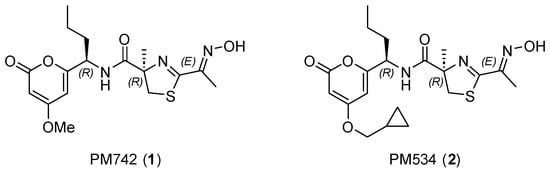
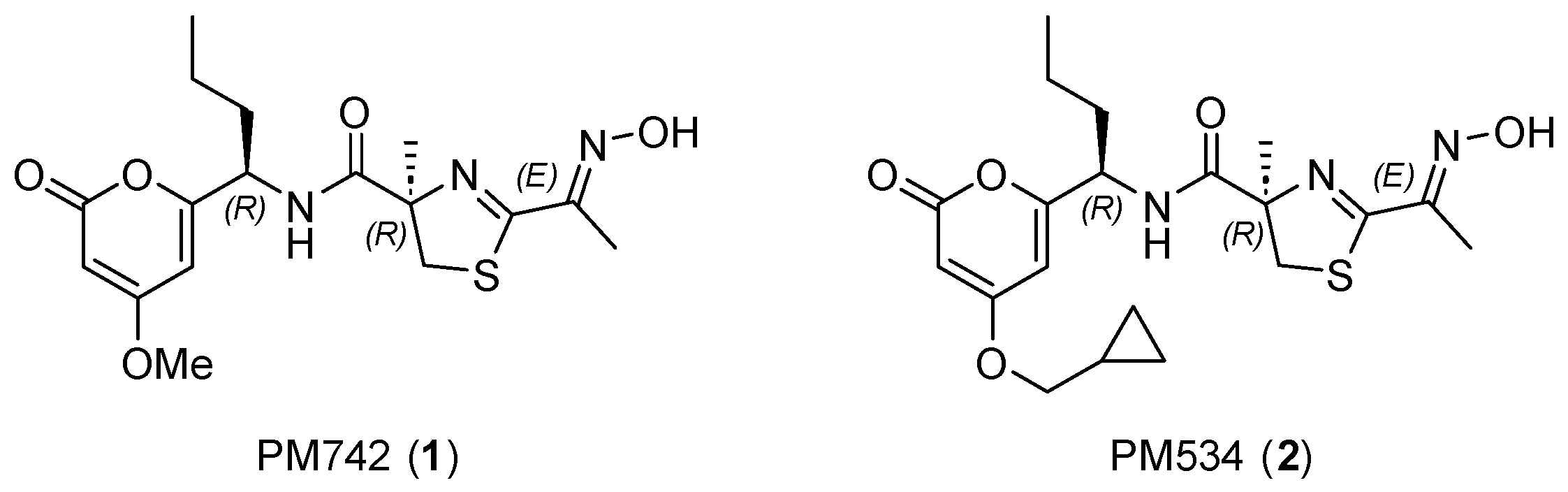
In our ongoing efforts to identify anticancer compounds from marine sources, we investigated the chemical composition of a Discodermia du Bocage specimen collected in the Pacific Ocean. This study led to the discovery of a new chemical entity, PM742 (1) (Figure 1), together with several analogs of the known aurantosides [1]. The planar structure of PM742 (1) consists of an α-pyrone linked through an amide bond to a 4-methyl-4,5-dihydrothiazole-derived E-oxime. Its structure was unequivocally confirmed by total synthesis, starting from N-Boc-D-Norvaline and 2-methyl-L-cysteine hydrochloride in a convergent sequence of eight chemical steps.
Figure 1.
Chemical Structures of PM742 (1) and PM534 (2).
The biological activity of PM742 (1) was evaluated against a panel of human cancer cell lines, revealing strong in vitro cytotoxicity. These results prompted an extensive structure-activity relationship (SAR) study that ultimately led to the identification of PM534 (2) (Figure 1), a synthetic analog of PM742 (1) [2] with potent antitumor activity in both lung epithelial cells and non-small cell lung cancer (NSCLC) cells. Notably, PM534 (2) is able to overcome typical resistance mechanisms against microtubule-targeting agents (MTAs), including detox pump overexpression and the presence of the βIII-tubulin isotype [3].
PM534 (2) demonstrates strong antitumor activity across multiple tumor types, including those characterized by the presence of well-established multidrug resistance (primary or acquired) mechanisms. The antitumor activity stems from PM534’s ability to simultaneously target two critical cellular processes, namely tumor cell division and tumor vasculature, resulting in apoptosis and necrosis [4]. The development of an efficient synthetic route resolved the supply challenge and, together with comprehensive pharmaceutical and preclinical studies, enabled PM534 (2) to advance into clinical evaluation as a promising new anticancer drug. A first-in-human clinical trial (ClinicalTrials.gov Identifier: NCT05835609), initiated in December 2022, aims to determine the recommended dose and to evaluate the safety and preliminary efficacy profile of PM534 (2) in patients [5].
2. Results and Discussions
2.1. Total Synthesis of PM742 (1)
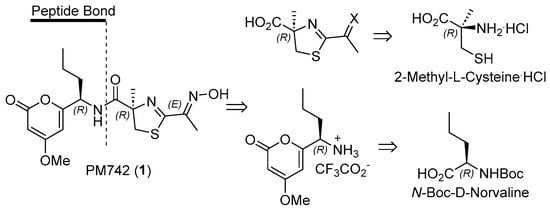
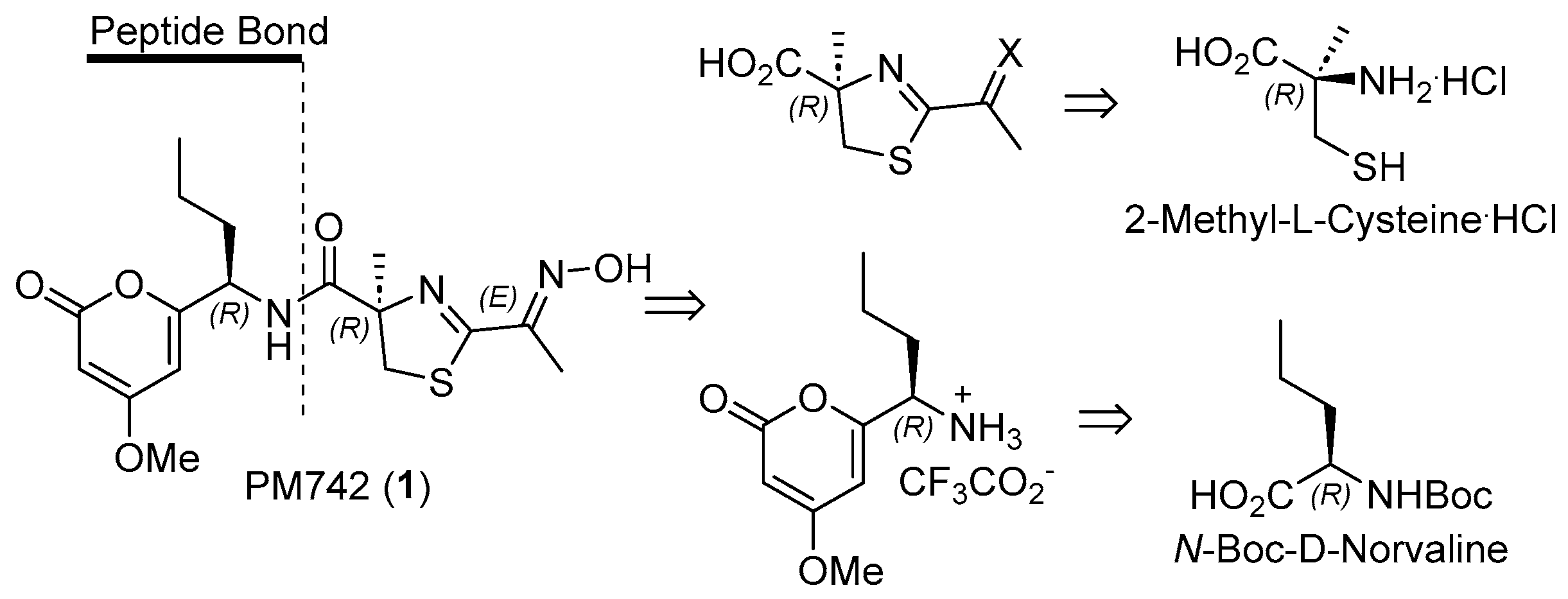
To overcome the supply limitations associated with the natural source and to enable further pharmaceutical development and in vivo preclinical studies, we have accomplished the first total synthesis of PM742 (1). Our strategy relied on a retrosynthetic analysis featuring a key disconnection that divides PM742 into two building blocks joined through a peptide bond, thus enabling an efficient convergent synthesis (Figure 2). One fragment, the methyl-thiazole derivative, was prepared from L-cysteine, while the second fragment, the pyrone moiety, was obtained using D-Norvaline as the starting material.
Figure 2.
Retrosynthetic analysis of PM742 (1).
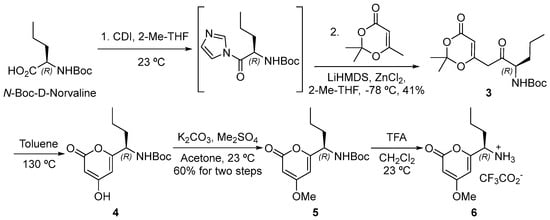
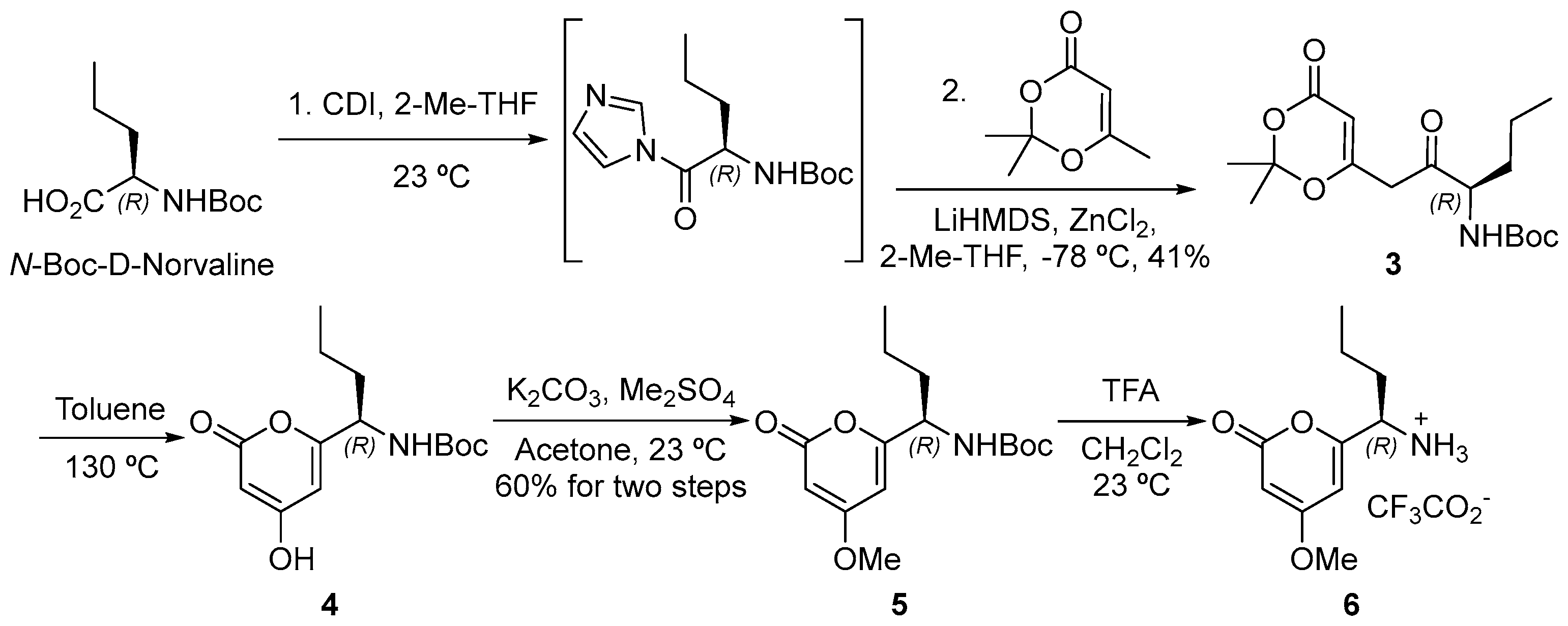
Regarding the pyrone moiety, the main challenge was constructing the pyrone ring without causing epimerization of the starting amino acid D-Norvaline. Among the various synthetic approaches evaluated for the preparation of 2-pyrones, dimethyl-1,3-dioxinone (Scheme 1) provided the best results [6]. Thermal ring opening of 1,3-dioxinone 3 facilitated the subsequent cyclization to 4, and the subsequent hydroxy group alkylation step to 5 was followed by N-Boc deprotection under acidic conditions to furnish the key pyrone fragment 6.
Scheme 1.
Synthesis of intermediate 6.
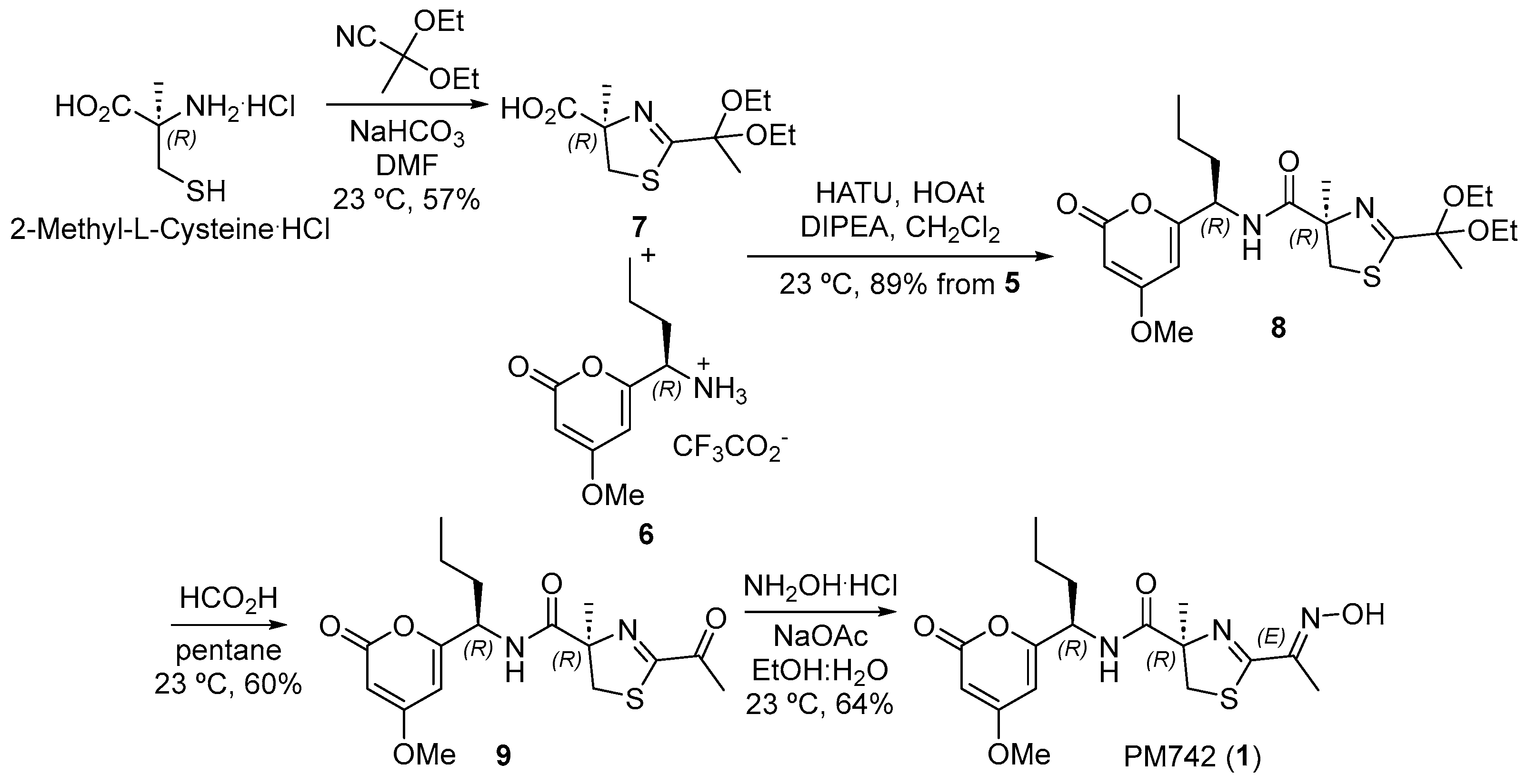
Among the various synthetic routes described in the literature for preparing thiazolines, we selected the approach based on the reaction between 2-methyl-L-cysteine hydrochloride and a nitrile reagent. Specifically, using 2,2-diethoxypropionitrile as the ketone precursor, its reaction with 2-methyl-L-cysteine hydrochloride afforded the desired key methyl-thiazoline intermediate 7. This amino acid is commercially available, and L-cysteine is an ideal precursor for the synthesis of α-methyl-L-cysteine through α-carbon methylation. To control the stereochemistry at this center, L-cysteine methylation is carried out only after the introduction of a temporary second chiral center following a known four-step sequence [7]. A large-scale preparation of 2-methyl-L-cysteine hydrochloride has also been reported as part of the multigram synthesis of Largazole [8].
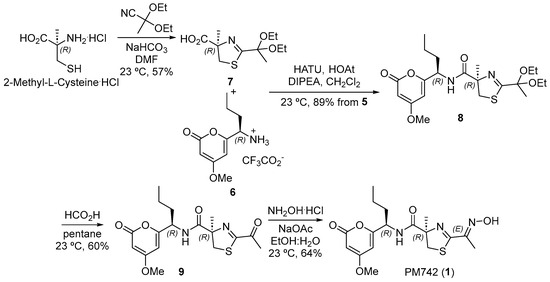
The final three steps begin with the coupling of building blocks 6 and 7 (Scheme 2). Treatment of the resulting compound 8 with formic acid cleanly generated the desired ketone 9, which subsequently reacted with hydroxylamine to yield predominantly the E-isomeric oxime; the Z isomer was formed as a minor byproduct during oxime formation, with an approximate E:Z ratio of 90:10. Overall, this efficient convergent route enables the straightforward preparation of PM742 (1), providing reliable access to the material required for the subsequent stages of drug development.
Scheme 2.
Final steps of PM742 (1).
PM742 (1) attracted our interest as a novel chemical entity due to its potent in vitro antitumor activity and preliminary evidence suggesting a unique tubulin depolymerization mechanism. These attributes prompted the initiation of a drug development program. Leveraging our highly convergent synthetic route, we embarked on an extensive structure-activity relationship (SAR) study to identify the positions amenable to modification for enhanced activity and improved solubility. Consequently, a new series of analogs was designed, synthesized, and evaluated against human cancer cell lines for lead optimization [2].
2.2. Total Synthesis of PM534 (2)
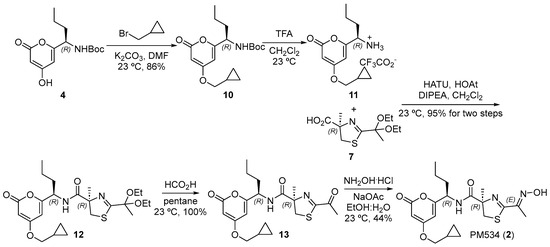
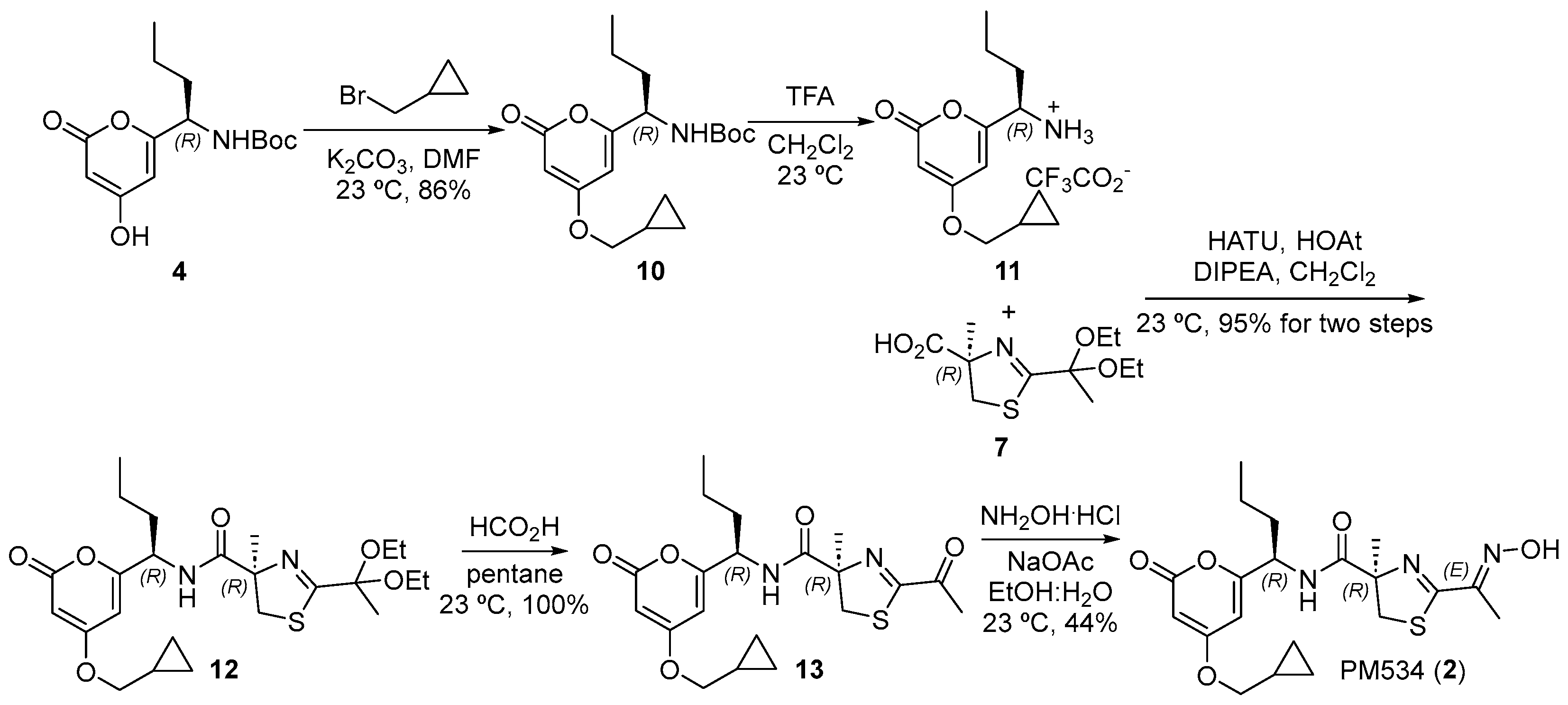
More than 100 analogs were synthesized for in vitro evaluation, providing extensive SAR data that guided the identification of more potent and selective compounds. Our convergent synthetic strategy enabled independent modification of the two building blocks, allowing multiple combinations to be explored. This approach revealed that certain molecular features, such as the norvaline residue and the methyl-thiazole moiety, are essential for activity, whereas others, including the oxime and hydroxy groups, can be modified to generate analogs with comparable or improved potency relative to the natural product. Based on both in vitro and in vivo antitumor activity, PM534 (2), bearing a cyclo-propyl group in place of the methyl group on the phenol, emerged as the lead candidate. The total synthesis of PM534 (2), starting from intermediates 7 and 10, is outlined in Scheme 3.
Scheme 3.
Synthesis of PM534 (2).
The total synthesis of PM534 was accomplished through a multistep sequence starting from intermediates 7 and 10. Key transformations included the preparation of the cyclo-propyl-substituted pyrone derivative 10 by alkylation with (bromomethyl)cyclopropane (86% yield), N-Boc deprotection of 10 with trifluoroacetic acid to give ammonium tri-fluoroacetate 11, and peptide-bond formation with the methyl-thiazole fragment 7 to afford intermediate 12 (95% overall yield for the two steps). Subsequent treatment with formic acid provided quantitative conversion to ketone 13, which was finally transformed into the E-oxime PM534 using hydroxylamine hydrochloride and sodium acetate; the Z isomer was formed as a minor byproduct during oxime formation, with an approximate E:Z ratio of 83:17. This convergent strategy supports scalable production for preclinical and clinical studies. The combination of synthetic accessibility, potent cytotoxicity, and favorable SAR underscores PM534 (2) as a promising candidate for anticancer drug development.
2.3. Biological Evaluation
The in vitro cytotoxic activity of PM742 (1), (Z)-PM742, PM534 (2), and (Z)-PM534 was evaluated against a panel of four human cancer cell lines, including A549 (lung), HT29 (colon), MDA-MB-231 (breast), and PSN (pancreas) (Table 1). PM742 (1) exhibited GI50 values of 11.5 nM (A549), 14.4 nM (HT29), 34.1 nM (MDA-MB-231), and 28.8 nM (PSN). Its Z isomer, (Z)-PM742, showed reduced potency with GI50 values of 144 nM, 152 nM, 204 nM, and 341 nM, respectively. In contrast, PM534 (2) displayed markedly enhanced potency, with GI50 values of 3.56 nM (A549), 3.80 nM (HT29), 3.80 nM (MDA-MB-231), and 3.08 nM (PSN). Notably, the Z isomer of (Z)-PM534 retained comparable activity, with GI50 values of 3.80 nM, 4.27 nM, 4.51 nM, and 4.51 nM across the same cell lines. These results indicate that PM534 (2) is highly potent and less sensitive to stereochemical variation at the oxime moiety, in contrast to PM742 (1).
Table 1.
In vitro cytotoxic activity (GI50, nM).
3. Materials and Methods
3.1. General Experimental Procedures
Dry solvents were purchased and used without any extra processing. All reagents were used as purchased without further purification unless otherwise stated. All reactions were performed under an atmosphere of nitrogen in flame-dried or oven-dried glassware. Routine monitoring of reactions was performed using silica gel TLC plates (Merck 60 F254, Merck KGaA, Darmstadt, Germany). Spots were visualized by UV and/or dipping the TLC plate into an ethanolic phosphomolybdic acid solution and heating with a hot plate. Flash chromatography was carried out on silica gel 60 (200–400 mesh). 1H and 13C NMR were recorded on a Varian Unity 300, 400 or 500 spectrometers (Varian, Inc., Palo Alto, CA, USA) at 300 MHz, 400 MHz or 500 MHz, and 75 MHz, 100 MHz or 125 MHz, respectively. Chemical shifts (δ) are reported in parts per millions (ppm) referenced to CHCl3 at 7.26 ppm for 1H and CDCl3 at 77.0 ppm for 13C and to CH3OH at 3.30 ppm for 1H and CD3OD at 49.0 ppm. Coupling constants are reported in Hertz (Hz), with the following abbreviations used: s = singlet, d = doublet, t = triplet, q = quartet, m = multiplet. When appropriate, the multiplicities are preceded with br, indicating that the signal was broad. Optical rotations were determined using a Jasco P-1020 polarimeter (JASCO Corporation, Tokyo, Japan) with a sodium lamp and are reported as follows: [α]25D (c g/100mL, solvent). (+)-ESIMS were recorded using an Agilent 1100 Series (Agilent Technologies, Palo Alto, CA, USA) LC/MSD spectrometer. The enantiomeric excess (ee) was determined by chiral HPLC analysis using an Agilent 1200 Series HPLC System equipped with a chiral stationary phase column. (+)-HRMS (ESI-TOF) was recorded using an Agilent 6230 TOF LC/MS system (Agilent Technologies, Santa Clara, CA, USA).
3.2. Total Synthesis of PM742 (1)
3.2.1. Synthesis of Intermediate 6
Compound 3: To a solution of N-Boc-D-Norvaline (20 g, 92.0 mmol, 100% ee) in 2-Me-THF (368 mL, 4 mL/mmol) under a nitrogen atmosphere at 23 °C was added 1,1′-carbonyldiimidazole (CDI) (15.7 g, 96.6 mmol, 1.05 equiv.). The reaction mixture was stirred for 2 h at 23 °C. A solution of 2,2,6-trimethyl-4H-1,3-dioxin-4-one (30.55 mL, 230 mmol, 2.5 equiv.) in 2-Me-THF (368 mL, 4 mL/mmol) was slowly added to a precooled dilution at −78 °C of LiHMDS (368 mL, 1.0 M in THF, 368 mmol, 4.0 equiv.) in 2-Me-THF (368 mL, 4 mL/mmol). The reaction mixture was stirred at −78 °C for 1 h. ZnCl2 (31.3 g, 230 mmol, 2.5 equiv.) was added in one portion, and the reaction mixture was stirred at −78 °C for 30 min. Finally, the solution of the intermediate previously prepared was added by cannula at −78 °C. The reaction mixture was stirred at −78 °C for 4 h. An aqueous saturated solution of NH4Cl was added, and the aqueous layers were extracted with EtOAc. The combined organic layers were dried over anhydrous Na2SO4, filtered and concentrated under vacuum. The crude obtained was purified by column chromatography (CH2Cl2:EtOAc, 9:1) to give pure 3 (12.9 g, 41% yield, 98.5% ee). 1H NMR (300 MHz, CDCl3) δ: 5.35 (s, 1H), 5.02 (d, J = 7.9 Hz, 1H), 4.27 (td, J = 7.9, 4.7 Hz, 1H), 3.43 (s, 2H), 1.77 (m, 2H), 1.68 (s, 6H), 1.58–1.28 (m, 2H), 1.43 (s, 9H), 0.94 (t, J = 7.2 Hz, 3H). 13C NMR (75 MHz, CDCl3) δ: 203.2, 164.5, 160.8, 155.7, 107.4, 97.1, 80.4, 59.8, 43.9, 33.0, 28.5, 25.2, 18.8, 13.9. (+)ESIMS: m/z 364.3 [M + Na]+. (+)-HRMS (ESI-TOF) m/z: [M + Na]+ Calcd for C17H27NNaO6 364.1731; Found 364.1734. Rf: 0.13 (Hex:EtOAc 4:1).
Compound 4: Compound 3 (10.74 g, 31.5 mmol) was dissolved in toluene (315 mL, 10 mL/mmol) and heated in a bath at 130 °C for 30 min. Evaporation of the solvent under vacuum afforded 4 crude (8.91 g, 99.5% ee) which was used in the next step without further purification. 1H NMR (400 MHz, CDCl3) δ: 10.50 (s, 1H), 6.09 (d, J = 1.8 Hz, 1H), 5.56 (s, 1H), 5.23 (d, J = 8.5Hz, 1H), 4.36 (q, J = 7.8 Hz, 1H), 1.78 (s, 1H), 1.67 (s, 1H), 1.43 (s, 9H), 0.92 (t, J = 7.3 Hz, 3H). 13C NMR (75 MHz, CDCl3) δ: 171.6, 166.9, 165.2, 155.8, 129.2, 128.4, 125.5, 100.9, 90.9, 80.9, 53.0, 35.3, 28.5, 19.3, 13.8. (+)ESIMS: m/z 306.1 [M + Na]+. (+)-HRMS (ESI-TOF) m/z: [M + Na]+ Calcd for C14H21NNaO5 306.1312; Found 306.1314. Rf: 0.35 (CH2Cl2:MeOH 9:1). [α]25D 101.6 (c 0.018, MeOH).
Compound 5: To a solution of 4 (8.92 g, 31.46 mmol) in acetone (314.6 mL, 10 mL/mmol) under a nitrogen atmosphere at 23 °C was added potassium carbonate (21.74 g, 157.3 mmol, 5.0 equiv.) and dimethyl sulfate (14.9 mL, 157.3 mmol, 5.0 equiv.). The reaction mixture was stirred for 2 h at 23 °C, filtered over Celite®, washed with CH2Cl2, and the solvent was removed under vacuum. The crude obtained was purified by column chromatography (Hexane:EtOAc, from 9:1 to 7:3) to give 5 pure (5.39 g, 60% yield for two steps). 1H NMR (400 MHz, CDCl3) δ: 5.93 (s, 1H), 5.45–5.40 (m, 1H), 4.86 (s, 1H), 4.38 (d, J = 8.2 Hz, 1H), 3.80 (s, 3H), 1.82–1.72 (m, 1H), 1.43 (t, J = 0.6 Hz, 9H), 1.38–1.30 (m, 2H), 0.93 (t, J = 7.3 Hz, 3H). 13C NMR (75 MHz, CDCl3) δ: 171.3, 164.6, 163.7, 155.1, 103.3, 100.0, 88.5, 56.2, 53.6, 52.7, 35.4, 29.9, 28.5, 19.3, 13.8. (+)ESIMS: m/z 320.0 [M + Na]+. (+)-HRMS (ESI-TOF) m/z: [M + Na]+ Calcd for C15H23NNaO5 320.1468; Found 320.1471. Rf: 0.3 (Hex:EtOAc 6:4). [α]25D 92.2 (c 0.503, MeOH).
Compound 6: To a solution of 5 (5.39 g, 18.1 mmol) in CH2Cl2 (202 mL, 37.5 mL/g) at 23 °C trifluoroacetic acid was added (59.3 mL, 11 mL/g). The reaction mixture was stirred for 1.5 h at 23 °C. Evaporation of the solvent under vacuum gave 6 crude, which was used in the next step without further purification. 1H NMR (300 MHz, CDCl3) δ: 6.16 (s, 1H), 5.54 (s, 1H), 4.13 (t, J = 7.5 Hz, 1H), 3.84 (s, 3H), 1.92 (q, J = 7.7 Hz, 2H), 1.29 (m, 2H), 0.93 (t, J = 7.3 Hz, 3H), 0.87 (m, 2H). 13C NMR (75 MHz, CDCl3) δ: 171.5, 165.4, 157.5, 141.6, 117.7, 104.0, 103.3, 89.8, 56.7, 53.1, 33.2, 29.9, 18.8, 13.3. (+)-HRMS (ESI-TOF) m/z: [M + H]+ Calcd for C10H16NO3 198.1125; Found 198.1119. [α]25D − 18.3 (c 0.497, MeOH).
3.2.2. Final Steps
Compound 7: 2-Methyl-L-cysteine hydrochloride (13 g, 75.74 mmol) was dissolved in the minimum quantity of H2O, cooled at 0 °C and basified with an aqueous saturated solution of NaHCO3 until pH 8. Evaporation of the solvent under vacuum afforded the corresponding sodium salt, which was dissolved in an aqueous saturated solution of NaHCO3 (151 mL, 2 mL/mmol). The aqueous solution was cooled to 0 °C and was added to DMF (151 mL, 2 mL/mmol) and 2,2-diethoxypropanenitrile (20 mL, 128 mmol, 1.7 equiv.). The reaction mixture was stirred overnight at 23 °C. After cooling at 0 °C, HCl 0.5 M was added until pH 2. The aqueous layer was extracted with a mixture of 50:50 Hex:EtOAc (x3). The combined organic layers were dried over anhydrous Na2SO4, filtered, and concentrated under vacuum to afford crude 7 (11.39 g, 57% yield, 99.2% ee) which was used in the next step without further purification. 1H NMR (300 MHz, CDCl3) δ: 3.72 (d, J = 11.6 Hz, 1H), 3.60–3.47 (m, 4H), 3.16 (d, J = 11.6 Hz, 1H), 1.59 (d, J = 1.9 Hz, 6H), 1.20 (t, J = 7.1, 6H). 13C NMR (75 MHz, CDCl3) δ: 175.6, 163.3, 100.5, 84.5, 57.9, 57.9, 40.7, 24.2, 23.9, 15.4. (+)-HRMS (ESI-TOF) m/z: [M + Na]+ Calcd for C11H19NNaO4S 284.0927; Found 284.0924. [α]25D − 4.4 (c 0.098, MeOH).
Compound 8: To a solution of 6 (6.76 g, 21.7 mmol) and 7 (5.68 g, 21.7 mmol) in CH2Cl2 (152 mL) was sequentially added at 23 °C O-(7-azabenzotriazoI-1-yl)-N,N,N′,N′-tetramethyluronium hexafluorophosphate (HATU) (17.02 g, 44.7 mmol, 2.06 equiv.), 1-hydroxy-7-azabenzotriazole (HOAt) (6.2 g, 45.1 mmol, 2.08 equiv.), and N,N-diisopropylethylamine (16.24 mL, 93 mmol, 4.29 equiv.). The reaction mixture was stirred for 15 h at 23 °C, diluted with CH2Cl2 and washed with an aqueous saturated solution of NaHCO3, HCl 0.5 M, and an aqueous saturated solution of NaCl. The combined organic layers were dried over anhydrous Na2SO4, filtered, and concentrated under vacuum. The obtained crude was purified by column chromatography (Hex:EtOAc, from 8:2 to 6:4) to obtain pure 8 (8.5 g, 89% yield for two steps). 1H NMR (400 MHz, CDCl3) δ: 7.02 (d, J = 9.0 Hz, 1H), 5.96–5.70 (m, 1H), 5.45–5.33 (m, 1H), 4.72 (td, J = 8.5, 6.2 Hz, 1H), 3.77 (s, 3H), 3.67–3.43 (m, 5H), 3.15 (d, J = 11.7 Hz, 1H), 1.87 (ddt, J = 13.1, 9.7, 6.4 Hz, 1H), 1.71 (ddd, J = 9.6, 8.3, 5.5 Hz, 2H), 1.61 (s, 3H), 1.53 (s, 3H), 1.44–1.28 (m, 2H), 1.22 (q, J = 7.2 Hz, 6H), 0.94 (t, J = 7.3 Hz, 3H). 13C NMR (75 MHz, CDCl3) δ: 177.1, 174.7, 171.0, 164.1, 163.2, 100.5, 99.8, 88.6, 85.4, 58.0, 56.1, 51.0, 40.6, 34.9, 25.5, 24.0, 19.3, 15.4, 13.8. (+)ESIMS: m/z 463.3 [M + Na]+. (+)-HRMS (ESI-TOF) m/z: [M + Na]+ Calcd for C21H32N2NaO6S 463.1873; Found 463.1875. Rf: 0.29 (Hex:EtOAc 1:1). [α]25D 51.1 (c 0.518, MeOH).
Compound 9: Over 8 (4.25 g, 9.6 mmol) was added at 23 °C pentane (255 mL, 60 mL/g) and formic acid (170 mL, 40 mL/g). The reaction mixture was stirred vigorously for 2 h at 23 °C. The solvent was removed under vacuum. The obtained crude was purified by column chromatography (CH2Cl2:EtOAc from 9:1 to 8:2) to obtain pure 9 (4.25 g, 60% yield). 1H NMR (400 MHz, CDCl3) δ: 7.01 (d, J = 8.9 Hz, 1H), 5.91 (dd, J = 2.2, 0.4 Hz, 1H), 5.42 (t, J = 2.1 Hz, 1H), 4.74 (q, J = 7.8 Hz, 1H), 3.82–3.75 (m, 3H), 3.63 (dd, J = 12.0, 2.0 Hz, 1H), 3.28 (dd, J = 11.9, 0.9 Hz, 1H), 2.56 (d, J = 0.9 Hz, 3H), 1.95–1.73 (m, 1H), 1.54 (d, J = 2.0 Hz, 3H), 1.46–1.29 (m, 1H), 0.96 (td, J = 7.3, 1.7 Hz, 3H). 13C NMR (75 MHz, CDCl3) δ: 193.1, 173.2, 170.8, 170.4, 164.0, 162.0, 100.3, 88.6, 86.1, 56.0, 51.1, 40.1, 34.8, 26.3, 24.5, 19.0, 13.5. (+)ESIMS: m/z 367.1 [M + H]+, 389.1 [M + Na]+. (+)-HRMS (ESI-TOF) m/z: [M + Na]+ Calcd for C17H22N2NaO5S 389.1142; Found 389.1157. [α]25D 67.3 (c 0.504, MeOH).
Compound PM742 (1): To a solution of 9 (4.25 g, 11.6 mmol) in ethanol (127.6 mL, 11 mL/mmol) and H2O (127.6 mL, 11 mL/mmol) was added at 23 °C hydroxylamine hydrochloride (5.96 g, 84.7 mmol, 7.4 equiv.) and sodium acetate (4.28 g, 52.2 mmol, 4.5 equiv.). The reaction mixture was stirred for 24 h at 23 °C. The solvent was removed under vacuum, and the residue obtained was dissolved in H2O and extracted with EtOAc. The combined organic layers were dried over anhydrous Na2SO4, filtered, and concentrated under vacuum. The obtained crude was purified by semipreparative HPLC (X-Bridge Prep C18, 5 μm, 19 × 150 mm, isocratic H2O:CH3CN (62:38), flow: 15 mL/min, UV detection) to yield (Z)-PM742 (320 mg, 7% yield, retention time: 6.0 min) and PM742 (1) (2.72 g, 64% yield, retention time: 9.3 min). The synthetic PM742 displayed physical, spectroscopic (1H, 13C NMR, and MS), and biological properties equivalent to those reported for natural PM742.
PM742: 1H NMR (500 MHz, CD3OD) δ: 6.08 (dd, J = 2.2, 0.7 Hz, 1H), 5.55 (d, J = 2.2 Hz, 1H), 4.72 (dd, J = 9.4, 5.4 Hz, 1H), 3.84 (s, 3H), 3.59 (d, J = 11.7 Hz, 1H), 3.22 (d, J = 11.6 Hz, 1H), 2.17 (s, 3H), 1.87 (dddd, J = 13.7, 9.6, 6.6, 5.4 Hz, 1H), 1.82–1.69 (m, 1H), 1.55 (s, 3H), 1.53–1.32 (m, 2H), 0.98 (t, J = 7.4 Hz, 3H). 13C NMR (125 MHz, CD3OD) δ: 176.5, 173.3, 170.2, 166.5, 165.1, 152.8, 100.7, 88.8, 85.5, 56.9, 52.1, 52.0, 40.5, 35.1, 35.1, 24.8, 20.1, 13.7, 10.8. (+)ESIMS: m/z 382.3 [M + H]+, 404.1 [M + Na]+. Rf: 0.36 (Hex:EtOAc 1:1).
(Z)-PM742: 1H NMR (500 MHz, CD3OD) δ: 6.08 (dd, J = 2.2, 0.7 Hz, 1H), 5.55 (d, J = 2.2 Hz, 1H), 4.72 (dd, J = 9.4, 5.4 Hz, 1H), 3.84 (s, 3H), 3.59 (d, J = 11.7 Hz, 1H), 3.22 (d, J = 11.6 Hz, 1H), 2.17 (s, 3H), 1.87 (dddd, J = 13.7, 9.6, 6.6, 5.4 Hz, 1H), 1.82–1.69 (m, 1H), 1.55 (s, 3H), 1.53–1.32 (m, 2H), 0.98 (t, J = 7.4 Hz, 3H). 13C NMR (75 MHz, CDCl3) δ: 173.5, 171.0, 164.6, 164.5, 162.4, 147.2, 100.1, 88.5, 83.6, 56.0, 51.0, 40.9, 35.0, 24.8, 19.2, 19.0, 13.5.
3.3. Synthesis of PM534 (2)
Compound 10: To a solution of 4 (9.9 g, 34.94 mmol) in DMF (800 mL) was added potassium carbonate (9.66 g, 69.89 mmol, 2 equiv.) at 23 °C. The reaction mixture was stirred for 30 min at 23 °C and cyclopropylmethyl bromide (3.7 mL, 38.44 mmol, 1 equiv.) was added at 23 °C. The reaction mixture was stirred overnight at 60 °C. The reaction mixture was concentrated under vacuum, diluted with EtOAc, filtered over Celite® and washed with EtOAc. The crude obtained was purified in an automatic system for flash chromatography (SiO2, Hex:EtOAc 70:30) to yield 10 pure (10.13 g, 86% yield, 99.7% ee). 1H NMR (400 MHz, CDCl3) δ: 5.95 (d, J = 2.2 Hz, 1H), 5.34 (d, J = 2.2 Hz, 1H), 4.91 (d, J = 8.9 Hz, 1H), 4.37 (q, J = 7.6 Hz, 1H), 3.75 (dd, J = 7.1, 1.3 Hz, 2H), 1.77 (ddt, J = 13.3, 9.5, 6.5 Hz, 1H), 1.69–1.53 (m, 1H), 1.41 (s, 9H), 1.46–1.13 (m, 2H), 0.91 (t, J = 7.3 Hz, 3H), 0.72–0.59 (m, 2H), 0.39–0.26 (m, 2H). 13C NMR (100 MHz, CDCl3) δ: 170.2, 164.5, 163.5, 154.9, 99.9, 88.5, 80.0, 73.7, 52.5, 35.1, 28.3, 19.0, 13.5, 9.4, 3.3 (x2). (+)ESIMS: m/z 360.2 [M + Na]+. HRMS (ESI-TOF) m/z: [M + Na]+ Calcd for C18H27NNaO5 360.1781; Found 360.1789. Rf: 0.32 (Hex:EtOAc 7:3). [α]25D 82.1 (c 0.046, MeOH).
Compound 11: A solution of 10 (8.9 g, 26.44 mmol) in CH2Cl2 (334 mL) and trifluoroacetic acid (98 mL) was stirred at 23 °C for 2 h and then evaporated to dryness. The crude was evaporated three times with toluene to remove trifluoroacetic acid. The crude containing 11 (13.9 g, >100% yield) was used in the next step without further purification. 1H NMR (300 MHz, CDCl3) δ: 8.51 (s, 2H), 6.18 (d, J = 1.8 Hz, 1H), 5.48 (s, 1H), 4.13 (t, J = 7.3 Hz, 1H), 3.80 (d, J = 7.2 Hz,2H), 1.91 (q, J = 7.6 Hz, 2H), 1.38–1.18 (m, 2H), 0.92 (t, J = 7.3 Hz, 3H), 0.72–0.62 (m, 2H), 0.39–0.30 (m, 2H). 13C NMR (75 MHz, CDCl3) δ: 170.6, 157.2, 104.2, 89.8, 74.7, 52.9, 32.8, 18.5, 13.1, 9.2, 3.4, 3.3. HRMS (ESI-TOF) m/z: [M + Na]+ Calcd for C13H19NNaO3 260.1257; Found 260.1261. [α]25D − 89.0 (c 0.037, MeOH).
Compound 12: To a solution of 11 (9.28 g, 26.41 mmol) and 7 (6.90 g, 26.41 mmol) in CH2Cl2 (180 mL) was sequentially added O-(7-azabenzotriazol-1-yl)-N,N,N′,N′-tetramethyluronium hexafluorophosphate (HATU) (10.04 g, 26.41 mmol, 1 equiv.), 1-hydroxy-7-azabenzotriazole (HOAt) (3.62 g, 26.41 mmol, 1 equiv.), and N,N-diisopropylethylamine (18.4 mL, 105.66 mmol, 4 equiv.) at 23 °C. The reaction mixture was stirred overnight at 23 °C, diluted with CH2Cl2 and washed HCl 0.5 M. The aqueous layer was extracted with CH2Cl2 (x2). The combined organic layers were dried over anhydrous Na2SO4, filtered and concentrated under vacuum. The obtained crude was purified in an automatic system for flash chromatography (SiO2, Hex:EtOAc 50:50) to obtain pure 12 (12.1 g, 95% yield for two steps, 100% ee). 1H NMR (400 MHz, CDCl3) δ: 7.03 (d, J = 8.9 Hz, 1H), 5.85 (dd, J = 2.2, 0.5 Hz, 1H), 5.31 (d, J = 2.2 Hz, 1H), 4.71 (td, J = 8.5, 6.2 Hz, 1H), 3.80–3.67 (m, 2H), 3.61 (d, J = 11.8 Hz, 1H), 3.61–3.42 (m, 4H), 3.14 (d, J = 11.7 Hz, 1H), 1.86 (ddt, J = 13.7, 9.5, 6.3 Hz, 1H), 1.75–1.62 (m, 1H), 1.60 (s, 3H), 1.52 (s, 3H), 1.45–1.15 (m, 2H), 1.22 (t, J = 7.1 Hz, 3H), 1.20 (t, J = 7.1 Hz, 3H), 0.92 (t, J = 7.3 Hz, 3H), 0.74–0.58 (m, 2H), 0.38–0.27 (m, 2H). 13C NMR (100 MHz, CDCl3) δ: 176.8, 174.4, 170.0, 163.9, 162.9, 100.2, 99.8, 88.6, 85.2, 73.7, 57.7, 57.6, 50.8, 40.3, 34.7, 25.3, 23.7, 19.0, 15.2, 13.5, 9.4, 3.3 (x2). (+)ESIMS: m/z 503.3 [M + Na]+. (+)-HRMS (ESI-TOF) m/z: [M + Na]+ Calcd for C24H36N2NaO6S 503.2186; Found 503.2203. Rf: 0.49 (Hex:EtOAc 1:1). [α]25D 47.3 (c 0.424, MeOH).
Compound 13: Over 12 (9.0 g, 18.73 mmol) was added at 23 °C pentane (460 mL) and formic acid (315 mL). The reaction mixture was stirred vigorously for 2 h at 23 °C and the volatiles were evaporated under vacuum. The obtained crude was evaporated a few times with a mixture of CH2Cl2:toluene to eliminate formic acid to give crude 13 (7.61 g, 100% yield), which was used in the next step without further purification. 1H NMR (400 MHz, CDCl3) δ: 7.05 (d, J = 8.9 Hz, 1H), 5.94 (d, J = 2.2 Hz, 1H), 5.37 (d, J = 2.3 Hz, 1H), 4.73 (q, J = 7.9 Hz, 1H), 3.76 (dd, J = 7.1,1.9 Hz, 2H), 3.61 (d, J = 11.9 Hz, 1H), 3.27 (d, J = 12.0 Hz, 1H), 2.55 (s, 3H), 1.94–1.73 (m, 1H), 1.66–1.53 (m, 1H), 1.53 (s, 3H), 1.52–1.16 (m, 2H), 0.95 (t, J = 7.4 Hz, 3H), 0.70–0.61 (m, 2H), 0.33 (t, J = 5.2 Hz, 2H). 13C NMR (100 MHz, CDCl3) δ: 93.2, 173.2, 170.4, 164.3, 163.0, 161.8, 100.8, 88.9, 86.0, 73.9, 51.0, 40.1, 34.8, 26.3, 24.5, 19.0, 13.5, 9.3, 3.4, 3.3. (+)ESIMS: m/z 407.1 [M + H]+, 429.2 [M + Na]+. HRMS (ESI-TOF) m/z: [M + H]+ Calcd for C20H27N2O5S 407.1635; Found 407.1635. Rf: 0.47 (Hex:EtOAc 1:1). [α]25D 56.2 (c 0.019, MeOH).
Compound PM534 (2): To a solution of crude 13 (33 mg, 0.08 mmol) in EtOH (0.9 mL) and H2O (0.9 mL) was added hydroxylamine hydrochloride (42 mg, 0.6 mmol, 7.5 equiv.) and sodium acetate (30 mg, 0.36 mmol, 4.5 equiv.) at 23 °C. The reaction mixture was stirred for 24 h at 23 °C and concentrated under vacuum. The residue obtained was diluted with an aqueous saturated solution of NaCl and extracted with EtOAc (x3). The combined organic layers were dried over anhydrous Na2SO4, filtered, and concentrated under vacuum. The obtained crude was purified by flash chromatography on silica gel (Hex:EtOAc, from 100:0 to 40:60) to afford PM534 (2) (15 mg, 44% yield, 100% ee) and (Z)-PM534 (3 mg, 9% yield).
PM534: 1H NMR (400 MHz, CD3OD) δ: 7.85 (d, J = 8.6 Hz, 1H), 6.05 (s, 1H), 5.48 (s, 1H), 4.74 (q, J = 6.8, 5.0 Hz, 1H), 3.86 (d, J = 7.2 Hz, 2H), 3.56 (d, J = 11.5 Hz, 1H), 3.17 (d, J = 11.5 Hz, 1H), 2.19 (s, 3H), 1.96–1.72 (m, 2H), 1.52 (s, 3H), 1.43 (ddd, J = 29.8, 14.7, 7.4 Hz, 4H), 1.31–1.16 (m, 1H), 0.99 (t, J = 7.4 Hz, 3H), 0.63 (d, J = 7.6 Hz, 2H), 0.35 (d, J = 5.0 Hz, 2H). 13C NMR (100 MHz, CD3OD) δ: 175.1, 171.2, 168.8, 165.3, 163.8, 151.5, 126.4, 99.7, 87.9, 84.2, 74.0, 50.7, 39.1, 33.9, 23.6, 18.8, 12.5, 9.6, 9.0, 2.3. (+)ESIMS: m/z 422.1 [M + H]+, 444.2 [M + Na]+. HRMS (ESI-TOF) m/z: [M + Na]+ Calcd for C20H27N3NaO5S 444.1564; Found 444.1563. Rf: 0.42 (Hex:EtOAc 1:1). [α]25D 55.0 (c 0.022, MeOH).
(Z)-PM534: 1H NMR (400 MHz, CD3OD) δ: 7.84 (d, J = 8.5 Hz, 0H), 6.09 (dd, J = 0.7, 2.2 Hz, 1H), 5.49 (d, J = 2.2 Hz, 1H), 4.72 (dd, J = 5.5, 9.4 Hz, 1H), 3.87 (d, J = 7.2 Hz, 2H), 3.59 (d, J = 11.7 Hz, 1H), 3.30–3.14 (m, 1H), 2.17 (d, J = 8.9 Hz, 7H), 2.02–1.68 (m, 3H), 1.59–1.32 (m, 5H), 1.30–1.13 (m, 1H), 1.03–0.90 (m, 3H), 0.69–0.58 (m, 2H), 0.40–0.31 (m, 2H). 13C NMR (100 MHz, CDCl3) δ: 173.8, 170.1, 168.4, 164.3, 162.3, 153.3, 100.5, 88.9, 84.2, 73.8, 51.1, 39.9, 34.8, 24.7, 19.1, 13.6, 11.3, 9.4, 3.4 (x2). (+)ESIMS: m/z 422.1 [M + H]+. (+)-HRMS (ESI-TOF) m/z: [M + H]+ Calcd for C20H28N3O5S 422.1744; Found 422.1758. [α]25D 73.7 (c 0.428, MeOH).
3.4. Bioassay for the Detection of Antitumor Activity
The aim of this assay is to evaluate the in vitro cytostatic (ability to delay or arrest tumor cell growth) or cytotoxic (ability to kill tumor cells) activity of the samples being tested. A colorimetric assay, using the sulforhodamine B (SRB) reaction has been adapted to provide a quantitative measurement of cell growth and viability [9,10]. This form of assay employs 96-well cell culture microplates. All the cell lines used in this study were obtained from the American Type Culture Collection (ATCC), unless otherwise indicated, and derived from different types of human cancer: A-549 (ATCC CCL-185), lung carcinoma; HT-29 (ATCC HTB-38), colorectal carcinoma, MDA-MB-231 (ATCC HTB-26), breast adenocarcinoma and PSN-1, pancreatic adenocarcinoma [11]. Cell lines were maintained in Dulbecco’s Modified Eagle Medium (DMEM) (for A-549, HT-29, and MDA-MB-231) or RPMI (for PSN-1) supplemented with 10% Fetal Bovine Serum (FBS), 2 mM L-glutamine, 100 U/mL penicillin, and 100 U/mL streptomycin, at 37 °C, 5% CO2 and 98% humidity. For the experiments, cells were harvested from subconfluent cultures using trypsinization and resuspended in a fresh medium before counting and plating.
Cells were seeded in 96-well microtiter plates at 5 × 10³ cells per well in aliquots of 150 μL and allowed to attach to the plate surface for 18 h (overnight) in a drug-free medium. After that, one control (untreated) plate of each cell line was fixed (as described below) and used for the time zero reference value. Culture plates were then treated with test compounds (50 μL aliquots of 4X concentrated compound stock solutions made in complete culture medium) using ten serial dilutions (concentrations ranging from 10 μg/mL to 0.000262 μg/mL) and triplicate cultures (final concentration of DMSO being 1%). After 72 h treatment, the antitumor effect was measured by using the SRB methodology: briefly, cells were washed twice with PBS, fixed for 15 min in 1% glutaraldehyde solution at room temperature, rinsed twice in PBS, and stained in 0.4% SRB solution for 30 min at room temperature. Cells were then rinsed several times with 1% acetic acid solution and air-dried at room temperature. SRB was then extracted in a 10 mM trizma base solution, and the absorbance was measured in an automated spectrophotometric plate reader at 490 nm. Effects on cell growth and survival were estimated by applying the NCI algorithm [12]. In this assay Doxorubicin and DMSO (solvent) were used as the positive and negative controls, respectively. Prism 3.03 from GraphPad was used for the statistical analysis of the cell growth inhibition results. Using the mean ± SD of triplicates, a dose–response curve was automatically generated using nonlinear regression analysis to a 4-parameter logistic curve. Three reference parameters were calculated (NCI algorithm) by automatic interpolation: GI50 = compound concentration that produces 50% cell growth inhibition, as compared to control cultures.
4. Conclusions
This work describes the first total synthesis of the marine natural product PM742 (1) through an efficient and convergent strategy that also enabled the preparation of a range of structurally related derivatives. The synthetic approach provides practical access to PM742 and facilitates further analog development. PM742 exhibited in vitro cytotoxic activity against human tumor cell lines, which motivated preliminary structure–activity relationship (SAR) studies. These efforts led to the identification of PM534 (2), a related analog with improved activity in the same assays. Preliminary studies suggest that PM534 may act through multiple mechanisms, including effects on tumor cell division and vasculature, supporting its further evaluation as a potential anticancer agent.
Supplementary Materials
The following supporting information can be downloaded at: https://www.mdpi.com/article/10.3390/md24050167/s1, Figure S1: 1H NMR spectra of PM742 (1) synthetic vs. natural; Figures S2–S15: NMR spectra of the synthesis intermediates of PM742 (1); Figures S16–S19: NMR spectra of PM742 (1) and (Z)-PM742; Figure S20: ROESY spectrum of (Z)-PM742; Figures S21–S28: NMR spectra of the synthesis intermediates of PM534 (2); Figures S29–S32: NMR spectra of PM534 (2) and (Z)-P534.
Author Contributions
Conceptualization, A.F., C.C. and M.J.M.; Synthesis, M.J.M., J.H., R.R.-A. and A.G.-S.; Writing—original draft preparation and supervision, A.F.; Writing—review, M.J.M., S.M. and C.C. All authors have read and agreed to the published version of the manuscript.
Funding
This research received no external funding.
Institutional Review Board Statement
Not applicable.
Data Availability Statement
The data are contained within the article or Supplementary Materials.
Acknowledgments
We would like to thank the staff of the Department of Cell Biology for their assistance with cytotoxicity testing.
Conflicts of Interest
All authors are employees of PharmaMar, S.A., and the study was carried out as part of their professional activities within the company. The authors declare that they have no additional conflicts of interest.
References
- Cruz, P.G.; Fernández, R.; Rodríguez-Acebes, R.; Martínez-Díez, M.; Santamaría-Núñez, G.; Pérez, M.; Cuevas, C. From Sea Sponge to Clinical Trials: Starting the Journey of the Novel Compound PM742. Mar. Drugs 2024, 22, 339. [Google Scholar] [CrossRef] [Scilit]
- Martín, M.J.; Rodríguez-Acebes, R.; Cruz, P.G.; Francesch, A.M.; Cuevas, C. Anticancer Compounds. WIPO Patent WO 2020127194, 26 June 2020. [Google Scholar]
- Lucena-Agell, D.; Guillén, M.J.; Matesanz, R.; Álvarez-Bernad, B.; Hortigüela, R.; Avilés, P.; Martínez-Díez, M.; Santamaría-Núñez, G.; Contre-ras, J.; Plaza-Menacho, I.; et al. PM534, an Optimized Target-Protein Interaction Strategy through the Colchicine Site of Tubulin. J. Med. Chem. 2024, 67, 2619–2630. [Google Scholar] [CrossRef] [Scilit] [PubMed]
- Avilés, P.; Ribeiro, M.L.; Guillén, M.J.; Martínez-Díez, M.; Muñoz-Alonso, M.J.; Santamaría-Núñez, G.; Torralba, D.; Álamo, P.; Gallardo, A.; Oliva, M.A.; et al. PM534, a Novel Colchicine-Site Tubulin Inhibitor with Broad-Spectrum and Resistance-Overcoming Antitumor Activity. Mol. Cancer Ther. 2025, OF1–OF13. [Google Scholar] [CrossRef] [Scilit] [PubMed]
- Available online: https://clinicaltrials.gov/study/NCT05835609?term=PM534&viewType=Card&rank=1 (accessed on 30 April 2026).
- Patel, B.H.; Mason, A.M.; Patel, H.; Coombes, R.C.; Ali, S.; Barrett, A.G.M. Conversion of α-Amino Acids into Bioactive o-Aminoalkyl Resorcylates and Related Dihydroxyisoindolinones. J. Org. Chem. 2011, 76, 6209–6217. [Google Scholar] [CrossRef] [Scilit] [PubMed]
- Singh, S. Asymmetric synthesis of (R)- and (S)-α-methylcysteine. Recent Res. Dev. Org. Chem. 2004, 8, 323–339. [Google Scholar] [CrossRef] [Scilit]
- Chen, Q.-Y.; Chaturvedi, P.R.; Luesch, H. Process Development and Scale-up Total Synthesis of Largazole, a Potent Class I Histone Deacety-lase Inhibitor. Org. Process Res. Dev. 2018, 22, 190–199. [Google Scholar] [CrossRef] [Scilit] [PubMed]
- Skehan, P.; Storeng, R.; Scudiero, D.; Monks, A.; McMahon, J.; Vistica, D.; Warren, J.T.; Bokesch, H.; Kenney, S.; Boyd, M.R. New colorimetric cytotoxicity assay for anticancer-drug screening. J. Natl. Cancer Inst. 1990, 82, 1107–1112. [Google Scholar] [CrossRef] [Scilit] [PubMed]
- Vichai, V.; Kirtikara, K. Sulforhodamine B colorimetric assay for cytotoxicity screening. Nat. Protoc. 2006, 1, 1112–1116. [Google Scholar] [CrossRef] [Scilit] [PubMed]
- Yamada, H.; Yoshida, T.; Sakamoto, H.; Terada, M.; Sugimura, T. Establishment of a human pancreatic adenocarcinoma cell line (PSN-1) with amplifications of both c-myc and activated c-Ki-ras by a point mutation. Biochem. Biophys. Res. Commun. 1986, 140, 167–173. [Google Scholar] [CrossRef] [Scilit] [PubMed]
- Boyd, M.R.; Paull, K.D. Some practical considerations and applications of the national cancer institute in vitro anticancer drug discovery screen. Drug Dev. Res. 1995, 34, 91–109. [Google Scholar] [CrossRef] [Scilit]

Disclaimer/Publisher’s Note: The statements, opinions and data contained in all publications are solely those of the individual author(s) and contributor(s) and not of MDPI and/or the editor(s). MDPI and/or the editor(s) disclaim responsibility for any injury to people or property resulting from any ideas, methods, instructions or products referred to in the content. |
© 2026 by the authors. Licensee MDPI, Basel, Switzerland. This article is an open access article distributed under the terms and conditions of the Creative Commons Attribution (CC BY) license.