Long-Chain n-3 Polyunsaturated Fatty Acids Attenuate the Severity of Obesity-Associated White Adipose Tissue and Skeletal Muscle Dysfunction
 , , , , ,
Abstract
1. Introduction
2. Obesity-Associated Changes in AT
3. LC n-3 PUFA and Adiposity
4. Effects of n-3 PUFA on AT Inflammation and Metabolic Dysfunction
5. Obese Skeletal Muscle
5.1. Obesity-Associated Changes in Skeletal Muscle and Cross-Talk with AT
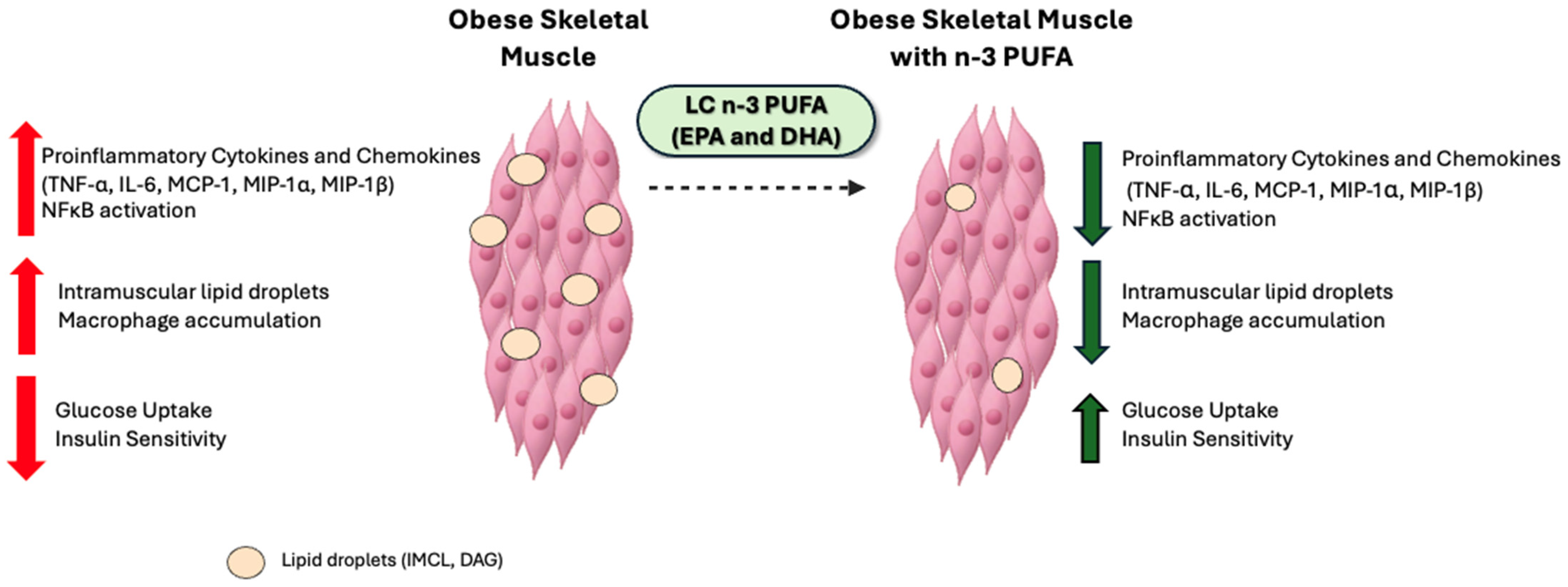
5.2. Effect of LC n-3 PUFA on Obese Skeletal Muscle Function
6. Conclusions
Author Contributions
Funding
Institutional Review Board Statement
Data Availability Statement
Conflicts of Interest
Abbreviations
| Akt | protein kinase B |
| ALA | α-linolenic acid |
| AT | adipose tissue |
| BMI | body mass index |
| CIDEA | cell death-inducing DFFA-like effector A |
| CLS | crown-like structures |
| CRP | C-reactive protein |
| DAG | Diacylglycerol |
| DHA | docosahexaenoic acid |
| EPA | eicosapentaenoic acid |
| FA | fatty acid |
| FAP | fibro-adipogenic progenitors |
| FFA | free fatty acid |
| GLUT4 | glucose transporter type 4 |
| GPR120 | G-protein coupled receptor 120 |
| GSK 3 | glycogen synthase kinase-3 |
| HbA1c | Hemoglobin A1c |
| HDL | high-density lipoprotein |
| HFD | high-fat diet |
| HOMA-IR | homeostatic model assessment of insulin resistance |
| IGF | insulin-like growth factor |
| IL | interleukin |
| IMCL | intramyocellular lipids |
| IR | insulin resistance |
| IRS | insulin receptor substrate |
| IRS-1 | insulin receptor substrate 1 |
| JAK | janus kinases |
| JNK | c-Jun N-terminal kinase |
| LC | long chain |
| LDL | low-density lipoprotein |
| LPS | lipopolysaccharide |
| MCP | monocyte chemoattractant protein |
| MIP | macrophage inflammatory protein |
| mTORC2 | mammalian target of rapamycin complex 2 |
| n-3 | omega 3 |
| NFκB | nuclear factor kappa-light-chain-enhancer of activated B cells |
| NLRP3 | NOD-like receptor family pyrin domain containing 3 |
| p38 MAPK | mitogen-activated protein kinase |
| PGC1α | peroxisome proliferator-activated receptor gamma coactivator 1 alpha |
| PI3K | Phosphoinositide 3-kinase |
| PKC-zeta | protein kinase C zeta |
| PPARγ | peroxisome proliferator-activated receptor gamma |
| PRDM16 | PR domain containing 16 |
| PUFA | polyunsaturated fatty acid |
| ROS | reactive oxygen species |
| SFA | saturated fatty acid |
| SOCS | suppressor of cytokine signaling |
| STAT | signal transducer and activator of transcription |
| T2D | type 2 diabetes mellitus |
| TCA cycle | tricarboxylic acid cycle |
| TGF-β | transforming growth factor-beta |
| Th cells | T helper cells |
| TLR | Toll-like receptor |
| TNF-α | tumor necrosis factor alpha |
| UCP1 | uncoupling protein 1 |
| VLDL | very-low-density lipoprotein |
| WAT | white adipose tissue |
References
- World Health Organization Obesity. Available online: https://www.who.int/health-topics/obesity (accessed on 26 January 2026).
- Mokwenye, V.C.; Ochuba, J.N.; Fasoro, O.S.; Nwokolo, A.S.; Osula, O.; Sowunmi, M.O.; Oramu, C.I.; Youkhana, S.; Oranu, K.P.; Asomugha-Okwara, A.; et al. Trends in Obesity Among Canadian Adults: A Population-Level Database Analysis. Cureus 2025, 17, e90206. [Google Scholar] [CrossRef] [Scilit] [PubMed]
- Zhang, X.; Liu, J.; Ni, Y.; Yi, C.; Fang, Y.; Ning, Q.; Shen, B.; Zhang, K.; Liu, Y.; Yang, L.; et al. Global Prevalence of Overweight and Obesity in Children and Adolescents: A Systematic Review and Meta-Analysis. JAMA Pediatr. 2024, 178, 800–813. [Google Scholar] [CrossRef] [Scilit] [PubMed]
- Carsley, S.; Tu, K.; Parkin, P.C.; Pullenayegum, E.; Birken, C.S. Overweight and Obesity in Preschool Aged Children and Risk of Mental Health Service Utilization. Int. J. Obes. 2019, 43, 1325–1333. [Google Scholar] [CrossRef] [Scilit]
- Rao, D.P.; Kropac, E.; Do, M.T.; Roberts, K.C.; Jayaraman, G.C. Childhood Overweight and Obesity Trends in Canada. Health Promot. Chronic Dis. Prev. Can. Res. Policy Pract. 2016, 36, 194–198. [Google Scholar] [CrossRef] [Scilit]
- Simmonds, M.; Llewellyn, A.; Owen, C.G.; Woolacott, N. Predicting Adult Obesity from Childhood Obesity: A Systematic Review and Meta-Analysis. Obes. Rev. Off. J. Int. Assoc. Study Obes. 2016, 17, 95–107. [Google Scholar] [CrossRef] [Scilit] [PubMed]
- Pati, S.; Irfan, W.; Jameel, A.; Ahmed, S.; Shahid, R.K. Obesity and Cancer: A Current Overview of Epidemiology, Pathogenesis, Outcomes, and Management. Cancers 2023, 15, 485. [Google Scholar] [CrossRef] [Scilit]
- Ruze, R.; Liu, T.; Zou, X.; Song, J.; Chen, Y.; Xu, R.; Yin, X.; Xu, Q. Obesity and Type 2 Diabetes Mellitus: Connections in Epidemiology, Pathogenesis, and Treatments. Front. Endocrinol. 2023, 14, 1161521. [Google Scholar] [CrossRef] [Scilit]
- Lakkis, J.I.; Weir, M.R. Obesity and Kidney Disease. Prog. Cardiovasc. Dis. 2018, 61, 157–167. [Google Scholar] [CrossRef] [Scilit]
- Powell-Wiley, T.M.; Poirier, P.; Burke, L.E.; Després, J.-P.; Gordon-Larsen, P.; Lavie, C.J.; Lear, S.A.; Ndumele, C.E.; Neeland, I.J.; Sanders, P.; et al. Obesity and Cardiovascular Disease: A Scientific Statement from the American Heart Association. Circulation 2021, 143, e984–e1010. [Google Scholar] [CrossRef] [Scilit]
- Wada, I.; Dohkita, S.; Hirano, S.; Saeki, H.; Morita, T. Urinary Retention Due to Idiopathic Megacolon. Urol. Int. 1987, 42, 392–394. [Google Scholar] [CrossRef] [Scilit]
- Zatterale, F.; Longo, M.; Naderi, J.; Raciti, G.A.; Desiderio, A.; Miele, C.; Beguinot, F. Chronic Adipose Tissue Inflammation Linking Obesity to Insulin Resistance and Type 2 Diabetes. Front. Physiol. 2019, 10, 1607. [Google Scholar] [CrossRef] [Scilit]
- Kawai, T.; Autieri, M.V.; Scalia, R. Adipose Tissue Inflammation and Metabolic Dysfunction in Obesity. Am. J. Physiol. Cell Physiol. 2021, 320, C375–C391. [Google Scholar] [CrossRef] [Scilit] [PubMed]
- Zand, H.; Morshedzadeh, N.; Naghashian, F. Signaling Pathways Linking Inflammation to Insulin Resistance. Diabetes Metab. Syndr. 2017, 11, S307–S309. [Google Scholar] [CrossRef] [Scilit]
- Shivappa, N.; Hébert, J.R.; Rietzschel, E.R.; De Buyzere, M.L.; Langlois, M.; Debruyne, E.; Marcos, A.; Huybrechts, I. Associations between Dietary Inflammatory Index and Inflammatory Markers in the Asklepios Study. Br. J. Nutr. 2015, 113, 665–671. [Google Scholar] [CrossRef] [Scilit] [PubMed]
- Shivappa, N.; Steck, S.E.; Hurley, T.G.; Hussey, J.R.; Hébert, J.R. Designing and Developing a Literature-Derived, Population-Based Dietary Inflammatory Index. Public Health Nutr. 2014, 17, 1689–1696. [Google Scholar] [CrossRef] [Scilit]
- Phillips, C.M.; Shivappa, N.; Hébert, J.R.; Perry, I.J. Dietary Inflammatory Index and Biomarkers of Lipoprotein Metabolism, Inflammation and Glucose Homeostasis in Adults. Nutrients 2018, 10, 1033. [Google Scholar] [CrossRef] [Scilit]
- Calder, P.C. Marine Omega-3 Fatty Acids and Inflammatory Processes: Effects, Mechanisms and Clinical Relevance. Biochim. Biophys. Acta 2015, 1851, 469–484. [Google Scholar] [CrossRef] [Scilit]
- Calder, P.C. Very Long-Chain n-3 Fatty Acids and Human Health: Fact, Fiction and the Future. Proc. Nutr. Soc. 2018, 77, 52–72. [Google Scholar] [CrossRef] [Scilit]
- Djuricic, I.; Calder, P.C. Beneficial Outcomes of Omega-6 and Omega-3 Polyunsaturated Fatty Acids on Human Health: An Update for 2021. Nutrients 2021, 13, 2421. [Google Scholar] [CrossRef] [Scilit]
- Rajaram, S. Health Benefits of Plant-Derived α-Linolenic Acid. Am. J. Clin. Nutr. 2014, 100, 443S–448S. [Google Scholar] [CrossRef] [Scilit] [PubMed]
- Santos, H.O.; Price, J.C.; Bueno, A.A. Beyond Fish Oil Supplementation: The Effects of Alternative Plant Sources of Omega-3 Polyunsaturated Fatty Acids upon Lipid Indexes and Cardiometabolic Biomarkers—An Overview. Nutrients 2020, 12, 3159. [Google Scholar] [CrossRef] [Scilit]
- Van Dael, P. Role of n-3 Long-Chain Polyunsaturated Fatty Acids in Human Nutrition and Health: Review of Recent Studies and Recommendations. Nutr. Res. Pract. 2021, 15, 137–159. [Google Scholar] [CrossRef] [Scilit]
- Kris-Etherton, P.M.; Harris, W.S.; Appel, L.J.; American Heart Association. Nutrition Committee Fish Consumption, Fish Oil, Omega-3 Fatty Acids, and Cardiovascular Disease. Circulation 2002, 106, 2747–2757. [Google Scholar] [CrossRef] [Scilit]
- Vannice, G.; Rasmussen, H. Position of the Academy of Nutrition and Dietetics: Dietary Fatty Acids for Healthy Adults. J. Acad. Nutr. Diet. 2014, 114, 136–153. [Google Scholar] [CrossRef] [Scilit]
- Zorena, K.; Jachimowicz-Duda, O.; Ślęzak, D.; Robakowska, M.; Mrugacz, M. Adipokines and Obesity. Potential Link to Metabolic Disorders and Chronic Complications. Int. J. Mol. Sci. 2020, 21, 3570. [Google Scholar] [CrossRef] [Scilit] [PubMed]
- Ziqubu, K.; Dludla, P.V.; Mthembu, S.X.H.; Nkambule, B.B.; Mabhida, S.E.; Jack, B.U.; Nyambuya, T.M.; Mazibuko-Mbeje, S.E. An Insight into Brown/Beige Adipose Tissue Whitening, a Metabolic Complication of Obesity with the Multifactorial Origin. Front. Endocrinol. 2023, 14, 1114767. [Google Scholar] [CrossRef] [Scilit]
- Gómez-Hernández, A.; Beneit, N.; Díaz-Castroverde, S.; Escribano, Ó. Differential Role of Adipose Tissues in Obesity and Related Metabolic and Vascular Complications. Int. J. Endocrinol. 2016, 2016, 1216783. [Google Scholar] [CrossRef] [Scilit] [PubMed]
- Flehmig, G.; Scholz, M.; Klöting, N.; Fasshauer, M.; Tönjes, A.; Stumvoll, M.; Youn, B.-S.; Blüher, M. Identification of Adipokine Clusters Related to Parameters of Fat Mass, Insulin Sensitivity and Inflammation. PLoS ONE 2014, 9, e99785. [Google Scholar] [CrossRef] [Scilit]
- Lee, M.-W.; Lee, M.; Oh, K.-J. Adipose Tissue-Derived Signatures for Obesity and Type 2 Diabetes: Adipokines, Batokines and MicroRNAs. J. Clin. Med. 2019, 8, 854. [Google Scholar] [CrossRef] [Scilit] [PubMed]
- Chandra, A.; Neeland, I.J.; Berry, J.D.; Ayers, C.R.; Rohatgi, A.; Das, S.R.; Khera, A.; McGuire, D.K.; de Lemos, J.A.; Turer, A.T. The Relationship of Body Mass and Fat Distribution with Incident Hypertension: Observations from the Dallas Heart Study. J. Am. Coll. Cardiol. 2014, 64, 997–1002. [Google Scholar] [CrossRef] [Scilit]
- Kranendonk, M.E.G.; van Herwaarden, J.A.; Stupkova, T.; de Jager, W.; Vink, A.; Moll, F.L.; Kalkhoven, E.; Visseren, F.L.J. Inflammatory Characteristics of Distinct Abdominal Adipose Tissue Depots Relate Differently to Metabolic Risk Factors for Cardiovascular Disease: Distinct Fat Depots and Vascular Risk Factors. Atherosclerosis 2015, 239, 419–427. [Google Scholar] [CrossRef] [Scilit]
- Clemente-Suárez, V.J.; Redondo-Flórez, L.; Beltrán-Velasco, A.I.; Martín-Rodríguez, A.; Martínez-Guardado, I.; Navarro-Jiménez, E.; Laborde-Cárdenas, C.C.; Tornero-Aguilera, J.F. The Role of Adipokines in Health and Disease. Biomedicines 2023, 11, 1290. [Google Scholar] [CrossRef] [Scilit]
- Guilherme, A.; Virbasius, J.V.; Puri, V.; Czech, M.P. Adipocyte Dysfunctions Linking Obesity to Insulin Resistance and Type 2 Diabetes. Nat. Rev. Mol. Cell Biol. 2008, 9, 367–377. [Google Scholar] [CrossRef] [Scilit] [PubMed]
- McArdle, M.A.; Finucane, O.M.; Connaughton, R.M.; McMorrow, A.M.; Roche, H.M. Mechanisms of Obesity-Induced Inflammation and Insulin Resistance: Insights into the Emerging Role of Nutritional Strategies. Front. Endocrinol. 2013, 4, 52. [Google Scholar] [CrossRef] [Scilit] [PubMed]
- Maury, E.; Brichard, S.M. Adipokine Dysregulation, Adipose Tissue Inflammation and Metabolic Syndrome. Mol. Cell. Endocrinol. 2010, 314, 1–16. [Google Scholar] [CrossRef] [Scilit]
- Taylor, E.B. The Complex Role of Adipokines in Obesity, Inflammation, and Autoimmunity. Clin. Sci. 2021, 135, 731–752. [Google Scholar] [CrossRef] [Scilit] [PubMed]
- Blüher, M. Adipose Tissue Dysfunction in Obesity. Exp. Clin. Endocrinol. Diabetes Off. J. Ger. Soc. Endocrinol. Ger. Diabetes Assoc. 2009, 117, 241–250. [Google Scholar] [CrossRef] [Scilit]
- Jo, J.; Gavrilova, O.; Pack, S.; Jou, W.; Mullen, S.; Sumner, A.E.; Cushman, S.W.; Periwal, V. Hypertrophy and/or Hyperplasia: Dynamics of Adipose Tissue Growth. PLoS Comput. Biol. 2009, 5, e1000324. [Google Scholar] [CrossRef] [Scilit] [PubMed]
- Ahmed, B.; Sultana, R.; Greene, M.W. Adipose Tissue and Insulin Resistance in Obese. Biomed. Pharmacother. 2021, 137, 111315. [Google Scholar] [CrossRef] [Scilit]
- Andersen, C.J.; Murphy, K.E.; Fernandez, M.L. Impact of Obesity and Metabolic Syndrome on Immunity. Adv. Nutr. 2016, 7, 66–75. [Google Scholar] [CrossRef] [Scilit]
- Arner, P.; Andersson, D.P.; Thörne, A.; Wirén, M.; Hoffstedt, J.; Näslund, E.; Thorell, A.; Rydén, M. Variations in the Size of the Major Omentum Are Primarily Determined by Fat Cell Number. J. Clin. Endocrinol. Metab. 2013, 98, E897–E901. [Google Scholar] [CrossRef] [Scilit]
- Blüher, M. The Distinction of Metabolically “healthy” from “Unhealthy” Obese Individuals. Curr. Opin. Lipidol. 2010, 21, 38–43. [Google Scholar] [CrossRef] [Scilit] [PubMed]
- Eckel, N.; Li, Y.; Kuxhaus, O.; Stefan, N.; Hu, F.B.; Schulze, M.B. Transition from Metabolic Healthy to Unhealthy Phenotypes and Association with Cardiovascular Disease Risk across BMI Categories in 90,257 Women (the Nurses’ Health Study): 30 Year Follow-Up from a Prospective Cohort Study. Lancet Diabetes Endocrinol. 2018, 6, 714–724. [Google Scholar] [CrossRef] [Scilit]
- Goossens, G.H. The Metabolic Phenotype in Obesity: Fat Mass, Body Fat Distribution, and Adipose Tissue Function. Obes. Facts 2017, 10, 207–215. [Google Scholar] [CrossRef] [Scilit]
- Nawaz, A.; Aminuddin, A.; Kado, T.; Takikawa, A.; Yamamoto, S.; Tsuneyama, K.; Igarashi, Y.; Ikutani, M.; Nishida, Y.; Nagai, Y.; et al. CD206+ M2-like Macrophages Regulate Systemic Glucose Metabolism by Inhibiting Proliferation of Adipocyte Progenitors. Nat. Commun. 2017, 8, 286. [Google Scholar] [CrossRef] [Scilit] [PubMed]
- Lumeng, C.N.; Bodzin, J.L.; Saltiel, A.R. Obesity Induces a Phenotypic Switch in Adipose Tissue Macrophage Polarization. J. Clin. Investig. 2007, 117, 175–184. [Google Scholar] [CrossRef] [Scilit]
- Nishimura, S.; Manabe, I.; Nagasaki, M.; Eto, K.; Yamashita, H.; Ohsugi, M.; Otsu, M.; Hara, K.; Ueki, K.; Sugiura, S.; et al. CD8+ Effector T Cells Contribute to Macrophage Recruitment and Adipose Tissue Inflammation in Obesity. Nat. Med. 2009, 15, 914–920. [Google Scholar] [CrossRef] [Scilit] [PubMed]
- Winer, S.; Winer, D.A. The Adaptive Immune System as a Fundamental Regulator of Adipose Tissue Inflammation and Insulin Resistance. Immunol. Cell Biol. 2012, 90, 755–762. [Google Scholar] [CrossRef] [Scilit]
- Lee, B.-C.; Lee, J. Cellular and Molecular Players in Adipose Tissue Inflammation in the Development of Obesity-Induced Insulin Resistance. Biochim. Biophys. Acta 2014, 1842, 446–462. [Google Scholar] [CrossRef] [Scilit] [PubMed]
- Zhou, H.; Liu, F. Regulation, Communication, and Functional Roles of Adipose Tissue-Resident CD4+ T Cells in the Control of Metabolic Homeostasis. Front. Immunol. 2018, 9, 1961. [Google Scholar] [CrossRef] [Scilit]
- Zeng, Q.; Sun, X.; Xiao, L.; Xie, Z.; Bettini, M.; Deng, T. A Unique Population: Adipose-Resident Regulatory T Cells. Front. Immunol. 2018, 9, 2075. [Google Scholar] [CrossRef] [Scilit]
- Thomas, D.; Apovian, C. Macrophage Functions in Lean and Obese Adipose Tissue. Metabolism 2017, 72, 120–143. [Google Scholar] [CrossRef] [Scilit]
- Stefanovic-Racic, M.; Yang, X.; Turner, M.S.; Mantell, B.S.; Stolz, D.B.; Sumpter, T.L.; Sipula, I.J.; Dedousis, N.; Scott, D.K.; Morel, P.A.; et al. Dendritic Cells Promote Macrophage Infiltration and Comprise a Substantial Proportion of Obesity-Associated Increases in CD11c+ Cells in Adipose Tissue and Liver. Diabetes 2012, 61, 2330–2339. [Google Scholar] [CrossRef] [Scilit]
- Liu, J.; Divoux, A.; Sun, J.; Zhang, J.; Clément, K.; Glickman, J.N.; Sukhova, G.K.; Wolters, P.J.; Du, J.; Gorgun, C.Z.; et al. Genetic Deficiency and Pharmacological Stabilization of Mast Cells Reduce Diet-Induced Obesity and Diabetes in Mice. Nat. Med. 2009, 15, 940–945. [Google Scholar] [CrossRef] [Scilit] [PubMed]
- Nakajima, S.; Koh, V.; Kua, L.-F.; So, J.; Davide, L.; Lim, K.S.; Petersen, S.H.; Yong, W.-P.; Shabbir, A.; Kono, K. Accumulation of CD11c+CD163+ Adipose Tissue Macrophages through Upregulation of Intracellular 11β-HSD1 in Human Obesity. J. Immunol. 2016, 197, 3735–3745. [Google Scholar] [CrossRef] [Scilit] [PubMed]
- Fujisaka, S.; Usui, I.; Bukhari, A.; Ikutani, M.; Oya, T.; Kanatani, Y.; Tsuneyama, K.; Nagai, Y.; Takatsu, K.; Urakaze, M.; et al. Regulatory Mechanisms for Adipose Tissue M1 and M2 Macrophages in Diet-Induced Obese Mice. Diabetes 2009, 58, 2574–2582. [Google Scholar] [CrossRef] [Scilit] [PubMed]
- Wentworth, J.M.; Naselli, G.; Brown, W.A.; Doyle, L.; Phipson, B.; Smyth, G.K.; Wabitsch, M.; O’Brien, P.E.; Harrison, L.C. Pro-Inflammatory CD11c+CD206+ Adipose Tissue Macrophages Are Associated with Insulin Resistance in Human Obesity. Diabetes 2010, 59, 1648–1656. [Google Scholar] [CrossRef] [Scilit]
- Cho, K.W.; Zamarron, B.F.; Muir, L.A.; Singer, K.; Porsche, C.E.; DelProposto, J.B.; Geletka, L.; Meyer, K.A.; O’Rourke, R.W.; Lumeng, C.N. Adipose Tissue Dendritic Cells Are Independent Contributors to Obesity-Induced Inflammation and Insulin Resistance. J. Immunol. 2016, 197, 3650–3661. [Google Scholar] [CrossRef] [Scilit]
- Bertola, A.; Ciucci, T.; Rousseau, D.; Bourlier, V.; Duffaut, C.; Bonnafous, S.; Blin-Wakkach, C.; Anty, R.; Iannelli, A.; Gugenheim, J.; et al. Identification of Adipose Tissue Dendritic Cells Correlated with Obesity-Associated Insulin-Resistance and Inducing Th17 Responses in Mice and Patients. Diabetes 2012, 61, 2238–2247. [Google Scholar] [CrossRef] [Scilit]
- McDonnell, M.E.; Ganley-Leal, L.M.; Mehta, A.; Bigornia, S.J.; Mott, M.; Rehman, Q.; Farb, M.G.; Hess, D.T.; Joseph, L.; Gokce, N.; et al. B Lymphocytes in Human Subcutaneous Adipose Crown-like Structures. Obesity 2012, 20, 1372–1378. [Google Scholar] [CrossRef] [Scilit]
- Winer, D.A.; Winer, S.; Shen, L.; Wadia, P.P.; Yantha, J.; Paltser, G.; Tsui, H.; Wu, P.; Davidson, M.G.; Alonso, M.N.; et al. B Cells Promote Insulin Resistance through Modulation of T Cells and Production of Pathogenic IgG Antibodies. Nat. Med. 2011, 17, 610–617. [Google Scholar] [CrossRef] [Scilit]
- McLaughlin, T.; Liu, L.-F.; Lamendola, C.; Shen, L.; Morton, J.; Rivas, H.; Winer, D.; Tolentino, L.; Choi, O.; Zhang, H.; et al. T-Cell Profile in Adipose Tissue Is Associated with Insulin Resistance and Systemic Inflammation in Humans. Arterioscler. Thromb. Vasc. Biol. 2014, 34, 2637–2643. [Google Scholar] [CrossRef] [Scilit]
- Winer, S.; Chan, Y.; Paltser, G.; Truong, D.; Tsui, H.; Bahrami, J.; Dorfman, R.; Wang, Y.; Zielenski, J.; Mastronardi, F.; et al. Normalization of Obesity-Associated Insulin Resistance through Immunotherapy. Nat. Med. 2009, 15, 921–929. [Google Scholar] [CrossRef] [Scilit]
- Strissel, K.J.; DeFuria, J.; Shaul, M.E.; Bennett, G.; Greenberg, A.S.; Obin, M.S. T-Cell Recruitment and Th1 Polarization in Adipose Tissue during Diet-Induced Obesity in C57BL/6 Mice. Obesity 2010, 18, 1918–1925. [Google Scholar] [CrossRef] [Scilit]
- O’Rourke, R.W.; White, A.E.; Metcalf, M.D.; Winters, B.R.; Diggs, B.S.; Zhu, X.; Marks, D.L. Systemic Inflammation and Insulin Sensitivity in Obese IFN-γ Knockout Mice. Metabolism 2012, 61, 1152–1161. [Google Scholar] [CrossRef] [Scilit]
- Ohmura, K.; Ishimori, N.; Ohmura, Y.; Tokuhara, S.; Nozawa, A.; Horii, S.; Andoh, Y.; Fujii, S.; Iwabuchi, K.; Onoé, K.; et al. Natural Killer T Cells Are Involved in Adipose Tissues Inflammation and Glucose Intolerance in Diet-Induced Obese Mice. Arterioscler. Thromb. Vasc. Biol. 2010, 30, 193–199. [Google Scholar] [CrossRef] [Scilit]
- Wensveen, F.M.; Jelenčić, V.; Valentić, S.; Šestan, M.; Wensveen, T.T.; Theurich, S.; Glasner, A.; Mendrila, D.; Štimac, D.; Wunderlich, F.T.; et al. NK Cells Link Obesity-Induced Adipose Stress to Inflammation and Insulin Resistance. Nat. Immunol. 2015, 16, 376–385. [Google Scholar] [CrossRef] [Scilit] [PubMed]
- Recinella, L.; Orlando, G.; Ferrante, C.; Chiavaroli, A.; Brunetti, L.; Leone, S. Adipokines: New Potential Therapeutic Target for Obesity and Metabolic, Rheumatic, and Cardiovascular Diseases. Front. Physiol. 2020, 11, 578966. [Google Scholar] [CrossRef] [Scilit] [PubMed]
- Huynh, P.M.; Wang, F.; An, Y.A. Hypoxia Signaling in the Adipose Tissue. J. Mol. Cell Biol. 2024, 16, mjae039. [Google Scholar] [CrossRef] [Scilit]
- Mirabelli, M.; Misiti, R.; Sicilia, L.; Brunetti, F.S.; Chiefari, E.; Brunetti, A.; Foti, D.P. Hypoxia in Human Obesity: New Insights from Inflammation towards Insulin Resistance—A Narrative Review. Int. J. Mol. Sci. 2024, 25, 9802. [Google Scholar] [CrossRef] [Scilit] [PubMed]
- Trayhurn, P.; Wang, B.; Wood, I.S. Hypoxia in Adipose Tissue: A Basis for the Dysregulation of Tissue Function in Obesity? Br. J. Nutr. 2008, 100, 227–235. [Google Scholar] [CrossRef] [Scilit]
- Norouzirad, R.; González-Muniesa, P.; Ghasemi, A. Hypoxia in Obesity and Diabetes: Potential Therapeutic Effects of Hyperoxia and Nitrate. Oxid. Med. Cell. Longev. 2017, 2017, 5350267. [Google Scholar] [CrossRef] [Scilit]
- Apovian, C.M.; Bigornia, S.; Mott, M.; Meyers, M.R.; Ulloor, J.; Gagua, M.; McDonnell, M.; Hess, D.; Joseph, L.; Gokce, N. Adipose Macrophage Infiltration Is Associated with Insulin Resistance and Vascular Endothelial Dysfunction in Obese Subjects. Arterioscler. Thromb. Vasc. Biol. 2008, 28, 1654–1659. [Google Scholar] [CrossRef] [Scilit]
- Farb, M.G.; Bigornia, S.; Mott, M.; Tanriverdi, K.; Morin, K.M.; Freedman, J.E.; Joseph, L.; Hess, D.T.; Apovian, C.M.; Vita, J.A.; et al. Reduced Adipose Tissue Inflammation Represents an Intermediate Cardiometabolic Phenotype in Obesity. J. Am. Coll. Cardiol. 2011, 58, 232–237. [Google Scholar] [CrossRef] [Scilit]
- Geng, J.; Zhang, X.; Prabhu, S.; Shahoei, S.H.; Nelson, E.R.; Swanson, K.S.; Anastasio, M.A.; Smith, A.M. 3D Microscopy and Deep Learning Reveal the Heterogeneity of Crown-like Structure Microenvironments in Intact Adipose Tissue. Sci. Adv. 2021, 7, eabe2480. [Google Scholar] [CrossRef] [Scilit]
- Guria, S.; Hoory, A.; Das, S.; Chattopadhyay, D.; Mukherjee, S. Adipose Tissue Macrophages and Their Role in Obesity-Associated Insulin Resistance: An Overview of the Complex Dynamics at Play. Biosci. Rep. 2023, 43, BSR20220200. [Google Scholar] [CrossRef] [Scilit] [PubMed]
- Huber, J.; Kiefer, F.W.; Zeyda, M.; Ludvik, B.; Silberhumer, G.R.; Prager, G.; Zlabinger, G.J.; Stulnig, T.M. CC Chemokine and CC Chemokine Receptor Profiles in Visceral and Subcutaneous Adipose Tissue Are Altered in Human Obesity. J. Clin. Endocrinol. Metab. 2008, 93, 3215–3221. [Google Scholar] [CrossRef] [Scilit] [PubMed]
- Duffaut, C.; Zakaroff-Girard, A.; Bourlier, V.; Decaunes, P.; Maumus, M.; Chiotasso, P.; Sengenès, C.; Lafontan, M.; Galitzky, J.; Bouloumié, A. Interplay between Human Adipocytes and T Lymphocytes in Obesity: CCL20 as an Adipochemokine and T Lymphocytes as Lipogenic Modulators. Arterioscler. Thromb. Vasc. Biol. 2009, 29, 1608–1614. [Google Scholar] [CrossRef] [Scilit] [PubMed]
- Nara, N.; Nakayama, Y.; Okamoto, S.; Tamura, H.; Kiyono, M.; Muraoka, M.; Tanaka, K.; Taya, C.; Shitara, H.; Ishii, R.; et al. Disruption of CXC Motif Chemokine Ligand-14 in Mice Ameliorates Obesity-Induced Insulin Resistance. J. Biol. Chem. 2007, 282, 30794–30803. [Google Scholar] [CrossRef] [Scilit]
- Frederich, R.C.; Hamann, A.; Anderson, S.; Löllmann, B.; Lowell, B.B.; Flier, J.S. Leptin Levels Reflect Body Lipid Content in Mice: Evidence for Diet-Induced Resistance to Leptin Action. Nat. Med. 1995, 1, 1311–1314. [Google Scholar] [CrossRef] [Scilit]
- Hamilton, B.S.; Paglia, D.; Kwan, A.Y.; Deitel, M. Increased Obese mRNA Expression in Omental Fat Cells from Massively Obese Humans. Nat. Med. 1995, 1, 953–956. [Google Scholar] [CrossRef] [Scilit]
- Considine, R.V.; Sinha, M.K.; Heiman, M.L.; Kriauciunas, A.; Stephens, T.W.; Nyce, M.R.; Ohannesian, J.P.; Marco, C.C.; McKee, L.J.; Bauer, T.L. Serum Immunoreactive-Leptin Concentrations in Normal-Weight and Obese Humans. N. Engl. J. Med. 1996, 334, 292–295. [Google Scholar] [CrossRef] [Scilit]
- Shen, J.; Sakaida, I.; Uchida, K.; Terai, S.; Okita, K. Leptin Enhances TNF-Alpha Production via P38 and JNK MAPK in LPS-Stimulated Kupffer Cells. Life Sci. 2005, 77, 1502–1515. [Google Scholar] [CrossRef] [Scilit]
- Santos-Alvarez, J.; Goberna, R.; Sánchez-Margalet, V. Human Leptin Stimulates Proliferation and Activation of Human Circulating Monocytes. Cell. Immunol. 1999, 194, 6–11. [Google Scholar] [CrossRef] [Scilit] [PubMed]
- Liu, Z.; Gan, L.; Zhou, Z.; Jin, W.; Sun, C. SOCS3 Promotes Inflammation and Apoptosis via Inhibiting JAK2/STAT3 Signaling Pathway in 3T3-L1 Adipocyte. Immunobiology 2015, 220, 947–953. [Google Scholar] [CrossRef] [Scilit]
- Zarkesh-Esfahani, H.; Pockley, G.; Metcalfe, R.A.; Bidlingmaier, M.; Wu, Z.; Ajami, A.; Weetman, A.P.; Strasburger, C.J.; Ross, R.J. High-Dose Leptin Activates Human Leukocytes via Receptor Expression on Monocytes. J. Immunol. 2001, 167, 4593–4599. [Google Scholar] [CrossRef] [Scilit]
- Kiguchi, N.; Maeda, T.; Kobayashi, Y.; Fukazawa, Y.; Kishioka, S. Leptin Enhances CC-Chemokine Ligand Expression in Cultured Murine Macrophage. Biochem. Biophys. Res. Commun. 2009, 384, 311–315. [Google Scholar] [CrossRef] [Scilit] [PubMed]
- Surmi, B.K.; Hasty, A.H. Macrophage Infiltration into Adipose Tissue: Initiation, Propagation and Remodeling. Future Lipidol. 2008, 3, 545–556. [Google Scholar] [CrossRef] [Scilit] [PubMed]
- Faggioni, R.; Fantuzzi, G.; Fuller, J.; Dinarello, C.A.; Feingold, K.R.; Grunfeld, C. IL-1 Beta Mediates Leptin Induction during Inflammation. Am. J. Physiol. 1998, 274, R204–R208. [Google Scholar] [CrossRef] [Scilit]
- Landman, R.E.; Puder, J.J.; Xiao, E.; Freda, P.U.; Ferin, M.; Wardlaw, S.L. Endotoxin Stimulates Leptin in the Human and Nonhuman Primate. J. Clin. Endocrinol. Metab. 2003, 88, 1285–1291. [Google Scholar] [CrossRef] [Scilit]
- Dandona, P.; Weinstock, R.; Thusu, K.; Abdel-Rahman, E.; Aljada, A.; Wadden, T. Tumor Necrosis Factor-Alpha in Sera of Obese Patients: Fall with Weight Loss. J. Clin. Endocrinol. Metab. 1998, 83, 2907–2910. [Google Scholar] [CrossRef] [Scilit]
- Hivert, M.-F.; Sullivan, L.M.; Fox, C.S.; Nathan, D.M.; D’Agostino, R.B.; Wilson, P.W.F.; Meigs, J.B. Associations of Adiponectin, Resistin, and Tumor Necrosis Factor-Alpha with Insulin Resistance. J. Clin. Endocrinol. Metab. 2008, 93, 3165–3172. [Google Scholar] [CrossRef] [Scilit] [PubMed]
- Nieto-Vazquez, I.; Fernández-Veledo, S.; Krämer, D.K.; Vila-Bedmar, R.; Garcia-Guerra, L.; Lorenzo, M. Insulin Resistance Associated to Obesity: The Link TNF-Alpha. Arch. Physiol. Biochem. 2008, 114, 183–194. [Google Scholar] [CrossRef] [Scilit]
- Jin, D.; Sun, J.; Huang, J.; He, Y.; Yu, A.; Yu, X.; Yang, Z. TNF-α Reduces G0s2 Expression and Stimulates Lipolysis through PPAR-γ Inhibition in 3T3-L1 Adipocytes. Cytokine 2014, 69, 196–205. [Google Scholar] [CrossRef] [Scilit] [PubMed]
- Wang, B.; Jenkins, J.R.; Trayhurn, P. Expression and Secretion of Inflammation-Related Adipokines by Human Adipocytes Differentiated in Culture: Integrated Response to TNF-Alpha. Am. J. Physiol. Endocrinol. Metab. 2005, 288, E731–E740. [Google Scholar] [CrossRef] [Scilit]
- Suganami, T.; Tanimoto-Koyama, K.; Nishida, J.; Itoh, M.; Yuan, X.; Mizuarai, S.; Kotani, H.; Yamaoka, S.; Miyake, K.; Aoe, S.; et al. Role of the Toll-like Receptor 4/NF-kappaB Pathway in Saturated Fatty Acid-Induced Inflammatory Changes in the Interaction between Adipocytes and Macrophages. Arterioscler. Thromb. Vasc. Biol. 2007, 27, 84–91. [Google Scholar] [CrossRef] [Scilit]
- Suganami, T.; Nishida, J.; Ogawa, Y. A Paracrine Loop between Adipocytes and Macrophages Aggravates Inflammatory Changes: Role of Free Fatty Acids and Tumor Necrosis Factor Alpha. Arterioscler. Thromb. Vasc. Biol. 2005, 25, 2062–2068. [Google Scholar] [CrossRef] [Scilit] [PubMed]
- Spranger, J.; Kroke, A.; Möhlig, M.; Hoffmann, K.; Bergmann, M.M.; Ristow, M.; Boeing, H.; Pfeiffer, A.F.H. Inflammatory Cytokines and the Risk to Develop Type 2 Diabetes: Results of the Prospective Population-Based European Prospective Investigation into Cancer and Nutrition (EPIC)-Potsdam Study. Diabetes 2003, 52, 812–817. [Google Scholar] [CrossRef] [Scilit]
- Bastard, J.-P.; Maachi, M.; Van Nhieu, J.T.; Jardel, C.; Bruckert, E.; Grimaldi, A.; Robert, J.-J.; Capeau, J.; Hainque, B. Adipose Tissue IL-6 Content Correlates with Resistance to Insulin Activation of Glucose Uptake Both In Vivo and In Vitro. J. Clin. Endocrinol. Metab. 2002, 87, 2084–2089. [Google Scholar] [CrossRef]
- Fried, S.K.; Bunkin, D.A.; Greenberg, A.S. Omental and Subcutaneous Adipose Tissues of Obese Subjects Release Interleukin-6: Depot Difference and Regulation by Glucocorticoid. J. Clin. Endocrinol. Metab. 1998, 83, 847–850. [Google Scholar] [CrossRef] [Scilit]
- Sopasakis, V.R.; Sandqvist, M.; Gustafson, B.; Hammarstedt, A.; Schmelz, M.; Yang, X.; Jansson, P.-A.; Smith, U. High Local Concentrations and Effects on Differentiation Implicate Interleukin-6 as a Paracrine Regulator. Obes. Res. 2004, 12, 454–460. [Google Scholar] [CrossRef] [Scilit]
- Sindhu, S.; Thomas, R.; Shihab, P.; Sriraman, D.; Behbehani, K.; Ahmad, R. Obesity Is a Positive Modulator of IL-6R and IL-6 Expression in the Subcutaneous Adipose Tissue: Significance for Metabolic Inflammation. PLoS ONE 2015, 10, e0133494. [Google Scholar] [CrossRef] [Scilit]
- Zhang, C.; Song, J.; Zhang, W.; Huang, R.; Li, Y.-J.; Zhang, Z.; Xin, H.; Zhao, Q.; Li, W.; Priceman, S.J.; et al. JAK2/STAT3 Signaling in Myeloid Cells Contributes to Obesity-Induced Inflammation and Insulin Resistance. Cells 2025, 14, 1194. [Google Scholar] [CrossRef] [Scilit]
- Priceman, S.J.; Kujawski, M.; Shen, S.; Cherryholmes, G.A.; Lee, H.; Zhang, C.; Kruper, L.; Mortimer, J.; Jove, R.; Riggs, A.D.; et al. Regulation of Adipose Tissue T Cell Subsets by Stat3 Is Crucial for Diet-Induced Obesity and Insulin Resistance. Proc. Natl. Acad. Sci. USA 2013, 110, 13079–13084. [Google Scholar] [CrossRef] [Scilit] [PubMed]
- Kanda, H.; Tateya, S.; Tamori, Y.; Kotani, K.; Hiasa, K.; Kitazawa, R.; Kitazawa, S.; Miyachi, H.; Maeda, S.; Egashira, K.; et al. MCP-1 Contributes to Macrophage Infiltration into Adipose Tissue, Insulin Resistance, and Hepatic Steatosis in Obesity. J. Clin. Investig. 2006, 116, 1494–1505. [Google Scholar] [CrossRef] [Scilit]
- Bruun, J.M.; Lihn, A.S.; Pedersen, S.B.; Richelsen, B. Monocyte Chemoattractant Protein-1 Release Is Higher in Visceral than Subcutaneous Human Adipose Tissue (AT): Implication of Macrophages Resident in the AT. J. Clin. Endocrinol. Metab. 2005, 90, 2282–2289. [Google Scholar] [CrossRef] [Scilit] [PubMed]
- Jiao, P.; Chen, Q.; Shah, S.; Du, J.; Tao, B.; Tzameli, I.; Yan, W.; Xu, H. Obesity-Related Upregulation of Monocyte Chemotactic Factors in Adipocytes: Involvement of Nuclear Factor-kappaB and c-Jun NH2-Terminal Kinase Pathways. Diabetes 2009, 58, 104–115. [Google Scholar] [CrossRef] [Scilit] [PubMed]
- Ruggiero, A.D.; Key, C.-C.C.; Kavanagh, K. Adipose Tissue Macrophage Polarization in Healthy and Unhealthy Obesity. Front. Nutr. 2021, 8, 625331. [Google Scholar] [CrossRef] [Scilit] [PubMed]
- Weisberg, S.P.; Hunter, D.; Huber, R.; Lemieux, J.; Slaymaker, S.; Vaddi, K.; Charo, I.; Leibel, R.L.; Ferrante, A.W. CCR2 Modulates Inflammatory and Metabolic Effects of High-Fat Feeding. J. Clin. Investig. 2006, 116, 115–124. [Google Scholar] [CrossRef] [Scilit]
- Park, S.Y.; Kim, K.H.; Seo, K.W.; Bae, J.U.; Kim, Y.H.; Lee, S.J.; Lee, W.S.; Kim, C.D. Resistin Derived from Diabetic Perivascular Adipose Tissue Up-Regulates Vascular Expression of Osteopontin via the AP-1 Signalling Pathway. J. Pathol. 2014, 232, 87–97. [Google Scholar] [CrossRef] [Scilit]
- Steppan, C.M.; Bailey, S.T.; Bhat, S.; Brown, E.J.; Banerjee, R.R.; Wright, C.M.; Patel, H.R.; Ahima, R.S.; Lazar, M.A. The Hormone Resistin Links Obesity to Diabetes. Nature 2001, 409, 307–312. [Google Scholar] [CrossRef] [Scilit] [PubMed]
- Tripathi, D.; Kant, S.; Pandey, S.; Ehtesham, N.Z. Resistin in Metabolism, Inflammation, and Disease. FEBS J. 2020, 287, 3141–3149. [Google Scholar] [CrossRef] [Scilit]
- Smith, D.R.; Osterloh, J.D.; Niemeyer, S.; Flegal, A.R. Stable Isotope Labeling of Lead Compartments in Rats with Ultralow Lead Concentrations. Environ. Res. 1992, 57, 190–207. [Google Scholar] [CrossRef] [Scilit]
- Utzschneider, K.M.; Carr, D.B.; Tong, J.; Wallace, T.M.; Hull, R.L.; Zraika, S.; Xiao, Q.; Mistry, J.S.; Retzlaff, B.M.; Knopp, R.H.; et al. Resistin Is Not Associated with Insulin Sensitivity or the Metabolic Syndrome in Humans. Diabetologia 2005, 48, 2330–2333. [Google Scholar] [CrossRef] [Scilit]
- Achari, A.E.; Jain, S.K. Adiponectin, a Therapeutic Target for Obesity, Diabetes, and Endothelial Dysfunction. Int. J. Mol. Sci. 2017, 18, 1321. [Google Scholar] [CrossRef] [Scilit]
- Ohashi, K.; Kihara, S.; Ouchi, N.; Kumada, M.; Fujita, K.; Hiuge, A.; Hibuse, T.; Ryo, M.; Nishizawa, H.; Maeda, N.; et al. Adiponectin Replenishment Ameliorates Obesity-Related Hypertension. Hypertension 2006, 47, 1108–1116. [Google Scholar] [CrossRef] [Scilit] [PubMed]
- Reneau, J.; Goldblatt, M.; Gould, J.; Kindel, T.; Kastenmeier, A.; Higgins, R.; Rengel, L.R.; Schoyer, K.; James, R.; Obi, B.; et al. Effect of Adiposity on Tissue-Specific Adiponectin Secretion. PLoS ONE 2018, 13, e0198889. [Google Scholar] [CrossRef] [Scilit]
- Bakondi, E.; Jung, T.; Marg, S.; Schnell, V.; Weber, D.; Schulz, T.J.; Grune, T.; Höhn, A. Palmitic Acid and Eicosapentaenoic Acid Supplementation in 3T3 Adipocytes: Impact on Lipid Storage and Oxidative Stress. Redox Rep. 2024, 29, 2430882. [Google Scholar] [CrossRef] [Scilit] [PubMed]
- Ruzickova, J.; Rossmeisl, M.; Prazak, T.; Flachs, P.; Sponarova, J.; Vecka, M.; Tvrzicka, E.; Bryhn, M.; Kopecky, J. Omega-3 PUFA of Marine Origin Limit Diet-induced Obesity in Mice by Reducing Cellularity of Adipose Tissue. Lipids 2004, 39, 1177–1185. [Google Scholar] [CrossRef] [Scilit]
- Pinel, A.; Pitois, E.; Rigaudiere, J.-P.; Jouve, C.; De Saint-Vincent, S.; Laillet, B.; Montaurier, C.; Huertas, A.; Morio, B.; Capel, F. EPA Prevents Fat Mass Expansion and Metabolic Disturbances in Mice Fed with a Western Diet. J. Lipid Res. 2016, 57, 1382–1397. [Google Scholar] [CrossRef] [Scilit]
- Liu, D.; Morales, F.E.; IglayReger, H.B.; Treutelaar, M.K.; Rothberg, A.E.; Hubal, M.J.; Nadler, E.P.; Robidoux, J.; Barakat, H.; Horowitz, J.F.; et al. Expression of Macrophage Genes within Skeletal Muscle Correlates Inversely with Adiposity and Insulin Resistance in Humans. Appl. Physiol. Nutr. Metab. 2018, 43, 187–193. [Google Scholar] [CrossRef] [Scilit] [PubMed]
- Cao, J.J.; Gregoire, B.R.; Michelsen, K.G.; Picklo Sr, M.J. Decreasing the Ratio of Dietary Linoleic to α-Linolenic Acid from 10 to 4 by Changing Only the Former Does Not Prevent Adiposity or Bone Deterioration in Obese Mice. J. Nutr. 2020, 150, 1370–1378. [Google Scholar] [CrossRef] [Scilit]
- De Jesus Simão, J.; De Sousa Bispo, A.F.; Plata, V.T.G.; Armelin-Correa, L.M.; Alonso-Vale, M.I.C. Fish Oil Supplementation Mitigates High-Fat Diet-Induced Obesity: Exploring Epigenetic Modulation and Genes Associated with Adipose Tissue Dysfunction in Mice. Pharmaceuticals 2024, 17, 861. [Google Scholar] [CrossRef] [Scilit] [PubMed]
- Smorenburg, J.N.; Hodun, K.; McTavish, P.V.; Wang, C.; Pinheiro, M.A.; Wells, K.R.D.; Brunt, K.R.; Nakamura, M.T.; Chabowski, A.; Mutch, D.M. EPA/DHA but Not ALA Reduces Visceral Adiposity and Adipocyte Size in High Fat Diet-Induced Obese Delta-6 Desaturase Knockout Mice. Mol. Nutr. Food Res. 2025, 69, e202400721. [Google Scholar] [CrossRef] [Scilit] [PubMed]
- Awada, M.; Meynier, A.; Soulage, C.O.; Hadji, L.; Géloën, A.; Viau, M.; Ribourg, L.; Benoit, B.; Debard, C.; Guichardant, M.; et al. N-3 PUFA Added to High-Fat Diets Affect Differently Adiposity and Inflammation When Carried by Phospholipids or Triacylglycerols in Mice. Nutr. Metab. 2013, 10, 23. [Google Scholar] [CrossRef] [Scilit]
- Gart, E.; Salic, K.; Morrison, M.; Caspers, M.; Van Duyvenvoorde, W.; Heijnk, M.; Giera, M.; Bobeldijk-Pastorova, I.; Keijer, J.; Storsve, A.; et al. Krill Oil Treatment Increases Distinct PUFAs and Oxylipins in Adipose Tissue and Liver and Attenuates Obesity-Associated Inflammation via Direct and Indirect Mechanisms. Nutrients 2021, 13, 2836. [Google Scholar] [CrossRef] [Scilit]
- Bargut, T.C.L.; Martins, F.F.; Santos, L.P.; Aguila, M.B.; Mandarim-de-Lacerda, C.A. Administration of Eicosapentaenoic and Docosahexaenoic Acids May Improve the Remodeling and Browning in Subcutaneous White Adipose Tissue and Thermogenic Markers in Brown Adipose Tissue in Mice. Mol. Cell. Endocrinol. 2019, 482, 18–27. [Google Scholar] [CrossRef] [Scilit]
- Yeop Han, C.; Kargi, A.Y.; Omer, M.; Chan, C.K.; Wabitsch, M.; O’Brien, K.D.; Wight, T.N.; Chait, A. Differential Effect of Saturated and Unsaturated Free Fatty Acids on the Generation of Monocyte Adhesion and Chemotactic Factors by Adipocytes: Dissociation of Adipocyte Hypertrophy from Inflammation. Diabetes 2010, 59, 386–396. [Google Scholar] [CrossRef] [Scilit]
- Kuda, O.; Jelenik, T.; Jilkova, Z.; Flachs, P.; Rossmeisl, M.; Hensler, M.; Kazdova, L.; Ogston, N.; Baranowski, M.; Gorski, J.; et al. N-3 Fatty Acids and Rosiglitazone Improve Insulin Sensitivity through Additive Stimulatory Effects on Muscle Glycogen Synthesis in Mice Fed a High-Fat Diet. Diabetologia 2009, 52, 941–951. [Google Scholar] [CrossRef] [Scilit]
- Félix-Soriano, E.; Sáinz, N.; Gil-Iturbe, E.; Collantes, M.; Fernández-Galilea, M.; Castilla-Madrigal, R.; Ly, L.; Dalli, J.; Moreno-Aliaga, M.J. Changes in Brown Adipose Tissue Lipid Mediator Signatures with Aging, Obesity, and DHA Supplementation in Female Mice. FASEB J. 2021, 35, e21592. [Google Scholar] [CrossRef] [Scilit]
- Félix-Soriano, E.; Sáinz, N.; Fernández-Galilea, M.; Gil-Iturbe, E.; Celay, J.; Martínez-Climent, J.A.; Moreno-Aliaga, M.J. Chronic Docosahexaenoic Acid Supplementation Improves Metabolic Plasticity in Subcutaneous Adipose Tissue of Aged Obese Female Mice. J. Nutr. Biochem. 2023, 111, 109153. [Google Scholar] [CrossRef] [Scilit] [PubMed]
- Lin, S.-Y.; Wang, Y.-Y.; Pan, P.-H.; Wang, J.-D.; Yang, C.-P.; Chen, W.-Y.; Kuan, Y.-H.; Liao, S.-L.; Lo, Y.-L.; Chang, Y.-H.; et al. DHA Alleviated Hepatic and Adipose Inflammation with Increased Adipocyte Browning in High-Fat Diet-Induced Obese Mice. J. Nutr. Biochem. 2023, 122, 109457. [Google Scholar] [CrossRef] [Scilit]
- Bashir, S.; Sharma, Y.; Jairajpuri, D.; Rashid, F.; Nematullah; Khan, F. Alteration of Adipose Tissue Immune Cell Milieu towards the Suppression of Inflammation in High Fat Diet Fed Mice by Flaxseed Oil Supplementation. PLoS ONE 2019, 14, e0223070. [Google Scholar] [CrossRef] [Scilit]
- Aiassa, V.; Ferreira, M.D.R.; Ingaramo, P.; D’Alessandro, M.E. Salvia hispanica L. (Chia) Seed Have Beneficial Effects upon Visceral Adipose Tissues Extracellular Matrix Disorders and Inflammation Developed in a Sucrose-Rich Diet-Induced Adiposity Rodent Model. Mol. Cell. Endocrinol. 2025, 597, 112438. [Google Scholar] [CrossRef] [Scilit]
- Salman, H.B.; Salman, M.A.; Yildiz, E.A. The Effect of Omega-3 Fatty Acid Supplementation on Weight Loss and Cognitive Function in Overweight or Obese Individuals on Weight-Loss Diet. Nutr. Hosp. 2022. [Google Scholar] [CrossRef] [Scilit] [PubMed]
- Krebs, J.D.; Browning, L.M.; McLean, N.K.; Rothwell, J.L.; Mishra, G.D.; Moore, C.S.; Jebb, S.A. Additive Benefits of Long-Chain n-3 Polyunsaturated Fatty Acids and Weight-Loss in the Management of Cardiovascular Disease Risk in Overweight Hyperinsulinaemic Women. Int. J. Obes. 2006, 30, 1535–1544. [Google Scholar] [CrossRef] [Scilit]
- Buckley, J.D.; Howe, P.R.C. Long-Chain Omega-3 Polyunsaturated Fatty Acids May Be Beneficial for Reducing Obesity—A Review. Nutrients 2010, 2, 1212–1230. [Google Scholar] [CrossRef] [Scilit] [PubMed]
- Fisk, H.L.; Childs, C.E.; Miles, E.A.; Ayres, R.; Noakes, P.S.; Paras-Chavez, C.; Antoun, E.; Lillycrop, K.A.; Calder, P.C. Dysregulation of Subcutaneous White Adipose Tissue Inflammatory Environment Modelling in Non-Insulin Resistant Obesity and Responses to Omega-3 Fatty Acids—A Double Blind, Randomised Clinical Trial. Front. Immunol. 2022, 13, 922654. [Google Scholar] [CrossRef] [Scilit]
- Borja-Magno, A.; Guevara-Cruz, M.; Flores-López, A.; Carrillo-Domínguez, S.; Granados, J.; Arias, C.; Perry, M.; Sears, B.; Bourges, H.; Gómez, F.E. Differential Effects of High Dose Omega-3 Fatty Acids on Metabolism and Inflammation in Patients with Obesity: Eicosapentaenoic and Docosahexaenoic Acid Supplementation. Front. Nutr. 2023, 10, 1156995. [Google Scholar] [CrossRef] [Scilit]
- Shareghfarid, E.; Nadjarzadeh, A.; Heidarzadeh-Esfahani, N.; Azamian, Y.; Hajiahmadi, S. The Effect of Flaxseed Oil Supplementation on Body Composition and Inflammation Indices in Overweight Adults with Pre-Diabetes. Nutr. Metab. Insights 2022, 15, 11786388221090083. [Google Scholar] [CrossRef] [Scilit]
- Zhang, Y.Y.; Liu, W.; Zhao, T.Y.; Tian, H.M. Efficacy of Omega-3 Polyunsaturated Fatty Acids Supplementation in Managing Overweight and Obesity: A Meta-Analysis of Randomized Clinical Trials. J. Nutr. Health Aging 2017, 21, 187–192. [Google Scholar] [CrossRef]
- Chan, D.C.; Watts, G.F.; Mori, T.A.; Barrett, P.H.R.; Redgrave, T.G.; Beilin, L.J. Randomized Controlled Trial of the Effect of N-3 Fatty Acid Supplementation on the Metabolism of Apolipoprotein B-100 and Chylomicron Remnants in Men with Visceral Obesity. Am. J. Clin. Nutr. 2003, 77, 300–307. [Google Scholar] [CrossRef] [Scilit] [PubMed]
- Hill, A.M.; Buckley, J.D.; Murphy, K.J.; Howe, P.R.C. Combining Fish-Oil Supplements with Regular Aerobic Exercise Improves Body Composition and Cardiovascular Disease Risk Factors. Am. J. Clin. Nutr. 2007, 85, 1267–1274. [Google Scholar] [CrossRef] [Scilit]
- Spencer, M.; Finlin, B.S.; Unal, R.; Zhu, B.; Morris, A.J.; Shipp, L.R.; Lee, J.; Walton, R.G.; Adu, A.; Erfani, R.; et al. Omega-3 Fatty Acids Reduce Adipose Tissue Macrophages in Human Subjects with Insulin Resistance. Diabetes 2013, 62, 1709–1717. [Google Scholar] [CrossRef] [Scilit]
- Browning, L.M.; Krebs, J.D.; Moore, C.S.; Mishra, G.D.; O’Connell, M.A.; Jebb, S.A. The Impact of Long Chain n-3 Polyunsaturated Fatty Acid Supplementation on Inflammation, Insulin Sensitivity and CVD Risk in a Group of Overweight Women with an Inflammatory Phenotype. Diabetes Obes. Metab. 2007, 9, 70–80. [Google Scholar] [CrossRef] [Scilit]
- Kunesová, M.; Braunerová, R.; Hlavatý, P.; Tvrzická, E.; Stanková, B.; Skrha, J.; Hilgertová, J.; Hill, M.; Kopecký, J.; Wagenknecht, M.; et al. The Influence of N-3 Polyunsaturated Fatty Acids and Very Low Calorie Diet during a Short-Term Weight Reducing Regimen on Weight Loss and Serum Fatty Acid Composition in Severely Obese Women. Physiol. Res. 2006, 55, 63–72. [Google Scholar] [CrossRef] [Scilit] [PubMed]
- Thorsdottir, I.; Tomasson, H.; Gunnarsdottir, I.; Gisladottir, E.; Kiely, M.; Parra, M.D.; Bandarra, N.M.; Schaafsma, G.; Martinéz, J.A. Randomized Trial of Weight-Loss-Diets for Young Adults Varying in Fish and Fish Oil Content. Int. J. Obes. 2007, 31, 1560–1566. [Google Scholar] [CrossRef] [Scilit]
- DeFina, L.F.; Marcoux, L.G.; Devers, S.M.; Cleaver, J.P.; Willis, B.L. Effects of Omega-3 Supplementation in Combination with Diet and Exercise on Weight Loss and Body Composition. Am. J. Clin. Nutr. 2011, 93, 455–462. [Google Scholar] [CrossRef] [Scilit]
- Gammelmark, A.; Madsen, T.; Varming, K.; Lundbye-Christensen, S.; Schmidt, E.B. Low-Dose Fish Oil Supplementation Increases Serum Adiponectin without Affecting Inflammatory Markers in Overweight Subjects. Nutr. Res. 2012, 32, 15–23. [Google Scholar] [CrossRef] [Scilit]
- Munro, I.A.; Garg, M.L. Dietary Supplementation with N-3 PUFA Does Not Promote Weight Loss When Combined with a Very-Low-Energy Diet. Br. J. Nutr. 2012, 108, 1466–1474. [Google Scholar] [CrossRef] [Scilit] [PubMed]
- Munro, I.A.; Garg, M.L. Dietary Supplementation with Long Chain Omega-3 Polyunsaturated Fatty Acids and Weight Loss in Obese Adults. Obes. Res. Clin. Pract. 2013, 7, e173–e181. [Google Scholar] [CrossRef] [Scilit] [PubMed]
- Hames, K.C.; Morgan-Bathke, M.; Harteneck, D.A.; Zhou, L.; Port, J.D.; Lanza, I.R.; Jensen, M.D. Very-Long-Chain ω-3 Fatty Acid Supplements and Adipose Tissue Functions: A Randomized Controlled Trial. Am. J. Clin. Nutr. 2017, 105, 1552–1558. [Google Scholar] [CrossRef] [Scilit] [PubMed]
- Ansari, S.; Djalali, M.; Mohammadzadeh Honarvar, N.; Mazaherioun, M.; Zarei, M.; Agh, F.; Gholampour, Z.; Javanbakht, M.H. The Effect of N-3 Polyunsaturated Fatty Acids Supplementation on Serum Irisin in Patients with Type 2 Diabetes: A Randomized, Double-Blind, Placebo-Controlled Trial. Int. J. Endocrinol. Metab. 2017, 15, e40614. [Google Scholar] [CrossRef] [Scilit]
- Dangardt, F.; Chen, Y.; Gronowitz, E.; Dahlgren, J.; Friberg, P.; Strandvik, B. High Physiological Omega-3 Fatty Acid Supplementation Affects Muscle Fatty Acid Composition and Glucose and Insulin Homeostasis in Obese Adolescents. J. Nutr. Metab. 2012, 2012, 395757. [Google Scholar] [CrossRef] [Scilit]
- Al-Shaer, A.E.; Regan, J.; Buddenbaum, N.; Tharwani, S.; Drawdy, C.; Behee, M.; Sergin, S.; Fenton, J.I.; Maddipati, K.R.; Kane, S.; et al. Enriched Marine Oil Supplement Increases Specific Plasma Specialized Pro-Resolving Mediators in Adults with Obesity. J. Nutr. 2022, 152, 1783–1791. [Google Scholar] [CrossRef] [Scilit]
- Maeda, N.; Shimomura, I.; Kishida, K.; Nishizawa, H.; Matsuda, M.; Nagaretani, H.; Furuyama, N.; Kondo, H.; Takahashi, M.; Arita, Y.; et al. Diet-Induced Insulin Resistance in Mice Lacking Adiponectin/ACRP30. Nat. Med. 2002, 8, 731–737. [Google Scholar] [CrossRef] [Scilit] [PubMed]
- Kim, J.-Y.; van de Wall, E.; Laplante, M.; Azzara, A.; Trujillo, M.E.; Hofmann, S.M.; Schraw, T.; Durand, J.L.; Li, H.; Li, G.; et al. Obesity-Associated Improvements in Metabolic Profile through Expansion of Adipose Tissue. J. Clin. Investig. 2007, 117, 2621–2637. [Google Scholar] [CrossRef] [Scilit]
- Song, J.; Li, C.; Lv, Y.; Zhang, Y.; Amakye, W.K.; Mao, L. DHA Increases Adiponectin Expression More Effectively than EPA at Relative Low Concentrations by Regulating PPARγ and Its Phosphorylation at Ser273 in 3T3-L1 Adipocytes. Nutr. Metab. 2017, 14, 52. [Google Scholar] [CrossRef] [Scilit]
- Hernandez, J.D.; Li, T.; De Filippis, E. ω-3PUFA Supplementation Ameliorates Adipose Tissue Inflammation and Insulin-Stimulated Glucose Disposal in Subjects with Obesity: A Potential Role for Apolipoprotein E. Int. J. Obes. 2021, 45, 2286–2287. [Google Scholar] [CrossRef] [Scilit]
- Monk, J.M.; Liddle, D.M.; Hutchinson, A.L.; Wu, W.; Lepp, D.; Ma, D.W.L.; Robinson, L.E.; Power, K.A. Fish Oil Supplementation to a High-Fat Diet Improves Both Intestinal Health and the Systemic Obese Phenotype. J. Nutr. Biochem. 2019, 72, 108216. [Google Scholar] [CrossRef] [Scilit]
- Todoric, J.; Löffler, M.; Huber, J.; Bilban, M.; Reimers, M.; Kadl, A.; Zeyda, M.; Waldhäusl, W.; Stulnig, T.M. Adipose Tissue Inflammation Induced by High-Fat Diet in Obese Diabetic Mice Is Prevented by N−3 Polyunsaturated Fatty Acids. Diabetologia 2006, 49, 2109–2119. [Google Scholar] [CrossRef] [Scilit]
- Flachs, P.; Mohamed-Ali, V.; Horakova, O.; Rossmeisl, M.; Hosseinzadeh-Attar, M.J.; Hensler, M.; Ruzickova, J.; Kopecky, J. Polyunsaturated Fatty Acids of Marine Origin Induce Adiponectin in Mice Fed a High-Fat Diet. Diabetologia 2006, 49, 394–397. [Google Scholar] [CrossRef] [Scilit] [PubMed]
- Itoh, M.; Suganami, T.; Satoh, N.; Tanimoto-Koyama, K.; Yuan, X.; Tanaka, M.; Kawano, H.; Yano, T.; Aoe, S.; Takeya, M.; et al. Increased Adiponectin Secretion by Highly Purified Eicosapentaenoic Acid in Rodent Models of Obesity and Human Obese Subjects. Arterioscler. Thromb. Vasc. Biol. 2007, 27, 1918–1925. [Google Scholar] [CrossRef] [Scilit]
- Oster, R.T.; Tishinsky, J.M.; Yuan, Z.; Robinson, L.E. Docosahexaenoic Acid Increases Cellular Adiponectin mRNA and Secreted Adiponectin Protein, as Well as PPARγ mRNA, in 3T3-L1 Adipocytes. Appl. Physiol. Nutr. Metab. Physiol. Appl. Nutr. Metab. 2010, 35, 783–789. [Google Scholar] [CrossRef] [Scilit]
- Mazaherioun, M.; Saedisomeolia, A.; Javanbakht, M.H.; Koohdani, F.; Eshraghian, M.R.; Djalali, M. Beneficial Effects of N-3 Polyunsaturated Fatty Acids on Adiponectin Levels and AdipoR Gene Expression in Patients with Type 2 Diabetes Mellitus: A Randomized, Placebo-Controlled, Double-Blind Clinical Trial. Arch. Med. Sci. AMS 2017, 13, 716–724. [Google Scholar] [CrossRef] [Scilit] [PubMed]
- Mostowik, M.; Gajos, G.; Zalewski, J.; Nessler, J.; Undas, A. Omega-3 Polyunsaturated Fatty Acids Increase Plasma Adiponectin to Leptin Ratio in Stable Coronary Artery Disease. Cardiovasc. Drugs Ther. 2013, 27, 289–295. [Google Scholar] [CrossRef] [Scilit]
- Żebrowska, A.; Hall, B.; Stolecka-Warzecha, A.; Stanula, A.; Sadowska-Krępa, E. The Effect of Omega-3 Fatty Acid Supplementation on Serum Adipocytokines, Lipid Profile and Biochemical Markers of Inflammation in Recreational Runners. Nutrients 2021, 13, 456. [Google Scholar] [CrossRef] [Scilit]
- Wu, J.H.Y.; Cahill, L.E.; Mozaffarian, D. Effect of Fish Oil on Circulating Adiponectin: A Systematic Review and Meta-Analysis of Randomized Controlled Trials. J. Clin. Endocrinol. Metab. 2013, 98, 2451–2459. [Google Scholar] [CrossRef] [Scilit]
- von Frankenberg, A.D.; Silva, F.M.; de Almeida, J.C.; Piccoli, V.; do Nascimento, F.V.; Sost, M.M.; Leitão, C.B.; Remonti, L.L.R.; Umpierre, D.; Reis, A.F.; et al. Effect of Dietary Lipids on Circulating Adiponectin: A Systematic Review with Meta-Analysis of Randomised Controlled Trials. Br. J. Nutr. 2014, 112, 1235–1250. [Google Scholar] [CrossRef] [Scilit]
- Allaire, J.; Couture, P.; Leclerc, M.; Charest, A.; Marin, J.; Lépine, M.-C.; Talbot, D.; Tchernof, A.; Lamarche, B. A Randomized, Crossover, Head-to-Head Comparison of Eicosapentaenoic Acid and Docosahexaenoic Acid Supplementation to Reduce Inflammation Markers in Men and Women: The Comparing EPA to DHA (ComparED) Study. Am. J. Clin. Nutr. 2016, 104, 280–287. [Google Scholar] [CrossRef] [Scilit] [PubMed]
- Kalupahana, N.S.; Claycombe, K.; Newman, S.J.; Stewart, T.; Siriwardhana, N.; Matthan, N.; Lichtenstein, A.H.; Moustaid-Moussa, N. Eicosapentaenoic Acid Prevents and Reverses Insulin Resistance in High-Fat Diet-Induced Obese Mice via Modulation of Adipose Tissue Inflammation. J. Nutr. 2010, 140, 1915–1922. [Google Scholar] [CrossRef] [Scilit]
- Tishinsky, J.M.; Gulli, R.A.; Mullen, K.L.; Dyck, D.J.; Robinson, L.E. Fish Oil Prevents High-Saturated Fat Diet-Induced Impairments in Adiponectin and Insulin Response in Rodent Soleus Muscle. Am. J. Physiol. Regul. Integr. Comp. Physiol. 2012, 302, R598–R605. [Google Scholar] [CrossRef] [Scilit] [PubMed]
- Titos, E.; Rius, B.; González-Périz, A.; López-Vicario, C.; Morán-Salvador, E.; Martínez-Clemente, M.; Arroyo, V.; Clària, J. Resolvin D1 and Its Precursor Docosahexaenoic Acid Promote Resolution of Adipose Tissue Inflammation by Eliciting Macrophage Polarization toward an M2-like Phenotype. J. Immunol. 2011, 187, 5408–5418. [Google Scholar] [CrossRef] [Scilit]
- Lionetti, L.; Mollica, M.P.; Sica, R.; Donizzetti, I.; Gifuni, G.; Pignalosa, A.; Cavaliere, G.; Putti, R. Differential Effects of High-Fish Oil and High-Lard Diets on Cells and Cytokines Involved in the Inflammatory Process in Rat Insulin-Sensitive Tissues. Int. J. Mol. Sci. 2014, 15, 3040–3063. [Google Scholar] [CrossRef] [Scilit]
- Haghiac, M.; Yang, X.; Presley, L.; Smith, S.; Dettelback, S.; Minium, J.; Belury, M.A.; Catalano, P.M.; Hauguel-de Mouzon, S. Dietary Omega-3 Fatty Acid Supplementation Reduces Inflammation in Obese Pregnant Women: A Randomized Double-Blind Controlled Clinical Trial. PLoS ONE 2015, 10, e0137309. [Google Scholar] [CrossRef] [Scilit]
- Fasshauer, M.; Klein, J.; Kralisch, S.; Klier, M.; Lossner, U.; Bluher, M.; Paschke, R. Monocyte Chemoattractant Protein 1 Expression Is Stimulated by Growth Hormone and Interleukin-6 in 3T3-L1 Adipocytes. Biochem. Biophys. Res. Commun. 2004, 317, 598–604. [Google Scholar] [CrossRef] [Scilit] [PubMed]
- Hector, J.; Schwarzloh, B.; Goehring, J.; Strate, T.G.; Hess, U.F.; Deuretzbacher, G.; Hansen-Algenstaedt, N.; Beil, F.-U.; Algenstaedt, P. TNF-Alpha Alters Visfatin and Adiponectin Levels in Human Fat. Horm. Metab. Res. Horm. Stoffwechselforschung Horm. Metab. 2007, 39, 250–255. [Google Scholar] [CrossRef] [Scilit]
- Lagathu, C.; Yvan-Charvet, L.; Bastard, J.-P.; Maachi, M.; Quignard-Boulangé, A.; Capeau, J.; Caron, M. Long-Term Treatment with Interleukin-1beta Induces Insulin Resistance in Murine and Human Adipocytes. Diabetologia 2006, 49, 2162–2173. [Google Scholar] [CrossRef] [Scilit] [PubMed]
- Kim, K.; Kim, J.K.; Jeon, J.H.; Yoon, S.R.; Choi, I.; Yang, Y. C-Jun N-Terminal Kinase Is Involved in the Suppression of Adiponectin Expression by TNF-Alpha in 3T3-L1 Adipocytes. Biochem. Biophys. Res. Commun. 2005, 327, 460–467. [Google Scholar] [CrossRef] [Scilit]
- Lord, G.M.; Matarese, G.; Howard, J.K.; Baker, R.J.; Bloom, S.R.; Lechler, R.I. Leptin Modulates the T-Cell Immune Response and Reverses Starvation-Induced Immunosuppression. Nature 1998, 394, 897–901. [Google Scholar] [CrossRef] [Scilit]
- Monk, J.M.; Hou, T.Y.; Turk, H.F.; Weeks, B.; Wu, C.; McMurray, D.N.; Chapkin, R.S. Dietary N-3 Polyunsaturated Fatty Acids (PUFA) Decrease Obesity-Associated Th17 Cell-Mediated Inflammation during Colitis. PLoS ONE 2012, 7, e49739. [Google Scholar] [CrossRef] [Scilit]
- Takahashi, Y.; Ide, T. Dietary N-3 Fatty Acids Affect mRNA Level of Brown Adipose Tissue Uncoupling Protein 1, and White Adipose Tissue Leptin and Glucose Transporter 4 in the Rat. Br. J. Nutr. 2000, 84, 175–184. [Google Scholar] [CrossRef] [Scilit]
- Mori, T.A.; Burke, V.; Puddey, I.B.; Shaw, J.E.; Beilin, L.J. Effect of Fish Diets and Weight Loss on Serum Leptin Concentration in Overweight, Treated-Hypertensive Subjects. J. Hypertens. 2004, 22, 1983–1990. [Google Scholar] [CrossRef] [Scilit]
- Winnicki, M.; Somers, V.K.; Accurso, V.; Phillips, B.G.; Puato, M.; Palatini, P.; Pauletto, P. Fish-Rich Diet, Leptin, and Body Mass. Circulation 2002, 106, 289–291. [Google Scholar] [CrossRef] [Scilit]
- Freeman, D.J.; Norrie, J.; Caslake, M.J.; Gaw, A.; Ford, I.; Lowe, G.D.O.; O’Reilly, D.S.J.; Packard, C.J.; Sattar, N.; for the West of Scotland Coronary Prevention Study Group. C-Reactive Protein Is an Independent Predictor of Risk for the Development of Diabetes in the West of Scotland Coronary Prevention Study. Diabetes 2002, 51, 1596–1600. [Google Scholar] [CrossRef] [Scilit]
- Festa, A.; D’Agostino, R.; Tracy, R.P.; Haffner, S.M. Elevated Levels of Acute-Phase Proteins and Plasminogen Activator Inhibitor-1 Predict the Development of Type 2 Diabetes. Diabetes 2002, 51, 1131–1137. [Google Scholar] [CrossRef] [Scilit] [PubMed]
- Ramel, A.; Martinez, J.A.; Kiely, M.; Bandarra, N.M.; Thorsdottir, I. Effects of Weight Loss and Seafood Consumption on Inflammation Parameters in Young, Overweight and Obese European Men and Women during 8 Weeks of Energy Restriction. Eur. J. Clin. Nutr. 2010, 64, 987–993. [Google Scholar] [CrossRef] [Scilit]
- Martínez-Gayo, A.; Félix-Soriano, E.; Ibáñez-Santos, J.; García-Unciti, M.; González-Muniesa, P.; Moreno-Aliaga, M.J. Myokine Circulating Levels in Postmenopausal Women with Overweight or Obesity: Effects of Resistance Training and/or DHA-Rich n-3 PUFA Supplementation. Nutrients 2025, 17, 2553. [Google Scholar] [CrossRef] [Scilit] [PubMed]
- Murphy, K.J.; Meyer, B.J.; Mori, T.A.; Burke, V.; Mansour, J.; Patch, C.S.; Tapsell, L.C.; Noakes, M.; Clifton, P.A.; Barden, A.; et al. Impact of Foods Enriched with N-3 Long-Chain Polyunsaturated Fatty Acids on Erythrocyte n-3 Levels and Cardiovascular Risk Factors. Br. J. Nutr. 2007, 97, 749–757. [Google Scholar] [CrossRef] [Scilit] [PubMed]
- Jellema, A.; Plat, J.; Mensink, R.P. Weight Reduction, but Not a Moderate Intake of Fish Oil, Lowers Concentrations of Inflammatory Markers and PAI-1 Antigen in Obese Men during the Fasting and Postprandial State. Eur. J. Clin. Invest. 2004, 34, 766–773. [Google Scholar] [CrossRef] [Scilit]
- Skulas-Ray, A.C.; Kris-Etherton, P.M.; Harris, W.S.; Vanden Heuvel, J.P.; Wagner, P.R.; West, S.G. Dose-Response Effects of Omega-3 Fatty Acids on Triglycerides, Inflammation, and Endothelial Function in Healthy Persons with Moderate Hypertriglyceridemia. Am. J. Clin. Nutr. 2011, 93, 243–252. [Google Scholar] [CrossRef] [Scilit]
- Dewell, A.; Marvasti, F.F.; Harris, W.S.; Tsao, P.; Gardner, C.D. Low- and High-Dose Plant and Marine (n-3) Fatty Acids Do Not Affect Plasma Inflammatory Markers in Adults with Metabolic Syndrome. J. Nutr. 2011, 141, 2166–2171. [Google Scholar] [CrossRef] [Scilit]
- Murumalla, R.K.; Gunasekaran, M.K.; Padhan, J.K.; Bencharif, K.; Gence, L.; Festy, F.; Césari, M.; Roche, R.; Hoareau, L. Fatty Acids Do Not Pay the Toll: Effect of SFA and PUFA on Human Adipose Tissue and Mature Adipocytes Inflammation. Lipids Health Dis. 2012, 11, 175. [Google Scholar] [CrossRef] [Scilit] [PubMed]
- Siriwardhana, N.; Kalupahana, N.S.; Fletcher, S.; Xin, W.; Claycombe, K.J.; Quignard-Boulange, A.; Zhao, L.; Saxton, A.M.; Moustaid-Moussa, N. N-3 and n-6 Polyunsaturated Fatty Acids Differentially Regulate Adipose Angiotensinogen and Other Inflammatory Adipokines in Part via NF-κB-Dependent Mechanisms. J. Nutr. Biochem. 2012, 23, 1661–1667. [Google Scholar] [CrossRef] [Scilit]
- Monk, J.M.; Liddle, D.M.; De Boer, A.A.; Brown, M.J.; Power, K.A.; Ma, D.W.; Robinson, L.E. Fish-Oil-Derived n-3 PUFAs Reduce Inflammatory and Chemotactic Adipokine-Mediated Cross-Talk between Co-Cultured Murine Splenic CD8+ T Cells and Adipocytes. J. Nutr. 2015, 145, 829–838. [Google Scholar] [CrossRef] [Scilit] [PubMed]
- Liddle, D.M.; Monk, J.M.; Hutchinson, A.L.; Ma, D.W.L.; Robinson, L.E. CD8+ T Cell/Adipocyte Inflammatory Cross Talk and Ensuing M1 Macrophage Polarization Are Reduced by Fish-Oil-Derived n-3 Polyunsaturated Fatty Acids, in Part by a TNF-α-Dependent Mechanism. J. Nutr. Biochem. 2020, 76, 108243. [Google Scholar] [CrossRef] [Scilit]
- De Boer, A.A.; Monk, J.M.; Robinson, L.E. Docosahexaenoic Acid Decreases Pro-Inflammatory Mediators in an In Vitro Murine Adipocyte Macrophage Co-Culture Model. PLoS ONE 2014, 9, e85037. [Google Scholar] [CrossRef] [Scilit]
- Liddle, D.M.; Hutchinson, A.L.; Monk, J.M.; DeBoer, A.A.; Ma, D.W.L.; Robinson, L.E. Dietary Long-Chain n-3 PUFAs Mitigate CD4+ T Cell/Adipocyte Inflammatory Interactions in Co-Culture Models of Obese Adipose Tissue. J. Nutr. Biochem. 2020, 86, 108488. [Google Scholar] [CrossRef] [Scilit]
- De Boer, A.A.; Monk, J.M.; Liddle, D.M.; Power, K.A.; Ma, D.W.L.; Robinson, L.E. Fish Oil-Derived Long-Chain n-3 Polyunsaturated Fatty Acids Reduce Expression of M1-Associated Macrophage Markers in an Ex Vivo Adipose Tissue Culture Model, in Part through Adiponectin. Front. Nutr. 2015, 2, 31. [Google Scholar] [CrossRef] [Scilit]
- Oh, D.Y.; Talukdar, S.; Bae, E.J.; Imamura, T.; Morinaga, H.; Fan, W.; Li, P.; Lu, W.J.; Watkins, S.M.; Olefsky, J.M. GPR120 Is an Omega-3 Fatty Acid Receptor Mediating Potent Anti-Inflammatory and Insulin-Sensitizing Effects. Cell 2010, 142, 687–698. [Google Scholar] [CrossRef] [Scilit] [PubMed]
- Hsueh, H.W.; Zhou, Z.; Whelan, J.; Allen, K.G.D.; Moustaid-Moussa, N.; Kim, H.; Claycombe, K.J. Stearidonic and Eicosapentaenoic Acids Inhibit Interleukin-6 Expression in Ob/Ob Mouse Adipose Stem Cells via Toll-like Receptor-2Mediated Pathways. J. Nutr. 2011, 141, 1260–1266. [Google Scholar] [CrossRef] [Scilit] [PubMed]
- Moosdeen, F.; Tee, S.S.; Eng, C.K.; Yunus, H. Susceptibility of Non-Fermentative Gram-Negative Organisms to Ureidopenicillins and Quinolones. Malays. J. Pathol. 1989, 11, 43–47. [Google Scholar]
- Bakker, N.; Hickey, M.; Shams, R.; Rivera, C.F.; Vlahos, J.; Cense, H.A.; Demirkiran, A.; Ramkhelawon, B.; Houdijk, A.P. Oral ω-3 PUFA Supplementation Modulates Inflammation in Adipose Tissue Depots in Morbidly Obese Women: A Randomized Trial. Nutrition 2023, 111, 112055. [Google Scholar] [CrossRef] [Scilit]
- Bradley, R.L.; Fisher, F.F.M.; Maratos-Flier, E. Dietary Fatty Acids Differentially Regulate Production of TNF-Alpha and IL-10 by Murine 3T3-L1 Adipocytes. Obesity 2008, 16, 938–944. [Google Scholar] [CrossRef] [Scilit]
- Wong, S.W.; Kwon, M.-J.; Choi, A.M.K.; Kim, H.-P.; Nakahira, K.; Hwang, D.H. Fatty Acids Modulate Toll-like Receptor 4 Activation through Regulation of Receptor Dimerization and Recruitment into Lipid Rafts in a Reactive Oxygen Species-Dependent Manner. J. Biol. Chem. 2009, 284, 27384–27392. [Google Scholar] [CrossRef] [Scilit]
- Snodgrass, R.G.; Huang, S.; Choi, I.-W.; Rutledge, J.C.; Hwang, D.H. Inflammasome-Mediated Secretion of IL-1β in Human Monocytes through TLR2 Activation; Modulation by Dietary Fatty Acids. J. Immunol. 2013, 191, 4337–4347. [Google Scholar] [CrossRef] [Scilit]
- Lee, J.Y.; Zhao, L.; Youn, H.S.; Weatherill, A.R.; Tapping, R.; Feng, L.; Lee, W.H.; Fitzgerald, K.A.; Hwang, D.H. Saturated Fatty Acid Activates but Polyunsaturated Fatty Acid Inhibits Toll-like Receptor 2 Dimerized with Toll-like Receptor 6 or 1. J. Biol. Chem. 2004, 279, 16971–16979. [Google Scholar] [CrossRef] [Scilit] [PubMed]
- Cranmer-Byng, M.M.; Liddle, D.M.; De Boer, A.A.; Monk, J.M.; Robinson, L.E. Proinflammatory Effects of Arachidonic Acid in a Lipopolysaccharide-Induced Inflammatory Microenvironment in 3T3-L1 Adipocytes In Vitro. Appl. Physiol. Nutr. Metab. 2015, 40, 142–154. [Google Scholar] [CrossRef] [Scilit] [PubMed]
- Liddle, D.M.; Hutchinson, A.L.; Monk, J.M.; Power, K.A.; Robinson, L.E. Dietary ω-3 Polyunsaturated Fatty Acids Modulate CD4+ T-Cell Subset Markers, Adipocyte Antigen-Presentation Potential, and NLRP3 Inflammasome Activity in a Coculture Model of Obese Adipose Tissue. Nutrition 2021, 91–92, 111388. [Google Scholar] [CrossRef] [Scilit]
- Hasan, A.U.; Ohmori, K.; Konishi, K.; Igarashi, J.; Hashimoto, T.; Kamitori, K.; Yamaguchi, F.; Tsukamoto, I.; Uyama, T.; Ishihara, Y.; et al. Eicosapentaenoic Acid Upregulates VEGF-A through Both GPR120 and PPARγ Mediated Pathways in 3T3-L1 Adipocytes. Mol. Cell. Endocrinol. 2015, 406, 10–18. [Google Scholar] [CrossRef] [Scilit]
- Bradley, D.; Deng, T.; Shantaram, D.; Hsueh, W.A. Orchestration of the Adipose Tissue Immune Landscape by Adipocytes. Annu. Rev. Physiol. 2024, 86, 199–223. [Google Scholar] [CrossRef] [Scilit] [PubMed]
- De Boer, A.A.; Monk, J.M.; Liddle, D.M.; Hutchinson, A.L.; Power, K.A.; Ma, D.W.L.; Robinson, L.E. Fish-Oil-Derived n-3 Polyunsaturated Fatty Acids Reduce NLRP3 Inflammasome Activity and Obesity-Related Inflammatory Cross-Talk between Adipocytes and CD11b(+) Macrophages. J. Nutr. Biochem. 2016, 34, 61–72. [Google Scholar] [CrossRef] [Scilit]
- Oliver, E.; McGillicuddy, F.C.; Harford, K.A.; Reynolds, C.M.; Phillips, C.M.; Ferguson, J.F.; Roche, H.M. Docosahexaenoic Acid Attenuates Macrophage-Induced Inflammation and Improves Insulin Sensitivity in Adipocytes-Specific Differential Effects between LC n-3 PUFA. J. Nutr. Biochem. 2012, 23, 1192–1200. [Google Scholar] [CrossRef] [Scilit]
- Chang, H.Y.; Lee, H.-N.; Kim, W.; Surh, Y.-J. Docosahexaenoic Acid Induces M2 Macrophage Polarization through Peroxisome Proliferator-Activated Receptor γ Activation. Life Sci. 2015, 120, 39–47. [Google Scholar] [CrossRef] [Scilit]
- Talamonti, E.; Pauter, A.M.; Asadi, A.; Fischer, A.W.; Chiurchiù, V.; Jacobsson, A. Impairment of Systemic DHA Synthesis Affects Macrophage Plasticity and Polarization: Implications for DHA Supplementation during Inflammation. Cell. Mol. Life Sci. CMLS 2017, 74, 2815–2826. [Google Scholar] [CrossRef] [Scilit]
- Yan, Y.; Jiang, W.; Spinetti, T.; Tardivel, A.; Castillo, R.; Bourquin, C.; Guarda, G.; Tian, Z.; Tschopp, J.; Zhou, R. Omega-3 Fatty Acids Prevent Inflammation and Metabolic Disorder through Inhibition of NLRP3 Inflammasome Activation. Immunity 2013, 38, 1154–1163. [Google Scholar] [CrossRef] [Scilit]
- Ludwig, T.; Worsch, S.; Heikenwalder, M.; Daniel, H.; Hauner, H.; Bader, B.L. Metabolic and Immunomodulatory Effects of N-3 Fatty Acids Are Different in Mesenteric and Epididymal Adipose Tissue of Diet-Induced Obese Mice. Am. J. Physiol. Endocrinol. Metab. 2013, 304, E1140–E1156. [Google Scholar] [CrossRef] [Scilit]
- Belchior, T.; Paschoal, V.A.; Magdalon, J.; Chimin, P.; Farias, T.M.; Chaves-Filho, A.B.; Gorjão, R.; St-Pierre, P.; Miyamoto, S.; Kang, J.X.; et al. Omega-3 Fatty Acids Protect from Diet-Induced Obesity, Glucose Intolerance, and Adipose Tissue Inflammation through PPARγ-Dependent and PPARγ-Independent Actions. Mol. Nutr. Food Res. 2015, 59, 957–967. [Google Scholar] [CrossRef] [Scilit] [PubMed]
- Mullen, A.; Loscher, C.E.; Roche, H.M. Anti-Inflammatory Effects of EPA and DHA Are Dependent upon Time and Dose-Response Elements Associated with LPS Stimulation in THP-1-Derived Macrophages. J. Nutr. Biochem. 2010, 21, 444–450. [Google Scholar] [CrossRef] [Scilit]
- Weldon, S.M.; Mullen, A.C.; Loscher, C.E.; Hurley, L.A.; Roche, H.M. Docosahexaenoic Acid Induces an Anti-Inflammatory Profile in Lipopolysaccharide-Stimulated Human THP-1 Macrophages More Effectively than Eicosapentaenoic Acid. J. Nutr. Biochem. 2007, 18, 250–258. [Google Scholar] [CrossRef] [Scilit] [PubMed]
- Monk, J.M.; Liddle, D.M.; Brown, M.J.; Zarepoor, L.; De Boer, A.A.; Ma, D.W.L.; Power, K.A.; Robinson, L.E. Anti-Inflammatory and Anti-Chemotactic Effects of Dietary Flaxseed Oil on CD8(+) T Cell/Adipocyte-Mediated Cross-Talk. Mol. Nutr. Food Res. 2016, 60, 621–630. [Google Scholar] [CrossRef] [Scilit]
- Hu, F.B.; Meigs, J.B.; Li, T.Y.; Rifai, N.; Manson, J.E. Inflammatory Markers and Risk of Developing Type 2 Diabetes in Women. Diabetes 2004, 53, 693–700. [Google Scholar] [CrossRef] [Scilit]
- Pickup, J.C.; Mattock, M.B.; Chusney, G.D.; Burt, D. NIDDM as a Disease of the Innate Immune System: Association of Acute-Phase Reactants and Interleukin-6 with Metabolic Syndrome X. Diabetologia 1997, 40, 1286–1292. [Google Scholar] [CrossRef] [Scilit]
- Konukoglu, D.; Hatemi, H.; Bayer, H.; Bağrıaçık, N. Relationship Between Serum Concentrations of Interleukin-6 and Tumor Necrosis Factor Alpha in Female Turkish Subjects with Normal and Impaired Glucose Tolerance. Horm. Metab. Res. 2006, 38, 34–37. [Google Scholar] [CrossRef] [Scilit]
- Choi, K.M.; Lee, J.; Lee, K.W.; Seo, J.A.; Oh, J.H.; Kim, S.G.; Kim, N.H.; Choi, D.S.; Baik, S.H. Comparison of Serum Concentrations of C-Reactive Protein, TNF-α, and Interleukin 6 between Elderly Korean Women with Normal and Impaired Glucose Tolerance. Diabetes Res. Clin. Pract. 2004, 64, 99–106. [Google Scholar] [CrossRef] [Scilit]
- Dehghan, A.; Kardys, I.; De Maat, M.P.M.; Uitterlinden, A.G.; Sijbrands, E.J.G.; Bootsma, A.H.; Stijnen, T.; Hofman, A.; Schram, M.T.; Witteman, J.C.M. Genetic Variation, C-Reactive Protein Levels, and Incidence of Diabetes. Diabetes 2007, 56, 872–878. [Google Scholar] [CrossRef] [Scilit] [PubMed]
- Barzilay, J.I.; Abraham, L.; Heckbert, S.R.; Cushman, M.; Kuller, L.H.; Resnick, H.E.; Tracy, R.P. The Relation of Markers of Inflammation to the Development of Glucose Disorders in the Elderly. Diabetes 2001, 50, 2384–2389. [Google Scholar] [CrossRef] [Scilit]
- Nakanishi, S.; Yamane, K.; Kamei, N.; Okubo, M.; Kohno, N. Elevated C-Reactive Protein Is a Risk Factor for the Development of Type 2 Diabetes in Japanese Americans. Diabetes Care 2003, 26, 2754–2757. [Google Scholar] [CrossRef] [Scilit] [PubMed]
- Pradhan, A.D. C-Reactive Protein, Interleukin 6, and Risk of Developing Type 2 Diabetes Mellitus. JAMA 2001, 286, 327. [Google Scholar] [CrossRef] [Scilit]
- Thorand, B.; Löwel, H.; Schneider, A.; Kolb, H.; Meisinger, C.; Fröhlich, M.; Koenig, W. C-Reactive Protein as a Predictor for Incident Diabetes Mellitus Among Middle-Aged Men: Results from the MONICA Augsburg Cohort Study, 1984–1998. Arch. Intern. Med. 2003, 163, 93. [Google Scholar] [CrossRef] [Scilit] [PubMed]
- Ruan, H.; Miles, P.D.G.; Ladd, C.M.; Ross, K.; Golub, T.R.; Olefsky, J.M.; Lodish, H.F. Profiling Gene Transcription In Vivo Reveals Adipose Tissue as an Immediate Target of Tumor Necrosis Factor-α. Diabetes 2002, 51, 3176–3188. [Google Scholar] [CrossRef] [Scilit] [PubMed]
- Fedor, D.; Kelley, D.S. Prevention of Insulin Resistance by N-3 Polyunsaturated Fatty Acids. Curr. Opin. Clin. Nutr. Metab. Care 2009, 12, 138–146. [Google Scholar] [CrossRef] [Scilit]
- Cavaliere, G.; Trinchese, G.; Bergamo, P.; De Filippo, C.; Mattace Raso, G.; Gifuni, G.; Putti, R.; Moni, B.H.; Canani, R.B.; Meli, R.; et al. Polyunsaturated Fatty Acids Attenuate Diet Induced Obesity and Insulin Resistance, Modulating Mitochondrial Respiratory Uncoupling in Rat Skeletal Muscle. PLoS ONE 2016, 11, e0149033. [Google Scholar] [CrossRef] [Scilit] [PubMed]
- Martins, A.R.; Crisma, A.R.; Masi, L.N.; Amaral, C.L.; Marzuca-Nassr, G.N.; Bomfim, L.H.M.; Teodoro, B.G.; Queiroz, A.L.; Serdan, T.D.A.; Torres, R.P.; et al. Attenuation of Obesity and Insulin Resistance by Fish Oil Supplementation Is Associated with Improved Skeletal Muscle Mitochondrial Function in Mice Fed a High-Fat Diet. J. Nutr. Biochem. 2018, 55, 76–88. [Google Scholar] [CrossRef] [Scilit]
- Castro, É.; Vieira, T.S.; Peixoto, Á.S.; Leonardi, B.F.; Tomazelli, C.A.; Lino, C.A.; Oliveira, T.E.; Pessoa, N.M.; Pessoa, E.V.M.; Abe-Honda, M.A.; et al. Fish Oil and EPA Improve Insulin Sensitivity, in Part Through Adipocyte mTORC2 Activation in Diet-Induced Obese Male Mice. Mol. Nutr. Food Res. 2025, 69, e70001. [Google Scholar] [CrossRef] [Scilit]
- Abbott, K.A.; Burrows, T.L.; Acharya, S.; Thota, R.N.; Garg, M.L. DHA-Enriched Fish Oil Reduces Insulin Resistance in Overweight and Obese Adults. Prostaglandins Leukot. Essent. Fat. Acids 2020, 159, 102154. [Google Scholar] [CrossRef] [Scilit]
- Vekic, J.; Stefanovic, A.; Zeljkovic, A. Obesity and Dyslipidemia: A Review of Current Evidence. Curr. Obes. Rep. 2023, 12, 207–222. [Google Scholar] [CrossRef] [Scilit]
- Merz, K.E.; Thurmond, D.C. Role of Skeletal Muscle in Insulin Resistance and Glucose Uptake. Compr. Physiol. 2020, 10, 785–809. [Google Scholar] [CrossRef] [Scilit]
- DeFronzo, R.A. Pathogenesis of Type 2 Diabetes Mellitus. Med. Clin. North Am. 2004, 88, 787–835, ix. [Google Scholar] [CrossRef] [Scilit] [PubMed]
- Abdul-Ghani, M.A.; DeFronzo, R.A. Pathogenesis of Insulin Resistance in Skeletal Muscle. J. Biomed. Biotechnol. 2010, 2010, 476279. [Google Scholar] [CrossRef] [Scilit]
- Jaiswal, N.; Gavin, M.G.; Quinn, W.J.; Luongo, T.S.; Gelfer, R.G.; Baur, J.A.; Titchenell, P.M. The Role of Skeletal Muscle Akt in the Regulation of Muscle Mass and Glucose Homeostasis. Mol. Metab. 2019, 28, 1–13. [Google Scholar] [CrossRef] [Scilit]
- Plomgaard, P.; Bouzakri, K.; Krogh-Madsen, R.; Mittendorfer, B.; Zierath, J.R.; Pedersen, B.K. Tumor Necrosis Factor-Alpha Induces Skeletal Muscle Insulin Resistance in Healthy Human Subjects via Inhibition of Akt Substrate 160 Phosphorylation. Diabetes 2005, 54, 2939–2945. [Google Scholar] [CrossRef] [Scilit]
- da Paixão, A.O.; Bolin, A.P.; Silvestre, J.G.; Rodrigues, A.C. Palmitic Acid Impairs Myogenesis and Alters Temporal Expression of miR-133a and miR-206 in C2C12 Myoblasts. Int. J. Mol. Sci. 2021, 22, 2748. [Google Scholar] [CrossRef] [Scilit] [PubMed]
- Pollak, N.; Janežič, E.G.; Šink, Ž.; Ugwoke, C.K. Crosstalk Between Skeletal Muscle and Proximal Connective Tissues in Lipid Dysregulation in Obesity and Type 2 Diabetes. Metabolites 2025, 15, 581. [Google Scholar] [CrossRef] [Scilit] [PubMed]
- Lee, Y.S.; Li, P.; Huh, J.Y.; Hwang, I.J.; Lu, M.; Kim, J.I.; Ham, M.; Talukdar, S.; Chen, A.; Lu, W.J.; et al. Inflammation Is Necessary for Long-Term but Not Short-Term High-Fat Diet–Induced Insulin Resistance. Diabetes 2011, 60, 2474–2483. [Google Scholar] [CrossRef] [Scilit]
- Boden, G.; Shulman, G.I. Free Fatty Acids in Obesity and Type 2 Diabetes: Defining Their Role in the Development of Insulin Resistance and β-Cell Dysfunction. Eur. J. Clin. Investig. 2002, 32, 14–23. [Google Scholar] [CrossRef] [Scilit] [PubMed]
- Holland, W.L.; Knotts, T.A.; Chavez, J.A.; Wang, L.-P.; Hoehn, K.L.; Summers, S.A. Lipid Mediators of Insulin Resistance. Nutr. Rev. 2007, 65, S39–S46. [Google Scholar] [CrossRef] [Scilit]
- Eckardt, K.; Taube, A.; Eckel, J. Obesity-Associated Insulin Resistance in Skeletal Muscle: Role of Lipid Accumulation and Physical Inactivity. Rev. Endocr. Metab. Disord. 2011, 12, 163–172. [Google Scholar] [CrossRef] [Scilit]
- Janssen, J.A.M.J.L. The Pivotal Role of the Western Diet, Hyperinsulinemia, Ectopic Fat, and Diacylglycerol-Mediated Insulin Resistance in Type 2 Diabetes. Int. J. Mol. Sci. 2025, 26, 9191. [Google Scholar] [CrossRef] [Scilit]
- Petrick, H.L.; Foley, K.P.; Zlitni, S.; Brunetta, H.S.; Paglialunga, S.; Miotto, P.M.; Politis-Barber, V.; O’Dwyer, C.; Philbrick, D.J.; Fullerton, M.D.; et al. Adipose Tissue Inflammation Is Directly Linked to Obesity-Induced Insulin Resistance, While Gut Dysbiosis and Mitochondrial Dysfunction Are Not Required. Function 2020, 1, zqaa013. [Google Scholar] [CrossRef] [Scilit]
- Kunz, H.E.; Hart, C.R.; Gries, K.J.; Parvizi, M.; Laurenti, M.; Dalla Man, C.; Moore, N.; Zhang, X.; Ryan, Z.; Polley, E.C.; et al. Adipose Tissue Macrophage Populations and Inflammation Are Associated with Systemic Inflammation and Insulin Resistance in Obesity. Am. J. Physiol.-Endocrinol. Metab. 2021, 321, E105–E121. [Google Scholar] [CrossRef] [Scilit] [PubMed]
- Sell, H.; Dietze-Schroeder, D.; Kaiser, U.; Eckel, J. Monocyte Chemotactic Protein-1 Is a Potential Player in the Negative Cross-Talk between Adipose Tissue and Skeletal Muscle. Endocrinology 2006, 147, 2458–2467. [Google Scholar] [CrossRef] [Scilit]
- da Silva Rosa, S.C.; Nayak, N.; Caymo, A.M.; Gordon, J.W. Mechanisms of Muscle Insulin Resistance and the Cross-talk with Liver and Adipose Tissue. Physiol. Rep. 2020, 8, e14607. [Google Scholar] [CrossRef] [Scilit]
- Patsouris, D.; Cao, J.-J.; Vial, G.; Bravard, A.; Lefai, E.; Durand, A.; Durand, C.; Chauvin, M.-A.; Laugerette, F.; Debard, C.; et al. Insulin Resistance Is Associated with MCP1-Mediated Macrophage Accumulation in Skeletal Muscle in Mice and Humans. PLoS ONE 2014, 9, e110653. [Google Scholar] [CrossRef] [Scilit]
- Petrascu, F.-M.; Matei, S.-C.; Olteanu, G.-E.; Barna, R.; Marian, C. Canonical NF-κB Pathway as a Central Regulator of Obesity-Associated Inflammation: A Narrative Review. Biomedicines 2025, 13, 3050. [Google Scholar] [CrossRef] [Scilit]
- Jang, S.Y.; Choi, K.M. Impact of Adipose Tissue and Lipids on Skeletal Muscle in Sarcopenia. J. Cachexia Sarcopenia Muscle 2025, 16, e70000. [Google Scholar] [CrossRef] [Scilit]
- Khan, I.M.; Dai Perrard, X.-Y.; Brunner, G.; Lui, H.; Sparks, L.M.; Smith, S.R.; Wang, X.; Shi, Z.-Z.; Lewis, D.E.; Wu, H.; et al. Intermuscular and Perimuscular Fat Expansion in Obesity Correlates with Skeletal Muscle T Cell and Macrophage Infiltration and Insulin Resistance. Int. J. Obes. 2015, 39, 1607–1618. [Google Scholar] [CrossRef] [Scilit] [PubMed]
- Wang, X.; Zhao, D.; Cui, Y.; Lu, S.; Gao, D.; Liu, J. Proinflammatory Macrophages Impair Skeletal Muscle Differentiation in Obesity through Secretion of Tumor Necrosis Factor-α via Sustained Activation of P38 Mitogen-Activated Protein Kinase. J. Cell. Physiol. 2019, 234, 2566–2580. [Google Scholar] [CrossRef] [Scilit] [PubMed]
- Fink, L.N.; Costford, S.R.; Lee, Y.S.; Jensen, T.E.; Bilan, P.J.; Oberbach, A.; Blüher, M.; Olefsky, J.M.; Sams, A.; Klip, A. Pro-Inflammatory Macrophages Increase in Skeletal Muscle of High Fat-Fed Mice and Correlate with Metabolic Risk Markers in Humans. Obesity 2014, 22, 747–757. [Google Scholar] [CrossRef] [Scilit]
- Smith, H.E.; Abughazaleh, N.; Seerattan, R.A.; Syed, F.; Young, D.; Dufour, A.; Hart, D.A.; Reimer, R.A.; Herzog, W. Sex-Specific Response of Intramuscular Fat to Diet-Induced Obesity in Rats. Sci. Rep. 2025, 15, 2147. [Google Scholar] [CrossRef] [Scilit]
- Varma, V.; Yao-Borengasser, A.; Rasouli, N.; Nolen, G.T.; Phanavanh, B.; Starks, T.; Gurley, C.; Simpson, P.; McGehee, R.E.; Kern, P.A.; et al. Muscle Inflammatory Response and Insulin Resistance: Synergistic Interaction between Macrophages and Fatty Acids Leads to Impaired Insulin Action. Am. J. Physiol. Endocrinol. Metab. 2009, 296, E1300–E1310. [Google Scholar] [CrossRef] [Scilit]
- Wu, H.; Ballantyne, C.M. Skeletal Muscle Inflammation and Insulin Resistance in Obesity. J. Clin. Investig. 2017, 127, 43–54. [Google Scholar] [CrossRef] [Scilit]
- Li, F.; Li, Y.; Duan, Y.; Hu, C.-A.A.; Tang, Y.; Yin, Y. Myokines and Adipokines: Involvement in the Crosstalk between Skeletal Muscle and Adipose Tissue. Cytokine Growth Factor Rev. 2017, 33, 73–82. [Google Scholar] [CrossRef] [Scilit]
- Graf, C.; Ferrari, N. Metabolic Health-The Role of Adipo-Myokines. Int. J. Mol. Sci. 2019, 20, 6159. [Google Scholar] [CrossRef] [Scilit] [PubMed]
- Sawada, K.; Kawabata, K.; Yamashita, T.; Kawasaki, K.; Yamamoto, N.; Ashida, H. Ameliorative Effects of Polyunsaturated Fatty Acids against Palmitic Acid-Induced Insulin Resistance in L6 Skeletal Muscle Cells. Lipids Health Dis. 2012, 11, 36. [Google Scholar] [CrossRef] [Scilit] [PubMed]
- Hutchinson, A.L.; Liddle, D.M.; Monk, J.M.; Ma, D.W.L.; Robinson, L.E. N-3 and n-6 Polyunsaturated Fatty Acids Modulate Macrophage–Myocyte Inflammatory Crosstalk and Improve Myocyte Insulin Sensitivity. Nutrients 2024, 16, 2086. [Google Scholar] [CrossRef] [Scilit]
- Sergi, D.; Luscombe-Marsh, N.; Heilbronn, L.K.; Birch-Machin, M.; Naumovski, N.; Lionetti, L.; Proud, C.G.; Abeywardena, M.Y.; O’Callaghan, N. The Inhibition of Metabolic Inflammation by EPA Is Associated with Enhanced Mitochondrial Fusion and Insulin Signaling in Human Primary Myotubes. J. Nutr. 2021, 151, 810–819. [Google Scholar] [CrossRef] [Scilit] [PubMed]
- Capel, F.; Acquaviva, C.; Pitois, E.; Laillet, B.; Rigaudière, J.-P.; Jouve, C.; Pouyet, C.; Gladine, C.; Comte, B.; Vianey Saban, C.; et al. DHA at Nutritional Doses Restores Insulin Sensitivity in Skeletal Muscle by Preventing Lipotoxicity and Inflammation. J. Nutr. Biochem. 2015, 26, 949–959. [Google Scholar] [CrossRef] [Scilit]
- Katsnelson, G.; Ceddia, R.B. Docosahexaenoic and Eicosapentaenoic Fatty Acids Differentially Regulate Glucose and Fatty Acid Metabolism in L6 Rat Skeletal Muscle Cells. Am. J. Physiol. Cell Physiol. 2020, 319, C1120–C1129. [Google Scholar] [CrossRef] [Scilit]
- Lam, Y.Y.; Hatzinikolas, G.; Weir, J.M.; Janovská, A.; McAinch, A.J.; Game, P.; Meikle, P.J.; Wittert, G.A. Insulin-Stimulated Glucose Uptake and Pathways Regulating Energy Metabolism in Skeletal Muscle Cells: The Effects of Subcutaneous and Visceral Fat, and Long-Chain Saturated, n-3 and n-6 Polyunsaturated Fatty Acids. Biochim. Biophys. Acta BBA Mol. Cell Biol. Lipids 2011, 1811, 468–475. [Google Scholar] [CrossRef] [Scilit]
- Nguyen, M.T.A.; Favelyukis, S.; Nguyen, A.-K.; Reichart, D.; Scott, P.A.; Jenn, A.; Liu-Bryan, R.; Glass, C.K.; Neels, J.G.; Olefsky, J.M. A Subpopulation of Macrophages Infiltrates Hypertrophic Adipose Tissue and Is Activated by Free Fatty Acids via Toll-like Receptors 2 and 4 and JNK-Dependent Pathways. J. Biol. Chem. 2007, 282, 35279–35292. [Google Scholar] [CrossRef] [Scilit] [PubMed]
- Li, P.; Lu, M.; Nguyen, M.T.A.; Bae, E.J.; Chapman, J.; Feng, D.; Hawkins, M.; Pessin, J.E.; Sears, D.D.; Nguyen, A.-K.; et al. Functional Heterogeneity of CD11c-Positive Adipose Tissue Macrophages in Diet-Induced Obese Mice. J. Biol. Chem. 2010, 285, 15333–15345. [Google Scholar] [CrossRef] [Scilit]
- Pinel, A.; Rigaudière, J.-P.; Laillet, B.; Pouyet, C.; Malpuech-Brugère, C.; Prip-Buus, C.; Morio, B.; Capel, F. N-3PUFA Differentially Modulate Palmitate-Induced Lipotoxicity through Alterations of Its Metabolism in C2C12 Muscle Cells. Biochim. Biophys. Acta 2016, 1861, 12–20. [Google Scholar] [CrossRef] [Scilit]
- Lanza, I.R.; Blachnio-Zabielska, A.; Johnson, M.L.; Schimke, J.M.; Jakaitis, D.R.; Lebrasseur, N.K.; Jensen, M.D.; Sreekumaran Nair, K.; Zabielski, P. Influence of Fish Oil on Skeletal Muscle Mitochondrial Energetics and Lipid Metabolites during High-Fat Diet. Am. J. Physiol. Endocrinol. Metab. 2013, 304, E1391–E1403. [Google Scholar] [CrossRef] [Scilit]
- Chávez-Ortega, M.P.; Almanza-Pérez, J.C.; Sánchez-Muñoz, F.; Hong, E.; Velázquez-Reyes, E.; Romero-Nava, R.; Villafaña-Rauda, S.; Pérez-Ontiveros, A.; Blancas-Flores, G.; Huang, F. Effect of Supplementation with Omega-3 Polyunsaturated Fatty Acids on Metabolic Modulators in Skeletal Muscle of Rats with an Obesogenic High-Fat Diet. Pharm. Basel Switz. 2024, 17, 222. [Google Scholar] [CrossRef] [Scilit]
- Chen, W.; Chen, Y.; Wu, R.; Guo, G.; Liu, Y.; Zeng, B.; Liao, X.; Wang, Y.; Wang, X. DHA Alleviates Diet-Induced Skeletal Muscle Fiber Remodeling via FTO/m6A/DDIT4/PGC1α Signaling. BMC Biol. 2022, 20, 39. [Google Scholar] [CrossRef] [Scilit]
- Liu, S.-H.; Lin, W.-H.; Tzeng, H.-P.; Chiang, M.-T. Attenuation of Diabetes-Mediated Muscle Atrophy in Rats by Fish Oil Enriched Omega-3 Polyunsaturated Fatty Acids Supplementation. J. Food Drug Anal. 2023, 31, 458–472. [Google Scholar] [CrossRef] [Scilit]
- Poudyal, H.; Panchal, S.K.; Ward, L.C.; Brown, L. Effects of ALA, EPA and DHA in High-Carbohydrate, High-Fat Diet-Induced Metabolic Syndrome in Rats. J. Nutr. Biochem. 2013, 24, 1041–1052. [Google Scholar] [CrossRef] [Scilit] [PubMed]
- Kunz, H.E.; Dasari, S.; Lanza, I.R. EPA and DHA Elicit Distinct Transcriptional Responses to High-Fat Feeding in Skeletal Muscle and Liver. Am. J. Physiol. Endocrinol. Metab. 2019, 317, E460–E472. [Google Scholar] [CrossRef] [Scilit] [PubMed]
- Casey, J.M.; Banz, W.J.; Krul, E.S.; Butteiger, D.N.; Goldstein, D.A.; Davis, J.E. Effect of Stearidonic Acid-Enriched Soybean Oil on Fatty Acid Profile and Metabolic Parameters in Lean and Obese Zucker Rats. Lipids Health Dis. 2013, 12, 147. [Google Scholar] [CrossRef] [Scilit]
- Sharma, A.M.; Staels, B. Review: Peroxisome Proliferator-Activated Receptor Gamma and Adipose Tissue--Understanding Obesity-Related Changes in Regulation of Lipid and Glucose Metabolism. J. Clin. Endocrinol. Metab. 2007, 92, 386–395. [Google Scholar] [CrossRef] [Scilit] [PubMed]
- Rajna, A.; Gibling, H.; Sarr, O.; Matravadia, S.; Holloway, G.P.; Mutch, D.M. Alpha-Linolenic Acid and Linoleic Acid Differentially Regulate the Skeletal Muscle Secretome of Obese Zucker Rats. Physiol. Genom. 2018, 50, 580–589. [Google Scholar] [CrossRef] [Scilit] [PubMed]



| Study Population [Reference] | Intervention | Effects of n-3 PUFA |
|---|---|---|
| Males and females (aged 30–60 years old) with overweight or obesity on a weight-loss diet program for 12 weeks [136] | n-3 PUFA Group (n = 20): 1020 mg n-3 PUFA/day (consisting of 580 mg EPA, 390 mg DHA, and 50 mg other n-3 PUFA) for 12 weeks, in addition to 150 g salmon consumed twice weekly Control Group (n = 20): 150 g salmon consumed twice weekly, 12 weeks | n-3 PUFA Group: ↓ Abdominal fat mass ↓ Abdominal fat percentage |
| Males (aged 58 ± 8 years old) with obesity and dyslipidemia [143] | n-3 PUFA Group (n = 12): 4 g/d fish oil capsule, consisting of 45% EPA and 39% DHA as ethyl esters, for 6 weeks Placebo Group (n = 12): corn oil placebo capsule, for 6 weeks | n-3 PUFA Group: ↓ plasma triacylglycerides and VLDL triacylglycerides versus placebo ↓ VLDL production versus placebo No change in plasma total cholesterol, LDL or HDL cholesterol, glucose, insulin or HOMA-IR score from baseline |
| Females with overweight or obesity and hyperinsulinemia [137] | Weight-loss program (to achieve 10% weight loss in 12 weeks, followed by 12 weeks of a weight maintenance phase Weight Loss + n-3 PUFA/fish oil group (WLFO; n = 35): 1.3 g EPA + 2.9 g DHA per day (for 24 weeks) Weight Loss + Placebo oil group (WLPO; n = 32): 2.8 g linoleic acid + 1.4 g oleic acid per day (for 24 weeks) Control group (n = 26): no weight loss and placebo oil (2.8 g linoleic acid + 1.4 g oleic acid per day; for 24 weeks) | Anthropometric outcomes WLFO versus Control: ↓ weight, waist circumference, fat mass and abdominal fat (at 12 and 24 weeks of intervention). No significant difference in these parameters between WLFO and WLPO groups. Clinical and plasma biochemical outcomes WLFO versus Control (after 24 weeks of intervention): ↑ Insulin sensitivity ↓ Triacylglycerides ↓ Leptin ↑ Adiponectin WLFO versus WLPO (after 24 weeks): ↓ Triacylglycerides |
| Males and females with obesity but not diagnosed metabolic or inflammatory complications (aged 18–65 years old) [139] | Fish oil group (n = 22): 3 g fish oil/day (providing 1.1 g EPA + 0.8 g DHA) for 12 weeks Corn oil group (n = 21): 3 g corn oil/day (providing 1.65 g linoleic acid + 0.81 g oleic acid) for 12 weeks | Fish oil and corn oil groups with obesity exhibited no difference in outcomes compared to non-obese fish oil- and corn oil-supplemented groups for BMI, % body fat, body fat mass, waist and hip circumference and circulating levels of total cholesterol, LDL cholesterol and HOMA-IR. Fish oil and corn oil groups were the “normal range” for circulating triacylglycerides, non-esterified fatty acids, HDL cholesterol, glucose, and insulin. Circulating IL-6 levels did not differ between n-3 PUFA-supplemented non-obese and obese groups (whereas IL-6 levels were significantly increased in obese versus non-obese corn oil groups) Adiponectin levels were decreased in corn oil obese versus non-obese groups, but did not differ between the obese and non-obese fish oil groups |
| Females with obesity (aged 25–45 years old) [140] | 4.8 g of LC n-3 PUFA/day (3.2 g EPA + 1.6 g DHA) for 3 months (n = 9) | n-3 PUFA effect compared to baseline (pre-supplementation): ↓ HOMA-IR ↓ plasma insulin ↓ plasma TNF-α Non-change in plasma leptin, IL-6, IL-10, TGF-β, adiponectin, triglycerides and total cholesterol |
| Females with obesity consuming a very low calorie diet (2200 kJ/day) for 3 weeks (aged ~37–62 years old) [147] | n-3 PUFA group: 2.8 g/day of EPA and DHA in a 2:1 ratio for 3 weeks (n = 11) Control group: saline solution for 3 weeks (n = 9) | n-3 PUFA Group: ↑ weight loss ↑ BMI loss ↓ hip circumference No difference in serum fibrinogen (n-3 PUFA versus Control) |
| Males and females (aged 20–40 years old) with overweight or obesity [148] | Lean fish consumption (3 × 150 g portions of cod/week; n = 70) Fatty fish consumption (3 × 150 g portions of salmon/week; n = 74) Fish oil capsule (1.5 g/day EPA and DHA) and no seafood consumption (n = 68) Control (sunflower oil capsule and no seafood consumption; n = 66) All groups consumed an energy-restricted diet (30% estimated energy restriction or ~600 kcal/day) for 8 weeks | Modeling approach was used to assess weight loss across intervention diets: Estimated ↑ weight loss in males consuming the fish and fish oil-supplemented diets compared to Control. No significant estimated weight-loss effect of the interventions in females |
| Males and females with overweight, and ≥1 cardiovascular risk factor: mild hypertension, elevated plasma total cholesterol, or elevated plasma triacylglyceride levels (aged 25–65 years old) [144] | Fish oil group: 6 × 1 g tuna fish oil capsules per day containing 250 mg DHA and 60 mg EPA per capsule (1500 mg DHA + 360 mg EPA total n-3 PUFA intake per day) for 12 weeks (n = 17) Placebo group: 6 g sunflower oil per day for 12 weeks (n = 18) Above dietary groups ± exercise (walking 3 day/week for 45 min at 75% age-predicted maximal heart rate) Fish Oil + Exercise (n = 16) Placebo + Exercise (n = 14) | Fish Oil Group: ↑ plasma HDL cholesterol ↓ plasma triacylglycerides Fish Oil + Exercise Group: ↓ fat mass No significant effect of interventions on body weight |
| Sedentary males and females with overweight and obesity [149] | Fish oil group: 3.0 g EPA plus DHA at a 5:1 ratio (EPA:DHA) per day for 24 weeks (n = 64) Placebo group: Daily isocaloric soybean and corn oil (1:1 ratio) capsules for 24 weeks (n = 64) Both groups exercised aerobically for 150 min/week at 50–85% of their VO2 max | No significant difference in the decrease in any anthropometric measurement between groups Both groups lost on average >5% of their body weight, BMI, body fat and waist circumference |
| Males and females with overweight and obesity (aged 30–75 years old) [150] | Fish oil group: 2 g fish oil (containing 640 mg EPA and 480 mg DHA) per day for 6 weeks (n = 25) Control group: 2 g olive oil capsule per day for 6 weeks (n = 25) | Fish Oil Group: ↑ serum adiponectin, ↑ blood glucose No significant difference between groups in BMI, waist circumference, total cholesterol, HDL cholesterol, LDL cholesterol, triglycerides, apolipoprotein-B, serum IL-6, TNF-α or CRP |
| Males with females with obesity (aged 18–60 years old) [151] | Fish oil group: 6 × 1 g tuna fish oil capsule/day containing 70 mg EPA + 270 mg DHA (total daily intake of 420 mg EPA+ 1620 mg DHA) for 14 weeks (n = 17) Placebo group: 6 × 1 g monounsaturated fatty acid (Sunola oil) capsule/day for 14 weeks (n = 12) First 4 weeks of intervention = weight-loss phase (very low energy diet; 3000 kJ/day), followed by a 10-week weight maintenance phase | No significant differences in anthropometric and blood biomarker outcomes between fish oil and placebo groups Fish oil group compared to baseline: ↓ Blood glucose, triacylglycerides, total cholesterol, HDL cholesterol and LDL cholesterol ↓ leptin, TNF-α ↓ Weight, BMI, fat mass, waist and hip circumference |
| Males with females with obesity (aged 18–60 years old) [152] | Both groups followed an energy-reduced, portion-controlled healthy eating weight-loss diet comprising daily intake of 5000 kJ for females and 6000 kJ for males Fish oil group: Tuna oil capsules (6 × 1 g capsule) taken with all meals for a total intake of 1.62 g DHA and 0.42 g EPA per day for 12 weeks (n = 15) Placebo group: Sunola oil (monounsaturated oil), 6 × 1 g placebo capsule per day for 12 weeks (n = 18) | ↓ plasma triglycerides in the fish oil group versus placebo No significant differences between the fish oil and placebo groups in anthropometric measurements after 12 weeks of intervention Fish oil group compared to baseline: ↓ Weight, fat mass, BMI, waist and hip circumference ↓ plasma triglycerides ↓ plasma TNF-α |
| Males and females with obesity that are non-diabetic with either impaired glucose tolerance, impaired fasting glucose, or at least three features of the metabolic syndrome [145] | Fish oil group (n = 19): 4 g/day omega-3-acid ethyl esters (LOVAZA, fish oil) for 12 weeks Control group (n = 14): 4 g/day corn oil for 12 weeks | Fish Oil Group compared to baseline: ↓ serum triacylglycerides ↓ plasma MCP-1 No significant differences between fish oil and control groups: weight, insulin sensitivity, circulating total cholesterol, HDL and LDL cholesterol, circulating inflammatory mediators (IL-6, IL-12, TNF-α, resistin, leptin) and circulating adiponectin and IL-10 |
| Females with overweight [146] | Crossover design: 12-week dietary intervention with a 4-week washout between phases n-3 PUFA (n = 15): 1.3 g EPA and 2.9 g DHA per day Placebo (n = 18): 2.8 g linoleic acid and 1.4 g oleic acid per day Groups stratified by inflammatory status | In subjects with higher inflammatory status, insulin sensitivity was improved with n-3 PUFA supplementation n-3 PUFA supplementation versus baseline: ↓ triacylglycerides after 4 and 12 weeks ↓ IL-6 and CRP levels after 12 weeks |
| Adults with obesity and insulin resistance (aged 18–65 years old) [153] | n-3 PUFA group (n = 12): oral supplement of 4.2 g n-3 PUFA/day (containing 3.9 g EPA + DHA with small amounts of α-linolenic acid, stearidonic acid, etc.) for 6 months Placebo group (n = 9): 4.2 g/day oleic acid for 6 months | No significant differences between the n-3 PUFA and placebo groups in BMI, fat free mass, % body fat, visceral fat mass |
| Males and females with overweight or obesity and type 2 diabetes (aged 30–65 years old) [154] | n-3 PUFA group: 3 capsules daily containing 300 mg DHA and 600 mg EPA (total n-3 PUFA intake per day: 900 mg DHA and 1800 mg EPA) for 10 weeks Placebo group: 3 placebo capsules daily containing paraffin for 10 weeks | n-3 PUFA Group versus Placebo: ↓ HOMA-IR ↑ serum irisin ↓ diastolic blood pressure No significant differences in weight, BMI, waist and hip circumference, insulin, HbA1c |
| Male and female adolescents (aged 14–17 years old) with obesity [155] | Crossover design with a 3-month intervention followed by a 6-week washout period (males: n = 11; females: n-14) n-3 PUFA: 1.2 g of LC n-3 PUFA per day (930 mg EPA, 290 mg DHA, 100 mg γ-linolenic acid) for 3 months Placebo: Medium-chain triglyceride capsules for 3 months | n-3 PUFA improved the glucose and insulin response to an intravenous glucose tolerance test in females (but not males) No significant difference between n-3 PUFA and placebo in weight, BMI, hip and waist circumference, fasting circulating lipids (total, LDL and HDL cholesterol, triacylglyceride), glucose, insulin, adiponectin and leptin in males and females |
| Domain | Effect of LC n-3 PUFA | Key Targets/Markers |
|---|---|---|
| Lipid mediators | ↑ Pro-resolving mediators | Resolvins, oxylipids |
| Adipokines | ↑ Adiponectin | Adiponectin |
| ↓ Leptin (variable) | Leptin | |
| ↓ Pro-inflammatory mediators | TNF-α, IL-6, MCP-1 | |
| Myokines | ↓ Pro-inflammatory mediators | TNF-α, IL-6, MCP-1, MIP-1α, MIP-1β |
| Inflammatory signaling | ↓ NF-κB, STAT3 | NF-κB, STAT3 |
| ↓ Inflammasome activity | NLRP3, IL-1β | |
| ↑ Anti-inflammatory signaling | PPARγ, GPR120 | |
| ↓ Pro-inflammatory signaling | JNK, MAPK, NF-κB | |
| Immune cell recruitment/chemotaxis | ↓ Chemokines | MCP-1, MCP-3, MIP-1α/β, RANTES |
| Macrophage phenotype | Shift in macrophage polarization: ↓ M1 and ↑ M2 | M1 and M2 surface marker expression ↑ IL-10 |
| Glucose metabolism | ↑ Glucose uptake | GLUT4 translocation |
| Systemic metabolism | ↓ IR Improved glucose metabolism | Insulin, HOMA-IR |
Disclaimer/Publisher’s Note: The statements, opinions and data contained in all publications are solely those of the individual author(s) and contributor(s) and not of MDPI and/or the editor(s). MDPI and/or the editor(s) disclaim responsibility for any injury to people or property resulting from any ideas, methods, instructions or products referred to in the content. |
© 2026 by the authors. Licensee MDPI, Basel, Switzerland. This article is an open access article distributed under the terms and conditions of the Creative Commons Attribution (CC BY) license.
Share and Cite
Alzubi, A.; Lucchesi, A.; Burns, J.L.; Cho, C.E.; Ma, D.W.L.; Robinson, L.E.; Monk, J.M. Long-Chain n-3 Polyunsaturated Fatty Acids Attenuate the Severity of Obesity-Associated White Adipose Tissue and Skeletal Muscle Dysfunction. Mar. Drugs 2026, 24, 166. https://doi.org/10.3390/md24050166
Alzubi A, Lucchesi A, Burns JL, Cho CE, Ma DWL, Robinson LE, Monk JM. Long-Chain n-3 Polyunsaturated Fatty Acids Attenuate the Severity of Obesity-Associated White Adipose Tissue and Skeletal Muscle Dysfunction. Marine Drugs. 2026; 24(5):166. https://doi.org/10.3390/md24050166
Chicago/Turabian StyleAlzubi, Ala, Alyssa Lucchesi, Jessie L. Burns, Clara E. Cho, David W. L. Ma, Lindsay E. Robinson, and Jennifer M. Monk. 2026. "Long-Chain n-3 Polyunsaturated Fatty Acids Attenuate the Severity of Obesity-Associated White Adipose Tissue and Skeletal Muscle Dysfunction" Marine Drugs 24, no. 5: 166. https://doi.org/10.3390/md24050166
APA StyleAlzubi, A., Lucchesi, A., Burns, J. L., Cho, C. E., Ma, D. W. L., Robinson, L. E., & Monk, J. M. (2026). Long-Chain n-3 Polyunsaturated Fatty Acids Attenuate the Severity of Obesity-Associated White Adipose Tissue and Skeletal Muscle Dysfunction. Marine Drugs, 24(5), 166. https://doi.org/10.3390/md24050166