Comparison of Objective and Subjective Indicators in Patients with Idiopathic Scoliosis Undergoing PSSE Therapy—Retrospective Observational

 ,
,
Abstract
1. Introduction
- Objectives
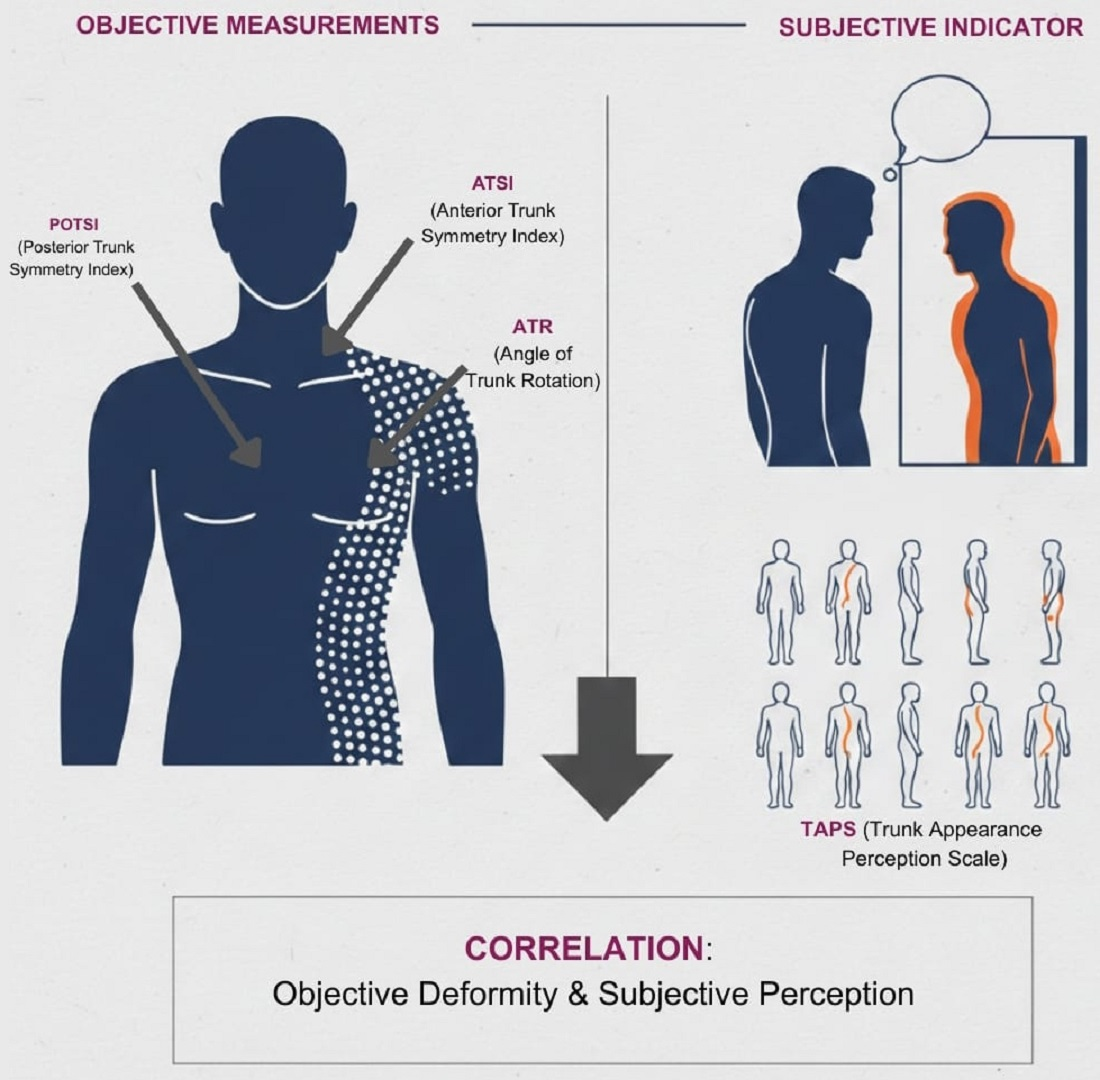
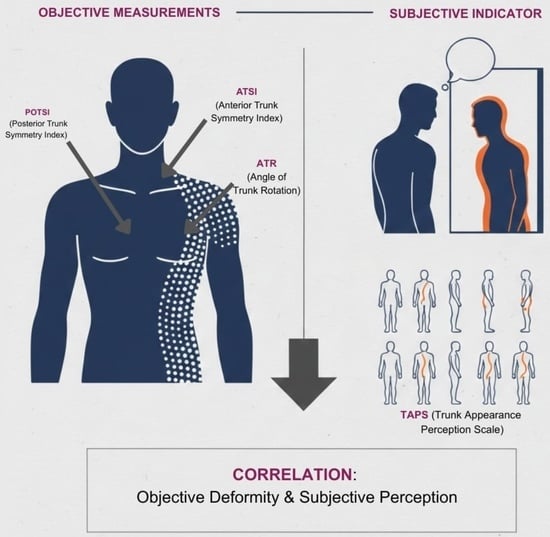
- To compare subjective and objective trunk assessment indicators in two planes (frontal and transversal) before and after therapy in patients treated by Functional Individual Therapy of Scoliosis (FITS).
- To determine whether a 5-day intensive FITS program is associated with clinical improvement of a patient, confirmed by subjective and objective indicators.
2. Material and Methods
2.1. Study Design
2.2. Participants
2.3. Intervention
2.4. Statistical Methods
2.5. Ethical Considerations
3. Results
3.1. Objective Evaluation Results
3.2. Results of the Subjective Study
3.3. Correlation of Objective and Subjective Indicators
4. Discussion
4.1. Study Limitations
4.2. Clinical Implications and Future Perspectives
5. Conclusions
- Our findings demonstrate that a patient’s subjective self-assessment using the TAPS test does not necessarily correlate with objective clinical measurements. This suggests that a child’s perception of their trunk deformity is a highly individual matter and may not directly reflect the actual physical severity of the scoliosis.
- Short-term intensive Functional Individual Therapy of Scoliosis (FITS Method) based on PSSE is associated with initial but statistically significant improvements in selected objective and subjective trunk appearance measures.
Author Contributions
Funding
Institutional Review Board Statement
Informed Consent Statement
Data Availability Statement
Conflicts of Interest
References
- Negrini, S.; Donzelli, S.; Aulisa, A.G.; Czaprowski, D.; Schreiber, S.; De Mauroy, J.C.; Diers, H.; Grivas, T.B.; Knott, P.; Kotwicki, T.; et al. 2016 SOSORT guidelines: Orthopaedic and rehabilitation treatment of idiopathic scoliosis during growth. Scoliosis Spinal Disord. 2018, 13, 3. [Google Scholar] [CrossRef] [Scilit] [PubMed]
- Czaprowski, D.; Kotwicki, T.; Durmała, J.; Stoliński, Ł. Physiotherapy in the treatment of idiopathic scoliosis—Current recommendations based on the recommendations of SOSORT 2011 (Society on Scoliosis Orthopaedic and Rehabilitation Treatment). Adv. Rehabil. 2014, 28, 23. [Google Scholar] [CrossRef] [Scilit]
- Berdishevsky, H.; Lebel, V.A.; Bettany-Saltikov, J.; Rigo, M.; Lebel, A.; Hennes, A.; Romano, M.; Białek, M.; M’hango, A.; Betts, T.; et al. Physiotherapy scoliosis—Specific exercises—A comprehensive review of seven major schools. Scoliosis Spinal Disord. 2016, 11, 20. [Google Scholar] [CrossRef] [Scilit]
- Białek, M.; M’hango, A. FITS concept—Functional Individual Therapy of Scoliosis. In The Conservative Scoliosis Treatment; Studies in Health Technology and Informatics; IOS Press: Amsterdam, The Netherlands, 2008; Volume 135, pp. 250–261. [Google Scholar]
- Białek, M. Conservative treatment of idiopathic scoliosis according to the FITS Concept: Presentation of the method and preliminary, short term radiological and clinical results based on SOSORT and SRS criteria. Scoliosis 2011, 6, 25. [Google Scholar] [CrossRef] [Scilit]
- Białek, M.; M’hango, A.; Bettany–Saltikov, J.; Paz–Lourido, B. Physical Therapy Perspectives in the 21st Century—Challenges and Possibilities; Intech Open: Rijeka, Croatia, 2012; pp. 26–31. [Google Scholar]
- Liu, L.; Liu, W.; Xiang, D.; Wang, J.; Li, X.; Dong, J.; Xia, H.; Song, X. An examination of factors affecting the efficacy of physiotherapeutic scoliosis-specific exercises in the management of adolescent idiopathic scoliosis. J. Intell. Med. 2025, 2, 81–90. [Google Scholar] [CrossRef] [Scilit]
- Bago, J.; Sanchez-Raya, J.; Sanchez Perez-Grueso, F.J.; Climent, J.M. The Trunk Appearance Perception Scale (TAPS): A new tool to evaluate subjective impression of trunk deformity in patients with idiopathic scoliosis. Scoliosis 2010, 5, 6. [Google Scholar] [CrossRef] [Scilit]
- Bago, J.; Matamalas, A.; Sánchez-Raya, J.; Pellise, F.; Pérez-Grueso, F.J.S. Responsiveness of Image Perception Outcome Scales After Surgical Treatment of Idiopathic Scoliosis: A Comparison Between the Trunk Appearance Perception Scale (TAPS) and Scoliosis Research Society-22 (SRS-22) Questionnaire. Spine Deform. 2018, 6, 417–423. [Google Scholar] [CrossRef] [Scilit] [PubMed]
- Matamalas, A.; D’Agata, E.; Sanchez-Raya, J.; Bago, J. Trunk appearance perception scale for physicians (TAPS-Phy)—A valid and reliable tool to rate trunk deformity in idiopathic scoliosis. Scoliosis Spinal Disord. 2016, 11, 24. [Google Scholar] [CrossRef] [Scilit]
- O’Sanders, J.; W’Polly, D., Jr.; Cats-Baril, W.; Jones, J.; Lenke, J.; O’Brien, M.F.; Stephens Richards, B.; Sucato, D.J. Analysis of Patient and Parent Assessment of Deformity in Idiopathic Scoliosis Using the Walter Reed Visual Assessment Scale. Spine 2003, 28, 2158–2163. [Google Scholar] [CrossRef] [Scilit] [PubMed]
- Thielsch, M.T.; Wetterkamp, M.; Boertz, P.; Gosheger, G.; Schulte, T.L. Reliability and validity of the Spinal Appearance Questionnaire (SAQ) and the Trunk Appearance Perception Scale (TAPS). J. Orthop. Surg. Res. 2018, 13, 274. [Google Scholar] [CrossRef] [Scilit]
- Negrini, S.; Donzelli, S.; Di Felice, F.; Zaina, F.; Caronni, A. Construct validity of the Trunk Aesthetic Clinical Evaluation (TRACE) in young people with idiopathic scoliosis. Ann. Phys. Rehabil. Med. 2020, 63, 216–221. [Google Scholar] [CrossRef] [Scilit]
- Suzuki, N.; Inami, K.; Ono, T.; Kohno, K.; Asher, M.A. Analysis of Posterior Trunk Symmetry Index (POTSI) in scoliosis. Stud. Health Technol. Inform. 1999, 59, 81–84. [Google Scholar]
- Stoliński, Ł.; Kozinoga, M.; Czaprowski, D.; Tyrakowski, M.; Cerny, P.; Suzuki, N.; Kotwicki, T. Two–dimensional digital photography for child body posture evaluation: Standardized technique, reliable parameters and normative data for age 7–10. Scoliosis Spinal Disord. 2017, 12, 38. [Google Scholar] [CrossRef] [Scilit] [PubMed]
- Stoliński, Ł.; Czeszejko-Sochacka, E.; Czaprowski, D. The use of photoregistration in the objectification of body posture assessment (Wykorzystanie fotorejestracji w obiektywizacji oceny postawy ciała). Prakt. Fizjoterapia I Rehabil. 2022, 135, 36–40. [Google Scholar]
- Živković, V.D.; Dimitrijević, L.; Čolović, H.; Zlatanović, D.; Spalević, M.; Savić, N. Aesthetic Appearance Assessment in Adolescents with Idiopathic Scoliosis. Acta Fac. Medicae Naissensis 2023, 40, 5–12. [Google Scholar] [CrossRef] [Scilit]
- von Elm, E.; Altman, D.G.; Egger, M.; Pocock, S.J.; Gøtzsche, P.C.; Vandenbroucke, J.P. STROBE Initiative. The Strengthening the Reporting of Observational Studies in Epidemiology (STROBE) statement: Guidelines for reporting observational studies. Lancet 2007, 370, 1453–1457. [Google Scholar] [CrossRef] [Scilit]
- Official Journal of the European Union. Regulation (EU) 2016/679 of the European Parliament and of the Council of 27 April 2016 on the Protection of Natural Persons with Regard to the Processing of Personal Data and on the Free Movement of Such Data, and Repealing Directive 95/46/EC (General Data Protection Regulation); Official Journal of the European Union: Brussels, Belgium, 2016. [Google Scholar]
- Cohen, J. Statistical Power Analysis for the Behavioral Sciences; Lawrence Erlbaum Associates: Mahwah, NJ, USA, 1988. [Google Scholar]
- Amendt, L.E.; Ause-Ellias, K.L.; Lundahl Eybers, J.; Wadsworth, C.T.; Nielsen, D.H.; Weinstein, S.L. Validity and Reliability Testing of the Scoliometer. Phys. Ther. 1990, 70, 108–117. [Google Scholar] [CrossRef] [Scilit]
- Savvides, P.; Gerdhem, P.; Grauers, A.; Danielsson, A.; Diarbakerli, E. Self-Experienced Trunk Appearance in Individuals with and Without Idiopathic Scoliosis. Spine 2020, 45, 522–527. [Google Scholar] [CrossRef] [Scilit]
- Topolovec, M. Effect of Scoliosis Specific Exercises on Trunk Asymmetry in Children with Adolescent Idiopathic Scoliosis (Učinak Vježbi Specifičnih za Skoliozu na Asimetriju Trupa Kod Djece s Adolescentnom Idopatskom Skoliozom). Ph.D. Thesis, University of Rijeka, (Sveučilište u Rijeci), Rijeka, Croatia, 2020. [Google Scholar]
- Belli, G.; Toselli, S.; Latessa, P.M.; Mauro, M. Evaluation of Self-Perceived Body Image in Adolescents with Mild Idiopathic Scoliosis. Eur. J. Investig. Health Psychol. Educ. 2022, 12, 319–333. [Google Scholar] [CrossRef] [Scilit]
- Lendzion, M.; Łukaszewicz, E.; Waś, J.; Czaprowski, D. Self-evaluation of Trunk Aesthetics in Conservatively Treated Children and Adolescents with Idiopathic Scoliosis. Ortop. Traumatol. Rehabil. 2018, 20, 371–382. [Google Scholar] [CrossRef] [Scilit] [PubMed]
- Podolska-Piechocka, A. Quality of Life of Patients with Idiopathic Scoliosis Treated with the Chêneau Brace (Jakość Życia Pacjentów ze Skoliozą Idiopatyczną Leczonych Gorsetem Chêneau—Rozprawa Doktorska). Ph.D. Thesis, Poznań University of Medical Sciences (Uniwersytetu Medycznego w Poznaniu), Poznań, Poland, 2013. [Google Scholar]
- Misterska, E.; Glowacki, M.; Latuszewska, J.; Adamczyk, K. Perception of stress level, trunk appearance, body function and mental health in females with adolescent idiopathic scoliosis treated conservatively: A longitudinal analysis. Qual. Life Res. 2012, 22, 1633–1645. [Google Scholar] [CrossRef] [Scilit]
- Chongov, B.; Alexiev, V.; Georgiev, H.; Kalinov, K.; Dimitrova, E. Correlation between scoliosis deformity type and trunk symmetry before and after schroth physiotherapeutic exercises. Proc. Bulg. Acad. Sci. 2017, 70, 1455–1462. [Google Scholar]
- Jia, Q.; Zhang, B.; Wang, H.; Zheng, W. Effectiveness of physical therapeutic scoliosis exercise (PSSE) intervention for adolescent idiopathic scoliosis: A systematic review and meta-analysis. BMC Musculoskelet. Disord. 2025, 26, 947. [Google Scholar] [CrossRef] [Scilit] [PubMed]



| Parameters | Number (n = 75) | Average (SD) |
|---|---|---|
| Single-curve scoliosis (°) | 17 | 27.41 ± 10.19 |
| Double-curve scoliosis: (°) | 58 | 31.03 ± 20.98 |
| Th curve (°) | 31.24 ± 11.82 | |
| L curve (°) | 30.82 ± 10.98 | |
| Risser | 2.16 ± 1.97 | |
| ATR Th (°) | 7.1 ± 4.1 | |
| ATR L (°) | 4.6 ± 3.7 | |
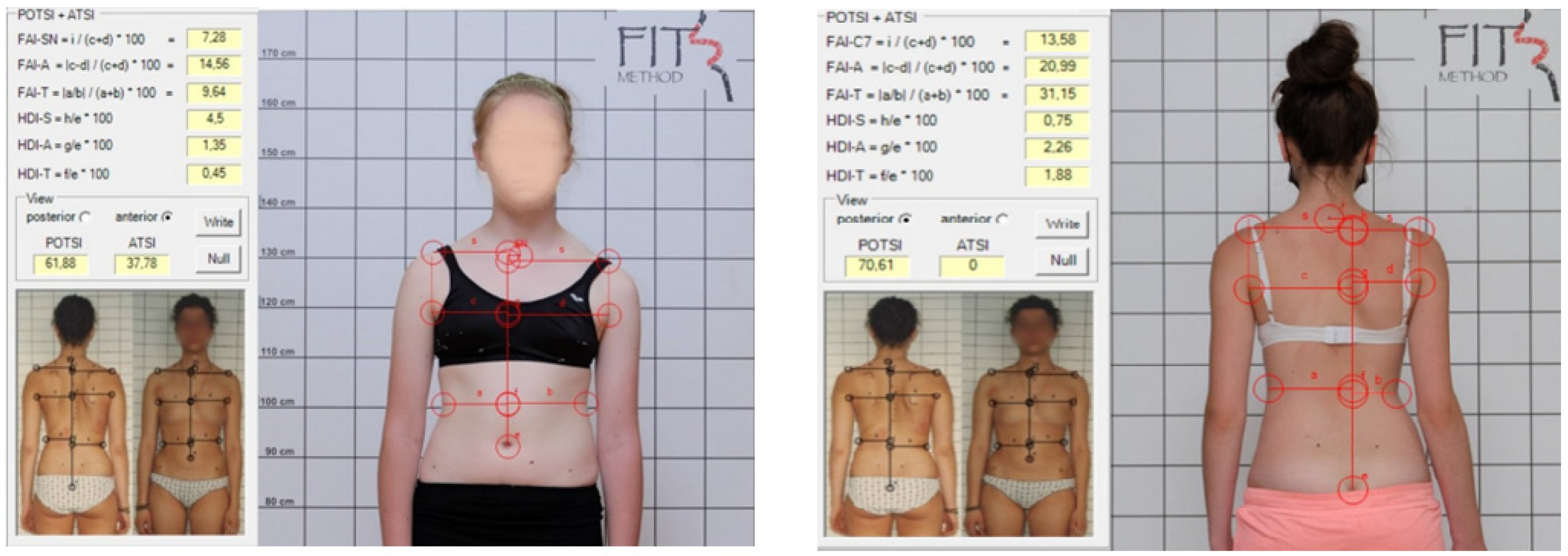
| ATSI | 26.2 ± 11 | |
| POTSI | 25.8 ± 13.3 | |
| Brace | 49 |
| ATSI | POTSI | |
|---|---|---|
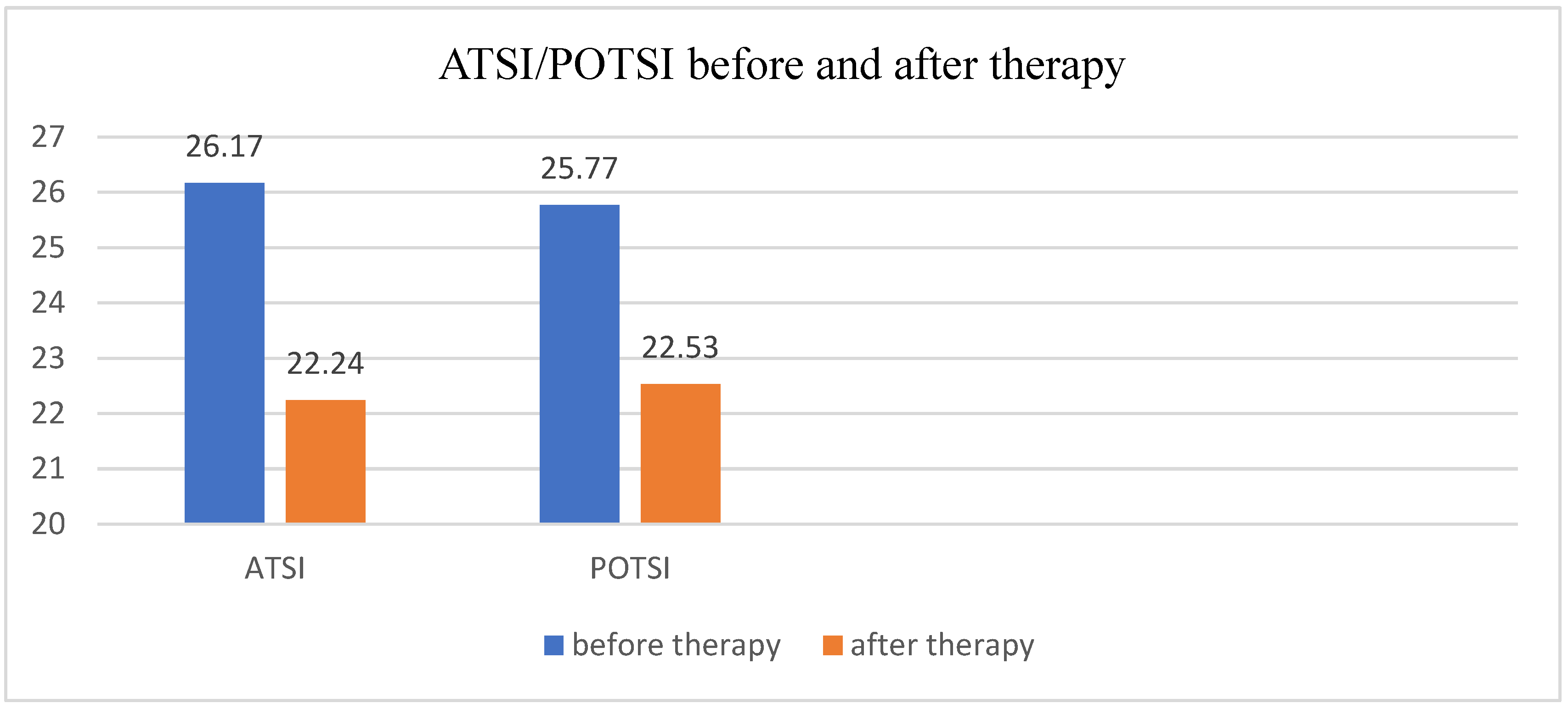
| Before | 26.17 ± 10.96 | 25.77 ± 13.28 |
| After | 22.24 ± 9.09 | 22.53 ± 10.81 |
| Difference | 3.93 ± 8.20 | 3.24 ± 9.51 |
| p < 0.001 | p = 0.008 |
| Thoracic ATR | Lumbar ATR | |
|---|---|---|
| Before | 7.12 ± 4.14 | 4.59 ± 3.66 |
| After | 6.08 ± 4.18 | 4.16 ± 3.27 |
| Difference | 1.04 ± 1.99 | 0.43 ± 2.31 |
| p < 0.001 | p = 0.164 |
| Average | |||||||||
|---|---|---|---|---|---|---|---|---|---|
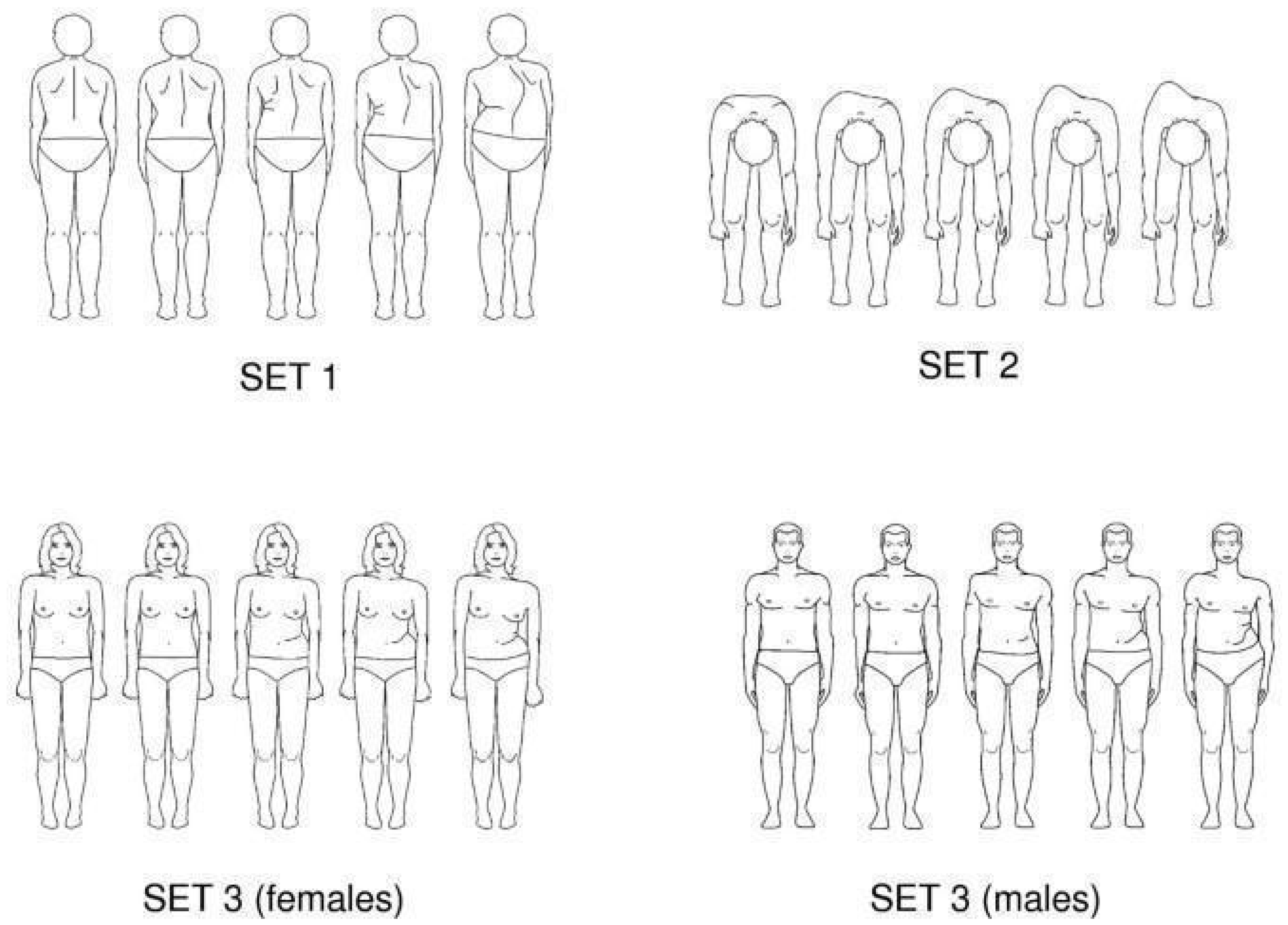
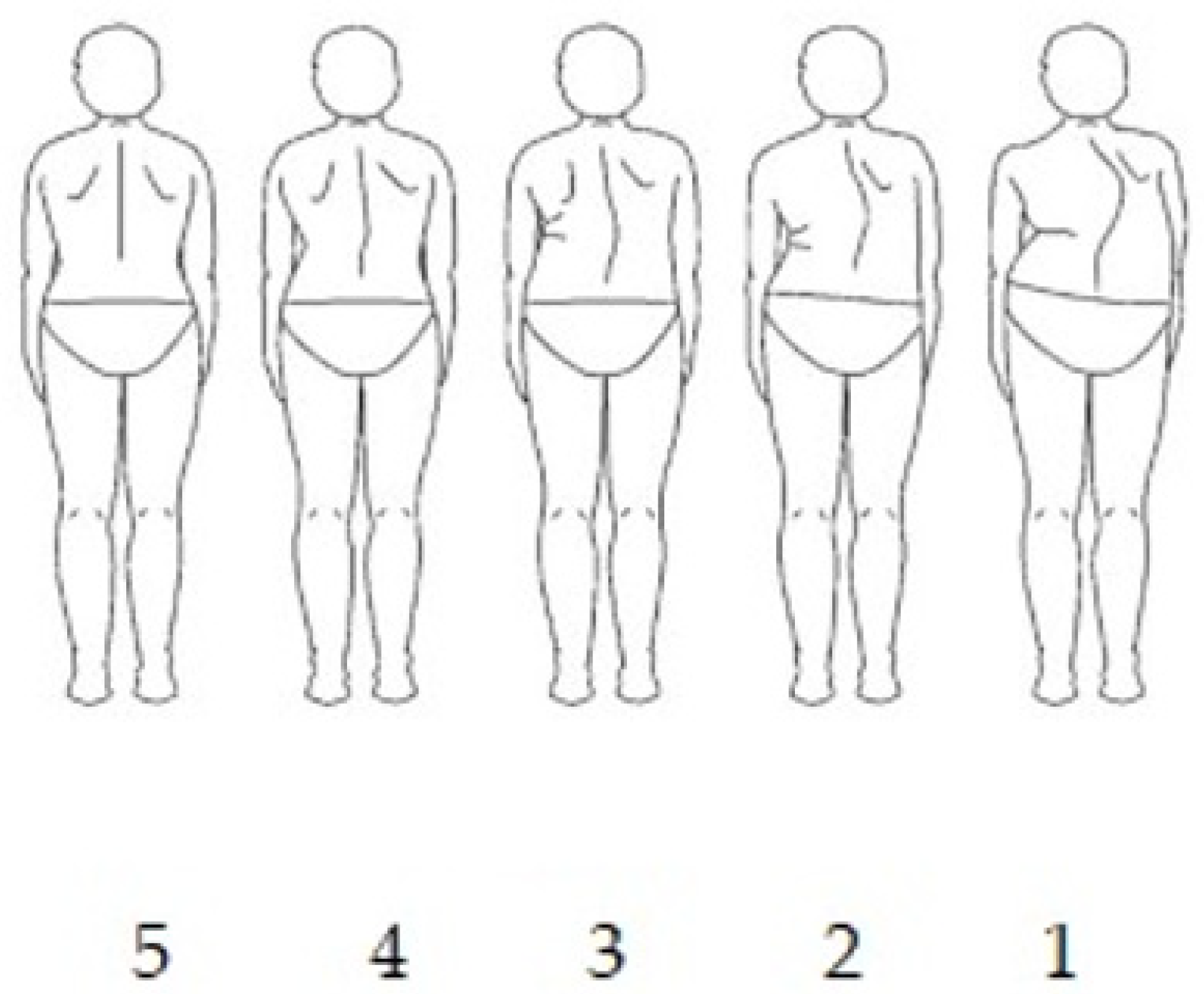
| SET 1 | CI −95% | CI +95% | SET 2 | CI −95% | CI +95% | SET 3 | CI −95% | CI +95% | |
| Before | 3.36 ± 0.85 | 3.17 | 3.55 | 3.69 ± 0.73 | 3.53 | 3.85 | 3.43 ± 0.81 | 3.25 | 3.61 |
| After | 3.68 ± 0.77 | 3.51 | 3.85 | 3.88 ± 0.72 | 3.72 | 3.72 | 3.63 ± 0.73 | 3.47 | 3.79 |
| Difference | 0.32 ± 0.77 | 0.15 | 0.49 | 0.19 ± 0.67 | 0.04 | 0.34 | 0.20 ± 0.70 | 0.04 | 0.36 |
| p before–after | p = 0.002 | p = 0.042 | p = 0.028 | ||||||
| p | R | |
|---|---|---|
| POTSI before–SET 1 before | 0.921 | −0.01 |
| POTSI after–SET 1 after | 0.409 | −0.10 |
| ATR Th before–SET 2 before | <0.001 | −0.45 |
| ATR Th after–SET 2 after | <0.001 | −0.45 |
| ATSI before–SET 3 before | 0.004 | −0.33 |
| ATSI after–SET 3 after | 0.011 | −0.29 |
Disclaimer/Publisher’s Note: The statements, opinions and data contained in all publications are solely those of the individual author(s) and contributor(s) and not of MDPI and/or the editor(s). MDPI and/or the editor(s) disclaim responsibility for any injury to people or property resulting from any ideas, methods, instructions or products referred to in the content. |
© 2026 by the authors. Published by MDPI on behalf of the Lithuanian University of Health Sciences. Licensee MDPI, Basel, Switzerland. This article is an open access article distributed under the terms and conditions of the Creative Commons Attribution (CC BY) license.
Share and Cite
Białek, M.; Piorun, S.; Białek-Kucharska, E.; Poświata, P.; Poczynek, M.; Pękala, J. Comparison of Objective and Subjective Indicators in Patients with Idiopathic Scoliosis Undergoing PSSE Therapy—Retrospective Observational. Medicina 2026, 62, 652. https://doi.org/10.3390/medicina62040652
Białek M, Piorun S, Białek-Kucharska E, Poświata P, Poczynek M, Pękala J. Comparison of Objective and Subjective Indicators in Patients with Idiopathic Scoliosis Undergoing PSSE Therapy—Retrospective Observational. Medicina. 2026; 62(4):652. https://doi.org/10.3390/medicina62040652
Chicago/Turabian StyleBiałek, Marianna, Sylwia Piorun, Ewelina Białek-Kucharska, Paulina Poświata, Małgorzata Poczynek, and Justyna Pękala. 2026. "Comparison of Objective and Subjective Indicators in Patients with Idiopathic Scoliosis Undergoing PSSE Therapy—Retrospective Observational" Medicina 62, no. 4: 652. https://doi.org/10.3390/medicina62040652
APA StyleBiałek, M., Piorun, S., Białek-Kucharska, E., Poświata, P., Poczynek, M., & Pękala, J. (2026). Comparison of Objective and Subjective Indicators in Patients with Idiopathic Scoliosis Undergoing PSSE Therapy—Retrospective Observational. Medicina, 62(4), 652. https://doi.org/10.3390/medicina62040652