


Abstract
Background and Objectives: Predicting the risk of progression from mild cognitive impairment (MCI) to dementia requires several clinical, radiological, and biochemical markers. Considering the possible neuroprotective features of albumin, this study evaluated whether hypoalbuminemia plays a role in the progression from MCI to dementia in older adults. Material and Methods: Older patients with MCI were divided into two groups according to their albumin levels: normoalbuminemia and hypoalbuminemia (albumin ≥ 4 g/dL and <4 g/dL, respectively). Demographics, biochemical characteristics, and comprehensive geriatric assessment parameters were collected retrospectively. During the three-year follow-up, the study focused on the progression from MCI to dementia, particularly its association with albumin levels. Results: Of the 650 participants, 233 patients were included in the hypoalbuminemia group and 417 were included in the control group. At baseline, the hypoalbuminemia group had higher mean age and Charlson Comorbidity Index (CCI) scores (p < 0.05 for each), whereas education levels, Montreal Cognitive Assessment (MoCA), and basic and instrumental daily living scores were lower (p < 0.05 for each). Among the 206 patients included in the final analysis, progression to dementia occurred in 33 of 69 patients in the hypoalbuminemia group and 30 of 137 patients in the normoalbuminemia group (47.8% vs. 21.9%; p < 0.001). After adjustment for age, sex, years of education, CCI, nutritional status and baseline MoCA score, hypoalbuminemia remained associated with higher odds of progression to dementia (OR, 2.61; 95% CI, 1.24–5.48; p = 0.012). Conclusions: This study demonstrated that hypoalbuminemia was associated with progression from MCI to dementia in older adults.
1. Introduction
In light of the growing elderly population, cognitive impairment has become a significant concern in medical practice, particularly in geriatric medicine, worldwide [1]. Given the intricate nature of the subject matter, individuals presenting with such symptoms seek specialist expertise from a range of disciplines to identify an appropriate diagnosis and treatment [2]. Mild cognitive impairment (MCI) is the state that is used to describe the transition between normal cognition and dementia, such that individuals with MCI have a memory impairment beyond that expected for age and education yet are not demented. MCI, with the potential to progress to dementia in 8–15% of patients annually [3], is also a major public health concern associated with an increased risk of dementia [4]. Therefore, it is essential to identify risk factors that lead to this progression, and all the strategies against MCI should be focused on preventing further decline in existing deficits. Considering the incurability of Alzheimer’s disease (AD), it is also crucial to identify the factors that may contribute to the progression from MCI to dementia and implement prevention strategies [5]. On the other hand, despite a growing body of evidence, 14 modifiable risk factors have been reported across the life course, which together account for approximately 45% of dementia cases, including less education, hearing loss, hypertension, smoking, obesity, depression, physical inactivity, diabetes, excessive alcohol consumption, traumatic brain injury, air pollution, and social isolation, vision loss and high low-density lipoprotein cholesterol [6].
Furthermore, it is shown that as well as the aforementioned factors, a multitude of factors, such as metabolic syndrome, folic acid deficiency, and neuropsychiatric symptoms, may influence the progression from MCI to dementia, whereas the Mediterranean diet decreases the risk [7]. Moreover, it is also demonstrated that hippocampal, medial temporal, entorhinal atrophy, white matter hyperintensity volume in the brain, abnormal total-τau, phospho-τau, τau/Amyloidβ1-42 levels in cerebrospinal fluid (CSF), and the presence of at least one Apoe4 allele increase the risk of AD in MCI patients [8]. Nevertheless, established risk factors do not fully explain progression from MCI to dementia in all patients, highlighting the need to investigate additional factors [9].
Within this context, the fact that recent studies reported the association between hypoalbuminemia and cognitive dysfunction raises the question of whether albumin may be a risk factor for dementia. Albumin is involved in numerous physiological functions, including transport, enzymatic reactions, and antioxidant and antibacterial activities. Hypoalbuminemia is associated with a wide array of pathologies, such as inflammatory diseases, cardiovascular diseases, renal diseases, stroke, venous thromboembolism, and solid organ tumors [10]. Indeed, hypoalbuminemia was evaluated as a risk factor for progression from cognitively healthy to MCI or dementia. In a population-based cohort study, Ng et al. showed that low albumin level was an independent risk marker for cognitive decline [11]. In a seven-year retrospective cohort study, Wang et al. found that cognitively normal individuals with serum albumin levels below 40.5 g/L were at higher risk for developing MCI [12]. Another study found that dementia risk was higher in cognitively healthy older adults with low serum albumin levels during a 17-year follow-up period [13]. However, no study has specifically evaluated albumin levels as a risk factor for dementia in older adults with MCI so far. Therefore, this study aimed to investigate whether hypoalbuminemia plays a role in the progression of dementia in patients with MCI.
2. Methods
2.1. Study Design and Participants
This study is a retrospective follow-up study. Data from medical records of patients diagnosed with MCI, aged 60 years or older, who visited our geriatric medicine clinic from January 2013 to December 2020, were reviewed. During the admission phase and subsequent follow-up period, patients with the following conditions were excluded from the study: psychotic disorders, depressive disorders, cirrhosis, malignancy, or an insufficient data set. Additionally, patients with head trauma, adverse drug reactions, metabolic disorders, organ failure, stroke, myocardial infarction, or gastrointestinal bleeding in the two weeks prior were not included.
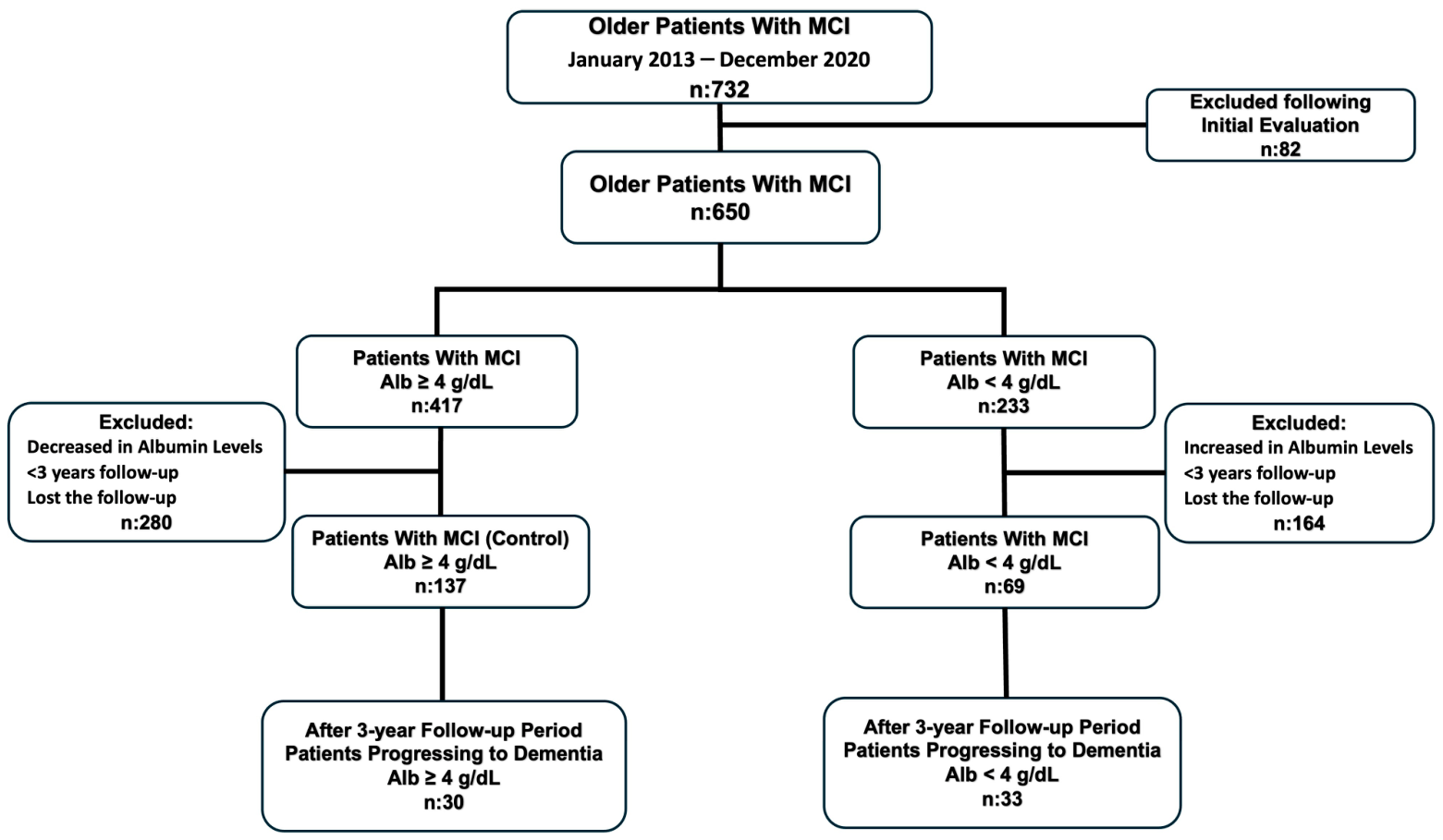
Accordingly, 732 patients with MCI were initially recruited. After initial exclusion, 650 participants were enrolled. These patients were split into two groups based on their serum albumin levels on their admission: patients with normoalbuminemia (Albumin ≥ 4 g/dL) and those with hypoalbuminemia (Albumin < 4 g/dL). Cut-offs of 4.0 g/dL or values close to this level have been used in previous studies examining cognitive dysfunction, functional decline, and mortality in older adults. Accordingly, we selected 4.0 g/dL as a literature-based cut-off [14]. At baseline, 417 MCI patients were normoalbuminemic (control group), while 233 were hypoalbuminemic (HA group).
2.2. Data Collection
Their sociodemographic characteristics (age, years of education, gender, body mass index, smoking status), comorbidities (hypertension, diabetes mellitus), Charlson comorbidity index scores (CCI), comprehensive geriatric assessment (CGA) parameters, and laboratory values were evaluated, and comparative analysis was performed. All participants underwent CGA, neurological examination, and laboratory tests at enrollment and at follow-up visits thereafter. Also, all participants had brain imaging as part of the diagnostic work-up.
2.3. Comprehensive Geriatric Assessment
All patients underwent a comprehensive geriatric assessment (CGA), including global cognitive function assessed using the Montreal Cognitive Assessment (MoCA), functionality status in Basic Activities of Daily Living (BADL), Instrumental Activities of Daily Living (IADL), and nutritional status (Mini Nutritional Assessment [MNA]) [15].
2.3.1. Classification After Follow-Up and Final Evaluation
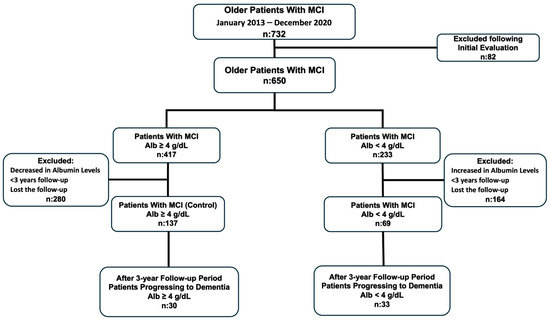
Patients were followed up at 6-month intervals for 36 months. To compare cognitive outcomes between patients with consistent albumin categories across follow-up assessments, the analysis was restricted to those whose category remained unchanged. This approach was intended to avoid assuming that a single baseline albumin measurement represented albumin status throughout follow-up. Patients in the HA group whose serum albumin reached ≥4.0 g/dL at any follow-up assessment, and patients in the control group whose serum albumin fell below 4.0 g/dL, were excluded from the final analysis. Patients who developed the specified diseases or acute events were excluded because these conditions could affect serum albumin levels and/or neurocognitive performance. Patients with incomplete follow-up CGA data were excluded because cognitive and functional changes could not be adequately assessed. In the final evaluation, the control group had 137 individuals, while the HA group had 69 (Figure 1). At the end of the three-year follow-up, patients in each group were compared based on the changes in CGA parameters, and the percentage of progression to dementia was assessed.
Figure 1.
Flowchart of the patients.
2.3.2. Mild Cognitive Impairment and Dementia Diagnosis
DSM-5 diagnostic criteria were utilized for the diagnosis of MCI and dementia [16]. The diagnosis of MCI required (i) evidence of modest cognitive decline from a previous level of performance in one or more cognitive domains, (ii) preserved independence in everyday activities (i.e., complex IADLs are preserved, but greater effort, compensatory strategies, or accommodation may be required), (iii) cognitive deficits that do not occur exclusively during delirium, and (iv) not better explained by another mental disorder. Diagnosis of dementia required (i) evidence of significant cognitive decline from a previous level of performance in one or more cognitive domains; a substantial impairment in cognitive performance was required; (ii) the cognitive deficits interfere with independence in everyday activities; (iii) cognitive deficits that do not occur exclusively during delirium; (iv) not better explained by another mental disorder.
At baseline, MCI was diagnosed by a geriatrician according to DSM-5 criteria. The assessment integrated the comprehensive geriatric assessment, including MoCA, BADL, and IADL scores; neurological examination; information obtained from the patient and a relative; and brain imaging. MoCA scores were not used as the sole basis for diagnosis. MCI was defined by cognitive decline without loss of independence in everyday activities, although greater effort or compensatory strategies could be required. Functional limitations were assessed clinically to determine whether they were attributable to cognitive impairment or to noncognitive factors. Patients whose cognitive deficits interfered with independence and met DSM-5 criteria for major neurocognitive disorder (dementia) were excluded at baseline. During the 36-month follow-up, cognitive and functional assessments were performed at six-month intervals, and dementia was diagnosed by a geriatrician when DSM-5 criteria were met.
2.4. Laboratory Analysis
Serum albumin (g/dL), estimated glomerular filtration rate (mL/min/1.73 m2), thyroid stimulating hormone (mIU/L), vitamin B12 (pg/mL), folic acid (ng/mL), vitamin D (ng/mL), and C-reactive protein (CRP) (mg/L) were recorded. Renal impairment was defined as an eGFR < 60 mL/min/1.73 m2, and elevated CRP was defined as a CRP level ≥ 5 mg/L.
2.5. Sample Size
Given that the prevalence of MCI in individuals over 60 years of age is 17.3% [17] and an average of 1000 new patients are admitted to our geriatrics department annually, it was planned to include at least 180 patients in the study with 5% acceptable error and 95% confidence level.
2.6. Statistical Analyses
Continuous variables were assessed for distributional characteristics and are presented as mean ± SD or median (interquartile range), as appropriate. Between-group comparisons were performed using the independent-samples t-test or Mann–Whitney U test for continuous variables and the chi-square test for categorical variables. Changes in cognitive and functional scores during follow-up were compared between groups using the Mann–Whitney U test.
For longitudinal cognitive and functional outcomes, analysis of covariance (ANCOVA) was performed using follow-up MoCA, BADL, and IADL scores as dependent variables, with the corresponding baseline score included as a covariate. Models were additionally adjusted for age, sex, years of education, CCI, and nutritional status. Adjusted between-group differences were reported as regression coefficients (β) with 95% confidence intervals.
Multivariable binary logistic regression was used to evaluate the association between hypoalbuminemia and progression to dementia. Model 1 was adjusted for age, sex, and years of education. Model 2 additionally included CCI and nutritional status, and Model 3 further included baseline MoCA score. Nutritional status was entered as a binary variable, combining malnutrition and risk of malnutrition, as determined by MNA scores, into one category, with normal nutritional status as the reference category. As a sensitivity analysis, baseline serum albumin was entered as a continuous variable in place of the albumin-group variable, with adjustment for the same covariates as Model 3. The OR was expressed per 0.5 g/dL decrease in albumin. Odds ratios (ORs) with 95% confidence intervals (CIs) were reported. A two-sided p value < 0.05 was considered statistically significant.
Ethics Approval: This study was carried out with the approval of the Dokuz Eylül University Ethics Committee (No: 9037-GOA), and was conducted in accordance with the Declaration of Helsinki.
3. Results
3.1. Initial Evaluation
Among the 650 patients included in the study, 233 (35.8%) were classified into the hypoalbuminemia (HA) group, while 417 (64.2%) were classified into the control group based on serum albumin levels at the initial evaluation. Patients in the HA group were older, had lower educational levels, greater comorbidity burdens, and poorer nutritional status (p < 0.05 for each). Renal impairment was significantly higher in the HA group (p = 0.007). At the initial evaluation, the MoCA scores of the HA group were significantly lower (16.82 ± 4.05 vs. 17.90 ± 4.09, p = 0.001). Additionally, patients in the HA group exhibited lower scores in basic and instrumental activities of daily living (p < 0.001). Sociodemographic characteristics, comorbidities, laboratory data, and CGA scores for the groups at the initial visit are detailed in Table 1.
Table 1.
Patients’ characteristics at the first admission.
3.2. Follow-Up Evaluation
After three years of follow-up, 137 patients in the control group and 69 in the HA group remained eligible for the final analysis. The HA group demonstrated a more significant reduction in BADL and IADL scores when the CGA parameters were compared at baseline and after a three-year follow-up (p = 0.011 and p = 0.003, respectively). In unadjusted analyses, the median change in MoCA score was −2.0 (IQR, −6.0 to 1.0) in the HA group and 0.0 (IQR, −3.0 to 2.0) in the control group (p = 0.004). Changes in cognitive and functional measures during the three-year follow-up are presented in Table 2. After adjustment for the corresponding baseline score, age, sex, years of education, CCI, and nutritional status, HA remained associated with poorer cognitive and functional outcomes at follow-up. Patients with HA had a 1.76-point lower follow-up MoCA score (β = −1.76; 95% CI, −3.27 to −0.25; p = 0.023), a 5.34-point lower BADL score (β = −5.34; 95% CI, −9.94 to −0.74; p = 0.023), and a 2.62-point lower IADL score (β = −2.62; 95% CI, −4.56 to −0.68; p = 0.008) compared with patients with normoalbuminemia.
Table 2.
Changes in cognitive and functional measures and progression to dementia during the three-year follow-up.
During the three-year follow-up, 30 patients (21.9%) in the control group and 33 patients (47.8%) in the HA group progressed to dementia (p < 0.001) (Table 2). In the multivariable logistic regression analyses, HA was consistently associated with incident dementia among patients with MCI. In Model 1, adjusted for age, sex, and years of education, HA was associated with higher odds of progression to dementia (OR, 2.94; 95% CI, 1.48–5.82; p = 0.002). After additional adjustment for CCI and malnutrition status in Model 2, the association remained essentially unchanged (OR, 3.00; 95% CI, 1.48–6.06; p = 0.002). In Model 3, which additionally included baseline MoCA score, the magnitude of the association was attenuated but remained statistically significant (OR, 2.61; 95% CI, 1.24–5.48; p = 0.012).
In a sensitivity analysis in which serum albumin was modeled as a continuous variable, each 0.5 g/dL lower baseline albumin level was associated with higher odds of progression to dementia after adjustment for age, sex, years of education, baseline MoCA score, CCI, and nutritional status (OR, 1.92; 95% CI, 1.06–3.48; p = 0.031).
4. Discussion
This single-center and retrospectively designed cohort study demonstrated that relatively low serum albumin levels (<4 g/dL) have been significantly associated with poor cognitive performance, nutritional status, and activities of daily living scores in older adults with MCI. During the three-year follow-up, progression to dementia occurred more frequently in the HA group. After adjustment for age, sex, years of education, CCI, nutritional status, and baseline MoCA score, HA remained associated with higher odds of progression to dementia (OR, 2.61; 95% CI, 1.24–5.48).
Several biological mechanisms may help explain the association between low serum albumin levels and cognitive dysfunction. Accordingly, a cross-sectional study revealed that the frequency of cognitive impairment increased as albumin levels decreased [18]. Albumin exerts neuroprotective effects by binding almost all the amyloid-beta (Aβ) in plasma, and inhibiting the polymerization of Aβ, and facilitating its transfer from the brain to the bloodstream. As such, a decrease in albumin levels may lead to the loss of these functions, potentially resulting in Aβ accumulation in the brain [19,20,21]. Additionally, the effects of Albumin on the astrocyte cells’ functions may lead to protection against cognitive dysfunction by several mechanisms, such as neurotransmission, maintenance of neurovascular homeostasis, removal of Aβ, and regulation of CSF functions [22,23,24]. Moreover, albumin may reduce oxidative stress and neuronal death by preventing DNA damage and apoptosis in cultured cortical neurons [25] but also inhibit platelet aggregation and prevent procoagulant mechanisms [26,27]. Consequently, low albumin level is potentially linked to an increased risk of cerebral ischemia and cognitive dysfunction [28,29].
Albumin is a negative acute-phase reactant, and its serum concentration decreases during inflammation [30]. A decline in serum albumin during ongoing inflammation may serve as a marker of increased risk of cognitive dysfunction [31,32,33]. Additionally, a recent study emphasized that cognitive frailty, which means MCI in a frail older adult, is also associated with malnutrition in older individuals and it has been reported that malnutrition and low serum albumin levels have been associated with cognitive impairment and reduced functioning [34]. In accordance with previous studies, MCI patients with hypoalbuminemia in this study had not only worse cognitive performance but also worse activities of daily living than others, which may be because malnutrition and the risk of nutritional deficiencies were more prevalent in the hypoalbuminemia group. Moreover, considering the close relationship between prevalent dementia subtypes and potentially hypoalbuminemia-related geriatric syndromes, such as frailty, malnutrition, and sarcopenia in older adults [34,35,36,37], it is not surprising that albumin may also be implicated in progressing to dementia in older patients with MCI.
This study has several limitations. First, its retrospective and single-center design limits causal inference and may reduce the generalizability of the findings. Second, a substantial proportion of the initial cohort was excluded from the final analysis or lost to follow-up during the three-year observation period. This reduction in the analytical sample may have introduced selection bias, particularly if patients not included in the final analysis differed systematically from those retained. Third, patients in the low-albumin group were older, had a greater comorbidity burden, and had poorer nutritional status and lower baseline cognitive scores. Although these factors were accounted for in the adjusted analyses, residual confounding cannot be entirely excluded. Frailty data were unavailable in the analytical dataset, preventing adjustment for this factor. Consequently, our findings should be validated in larger prospective cohorts with careful consideration of baseline clinical differences. Fourth, the limited number of dementia events constrained the number of covariates that could be included and may have reduced the precision and stability of the adjusted estimates. Finally, the date of the first dementia diagnosis was unavailable, precluding time-to-event analysis. Mortality status and dates of death were also unavailable; therefore, death could not be evaluated as a competing event.
To our knowledge, this is the first study to examine the association between low serum albumin and progression to dementia over three years in older adults with MCI. Given the substantial clinical, social, and economic burden of dementia, further research is warranted to clarify the relationship between low serum albumin levels and progression to dementia in older adults with MCI. On the other hand, as well as a potential risk factor for dementia throughout the mechanisms mentioned above, relatively low serum albumin levels may also play a role in the development of common comorbidities in older adults, such as coronary heart disease, heart failure, venous thromboembolism, diabetes, malnutrition, metabolic syndrome, breast cancer, stroke, and post-stroke depressive symptoms [12]. However, the present findings do not establish whether interventions targeting hypoalbuminemia would preserve cognitive function or reduce the risk of dementia progression.
5. Conclusions
Low serum albumin levels were associated with higher odds of progression to dementia over three years in older adults with MCI, even after adjustment for baseline cognitive performance and relevant clinical and demographic factors. These findings highlight serum albumin, a readily available and inexpensive measure, as a potential marker of dementia progression in this population. However, the observational design precludes causal inference, and whether interventions targeting hypoalbuminemia improve cognitive outcomes requires further investigation.
Author Contributions
E.İ.: Conceptualization, Methodology, Investigation, Data Curation, Formal Analysis, Writing—Original Draft. D.K.: Methodology, Writing—Review & Editing. A.T.I.: Supervision, Conceptualization, Methodology, Writing—Review & Editing. All authors have read and agreed to the published version of the manuscript.
Funding
This research received no external funding.
Institutional Review Board Statement
This study was carried out with the approval of the Dokuz Eylül University Ethics Committee (No: 9037-GOA) and was conducted in accordance with the Declaration of Helsinki.
Informed Consent Statement
Patient consent was waived due to the retrospective nature of the study.
Data Availability Statement
The datasets generated and/or analyzed during the current study are not publicly available because they contain confidential patient information but are available from the corresponding author on reasonable request.
Conflicts of Interest
The authors declare no conflicts of interest.
References
- Gold, P.E.; Korol, D.L. Forgetfulness during aging: An integrated biology. Neurobiol. Learn. Mem. 2014, 112, 130–138. [Google Scholar] [CrossRef] [Scilit]
- Pérez Palmer, N.; Trejo Ortega, B.; Joshi, P. Cognitive Impairment in Older Adults: Epidemiology, Diagnosis, and Treatment. Psychiatr. Clin. N. Am. 2022, 45, 639–661. [Google Scholar] [CrossRef] [Scilit]
- Petersen, R.C. Mild Cognitive Impairment. Continuum 2016, 22, 404–418. [Google Scholar] [CrossRef] [Scilit]
- Toot, S.; Devine, M.; Akporobaro, A.; Orrell, M. Causes of hospital admission for people with dementia: A systematic review and meta-analysis. J. Am. Med. Dir. Assoc. 2013, 14, 463–470. [Google Scholar] [CrossRef] [Scilit]
- Campbell, N.L.; Unverzagt, F.; LaMantia, M.A.; Khan, B.A.; Boustani, M.A. Risk factors for the progression of mild cognitive impairment to dementia. Clin. Geriatr. Med. 2013, 29, 873–893. [Google Scholar] [CrossRef] [Scilit]
- Livingston, G.; Huntley, J.; Liu, K.Y.; Costafreda, S.G.; Selbæk, G.; Alladi, S.; Ames, D.; Banerjee, S.; Burns, A.; Brayne, C.; et al. Dementia prevention, intervention, and care: 2024 report of the Lancet standing Commission. Lancet 2024, 404, 572–628. [Google Scholar] [CrossRef] [Scilit]
- Cooper, C.; Sommerlad, A.; Lyketsos, C.G.; Livingston, G. Modifiable predictors of dementia in mild cognitive impairment: A systematic review and meta-analysis. Am. J. Psychiatry 2015, 172, 323–334. [Google Scholar] [CrossRef] [Scilit]
- Li, J.Q.; Tan, L.; Wang, H.F.; Tan, M.S.; Tan, L.; Xu, W.; Zhao, Q.F.; Wang, J.; Jiang, T.; Yu, J.T. Risk factors for predicting progression from mild cognitive impairment to Alzheimer’s disease: A systematic review and meta-analysis of cohort studies. J. Neurol. Neurosurg. Psychiatry 2016, 87, 476–484. [Google Scholar] [CrossRef] [Scilit]
- Qin, W.; Li, F.; Jia, L.; Wang, Q.; Li, Y.; Wei, Y.; Li, Y.; Jin, H.; Jia, J. Phosphorylated Tau 181 Serum Levels Predict Alzheimer’s Disease in the Preclinical Stage. Front. Aging Neurosci. 2022, 14, 900773. [Google Scholar] [CrossRef] [Scilit]
- Fanali, G.; di Masi, A.; Trezza, V.; Marino, M.; Fasano, M.; Ascenzi, P. Human serum albumin: From bench to bedside. Mol. Asp. Med. 2012, 33, 209–290. [Google Scholar] [CrossRef] [Scilit]
- Ng, T.P.; Niti, M.; Feng, L.; Kua, E.H.; Yap, K.B. Albumin, apolipoprotein E-epsilon4 and cognitive decline in community-dwelling Chinese older adults. J. Am. Geriatr. Soc. 2009, 57, 101–106. [Google Scholar] [CrossRef] [Scilit]
- Wang, L.; Wang, F.; Liu, J.; Zhang, Q.; Lei, P. Inverse Relationship between Baseline Serum Albumin Levels and Risk of Mild Cognitive Impairment in Elderly: A Seven-Year Retrospective Cohort Study. Tohoku J. Exp. Med. 2018, 246, 51–57. [Google Scholar] [CrossRef] [Scilit]
- Taniguchi, Y.; Kitamura, A.; Kaito, S.; Yokoyama, Y.; Yokota, I.; Shinozaki, T.; Seino, S.; Murayama, H.; Matsuyama, Y.; Ikeuchi, T.; et al. Albumin and Hemoglobin Trajectories and Incident Disabling Dementia in Community-Dwelling Older Japanese. Dement. Geriatr. Cogn. Disord. 2019, 47, 233–242. [Google Scholar] [CrossRef] [Scilit]
- Iwasaki, M.; Motokawa, K.; Watanabe, Y.; Hayakawa, M.; Mikami, Y.; Shirobe, M.; Inagaki, H.; Edahiro, A.; Ohara, Y.; Hirano, H.; et al. Nutritional status and body composition in cognitively impaired older persons living alone: The Takashimadaira study. PLoS ONE 2021, 16, e0260412. [Google Scholar] [CrossRef] [Scilit]
- Canaslan, K.; Ates Bulut, E.; Kocyigit, S.E.; Aydin, A.E.; Isik, A.T. Predictivity of the comorbidity indices for geriatric syndromes. BMC Geriatr. 2022, 22, 440. [Google Scholar] [CrossRef] [Scilit]
- American Psychiatric Association. Diagnostic and Statistical Manual of Mental Disorders, 5th ed.; American Psychiatric Association: Washington, DC, USA, 2013. [Google Scholar] [CrossRef] [Scilit]
- Pessoa, R.; Bomfim, A.; Ferreira, B.; Chagas, M. Diagnostic criteria and prevalence of mild cognitive impairment in older adults living in the community: A systematic review and meta-analysis. Arch. Clin. Psychiatry 2019, 46, 72–79. [Google Scholar] [CrossRef] [Scilit]
- Llewellyn, D.J.; Langa, K.M.; Friedland, R.P.; Lang, I.A. Serum albumin concentration and cognitive impairment. Curr. Alzheimer Res. 2010, 7, 91–96. [Google Scholar] [CrossRef] [Scilit]
- Stanyon, H.F.; Viles, J.H. Human serum albumin can regulate amyloid-β peptide fiber growth in the brain interstitium: Implications for Alzheimer disease. J. Biol. Chem. 2012, 287, 28163–28168. [Google Scholar] [CrossRef] [Scilit]
- Zlokovic, B.V. Clearing amyloid through the blood-brain barrier. J. Neurochem. 2004, 89, 807–811. [Google Scholar] [CrossRef] [Scilit]
- Ahn, S.M.; Byun, K.; Cho, K.; Kim, J.Y.; Yoo, J.S.; Kim, D.; Paek, S.H.; Kim, S.U.; Simpson, R.J.; Lee, B. Human microglial cells synthesize albumin in brain. PLoS ONE 2008, 3, e2829. [Google Scholar] [CrossRef] [Scilit]
- Price, B.R.; Norris, C.M.; Sompol, P.; Wilcock, D.M. An emerging role of astrocytes in vascular contributions to cognitive impairment and dementia. J. Neurochem. 2018, 144, 644–650. [Google Scholar] [CrossRef] [Scilit]
- Carter, S.F.; Herholz, K.; Rosa-Neto, P.; Pellerin, L.; Nordberg, A.; Zimmer, E.R. Astrocyte Biomarkers in Alzheimer’s Disease. Trends Mol. Med. 2019, 25, 77–95. [Google Scholar] [CrossRef] [Scilit]
- Tabernero, A.; Medina, A.; Sánchez-Abarca, L.I.; Lavado, E.; Medina, J.M. The effect of albumin on astrocyte energy metabolism is not brought about through the control of cytosolic Ca2+ concentrations but by free-fatty acid sequestration. Glia 1999, 25, 1–9. [Google Scholar] [CrossRef] [PubMed]
- Baltanás, F.C.; Weruaga, E.; Valero, J.; Recio, J.S.; Alonso, J.R. Albumin attenuates DNA damage in primary-cultured neurons. Neurosci. Lett. 2009, 450, 23–26. [Google Scholar] [CrossRef] [Scilit]
- Jørgensen, K.A.; Stoffersen, E. On the inhibitory effect of albumin on platelet aggregation. Thromb. Res. 1980, 17, 13–18. [Google Scholar] [CrossRef] [Scilit]
- Paar, M.; Rossmann, C.; Nusshold, C.; Wagner, T.; Schlagenhauf, A.; Leschnik, B.; Oettl, K.; Koestenberger, M.; Cvirn, G.; Hallström, S. Anticoagulant action of low, physiologic, and high albumin levels in whole blood. PLoS ONE 2017, 12, e0182997. [Google Scholar] [CrossRef] [Scilit]
- Xu, W.H.; Dong, C.; Rundek, T.; Elkind, M.S.; Sacco, R.L. Serum albumin levels are associated with cardioembolic and cryptogenic ischemic strokes: Northern Manhattan Study. Stroke 2014, 45, 973–978. [Google Scholar] [CrossRef] [Scilit]
- Rost, N.S.; Brodtmann, A.; Pase, M.P.; van Veluw, S.J.; Biffi, A.; Duering, M.; Hinman, J.D.; Dichgans, M. Post-Stroke Cognitive Impairment and Dementia. Circ. Res. 2022, 130, 1252–1271. [Google Scholar] [CrossRef] [Scilit]
- Sheinenzon, A.; Shehadeh, M.; Michelis, R.; Shaoul, E.; Ronen, O. Serum albumin levels and inflammation. Int. J. Biol. Macromol. 2021, 184, 857–862. [Google Scholar] [CrossRef] [Scilit]
- Kinney, J.W.; Bemiller, S.M.; Murtishaw, A.S.; Leisgang, A.M.; Salazar, A.M.; Lamb, B.T. Inflammation as a central mechanism in Alzheimer’s disease. Alzheimers Dement. 2018, 4, 575–590. [Google Scholar] [CrossRef] [Scilit]
- Marsland, A.L.; Gianaros, P.J.; Kuan, D.C.; Sheu, L.K.; Krajina, K.; Manuck, S.B. Brain morphology links systemic inflammation to cognitive function in midlife adults. Brain Behav. Immun. 2015, 48, 195–204. [Google Scholar] [CrossRef] [Scilit]
- Venkat, P.; Chopp, M.; Chen, J. Models and mechanisms of vascular dementia. Exp. Neurol. 2015, 272, 97–108. [Google Scholar] [CrossRef] [Scilit]
- Kocyigit, S.E.; Ates Bulut, E.; Aydin, A.E.; Dost, F.S.; Kaya, D.; Isik, A.T. The relationship between cognitive frailty, physical frailty and malnutrition in Turkish older adults. Nutrition 2024, 126, 112504. [Google Scholar] [CrossRef] [Scilit]
- Picca, A.; Coelho-Junior, H.J.; Calvani, R.; Marzetti, E.; Vetrano, D.L. Biomarkers shared by frailty and sarcopenia in older adults: A systematic review and meta-analysis. Ageing Res. Rev. 2022, 73, 101530. [Google Scholar] [CrossRef] [Scilit]
- Dost, F.S.; Ates Bulut, E.; Dokuzlar, O.; Kaya, D.; Mutlay, F.; Yesil Gurel, B.H.; Isik, A.T. Sarcopenia is as common in older patients with dementia with Lewy bodies as it is in those with Alzheimer’s disease. Geriatr. Gerontol. Int. 2022, 22, 418–424. [Google Scholar] [CrossRef] [Scilit]
- Dost, F.S.; Erken, N.; Ontan, M.S.; Ates Bulut, E.; Kaya, D.; Kocyigit, S.E.; Dokuzlar, O.; Aydin, A.E.; Isik, A.T. Muscle Strength Seems to be Related to The Functional Status and Severity of Dementia in Older Adults with Alzheimer’s Disease. Curr. Aging Sci. 2023, 16, 75–83. [Google Scholar] [CrossRef] [Scilit]

Disclaimer/Publisher’s Note: The statements, opinions and data contained in all publications are solely those of the individual author(s) and contributor(s) and not of MDPI and/or the editor(s). MDPI and/or the editor(s) disclaim responsibility for any injury to people or property resulting from any ideas, methods, instructions or products referred to in the content. |
© 2026 by the authors. Published by MDPI on behalf of the Lithuanian University of Health Sciences. Licensee MDPI, Basel, Switzerland. This article is an open access article distributed under the terms and conditions of the Creative Commons Attribution (CC BY) license.