


Abstract
Background and Objectives: The Canadian Occupational Performance Measure (COPM) is a widely used client-centered outcome measure designed to evaluate individuals’ self-perceived occupational performance and satisfaction with performance. Although an official Lithuanian version is available, its psychometric properties have not previously been evaluated in individuals undergoing poststroke rehabilitation. This study aimed to examine the test–retest reliability, concurrent validity, and responsiveness of the Lithuanian version of the COPM. Materials and Methods: Thirty-one individuals with subacute stroke participated in this prospective validation study. Test–retest reliability was assessed over a three-day interval using the intraclass correlation coefficient (ICC). Concurrent validity was examined by correlating COPM Performance and Satisfaction scores with the Functional Independence Measure (FIM). Responsiveness was evaluated by comparing baseline and discharge COPM scores following inpatient rehabilitation. Additional exploratory analyses assessed whether demographic or clinical characteristics were associated with COPM scores. Results: The Lithuanian version of the COPM demonstrated high test–retest reliability, with ICC values of 0.974 (95% CI: 0.947–0.988) for Occupational Performance and 0.956 (95% CI: 0.911–0.979) for Occupational Satisfaction (both p < 0.001). Concurrent validity was partially supported by weak-to-moderate correlations between the COPM and the FIM at both the initial and final evaluations. Both COPM subscales showed significant improvements following inpatient rehabilitation (p < 0.001), with a mean change of 2.37 and 2.18 points for Occupational Performance and Occupational Satisfaction, respectively. Improvements of at least 2 points, a commonly used threshold for minimal important change in COPM scores, were observed in 51.6% and 41.9% of participants, respectively. Exploratory analyses showed no significant differences according to sex, stroke type, or affected body side. Conclusions: The Lithuanian version of the COPM demonstrated high test–retest reliability, evidence partially supporting concurrent validity, and responsiveness to change in individuals undergoing poststroke rehabilitation. These findings support its use as a client-centered outcome measure for evaluating occupational performance and satisfaction alongside standardized functional assessments.
1. Introduction
Stroke remains one of the leading causes of long-term adult disability worldwide, imposing a significant burden on both health care systems and survivors’ families [1]. Following stroke, individuals frequently experience a wide range of impairments that severely disrupt their ability to engage in daily activities, leading to a restricted participation in meaningful life roles. Approximately 35–40% of stroke survivors still have limitations in activities of daily living 6 months after stroke, and nearly 40% live with moderate-to-severe disability [2].
Traditionally poststroke rehabilitation outcomes have predominantly been evaluated using standardized measures of impairment and functional independence. However, these measures may not fully reflect the individual’s ability to participate in meaningful occupations or the impact of disability on personal everyday life. The International Classification of Functioning, Disability and Health (ICF) framework emphasizes that functioning should be understood in terms of not only body functions and structures but also activity, participation, and contextual factors [3].
In modern occupational therapy, there has been a paradigm shift towards client-centered care. It is critically important to understand which specific occupations and daily activities are uniquely meaningful and a priority to patients themselves, rather than relying solely on objective clinician-observed functional measures [4].
To address this need, the Canadian Occupational Performance Measure (COPM) was developed as an individualized, client-centered outcome measure [5]. The COPM is designed to detect changes in client’s self-perceived occupational performance and satisfaction with performance over time. As a semi-structured interview, the COPM enables patients to identify, prioritize, and rate their daily occupational performance problems across three main areas: self-care, productivity, and leisure [6]. Unlike standardized measures of functional independence, such as the Functional Independence Measure (FIM) or the Barthel Index, the COPM captures the patient’s own perspective on occupational performance and satisfaction, thereby complementing the assessments made by a therapist. Due to its strong psychometric properties, the COPM has been translated and cross-culturally adapted into numerous languages, making it one of the most widely used client-centered outcome measures in occupational therapy [7].
Beyond its psychometric properties, the COPM has demonstrated considerable client utility by promoting client-centered practice, encouraging patients’ active participation in goal setting, helping them feel heard and acknowledged as individuals [8], facilitating adaptation to new occupational limitations [9], and supporting treatment planning, communication within the rehabilitation team, and occupational therapists’ professional role [10].
Although an official Lithuanian version of the COPM is available, its psychometric properties have not been evaluated in individuals after stroke. Therefore, the aim of this study was to evaluate the psychometric properties of the Lithuanian version of the COPM, including test–retest reliability, concurrent validity against the FIM, and responsiveness in individuals undergoing poststroke rehabilitation.
2. Materials and Methods
2.1. Study Design and Participants
This methodological study was conducted as part of a larger prospective doctoral research project evaluating rehabilitation outcomes in individuals after stroke. The study was approved by Kaunas Regional Biomedical Research Ethics Committee on 24 July 2025 (permission No. BE-2-91), and written informed consent was obtained from all participants prior to enrolment.
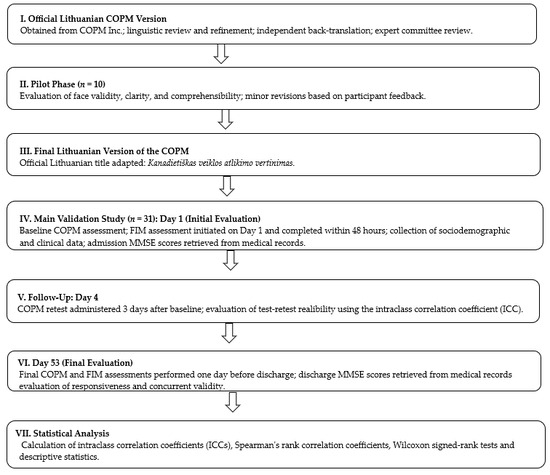
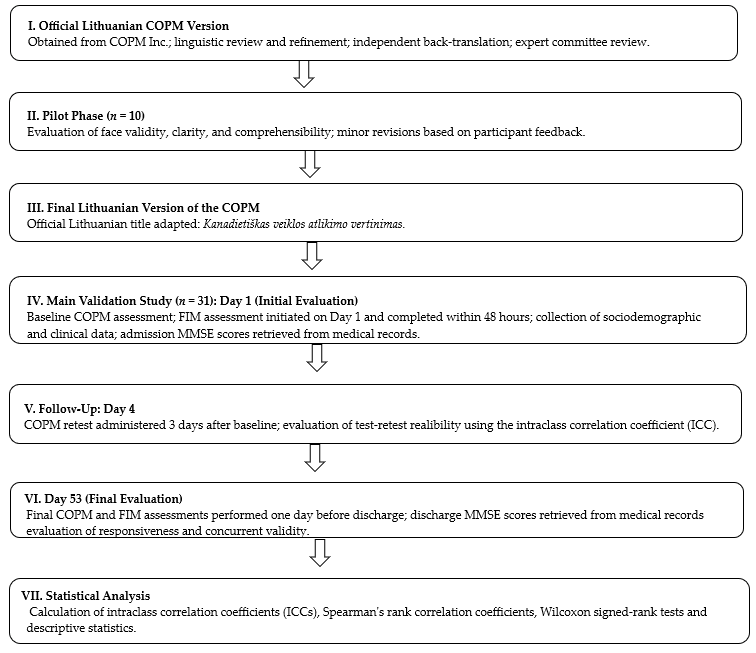
The study consisted of two phases. First, a pilot study involving 10 individuals after stroke was conducted to evaluate the clarity, comprehensibility, and practical applicability of the Lithuanian COPM version at Kulautuva Rehabilitation Hospital, a branch of the Hospital of Lithuanian University of Health Sciences Kauno Klinikos (Kaunas, Lithuania). Following minor linguistic refinements, the psychometric validation study was performed in an independent sample of 31 individuals undergoing inpatient rehabilitation at the Department of Neurorehabilitation of the same university hospital (Kaunas, Lithuania). The overall study design and validation process are presented in Figure 1.
Figure 1.
Study design and psychometric validation process of the Lithuanian version of the Canadian Occupational Performance Measure (COPM).
Participants were included if they had a confirmed diagnosis of stroke, were in the subacute phase of rehabilitation, and had signed an informed consent form. Patients were excluded if they had severe cognitive impairment (Mini-Mental State Examination (MMSE) score of <10), communication disorders (e.g., aphasia), or other conditions preventing their participation in the COPM interview, including the ability to understand the interview questions, identify personally meaningful occupational performance problems, prioritize them, and rate their occupational performance and satisfaction.
2.2. Review and Refinement of the Lithuanian COPM Version
An official Lithuanian version of the COPM was obtained from the copyright holders (COPM Inc., Canada). Prior to pilot testing, the wording of the Lithuanian version was reviewed by the research team and language specialists to ensure conceptual consistency with the original English instrument. Minor linguistic inconsistencies were corrected, and the Lithuanian title “Kanadietiškas veiklos atlikimo vertinimas” was adapted. A formal backtranslation into English was subsequently performed by bilingual professionals and compared with the original COPM version to verify conceptual equivalence.
During the pilot phase (n = 10), participants evaluated the clarity, comprehensibility, and practical applicability of the Lithuanian version of the COPM. Based on their feedback, minor linguistic and stylistic modifications were introduced, resulting in the final Lithuanian version used in the psychometric validation study.
2.3. Study Procedure
Following completion of the pilot phase, the psychometric validation study was initiated. Sociodemographic and clinical characteristics, including age, sex, stroke type, and affected body side, were recorded at admission. Upon admission, the MMSE was administered by a medical psychologist as part of the initial clinical assessment and was used to determine eligibility for the study. MMSE scores were obtained from patients’ medical records.
All participants received standard multidisciplinary inpatient rehabilitation throughout the study period. Assessments were performed at three predefined time points. At admission, the initial COPM interview was administered by an occupational therapist as part of the initial occupational therapy assessment (Day 1). The baseline FIM assessment was initiated on Day 1 as part of the initial multidisciplinary rehabilitation evaluation and completed within the first 48 h of admission, allowing sufficient time to evaluate functional independence across daily activities. The COPM was re-administered 3 days later (Day 4) to evaluate test–retest reliability. The final assessment was performed one day prior to discharge from inpatient rehabilitation, on average 53 days after admission (SD, 2 days). At that time, the COPM interview and final FIM scores were recorded to evaluate responsiveness and concurrent validity. MMSE scores at discharge, obtained from assessments performed by medical psychologist, were also retrieved from patient’s medical records for exploratory analyses.
2.4. Outcome Measures
2.4.1. Canadian Occupational Performance Measure
The COPM was used to identify occupational performance problems and evaluate changes in self-perceived occupational performance and satisfaction over time. It is a semi-structured, client-centered interview in which participants identify, prioritize, and rate occupational performance problems in the areas of self-care, productivity, and leisure [6]. During the interview, participants first rated the importance of each identified occupational performance problem to establish individual priorities. Subsequently, they rated their Performance and Satisfaction for the identified problems using a 10-point scale, with higher scores indicating better perceived performance and greater satisfaction. For statistical analysis, overall Performance and Satisfaction scores were calculated for each participant as the mean rating across all identified occupational performance problems.
2.4.2. Functional Independence Measure
The Lithuanian version of the FIM was used as an external criterion to assess the concurrent validity of the Lithuanian version of the COPM. Its use followed the standardized FIM methodology published by the Lithuanian Ministry of Health in 2019 [11]. The FIM consists of 18 items covering motor and cognitive domains. Each item is scored on a 7-point scale ranging from 1 (complete dependence) to 7 (complete independence) [12]. The FIM total score ranges from 18 to 126, with higher scores indicating greater functional independence. The motor subscale consists of 13 items (score range: 13–91), while the cognitive subscale consists of 5 items (score range: 5–35). FIM total, motor, and cognitive scores were included in the analysis.
The FIM was selected as a comparator because it is widely used to assess functional independence in inpatient rehabilitation. Although the COPM and the FIM address related aspects of functioning, they measure distinct constructs: the COPM captures patient-perceived occupational performance and satisfaction, whereas the FIM assesses clinician-rated functional independence in daily activities.
2.5. Statistical Analysis
Statistical analyses were performed using IBM SPSS Statistics software, version 31.0. Continuous variables are presented as means with standard deviations (SDs). Categorical variables are presented as frequencies and percentages.
Test–retest reliability was assessed using a single-measure intraclass correlation coefficient (ICC) based on a two-way mixed-effects model for absolute agreement, along with its 95% confidence interval. The corresponding 95% confidence intervals were obtained using the standard ICC procedure in IBM SPSS Statistics. Concurrent validity was assessed by calculating Spearman’s correlation coefficients between COPM Performance and Satisfaction scores and FIM total, motor, and cognitive scores at both admission and discharge. The 95% confidence intervals for Spearman’s correlation coefficients were estimated using the Bonett and Wright method. For a borderline correlation, an additional non-parametric bootstrap analysis (1000 resamples) was performed to assess the robustness of the confidence interval estimate.
Responsiveness was evaluated by comparing baseline COPM and FIM scores obtained at the initial evaluation (Day 1) and the final evaluation (Day 53) using the Wilcoxon signed-rank test. The normality of the paired differences was assessed using the Shapiro–Wilk test. Due to a departure from normality in the paired differences (p = 0.016 and p = 0.003, respectively), the non-parametric Wilcoxon signed-rank test was chosen over the paired t-test. Data are expressed as median and interquartile range: median (Q1–Q3). Effect sizes were calculated using the formula , where Z represents the test statistic of the Wilcoxon signed-rank test and n represents the total number of paired observations (n = 31), and were interpreted as small (r ≥ 0.10), medium (r ≥ 0.30), or large (r ≥ 0.50).
Additional analyses were performed to compare COPM scores according to sex, stroke type, and affected body side using the Mann–Whitney U test. Associations between age and COPM scores were assessed using Spearman’s correlation coefficient.
Statistical significance was set at p < 0.05.
3. Results
3.1. Participant Characteristics
Thirty-one individuals with subacute stroke participated in the main validation study. The mean age of the study population was 71.16 years (SD, 11.88) (median, 73 years; range, 37–88 years). The demographic and clinical characteristics of the participants are presented in Table 1.
Table 1.
Demographic and clinical characteristics of the study participants.
3.2. Test–Retest Reliability
Test–retest reliability was evaluated to determine the temporal stability of the Lithuanian version of the COPM. Occupational Performance and Satisfaction scores obtained at the initial evaluation (Day 1) were compared with those obtained at the follow-up assessment performed 3 days later (Day 4). The analysis demonstrated a high level of agreement between the two assessments. The ICC was 0.974 (p < 0.001) for the Performance score and 0.956 (p < 0.001) for the Satisfaction score (Table 2).
Table 2.
Test–retest reliability of the subscales of the Lithuanian COPM version.
3.3. Concurrent Validity
Concurrent validity was evaluated by examining the associations between the COPM and the clinician-rated FIM, which served as the external criterion measure. Spearman’s rank correlation coefficients (ρ) were used to assess associations separately at the initial and final evaluations; the detailed correlation results are presented in Table 3.
Table 3.
Concurrent validity of the Lithuanian COPM in relation to the Functional Independence Measure (FIM).
At the initial evaluation, COPM Performance scores demonstrated a moderate positive correlation with the FIM total score (ρ = 0.439, p = 0.014). No statistically significant correlations were observed between COPM Satisfaction scores and FIM total scores (p > 0.05). Neither Performance nor Satisfaction scores were significantly correlated with the scores of the cognitive FIM subscale (p > 0.05).
At the final evaluation, COPM Satisfaction scores showed moderate positive correlations with both the FIM total score (ρ = 0.592, p < 0.001) and the FIM motor subscale (ρ = 0.580, p < 0.001). A borderline possible association was observed between the COPM Performance score and the FIM total score at discharge (ρ = 0.360, p = 0.047; 95% CI: 0.032 to 0.651). The Bonett and Wright 95% CI (−0.005 to 0.641) marginally included zero, whereas the bootstrap percentile 95% CI (0.032 to 0.651) excluded zero. Given this discrepancy and the small sample size (n = 31), the association should be interpreted cautiously. No significant associations were found between COPM Performance scores and either the FIM motor or FIM cognitive subscale scores at discharge (p > 0.05).
3.4. Responsiveness
Responsiveness of the Lithuanian COPM was evaluated by comparing baseline and final assessment scores. Statistically significant improvements were observed in the scores of both COPM subscales following inpatient rehabilitation (p < 0.001 for both; Table 4).
Table 4.
Changes in COPM scores between the initial and final evaluation.
The median Performance score increased from 3.00 (Q1–Q3: 2.00–3.75) at the initial evaluation to 4.67 (Q1–Q3: 4.00–8.00) at the final evaluation, while the median Satisfaction score increased from 6.00 (Q1–Q3: 4.75–6.67) to 8.33 (Q1–Q3: 7.25–9.00). Detailed statistical parameters are presented in Table 4. At the individual level, 16 participants (51.6%) achieved an improvement of at least 2 points in COPM Performance, while 13 participants (41.9%) achieved this threshold in COPM Satisfaction.
3.5. Occupational Performance Problems Identified Using the COPM
The occupational performance problems identified during COPM assessment were predominantly related to basic activities of daily living. The most frequently noted problems were related to toileting (n = 25, 80.6%), dressing (n = 17, 54.8%), bathing (n = 15, 48.4%), personal hygiene (n = 12, 38.7%), and eating (n = 8, 25.8%). Mobility-related problems, specifically stair climbing, were identified by 14 participants (45.2%). Instrumental activities of daily living were reported less frequently, including driving, food preparation, and shopping (n = 2, 6.5% each). Only one participant (3.2%) mentioned a leisure-related occupational performance problem, while no work-related problems were identified.
3.6. Exploratory Analyses of Demographic and Clinical Variables
Additional exploratory analyses were performed to examine whether demographic and clinical characteristics were associated with COPM scores. No statistically significant differences in COPM scores were observed according to sex, stroke type, or affected body side.
No statistically significant correlation was found between age and baseline COPM Performance scores (ρ = −0.146, p = 0.432). However, age was negatively correlated with COPM Satisfaction scores at the final evaluation (ρ = −0.365, p = 0.043) and with MMSE scores at the final evaluation (ρ = −0.388, p = 0.031).
4. Discussion
This study presents the first psychometric evaluation of the Lithuanian version of the COPM in individuals after stroke. The findings demonstrated high test–retest reliability, evidence partially supporting concurrent validity with the FIM, and good responsiveness to clinical changes during inpatient rehabilitation. Together, these findings support the use of the Lithuanian version of the COPM as a reliable and valid client-centered outcome measure for stroke rehabilitation in Lithuania.
The Lithuanian version of the COPM demonstrated high test–retest reliability for both the Performance (ICC = 0.974) and Satisfaction (ICC = 0.956) subscales. Similarly, Berardi et al. determined ICC values of 0.99 for Performance and 0.98 for Satisfaction in individuals with spinal cord injury, with both assessments performed by the same occupational therapist within a 6-day retest interval [10]. Larsen et al. reported ICC values of 0.753 for Performance and 0.703 for Satisfaction for intra-rater reliability when the same therapist repeated the assessment after approximately 10 days, whereas lower values were observed for inter-rater reliability involving two different therapists [13]. In the Turkish study of COPM validation evaluating older adults, ICC values were 0.92 for Performance and 0.78 for Satisfaction following a retest performed within 2 weeks [14]. These studies involved different patient populations, including individuals with spinal cord injury, older adults, and patients undergoing stroke rehabilitation. Differences in clinical characteristics, rehabilitation settings, and the potential for changes in occupational performance between assessments should therefore be considered when comparing reliability estimates across studies.
Overall, previous studies suggest that test–retest reliability is influenced not only by the psychometric properties of the instrument but also by methodological factors, including a retest interval and whether repeated assessments are performed by the same or different occupational therapists. Taken together, these findings suggest that shorter retest intervals may result in greater test–retest reliability estimates as there is a smaller chance for actual changes in patients’ perceived occupational performance and satisfaction to occur between assessments. In the present study, a longer retest interval was intentionally avoided because patients undergoing inpatient neurological rehabilitation may experience clinically meaningful changes in functional status within a relatively short period, potentially affecting self-perceived occupational performance and satisfaction independently of the measurement properties of the instrument. Furthermore, the short 3-day interval between assessments may have introduced recall bias, as participants could have remembered their responses from the initial assessment, potentially influencing the test–retest reliability estimates.
These findings are consistent with the conclusions of Larsen and Law, who in their recent state-of-the-art review concluded that the COPM is a reliable outcome measure for evaluating changes before and after intervention, particularly when the same occupational therapist performs repeated assessments [7].
As the COPM is a client-centered measure, occupational performance problems identified by participants provide valuable insight into patients’ rehabilitation priorities during the early stage of stroke recovery. In the present study, participants predominantly identified occupational performance problems related to basic activities of daily living including dressing, bathing, toileting, eating and functional mobility. Occupational performance problems related to instrumental activities of daily living such as preparing food and driving were reported less frequently, only one participant identified an occupational performance problem related to leisure, and no work-related occupational performance problems were prioritized. These findings are consistent with a recent systemic review and meta-analysis reporting that inpatient stroke rehabilitation during acute and subacute stages primarily targets body functions, body structures, and activity-level limitations, potentially explaining why occupations related to basic activities of daily living were most frequently prioritized in the present study [15].
A similar pattern has been reported by Tuntland et al., who found that functional mobility was the most frequently prioritized occupational category among home-dwelling older adults receiving rehabilitation, whereas relatively few participants reported work or leisure-related occupational problems [16]. Comparable findings have also been reported in other COPM validation studies, where self-care activities represented the most frequently identified occupational performance problems in the rehabilitation population [14]. Furthermore, Larsen and Law, in their comprehensive review, have emphasized that inpatient populations more often identify challenges related to basic activities of daily living, whereas community-based patients tend to prioritize instrumental activities of daily living and lifestyle integration [7].
The predominance of problems related to basic activities of daily living observed in the present study could be linked to the early stage of stroke rehabilitation, when regaining independence in essential daily activities is a primary rehabilitation goal.
Similar weak-to-moderate correlations have been reported in previous validation studies using the FIM [14]. Moderate correlations between the COPM and the FIM may be explained by differences in what the two instruments measure. The FIM evaluates standardized functional independence from an occupational therapist’s perspective, whereas the COPM reflects patients’ self-perceived performance and satisfaction in individually meaningful occupations. Accordingly, Larsen and Law have concluded that consistently reported low-to-moderate correlations in COPM validation studies indicate that occupational performance problems identified by this client-centered measure provide unique information rather than duplicating standardized functional assessments [7], enabling the identification of occupations that clients want or need to perform, as well as those which they are dissatisfied with [17].
A more detailed analysis of the FIM subscales provides further insight into these relationships. Although the correlation of COPM scores with FIM motor subscale scores tended to be stronger than that with FIM cognitive subscale scores, this pattern may reflect the fact that the occupational performance problems identified by participants were predominantly related to self-care and mobility, which largely depend on motor function rather than cognitive abilities.
The present study identified several statistically significant correlations between COPM and FIM scores, providing partial support for the concurrent validity of the Lithuanian COPM. However, these findings should be interpreted cautiously, as the two instruments assess related but distinct constructs. Similar weak-to-moderate associations have consistently been reported across validation studies of different language versions of the COPM. The Turkish validation study demonstrated weak-to-moderate correlations between the COPM and the FIM (Spearman’s correlation coefficients ranging from 0.33 to 0.61) [14], consistent with the present findings. In the Spanish validation study involving older adult rehabilitation inpatients, COPM Performance and Satisfaction showed moderate correlations with the Barthel Index (Spearman’s ρ = 0.43 and ρ = 0.46, respectively), another widely used measure of functional independence [18]. Furthermore, Thyer et al. found moderate correlations between COPM Performance and Satisfaction scores and FIM Total scores at discharge (Pearson’s r = 0.598 and r = 0.596, respectively) among older adults undergoing subacute inpatient rehabilitation [19].
Cup et al. similarly reported that many occupational performance problems identified using the COPM in individuals with stroke were not captured by standardized functional measures [20]. A systematic review of research on the COPM in stroke rehabilitation has concluded that the COPM generally demonstrates weak-to-moderate correlations with standardized functional outcome measures because it assesses individualized occupational problems that cannot be adequately captured by fixed-item instruments [21]. More recently, Larsen and Law have reached the same conclusion in their comprehensive review, emphasizing that occupational performance problems identified through the COPM provide unique patient-centered information rather than duplicating standardized functional assessments [7].
An interesting finding of the present study was that the pattern of associations differed between the initial and final evaluations. At admission, only the COPM performance score was significantly correlated with the FIM Total score, whereas satisfaction was not associated with functional independence. By the final evaluation, Satisfaction scores demonstrated moderate correlations with both the FIM Total and FIM Motor scores, while no significant associations were observed with the FIM Cognitive subscale scores. This pattern indicates that at the final evaluation, patients’ satisfaction with occupational performance was more closely associated with their level of functional independence than at the initial evaluation.
The Lithuanian version of the COPM demonstrated good responsiveness as both Occupational Performance and Occupational Satisfaction scores improved significantly following inpatient stroke rehabilitation. Similar improvements have been reported in previous studies evaluating the responsiveness of COPM in neurological rehabilitation. Almhdawi et al. reported a mean improvement of 2.83 and 3.46 points for Performance and Satisfaction, respectively, following task-orientated occupational therapy in individuals after stroke [22]. Likewise, a large retrospective study by Vyslysel et al. involving patients who underwent community-based rehabilitation found that 60% of patients showed a clinically meaningful improvement of ≥2 points in COPM Performance and 66% in Satisfaction, with average improvements of 2.2 and 2.8 points, respectively [23].
Minimal important change (MIC) is defined as the smallest change in an outcome measure that is perceived as clinically important by a patient. A change of 2 points in COPM Performance and Satisfaction scores has traditionally been regarded as clinically meaningful. However, a review by McColl et al. has highlighted that this threshold is largely based on expert opinion rather than empirical evidence [24]. More recently, a systematic review by Yuine et al. summarized the available studies investigating the MIC within the COPM and concluded that a clinically meaningful change varied across populations and assessment methods, although a change between 2 and 4 points may serve as a practical reference when interpreted within the clinical context [25].
In the present study, the mean improvements were 2.37 points for Occupational Performance and 2.18 points for Occupational Satisfaction. These values are comparable to the MIC estimates (2.20 and 2.06 points, respectively) reported by Ohno et al. in patients undergoing subacute rehabilitation [26], although they are lower than values reported by Tuntland et al. (3.0 and 3.2 points) in home-dwelling older adults receiving rehabilitation [16]. Altogether, these findings support the responsiveness of the Lithuanian version of the COPM and further illustrate that the magnitude of clinically meaningful change depends on the characteristics of the study population, rehabilitation setting, and method used to estimate MIC. In addition to the statistically significant improvements and large effect sizes (r = 0.83 for COPM Performance and r = 0.86 for COPM Satisfaction), individual-level analysis showed that 51.6% of participants achieved an improvement of at least 2 points in Performance and 41.9% in Satisfaction. These findings provide further insight into responsiveness of the Lithuanian COPM, while illustrating the variability in individual outcomes and the importance of considering both statistical and potential clinical importance of observed changes.
In contrast, while the present study demonstrated concurrent improvements in both COPM scores and functional independence during early inpatient rehabilitation, a recent systematic review and meta-analysis reported significant improvements in COPM-measured occupational performance among individuals with chronic stroke, although no significant improvements in objectively measured physical or cognitive function were found [2].
Regarding demographic and clinical characteristics, exploratory analyses in the present study showed that age was negatively correlated with COPM Satisfaction scores at discharge, whereas no significant differences in COPM scores were observed according to sex, stroke type, or affected body side. However, these subgroup findings should be interpreted cautiously given the relatively small sample size. Similarly, Abu Tariah et al. found no significant associations between the achievement of occupational therapy goals and age, sex, stroke type, or stroke hemisphere [27].
5. Limitations
This study has several limitations. First, the relatively small sample size and recruitment from a single rehabilitation center may limit the generalizability of the findings. The small sample size also limited the statistical power of exploratory subgroup analyses based on sex, stroke type, and affected body side. Therefore, the absence of statistically significant differences should not be interpreted as evidence that clinically meaningful differences between these subgroups do not exist. Second, test–retest reliability was assessed by the same examiner over a short 3-day interval, which may have introduced recall bias. Additionally, inter-rater reliability was not evaluated and could be explored in future studies. Finally, individuals with severe cognitive impairment who were unable to understand the interview procedure were not included; therefore, the findings cannot be generalized to all individuals with stroke.
Despite these limitations, the present study provides valuable evidence supporting the reliability and responsiveness of the Lithuanian version of the COPM and may encourage further research involving larger samples and more diverse patient populations.
6. Conclusions
The findings of this study support the use of the Lithuanian version of the COPM as a client-centered assessment and outcome measure for individuals undergoing poststroke rehabilitation. The instrument demonstrated high test–retest reliability, evidence partially supporting concurrent validity, and responsiveness to change, supporting its use for evaluating patients’ self-perceived occupational performance and satisfaction during inpatient rehabilitation. By complementing clinician-rated functional assessments with patients’ own perspectives, the COPM may facilitate individualized goal setting, treatment planning, and outcome evaluation in occupational therapy.
Author Contributions
Conceptualization, E.E. and D.P.; methodology, R.K. and R.S.; validation, E.E. and J.M.; formal analysis, R.P.; investigation, E.E. and D.P.; data curation, R.P.; writing—original draft preparation, E.E.; writing—review and editing, D.P., J.M. and R.S.; supervision, R.K. All authors have read and agreed to the published version of the manuscript.
Funding
This research received no external funding.
Institutional Review Board Statement
The study was conducted in accordance with the Declaration of Helsinki and approved by Kaunas Regional Biomedical Research Ethics Committee (protocol number No. 2025-BE10-0007, permission No. BE-2-91; date of approval: 24 July 2025).
Informed Consent Statement
Informed consent was obtained from all subjects involved in the study.
Data Availability Statement
The datasets generated and analyzed during the current study are not publicly available due to ethical and privacy restrictions but are available from the corresponding author on reasonable request.
Conflicts of Interest
The authors declare no conflicts of interest.
Abbreviations
The following abbreviations are used in this manuscript:
| ICF | International Classification of Functioning, Disability, and Health |
| COPM | Canadian Occupational Performance Measure |
| FIM | Functional Independence Measure |
| MMSE | Mini-Mental State Examination |
| SD | Standard deviation |
| ICC | Intraclass correlation coefficient |
| MIC | Minimal important change |
References
- Feigin, V.L.; Brainin, M.; Norrving, B.; Martins, S.O.; Pandian, J.; Lindsay, P.; Grupper, M.F.; Rautalin, I. World Stroke Organization: Global Stroke Fact Sheet 2025. Int. J. Stroke 2025, 20, 132–144. [Google Scholar] [CrossRef] [Scilit]
- Vásquez-Carrasco, E.; Jamett-Oliva, P.; Hernandez-Martinez, J.; Riquelme-Hernández, C.; Villagrán-Silva, F.; Branco, B.H.M.; Sandoval, C.; Valdés-Badilla, P. Effectiveness of Occupational Therapy Interventions on Activities of Daily Living, Cognitive Function, and Physical Function in Middle-Aged and Older People with Chronic Stroke: A Systematic Review with Meta-Analysis. J. Clin. Med. 2025, 14, 2197. [Google Scholar] [CrossRef] [Scilit]
- Wong, M.N.-K.; Cheung, M.K.-T.; Ng, Y.-M.; Yuan, H.-L.; Lam, B.Y.-H.; Fu, S.N.; Chan, C.C.H. International Classification of Functioning, Disability, and Health-based rehabilitation program promotes activity and participation of post-stroke patients. Front. Neurol. 2023, 14, 1235500. [Google Scholar] [CrossRef] [Scilit] [PubMed]
- Rodríguez-Bailón, M.; López-González, L.; Merchán-Baeza, J.A. Client-centred practice in occupational therapy after stroke: A systematic review. Scand. J. Occup. Ther. 2022, 29, 89–103. [Google Scholar] [CrossRef] [Scilit]
- Law, M.; Baptiste, S.; McColl, M.; Opzoomer, A.; Polatajko, H.; Pollock, N. The Canadian occupational performance measure: An outcome measure for occupational therapy. Can. J. Occup. Ther. 1990, 57, 82–87. [Google Scholar] [CrossRef] [Scilit]
- Law, M.; Baptiste, S.; Carswell, A.; McColl, M.A.; Polatajko, H.; Pollock, N. Canadian Occupational Performance Measure Manual, 5th ed.; CAOT Publications ACE: Ottawa, ON, Canada, 2014; 56p. [Google Scholar]
- Larsen, A.E.; Law, M. Canadian Occupational Performance Measure the state of the art—A review. Scand. J. Occup. Ther. 2025, 32, 2473045. [Google Scholar] [CrossRef] [Scilit]
- Dedding, C.; Cardol, M.; Eyssen, I.C.; Dekker, J.; Beelen, A. Validity of the Canadian Occupational Performance Measure: A client-centred outcome measurement. Clin. Rehabil. 2004, 18, 660–667. [Google Scholar] [CrossRef] [Scilit]
- Wressle, E.; Marcusson, J.; Henriksson, C. Clinical utility of the Canadian Occupational Performance Measure--Swedish version. Can. J. Occup. Ther. 2002, 69, 40–48. [Google Scholar] [CrossRef] [Scilit]
- Berardi, A.; Galeoto, G.; Guarino, D.; Marquez, M.A.; De Santis, R.; Valente, D.; Caporale, G.; Tofani, M. Construct validity, test-retest reliability, and the ability to detect change of the Canadian Occupational Performance Measure in a spinal cord injury population. Spinal Cord. Ser. Cases 2019, 5, 52. [Google Scholar] [CrossRef] [Scilit]
- Lithuanian Ministry of Health. Funkcinio Nepriklausomumo Nustatymo Skalės (FIM) Metodika [Functional Independence Measure (FIM) Methodology]; Lithuanian Ministry of Health: Vilnius, Lithuania, 2019; Available online: https://sam.lrv.lt/uploads/sam/documents/files/FIM_metodika_v3_fin.pdf (accessed on 23 October 2026).
- Granger, C.V.; Hamilton, B.B.; Linacre, J.M.; Heinemann, A.W.; Wright, B.D. Performance profiles of the functional independence measure. Am. J. Phys. Med. Rehabil. 1993, 72, 84–89. [Google Scholar] [CrossRef] [Scilit]
- Larsen, A.E.; Wehberg, S.; Christensen, J.R. The reliability of the Danish version of the Canadian Occupational Performance Measure. Br. J. Occup. Ther. 2022, 85, 367–376. [Google Scholar] [CrossRef] [Scilit]
- Altuntaş, O.; Değerli, M.N.Ö.; Temizkan, E.; Ekici, G. Psychometric properties of the Canadian occupational performance measure in older individuals. Turk. J. Med. Sci. 2023, 54, 338–347. [Google Scholar] [CrossRef] [Scilit]
- Triantis, E.; Liu, K.P. Activities of daily living interventions on activity performance of inpatients post-stroke: A systematic review and meta-analysis. Br. J. Occup. Ther. 2024, 87, 598–613. [Google Scholar] [CrossRef] [Scilit]
- Tuntland, H.; Aaslund, M.K.; Langeland, E.; Espehaug, B.; Kjeken, I. Psychometric properties of the Canadian Occupational Performance Measure in home-dwelling older adults. J. Multidiscip. Healthc. 2016, 9, 411–423. [Google Scholar] [CrossRef] [Scilit] [PubMed]
- Larsen, E.A.; Wehberg, S.; Christensen, J.R. The Validity of the Danish Version of the Canadian Occupational Performance Measure. Occup. Ther. Int. 2020, 2020, 1309104. [Google Scholar] [CrossRef] [Scilit]
- Capdevila, E.; Portell, M.; Penelo, E.; Rodríguez-Bailón, M. Measurement properties of the Spanish COPM in older adult rehabilitation inpatients. Scand. J. Occup. Ther. 2024, 31, 2377175. [Google Scholar] [CrossRef] [Scilit]
- Thyer, L.; Brown, T.; Roe, D. The Validity of the Canadian Occupational Performance Measure (COPM) When Used in a Sub-Acute Rehabilitation Setting with Older Adults. Occup. Ther. Health Care 2018, 32, 137–153. [Google Scholar] [CrossRef] [Scilit]
- Cup, E.H.; Scholte Op Reimer, W.J.; Thijssen, M.C.; van Kuyk-Minis, M.A. Reliability and validity of the Canadian Occupational Performance Measure in stroke patients. Clin. Rehabil. 2003, 17, 402–409. [Google Scholar] [CrossRef] [Scilit]
- Yang, S.Y.; Lin, C.Y.; Lee, Y.C.; Chang, J.H. The Canadian occupational performance measure for patients with stroke: A systematic review. J. Phys. Ther. Sci. 2017, 29, 548–555. [Google Scholar] [CrossRef] [Scilit]
- Almhdawi, K.A.; Mathiowetz, V.G.; White, M.; DelMas, R.C. Efficacy of Occupational Therapy Task-oriented Approach in Upper Extremity Post-stroke Rehabilitation. Occup. Ther. Int. 2016, 23, 444–456. [Google Scholar] [CrossRef] [Scilit]
- Vyslysel, G.; Barker, D.; Hubbard, I.J. The Canadian Occupational Performance Measure (COPM) as Routine Practice in Community-Based Rehabilitation: A Retrospective Chart Review. Arch. Rehabil. Res. Clin. Transl. 2021, 3, 100134. [Google Scholar] [CrossRef] [Scilit]
- McColl, M.A.; Denis, C.B.; Douglas, K.L.; Gilmour, J.; Haveman, N.; Petersen, M.; Presswell, B.; Law, M. A Clinically Significant Difference on the COPM: A Review. Can. J. Occup. Ther. 2023, 90, 92–102. [Google Scholar] [CrossRef] [Scilit]
- Yuine, H.; Sasaki, T.; Miyata, K.; Saito, S.; Shiraishi, H. Minimal Important Change in Canadian Occupational Performance Measure: A Systematic Review. OTJR Occup. Ther. J. Res. 2025, 46, 15394492251360232. [Google Scholar] [CrossRef] [Scilit]
- Ohno, K.; Tomori, K.; Sawada, T.; Kobayashi, R. Examining minimal important change of the Canadian Occupational Performance Measure for subacute rehabilitation hospital inpatients. J. Patient Rep. Outcomes 2021, 5, 133. [Google Scholar] [CrossRef] [Scilit]
- Abu Tariah, H.; Aljehani, A.S.; Alenazi, D.Y.; Alturaif, D.A.; Alsarhani, M.N. Occupational Therapy Goal Achievement for People with Stroke: A Retrospective Study. Occup. Ther. Int. 2020, 2020, 8587908. [Google Scholar] [CrossRef] [Scilit]

Disclaimer/Publisher’s Note: The statements, opinions and data contained in all publications are solely those of the individual author(s) and contributor(s) and not of MDPI and/or the editor(s). MDPI and/or the editor(s) disclaim responsibility for any injury to people or property resulting from any ideas, methods, instructions or products referred to in the content. |
© 2026 by the authors. Published by MDPI on behalf of the Lithuanian University of Health Sciences. Licensee MDPI, Basel, Switzerland. This article is an open access article distributed under the terms and conditions of the Creative Commons Attribution (CC BY) license.