


Abstract
Background and Objectives: Adherence to oral therapies in inflammatory bowel disease (IBD) is a critical determinant of treatment outcomes. Janus kinase inhibitors (JAKis) are an important therapeutic advancement in IBD management, offering oral, small-molecule alternatives to biological agents. However, little is known about how clinicians perceive and assess adherence to oral small-molecule therapies. This exploratory study aimed to examine how gastroenterologists perceive, assess, and address JAKi adherence. Materials and Methods: A structured 21-item web survey was administered by the Italian Association of Hospital Gastroenterologists and Endoscopists (AIGO) to Italian IBD gastroenterologists in April 2025; 42 completed it. Respondents were characterized by years of experience (<10, 10–20, >20 years), hospital type, and IBD patient volume (<100, 100–500, >500 patients). The questionnaire addressed prescribing practices, adherence assessment methods, perceived barriers to adherence, and strategies to improve adherence. No patient-level adherence data were collected: all findings reflect physicians’ self-reported perceptions and practices. Primary analyses were restricted to the 38 respondents who had at least one patient treated with a JAKi. Proportions are reported with Wilson 95% confidence intervals; associations were explored with 279 pairwise Fisher’s exact tests, reported both uncorrected and after Benjamini–Hochberg false discovery rate (FDR) adjustment, and are hypothesis-generating. Results: Among the 38 JAKi prescribers, 86.8% (33/38; 95% CI 72.7–94.2%) considered adherence a clinical concern and all 38 (100%) reported assessing adherence in clinical practice; 37/38 (97.4%) reported doing so by direct verbal questioning and none reported using a questionnaire or validated scale. Forgetfulness (71.1%) and absence of symptoms (68.4%) were the most frequently perceived barriers; digital applications/reminders (71.1%) and dose simplification (63.2%) were the most endorsed interventions. No association was detected between adherence concern and years of IBD experience, hospital type, or patient volume in this small sample. Sixteen of 279 pairwise tests had an uncorrected p < 0.05 (14 expected by chance); none remained significant after FDR adjustment (smallest q = 0.24), and odds ratios had very wide confidence intervals. Small sample size, unknown response rate, a non-validated questionnaire, cross-sectional design, and the perception-based nature of the data limit inference and generalizability. Conclusions: Among the Italian gastroenterologists who responded to this survey and currently prescribe JAKi, adherence to oral therapy was a concern when prescribing a JAK inhibitor, and respondents reported routinely assessing adherence to therapies in clinical practice, mainly through unstructured verbal questioning. The exploratory associations among survey responses require confirmation in larger, patient-centred studies incorporating objective adherence measures.
1. Introduction
Inflammatory bowel disease (IBD), encompassing Crohn’s disease and ulcerative colitis, is a chronic relapsing–remitting condition that requires long-term pharmacological management [1]. The introduction of Janus kinase (JAK) inhibitors (JAKi), including tofacitinib, upadacitinib, and filgotinib, has expanded the therapeutic armamentarium for patients with moderate-to-severe IBD, offering oral administration as a practical advantage over biologic therapies that require parenteral delivery [2].
Unlike biological therapies administered by injection or intravenous infusion, JAKis are taken orally, offering patients greater autonomy and convenience. However, this apparent advantage also introduces a specific vulnerability: the risk of suboptimal adherence. Adherence to chronic therapy is a well-recognized medical issue, with a worldwide estimated mean adherence rate of about 50% [3]. In IBD, non-adherence to oral medication has been reported in 7% to 72% of patients, with most studies reporting 30–45%, depending on the measurement method and the population studied [4]. Oral therapies may be more vulnerable to non-adherence than parenteral therapies, because the absence of clinical supervision at each administration removes a natural adherence-promoting mechanism [5]. Non-adherence in chronic inflammatory conditions is associated with disease relapse, hospitalization, increased healthcare resource utilization, and disease progression [6]. For JAKi specifically, the plasma half-lives of the available agents are short (approximately 3 h for tofacitinib, 7 h for filgotinib, and 9–14 h for upadacitinib) [2], so missed doses may translate into periods of reduced drug exposure, which could in principle compromise efficacy.
As for other chronic therapy, adherence to JAKi treatment is not solely a patient-level issue. It reflects a complex interplay of drug-related factors (dosing frequency, side-effect profile, pill burden), disease-related factors (symptom presence, chronicity, perceived necessity), patient-related factors (health literacy, social support, motivation), and healthcare system factors (quality of physician–patient communication, access to monitoring, and availability of multidisciplinary support) [7]. Physicians play a central role in this ecosystem both as prescribers who shape treatment choice and as educators who influence patient understanding and engagement.
Physician perceptions of adherence barriers are clinically important, because they determine counselling approaches, follow-up intensity, and the selection of supportive interventions [8]. Although clinicians’ perceptions of medication non-adherence in IBD have been surveyed in general [9], data on how IBD specialists conceptualize and manage JAKi adherence are virtually absent. Moreover, it is unknown whether prescribing volume, institutional setting, or years of clinical experience influence these perceptions and behaviours.
Accordingly, this exploratory study aimed to describe the perceptions, practices, and preferred strategies of Italian gastroenterologists regarding adherence to JAKi in IBD, and to explore whether physician- and institution-level characteristics were associated with considering adherence a clinical concern, through a cross-sectional survey. The study investigates physicians’ perceptions and self-reported practices; patient adherence itself was not measured.
2. Materials and Methods
2.1. Study Design and Participants
A cross-sectional web-based survey was administered by the Italian Association of Hospital Gastroenterologists and Endoscopists (AIGO) to Italian gastroenterologists with IBD expertise in April 2025. Eligibility criteria were: current practice as a gastroenterologist managing IBD patients, and familiarity with JAKi therapy. No minimum prescribing volume was required for inclusion. The invitation was sent by the AIGO mailing list to AIGO-affiliated physicians. Forty-two completed questionnaires were received. The geographic distribution of respondents was not recorded because the questionnaire was anonymous. This study surveyed physicians and did not collect patient-level data or identifiable information on individuals. Participation was voluntary, and the questionnaire consent was assumed upon completion. The study was conducted according to the principles of the Declaration of Helsinki. Ethical approval was not required for this study as it involved an anonymous, voluntary survey among healthcare professionals regarding their clinical practice/knowledge, without collecting any personal or clinical data from patients.
2.2. Survey Questionnaire
The survey comprised 21 structured items (Q1–Q21; Supplementary Table S1) covering: physician demographics and practice context (Q1–Q3: years of IBD experience, hospital type, patient volume); JAK prescribing context (Q4–Q5); adherence-focused practice (Q6, Q9, Q11–Q13); patient assessment before prescribing (Q7, Q8, Q10); adherence evaluation tools (Q14); communication and intervention strategies (Q15, Q17); technology attitudes (Q16); knowledge of adherence benefits (Q18); perceived reasons for non-adherence (Q19); and clinician behaviour and psychological support (Q20–Q21). The questionnaire was developed by the AIGO IBD working group, by consensus, was administered in the Italian language, and was not formally validated or pilot-tested. Table S1 is a translation. Q2 (hospital type) offered three options (university hospital, non-university hospital, outpatient clinic). Q4 asked whether the respondent could prescribe a JAKi and Q5 asked whether the respondent currently had patients treated with a JAKi; the specific JAKi used and the number of patients treated were not collected. Multiple-choice items with a requested maximum of three selections were used for Q15, Q17, and Q19 to elicit prioritized responses; the limit was an instruction to respondents and was not technically enforced, so that some respondents selected more than three options (Q15, n = 5; Q17, n = 1; Q19, n = 2). These responses were retained as given. For exploratory comparisons, ‘adherence concern’ was defined as a ‘yes’ answer to Q6, which asked whether, in light of the restrictions imposed by AIFA and by the Region, respondents consider the problem of adherence to an oral therapy when prescribing a JAK inhibitor. Q13 asked whether respondents dedicate time in their clinical practice to evaluating adherence to therapies, and Q14 asked which tools they use; these two items were not specific to JAKi. Together, the items describe physicians’ self-reported attitudes and practices regarding adherence, with Q6 anchored to JAKi prescribing.
2.3. Statistical Analysis
Data were organized using pandas and statistical analyses were conducted using scipy and statsmodels in Python 3.12 (Python Software Foundation, Wilmington, DE, USA). Proportions are reported with Wilson 95% confidence intervals [10]. For multiple-select items, each option was treated as a binary indicator and analyzed independently. Associations between binary variables were explored with Fisher’s exact test (2 × 2 tables); odds ratios (ORs) with 95% confidence intervals were calculated with the Woolf (logit) method [11]. Years of experience, hospital type, and patient volume (three levels each) were compared with adherence concern (Q6) using the Freeman–Halton extension of Fisher’s exact test [12]; the single outpatient-clinic respondent was kept as a separate category, and a 2 × 2 comparison of university versus non-university/outpatient respondents was also performed. In total, 279 pairwise tests were performed: all pairs among 24 binary survey variables (Q6, Q9, Q11, Q12, Q15a-f, Q16 [yes vs. not yes], Q17a-f, Q19a-f, and Q21 [psychological service already activated vs. not]; 276 tests) plus the three demographic comparisons with Q6. p-values are two-sided and uncorrected unless stated; the Benjamini–Hochberg false discovery rate (FDR) procedure [13] was applied to all 279 tests as a sensitivity analysis. Because the analyses are exploratory, ORs and p-values describe the data and are not confirmatory. No missing data were present for the items analyzed in the 38 respondents. To assess whether inverse associations between options of a capped multiple-choice item could arise from the response format, the observed co-selection of option pairs in Q19 was compared with a null distribution obtained by randomly reassigning each respondent’s selections while preserving the number of options he or she chose (20,000 permutations); a second null also preserved the total number of selections per option (matrix-swap randomization). All analyses were repeated in all 42 respondents as a sensitivity analysis.
3. Results
3.1. Sample Characteristics
Forty-two gastroenterologists completed the survey. Forty (95.2%) reported being able to prescribe a JAKi (Q4) and 38 (90.5%) reported currently having at least one patient treated with a JAKi (Q5); all 38 were also prescribers. These 38 respondents form the primary analytic sample (Table 1). The remaining four respondents (two without prescribing rights, one with prescribing rights but no current JAKi patients, and one with prescribing rights who did not answer Q5) were excluded from the primary analysis and were included only in the full-sample sensitivity analysis. Which JAKi were used and how many patients each respondent treated were not recorded.
Table 1.
Characteristics of respondents (n = 38).
Among the 38 included gastroenterologists, 44.7% had <10 years of IBD experience, 36.8% had 10–20 years of experience, and 18.4% had >20 years of experience. Most respondents worked in non-university hospitals (68.4%), 28.9% worked in university settings and 2.6% worked in outpatient clinics. Patient volume was distributed across the spectrum: 7.9% managed <100 IBD patients, 47.4% managed 100–500 patients, and 44.7% > 500.
3.2. Adherence Concern and Assessment
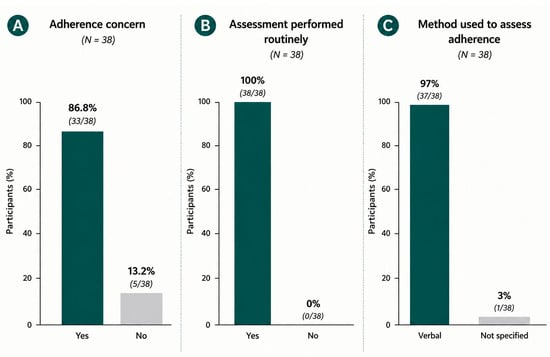
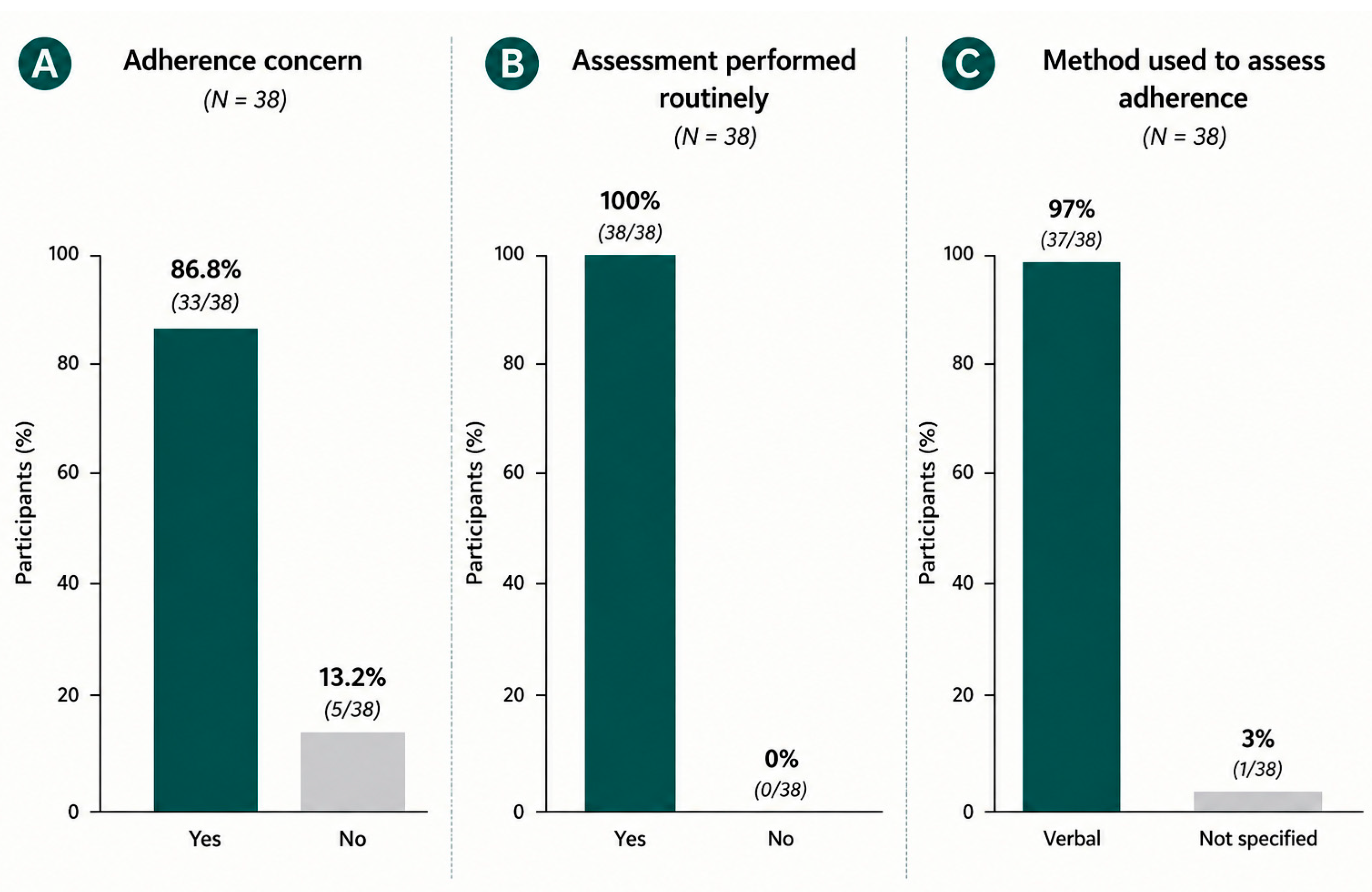
Thirty-three of 38 respondents (86.8%; 95% CI 72.7–94.2%) reported that they consider adherence to oral therapy a concern when prescribing a JAK inhibitor (Q6), and all 38 (100%; 95% CI 90.8–100%) reported dedicating time to assessing adherence to therapies in their clinical practice (Q13; not JAKi-specific; Figure 1A,B). Thirty-seven of 38 (97.4%; 95% CI 86.5–99.5%) reported assessing adherence by direct verbal questioning (one respondent who reported assessing adherence did not indicate a method), whereas questionnaires, whether anonymous or validated (e.g., the Morisky Medication Adherence Scale), were reported by none of the respondents (0/38; 95% CI 0–9.2%), indicating that structured adherence measurement was not reported in routine practice (Figure 1C). Five respondents (13.2%) reported assessing adherence although they did not consider it a clinical concern. In addition, 26/38 (68.4%; 95% CI 52.5–80.9%) of JAKi prescribers considered dosing frequency clinically important, 24/38 (63.2%; 95% CI 47.3–76.6%) believed that polytherapy for other comorbidities adversely affects adherence, and 28/38 (73.7%; 95% CI 58.0–85.0%) considered poor adherence to mesalamine a predictor of future poor adherence to JAKi.
Figure 1.
Discrepancy between awareness of adherence issues and adherence assessment practices among clinicians prescribing JAKi. (A) Concern regarding treatment adherence to JAKi. (B) Routine assessment of treatment adherence. (C) Methods reported to assess adherence (one respondent who reported assessing adherence did not specify a method). Data are expressed as percentages and numbers of respondents (N = 38). Despite routine assessment of adherence, no respondent reported using a structured or validated instrument.
3.3. Perceived Reasons for Non-Adherence
JAKi prescribers were asked to select up to three reasons they believed contributed most to patient non-adherence (Table 2); these are physicians’ perceptions, not measured patient behaviour. Forgetfulness and absence of symptoms were the two most frequent factors, chosen by 71.1% (95% CI 55.2–83.0%) and 68.4% (95% CI 52.5–80.9%) of respondents, respectively. Regimen complexity (39.5%; 95% CI 25.6–55.3%), lack of motivation (36.8%; 95% CI 23.4–52.7%), fear of side effects (28.9%; 95% CI 17.0–44.8%), and lack of information (21.1%; 95% CI 11.1–36.3%) followed in descending order of frequency. The mean number of reasons selected per respondent was 2.66 (median 3): 24 respondents (63.2%) selected three, 9 (23.7%) selected two, 3 (7.9%) selected one, and 2 (5.3%) selected four (the three-option limit was not technically enforced; these responses were retained). That most respondents used the full allotment is compatible with a multifactorial perception of non-adherence, although the selection limit prevents firm conclusions.
Table 2.
Perceived reasons for JAKi non-adherence (Q19; n = 38; respondents were asked to select up to 3 options; the limit was not enforced and 2 respondents selected 4; 95% CI, Wilson).
3.4. Preferred Intervention and Communication Strategies
For communication improvement (up to three of six items requested; five respondents selected more than three), respondents most frequently endorsed the use of clear language (76.3%, 95% CI 60.8–87.0%), more consultation time (65.8%, 95% CI 49.9–78.8%), human rapport (55.3%, 95% CI 39.7–69.9%), and continuity of the treating physician (55.3%, 95% CI 39.7–69.9%). When asked about specific adherence improvement strategies (up to three of six requested; one respondent selected four), digital applications or technology-based reminders were the top choice (71.1%, 95% CI 55.2–83.0%), followed by dose simplification (63.2%, 95% CI 47.3–76.6%), nurse or physician counselling sessions (52.6%, 95% CI 37.3–67.5%), and direct physician communication (42.1%, 95% CI 27.9–57.8%). Twenty-eight prescribers (73.7%; 95% CI 58.0–85.0%) found technology useful for adherence support.
All 38 prescribers endorsed the usefulness of psychological support, but only 9 (23.7%; 95% CI 13.0–39.2%) had already activated dedicated services. All 38 JAKi prescribers affirmed being aware of the clinical benefits of adherence; these two items (Q18, Q21) are likely to elicit near-universal agreement and are reported for completeness only.
3.5. Exploratory Cross-Tabulations
In total, 279 pairwise Fisher’s exact tests were performed. Sixteen had an uncorrected p < 0.05, against about 14 expected by chance alone. After Benjamini–Hochberg FDR adjustment, no association remained significant (smallest q = 0.24); the exploratory associations should therefore be read as hypothesis-generating only. In particular, no association was detected between considering adherence a clinical concern (Q6) and years of IBD experience (Freeman–Halton p = 0.57), hospital type (p = 1.00), or IBD patient volume (p = 0.26); with only five respondents not considering adherence a concern, these comparisons had very low power, and the absence of a significant association should not be interpreted as evidence of independence. Contingency tables, uncorrected p-values, FDR q-values, odds ratios and the exploratory nature of the analyses are detailed in Supplementary Table S2. To assess whether the inverse associations between Q19 options could arise from the capped-response format, permutation analyses were performed (20,000 permutations). When each respondent’s number of selections was preserved, the observed co-selection counts for fear of side effects with forgetfulness (4 observed vs. 6.2 expected; two-sided p = 0.46) and for absence of symptoms with lack of motivation (6 vs. 6.2; p = 1.00) were compatible with chance. When both respondent-level and option-level totals were preserved (matrix-swap randomization), co-selection of the first pair remained lower than expected (4 vs. 6.9; p = 0.067), and that of the second pair was also compatible with chance (6 vs. 8.5; p = 0.15). Results were similar in all 42 respondents (p = 0.12 and p = 0.23). None of the 15 option pairs remained significant after Benjamini–Hochberg correction (smallest q = 0.51). These findings suggest that the response format accounts for much of the observed inverse association, although a residual effect for the first pair cannot be excluded; all analyses are exploratory.
3.6. Baseline Safety Work-Up
Baseline safety monitoring was collected as a descriptive indicator of overall JAKi follow-up practice and was not tested against adherence. At JAKi initiation, 37/38 (97.4%; 95% CI 86.5–99.5%) of prescribers requested lipid and creatine phosphokinase (CPK) assessment. Cardiology evaluation was requested in all patients by 7/38 (18.4%; 95% CI 9.2–33.4%) and only in patients with cardiovascular risk factors by 21/38 (55.3%; 95% CI 39.7–69.9%); 12/38 (31.6%; 95% CI 19.1–47.5%) selected neither option (two respondents selected both). Regarding Herpes Zoster vaccination (item Q10), clinicians were asked whether all patients receiving JAK inhibitor therapy in their practice had received the vaccine. Overall, 76.3% (29/38; 95% CI 60.8–87.0%) of prescribers responded affirmatively, indicating complete vaccination coverage across their JAKi-treated patient cohort, while 21.1% (8/38) answered negatively and 2.6% (1/38) were unsure.
3.7. Sensitivity Analysis Including All Respondents
When the analyses were repeated in all 42 respondents using available cases, descriptive results were similar (for example, 34/40 [85.0%] retained that adherence to oral therapy was a concern when prescribing a JAK inhibitor and 31/42 [73.8%] held the mesalamine belief), and no association between adherence concern and experience, hospital type, or patient volume was detected (Freeman–Halton p = 0.86, 1.00, and 0.09, respectively). All nine associations remained nominally significant (p = 0.001–0.039) with similar odds ratios; 17 of 279 tests had p < 0.05 and none remained significant after FDR adjustment (smallest q = 0.30).
4. Discussion
This cross-sectional survey of Italian gastroenterologists provides, to our knowledge, the first description of physicians’ perceptions and practices regarding adherence to JAKi in IBD. It reflects what physicians report, not what patients do: no patient-level adherence data were collected, and the barriers discussed below are physicians’ perceptions of the causes of non-adherence. In the absence of JAKi-specific data, most evidence on oral adherence in IBD comes from mesalamine studies, which report variable rates [14]. Consistent with our findings, prior work has suggested a gap between physicians’ perception of non-adherence and the problem itself, as well as between recognition of the issue and practical strategies to address it [9,15]. A central finding is the contrast between the high proportion of physicians who consider adherence a clinical concern (86.8%) and report assessing it (100%), and the reliance on direct verbal questioning (97.4%), with none reporting questionnaires or validated instruments such as the Morisky Medication Adherence Scale (MMAS) [16]. Five respondents reported assessing adherence although they did not consider it a clinical concern. Assessment methods should be distinguished: direct questioning and validated self-report questionnaires (e.g., the MMAS-8 [17] or the five-item Medication Adherence Report Scale, MARS-5 [18]) are subjective methods; pharmacy refill or dispensing records and pill counts are indirect objective measures; and electronic monitoring is a direct objective method [19]. Direct questioning is simple but prone to recall and social-desirability bias, and self-report measures differ in their suitability for routine clinical use [20,21]. The universal self-reported assessment (100%) may itself be inflated by social desirability, and our survey did not evaluate how adherence was assessed or whether any method performs better than another. These observations are in line with the broader IBD literature describing physician awareness without systematic measurement [15,19]. Considering adherence a clinical concern was not significantly associated with years of experience, hospital type, or patient volume, but with only five respondents answering ‘no’, these tests were underpowered and cannot demonstrate independence.
The belief that prior non-adherence to mesalamine predicts poor adherence to JAKi was endorsed by 73.7% of respondents. In exploratory analyses, respondents holding this belief more often endorsed additional consultation time, considered dosing frequency clinically relevant, considered adherence a clinical concern, and perceived digital health technologies as useful. These are associations among survey responses; given the number of tests, the sparse data, the wide confidence intervals, and the lack of significance after FDR adjustment, they should be regarded as hypothesis-generating. Positive correlations among agree/disagree items may also reflect a general tendency to agree [22]. Our data do not allow us to conclude that these respondents form a distinct group or profile of physicians; this would require validated attitudinal measures and larger samples.
The association between the belief in cross-drug adherence and the endorsement of technology (the smallest p-value in our screening, although not significant after FDR adjustment) may suggest that physicians who are more attentive to adherence also hold more favourable views of supportive tools, but this hypothesis needs to be tested; stated attitudes towards technology do not equal adoption. Digital reminders were the intervention most often endorsed (71.1%), which is plausible for forgetfulness, the most frequently perceived barrier, but our survey did not test whether any intervention improves adherence. Likewise, all JAKi prescribers acknowledged the usefulness of psychological support, yet only 23.7% had already activated dedicated services, a gap that may relate to the limited availability of psycho-gastroenterology services and integrated mental health pathways, although the survey did not explore the reasons.
In our survey, nurse or physician counselling sessions were endorsed as an adherence-enhancing strategy by just over half of prescribers (52.6%), in line with recent patient-survey evidence on the value of the dedicated IBD nurse within the multidisciplinary team [23]. A continuous professional reference point, such as an IBD nurse available for counselling, follow-up, and remote support, may help bridge the gap between prescribing physicians and patient self-management, although the effect of such models on JAKi adherence has not been tested.
Regarding the perceived causes of non-adherence, gastroenterologists most often selected forgetfulness (71.1%) and absence of symptoms (68.4%), followed by regimen complexity (39.5%), lack of motivation (36.8%), fear of side effects (28.9%), and lack of information (21.1%). That most respondents (63.2%) used all three allowed selections is compatible with a multifactorial perception of non-adherence, although the selection limit constrains interpretation. Respondents who regarded dosing frequency as clinically important more often cited regimen complexity as a barrier (53.8% vs. 8.3%) and endorsed dose simplification (76.9% vs. 33.3%), but these items address overlapping concepts, so their association mainly reflects the internal consistency of the responses. This is consistent with evidence from other chronic conditions that simpler regimens are associated with better adherence [24]. Because the survey did not record which JAKi each respondent used (twice-daily tofacitinib versus once-daily upadacitinib or filgotinib) or how many patients they treat, the dosing-frequency findings cannot be related to specific agents.
The two inverse associations between options of the same capped item (fear of side effects with forgetfulness; absence of symptoms with lack of motivation) are not interpreted as evidence of how clinicians conceptualize patient behaviour: in a multiple-choice item limited to about three of six options, choosing one option reduces the opportunity to choose another, and in permutation analyses preserving each respondent’s number of selections, the observed co-selection counts were not unusual (Section 3.5). The relatively modest prominence of fear of side effects (28.9%) is nevertheless of interest, given the ongoing debate surrounding the cardiovascular and oncological safety signals associated with tofacitinib and, to a lesser extent, other JAKis [25]. Whether clinicians underestimate the degree to which patients reduce or discontinue therapy because of anxiety about long-term risks cannot be answered by our data, as patients’ own reasons for non-adherence were not collected.
Baseline safety monitoring was surveyed only as descriptive context for JAKi follow-up and was not related to adherence in our analyses. Baseline lipid and CPK assessment was reported by 97.4% of prescribers, and Herpes Zoster vaccination status was confirmed by 76.3%, meaning that nearly one in four respondents did not confirm it (21.1%) or was unsure (2.6%), a gap relative to current recommendations for vaccination before JAKi initiation [26]. Regarding Herpes Zoster prevention, item Q10 addressed prescribers to determine whether full vaccination coverage was attained among all JAKi-treated patients within their clinical setting. It is essential to highlight the inherent limitation of this item: because it queried physicians about their practice as a whole rather than collecting individual patient data, a negative response simply indicates that at least one patient was unvaccinated. Consequently, these findings reflect practice-level complete coverage rather than patient-specific adherence or pre-treatment verification rates. Cardiology evaluation was requested selectively in patients with risk factors by 55.3% and in all patients by 18.4%, whereas 31.6% selected neither option. These are self-reported practices and should not be taken as evidence of high adherence to guidelines. Finally, the widespread endorsement of psychological support, with 23.7% having already activated dedicated services, points to the recognition of the gut–brain axis and behavioural health in the management of IBD.
The present survey suggests hypotheses for future studies rather than recommendations for practice. First, structured assessment of adherence—for example, with brief patient-reported measures (such as MARS-5 [18] or visual analogue scales)—could be compared with unstructured verbal inquiry; the MMAS-8 is a proprietary instrument subject to licensing fees [17], and objective measures such as pharmacy refill or dispensing data (e.g., proportion of days covered) and pill counts are further options. In Italy, regional prescription and hospital-pharmacy dispensing records could in principle support refill-based measures of adherence to oral small molecules, and their feasibility deserves evaluation. Second, digital reminder applications, endorsed by 71.1% of prescribers, could be assessed in trials for their effect on forgetfulness-related non-adherence. Third, once-daily regimens and dedicated consultation time may be worth testing as ways of reducing perceived regimen complexity. Finally, nurse-led counselling and psycho-gastroenterology pathways could be evaluated as ways of addressing emotional and motivational barriers. The survey did not test whether any of these approaches improves adherence.
Several limitations of the present study warrant consideration. First, the sample is small (42 respondents; 38 in the primary analysis), the number of invited physicians and the response rate and the geographic distribution of respondents are unknown, so the sample cannot be considered representative of Italian IBD gastroenterologists or of the AIGO IBD community, and non-response bias is possible. Because the study was promoted under the auspices of a gastroenterology scientific society, smaller or non-academic facilities, such as IBD care units operating within Internal Medicine or General Surgery departments, might be under-represented, and a single-country sample of hospital gastroenterologists limits generalizability. Second, the questionnaire was not formally validated or pilot-tested, some items (e.g., awareness of the benefits of adherence, usefulness of psychological support) are likely to elicit near-universal agreement, and agree/disagree items may be affected by acquiescence bias. Third, the study measured physicians’ perceptions and self-reported practices, not patient adherence, and it did not record which JAKis were prescribed or how many patients each respondent treated. Fourth, self-reported data are susceptible to social-desirability bias, which may inflate the reported rates of routine adherence monitoring. Fifth, the three-option limit of Q15, Q17, and Q19 was not technically enforced, and the capped format can generate artefactual associations between options. Sixth, the analyses were exploratory, involved 279 pairwise tests in a very small sample, and yielded wide confidence intervals, and none remained significant after FDR adjustment; the null results for experience, hospital type, and patient volume reflect low power, as only five respondents did not consider adherence a concern. Seventh, Q6 was anchored to JAKi prescribing, but Q6, Q13 and Q14 capture physicians’ concern and self-reported practice; Q13 and Q14 referred to adherence to therapies in general and were not specific to JAK inhibitors; none of the items measures adherence to JAKi in patients. Finally, the cross-sectional design precludes inference on causality or directionality. Future validation in larger, multinational cohorts, combining physician surveys with objective patient-level adherence measures, is warranted.
5. Conclusions
To our knowledge, this is the first survey of physicians’ perceptions of adherence to JAKi in IBD.
Among the Italian gastroenterologists who responded and currently prescribe JAKi, adherence to oral therapy was a concern when prescribing a JAK inhibitor, and respondents reported routinely assessing adherence to therapies in clinical practice, mainly through unstructured verbal questioning. These findings reflect physicians’ perceptions and self-reported practices in a small, exploratory survey; they do not measure patient adherence and do not support practice recommendations. Larger, patient-centred studies incorporating objective adherence measures are needed to define the problem and to test specific interventions.
Supplementary Materials
The following supporting information can be downloaded at https://www.mdpi.com/article/10.3390/medicina62112157/s1, Table S1: Questionnaire submitted to physicians, Table S2: Exploratory associations with uncorrected Fisher’s exact p < 0.05 discussed in the text (n = 38; 279 pairwise tests performed). Contingency tables are [a,b], [c,d]: rows = first-named variable yes/no (Group 1/Group 2), columns = second-named variable (outcome) yes/no; % = proportion with the outcome in Group 1 vs. Group 2. OR by the Woolf method. q = Benjamini–Hochberg FDR across all 279 tests; no association had q < 0.05.
Author Contributions
Conceptualization, G.M., E.A. and C.P.; methodology, E.A. and C.P.; software, E.A. and C.P.; validation, E.A., C.P. and G.M.; formal analysis, E.A. and C.P.; investigation, E.A., C.P., L.C., I.M.L., R.P., A.C. and D.B.; data curation, E.A. and C.P.; writing—original draft preparation, E.A. and C.P.; writing—review and editing, M.B., G.B., M.C.D.P., P.U.S. and M.C.; supervision, P.U.S. and G.M. All authors have read and agreed to the published version of the manuscript.
Funding
This research received no external funding.
Institutional Review Board Statement
The study consisted exclusively of an anonymous and voluntary survey involving healthcare professionals, aimed at exploring their clinical practice and knowledge regarding JAK inhibitor therapy. No patients were involved, and no personal or clinical patient data were collected. The study did not involve any clinical intervention, modification of patient management, or collection of identifiable personal information. In this context, the data collected were anonymous, consistently with the principles outlined in Recital 26 of Regulation (EU) 2016/679 (GDPR). Furthermore, the Italian regulatory framework governing Ethics Committees, including the Ministerial Decree of 30 January 2023, distinguishes clinical trials and pharmacological observational studies from other research activities. Based on the nature of the survey and the applicable institutional provisions, ethical approval was not required for this study.
Informed Consent Statement
This study surveyed physicians and did not collect patient-level data or identifiable information on individuals. Participation was voluntary, and the questionnaire consent was assumed upon completion.
Data Availability Statement
The individual-level survey responses are not publicly available. They may be provided by the corresponding author only upon explicit and duly justified request.
Acknowledgments
ChatGPT (GPT 5.6 Luna) has been used for Figure 1. Claude AI (Sonnet 5) has been used for language editing of some part of the manuscript.
Conflicts of Interest
The authors declare no conflicts of interest.
References
- Abraham, C.; Cho, J.H. Inflammatory bowel disease. N. Engl. J. Med. 2009, 361, 2066–2078. [Google Scholar] [CrossRef] [Scilit] [PubMed]
- Honap, S.; Agorogianni, A.; Colwill, M.J.; Mehta, S.K.; Donovan, F.; Pollok, R.; Poullis, A.; Patel, K. JAK inhibitors for inflammatory bowel disease: Recent advances. Frontline Gastroenterol. 2024, 15, 59–69. [Google Scholar] [CrossRef] [Scilit] [PubMed]
- Dunbar-Jacob, J.; Erlen, J.A.; Schlenk, E.A.; Ryan, C.M.; Sereika, S.M.; Doswell, W.M. Adherence in chronic disease. Annu. Rev. Nurs. Res. 2000, 18, 48–90. [Google Scholar] [CrossRef] [Scilit]
- Jackson, C.A.; Clatworthy, J.; Robinson, A.; Horne, R. Factors associated with non-adherence to oral medication for inflammatory bowel disease: A systematic review. Am. J. Gastroenterol. 2010, 105, 525–539. [Google Scholar] [CrossRef] [Scilit] [PubMed]
- Chan, W.; Chen, A.; Tiao, D.; Selinger, C.; Leong, R. Medication adherence in inflammatory bowel disease. Intest. Res. 2017, 15, 434–445. [Google Scholar] [CrossRef] [Scilit] [PubMed]
- Burnier, M. The role of adherence in patients with chronic diseases. Eur. J. Intern. Med. 2024, 119, 1–5. [Google Scholar] [CrossRef] [Scilit] [PubMed]
- Tripathi, K.; Dong, J.; Mishkin, B.F.; Feuerstein, J.D. Patient Preference and Adherence to Aminosalicylates for the Treatment of Ulcerative Colitis. Clin. Exp. Gastroenterol. 2021, 14, 343–351. [Google Scholar] [CrossRef] [Scilit] [PubMed]
- Religioni, U.; Barrios-Rodriguez, R.; Requena, P.; Borowska, M.; Ostrowski, J. Enhancing Therapy Adherence: Impact on Clinical Outcomes, Healthcare Costs, and Patient Quality of Life. Medicina 2025, 61, 153. [Google Scholar] [CrossRef] [Scilit] [PubMed]
- Soobraty, A.; Boughdady, S.; Selinger, C.P. Current practice and clinicians’ perception of medication non-adherence in patients with inflammatory bowel disease: A survey of 98 clinicians. World J. Gastrointest. Pharmacol. Ther. 2017, 8, 67–73. [Google Scholar] [CrossRef] [Scilit] [PubMed]
- Wilson, E.B. Probable inference, the law of succession, and statistical inference. J. Am. Stat. Assoc. 1927, 22, 209–212. [Google Scholar] [CrossRef]
- Woolf, B. On estimating the relation between blood group and disease. Ann. Hum. Genet. 1955, 19, 251–253. [Google Scholar] [CrossRef] [Scilit] [PubMed]
- Freeman, G.H.; Halton, J.H. Note on an exact treatment of contingency, goodness of fit and other problems of significance. Biometrika 1951, 38, 141–149. [Google Scholar] [CrossRef] [Scilit]
- Benjamini, Y.; Hochberg, Y. Controlling the false discovery rate: A practical and powerful approach to multiple testing. J. R. Stat. Soc. Ser. B 1995, 57, 289–300. [Google Scholar] [CrossRef] [Scilit]
- Pagnini, C.; Antonelli, E.; Scrivo, B.; Cappello, M.; Soncini, M.; Vassallo, R.; Mocci, G.; Di Paolo, M.C.; On Behalf of Aigo Ibd Commission. Non-Adherence Rate to Oral Mesalamine in Ulcerative Colitis Patients: A Systematic Review with Meta-Analysis. J. Pers. Med. 2025, 15, 123. [Google Scholar] [CrossRef] [Scilit] [PubMed]
- Di Paolo, M.C.; Cassinotti, A.; Pagnini, C.; Ceccarelli, L.; Mocci, G.; Luppino, I.; Pumpo, R.; Antonelli, E.; Cappello, M.; Vassallo, R.; et al. Adherence to clinical and endoscopic standards of quality in inflammatory bowel disease: A nationwide survey from the Italian Association of Hospital Gastroenterologists and Endoscopists. Eur. J. Gastroenterol. Hepatol. 2025, 37, 1219–1229. [Google Scholar] [CrossRef] [Scilit] [PubMed]
- Morisky, D.E.; Green, L.W.; Levine, D.M. Concurrent and predictive validity of a self-reported measure of medication adherence. Med. Care 1986, 24, 67–74. [Google Scholar] [CrossRef] [Scilit] [PubMed]
- García-Muñoz, A.M.; Victoria-Montesinos, D.; Cerdá, B.; Ballester, P.; de Velasco, E.M.; Zafrilla, P. Self-Reported Medication Adherence Measured with Morisky Scales in Rare Disease Patients: A Systematic Review and Meta-Analysis. Healthcare 2023, 11, 1609. [Google Scholar] [CrossRef] [Scilit] [PubMed]
- Chan, A.H.Y.; Horne, R.; Hankins, M.; Chisari, C. The Medication Adherence Report Scale: A measurement tool for eliciting patients’ reports of nonadherence. Br. J. Clin. Pharmacol. 2020, 86, 1281–1288. [Google Scholar] [CrossRef] [Scilit] [PubMed]
- Anghel, L.A.; Farcas, A.M.; Oprean, R.N. An overview of the common methods used to measure treatment adherence. Med. Pharm. Rep. 2019, 92, 117–122. [Google Scholar] [CrossRef] [Scilit] [PubMed]
- Stirratt, M.J.; Dunbar-Jacob, J.; Crane, H.M.; Simoni, J.M.; Czajkowski, S.; Hilliard, M.E.; Aikens, J.E.; Hunter, C.M.; Velligan, D.I.; Huntley, K.; et al. Self-report measures of medication adherence behavior: Recommendations on optimal use. Transl. Behav. Med. 2015, 5, 470–482. [Google Scholar] [CrossRef] [Scilit] [PubMed]
- Garfield, S.; Clifford, S.; Eliasson, L.; Barber, N.; Willson, A. Suitability of measures of self-reported medication adherence for routine clinical use: A systematic review. BMC Med. Res. Methodol. 2011, 11, 149. [Google Scholar] [CrossRef] [Scilit] [PubMed]
- Podsakoff, P.M.; MacKenzie, S.B.; Lee, J.Y.; Podsakoff, N.P. Common method biases in behavioral research: A critical review of the literature and recommended remedies. J. Appl. Psychol. 2003, 88, 879–903. [Google Scholar] [CrossRef] [Scilit] [PubMed]
- Napolitano, D.; Scaldaferri, F.; Leone, S.; Previtali, E.; Fiorino, G.; Caprioli, F.; Fantini, M.C.; Radice, S.; Lorenzon, G.; Schiavoni, E.; et al. The Dedicated Inflammatory Bowel Disease Nurse, If You Know Them, You Love Them: Survey of the Italian IBD Patients’ Association. Crohn’s Colitis 2025, 7, otaf063. [Google Scholar] [CrossRef] [Scilit] [PubMed]
- Coleman, C.I.; Limone, B.; Sobieraj, D.M.; Lee, S.; Roberts, M.S.; Kaur, R.; Alam, T. Dosing frequency and medication adherence in chronic disease. J. Manag. Care Pharm. 2012, 18, 527–539. [Google Scholar] [CrossRef] [Scilit] [PubMed]
- Solitano, V.; Ahuja, D.; Lee, H.H.; Gaikwad, R.; Yeh, K.H.; Facciorusso, A.; Singh, A.G.; Ma, C.; Ananthakrishnan, A.N.; Yuan, Y.; et al. Comparative Safety of JAK Inhibitors vs TNF Antagonists in Immune-Mediated Inflammatory Diseases: A Systematic Review and Meta-Analysis. JAMA Netw. Open 2025, 8, e2531204. [Google Scholar] [CrossRef] [Scilit] [PubMed]
- Solitano, V.; Facheris, P.; Petersen, M.; D’Amico, F.; Ortoncelli, M.; Aletaha, D.; Olivera, P.A.; Bieber, T.; Ramiro, S.; Ghosh, S.; et al. Implementation of regulatory guidance for JAK inhibitors use in patients with immune-mediated inflammatory diseases: An international appropriateness study. Autoimmun. Rev. 2024, 23, 103504. [Google Scholar] [CrossRef] [Scilit] [PubMed]

Disclaimer/Publisher’s Note: The statements, opinions and data contained in all publications are solely those of the individual author(s) and contributor(s) and not of MDPI and/or the editor(s). MDPI and/or the editor(s) disclaim responsibility for any injury to people or property resulting from any ideas, methods, instructions or products referred to in the content. |
© 2026 by the authors. Published by MDPI on behalf of the Lithuanian University of Health Sciences. Licensee MDPI, Basel, Switzerland. This article is an open access article distributed under the terms and conditions of the Creative Commons Attribution (CC BY) license.