


Abstract
Background and Objectives: Inadvertent perioperative hypothermia is common during arthroscopy, and conductive heat loss from room-temperature irrigation fluid is considered the principal mechanism. Knee arthroscopy has remained largely unstudied. We described the temperature course in knee arthroscopy without active warming, compared general with spinal anesthesia, and examined which variables were associated with heat loss. Materials and Methods: Sixty consecutive patients undergoing elective knee arthroscopy were followed prospectively: 30 received general and 30 spinal anesthesia. None was actively warmed and irrigation fluid was at room temperature. Tympanic temperature was recorded with an infrared ear thermometer before anesthesia, after induction, every 15 min to 120 min, and in recovery. Repeated measurements were analyzed with a linear mixed model; the maximum temperature decrease and the development of hypothermia were examined by multivariable regression. Results: Tympanic temperature fell significantly from 30 min onward, reaching 0.300 °C below baseline at 90 min (p < 0.001). Anesthesia type was not significant (p = 0.162), and the maximum temperature decrease did not differ significantly between groups (difference in means 0.05 °C; 95% confidence interval −0.13 to 0.23; p = 0.395). Hypothermia developed in 22 of 60 patients (36.7%), with no significant between-group difference (p = 0.592). Tourniquet time was associated with the maximum temperature decrease (β = 0.388; p = 0.003) and with the odds of hypothermia (odds ratio 1.42 per 10 min; p = 0.007), but the former was attenuated once procedure category was added (β = 0.268; p = 0.109). Recovery unit stay was shorter after spinal anesthesia (p = 0.003). Conclusions: Hypothermia affected over one third of unwarmed patients. No significant difference was detected between the anesthetic techniques. Longer tourniquet time was associated with greater heat loss and higher odds of hypothermia, although this was closely linked to procedure category and operative duration.
1. Introduction
Core temperature is normally held within a few tenths of a degree by sweating, arteriovenous shunt vasoconstriction and shivering. General anesthetics displace the thresholds for these responses, whereas neuraxial blockade both alters central control and abolishes vasoconstriction and shivering below the level of the block. Unwarmed patients therefore cool by 1 to 2 °C [1,2], rapidly during the first hour as heat redistributes from the core to the periphery and more slowly thereafter, once losses exceed metabolic heat production [3]. Impaired coagulation, wound infection, delayed clearance of anesthetic drugs, slow emergence and shivering have all been attributed to this decline, and maintaining normothermia is accordingly accepted practice [1].
Arthroscopy adds a further mechanism. Irrigation fluid is delivered into the joint cavity at room temperature and causes conductive heat loss that increases with the volume used. The evidence from shoulder and hip arthroscopy is nevertheless contradictory. Steelman et al. found in a meta-analysis that warming the fluid reduced both the risk of hypothermia and the maximum temperature decrease [4]. Oh et al. found no difference between fluid warmed to 36 °C and fluid at room temperature, with more than 90% of patients becoming hypothermic in both arms [5]. Ralte et al. reported a statistically significant but clinically negligible difference between two warming devices [6], and a more recent study found warmed irrigation effective [7].
Knee arthroscopy lies outside most of this work. The knee is distal to the core, a tourniquet is applied, and the large-volume extravasation seen in the shoulder does not occur. On these grounds Steelman et al. excluded from their meta-analysis the single knee study they had identified [4]. Kelly et al. could not confirm that warmed irrigation preserves core temperature in the knee [8], a systematic review reached the same conclusion [9], and a recent randomized trial of a combined thermal protection strategy preserved core temperature without changing the incidence of hypothermia or shivering [10]. What actually drives heat loss in this setting therefore remains unclear.
The contribution of the anesthetic technique is equally unsettled. Spinal anesthesia has been associated with lower recovery unit temperatures and identified as a risk factor after cesarean section [11,12]. Whether this extends to a tourniquet-controlled procedure on a distal limb is uncertain. Tourniquet time is a plausible alternative. Chon and Lee showed that the temperature drop after cuff release depended on inflation time and was larger in arthroscopic cases [13], and operative duration appears among the determinants of hypothermia in other surgical fields [14,15]. We are not aware of a knee arthroscopy cohort in which these two variables have been weighed against each other in a multivariable model.
We therefore described the intraoperative temperature course in elective knee arthroscopy performed without active warming, compared general with spinal anesthesia, and examined which operative variables were associated with heat loss. The intended contribution is threefold. First, we are not aware of a previous study that has compared general and spinal anesthesia with respect to intraoperative temperature within a single knee arthroscopy cohort. Second, because no patient received active warming, the untreated course of heat loss could be observed, which studies of warming devices cannot show. Third, tourniquet time has not previously been weighed against anesthetic technique, baseline temperature and irrigation volume in the same multivariable model in this population. We hypothesized that the maximum temperature decrease would not differ significantly between the anesthetic techniques, and that longer tourniquet time would be associated with greater heat loss.
2. Materials and Methods
2.1. Study Design
This prospective observational cohort study was conducted in the Department of Orthopedics and Traumatology of a tertiary training and research hospital between 1 September 2025 and 1 August 2026. All procedures conformed to the Declaration of Helsinki. Written informed consent was obtained from every participant before surgery. The study is reported in accordance with the STROBE statement, and the completed checklist is provided as Supplementary Materials.
2.2. Participants
Consecutive patients aged 18 years or older scheduled for elective knee arthroscopy with American Society of Anesthesiologists (ASA) physical status I or II were enrolled. Patients were excluded if surgery was emergent; if they had thyroid or other endocrine disease capable of affecting thermoregulation; if preoperative tympanic temperature was below 36 °C or above 37.5 °C; if they had active infection, bleeding diathesis or anticoagulant use; if tympanic measurement was precluded by membrane perforation or external canal pathology; or if the anesthetic technique was converted intraoperatively.
The anesthetic technique was chosen by the patient together with the attending anesthesiologist and was not randomized, giving a general anesthesia group (n = 30) and a spinal anesthesia group (n = 30). Sample size was determined by the number of eligible cases within the study period, and no a priori power calculation was performed. A post hoc sensitivity analysis indicated that 30 patients per group allowed a difference of 0.26 °C in the maximum temperature decrease to be detected with 80% power at a two-sided alpha of 0.05, a value below the 0.5 °C generally regarded as clinically meaningful.
2.3. Anesthetic Protocol
The anesthetic technique was selected during the preoperative anesthetic assessment, after the options had been discussed with the patient. The decision rested principally on the patient’s preference together with the anesthesiologist’s assessment; the department had no protocol assigning a technique according to the planned procedure or its expected duration. Patients with a contraindication to spinal anesthesia received general anesthesia. All patients received intravenous midazolam 2 mg as premedication. General anesthesia was induced with propofol 3 mg/kg, rocuronium 0.5 mg/kg and fentanyl 2 µg/kg and maintained with sevoflurane at approximately 1 minimum alveolar concentration. Spinal anesthesia was performed in the sitting position at L3-L4 or L4-L5 with a 25-gauge needle, and 7.5 to 10 mg (1.5 to 2 mL) of 0.5% bupivacaine was injected intrathecally; surgery began once the sensory block reached T10. Intravenous fluids were isotonic saline or a balanced electrolyte solution at room temperature. In accordance with departmental routine for knee arthroscopy, no patient received forced-air warming, a heated blanket or a fluid warmer. Operating room temperature and relative humidity were set by the departmental air-conditioning system to 22 °C and 30%, respectively. These were the target values of routine practice; they were not measured and recorded for each individual case.
2.4. Surgical Technique
All procedures were performed by the same surgical team using a standard technique. Patients were positioned supine and a pneumatic thigh tourniquet was inflated in every case to a pressure 100 to 150 mmHg above the systolic arterial pressure measured at the time of inflation; these figures denote the increment added to systolic pressure and not an absolute cuff pressure. Limb circumference and cuff dimensions were not taken into account in setting the pressure. The cuff was inflated once at the start of the procedure and remained inflated until the end; no patient underwent deflation and reinflation. Diagnostic arthroscopy through standard anteromedial and anterolateral portals was followed by the procedure indicated by the pathology encountered; for analysis these were grouped as arthroscopy or meniscal surgery, isolated anterior cruciate ligament (ACL) reconstruction, and ACL reconstruction with an adjunctive procedure. Irrigation used isotonic saline at room temperature, delivered by gravity and not warmed, and the total volume was recorded at the end of the procedure. The temperature of the irrigation fluid was assumed to equal the target operating room temperature of 22 °C and was not measured for individual cases.
2.5. Temperature Measurement
Tympanic temperature was measured with an infrared tympanic thermometer (ThermoScan PRO 6000; Braun/Welch Allyn, Skaneateles Falls, NY, USA) by a single trained observer, always from the same ear. A disposable probe cover was used for each reading, the auricle was retracted gently backwards, and the mean of two consecutive readings was recorded, as specified by the manufacturer. According to the manufacturer’s documentation the device has a display resolution of 0.1 °C and a stated accuracy with a probe cover of ±0.2 °C between 35.0 and 42.0 °C, with a clinical bias of 0.09 °C, limits of agreement of 0.58 °C and a clinical repeatability of 0.19 °C calculated according to ASTM E1965 [16]. In its normal operating mode the device displays an oral-equivalent temperature derived from the ear measurement rather than an unadjusted ear temperature; the instrument settings were not altered, so the values recorded here are oral-equivalent readings. For this reason the measured variable is referred to throughout as the tympanic temperature rather than the core temperature. The observer was not blinded to the hypothesis, and blinding to the anesthetic technique was not feasible.
The preoperative reading was taken immediately after transfer to the operating table, before any anesthetic intervention. The second reading (0 min) followed the establishment of anesthesia, immediately before surgery began. Readings were then obtained every 15 min to a maximum of 120 min; none were taken after a procedure had ended, so the number of patients falls at the later time points by design. Because measurement followed the fixed 15 min schedule and ceased when the procedure ended, the final intraoperative reading preceded cuff deflation in 43 of the 60 patients, coincided with it in 12 and followed it in 5. No reading was scheduled specifically after deflation, and the data therefore do not permit the effect of reperfusion to be examined directly. The final two readings were taken on admission to and discharge from the recovery unit.
2.6. Outcomes
The primary outcome was the maximum temperature decrease, defined as the difference between the preoperative value and the lowest intraoperative value. Secondary outcomes were the development of intraoperative hypothermia, the lowest intraoperative temperature, the temperature on admission to the recovery unit and the length of recovery unit stay. Intraoperative hypothermia was defined as a fall below 36 °C at any intraoperative reading in patients whose post-induction temperature was 36 °C or higher, so that patients already hypothermic at the start of surgery were not misclassified; a broader definition disregarding the baseline value was examined in a sensitivity analysis. Recovery unit hypothermia was defined as a temperature below 36 °C on admission. Four patients had a post-induction reading below 36 °C. Under the primary definition these patients could not contribute an event; they were retained in all analyses and coded as having no event. All four fell below 36 °C again at a later reading, and they account precisely for the difference between the 22 events of the primary definition and the 26 events of the broader definition. A sensitivity analysis restricted to the 56 patients whose post-induction reading was 36 °C or higher is reported in Supplementary Table S3. Discharge from the recovery unit followed the modified Aldrete scoring system: patients were transferred to the ward once the total score reached 8 or more, provided that no individual component scored zero. No separate temperature threshold and no formal requirement for regression of spinal blockade were applied.
2.7. Variables and Data Collection
Age, sex, height, weight, body mass index, ASA class, preoperative hemoglobin concentration, platelet count and international normalized ratio were retrieved from the patient records. Tourniquet time, the interval between inflation and deflation, was used as the measure of surgical duration. Total operating room time, the interval between entry to the operating room and transfer to the recovery unit, also covers induction, positioning, draping and emergence and was therefore treated as distinct from skin-to-skin time. Recovery unit stay was the interval between admission and discharge, which followed standard departmental recovery criteria applied independently of the study.
2.8. Statistical Analysis
Analyses were performed with IBM SPSS Statistics version 27.0 (IBM Corp., Armonk, NY, USA). Normality was assessed with the Shapiro–Wilk test and by graphical inspection, and homogeneity of variance with the Levene test. Normally distributed variables are presented as mean ± standard deviation, others as median (interquartile range), and categorical variables as number and percentage. Groups were compared with the independent-samples t test, the Mann–Whitney U test or the Pearson chi-square test as appropriate, with the Welch correction applied where the Levene test indicated unequal variances. Effect sizes are reported as Cohen d for the t test and as r = Z/√n for the Mann–Whitney U test. Expected cell counts exceeded five throughout, so the Fisher exact test was not required.
The change in tympanic temperature over time was analyzed with a linear mixed model, chosen because it retains patients whose measurements stopped when their surgery ended, whereas repeated-measures analysis of variance would have excluded them listwise. Anesthesia type, time and their interaction were entered as fixed effects, preoperative tympanic temperature as a covariate, and the patient identifier as the repeated-measures subject. Measurement ceased when a procedure ended, so data were missing by design with respect to operative duration: the patients contributing data at the later time points were by definition those undergoing longer operations, and duration is closely related to tourniquet time, one of the predictors of interest. Conditional on operative duration the mechanism is unrelated to the temperature values themselves, and the missing-at-random assumption was adopted on that basis. The estimates at 105 and 120 min therefore describe the subgroup still undergoing surgery rather than the trajectory of the whole cohort.
Three covariance structures were compared (Supplementary Table S1). The unstructured model produced the lowest Akaike information criterion but required the estimation of 45 covariance parameters and became unstable at the later time points, where few patients remained under anesthesia; the denominator degrees of freedom for the interaction term fell from 302 to 16. When the analysis was restricted to the first 90 min, the interaction term was no longer significant, indicating that the apparent effect was driven by sparse data at the end of the observation period. The more parsimonious first-order autoregressive structure was therefore selected for the primary analysis, and the Bonferroni correction was applied to pairwise comparisons between time points.
Spearman rank correlation was used for exploratory analysis (Supplementary Table S2). Multivariable linear regression examined the variables associated with the maximum temperature decrease and with recovery unit stay; because tourniquet time and total operating room time were highly correlated, only tourniquet time was entered in the primary model, and a model substituting total operating room time was fitted as a sensitivity analysis. A further sensitivity analysis added procedure category as two indicator variables. Binary logistic regression identified predictors of intraoperative hypothermia and was limited to two independent variables in accordance with the ten-events-per-variable rule, with preoperative tympanic temperature excluded because it forms part of the definition of the outcome. Collinearity was assessed with the variance inflation factor, independence of residuals with the Durbin–Watson statistic, and the fit of the logistic model with the Hosmer–Lemeshow test. A two-sided p value below 0.05 was considered significant.
3. Results
3.1. Patient Characteristics
Sixty patients were enrolled, 30 in each anesthesia group. Baseline demographic and clinical characteristics were comparable, with no significant difference in age, sex, body mass index, ASA class, preoperative hemoglobin concentration, platelet count, international normalized ratio, type of procedure, irrigation volume, tourniquet time or total operating room time (Table 1). Preoperative tympanic temperature was marginally higher in the spinal group (36.29 ± 0.25 vs. 36.42 ± 0.29 °C; p = 0.055). For the series as a whole, mean tourniquet time was 86.7 ± 26.0 min, mean total operating room time 127.8 ± 29.0 min and median irrigation volume 6.5 L (6.0–9.0). No patient received active warming.
Table 1.
Demographic, clinical and operative characteristics of the study groups.
3.2. Intraoperative Temperature Course
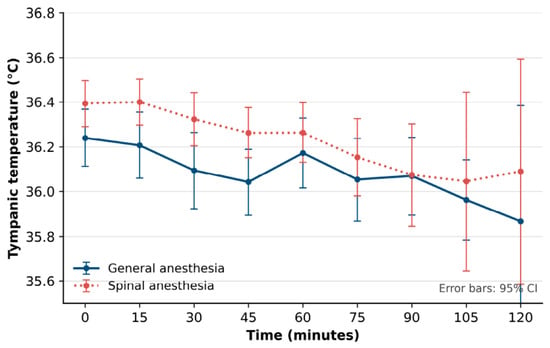
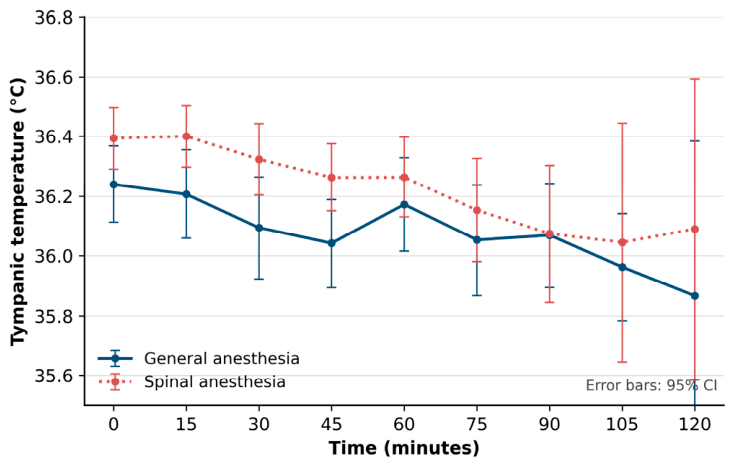
A total of 384 measurements were obtained. Mean preoperative temperature was 36.35 ± 0.28 °C, and the reading taken immediately after the establishment of anesthesia was essentially unchanged (36.32 °C; decrease 0.038 °C; p = 0.062). The decline became significant at 30 min (36.21 °C; decrease 0.147 °C; p = 0.002) and continued thereafter, reaching 0.300 °C below the preoperative value at 90 min (p < 0.001) (Figure 1). Measurement ceased when each procedure ended, so the estimates at 105 and 120 min, which rest on 17 and 12 patients respectively, describe the patients still undergoing surgery at those times rather than the whole cohort.
Figure 1.
Intraoperative tympanic temperature over time in the general and spinal anesthesia groups. Values are mean with 95% confidence intervals. Confidence intervals widen at the later time points because fewer patients remained under anesthesia. The numbers contributing at 0, 15, 30, 45, 60, 75, 90, 105 and 120 min were 30, 30, 30, 29, 25, 21, 19, 8 and 3 in the general anesthesia group and 30, 30, 30, 27, 22, 17, 15, 9 and 9 in the spinal anesthesia group (60, 60, 60, 56, 47, 38, 34, 17 and 12 in total). Because measurement ceased when each procedure ended, the estimates at 105 and 120 min describe the patients still undergoing surgery and not the whole cohort. The interaction between anesthesia type and time was not significant in the linear mixed model (p = 0.666).
In the linear mixed model the main effect of time was significant (F = 5.38; p < 0.001), whereas neither anesthesia type (F = 1.99; p = 0.162) nor its interaction with time (F = 0.73; p = 0.666) was, so the two curves ran in parallel. Preoperative tympanic temperature was significantly associated with the temperature course (F = 20.19; p < 0.001) (Table 2).
Table 2.
Linear mixed model for intraoperative tympanic temperature.
3.3. Outcomes According to Anesthesia Type
The median maximum temperature decrease was 0.40 °C (0.20–0.57) after general and 0.30 °C (0.10–0.50) after spinal anesthesia (p = 0.395; r = 0.11). The corresponding means were 0.44 °C and 0.39 °C. The difference between these means was 0.05 °C, and its 95% confidence interval, obtained from the two-sample t distribution with 58 degrees of freedom, ran from −0.13 to 0.23 °C; the interval therefore refers to the difference in means and not to the difference between the medians quoted above. The lowest intraoperative temperature, the post-induction temperature and the temperatures on admission to and discharge from the recovery unit did not differ between groups (Table 3).
Table 3.
Primary and secondary outcomes according to anesthesia type.
Intraoperative hypothermia developed in 22 patients (36.7%), 12 (40.0%) after general and 10 (33.3%) after spinal anesthesia (p = 0.592); the broader definition raised the incidence to 26 patients (43.3%). Twelve patients (20.0%) were hypothermic on admission to the recovery unit. The mean lowest intraoperative temperature for the series was 35.94 ± 0.36 °C (range 34.8–36.7).
Recovery unit stay was the single exception. Patients given spinal anesthesia were discharged sooner than those given general anesthesia (36.9 ± 9.0 vs. 44.9 ± 10.6 min; p = 0.003; Cohen d = 0.81).
3.4. Determinants of the Temperature Decrease
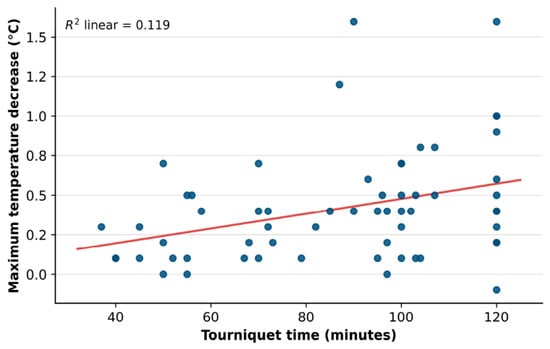
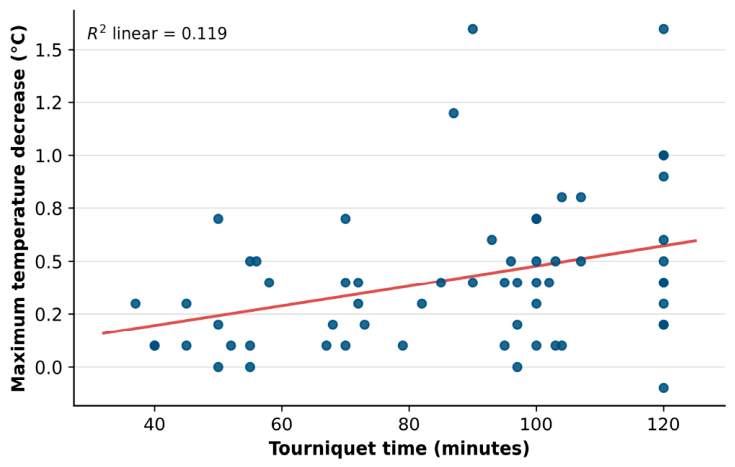
Tourniquet time correlated with both the maximum temperature decrease (rho = 0.362; p = 0.004) and the lowest intraoperative temperature (rho = −0.378; p = 0.003) (Figure 2; Supplementary Table S2). Total operating room time showed the same direction but a weaker association, and because the two were highly correlated (rho = 0.914; p < 0.001) only tourniquet time was entered into the regression models. Irrigation volume, body mass index and preoperative hemoglobin concentration showed no significant association; age was associated only with the lowest intraoperative temperature, and marginally so (rho = −0.255; p = 0.049).
Figure 2.
Relationship between tourniquet time and the maximum intraoperative temperature decrease. Each point represents one patient (n = 60); the line denotes the linear fit (R2 = 0.119). Tourniquet time was significantly associated with the maximum temperature decrease (Spearman rho = 0.362; p = 0.004), and this association persisted after adjustment for anesthesia type, preoperative tympanic temperature and irrigation fluid volume (β = 0.388; p = 0.003), but was attenuated and no longer significant when procedure category was also entered (β = 0.268; p = 0.109).
The multivariable model for the maximum temperature decrease was significant (F(4,55) = 5.75; p < 0.001; R2 = 0.295). Tourniquet time (β = 0.388; p = 0.003) and preoperative tympanic temperature (β = 0.421; p < 0.001) were associated with the outcome, whereas anesthesia type (p = 0.176) and irrigation volume (p = 0.249) were not. All variance inflation factors were below 1.21 and the Durbin–Watson statistic was 2.21 (Table 4, Panel A). The unadjusted association of tourniquet time with the maximum temperature decrease accounted for 11.9% of its variance (Figure 2), whereas the four-variable model accounted for 29.5%; these two figures describe different analyses and are not directly comparable. Operative and temperature variables differed markedly across procedure categories (Table 5). Tourniquet time rose from 73.4 ± 22.3 min for arthroscopy or meniscal surgery to 95.1 ± 19.7 min for isolated ACL reconstruction and 116.4 ± 6.6 min for ACL reconstruction with an adjunctive procedure (Kruskal–Wallis p < 0.001), and the maximum temperature decrease differed in the same direction (p = 0.008), whereas irrigation volume did not (p = 0.269). Tourniquet time and procedure category were therefore closely related (Spearman rho = 0.707), and the sensitivity analyses in Table 6 were performed to examine how far the association of tourniquet time with the temperature decrease could be separated from procedure category and from operative duration in general. When procedure category was added, the coefficient for tourniquet time was attenuated and no longer reached significance (β = 0.268; p = 0.109), and when total operating room time was substituted for tourniquet time the model explained less variance (R2 = 0.245) but the duration term remained significant (β = 0.304; p = 0.022). Both models are shown in Table 6.
Table 4.
Multivariable models for the temperature decrease, recovery unit stay and hypothermia.
Table 5.
Operative and temperature variables according to procedure category.
Table 6.
Sensitivity analyses for the maximum temperature decrease.
The logistic model was also significant (χ2(2) = 9.25; p = 0.010; Nagelkerke R2 = 0.195), with adequate fit on the Hosmer–Lemeshow test (p = 0.102). Each additional 10 min of tourniquet time raised the odds of hypothermia 1.42-fold (95% confidence interval 1.10–1.84; p = 0.007), whereas anesthesia type showed no statistically significant association (odds ratio 0.76; p = 0.630) (Table 4, Panel C). Tourniquet time was longer in patients who became hypothermic (99.3 ± 23.0 vs. 79.4 ± 25.0 min; p = 0.003). Unlike the linear model, this association persisted when procedure category was added (odds ratio 1.57 per 10 min; 95% confidence interval 1.09–2.25; p = 0.015) and when the analysis was restricted to the 56 patients whose post-induction reading was 36 °C or higher (odds ratio 1.43; 95% confidence interval 1.10–1.86; p = 0.007); both are reported in Supplementary Table S3.
3.5. Determinants of Recovery Unit Stay
The maximum temperature decrease correlated with recovery unit stay (rho = 0.355; p = 0.005), and patients who became hypothermic stayed longer (44.7 ± 8.8 vs. 38.7 ± 10.9 min; p = 0.034). In the multivariable model this association lost significance (β = 0.137; p = 0.195), whereas tourniquet time (β = 0.507; p < 0.001) and anesthesia type (β = −0.338; p = 0.001) remained significantly associated with the length of stay; the model accounted for almost half of the variance (F(3,56) = 16.34; p < 0.001; R2 = 0.467) (Table 4, Panel B).
4. Discussion
Three findings emerged. No statistically significant difference in the intraoperative temperature course was detected between the anesthetic techniques, a result obtained consistently by the mixed model, both regression analyses and the chi-square test. Longer tourniquet time was associated with a greater maximum temperature decrease and with higher odds of hypothermia, each additional 10 min raising the odds approximately 1.4-fold; the association with the magnitude of the decrease was, however, attenuated and no longer significant once procedure category was taken into account. Patients given spinal anesthesia left the recovery unit about seven minutes earlier, an advantage not explained by temperature.
This conflicts with part of the perioperative literature, in which spinal anesthesia has been associated with lower recovery unit temperatures and identified as a risk factor after cesarean section [11,12]. In those settings the surgical field lies close to the trunk and a large surface area is exposed, whereas in knee arthroscopy the field is distal, the exposed surface small and limb perfusion temporarily interrupted by the tourniquet. General anesthesia lowers the vasoconstriction and shivering thresholds together, whereas neuraxial blockade impairs these responses only below the level of the block [1,2]; over a short procedure on a small part of the body the net effect of the two may be similar.
Three features distinguish this cohort from the earlier literature and define what it adds. It is, as far as we are aware, the first in which general and spinal anesthesia have been compared with respect to intraoperative temperature within a single knee arthroscopy population; it is one of the few in which no patient received active warming, so that the untreated course of heat loss could be observed; and it is the first in which tourniquet time has been weighed against anesthetic technique, baseline temperature and irrigation volume in the same multivariable model. The principal limitation of that contribution is set out below: the design identifies associations and cannot establish mechanism. The incidence of 36.7% is far below that reported in shoulder arthroscopy, where more than 90% of patients became hypothermic irrespective of fluid temperature [5], but close to the 38.8% reported in pediatric scoliosis surgery [14]. Extravasation and the site of surgery are the most likely explanation for the difference: shoulder irrigation leaks into periarticular tissue and cools a large compartment near the trunk, whereas in the knee the tourniquet and the limited capacity of the joint restrict this. The exclusion of the knee from an earlier meta-analysis on grounds of clinical heterogeneity [4] is consistent with that structural difference.
The magnitude of the decline also deserves comment. The mean fall at 90 min was 0.300 °C and the mean maximum decrease 0.42 °C, well below the 1 to 2 °C expected in unwarmed patients [1]. These changes are of the same order as the measurement properties of the instrument, whose clinical repeatability is 0.19 °C and whose stated accuracy is ±0.2 °C. A mean decrease of 0.300 °C is therefore only about 1.6 times the repeatability of a single reading, and the 95% confidence interval for the between-group difference (−0.13 to 0.23 °C) lies almost entirely within the accuracy band of the device. Averaging across 60 patients and 384 readings reduces random error in the group estimates, but classification of individual patients at the 36 °C threshold remains sensitive to measurement variability, and the recovery unit medians of 36.10 to 36.20 °C lie close to that threshold. The limits of agreement of infrared tympanic thermometry with esophageal measurement are inadequate for intraoperative monitoring [17], and although the technique agrees well with zero-heat-flux thermometry [18,19] it may underestimate rapid change. Measurement method is therefore one possible explanation for the small observed decline, but the present study did not compare measurement methods and cannot establish this. The shape of the curve nevertheless matched physiological expectation, with no fall at induction and a significant decline from 30 min onward, corresponding to the linear phase that follows redistribution [3].
The association with tourniquet time was the most consistent finding, although its interpretation requires care. In the linear model it remained significant after adjustment for anesthesia type, preoperative temperature and irrigation volume, but it was attenuated and no longer significant once procedure category was entered, and tourniquet time was strongly related to procedure category (73.4 ± 22.3 min for arthroscopy or meniscal surgery, 95.1 ± 19.7 min for isolated ACL reconstruction and 116.4 ± 6.6 min for ACL reconstruction with an adjunctive procedure; Table 5). The present data therefore do not isolate a tourniquet-specific effect from the effect of a longer and more extensive operation, and a model substituting total operating room time produced a similar though weaker association. In the logistic model the association with hypothermia did persist after adjustment for procedure category, which suggests that duration of cuff inflation carries information about the risk of crossing the 36 °C threshold beyond procedure category alone, but with 22 events and four predictors that model is itself imprecise. Chon and Lee reported that inflation time governed the fall seen after cuff release and that arthroscopic cases fared worse [13]; our data are consistent with an association between inflation time and heat loss across the intraoperative period. Several mechanisms are plausible: longer inflation means longer contact with cold irrigation fluid and further cooling of the limb towards ambient temperature, and the return of cooled blood to the circulation after cuff release has been proposed as a further contributor. The last of these could not be examined here, because measurement followed a fixed schedule that ended with the procedure and the final reading preceded deflation in most patients; reperfusion is therefore cited as a mechanism proposed in previous work rather than one demonstrated by these data. Longer operations also increase environmental and evaporative losses, and operative duration appears consistently among the determinants of hypothermia [15].
The borderline association of irrigation volume disappeared once tourniquet time entered the model. Table 5 helps to interpret this. Irrigation volume did not differ significantly across procedure categories (p = 0.269), whereas tourniquet time did (p < 0.001), so volume carries little information about the extent or duration of the operation once duration itself is in the model. Volume also records only the quantity delivered: under tourniquet the capacity of the knee is limited and much of the fluid flows out again, so the delivered volume is a poor proxy for how much fluid remained in contact with tissue or for how long. A non-significant coefficient should therefore not be read as evidence that irrigation contributes nothing to heat loss, only that the volume delivered is an insensitive measure of that contribution in this setting. Its influence appears to vary with the anatomy of the procedure [12,15].
The recovery unit finding has two layers. The univariable association between the temperature decrease and length of stay disappeared once tourniquet time was included, indicating that it is largely explained by operative duration, whereas the effect of the anesthetic technique persisted. The literature is inconsistent: discharge was markedly earlier after subarachnoid chloroprocaine in a day-case study [20], longest after spinal anesthesia in a randomized comparison of three techniques for inguinal hernia repair [21], and selective unilateral blockade has been reported to permit early discharge after ambulatory knee arthroscopy [22]. The agent, dose and blockade technique therefore matter, and because our study was not randomized this finding should not be read causally.
Clinically, hypothermia during knee arthroscopy is less common than in shoulder surgery but still affects more than a third of patients. Because longer procedures were associated with greater heat loss and with higher odds of crossing the 36 °C threshold, warming targeted at patients in whom a long tourniquet time is anticipated is a reasonable hypothesis for future comparative studies. It is not a recommendation that follows from these data: no warming intervention was evaluated here, and the present design cannot show whether targeted warming would be more effective, or more efficient, than warming every patient. Prewarming in outpatient surgery has been reported to improve thermal comfort without significantly reducing redistribution hypothermia [23], which illustrates that the benefit of a warming strategy has to be demonstrated rather than inferred.
Limitations
The anesthetic technique was not randomized but chosen by the patient together with the attending anesthesiologist, so unmeasured confounding cannot be excluded despite the groups being balanced on the characteristics recorded. Similar baseline characteristics do not rule out systematic differences in variables that were not measured. Tympanic thermometry provides an oral-equivalent estimate rather than a direct measure of core temperature, and its repeatability of 0.19 °C is of the same order as the changes observed; this limits confidence both in the magnitude of the decline and in the classification of individual patients close to the 36 °C threshold. A further limitation concerns the primary outcome itself: the maximum temperature decrease is calculated as the preoperative value minus the lowest intraoperative value, so preoperative temperature forms part of the outcome that it is also used to predict in Table 4. Its positive coefficient is partly a mathematical consequence of this coupling, and baseline temperature should not be read as an independently established determinant of heat loss. Postoperative shivering was not recorded, which limits interpretation of the recovery unit findings. Operating room temperature and the actual temperature of the irrigation fluid were not recorded case by case, and institutional target values were assumed. Irrigation volume records the quantity delivered and not how much fluid remained in contact with tissue or for how long, which may explain why its coefficient was small and non-significant once procedure category and duration were taken into account. Measurements ended at 120 min, when only 12 patients still contributed data, so findings beyond 90 min describe the subgroup undergoing longer surgery and should be interpreted cautiously. Finally, the sample was small; the confidence interval of the between-group difference (−0.13 to 0.23 °C) lies well below the threshold regarded as clinically meaningful, but the study was not designed as an equivalence trial and cannot establish that the techniques are equivalent. Against these limitations, no patient received active warming, which removed the confounding influence of warming methods, and all measurements were taken at fixed intervals by a single observer using an identical protocol in both groups.
5. Conclusions
Intraoperative hypothermia occurred in more than one third of patients undergoing knee arthroscopy without active warming. No statistically significant difference in heat loss was detected between general and spinal anesthesia in this cohort, although the observational design and the sample size do not establish equivalence between the techniques. Longer tourniquet time was associated with a greater temperature decrease and with higher odds of hypothermia; the association with the magnitude of the decrease was attenuated once procedure category was taken into account, so it cannot be separated from the effect of a longer and more extensive operation. Anticipated operative duration therefore appears to be the more informative variable for identifying patients at risk. Whether thermal protection targeted on that basis improves outcomes was not tested here and should be evaluated in randomized comparative studies.
Supplementary Materials
The following supporting information can be downloaded at https://www.mdpi.com/article/10.3390/medicina62112088/s1, Table S1: Comparison of covariance structures for the linear mixed model; Table S2: Spearman rank correlation coefficients; Table S3: Sensitivity analyses for the logistic regression model for intraoperative hypothermia.
Author Contributions
Conceptualization, O.T.E. and B.B.; methodology, B.B. and E.İ.; software, E.İ.; validation, M.A.K. and Y.A.; formal analysis, E.İ.; investigation, B.B., M.A.K., O.D. and Y.A.; resources, O.D.; data curation, B.B.; writing—original draft preparation, B.B.; writing—review and editing, O.T.E. and E.İ.; visualization, B.B.; supervision, O.T.E.; project administration, O.T.E. All authors have read and agreed to the published version of the manuscript.
Funding
This research received no external funding.
Institutional Review Board Statement
The study was conducted in accordance with the Declaration of Helsinki, and approved by the Clinical Research Ethics Committee of Şişli Hamidiye Etfal Training and Research Hospital (protocol code 3097, 5 August 2025).
Informed Consent Statement
Informed consent for participation was obtained from all subjects involved in the study.
Data Availability Statement
The raw data supporting the conclusions of this article will be made available by the authors on request.
Acknowledgments
During the preparation of this article, the authors used a large language model for language editing purposes. The authors reviewed and edited the resulting content and assumed full responsibility for the content of this publication.
Conflicts of Interest
The authors declare no conflicts of interest.
References
- Sessler, D.I. Perioperative thermoregulation and heat balance. Lancet 2016, 387, 2655–2664. [Google Scholar] [CrossRef] [Scilit] [PubMed]
- Sessler, D.I. Perianesthetic thermoregulation and heat balance in humans. FASEB J. 1993, 7, 638–644. [Google Scholar] [CrossRef] [Scilit] [PubMed]
- Sessler, D.I. How three linked clinical observations led to an understanding of perioperative heat balance: A personal reflection on the scientific process. J. Clin. Anesth. 2024, 96, 111496. [Google Scholar] [CrossRef] [Scilit] [PubMed]
- Steelman, V.M.; Chae, S.; Duff, J.; Anderson, M.J.; Zaidi, A. Warming of irrigation fluids for prevention of perioperative hypothermia during arthroscopy: A systematic review and meta-analysis. Arthroscopy 2018, 34, 930–942.e2. [Google Scholar] [CrossRef] [Scilit] [PubMed]
- Oh, J.H.; Kim, J.Y.; Chung, S.W.; Park, J.S.; Kim, D.H.; Kim, S.H.; Yun, M.J. Warmed irrigation fluid does not decrease perioperative hypothermia during arthroscopic shoulder surgery. Arthroscopy 2014, 30, 159–164. [Google Scholar] [CrossRef] [Scilit] [PubMed]
- Ralte, P.; Mateu-Torres, F.; Winton, J.; Bardsley, J.; Smith, M.; Kent, M.; Sethuraman, D.; Guisasola, I. Prevention of perioperative hypothermia: A prospective, randomized, controlled trial of Bair Hugger versus Inditherm in patients undergoing elective arthroscopic shoulder surgery. Arthroscopy 2020, 36, 347–352. [Google Scholar] [CrossRef] [Scilit] [PubMed]
- Liu, J.; Huang, X.; Xu, X.; Song, Y.; Chen, J.; Yu, P.; Ye, T.; Zhang, Y.; Zhao, D.; Li, G.; et al. Impact of warmed irrigation fluid during shoulder arthroscopy on patient temperature, recovery, and cognitive function: A prospective analysis of influencing factors. Orthop. Surg. 2025, 17, 2371–2384. [Google Scholar] [CrossRef] [Scilit] [PubMed]
- Kelly, J.A.; Doughty, J.K.; Hasselbeck, A.N.; Vacchiano, C.A. The effect of arthroscopic irrigation fluid warming on body temperature. J. Perianesth. Nurs. 2000, 15, 245–252. [Google Scholar] [CrossRef] [Scilit] [PubMed]
- Moola, S.; Lockwood, C. The effectiveness of strategies for the management and/or prevention of hypothermia within the adult perioperative environment: Systematic review. JBI Libr. Syst. Rev. 2010, 8, 752–792. [Google Scholar] [CrossRef] [Scilit]
- Jiang, H.; Wang, W.; Tian, H.; Yang, H. Effect of a combined thermal protection strategy with plantar hot salt packs on preventing intraoperative hypothermia during knee arthroscopy: A randomized controlled trial. Sci. Rep. 2026, 16, 19271. [Google Scholar] [CrossRef] [Scilit] [PubMed]
- Mendonça, F.T.; Lucena, M.C.; Quirino, R.S.; Govêia, C.S.; Guimarães, G.M.N. Risk factors for postoperative hypothermia in the post-anesthetic care unit: A prospective prognostic pilot study. Braz. J. Anesthesiol. 2019, 69, 122–130. [Google Scholar] [CrossRef] [Scilit]
- Wang, X.; Zhang, Y.; Li, Z.; Wang, X.; Qiu, H. Risk factors for perioperative hypothermia in pregnant women undergoing cesarean section: A systematic review and meta-analysis. Ann. Ital. Chir. 2024, 95, 448–460. [Google Scholar] [CrossRef] [Scilit] [PubMed]
- Chon, J.Y.; Lee, J.Y. The effects of surgery type and duration of tourniquet inflation on body temperature. J. Int. Med. Res. 2012, 40, 358–365. [Google Scholar] [CrossRef] [Scilit] [PubMed]
- Okamura, M.; Saito, W.; Miyagi, M.; Shirasawa, E.; Imura, T.; Nakazawa, T.; Mimura, Y.; Yokozeki, Y.; Kuroda, A.; Kawakubo, A.; et al. Incidence of unintentional intraoperative hypothermia in pediatric scoliosis surgery and associated preoperative risk factors. Spine Surg. Relat. Res. 2020, 5, 154–159. [Google Scholar] [CrossRef] [Scilit] [PubMed]
- Shen, Y.; Zhong, X. Related factors of perioperative low body temperature and incidence of postoperative shivering in patients undergoing complex percutaneous nephrolithotomy and the effect analysis of composite insulation nursing intervention. Heliyon 2024, 10, e32126. [Google Scholar] [CrossRef] [Scilit] [PubMed]
- Standard’s ASTM E1965-98; Standard Specification for Infrared Thermometers for Intermittent Determination of Patient Temperature. ASTM International: West Conshohocken, PA, USA, 2016.
- Harioka, T.; Sone, T.; Nomura, K.; Kakuyama, M. Relative accuracy and precision of two non-invasive thermometry systems. Masui 1993, 42, 856–861. (In Japanese) [Google Scholar] [PubMed]
- Liang, H.; Wang, J.Y.; Liang, Y.; Shao, X.F.; Ding, Y.L.; Jia, H.Q. Agreement of zero-heat-flux thermometry with the oesophageal and tympanic core temperature measurement in patient receiving major surgery. J. Clin. Monit. Comput. 2024, 38, 197–203. [Google Scholar] [CrossRef] [Scilit] [PubMed]
- Wang, J.; Liang, H.; Tian, C.; Rong, G.; Shao, X.; Ran, C. Agreement of zero-heat-flux thermometry compared with infrared tympanic temperature monitoring in adults undergoing major surgery. Eur. J. Med. Res. 2025, 30, 60. [Google Scholar] [CrossRef] [Scilit] [PubMed]
- Manju; Agarwal, B.; Choudhary, U.; Choudhary, M.; Singh, Y.D.; Nehra, V.P. Prospective comparative study between subarachnoid chloroprocaine and general anesthesia for short daycare surgeries. Cureus 2025, 17, e78973. [Google Scholar] [CrossRef] [Scilit] [PubMed]
- Pere, P.; Harju, J.; Kairaluoma, P.; Remes, V.; Turunen, P.; Rosenberg, P.H. Randomized comparison of the feasibility of three anesthetic techniques for day-case open inguinal hernia repair. J. Clin. Anesth. 2016, 34, 166–175. [Google Scholar] [CrossRef] [Scilit] [PubMed]
- Bergmann, I.; Hesjedal, B.; Crozier, T.A.; Pöschl, R.; Bauer, M.; Hinz, J.M.; Büttner, B. Selective unilateral spinal anaesthesia for outpatient knee arthroscopy using real-time monitoring of lower limb sympathetic tone. Anaesth. Intensive Care 2015, 43, 351–356. [Google Scholar] [CrossRef] [Scilit] [PubMed]
- Akhtar, Z.; Hesler, B.D.; Fiffick, A.N.; Mascha, E.J.; Sessler, D.I.; Kurz, A.; Ayad, S.; Saager, L. A randomized trial of prewarming on patient satisfaction and thermal comfort in outpatient surgery. J. Clin. Anesth. 2016, 33, 376–385. [Google Scholar] [CrossRef] [Scilit] [PubMed]

Disclaimer/Publisher’s Note: The statements, opinions and data contained in all publications are solely those of the individual author(s) and contributor(s) and not of MDPI and/or the editor(s). MDPI and/or the editor(s) disclaim responsibility for any injury to people or property resulting from any ideas, methods, instructions or products referred to in the content. |
© 2026 by the authors. Published by MDPI on behalf of the Lithuanian University of Health Sciences. Licensee MDPI, Basel, Switzerland. This article is an open access article distributed under the terms and conditions of the Creative Commons Attribution (CC BY) license.