


Abstract
Background and Objectives: This study compared the risks of rotator cuff disease and rotator cuff repair surgery in patients receiving dipeptidyl peptidase 4 inhibitors (DPP4is), thiazolidinediones (TZDs), and sulfonylureas (SUs). Materials and Methods: A retrospective cohort analysis of Taiwan’s National Health Insurance Research Database was conducted to identify patients with type 2 diabetes mellitus who were newly prescribed DPP4is, TZDs, or SUs between 2012 and 2020. The outcomes of interest were rotator cuff disease and rotator cuff repair surgery. Cox proportional hazard regression models were used to calculate HRs with 95% CIs for the outcomes. Results: Initially, 334,322 DPP4is users, 87,738 TZDs users, and 928,479 SUs users were included. After propensity scores with inverse probability of treatment weighting were calculated with 5% trimming, Sus users had a significantly lower risk of rotator cuff disease than DPP4is users (HR 0.914, 95% CI: 0.898–0.930) and TZDs users (HR 0.887, 95% CI: 0.871–0.904) did, and DPP4is users had a significantly lower risk of this disease than TZDs users had (0.956, 95% CI: 0.926–0.986). As for the risk of rotator cuff repair surgery, the effect sizes did not reach statistical significance. Conclusions: SUs users had the lowest risk of rotator cuff disease, followed by DPP4is and TZDs users.
1. Introduction
Rotator cuff disease is a prevalent musculoskeletal disorder that imposes substantial economic and clinical burdens [1]. The prevalence of rotator cuff tears differed across population sources, ranging from 23.6% in asymptomatic or previously unevaluated populations to 55.5% in symptomatic, trauma-related, or outpatient cohorts and 57.3% in groups with specific high-exposure characteristics [2]. Compounding this issue, diabetes mellitus has been shown to significantly exacerbate the risk of rotator cuff disease [3] and consequently elevate the likelihood of requiring reparative surgery [4]. While recent evidence shows that metformin and sodium–glucose cotransporter 2 inhibitors (SGLT2is) may mitigate this risk [5,6], the potential clinical impact of other major classes of oral hypoglycaemic agents (OHAs) remains unexplored.
Dipeptidyl peptidase 4 inhibitors (DPP4is), a class of OHA, have been linked to arthritis/arthralgia [7,8] in case reports and a cohort study utilizing a new-user versus non-user design. However, a subsequent retrospective cohort study employing a new-user, active comparator design showed comparable risks across different classes of antidiabetic drugs [9]. As for tendinopathy, some case reports demonstrated a link between DPP4is and Achilles tendinitis [10,11]. However, whether DPP4is increases the risk of tendinopathy has not yet been evaluated in larger studies.
Another commonly used class of OHA, thiazolidinediones (TZDs), showed no effect on the incidence of joint replacement surgery compared with other antidiabetic drugs [12] but were associated with a higher incidence of arthritis/arthralgia [9] compared to DPP4is. However, whether TZDs possess similar effects to DPP4is among other musculoskeletal conditions, such as tendinopathy, has not yet been evaluated. Theoretically, TZDs have been reported to increase intramuscular fat in animals and humans [13,14], possibly by activating peroxisome proliferator-activated receptor gamma. Fatty infiltration of the rotator cuff muscle is a poor prognostic factor for repair of the cuff tendons [15]. Additionally, at least one cohort study has linked hyperlipidaemia to rotator cuff disease; the authors hypothesized that fatty infiltration was the underlying mechanism of disease progression [3].
Given the high prevalence of rotator cuff disease among patients with diabetes mellitus [3] and because it has been a common outcome of interest in previous studies [5,6], rotator cuff disease was selected as the target outcome in the present study. The present study used sulfonylureas (SUs) rather than SGLT2is as the active comparator because SGLT2is were only approved for use by the Taiwan Food and Drug Administration in 2014 and for national insurance reimbursement in 2016 [16], and therefore, the cohorts would have been small if SGLT2is had been used. This study adopted a new user-active comparator design to compare the incidence of rotator cuff disease and rotator cuff repair surgery between users of DPP4is, TZDs, and SUs.
2. Materials and Methods
2.1. Data Sources
This nationwide retrospective cohort study used data from a National Health Insurance Research Database (NHIRD). The NHIRD contains data on nearly the entire nationwide population; a detailed description of the NHIRD was provided in a previous study [17]. The Research Ethics Committee approved this study on 18 July 2024 (A-ER-113-181), and the requirement for informed consent was waived.
2.2. Study Design
We employed a target trial design to emulate a randomized controlled trial with observational data (Supplementary Table S1). The study included patients with type 2 diabetes mellitus aged 20 years or older and considered records from 2012 to 2020 in the database. Each case with type 2 diabetes mellitus was defined in accordance with International Classification of Diseases, Ninth Revision, Clinical Modification (ICD-9-CM) or International Classification of Diseases, Tenth Revision, Clinical Modification (ICD-10-CM) codes (Supplementary Table S2) [3,4,5]. This study used the first date of prescription of the target medications as the index date and the year before the index date as the baseline period. To identify incident cases, patients with rotator cuff disease diagnoses during the baseline period were excluded. To make sure that sufficient information could be obtained for evaluation of comorbidities and comedications, the present study excluded patients for whom prior clinical data were unavailable at baseline. Furthermore, we excluded patients with certain comorbidities at baseline, that is, with end-stage kidney disease, shoulder-girdle-associated fractures and dislocation, or rheumatoid arthritis (Supplementary Table S2). These diseases have also been considered as exclusion criteria in other studies [3,5,6].
2.3. Outcomes and Follow-Up
The outcomes of this study were rotator cuff disease and rotator cuff repair surgery. Patients were determined to have rotator cuff disease if they met all of the following criteria [3,4,5].
- Satisfying the criteria of the International Classification of Diseases (ICD) codes for rotator cuff disease (ICD-9-CM: 726.10, 726.13, 727.61, and 840.4 or ICD-10-CM: M75.100, M75.110, M75.120, and S43.429A) [18] by one admission claim or 2 following ambulatory claims.
- Having a diagnosis of rotator cuff disease in accordance with ICD codes, as determined by orthopaedic surgeons, physical medicine and rehabilitation physicians, or rheumatologists.
Patients were deemed to have received rotator cuff repair surgery if they met all of the following criteria [19]:
- Satisfied the criteria of the ICD codes for rotator cuff disease according to 1 admission claim or 2 following ambulatory claims or
- Were assigned a rotator cuff repair surgery code (National Health Insurance procedural codes 64121B and 64122B) during hospitalization.
We followed up the patients included in the study from the index date to the occurrence of the target outcomes, the last clinical visit, the death of the patient, or the end of the database.
Rotator cuff disease was identified based on ICD-10 administrative codes combined with specialist diagnoses, without direct imaging validation. Clinical severity data were not available in the database. Hence, to assess severe cases, rotator cuff repair surgery was also tracked as an outcome. Within the standard ICD-10 system, conditions such as partial tears, complete tears, tendinopathy, and bursitis are assigned distinct individual codes.
2.4. Covariates
The covariates included age, sex, year of diagnosis of type 2 diabetes mellitus, insurance premium level, urbanization, baseline length of hospital stay, adapted Diabetes Complications Severity Index score [20], cardiovascular comorbidities (ischemic stroke, coronary artery disease, heart failure, peripheral artery disease, atrial fibrillation, hypertension, and dyslipidaemia), depressive disorders [19], and rheumatic and musculoskeletal comorbidities (osteoporosis, osteoarthritis, gout, obesity, systemic lupus erythematosus, ankylosing spondylitis, Sjögren syndrome, and Reiter’s syndrome). The covariates also included medications, defined using Anatomical Therapeutic Chemical codes, such as analgesics (systemic corticosteroids, nonsteroidal anti-inflammatory drugs, glucosamine, opioids, and codeine), hypoglycaemic medications (alpha glucosidase inhibitors, metformin, insulin, glinides, glucagon-like peptide-1 receptor agonists, and SGLT2is), and cardiovascular medications (antiplatelets, beta-blockers, calcium channel blockers, angiotensin-converting enzyme inhibitors or angiotensin II receptor blockers, statins, diuretics, fibrates, and ezetimibe) [5]. Details regarding the covariates are provided in Supplementary Tables S2 and S3.
2.5. Statistical Analysis
We calculated numbers and frequencies for categorical variables and means and standard deviations for continuous variables. The median interquartile range was calculated for continuous variables where appropriate. To achieve more homogeneous comparisons between groups, we used propensity scores with inverse probability of treatment weighting (IPTW) and trimmed the 5% of patients with the most extreme propensity score values for the main analysis and the sensitivity analysis. The aforementioned covariates were used in the propensity scores with logistic regressions. The absolute standardized mean differences with a cutoff value of 0.1 were used to assess the balance of baseline covariates between the treatment groups after IPTW adjustment [21]. HRs and 95% CIs for the risk of rotator cuff disease and rotator cuff repair surgery were estimated using Cox proportional hazard regression models. Statistical analyses were performed using SAS Enterprise Guide, version 9.4 (SAS Institute, Cary, NC, USA).
2.6. Sensitivity Analyses
Sensitivity analyses were conducted to assess the robustness of our results. First, we used a 1:1 propensity score matching (PSM) method. Unlike IPTW, which creates a weighted pseudo-population, PSM constructs a matched cohort of patients with similar propensity scores. Consistency between the IPTW and PSM results would provide additional evidence that our findings were not dependent on the specific propensity score adjustment method used. Second, we conducted an on-treatment analysis. In this approach, we censored patients who discontinued treatment (patients with >90 days without a prescription refill of index medications) or switched to another index medication class during the follow-up period. This approach was intended to assess whether the observed associations persisted when follow-up was restricted to the period during which patients remained on their initial treatment.
2.7. Falsification Outcome
We used falsification outcomes to assess the likelihood of false-positive results of primary study outcomes that may be attributed to unmeasured confounders or suboptimal internal validity. Acute appendicitis was used as a falsification outcome because the incidence was likely to be similar between groups.
3. Results
3.1. Patient Characteristics
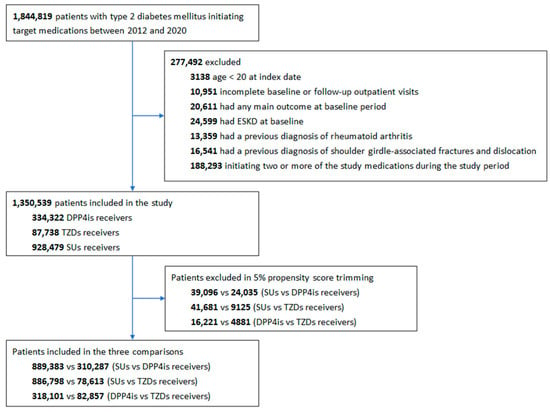
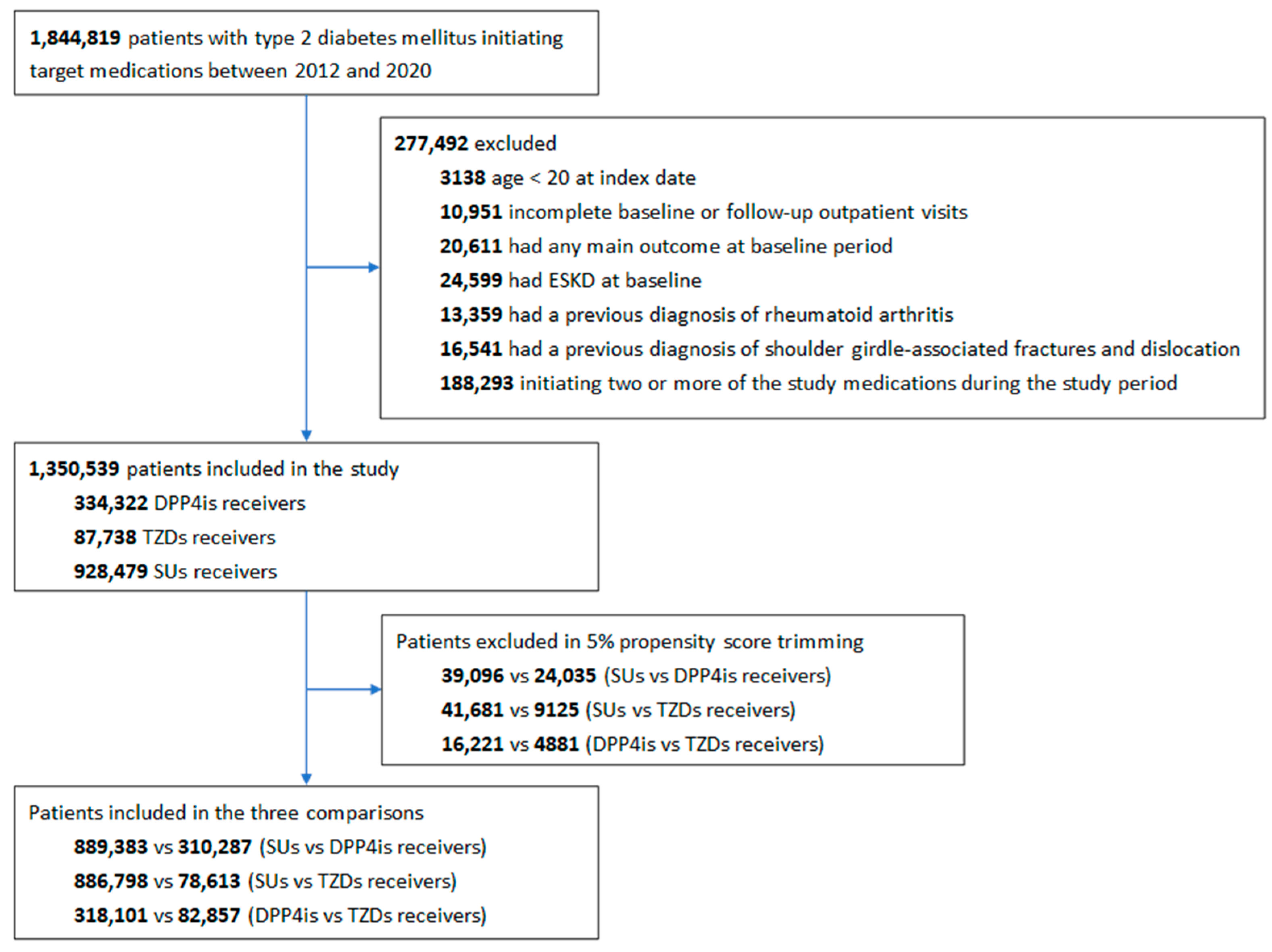
Our original study population included 1,350,539 patients (Figure 1). After 5% propensity score trimming and IPTW were applied, we created 3 pseudopopulations: (1) 1,196,618 SUs users versus 1,184,048 DPP4is users (Supplementary Table S4), (2) 963,021 SUs users versus 935,221 TZDs users (Supplementary Table S5), and (3) 381,289 DPP4is users versus 384,754 TZDs users (Supplementary Table S6). The flowchart of patient selection is presented in Figure 1. After the propensity score method was conducted, all baseline characteristics were balanced between the treatment groups. The mean follow-up times were 1759, 2002, and 2299 days in the DPP4is, TZDs, and SUs groups, respectively. As for medications that can be associated with tendinopathy (systemic corticosteroids and nonsteroid anti-inflammatory drugs), there were no significant differences between groups in the crude nor the IPTW cohorts.
Figure 1.
Flowchart of patient enrollment. DPP4is: dipeptidyl peptidase 4 inhibitors; SUs: sulfonylureas; TZDs: thiazolidinediones.
3.2. Rotator Cuff Disease
The results of the crude analyses between the groups prescribed SUs versus DPP4is, SUs versus TZDs, and DPP4is versus TZDs are presented in Table 1. After IPTW with 5% trimming was completed, the SUs users had a significantly lower risk of rotator cuff disease than the DPP4is users (HR 0.914, 95% CI: 0.898–0.930; Table 1) and TZDs users (HR 0.887, 95% CI: 0.871–0.904; Table 1). Additionally, the risk of rotator cuff disease was significantly lower in the DPP4is users than in the TZDs users (0.956, 95% CI: 0.926–0.986; Table 1).
Table 1.
Results of the main and sensitivity analyses.
3.3. Rotator Cuff Repair Surgery
The results of the crude analyses are presented in Table 1. After IPTW with 5% trimming was completed, similar trends were observed for the risk of rotator cuff repair surgery to those of the risk of rotator cuff disease: the SUs users had a lower risk of rotator cuff repair surgery than did the DPP4is users (HR 0.930, 95% CI: 0.863–1.003, Table 1) and TZDs users (HR 0.989, 95% CI: 0.910–1.074, Table 1), and the DPP4is users had a lower risk of rotator cuff repair surgery than did the TZDs users (HR 0.940, 95% CI: 0.817–1.082, Table 1). However, none of the comparisons reached statistical significance (p > 0.05).
3.4. Sensitivity Analysis
In the sensitivity analysis based on propensity score matching, the risk of rotator cuff disease for users of SUs versus DPP4is and of SUs versus TZDs was similar to those of the main analyses, although the comparison of the users of DPP4is versus TZDs did not reach significance (HR 0.942, 95% CI: 0.874–1.015, Table 1). The risk of rotator cuff repair surgery was significantly lower for SUs users than for TZDs users (HR 0.693, 95% CI: 0.496–0.969), although the differences in the risks of using SUs versus DPP4is and DPP4is versus TZDs were nonsignificant (Table 1).
In the on-treatment sensitivity analysis, the risk of rotator cuff disease between the users of SUs versus DPP4is, of SUs versus TZDs, and of DPP4is versus TZDs was similar to that identified in the main analysis. The risk of rotator cuff repair surgery was significantly lower in the SUs group than in the DPP4is group (HR 0.894, 95% CI: 0.803–0.996), although the difference in the risk of rotator cuff repair surgery for users of SUs versus TZDs and that of users of DPP4is versus TZDs did not reach statistical significance (Table 1).
3.5. Falsification Outcome
No significant difference in the incidence of acute appendicitis was observed between the 3 comparison groups (Table 2). The HRs were 1.038 (SUs vs. DPP4is, 95% CI: 0.967–1.115), 0.955 (SUs vs. TZDs, 95% CI: 0.844–1.080), and 0.928 (DPP4is vs. TZDs, 95% CI: 0.821–1.049) in the weighted cohorts.
Table 2.
Results of the falsification outcome analysis.
4. Discussion
According to the results of the main analysis, SUs users had the lowest risk of rotator cuff disease, followed by DPP4is and TZDs users. Additionally, the results of the on-treatment sensitivity analysis supported those of the main analysis.
DPP4is users had higher risks of rotator cuff disease compared with those of SUs users. Although DPP4is have been linked to tendinitis [10,11] and arthritis/arthralgia [7,8,22] in previous studies, the underlying mechanisms of action of DPP4is on rotator cuff tissues have not yet been studied. However, several studies have indicated that dipeptidyl peptidase-IV may increase muscle blood flow by reducing neuropeptide Y-mediated vasoconstriction [23]. Additionally, a study comparing normal and diseased rotator cuffs revealed that microvascular blood flow was significantly lower in diseased rotator cuffs [24]. Hence, we propose that DPP4is may harm rotator cuffs by decreasing blood flow to rotator cuff tissues. However, no direct clinical evidence exists currently, and this proposed mechanism remains speculative.
The current study results reveal that TZDs users had a higher risk of rotator cuff disease compared with that of SUs users. Fatty infiltration of the rotator cuff may explain our findings. Fatty infiltration of the rotator cuff muscle has been demonstrated to be a poor prognostic factor for repair of the rotator cuff tendons [15]. Hyperlipidaemia has been hypothesized to impair the rotator cuff by causing fatty infiltration [3], a hypothesis supported by findings of an association of statins—which ameliorate fatty infiltration—with a lower risk of rotator cuff disease. Because TZDs have been reported to increase intramuscular fat [13,14], they may adversely affect the rotator cuff by inducing fatty infiltration. However, direct clinical evidence demonstrating TZDs-induced fatty infiltration specifically within human rotator cuff tissue is lacking, and this mechanism remains a theoretical extrapolation.
In the present study, the effect on the risk of requiring rotator cuff repair surgery was similar yet nonsignificant to that of the risk of rotator cuff disease. This finding may have been the result of a type II error related to insufficient statistical power or bias due to outcome misclassification [25]. To avoid misclassification, we identified patients not only by claim codes but also required the code to be made by orthopaedic surgeons, physical medicine and rehabilitation physicians, or rheumatologists. We also sought to identify patients with severe rotator cuff tears by calculating the incidence of rotator cuff repair surgery. However, in the real-world setting, not all patients who have severe rotator cuff tears undergo repair surgery; such surgery may not be used for patients with poor prognostic factors, such as advanced age [26]. The lack of a one-to-one correspondence between severe rotator cuff tears and rotator cuff repair surgery indicates that the results of the present study may still be affected by misclassification bias [25]. Furthermore, such bias may have occurred nondifferentially in both groups, causing estimates that tended toward the null value [25].
Although findings of our retrospective cohort study suggested that SUs users had a modestly lower risk of rotator cuff disease compared to DPP4is and TZDs users among patients with diabetes mellitus, given that SUs users carry well-recognized clinical risks such as hypoglycemia and weight gain, these modest observational findings should not override established glycemic guidelines. Instead, our results suggest that when selecting anti-diabetic therapies, a patient’s potential risk for musculoskeletal complications like rotator cuff disease could be considered as one of many factors within a comprehensive, individualized benefit-risk assessment.
A previous study showed that the incidence of rotator cuff pathology follows a non-linear trend by age, peaking at 55 to 55.9 years old and steadily decreasing after the 70s [27]. In our cohort, the mean patient age was approximately 60 years (SD ±10–15 years). Due to this parabolic incidence pattern, it remains unclear whether the longer follow-up period in the SUs group would systematically overestimate or underestimate the overall risk of rotator cuff pathology. Therefore, future prospective studies are warranted to further clarify this question.
Our study has several strengths. First, we used a nationwide database that included nearly all of Taiwan’s population. Second, we employed a new user active comparator design to avoid immortal time bias and reduce differences resulting from confounding by indication and other unmeasured patient characteristics between groups. Third, the target trial emulation design of our study may strengthen the causal inference [28]. Finally, the robustness of the study was supported by sensitivity analyses. Our findings may aid clinicians in clinical decision-making when selecting individualized antidiabetic treatments for patients with diabetes.
Our study has some limitations. First, occupational risk factors, such as whether the patients worked with the shoulder at an angle greater than 90° [29], could not be retrieved from the NHIRD. However, these factors are unlikely to have affected whether patients received DPP4is, TZDs, or SUs to treat diabetes mellitus and were thus likely nondifferential between the groups. Second, we did not include treatment arms of newer antidiabetic medications, such as SGLT2is or glucagon-like peptide-1 receptor agonists, in our study. SGLT2is and glucagon-like peptide-1 receptor agonists are more likely to be prescribed to patients with cardiovascular disease risk factors than DPP4is, TZDs, and SUs [30]. In a previous study, cardiovascular disease risk factors have been linked to rotator cuff tendinopathy, indicating that comparing SGLT2is or glucagon-like peptide-1 receptor agonists with other antidiabetic medications may be inappropriate [31]. Third, we used data from a medical claims system rather than medical records to identify diseases and outcomes, which may have led to misclassification errors; nevertheless, we believe misclassification errors are likely to have been nondifferential between the groups and thus biased our estimates toward the null [25]. Therefore, the exact differences between groups may be greater than those observed. Fourth, HbA1c, BMI, smoking status, alcohol consumption, physical activity, occupational shoulder use, and duration of diabetes were not available in our National Health Insurance Research Database. Although we adopted the adapted Diabetes Complications Severity Index score as a surrogate, the absence of these data might still cause residual confounding. Fifth, although the hazard ratios comparing SUs, DPP4is, and TZDs were statistically significant, the observed effect sizes were relatively small. Consequently, these statistical differences should be interpreted with caution, as they may not entirely translate into clinically meaningful differences for individual patients in real-world practice. Moreover, the study’s secondary outcome, rotator cuff repair surgery, showed no statistically significant difference in the primary analyses. While a difference was detected in the diagnosis of rotator cuff disease, no convincing variance was observed for this harder clinical endpoint. Sixth, unmeasured variations in individual healthcare utilization frequency, specialist access, and individual likelihood of undergoing a musculoskeletal evaluation may introduce surveillance bias, potentially altering the observed diagnosis rates of rotator cuff disease. Although we attempted to adjust for these factors using surrogates—including monthly insurance premium level, urbanization level, and overall length of hospital stay—the possibility of residual confounding regarding specific healthcare-seeking behaviors cannot be entirely ruled out. Seventh, we evaluated antidiabetic medications at the class level (SUs, DPP4is, and TZDs) rather than analyzing individual therapeutic agents or investigating cumulative exposure metrics. While this choice aligns with our primary goal of assessing broad therapeutic classes, it may obscure potential within-class pharmacological differences or dose-dependent variations in risk. Finally, the study could not determine the degree of adherence to medication regimens.
5. Conclusions
The findings of our retrospective cohort study on Taiwan’s National Health Insurance Research Database suggested that SUs users had the lowest risk of rotator cuff disease, followed by DPP4is and TZDs users in patients with diabetes mellitus. Future prospective studies are necessary to verify our findings.
Supplementary Materials
The following supporting information can be downloaded at: https://www.mdpi.com/article/10.3390/medicina62112068/s1, Supplementary Table S1. Specification and emulation of a target trial, Table S2. Diagnosis and procedure codes for study outcome and comorbidities, Table S3. Individual medication drugs, Table S4. Clinical characteristics of study population (SU vs DPP4i), Table S5. Clinical characteristics of study population (SU vs TZD), Table S6. Clinical characteristics of study population (DPP4i vs TZD).
Author Contributions
Conceptualization, Y.-C.L. and Y.-C.S.; methodology, Y.-C.L. and Y.-C.S.; software, M.C.-Y.C. and B.M.-H.L.; validation, Y.-C.S., B.M.-H.L., and Y.-C.L.; formal analysis, M.C.-Y.C. and B.M.-H.L.; investigation, M.C.-Y.C. and B.M.-H.L.; resources, Y.-C.L.; data curation, M.C.-Y.C. and B.M.-H.L.; writing—original draft preparation, Y.-C.S., B.M.-H.L., and Y.-C.L.; writing—review and editing, E.C.-C.L. and Y.-C.L.; visualization, M.C.-Y.C. and B.M.-H.L.; supervision, Y.-C.L. and E.C.-C.L.; project administration, Y.-C.L. and E.C.-C.L.; funding acquisition, Y.-C.L. All authors have read and agreed to the published version of the manuscript.
Funding
This work was supported by the National Cheng Kung University Hospital [grant number NCKUH-11302035].
Institutional Review Board Statement
The study was conducted in accordance with the Declaration of Helsinki and approved by the Institutional Review Board of National Cheng Kung University Hospital (A-ER-113-181, 18 July 2024).
Informed Consent Statement
Patient consent was waived because the study involved only a retrospective review of existing clinical charts.
Data Availability Statement
The raw data supporting the conclusions of this article will be made available by the authors on request.
Conflicts of Interest
The authors declare no conflicts of interest.
Abbreviations
The following abbreviations are used in this manuscript:
| CI | Confidence Interval |
| DPP4is | Dipeptidyl Peptidase 4 Inhibitors |
| HR | Hazard Ratio |
| ICD-9-CM | International Classification of Diseases, Ninth Revision, Clinical Modification |
| ICD-10-CM | International Classification of Diseases, Tenth Revision, Clinical Modification |
| IPTW | Inverse Probability of Treatment Weighting |
| NHIRD | National Health Insurance Research Database |
| OHA | Oral Hypoglycaemic Agent |
| SGLT2is | Sodium–Glucose Cotransporter 2 Inhibitors |
| Sus | Sulfonylureas |
| TZDs | Thiazolidinediones |
References
- Longo, U.G.; Berton, A.; Papapietro, N.; Maffulli, N.; Denaro, V. Epidemiology, Genetics and Biological Factors of Rotator Cuff Tears. Rotator Cuff Tear 2011, 57, 1–9. [Google Scholar] [CrossRef] [Scilit] [PubMed]
- Yang, Y.; Fu, X.; Meng, S.; Zhong, M. Prevalence of rotator cuff tears: A systematic review and meta-analysis of observational studies. Front. Physiol. 2026, 17, 1876217. [Google Scholar] [CrossRef] [Scilit] [PubMed]
- Lin, T.T.; Lin, C.H.; Chang, C.L.; Chi, C.H.; Chang, S.T.; Sheu, W.H. The effect of diabetes, hyperlipidemia, and statins on the development of rotator cuff disease: A nationwide, 11-year, longitudinal, population-based follow-up study. Am. J. Sports Med. 2015, 43, 2126–2132. [Google Scholar] [CrossRef] [Scilit] [PubMed]
- Huang, S.W.; Wang, W.T.; Chou, L.C.; Liou, T.H.; Chen, Y.W.; Lin, H.W. Diabetes mellitus increases the risk of rotator cuff tear repair surgery: A population-based cohort study. J. Diabetes Complicat. 2016, 30, 1473–1477. [Google Scholar] [CrossRef] [Scilit] [PubMed]
- Chang, R.; Tu, T.Y.; Hung, Y.M.; Huang, J.Y.; Chou, M.C.; Wei, J.C. Metformin use is associated with a lower risk of rotator cuff disease in patients with Type 2 diabetes mellitus. Diabetes Metab. 2022, 48, 101368. [Google Scholar] [CrossRef] [Scilit] [PubMed]
- Su, Y.C.; Hsieh, P.C.; Lai, E.C.; Lin, Y.C. Risk of rotator cuff tear and rotator cuff repair surgery comparison between sodium-glucose cotransporter 2 inhibitors and glucagon like peptide-1 receptor agonists: A real-world study. Diabetes Metab. 2024, 50, 101522. [Google Scholar] [CrossRef] [Scilit] [PubMed]
- Mascolo, A.; Rafaniello, C.; Sportiello, L.; Sessa, M.; Cimmaruta, D.; Rossi, F.; Capuano, A. Dipeptidyl Peptidase (DPP)-4 Inhibitor-Induced Arthritis/Arthralgia: A Review of Clinical Cases. Drug Saf. 2016, 39, 401–407. [Google Scholar] [CrossRef] [Scilit] [PubMed]
- Rai, P.; Dwibedi, N.; Rowneki, M.; Helmer, D.A.; Sambamoorthi, U. Dipeptidyl Peptidase-4 Inhibitors and Joint Pain: A Retrospective Cohort Study of Older Veterans with Type 2 Diabetes Mellitus. Am. Health Drug Benefits 2019, 12, 223–231. [Google Scholar] [PubMed]
- Park, T.; Bresnahan, M.; Griggs, S.K.; Chen, J.; Cho, A.H.; Gousse, Y.; Feinglos, M. Comparative risk of musculoskeletal adverse reactions among new users of dipeptidyl peptidase-4 inhibitors: A retrospective cohort study. Explor. Res. Clin. Soc. Pharm. 2021, 2, 100022. [Google Scholar] [CrossRef] [Scilit] [PubMed]
- Bussey, M.R.; Emanuele, M.A.; Lomasney, L.M.; Tehrani, R. Sitagliptin-induced bilateral Achilles tendinitis. Rheumatology 2014, 53, 630. [Google Scholar] [CrossRef] [Scilit] [PubMed][Green Version]
- Rızvanoğlu, I.H.; Kısacık, B. Sitagliptin-induced Achilles enthesopathy: Case report and literature review. Eur. J. Rheumatol. 2022, 9, 111–113. [Google Scholar] [CrossRef] [Scilit] [PubMed]
- Nielen, J.T.; de Vries, F.; Dagnelie, P.C.; van den Bemt, B.J.; Emans, P.J.; Lalmohamed, A.; de Boer, A.; Boonen, A. Use of thiazolidinediones and the risk of elective hip or knee replacement: A population based case-control study. Br. J. Clin. Pharmacol. 2016, 81, 370–378. [Google Scholar] [CrossRef] [Scilit] [PubMed]
- Mayerson, A.B.; Hundal, R.S.; Dufour, S.; Lebon, V.; Befroy, D.; Cline, G.W.; Enocksson, S.; Inzucchi, S.E.; Shulman, G.I.; Petersen, K.F. The effects of rosiglitazone on insulin sensitivity, lipolysis, and hepatic and skeletal muscle triglyceride content in patients with type 2 diabetes. Diabetes 2002, 51, 797–802. [Google Scholar] [CrossRef] [Scilit] [PubMed]
- Wang, Z.; Li, Y.; Wu, L.; Guo, Y.; Yang, G.; Li, X.; Shi, X. Rosiglitazone-induced PPARγ activation promotes intramuscular adipocyte adipogenesis of pig. Anim. Biotechnol. 2023, 34, 3708–3717. [Google Scholar] [CrossRef] [Scilit] [PubMed]
- Somerson, J.S.; Hsu, J.E.; Gorbaty, J.D.; Gee, A.O. Classifications in Brief: Goutallier Classification of Fatty Infiltration of the Rotator Cuff Musculature. Clin. Orthop. Relat. Res. 2016, 474, 1328–1332. [Google Scholar] [CrossRef] [Scilit] [PubMed]
- Chu, C.H.; Hsu, C.C.; Lin, S.Y.; Chuang, L.M.; Liu, J.S.; Tu, S.T. Trends in antidiabetic medical treatment from 2005 to 2014 in Taiwan. J. Formos. Med. Assoc. 2019, 118, S74–S82. [Google Scholar] [CrossRef] [Scilit] [PubMed]
- Hsieh, C.Y.; Su, C.C.; Shao, S.C.; Sung, S.F.; Lin, S.J.; Kao Yang, Y.H.; Lai, E.C. Taiwan’s National Health Insurance Research Database: Past and future. Clin. Epidemiol. 2019, 11, 349–358. [Google Scholar] [CrossRef] [Scilit] [PubMed]
- Smith, K.M.; Presson, A.P.; Zhang, C.; Horns, J.J.; Hotaling, J.M.; Tashjian, R.Z.; Chalmers, P.N. Does diabetes mellitus predispose to both rotator cuff surgery and subsequent failure? JSES Int. 2021, 5, 636–641. [Google Scholar] [CrossRef] [Scilit] [PubMed]
- Kuo, L.T.; Chen, H.M.; Yu, P.A.; Chen, C.L.; Hsu, W.H.; Tsai, Y.H.; Chen, K.J.; Chen, V.C. Depression increases the risk of rotator cuff tear and rotator cuff repair surgery: A nationwide population-based study. PLoS ONE 2019, 14, e0225778. [Google Scholar] [CrossRef] [Scilit] [PubMed]
- Chang, H.Y.; Weiner, J.P.; Richards, T.M.; Bleich, S.N.; Segal, J.B. Validating the adapted Diabetes Complications Severity Index in claims data. Am. J. Manag. Care 2012, 18, 721–726. [Google Scholar] [PubMed]
- Zhang, Z.; Kim, H.J.; Lonjon, G.; Zhu, Y. Balance diagnostics after propensity score matching. Ann. Transl. Med. 2019, 7, 16. [Google Scholar] [CrossRef] [Scilit] [PubMed]
- Sayiner, Z.A.; Okyar, B.; Kısacık, B.; Akarsu, E.; Özkaya, M.; Araz, M. DPP-4 INHIBITORS INCREASE THE INCIDENCE OF ARTHRITIS/ARTHRALGIA BUT DO NOT AFFECT AUTOIMMUNITY. Acta Endocrinol. 2018, 14, 473–476. [Google Scholar] [CrossRef] [Scilit] [PubMed]
- Kluess, H.A. Dipeptidyl Peptidase IV as a Muscle Myokine. Front. Physiol. 2020, 11, 148. [Google Scholar] [CrossRef] [Scilit] [PubMed]
- Karthikeyan, S.; Griffin, D.R.; Parsons, N.; Lawrence, T.M.; Modi, C.S.; Drew, S.J.; Smith, C.D. Microvascular blood flow in normal and pathologic rotator cuffs. J. Shoulder Elb. Surg. 2015, 24, 1954–1960. [Google Scholar] [CrossRef] [Scilit] [PubMed]
- Copeland, K.T.; Checkoway, H.; McMichael, A.J.; Holbrook, R.H. Bias due to misclassification in the estimation of relative risk. Am. J. Epidemiol. 1977, 105, 488–495. [Google Scholar] [CrossRef] [Scilit] [PubMed]
- Jacquot, A.; Dezaly, C.; Goetzmann, T.; Roche, O.; Sirveaux, F.; Molé, D. Is rotator cuff repair appropriate in patients older than 60 years of age? prospective, randomised trial in 103 patients with a mean four-year follow-up. Orthop. Traumatol. Surg. Res. 2014, 100, S333–S338. [Google Scholar] [CrossRef] [Scilit] [PubMed]
- White, J.J.; Titchener, A.G.; Fakis, A.; Tambe, A.A.; Hubbard, R.B.; Clark, D.I. An epidemiological study of rotator cuff pathology using The Health Improvement Network database. Bone Jt. J. 2014, 96-b, 350–353. [Google Scholar] [CrossRef] [Scilit] [PubMed]
- Kutcher, S.A.; Brophy, J.M.; Banack, H.R.; Kaufman, J.S.; Samuel, M. Emulating a Randomised Controlled Trial with Observational Data: An Introduction to the Target Trial Framework. Can. J. Cardiol. 2021, 37, 1365–1377. [Google Scholar] [CrossRef] [Scilit] [PubMed]
- Leong, H.T.; Fu, S.C.; He, X.; Oh, J.H.; Yamamoto, N.; Hang, S. Risk factors for rotator cuff tendinopathy: A systematic review and meta-analysis. J. Rehabil. Med. 2019, 51, 627–637. [Google Scholar] [CrossRef] [Scilit] [PubMed]
- ElSayed, N.A.; Aleppo, G.; Aroda, V.R.; Bannuru, R.R.; Brown, F.M.; Bruemmer, D.; Collins, B.S.; Hilliard, M.E.; Isaacs, D.; Johnson, E.L.; et al. 9. Pharmacologic Approaches to Glycemic Treatment: Standards of Care in Diabetes-2023. Diabetes Care 2023, 46, S140–S157. [Google Scholar] [CrossRef] [Scilit] [PubMed]
- Applegate, K.A.; Thiese, M.S.; Merryweather, A.S.; Kapellusch, J.; Drury, D.L.; Wood, E.; Kendall, R.; Foster, J.; Garg, A.; Hegmann, K.T. Association Between Cardiovascular Disease Risk Factors and Rotator Cuff Tendinopathy: A Cross-Sectional Study. J. Occup. Environ. Med. 2017, 59, 154–160. [Google Scholar] [CrossRef] [Scilit] [PubMed]

Disclaimer/Publisher’s Note: The statements, opinions and data contained in all publications are solely those of the individual author(s) and contributor(s) and not of MDPI and/or the editor(s). MDPI and/or the editor(s) disclaim responsibility for any injury to people or property resulting from any ideas, methods, instructions or products referred to in the content. |
© 2026 by the authors. Published by MDPI on behalf of the Lithuanian University of Health Sciences. Licensee MDPI, Basel, Switzerland. This article is an open access article distributed under the terms and conditions of the Creative Commons Attribution (CC BY) license.