A WSN Framework for Privacy Aware Indoor Location




Abstract
1. Introduction
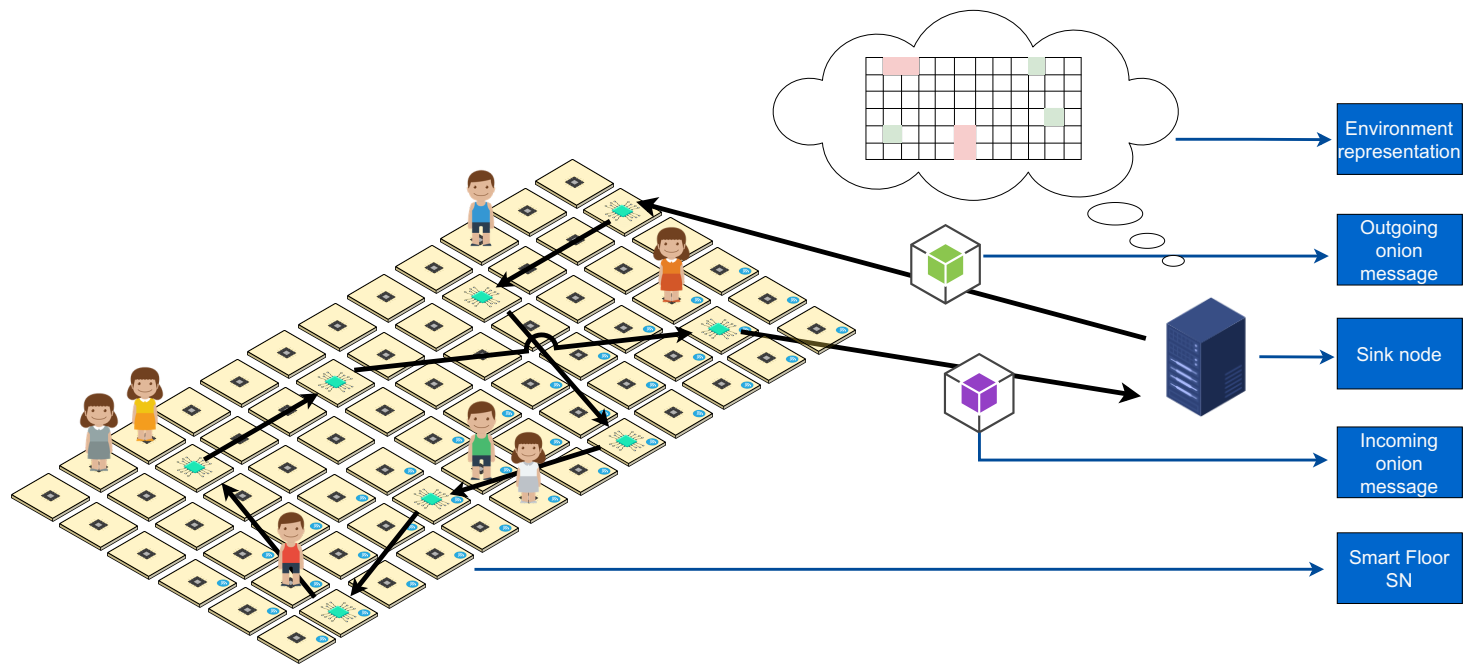
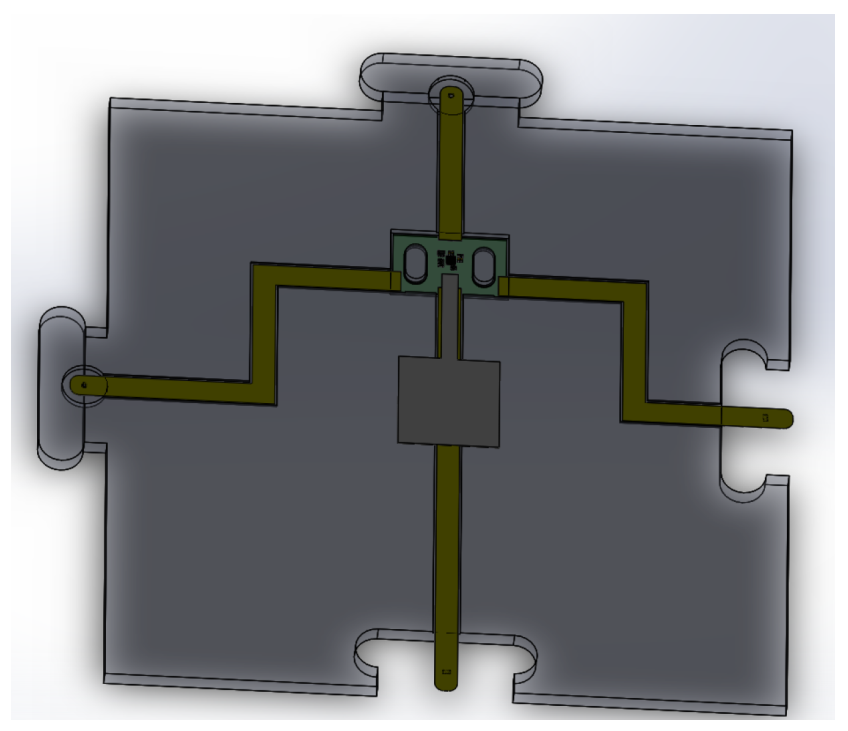
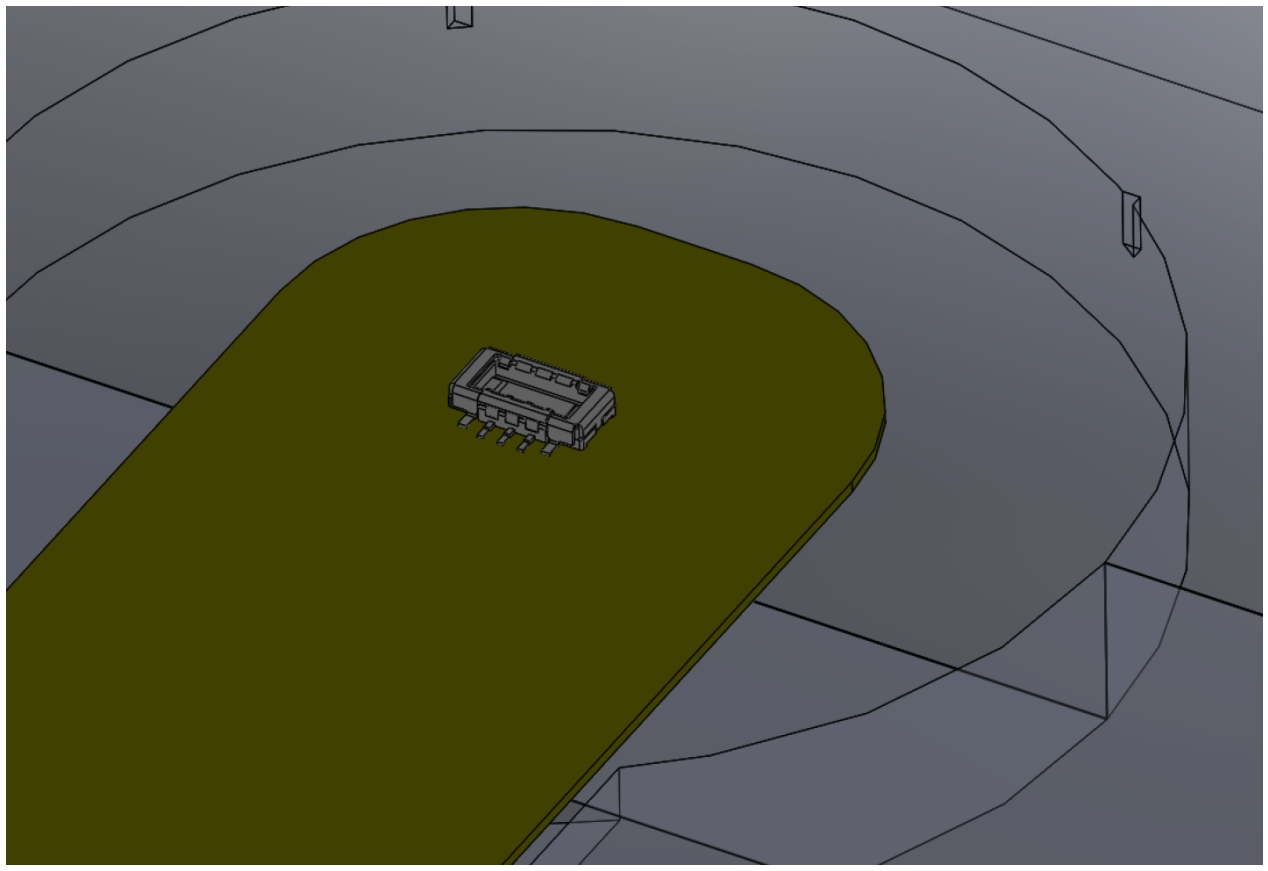
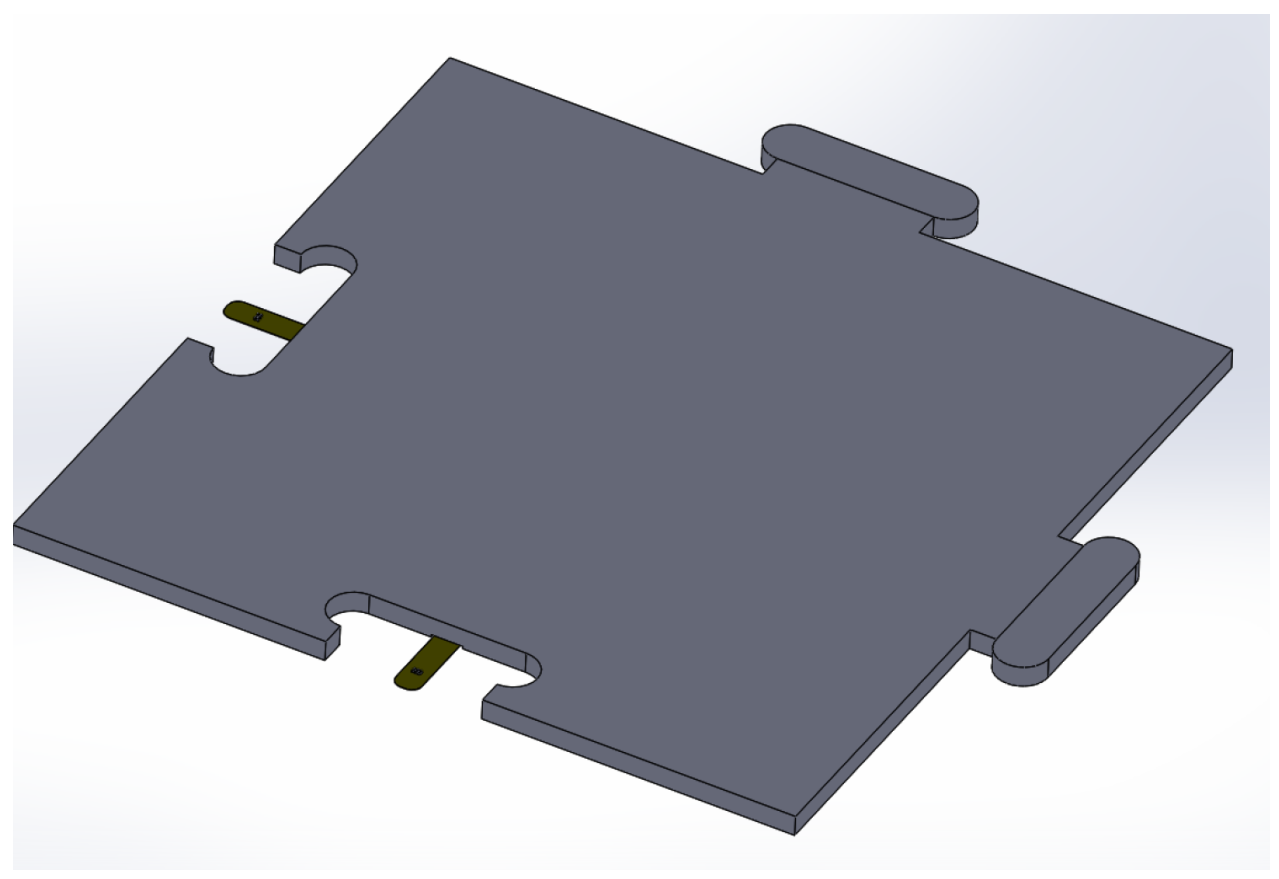
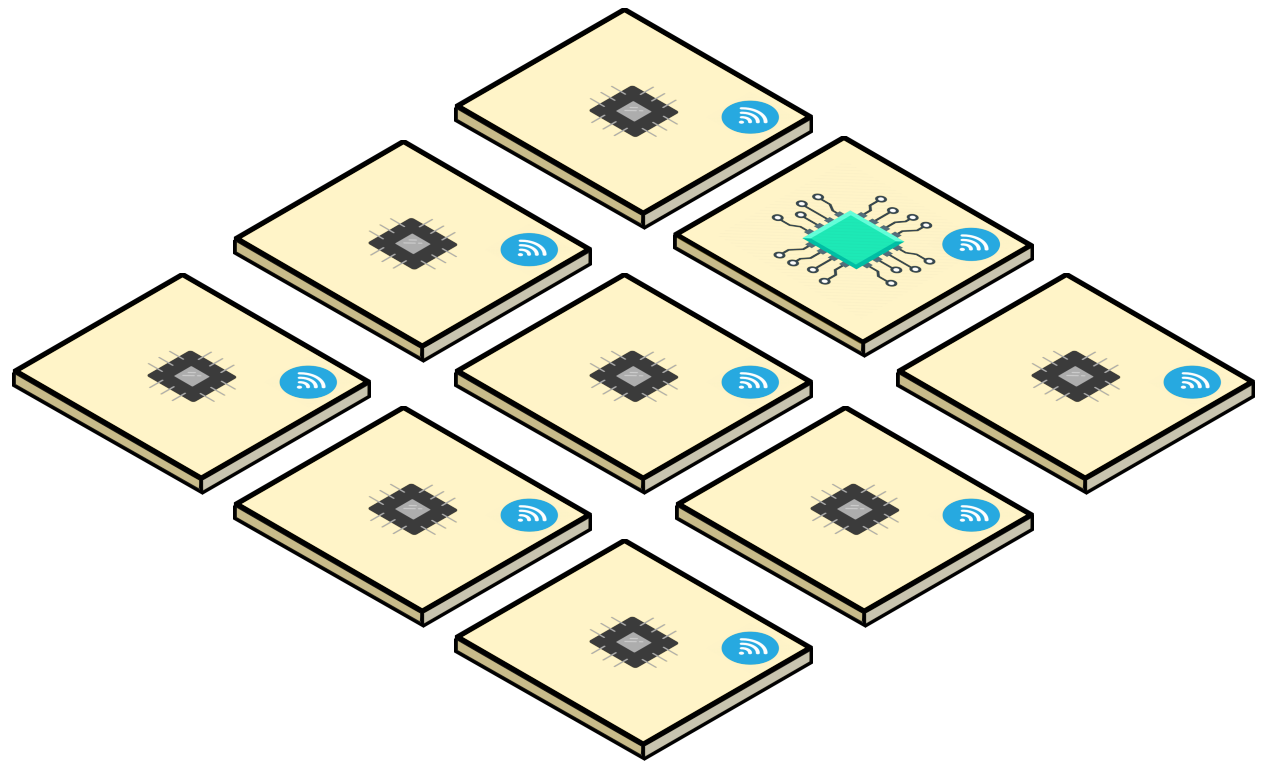
- A novel privacy-preserving indoor location system with querying capabilities: The network of sensors is embedded in the floor and senses the local force applied over it. It is non-intrusive and does not require active user interaction. Moreover, the raw sensory data collected by sensors describe the force applied to the floor and can only lead to unique user identification via walking gait analysis. However, the walking gait analysis [12] requires large amounts of data from individual users, and in our privacy-aware framework, the raw data do not leave the source sensor, therefore inhibiting similar attempts.
- A secure WSN with anonymous source location and sensor network identity: We propose a new querying protocol for WSN, which uses multi-layer encryption to conceal the network identity of sensor nodes, obfuscating the computation described in [13]. The protocol relies on particular messages similar to those used in the onion routing [14] to convey edge data processing information to sensor nodes and privately retrieve data.
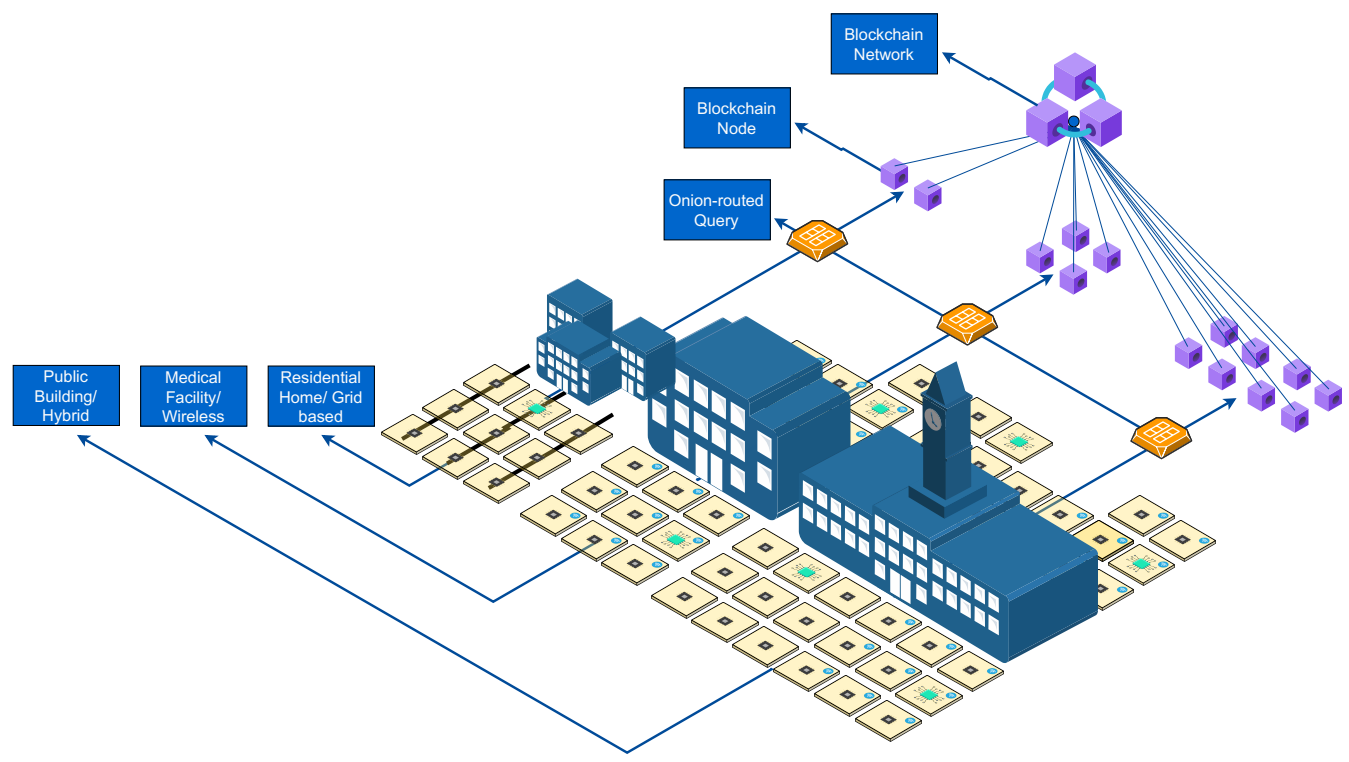
- A blockchain-based fault tolerant indoor location system with no single point of failure(SPOF): We address the fault tolerance shortcomings of sink nodes [15] in traditional WSNs by substituting it with a smart contract, which handles the processing of queries, and storing the results. A decentralized role-based access control (RBAC) contract provides user access authorization to monitor individual building spaces defining privacy boundaries and further improves the security over traditional centralized approaches.
2. Literature Review
2.1. Secure Data Processing in Network of Sensors
2.2. Role Based Access Control—RBAC
3. Architecture
3.1. Cost Aspects of the Proposed Solution
3.2. Non-Intrusive, Privacy-Preserving Indoor Location
4. Secure, and Private Data Filtering, and Aggregation
- (a)
- Nodes processing the OM obtain two symmetric encryption keys and the next-hop IP address from layer decryption of the layered object. The first symmetric encryption key is used to access the content of the OM payload. Next, the node executes the computer code and embeds results in the binary string. The OM payload is then encrypted using the second symmetric encryption key, and after a time-span affected by randomness, the OM is forwarded to the next-hop node.
- (b)
- Nodes emulating OM processing only obtain the next-hop IP address from layer decryption of the layered object. These nodes retain the OM without accessing the payload for a time-span similar to nodes processing the OM, and then the message is forwarded to the next-hop node.
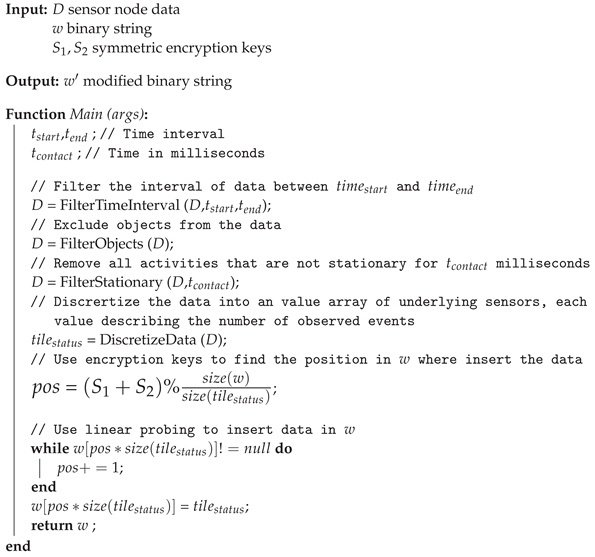
4.1. Data Filtering and Aggregation
| Algorithm 1: Data filtering to supervise social distancing violations |
 |
5. Blockchain for Secure Storage and Computation
5.1. WSN Sink
5.2. Role-Based Access Control
6. Validation
6.1. Data Filtering and Aggregation
Experimental Setup
6.2. Blockchain
6.3. Discussion
7. Conclusions and Future Work
Author Contributions
Funding
Institutional Review Board Statement
Informed Consent Statement
Acknowledgments
Conflicts of Interest
References
- Riffe, T.; Acosta, E. Data Resource Profile: COVerAGE-DB: A global demographic database of COVID-19 cases and deaths. Int. J. Epidemiol. 2021, 50, 390–390f. [Google Scholar] [CrossRef] [Scilit]
- Bale, R.; Li, C.G.; Yamakawa, M.; Iida, A.; Kurose, R.; Tsubokura, M. Simulation of droplet dispersion in COVID-19 type pandemics on Fugaku. In Proceedings of the Platform for Advanced Scientific Computing Conference, Geneva, Switzerland, 5–9 July 2021; pp. 1–11. [Google Scholar]
- Ooi, C.C.; Suwardi, A.; Ouyang, Z.L.; Xu, G.; Tan, C.K.I.; Daniel, D.; Li, H.; Ge, Z.; Leong, F.Y.; Marimuthu, K.; et al. Risk assessment of airborne COVID-19 exposure in social settings. Phys. Fluids 2021, 33, 087118. [Google Scholar] [CrossRef] [Scilit]
- Sun, C.; Zhai, Z. The efficacy of social distance and ventilation effectiveness in preventing COVID-19 transmission. Sustain. Cities Soc. 2020, 62, 102390. [Google Scholar] [CrossRef] [Scilit] [PubMed]
- Singh, R.P.; Javaid, M.; Haleem, A.; Suman, R. Internet of things (IoT) applications to fight against COVID-19 pandemic. Diabetes Metab. Syndr. Clin. Res. Rev. 2020, 14, 521–524. [Google Scholar] [CrossRef] [Scilit] [PubMed]
- Singh, P.K.; Nandi, S.; Ghafoor, K.Z.; Ghosh, U.; Rawat, D.B. Preventing covid-19 spread using information and communication technology. IEEE Consum. Electron. Mag. 2020, 10, 18–27. [Google Scholar] [CrossRef] [Scilit]
- Kumar, K.; Kumar, N.; Shah, R. Role of IoT to avoid spreading of COVID-19. Int. J. Intell. Netw. 2020, 1, 32–35. [Google Scholar] [CrossRef] [Scilit]
- Dong, Y.; Yao, Y.D. IoT platform for COVID-19 prevention and control: A survey. IEEE Access 2021, 9, 49929–49941. [Google Scholar] [CrossRef] [Scilit]
- Garg, L.; Chukwu, E.; Nasser, N.; Chakraborty, C.; Garg, G. Anonymity preserving IoT-based COVID-19 and other infectious disease contact tracing model. IEEE Access 2020, 8, 159402–159414. [Google Scholar] [CrossRef] [Scilit]
- Chan, H.; Perrig, A. Security and privacy in sensor networks. Computer 2003, 36, 103–105. [Google Scholar] [CrossRef]
- Gao, Y.; Ao, H.; Feng, Z.; Zhou, W.; Hu, S.; Tang, W. Mobile network security and privacy in WSN. Procedia Comput. Sci. 2018, 129, 324–330. [Google Scholar] [CrossRef] [Scilit]
- Shi, Q.; Zhang, Z.; He, T.; Sun, Z.; Wang, B.; Feng, Y.; Shan, X.; Salam, B.; Lee, C. Deep learning enabled smart mats as a scalable floor monitoring system. Nat. Commun. 2020, 11, 4609. [Google Scholar] [CrossRef] [Scilit] [PubMed]
- Hrovatin, N.; Tošić, A.; Mrissa, M.; Vičič, J. A General Purpose Data and Query Privacy Preserving Protocol for Wireless Sensor Networks. arXiv 2021, arXiv:2111.14994. [Google Scholar]
- Goldschlag, D.M.; Reed, M.G.; Syverson, P.F. Hiding routing information. In International Workshop on Information Hiding; Springer: Berlin/Heidelberg, Germany, 1996; pp. 137–150. [Google Scholar]
- Thulasiraman, P.; Haakensen, T.; Callanan, A. Countering passive cyber attacks against sink nodes in tactical sensor networks using reactive route obfuscation. J. Netw. Comput. Appl. 2019, 132, 10–21. [Google Scholar] [CrossRef] [Scilit]
- Brena, R.F.; García-Vázquez, J.P.; Galván-Tejada, C.E.; Muñoz-Rodriguez, D.; Vargas-Rosales, C.; Fangmeyer, J. Evolution of indoor positioning technologies: A survey. J. Sens. 2017, 2017, 2630413. [Google Scholar] [CrossRef] [Scilit]
- Farahsari, P.S.; Farahzadi, A.; Rezazadeh, J.; Bagheri, A. A Survey on Indoor Positioning Systems for IoT-based Applications. IEEE Internet Things J. 2022. early access. [Google Scholar] [CrossRef] [Scilit]
- Want, R.; Hopper, A.; Falcao, V.; Gibbons, J. The active badge location system. ACM Trans. Inf. Syst. (TOIS) 1992, 10, 91–102. [Google Scholar] [CrossRef] [Scilit]
- Forestiero, A. Metaheuristic algorithm for anomaly detection in Internet of Things leveraging on a neural-driven multiagent system. Knowl.-Based Syst. 2021, 228, 107241. [Google Scholar] [CrossRef] [Scilit]
- Forestiero, A. Self-organizing anomaly detection in data streams. Inf. Sci. 2016, 373, 321–336. [Google Scholar] [CrossRef] [Scilit]
- Orr, R.J.; Abowd, G.D. The smart floor: A mechanism for natural user identification and tracking. In Proceedings of the CHI’00 Extended Abstracts on Human Factors in Computing Systems, The Hague, The Netherlands, 1–6 April 2000; pp. 275–276. [Google Scholar]
- He, C.; Zhu, W.; Chen, B.; Xu, L.; Jiang, T.; Han, C.B.; Gu, G.Q.; Li, D.; Wang, Z.L. Smart floor with integrated triboelectric nanogenerator as energy harvester and motion sensor. ACS Appl. Mater. Interfaces 2017, 9, 26126–26133. [Google Scholar] [CrossRef] [Scilit]
- Kaddoura, Y.; King, J.; Helal, A. Cost-precision tradeoffs in unencumbered floor-based indoor location tracking. In Proceedings of the Third International Conference On Smart Homes and Health Telematic (ICOST), Sherbrooke, QC, Canada, 4–6 July 2005. [Google Scholar]
- Shen, Y.L.; Shin, C.S. Distributed sensing floor for an intelligent environment. IEEE Sens. J. 2009, 9, 1673–1678. [Google Scholar] [CrossRef] [Scilit]
- Yang, X.; Gao, L.; Zheng, J.; Wei, W. Location privacy preservation mechanism for location-based service with incomplete location data. IEEE Access 2020, 8, 95843–95854. [Google Scholar] [CrossRef] [Scilit]
- Shen, H.; Zhou, J.; Cao, Z.; Dong, X.; Choo, K.K.R. Blockchain-based lightweight certificate authority for efficient privacy-preserving location-based service in vehicular social networks. IEEE Internet Things J. 2020, 7, 6610–6622. [Google Scholar] [CrossRef] [Scilit]
- Selamneni, V.; Dave, A.; Mondal, S.; Mihailovic, P.; Sahatiya, P. Large Area Pressure Sensor for Smart Floor Sensor Applications—An Occupancy Limiting Technology to Combat Social Distancing. IEEE Consum. Electron. Mag. 2021, 10, 98–103. [Google Scholar] [CrossRef] [Scilit]
- Tošić, A.; Hrovatin, N.; Vičič, J. Data about fall events and ordinary daily activities from a sensorized smart floor. Data Brief 2021, 37, 107253. [Google Scholar] [CrossRef] [Scilit] [PubMed]
- Gu, T.; Fang, Z.; Abhishek, A.; Mohapatra, P. IoTSpy: Uncovering Human Privacy Leakage in IoT Networks via Mining Wireless Context. In Proceedings of the 2020 IEEE 31st Annual International Symposium on Personal, Indoor and Mobile Radio Communications, London, UK, 31 August–3 September 2020; pp. 1–7. [Google Scholar]
- Zhang, F.; He, W.; Liu, X. Defending against traffic analysis in wireless networks through traffic reshaping. In Proceedings of the 2011 31st International Conference on Distributed Computing Systems, Minneapolis, MN, USA, 20–24 June 2011; pp. 593–602. [Google Scholar]
- Saltaformaggio, B.; Choi, H.; Johnson, K.; Kwon, Y.; Zhang, Q.; Zhang, X.; Xu, D.; Qian, J. Eavesdropping on fine-grained user activities within smartphone apps over encrypted network traffic. In Proceedings of the 10th {USENIX} Workshop on Offensive Technologies ({WOOT} 16), Austin, TX, USA, 8–9 August 2016. [Google Scholar]
- Middya, R.; Chakravarty, N.; Naskar, M.K. Compressive sensing in wireless sensor networks—A survey. IETE Tech. Rev. 2017, 34, 642–654. [Google Scholar] [CrossRef] [Scilit]
- Zheng, H.; Yang, F.; Tian, X.; Gan, X.; Wang, X.; Xiao, S. Data gathering with compressive sensing in wireless sensor networks: A random walk based approach. IEEE Trans. Parallel Distrib. Syst. 2014, 26, 35–44. [Google Scholar] [CrossRef] [Scilit]
- Hu, P.; Xing, K.; Cheng, X.; Wei, H.; Zhu, H. Information leaks out: Attacks and countermeasures on compressive data gathering in wireless sensor networks. In Proceedings of the IEEE INFOCOM 2014-IEEE Conference on Computer Communications, Toronto, ON, Canada, 27 April–2 May 2014; pp. 1258–1266. [Google Scholar]
- Xie, K.; Ning, X.; Wang, X.; He, S.; Ning, Z.; Liu, X.; Wen, J.; Qin, Z. An efficient privacy-preserving compressive data gathering scheme in WSNs. Inf. Sci. 2017, 390, 82–94. [Google Scholar] [CrossRef] [Scilit]
- Paillier, P. Public-key cryptosystems based on composite degree residuosity classes. In International Conference on the Theory and Applications of Cryptographic Techniques; Springer: Berlin/Heidelberg, Germany, 1999; pp. 223–238. [Google Scholar]
- Xu, J.; Yang, G.; Chen, Z.; Wang, Q. A survey on the privacy-preserving data aggregation in wireless sensor networks. China Commun. 2015, 12, 162–180. [Google Scholar] [CrossRef] [Scilit]
- Bista, R.; Chang, J.W. Privacy-preserving data aggregation protocols for wireless sensor networks: A survey. Sensors 2010, 10, 4577–4601. [Google Scholar] [CrossRef] [Scilit]
- Sandhu, R.S. Role-based access control. In Advances in Computers; Elsevier: Amsterdam, The Netherlands, 1998; Volume 46, pp. 237–286. [Google Scholar]
- Di Francesco Maesa, D.; Mori, P.; Ricci, L. Blockchain Based Access Control. In IFIP International Conference on Distributed Applications and Interoperable Systems; Chen, L.Y., Reiser, H.P., Eds.; Springer International Publishing: Cham, Switzerland, 2017; pp. 206–220. [Google Scholar]
- Hu, V.C.; Kuhn, D.R.; Ferraiolo, D.F.; Voas, J. Attribute-based access control. Computer 2015, 48, 85–88. [Google Scholar] [CrossRef] [Scilit]
- Sandhu, R.S.; Samarati, P. Access control: Principle and practice. IEEE Commun. Mag. 1994, 32, 40–48. [Google Scholar] [CrossRef] [Scilit]
- Achour, I.; Ayed, S.; Idoudi, H. On the Implementation of Access Control in Ethereum Blockchain. In Proceedings of the 2021 International Conference on Innovation and Intelligence for Informatics, Computing, and Technologies (3ICT), Virtual, 29–30 September 2021; pp. 483–487. [Google Scholar]
- Cruz, J.P.; Kaji, Y.; Yanai, N. RBAC-SC: Role-based access control using smart contract. IEEE Access 2018, 6, 12240–12251. [Google Scholar] [CrossRef] [Scilit]
- Wadaa, A.; Olariu, S.; Wilson, L.; Eltoweissy, M.; Jones, K. On providing anonymity in wireless sensor networks. In Proceedings of the Tenth International Conference on Parallel and Distributed Systems, Istanbul, Turkey, 15–20 July 2004; pp. 411–418. [Google Scholar]
- Syverson, P.F.; Goldschlag, D.M.; Reed, M.G. Anonymous connections and onion routing. In Proceedings of the 1997 IEEE Symposium on Security and Privacy (Cat. No. 97CB36097), Oakland, CA, USA, 4–7 May 1997; pp. 44–54. [Google Scholar]
- Rivest, R.L.; Shamir, A.; Adleman, L. A method for obtaining digital signatures and public-key cryptosystems. Commun. ACM 1978, 21, 120–126. [Google Scholar] [CrossRef] [Scilit]
- Sunshine, C.A. Source routing in computer networks. ACM SIGCOMM Comput. Commun. Rev. 1977, 7, 29–33. [Google Scholar] [CrossRef] [Scilit]
- Microsoft. Decentralized Identity. 2018. Available online: https://query.prod.cms.rt.microsoft.com/cms/api/am/binary/RE2DjfY (accessed on 19 December 2021).
- Snow, P.; Deery, B.; Kirby, P.; Johnston, D. Factom Ledger by Consensus. 2015. Available online: https://cryptochainuni.com/wp-content/uploads/Factom-Ledger-by-Consensus.pdf (accessed on 19 December 2021).
- Buterin, V. Ethereum white paper. GitHub Repos. 2013, 1, 22–23. [Google Scholar]
- Kohno, E.; Ohta, T.; Kakuda, Y. Secure decentralized data transfer against node capture attacks for wireless sensor networks. In Proceedings of the 2009 International Symposium on Autonomous Decentralized Systems, Athens, Greece, 23–25 March 2009; pp. 1–6. [Google Scholar]
- Hrovatin, N.; Tošić, A.; Vičič, J. Ppwsim: Privacy Preserving Wireless Sensor Network Simulator. SSRN 2021. Available online: https://papers.ssrn.com/sol3/papers.cfm?abstract_id=3978796 (accessed on 19 December 2021).
- Henderson, T.R.; Lacage, M.; Riley, G.F.; Dowell, C.; Kopena, J. Network simulations with the ns-3 simulator. SIGCOMM Demonstr. 2008, 14, 527. [Google Scholar]
- Clausen, T.; Jacquet, P.; Adjih, C.; Laouiti, A.; Minet, P.; Muhlethaler, P.; Qayyum, A.; Viennot, L. Optimized Link State Routing Protocol (OLSR). 2003. Available online: https://hal.inria.fr/inria-00471712/ (accessed on 19 December 2021).
- Miller, V.S. Use of elliptic curves in cryptography. In Conference on the Theory and Application of Cryptographic Techniques; Springer: Berlin/Heidelberg, Germany, 1985; pp. 417–426. [Google Scholar]
- Libsodium. The Sodium Crypto Library. Available online: https://libsodium.gitbook.io/doc/ (accessed on 28 May 2021).
- Bernstein, D.J. Curve25519: New Diffie-Hellman speed records. In International Workshop on Public Key Cryptography; Springer: Berlin/Heidelberg, Germany, 2006; pp. 207–228. [Google Scholar]
- Rahman, M.U.; Baiardi, F.; Guidi, B.; Ricci, L. Protecting personal data using smart contracts. In International Conference on Internet and Distributed Computing Systems; Springer: Berlin/Heidelberg, Germany, 2019; pp. 21–32. [Google Scholar]
- Schäffer, M.; Angelo, M.D.; Salzer, G. Performance and scalability of private Ethereum blockchains. In International Conference on Business Process Management; Springer: Berlin/Heidelberg, Germany, 2019; pp. 103–118. [Google Scholar]



| n | 10 | 20 | 30 | 40 | 50 | 60 | 70 | 80 | 90 | 100 |
|---|---|---|---|---|---|---|---|---|---|---|
| Layered object (bytes) | 840 | 1680 | 2520 | 3360 | 4200 | 5040 | 5880 | 6720 | 7560 | 8400 |
| Total (bytes) | 3340 | 4180 | 5020 | 5860 | 6700 | 7540 | 8380 | 9220 | 10,060 | 10,900 |
| Operation | ECC Decryption | ECC Decryption | ChaCha20 Encryption | ChaCha20 Decryption | Data Processing |
|---|---|---|---|---|---|
| Data | 1 B | 1 kB | 2.5 kB | 2.5 kB | 15 kB |
| Execution time | 18.4 ms | 18.9 ms | 1.2 ms | 1.1 ms | 9.8 ms |
| n | 10 | 20 | 30 | 40 | 50 | 60 | 70 | 80 | 90 | 100 |
|---|---|---|---|---|---|---|---|---|---|---|
| mean (seconds) | 1.12 | 2.28 | 3.23 | 4.24 | 5.35 | 6.38 | 7.39 | 8.60 | 9.55 | 10.61 |
| std | 0.018 | 0.022 | 0.046 | 0.078 | 0.080 | 0.092 | 0.121 | 0.153 | 0.097 | 0.110 |
Publisher’s Note: MDPI stays neutral with regard to jurisdictional claims in published maps and institutional affiliations. |
© 2022 by the authors. Licensee MDPI, Basel, Switzerland. This article is an open access article distributed under the terms and conditions of the Creative Commons Attribution (CC BY) license (https://creativecommons.org/licenses/by/4.0/).
Share and Cite
Tošić, A.; Hrovatin, N.; Vičič, J. A WSN Framework for Privacy Aware Indoor Location. Appl. Sci. 2022, 12, 3204. https://doi.org/10.3390/app12063204
Tošić A, Hrovatin N, Vičič J. A WSN Framework for Privacy Aware Indoor Location. Applied Sciences. 2022; 12(6):3204. https://doi.org/10.3390/app12063204
Chicago/Turabian StyleTošić, Aleksandar, Niki Hrovatin, and Jernej Vičič. 2022. "A WSN Framework for Privacy Aware Indoor Location" Applied Sciences 12, no. 6: 3204. https://doi.org/10.3390/app12063204
APA StyleTošić, A., Hrovatin, N., & Vičič, J. (2022). A WSN Framework for Privacy Aware Indoor Location. Applied Sciences, 12(6), 3204. https://doi.org/10.3390/app12063204