


Abstract
Cyclocodon lancifolius fruit (CF), a functional food widely consumed in Southwest China, exhibits potent antioxidant activity and considerable commercial importance. However, its protective effects against acute alcohol-induced liver injury (ALI) and the underlying mechanisms remain to be fully elucidated. This exploratory study examined the hepatoprotective effect of CF pre-treatment in an acute binge ethanol-induced mouse model. CF pre-treatment significantly attenuated hepatic pathology, as evidenced by reduced serum ALT/AST levels and mitigated mitochondrial damage. It also ameliorated oxidative stress with Keap1 downregulation and Nrf2 upregulation. Furthermore, 16S rRNA sequencing revealed that CF pre-treatment was associated with increased abundance of Prevotella and enhanced acetate production. Fecal microbiota transplantation (FMT) suggested that the transfer of CF-modulated fecal material could partially reproduce the hepatoprotective phenotype, although the specific role of live microbes versus soluble metabolites requires further verification. In conclusion, CF pre-treatment alleviates acute alcohol-induced liver injury, which is accompanied by alterations in the gut microbiota, SCFAs, and the hepatic Keap1/Nrf2 pathway.
1. Introduction
Alcohol has played an integral role in cultural traditions and social practices across civilizations throughout history [1]. However, contemporary medical research has increasingly highlighted the potential health risks associated with its consumption [2]. Alcohol-related liver damage is prominent among the various adverse effects on the human body because of the liver’s central role in metabolizing alcohol [3]. This makes alcoholic liver injury (ALI) one of the most clinically significant consequences of heavy drinking [4]. Alcohol and its metabolites disrupt key metabolic pathways and mitochondrial function [5]. The development of ALI is primarily driven by the disruption of redox homeostasis [6]. Alcohol metabolism generates excessive reactive oxygen species (ROS), which overwhelm the body’s antioxidant defenses [7]. The impaired Nrf2-Keap1 signaling pathway plays a crucial role in this process [8]. Specifically, alcohol metabolism directly affects Keap1’s sensor function, creating a self-amplifying loop of oxidative damage [9]. Thus, it is urgent to take action to prevent and ameliorate ALI [10].
Recent advances show that the gut microbiome is a key regulator of systemic metabolism, especially in the context of ALI pathogenesis [11,12]. Intestinal microbes can produce short-chain fatty acids (SCFAs), such as acetate, propionate, and butyrate [13]. These SCFAs act as bioactive metabolites, serving both as energy sources and regulatory compounds [14]. This metabolic disorder caused by the microbiota exacerbates oxidative stress in the liver and disrupts the body’s overall metabolic regulation [15,16]. This highlights the potential for interventions that restore microbial balance and reduce oxidative and metabolic disruptions in ALI. Unfortunately, current therapeutic strategies are insufficient to tackle this complex pathophysiology. Newer and more effective agents from botanical resources need to be urgently found [17]. Indeed, natural functional foods have been reported to alleviate ALI by modulating the gut microbiome [18].
Cyclocodon lancifolius (Roxb.) Kurz, a member of the Campanulaceae family, is commonly known as Hong Guo Ginseng [19]. In China, it is mainly found in the southwestern regions, including Yunnan, Guizhou, and Sichuan [20]. The leaves and roots of C. lancifolius are extensively utilized as tonics among ethnic minorities [21]. Its edible fruit is a small berry, rich in flavonoids, organic acids, and other active components. C. lancifolia fruit (CF) has high nutritional value and health benefits, including antioxidant properties and the potential inhibitory activity towards xanthine oxidase [22]. Previous studies have also demonstrated that CF can extend the lifespan of Caenorhabditis elegans by enhancing antioxidant defenses and modulating purine metabolism [23]. Thus, CF holds substantial potential for both medicinal applications and economic development. However, the hepatoprotective effect of CF on ALI mice, as well as the precise mechanism, remains unclear.
This study aims to elucidate the mechanisms underlying the hepatoprotective effects of CF against ALI. We will employ an acute alcohol exposure murine model to characterize CF’s effects on liver injury and oxidative stress. Complementary 16S rRNA sequencing and GC-MS analyses will be conducted to assess CF-induced modulations in gut microbial ecology and SCFA biosynthesis. Mechanistic validation will involve fecal microbiota transplantation (FMT) experiments to establish microbial contribution to the observed phenotypic improvements.
2. Materials and Methods
2.1. Preparation of C. lancifolia Fruit Extract
The fruits of C. lancifolius were gathered from a cultivation base of Guizhou Innovation Agriculture Development Co., Ltd., Tongren, China. These fruits were fully mature, and their authenticity was verified by Professor Qingwen Sun from Guizhou University of Traditional Chinese Medicine. Fresh C. lancifolius fruits (CF) underwent hot aqueous extraction (1:9 w/v, 100 °C, 30 min) followed by immediate filtration. The resulting aqueous phase was lyophilized to produce a stable powdered extract, which was aliquoted and stored at −20 °C until further analysis. CF was dissolved in distilled water before administration
2.2. Composition Analysis of CF
CF sample was dissolved in purified water. The mixture was then vortexed for 10 min, followed by centrifugation at 12,000 rpm for 10 min. A 500 µL amount of the supernatant was filtered through a 0.22 µm membrane for further analysis. Chemical composition analysis was performed using an UltiMate 3000 UHPLC system coupled to a Q-Exactive high-resolution mass spectrometer (Thermo Fisher Scientific, Waltham, MA, USA) with electrospray ionization capability. The chromatographic separation of CF was performed using an ACQUITY™ Premier HSS T3 column (1.8 μm, 2.1 × 100 mm; Waters, Milford, MA, USA). The mobile phase was composed of 0.1% (v/v) formic acid in water (A) and methanol (B). The gradient elution was as follows: 2% B from 0 to 1 min, a linear increase from 2% to 100% B from 1 to 5.5 min, 100% B from 5.5 to 14 min, a decrease from 100% to 2% B from 14 to 14.1 min, and 2% B from 14.1 to 16 min. The column was maintained at 45 °C, and the flow rate was kept at 0.3 mL/min. Mass spectrometry analysis was conducted in positive ion mode; the MS scanned across a mass range of m/z 80 to 1200, with a resolution of 70,000 for MS1 and 17,500 for MS2 acquisitions.
2.3. Animals and Experimental Design
The animal experiments were approved by the Animal Experiment Center of Guizhou University of Traditional Chinese Medicine and conformed to animal ethics (approval number: 2024094; Guiyang, China). Male Kunming mice (8 weeks old, weighing 18–22 g) were obtained from Tianqin Biotechnology Co., Ltd. (Changsha, China) and maintained under SPF conditions at 21–25 °C with 55 ± 5% humidity, 12 h light/dark cycles, and free access to food and water.
Dose–response study: Thirty mice were randomized into five groups (n = 6): Control, Model, CF-L (25 mg/kg/d, i.g.), CF-M (50 mg/kg/d, i.g.), and CF-H (100 mg/kg/d, i.g.). Mice were pre-treated with CF or distilled water for 14 consecutive days.
FMT study: Recipient mice were pre-treated with a broad-spectrum antibiotic cocktail to deplete the gut microbiota. After depletion, they were randomly divided into three groups (n = 6): FMT-Con, FMT-ALI, and FMT-CF. Donor mice for the FMT-CF group were treated with 100 mg/kg/d CF for 14 days. FMT-Con and FMT-ALI received feces from healthy control donors. Antibiotics were withdrawn 24 h before the first FMT. Fresh feces (100 mg) were homogenized in 1 mL sterile PBS, and 200 μL of the supernatant was gavaged daily for 7 consecutive days.
Acute ALI model: Following the 14-day CF pre-treatment (Experiment 1) or the 7-day FMT period (Experiment 2), acute ALI was induced. Mice in all groups except the Control and FMT-Con groups received a single gavage of 50% (v/v) ethanol at 12 mL/kg, while the control groups received an equal volume of water [24,25]. Liver, serum, and cecal contents were collected 12 h after ethanol administration.
2.4. Liver Histopathology
For hematoxylin-eosin (H&E) staining, liver tissues were fixed in 10% neutral formalin (4 °C, 48 h), paraffin-embedded, and sectioned into 5 µm slices. After deparaffinization and ethanol gradient hydration, sections were stained with hematoxylin and eosin. Histological images were captured using a Pannoramic 250 automated scanner (3DHISTECH Ltd., Budapest, Hungary) [26].
For transmission electron microscopy (TEM) analysis, liver tissues were fixed with 2.5% glutaraldehyde and 1% osmium tetroxide, dehydrated through an acetone gradient (30–100%), and embedded in Epon-812 resin after stepwise infiltration. Ultrathin sections (60–90 nm) on copper grids were stained with uranyl acetate (15 min) and lead citrate (2 min) at room temperature. Images were acquired using a JEM-1400FLASH transmission electron microscope (JEOL, Tokyo, Japan) at 80 kV.
2.5. Biochemical Assays
The levels of serum alanine aminotransferase (ALT), aspartate aminotransferase (AST), total cholesterol (TC), and total triglyceride (TG) were determined using kits obtained from the Nanjing Jiancheng Bioengineering Institute. The levels of oxidative stress markers, including glutathione peroxidase (GSH-Px) and superoxide dismutase (SOD), in liver samples were quantified using commercially available assay kits according to the manufacturer’s protocol (Solarbio, Beijing, China).
2.6. Western Blotting
Proteins were extracted from liver according to the previously described methods [27]. The proteins were separated by SDS-PAGE based on their molecular weight. Antibodies against the following targets were used: Keap1 (Abclonal, Wuhan, China), β-actin (Abclonal), GPX4 (Proteintech, Wuhan, China), and Nrf2 (Abcam, Cambridge, UK). The target proteins were transferred onto a PVDF membrane, blocked with skimmed milk powder at room temperature for 2 h, and then incubated with the primary antibody overnight. The corresponding secondary antibody was incubated at room temperature in the dark for 2 h. Subsequently, the relative expression levels of Keap1, Nrf2, and GPX4 were detected using the 5200 Multi Automatic Chemiluminescence Imaging System (Tanon, Shanghai, China).
2.7. 16S rRNA Gene Sequencing
Gut microbiota profiling was performed on fecal samples collected from control, model, and CF-H groups. Target regions were amplified in 25 μL reaction volumes containing Phusion® High-Fidelity DNA Polymerase (New England Biolabs, Ipswich, MA, USA) under optimized thermal cycling conditions. The thermal cycling protocol comprised an initial denaturation at 98 °C for 1 min, followed by 30 cycles of the following steps: denaturation (98 °C, 10 s), primer annealing (50 °C, 30 s), and extension (72 °C, 30 s), with a final elongation at 72 °C for 5 min. DNA sequencing libraries were constructed using the NEB Next® Ultra DNA Library Prep Kit (New England Biolabs). Finally, paired-end sequencing was performed on an Illumina NovaSeq 6000 platform (Illumina, San Diego, CA, USA). The α-diversity of Shannon and Chao1 and β-diversity of Principal Coordinates Analysis (PCoA) based on Bray–Curtis were completed using the Wekemo Bioincloud (https://www.bioincloud.tech (accessed on 10 May 2026)).
2.8. Short-Chain Fatty Acids Analysis
The concentrations of SCFAs in cecum contents were analyzed by HP6890/5975C Gas Chromatograph-Mass Spectrometer (Agilent, Santa Clara, CA, USA) and HP-5 MS capillary column (60 m × 250 μm, 0.25 μm) [28]. The temperature program was set as follows: initial temperature held at 40 °C for 3 min, increased to 210 °C at a rate of 30 °C/min, and maintained for 5 min. The carrier gas flow rate was 1.0 mL/min, with a 1 μL injection volume in splitless mode. Mass spectrometry conditions included an electron ionization (EI) source, ion source temperature of 230 °C, transfer line temperature of 280 °C, and data acquisition in selected ion monitoring (SIM) mode with a scan interval of 0.3 s.
2.9. Statistical Analysis
Data were expressed as mean ± standard error of the mean (SEM) and analyzed using GraphPad Prism 9.0. For normally distributed data, differences among multiple groups were evaluated using one-way ANOVA followed by Dunnett’s test. For data that did not meet the assumptions of normality, the Kruskal–Wallis test followed by Dunn’s post-hoc test was applied. A p-value < 0.05 was considered statistically significant.
3. Results
3.1. Preliminary Analysis of the Chemical Composition in CF
To systematically characterize the chemical constituents of CF, UHPLC-Q-exactive orbitrap HRMS was employed. Raw mass spectral data were processed using MS-DIAL software 4.7.0, with compound annotation achieved by matching MS/MS spectra against the following curated databases: MassBank (a plant metabolite-specific library), ReSpect (plant-specific library), and GNPS (natural products library). Finally, a total of 23 compounds were tentatively identified in positive ion mode. The total ion chromatogram (TIC) of CF was illustrated in Figure S1. Further details regarding these compounds can be found in Table S1. Overall, 12 organic acids, 6 flavonoids, 1 lignan, 3 glycosides and 1 sterol were identified from CF.
3.2. CF Protected Against ALI in Mice
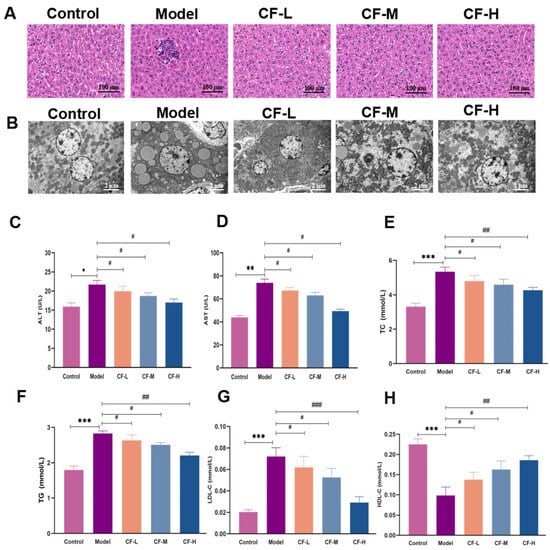
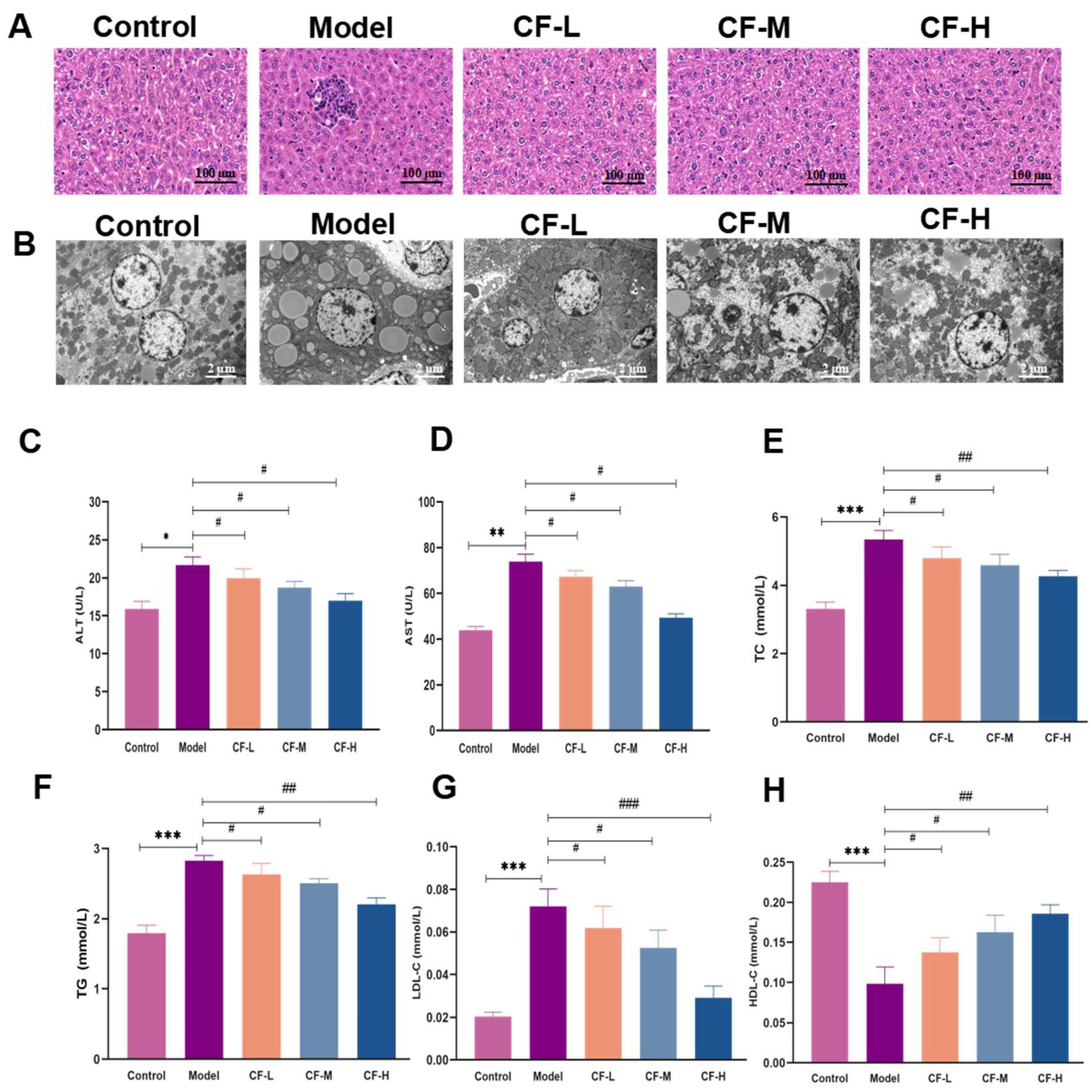
H&E staining of liver sections revealed uniform hepatocyte size, orderly arrangement of hepatocyte cords, and homogeneous cytoplasm in the control group, with no evident fibrous tissue proliferation or inflammatory cell infiltration. Following ethanol pre-treatment, hepatocytes showed vacuolar degeneration, swelling, and ballooning. After the administration of CF, the above pathological changes were ameliorated (Figure 1A). TEM analysis revealed that hepatocytes in the control group exhibited normal morphological architecture. The mitochondria exhibited typical short rod-like or circular shapes, with distinct cristae and homogeneous matrix. In the model group, hepatocytes showed significant abnormalities, as mitochondria were severely swollen, cristae were dissolved and fragmented, and matrix was lost. CF pre-treatment improved these changes, restoring hepatocyte and mitochondrial structures to near-normal conditions. (Figure 1B).
Figure 1.
CF alleviated alcohol-induced liver injury in mice. (A) Images of liver H&E staining (scale Bar = 100 μm). (B) TEM image of the liver (scale Bar = 2 μm). (C–F) Levels of serum ALT (C), AST (D), TC (E) and TG (F). (G,H) Levels of liver LDL-C (G) and HDL-C (H). Data are presented as means ± SEM. * p < 0.05, ** p < 0.01, *** p < 0.001, compared with the control group. # p < 0.05, ## p < 0.01, ### p < 0.001 compared with the model group.
Alcohol consumption also significantly elevated the levels of serum ALT, AST, TC, and TG (Figure 1C–F). Concurrently, it led to an elevation in hepatic LDL-C and a decrease in hepatic HDL-C (Figure 1G,H), indicative of liver injury [29]. CF administration effectively lowered serum concentrations of ALT, AST, TC, and TG, as well as LDL-C in the liver, while boosting hepatic HDL-C levels. CF exerts a modest protective effect on acute alcohol-induced biochemical injury.
3.3. CF Alleviated Oxidative Stress and Regulated Keap1/Nrf2 Pathway in the Liver
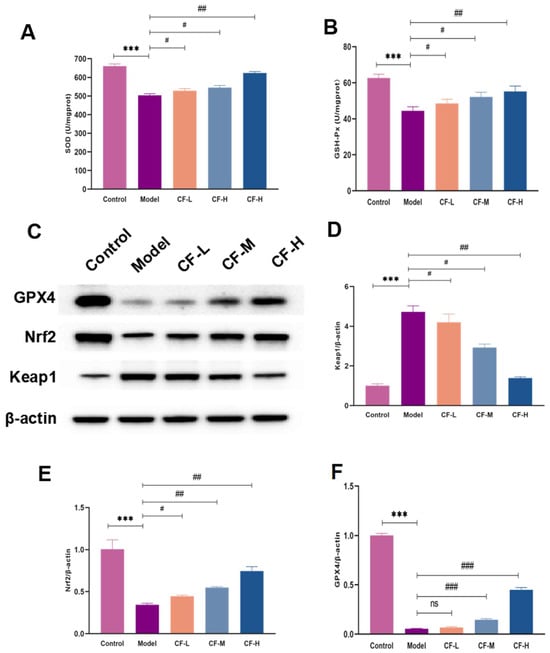
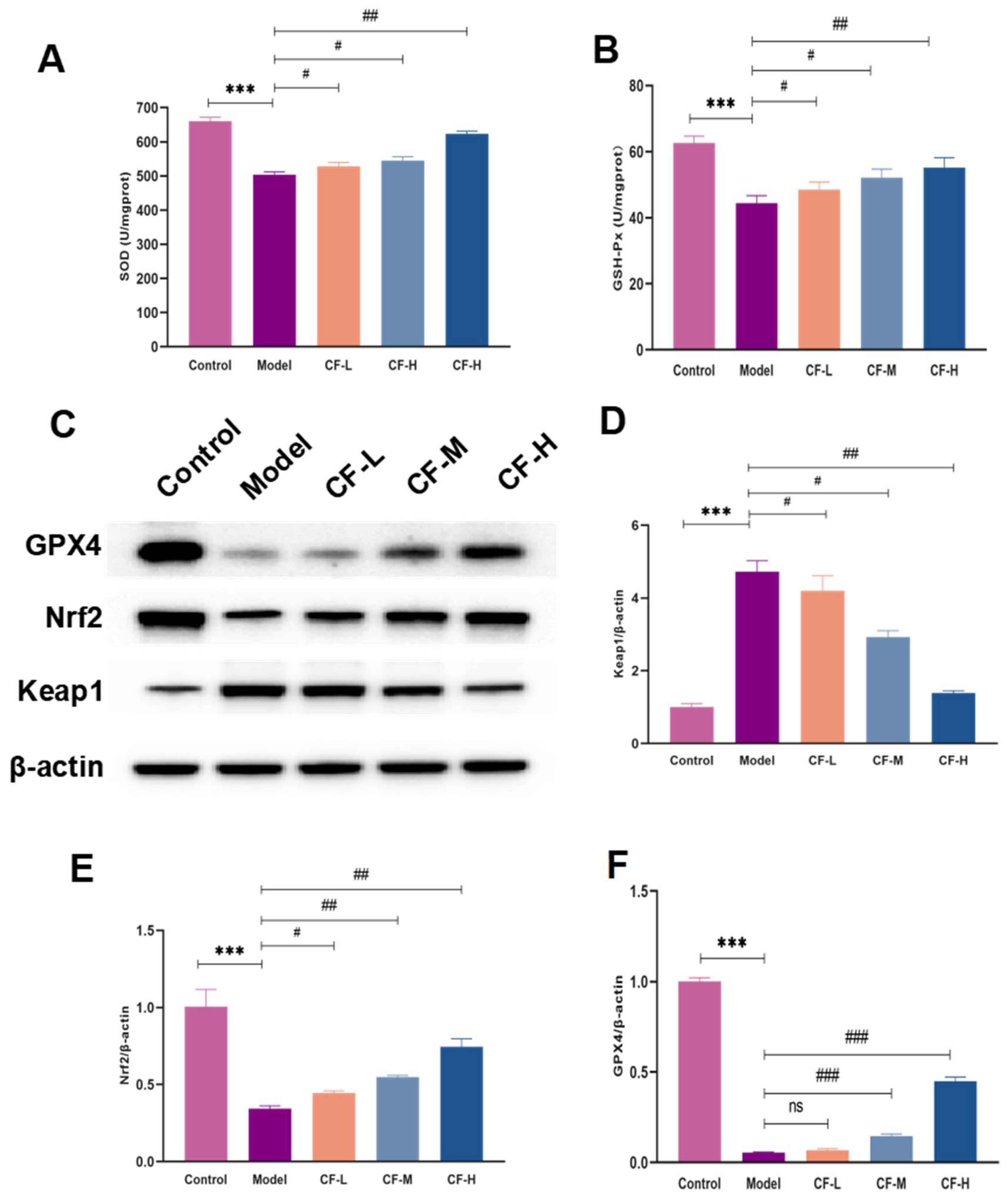
To determine whether CF could mitigate oxidative stress, the activity of SOD and GSH-Px in livers was measured. As shown in Figure 2A,B, ethanol pre-treatment decreased hepatic GSH-Px and SOD activity. By contrast, CF partially reversed the ethanol-induced reductions in GSH-Px and SOD activity. Thus, CF attenuates ethanol-induced hepatic oxidative stress. The Keap1/Nrf2 signaling pathway plays a vital role in protecting against the development of ALI [30]. Western blot analysis revealed that the expression levels of Nrf2 and GPX4 proteins were significantly reduced in the model group compared to the control group, whereas Keap1 expression was elevated. CF-H showed a trend toward upregulating Nrf2/GPX4 and downregulating Keap1 (Figure 2C–F). CF potentially alleviates oxidative stress in mouse livers via the Keap1/Nrf2 pathway.
Figure 2.
CF relieved oxidative stress in the liver. (A,B) Activity of SOD (A) and GSH-Px (B). (C) Images of Wwestern blot analysis of liver Keap1, Nrf2 and GPX4. (D–F) Semi-quantitative analysis of Keap1 (D), Nrf2 (E) and GPX4 (F). Data are presented as means ± SEM (n = 3). *** p < 0.001, compared with the control group. # p < 0.05, ## p < 0.01, ### p < 0.001 compared with the model group.
3.4. CF Improved Alcohol-Induced Dysbiosis of the Gut Microbiota
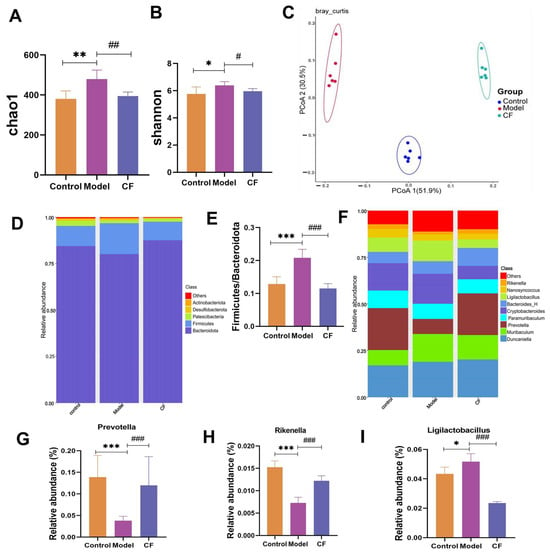
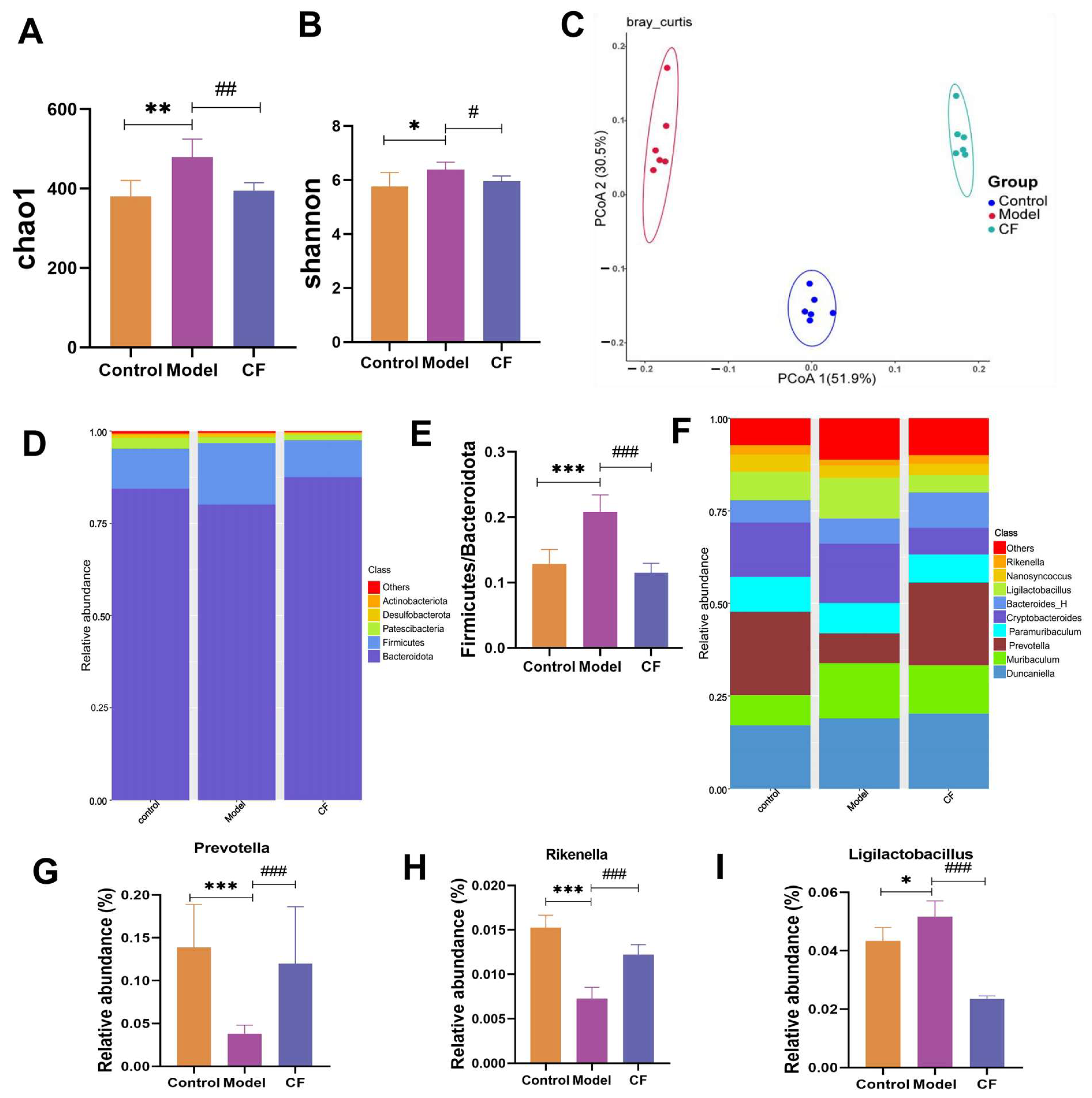
To assess the effects of CF on the gut microbiome alterations in ALI mice, 16S rRNA amplicon sequencing was performed on fecal samples for microbiome analysis. CF modulated the alcohol-induced elevation of the Chao1 and Shannon indices (Figure 3A,B), indicating its potential efficacy in mitigating the alcohol-associated increase in gut microbiota diversity. The β-diversity of the gut microbiota was evaluated using Bray–Curtis dissimilarity-based PCoA. The PCoA analysis effectively separated the blank, model, and CF groups (Figure 3C), thereby uncovering distinct compositional differences in the gut microbiota.
Figure 3.
CF altered the composition of the gut microbiome. (A,B) Chao1 index (A) and Shannon index (B) of different groups. (C) PCoA analysis based on Bray–Curtis dissimilarity. (D) Relative abundance of bacteria at the phylum level. (E) F/B ratio for each group. (F) Relative abundance of bacteria at the genus level. (G–I) Relative abundance of Prevotella (G), Rikenella (H) and Ligilactobacillus (I). Data are presented as means ± SEM (n = 6). * p < 0.05, ** p < 0.01, *** p < 0.001 vs. control; # p < 0.05, ## p < 0.01, ### p < 0.001 compared with the model group.
Taxonomic analysis revealed that at the phylum level, the predominant bacterial groups were Firmicutes, Bacteroidota, and Patescibacteria. Compared with the control group, the model group exhibited an increased relative abundance of Firmicutes and a significant decrease in the relative abundance of Bacteroidota (Figure 3D). These alterations were reversed by CF. Additionally, CF supplementation significantly reduced the ratio of Firmicutes to Bacteroidota (F/B) (Figure 3E). At the genus level, the model group displayed marked reductions in Prevotella and Rikenella, whereas Ligilactobacillus levels were significantly elevated. Conversely, CF effectively mitigated these alcohol-induced shifts in the gut microbiota composition in mice (Figure 3F–I).
3.5. CF Promoted the Synthesis of Gut Microbiota-Derived SCFAs in Mice with ALI
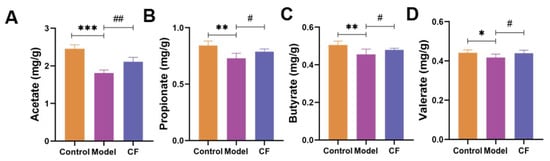
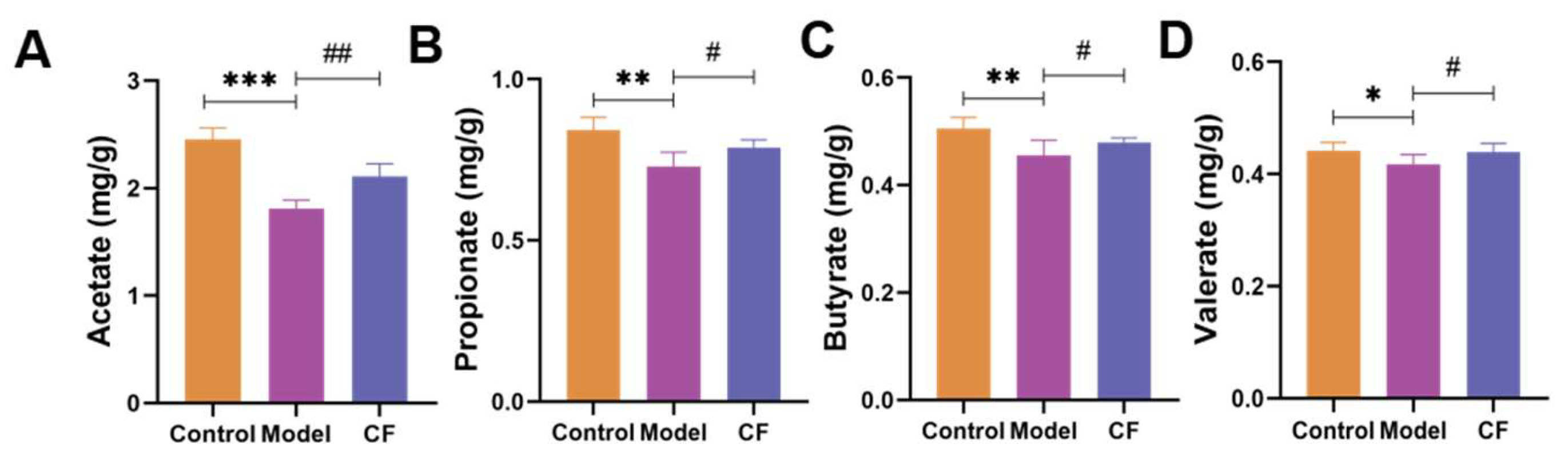
Alcohol exposure significantly decreased the levels of acetate, propionate, butyrate, and valerate. CF (100 mg/kg) pre-treatment substantially recovered acetate levels, while it modestly increased the levels of propionate, butyrate, and valerate. (Figure 4). A limitation of our study is that the SCFAs were quantified using a semi-quantitative approach.
Figure 4.
CF recovered the levels of SCFAs in the cecum of alcohol-induced mice. The content of acetate (A), propionate (B), butyrate (C) and valerate (D) in different groups. Data are presented as means ± SEM (n = 6). * p < 0.05, ** p< 0.01, *** p < 0.001, compared with the control group. # p < 0.05, ## p < 0.01 compared with the model group.
3.6. Transplantation of the Gut Microbiota of CF-Treated Mice Attenuated ALI
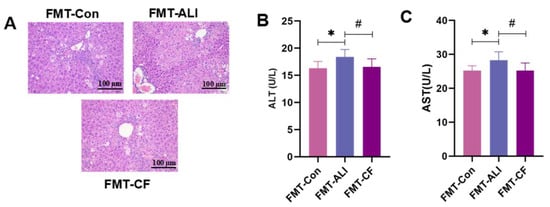
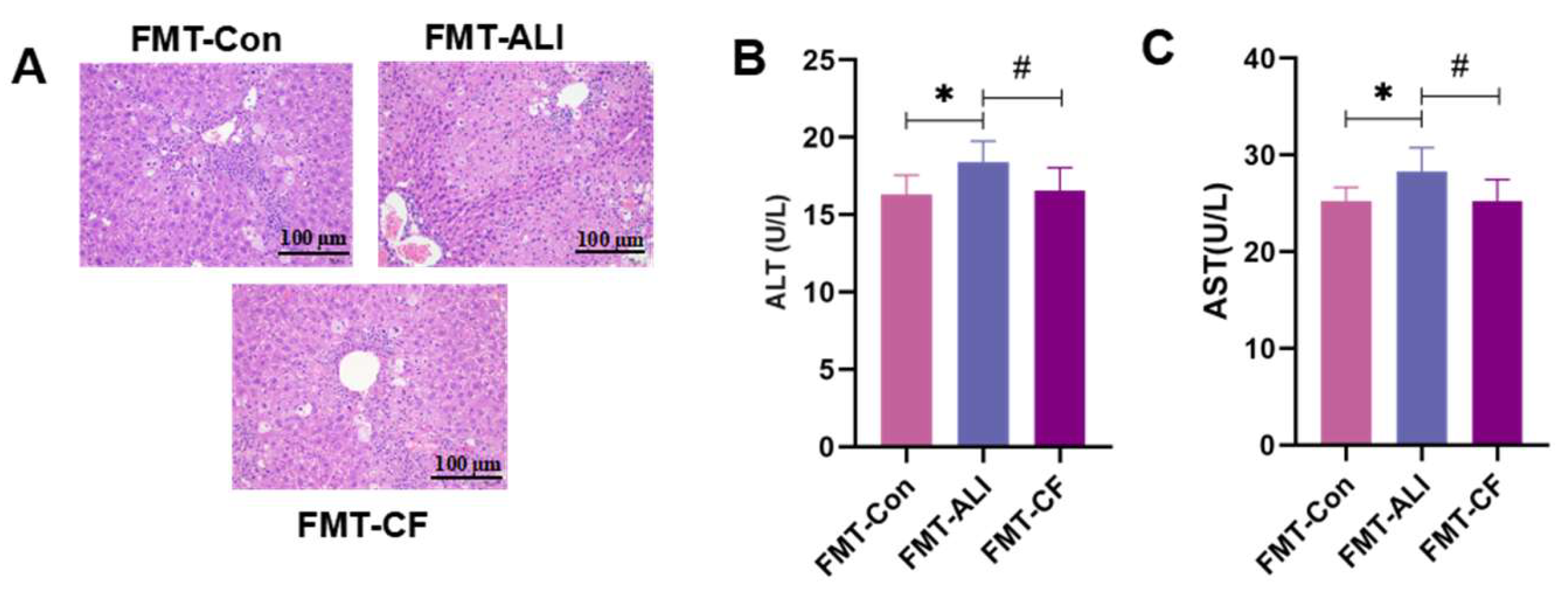
In the FMT experiment, transplantation of CF-trained microbiota ameliorated liver injury and significantly reduced serum ALT and AST levels in mice compared to the FMT-ALI group (Figure 5), indicating a potential association with the transferred microbiota.
Figure 5.
FMT from CF-treated donors partially reproduced the hepatoprotective effect against ALI. (A) Images of liver H&E staining (scale Bar = 100 μm). (B,C) Levels of serum ALT (B) and AST (C). Data are presented as means ± SEM. * p < 0.05, compared with the FMT-Con group. # p < 0.05, compared with the FMT-ALI group.
4. Discussion
ALI pathogenesis is complex. It involves factors like redox imbalance, metabolic dysfunction, and enteric dysbiosis. These issues demand multi-targeted therapeutic approaches [31,32]. Dietary botanicals like C. lancifolius fruit (CF) emerge as compelling candidates due to their broad-spectrum bioactivities, yet evaluations of their effects on ALI are limited. This study elucidates the hepatoprotective mechanisms of CF, showing that it can reshape gut microbial ecology and enhance cellular antioxidant capacity.
Alcohol is primarily metabolized in the liver, where it results in increased serum levels of ALT and AST, which serve as key markers of liver damage [33]. In this investigation, acute alcohol exposure induced marked liver injury in mice, as evidenced by histopathological and ultrastructural analyses revealing vacuolar degeneration, hepatocyte swelling, and mitochondrial abnormalities. Biochemical assays further indicated elevated serum levels of AST, ALT, TC, and TG. Administration of CF effectively ameliorated these pathological changes by preserving hepatocyte and mitochondrial integrity, reducing serum markers of liver injury. Previous research confirmed the connection between ALI and oxidative stress [34]. The transcription factor Nrf2 plays a crucial role in modulating antioxidant defense systems and a range of antioxidant mechanisms [35]. The observed protein upregulation of Nrf2 and reductions in oxidative stress markers further support the hepatoprotective effects of CF. The CF dose used in mice may not be directly translatable to human daily intake, requiring future dose-optimization studies. Without a CF-only group, the observed effects should be interpreted as CF reversing ethanol-induced injury rather than its baseline effects in healthy conditions.
Prior research has established a positive correlation between alcohol consumption and the decrease in beneficial bacteria, while concurrently linked to the decline in bacteria that produce SCFAs [36]. At the phylum level, CF suppressed the increase in the F/B ratio in ALI mice. The F/B ratio represents a critical microbial equilibrium that governs intestinal ecosystem stability. An increased F/B ratio exacerbates liver injury by disrupting metabolic homeostasis and amplifying oxidative stress through impairing mitochondrial β-oxidation and increasing lipid peroxidation [37]. At the genus level, CF pre-treatment significantly enriched the abundance of Prevotella and Rikenella. A limitation of this study is the lack of advanced differential abundance analysis such as LEfSe. These findings suggest that CF’s protective effects are associated with gut microbial remodeling.
To clarify the causal link between gut microbiota and the hepatoprotective effects of CF, we carried out a fecal microbiota transplantation experiment. FMT from CF-treated donors to alcohol-fed recipients effectively transferred the hepatoprotective phenotype. This was evidenced by a significant reduction in serum ALT/AST levels compared to the FMT-ALI group.
The mice were kept on a normal light/dark cycle rather than a reversed one, so circadian factors might have had some influence. Additionally, we did not perform a formal power analysis beforehand. The CF dose may not directly translate to human intake. Future studies will need to address these points.
This study should be considered exploratory. Due to the limitations of our experimental design, the current data can only demonstrate associations rather than a causal chain. The FMT experiment could not fully distinguish the effects of live microbes from residual CF constituents or soluble metabolites in the donor feces. Furthermore, we did not measure blood ethanol concentrations, leaving open the possibility that CF altered ethanol absorption or metabolism. Therefore, the exact mechanistic link between the microbiota–SCFA axis and hepatic Keap1/Nrf2 changes remains to be established, and our findings provide a preliminary basis for future causal studies.
5. Conclusions
This study provides preliminary evidence that CF pre-treatment alleviates ALI. This protective effect is accompanied by the remodeling of gut microbiota, elevated SCFA levels, and activation of the Keap1/Nrf2 pathway. However, the causal role of the microbiota–SCFA–Keap1 axis in mediating CF’s hepatoprotection requires further verification with rigorous control experiments.
Supplementary Materials
The following supporting information can be downloaded at: https://www.mdpi.com/article/10.3390/cimb48111207/s1.
Author Contributions
Conceptualization, L.C.; methodology, Y.X.; software, Y.X.; validation, Y.X. and L.C.; formal analysis, J.C.; investigation, Y.H.; resources, B.T.; data curation, Y.X.; writing—original draft preparation, L.C.; writing—review and editing, L.C.; visualization, L.C.; supervision, Q.S.; project administration, Q.S.; funding acquisition, Q.S. All authors have read and agreed to the published version of the manuscript.
Funding
This research was funded by the High-Level Innovative Talents Project of Guizhou Province, grant number GCC [2023] 077.
Institutional Review Board Statement
The study was approved by the Animal Care Welfare Committee of Guizhou University of Traditional Chinese Medicine (protocol code 2024094 and dated 20 August 2024).
Informed Consent Statement
Not applicable.
Data Availability Statement
The original data are available upon reasonable request from the corresponding authors.
Acknowledgments
During the preparation of this work, the authors used DeepSeek V4.1–Flash–1017 in order to improve the language and readability of the manuscript. After using this tool, the authors reviewed and edited the content as needed.
Conflicts of Interest
The authors declare no conflicts of interest.
Abbreviations
The following abbreviations are used in this manuscript:
| CF | Cyclocodon lancifolius fruit |
| ALT | Alanine aminotransferase |
| AST | Aspartate aminotransferase |
| TC | Total cholesterol |
| TG | Total triglyceride |
| GSH-Px | Glutathione peroxidase |
| SOD | Superoxide dismutase |
| Keap1 | Kelch-like ECH-associated protein 1 |
| SCFA | Short-Chain Fatty Acid |
| FMT | Fecal Microbiota Transplantation |
References
- Herdiana, Y. Alcohol in daily products: Health risks, cultural considerations, and economic impacts. Risk Manag. Healthc. Policy 2025, 18, 217–237. [Google Scholar] [CrossRef] [Scilit]
- Fu, Y.; Mackowiak, B.; Lin, Y.H.; Maccioni, L.; Lehner, T.; Pan, H.; Guan, Y.; Godlewski, G.; Lu, H.; Chen, C.; et al. Coordinated action of a gut-liver pathway drives alcohol detoxification and consumption. Nat. Metab. 2024, 6, 1380–1396. [Google Scholar] [CrossRef] [Scilit]
- Kang, J.; Park, S.H.; Khanam, M.; Park, S.B.; Shin, S.; Seo, W. Impact of binge drinking on alcoholic liver disease. Arch. Pharm. Res. 2025, 48, 212–223. [Google Scholar]
- Di Ciaula, A.; Bonfrate, L.; Krawczyk, M.; Frühbeck, G.; Portincasa, P. Synergistic and detrimental effects of alcohol intake on progression of liver steatosis. Int. J. Mol. Sci. 2022, 23, 2636. [Google Scholar] [CrossRef] [Scilit]
- Thoudam, T.; Gao, H.; Jiang, Y.; Huda, N.; Yang, Z.; Ma, J.; Liangpunsakul, S. Mitochondrial quality control in alcohol-associated liver disease. Hepatol. Commun. 2024, 8, e0534. [Google Scholar] [CrossRef] [Scilit]
- Wang, P.; Zheng, X.; Du, R.; Xu, J.; Li, J.; Zhang, H.; Liang, X.; Liang, H. Astaxanthin protects against alcoholic liver injury via regulating mitochondrial redox balance and calcium homeostasis. J. Agric. Food Chem. 2023, 71, 19531–19550. [Google Scholar] [CrossRef] [Scilit]
- Gopal, T.; John Kathiravan, A.D.; Kabanov, A.V.; Casey, C.A.; Saraswathi, V. The Pathophysiology of Alcohol-Associated Liver Disease: Focusing on Superoxide Dismutase 1 as a Therapeutic Target. Biology 2025, 14, 1319. [Google Scholar] [CrossRef] [Scilit]
- Pan, E.; Sun, H.; Zhang, S.; Wang, J.; Liu, Y.; Wang, F.; Xia, J.; Qian, Y.; Xu, X.; Dong, J. Angelicin attenuates sepsis-associated acute liver injury via p38 MAPK inhibition and NF-κB-mediated Nrf2/Keap1 activation to suppress inflammation and oxidative stress. Acta Biochim. Biophys. Sin. 2025, 58, 1387–1401. [Google Scholar] [CrossRef] [Scilit]
- Chen, S.; Pan, H.; Chen, Y.; Lu, L.; He, X.; Chen, H.; Chen, R.; Zhan, S.; Tang, S. Association between genetic polymorphisms of NRF2, KEAP1, MAFF, MAFK and anti-tuberculosis drug-induced liver injury: A nested case-control study. Sci. Rep. 2019, 9, 14311. [Google Scholar] [CrossRef] [Scilit]
- Nie, W.; Xu, F.; Zhou, K.; Yang, X.; Zhou, H.; Xu, B. Stearic acid prevent alcohol-induced liver damage by regulating the gut microbiota. Food Res. Int. 2022, 155, 111095. [Google Scholar] [CrossRef] [Scilit]
- Wang, R.; Tang, R.; Li, B.; Ma, X.; Schnabl, B.; Tilg, H. Gut microbiome, liver immunology, and liver diseases. Cell. Mol. Immunol. 2021, 18, 4–17. [Google Scholar] [CrossRef] [Scilit]
- Hsu, C.L.; Schnabl, B. The gut-liver axis and gut microbiota in health and liver disease. Nat. Rev. Microbiol. 2023, 21, 719–733. [Google Scholar] [CrossRef] [Scilit]
- Liu, X.; Xu, M.; Wang, H.; Zhu, L. Role and mechanism of short-chain fatty acids in skeletal muscle homeostasis and exercise performance. Nutrients 2025, 17, 1463. [Google Scholar] [CrossRef] [Scilit]
- Niu, Y.; Yu, W.; Kou, X.; Wu, S.; Liu, M.; Chen, C.; Ji, J.; Shao, Y.; Xue, Z. Bioactive compounds regulate appetite through the melanocortin system: A review. Food Funct. 2024, 15, 11811–11833. [Google Scholar] [CrossRef] [Scilit]
- Zhang, Z.; Qin, X.; Yi, T.; Li, Y.; Li, C.; Zeng, M.; Luo, H.; Lin, X.; Xie, J.; Xia, B.; et al. Gubra amylin-NASH diet induced nonalcoholic fatty liver disease associated with histological damage, oxidative stress, immune disorders, gut microbiota, and its metabolic dysbiosis in colon. Mol. Nutr. Food Res. 2024, 68, e2300845. [Google Scholar] [CrossRef] [Scilit]
- Cui, H.; Jiang, X.; Cao, J.; Yang, W.; Yang, B.; Li, M. Comparative analysis of metabolic dysfunctions associated with pristine and aged polyethylene microplastic exposure via the liver-gut axis in mice. ACS Nano 2025, 19, 14272–14283. [Google Scholar] [CrossRef] [Scilit]
- Hong, X.; Huang, S.; Jiang, H.; Ma, Q.; Qiu, J.; Luo, Q.; Cao, C.; Xu, Y.; Chen, F.; Chen, Y.; et al. Alcohol-related liver disease (ALD): Current perspectives on pathogenesis, therapeutic strategies, and animal models. Front. Pharmacol. 2024, 15, 1432480. [Google Scholar] [CrossRef] [Scilit]
- Yan, X.; Ren, X.; Liu, X.; Wang, Y.; Ma, J.; Song, R.; Wang, X.; Dong, Y.; Fan, Q.; Wei, J.; et al. Dietary ursolic acid prevents alcohol-induced liver injury via gut-liver axis homeostasis modulation: The key role of microbiome manipulation. J. Agric. Food Chem. 2021, 69, 7074–7083. [Google Scholar] [CrossRef] [Scilit]
- Shang, F.; Fang, H.; Qian, J.; Duan, B. High-throughput sequencing of complete chloroplast genome of Yi folk medicine Cyclocodon lancifolius (Roxb.) Kurz. Mitochondrial DNA B 2020, 5, 1791–1793. [Google Scholar] [CrossRef] [Scilit]
- Ma, M.J.; Wu, W.; Tian, B.; Shen, L.P.; Wu, T.; Huang, C.Y.; Mao, X.D.; Hu, X. Four new constituents from the fruits of Cyclocodon lancifolius (Roxburgh) Kurz. Nat. Prod. Res. 2025, 39, 2130–2139. [Google Scholar] [CrossRef] [Scilit]
- Yang, X.; Dang, Y.C.; Chen, J.Z.; Xu, K.C.; Dai, D.D.; Sun, Q.W. Preliminary study on Cyclocodon lancifolius leaf blight and screening of Bacillus subtilis as a biocontrol agent. Front. Microbiol. 2024, 15, 1459868. [Google Scholar] [CrossRef] [Scilit]
- Ma, M.; Wu, M.; Tian, B.; Mao, X.; Lin, S.; Huang, C.; Hu, X. Polyacetylenes with xanthine oxidase inhibitory activity from the medicinal and edible fruits of Cyclocodon lancifolius (Roxburgh) Kurz. Fitoterapia 2023, 170, 105631. [Google Scholar] [CrossRef] [Scilit]
- Liu, Y.; Zhang, X.; Wang, Y.; Wang, J.; Wei, H.; Zhang, C.; Zhang, Q. Cyclocodon lancifolius fruit prolongs the lifespan of Caenorhabditis elegans via antioxidation and regulation of purine metabolism. Food Funct. 2024, 15, 3353–3364. [Google Scholar]
- Guo, L.; Guan, Q.; Duan, W.; Ren, Y.; Zhang, X.J.; Xu, H.Y.; Shi, J.S.; Wang, F.Z.; Lu, R.; Zhang, H.L.; et al. Dietary Goji shapes the gut microbiota to prevent the liver injury induced by acute alcohol intake. Front. Nutr. 2022, 9, 929776. [Google Scholar] [CrossRef] [Scilit]
- Wang, W.; Liu, M.; Fu, X.; Qi, M.; Zhu, F.; Fan, F.; Wang, Y.; Zhang, K.; Chu, S. Hydroxysafflor yellow A ameliorates alcohol-induced liver injury through PI3K/Akt and STAT3/NF-κB signaling pathways. Phytomedicine 2024, 132, 155814. [Google Scholar] [CrossRef] [Scilit]
- Chen, L.; Li, J.; Li, Q.; Sun, Q. Hepatotoxicity induced by methyl eugenol: Insights from toxicokinetics, metabolomics, and gut microbiota. Curr. Issues Mol. Biol. 2024, 46, 11314–11325. [Google Scholar] [CrossRef] [Scilit]
- Chi, Y.Y.; Xiang, J.Y.; Li, H.M.; Shi, H.Y.; Ning, K.; Shi, C.; Xiang, H.; Xie, Q. Schisandra chinensis polysaccharide prevents alcohol-associated liver disease in mice by modulating the gut microbiota-tryptophan metabolism-AHR pathway axis. Int. J. Biol. Macromol. 2024, 282, 136843. [Google Scholar] [CrossRef] [Scilit]
- Hoving, L.R.; Heijink, M.; van Harmelen, V.; van Dijk, K.W.; Giera, M. GC-MS analysis of short-chain fatty acids in feces, cecum content, and blood samples. Methods Mol. Biol. 2018, 1730, 247–256. [Google Scholar] [CrossRef] [Scilit]
- Erukainure, O.L.; Matsabisa, M.G.; Salau, V.F.; Oyedemi, S.O.; Oyenihi, O.R.; Ibeji, C.U.; Islam, M.S. Cannabis sativa L. (var. indica) exhibits hepatoprotective effects by modulating hepatic lipid profile and mitigating gluconeogenesis and cholinergic dysfunction in oxidative hepatic injury. Front. Pharmacol. 2021, 12, 705402. [Google Scholar] [CrossRef] [Scilit]
- Galicia-Moreno, M.; Lucano-Landeros, S.; Monroy-Ramirez, H.C.; Silva-Gomez, J.; Gutierrez-Cuevas, J.; Santos, A.; Armendariz-Borunda, J. Roles of Nrf2 in liver diseases: Molecular, pharmacological, and epigenetic aspects. Antioxidants 2020, 9, 980. [Google Scholar] [CrossRef] [Scilit]
- Danpanichkul, P.; Suparan, K.; Ng, C.H.; Dejvajara, D.; Kongarin, S.; Panpradist, N.; Chaiyakunapruk, N.; Muthiah, M.D.; Chen, V.L.; Huang, D.Q.; et al. Global and regional burden of alcohol-associated liver disease and alcohol use disorder in the elderly. JHEP Rep. 2024, 6, 101020. [Google Scholar] [CrossRef] [Scilit]
- Perumal, S.K.; Arumugam, M.K.; Osna, N.A.; Rasineni, K.; Kharbanda, K.K. Betaine regulates the gut-liver axis: A therapeutic approach for chronic liver diseases. Front. Nutr. 2025, 12, 1478542. [Google Scholar] [CrossRef] [Scilit]
- Ali, N.A.M.; Abdelhamid, A.M.; El-Sayed, N.M.; Radwan, A. Alpha-Asarone attenuates alcohol-induced hepatotoxicity in a murine model by ameliorating oxidative stress, inflammation, and modulating apoptotic-Autophagic cell death. Toxicol. Appl. Pharmacol. 2024, 490, 117041. [Google Scholar] [CrossRef] [Scilit]
- Yang, Y.M.; Cho, Y.E.; Hwang, S. Crosstalk between oxidative stress and inflammatory liver injury in the pathogenesis of alcoholic liver disease. Int. J. Mol. Sci. 2022, 23, 774. [Google Scholar] [CrossRef] [Scilit]
- Wu, M.; Liu, X.; Yu, Q.; Shi, J.; Guo, W.; Zhang, S. Adelmidrol ameliorates liver ischemia-reperfusion injury through activating Nrf2 signaling pathway. Eur. J. Pharmacol. 2024, 964, 176224. [Google Scholar] [CrossRef] [Scilit]
- Zhang, J.; Fan, J.; Luo, H.; Liang, Z.; Guan, Y.; Lei, X.; Bo, N.; Zhao, M. Alleviation of alcoholic fatty liver by dendrobium officinale flower extracts due to regulation of gut microbiota and short-chain fatty acids in mice exposed to chronic alcohol. Foods 2023, 12, 1428. [Google Scholar] [CrossRef] [Scilit]
- Zhang, T.; Bao, L.; Zhao, Q.; Wu, Z.E.; Dai, M.; Rao, Q.; Li, F. Metabolomics reveals gut microbiota contribute to PPARα deficiency-induced alcoholic liver injury. J. Proteome Res. 2023, 22, 2327–2338. [Google Scholar] [CrossRef] [Scilit]
Disclaimer/Publisher’s Note: The statements, opinions and data contained in all publications are solely those of the individual author(s) and contributor(s) and not of MDPI and/or the editor(s). MDPI and/or the editor(s) disclaim responsibility for any injury to people or property resulting from any ideas, methods, instructions or products referred to in the content. |
© 2026 by the authors. Licensee MDPI, Basel, Switzerland. This article is an open access article distributed under the terms and conditions of the Creative Commons Attribution (CC BY) license.