


Abstract
Postprandial hyperglycemia can be modified before absorbed glucose reaches the circulation. Plant-derived compounds may slow starch hydrolysis through α-amylase and intestinal α-glucosidases, stimulate glucagon-like peptide-1 (GLP-1) release, or preserve incretin activity through dipeptidyl peptidase-4 (DPP-4) inhibition. This critical narrative review integrates these mechanisms around intestinal exposure, substrate selectivity, and human evidence. Flavonoids show structure-dependent and time-dependent inhibition of carbohydrate-hydrolyzing enzymes, but results vary markedly between yeast, rodent, and human enzyme systems. Iminosugar-rich mulberry preparations and thiosugar-containing Salacia extracts provide the strongest chemistry-to-clinic examples, including randomized trials that reduced postprandial glucose or HbA1c. Preclinical studies suggest that berberine may link bitter-taste-receptor-mediated GLP-1 secretion with local intestinal DPP-4 effects, whereas mangiferin, flavonol glycosides, anthocyanins, and food-derived peptides remain supported mainly by preclinical studies. In vitro potency alone is insufficient: meal composition, enzyme source, luminal concentration, metabolism, product standardization, gastrointestinal tolerance, and incretin measurements determine translational value. Candidate prioritization requires defined chemistry, achievable exposure, and product-specific human validation; acute effects do not establish durable benefit or human target engagement.
Keywords:
postprandial glycemia; α-amylase; α-glucosidase; DPP-4; GLP-1; 1-deoxynojirimycin; Salacia; mulberry; natural products 1. Introduction
Postprandial glucose excursions are determined by the amount and physical form of carbohydrate, gastric emptying, enzymatic hydrolysis, intestinal transport, incretin secretion, pancreatic insulin and glucagon responses, hepatic glucose handling, and peripheral glucose disposal. This sequence creates several opportunities for a locally acting intervention. A compound does not necessarily need high systemic bioavailability if it reaches intestinal enzymes or enteroendocrine cells at an effective concentration during a meal. Conversely, systemic claims such as DPP-4 inhibition require evidence that the active molecule or metabolite reaches the relevant compartment.
Three targets recur in the phytochemical literature. Salivary and pancreatic α-amylases initiate starch hydrolysis. Brush-border α-glucosidases, primarily maltase-glucoamylase and sucrase-isomaltase activities, release absorbable glucose from oligosaccharides and disaccharides. Dipeptidyl peptidase-4 (DPP-4) terminates the action of glucagon-like peptide-1 (GLP-1) and glucose-dependent insulinotropic polypeptide, while plant compounds can also stimulate GLP-1 secretion through nutrient-sensing or taste-receptor pathways. These mechanisms are related but not interchangeable. A candidate may inhibit carbohydrate hydrolysis without changing incretin exposure, increase GLP-1 secretion without inhibiting DPP-4, or affect both through altered nutrient delivery to the distal intestine.
The field is crowded with in vitro screening reports, yet only a small fraction reaches controlled human testing. The central translational problem is assay relevance. Yeast α-glucosidase differs from human intestinal enzymes; porcine pancreatic α-amylase is not identical to the human target; purified enzyme assays omit starch structure and food matrix; and colorimetric readouts can be distorted by strongly colored or reducing extracts; and docking cannot establish luminal potency. In the DPP-4 literature, inhibition of purified enzyme may not survive digestion, absorption, metabolism, or competition with related peptidases.
This review therefore asks a focused question: which plant-derived candidates connect defined chemistry, relevant target assays, plausible intestinal or systemic exposure, and human postprandial outcomes? Mulberry alkaloids and Salacia thiosugars are treated as anchor cases because they have progressed from mechanism to randomized trials. Flavonoids, berberine, mangiferin, anthocyanins, guava constituents, and food-derived peptides are evaluated against the same standard. The aim is not to rank herbs, but to define the evidence chain required for a credible postprandial glucose-control product.
Earlier reviews describe plant α-amylase inhibitors and polyphenol structure–activity relationships [1,2], while a recent review considers flavonoid effects on intestinal nutrient handling, gut hormones, and systemic metabolism [3]. The added contribution here is a common decision framework linking enzyme source, substrate, compartmental exposure, product identity, and the endpoint actually measured. It explicitly separates biochemical inhibition, GLP-1 secretion, DPP-4 target engagement, acute meal responses, and sustained HbA1c changes, and incorporates null clinical translation rather than ranking candidates by in vitro potency alone.
2. Literature Search and Evidence-Appraisal Framework
2.1. Review Design and Research Question
This study was designed as a structured critical narrative review addressing the translational evidence supporting natural-product modulation of postprandial glycemia through α-amylase, intestinal α-glucosidases, glucagon-like peptide-1 (GLP-1) secretion, and dipeptidyl peptidase-4 (DPP-4). The review specifically addressed which candidates demonstrate a coherent evidence chain linking chemical characterization, target-relevant activity, plausible intestinal or systemic exposure, and controlled human postprandial outcomes. The structured search supports a critical narrative synthesis; the review does not claim exhaustive systematic-review coverage or a pooled certainty-of-evidence assessment. The purpose was not to generate a pooled treatment-effect estimate, but to critically assess the progression of evidence from biochemical activity to clinically relevant target engagement.
2.2. Information Sources and Search Strategy
PubMed/MEDLINE, Scopus, and Web of Science Core Collection were searched. Three complementary search families were used to identify: (i) natural-product modulators of α-amylase and intestinal α-glucosidases; (ii) natural-product modulators of GLP-1 secretion and DPP-4 activity; and (iii) controlled human studies evaluating postprandial glycemic responses.
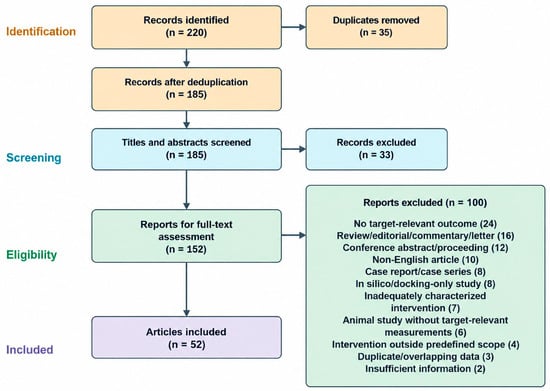
Search terms included combinations of “α-amylase”, “alpha-amylase”, “α-glucosidase”, “alpha-glucosidase”, “maltase-glucoamylase”, “sucrase-isomaltase”, “DPP-4”, “DPP-IV”, “GLP-1”, “glucagon-like peptide-1”, “incretin”, “postprandial glucose”, “postprandial glycemia”, “postprandial glycaemia”, “meal challenge”, “continuous glucose monitoring”, “flash glucose monitoring”, “plant”, “phytochemical”, “botanical”, “natural product”, “flavonoid”, “polyphenol”, “alkaloid”, “iminosugar”, “1-deoxynojirimycin”, “mulberry”, “Morus”, “Salacia”, “salacinol”, “kotalanol”, “berberine”, “berberrubine”, “palmatine”, “mangiferin”, “anthocyanin”, “guava”, “Psidium”, “food-derived peptide”, and “protein hydrolysate”. The search terms were organized into three concept blocks: target-related terms, natural-product terms, and human postprandial-outcome terms. The Boolean structure applied in each database was: (target-related terms AND natural-product terms) OR (human postprandial-outcome terms AND natural-product terms). In PubMed/MEDLINE, terms were searched within the title and abstract fields; in Scopus, within the title, abstract, and keyword fields; and in Web of Science Core Collection, within the Topic field. Database-specific syntax was applied, including [Title/Abstract] in PubMed/MEDLINE, TITLE-ABS-KEY in Scopus, and TS in Web of Science. No language filter was applied during the database searches, which covered the period from database inception to 19 August 2026. Eligibility was subsequently restricted to English-language publications during the screening process. The searches retrieved 82 records from PubMed/MEDLINE, 76 records from Scopus, and 62 records from Web of Science Core Collection, yielding 220 records before deduplication. After removal of 35 duplicate records, 185 unique records remained for title and abstract screening. The complete database-specific search strategies are provided in Supplementary Table S1.
2.3. Eligibility Criteria and Study Selection
English-language primary experimental and clinical studies were eligible when they evaluated a chemically identifiable natural product, phytochemical, botanical extract, standardized preparation, or natural-product-derived scaffold and provided target-relevant evidence for α-amylase, intestinal α-glucosidase, GLP-1 secretion, DPP-4 activity, or postprandial glycemic control. Eligible mechanistic studies included human or mammalian enzyme assays, kinetic studies, chemically characterized cellular models, intestinal models, pharmacokinetic or exposure studies, and in vivo experiments incorporating target-relevant measurements.
Human studies were eligible when they evaluated standardized meal or carbohydrate challenges, postprandial glucose or insulin responses, incremental area under the curve, continuous or flash glucose monitoring, incretin responses, DPP-4 activity, or longer-term glycemic outcomes using a defined intervention.
Studies based solely on molecular docking, total phenolic content, nonspecific antioxidant activity, or glucose lowering in animal models without target-relevant measurements were excluded from mechanistic inference. Editorials, case reports, conference abstracts or proceedings, non-English publications, and reports with insufficient intervention identity were excluded from the selected evidence corpus. Synthetic derivatives of natural-product scaffolds were retained only when they provided relevant structure–activity information and were not considered evidence of botanical-product clinical efficacy.
All retrieved records were exported to a reference-management database, and duplicates were removed before screening. Two review authors (P.D.F.V. and D.-M.T.) independently screened the titles and abstracts and subsequently assessed the potentially eligible full-text articles using separate screening records. Screening decisions were compared only after both reviewers had completed each stage. Disagreements were resolved through discussion and consensus. Any disagreement that could not be resolved through consensus was adjudicated by a third review author (R.M.V.). The selection comprised 220 identified records and 35 duplicate removals, leaving 185 records for title/abstract screening. After 33 exclusions, 152 reports entered full-text eligibility assessment; 100 were excluded, leaving 52 included articles (Figure 1). Exclusion reasons were no target-relevant outcome (n = 24), review/editorial/commentary/letter (n = 16), conference abstract/proceeding (n = 12), non-English article (n = 10), case report/case series (n = 8), in silico/docking-only study (n = 8), inadequately characterized intervention (n = 7), animal study without target-relevant measurements (n = 6), intervention outside the predefined scope ((n = 4), duplicate/overlapping data ((n = 3), and insufficient information (n = 2) (Figure 1).
Figure 1.
Literature-selection flow for the structured narrative review.
2.4. Data Extraction and Evidence Classification
Data were extracted using a predefined standardized form including the following variables: study design, biological model or clinical population, natural-product identity, botanical source, plant part, extraction method or formulation, chemical marker or standardization, target, enzyme source, substrate, potency or kinetic parameters, administered dose or tested concentration, exposure information, comparator, carbohydrate or meal challenge, treatment duration, glycemic outcomes, insulin outcomes, GLP-1, GIP, and DPP-4 measurements, adverse events, funding information, and major methodological limitations.
Evidence was interpreted according to translational proximity using the operational categories in Table 1. These categories describe the type of support for a specific claim, not a validated risk-of-bias or certainty score. The highest weight was assigned to controlled human studies using chemically defined or standardized products with target-compatible outcomes, followed by human efficacy studies with incomplete target-engagement information, in vivo mechanistic studies, and target-relevant biochemical or cellular investigations. Exploratory evidence based primarily on yeast-enzyme screening, crude-extract screening, molecular docking, or indirect mechanistic inference was considered hypothesis-generating and was not regarded as sufficient to establish clinically relevant target engagement.
Table 1.
Operational evidence categories for this narrative synthesis.
2.5. Critical Appraisal
Clinical studies were critically appraised according to study design, randomization and blinding where applicable, comparator selection, sample size, intervention standardization, outcome measurement, treatment duration, completeness of reporting, and potential sources of bias. For biochemical and cellular studies, methodological credibility was evaluated according to enzyme or model relevance, substrate appropriateness, use of positive and interference controls, chemical characterization, concentration–response assessment, kinetic characterization, biological replication, and exposure plausibility. For animal studies, particular attention was given to experimental-group comparability, target-relevant measurements, dose selection, and consistency between mechanistic and metabolic outcomes. Given the heterogeneity of the evidence base, no numerical quality score was assigned.
2.6. Evidence Synthesis
Because the included evidence spans biochemical, cellular, animal, pharmacokinetic, acute meal-challenge, and longer-term clinical studies, substantial heterogeneity was anticipated in biological models, enzyme sources, substrates, intervention composition, populations, doses, and outcome definitions. Therefore, quantitative meta-analysis was not planned. Evidence was synthesized qualitatively according to target mechanism, chemical identity, intended compartment of action, exposure plausibility, methodological credibility, and level of human translational support. Particular emphasis was placed on discrepancies between in vitro potency and in vivo or clinical outcomes, product-to-product non-equivalence, target-specific assay validity, and reproducibility across chemically comparable interventions. Prioritization considered chemical standardization, controlled-trial design and sample size, target-compatible outcomes, direct target-engagement measurements, independent replication, and duration. These are transparent interpretive criteria for this synthesis, not retrospectively claimed prespecified thresholds. Mulberry twig alkaloid tablets have the larger longer-duration trial program; Salacia has several acute trials across heterogeneous extracts. Neither ranking establishes a class effect or completes every step of the evidence chain (Table 2).
Table 2.
Target-specific evidence requirements for plant-derived control of postprandial glycemia. These are proposed evidence requirements, not findings established for every candidate.
3. The Intestinal Pharmacology of Postprandial Glucose
Starch must be physically accessible before enzymatic hydrolysis can proceed. Granule structure, gelatinization, particle size, amylose-to-amylopectin ratio, protein and lipid interactions, and food viscosity all influence the rate at which amylases release shorter glucans. α-Amylase inhibition is therefore only one component of starch control. Polyphenols may also bind starch or alter matrix structure, meaning that an apparent reduction in hydrolysis can reflect enzyme inhibition, substrate sequestration, or both. Three flavanols, for example, delayed starch digestion through combined α-amylase inhibition and starch binding [10].
3.1. α-Amylase: Potency Is Substrate- and Time-Dependent
Plant-derived α-amylase inhibitors and the structure–activity relationships of dietary polyphenols have been extensively investigated in previous studies and reviews [1,2]. Flavonoids can inhibit human α-amylase through hydrogen bonding and aromatic interactions near the catalytic region. Work with human salivary α-amylase identified structural requirements including a conjugated π-system and hydroxyl groups positioned to interact with catalytic residues [4]. Broader kinetic studies showed that luteolin, hesperetin, and quercetin can produce mixed-type inhibition, whereas the apparent rank order depends on assay design and substrate [21]. A library of pancreatic α-amylase inhibitors likewise linked activity to the flavonoid substitution pattern rather than to total hydroxylation alone [22]. Early comparative work showing inhibition of both α-glucosidase and α-amylase by flavonoids remains a useful foundation, although enzyme source and substrate now require tighter control [23].
Binding kinetics can materially change an inhibition estimate. Gallated catechins interacted rapidly with human salivary and porcine pancreatic α-amylases, whereas non-gallated analogues required much longer incubation to approach maximal inhibition [11]. If a screen uses a preincubation period that does not occur during digestion, it may overestimate or underestimate meal-time efficacy. The substrate also matters: a small chromogenic analogue provides clean kinetics but does not reproduce enzyme access to cooked starch, starch-polyphenol binding, or diffusion within a food matrix.
Purified-enzyme inhibition establishes activity under defined biochemical conditions. Digestion of cooked starch or a food matrix adds substrate binding, accessibility, and contact-time constraints but remains preclinical. A controlled meal challenge tests the integrated human response and cannot, by itself, identify α-amylase as the causal target. These evidence types should therefore be reported separately [4,10,11].
Maximal α-amylase inhibition may be undesirable. If extensive starch reaches the colon, bacterial fermentation can produce bloating, flatulence, or diarrhea. A pharmacologically useful profile may therefore combine partial α-amylase inhibition with stronger, substrate-matched brush-border α-glucosidase inhibition, slowing glucose appearance without preventing eventual digestion. This principle is more informative than selecting the extract with the lowest nominal α-amylase IC50.
3.2. Brush-Border α-Glucosidases: The Enzyme-Source Problem
The term α-glucosidase often conceals major biological differences. Yeast enzymes are convenient for screening, but their active sites and inhibitor sensitivities differ from mammalian intestinal maltase-glucoamylase and sucrase-isomaltase. Compounds isolated from Vauquelinia corymbosa illustrate the problem: quercetin-3-O-(6″-benzoyl)-β-galactoside had IC50 values of 30 μM for yeast and 437 μM for rat intestinal α-glucosidase; the corresponding Ki values were 50 and 212 μM [12]. A low IC50 against yeast enzyme should therefore trigger confirmation, not a clinical claim.
Earlier enzyme-guided investigations examined Tournefortia hartwegiana, Andrographis paniculata and andrographolide, Rheum emodi constituents, and plants used in Lebanese traditional medicine [24,25,26,27]. Collectively, these reports demonstrate the usefulness of α-glucosidase and α-amylase assays for bioactivity-guided fractionation. They also expose a recurring limitation: activity against yeast enzyme, crude extracts, or a single chromogenic substrate cannot predict inhibition of human brush-border enzymes or the response to a mixed meal. Their strongest current role is therefore source discovery and chemical prioritization.
Target selectivity can be designed. In a comparative panel, the C2-C3 double bond and selected hydroxyl groups favored α-amylase inhibition, whereas a different arrangement supported α-glucosidase inhibition [13]. Salacinol analogues with extended side chains achieved higher potency against human intestinal maltase than the natural parent and in some cases matched or exceeded reference inhibitors [14]. These studies show how plant-derived scaffolds can inform medicinal chemistry even when the crude botanical product is not itself a drug candidate.
The approximately 15-fold IC50 difference in this within-study comparison illustrates source dependence, not a conversion factor from yeast to humans [12]. Potencies from different studies should remain stratified by enzyme source, substrate, and assay conditions; crude-extract concentrations in μg/mL are not directly comparable with purified-compound values in μM. Both maltase-glucoamylase and sucrase-isomaltase contribute overlapping intestinal activities, so a maltose challenge is not specific to only one enzyme complex.
3.3. Incretin Release and DPP-4: Direct and Indirect Intestinal Effects
GLP-1 is released from enteroendocrine cells after nutrient sensing and enhances glucose-dependent insulin secretion while suppressing glucagon and slowing gastric emptying. DPP-4 rapidly cleaves active GLP-1. Medicinal-plant-derived GLP-1 secretagogues have been previously reported and investigated as potential modulators of incretin signaling [28]. A plant product can increase active incretin exposure by stimulating secretion, reducing degradation, or changing the rate and site of nutrient delivery. α-Glucosidase inhibition itself may shift carbohydrate to more distal intestinal segments and alter incretin release. Direct L-cell stimulation should be demonstrated with receptor or signaling controls rather than inferred from a higher post-meal GLP-1 concentration.
DPP-4 is both a membrane-associated and soluble enzyme with substrates beyond incretins. Potency should be measured against human enzyme and interpreted with selectivity, cell-surface access, and exposure. Food-derived inhibitors may act locally before absorption, but systemic claims require stability through digestion and enough free compound in plasma or tissues. A comparison of digested proteins found no simple correlation between in vitro and in vivo DPP-4 inhibition, underscoring the influence of peptide release, intestinal passage, metabolism, and assay context [17].
Two representative studies illustrate why incretin measurements require mechanism-specific interpretation. Wild bitter gourd produced GLP-1-dependent hypoglycemic effects in a preclinical model [29], whereas a human cinnamon study jointly assessed gastric emptying, glucose, insulin, GIP, GLP-1, ghrelin, and satiety [15]. Such multi-endpoint designs are valuable because a botanical can change postprandial glucose through gastric emptying or carbohydrate delivery without directly inhibiting DPP-4. Active versus total GLP-1, sampling time, and an independent gastric-emptying measure are therefore essential.
4. Chemical Classes and Mechanistic Examples
Natural postprandial modulators span polyphenols, iminosugars, sulfonium thiosugars, isoquinoline alkaloids, xanthones, anthocyanins, and food-derived peptides. Their physicochemical properties imply different development strategies. Highly polar iminosugars and thiosugars can be effective in the intestinal lumen with limited systemic exposure. Polyphenols may bind enzymes and food macromolecules but are extensively metabolized. Alkaloids such as berberine can achieve high intestinal exposure despite low plasma concentrations. Peptides must survive digestion long enough to act locally or be released by digestion in an active form.
4.1. Flavonoids and Polyphenols
Flavonoid inhibition is structure-dependent rather than a generic antioxidant effect. Planarity, the C2-C3 double bond, the 4-carbonyl group, and hydroxyl positions determine enzyme binding, while glycosylation can either reduce access or create new interactions. Comparative experiments have produced partially different structure–activity rules because enzyme sources, substrates, incubation times, and analysis methods differ [4,13,21]. These disagreements are informative: they show that a universal flavonoid ranking is unlikely without a standardized assay panel.
DPP-4 inhibition by flavonoids is also chemically selective. In a purified-enzyme panel of 70 compounds, myricetin, hyperoside, narcissoside, cyanidin 3-O-glucoside, and isoliquiritigenin showed concentration-dependent inhibition with non-competitive or mixed kinetic behavior [18]. A separate study identified isorhamnetin-3-O-glucoside, cyanidin-3-O-glucoside, and isorhamnetin-3-O-rutinoside as potent inhibitors in purified and Caco-2-associated systems [19]. These are preclinical mechanistic findings, but glycoside stability, luminal concentrations, brush-border access, and selectivity against related peptidases must be established before therapeutic equivalence to pharmaceutical DPP-4 inhibitors is suggested.
Assay dependence is quantitatively substantial: Pan et al. reported IC50 values of 156.29 ± 1.18 μM for myricetin and 81.05 ± 4.14 μM for cyanidin 3-O-glucoside [18]. These values are assay-specific and do not establish attainable free concentrations or DPP-4 inhibition in humans.
4.2. Mulberry Iminosugars and 1-Deoxynojirimycin
Mulberry leaves and twigs contain iminosugar alkaloids, particularly 1-deoxynojirimycin (DNJ), that inhibit intestinal α-glucosidase. DNJ content offers a chemically meaningful standardization marker because it is linked to the proposed mechanism. In subjects with impaired glucose metabolism, a DNJ-enriched mulberry leaf extract reduced postprandial glucose and insulin responses after a rice challenge in a randomized crossover study [7]. Dose-finding work in obese people with borderline diabetes further evaluated glycemic profiles and tolerability of mulberry leaves standardized by DNJ [30].
Mulberry research also demonstrates why product identity must remain precise. Leaf extracts, twig alkaloid tablets, fruit extracts, teas, and combination products are not interchangeable. Their DNJ content, accompanying polyphenols, dose, and food matrix differ. A low-dose mulberry fruit extract reduced postprandial glucose and insulin responses in a randomized pilot study in unmedicated adults with type 2 diabetes [31], while a mulberry leaf combination containing fiber, vitamin D, and chromium altered postprandial glucometabolic responses but could not isolate every contribution of the mixture [32]. Clinical interpretation should stay product-specific.
Accordingly, isolated DNJ is treated as a defined compound, DNJ-enriched leaf extracts and twig alkaloid tablets as separately standardized preparations, fruit extracts as distinct botanical products, and teas or multi-ingredient formulations as food or combination interventions. A clinical result for one category is not assigned to another without chemical equivalence; a mixture cannot establish the contribution of mulberry alone [7,8,9,30,31,32,33,34,35,36,37].
4.3. Salacia Thiosugars
Species of Salacia contain sulfonium thiosugars such as salacinol, kotalanol, and related compounds that inhibit intestinal α-glucosidases. Earlier studies demonstrated antidiabetic activity of Salacia reticulata leaf extract in mice and assessed Salacia chinensis quality using α-glucosidase inhibitory activity as a bioactivity-guided criterion [38,39]. Their polarity and target location make local gastrointestinal pharmacology plausible. Synthetic modification of salacinol confirmed that side-chain length can increase potency against human intestinal maltase [14]. This structure-to-target connection distinguishes Salacia from extracts supported only by total phenolics or yeast enzyme screening.
Clinical meal-challenge studies support an acute effect. In people with type 2 diabetes, Salacia oblonga extract reduced postprandial glucose and insulin exposure after a carbohydrate-rich meal [20]. Randomized crossover studies in healthy volunteers also reported reductions in glycemic or insulinemic responses [40,41]. Salacia chinensis produced dose-dependent suppression of postprandial glucose in a randomized study and improved longer-term glycemic variables in a separate 12-week trial [42]. The mechanism is coherent, but extract composition, sponsorship, gastrointestinal effects, and replication across independent products should remain visible in interpretation.
Heterogeneity also occurs within Salacia: S. oblonga, S. chinensis, and S. reticulata, and their roots, stems, or leaves, cannot be treated as one intervention. Aqueous versus other extraction procedures, extraction ratios, salacinol/kotalanol/neokotalanol content, administered extract mass, and capsule, beverage, or biscuit matrices can change effective intestinal exposure. For example, acute S. oblonga doses of 240–480 mg [20] cannot be equated by extract mass alone with S. chinensis at 150–600 mg or 600 mg three times/day [42]. Unreported marker contents prevent a reliable cross-product potency ranking.
4.4. Berberine at the Incretin Interface
Berberine is poorly absorbed, making local intestinal exposure plausible, although effective human target-site concentrations remain unestablished; previous literature has described its progression from cellular pharmacology toward clinically relevant metabolic effects [43]. In human enteroendocrine NCI-H716 cells, berberine stimulated GLP-1 secretion through the bitter taste receptor TAS2R38 and a phospholipase C-dependent pathway; receptor blockade and knockdown reduced the response [5]. As a contextual preclinical example outside the selected English-language evidence corpus, a Chinese-language study in diabetic rats reported that short-term berberine increased intestinal GLP-1, reduced intestinal DPP-4, and preferentially lowered postprandial rather than fasting glucose, findings consistent with a possible local intestinal mechanism [44].
Metabolism may extend or redirect this mechanism. Berberrubine and palmatine increased GLP-1 production or glucose-stimulated secretion in GLUTag cells while alleviating oxidative and mitochondrial stress in a 2024 study [16]. These results support active-metabolite testing, but they do not by themselves demonstrate that the metabolites reach enteroendocrine cells at the effective concentrations in humans. The most informative clinical experiment would combine a standardized berberine formulation with intestinal or plasma exposure, active and total GLP-1, DPP-4 activity, gastric emptying, and postprandial glucose.
The TAS2R38–PLC and intestinal DPP-4 observations are cellular or animal findings, not established human mechanisms. Berberine-associated changes in glucose may also involve hepatic glucose production, insulin sensitivity, inflammation, and microbiota-related pathways [43,45]. The trials and models discussed here do not quantify the independent contribution of DPP-4 inhibition or GLP-1 secretion to any clinical glycemic effect.
4.5. Mangiferin, Anthocyanins, Guava Flavonols, and Food-Derived Peptides
Previous studies have reported DPP-4 inhibitory activity associated with Mangifera indica [46]. Mangiferin subsequently reduced circulating DPP-4 activity and improved glycemic, lipid, and β-cell-related endpoints in a high-fat diet/streptozotocin rat model [6]. A later comparison of berberine and mangiferin with pharmaceutical controls in diabetic metabolic-syndrome rats reported improvements across insulin resistance, inflammation, lipids, and β-cell preservation [45]. These multi-endpoint preclinical findings are suggestive, but causal DPP-4 dependence, free exposure, and selectivity require stronger confirmation.
Cyanidin 3,5-diglucoside was identified as a DPP-4 inhibitor in aronia juice [47], and flavonol glycosides from guava leaves inhibited DPP-4 in vitro [48]. These chemically anchored observations are more informative than extract docking, yet juice and leaf products contain many constituents and can act through carbohydrate digestion, transport, microbiota, or insulin signaling. A direct incretin claim should connect marker exposure to active GLP-1 preservation in vivo.
Protein hydrolysates represent a different modality. A Palmaria palmata hydrolysate inhibited DPP-4 and influenced insulin, GLP-1, and GIP secretion in cellular systems, with acute animal glucose-tolerance testing used to extend the observation [49]. However, digestion can both create and destroy active peptides. Comparative work with food proteins showed that in vitro potency did not reliably predict plasma DPP-4 inhibition after oral administration [17]. Standardized gastrointestinal digestion, peptide identification, brush-border models, and in vivo exposure are therefore essential (Table 3 and Figure 2).
Table 3.
Mechanistic examples at the carbohydrate-digestion and incretin-DPP-4 interface. SAR, structure–activity relationship; PLC, phospholipase C; TAS2R38, taste receptor type 2 member 38. Evidence categories are defined in Table 1.
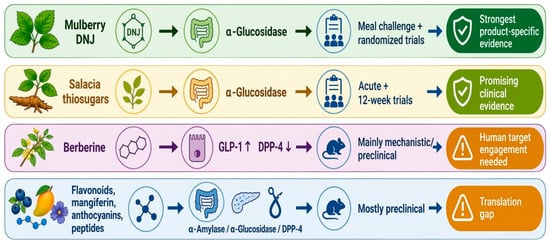
Figure 2.
Chemistry-to-clinic evidence map for plant-derived postprandial glycemic modulators. Mulberry DNJ preparations and Salacia thiosugars currently have the strongest product-specific clinical support, whereas berberine and other phytochemical classes require additional human target-engagement evidence. This conceptual map distinguishes the type of evidence from the development requirements summarized in the tables; it is not a comparative efficacy estimate. Created in BioRender. Varut, M. (2026) https://BioRender.com/hf5tr6f.
5. Human Evidence: Where Chemistry and Clinical Response Converge
Human evidence is strongest when the intervention is chemically characterized, administered with a defined carbohydrate challenge or for a prespecified treatment period, and evaluated against placebo or an active comparator. Acute meal studies answer whether a product changes glucose appearance under controlled conditions. Longer trials address durability and HbA1c but introduce adherence, background therapy, diet, and weight change. Continuous glucose monitoring can reveal time in range and meal-specific excursions that are missed by fasting glucose alone.
5.1. Mulberry Alkaloid Preparations
Mulberry twig alkaloid tablets have advanced beyond acute meal testing. A 24-week multicenter randomized double-blind double-dummy trial in 600 people with type 2 diabetes found HbA1c reduction non-inferior to acarbose, with fewer treatment-related and gastrointestinal adverse events in the mulberry group [8]. A separate randomized placebo-controlled multicenter study of 200 participants reported HbA1c changes of −0.80 percentage points (95% CI −0.98 to −0.62) with treatment and −0.09 (95% CI −0.27 to 0.09) with placebo after 16 weeks, together with improved fasting and postprandial endpoints [9]. An earlier smaller active-controlled trial provided preliminary support and highlighted the need for the larger studies [33].
The program has continued to clinically relevant phenotyping. In people inadequately controlled on oral therapy, a 2026 randomized study using flash glucose monitoring compared mulberry twig alkaloids with canagliflozin; both improved several glycemic metrics, with differences in selected postprandial excursions. This small open-label study does not establish overall equivalence or superiority [34]. A small three-arm study in insulin-treated patients used continuous glucose monitoring to compare add-on mulberry alkaloids, metformin, and insulin alone [35]. These findings add product-specific observations, although open questions include long-term cardiovascular and renal outcomes, external replication, generalizability, and detailed constituent-exposure relationships.
Not every mulberry product has the same evidence. A randomized crossover study of a low-dose fruit extract in 24 unmedicated adults with type 2 diabetes showed acute postprandial effects [31], while mulberry leaf plus corn silk reduced selected glucose endpoints mainly in a subgroup in a 2025 crossover trial [36]. A mulberry leaf and water chestnut tea also reduced postprandial glucose in borderline diabetes [37]. These studies may support food-format development, but they cannot be pooled directly with standardized twig alkaloid tablets.
5.2. Salacia Extracts
Salacia provides a second coherent mechanism-to-human example. Acute randomized crossover studies in healthy participants and people with type 2 diabetes generally showed reduced postprandial glucose and/or insulin exposure after carbohydrate-rich meals [20,40,41]. Dose–response and 12-week data with S. chinensis strengthened the association between an α-glucosidase-inhibitory extract and glycemic endpoints [42]. A randomized trial in overweight or obese adults found attenuation of glycemic indices and changes in selected gastrointestinal peptides, but no overall GLP-1 area-under-the-curve difference, illustrating that α-glucosidase inhibition does not guarantee a uniform incretin response [50].
A triple-blind crossover trial of Salacia reticulata extract biscuits in people with type 2 diabetes tested a food-format intervention over longer periods [51]. Such formats are attractive for meal-linked dosing but complicate blinding, stability, and control of background carbohydrate intake. Future studies should report salacinol, kotalanol, and related marker contents, enzyme-inhibition potency per dose, adherence, gastrointestinal events, and whether the clinical product matches the material used in mechanistic assays.
5.3. Mixed Botanical Products and Negative Translation
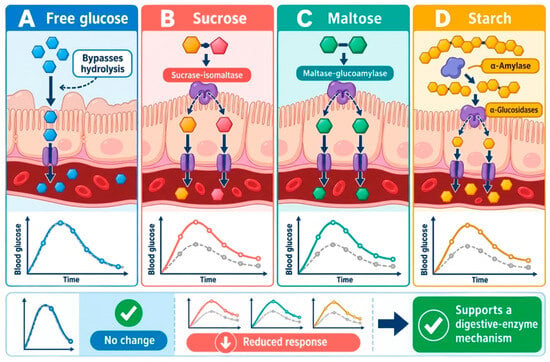
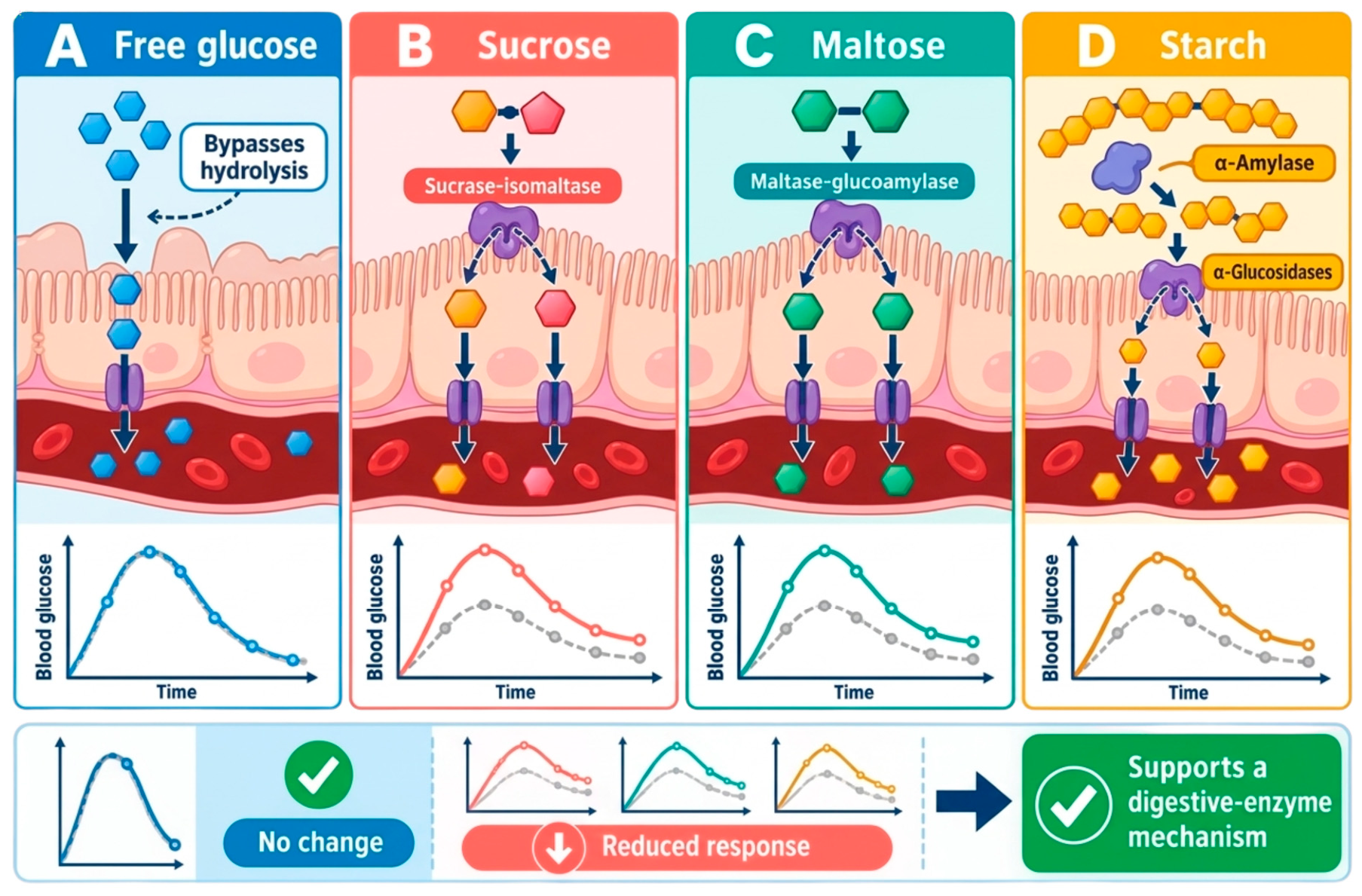
Tangzhiqing, a multi-herb Chinese product, was evaluated in an eight-period crossover study using glucose, sucrose, maltose, maltodextrin, and starch challenges. It reduced responses to selected hydrolyzable carbohydrates but not free glucose, supporting a digestive-enzyme mechanism and demonstrating the value of substrate-discrimination designs [52]. The non-linear dose response also cautions against assuming that more enzyme inhibition produces proportionally greater benefit.
Negative or discordant studies are equally informative. A 2026 randomized crossover study of a polyphenol-rich sugarcane extract found in vitro inhibition of human sucrase and weaker effects on maltase/isomaltase, yet did not reduce postprandial glucose or insulin responses in healthy adults [53]. The null result limits efficacy claims for that product, dose, population, and starch-containing meal; it does not prove absence of all biological activity or equivalence to placebo. Differences in dose, food matrix, effective luminal concentration, inhibitor timing, and compensatory physiology should be investigated rather than treating the clinical null result as an anomaly.
The trial used liquid extract at 0.5% or 5% with a 50 g-carbohydrate meal and 180 min sampling. Glucose iAUC did not differ significantly from the corresponding controls (p = 0.49 and 0.22); human sucrase IC50 was 425.8 ± 18.7 μg/mL, while the extract activated rather than inhibited human α-amylases in vitro [53]. The small sample and substrate mismatch limit generalization. Null HbA1c findings in the 12-week DNJ-enriched leaf study [7] and absent overall GLP-1 AUC differences with S. chinensis [50] likewise separate acute glycemic effects from sustained efficacy and incretin mechanisms (Table 4).
Table 4.
Selected controlled human studies with chemically or mechanistically informative plant products.
6. Why In Vitro Potency Often Fails to Translate
An IC50 is conditional on enzyme concentration, substrate identity and concentration, incubation time, buffer, pH, detector, and inhibitor solubility. It is not an intrinsic clinical dose. For competitive inhibitors, the apparent potency changes with substrate concentration. For mixed or non-competitive inhibitors, different kinetic components matter. Colored extracts can absorb at assay wavelengths; tannins can precipitate proteins; and reducing compounds can alter coupled detection systems. Orthogonal readouts and extract blanks are therefore required.
Enzyme-source mismatch is especially consequential for α-glucosidase. Yeast screening is acceptable for discovery but should be followed by mammalian and preferably human maltase-glucoamylase and sucrase-isomaltase assays. The Vauquelinia example, in which potency differed substantially between yeast and mammalian enzymes, shows that the rank order can change [12]. For α-amylase, both salivary and pancreatic isoforms should be considered, and the inhibitor should be tested against realistic starch substrates with physiologically plausible contact times.
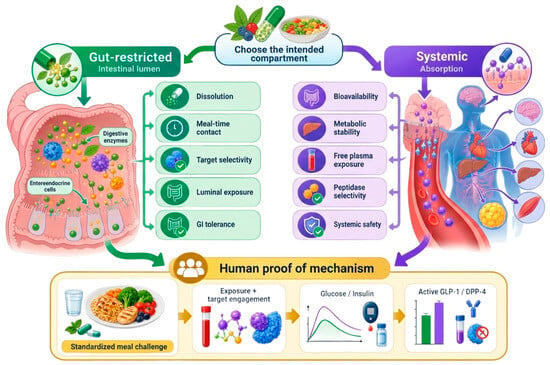
The luminal concentration is determined by dose, dissolution, meal volume, binding to food, and timing. A poorly absorbed compound can be advantageous for an intestinal enzyme target, but only if it dissolves and remains active. For DPP-4, the relevant site must be specified. Local intestinal inhibition is a preclinical hypothesis even when plasma activity is unchanged, as proposed in rats for berberine [44]. Systemic DPP-4 claims require free plasma or tissue exposure, enzyme activity, and active GLP-1 preservation (Figure 3).
Figure 3.
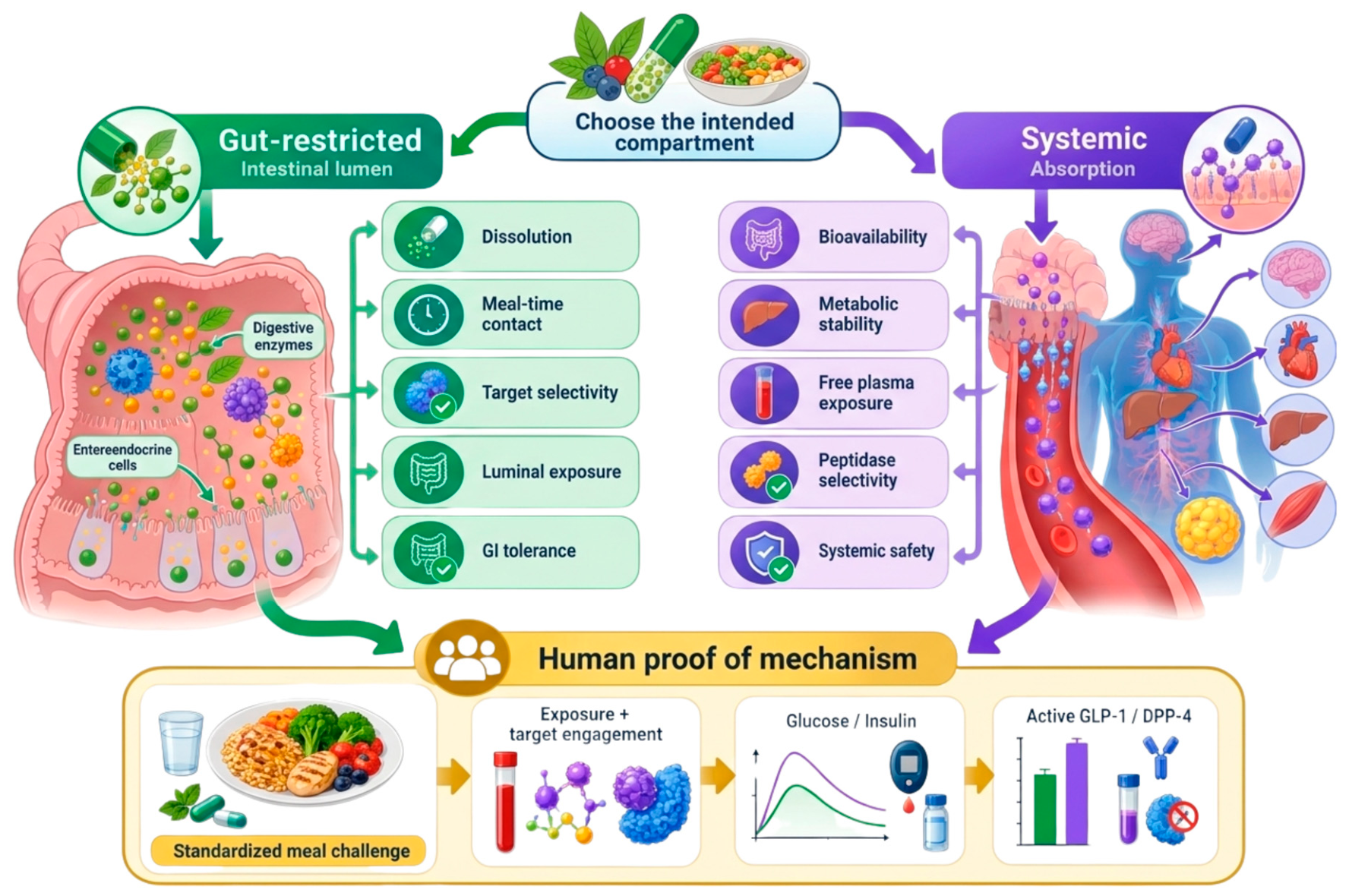
Compartment-led development of plant-derived postprandial glycemic modulators. Gut-restricted candidates are optimized for luminal dissolution, meal-time contact, target selectivity, and gastrointestinal tolerability, whereas systemic candidates require bioavailability, metabolic stability, free plasma exposure, peptidase selectivity, and systemic safety. Both pathways require exposure-linked human proof of mechanism. The two paths depict distinct experimental decisions rather than observed clinical equivalence. Created in BioRender. Varut, M. (2026) https://BioRender.com/hskesy9.
Finally, the body compensates. Slower carbohydrate hydrolysis can alter gastric emptying, insulin, glucagon, GLP-1, GIP, amylin, substrate oxidation, and later hunger. An acute reduction in the early glucose peak may be offset by delayed appearance later in the sampling window. Meal studies should therefore sample long enough to capture the full excursion and should report glucose and insulin iAUC, peak timing, late glucose, active and total incretins, and gastrointestinal symptoms.
7. Safety, Interactions, and Product Quality
Gastrointestinal effects are mechanism-linked for carbohydrate-hydrolysis inhibitors. Undigested carbohydrate increases osmotic load and fermentation, so flatulence, abdominal discomfort, and diarrhea should be recorded with standardized definitions and related to meal composition. In the 24-week mulberry twig trial, gastrointestinal events occurred in 12.2% versus 24.6% with acarbose, and treatment-related events in 15.3% versus 28.4%; no hypoglycemia was reported in either group [8], but it should be confirmed across doses, diets, and longer exposure. Reduced symptoms must not result from inadequate enzyme inhibition.
In the acute S. oblonga crossover trial, gastrointestinal symptoms were reported after control, 240 mg, and 480 mg by 2, 8, and 12 participants, respectively, and lasted no more than 24 h [20]. These crossover counts are not independent parallel-group event rates. The 12–24-week studies discussed here cannot establish rare-event or multi-year safety; this limitation also applies to food formulations and products with different chemical specifications.
The mechanism of a purely local digestive inhibitor suggests a low intrinsic hypoglycemia risk when used alone, but risk can increase when postprandial modulators are combined with insulin or insulin secretagogues. Combination trials should prespecify glucose monitoring and hypoglycemia reporting; the absence of events in monotherapy cannot be generalized to insulin-treated populations. Products that stimulate GLP-1 or inhibit DPP-4 may have broader gastrointestinal or immune effects, and non-selective inhibition of related peptidases is undesirable. Berberine has clinically demonstrated enzyme-interaction potential: in a crossover study of 17 healthy completers, 300 mg three times daily for 14 days reduced CYP2D6, CYP2C9, and CYP3A4 activity; midazolam exposure increased by about 40% [54]. This supports medication review for susceptible substrates, especially drugs with narrow therapeutic margins. It does not establish the magnitude of every proposed herb–drug interaction.
Quality specifications should include botanical identity, plant part, extraction solvent, drug-to-extract ratio, relevant active markers, enzyme potency per unit dose, contaminants, microbial limits, residual solvents, and stability. For mulberry, DNJ or a defined alkaloid panel is mechanistically relevant. For Salacia, salacinol, kotalanol, and related thiosugars should be quantified. Total phenolics alone are not an adequate release specification for a product developed as an α-glucosidase or DPP-4 inhibitor.
8. A Development Framework for Molecules and Standardized Products
Development should start by choosing the intended compartment. A gut-restricted product can be optimized for dissolution, meal-time contact, and selectivity among digestive enzymes without pursuing high plasma exposure. A systemic DPP-4 inhibitor requires absorption, metabolic stability, peptidase selectivity, and conventional systemic toxicology. A GLP-1 secretagogue should reach the relevant enteroendocrine sensors and demonstrate receptor-dependent secretion rather than only elevated circulating GLP-1 after delayed digestion.
The carbohydrate challenge should match the target. Sucrose tests sucrase activity; maltose tests maltase; starch requires amylase plus downstream α-glucosidases; and free glucose bypasses hydrolysis. The Tangzhiqing study illustrates how a multi-substrate design can distinguish digestive inhibition from downstream insulin sensitization [52]. This approach should be used earlier, in both animal and human proof-of-mechanism studies (Figure 4).
Figure 4.
Target-matched carbohydrate challenges for mechanism discrimination. Free glucose bypasses hydrolysis, whereas sucrose, maltose, and starch probe sucrase–isomaltase, overlapping intestinal maltase activities, and sequential α-amylase/α-glucosidase activity. Selective attenuation of responses to hydrolyzable carbohydrates supports a digestive-enzyme mechanism. These are functional substrate probes, not enzyme-complex-specific tests. Created in BioRender. Varut, M. (2026) https://BioRender.com/64cnko4.
A minimum clinical development sequence would include: an acute randomized crossover meal challenge with exposure and gastrointestinal measurements; a dose-ranging study to define the efficacy-tolerability window; and a longer randomized trial using the same standardized product. Continuous glucose monitoring can identify which meals and time windows respond, while HbA1c establishes durability. Mechanistic biomarkers should be prespecified and limited to those that can discriminate among α-amylase, α-glucosidase, GLP-1 secretion, and DPP-4 inhibition.
The checklist in Table 5 is an author-developed synthesis for this narrative review, informed by the assay-to-clinic discrepancies and product-specific trial designs discussed above [7,8,10,11,12,17,20,52,53]. It is neither a validated scoring instrument nor an externally endorsed drug-development standard; the domains should be tested prospectively (Table 5).
Table 5.
Translational checklist for a plant-derived postprandial glucose modulator.
9. Conclusions
Plant-derived control of postprandial glycemia is most credible when mechanism and compartment align. Flavonoids provide valuable structure–activity information for α-amylase, α-glucosidase, and DPP-4, but assay-dependent potency and extensive metabolism limit direct therapeutic inference. Preclinical berberine studies suggest a possible intestinal link between bitter-taste-receptor-mediated GLP-1 secretion and local DPP-4 effects, whereas mangiferin, anthocyanins, guava flavonols, and protein hydrolysates remain primarily preclinical.
Mulberry iminosugar preparations and Salacia thiosugars currently provide the most developed product-specific human evidence among the candidates considered. Standardized mulberry twig alkaloid tablets have shown placebo-controlled efficacy and non-inferiority to acarbose, while Salacia extracts repeatedly reduced acute postprandial responses and have some longer-term support. These findings cannot be generalized to all mulberry or Salacia products, much less to all antidiabetic plants. Product identity is part of the mechanism.
Future progress depends on replacing potency lists with target-relevant enzyme panels, substrate-discrimination studies, luminal or systemic exposure measurements, active incretin assays, and controlled trials using a locked chemical specification. Negative translation should be reported and used to refine the model. Only a limited number of rigorously characterized preparations have replicated controlled human findings, and replication across independent batches and populations remains incomplete. The same standard applies to all candidates: in vitro potency alone is insufficient, acute postprandial effects do not establish durable therapeutic benefit, and clinical glucose lowering does not by itself prove the proposed molecular target.
Supplementary Materials
The following supporting information can be downloaded at: https://www.mdpi.com/article/10.3390/ph19101546/s1.
Author Contributions
Conceptualization, P.D.F.V., A.M.K., R.M.V., G.-A.S., C.S.C.T. and M.S.; Methodology, P.D.F.V., D.-M.T., A.M.K., R.M.V., P.I.D., D.R. and M.S.; Validation, D.-M.T., A.M.K., R.M.V., R.P., P.I.D., G.-A.S. and M.S.; Formal analysis, P.D.F.V., C.S.C.T., D.-M.T., R.P., D.R. and M.S.; Investigation, P.D.F.V., G.-A.S., D.-M.T., A.M.K., R.M.V., R.P., P.I.D., D.R. and M.S.; Resources, A.M.K., R.M.V., R.P. and P.I.D.; Data curation, P.D.F.V., D.-M.T., R.M.V., D.R. and M.S.; Writing—original draft preparation, P.D.F.V., R.M.V., C.S.C.T., G.-A.S. and M.S.; Writing—review and editing, P.D.F.V., D.-M.T., A.M.K., R.M.V., R.P., P.I.D., D.R. and M.S.; Visualization, D.-M.T., R.P. and M.S.; Supervision, A.M.K., R.M.V. and M.S.; Project administration, A.M.K., R.M.V., P.I.D. and M.S. All authors were personally and actively involved in substantial work leading to this paper. All authors have read and agreed to the published version of the manuscript.
Funding
The Article Processing Charges were funded by the University of Medicine and Pharmacy of Craiova, Romania.
Institutional Review Board Statement
Not applicable.
Informed Consent Statement
Not applicable.
Data Availability Statement
No new data were created or analyzed in this study. Data sharing is not applicable to this article.
Conflicts of Interest
The authors declare no conflicts of interest.
Abbreviations
The following abbreviations are used in this manuscript:
| CGM | Continuous glucose monitoring |
| DNJ | 1-Deoxynojirimycin |
| DPP-4 | Dipeptidyl peptidase-4 |
| GIP | Glucose-dependent insulinotropic polypeptide |
| GLP-1 | Glucagon-like peptide-1 |
| GI | Gastrointestinal |
| iAUC | Incremental area under the curve |
| PLC | Phospholipase C |
| T2DM | Type 2 diabetes mellitus |
| TAS2R38 | Taste receptor type 2 member 38 |
References
- Sales, P.M.; de Souza, P.M.; Simeoni, L.A.; Magalhães, P.O.; Silveira, D. α-Amylase inhibitors: A review of raw material and isolated compounds from plant source. J. Pharm. Pharm. Sci. 2012, 15, 141–183. [Google Scholar] [CrossRef] [Scilit] [PubMed]
- Xiao, J.; Ni, X.; Kai, G.; Chen, X. A review on structure–activity relationship of dietary polyphenols inhibiting α-amylase. Crit. Rev. Food Sci. Nutr. 2013, 53, 497–506. [Google Scholar] [CrossRef] [Scilit] [PubMed]
- Li, X.; Xie, E.; Sun, S.; Shen, J.; Ding, Y.; Wang, J.; Peng, X.; Zheng, R.; Farag, M.A.; Xiao, J. Flavonoids for gastrointestinal tract local and associated systemic effects: A review of clinical trials and future perspectives. J. Adv. Res. 2025, 77, 15–41. [Google Scholar] [CrossRef] [Scilit] [PubMed]
- Lo Piparo, E.; Scheib, H.; Frei, N.; Williamson, G.; Grigorov, M.; Chou, C.J. Flavonoids for controlling starch digestion: Structural requirements for inhibiting human alpha-amylase. J. Med. Chem. 2008, 51, 3555–3561. [Google Scholar] [CrossRef] [Scilit] [PubMed]
- Yu, Y.; Hao, G.; Zhang, Q.; Hua, W.; Wang, M.; Zhou, W.; Zong, S.; Huang, M.; Wen, X. Berberine induces GLP-1 secretion through activation of bitter taste receptor pathways. Biochem. Pharmacol. 2015, 97, 173–177. [Google Scholar] [CrossRef] [Scilit] [PubMed]
- Suman, R.K.; Mohanty, I.R.; Maheshwari, U.; Borde, M.K.; Deshmukh, Y.A. Natural dipeptidyl peptidase-IV inhibitor mangiferin mitigates diabetes- and metabolic syndrome-induced changes in experimental rats. Diabetes Metab. Syndr. Obes. 2016, 9, 261–272. [Google Scholar] [CrossRef] [Scilit] [PubMed]
- Asai, A.; Nakagawa, K.; Higuchi, O.; Kimura, T.; Kojima, Y.; Kariya, J.; Miyazawa, T.; Oikawa, S. Effect of mulberry leaf extract with enriched 1-deoxynojirimycin content on postprandial glycemic control in subjects with impaired glucose metabolism. J. Diabetes Investig. 2011, 2, 318–323. [Google Scholar] [CrossRef] [Scilit] [PubMed]
- Qu, L.; Liang, X.; Tian, G.; Zhang, G.; Wu, Q.; Huang, X.; Cui, Y.; Liu, Y.; Shen, Z.; Xiao, C.; et al. Efficacy and Safety of Mulberry Twig Alkaloids Tablet for the Treatment of Type 2 Diabetes: A Multicenter, Randomized, Double-Blind, Double-Dummy, and Parallel Controlled Clinical Trial. Diabetes Care 2021, 44, 1324–1333. [Google Scholar] [CrossRef] [Scilit] [PubMed]
- Qu, L.; Liang, X.C.; Tian, G.Q.; Zhang, G.L.; Wu, Q.L.; Huang, X.M.; Cui, Y.Z.; Liu, Y.L.; Shen, Z.F.; Ma, G.Q.; et al. Efficacy and Safety of Mulberry Twig Alkaloids Tablet for Treatment of Type 2 Diabetes: A Randomized, Double-Blind, Placebo-Controlled Multicenter Clinical Study. Chin. J. Integr. Med. 2022, 28, 304–311. [Google Scholar] [CrossRef] [Scilit] [PubMed]
- Jiang, C.; Chen, Y.; Ye, X.; Wang, L.; Shao, J.; Jing, H.; Jiang, C.; Wang, H.; Ma, C. Three flavanols delay starch digestion by inhibiting α-amylase and binding with starch. Int. J. Biol. Macromol. 2021, 172, 503–514. [Google Scholar] [CrossRef] [Scilit] [PubMed]
- D’Costa, A.S.; Bordenave, N. Inhibition of starch digestion by flavonoids: Role of flavonoid-amylase binding kinetics. Food Chem. 2021, 341, 128256. [Google Scholar] [CrossRef] [Scilit] [PubMed]
- Flores-Bocanegra, L.; Pérez-Vásquez, A.; Torres-Piedra, M.; Bye, R.; Linares, E.; Mata, R. α-Glucosidase Inhibitors from Vauquelinia corymbosa. Molecules 2015, 20, 15330–15342. [Google Scholar] [CrossRef] [Scilit] [PubMed]
- Lim, J.; Ferruzzi, M.G.; Hamaker, B.R. Structural requirements of flavonoids for the selective inhibition of α-amylase versus α-glucosidase. Food Chem. 2022, 370, 130981. [Google Scholar] [CrossRef] [Scilit] [PubMed]
- Takashima, K.; Sakano, M.; Kinouchi, E.; Nakamura, S.; Marumoto, S.; Ishikawa, F.; Ninomiya, K.; Nakanishi, I.; Morikawa, T.; Tanabe, G. Elongation of the side chain by linear alkyl groups increases the potency of salacinol, a potent α-glucosidase inhibitor from the Ayurvedic traditional medicine “Salacia,” against human intestinal maltase. Bioorg. Med. Chem. Lett. 2021, 33, 127751. [Google Scholar] [CrossRef] [Scilit] [PubMed]
- Hlebowicz, J.; Hlebowicz, A.; Lindstedt, S.; Björgell, O.; Höglund, P.; Holst, J.J.; Darwiche, G.; Almér, L.O. Effects of 1 and 3 g cinnamon on gastric emptying, satiety, and postprandial glucose, insulin, glucose-dependent insulinotropic polypeptide, glucagon-like peptide-1, and ghrelin concentrations in healthy subjects. Am. J. Clin. Nutr. 2009, 89, 815–821. [Google Scholar] [CrossRef] [Scilit] [PubMed]
- Yang, W.L.; Zhang, C.Y.; Ji, W.Y.; Zhao, L.L.; Yang, F.Y.; Zhang, L.; Cao, X. Berberine Metabolites Stimulate GLP-1 Secretion by Alleviating Oxidative Stress and Mitochondrial Dysfunction. Am. J. Chin. Med. 2024, 52, 253–274. [Google Scholar] [CrossRef] [Scilit] [PubMed]
- Fleury, L.; Deracinois, B.; Dugardin, C.; Nongonierma, A.B.; FitzGerald, R.J.; Flahaut, C.; Cudennec, B.; Ravallec, R. In Vivo and In Vitro Comparison of the DPP-IV Inhibitory Potential of Food Proteins from Different Origins after Gastrointestinal Digestion. Int. J. Mol. Sci. 2022, 23, 8365. [Google Scholar] [CrossRef] [Scilit] [PubMed]
- Pan, J.; Zhang, Q.; Zhang, C.; Yang, W.; Liu, H.; Lv, Z.; Liu, J.; Jiao, Z. Inhibition of Dipeptidyl Peptidase-4 by Flavonoids: Structure-Activity Relationship, Kinetics and Interaction Mechanism. Front. Nutr. 2022, 9, 892426. [Google Scholar] [CrossRef] [Scilit] [PubMed]
- Gao, F.; Fu, Y.; Yi, J.; Gao, A.; Jia, Y.; Cai, S. Effects of Different Dietary Flavonoids on Dipeptidyl Peptidase-IV Activity and Expression: Insights into Structure-Activity Relationship. J. Agric. Food Chem. 2020, 68, 12141–12151. [Google Scholar] [CrossRef] [Scilit] [PubMed]
- Williams, J.A.; Choe, Y.S.; Noss, M.J.; Baumgartner, C.J.; Mustad, V.A. Extract of Salacia oblonga lowers acute glycemia in patients with type 2 diabetes. Am. J. Clin. Nutr. 2007, 86, 124–130. [Google Scholar] [CrossRef] [Scilit] [PubMed]
- Martinez-Gonzalez, A.I.; Díaz-Sánchez, Á.G.; de la Rosa, L.A.; Bustos-Jaimes, I.; Alvarez-Parrilla, E. Inhibition of α-amylase by flavonoids: Structure activity relationship (SAR). Spectrochim. Acta A Mol. Biomol. Spectrosc. 2019, 206, 437–447. [Google Scholar] [CrossRef] [Scilit] [PubMed]
- Proença, C.; Freitas, M.; Ribeiro, D.; Tomé, S.M.; Oliveira, E.F.T.; Viegas, M.F.; Araújo, A.N.; Ramos, M.J.; Silva, A.M.S.; Fernandes, P.A.; et al. Evaluation of a flavonoids library for inhibition of pancreatic α-amylase towards a structure-activity relationship. J. Enzym. Inhib. Med. Chem. 2019, 34, 577–588. [Google Scholar] [CrossRef] [Scilit] [PubMed]
- Tadera, K.; Minami, Y.; Takamatsu, K.; Matsuoka, T. Inhibition of α-glucosidase and α-amylase by flavonoids. J. Nutr. Sci. Vitaminol. 2006, 52, 149–153. [Google Scholar] [PubMed]
- Ortiz-Andrade, R.R.; García-Jiménez, S.; Castillo-España, P.; Ramírez-Avila, G.; Villalobos-Molina, R.; Estrada-Soto, S. α-Glucosidase inhibitory activity of the methanolic extract from Tournefortia hartwegiana: An anti-hyperglycemic agent. J. Ethnopharmacol. 2007, 109, 48–53. [Google Scholar] [CrossRef] [Scilit] [PubMed]
- Subramanian, R.; Asmawi, M.Z.; Sadikun, A. In vitro α-glucosidase and α-amylase enzyme inhibitory effects of Andrographis paniculata extract and andrographolide. Acta Biochim. Pol. 2008, 55, 391–398. [Google Scholar] [CrossRef] [Scilit] [PubMed]
- Suresh Babu, K.; Tiwari, A.K.; Srinivas, P.V.; Ali, A.Z.; China Raju, B.; Rao, J.M. Yeast and mammalian α-glucosidase inhibitory constituents from Himalayan rhubarb Rheum emodi. Bioorg. Med. Chem. Lett. 2004, 14, 3841–3845. [Google Scholar] [CrossRef] [Scilit] [PubMed]
- Loizzo, M.R.; Saab, A.M.; Tundis, R.; Menichini, F.; Bonesi, M.; Piccolo, V.; Statti, G.A.; de Cindio, B.; Houghton, P.J.; Menichini, F. In vitro inhibitory activities of plants used in Lebanese traditional medicine against angiotensin-converting enzyme and digestive enzymes related to diabetes. J. Ethnopharmacol. 2008, 119, 109–116. [Google Scholar] [CrossRef] [Scilit] [PubMed]
- Singh, R.; Bhat, G.A.; Sharma, P. GLP-1 secretagogue potential of medicinal plants in the management of diabetes. J. Pharmacogn. Phytochem. 2015, 4, 197–202. [Google Scholar]
- Huang, T.N.; Lu, K.N.; Pai, Y.P.; Hsu, C.; Huang, C.J. Role of GLP-1 in the hypoglycemic effects of wild bitter gourd. Evid.-Based Complement. Altern. Med. 2013, 2013, 625892. [Google Scholar] [CrossRef] [Scilit] [PubMed]
- Thaipitakwong, T.; Supasyndh, O.; Rasmi, Y.; Aramwit, P. A randomized controlled study of dose-finding, efficacy, and safety of mulberry leaves on glycemic profiles in obese persons with borderline diabetes. Complement. Ther. Med. 2020, 49, 102292. [Google Scholar] [CrossRef] [Scilit] [PubMed]
- Mela, D.J.; Alssema, M.; Hiemstra, H.; Hoogenraad, A.R.; Kadam, T. Effect of Low-Dose Mulberry Fruit Extract on Postprandial Glucose and Insulin Responses: A Randomized Pilot Trial in Individuals with Type 2 Diabetes. Nutrients 2024, 16, 2177. [Google Scholar] [CrossRef] [Scilit] [PubMed]
- Mohamed, M.; Zagury, R.L.; Bhaskaran, K.; Neutel, J.; Mohd Yusof, B.N.; Mooney, L.; Yeo, L.; Kirwan, B.A.; Aprikian, O.; von Eynatten, M.; et al. A Randomized, Placebo-Controlled Crossover Study to Evaluate Postprandial Glucometabolic Effects of Mulberry Leaf Extract, Vitamin D, Chromium, and Fiber in People with Type 2 Diabetes. Diabetes Ther. 2023, 14, 749–766. [Google Scholar] [CrossRef] [Scilit] [PubMed]
- Li, M.; Huang, X.; Ye, H.; Chen, Y.; Yu, J.; Yang, J.; Zhang, X. Randomized, Double-Blinded, Double-Dummy, Active-Controlled, and Multiple-Dose Clinical Study Comparing the Efficacy and Safety of Mulberry Twig (Ramulus Mori, Sangzhi) Alkaloid Tablet and Acarbose in Individuals with Type 2 Diabetes Mellitus. Evid. Based Complement. Altern. Med. 2016, 2016, 7121356. [Google Scholar] [CrossRef] [Scilit] [PubMed]
- Li, H.; Tao, S.; Zhou, X.; Yan, R.; Yu, B.; Luo, Y.; Zhang, P.; Kong, X.; Ma, J. Effects of mulberry twig alkaloids and canagliflozin in inadequately controlled type 2 diabetes: A randomized controlled study based on flash glucose monitoring. Sci. Rep. 2026, 16, 18502. [Google Scholar] [CrossRef] [Scilit] [PubMed]
- Meng, Z.; Xu, C.; Liu, H.; Gao, X.; Li, X.; Lin, W.; Ma, X.; Yang, C.; Hao, M.; Zhao, K.; et al. Effects of mulberry twig alkaloids(Sangzhi alkaloids) and metformin on blood glucose fluctuations in combination with premixed insulin-treated patients with type 2 diabetes. Front. Endocrinol. 2023, 14, 1272112. [Google Scholar] [CrossRef] [Scilit] [PubMed]
- Sun, Y.; Niu, X.; Wang, Y.; Zhang, Q.; Liu, Y.; He, J.; Xu, L.; Wang, R.; Guo, J. Effects of Mulberry Leaf and Corn Silk Extracts Against α-Amylase and α-Glucosidase In Vitro and on Postprandial Glucose in Prediabetic Individuals: A Randomized Crossover Trial. Nutrients 2025, 17, 3438. [Google Scholar] [CrossRef] [Scilit] [PubMed]
- Yasuda, M.; Yasutake, K.; Yoshinaga, I.; Nakashima, K.; Saiki, M.; Takeyama-Mitsuta, A.; Doi, T. Mulberry leaves and water chestnut tea reduces postprandial blood glucose in borderline diabetic Japanese: A randomized, double-blind, placebo-controlled crossover study. Asia Pac. J. Clin. Nutr. 2025, 34, 174–182. [Google Scholar] [CrossRef] [PubMed]
- Yoshino, K.; Miyauchi, Y.; Kanetaka, T.; Takagi, Y.; Koga, K. Anti-diabetic activity of a leaf extract prepared from Salacia reticulata in mice. Biosci. Biotechnol. Biochem. 2009, 73, 1096–1104. [Google Scholar] [CrossRef] [Scilit] [PubMed]
- Yoshikawa, M.; Pongpiriyadacha, Y.; Kishi, A.; Kageura, T.; Wang, T.; Morikawa, T.; Matsuda, H. Biological activities of Salacia chinensis originating in Thailand: Quality evaluation guided by α-glucosidase inhibitory activity. Yakugaku Zasshi 2003, 123, 871–880. [Google Scholar] [CrossRef] [Scilit] [PubMed]
- Heacock, P.M.; Hertzler, S.R.; Williams, J.A.; Wolf, B.W. Effects of a medical food containing an herbal alpha-glucosidase inhibitor on postprandial glycemia and insulinemia in healthy adults. J. Am. Diet. Assoc. 2005, 105, 65–71. [Google Scholar] [CrossRef] [Scilit] [PubMed]
- Jeykodi, S.; Deshpande, J.; Juturu, V. Salacia Extract Improves Postprandial Glucose and Insulin Response: A Randomized Double-Blind, Placebo Controlled, Crossover Study in Healthy Volunteers. J. Diabetes Res. 2016, 2016, 7971831. [Google Scholar] [CrossRef] [Scilit] [PubMed]
- Kobayashi, M.; Akaki, J.; Ninomiya, K.; Yoshikawa, M.; Muraoka, O.; Morikawa, T.; Odawara, M. Dose-Dependent Suppression of Postprandial Hyperglycemia and Improvement of Blood Glucose Parameters by Salacia chinensis Extract: Two Randomized, Double-Blind, Placebo-Controlled Studies. J. Med. Food 2021, 24, 10–17, Correction in J. Med. Food 2021, 24, 331. https://doi.org/10.1089/jmf.2020.4751.correx. [Google Scholar] [CrossRef] [Scilit] [PubMed]
- Cicero, A.F.; Tartagni, E. Antidiabetic properties of berberine: From cellular pharmacology to clinical effects. Hosp. Pract. 2012, 40, 56–63. [Google Scholar] [CrossRef] [Scilit] [PubMed]
- Wang, J.; Dai, G.; Li, W. Berberine regulates glycemia via local inhibition of intestinal dipeptidyl peptidase-IV. Zhejiang Da Xue Xue Bao Yi Xue Ban 2016, 45, 486–492. [Google Scholar] [CrossRef] [Scilit] [PubMed]
- Suman, R.K.; Borde, M.K.; Mohanty, I.R.; Singh, H.K. Mechanism of Action of Natural Dipeptidyl Peptidase-IV Inhibitors (Berberine and Mangiferin) in Experimentally Induced Diabetes with Metabolic Syndrome. Int. J. Appl. Basic Med. Res. 2023, 13, 133–142. [Google Scholar] [CrossRef] [Scilit] [PubMed]
- Yogisha, S.; Raveesha, K.A. Dipeptidyl peptidase IV inhibitory activity of Mangifera indica. J. Nat. Prod. 2010, 3, 76–79. [Google Scholar]
- Kozuka, M.; Yamane, T.; Nakano, Y.; Nakagaki, T.; Ohkubo, I.; Ariga, H. Identification and characterization of a dipeptidyl peptidase IV inhibitor from aronia juice. Biochem. Biophys. Res. Commun. 2015, 465, 433–436. [Google Scholar] [CrossRef] [Scilit] [PubMed]
- Eidenberger, T.; Selg, M.; Krennhuber, K. Inhibition of dipeptidyl peptidase activity by flavonol glycosides of guava (Psidium guajava L.): A key to the beneficial effects of guava in type II diabetes mellitus. Fitoterapia 2013, 89, 74–79. [Google Scholar] [CrossRef] [Scilit] [PubMed]
- McLaughlin, C.M.; Harnedy-Rothwell, P.A.; Lafferty, R.A.; Sharkey, S.; Parthsarathy, V.; Allsopp, P.J.; McSorley, E.M.; FitzGerald, R.J.; O’Harte, F.P.M. Macroalgal protein hydrolysates from Palmaria palmata influence the ‘incretin effect’ in vitro via DPP-4 inhibition and upregulation of insulin, GLP-1 and GIP secretion. Eur. J. Nutr. 2021, 60, 4439–4452. [Google Scholar] [CrossRef] [Scilit] [PubMed]
- Hao, L.; Schlussel, Y.; Fieselmann, K.; Schneider, S.H.; Shapses, S.A. Appetite and Gut Hormones Response to a Putative α-Glucosidase Inhibitor, Salacia Chinensis, in Overweight/Obese Adults: A Double Blind Randomized Controlled Trial. Nutrients 2017, 9, 869. [Google Scholar] [CrossRef] [Scilit] [PubMed]
- Siribaddana, S.; Medagama, A.; Wickramasinghe, N.; Siribaddana, N.M.; Agampodi, S.; Fernando, D. The Effect of Salacia Reticulata Extract Biscuits on Blood Sugar Control of Type 2 Diabetes Mellitus Patients: A Two-Period, Two-Sequence, Crossover, Randomized, Triple-Blind, Placebo-Controlled, Clinical Trial. Cureus 2023, 15, e45921. [Google Scholar] [CrossRef] [Scilit] [PubMed]
- Li, Y.; Li, Z.; Wang, R.; Mi, B.; Jiang, T.; Lu, M.; Liu, J.; Wang, B.; Zhang, D.; Xu, Q.; et al. Alleviating the Hydrolysis of Carbohydrates, Tangzhiqing (TZQ) Decreased the Postprandial Glycemia in Healthy Volunteers: An Eight-Period Crossover Study. Evid. Based Complement. Altern. Med. 2020, 2020, 8138195. [Google Scholar] [CrossRef] [Scilit] [PubMed]
- Hewawansa, U.H.A.J.; Barber, E.; Houghton, M.J.; Visvanathan, R.; Nicolotti, L.; Costa, R.J.S.; Williamson, G. Impact of Acute (Poly)Phenol-Rich Sugarcane Extract Consumption on Postprandial Glycemic Response in Healthy Adults: A Randomized Crossover Study. Foods 2026, 15, 631. [Google Scholar] [CrossRef] [Scilit] [PubMed]
- Guo, Y.; Chen, Y.; Tan, Z.R.; Klaassen, C.D.; Zhou, H.H. Repeated administration of berberine inhibits cytochromes P450 in humans. Eur. J. Clin. Pharmacol. 2012, 68, 213–217. [Google Scholar] [CrossRef] [Scilit] [PubMed]

Disclaimer/Publisher’s Note: The statements, opinions and data contained in all publications are solely those of the individual author(s) and contributor(s) and not of MDPI and/or the editor(s). MDPI and/or the editor(s) disclaim responsibility for any injury to people or property resulting from any ideas, methods, instructions or products referred to in the content. |
© 2026 by the authors. Licensee MDPI, Basel, Switzerland. This article is an open access article distributed under the terms and conditions of the Creative Commons Attribution (CC BY) license.