


Abstract
Research on biometric authentication addresses multiple issues, with one being the protection of biometric templates against spoofing and theft. Cancelable biometrics address this issue by transforming biometric data into a protected representation that is designed to be non-invertible, while multimodal cancelable biometrics extend this approach by combining several biometric traits into a single cancelable template, so that an attacker has to forge all of them at once. In this paper, we describe a keyless multimodal cancelable biometric scheme that is based on generative adversarial networks (GANs). We first extract features from three biometric instances of two modalities: the face (face modality) and the left and right irises (iris modality). Then, only two of them (the face and the right iris) are used to train a GAN that generates a transformed template, which is then fused at the feature level with the features of the third instance (the left iris) to create the final cancelable template. Authentication requires only two instances, one of each modality (the face and the left iris), while the right iris is used only during enrollment as a biometric salt and is neither stored nor used afterwards. We evaluated the scheme on the CASIA-V3-Internal iris dataset and the AT&T (ORL) face database. On the resulting virtual multimodal database of 40 subjects, with impostor comparisons made between templates produced by the generators of different users, the scheme is more accurate than the corresponding unimodal systems at low false acceptance rates, with EERs of 1.5%, 1.71% and 1.87% for the AND, OR and XOR fusion, respectively. Furthermore, a compromised template can be revoked and reissued without any stored key. Non-invertibility is an intended property of the design rather than an established guarantee, and full unlinkability remains unverified; we analyze both properties, including the limitations of each fusion operator.
1. Introduction
Multimodal biometrics uses multiple biometric characteristics to verify the identity of an individual. By integrating several biometric traits, such as fingerprints, the face and the iris, it improves both accuracy and security [1]. Unlike unimodal biometrics, which rely on a single modality, multimodal systems exploit the strengths of each of their components [2]. For instance, face recognition is suitable for identifying individuals from a distance, while fingerprint recognition is more effective for close-up identification [2]. Such a combination reduces the risk of spoofing and fraud, because an attacker has to replicate several biometric traits to deceive the system [3]. Furthermore, multimodal biometrics can also improve user experience by offering convenient authentication, such as using both face and fingerprint recognition instead of traditional PINs or passwords [4].
Multimodal biometrics, however, poses several challenges [5]. First, privacy is paramount: biometric templates have to be protected so that they do not reveal personal information. Second, compatibility is required so that different traits, such as the face and the iris, can be integrated effectively. Third, fusion, i.e., the process of combining data from several modalities, introduces complexity due to the heterogeneity and the varying quality of the data. Fusion is performed at one of three levels [6]: (i) the feature level, which merges the extracted features [7]; (ii) the score level, which combines the matching scores [8]; and (iii) the decision level, which integrates the decisions of the individual systems [9]. Feature-level fusion, which combines the biometric data before dimensionality reduction, generally outperforms score-level and decision-level fusion in multimodal recognition, as it supports (i) elimination of redundant information and (ii) extraction of discriminative features that improve recognition accuracy [10]. Due to their recognition performance and improved security, multimodal biometrics are increasingly adopted in practical applications [11].
Cancelable biometrics is used as a protection against attacks on biometric templates [12]. It maps the biometric data in such a manner that the result can be distinguished from other data but is intended to be impossible to reconstruct back to its original form, which improves both security and privacy [13]. In contrast to traditional biometrics, a cancelable template can be revoked and reissued without affecting the biometric characteristics of the user, which makes it more difficult to steal and misuse the data [14]. Such flexibility also lets different templates be issued for different applications or devices. Combining multimodal and cancelable biometrics is beneficial in areas such as access control, border security and law enforcement: the use of multiple traits improves accuracy and reduces false acceptances and false rejections, while cancelability provides additional protection against biometric theft and spoofing. Furthermore, multimodal systems can accommodate users with different biometric features and are more tolerant of variations in lighting and pose [15].
The Generative Adversarial Network (GAN) is a deep learning approach that can produce highly realistic synthetic data [16]. In biometric applications, GANs can be used to create synthetic templates for verification while preserving user privacy, and thus they are a promising approach to improving the accuracy, security and usability of keyless cancelable biometric systems [17,18]. A GAN trains two neural networks against each other: the generator produces synthetic biometric templates, while the discriminator attempts to distinguish the synthetic data from the real data. Through this adversarial process, the generator learns to produce templates that are similar to real biometric data [16]. Research on multimodal biometrics has thus progressed from fusion schemes designed to maximize recognition accuracy [7,10] to cancelable multimodal schemes [15] and, more recently, to keyless GAN-based salting of a single trait [17]. Despite these advances, we identify three open problems. First, most studies on multimodal fusion focus on accuracy, and the stored fused template is not necessarily protected; consequently, if a database is breached, several traits are compromised, and the damage is irreparable because biometric traits cannot be replaced [12,14]. Second, most multimodal template protection schemes rely on user-specific keys or tokens that have to be stored or presented, which is not secure if they are stolen, nor convenient if they are lost. Third, GAN-based cancelable transformations have so far been investigated only for a single trait, either a single instance [17] or multiple instances of the same trait [19], and since the GAN generator can be inverted [20], storing a trained generator together with the template raises security concerns. We review the related work and these gaps in Section 2.
In this paper, we propose a feature-level fusion scheme that uses a GAN to combine the face and iris traits. Throughout this paper, we use the term modality (or trait) for the type of biometric characteristic, namely the face or the iris, and the term instance for a specific source of a modality. Our approach thus uses two modalities and three instances: one face instance and two iris instances (the left and right irises). Enrollment requires all three instances, whereas authentication requires only two, one of each modality (the face and the left iris). We first extract features from each biometric instance using specialized models, and then apply the GAN-based fusion process: the GAN generates a transformed template from the face features, using the right iris as a salt, and this template is then fused with the averaged left-iris features. As the design aims at non-invertibility (Section 4.4), the scheme is intended to protect user privacy. Although the scheme is simple to implement, it combines several modalities to improve accuracy, and it exploits the difficulty an attacker faces in forging multiple biometric traits simultaneously, thus increasing the security of the system [21]. Furthermore, the GAN serves as a keyless salting mechanism for any modality represented by binary features [17], while using two instances of the same trait (the left and right irises) improves reliability and performance without requiring additional sensors, feature extraction or matching modules, which makes the approach a cost-effective alternative to unimodal methods [22]. The main contributions of this paper are as follows:
- (i)
- A keyless multimodal cancelable scheme in which a per-user GAN, trained on face features and salted with a permuted right-iris reference, produces a transformed template that is then fused with the left-iris template using a Boolean operator.
- (ii)
- A three-instance (two-modality) enrollment and two-instance (two-modality) authentication design, in which the right iris is used only during enrollment as a salt and is neither stored nor used during authentication.
- (iii)
- An experimental study of the AND, OR and XOR fusion operators, together with an analysis of their cost, security and limitations.
- (iv)
- A transformed-template design in which the GAN output is never stored in the clear, which mitigates, but does not by itself eliminate, the risk posed by the invertibility of the GAN generator, together with a security analysis (Section 4.4) in which revocability and diversity are shown to follow from the construction, non-invertibility is treated as an intended design property rather than an established guarantee, and full unlinkability is identified as not yet verified.
The generator and discriminator architecture, their adversarial training and the use of a GAN as a keyless salting transformation are taken from the Unimodal-Bio-GAN [17], and the fusion of binary templates with Boolean operators is an established technique [19,23]. The contribution of this paper is architectural: it lies in the way these components are composed into a multimodal scheme. Specifically, (a) the input of the GAN and its salt come from two different modalities (the face drives the generator, whereas the right iris provides the salt), so that the transformation binds two modalities instead of transforming a single one, as in [17,19]; (b) the generator output is never stored, but is binarized and fused with a third instance (the left iris), whereas [17] stores the transformed template itself; and (c) the instance that provides the salt is required only at enrollment, so that the stored template depends on three instances, whereas only two are presented at authentication. The differences with respect to [17], to the multi-instance GAN schemes of [19] and to the keyless contralateral-iris scheme of [23] are summarized in Section 2.3. The rest of the paper is organized as follows. Section 2 reviews the related work, while Section 3 describes the proposed methodology. Section 4 reports on the experiments and discusses the results, the computational cost, the security properties and the limitations of the study, and Section 5 provides conclusions.
2. Related Work
2.1. Multimodal Biometric Recognition
Using multiple biometric modalities is an effective way to achieve better accuracy and robustness than unimodal systems [1,22]. Depending on the stage at which the information is combined, fusion is performed at the feature level, the score level or the decision level [6]. Decision-level fusion, used for fingerprint verification in [9], operates on the least information, as it discards most of the information that is available before the final decision. Score-level fusion combines the outputs of the individual matchers, as in fingerprint and finger-vein verification [8]. Feature-level fusion preserves the most information and is generally expected to be the most discriminative [7,10]. Representative schemes include (i) feature-level fusion of hand and face biometrics [7], (ii) frequency-level fusion of fingerprint and iris features [24], (iii) sparse representations of multiple modalities [25], and (iv) multi-level feature abstraction using convolutional networks for multimodal identification [26]. Although these studies show the benefits of multimodal fusion for recognition accuracy, they target primarily recognition performance, and the stored fused templates are generally not protected.
2.2. Template Protection and Multimodal Cancelable Biometrics
Biometric authentication is increasingly deployed as one component of broader identity and access management frameworks, such as multi-factor authentication frameworks for cloud applications [27], identity management schemes for cloud computing [28] and privacy-preserving identity and data governance based on zero-knowledge proofs and smart contracts [29]. In all these settings, a compromised biometric template cannot be replaced like a password, which motivates template protection. Two main categories of template protection schemes have been proposed to protect biometric traits: biometric cryptosystems [12,14,24,30,31] and cancelable biometrics. Cancelable biometrics use a repeatable, parameterized and non-invertible transformation, so that if a template is compromised, it can be discarded and a new one issued [12,14]. The properties that are typically required are revocability, diversity, unlinkability, non-invertibility and recognition accuracy [14,32]. Several authors have combined template protection with multimodal fusion: Paul and Gavrilova [15] proposed multimodal cancelable biometrics; Merkle et al. [21] and Nagar et al. [33] investigated multimodal and multi-instance fusion in biometric cryptosystems; Sarier [11] proposed a multimodal biometric identity-based encryption scheme; and Morampudi et al. [34] proposed multi-instance iris authentication with template protection against a malicious cloud server. Non-invertible cancelable templates have also been derived using transformations based on neural networks [35,36], while record multiplicity attacks have been shown to break several cancelable schemes when multiple transformed templates of the same user exist [37]. Keyless alternatives have also been proposed: Chaivong et al. [23] bind the left and right irises of a subject using a bit permutation derived from the enrollment identifier and XOR fusion, so that no separate token or stored secret is needed. However, many of these methods require a user-specific key or token that has to be stored or presented, which introduces the risk of a stolen key and reduces usability.
2.3. GAN-Based Template Protection
Generative Adversarial Networks [16,18] are a learning framework that generates realistic data through an adversarial game between a generator and a discriminator. In the biometric domain, the Unimodal-Bio-GAN [17] applied a GAN as a keyless salting mechanism for a single biometric modality, thus eliminating the need for an external key. Tarek et al. [19] subsequently used a GAN-based transformation for multi-instance iris recognition, in which the features of the two irises are fused at the feature level either before or after the transformation. Both schemes operate on a single modality (the scheme of [17] on one instance and that of [19] on two instances of the iris), and they have two drawbacks if they are applied directly in a multimodal context: (i) as single-modality schemes, they suffer from the limited accuracy and weak spoofing resistance of unimodal systems; and (ii) as the generator of a GAN can be inverted [20], storing a trained generator together with its output may leak information about the input.
Table 1 summarizes how the proposed scheme differs from these schemes. Three algorithmic differences are essential. First, the GAN is driven by an instance of one modality (the face) and salted by an instance of the other modality (the right iris), so that the transformation binds two modalities instead of transforming a single one. Second, the generator output is never stored: it is binarized and fused with a third instance (the left iris) by a Boolean operator, and only the fused template Cref and the generator weights Wg are stored. Third, the instance that provides the salt is required only at enrollment, so that the template depends on three biometric instances of two modalities, whereas the user presents only two instances, one of each modality, at authentication and no password, token or stored key is involved.
Table 1.
Comparison of the proposed scheme with closely related keyless or GAN-based template protection schemes.
Table 1 shows highlights the contribution of proposed scheme, it inherits from [17] the GAN architecture (a fully connected generator and discriminator with one hidden layer), the adversarial training procedure and the principle of keyless salting; from [19,23], it inherits the idea of fusing binary iris features with a Boolean operator. It differs from [17] in that the transformation is cross-modal and its output is not stored; from [19] in that the GAN input is a different modality (the face) and the second iris instance is not fused into the template, but is used only as the enrollment salt; and from [23] in that the protecting transformation is a learned, user-specific non-linear mapping rather than a permutation derived from the enrollment identifier. None of these differences modifies the GAN or the Boolean operators themselves. The contribution therefore lies in the composition, and the experiments in Section 4 evaluate this composition rather than its individual components, whose separate contributions are left to the ablation studies listed in Section 4.5.
2.4. Summary of the Research Gaps
To summarize, the literature indicates that (i) multimodal fusion can improve accuracy, but the stored multimodal templates are often unprotected; (ii) cancelable transformations may be vulnerable to record multiplicity and inversion attacks; and (iii) GAN-based salting has so far been studied only for a single trait, either a single instance [17] or multiple instances [19]. In the scheme that we propose, the face features are transformed using a GAN that is salted with a permuted reference vector derived from the right-iris samples, which are captured only at enrollment. The transformed template is then fused with the averaged left-iris features, so that the transformed template itself is never stored in the clear.
3. Proposed Methodology
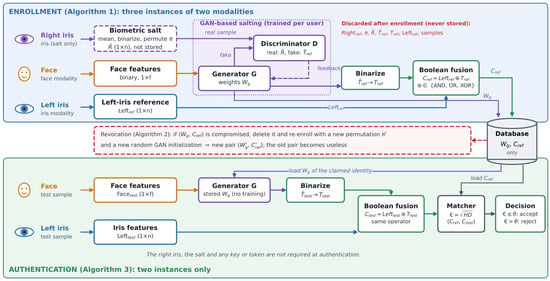
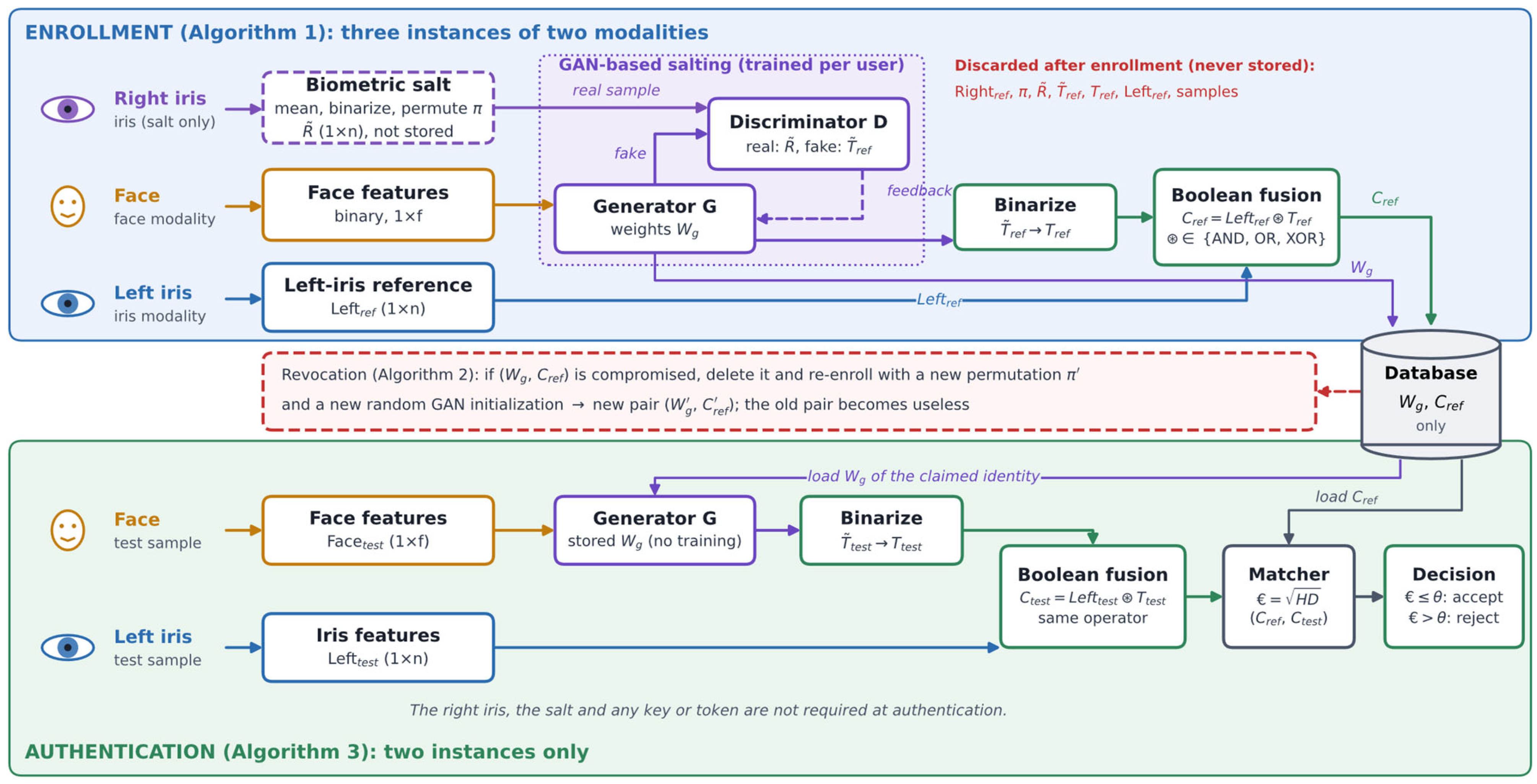
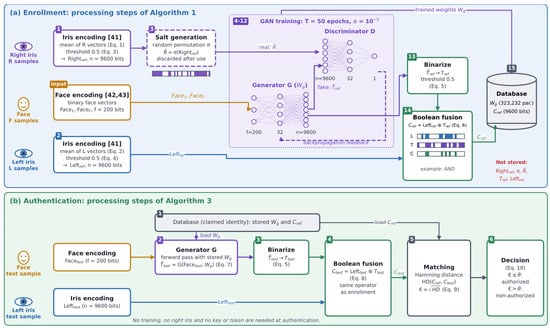
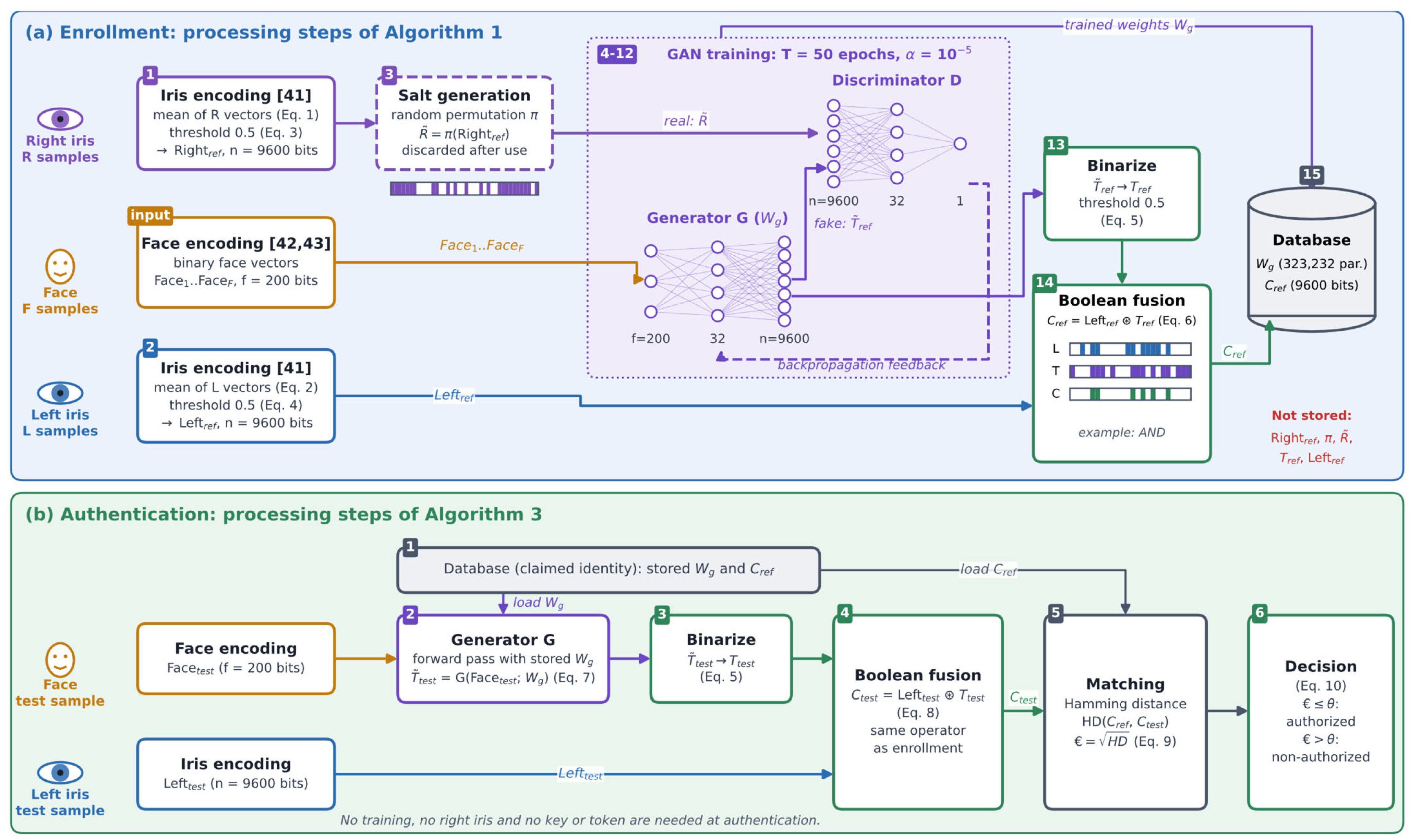
Our cancelable multimodal biometric scheme uses feature-level fusion and consists of two main stages. In the first stage, features are extracted from each biometric instance, namely, two iris instances (left and right) and one face instance for each individual, which results in two binary representations from the iris model and a third one from the face model, all corresponding to the same person. In the second stage, a GAN is trained on the face features, using the right-iris features as a salt, to generate a transformed template, which is then fused at the feature level with the averaged left-iris features to generate the final cancelable template. Thus, enrollment requires three instances of two modalities (the face, the left iris and the right iris), whereas authentication requires only two instances, one of each modality (the face and the left iris). Figure 1 gives an overview of the complete framework, including enrollment, authentication and revocation, and Figure 2 details the processing steps of each phase together with the corresponding lines of Algorithms 1–3. The objective of this design is to improve both the performance and the security of the system.
Figure 1.
Overall framework of the proposed keyless multimodal cancelable scheme. Enrollment (top; Algorithm 1) uses three instances of two modalities: the right iris provides only the biometric salt, the face drives the per-user GAN, and the binarized generator output is fused with the left iris. Only the generator weights Wg and the cancelable template Cref are stored. Authentication (bottom; Algorithm 3) uses two instances, one of each modality (the face and the left iris). A compromised pair is revoked and reissued with Algorithm 2 (middle). Solid arrows denote data flow, dashed arrows denote training feedback or revocation, and dashed boxes denote quantities that are used only at enrollment and are then discarded.
Figure 2.
Detailed processing steps of the proposed scheme. (a) Enrollment, with the line numbers of Algorithm 1 (numbered tags), the network architectures of Table 2 and an illustrative AND fusion of binary vectors (L: left-iris reference, T: binarized generator output, C: cancelable template). (b) Authentication, with the line numbers of Algorithm 3: the test face sample is transformed by the stored generator of the claimed identity, binarized and fused with the test left-iris features, and the resulting Ctest is compared with the stored Cref using the distance € = √HD of Equation (9) and the threshold θ of Equation (10). The right iris is not required at authentication.
As illustrated in Figure 2a, the enrollment of each individual is carried out in three stages. In the first stage, features are extracted from two iris instances and one face instance, producing distinct binary feature representations. Specifically, for each subject, L binary feature vectors are derived from the left-iris samples, R binary feature vectors from the right-iris samples, and F binary feature vectors from the face samples. Each iris instance yields a binary feature vector of size n, while the face yields a vector of size f. In the second stage, the facial binary feature vectors (F) are used as training inputs to the generator of the GAN. Meanwhile, a single binary feature vector, computed as the mean of all right-iris (R) samples, is randomly permuted and supplied as an additional input to the discriminator of the same GAN, where it acts as a salting parameter for the GAN-based transformation. During training, the generator produces an output template of size 1 × n, which is also provided to the discriminator. In each training epoch, the discriminator is updated using a standard backpropagation algorithm [38], and the weights of the generator are then adjusted based on the feedback from the discriminator, using the same learning method. After a predefined number of epochs, the final output of the generator forms the transformed template, and the trained generator weights are saved in the system database. However, as GAN models can be inverted [20], storing both the transformed template and the generator weights could make it possible to reconstruct the original facial features. To address this issue, and to further improve performance, we introduce a third stage that is intended to make the stored cancelable template non-invertible (the extent to which this holds is analyzed in Section 4.4), by fusing a binarized version of the transformed template (the output of the generator) with a binarized vector derived from the mean of all left-iris (L) samples. The resulting binary vector, also of size 1 × n, serves as the cancelable template that is stored in the system database. The enrollment procedure is summarized in Algorithm 1. To improve readability, the computations of the enrollment phase are given below and are referred to by number in the algorithm.
The mean right- and left-iris feature vectors are computed component-wise, for i = 1, …, n, as
and are binarized with a threshold of 0.5:
The biometric salt is = π(Rightref), where π is a random permutation of {1, …, n} that is drawn at each enrollment and discarded afterwards. The generator G, with weights Wg, is trained with the face vectors Face1, …, FaceF as its inputs and with as the real sample of the discriminator D. The output of the trained generator is binarized with the same rule,
and the cancelable template is obtained by Boolean fusion with the left-iris reference:
where ⊛ denotes the fusion operator. Only Wg and Cref are stored.
| Algorithm 1: Enrollment of a user (proposed scheme) |
| Input: right-iris samples Right1, …, RightR; face samples Face1, …, FaceF; left-iris samples Left1, …, LeftL (binary vectors of sizes n, f and n) Parameters: number of epochs T; learning rate α; hidden-layer sizes h1 (generator) and h2 (discriminator) Output: generator weights Wg; cancelable template Cref of size 1 × n //Stage 1: iris reference vectors 1: Rightref ← binarize(mean(Right1, …, RightR)) ▷ Equations (1) and (3) 2: Leftref ← binarize(mean(Left1, …, LeftL)) ▷ Equations (2) and (4) //Stage 2: keyless GAN-based salting of the face features 3: π ← random permutation of {1, …, n}; ← π(Rightref) ▷ biometric salt 4: initialize G = [f × h1 × n] with random Wg and D = [n × h2 × 1] with random Wd 5: for t = 1 to T do 6: for each face sample Facek, k = 1, …, F do 7: k ← G(Facek; Wg) ▷ fake sample 8: update Wd by backpropagation (: real, k: fake) 9: update Wg by backpropagation using the feedback of D 10: end for 11: end for 12: ref ← final output of the trained generator ▷ transformed template, never stored //Stage 3: Boolean fusion and storage 13: Tref ← binarize(ref) ▷ Equation (5) 14: Cref ← Leftref ⊛ Tref, ⊛ ∈ {AND, OR, XOR} ▷ Equation (6) 15: store (Wg, Cref); discard Wd, π, , Rightref, Leftref, ref, Tref and all samples 16: return Wg, Cref |
The face features drive the generator network, while the permuted right-iris reference acts as the biometric salt of the transformation: it is the real sample presented to the discriminator, and it is used only at enrollment; it is neither stored nor required at authentication. The output of the generator is binarized and fused with the left-iris features to produce the cancelable template Cref. No external secret (password, token or stored key) is required: only the generator weights Wg and Cref are stored, and only the face and left-iris samples of the claimed identity are required at authentication.
If the stored data of a user are breached, the data are erased and the user is re-enrolled with (i) a new random permutation of the right-iris reference and (ii) a new random initialization of the generator and discriminator weights. Thus, the pair (Wg, Cref) is new for each enrollment, as it is generated from random choices that are drawn independently at each enrollment, and the previous pair becomes useless for authentication. The two pairs are not, however, fully independent, because both are computed from the left iris of the same user (Section 4.4). Furthermore, the reissued template is not a deterministic function of the previous template, which is a necessary, but not a sufficient, condition for unlinkability; the remaining factors are analyzed in Section 4.4. The revocation and re-issuance procedure is summarized in Algorithm 2.
| Algorithm 2: Revocation and re-issuance of a compromised template |
| Input: notification that the stored pair (Wg, Cref) of user u has been compromised Output: new pair (W’g, C’ref) of user u 1: delete (Wg, Cref) of u from the database and mark the enrollment as revoked 2: capture new right-iris, face and left-iris samples of u ▷ nothing is kept from the previous enrollment 3: run Algorithm 1 with a new permutation π’ (line 3) and a new random initialization (line 4), both drawn independently of the previous ones, to obtain (W’g, C’ref) 4: store (W’g, C’ref); discard π’ and ’ 5: return (W’g, C’ref) ▷ the revoked pair cannot be regenerated: neither π nor the previous initialization was stored |
We note that the small number of training and test samples per user is not a concern, because this is not a conventional generative-modeling problem: the objective is not to learn the distribution of the face data, but to learn a user-specific, salt-dependent mapping from the face features of that user to a template of size 1 × n. Fitting closely to the data of a single user is thus not harmful in itself; what matters is the generalization to unseen face samples of the same user, which is what we measure in the experiments. Concretely, for each user, the generator is trained on the six enrollment face vectors (60% of the samples) and is never exposed to the four test vectors (40%), on which all the results of Section 4 are computed. The networks are small (one hidden layer of 32 units), and training is short (50 epochs with a learning rate of 0.00001; Table 2), which limits the capacity of the generator to memorize individual samples. Because the discriminator receives a single real sample, adversarial training drives the generator outputs for the face samples of the user towards the salt; the separation between the genuine and impostor distributions in Figure 3 indicates that the binarized outputs for unseen face samples of the same user remain close to the enrolled template. Whether the trained generator also remains sensitive to its input, that is, whether a face sample of another user presented to the generator of the genuine user is mapped to a different output, is not established by these results and is included among the ablations listed in Section 4.5.
Figure 3.
Score distributions of the distance € of Equation (9) (€ = √HD; the horizontal axis shows €). Intra-class (genuine) and inter-class (impostor) distributions of the GAN-based feature fusion with (a) AND, (b) OR and (c) XOR operation. Dotted vertical lines mark the class means. Genuine scores compare test templates of the same subject; impostor scores compare test templates of different subjects, each generated by the generator of its own subject.
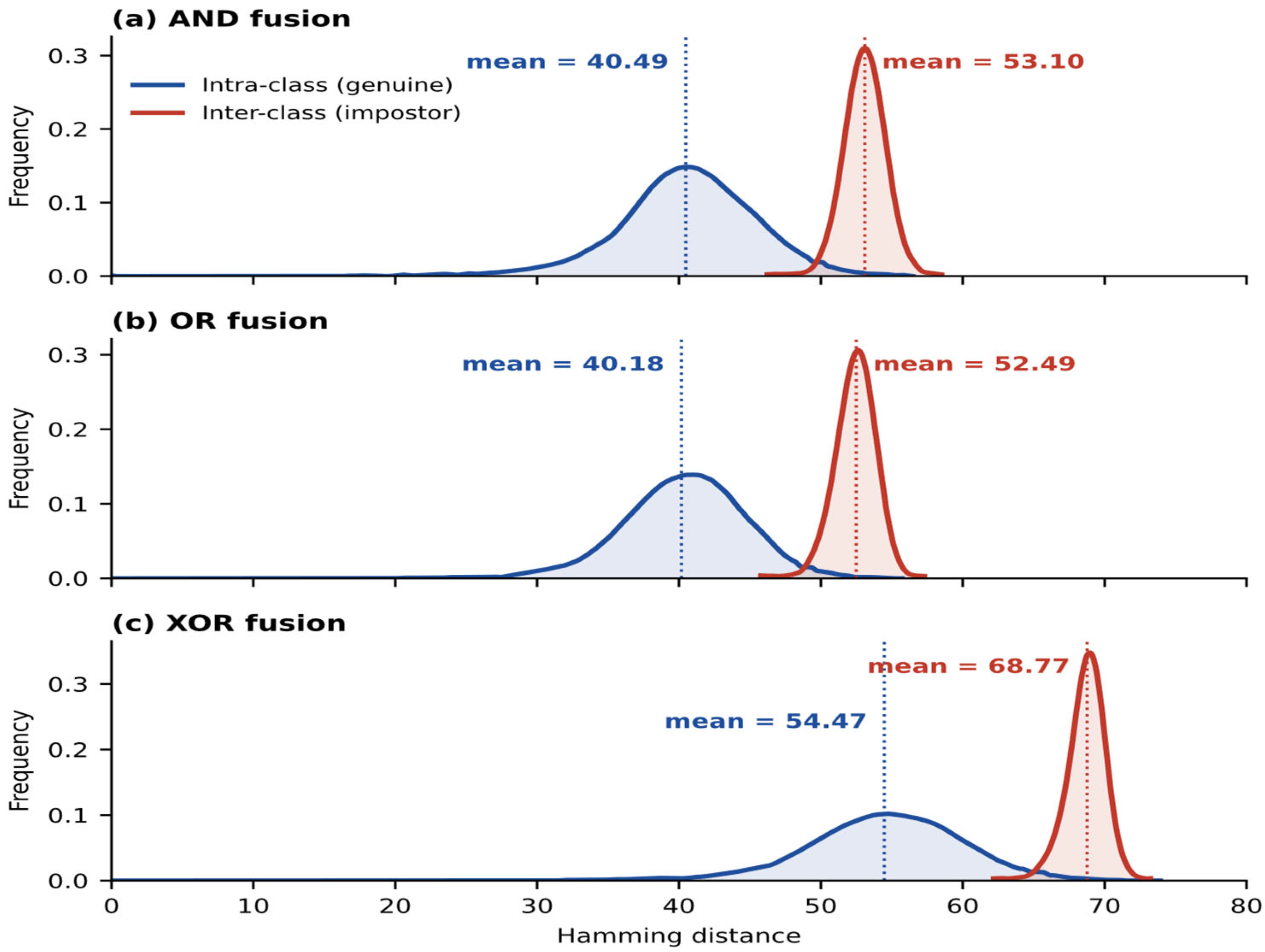
Table 2.
Experimental parameters.
In the authentication phase, the user is verified using test samples of the left iris and the face only. As shown in Figure 2b, the face test sample is first processed by the generator, using the stored weights. The output of the generator is then binarized and fused with the left-iris test sample to produce the cancelable test template, which is compared with the stored cancelable template of the claimed identity to reach an authentication decision. The authentication procedure is outlined in Algorithm 3.
Formally, using the stored generator weights Wg of the claimed identity, the test face sample is transformed as
where G(·; Wg) denotes the forward pass of the trained generator; no training takes place at authentication. The output test is binarized with the rule of Equation (5) to give Ttest, and the test template is obtained with the same fusion operator as in enrollment:
The test template is compared with the stored template Cref of the claimed identity using
and the decision is made with a threshold θ:
| Algorithm 3: Authentication of a claimed identity (proposed scheme) |
| Input: test face sample Facetest (1 × f); test left-iris sample Lefttest (1 × n); claimed identity u; threshold θ Output: decision: Authorized or Non-authorized 1: (Wg, Cref) ← stored data of the claimed identity u 2: test ← G(Facetest; Wg) ▷ forward pass only, Equation (7) 3: Ttest ← binarize( test) ▷ Equation (5) 4: Ctest ← Lefttest ⊛ Ttest ▷ same operator as in enrollment, Equation (8) 5: € ← √HD(Cref, Ctest) ▷ Equation (9) 6: if € ≤ θ then return Authorized else return Non-authorized ▷ Equation (10) |
As the scheme operates on binarized biometric features and a binarized transformed template, we use logical operations for fusion. Although Boolean operations such as AND, OR, XOR, NAND, NOR and XNOR can be applied for this purpose, due to the complementary relationship between AND/NAND, OR/NOR and XOR/XNOR, we consider only three of them: AND, OR and XOR.
For binary vectors, each squared difference in Equation (9) is 1 when the two bits differ and 0 otherwise; hence, the distance of Equation (9) is the square root of the Hamming distance HD, that is, € = √HD. As the square root is monotonically increasing, the decision of Equation (10) is identical to thresholding HD at θ2; the distances and thresholds reported in Section 4 are values of € computed with Equation (9). We acknowledge the following limitations of the Boolean operators: AND and OR are many-to-one but not fully hiding (e.g., a “1” in an AND-fused bit indicates that both inputs are “1”, while a “0” in an OR-fused bit indicates that both inputs are “0”), whereas XOR is fully invertible if either operand is known. Thus, the non-invertibility of the stored template depends not only on the fusion operator, but also on (i) the non-linearity of the generator mapping and (ii) the secrecy of the discarded salt.
4. Experiments and Discussion
In this section, we evaluate the recognition performance of the proposed scheme and discuss the results, and we then analyze the computational cost and the limitations of the study.
4.1. Experimental Setup
For our experiments, we used the CASIA-V3-Internal iris database [39] and the AT&T (ORL) face database [40]. The CASIA-V3-Internal dataset contains iris images of 249 subjects; for 146 of them, images of both the left and the right eye are available, and only these subjects can be used in our multi-instance design. Before analysis, the iris images were preprocessed in several steps: (i) the iris was localized using circular and linear Hough transforms; (ii) the images were normalized using the rubber sheet model of Daugman; and (iii) the features were encoded using 1D Log-Gabor filters followed by phase quantization to generate binary iris templates (using the implementation of Masek and Kovesi [41]). These iris templates were then reshaped into binary feature vectors that are used as the iris input to the GAN and in the fusion stage.
The AT&T face database contains 400 grayscale images (92 × 112 pixels, 256 intensity levels) of 40 subjects. Each subject provided 10 facial images taken with different expressions, lighting conditions and at different times. All images were taken in the same room against a dark background. We used a transformation approach optimized by a genetic algorithm [42,43] to extract binary facial features from these images. In our experiments, 40 of the 146 two-eye CASIA subjects were selected at random and paired one-to-one, also at random, with the 40 identities of the AT&T database to create 40 virtual multimodal subjects; each virtual subject thus has a genuine pair of left and right irises from one CASIA subject and the face images of one AT&T subject. The dataset was split into a training set (60%) and a test set (40%). The input dimension of the generator was the face feature size (f), while its output dimension was the iris feature size (n). The input size of the discriminator was also the right-iris feature size (n), with one output neuron. The experimental parameters are shown in Table 2; for a fair comparison, the parameters that are common to the three fusions were set in the same way.
As in many studies of multimodal and cancelable multimodal biometrics, the face–iris association in our database is virtual (chimeric). Public databases that contain the face and both irises of the same persons, captured under a common protocol, are scarce, and virtual subjects are therefore commonly formed by pairing identities from independently collected single-trait databases, under the usual assumption that different traits of an individual are statistically independent. For example, face–iris identification has been evaluated on a chimeric CASIA–ORL database [44], cancelable multi-biometric verification has been evaluated on virtual iris–fingerprint databases [45], and cancelable face–iris fusion has been studied recently in [46]. In our design, the multi-instance relationship (left and right iris) is genuine, because both irises come from the same CASIA subject; only the iris–face association is virtual. A virtual population of 40 subjects cannot, however, support claims about large-scale deployment, robustness or user acceptance. We therefore present the results as evidence of the feasibility of the scheme and of the relative behavior of the fusion operators, and we discuss the limitations of the evaluation in Section 4.5.
4.2. Performance Evaluation
We evaluated the performance of the system using three metrics: the False Acceptance Rate (FAR), the False Rejection Rate (FRR) and the Equal Error Rate (EER). The FAR is the proportion of attempts in which the system incorrectly accepts unauthorized users, while the FRR is the proportion of attempts in which legitimate users are incorrectly rejected. The EER, at which the FAR and FRR are equal, is a widely used indicator of overall system accuracy [47]. To further assess the system, we computed the intra-class and inter-class score distributions of the generated test cancelable templates by comparing all possible pairs in the database, using the distance of Equation (9) (€ = √HD) as the dissimilarity measure. Figure 3 shows the resulting intra- and inter-class score distributions for the three logical operations.
Each test template Ctest of a subject was generated with the generator of that subject: the test face sample of the subject was passed through the stored weights Wg of the same subject, binarized and fused with the test left-iris sample of the same subject. The 160 test templates (40 subjects × 4 test samples) were then compared pairwise. The 240 comparisons between templates of the same subject are the genuine comparisons, and the 12,480 comparisons between templates of different subjects are the impostor comparisons. Hence, an impostor comparison compares two templates that were produced by the generators of two different users; in our experiments, the face sample of an impostor was not passed through the stored generator of the claimed user. This protocol measures how well the cancelable templates of different enrolled users are separated, and the reported FAR and EER values refer to this setting. The stricter verification scenario, in which an impostor claims the identity of user u and presents his or her own face and left iris, so that the face of the impostor is transformed by the generator Wg of u, was not evaluated. In this scenario, the left iris of the impostor still differs from that of u, but the contribution of the generator to the separation depends on how strongly its output varies with its input, which, as noted in Section 3, has not been established. The FAR values reported below may therefore be optimistic for this scenario, and its evaluation is included among the ablations listed in Section 4.5.
As shown in Figure 3, for the feature fusion scheme with the AND operation, the means of the intra-class and inter-class distributions are 40.49 and 53.10, respectively. For the OR operation, the mean intra-class value is 40.18 and the mean inter-class value is 52.49, while for the XOR operation, they are 54.47 and 68.77, respectively. As discussed below, the scheme with the AND operation separates the intra- and inter-class distributions better than the schemes with the OR and XOR operations. We make three observations about the score distributions. First, in all three schemes, the inter-class (impostor) distribution has a very small standard deviation (about 1.5 distance units) and is asymmetric, with its tail towards smaller distances (opposite to the tail of the intra-class distribution). In contrast, the intra-class (genuine) distribution is much wider, with a long tail towards larger distances. The impostor scores thus indicate that the templates of different users are nearly independent of each other, as they should be for a cancelable template, and the verification error is determined largely by the right tail of the genuine distribution, where it overlaps with the impostor peak.
Second, the AND- and OR-based fusions yield the most compact genuine distributions (standard deviations of about 7 and 8 units, respectively), with gaps between the class means of about 12.6 and 12.3 units, respectively. Although the XOR-based fusion has the largest absolute gap (around 14.3 units), its genuine distribution is considerably wider, so the two distributions overlap over a broader range of distances (around 60 to 68). Thus, a larger gap between the means does not necessarily mean better separation. When the gap is normalized by the pooled standard deviation (STD), the resulting order is AND (about 2.6), OR (about 2.4) and XOR (about 2.0), which is consistent with the order of the EERs reported below (1.5%, 1.71% and 1.87%).
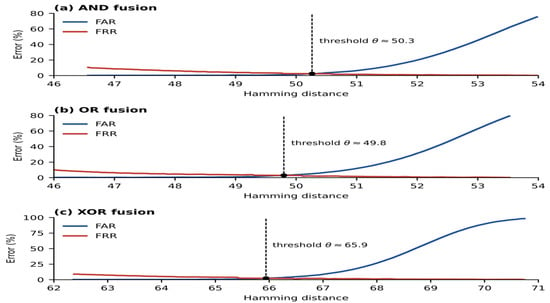
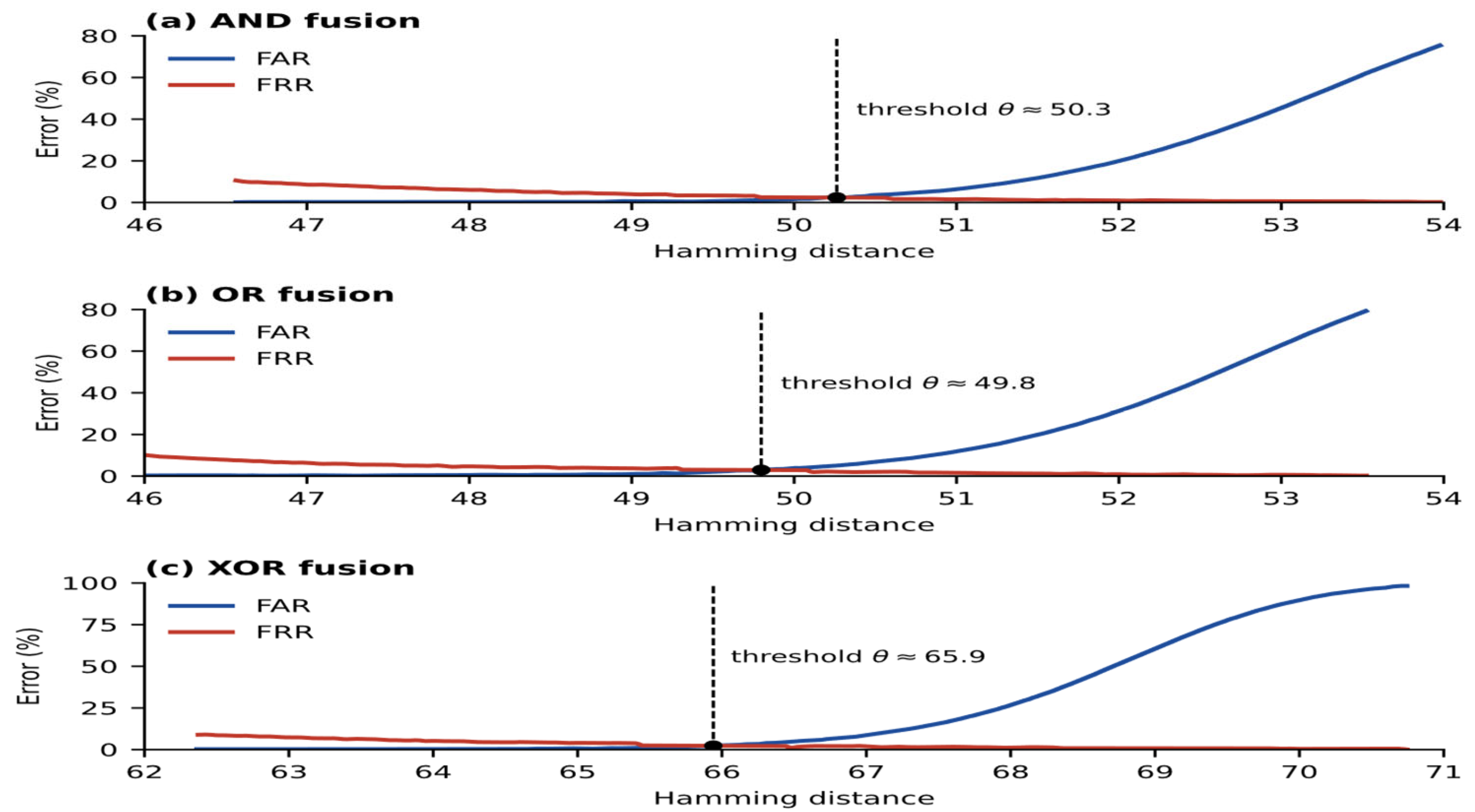
Third, the genuine distances are not close to zero (the mean values are around 40 for both AND and OR), due to the intra-class variability of the binarized face and iris features, which propagates through the generator and the fusion operator. Although smaller genuine distances could be obtained with a less aggressive transformation, it would be at the cost of leaking more information about the original features. Thus, the relevant measure is not the absolute distance, but the separation between the two distributions, as captured by the threshold analysis in Figure 4. Figure 4 also shows the recognition accuracy of the proposed schemes, where the point at which the FAR and FRR curves intersect defines the distance threshold (θ) used in the verification phase. At this threshold, the system achieves an EER of 1.5% for the AND-based scheme, 1.71% for the OR-based scheme and 1.87% for the XOR-based scheme.
Figure 4.
FAR and FRR as functions of the distance threshold θ (€ = √HD, Equation (9)) for (a) AND, (b) OR and (c) XOR fusion. The dashed vertical line marks the threshold θ at which the two curves intersect.
The thresholds at the intersection points are approximately 50.3 (AND), 49.8 (OR) and 65.9 (XOR) distance units; Figure 4 marks them with dashed vertical lines. Around this point, the two error curves behave very differently: the FRR decreases monotonically as the threshold increases, while the FAR remains nearly zero up to about half a unit below the intersection and increases steeply from there onward. For AND and OR, the FAR is below about 1% up to about half a unit below the intersection threshold and reaches about 8% at about one unit above it. Thus, the operating point is much more sensitive on the FAR side than on the FRR side.
This asymmetry has a practical implication: moving the threshold slightly below the EER point trades a small increase in the FRR for a large decrease in the FAR, whereas moving it above the EER point quickly makes the system permissive. A threshold slightly below the EER point is therefore better suited to security-critical applications. The three schemes also differ in their sensitivity. For the XOR scheme, the FAR curve rises more slowly (it takes approximately four distance units for the FAR to reach 100%), which is consistent with its wider genuine distribution in Figure 3, while the AND and OR curves rise over a narrower range. Finally, as θ is derived from the same test scores that are used to compute the EER, the EER values should be interpreted as optimistic estimates until θ is validated on independent test data.
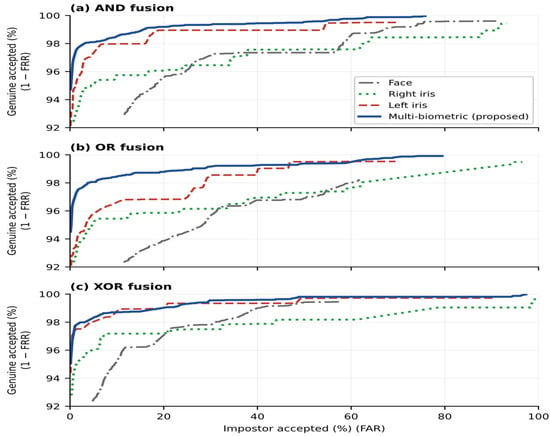
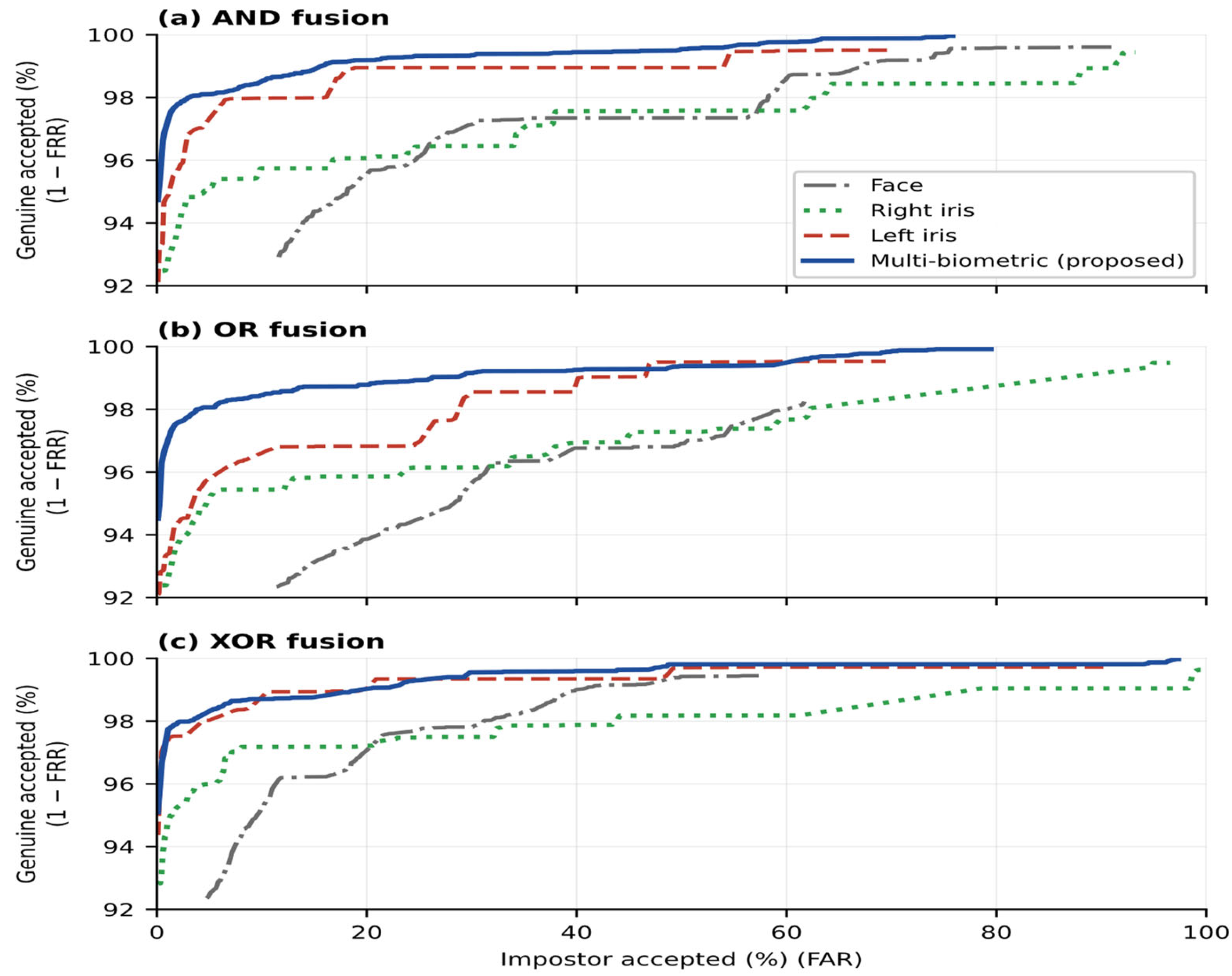
To further assess the proposed schemes, we compared their recognition accuracy with that of traditional unimodal and multimodal methods using iris and face data. Figure 5 shows the ROC curves for (i) the unimodal iris systems (evaluating the left and right irises separately), (ii) the unimodal face system, and (iii) the multimodal iris–face system. The results show that the proposed schemes outperform, or at least match, the unimodal iris and face systems in the low-FAR region, which is the region of interest for security-oriented applications. As discussed below, the size of the gain depends on the fusion operator.
Figure 5.
ROC curves of the proposed multimodal schemes for (a) AND, (b) OR and (c) XOR fusion, compared with the unimodal left-iris, right-iris and face systems. The line styles are the same in the three panels.
We note that the numbers below are read from the curves and are thus only approximate. In all three panels, the multimodal curve is on or above those of the unimodal systems for low and moderate FAR. At FAR = 1%, the proposed schemes achieve a genuine acceptance rate of around 97% to 97.6%, compared to 93% to 97% for the best unimodal system (left iris) and 92.5% to 95% for the right iris, while the face-only system remains below 92% at FAR values up to 5% to 11%, depending on the panel. In panels (a) and (b), the fused template, which relies on the face through the generator, performs better than the iris-only systems, although the face is the weakest single trait in our setting. This is consistent with the face information being retained through the generator and the fusion; however, as discussed in Section 4.5, this comparison alone does not isolate the contribution of the GAN transformation.
The gain depends on the operator. In panel (a) (AND), the advantage over the left iris is about 2.3 percentage points at FAR = 1% and remains approximately 2 to 3.6 points up to FAR = 20%. In panel (b) (OR), the advantage over the left iris is about 2 points at FAR = 1% and stays around 2 to 3.6 points up to FAR = 20%. In panel (c) (XOR), the multimodal and left-iris curves are nearly identical, with a difference of less than 0.2 points for FAR > 5% (and about 0.2 points at FAR = 1%); thus, the advantage of XOR fusion over the best single trait is not significant, which is consistent with XOR having the highest EER. For FAR greater than approximately 50%, all curves reach a plateau above 99%, and the differences between them are negligible. Two cautions apply. First, the unimodal reference curves are not the same in the three panels (e.g., the left-iris curve differs between panels (a) and (c)); thus, comparisons should be made within each panel, and the gains of one operator should not be compared with those of another. Second, the superiority of the multimodal schemes over the unimodal ones is qualified: it is clear for AND and OR, but small for XOR. For comparison, Table 3 shows the EERs reported in the literature for several representative multimodal and multi-instance fusion schemes, together with the EERs of the proposed schemes. These numbers are taken from the original publications and were obtained using different databases, modalities and protocols (for instance, fingerprint and iris in [24,25,26] versus a virtual face and iris database of 40 subjects here); furthermore, to our knowledge, most of these techniques target recognition accuracy rather than template protection. Thus, the table provides only a “ballpark” indication of the accuracy range of multimodal fusion.
Table 3.
Reported EERs of representative multimodal and multi-instance schemes (values taken from the original publications, obtained with different databases and protocols; not directly comparable).
This comparison indicates that the AND-based scheme (EER 1.5%) falls within the range of the results reported in Table 3 (0.36% to 10.80%), but it is not the most accurate: Shekhar et al. [25] report 1.3%, and the keyless contralateral-iris scheme of Chaivong et al. [23] reports 0.36% on CASIA-IrisV4-Interval. We therefore do not claim that the proposed schemes are more accurate than the state of the art. Most of the methods in Table 3 do not provide template protection; the two that do (Morampudi et al. [34] and Chaivong et al. [23]) use two instances of a single trait, whereas the proposed scheme binds two modalities without any stored key. The proposed multimodal cancelable feature fusion method is designed to meet four requirements: revocability, diversity, unlinkability and non-invertibility [14,32]. Of these, revocability and diversity follow from the construction, non-invertibility is an intended property that is supported by design arguments but is not proven, and full unlinkability has not yet been verified (Section 4.4). At each enrollment, it uses (i) a new random permutation of the right-iris reference and (ii) a new random initialization of the GAN, so that a new pair (Wg, Cref) results. The extent to which unlinkability and non-invertibility follow from these choices, from the many-to-one nature of the AND/OR fusion and from the non-linear generator is analyzed in Section 4.4.
4.3. Computational Cost and Practical Considerations
We note that the GAN in the proposed scheme is not used for data augmentation; rather, it is used to transform the face features on a per-user basis using a user-specific salt, and no synthetic samples are added to any training set. Its computational cost can nevertheless be evaluated analytically from the architecture in Table 2. The generator (200 × 32 × 9600) has 313,600 weights and 9632 biases, i.e., 323,232 parameters, while the discriminator (9600 × 32 × 1) has about 307,000 parameters. Both networks are trained once per user for 50 epochs using 6 face vectors, which corresponds to approximately 300 training iterations per user. At about 3 million multiply–accumulate operations per iteration, this amounts to approximately 10^9 operations per user (estimated analytically rather than measured on a specific CPU). Enrollment is a one-time process, and re-enrollment is required only if the template is revoked. Authentication does not require any training: it requires only (i) a forward pass through the generator (approximately 0.31 million multiply–accumulate operations), (ii) a bitwise Boolean operation over 9600 bits, and (iii) a Hamming distance computation over 9600 bits, all of which are negligible compared with the feature extraction of the iris and the face. Thus, the main practical overhead is not computation but storage: the generator weights of each user have to be stored (about 1.3 MB with 32-bit floating-point weights, 0.65 MB with 16-bit weights and 0.32 MB with 8-bit weights), whereas the 9600-bit template Cref requires only 1.2 kB. For 1 million users, this amounts to about 1.3 TB, which is acceptable for a centralized server but not for a small embedded token; this is the cost of forgoing an external key. The storage requirement could potentially be reduced by using smaller hidden layers, weight quantization or pruning, although we have not yet tested the impact of these techniques on accuracy. Table 4 summarizes these costs.
Table 4.
Computational and storage cost of the proposed scheme, estimated analytically from the architecture in Table 2.
4.4. Security Analysis: Revocability, Unlinkability and Non-Invertibility
The security properties of the scheme have different status, and we state them accordingly. Revocability and diversity are provided by construction. Non-invertibility is an intended property of the design, supported by the arguments below. Full unlinkability remains unverified, and the analysis below shows that it does not hold in general for the AND and OR operators.
- Revocability and diversity. A compromised template is revoked by deleting the pair (Wg, Cref) and re-enrolling the user with Algorithm 2. The new pair depends on a new random permutation of the right-iris reference and on a new random initialization of the GAN, neither of which is stored; thus, the revoked pair cannot be regenerated from the new one, and different applications can be given different pairs for the same user. As the generator is trained towards a different salt at each enrollment, its binarized output Tref, and hence Cref, is expected to change from one enrollment to the next.
- Unlinkability. Two templates of the same user issued at different enrollments should not be matchable. In the proposed scheme, the component contributed by the generator is renewed at each enrollment, but the left-iris reference Leftref enters the fusion without a transformation and is therefore common to all the templates of a user. The consequences depend on the operator. With AND, every bit position in which Leftref is 0 is 0 in every reissued template; with OR, every bit position in which Leftref is 1 is 1 in every reissued template. Hence, under AND and OR, two templates of the same user agree on more positions than two templates of different users, and a cross-matching attack based on these positions cannot be ruled out. With XOR, each reissued template is Leftref ⊕ Tref with a renewed Tref, which hides Leftref only to the extent that Tref behaves as an independent random mask, and the XOR of two reissued templates cancels Leftref. We therefore do not claim full unlinkability for the current design. A possible hardening that preserves the keyless property is to permute the left-iris features with a permutation derived from the generator weights Wg, which are renewed at each enrollment and are available at authentication. We will quantify linkability, with and without this hardening, using the framework of Gomez-Barrero et al. [48], which is consistent with ISO/IEC 24745 [32], by comparing mated (same user, different enrollments) and non-mated template pairs.
- Non-invertibility. The stored template does not contain the generator output in the clear, and recovering the face features would require inverting the generator [20] from an estimate of Tref. An attacker who obtains (Wg, Cref) can, however, compute the generator output for any face input, and the information that Cref then leaks about Leftref depends on the operator: under AND, the positions in which both Cref and the generator output are 1 reveal the corresponding bits of Leftref; under OR, the positions in which both are 0 do so; and under XOR, Leftref = Cref ⊕ Tref is recovered exactly if Tref is known. The protection of the left iris therefore relies on Tref being difficult to reproduce without the genuine face, which depends on how strongly the generator output varies with its input. For these reasons, we describe the security of the scheme as resistance by design rather than as proven irreversibility; a quantitative analysis of information leakage is part of our future work.
4.5. Limitations of the Evaluation
Several limitations of the experimental evaluation should be kept in mind. First, the database contains only 40 virtual subjects formed by a single random pairing of iris and face identities (Section 4.1); the results may change with other pairings and with larger populations, and repeated random pairings and real multimodal data are needed to estimate their variability. Second, the threshold θ is selected on the same scores that are used to compute the EER, so the reported EERs are optimistic estimates. Moreover, with four test samples per subject, comparing all pairs of the 160 test templates yields 240 genuine and 12,480 impostor comparisons, so that a single genuine comparison corresponds to about 0.42 percentage points of FRR. The EERs of the three operators (1.5%, 1.71% and 1.87%) therefore differ by less than one genuine comparison, and the 95% Wilson confidence interval of an error rate of 1.5% estimated from 240 comparisons extends from about 0.6% to 4.0%. The ordering of the operators should thus not be over-interpreted, and the stability of the results with respect to the random pairing and to the population size can only be established with repeated pairings and larger databases. Furthermore, as explained in Section 4.2, all impostor comparisons were made between templates produced by the generators of different users; the scenario in which the face sample of an impostor is transformed by the stored generator of the claimed user was not evaluated, so that the reported FAR values may be optimistic for that scenario.
Third, the experiments do not isolate the contribution of each component of the scheme. The comparison of the three operators is controlled, as the data split, the feature extraction, the GAN architecture and the hyper-parameters are identical (Table 2), so that the differences between the operators are due to the operator itself; the comparison with the unimodal systems on the same data (Figure 5) shows the benefit of fusion at low FAR. Neither comparison, however, separates the effect of the GAN transformation from that of the fusion. The GAN is introduced for template protection, namely to provide a keyless, user-specific and non-linear transformation whose output does not have to be stored, rather than to improve accuracy, and we do not claim that it improves accuracy over a non-GAN fusion. A learned non-linear mapping also differs from a salted linear transformation, such as a random projection, in that it cannot be inverted by solving a linear system. Controlled ablations under the same protocol are nevertheless required to quantify the contribution of each component, namely (i) fusion without the GAN, (ii) the unimodal GAN salting of [17] applied to the face, (iii) a simpler salted transformation, such as a random projection seeded by the right-iris reference, (iv) an untrained generator, and (v) impostor face samples presented to the generator of the genuine user; these ablations are the first item of our future work.
5. Conclusions
In this paper, we described a keyless multimodal cancelable biometric scheme that uses generative adversarial networks (GANs) to generate protected (cancelable) biometric templates. The scheme integrates two biometric modalities, the iris (two instances) and the face (one instance), which is intended to make spoofing attacks more difficult. Enrollment requires all three instances, whereas authentication requires only two, one of each modality. Features are first extracted from all three biometric instances; two of them are used to train a GAN that produces a transformed representation, which is then fused at the feature level with the third instance to form the final cancelable template. The scheme does not rely on external cryptographic keys: the right iris is used only as a biometric salt during enrollment and is neither stored nor required for authentication. On a virtual multimodal database of 40 subjects, the scheme outperforms the corresponding unimodal systems at low false acceptance rates (FARs), clearly for the AND and OR operators and marginally for XOR, with EERs of 1.5%, 1.71% and 1.87% for the AND, OR and XOR operators, respectively; these values were obtained with impostor comparisons between templates generated by the generators of different users. Furthermore, a compromised template can be revoked and reissued without any stored key; our analysis shows, however, that the untransformed left-iris component is shared by the reissued templates of a user, so that full unlinkability remains unverified (and, under the AND and OR operators, cross-matching cannot be ruled out), and that the information leaked by the stored template depends on the fusion operator. Non-invertibility should therefore be regarded as an intended property of the design rather than an established guarantee. In future work, we plan to (i) evaluate the scheme on larger multimodal databases using repeated random pairing; (ii) perform controlled ablation studies with respect to non-GAN fusion, the unimodal scheme of [17], simpler salted transformations and an untrained generator; (iii) analyze quantitatively the revocability, unlinkability and information leakage of the scheme using the framework of [48]; (iv) remove the residual linkability caused by the untransformed left-iris component; and (v) evaluate impostor attempts in which the face of the impostor is transformed by the stored generator of the claimed user.
Author Contributions
Conceptualization, A.A., E.H., A.M.M. and M.T.; methodology, A.A., E.H., A.M.M. and M.T.; software, M.T.; formal analysis, A.A., E.H., A.M.M. and M.T.; investigation, A.A., E.H., A.M.M. and M.T.; data curation, M.T.; writing A.A., E.H., A.M.M. and M.T.; Review and editing, A.A., E.H., A.M.M. and M.T.; visualization, A.A., E.H., A.M.M. and M.T.; supervision M.T.; project administration, M.T. All authors have read and agreed to the published version of the manuscript.
Funding
This research received no external funding.
Institutional Review Board Statement
This article does not contain any studies with human participants or animals performed by any of the authors.
Informed Consent Statement
This article does not contain any studies with human participants; hence, no informed consent is declared.
Data Availability Statement
The used datasets are publicly available on: http://cam-orl.co.uk/facedatabase.html, accessed on 10 January 2026 [AT&T (ORL) face data set link]; http://english.ia.cas.cn/db/201610/t20161026_169399.html, accessed on 10 January 2026 [CASIA-V3-Internal iris data set link]; Implementation code used for the current study is provided upon reasonable requests to authors.
Conflicts of Interest
The authors declare no conflicts of interest.
References
- Jain, A.K.; Ross, A. Multibiometric systems. Commun. ACM 2004, 47, 34–40. [Google Scholar] [CrossRef] [Scilit]
- Adusumalli, B.; Bhuvaneswari, S. A Study of Multimodal Biometric System Recognition using Different Modalities and Fusion Techniques. Inter. J. Res. Stud. Comp. Sci. Eng. 2018, 5, 38–41. [Google Scholar] [CrossRef]
- Aditya, A.; Kaur, S. Novel Methods for Multimodal Biometric Systems to Strengthen the Security. In Proceedings of the 2nd International Conference on Computational Methods in Science & Technology (ICCMST), Mohali, India, 17–18 December 2021; pp. 99–105. [Google Scholar] [CrossRef] [Scilit]
- Sheena, S.; Mathew, S. A study of multimodal biometrics system. Int. J. Res. Eng. Technol. 2014, 3, 93–98. [Google Scholar] [CrossRef] [Scilit]
- Patil, S. A Study of Biometric, Multimodal Biometric Systems: Fusion Techniques, Applications and Challenges. Int. J. Comput. Sci. Technol. 2012, 3, 524–526. [Google Scholar]
- Gupta, D. Multi-model biometric system: Fusion techniques and their Comparison. In Proceedings of the 2nd International Conference on Recent Advances in Engineering & Computational Sciences (RAECS), Chandigarh, India, 21–22 December 2015; pp. 1–4. [Google Scholar] [CrossRef] [Scilit]
- Ross, A.; Govindarajan, R. Feature level fusion of hand and face biometrics. In Proceedings of the Proceeding SPIE 5779, Biometric Technology for Human Identification II, Orlando, FL, USA, 28–29 March 2005; pp. 196–204. [Google Scholar]
- Cui, F.; Yang, G. Score Level Fusion of Fingerprint and Finger Vein Recognition. J. Comput. Inf. Syst. 2011, 7, 5723–5731. [Google Scholar]
- Prabhakar, S.; Jain, A. Decision-level fusion in fingerprint verification. Pattern Recog. 2002, 35, 861–874. [Google Scholar] [CrossRef] [Scilit]
- Yuan, Y.; Sun, Q.; Zhou, Q.; Xia, D. A novel multiset integrated canonical correlation analysis framework and its application in feature fusion. Pattern Recognit. 2011, 44, 1031–1040. [Google Scholar] [CrossRef] [Scilit]
- Sarier, N.D. Multimodal biometric Identity Based Encryption. Future Gener. Comput. Syst. 2018, 80, 112–125. [Google Scholar] [CrossRef] [Scilit]
- Patel, V.M.; Ratha, N.K.; Chellappa, R. Cancelable Biometrics: A review. IEEE Signal Process. Mag. 2015, 32, 54–65. [Google Scholar] [CrossRef] [Scilit]
- El-Hameed, H.A.; Ramadan, N.; Shafai, W.E.; Khalaf, A.A.; Ahmed, H.E.; Elkhamy, S.; El-Samie, F.E. Cancelable biometric security system based on advanced chaotic maps. Vis. Comput. 2021, 38, 2171–2187. [Google Scholar] [CrossRef] [Scilit]
- Manisha; Kumar, N. Cancelable Biometrics: A comprehensive survey. Artif. Intell. Rev. 2020, 53, 3403–3446. [Google Scholar] [CrossRef] [Scilit]
- Paul, P.P.; Gavrilova, M.L. Multimodal Cancelable Biometrics. In Proceedings of the 11th IEEE International Conference on Cognitive Informatics and Cognitive Computing, Kyoto, Japan, 22–24 August 2012; pp. 43–49. [Google Scholar] [CrossRef] [Scilit]
- Saxena, D.; Cao, J. Generative Adversarial Networks (GANs). ACM Comput. Surv. (CSUR) 2020, 54, 63. [Google Scholar] [CrossRef] [Scilit]
- Tarek, M.; Hamouda, E.; El-Metwally, S. Unimodal-Bio-GAN: Keyless biometric salting scheme based on generative adversarial network. IET Biom. 2021, 10, 654–663. [Google Scholar] [CrossRef] [Scilit]
- Alqahtani, H.; Kavakli-Thorne, M.; Kumar, G. Applications of Generative Adversarial Networks (GANs): An Updated Review. Arch. Comput. Methods Eng. 2019, 28, 525–552. [Google Scholar] [CrossRef] [Scilit]
- Tarek, M.; Hamouda, E.; Abohamama, A.S. Multi-instance cancellable biometrics schemes based on generative adversarial network. Appl. Intell. 2022, 52, 501–513. [Google Scholar] [CrossRef] [Scilit]
- Creswell, A.; Bharath, A.A. Inverting the Generator of a Generative Adversarial Network. IEEE Trans. Neural Netw. Learn. Syst. 2018, 30, 1967–1974. [Google Scholar] [CrossRef] [Scilit]
- Merkle, J.; Kevenaar, T.A.; Korte, U. Multimodal and multi-instance Fusion for biometric cryptosystems. In Proceedings of the International Conference of the Biometrics Special Interest Group (BIOSIG 2012), Darmstadt, Germany, 6–7 September 2012; Lecture Notes in Informatics P-196. pp. 51–62. [Google Scholar]
- Ross, A.; Jain, A. Multimodal biometrics: An overview. In Proceedings of the 12th European Signal Processing Conference, Vienna, Austria, 6–10 September 2004; pp. 1221–1224. [Google Scholar]
- Chaivong, J.; Vikromrotjananan, N.; Piriyapittaya, T.; Kongprawechnon, W.; Duangpummet, S. Cancelable Biometric Template Protection Based on Multi-Instance Fusion: A Contralateral Iris Approach. arXiv 2026, arXiv:2607.02860. [Google Scholar] [CrossRef] [Scilit]
- Conti, V.; Militello, C.; Sorbello, F.; Vitabile, S. A Frequency-based Approach for Features Fusion in Fingerprint and Iris Multimodal Biometric Identification Systems. IEEE Trans. Syst. Man. Cybern. Part C (Appl. Rev.) 2010, 40, 384–395. [Google Scholar] [CrossRef] [Scilit]
- Shekhar, S.; Patel, V.M.; Nasrabadi, N.M.; Chellappa, R. Joint Sparse Representation for Robust Multimodal Biometrics Recognition. IEEE Trans. Pattern Anal. Mach. Intell. 2014, 36, 113–126. [Google Scholar] [CrossRef] [Scilit]
- Soleymani, S.; Dabouei, A.; Kazemi, H.; Dawson, J.M.; Nasrabadi, N.M. Multi-Level Feature Abstraction from Convolutional Neural Networks for Multimodal Biometric Identification. In Proceedings of the 2018 24th International Conference on Pattern Recognition (ICPR), Beijing, China, 20–24 August 2018; pp. 3469–3476. [Google Scholar] [CrossRef] [Scilit]
- Said, W.; Mostafa, E.; Hassan, M.M.; Mostafa, A.M. A Multi-Factor Authentication-Based Framework for Identity Management in Cloud Applications. Comput. Mater. Contin. 2022, 71, 3193–3209. [Google Scholar] [CrossRef] [Scilit]
- Mostafa, A.M.; Rushdy, E.; Medhat, R.; Hanafy, A. An identity management scheme for cloud computing: Review, challenges, and future directions. J. Intell. Fuzzy Syst. 2023, 45, 11295–11317. [Google Scholar] [CrossRef] [Scilit]
- Ezz, M.; Alaerjan, A.S.; Mostafa, A.M. Ethical AI in Healthcare: Integrating Zero-Knowledge Proofs and Smart Contracts for Transparent Data Governance. Bioengineering 2025, 12, 1236. [Google Scholar] [CrossRef] [Scilit]
- Ratha, N.K.; Connell, J.H.; Bolle, R.M. Enhancing security and privacy in biometrics-based authentication systems. IBM Syst. J. 2001, 40, 614–634. [Google Scholar] [CrossRef] [Scilit]
- Jain, A.K.; Nandakumar, K.; Nagar, A. Biometric template security. EURASIP J. Adv. Signal Process. 2008, 2008, 579416. [Google Scholar] [CrossRef] [Scilit]
- ISO/IEC 24745:2022; Information Security, Cybersecurity and Privacy Protection—Biometric Information Protection. International Organization for Standardization: Geneva, Switzerland, 2022.
- Nagar, A.; Nandakumar, K.; Jain, A.K. Multibiometric cryptosystems based on feature-level fusion. IEEE Trans. Inf. Forensics Secur. 2012, 7, 255–268. [Google Scholar] [CrossRef] [Scilit]
- Morampudi, M.K.; Veldandi, S.; Prasad, M.V.; Raju, U.S. Multi-instance iris remote authentication using private multi-class perceptron on malicious cloud server. Appl. Intell. 2020, 50, 2848–2866. [Google Scholar] [CrossRef] [Scilit]
- Tarek, M.; Ouda, O.; Hamza, T. Robust cancelable biometrics scheme based on neural networks. IET J. Biom. 2016, 5, 220–228. [Google Scholar] [CrossRef] [Scilit]
- Tarek, M.; Ouda, O.; Hamza, T. Pre-image Resistant Cancelable Biometrics Scheme Using Bidirectional Memory Model. Int. J. Netw. Secur. 2017, 19, 498–506. [Google Scholar] [CrossRef]
- Li, C.; Hu, J. Attacks via record multiplicity on cancelable biometrics templates. Concurr. Comput. Pract. Exp. 2014, 26, 1593–1605. [Google Scholar] [CrossRef] [Scilit]
- Goodfellow, I.J.; Pouget-Abadie, J.; Mirza, M.; Xu, B.; Warde-Farley, D.; Ozair, S.; Courville, A.; Bengio, Y. Generative Adversarial Nets. In Proceedings of the Advances in Neural Information Processing Systems 27: 28th International Conference on Neural Information Processing Systems (NIPS 2014), Montreal, QC, Canada, 8–13 December 2014; pp. 2672–2680. [Google Scholar]
- CASIA, Chinese Academy of Sciences. CASIA Iris Image Database, v3. 2020. Available online: http://english.ia.cas.cn/db/201610/t20161026_169399.html (accessed on 10 January 2026).
- ORL, AT&T Laboratories Cambridge. ORL Face Image Database, v1. 2001. Available online: http://cam-orl.co.uk/facedatabase.html (accessed on 10 January 2026).
- Masek, L.; Kovesi, P. In MATLAB Source Code for a Biometric Identification System Based on Iris Patterns; The School of Computer Science and Software Engineering. The University of Western Australia: Crawley, Australia, 2003. [Google Scholar]
- Turk, M.; Pentland, A. Eigenfaces for recognition. J. Cogn. Neurosci. 1991, 3, 71–86. [Google Scholar] [CrossRef] [Scilit]
- Hamouda, E.; Ouda, O.; Yuan, X.; Hamza, T. Optimizing Discriminability of Globally Binarized Face Templates. Arab. J. Sci. Eng. 2016, 41, 2837–2846. [Google Scholar] [CrossRef] [Scilit]
- Ammour, B.; Boubchir, L.; Bouden, T.; Ramdani, M. Face–Iris Multimodal Biometric Identification System. Electronics 2020, 9, 85. [Google Scholar] [CrossRef] [Scilit]
- Dwivedi, R.; Dey, S. A novel hybrid score level and decision level fusion scheme for cancelable multi-biometric verification. Appl. Intell. 2019, 49, 1016–1035. [Google Scholar] [CrossRef] [Scilit]
- Badreddine, A.; Boukezzoula, N.-E.; Bekkouche, T. Cancelable multimodal biometric system through inverse tangent function and chaotic map. Multimed. Tools Appl. 2026, 85, 154. [Google Scholar] [CrossRef] [Scilit]
- Jain, A.; Ross, A.; Prabhakar, S. An introduction to biometric recognition. IEEE Trans. Circuits Syst. Video Technol. 2004, 14, 4–20. [Google Scholar] [CrossRef] [Scilit]
- Gomez-Barrero, M.; Galbally, J.; Rathgeb, C.; Busch, C. General Framework to Evaluate Unlinkability in Biometric Template Protection Systems. IEEE Trans. Inf. Forensics Secur. 2018, 13, 1406–1420. [Google Scholar] [CrossRef] [Scilit]

Disclaimer/Publisher’s Note: The statements, opinions and data contained in all publications are solely those of the individual author(s) and contributor(s) and not of MDPI and/or the editor(s). MDPI and/or the editor(s) disclaim responsibility for any injury to people or property resulting from any ideas, methods, instructions or products referred to in the content. |
© 2026 by the authors. Licensee MDPI, Basel, Switzerland. This article is an open access article distributed under the terms and conditions of the Creative Commons Attribution (CC BY) license.