


Abstract
This paper investigates the optimal tracking control problem for a Mecanum-wheeled mobile robot subject to asymmetric actuator saturation. Within the command-filtered backstepping framework, a switching event-triggered control strategy based on reinforcement learning is proposed. First, a compensation system incorporating an anti-saturation term is designed to mitigate both filtering errors and actuator saturation. Then, a novel switching event-triggered mechanism is developed based on the actuator saturation status. It dynamically updates the control signal during unsaturated phases while suspending updates during saturation phases, thereby significantly reducing communication frequency. To achieve optimal control, a reinforcement learning algorithm is constructed by leveraging the function approximation capabilities of neural networks, without relying on prior knowledge of system dynamics. Based on Lyapunov stability theory, it is strictly proven that all signals of the closed-loop system are uniformly ultimately bounded. The simulation results demonstrate that the proposed method effectively reduces data transmission compared with conventional dynamic event-triggered mechanisms, while maintaining satisfactory tracking performance.
1. Introduction
A Mecanum-wheeled mobile robot (MWMR), owing to its omnidirectional mobility, can achieve continuous omnidirectional motion without steering the wheels [1]. This capability makes it particularly well-suited for operation in complex environments. Consequently, it has demonstrated significant potential in applications such as autonomous logistics, industrial automation, and hazardous-environment exploration [2,3,4]. Developing efficient and stable adaptive control strategies for MWMR has become a key research focus. However, the inherent strong nonlinearity and coupling in MWMR dynamics pose considerable challenges for controller design [5]. Moreover, practical systems often face energy constraints and actuator saturation, which further complicate the controller design.
Efficient communication and computation are crucial in practical control systems, particularly for resource-constrained mobile robots. Conventional control systems typically employ time-triggered communication. Although this approach is simple to implement, it often results in inefficient resource usage [6,7,8,9]. To address this issue, event-triggered mechanisms have been proposed [10,11,12], which update the control signal only when the system state violates specific conditions, thereby effectively reducing unnecessary signal transmissions. For trajectory tracking of mobile robots, Wang et al. [13] introduced a static event-triggered nonsingular terminal sliding mode controller that achieves finite-time tracking while conserving communication resources. To reduce the complexity of controller design, Chang et al. [14] combined a dynamic event-triggered method with a time-sampling strategy to develop a hybrid dynamic event-triggered mechanism, and applied it to mobile robot formation control. Addressing the leaderless consensus control problem for mobile robots, Xu et al. [15] proposed a novel triggering mechanism based on a cascade structure. This mechanism designs two distinct triggering conditions for angular and position errors, thereby improving system control accuracy. For switched nonlinear systems under communication constraints, Xie et al. [16] developed a switching-mode-based event-triggered control scheme, where each subsystem has an independent triggering condition to conserve network resources under arbitrary switching. Despite these advances, all the aforementioned event-triggered control strategies operate under the implicit assumption that the actuator operates within its linear range. None of them explicitly addresses the case where the actuator enters saturation.
Actuator saturation has also been extensively studied in various practical control systems, including ground vehicle control systems [17], marine surface systems [18], and networked control systems [19], due to its potential to degrade system performance and even cause instability [20,21,22,23,24,25,26]. Most existing research focuses on addressing input constraints to manage actuator saturation [27]. Wang et al. [17] transformed nonlinear saturated inputs into convex combinations of linear terms and designed a tracking controller using robust control techniques. Although this method ensures closed-loop stability under saturation, it may degrade tracking accuracy. To address actuator saturation in marine surface vehicle formation control, Shi et al. [18] proposed a controller based on an auxiliary system but did not consider the asymmetry of constraints. For networked control systems with asymmetric input saturation, Tan et al. [19] used hyperbolic tangent functions to approximate saturation nonlinearity, thereby simplifying controller design. However, this approach may introduce control chattering. Unlike the aforementioned studies, this article introduces a compensation system that directly feeds the saturation error back into the compensation dynamics, effectively mitigating saturation while simultaneously integrating an event-triggered mechanism.
The complex dynamics of MWMR and the high-precision demands of its tasks necessitate not only an efficient anti-saturation scheme but also adaptive and optimal control under model uncertainties [28,29,30,31,32]. For four-wheeled MWMRs with model uncertainties, Chen et al. integrated an adaptive control mechanism with optimal control and proposed a nonlinear adaptive optimal control scheme capable of online adaptation to unknown parameter variations, thereby achieving accurate trajectory tracking [33]. Compared to traditional optimal control methods, reinforcement learning demonstrates superior adaptability to complex systems, effectively managing system nonlinearities and uncertainties without requiring complete model knowledge. In recent years, reinforcement learning has been increasingly applied to solve optimal control problems. Juang et al. [34] introduced an interpretable fuzzy reinforcement learning method based on an actor–critic network framework for mobile robot tracking control. Furthermore, for autonomous vehicle systems with safety constraints, Zhang et al. [35] proposed an adaptive safe reinforcement learning algorithm based on a projection operator, which effectively balances safety and optimality. Motivated by the aforementioned literature, we employ an actor–critic RL architecture to directly approximate the gradients of unknown system dynamics and cost functions. This design not only eliminates the need for previous system models, but also enables online learning of optimal strategies under actuator saturation and communication constraints.
To our knowledge, none of these studies have addressed the combined challenges of event-triggered communication, asymmetric actuator saturation, and optimal control within the unified framework of MWMR. Motivated by this gap, this paper focuses on event-triggered optimal control of MWMR with asymmetric actuator saturation within a reinforcement learning framework. The key contributions of this paper are summarized as follows:
- Unlike the event-triggered strategies described in [13,14,15,16], the proposed switching event-triggered mechanism uses a switching signal to smoothly transition between normal and saturated modes, thereby significantly reducing unnecessary communication.
- Within the framework of command-filtered backstepping control, a compensation system with an anti-saturation term is designed to simultaneously address filtering errors and actuator saturation. This approach ensures the control performance of the MWMR system under asymmetric actuator saturation.
- To achieve optimal tracking control without requiring complete knowledge of the MWMR dynamics, an actor–critic reinforcement learning algorithm is developed. This approach reduces reliance on system model knowledge.
2. Preliminaries and Problem Formulation
2.1. Kinematics and Dynamics of MWMR
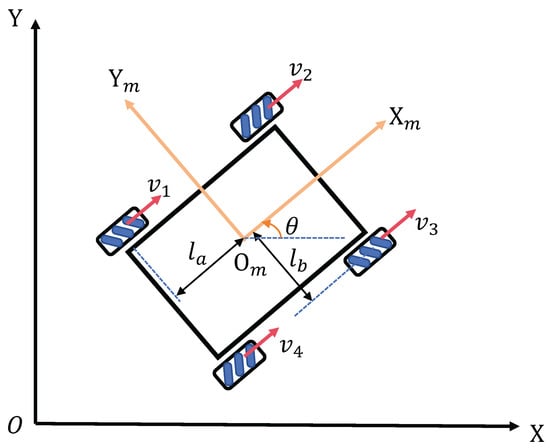
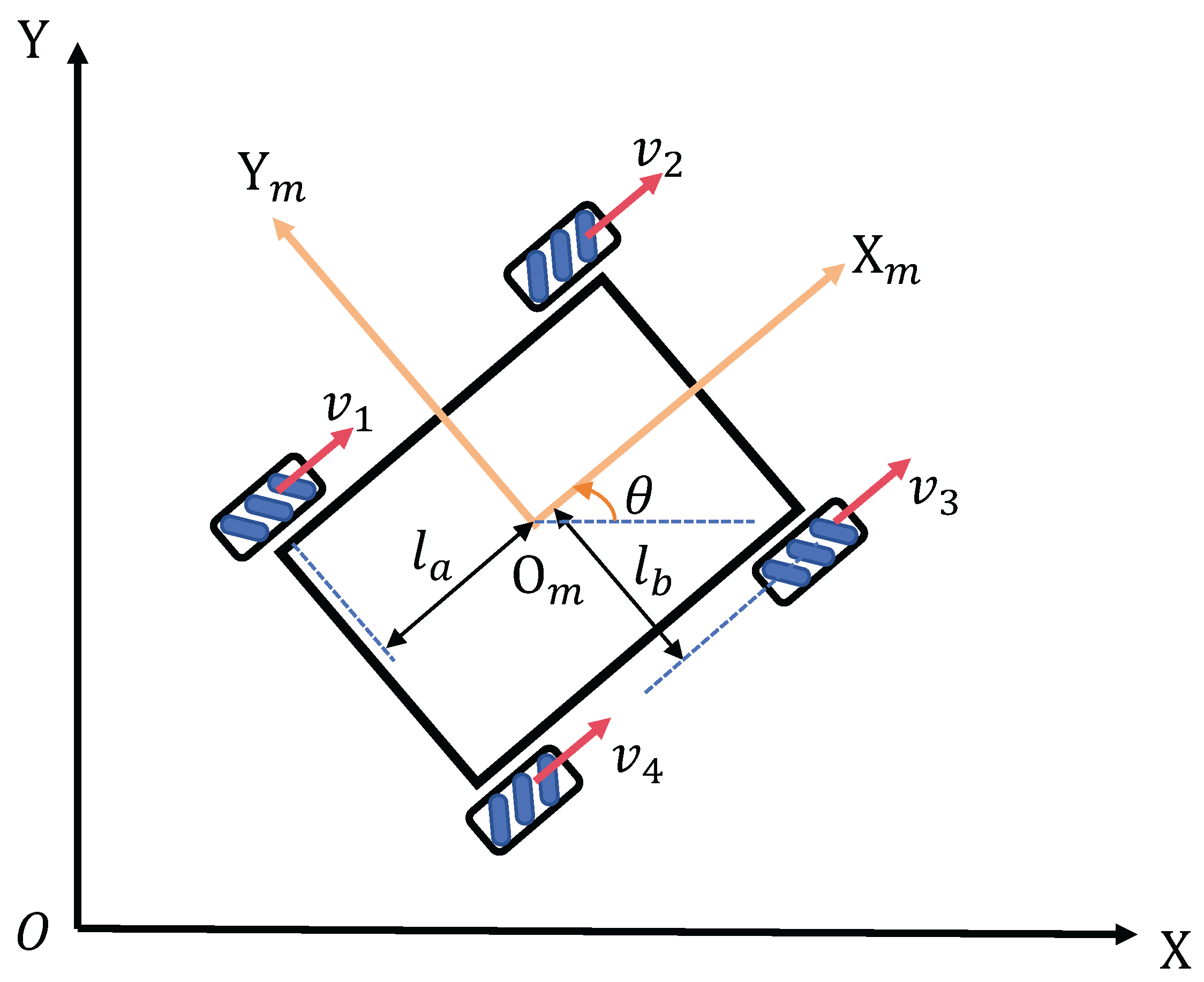
To study the motion model of the mobile robot, an inertial reference frame and a body-fixed coordinate system are defined, as illustrated in Figure 1.
Figure 1.
Kinematic model of the MWMR.
The kinematic model of the MWMR is obtained through velocity decomposition and composition as follows:
where x and y are the MWMR coordinates in the inertial frame, represents the orientation angle, and and . u, v, and are the generalized velocities.
By decomposing the velocity of each Mecanum wheel and eliminating intermediate variables, the mapping from the four wheel angular velocities to the generalized velocity of the MWMR is derived as follows:
where is the angular velocity of the i-th wheel, R denotes the wheel radius, and and stand for the distances from the and axes to the wheel center, respectively.
The total kinetic energy consists of the translational and rotational components of the main body, together with the rotational energy of the four wheels, and is computed as
where m, , and are the MWMR mass, robot inertia, and each wheel’s inertia, respectively.
Assuming the plane of motion corresponds to a zero-potential-energy surface, the total energy can be expressed as follows:
According to the Euler–Lagrange equation, the torque experienced by each Mecanum wheel is given by
where . The driving torque and the static friction torque satisfy , with for .
Considering that the driving torque is subject to asymmetric actuator saturation constraints, the model is given as follows:
where and are the saturation bounds with , and is the intermediate control signal.
By defining the velocity vector , the system (8) is rewritten as
Assumption A1
([36]). The desired trajectory and its first-order derivatives are smooth and bounded.
2.2. Radial Basis Function Neural Network
A radial basis function (RBF) neural network (NN) is used to approximate a nonlinear function as [37]
where stands for the input vector, and is the bounded approximation error such that with . corresponds to the ideal weight matrix
where represents a sufficiently large operational domain. The basis function vector is defined as:
where , and denote the center and width of the r-th basis function, respectively.
2.3. Switching Event-Triggered Mechanism
To reduce communication consumption, we design the switching event-triggered mechanism as follows:
where represents the switching signal, , and with . The parameters and are design parameters. Additionally, () denotes the triggering time.
Remark 1.
The known switching signal adapts the event-triggered condition to actuator saturation. When the desired control signal lies strictly within the saturation bounds, i.e., , we have , and the triggering condition reduces to the conventional dynamic event-triggered form . Hence, events are generated normally.
Once exceeds the upper bound or falls below the lower bound , we obtain . The left-hand side of the triggering condition becomes identically 0, while the right-hand side remains strictly positive. Consequently, the condition can never be satisfied during saturation, and no new event is generated. The actuator input then stays at the saturated value or .
This design eliminates futile communication attempts when the actuator cannot respond to updated signals. Without , the event condition would keep evaluating regardless of saturation, leading to frequent unnecessary triggers. Thus, is essential to suspend event detection during saturation periods.
It is worth noting that chattering may occur when the control signal frequently crosses the saturation boundary. The anti-saturation term in the proposed compensation system (13) actively mitigates such effects, enhancing robustness in discrete-time or noisy implementations.
3. Main Results
In this section, we design an optimal tracking controller for the MWMR under asymmetric actuator saturation using a reinforcement learning approach within the command-filtered backstepping framework. The overall structure consists of a command filter, a compensation system to address filtering errors and actuator saturation, an RBF NN identifier for unknown dynamics, and an actor–critic NN architecture to approximate the optimal control policy.
Define the tracking errors as
where is the filtered output signal generated by the following command filter:
where , and are design parameters. represents the virtual controller.
To compensate for the filtering error and handle actuator saturation, the following compensation system is introduced:
where and are positive constants, and are filter compensating signals, denotes the optimal control input, and is the estimation. The term provides an anti-saturation action. When saturation occurs (), it actively drives to compensate the saturation effect.
The compensated tracking errors are defined as
Consider the following Lyapunov function candidate:
Its derivative is
Applying Young’s inequality, it yields
The virtual controller is designed as follows:
Define the following cost function as
where and are symmetric positive definite matrices, is a discount factor, and denotes the set of admissible controls.
Remark 2.
Let and . Since is not a square matrix, its regular inverse does not exist. To overcome this issue, we employ the Moore–Penrose pseudo-inverse denoted by , which satisfies . As discussed in [37], using the pseudo-inverse yields a unique and bounded control signal. Therefore, we employ the pseudo-inverse in the following derivations. Note that the explicit expression for the pseudo-inverse is , and for the matrix we have because is row-full rank. Moreover, holds since is invertible.
According to reference [34], the Hamiltonian function is defined as
Since , the optimal control input is deduced as follows:
To achieve the optimal control, the gradient of the cost function is segmented as follows:
where .
The nonlinear function and are approximated by RBF NNs:
where is the input vector. For ease of notation, write as and as . ad denote the bounded approximation errors satisfying and with .
By using a reinforcement learning algorithm, we have
where , , and are estimates of , (for the critic), and (for the actor), respectively.
The adaptive updating laws are designed as follows:
where , and are design parameters.
Choose the following Lyapunov function:
where , , .
Remark 3.
In practice, the proposed controller involves several parameters that must be selected carefully. Typically, increasing and accelerates the convergence of tracking errors, but excessively large values may cause saturation. For the command filters, determines the response speed, while affects damping. These parameters are usually set within the range [0.5, 5] in our simulations. The event-triggered parameters and balance communication reduction and tracking performance: a larger may reduce the number of triggers but can also degrade accuracy. A practical tuning procedure is to first adjust and to achieve acceptable tracking, then tune and for smoothness, and finally modify and to meet communication requirements. The parameters used in our simulations are summarized at the beginning of Section 5 as a reference.
4. Stability Analysis
Theorem 1.
Under Assumption 1, for the MWMR system (9) subject to actuator saturation, the proposed control scheme consists of the switching event-triggered mechanism (10), the compensation system (13), the virtual controller (18), the optimal control input (30), and the adaptive update laws (31)–(33). By selecting appropriate design parameters, all error signals (, , , , and ) are bounded. Moreover, the Zeno phenomenon is excluded.
Proof.
Consider the following Lyapunov function candidate:
Using Young’s inequality yields
Moreover, utilizing and gives
Then, (41) becomes
where , .
Integrating both sides of (42) yields
which implies that all signals are bounded.
Next, we exclude Zeno behavior and consider the following two cases.
Case I (With actuator saturation): This case occurs when or .
The input to the actuator is a saturation value, , and the triggering condition simplifies to , which is never satisfied. Therefore, no event is generated.
Case II (Without actuator saturation): This case occurs when .
For the control signal , assuming that Zeno behavior exists, there must be a finite time instant such that .
For any , during the interval , initially equals zero and may later reach zero multiple times. Let be the last time instant where , with . Consequently, we can compute the derivative of on as follows:
From the definition of , one can find a positive constant such that . According to (10), when , a sufficient condition for an event to occur is . Since , from (44), the trigger interval satisfies
This precludes the occurrence of infinitely many events in any finite interval . Hence, Zeno behavior is precluded. □
5. Simulation Result
In this section, three simulation scenarios are designed to comprehensively evaluate the proposed reinforcement learning-based switching event-triggered tracking controller. The proposed method is compared with two representative algorithms from the literature [13,19] under three distinct reference trajectories to verify its generality and effectiveness.
The MWMR parameters are set as follows: kg, m, m, kg·m2, kg·m2, m, mg, and m/s2. The sampling period is s. For the proposed method, the event-triggering parameters are set to and for , and the learning rates are , , . The command filter parameters are and for all cases.
Case 1: The initial states are m and m/s. The asymmetric saturation limits are Nm and Nm. The reference trajectory is given by . The controller gains for the proposed method are and .
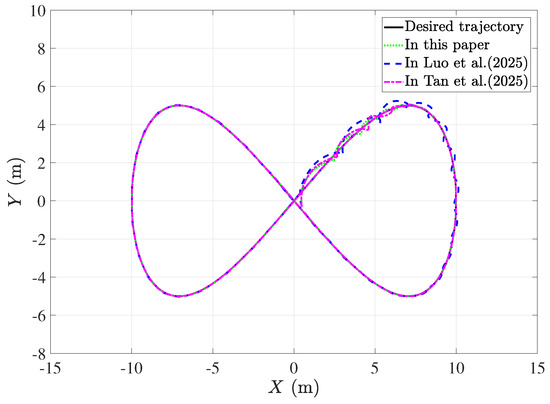
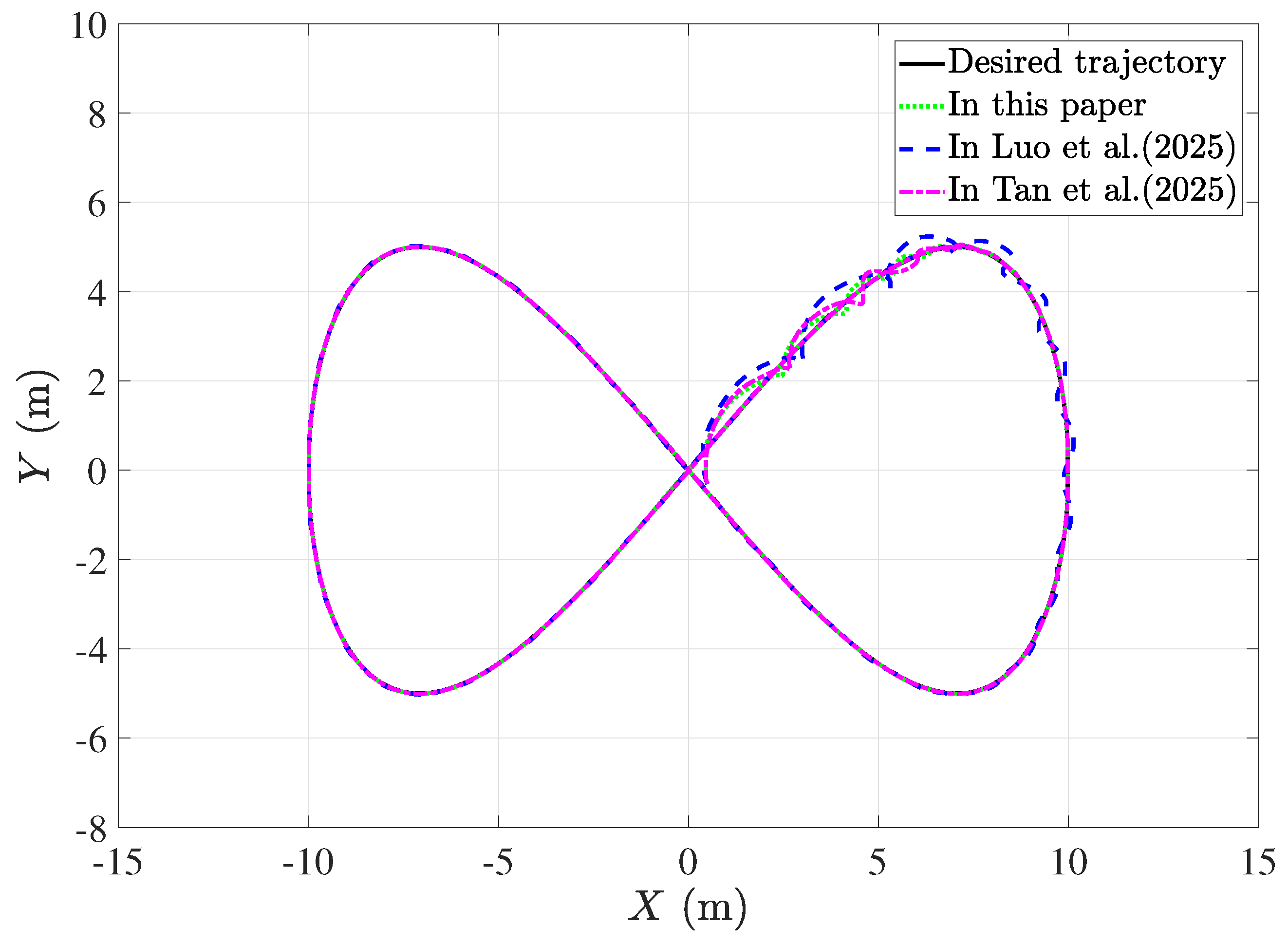
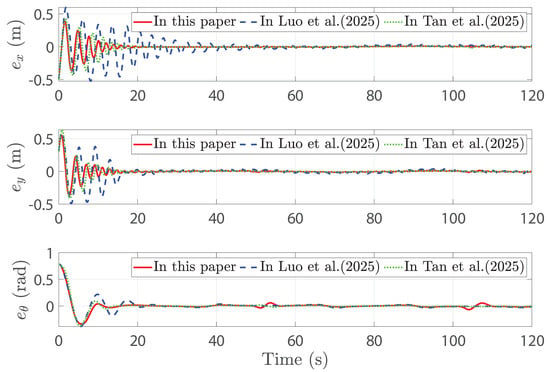
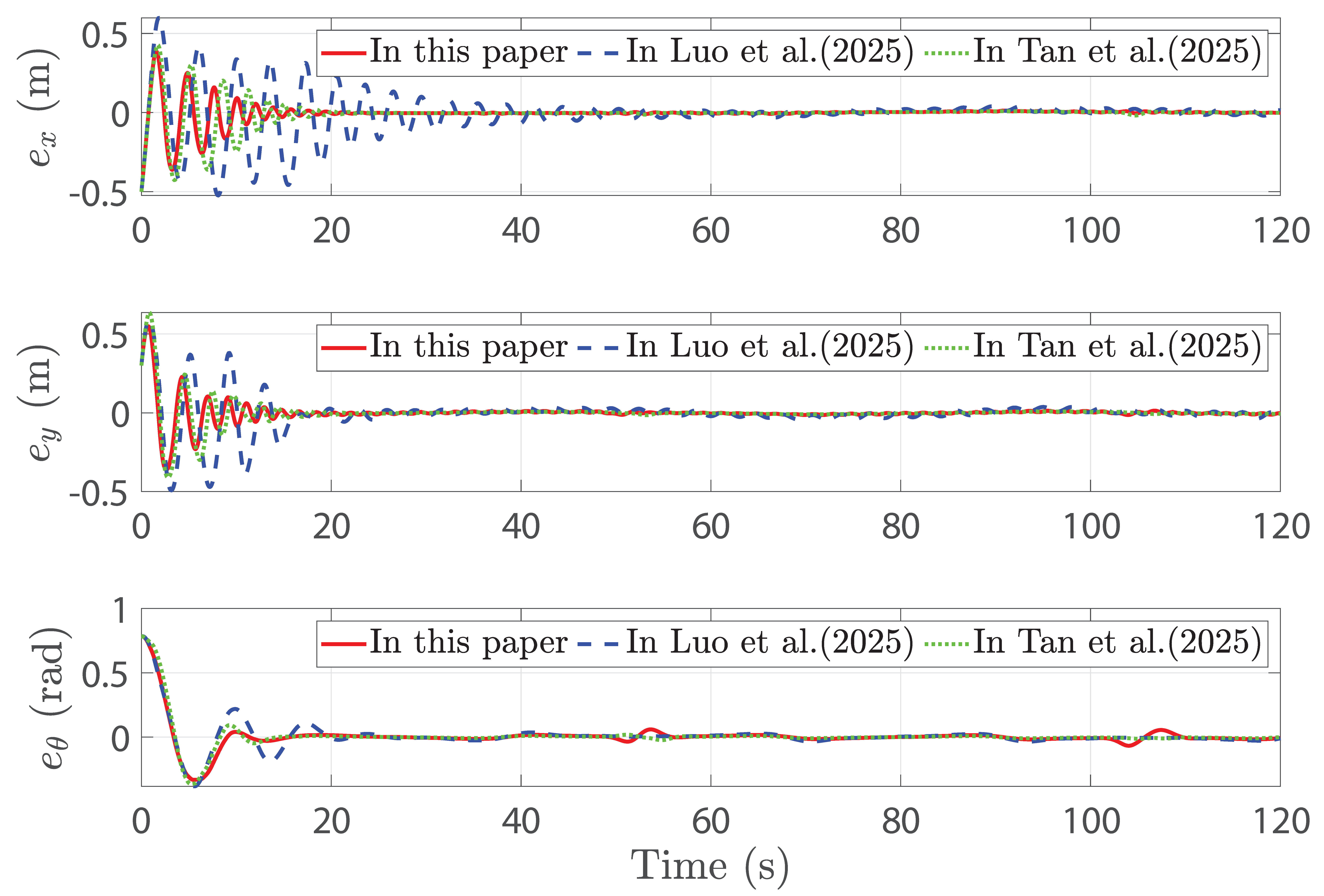
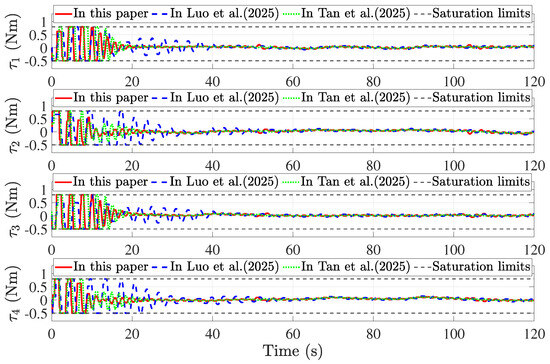
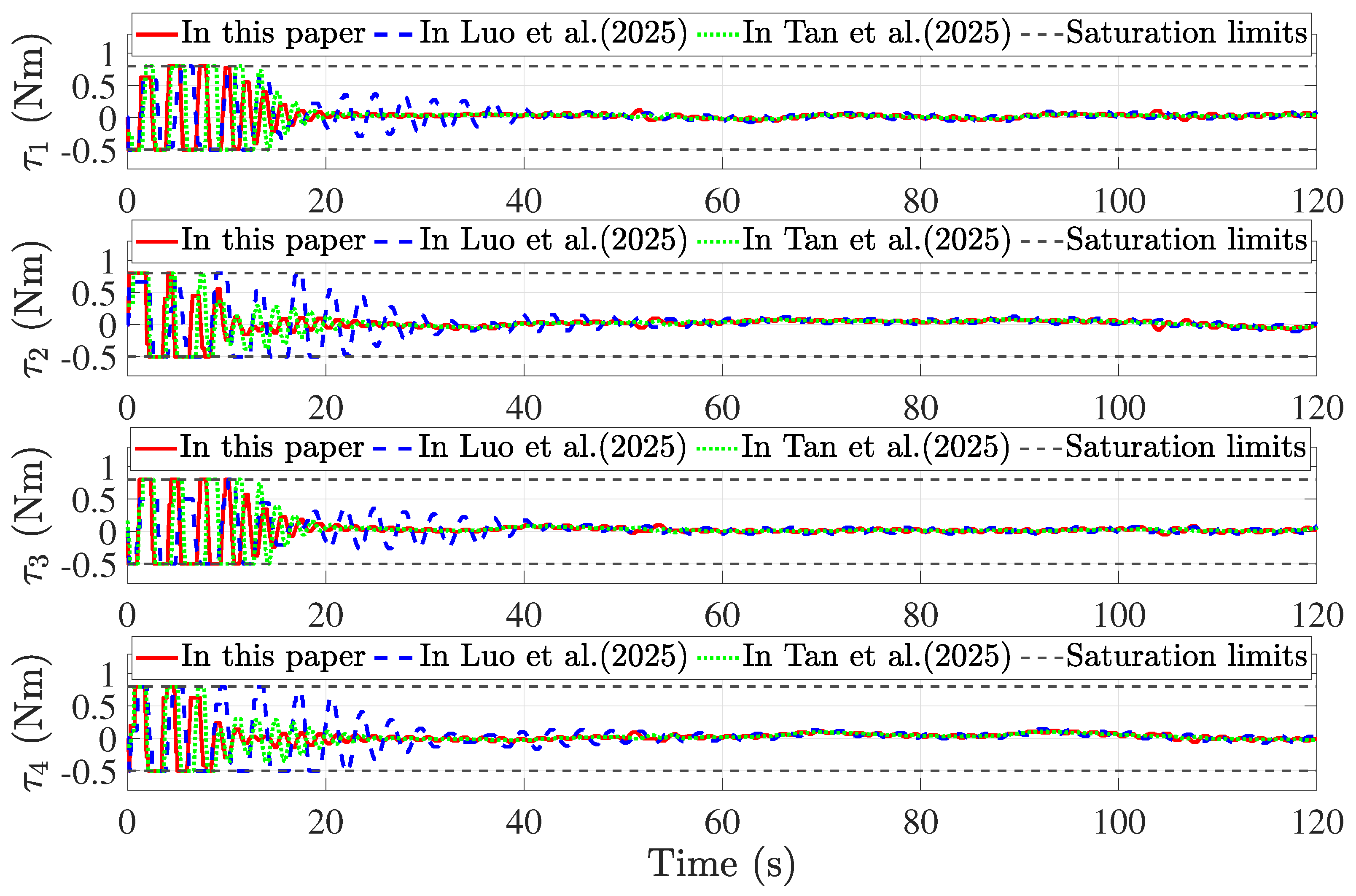
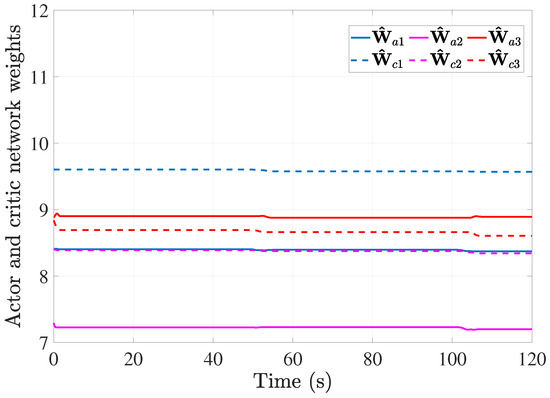
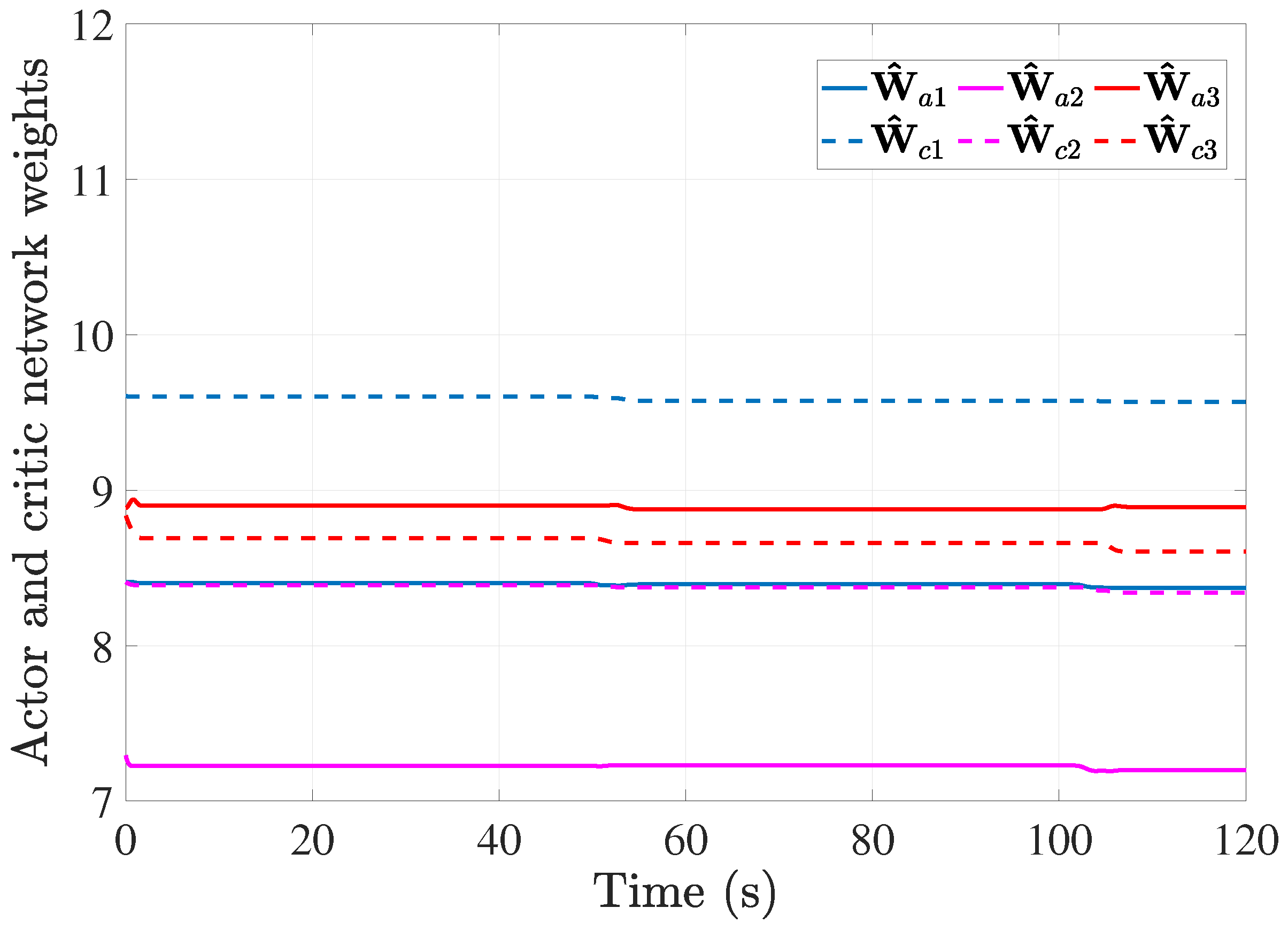
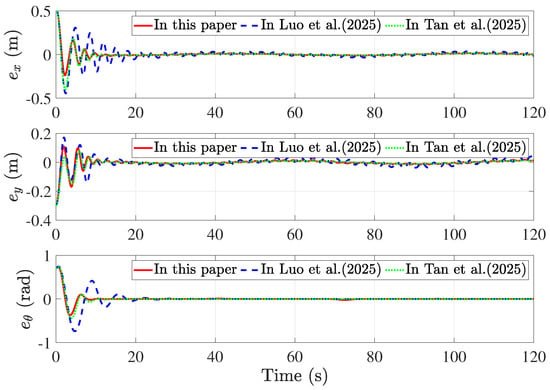
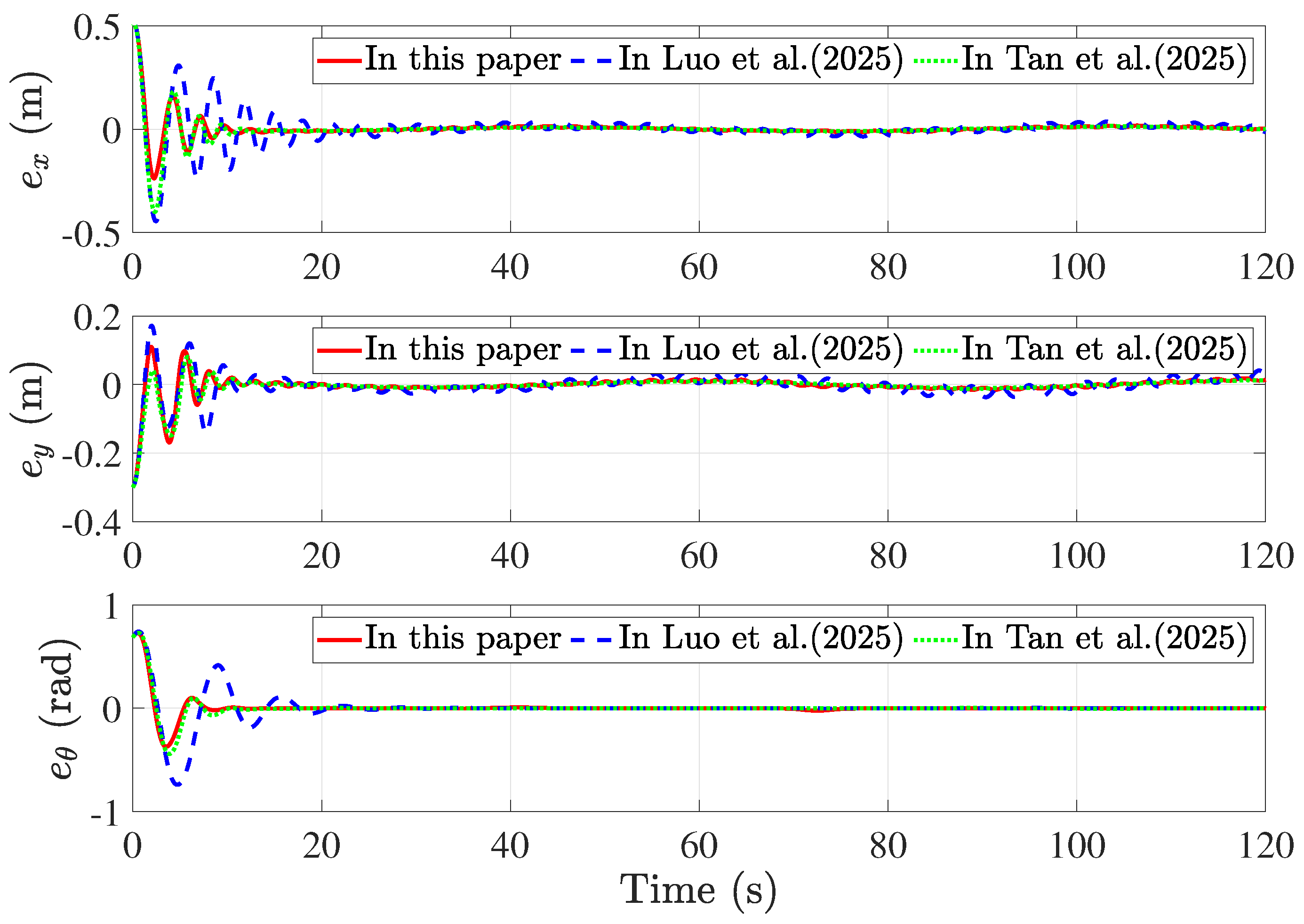
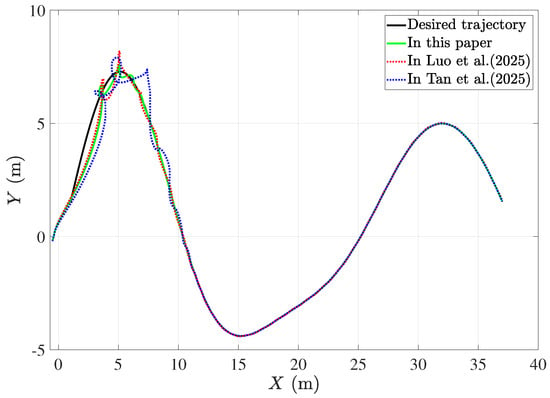
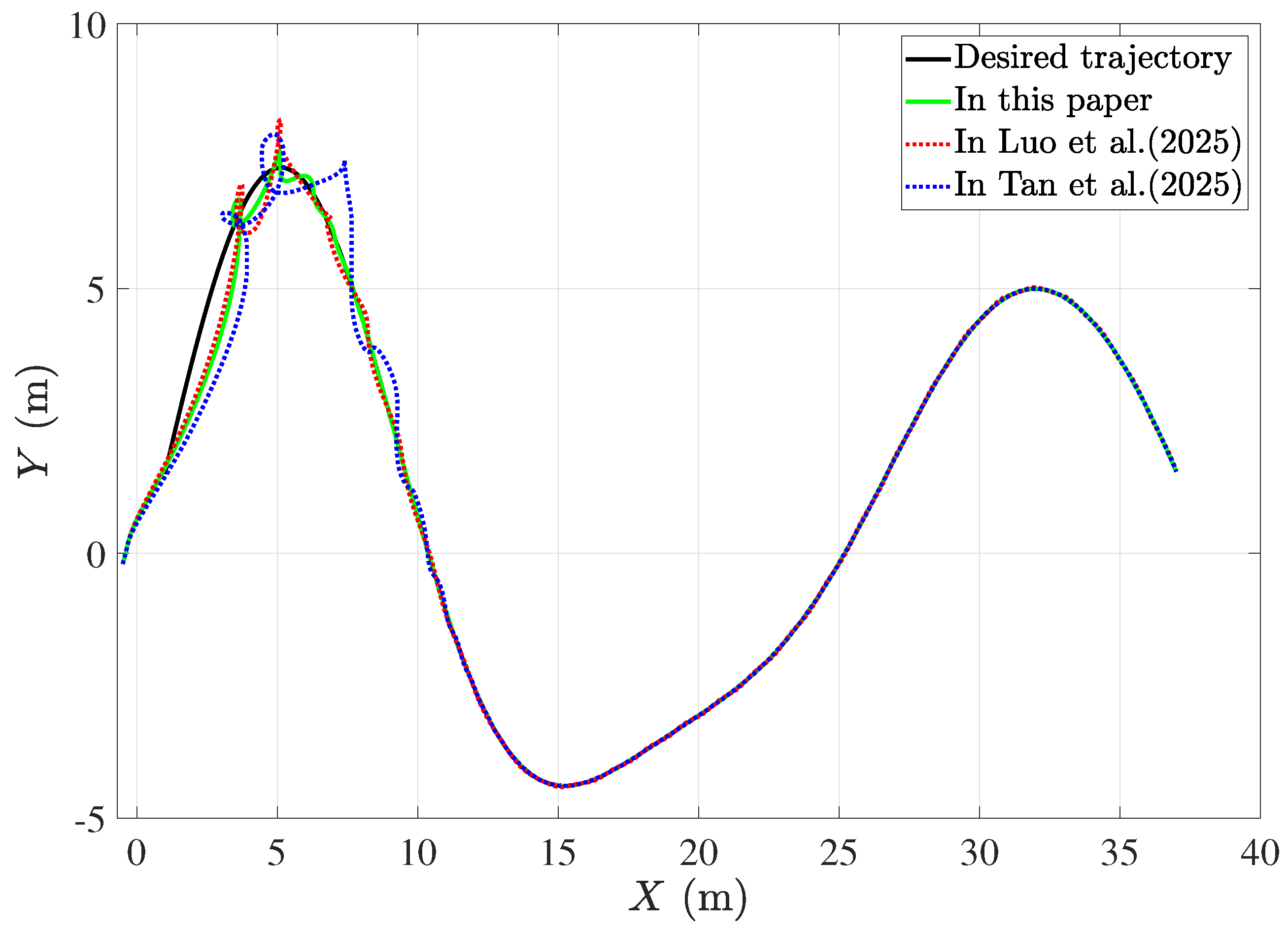
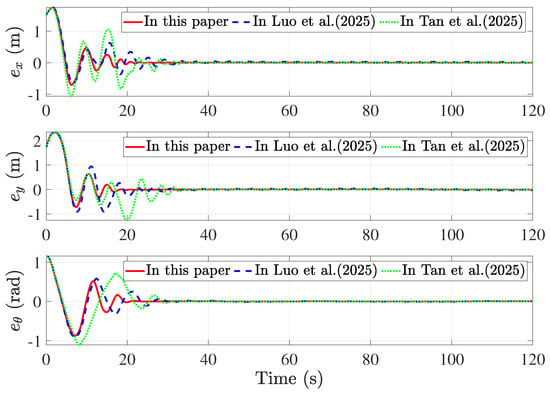
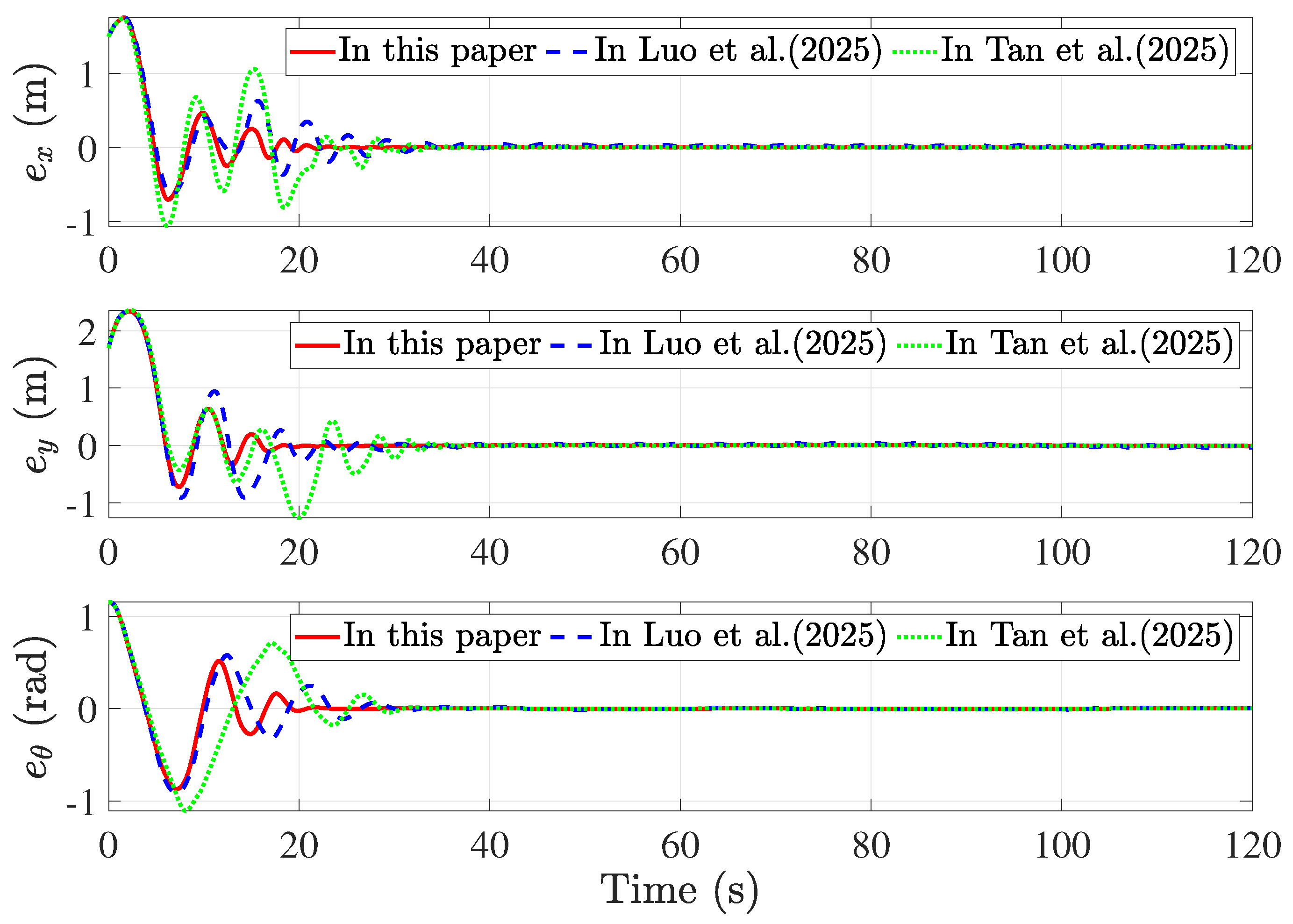
The simulation results for Case 1 are presented in Figure 2, Figure 3, Figure 4 and Figure 5. Figure 2 compares the tracking trajectories obtained using our proposed method with those from the methods described in [12,19]. It can be observed that all three methods successfully achieve trajectory tracking. Figure 3 depicts the time evolution of the tracking errors , , and , demonstrating that our proposed controller achieves faster convergence and smaller tracking errors. Figure 4 plots the trajectories of each motor torque. Figure 5 presents the convergence of the actor–critic network weight norms for this paper. The norms for all output dimensions become stable over time, demonstrating that the neural networks successfully adapt online to the unknown robot dynamics.
Figure 2.
The tracking trajectories of the three methods in this paper, [12], and [19] for Case 1.
Figure 3.
The trajectories of tracking errors in this paper, [12], and [19] for Case 1.
Figure 4.
The trajectories of each motor torque in this paper, [12], and [19] for Case 1.
Figure 5.
The trajectories of actor–critic network weight norms for Case 1.
Table 1 and Table 2 present the RMSE of tracking errors and the number of triggering events for all three methods, respectively. The proposed method achieves the lowest RMSE among the three methods while maintaining the fewest triggering events, demonstrating that the switching event-triggered mechanism effectively reduces communication load without compromising control performance.
Table 1.
Tracking accuracy comparison using RMSE for Case 1.
Table 2.
Number of triggers of different methods for Case 1.
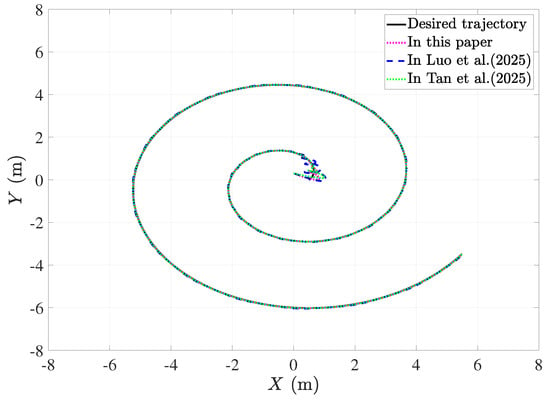
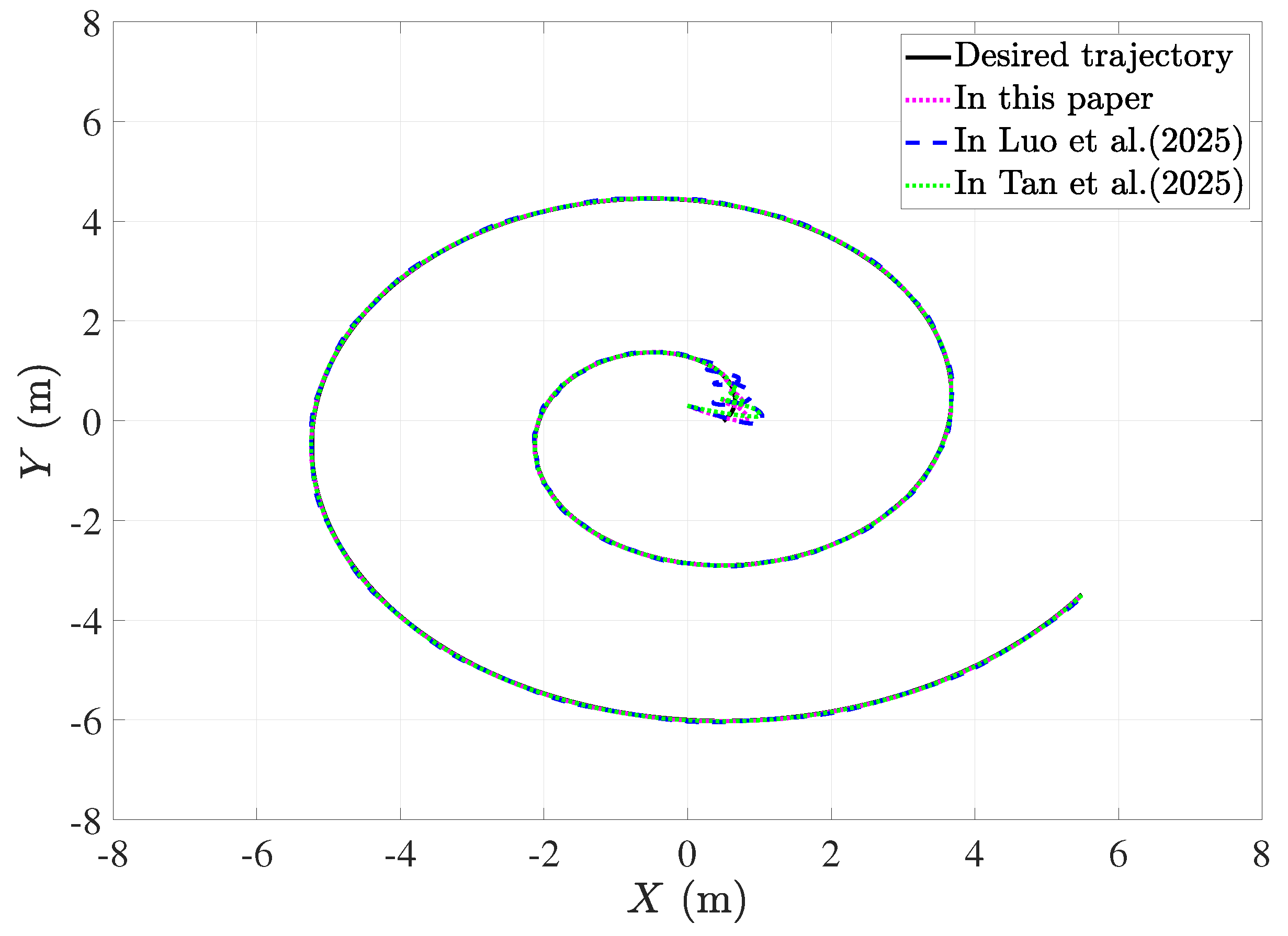
Case 2: The initial states are m and m/s. The asymmetric saturation limits are Nm and Nm. The reference trajectory is a spiral given by with . The controller gains for the proposed method are and .
Figure 6 and Figure 7 and Table 3 and Table 4 present the results for Case 2. Figure 6 compares the tracking trajectories, and Figure 7 shows the tracking errors. The proposed method again achieves the smallest tracking errors and the lowest trigger counts among the three methods, as quantified in Table 3 and Table 4.
Figure 6.
The tracking trajectories of the three methods in this paper, [12], and [19] for Case 2.
Figure 7.
The trajectories of tracking errors in this paper, [12], and [19] for Case 2.
Table 3.
Tracking accuracy comparison using RMSE for Case 2.
Table 4.
Number of triggers of different methods for Case 2.
Case 3: The initial states are m and m/s. The asymmetric saturation limits are Nm and Nm. The reference trajectory is given by . The controller gains are and .
Figure 8 and Figure 9 and Table 5 and Table 6 present the results for Case 3. The proposed method consistently achieves the best tracking accuracy and the lowest communication load among the three methods.
Figure 8.
The tracking trajectories of the three methods in this paper, [12], and [19] for Case 3.
Figure 9.
The trajectories of tracking errors in this paper, [12], and [19] for Case 3.
Table 5.
Tracking accuracy comparison using RMSE for Case 3.
Table 6.
Number of triggers of different methods for Case 3.
The simulation results from the three cases consistently demonstrate the superiority of the proposed method. Across all three trajectories with different geometric characteristics and saturation constraints, the proposed switching event-triggered reinforcement learning controller achieves the smallest tracking errors and the lowest number of triggering events compared to the two representative algorithms from the literature. The proposed method thus provides a robust and efficient solution for MWMR trajectory tracking under asymmetric actuator saturation.
6. Conclusions
This paper has investigated the optimal trajectory tracking control problem for an MWMR subject to asymmetric actuator saturation. Within the command-filtered backstepping framework, a switching event-triggered control scheme based on reinforcement learning has been proposed. A compensation system with an anti-saturation term is designed to simultaneously compensate filtering errors and actuator saturation, ensuring closed-loop stability without requiring prior knowledge of the saturation nonlinearity. Unlike conventional event-triggered strategies, the designed switching mechanism suspends control signal updates when the actuator enters saturation and resumes them only when the saturation is relieved, thereby avoiding unnecessary communication during saturation periods. Furthermore, the designed reinforcement learning algorithm enables online learning of the optimal control policy. The simulation results show that the proposed method achieves satisfactory tracking performance while significantly reducing communication resource waste.
Author Contributions
Conceptualization, J.B., Y.P. and Y.W.; methodology, J.B. and Y.P.; software, J.B.; validation, J.B., Y.P. and Y.W.; formal analysis, J.B.; investigation, J.B.; resources, Y.W.; data curation, Y.W.; writing—original draft preparation, J.B.; writing—review and editing, Y.P. and Y.W.; visualization, J.B.; supervision, Y.P. and Y.W.; project administration, Y.P.; funding acquisition, J.B. and Y.W. All authors have read and agreed to the published version of the manuscript.
Funding
This research received no external funding
Institutional Review Board Statement
Not applicable.
Informed Consent Statement
Not applicable.
Data Availability Statement
The original contributions presented in this study are included in the article. Further inquiries can be directed to the corresponding author.
Conflicts of Interest
The authors declare no conflicts of interest.
References
- Liu, Y.; Li, Y.; Shi, L.; Lin, Z. Leader-Following Formation Control for Cooperative Transportation of Multiple Mecanum-Wheeled Mobile Robots. IEEE Trans. Intell. Transp. Syst. 2026, 27, 5477–5487. [Google Scholar] [CrossRef] [Scilit]
- Zhang, D.; Wang, G.; Wu, Z. Reinforcement Learning-Based Tracking Control for a Three Mecanum Wheeled Mobile Robot. IEEE Trans. Neural Netw. Learn. Syst. 2024, 35, 1445–1452. [Google Scholar] [CrossRef] [Scilit] [PubMed]
- Tsai, M.C.; Peng, C.C. Model-Based Particle Swarm Optimization Filtering Algorithm for Mecanum Wheel Car Parameter Identification with Measurement Noise. IEEE Trans. Instrum. Meas. 2025, 74, 3003312. [Google Scholar] [CrossRef] [Scilit]
- Li, S.; Zhang, J.; Gu, S. Discrete Time Trajectory Tracking Control for Four-Mecanum-Wheeled Mobile Vehicle: An Variable Gain ADRC Method. IEEE Robot. Autom. Lett. 2024, 9, 7771–7778. [Google Scholar] [CrossRef] [Scilit]
- Hwang, C.L.; Li, Y.H. Fuzzy Finite-Time Pose Tracking Control with Nonlinear Output Scale Factor for a Four Mecanum-Wheel Vehicle in Smooth Indoor and Complex Outdoor Environments. IEEE Trans. Syst. Man. Cybern. Syst. 2026, 56, 148–163. [Google Scholar] [CrossRef] [Scilit]
- Ma, H.; Duan, S.; Liu, Y.; Liu, R.; Li, H. LSTM Neural Network-Based Data-Driven Adaptive Control for MlMO Discrete-Time Systems. Sci. China Technol. Sci. 2026, 69, 1920405. [Google Scholar] [CrossRef] [Scilit]
- He, W.; Liang, K.; Qian, F.; Chen, G. Designing Distributed Impulsive Controller for Networked Singularly Perturbed Systems. IEEE Trans. Autom. Control 2023, 68, 3680–3686. [Google Scholar] [CrossRef] [Scilit]
- Zeng, Z.; Wang, J.; Liao, X. Stability Analysis of Delayed Cellular Neural Networks Described Using Cloning Templates. IEEE Trans. Circuits Syst. I Regul. Pap. 2004, 51, 2313–2324. [Google Scholar] [CrossRef] [Scilit]
- Ren, H.; Zhang, C.; Ma, H.; Li, H. Cloud-Based Distributed Group Asynchronous Consensus for Switched Nonlinear Cyber-Physical Systems. IEEE Trans. Ind. Inform. 2025, 21, 693–702. [Google Scholar] [CrossRef] [Scilit]
- Zhang, P.; Liu, T.; Jiang, Z.P. Tracking Control of Unicycle Mobile Robots with Event-Triggered and Self-Triggered Feedback. IEEE Trans. Autom. Control 2023, 68, 2261–2276. [Google Scholar] [CrossRef] [Scilit]
- Qian, M.; Sun, C.; Jiang, B.; Wang, R.; Shi, J. Event-Based Adaptive Fault Tolerant Control and Collision Avoidance of Wheel Mobile Robots with Communication Limits. IEEE Trans. Ind. Electron. 2024, 71, 14832–14841. [Google Scholar] [CrossRef] [Scilit]
- Luo, A.; Zhou, Q.; Ma, H.; Li, H. Event-Triggered Optimal Consensus Control for MASs with Multiple Constraints: A Flexible Performance Approach. IEEE Trans. Autom. Sci. Eng. 2025, 22, 13117–13127. [Google Scholar] [CrossRef] [Scilit]
- Wang, C.; Shi, P.; Rudas, I. Tracking Control for Two-Wheeled Mobile Robots via Event-Triggered Mechanism. ISA Trans. 2025, 156, 632–638. [Google Scholar] [CrossRef] [Scilit] [PubMed]
- Chang, Z.; Guo, Y.; Zong, G.; Qi, W.; Zhao, X. Exponential Synchronization for Mobile Robotic Formation: A Hybrid Dynamic Event-Triggered Intermittent Control Method. IEEE Trans. Intell. Veh. 2024, 1–10. [Google Scholar] [CrossRef] [Scilit]
- Xu, L.; Su, Y.; Cai, H. Event-Triggered Consensus of Multiple Nonholonomic Mobile Robots. Automatica 2025, 174, 112156. [Google Scholar] [CrossRef] [Scilit]
- Xie, H.; Zong, G.; Yang, D.; Guo, Y.; Zhao, X. Secure Control for Switched Nonlinear Systems with DoS Attacks: A Switching Event-Triggered Adaptive Output-Feedback Control Method. IEEE Trans. Syst. Man. Cybern. Syst. 2024, 54, 3011–3021. [Google Scholar] [CrossRef] [Scilit]
- Wang, H.; Zhang, T.; Zhang, X.; Li, Q. Observer-Based Path Tracking Controller Design for Autonomous Ground Vehicles with Input Saturation. IEEE Trans. Neural Netw. Learn. Syst. 2023, 10, 749–761. [Google Scholar] [CrossRef] [Scilit]
- Shi, H.; He, S.; Dai, S.L.; Dong, C. Cooperative Learning From Neural Formation Control for Uncertain Marine Surface Vehicles with Input Saturation Under Switching Topology. IEEE Trans. Transp. Electrif. 2024, 10, 7828–7839. [Google Scholar] [CrossRef] [Scilit]
- Tan, C.; Ma, X.; Li, Y.; Xie, X. Event-Based Adaptive Control of Networked Systems with Asymmetric Input Saturation and Multiplicative Noise Via Neural Networks. IEEE Trans. Control Netw. Syst. 2025, 12, 2774–2785. [Google Scholar] [CrossRef] [Scilit]
- Ma, H.; Zhou, Q.; Ren, H.; Liang, H. Hyperchaotic Privacy-Preserving Cooperative Adaptive Control with Application to Multimotor Systems. IEEE/ASME Trans. Mechatron. 2026, 1–11. [Google Scholar] [CrossRef] [Scilit]
- Wu, S.; Li, X. Finite-Time Stabilization of Nonlinear Systems with Actuator Saturation. IEEE Trans. Autom. Sci. Eng. 2024, 22, 7582–7589. [Google Scholar] [CrossRef] [Scilit]
- Gu, Z.; Cao, R.; Tian, E. Reinforcement Learning-Based Event-Triggered Optimal Control of Power Systems with Control Input Saturation. IEEE Trans. Ind. Inform. 2025, 21, 1528–1536. [Google Scholar] [CrossRef] [Scilit]
- Gao, H.; Kan, Z.; Chen, F.; Hao, Z.; He, X.; Su, H.; Li, K. Adaptive Finite-Time Trajectory Tracking Control of Autonomous Vehicles That Experience Disturbances and Actuator Saturation. IEEE Intell. Transp. Syst. Mag. 2022, 14, 80–91. [Google Scholar] [CrossRef] [Scilit]
- Ren, J.; Luo, R.; Wu, C. Event-Triggered Reinforcement Learning Control for Switching Fuzzy Vehicle Lateral Dynamics. IEEE Trans. Intell. Transp. Syst. 2026, 27, 5104–5116. [Google Scholar] [CrossRef] [Scilit]
- Shao, X.; Pustina, P.; Stölzle, M.; Sun, G.; De Luca, A.; Wu, L.; Santina, C.D. Model-Based Control for Soft Robots with System Uncertainties and Input Saturation. IEEE Trans. Ind. Electron. 2024, 71, 7435–7444. [Google Scholar] [CrossRef] [Scilit]
- Zhang, C.; Ma, H.; Cheng, Z.; Ren, H. A Koopman-DMPC Strategy for Nonlinear Cyberphysical Systems Under Bounded Communication Delays. IEEE Trans. Syst. Man. Cybern. Syst. 2026, 56, 5595–5605. [Google Scholar] [CrossRef] [Scilit]
- Liu, Y.; Yao, X.; Zhao, W. Distributed Neural-Based Fault-Tolerant Control of Multiple Flexible Manipulators with Input Saturations. Automatica 2023, 156, 111202. [Google Scholar] [CrossRef] [Scilit]
- Wang, C.; Zhan, H.; Guo, Q.; Li, T. Adaptive Dynamic Programming-Based Fixed-Time Optimal Control for Wheeled Mobile Robot. IEEE Robot. Autom. Lett. 2025, 10, 176–183. [Google Scholar] [CrossRef] [Scilit]
- Wen, G.; Chen, C.L.P. Optimized Backstepping Consensus Control Using Reinforcement Learning for a Class of Nonlinear Strict-Feedback-Dynamic Multi-Agent Systems. IEEE Trans. Neural Netw. Learn. Syst. 2023, 34, 1524–1536. [Google Scholar] [CrossRef] [Scilit] [PubMed]
- Kim, Y.; Singh, T. Energy-Time Optimal Trajectory Tracking Control of Wheeled Mobile Robots. IEEE/ASME Trans. Mechatron. 2024, 29, 1283–1294. [Google Scholar] [CrossRef] [Scilit]
- Ma, H.; Zhu, L.; Zhou, Q.; Li, H.; Lei, Y. Actor–Critic-Based Prescribed Performance Optimal Control for Flexible-Joint Robots with Input Delay. IEEE Trans. Neural Netw. Learn. Syst. 2026, 1–11. [Google Scholar] [CrossRef] [Scilit] [PubMed]
- Luo, A.; Ma, H.; Ren, H.; Li, H. Estimator-Based Reinforcement Learning Consensus Control for Multiagent Systems with Discontinuous Constraints. IEEE Trans. Neural Netw. Learn. Syst. 2025, 36, 11008–11019. [Google Scholar] [CrossRef] [Scilit] [PubMed]
- Chen, Y.H. Nonlinear Adaptive Optimal Control Design and Implementation for Trajectory Tracking of Four-Wheeled Mecanum Mobile Robots. Mathematics 2024, 12, 4013. [Google Scholar] [CrossRef] [Scilit]
- Juang, C.F.; You, Z.B. Reinforcement Learning of an Interpretable Fuzzy System Through a Neural Fuzzy Actor-Critic Framework for Mobile Robot Control. IEEE Trans. Fuzzy Syst. 2024, 32, 3655–3668. [Google Scholar] [CrossRef] [Scilit]
- Zhang, Y.; Liang, X.; Li, D.; Ge, S.S.; Gao, B.; Chen, H.; Lee, T.H. Adaptive Safe Reinforcement Learning with Full-State Constraints and Constrained Adaptation for Autonomous Vehicles. IEEE Trans. Cybern. 2024, 54, 1907–1920. [Google Scholar] [CrossRef] [Scilit] [PubMed]
- Nayak, A.; Banavar, R.N. On Almost-Global Tracking for a Certain Class of Simple Mechanical Systems. IEEE Trans. Autom. Control 2019, 64, 412–419. [Google Scholar] [CrossRef] [Scilit]
- Liu, Y.J.; Sun, X.; Liao, Y.; Li, S.; Liu, L.; Liu, J.J.R. Adaptive Reinforcement Learning Tracking Control of Vehicle Based on Threshold Band Event-Triggered. IEEE Trans. Autom. Sci. Eng. 2025, 22, 13764–13776. [Google Scholar] [CrossRef] [Scilit]

Disclaimer/Publisher’s Note: The statements, opinions and data contained in all publications are solely those of the individual author(s) and contributor(s) and not of MDPI and/or the editor(s). MDPI and/or the editor(s) disclaim responsibility for any injury to people or property resulting from any ideas, methods, instructions or products referred to in the content. |
© 2026 by the authors. Licensee MDPI, Basel, Switzerland. This article is an open access article distributed under the terms and conditions of the Creative Commons Attribution (CC BY) license.