


Abstract
Water scarcity in semi-arid regions makes efficient irrigation scheduling a priority, yet farm-level adoption of soil-moisture monitoring remains limited by the cost, low portability and installation complexity of commercial sensing systems. This study presents the development and field validation of WaziSense, a low-cost, solar-powered Internet-of-Things (IoT) smart tensiometer, developed within the OSIRRIS platform for soil-water monitoring and irrigation scheduling. The device couples a Watermark granular-matrix sensor and a DS18B20 temperature probe to an ATmega328P microcontroller (Arduino Pro-Mini, 3.3 V, 8 MHz) with long-range LoRa communication and a maximum-power-point-tracking (MPPT) solar-charging stage, logging soil matric potential and soil temperature every 15 min. An open-source edge/cloud stack (WaziGate, WaziApp) retrieves weather forecasts from an open API and runs an automated machine learning (AutoML) regression pipeline that forecasts soil-water dynamics and the time to a user-defined threshold, from which irrigation is scheduled and its applied volume verified by a flow meter. The system was deployed at three bioclimatic sites in Tunisia (durum wheat at Cherfech, citrus at Nabeul, apple at Sbeitla), with tensiometers installed at 20 and 40 cm depths, and validated against commercial 10HS capacitive probes coupled to a ZL6 data logger, with which the co-located readings were significantly correlated (r = 0.81). Calibrated readings showed a strong relationship between soil–water content and soil–water potential (R2 = 0.99), and the edge forecasting model reproduced soil–water dynamics on unseen data (Sbeitla apple site, 5-day horizon) with R2 = 0.73, RMSE = 0.35, MAE = 0.23 and MPE = 12.52%. With a material cost under about 90 EUR per node and fully open-source hardware and software, WaziSense is one to two orders of magnitude cheaper than commercial monitoring stations, offering an affordable, reproducible and scalable tool for data-driven irrigation in water-limited agriculture.
1. Introduction
Agriculture is the largest consumer of freshwater worldwide, accounting for roughly 70% of global withdrawals, and this share is even higher in the arid and semi-arid regions of the Mediterranean, where climate change is intensifying droughts and competition for water [1,2]. Raising water use efficiency at the farm scale has therefore become a central objective of sustainable and digital agriculture, and the paradigms of Agriculture 4.0 and 5.0 place data-driven, sensor-based decision-making at the core of this transition [3,4]. Matching irrigation to the actual soil-water status, rather than to fixed calendars, is one of the most effective ways to achieve this, provided that reliable, affordable and easy-to-deploy soil sensing is available [1,5].
A wide range of soil-moisture sensors are commercially available, yet few growers use them to schedule irrigation, mainly because of their cost, limited portability and installation complexity [1,5]. Granular-matrix (Watermark) tensiometers are particularly attractive for this purpose: they relate directly to the soil matric potential, they are inexpensive and are robust in the field, and, when combined with low-power IoT connectivity, they can bring continuous root zone monitoring within reach of smallholders [6].
Several IoT-based irrigation systems have been proposed. Wireless-sensor-network systems automate irrigation but often lack integration with weather forecasting or rain detection [7,8]; GSM-based controllers enable remote management but depend on manual input and network availability [9]; and cloud-centric systems improve decision-making but require stable connectivity and paid subscriptions that are not always feasible for small farms [10]. Coupling in situ sensing with weather forecasts and machine learning has been shown to reduce water use and improve scheduling [6,7], and low-cost IoT tensiometers have been developed and validated [11]. Within the same OSIRRIS framework, the present system has already supported deficit irrigation studies in apple [12], winter wheat [13] and Washington Navel orange [14]; here, we focus on the development, full disclosure and field validation of the sensing-and-decision device itself.
The aim of this work is to develop and validate an affordable, energy-autonomous and reproducible IoT tensiometer for soil-water monitoring and irrigation scheduling in semi-arid agriculture. Specifically, the objectives are (i) to design a low-cost, solar-powered LoRa sensing node from widely available components; (ii) to describe its embedded firmware, on-device calibration and open-source edge/cloud software, including the machine learning forecasting pipeline and the irrigation-scheduling logic, in a fully reproducible way; (iii) to validate the device in the field, at three bioclimatic sites and against a commercial 10HS/ZL6 reference; and (iv) to quantify its material cost relative to commercial monitoring stations.
2. Materials and Methods
2.1. The OSIRRIS Platform and the WaziSense Smart Tensiometer
WaziSense was developed within the OSIRRIS project (Precision Irrigation with Cost-effective and Autonomic IoT at the Edge), a TUNGER 2+2 bilateral collaboration between Germany (Waziup e.V., Dresden, and INNOTEC21) and Tunisia (INRGREF and INRAT, Menzah, Tunisia), funded by the German Federal Ministry of Education and Research (BMBF) and the Tunisian Ministry of Higher Education and Scientific Research (2022–2025) [13]. It is an affordable, easily deployable IoT/edge-computing platform. The smart tensiometer integrates LoRa wireless communication, an MPPT solar charge controller and an ATmega328P microcontroller (Microchip Technology, Chandler, AZ, USA) programmed in C/C++. It comprises a Watermark tensiometer (Irrometer Company, Inc., Riverside, CA, USA) and a temperature probe connected to Arduino Pro-Mini (Arduino, Ivrea, Italy) operating at 3.3 V and 8 MHz; soil matric potential and soil temperature are logged automatically every 15 min and transmitted over LoRaWAN to the WaziGate gateway, which stores the data, synchronizes them with the OSIRRIS cloud and hosts the edge applications (WaziApp). The WaziAct module drives the pump for automated irrigation.
The platform was developed iteratively. A first prototype (Prototype 1) was built and tested in the laboratory in 2022 and deployed with the WaziGate platform at the three experimental sites for calibration and validation in 2023. A more robust prototype (Prototype 2) was then evaluated in the field in 2024 under controlled deficit irrigation (CDI) and partial root zone drying (PRD); a fully automated prototype (Prototype 3), in which the smart tensiometer drives the irrigation controller, was subsequently tested.
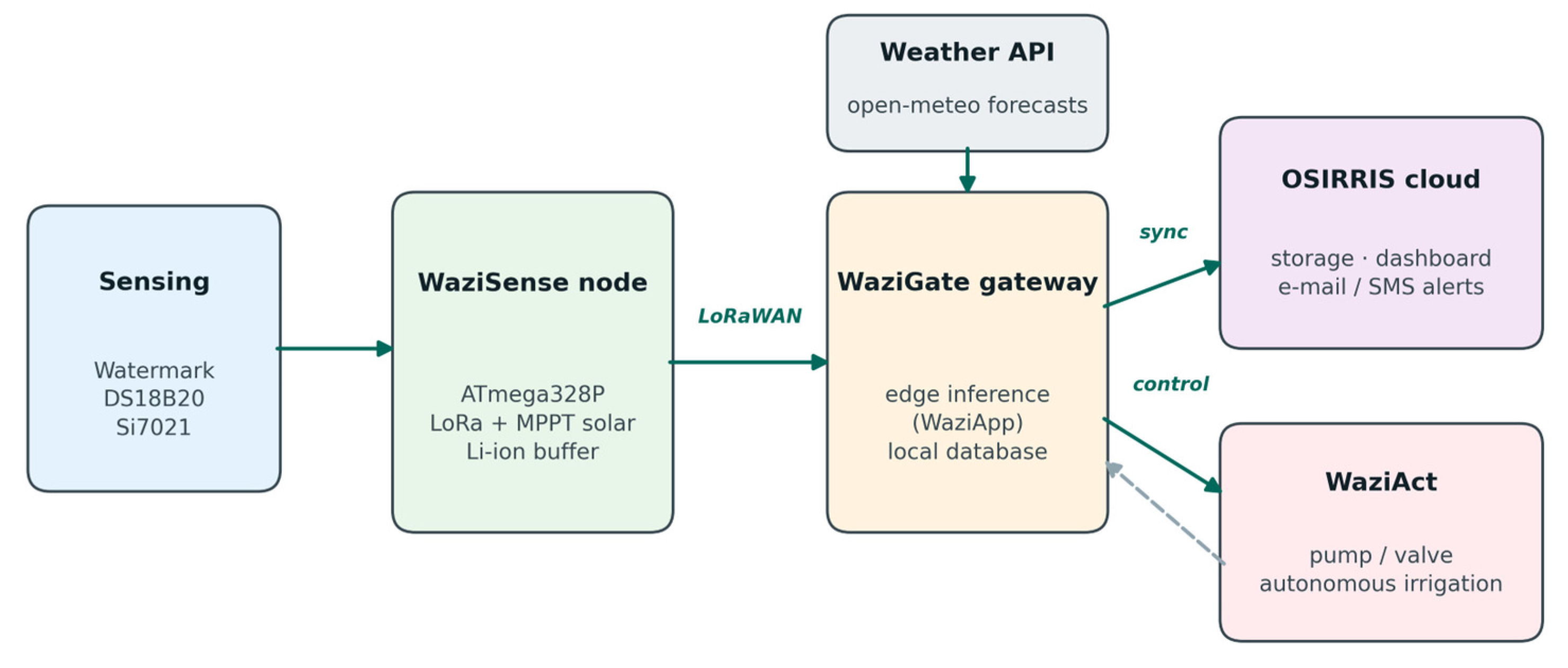
The overall architecture of the platform is shown in Figure 1.
Figure 1.
Architecture of the OSIRRIS platform: the WaziSense node acquires soil and air data and transmits them over LoRaWAN to the WaziGate gateway, which performs edge inference (WaziApp), stores the data and synchronizes with the OSIRRIS cloud; weather forecasts from an open API feed the machine learning model, and the WaziAct module drives the pump for automated irrigation. Solid arrows show the data and command flow; the dashed arrow shows the soil-response feedback from WaziAct to the gateway. Box colours only group the platform layers and have no quantitative meaning.
2.2. Hardware Architecture
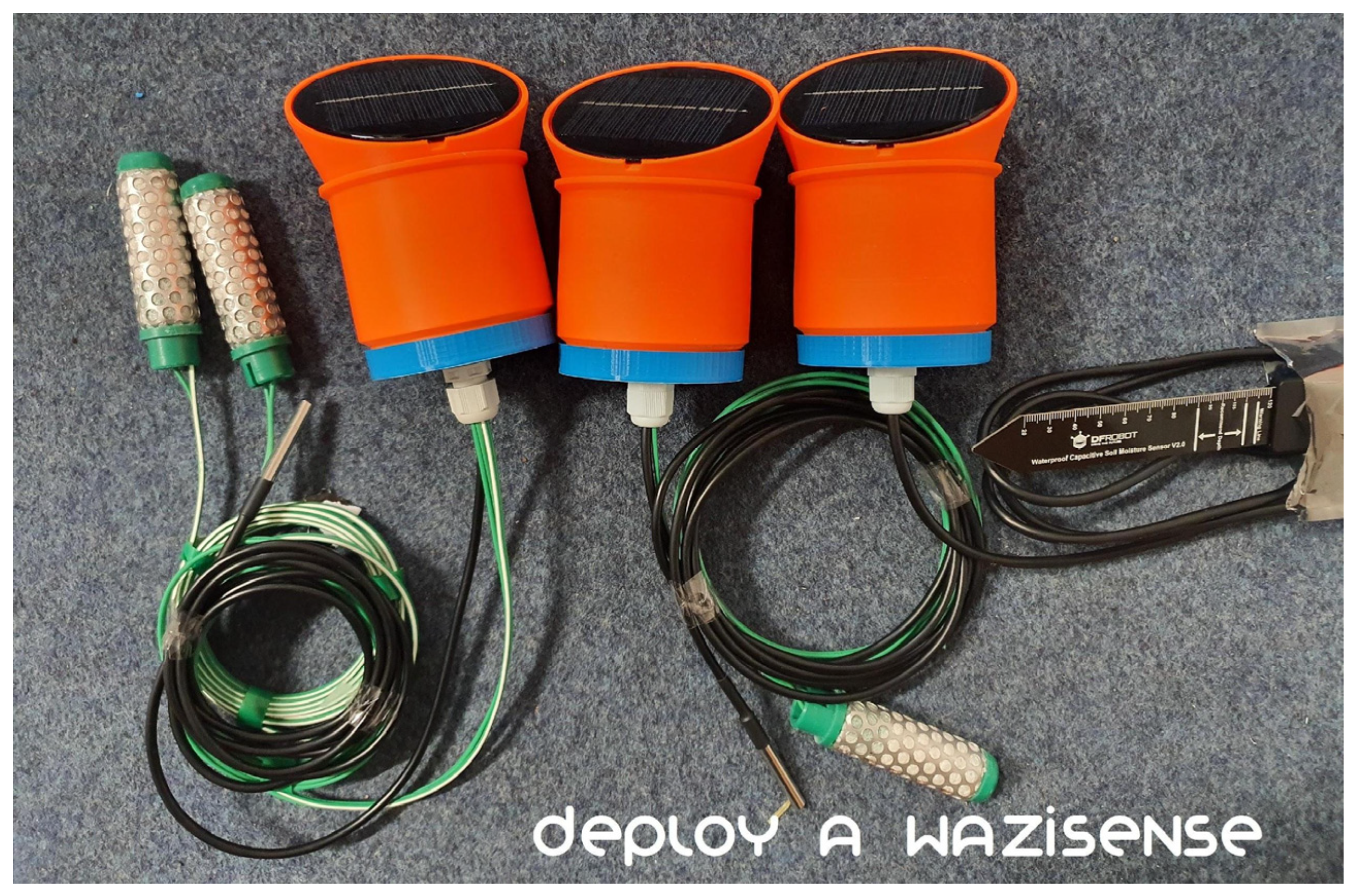
The sensor node is a production-ready LoRa node built around the ATmega328P microcontroller (Arduino Pro-Mini 3.3 V 8 MHz bootloader). It can operate as a battery-less node harvesting energy from the environment, using a super-capacitor circuit able to retain energy for multiple transmissions; in the most recent test, more than 100 messages were transmitted at spreading factor 12 on a single full charge of the super-capacitors. The node (Figure 2) combines LoRa communication, an MPPT solar charge controller and the ATmega328P microcontroller. The selected sensing element is the Watermark granular-matrix tensiometer; combining the soil temperature measured by a waterproof DS18B20 sensor (Maxim Integrated, San Jose, CA, USA) with the Watermark resistance allows the soil matric potential to be computed in centibars. The node also embeds a Si7021 sensor (Silicon Labs, Austin, TX, USA) that measures air temperature and relative humidity over the I2C bus, and exposes terminals for external probes, so that it can host either a Watermark tensiometer or a capacitive soil-moisture probe.
Figure 2.
WaziSense nodes, showing the 3D-printed solar enclosures, the Watermark granular-matrix sensors and the temperature probes.
2.3. Power System and Energy Autonomy
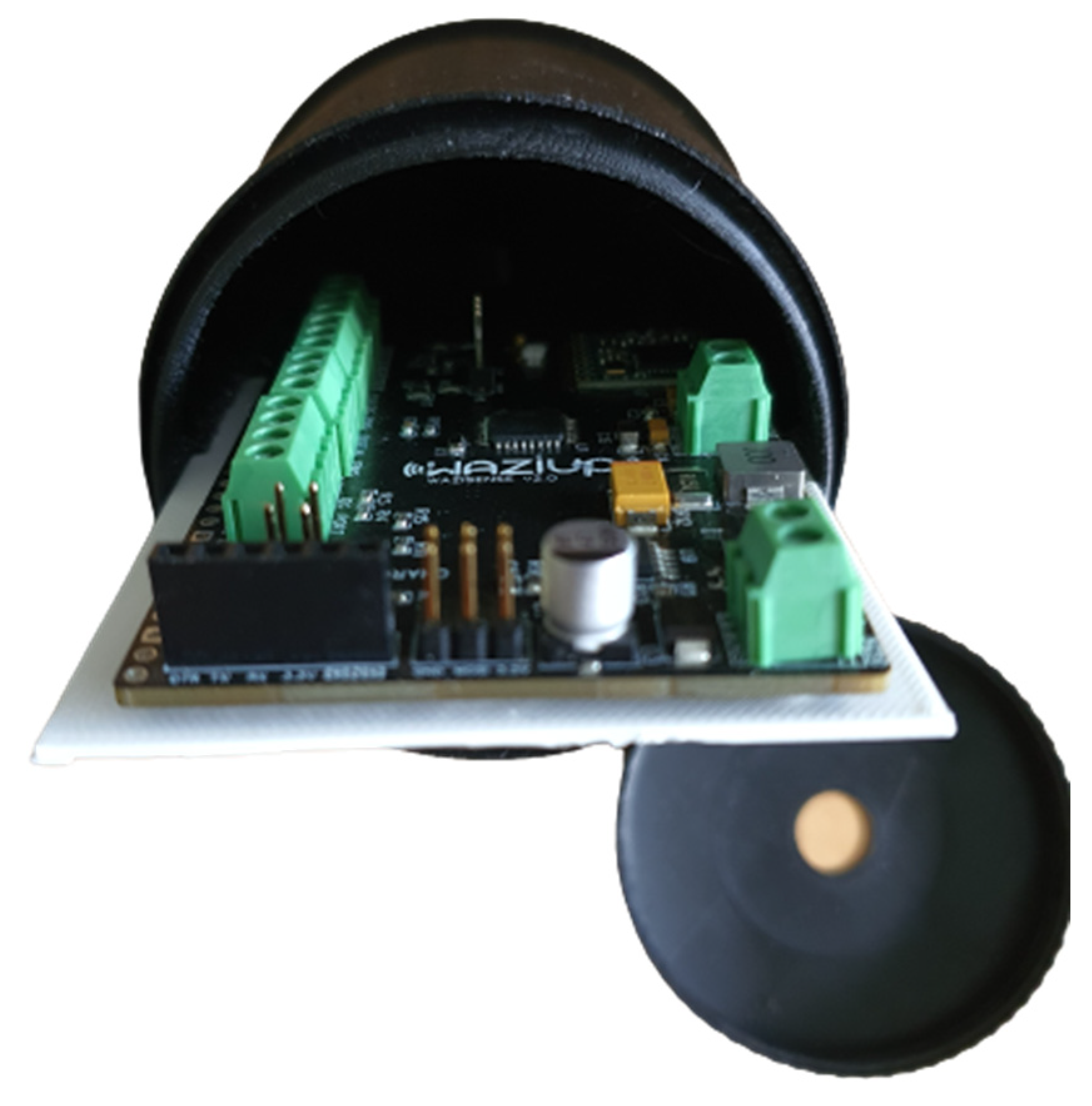
In deep-sleep mode at 4 V, the node draws only 2.5 mA (about 10 mWh) and accepts supply voltages from 3.3 to 16 V. For short-term data collection, a 4-cell AA battery holder is connected directly to the node; for long-term operation, solar energy is harvested through a 6 V MPPT solar charge controller that charges a 3.7 V Li-ion cell up to 4.2 V and provides short-circuit and overcharge protection. The 6 V/1 W panel recharges the buffer cell in roughly 9 h under optimal conditions. AA batteries alone last about two months, while the lower consumption of the second-generation node extends this autonomy to about six months. The enclosure is 3D-printed in UV-resistant ASA to IP55 (Figure 3), and a 75 mm PVC pipe serves as a protective cover, mast and cable conduit. The two super-capacitors store about 0.041 Wh, whereas the 2500 mAh Li-ion buffer stores about 10 Wh, roughly 250 times more, which guarantees continuous operation through cloudy periods.
Figure 3.
WaziSense electronics mounted on the sliding sledge, partly extracted from the 3D-printed ASA enclosure with its bottom service cover.
2.4. Gateway and Embedded Software
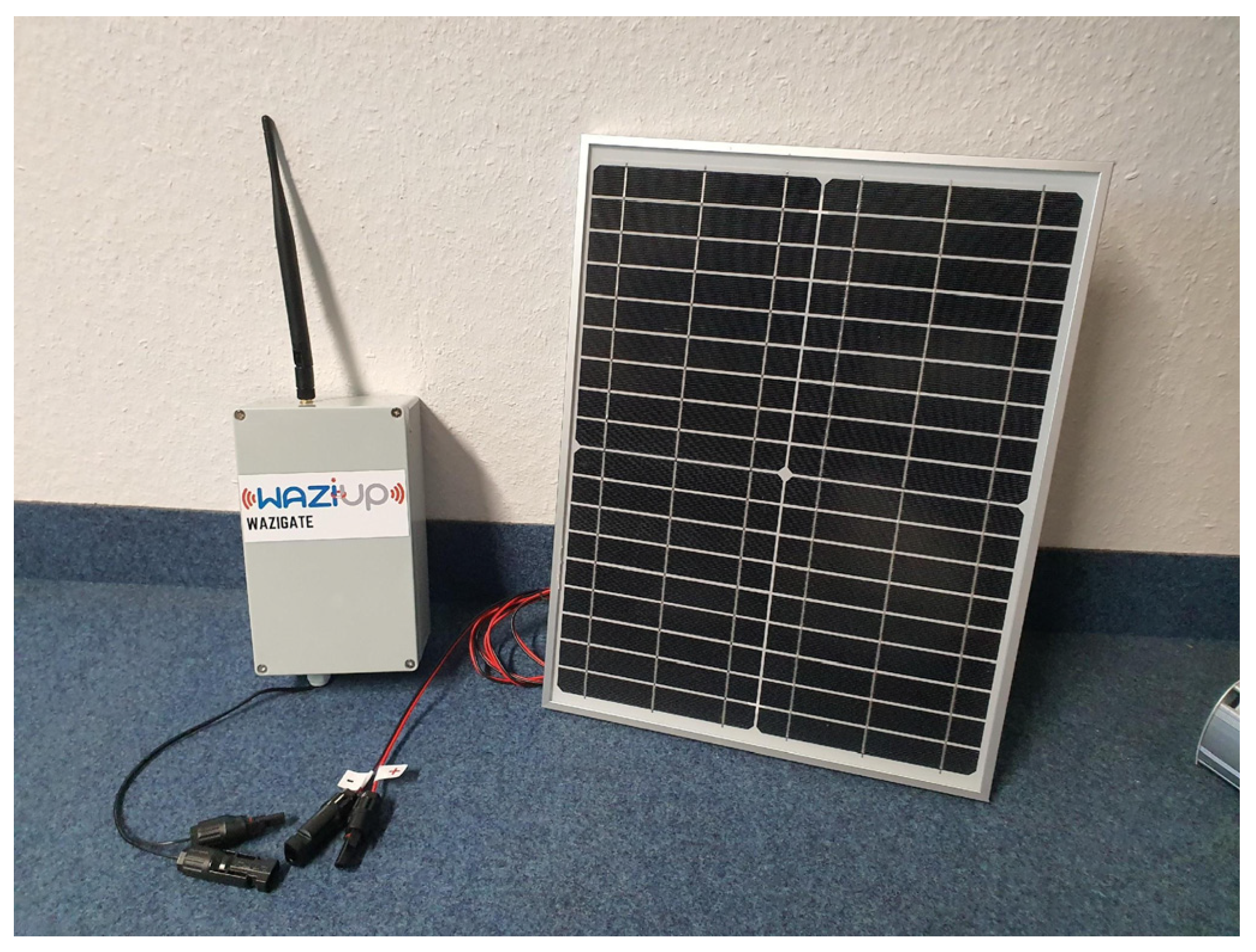
The WaziGate IoT LoRa gateway (Figure 4) connects up to 100 sensor and actuator nodes and hosts edge applications directly on the device. It offers a LoRa range of up to 10–12 km and a WiFi hotspot for connectivity, and adapts to WiFi, 3G and Ethernet. Its embedded database and web-based visualization module enable remote management even without Internet access.
Figure 4.
WaziGate IoT LoRa gateway with its solar panel.
At the core of WaziSense, the embedded firmware orchestrates five tasks:
- Measurement execution: Sensor activation, data acquisition and conversion of raw readings into meaningful values;
- Calibration: Conversion of the raw readings into calibrated centibar values;
- LoRa data transmission: Formatting into LoRa packets and reliable transfer to the gateway;
- Energy management: Monitoring of the battery voltage and application of energy-saving measures;
- Low-battery adaptation: Lengthening of the transmission interval when the battery is low.
2.5. Edge Machine Learning Forecasting Model
Soil-water forecasting is performed by the open-source WaziApp “irrigation-prediction” application, which runs on the WaziGate at the edge; its full source code is publicly available under an Apache-2.0 license [15], making the forecasting component entirely reproducible. The pipeline is built on the PyCaret automated machine learning (AutoML) regression library [16] and proceeds as follows. Historical and forecast weather variables for the plot’s GPS location are retrieved from the open-meteo API (https://open-meteo.com; air temperature, relative humidity, precipitation, cloud cover, shortwave radiation, wind speed and direction, reference evapotranspiration, and soil temperature and moisture at several depths); these are combined with the in situ soil-tension and temperature series and with the recorded irrigation events. A rolling mean of the grouped soil-moisture signal is used as the prediction target.
The dataset is split while preserving temporal order and evaluated with a sliding-window (time-series) cross-validation. The forecasting relies on a standard, openly available AutoML framework (PyCaret [16]) and is not, in itself, a machine learning contribution of this work; the novelty of the study lies in the integration, low-cost implementation and field validation of the complete IoT sensing-and-decision platform. Using PyCaret’s compare_models routine, sixteen candidate regressors are trained and ranked by the coefficient of determination (linear, ridge, lasso, elastic-net, Bayesian-ridge and Huber regressions, k-nearest neighbors, decision tree, random forest, extra trees, AdaBoost, gradient boosting, XGBoost, LightGBM and CatBoost). Because no single algorithm performed best across the five test periods evaluated, the deployed predictor is not a single fixed model but an ensemble: the best-performing candidates are combined by blending and stacking, and the resulting stacked ensemble is tuned over predefined grids, finalized and deployed for edge inference. The main tuned hyper-parameters are the regularization strength and the intercept for the linear, ridge, lasso and elastic-net regressions; the number of trees (100–500), the maximum depth (up to 20) and the minimum samples per split and per leaf for the random-forest and extra-trees models; the number of trees, the learning rate (0.01–0.1), the maximum depth (2–7) and the sub-sampling ratio for the gradient-boosting, XGBoost, LightGBM and CatBoost models; the number of neighbors (3–11) for k-nearest neighbors; and the hidden-layer size and learning-rate schedule for the multilayer perceptron. The complete hyper-parameter grids are provided in the open-source code [15]. The implementation uses Python (version 3.9) with PyCaret, scikit-learn, XGBoost, CatBoost and TensorFlow/Keras (software environment and versions in the open-source code [15]), and the full design, model list and development are documented in the public OSIRRIS deliverables D3.1 and D3.2 [17], making the component fully reproducible. Model performance on unseen data is reported with the mean absolute error (MAE), root-mean-square error (RMSE), mean percentage error (MPE) and coefficient of determination (R2) (Section 3.5), and the day-before-irrigation recommendations were compared with the irrigation actually performed and reviewed by agronomic experts.
2.6. Irrigation Scheduling and Control Logic
Irrigation is scheduled from the forecast rather than from a fixed calendar. Following the FAO-56 soil-water-balance approach, root zone depletion is tracked and irrigation is planned so as to keep it between field capacity and the readily available water (RAW) threshold, the root zone being replenished towards field capacity after each event; deficit treatments apply a reduction coefficient to the crop evapotranspiration (ETc) [13,14]. Operationally, WaziApp forecasts the time at which the soil signal will cross a user-defined threshold and issues an irrigation recommendation; the corresponding water amount is applied through the WaziAct actuator, and the volume actually delivered is confirmed by a flow meter, with a tolerance of 20% and a verification window of about three hours. The stop condition is therefore the delivery of the computed, flow-meter-verified water amount that returns the root zone to the target soil-water status, rather than a fixed irrigation duration.
2.7. Experimental Sites and Deployment
The platform was tested and validated under Tunisian farming practices across three bioclimatic stages. Site 1 is the INRGREF experimental station at Cherfech, Grand Tunis (durum wheat). Site 2 is the INRGREF station at Oued Souhil, Nabeul (mean annual rainfall about 440 mm), on 27-year-old Washington Navel orange trees (Citrus sinensis L. Osbeck). Site 3 is the CFPA apple orchard at Sbeitla, Kasserine (525 m a.s.l.; semi-arid, mean rainfall about 254.8 mm), on the cultivars Galaxy and Richared. At each site, the WaziSense tensiometers were installed in the root zone at 20 and 40 cm depths, about 30 cm from the plant, consistent with the 0–40 cm root zone monitored in the related field trials [12,13]; the node exposes terminals for several probes, so additional depths (e.g., 60 cm) can be monitored where a deeper root zone requires it. Gravimetric soil sampling was used to establish the soil-water retention relationship. Two complementary sources of weather data were used. Daily meteorological variables recorded by a standard agro-meteorological station located within each experimental unit were used to compute reference evapotranspiration (ET0) with the FAO-56 Penman–Monteith equation and hence meet the crop water requirements of the trials [13,14]. Independently, the edge forecasting model does not require an on-site station: it retrieves historical and forecast weather variables for the plot GPS location from the open-meteo API, which keeps the deployed system low-cost and usable anywhere. Commercial 10HS capacitive probes coupled to a ZL6 data logger (METER Group, Pullman, WA, USA) were first used to build the training database; from December 2022, the WaziSense prototypes and the WaziGate platform were operated at the three sites under controlled deficit irrigation and partial root zone drying.
3. Results
3.1. Soil Matric Potential and Volumetric Water Content Dynamics
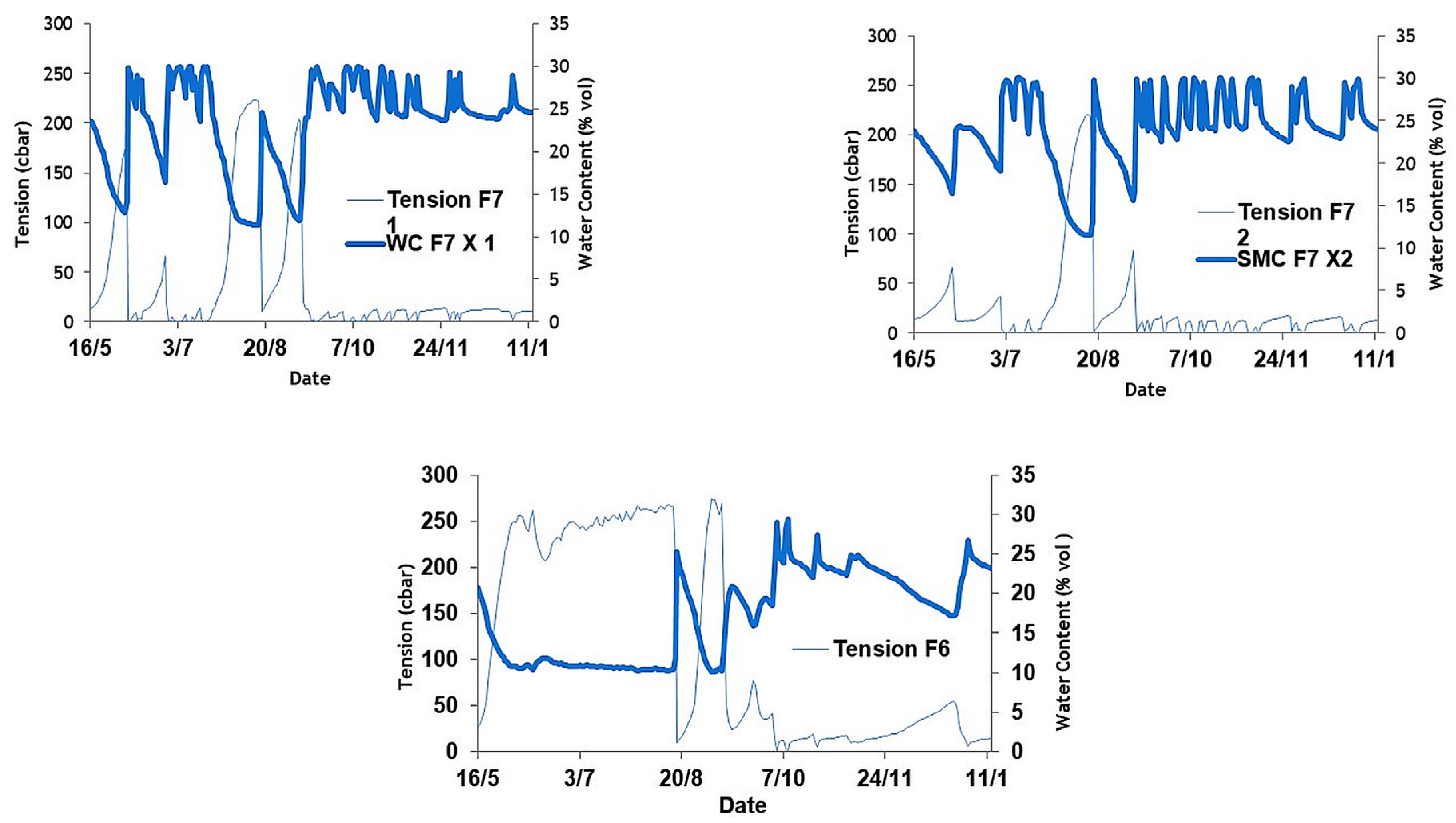
Figure 5 shows the temporal variations in soil matric potential (cbar) and volumetric soil-water content (% vol.) measured with WaziSense (Prototype 2). The device tracked the wetting and drying cycles of the root zone continuously and in real time, capturing the expected inverse relationship between matric potential and water content over the monitored period.
Figure 5.
Temporal variations in soil matric potential (cbar) and volumetric soil-water content (% vol.) measured with WaziSense (Prototype 2). Positions 1 and 2 denote the two monitored sensor locations; the blue line is the volumetric soil-water content.
3.2. Calibration and Reliability of the Readings
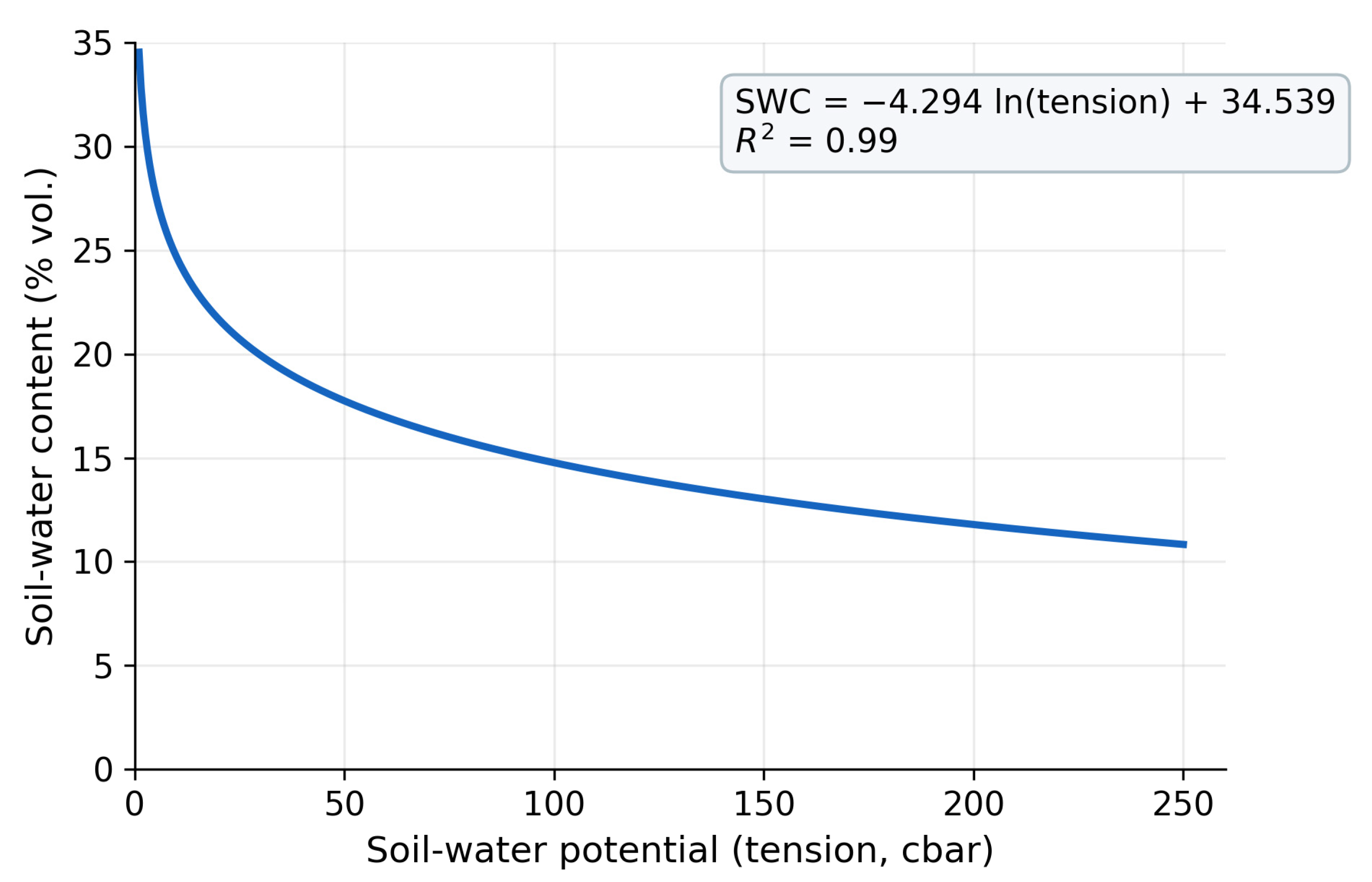
Figure 6 presents the relationship between soil-water content (% vol.) and soil-water potential (cbar) measured with WaziSense during the 2023–2024 cropping season. A strong logarithmic relationship was obtained (SWC = −4.294 ln(tension) + 34.539), with a coefficient of determination of R2 = 0.99, confirming the reliability and internal consistency of the calibrated readings.
Figure 6.
Calibration curve relating volumetric soil-water content (% vol.) to soil-water potential (cbar) (2023–2024; R2 = 0.99).
3.3. Daily Root Zone Water Depletion
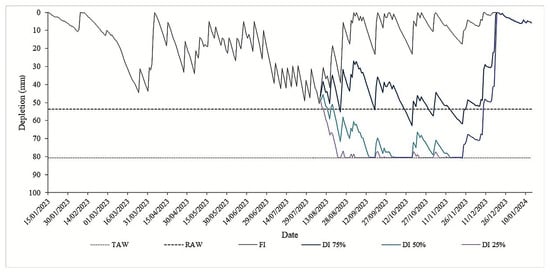
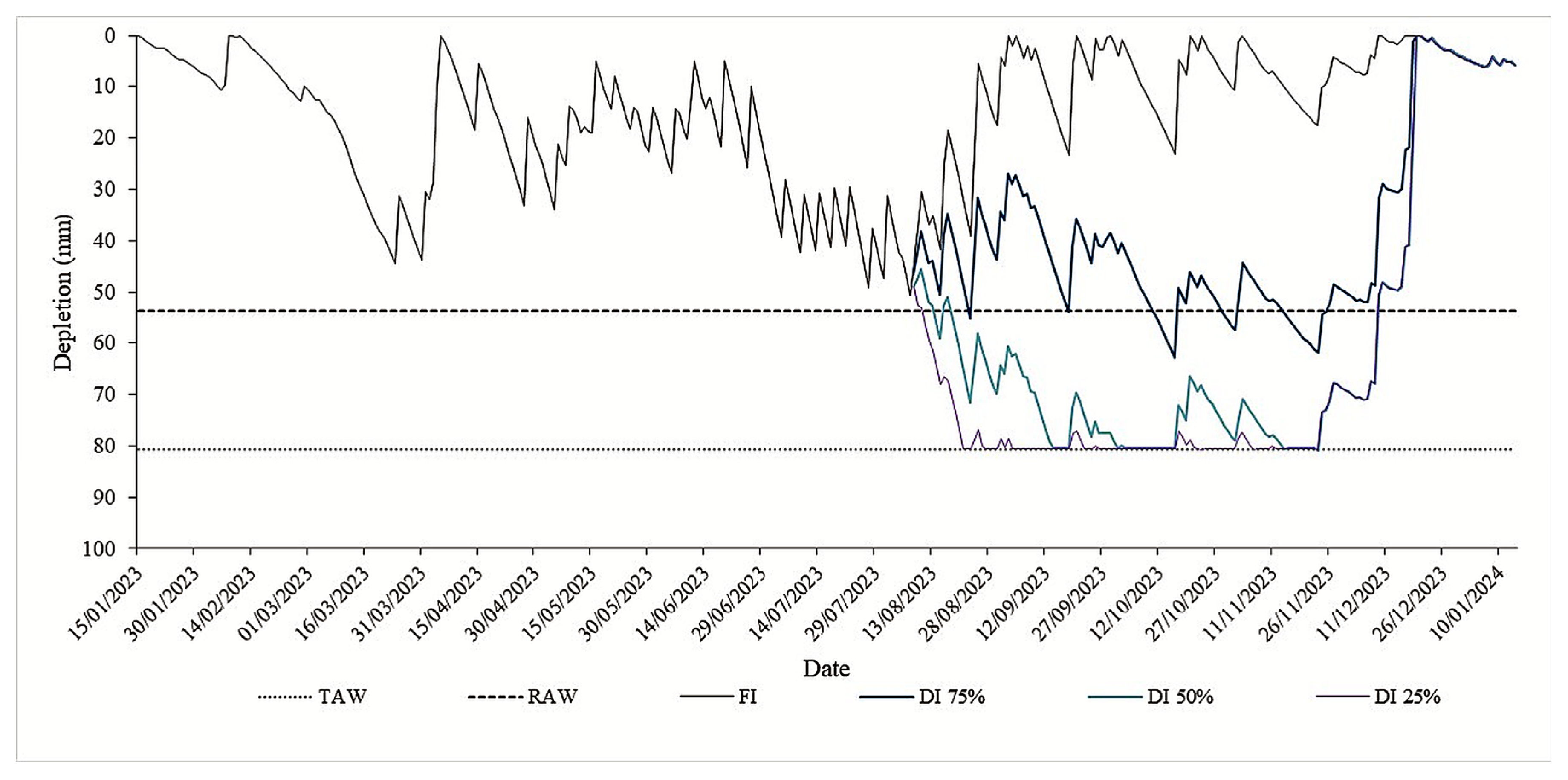
Figure 7 shows the daily dynamics of water depletion (mm) in the root zone under full irrigation (FI) and deficit irrigation at 75%, 50% and 25% of ETc. WaziSense resolved the day-to-day depletion relative to the total available water (TAW) and readily available water (RAW) thresholds, showing how the deficit treatments progressively crossed the RAW threshold while the full-irrigation treatment remained within the readily available range, information that directly supports the timing of irrigation.
Figure 7.
Daily patterns of root zone water depletion (mm) under full irrigation (FI) and deficit irrigation (DI-75%, DI-50%, DI-25% ETc.), 2023–2024 (TAW: total available water, 80 mm; RAW: readily available water, 54 mm). Adapted from [14].
3.4. Validation Against a Commercial Reference Probe
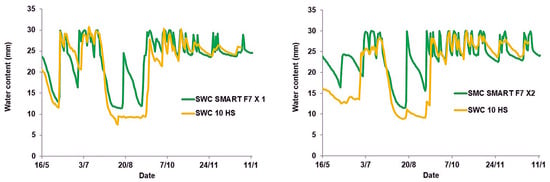
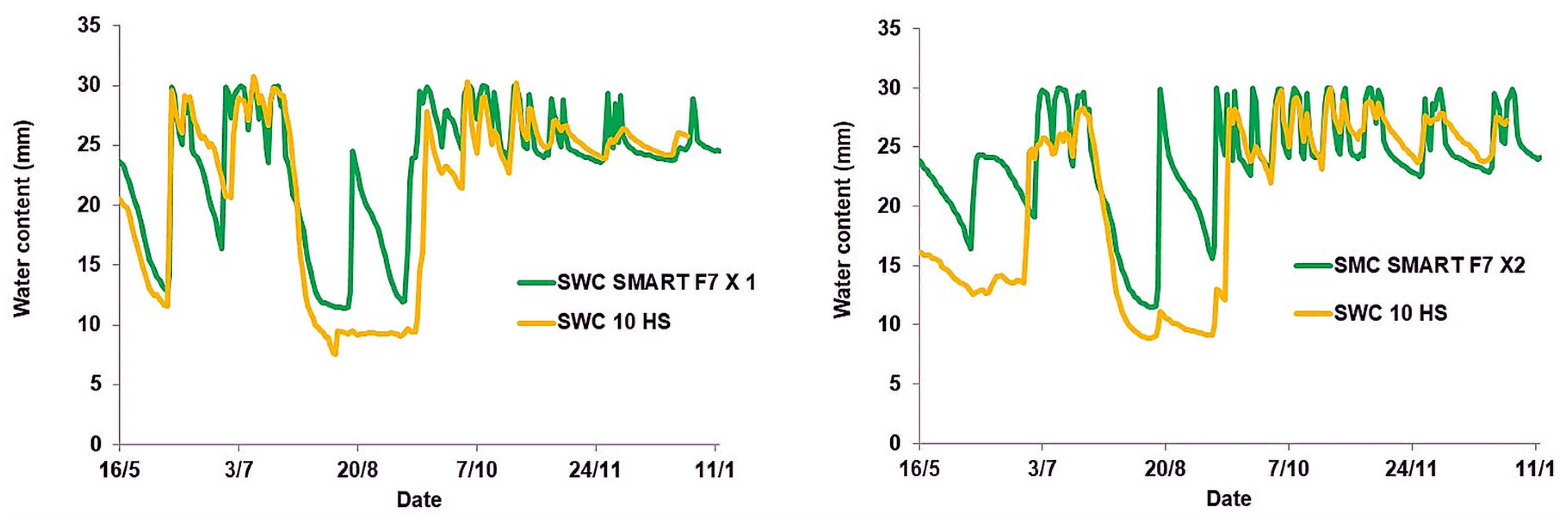
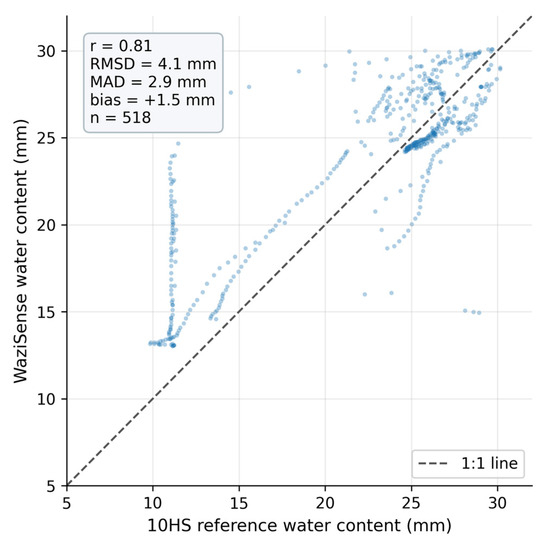
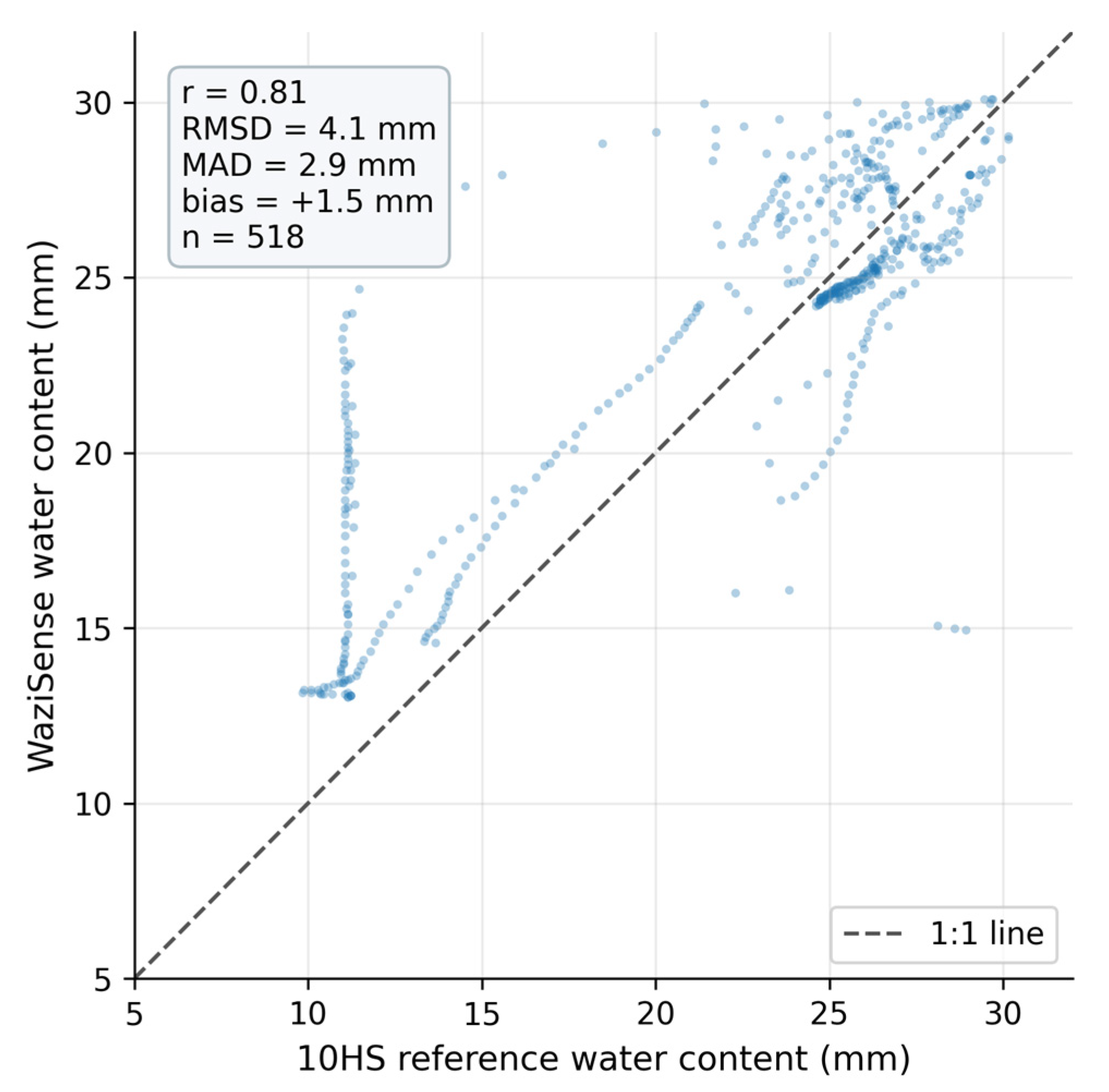
The WaziSense readings were validated against commercial 10HS capacitive probes coupled to a ZL6 data logger, installed alongside the smart tensiometers at 20 and 40 cm depths. Figure 8 shows the soil-water content measured simultaneously by the 10HS reference and by WaziSense (Prototype 2): the two instruments followed the same wetting and drying dynamics closely throughout the monitoring period, confirming that the low-cost device reproduces the soil-water status given by an established commercial system. A quantitative comparison of the two co-located series over the monitoring period showed that they were significantly correlated (correlation coefficient r = 0.81), with a root-mean-square difference of the order of 4 mm, a mean absolute difference of about 2.9 mm and a small positive bias (the WaziSense reading was, on average, about 1.5 mm wetter than the 10HS reference) (Figure 9).
Figure 8.
Soil-water content (mm) measured simultaneously by the commercial 10HS/ZL6 reference probe and by WaziSense (Prototype 2) at two sensor positions.
Figure 9.
Scatter plot of the water content measured by WaziSense against the commercial 10HS/ZL6 reference over the monitoring period, with the 1:1 line and the agreement statistics (r: correlation coefficient; RMSD: root-mean-square difference; MAD: mean absolute difference; n: number of paired observations).
3.5. Edge Forecasting Performance
The retained stacked-ensemble model was evaluated on unseen data at the Sbeitla apple site for a 5-day forecast horizon, with the rolling-mean soil-moisture signal as a target. The performance metrics on the test set are summarized in Table 1: the model reproduced the soil-water dynamics with a coefficient of determination of R2 = 0.73, an RMSE of 0.35, an MAE of 0.23 and an MPE of 12.52%, providing actionable forecasts of soil-water depletion for irrigation scheduling.
Table 1.
Performance of the retained edge machine learning model on unseen test data (target: rolling-mean soil-moisture signal).
3.6. Energy Autonomy and Communication
Operating at 2.5 mA in deep-sleep mode (about 10 mWh) and harvesting energy through the MPPT solar stage, WaziSense maintained continuous 15 min logging throughout the monitoring period. On AA batteries alone, autonomy increased from about two months for the first-generation node to about six months for the second-generation node, and the 6 V/1 W panel recharged the buffer cell in about 9 h under optimal conditions. The super-capacitor variant transmitted more than 100 messages at spreading factor 12 on a single charge, and the WaziGate gateway provided a LoRa range of up to 10–12 km, ensuring reliable communication across the three sites.
3.7. Cost Analysis
At representative component prices, the material cost of a WaziSense node is under 90 EUR, in agreement with the figure reported for the same device in the related field studies [12]; the itemized procurement record used here (Table 2), which includes import costs, totals about 110 EUR. In either case, the node is comparable to previously reported low-cost prototypes (76 USD [11]; about 72 EUR [18]) and one to two orders of magnitude below commercial soil-moisture telemetry stations, the price of which ranges from several hundred to several thousand Euros. The shared WaziGate gateway adds about 74 EUR and serves up to 100 nodes.
Table 2.
Bill of materials of a WaziSense node and the shared WaziGate gateway (actual project procurement, OSIRRIS, 2022), and cost comparison with commercial soil-moisture monitoring solutions.
4. Discussion
The strong agreement between soil-water content and soil-water potential (R2 = 0.99) confirms that the calibrated WaziSense provides internally consistent readings of the soil-water status, in line with granular-matrix sensors and previous low-cost IoT tensiometers [11]. The close agreement with the commercial 10HS/ZL6 reference (Figure 8) shows that the low-cost device reproduces the soil-water dynamics of an established system, while the edge AutoML model anticipated those dynamics on unseen data with R2 = 0.73 and RMSE = 0.35, consistent with the range reported for IoT-based irrigation models [8,10].
Triggering irrigation from the soil-water status and from a forecast of threshold crossing is a well-established and effective approach [10,11]. It nevertheless has a known limitation: because root zone moisture is not uniformly distributed, soil-moisture-only control can lead either to salt accumulation or to water waste. More advanced, crop-water-demand-based strategies have already been demonstrated in practice. In particular, Kocian et al. base irrigation control on crop water demand rather than on a fixed soil-moisture threshold: they combine a dynamic Bayesian-network prediction of the crop coefficient (crop evapotranspiration) with automated lysimetry to regulate the irrigation duration through a target leaching fraction, quantitatively reducing irrigation water use and runoff under field conditions [19]; comparisons of soil-moisture- and weather-based scheduling with other advanced IoT irrigation-management approaches have likewise been reported [20,21]. Compared with these methods, the advantages of WaziSense are its very low cost (under 90 EUR per node), its energy autonomy and its fully open hardware and software, which make the whole sensing-and-decision chain affordable and reproducible. Its main limitations, relative to the weighing-lysimeter approach, are that it derives crop water requirements from the FAO-56 water balance using standard, tabulated crop coefficients rather than from a dynamically predicted crop coefficient, and that it does not measure drainage or regulate the leaching fraction. Integrating crop-coefficient prediction and leaching-fraction-based control into the WaziSense platform is therefore a clear and worthwhile next step. Positioned within the Agriculture 4.0/5.0 framework [3,4], the main strengths of the present device are its very low cost, its energy autonomy, and, importantly, the full openness of both hardware and software, which make the whole sensing-and-decision chain reproducible and lower the barrier to large-scale, data-driven irrigation.
Three design choices further differentiate WaziSense from earlier work. First, the edge-computing architecture and on-device calibration reduce the dependence on permanent connectivity and paid cloud subscriptions, which have previously limited cloud-centric systems [10]. Second, the MPPT solar stage and the lower consumption of the second-generation node extend the maintenance-free autonomy from about two to about six months, addressing the portability and installation constraints that hinder sensor adoption [2]. Third, the use of widely available components keeps the node cost under about 90 EUR (Table 2 and reference [12]), a prerequisite for large-scale uptake. Validated across three bioclimatic sites and three crops (durum wheat, citrus and apple), the device already underpins the agronomic outcomes reported within the OSIRRIS framework [12,13,14]. Remaining limitations include the single-season scope of the forecasting evaluation and the need to consolidate the metrological comparison over additional seasons and depths.
5. Conclusions
This work presented WaziSense, a low-cost, solar-powered IoT smart tensiometer with an edge forecasting model, developed and validated within the OSIRRIS platform at three bioclimatic sites in Tunisia. The device delivered reliable, real-time monitoring of soil matric potential and volumetric water content (calibration R2 = 0.99), agreed closely with a commercial 10HS/ZL6 reference at 20 and 40 cm depth, and forecasted soil-water dynamics on unseen data with R2 = 0.73 using a fully open-source AutoML pipeline. Combining an edge-computing architecture, solar-powered autonomy of up to six months, open hardware and software, and a material cost of under about 90 EUR per node, WaziSense offers an affordable, reproducible and scalable tool for soil-water monitoring and irrigation scheduling in water-limited agriculture. Future work will extend the multi-season validation, integrate weighing- and leaching-fraction-based control, and quantify the water savings achievable under operational farm conditions.
Author Contributions
Conceptualization, H.B.A., M.R. and M.A.B.A.; methodology, H.B.A. and M.R.; hardware, firmware and software, F.M., M.A.R. and C.D.; calibration and investigation, H.B.A., M.B. and M.A.B.A.; validation, L.N. and M.R.; formal analysis, H.B.A. and L.N.; writing—original draft, H.B.A. and L.N.; writing—review and editing, L.N., M.R. and all authors; supervision, M.R. and M.A.R.; project administration, M.R.; funding acquisition, M.R., M.A.R. and C.D. All authors have read and agreed to the published version of the manuscript.
Funding
This research was carried out within the OSIRRIS project (TUNGER 2+2 bilateral cooperation, grant 20_046, 2022–2025), funded by the German Federal Ministry of Education and Research (BMBF) and the Tunisian Ministry of Higher Education and Scientific Research and by the EcofertiSH project through PRIMA 2 grant agreement number ANR-24-P013-0010.
Institutional Review Board Statement
Not applicable.
Informed Consent Statement
Not applicable.
Data Availability Statement
The data presented in this study are available on request from the corresponding author. The source code of the forecasting application is openly available at https://github.com/Waziup/waziup.irrigation-prediction (accessed on 1 July 2026).
Acknowledgments
The authors thank the technical staff of INRGREF and INRAT and the OSIRRIS partners (Waziup e.V., INNOTEC21) for their support during the field deployment.
Conflicts of Interest
Authors F.M., M.A.R. and C.D. are affiliated with Waziup e.V., which is involved in the development of the device described. The remaining authors declare no conflicts of interest.
Abbreviations
The following abbreviations are used in this manuscript:
| API | Application Programming Interface |
| ASA | Acrylonitrile Styrene Acrylate |
| AutoML | Automated Machine Learning |
| CDI | Controlled Deficit Irrigation |
| ET0 | Reference Evapotranspiration |
| ETc | Crop Evapotranspiration |
| FAO-56 | FAO Irrigation and Drainage Paper 56 |
| IoT | Internet of Things |
| IP55 | Ingress Protection rating 55 |
| LoRa | Long Range (radio modulation) |
| LoRaWAN | Long Range Wide Area Network |
| MAE | Mean Absolute Error |
| ML | Machine Learning |
| MPE | Mean Percentage Error |
| MPPT | Maximum Power Point Tracking |
| OSIRRIS | Precision Irrigation with Cost-effective and Autonomic IoT at the Edge (project) |
| PRD | Partial Root-zone Drying |
| RAW | Readily Available Water |
| RMSE | Root Mean Square Error |
| SWC | Soil Water Content |
| TAW | Total Available Water |
| WaziAct | Waziup actuation module |
| WaziApp | Waziup edge application |
| WaziGate | Waziup IoT LoRa gateway |
| WaziSense | Waziup smart-tensiometer sensor node |
References
- Hardie, M. Review of Novel and Emerging Proximal Soil Moisture Sensors for Use in Agriculture. Sensors 2020, 20, 6934. [Google Scholar] [CrossRef] [Scilit] [PubMed]
- Babaeian, E.; Sadeghi, M.; Jones, S.B.; Montzka, C.; Vereecken, H.; Tuller, M. Ground, Proximal, and Satellite Remote Sensing of Soil Moisture. Rev. Geophys. 2019, 57, 530–616. [Google Scholar] [CrossRef] [Scilit]
- Liu, Y.; Ma, X.; Shu, L.; Hancke, G.P.; Abu-Mahfouz, A.M. From Industry 4.0 to Agriculture 4.0: Current Status, Enabling Technologies, and Research Challenges. IEEE Trans. Ind. Inform. 2021, 17, 4322–4334. [Google Scholar] [CrossRef] [Scilit]
- Fraser, E.D.G.; Campbell, M. Agriculture 5.0: Reconciling Production with Planetary Health. One Earth 2019, 1, 278–280. [Google Scholar] [CrossRef] [Scilit]
- Susha Lekshmi, S.U.; Singh, D.N.; Shojaei Baghini, M. A critical review of soil moisture measurement. Measurement 2014, 54, 92–105. [Google Scholar] [CrossRef] [Scilit]
- Garcia, L.; Parra, L.; Jimenez, J.M.; Lloret, J.; Lorenz, P. IoT-Based Smart Irrigation Systems: An Overview on the Recent Trends on Sensors and IoT Systems for Irrigation in Precision Agriculture. Sensors 2020, 20, 1042. [Google Scholar] [CrossRef] [Scilit] [PubMed]
- Vij, A.; Vijendra, S.; Jain, A.; Bajaj, S.; Bassi, A.; Sharma, A. IoT and Machine Learning Approaches for Automation of Farm Irrigation System. Procedia Comput. Sci. 2020, 167, 1250–1257. [Google Scholar] [CrossRef] [Scilit]
- Goap, A.; Sharma, D.; Shukla, A.K.; Krishna, C.R. An IoT based smart irrigation management system using machine learning and open source technologies. Comput. Electron. Agric. 2018, 155, 41–49. [Google Scholar] [CrossRef] [Scilit]
- Barkunan, S.R.; Bhanumathi, V.; Sethuram, J. Smart sensor for automatic drip irrigation system for paddy cultivation. Comput. Electr. Eng. 2019, 73, 180–193. [Google Scholar] [CrossRef] [Scilit]
- Abioye, E.A.; Abidin, M.S.Z.; Mahmud, M.S.A.; Buyamin, S.; Ishak, M.H.I.; Rahman, M.K.I.A.; Otuoze, A.O.; Onotu, P.; Ramli, M.S.A. A review on monitoring and advanced control strategies for precision irrigation. Comput. Electron. Agric. 2020, 173, 105441. [Google Scholar] [CrossRef] [Scilit]
- Abdelmoneim, A.A.; Khadra, R.; Derardja, B.; Dragonetti, G. Internet of Things (IoT) for Soil Moisture Tensiometer Automation. Micromachines 2023, 14, 263. [Google Scholar] [CrossRef] [Scilit] [PubMed]
- Bakri, M.; Guizani, M.; Maatallah, S.; Elloumi, O.; Rezig, M. Use of smart tensiometers for monitoring different deficit irrigation strategies in two young apple cultivars in Tunisia: Comparison of physiological and pomological behavior. Front. Agron. 2026, 7, 1666801. [Google Scholar] [CrossRef] [Scilit]
- Belkher, S.; Latrech, B.; Bekri, W.; Markwordt, F.; Rahim, M.A.; Dupont, C.; Ben Abdallah, M.A.; Daghari, H.; Rezig, M. Deficit Irrigation and an IoT-Based System for Improving Yield and Water Use Efficiency of Winter Wheat Grown Under Semi-Arid Conditions. Agronomy 2025, 15, 157. [Google Scholar] [CrossRef] [Scilit]
- Belkher, S.; Latrech, B.; Rezig, M.; Bouhlal, R.; Bekri, W.; Markwordt, F.; Dupont, C.; Rahim, M.A.; Daghari, H.; Ben Abdallah, M.A. Effects of partial root-zone drying and deficit irrigation on yield, quality and water productivity of Washington Naval orange. J. Ecol. Eng. 2025, 26, 12–27. [Google Scholar] [CrossRef] [Scilit] [PubMed]
- Waziup e.V. WaziApp Irrigation-Prediction: Open-Source Soil-Moisture Forecasting and Irrigation-Scheduling Application for WaziGate (Apache-2.0 Licence). Available online: https://github.com/Waziup/waziup.irrigation-prediction (accessed on 6 July 2026).
- Ali, M. PyCaret: An Open-Source, Low-Code Machine Learning Library in Python. 2020. Available online: https://github.com/pycaret/pycaret (accessed on 6 July 2026).
- Waziup e.V. OSIRRIS Deliverables D3.1 (Design of the OSIRRIS Light-Weight AI Irrigation Model) and D3.2 (Report on the Development of the OSIRRIS Light-Weight AI Irrigation Model). Available online: https://www.waziup.org/research-innovation/projects/osirris/ (accessed on 7 July 2026).
- Thalheimer, M. A low-cost electronic tensiometer system for continuous monitoring of soil water potential. J. Agric. Eng. 2013, 44, e16. [Google Scholar] [CrossRef] [Scilit]
- Kocian, A.; Cela, F.; Carmassi, G.; Citti, S.; Malorgio, F.; Paganelli, F.; Chessa, S.; Milazzo, P.; Incrocci, L. Combining dynamic Bayesian prediction of the crop coefficient with automated lysimetry for highly accurate water-use control. Comput. Electron. Agric. 2026, 246, 111653. [Google Scholar] [CrossRef] [Scilit]
- Abdelmoneim, A.A.; Al Kalaany, C.M.; Dragonetti, G.; Derardja, B.; Khadra, R. Comparative Analysis of Soil Moisture- and Weather-Based Irrigation Scheduling for Drip-Irrigated Lettuce Using Low-Cost Internet of Things Capacitive Sensors. Sensors 2025, 25, 1568. [Google Scholar] [CrossRef] [Scilit] [PubMed]
- Abdelmoneim, A.A.; Kimaita, H.N.; Al Kalaany, C.M.; Derardja, B.; Dragonetti, G.; Khadra, R. IoT sensing for advanced irrigation management: A systematic review of trends, challenges, and future prospects. Sensors 2025, 25, 2291. [Google Scholar] [CrossRef] [Scilit] [PubMed]

Disclaimer/Publisher’s Note: The statements, opinions and data contained in all publications are solely those of the individual author(s) and contributor(s) and not of MDPI and/or the editor(s). MDPI and/or the editor(s) disclaim responsibility for any injury to people or property resulting from any ideas, methods, instructions or products referred to in the content. |
© 2026 by the authors. Licensee MDPI, Basel, Switzerland. This article is an open access article distributed under the terms and conditions of the Creative Commons Attribution (CC BY) license.