Research on Fire Source Recognition and Fire Extinguishing Algorithms Based on Multimodal Fusion and Lightweight Model Deployment


Abstract
1. Introduction
2. Related Work
2.1. Lightweight Object Detection for Fire Recognition
2.2. Multimodal Fusion Strategies for Fire Detection
2.3. Fire Suppression Control Strategies
3. System Overall Design
3.1. Design Concept
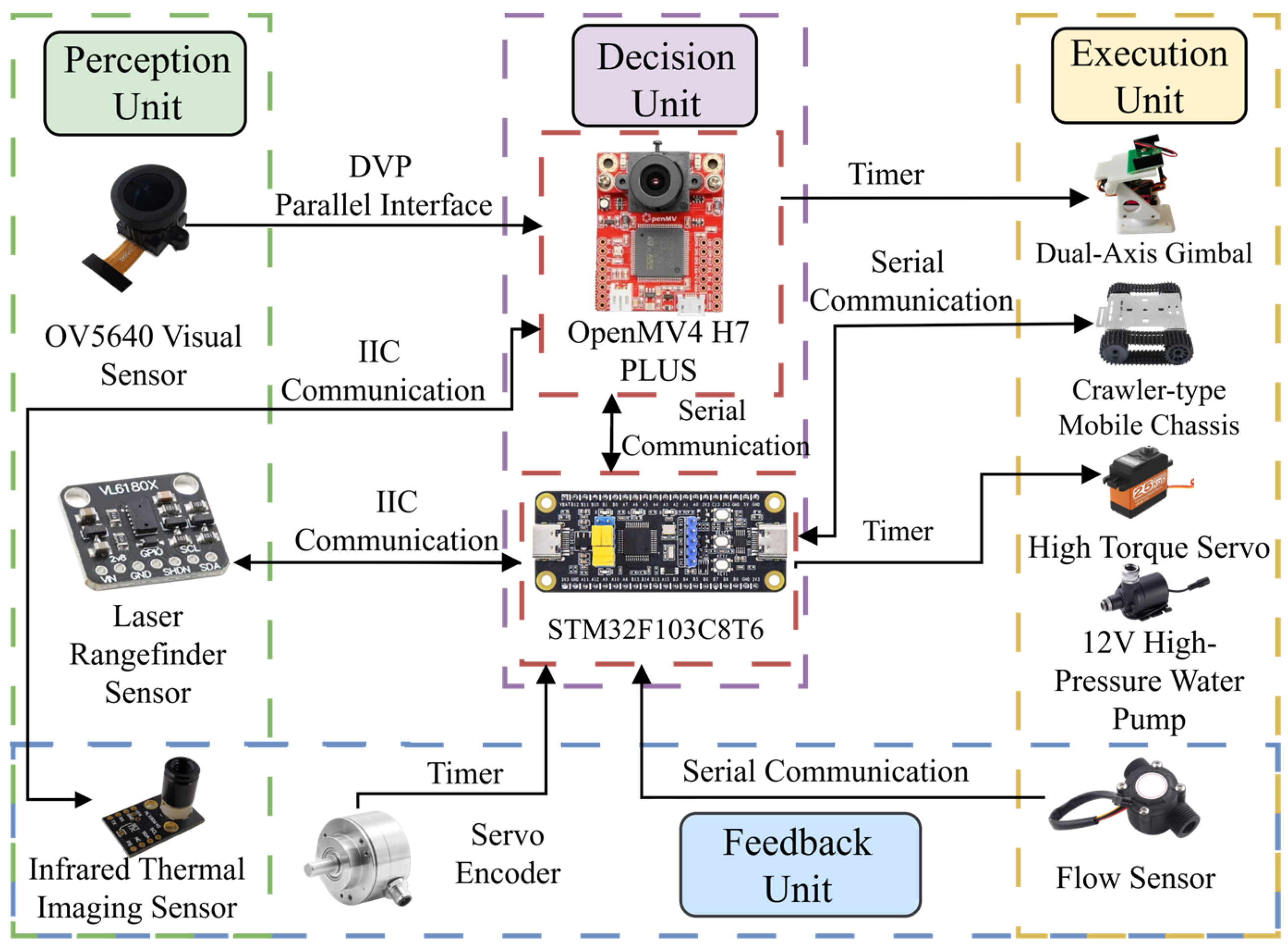
3.2. Hardware System Design
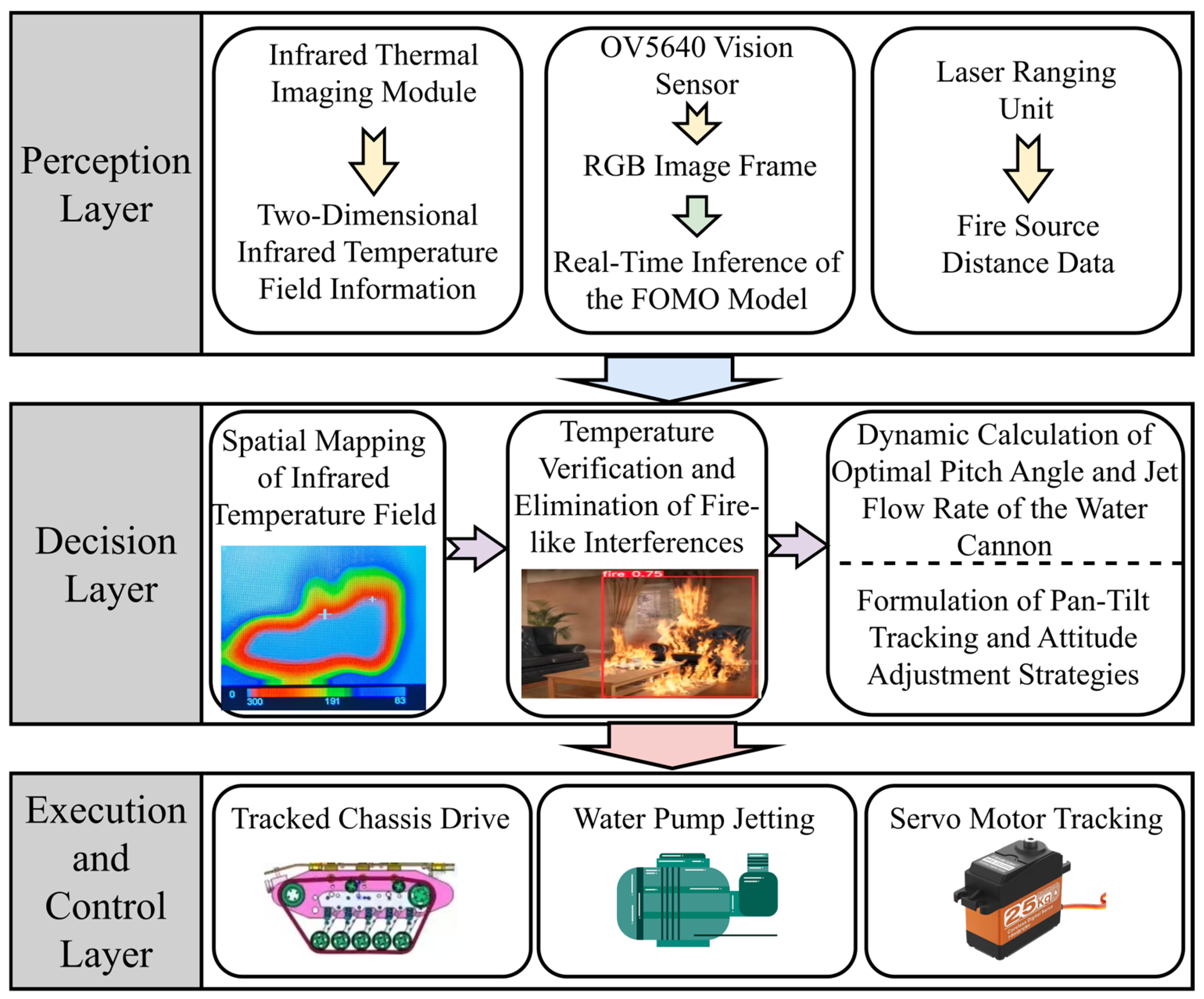
3.3. Software System Design
4. Research on Lightweight FOMO Model and Multimodal Fusion Algorithm
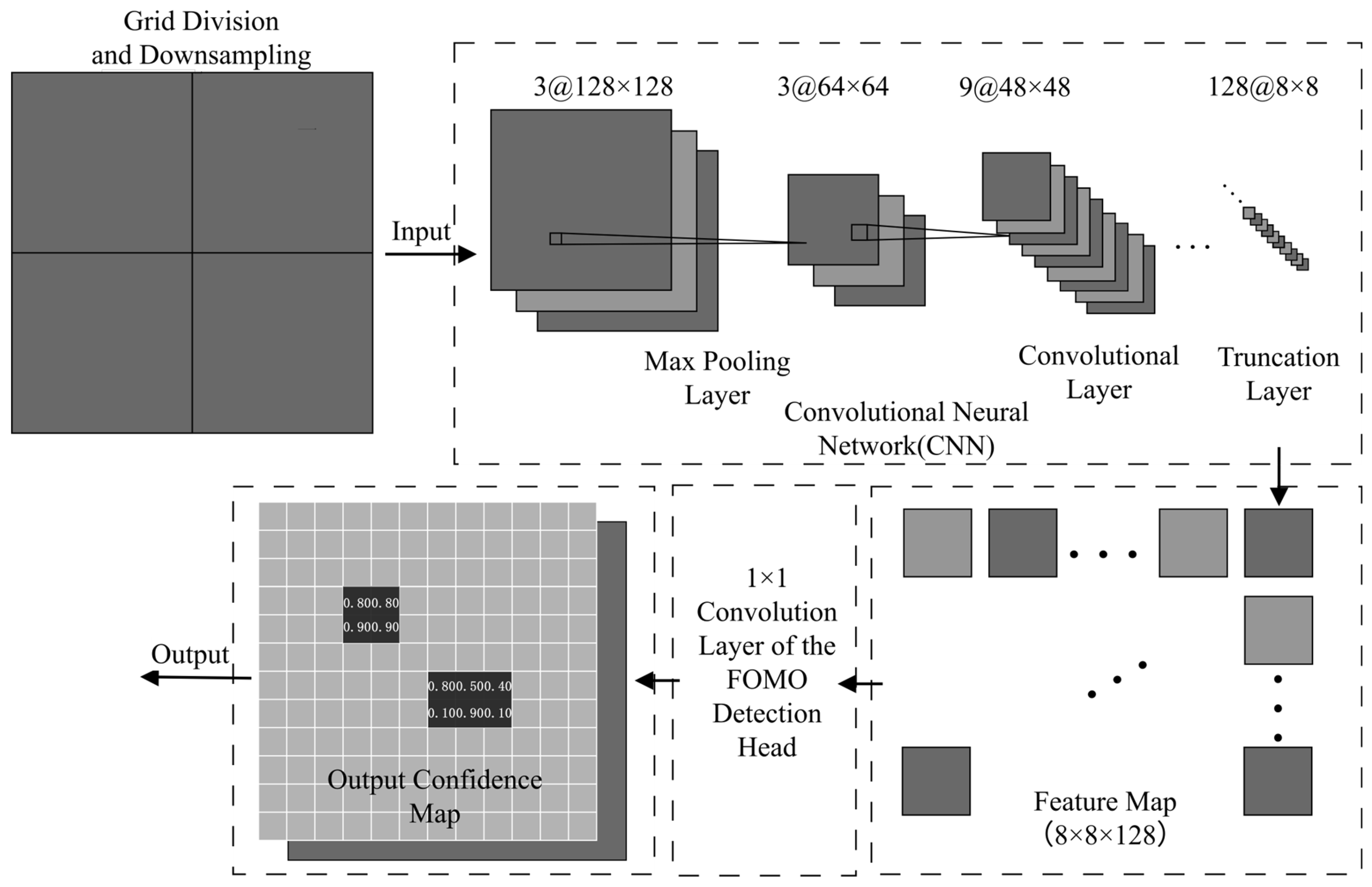
4.1. Overview of the FOMO Model
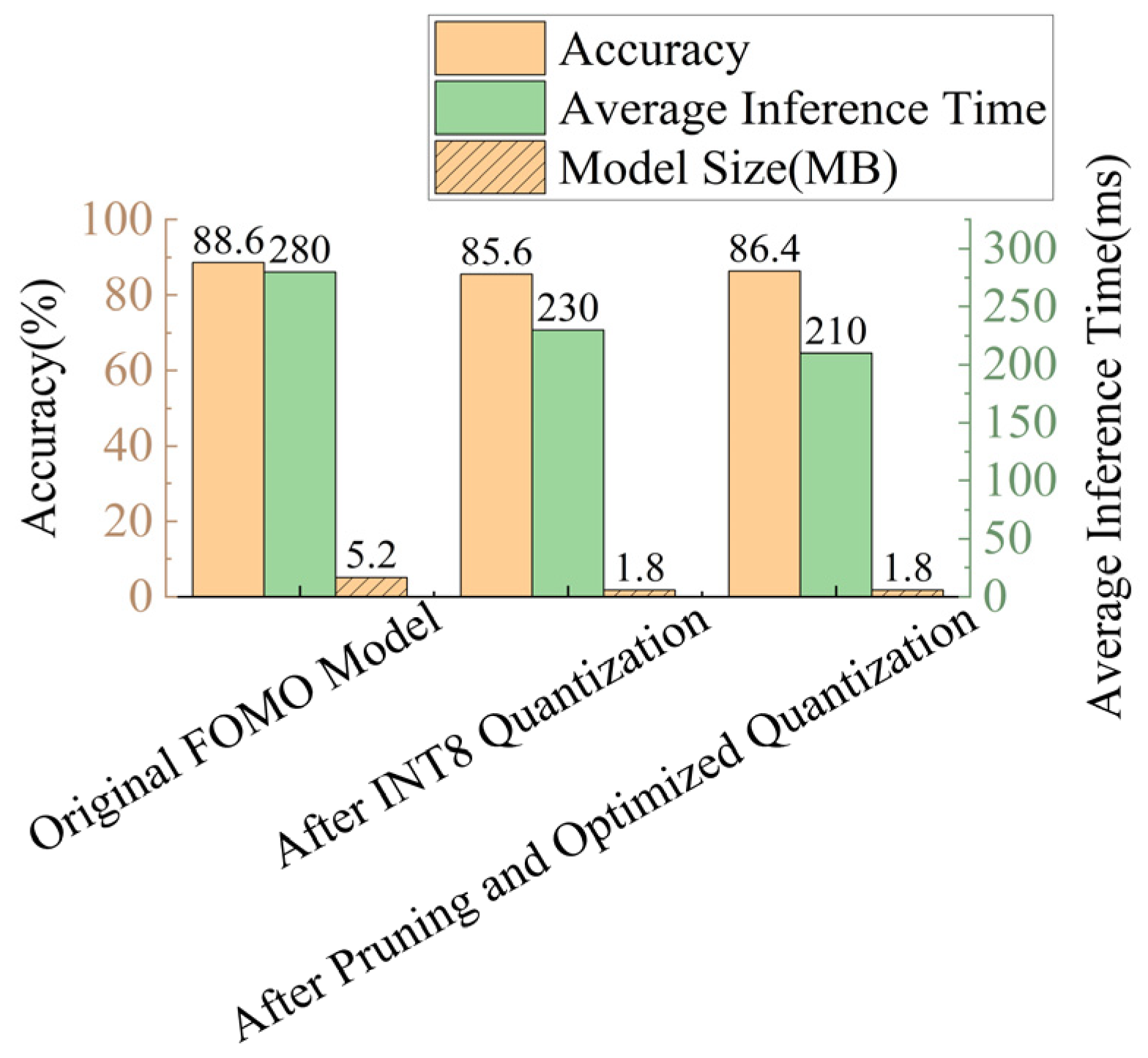
4.2. Quantization and Optimization of the FOMO Model
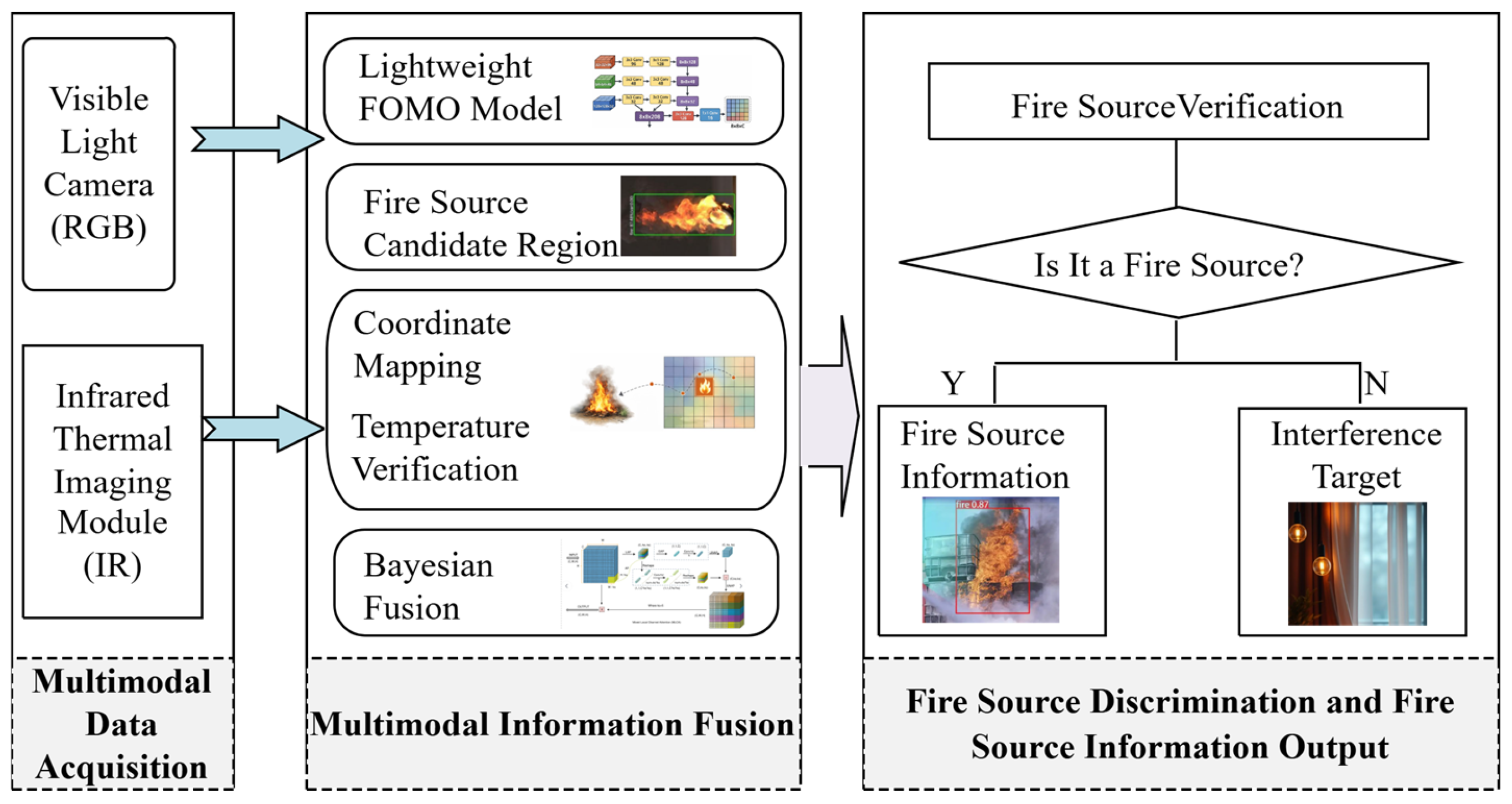
4.3. Design of Multimodal Information Fusion Algorithm
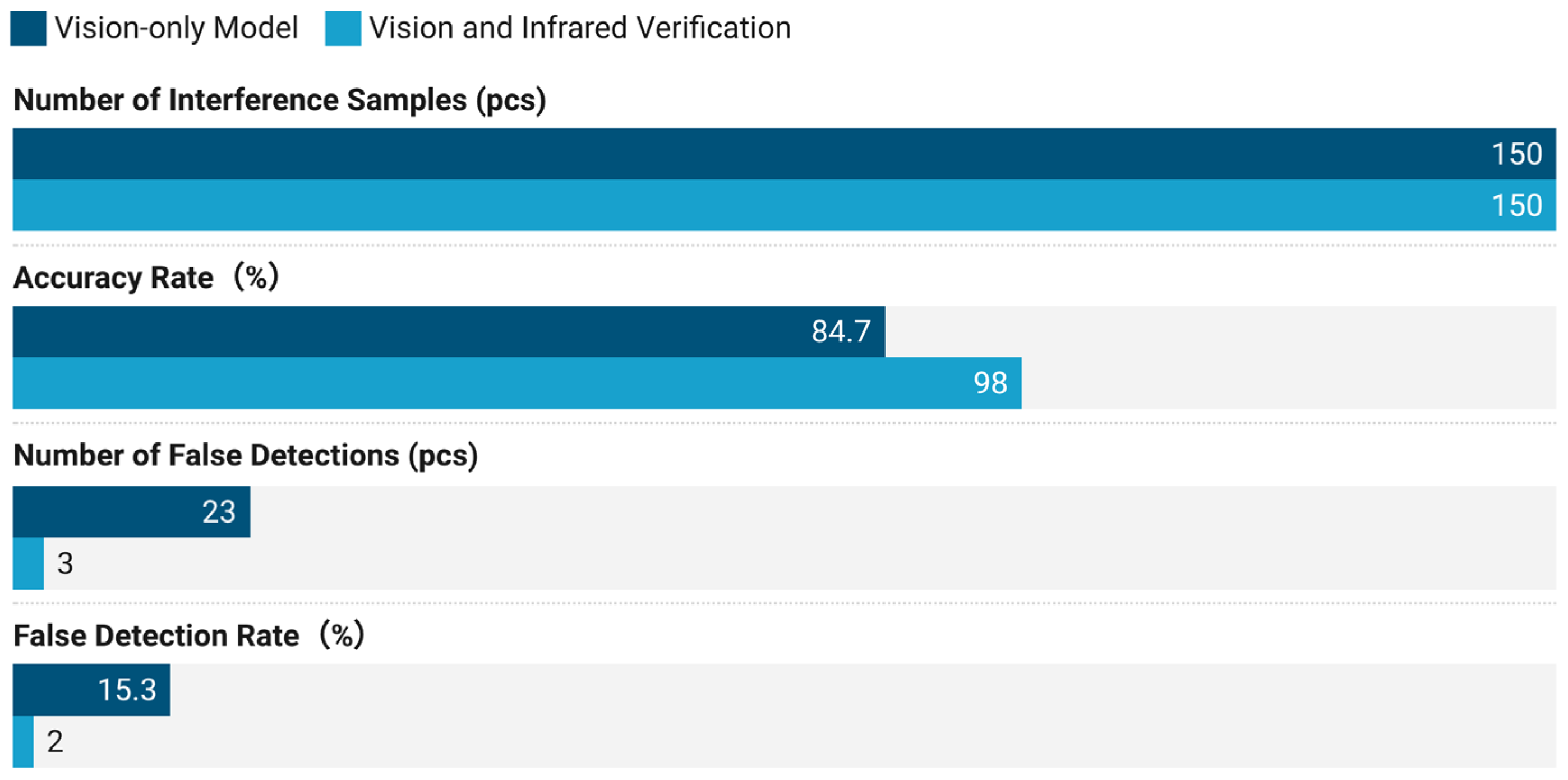
4.4. Performance Verification of Multimodal Fusion
5. Research on Jet Trajectory Modeling and Precision Fire Suppression Control Strategy
5.1. Mathematical Modeling of Jet Trajectory
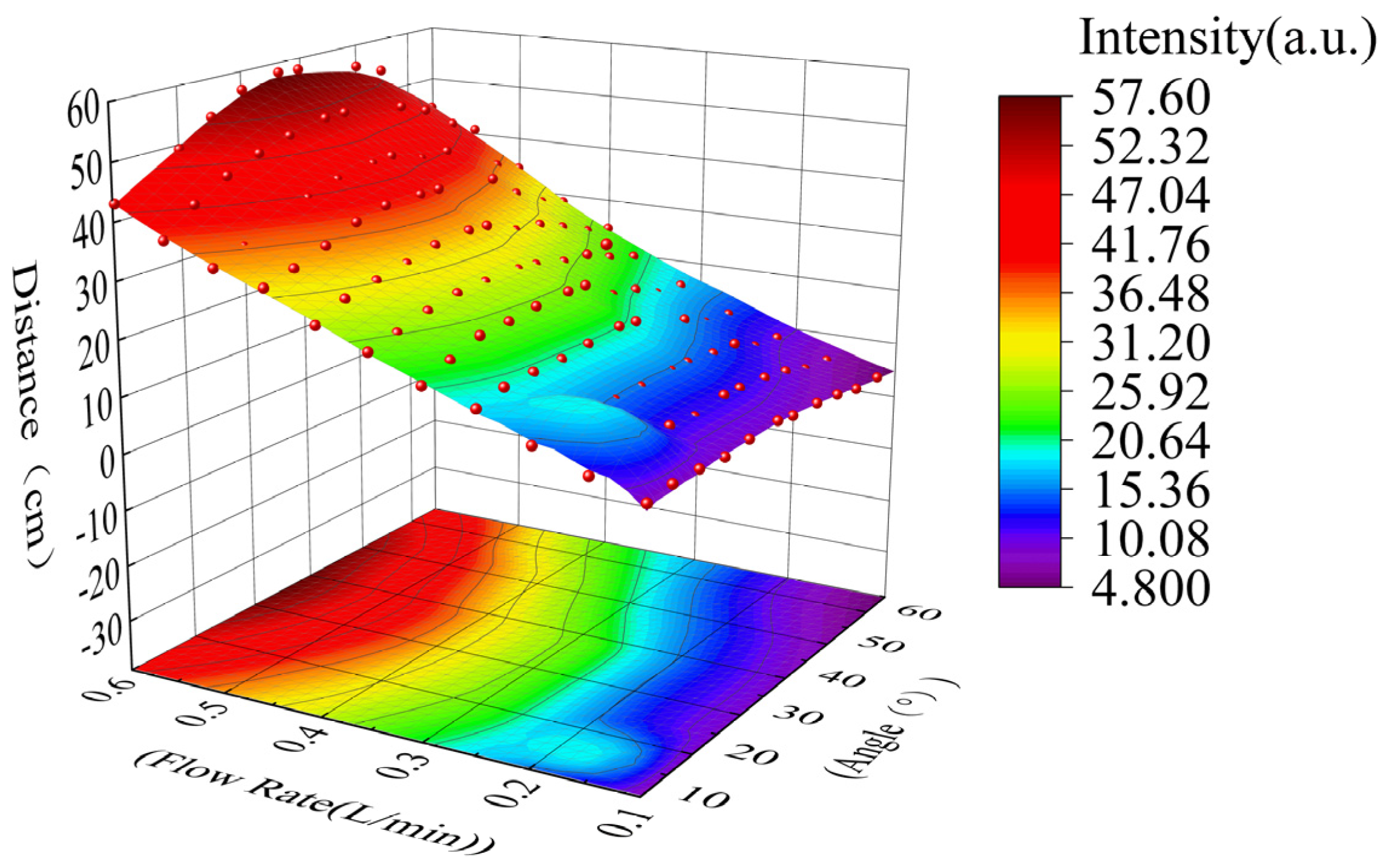
5.2. Data Analysis and Trajectory Fitting Model
5.3. Dynamic Range Calculation and Control Implementation
5.3.1. Dynamic Range Calculation and Control
5.3.2. PID Control Algorithm Optimization
5.3.3. Dynamic Flow Regulation and Control
5.3.4. Control System Performance Analysis
6. Experimental Verification and Result Analysis
6.1. Experimental Environment Setup
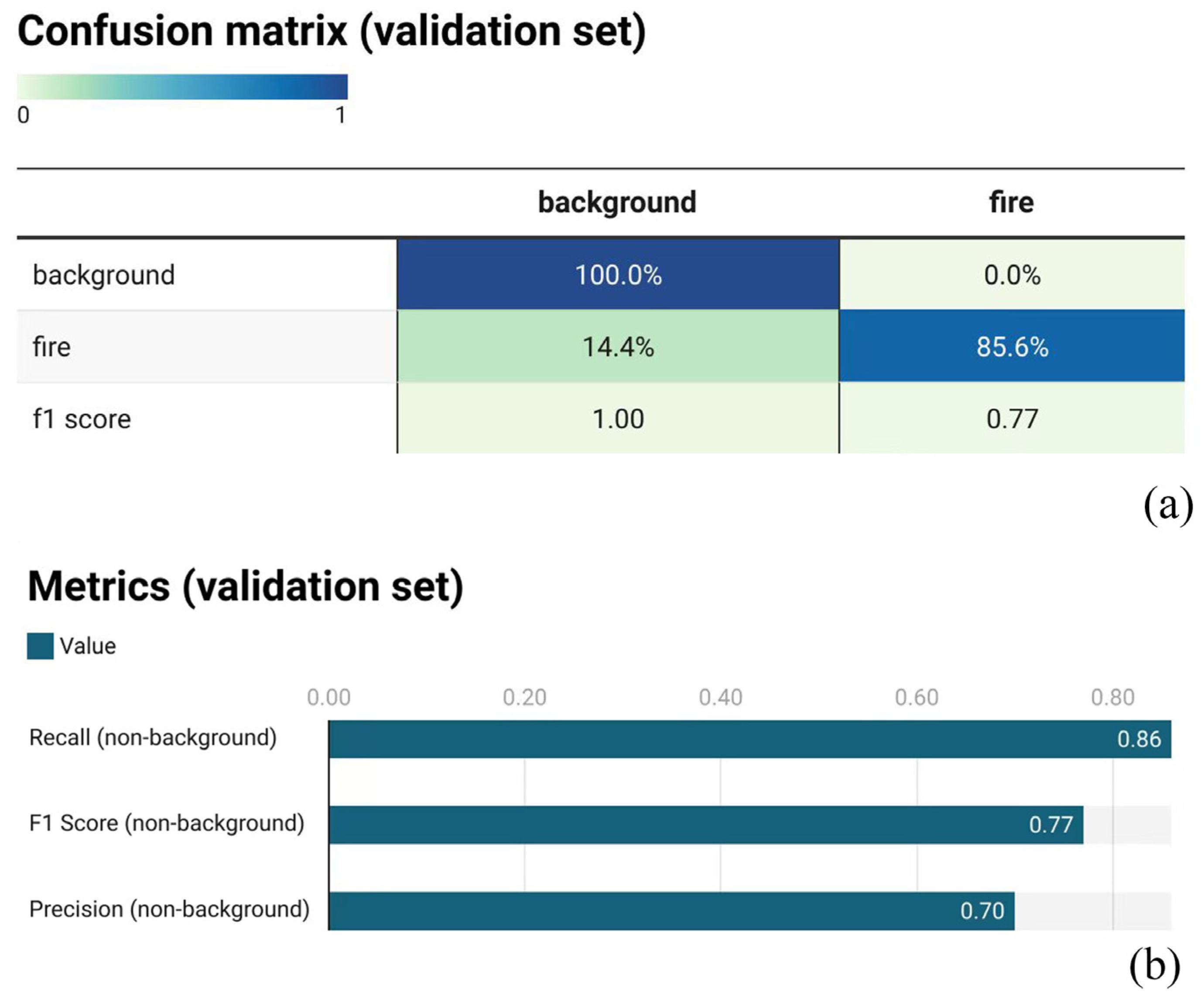
6.2. Fire Source Recognition Performance Testing
6.3. Overall System Performance Testing
6.4. Ablation Study: Component Contribution Analysis
6.5. Power Consumption and Energy Budget
7. Conclusions
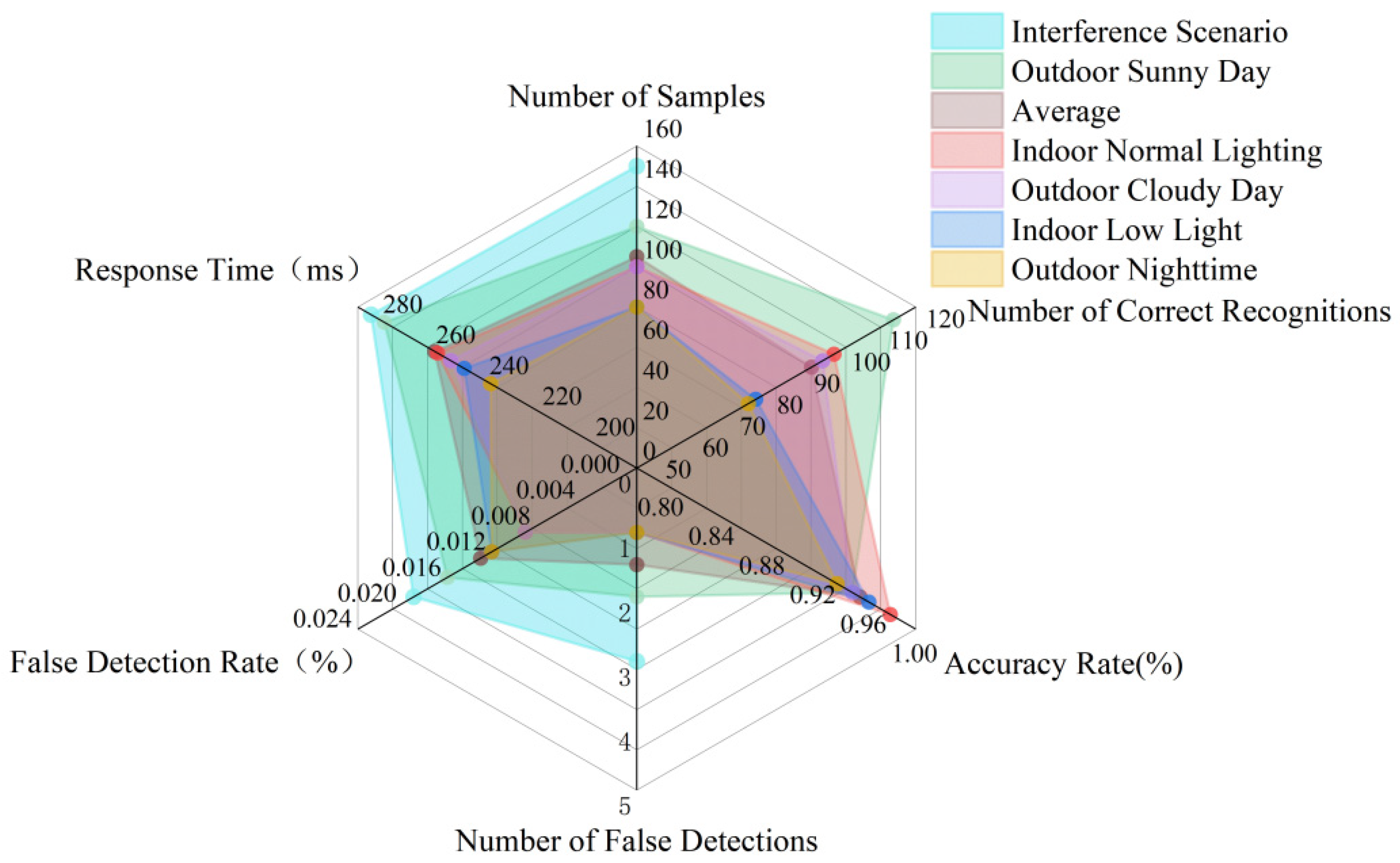
- A lightweight vision-infrared decision-level fusion recognition mechanism was proposed By fusing visible light images and infrared temperature information based on the Bayesian inference framework, combined with the FOMO model optimized via INT8 quantization and pruning, the system achieves an average recognition accuracy of 95.6% and a false alarm rate of 2.0% on interference-dominant scenarios and an average of 1.4% across all operational conditions, which significantly improves the robustness of the system in complex illumination and interference environments.
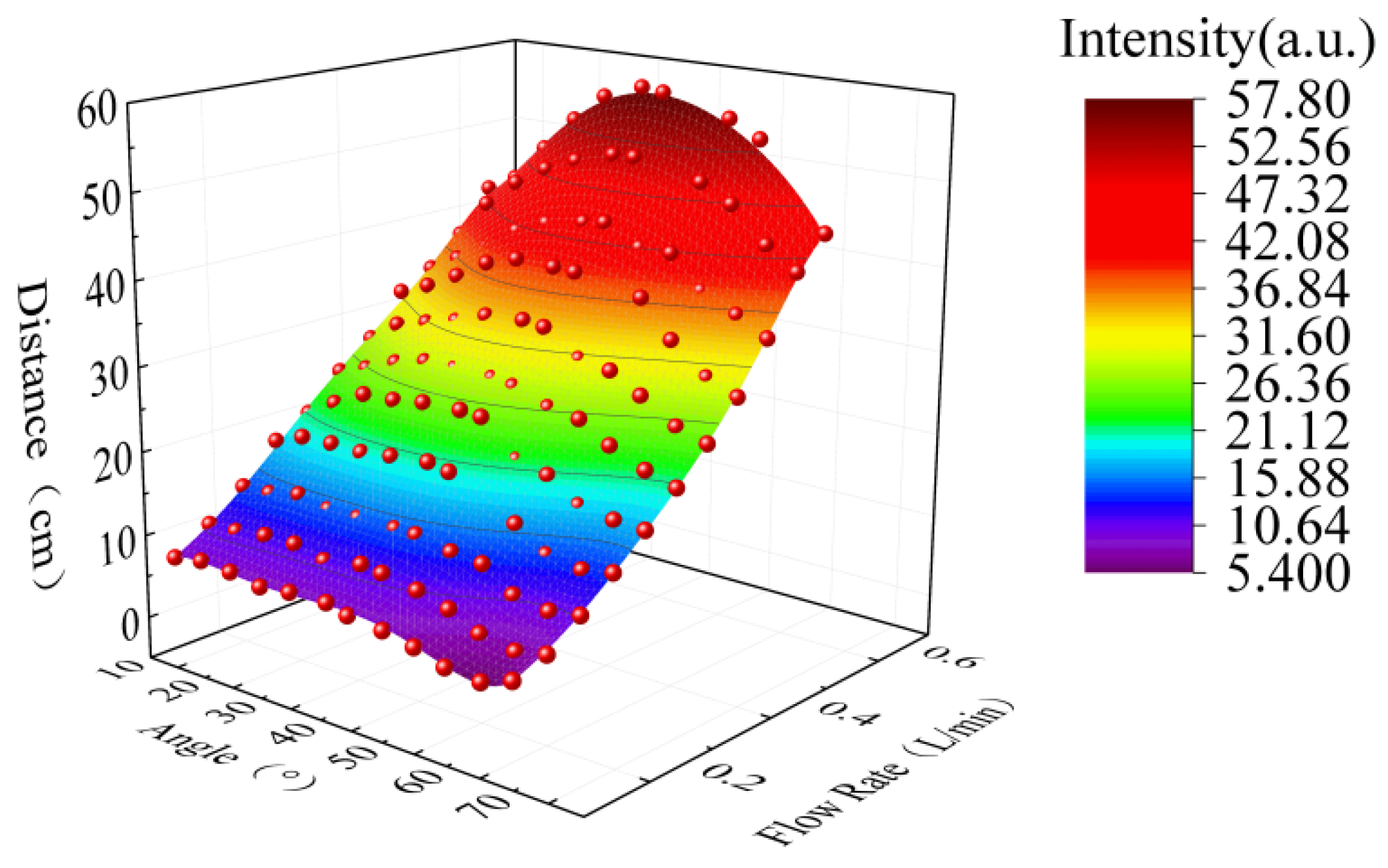
- The established high-precision sixth-order polynomial jet trajectory prediction model fully characterizes the coupled dynamic characteristics of elevation angle, flow rate and air resistance. Within the full parameter range, the goodness of fit R2 reaches 0.9975 (adjusted R2 = 0.9968) and the root mean square error (RMSE) of drop point prediction is 0.042 m, which provides a reliable theoretical basis for the precise control of fire-extinguishing actuators.
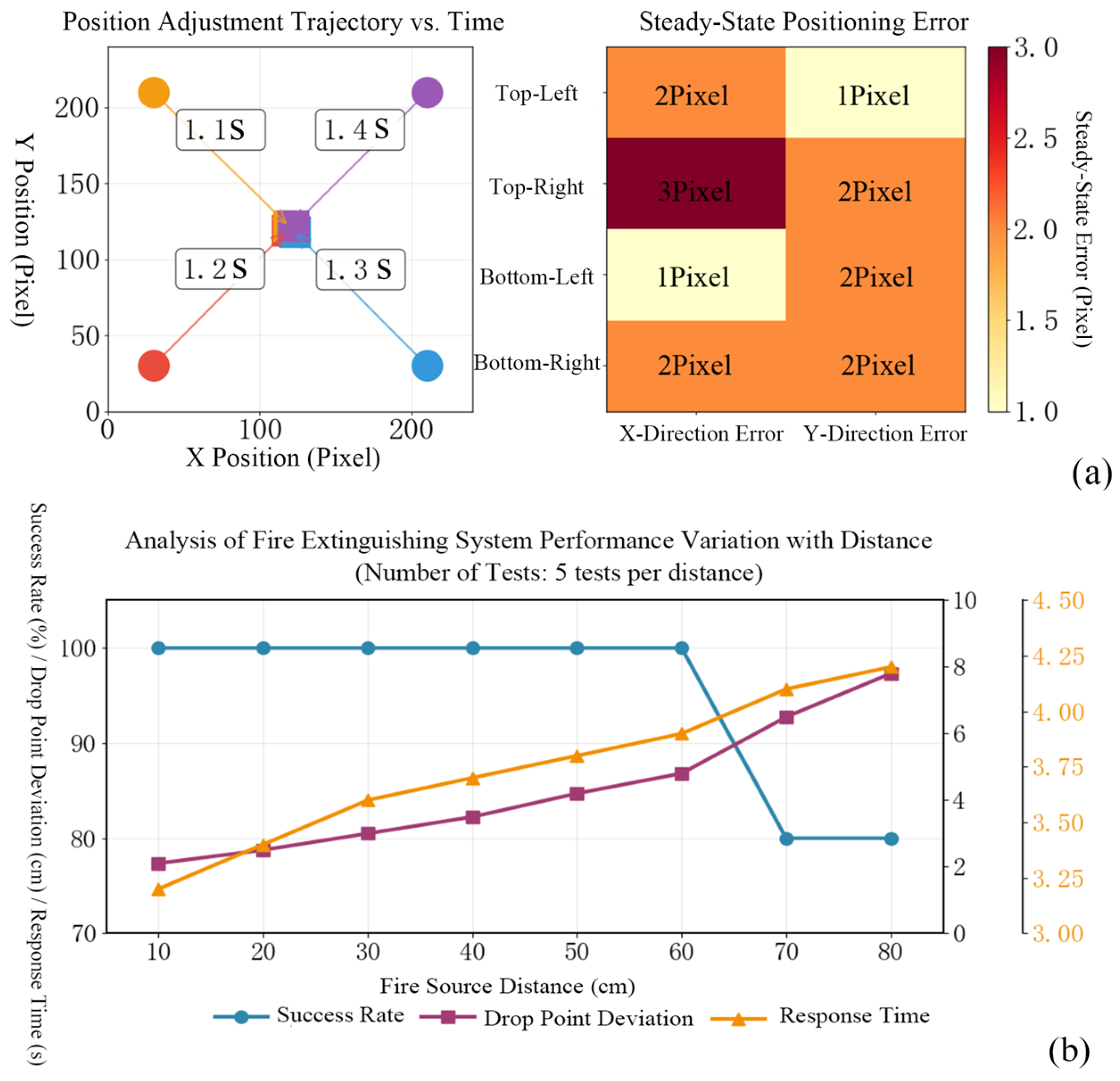
- For servo control, the introduced error dead zone and output limiting mechanism achieve fast and stable fire source tracking and attitude control. The system tracking adjustment time is 1.25 s, the steady-state error does not exceed 3 pixels, the fire-extinguishing drop point accuracy is better than ±5 cm within the range of 10–60 cm, and the overall system response time is controlled within 8.5 s.
- Collectively, the embedded intelligent fire protection closed-loop system constructed demonstrates excellent comprehensive performance across a wide illumination range (50–100,000 Lux) and various interference scenarios, with a task success rate of 92%, which verifies its practicability and reliability in real-world applications such as households, warehouses and industrial inspections.
- Advanced sensor fusion: While the current decision-level fusion achieves O(1) complexity, feature-level fusion approaches such as transformer-based cross-modal attention mechanisms could potentially enhance accuracy further on more powerful edge platforms.
- Expanded fire scenarios: Testing on larger-scale fires (Class A/B fires per NFPA 10) and outdoor environments with uncontrolled wind conditions would validate scalability.
- Multi-agent coordination: Implementing cooperative fire suppression with multiple robotic units using distributed consensus algorithms to cover extended areas.
- Moving target tracking: Extending the current static fire source assumption to dynamic fire spread by integrating predictive motion models with the control loop.
- Adaptive learning: Implementing online model adaptation through federated learning across deployed units to continuously improve detection accuracy without centralized data collection.
Author Contributions
Funding
Institutional Review Board Statement
Informed Consent Statement
Data Availability Statement
Acknowledgments
Conflicts of Interest
Abbreviations
| FOMO | Faster Objects, More Objects |
| YOLO | You Only Look Once |
| CNN | Convolutional Neural Network |
| ROI | Region Of Interest |
References
- Wang, Y.; Pei, X.; Wang, K.; Xu, G. Research on early fire source identification and anti-interference methods in mines based on dual-spectrum imaging technology. J. Mine Autom. 2025, 51, 122–130. [Google Scholar]
- Dou, Z.; Zhou, H.; Liu, Z.; Hu, Y.; Wang, P.; Zhang, J.; Wang, Q.; Chen, L.; Diao, X.; Li, J. An improved yolov5s fire detection model. Fire Technol. 2024, 60, 135–166. [Google Scholar]
- Xu, P.T.; Wang, G.; Zhang, L.J.; Wang, Y.; Huang, H. A Lightweight Model Design Method for Fire Detection via Dual Level Pruning and Post-Training Quantization. Acta Sci. Nat. Univ. Pekin. 2025, 61, 884–890. [Google Scholar] [CrossRef]
- Tang, H.; Wang, J.; Wu, J.; Zhao, Y.; Chen, J.; Liang, F.; Zhang, Z. The nexus of intelligent transportation: A lightweight Bi-input fusion detection model for autonomous-rail rapid transit. Eng. Appl. Artif. Intell. 2025, 139, 109705. [Google Scholar] [CrossRef] [Scilit]
- Zervas, E.; Mpimpoudis, A.; Anagnostopoulos, C.; Sekkas, O.; Hadjiefthymiades, S. Multisensor data fusion for fire detection. Inf. Fusion 2011, 12, 150–159. [Google Scholar] [CrossRef] [Scilit]
- Meng, G.X. Research on fire source visual recognition method based on multi-feature fusion. China Saf. Sci. J. 2025, 35, 40–46. [Google Scholar]
- Sun, W.; Liu, Y.; Wang, F.; Hua, L.; Fu, J.; Hu, S. A Study on Flame Detection Method Combining Visible Light and Thermal Infrared Multimodal Images. Fire Technol. 2024, 61, 2167–2188. [Google Scholar] [CrossRef] [Scilit]
- Zhang, Y.; Rui, X.; Song, W. A UAV-Based Multi-Scenario RGB-Thermal Dataset and Fusion Model for Enhanced Forest Fire Detection. Remote Sens. 2025, 17, 2593. [Google Scholar] [CrossRef] [Scilit]
- Zhu, J.S. Research on Intelligent Fire Monitor Control Based on Machine Vision. Ph.D. Thesis, China University of Mining and Technology, Xuzhou, China, 2020. [Google Scholar]
- Bai, Y.Y.; Liu, C.C.; Li, C.Y.; Ai, G.D.; Liu, S.Q.; Song, F.Z. Jet trajectory model of fire water cannon based on Euler method. China Saf. Sci. J. 2024, 34, 200–205. [Google Scholar]
- Zhu, F.; Liu, W.T.; Li, X.B. Analysis of Jet Trajectory of Water Fire Monitor for Underground Coal Mine Fire Fighting Robot. Coal Mine Mach. 2022, 43, 78–81. [Google Scholar]
- Hosseini, A.; Hashemzadeh, M.; Farajzadeh, N. UFS-Net: A unified flame and smoke detection method for early detection of fire in video surveillance applications using CNNs. J. Comput. Sci. 2022, 61, 101638. [Google Scholar] [CrossRef] [Scilit]
- Deng, X.; Shi, X.; Wang, H.; Wang, Q.; Bao, J.; Chen, Z. An indoor fire detection method based on multi-sensor fusion and a lightweight convolutional neural network. Sensors 2023, 23, 9689. [Google Scholar] [CrossRef] [Scilit] [PubMed]
- Pan, X.; Wang, X.; Su, D.S.; Feng, L.H.; Wang, J. Design of forest fire image detection system based on embedded AI. Wirel. Internet Technol. 2023, 20, 62–66. [Google Scholar]
- Jiao, T.; Guo, C.; Feng, X.; Chen, Y.; Song, J. A Comprehensive Survey on Deep Learning Multi-Modal Fusion: Methods, Technologies and Applications. Comput. Mater. Contin. 2024, 80, 1. [Google Scholar] [CrossRef] [Scilit]
- He, D.; He, X.; Yuan, R.; Li, Y.; Shen, C. Lightweight network-based multi-modal feature fusion for face anti-spoofing. Vis. Comput. 2023, 39, 1423–1435. [Google Scholar]
- Jongboom, J. Bringing Real time Object Detection to MCU with Edge Impulse FOMO. Integr. Circuits Embed. Syst. 2023, 23, 1–2. [Google Scholar]
- Sandler, M.; Howard, A.; Zhu, M.; Zhmoginov, A.; Chen, L.C. Mobilenetv2: Inverted residuals and linear bottlenecks. In 2018 IEEE/CVF Conference on Computer Vision and Pattern Recognition; IEEE: New York, NY, USA, 2018; pp. 4510–4520. [Google Scholar]
- Jacob, B.; Kligys, S.; Chen, B.; Zhu, M.; Tang, M.; Howard, A.; Adam, H.; Kalenichenko, D. Quantization and training of neural networks for efficient integer-arithmetic-only inference. In 2018 IEEE/CVF Conference on Computer Vision and Pattern Recognition; IEEE: New York, NY, USA, 2018; pp. 2704–2713. [Google Scholar]
- Han, S.; Pool, J.; Tran, J.; Dally, W. Learning both weights and connections for efficient neural network. In Proceedings of the 29th International Conference on Neural Information Processing Systems (NIPS 2015), Montreal, QC, Canada, 7–12 December 2015; pp. 1135–1143. [Google Scholar]
- Shamsoshoara, A.; Afghah, F.; Razi, A.; Zheng, L.; Fulé, P.; Blasch, E. The FLAME Dataset: Aerial Imagery Pile Burn Detection Using Drones (UAVs). IEEE Dataport. Available online: https://github.com/OlafenwaMoses/FireNET (accessed on 23 August 2025).
- FireNet: A Specialized Lightweight Fire & Smoke Detection Model for Real-Time IoT Applications. DeepQuest AI. Available online: https://github.com/OlafenwaMoses/FireNET (accessed on 23 August 2025).
- Kaggle. Fire-Related Image Collections. Kaggle Datasets. 2025. Available online: https://www.kaggle.com/datasets/ (accessed on 23 August 2025).
- Fanariotis, A.; Orphanoudakis, T.; Kotrotsios, K.; Fotopoulos, V.; Keramidas, G.; Karkazis, P. Power efficient machine learning models deployment on edge IoT devices. Sensors 2023, 23, 1595. [Google Scholar] [CrossRef] [Scilit] [PubMed]
- Yang, J.; Du, B.; Liu, R.; Mao, Z.; Zhang, L. Boosting Multimodal Remote Sensing Image Classification with Transformer-based Heterogeneously Salient Graph Representation. IEEE Trans. Geosci. Remote. Sens. 2026, 64, 5512117. [Google Scholar] [CrossRef] [Scilit]
- Lan, M.; Rong, F.; Jiao, H.; Gao, Z.; Zhang, L. Language query-based transformer with multiscale cross-modal alignment for visual grounding on remote sensing images. IEEE Trans. Geosci. Remote Sens. 2024, 62, 5626513. [Google Scholar] [CrossRef] [Scilit]
- Zhu, J.; Li, W.; Lin, D.; Zhao, G. Study on water jet trajectory model of fire monitor based on simulation and experiment. Fire Technol. 2019, 55, 773–787. [Google Scholar]
- Qiu, Z.; Martínez-Sánchez, J.; Arias-Sánchez, P.; Rashdi, R. External multi-modal imaging sensor calibration for sensor fusion: A review. Inf. Fusion 2023, 97, 101806. [Google Scholar] [CrossRef] [Scilit]



| Method | Accuracy | Model Size | Speed | Platform | Compression Strategy |
|---|---|---|---|---|---|
| Improved YOLOv5s | 82.1% mAP@0.5 | 5.9 MB | 79.92 FPS | RTX 3070 (GPU) | None (full precision) |
| UFS-Net | 98.802% | 7.99 MB | 68 FPS | GTX 1080 (GPU) | Depthwise separable conv |
| Multi-sensor + CNN | 99.1% | - | - | Embedded (unspecified) | Lightweight design |
| Proposed LFOMO | 95.6% | 1.8 MB | 4.76 FPS | OpenMV4 H7 Plus (480 MHz) | INT8 + Pruning |
| Method | Fusion Level | Accuracy | Complexity | Latency | Platform |
|---|---|---|---|---|---|
| D-S Fusion [7] | Decision-level | 0.9818 max prob. | O(n) per node | 10–13.5 min | WSN (distributed) |
| SVM-RCNN [8] | Feature-level | >87% | Hand-crafted features | - | GPU-based |
| CCMR-PA [9] | Decision-level (GIoU) | F1 = 90.03% | GIoU computation | - | GPU-based |
| CP-YOLOv11-MF [10] | Mid-term feature (CPCA + PPAS) | 96.3% mAP50 | O(n2), 11.83M params | - | GPU (23 MB) |
| LBiF-YOLO [11] | Feature-level (SSAF) | 84.93% mAP@0.5 | 28.9 GFLOPs, 17.29M params | 21.2 ms | GPU-based |
| Proposed LFOMO | Decision-level (Bayesian) | 95.6%/2.0% FAR | O(1) | 210 ms | OpenMV4 H7 Plus |
| Method | Trajectory Model | Precision | Range/Distance | Integration Level | Method |
|---|---|---|---|---|---|
| Fire monitor | Geometric aiming | 0.10 m pitch error | Long-range | Detection to Actuation (open-loop) | Fire monitor |
| Euler jet model | Theoretical (Euler) | ≤10% flow-rate error | Variable | Model only (no system) | Euler jet model |
| Coal mine robot | Experimental (K = 0.36) | Range-focused | 18.147 m max | Actuation only (no detection) | Coal mine robot |
| Proposed LFOMO | Sixth-degree polynomial | ±5 cm | 10–60 cm | Closed-loop | Proposed LFOMO |
| Component | Description | Sample Count | Notes |
|---|---|---|---|
| Self-Collected Data | 6 illumination scenarios, 3 fire types, 3 interference types | 1000 | OV5640 @ 640 × 480, VOC format |
| Public: FLAME Public: FireNET Public: Kaggle Curated TOTAL | Aerial wildfire imagery, UAV-captured | 1500 | Screened from 9000+ raw images |
| IoT-oriented fire detection images | 1000 | Screened from 2425 images | |
| Mixed indoor/outdoor fire scenarios | 1000 | Screened from Kaggle collections | |
| 9 scene categories, 6 object classes | 4500 | Train 3600/Test 900 (8:2) |
| - | E |
|---|---|
| Number of Points | 132 |
| Degrees of Freedom (DOF) | 104 |
| Reduced Chi-Sqr | 0.66026 |
| Sum of Squared Residuals (SSR) | 68.66714 |
| R-Squared (Coefficient of Determination, COD) | 0.99746 |
| Adjusted R-Squared | 0.99678 |
| - | - | DF | Sum of Squares (SS) | Mean Square (MS) | F-Value | Prob > F |
|---|---|---|---|---|---|---|
| Distance | Regression | 27 | 26,918.08987 | 996.96629 | 1509.9579 | <0.0001 |
| Residual | 104 | 68.66714 | 0.66026 | - | - | |
| Uncorrected Total | 132 | 125,912.3421 | - | - | - | |
| Corrected Total | 131 | 26,986.75701 | - | - | - |
| Controller Type | Proportional Coefficient (Kp) | Integral Coefficient (Ki) | Derivative Coefficient (Kd) | Output Limit |
|---|---|---|---|---|
| Pan | 0.1 | 0.01 (Enabled when e > 10) | 0.012 | ±8 |
| Tilt | 0.09 | 0.01 (Enabled when e > 10) | 0.012 | ±8 |
| Controller Type | Proportional Coefficient (Kp) | Integral Coefficient (Ki) | Derivative Coefficient (Kd) | Output Limit |
|---|---|---|---|---|
| Pan | 0.1 | 0.01 (Enabled when e > 10) | 0.01 | ±8 |
| Tilt | 0.15 | 0.015 (Enabled when e > 10) | 0.015 | ±6 |
| Scene Name | Type | |
|---|---|---|
| Lighting Scene | Indoor | Indoor Normal Light (500 lux) |
| Indoor Low Light (50 lux) | ||
| Indoor Strong Light (5000 lux) | ||
| Outdoor | Sunny Day (100,000 lux) | |
| Cloudy Day (10,000 lux) | ||
| Nighttime (10 lux) | ||
| Fire Scene | Candle Fire (Diameter: 3 cm, Distance: 10–80 cm) | |
| Alcohol Fire (Diameter: 5 cm, Distance: 10–80 cm) | ||
| Interference Scene | Candlelight (55 °C) | |
| Electric Soldering Iron (60 °C) | ||
| Sunset Reflection (40 °C) | ||
| Test Scenario | Number of Samples | Number of Correct Recognitions | Accuracy Rate | Number of False Detections | False Detection Rate | Response Time |
|---|---|---|---|---|---|---|
| Indoor Normal Lighting | 100 | 98 | 98.0% | 1 | 1.0% | 260 ms |
| Indoor Low Light | 80 | 77 | 96.3% | 1 | 1.3% | 250 ms |
| Outdoor Sunny Day | 120 | 114 | 95.0% | 2 | 1.7% | 280 ms |
| Outdoor Cloudy Day | 100 | 95 | 95.0% | 1 | 1.0% | 255 ms |
| Outdoor Nighttime | 80 | 75 | 93.8% | 1 | 1.3% | 240 ms |
| Interference Scenario | 150 | - | - | 3 | 2.0% | 285 ms |
| Average | 105 | 92 | 95.6% | 1.5 | 1.4% | 261 ms |
| Test Scenario | Number of Successful Tests | Success Rate | Total Time Consumption (s) | Recognition Time Consumption (s) | Tracking Time Consumption (s) | Fire Extinguishing Time Consumption (s) |
|---|---|---|---|---|---|---|
| Indoor Low Light and Interference | 46 | 92% | 8.5 | 0.28 | 1.25 | 3.8 |
| Standard Deviation (SD) | - | - | 0.5 | 0.04 | 0.12 | 0.3 |
| Config | Configuration Description | Accuracy (%) | Latency (ms) | Model Size (MB) | False Alarm (%) | Ext. Precision (cm) |
|---|---|---|---|---|---|---|
| A | FP32 + No Pruning + IR Fusion + 6th Poly (Non-deployable baseline) | 96.2 | 520 | 20.8 | 2.0 | ±4 |
| B | INT8 + No Pruning + IR Fusion + 6th Poly | 95.8 | 340 | 5.2 | 2.0 | ±4 |
| C | INT8 + Pruning + IR Fusion + 6th Poly (PROPOSED) | 95.6 | 261 | 1.8 | 2.0 | ±5 |
| D | INT8 + Pruning + No IR Fusion + 6th Poly (w/parabola) | 86.4 | 245 | 1.8 | 15.3 | ±5 |
| E | INT8 + No Pruning + IR Fusion + 6th Poly | 95.6 | 280 | 5.2 | 2.0 | ±5 |
| F | INT8 + Pruning + IR Fusion + Ideal Parabola | 95.6 | 261 | 1.8 | 2.0 | ±12 |
| G | INT8 + Pruning + IR Fusion + 6th Poly + Standard PID | 95.6 | 261 | 1.8 | 2.0 | ±7.5 |
| Hardware Module | Idle Mode | Detection Mode | Tracking Mode | Pumping Mode | Full Operation |
|---|---|---|---|---|---|
| OpenMV4 H7 Plus (MCU) | 450–500 mW | 750–850 mW | 700–800 mW | 450–500 mW | 750–850 mW |
| STM32F103C8T6 (MCU) | 15–25 mW | 70–80 mW | 70–80 mW | 70–80 mW | 70–80 mW |
| MLX90640 IR Sensor | 10–20 mW | 10–20 mW | 10–20 mW | 10–20 mW | 10–20 mW |
| VL53L1X ToF Sensor | 15–25 mW | 15–25 mW | 15–25 mW | 15–25 mW | 15–25 mW |
| Servo Pan-Tilt (2-DOF) | 100–150 mW | 100–150 mW | 300–400 mW | 100–150 mW | 300–400 mW |
| 12V Water Pump | <10 mW | <10 mW | <10 mW | 4500–5500 mW | 4500–5500 mW |
| TOTAL SYSTEM POWER | 600–700 mW | 950–1100 mW | 1100–1300 mW | 5200–5800 mW | 5800–6500 mW |
Disclaimer/Publisher’s Note: The statements, opinions and data contained in all publications are solely those of the individual author(s) and contributor(s) and not of MDPI and/or the editor(s). MDPI and/or the editor(s) disclaim responsibility for any injury to people or property resulting from any ideas, methods, instructions or products referred to in the content. |
© 2026 by the authors. Licensee MDPI, Basel, Switzerland. This article is an open access article distributed under the terms and conditions of the Creative Commons Attribution (CC BY) license.
Share and Cite
Zhai, D.; Zhai, Q.; Liu, S.; Liu, X.; Guo, T. Research on Fire Source Recognition and Fire Extinguishing Algorithms Based on Multimodal Fusion and Lightweight Model Deployment. Sensors 2026, 26, 3988. https://doi.org/10.3390/s26133988
Zhai D, Zhai Q, Liu S, Liu X, Guo T. Research on Fire Source Recognition and Fire Extinguishing Algorithms Based on Multimodal Fusion and Lightweight Model Deployment. Sensors. 2026; 26(13):3988. https://doi.org/10.3390/s26133988
Chicago/Turabian StyleZhai, Daoshang, Qianjuan Zhai, Shuo Liu, Xiuyan Liu, and Tingting Guo. 2026. "Research on Fire Source Recognition and Fire Extinguishing Algorithms Based on Multimodal Fusion and Lightweight Model Deployment" Sensors 26, no. 13: 3988. https://doi.org/10.3390/s26133988
APA StyleZhai, D., Zhai, Q., Liu, S., Liu, X., & Guo, T. (2026). Research on Fire Source Recognition and Fire Extinguishing Algorithms Based on Multimodal Fusion and Lightweight Model Deployment. Sensors, 26(13), 3988. https://doi.org/10.3390/s26133988