Development, Reliability, and Validity Assessment of a Portable 3D Camera-Based System for Quantifying Postural Sway and Balance

 ,
,  ,
,
Abstract
1. Introduction and Background
Study Objectives
2. Methodology
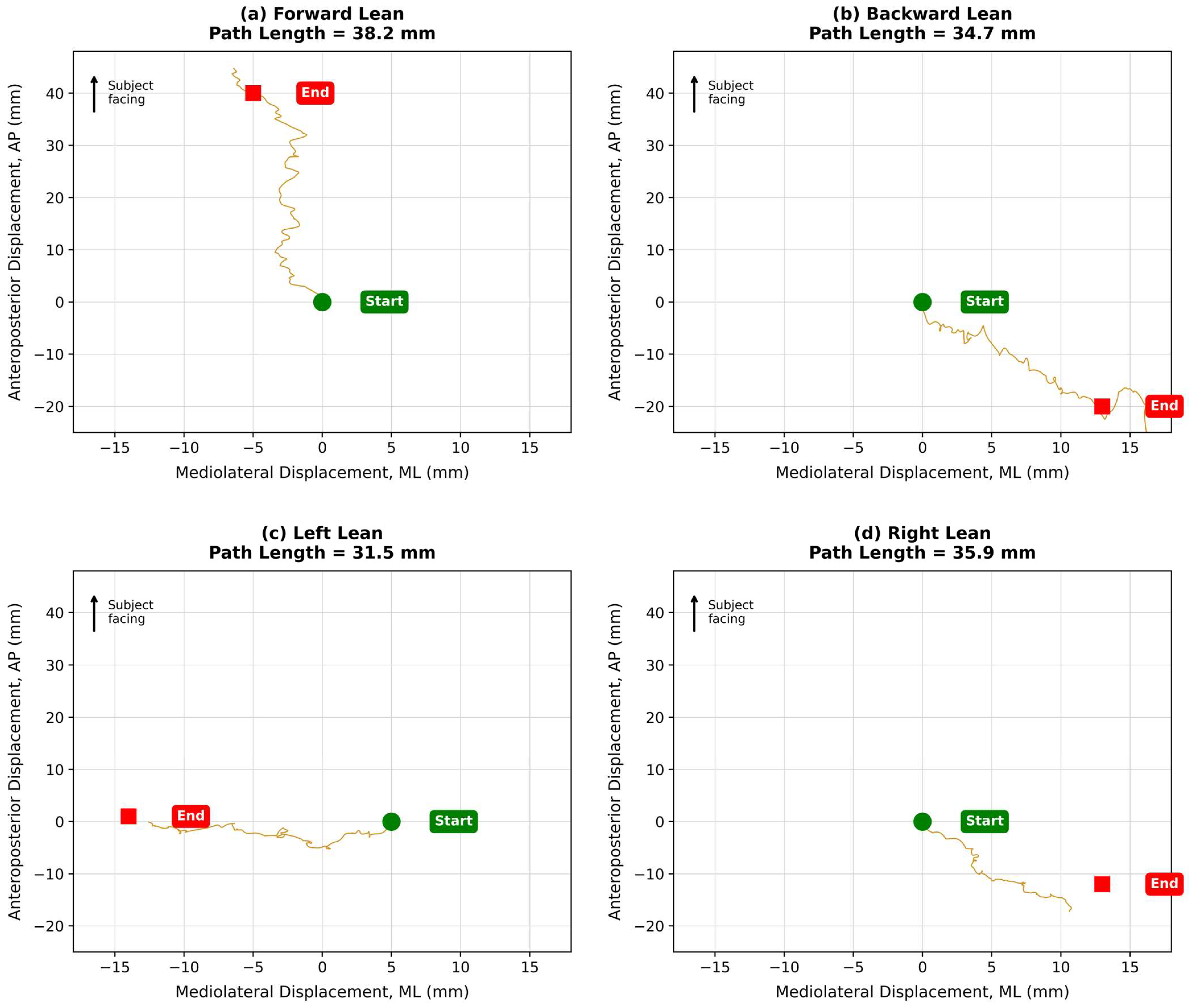
- Primary output: Stabilogram of whole-body CoM projected on the ground plane and derived sway metrics (path length (PL), mean velocity (MV), root mean square (RMS) in anterior–posterior (AP) and medial–lateral (ML) directions, ellipse area (EA), and trunk angle (θ)).
- Throughput target: ≥30 FPS end-to-end (capture → pose → CoM → features → GUI).
- Latency budget: <100 ms pipeline latency (capture to on-screen metrics), split roughly as: capture (10–20 ms) + pose inference (15–35 ms) + depth fusion (5–10 ms) + filters and metrics (5–15 ms) + rendering (5–10 ms).
- Reliability hooks: Missing-data handling, artifact detection, QC gates (coverage, dropouts, tracking loss).
- Portability: Single Intel® RealSense™ D415 + laptop; no markers, no force plate required for runtime.
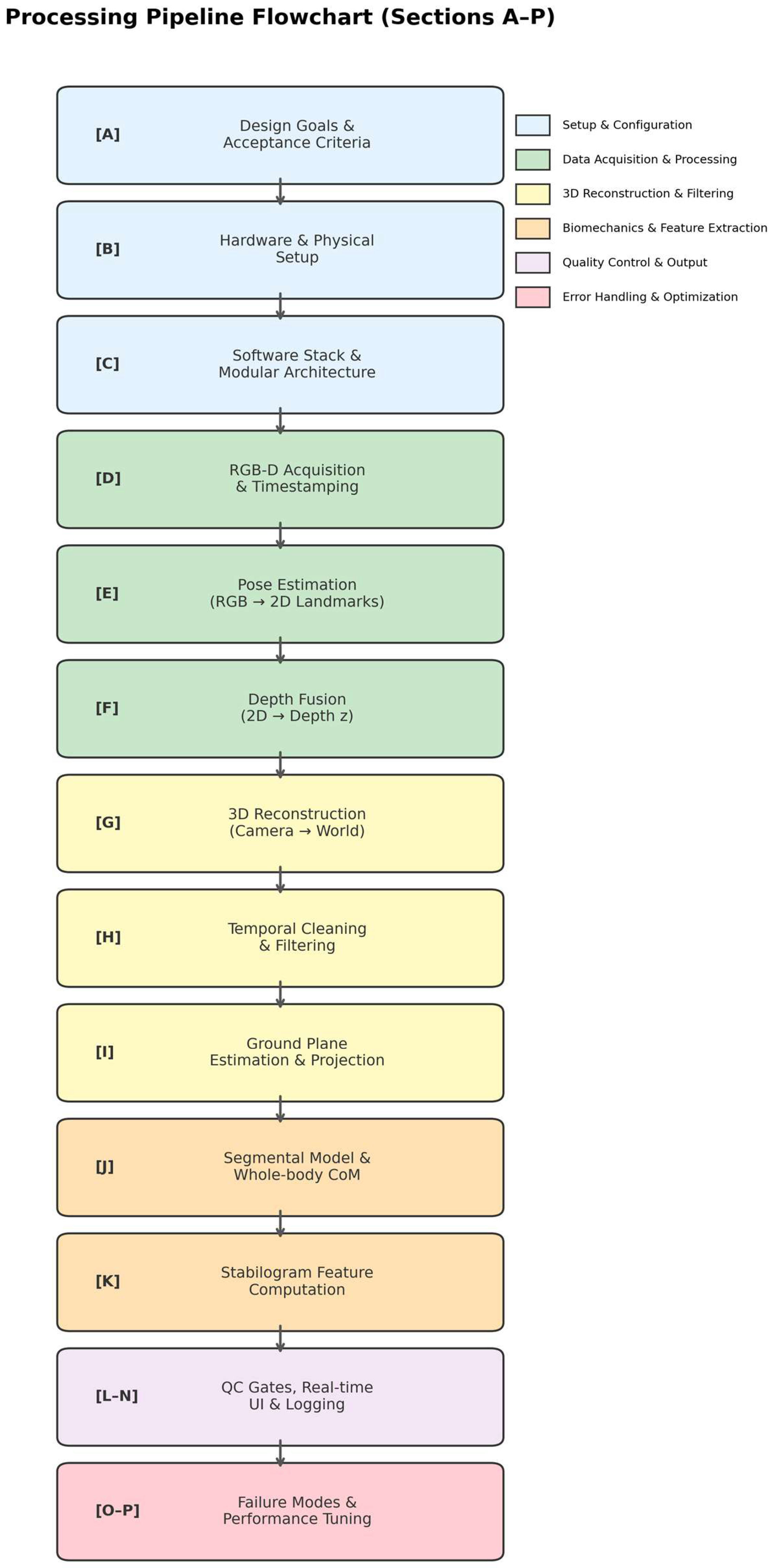
- The system uses an Intel RealSense D415 RGB-D camera (Intel Corporation, Santa Clara, CA, USA) with 16-bit depth at 640 × 480 resolution, operating at 30 Hz with the depth stream aligned to the color stream. The camera is mounted on a tripod at 1.1–1.2 m in height, positioned 2.0 m from the subject with approximately 5° downward pitch to keep both feet fully in the field of view. Uniform diffuse lighting is used, and strong infrared sources are avoided. A 2 s pre-roll period allows auto-exposure and gain stabilization before each trial. The system runs on a Lenovo Legion 7 laptop with a CUDA-capable GPU, maintained below 80% utilization to prevent thermal throttling. The camera is configured with the High Accuracy depth preset, emitter power of 150–330 mA, auto-exposure enabled, depth-to-RGB alignment enabled, and a frame queue size of 3–5 to minimize latency while avoiding frame drops. Single-camera markerless motion capture has been identified as a practical and accessible approach for healthcare movement analysis, with demonstrated applications across rehabilitation, fall risk screening, and postural assessment [16].
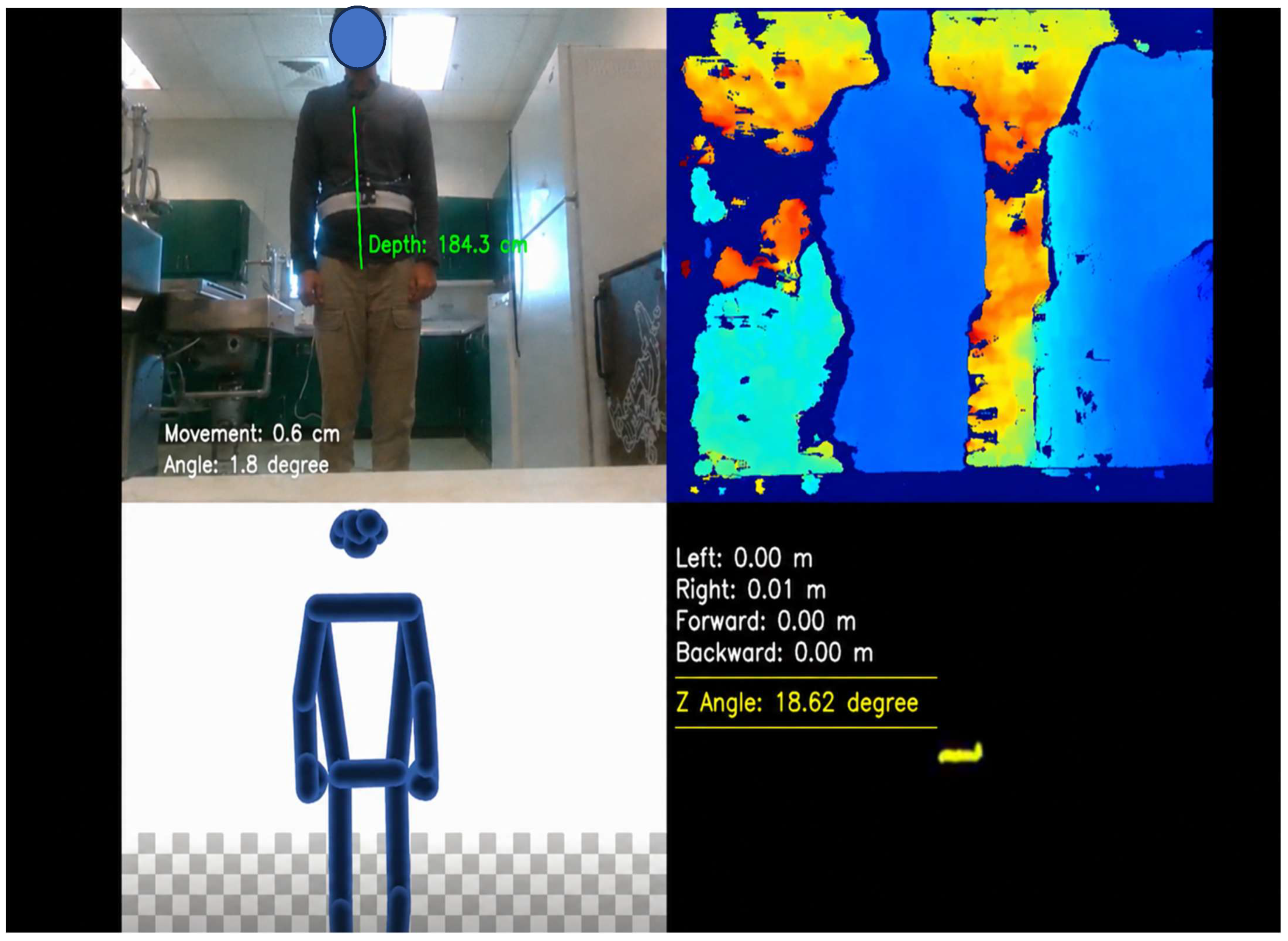
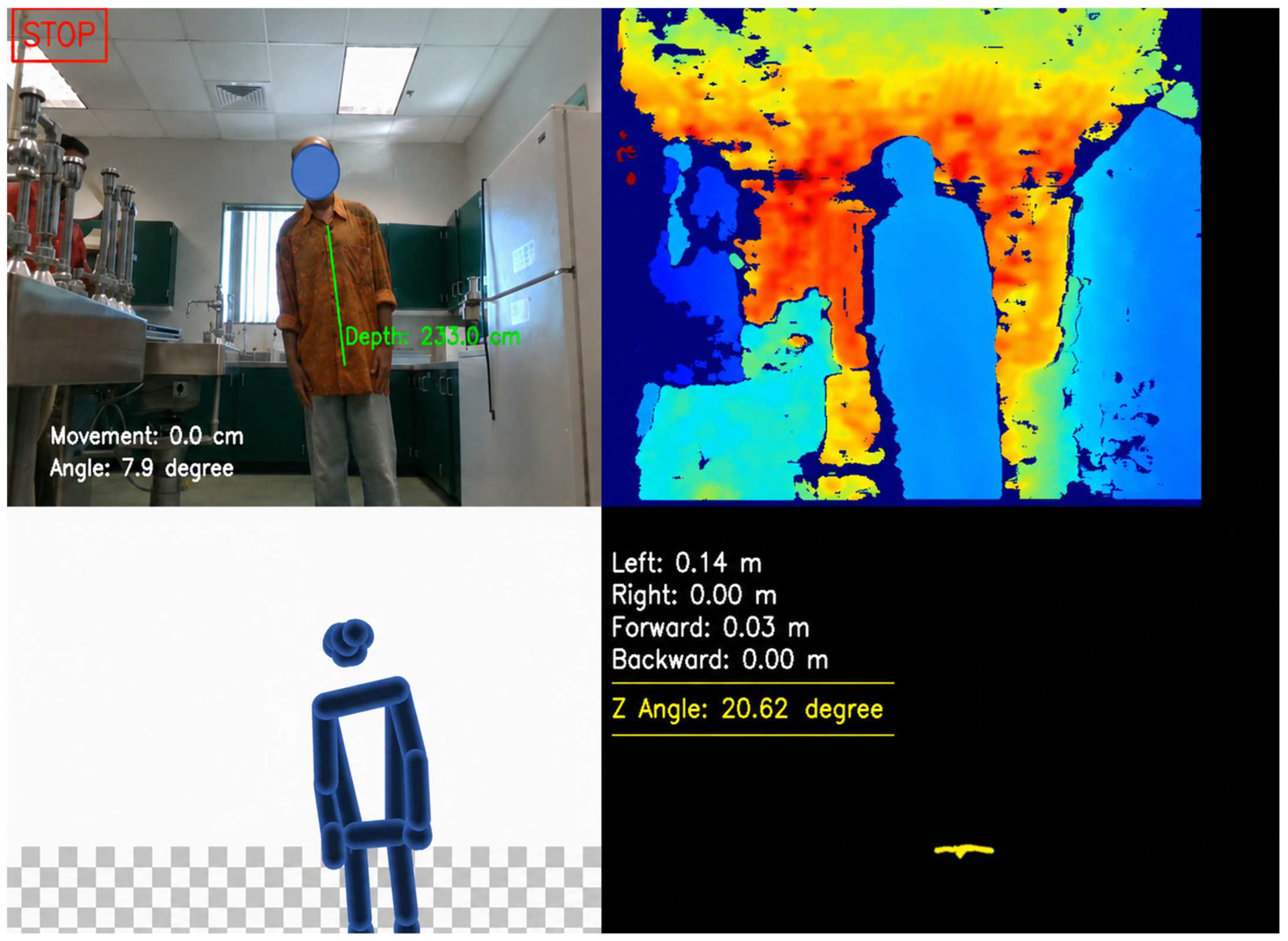
- The software architecture consists of several modular components: the RealSense SDK handles synchronized RGB and depth capture at 30 Hz; MediaPipe Pose performs skeletal landmark detection (33 landmarks) on the RGB stream, with depth values sampled per-landmark from the aligned depth map; camera intrinsics are used for back-projection, with the world frame fixed to the ground plane; biomechanical modeling follows the Zatsiorsky–Seluyanov segment mass model with de Leva adjustments for whole-body CoM estimation; signal processing includes interpolation, Butterworth low-pass filtering, and Hampel outlier suppression; a real-time four-panel user interface displays the RGB stream with skeletal overlay, a depth heat map, a stabilized 3D stick figure, and live metrics; and per-frame data including timestamps, 3D joint positions, CoM coordinates, and all derived metrics are logged to CSV. MediaPipe-based markerless tracking has been evaluated against gold-standard systems for 2D trajectory accuracy, demonstrating promise as a lightweight AI-based motion capture solution for clinical settings [47].
- Open RGB stream (640 × 480, 30 Hz), Depth stream (640 × 480, 30 Hz), aligned.
- Warm-up: discard first 60 frames (~2 s) for AE/gain stabilization (the pre-roll period described in Section B).
- Pre-allocate ring buffers (length 90–120 frames) for RGB, Depth, and Landmarks.
- Use RealSense hardware timestamps as the primary clock. Store t_capture, and later annotate t_pose_done, t_metrics_done for latency profiling.
- Resize RGB to model input [e.g., 256–640 px shortest side], keep aspect ratio; normalize to [0, 1].
- 1.
- Median filter. The nine depth values in are sorted, and the median value is selected. The median filter suppresses isolated outlier pixels (speckle) without shifting the central depth estimate, and its kernel size is fixed at pixels throughout this study.
- 2.
- Bilateral weighting. To prevent depth averaging across object boundaries (e.g., the edge between a limb and the background), a bilateral weight is applied. Each neighbor pixel receives weight:
- Reject depth values if:
- ○
- Z ∉ [zmin, zmax] = [0.3, 5.0] m, or sensor marks invalid (0), or local dropout > 20%.
- If >20% in a 200 ms
- window are invalid at a landmark, flag for interpolation (Section H).
- If landmark jumps > 0.15 m between frames (physical plausibility), mark as transient and send to Hampel filter (Section H)
- Temporal cleaning is performed in three stages: gaps of 200 ms or fewer (up to 6 frames at 30 Hz) are filled using cubic interpolation; a zero-phase 4th-order Butterworth low-pass filter with a cutoff frequency of 5 Hz is applied to all joint and CoM trajectories; and outliers are suppressed using a Hampel filter (SciPy v1.17.1, SciPy Developers, Austin, TX, USA) with a 0.5 s window and a 3 σ threshold.
- Region of interest: rectangle spanning both feet using ankle/heel landmarks ± [40–80] px.
- RANSAC plane fit Π: n⊤x + b = 0 on depth points in ROI. Inlier threshold: ε = 8–12 mm distance to plane. Refine using foot landmarks to lock the plane normal.
- For any 3D point x project to plane:
- Stabilogram trajectory is CoM projected to plane: c(t) = [x (t), y (t)] ⊤.
- The body is modeled as 16 rigid segments following the Zatsiorsky–Seluyanov model with de Leva’s adjusted mass fractions [20]. Each segment is defined by a pair of MediaPipe Pose landmarks that serve as proximal and distal endpoints: head (nose to mid-ear midpoint), upper trunk (left shoulder to right shoulder midpoint, to mid-hip midpoint), lower trunk (mid-hip to mid-hip), upper arms (shoulder to elbow), forearms (elbow to wrist), hands (wrist to index finger tip), thighs (hip to knee), shanks (knee to ankle), and feet (ankle to foot index). The segmental center of mass for each segment is located as a fixed proportion along the proximal-to-distal axis, using the gender-specific percentages provided by de Leva [20]. When a landmark is missing due to occlusion or depth dropout, the segment’s position is held at its last valid value for up to 200 ms; beyond that, cubic interpolation is applied as described in Section H. The whole-body CoM is then computed as the mass-weighted sum of all segmental centers of mass using Equation (6).
- 1.
- Path length (PL)
- 2.
- Mean Velocity (MV)
- 3.
- Directional RMS sway
- 4.
- 95% ellipse area (EA) (from covariance Σ of x, y)
- 5.
- Trunk inclination (θ)
- Pelvis → thorax vector v in world frame; vertical unit .
- Trials are included in the analysis if they meet the following quality criteria: landmark coverage of at least 85% (defined as the proportion of frames with valid pose and depth at key landmarks), per-landmark depth dropout of no more than 20% within the trial, no continuous tracking loss of 5 or more frames (167 ms or more), the subject is positioned within the linear depth region (approximately 1.0–2.5 m), and an investigator is within arm’s reach during quiet stance for safety.
- Panel A (RGB): 3D skeleton overlay + line of gravity + CoM trace, updated every frame.
- Panel B (Depth heat map): depth normalized to [0, 1]; perceptual colormap; warmer = nearer.
- Panel C (Stick figure): stabilized 3D skeleton in world axes to visualize AP/ML sway and trunk θ.
- Panel D (Metrics): PL, MV, EA, RMS-AP/ML, θ with rolling means; color-code if exceeding thresholds.
- Update cadence: render at display vsync (60 Hz) with last computed metrics.
- Per-frame_CSVcolumns: t_capture_ms, t_pose_ms, subj_id, cam_id, joint_0_x… joint_32_z, com_x, com_y, com_z, com_proj_x, com_proj_y, pl, mv, rms_ap, rms_ml, ea, trunk_theta
- Trial JSON sidecar (metadata): camera extrinsics, plane normal n, b, filter settings (fc, order), thresholds, app version hash, OS, GPU driver, room notes.
- Compression: CSV.gz + JSON; hash both files for integrity.
- Pose fail: if the global pose detection score for more than 500 ms, freeze GUI metrics, show “tracking lost,” keep logging QC flags.
- Depth voids: if local dropout > 20%, switch to temporal hold-last for that landmark for ≤200 ms; beyond that, interpolate.
- Occlusion: if foot landmarks are unseen, inflate ground plane inlier ε temporarily to avoid plane flips; revert when feet return.
- Threading: 3 threads → (T1) capture, (T2) pose + depth fusion, (T3) filters + metrics + render; lock-free ring buffers.
- Batching: Run pose every frame; if CPU-bound, decimate to 20 Hz and interpolate 2D landmarks back to 30 Hz.
- Profiling hooks: per-stage timers: capture, pose, fusion, filters, metrics, render; export percentile latencies.
- 6.
- 7.
- Camera Calibration: intrinsic and extrinsic parameter alignment for accurate 3D reconstruction.
- 8.
- Synchronized RGB–Depth Acquisition: recording at 30 Hz, providing millimeter-level precision.
- 9.
- Pose and Landmark Estimation: application of MediaPipe Pose, which identifies 33 skeletal landmarks in real time [19].
- 10.
- Depth Fusion and 3D Joint Reconstruction: back-projection of pixels into 3D space using intrinsic camera parameters.
- 11.
- Ground Plane Estimation: fitting the support plane via RANSAC on foot-depth points and projecting CoM trajectories.
- 12.
- Segmental CoM Modeling: calculation of segment-level CoM using the Zatsiorsky–Seluyanov model with adjustments by de Leva [20].
- 13.
- Stabilogram Feature Extraction: derivation of sway metrics, including path length (PL), mean velocity (MV), root mean square sway in AP and ML directions (RMS-AP, RMS-ML), ellipse area (EA), and trunk inclination.
- 14.
- Data Cleaning and Filtering: signal interpolation, Butterworth low-pass filtering, and artifact suppression.
- 15.
- GUI and Heat Map Visualization: generation of a four-panel display, including RGB with skeleton overlay, depth heat map, 3D stick figure, and live stabilogram metrics.
- 16.
- Logging and Synchronization: continuous logging of joint and CoM time-series data.
- 17.
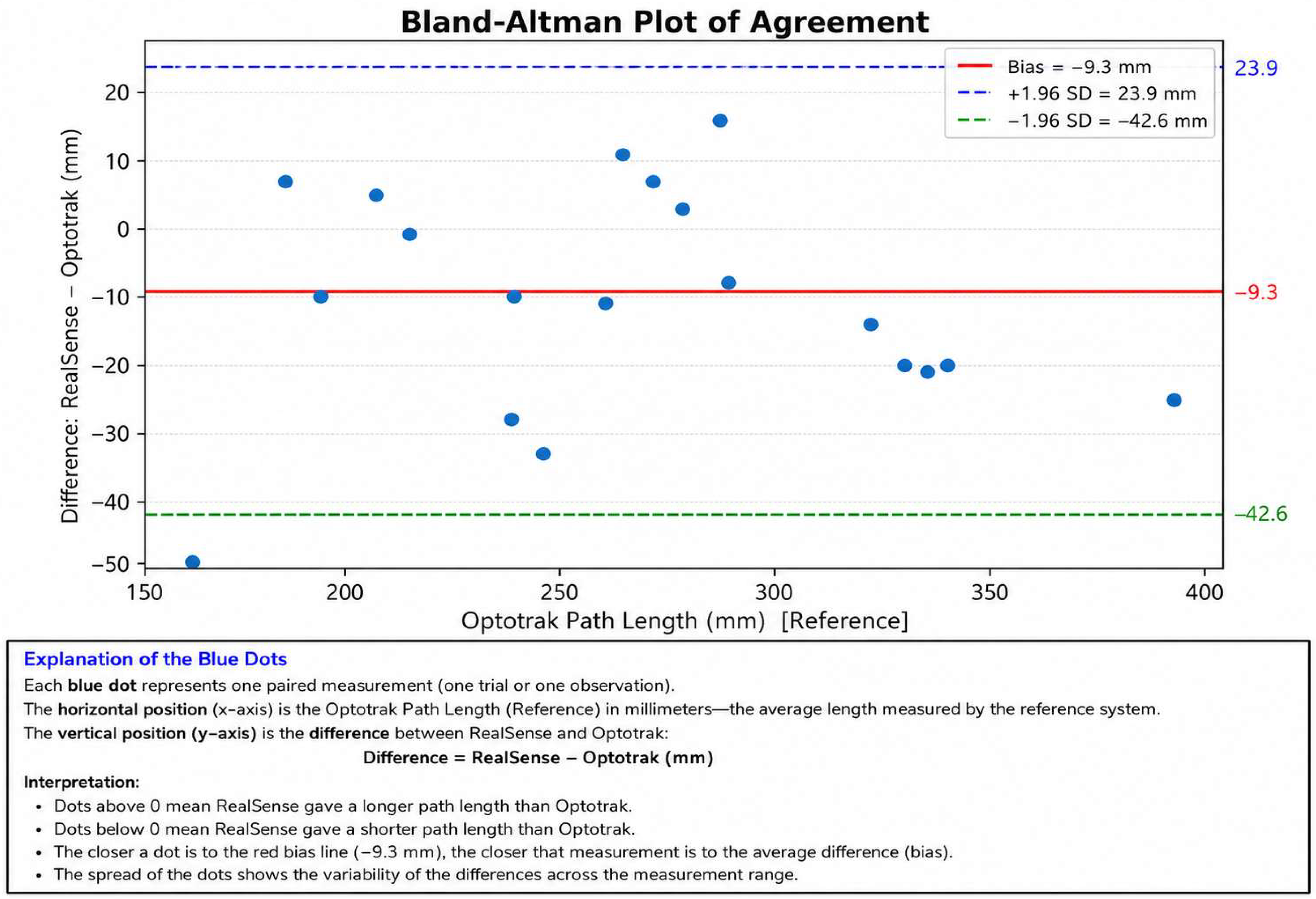
- Statistical and Error Analysis: evaluation of reliability (ICC) and validity (correlation, Bland–Altman analysis [48]) against Mocap reference values.
- Panel A (RGB): overlaid 3D skeleton and line of gravity; CoM trajectory trace.
- Panel B (Depth heat map): depth normalized to [0, 1] and mapped to a perceptual colormap; warmer colors = nearer.
- Panel C (Stick figure): stabilized 3D skeleton in world axes to visualize AP/ML sway and trunk inclination.
- Panel D (Metrics): PL, MV, EA, RMS-AP/ML, θZ updated each frame with rolling means.
3. Results
4. Discussion
5. Limitations
6. Future Work
- Validation in Clinical Populations: This study focused on healthy young adults, which limits generalizability to older or clinical populations. Future studies should include older adults, patients with Parkinson’s disease, vestibular dysfunction, and stroke survivors to establish generalizability. Testing across diverse cohorts will confirm whether RealSense-based metrics remain reliable and valid in populations most at risk of falls.
- Dynamic Balance Tasks: The current evaluation only evaluated quiet-standing tasks. Beyond quiet standing, protocols such as the Modified Clinical Test of Sensory Interaction on Balance, tandem stance, sit-to-stand, gait initiation, and perturbation tasks should be systematically evaluated [53].
- Multi-Camera Fusion: Incorporating multiple synchronized RealSense devices in convergent positions can minimize occlusion errors, expand field-of-view coverage, and improve depth linearity. Multi-camera setups may also enable more accurate 3D reconstructions of whole-body kinematics during dynamic tasks.
- Machine Learning and Predictive Analytics: Integration of advanced machine learning algorithms can enable automated classification of high-risk vs. low-risk individuals based on sway features. Machine learning approaches for fall risk classification have already been demonstrated using wearable plantar pressure sensors [33] and markerless motion capture systems [54], providing a clear pathway for incorporating predictive analytics into the proposed 3D camera system. The results suggest that such low-cost, portable approaches could support predictive models for fall risk and promote personalized rehabilitation strategies. Machine learning applied to triaxial inertial sensor data has shown promise for predicting center-of-pressure trajectory during postural sway, supporting the development of automated balance assessment tools [55].
- Standardizing testing protocols: Development of standardized testing protocols using different commercially available cameras, as well as the creation of normative databases for healthy individuals and those with specific conditions, such as vertigo, will be beneficial for translating this technology into clinical practice.
7. Conclusions
Author Contributions
Funding
Institutional Review Board Statement
Informed Consent Statement
Data Availability Statement
Conflicts of Interest
References
- Aryan, R.; Inness, E.; Patterson, K.K.; Mochizuki, G.; Mansfield, A. Reliability of force plate-based measures of standing balance in the sub-acute stage of post-stroke recovery. Heliyon 2023, 9, e21046. [Google Scholar] [CrossRef]
- World Health Organization. Falls: Fact Sheet. Available online: https://www.who.int/news-room/fact-sheets/detail/falls (accessed on 28 August 2025).
- van Vugt, Y.; Stinear, J.; Davies, T.C.; Zhang, Y. Postural Stability During Gait for Adults with Hereditary Spastic Paraparesis. J. Biomech. 2019, 88, 12–17. [Google Scholar] [CrossRef] [PubMed]
- Li, Y.; Liu, P.; Fang, Y.; Wu, X.; Xie, Y.; Xu, Z.; Ren, H.; Jing, F. A Decade of Progress in Wearable Sensors for Fall Detection (2015–2024): A Network-Based Visualization Review. Sensors 2025, 25, 2205. [Google Scholar] [CrossRef] [PubMed]
- Maudsley-Barton, S.; Yap, M.-H. Objective Falls Risk Assessment Using Markerless Motion Capture and Representational Machine Learning. Sensors 2024, 24, 4593. [Google Scholar] [CrossRef] [PubMed]
- Jeyasingh-Jacob, J.; Crook-Rumsey, M.; Shah, H.; Joseph, T.; Abulikemu, S.; Daniels, S.; Sharp, D.J.; Haar, S. Markerless Motion Capture to Quantify Functional Performance in Neurodegeneration: Systematic Review. JMIR Aging 2024, 7, e52582. [Google Scholar] [CrossRef] [PubMed]
- Bertram, J.; Krüger, T.; Röhling, H.M.; Jelusic, A.; Mansow-Model, S.; Schniepp, R.; Wuehr, M.; Otte, K. Accuracy and Repeatability of the Microsoft Azure Kinect for Clinical Measurement of Motor Function. PLoS ONE 2023, 18, e0279697. [Google Scholar] [CrossRef] [PubMed]
- Eichler, N.; Hel-Or, H.; Shimshoni, I. Spatio-Temporal Calibration of Multiple Kinect Cameras Using 3D Human Pose. Sensors 2022, 22, 8900. [Google Scholar] [CrossRef] [PubMed]
- Ellrich, N.; Niermeyer, K.; Peto, D.; Decker, J.; Fietzek, U.M.; Katzdobler, S.; Höglinger, G.U.; Jahn, K.; Zwergal, A.; Wuehr, M. Precision Balance Assessment in Parkinson’s Disease: Utilizing Vision-Based 3D Pose Tracking for Pull Test Analysis. Sensors 2024, 24, 3673. [Google Scholar] [CrossRef] [PubMed]
- Ng, K.D.; Mehdizadeh, S.; Iaboni, A.; Mansfield, A.; Flint, A.; Taati, B. Measuring Gait Variables Using Computer Vision to Assess Mobility and Fall Risk in Older Adults with Dementia. IEEE J. Transl. Eng. Health Med. 2020, 8, 2100111. [Google Scholar] [CrossRef] [PubMed]
- Lam, W.W.T.; Tang, Y.M.; Fong, K.N.K. A Systematic Review of the Applications of Markerless Motion Capture (MMC) Technology for Clinical Measurement in Rehabilitation. J. Neuroeng. Rehabil. 2023, 20, 57. [Google Scholar] [CrossRef] [PubMed]
- Clark, R.A.; Pua, Y.-H.; Oliveira, C.C.; Bower, K.J.; Thilarajah, S.; McGaw, R.; Hasanki, K.; Mentiplay, B.F. Reliability and Concurrent Validity of the Microsoft Xbox One Kinect for Assessment of Standing Balance and Postural Control. Gait Posture 2015, 42, 210–213. [Google Scholar] [CrossRef] [PubMed]
- Mancini, M.; King, L.; Salarian, A.; Holmstrom, L.; McNames, J.; Horak, F.B. Mobility Lab to Assess Balance and Gait with Synchronized Body-Worn Sensors. J. Bioeng. Biomed. Sci. 2011, S1, 007. [Google Scholar] [CrossRef]
- Li, K.-J.; Wong, N.L.-Y.; Law, M.-C.; Lam, F.M.-H.; Wong, H.-C.; Chan, T.-O.; Wong, K.-N.; Zheng, Y.-P.; Huang, Q.-Y.; Wong, A.Y.-L.; et al. Reliability, Validity, and Identification Ability of a Commercialized Waist-Attached Inertial Measurement Unit Sensor-Based System in Fall Risk Assessment of Older People. Biosensors 2023, 13, 998. [Google Scholar] [CrossRef] [PubMed]
- Baker, N.; Gough, C.; Gordon, S.J. Inertial Sensor Reliability and Validity for Static and Dynamic Balance in Healthy Adults: A Systematic Review. Sensors 2021, 21, 5167. [Google Scholar] [CrossRef] [PubMed]
- Scott, B.; Seyres, M.; Philp, F.; Chadwick, E.K.; Blana, D. Healthcare Applications of Single Camera Markerless Motion Capture: A Scoping Review. PeerJ 2022, 10, e13517. [Google Scholar] [CrossRef] [PubMed]
- Carfagni, M.; Furferi, R.; Governi, L.; Santarelli, C.; Servi, M.; Uccheddu, F.; Volpe, Y. Metrological and Critical Characterization of the Intel D415 Stereo Depth Camera. Sensors 2019, 19, 489. [Google Scholar] [CrossRef] [PubMed]
- Servi, M.; Mussi, E.; Profili, A.; Furferi, R.; Volpe, Y.; Governi, L.; Buonamici, F. Metrological Characterization and Comparison of D415, D455, L515 RealSense Devices in the Close Range. Sensors 2021, 21, 7770. [Google Scholar] [CrossRef] [PubMed]
- Kim, J.-W.; Choi, J.-Y.; Ha, E.-J.; Choi, J.-H. Human Pose Estimation Using MediaPipe Pose and Optimization Method Based on a Humanoid Model. Appl. Sci. 2023, 13, 2700. [Google Scholar] [CrossRef]
- de Leva, P. Adjustments to Zatsiorsky-Seluyanov’s Segment Inertia Parameters. J. Biomech. 1996, 29, 1223–1230. [Google Scholar] [CrossRef] [PubMed]
- Kongsawasdi, S.; Wiboonsuntharangkoon, C.; Tajarernmuang, P.; Wantanajittikul, K. Feasibility Study of a Prototype Wearable Inertial Measurement Unit for Elderly Postural Sway Assessment. J. Clin. Med. Res. 2024, 16, 174–181. [Google Scholar] [CrossRef] [PubMed]
- Kongsawasdi, S.; Bunjan, P.; Wongjak, M.; Saenmueng, W.; Wantanajittikul, K. Evaluating Postural Sway in the Elderly Using Inertial Measurement Units: A Study on Center of Mass Measurements via Accelerometers and Gyroscopes. J. Clin. Med. Res. 2025, 17, 200–207. [Google Scholar] [CrossRef] [PubMed]
- Ferrari, L.; Bochicchio, G.; Bottari, A.; Scarton, A.; Lucertini, F.; Pogliaghi, S. Construct Validity of a Wearable Inertial Measurement Unit (IMU) in Measuring Postural Sway and the Effect of Visual Deprivation in Healthy Older Adults. Biosensors 2024, 14, 529. [Google Scholar] [CrossRef] [PubMed]
- Siena, F.L.; Byrom, B.; Watts, P.; Breedon, P. Utilising the Intel RealSense Camera for Measuring Health Outcomes in Clinical Research. J. Med. Syst. 2018, 42, 53. [Google Scholar] [CrossRef] [PubMed]
- Nairn, B.; Tsakanikas, V.; Gordon, B.; Karapintzou, E.; Kaski, D.; Fotiadis, D.I.; Bamiou, D.E. Smart Wearable Technologies for Balance Rehabilitation in Older Adults at Risk of Falls: Scoping Review and Comparative Analysis. JMIR Rehabil. Assist. Technol. 2025, 12, e69589. [Google Scholar] [CrossRef] [PubMed]
- Röhling, H.M.; Otte, K.; Rekers, S.; Finke, C.; Rust, R.; Dorsch, E.-M.; Behnia, B.; Paul, F.; Schmitz-Hübsch, T. RGB-Depth Camera-Based Assessment of Motor Capacity: Normative Data for Six Standardized Motor Tasks. Int. J. Environ. Res. Public Health 2022, 19, 16989. [Google Scholar] [CrossRef] [PubMed]
- Slunecko, M.; Csapo, R. Assessment of Postural Sway with Accelerometers: A Comparison with Force Plate Measures. Curr. Issues Sport Sci. 2024, 9, 058. [Google Scholar] [CrossRef]
- Meshkati, Z.; Namazizadeh, M.; Salavati, M.; Mazaheri, M. Reliability of Force-Platform Measures of Postural Sway and Expertise-Related Differences. J. Sport Rehabil. 2011, 20, 442–456. [Google Scholar] [CrossRef] [PubMed]
- Lin, D.; Seol, H.; Nussbaum, M.A.; Madigan, M.L. Reliability of COP-Based Postural Sway Measures and Age-Related Differences. Gait Posture 2008, 28, 337–342. [Google Scholar] [CrossRef] [PubMed]
- Mao, Q.; Zhang, J.; Yu, L.; Zhao, Y.; Luximon, Y.; Wang, H. Effectiveness of Sensor-Based Interventions in Improving Gait and Balance Performance in Older Adults: Systematic Review and Meta-Analysis of Randomized Controlled Trials. J. Neuroeng. Rehabil. 2024, 21, 85. [Google Scholar] [CrossRef] [PubMed]
- Bauer, C.; Gröger, I.; Rupprecht, R.; Gassmann, K.G. Intrasession Reliability of Force Platform Parameters in Community-Dwelling Older Adults. Arch. Phys. Med. Rehabil. 2008, 89, 1977–1982. [Google Scholar] [CrossRef] [PubMed]
- Goble, D.J.; Baweja, H.S. Normative Data for the BTrackS Balance Test of Postural Sway: Results from 16,357 Community-Dwelling Individuals Who Were 5 to 100 Years Old. Phys. Ther. 2018, 98, 779–785. [Google Scholar] [CrossRef] [PubMed]
- Ou, J.; Chen, F.; Liao, C.; Song, Z.; Liu, L.; Song, X.; Bi, W.; Wang, L.; Shu, L.; Chen, Z. Balance and Fall-Risk Assessment in Older Adults Using Wearable Plantar Pressure and Semi-Supervised Learning. Front. Bioeng. Biotechnol. 2025, 13, 1703500. [Google Scholar] [CrossRef]
- Maudsley-Barton, S.; Yap, M.H.; Bukowski, A.; Mills, R.; McPhee, J. A New Process to Measure Postural Sway Using a Kinect Depth Camera During a Sensory Organisation Test. PLoS ONE 2020, 15, e0227485. [Google Scholar] [CrossRef] [PubMed]
- Yeung, L.F.; Cheng, K.C.; Fong, C.H.; Lee, W.C.C.; Tong, K.-Y. Evaluation of the Microsoft Kinect as a Clinical Assessment Tool of Body Sway. Gait Posture 2014, 40, 532–538. [Google Scholar] [CrossRef] [PubMed]
- Saenz-de-Urturi, Z.; Garcia-Zapirain Soto, B. Kinect-Based Virtual Game for the Elderly that Detects Incorrect Body Postures in Real Time. Sensors 2016, 16, 704. [Google Scholar] [CrossRef] [PubMed]
- Bartlett, K.A.; Camba, J.D. An RGB-D Sensor-Based Instrument for Sitting Balance Assessment. Multimed. Tools Appl. 2023, 82, 27245–27268. [Google Scholar] [CrossRef]
- Agostinelli, T.; Generosi, A.; Ceccacci, S.; Khamaisi, R.K.; Peruzzini, M.; Mengoni, M. Preliminary Validation of a Low-Cost Motion Analysis System Based on RGB Cameras to Support the Evaluation of Postural Risk Assessment. Appl. Sci. 2021, 11, 10645. [Google Scholar] [CrossRef]
- Lim, D.; Pei, W.; Lee, J.W.; Musselman, K.E.; Masani, K. Feasibility of Using a Depth Camera or Pressure Mat for Visual Feedback Balance Training with Functional Electrical Stimulation. BioMed. Eng. OnLine 2024, 23, 19. [Google Scholar] [CrossRef] [PubMed]
- Ponciano, V.; Pires, I.M.; Ribeiro, F.R.; Villasana, M.V.; Crisóstomo, R.; Canavarro Teixeira, M.; Zdravevski, E. Mobile Computing Technologies for Health and Mobility Assessment: Research Design and Results of the Timed Up and Go Test in Older Adults. Sensors 2020, 20, 3481. [Google Scholar] [CrossRef] [PubMed]
- Xing, Q.; Hong, R.; Shen, Y.; Shen, Y. Design and Validation of Depth Camera-Based Static Posture Assessment System. iScience 2023, 26, 107974. [Google Scholar] [CrossRef] [PubMed]
- Lee, H.J.; Cho, H.E.; Kim, M.; Chung, S.Y.; Park, J.H. Validity and Reliability of a Non-Radiographic Postural Analysis Device Based on an RGB-Depth Camera Comparing EOS 3D Imaging: A Prospective Observational Study. Healthcare 2023, 11, 686. [Google Scholar] [CrossRef] [PubMed]
- Lafayette, T.B.d.G.; Kunst, V.H.d.L.; Melo, P.V.d.S.; Guedes, P.d.O.; Teixeira, J.M.X.N.; Vasconcelos, C.R.d.; Teichrieb, V.; da Gama, A.E.F. Validation of Angle Estimation Based on Body Tracking Data from RGB-D and RGB Cameras for Biomechanical Assessment. Sensors 2023, 23, 3. [Google Scholar] [CrossRef]
- Koda, H.; Kai, Y.; Kida, N.; Morihara, T. Spinal Alignment Measurement with Kinect Sensor Is Valid for Thoracic Kyphosis but Not for Lumbar Lordosis. J. Orthop. Surg. Res. 2023, 18, 214. [Google Scholar] [CrossRef] [PubMed]
- Lu, Z.; Zhou, H.; Lyu, H.; Wu, H.; Tian, S.; Yang, G. Berg Balance Scale Scoring System for Balance Evaluation by Leveraging Attention-Based Deep Learning with Wearable IMU Sensors. Bioengineering 2025, 12, 395. [Google Scholar] [CrossRef] [PubMed]
- Kiprijanovska, I.; Gjoreski, H.; Gams, M. Detection of Gait Abnormalities for Fall Risk Assessment Using Wrist-Worn Inertial Sensors and Deep Learning. Sensors 2020, 20, 5373. [Google Scholar] [CrossRef] [PubMed]
- Wagh, V.; Scott, M.W.; Kraeutner, S.N. Quantifying Similarities Between MediaPipe and a Known Standard to Address Issues in Tracking 2D Upper Limb Trajectories: Proof of Concept Study. JMIR Form. Res. 2024, 8, e56682. [Google Scholar] [CrossRef] [PubMed]
- Gerke, O. Reporting Standards for a Bland–Altman Agreement Analysis: A Review of Methodological Reviews. Diagnostics 2020, 10, 334. [Google Scholar] [CrossRef] [PubMed]
- Paderi, F.; Emmanouil, A.; Boudolos, K.; Rousanoglou, E. Inertial Sensor Reliability and Validity Across a Five-Level Surface Instability Gradation During Single-Leg Standing. Sensors 2026, 26, 3575. [Google Scholar] [CrossRef] [PubMed]
- Foulger, L.; Reiter, E.R.; Kuo, C.; Carpenter, M.G.; Blouin, J.-S. Estimating Whole-Body Centre of Mass Sway During Quiet Standing with Inertial Measurement Units. PLoS ONE 2025, 20, e0315851. [Google Scholar] [CrossRef] [PubMed]
- Sonar, V.G.; Jan, M.T.; Wells, M.; Pandya, A.; Engstrom, G.; Shih, R.; Furht, B. Estimating Body Volume and Height Using 3D Data. arXiv 2024, arXiv:2410.02800. [Google Scholar] [CrossRef]
- Jan, M.T.; Kumar, A.; Sonar, V.G.; Wells, M.; Pandya, A.; Engstrom, G.; Shih, R.; Furht, B. Comprehensive Survey of Body Weight Estimation: Techniques, Datasets, and Applications. Multimed. Tools Appl. 2024, 84, 28807–28837. [Google Scholar] [CrossRef]
- Wang, S.; Omar, K.S.; Miranda, F.; Bhatt, T. Automatic Gait Event Detection in Older Adults During Perturbed Walking. J. Neuroeng. Rehabil. 2025, 22, 40. [Google Scholar] [CrossRef] [PubMed]
- Cedeno-Moreno, R.; Malagon-Barillas, D.L.; Morales-Hernandez, L.A.; Gonzalez-Hernandez, M.P.; Cruz-Albarran, I.A. Computer Vision System Based on the Analysis of Gait Features for Fall Risk Assessment in Elderly People. Appl. Sci. 2024, 14, 3867. [Google Scholar] [CrossRef]
- Wantanajittikul, K.; Wiboonsuntharangkoon, C.; Chuatrakoon, B.; Kongsawasdi, S. Application of Machine Learning to Predict Trajectory of the Center of Pressure (COP) Path of Postural Sway Using a Triaxial Inertial Sensor. Sci. World J. 2022, 2022, 9483665. [Google Scholar] [CrossRef] [PubMed]


Disclaimer/Publisher’s Note: The statements, opinions and data contained in all publications are solely those of the individual author(s) and contributor(s) and not of MDPI and/or the editor(s). MDPI and/or the editor(s) disclaim responsibility for any injury to people or property resulting from any ideas, methods, instructions or products referred to in the content. |
© 2026 by the authors. Licensee MDPI, Basel, Switzerland. This article is an open access article distributed under the terms and conditions of the Creative Commons Attribution (CC BY) license.
Share and Cite
Sonar, V.G.; Agrawal, V.; Kalkani, K.; Hashemi, J.; Pandya, A. Development, Reliability, and Validity Assessment of a Portable 3D Camera-Based System for Quantifying Postural Sway and Balance. Sensors 2026, 26, 3987. https://doi.org/10.3390/s26133987
Sonar VG, Agrawal V, Kalkani K, Hashemi J, Pandya A. Development, Reliability, and Validity Assessment of a Portable 3D Camera-Based System for Quantifying Postural Sway and Balance. Sensors. 2026; 26(13):3987. https://doi.org/10.3390/s26133987
Chicago/Turabian StyleSonar, Vivek Ganesh, Vibhor Agrawal, Krushal Kalkani, Javad Hashemi, and Abhijit Pandya. 2026. "Development, Reliability, and Validity Assessment of a Portable 3D Camera-Based System for Quantifying Postural Sway and Balance" Sensors 26, no. 13: 3987. https://doi.org/10.3390/s26133987
APA StyleSonar, V. G., Agrawal, V., Kalkani, K., Hashemi, J., & Pandya, A. (2026). Development, Reliability, and Validity Assessment of a Portable 3D Camera-Based System for Quantifying Postural Sway and Balance. Sensors, 26(13), 3987. https://doi.org/10.3390/s26133987