


Abstract
In this work, we study the security performance of a double intelligent reflecting surface non-orthogonal multiple access (DIRS-NOMA) wireless communication system supporting communication for a group of two NOMA users (UEs) at the edge, with the existence of an eavesdropping device (ED). We also assume that there is no direct connection between the BS and the UEs. From the proposed model, we compute closed-form expressions for the secrecy outage probability (SOP) and the average security rate (ASR) for each UE. After that, we discuss and analyze the system security performance according to the NOMA power allocation for each user and the number of IRS counter-emission elements. In addition, we analyze the SOP of both the considered DIRS-NOMA and conventional NOMA systems to demonstrate that DIRS-NOMA systems have much better security than conventional NOMA systems. Based on the analytical results, we develop an ASR optimization algorithm using the alternating optimization method, combining NOMA power allocation factor optimization and IRS passive beam optimization through the Lagrange double transform. The derived analytical expressions are validated through Monte Carlo simulations.
1. Introduction
It is known that an intelligent reflecting surface (IRS) is a simple way to manipulate the characteristics of electromagnetic waves (frequency, amplitude, and phase) and then reflect them to the desired destination. IRS technology certainly brings an additional level of coverage to wireless networks, and it has great potential to achieve the global connectivity required in future 6G systems [1]. The application of IRSs in wireless communication systems has been widely studied by the research community in recent years [2,3,4,5,6,7,8]. Nowadays, with the rapid development of wireless communication systems, requiring the connection of many devices and leading to limited wireless resources, a new technique is needed to meet user needs. Non-orthogonal multiple access (NOMA) is a promising technique that allows multiple users to share a single wireless resource. The advantage of NOMA is that it can serve additional secondary UEs through the specific channel that the primary UE is occupying. Although the performance of the primary UE may be affected by these secondary UEs, the overall throughput of the system can be significantly increased, especially if the secondary UE has a good connection to the BS. Unlike NOMA, cognitive radio (CR) relies on a communication technique in which the secondary UEs intelligently adjust their operating parameters to access the spectrum band occupied by the primary UE by cooperation or adaptation [9]. Integrated sensing and communications (ISAC) techniques can achieve energy savings, spectrum reuse, adaptability to changing conditions, and resilience to failures. In practice, NOMA, CR, and ISAC are all limited by inter-network interference and co-channel interference, which lead to serious degradation of reception reliability performance [10]. There are several security issues that need to be addressed in the implementation of NOMA, including the transmission power of the SIC implementation, the correct CSI, and the need for UE security and privacy. The relevant feature of NOMA here is that the power allocation coefficients are developed considering the channel characteristics of the legitimate UE, which ensures effective prevention of eavesdropping because SIC for eavesdroppers may not be feasible. Combining NOMA and IRS for wireless communication systems not only helps the wireless system achieve high connectivity but also has the ability to increase coverage. However, due to the broadcasting nature of physical devices, NOMA users are vulnerable to eavesdropping. In order to meet the security requirements of NOMA networks, existing security techniques such as artificial interference and cooperative relaying have been proposed to enhance system security, resist eavesdroppers, and increase system performance. Some of the pioneering research works on implementing IRS in NOMA networks to enhance the security of wireless systems include the following.
In [11], the security capacity of an IRS-enabled indoor wireless communication system was studied using an analytical approach that enables measurement of the ASR and SOP of the system considered. The closed-form analytical expressions for the SOP and ASR in the generalized tile-allocation-and-phase-shift-adjustment (TAaPSA) strategy were derived. Then, the optimal TAaPSA strategy, which aims to maximize ASR, was obtained using a genetic algorithm (GA). Furthermore, two realistic IRS cases, i.e., discrete phase-shift fixed amplitude (DPSFA) and discrete phase-dependent amplitude variation (DPDAV), were considered to investigate the performance loss caused by the IRS limitations. The simulation results confirmed the accuracy of the analytical results and the improvement of ASR using GA. The obtained simulation results show that the security performance was significantly improved with the help of an IRS and provide useful insights into the configuration of IRSs for high-security storage. In [12], the SOP of a single-antenna system enabled by RIS was studied in the presence of an eavesdropper. More specifically, an analytical expression of the SOP was derived and validated through simulation. The numerical results showed that the application of RIS can improve security performance. In [13], the security performance of an RIS-enabled communication system was studied in the presence of discrete phase changes. Using Fox’s H transforms, the authors obtained exact SOP and ASR expressions. The work concisely revealed the security diversity order and security array gain and quantified the security loss due to phase resolution.
In [14], the authors studied the SOP and security of a NOMA-RIS-enabled IoT system for a group of NOMA users in the presence of eavesdroppers. More specifically, the work presentd analytical expressions of SOP and security to provide secure analysis for two users. The authors applied a Golden Section search algorithm; the power allocation factors could be optimized at the base station to achieve the lowest SOP performance. The authors proposed a DNN-based prediction scheme that allows the source to adjust the power allocation factors to ensure fairness between two NOMA users as well as security. The numerical results showed that applying IRS with a higher metadata surface can significantly improve security performance. In particular, in [15], the authors presented an accurate approximation of the security ratio of IRS-enabled systems in the presence of discrete phase shifts and multiple eavesdroppers by exploiting the bounding technique in [16].
In [17], the authors formulated a transmission power minimization problem for a downlink DIRS-NOMA system according to the SINR of each UE, solved the non-convex optimization problem by establishing the relationship between the transmission power and the phase shift, and then developed an alternative optimization algorithm to determine the optimal phase shift. The results presented in the paper showed that the performance of dual IRS implementation is significantly better than that of centralized IRS implementation when there are enough reflectors. In [18], the authors studied a DIRS-NOMA network, in which they proposed a scheme to maximize the sum rate by simultaneously optimizing the time allocation and phase shift matrices. An alternative optimization algorithm was applied to increase the sum rate and efficiency of the dual IRS. In [19], the authors proposed a cooperative non-orthogonal multiple-input single-output access (MISO-NOMA) scheme for an ITS with an IRS and simultaneous wireless information and power transfer (SWIPT). In the paper, the UE fairness optimization problem was formulated to maximize the fairness ratio of UEs, depending on the service quality requirements of UEs with successive interference cancellation. The authors proposed an algorithm based on iterative successive convex approximation to simplify the non-convex objective function and then decomposed the original problem into two easily solved subproblems. Experimental results illustrated that the UE fairness of cooperative MISO-NOMA is better than that of both IRS-NOMA for ITS without SWIPT and IRS-OMA for ITS.
In [20], the performance of IRS-NOMA in mixed free space in the presence of imperfect CSI and imperfect SIC was studied, taking into account the harmful effects of atmospheric turbulence on the FSO communication link, affecting the end-to-end communication. The authors’ numerical analysis showed that the system performance could be significantly improved. In [21], the authors focused on the in-depth performance analysis of IRS-NOMA, multiplexing in the scope of SR systems, operating in fading channels. The authors formulated an exact expression of the OP related to the collective receiver framework. In addition, the authors presented an approximation technique for the OP using a univariate attenuation algorithm. The results were rigorously verified by the authors through Monte Carlo simulations. In [22], the authors proposed an AIRS-assisted unmanned aerial vehicle (UAV) relay scheme, in which the AIRS is equipped on the UAV to reflect signals from the ground base station (GBS) to the UE via NOMA access. The authors maximized the average total rate of the system by decomposing it into three subproblems through projection in the block coordinate system and proposed an iterative algorithm. In [23], the authors studied an active IRS-aided rate-splitting multiple access (RSMA). They grouped UEs for successive interference cancellation and proposed an alternating optimization (AO) algorithm with a novel AO strategy to solve the MMF OP optimization problem. The simulation results illustrated that the proposed scheme can bring energy efficiency to the system.
In [24], the physical layer security scheme of an IRS-assisted multiple-input single-output (MISO) wireless communication system was studied. The authors proposed the MISO-IRS security scheme, artificial noise (AN), and optimization problems. To solve the non-convex optimization problem, the authors transformed it into a two-layer optimization problem. The first layer consisted of finding the optimal slack variable, and the second layer consisted of finding the optimal beam shaping and phase shift for a certain value of the slack variable. The simulation results showed that the proposed scheme has good robustness and can significantly improve the security loss rate compared with the robust scheme without IRS or the robust scheme without optimal beam shaping. In [25], the authors studied the problem of deploying IRS to enhance the physical security layer in NOMA. The total security rate of NOMA-MIMO-IRS was maximized in the presence of eavesdroppers. The authors solved the convex optimization problem by using a rotation matrix and applied a particle swarm algorithm for global optimization. The simulation results verified that the proposed algorithm outperforms other methods. In [26], a MISO-IRS communication system that could simultaneously reflect and harvest energy from received signals was studied. The authors jointly designed the beam shaper at the access point (AP), the phase shift, and the energy harvesting schedule at the IRS to maximize the total rate of the system. The system performance analysis took into account the wireless energy harvesting capability of IRS elements, secure communication, and the impact of CSI. The simulation results of the paper showed that the total rate of the system affected the self-sustainability of the IRS, as did the number of energy-harvesting IRS elements.
1.1. Motivation and Contribution
Despite the rigorous efforts to date devoted to the performance of IRS-enhanced PLS, there are still very few studies on the security performance bounds in communication theory, due to the rather complex nature of the IRS aggregate fading model. In recent years, PLS has attracted widespread attention, and several techniques have been proposed to improve the security performance of wireless systems, such as cooperative diversity and spatial diversity. Since PLS takes advantage of the physical characteristics of the propagation medium, it is interesting to study the performance of PLS using IRS, while PLS for various wireless systems has been extensively studied in the literature [27,28], the application of IRS to improve PLS has not been studied in depth. To the best of our knowledge, the security performance for systems using IRS has only recently been considered in [29,30,31]. However, the authors focused their attention on design optimization, such as beam shaping and jamming. In this paper, we study the security performance of a DIRS-NOMA wireless communication system supporting communication with a group of two NOMA UEs at the edge, without direct connection with the BS and with one ED at each UE. The detailed contributions of this paper are as follows:
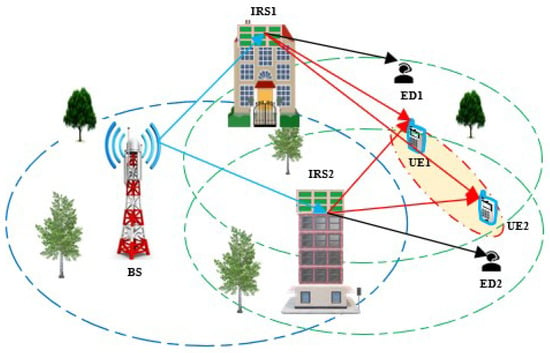
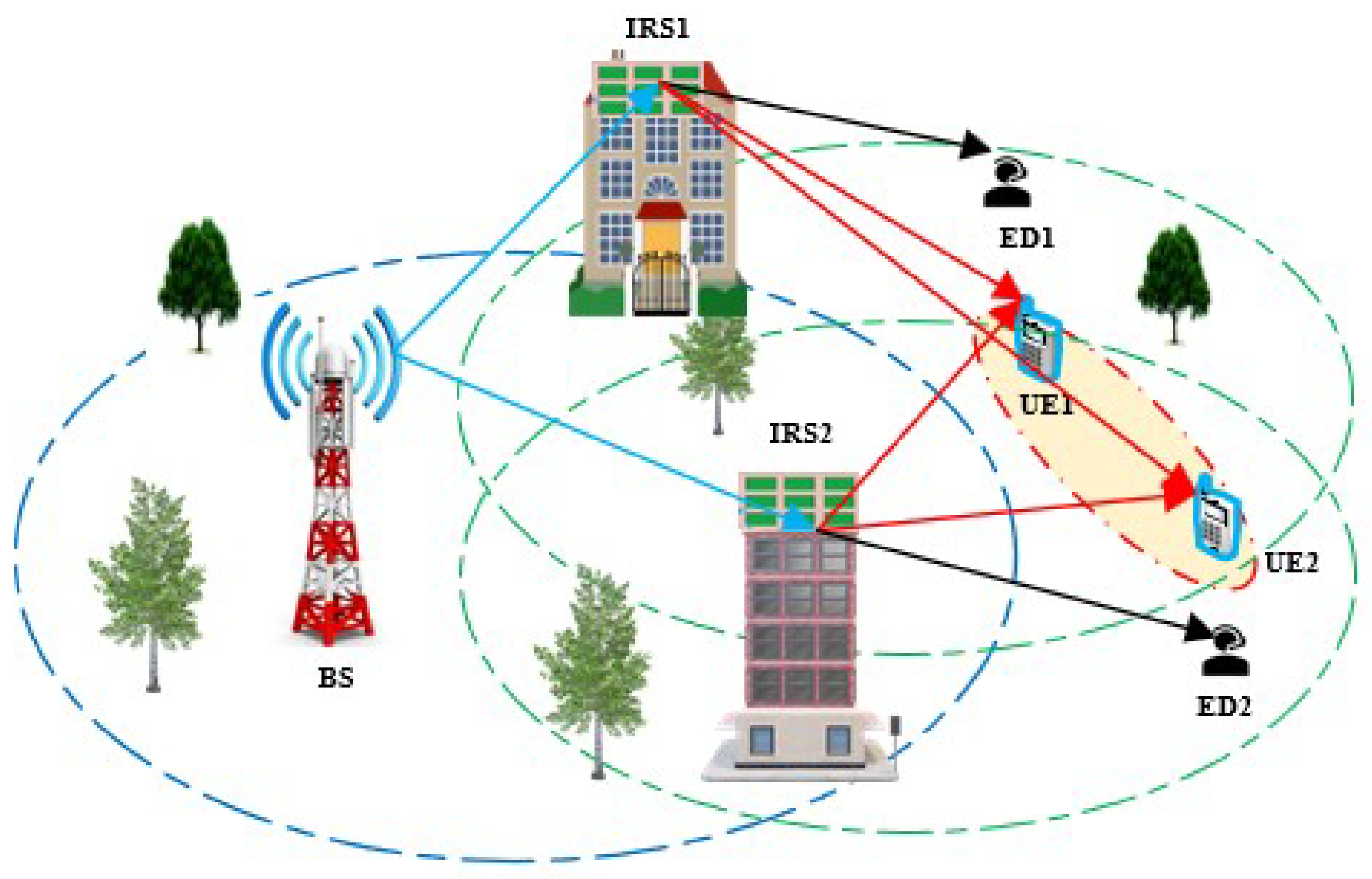
- We study a model of a DIRS-NOMA downlink wireless communication network system connecting a group of two UEs. The system consists of a BS supported by a DIRS connecting to a group of two NOMA UEs at the edge without a direct connection to the BS, using the NOMA technique. At each UE, there is an ED: ED1 is in the coverage area of IRS1, and IRS2 does not affect ED1; ED2 is in the coverage area of IRS2, and IRS1 does not affect ED2.
- Our analysis model considers statistical parameters of BS-DIRS-UE and BS-DIRS-ED channel models, taking into account the number of DIRS reflectors. It is assumed that BS-DIRS, DIRS-UE, and IRS-ED channels are interconnected channels with identical Rayleigh distributions.
- From the proposed model, we construct closed-form expressions of the SOP and ASR for each UE. We discuss and analyze the system security performance according to the NOMA power allocation for each UE and the number of IRS reflectors.
- Based on the analysis results, we build an ASR optimization algorithm using the alternating optimization method combining NOMA power allocation coefficient optimization and IRS passive beam optimization through the Lagrange double transform.
- Finally, we verify the inferred expressions by providing Monte Carlo simulations and analytical results.
1.2. Structure of the Paper
The paper is structured as follows. Section 2 presents the system model and problem formulation. Section 3 describes security performance analysis. Section 5 confirms the analytical results with simulation and discussions. Section 6 concludes the study.
The main notations of this paper are as follows: denotes the probability operator; denotes the expectation operator; and denote the PDF and the CDF, respectively; is a circularly symmetric complex Gaussian distribution; ∼ stands for “distributed as”; is absolute operator; denotes the exponential integral function [32] [Equation (8.211.1)]. An identity matrix of size is denoted by ; denotes the conjugate and Hermitian transpose; a diagonal matrix with on the diagonal is denoted by . is the gamma function, and is the lower incomplete gamma function. .
2. System Model and Problem Formulation
2.1. The System Model
We study a downlink DIRS-NOMA network model for a two-UE NOMA edge group. The locations of the two-UE groups forming the NOMA user group in each cell are randomly selected among the UEs associated with that cell. One of these two UEs is considered UE1, and the other is considered UE2. For UE1, there is one ED1; in our scenario, ED1 is assumed to be supported only by IRS1. UE2 has one ED2, and ED2 is only supported by IRS2. In the downlink, in the BS-DIRS-UE link, it is assumed that all channels are flat-fading channels and that the BS has complete channel state information (CSI). We assume that IRS has no CSI about the ED link. Therefore, we consider a passive eavesdropping scenario. Consequently, we cannot guarantee secure data transmission. To quantify the performance, we use the SOP as the performance metric of interest. In addition, we assume that all links undergo independent Rayleigh fading. The BS-DIRS, DIRS-UE, and IRS-ED links can be LoS or NLoS for different scenarios. The channel gain between BS-DIRS is the same, denoted as . The channel gain between DIRS-UE and IRS-ED is the same, denoted as . In particular, they are represented as the vector spaces and , respectively. All elements in G and g follow the fading Rayleigh model with variance . The BS is equipped with M antennas that generate K beamforming vectors to serve K groups of two NOMA UEs. The BS has one antenna supported by two IRSs to communicate with UE1 and UE2, each of which has a single antenna (Figure 1). Assume that there is no direct signal transmission between the BS and the UEs, due to the BS and the UEs being far apart or having obstacles between them. The IRS has N reflecting elements, and its reflection coefficient matrix is theoretically defined as , , in which is called the amplitude of the reflection coefficient and is the phase shift angle of the kth adjustable IRS element ().
Figure 1.
DIRS-NOMA network model.
2.2. Signal Analysis
The BS’s transmission signal is represented as , where is the transmission power at the BS. and are the signals that the BS transmits to UE1 and UE2, respectively. and are the NOMA power allocation coefficient of the BS to UE1 and UE2, respectively. Parameters and satisfy the condition . UEs are sorted based on their channel quality relative to the BS. According to the decoding principle of NOMA, UE1 performs SIC and directly decodes its own signal by treating UE2’s signal as interference. For UE2, it performs SIC and then decodes UE1’s signal and deletes this message from the observation area before decoding its own message [33,34]. Then, the signal received by the UEs and EDs can be represented as follows:
- The signal received by UE1 is
- The signal received by ED1 is
- The signal received by UE2 is
- The signal received by ED2 is
In these equations, is the signal transmission distance from BS to IRS1, is the signal transmission distance from BS to IRS2, is the distance between IRS1 and UE1, is the distance between IRS1 and UE2, is the distance between IRS2 and UE1, is the distance between IRS2 and UE2, is the distance from IRS1 to ED1, and is the distance from IRS2 to ED2. , , , and are defined as the Gaussian noise at UE1, UE2, ED1, and ED2, respectively. , , , and have the same variance of 1.
2.3. Signal-to-Noise Ratio Plus Noise for UEs and EDs
The signal-to-interference-plus-noise ratio (SINR) for the UEs and EDs is defined as follows:
- The SINR for UE1 is
- The SINR for ED1 is
- The SINR for UE2 is
- The SINR at ED2 is
In these equations, , , , , and .
3. Security Performance Analysis
In this section, we analyze the security performance parameters of the DIRS-NOMA system, namely, the SOP and ASR.
3.1. Statistical Analysis
The statistical characteristics of BS-DIRS-UE and BS-IRS-ED channels are that we analyze the statistics of the random variable . depends on the reflection parameters of the reflecting elements of the IRS; is represented as , where and are the channel gains of the kth element of G and g, respectively. Setting , , we have
Considering , in which and are two random variables with Rayleigh distributions, it follows that the product is also a random variable with a double Rayleigh distribution. Therefore, X is the sum of N random variables with statistically independent double Rayleigh distributions. The PDF and CDF of X can be approximated as follows [7]:
where , , , and .
Theorem 1.
and are defined as follows:
Proof.
Please refer to Appendix A. □
3.2. Analysis
The is defined as the probability that a secure communication can be performed, which is a typical performance measure for PLS. Specifically, the instantaneous security rate can be expressed as
- UE1 :
The of UE1 is presented in the following theorem.
Theorem 2.
The of UE1 is defined as
where
,
,
,
.
Proof.
Please refer toAppendix B. □
- UE2 SOP:
The of UE2 is presented in the following theorem.
Theorem 3.
The of UE2 is defined as
where
,
,
,
.
Proof.
Please refer to Appendix C. □
3.3. Average Secrecy Rate (ASR)
The ASR is one of the most important performance metrics to evaluate a system’s covert performance in the presence of an eavesdropper. We assume that the worst-case eavesdropper can continue to achieve the largest channel gain with the maximum achievable ergodic rate . Therefore, the average achievable covert rate is [31].
- UE1 ASR:
To determine , we determine and as follows:
Transforming and , we obtain
In these equations, , , , and are determined by the following theorems.
Theorem 4.
and are determined by
Proof.
Please refer to Appendix D. □
Theorem 5.
and are determined by
Proof.
Please refer to Appendix E. □
- UE2 ASR:
To determine , we determine and as follows:
Transforming and , we obtain
In these equations, , , , and are determined by the following theorems.
Theorem 6.
and are determined by
Proof.
Please refer to Appendix F. □
Theorem 7.
and are determined by
Proof.
Please refer to Appendix G. □
4. Weighted Secrecy Rate Optimization Problem
In this subsection, we optimize the weighted secrecy rate (WSR) of a legitimate user subject to the total power constraint of the BS, the IRS phase-shift constraints, and the SOP/SIC constraints of the legitimate user by designing the NOMA transmission power allocation factor of the BS and the IRS’s reflected beamforming vector . To enhance the security of the above system from the perspective of the physical layer, we jointly optimize () and so that the system’s secrecy rate is optimized. Specifically, secrecy rate optimization can be achieved by the optimization problem stated as follows [35,36,37,38]:
4.1. Weighted Secrecy Rate Optimization for UE1
is defined as
Transforming expression , we obtain
where
with , , and .
Our goal is to optimize the WSR of UE1 by combining the design of the transmision beamforming matrix at the BS and at the IRS. Therefore, the WSR optimization problem is formulated as follows:
where the weight is used to represent the priority of UE1.
The objective function is non-convex, because the constraint set F is non-convex. To solve the logarithm of the objective function (41a)–(41c), we apply the Lagrangian double transform proposed in [31]. Then, (41a)–(41c) can be equivalently written as follows:
where is an auxiliary variable for decoding ; the new objective function is defined by
In (42), when , are fixed, the optimal is the solution of the equation
We find the optimal as follows:
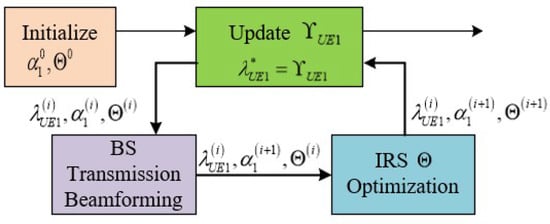
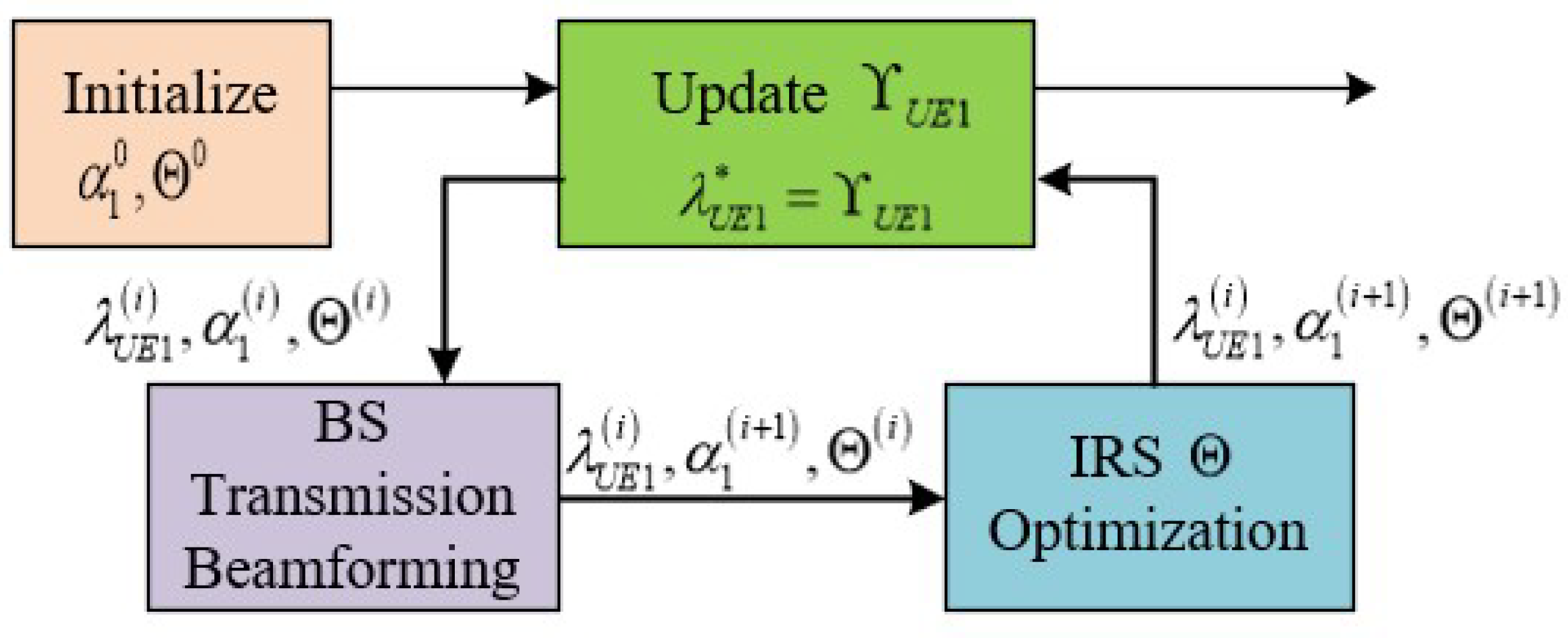
In the following, we solve by fixing and solve by fixing , respectively. Then, the original problem (42a)–(42c) can be solved iteratively by applying the alternating optimization method as illustrated in Figure 2. Specifically, in each iteration, we first update the nominal ; then, the better solutions for and are updated accordingly. This process is repeated until no further improvement is achieved.
Figure 2.
Alternating optimization for (42a)–(42c).
4.1.1. Optimizing NOMA Power Allocation Factor for UE1
We study how to find the optimization of with fixed for (42a)–(42c). Hence, with fixed and , the optimization of becomes as follows:
where .
Using the quadratic transformation proposed in [32], is re-expressed as
The optimization problem in (46a) and (46b) is solved by updating and while fixing one of them. The optimal is determined as
where is the solution of the equation . Then, fixing , the optimal is determined by the following theorem.
Theorem 8.
The optimal is determined by
where , , and .
Proof.
Please refer to Appendix H. □
4.1.2. Optimized Reflection Matrix for UE1
We study how to find the optimization of with fixed for (42a)–(42c). Hence, with fixed and , the optimization of becomes as follows:
where .
We optimize in (42a)–(42c) given fixed values of and . Using as defined in (40), the objective function of (50a) and (50b) is expressed as a function of :
where . Transforming expression (51), we obtain
The maximum value of is determined by
when . is optimally adjusted so that
An alternating optimization method to optimize for UE1 is proposed by us in Algorithm 1.
| Algorithm 1: Alternating optimization method for solving (42a)–(42c). |
1: Step 0: Initialize and to feasible values. Repeat 2: Step 1: Update the nominal by (45). 3: Step 2.1: Update by (48). 4: Step 2.2: Update the transmission beamforming by (49). 5: Step 3: Update by (54). Until the value of the function in (43) converges. |
4.2. Weighted Secrecy Rate Optimization for UE2
is defined as
Transforming expression , we obtain
where
with , , and .
Our goal is to optimize the WSR of UE2 by combining the design of the transmission beamforming matrix at the BS and at the IRS. Therefore, the WSR optimization problem is formulated as
where the weight is used to represent the priority of UE2.
The objective function is non-convex, because the constraint set F is non-convex. To solve the logarithm of the objective function (58a)–(58c), we apply the Lagrangian double transform proposed in [32]. Then, (58a)–(58c) can be equivalently written as follows:
where is an auxiliary variable for decoding ; the new objective function is defined by
In (59a)–(59c), when and are fixed, the optimal is the solution of the equation:
We find the optimal as follows
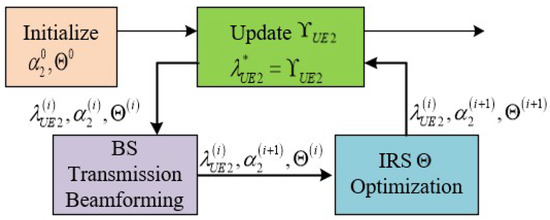
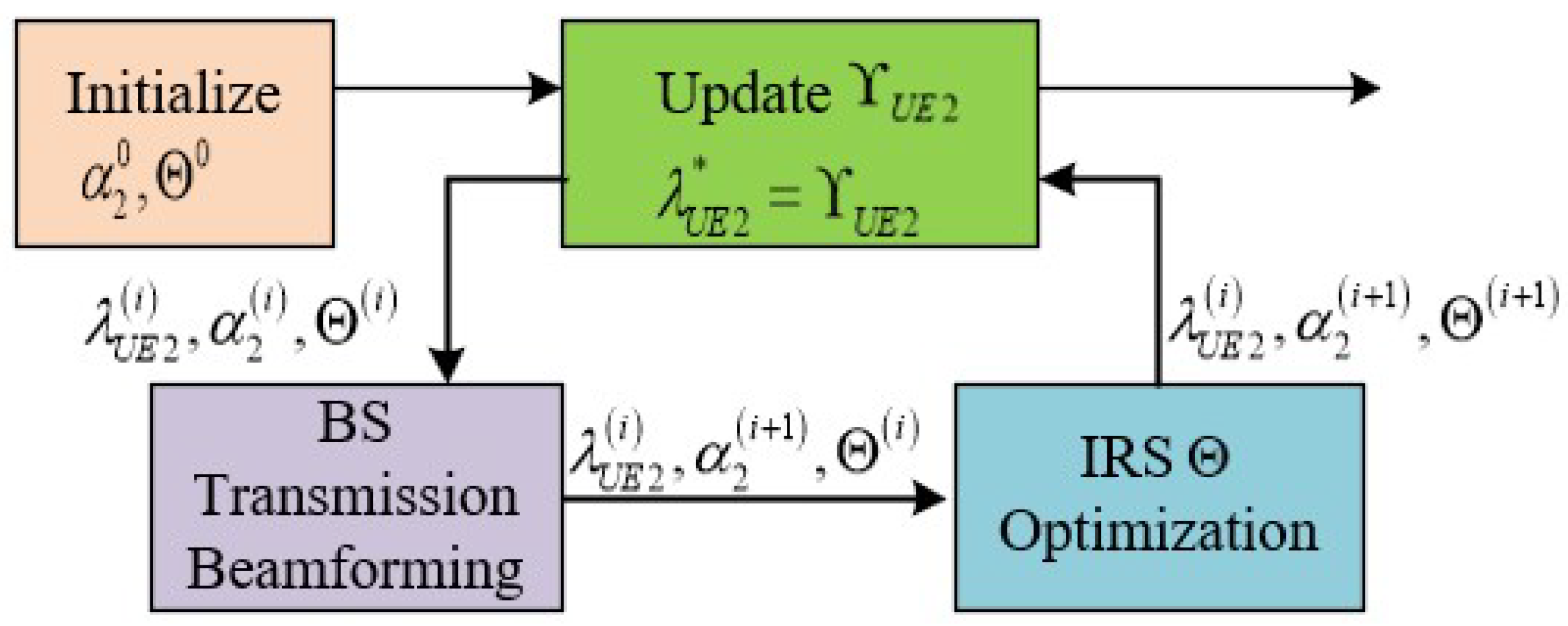
In the following, we solve by fixing and solve by fixing , respectively. Then, the original problem (59a)–(59c) can be solved iteratively by applying the alternating optimization method as illustrated in Figure 3. Specifically, in each iteration, we first update the nominal , then the better solutions for and are updated accordingly. This process is repeated until no further improvement is achieved.
Figure 3.
Alternating optimization for (59a)–(59c).
4.2.1. Optimizing NOMA Power Allocation Factor for UE2
We study how to find the optimization of with fixed for (59a)–(59c). Hence, with fixed and , the optimization of becomes
where .
Using the quadratic transformation proposed in [32], is re-expressed as
At this point, (63a) and (63b) is solved by updating and by fixing one of them. The optimal is determined as follows:
where is the solution of equation . Then, fixing , the optimal is determined by the following theorem.
Theorem 9.
The optimal is determined by
where , , and .
Proof.
Please refer to Appendix I. □
4.2.2. Optimized Reflection Matrix for UE2
We study how to find the optimization of with fixed for (59a)–(59c). Hence, with fixed and , the optimization of becomes the following:
where .
We optimize in (65) given a fixed and . Using defined in (57), the objective function of (67a) and (67b) is expressed as a function of :
Transforming expression (66), we obtain
The maximum value of is determined by
when . is optimally adjusted so that
An alternating optimization method to optimize for UE2 is proposed by us in Algorithm 2.
| Algorithm 2: Alternating optimization method for solving (61). |
1: Step 0: Initialize and to feasible values. Repeat 2: Step 1: Update the nominal by (62). 3: Step 2.1: Update by (65). 4: Step 2.2: Update the transmission beamforming by (66). 5: Step 3: Update by (71). Until the value of the function in (60) converges. |
5. Simulation Results and Discussion
In this section, we simulate the analyzed results using the Monte Carlo simulation method in MATLAB software, version R2014a. The simulation settings we set are as shown in Table 1.
Table 1.
Simulation parameters.
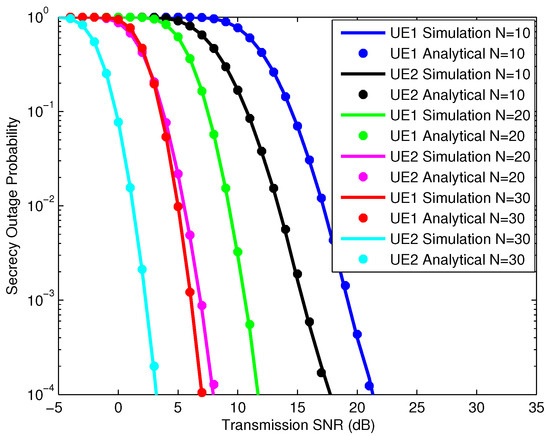
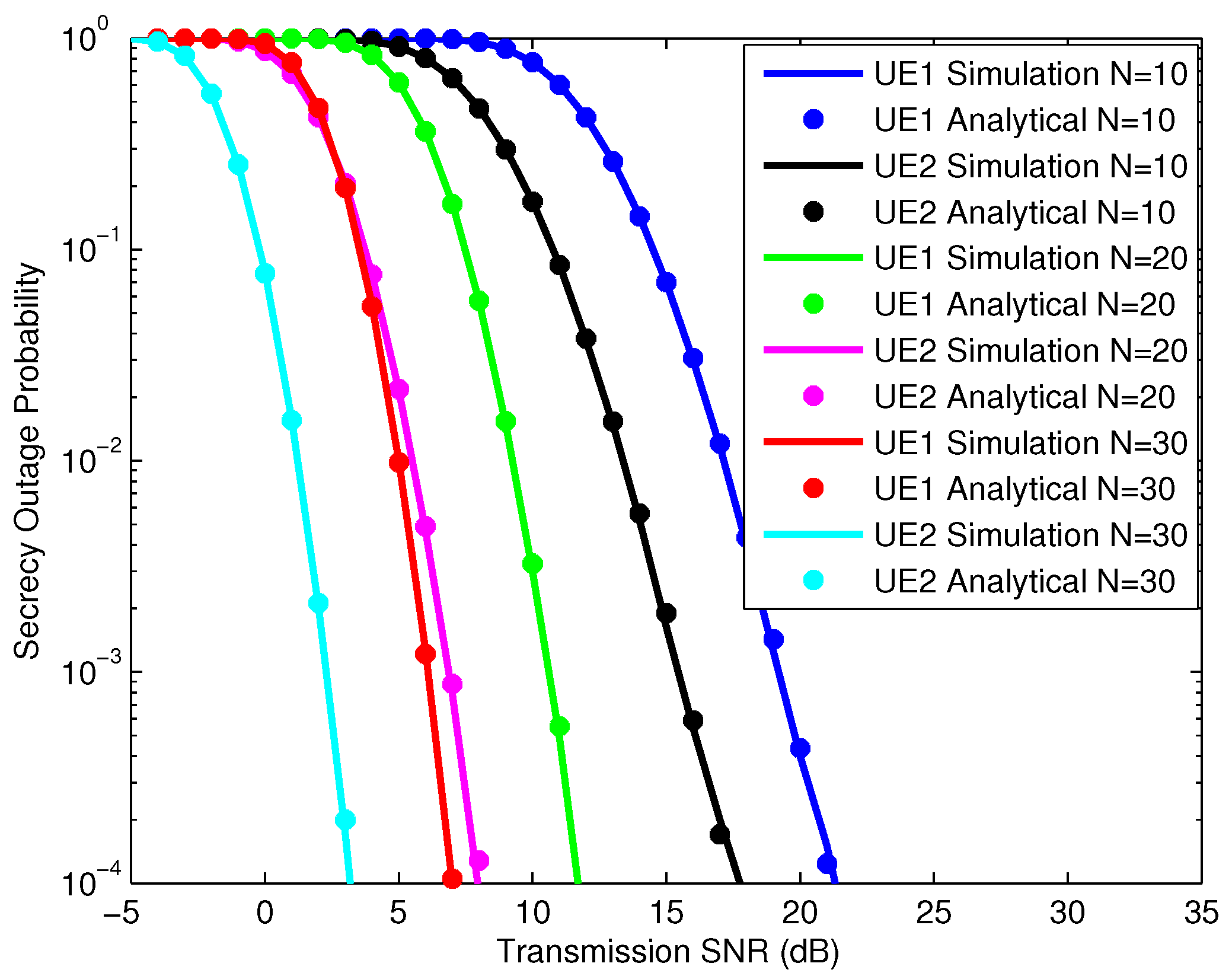
In Figure 4, we simulate the SOPs of the UEs according to the SNR, in which the IRS has 10, 20, and 30 reflectors with NOMA power allocation factors of 0.3 and 0.7 for UE1 and UE2, respectively. The simulation analysis results of the UEs’ SOPs show us that all the simulation and analysis results are consistent. When the number of IRS reflectors is large, the slope of the SOP characteristics is large and is achieved quickly when the SNR is small. Therefore, we can confirm that the security performance of the system depends on the number of IRS reflectors. In addition, we see that the SOP characteristics of the UEs also depend on the NOMA power allocation factor of the UE. Specifically, if the NOMA power allocation factor of UE2 is larger than UE1, the characteristic SOP curve of UE2 has a lower SNR value than the SOP of UE1. To evaluate the influence of the NOMA power allocation factor, we continue to simulate the SOPs of UEs with different NOMA power allocation factors as shown in Figure 5.
Figure 4.
of UEs with different numbers of IRS reflection elements.
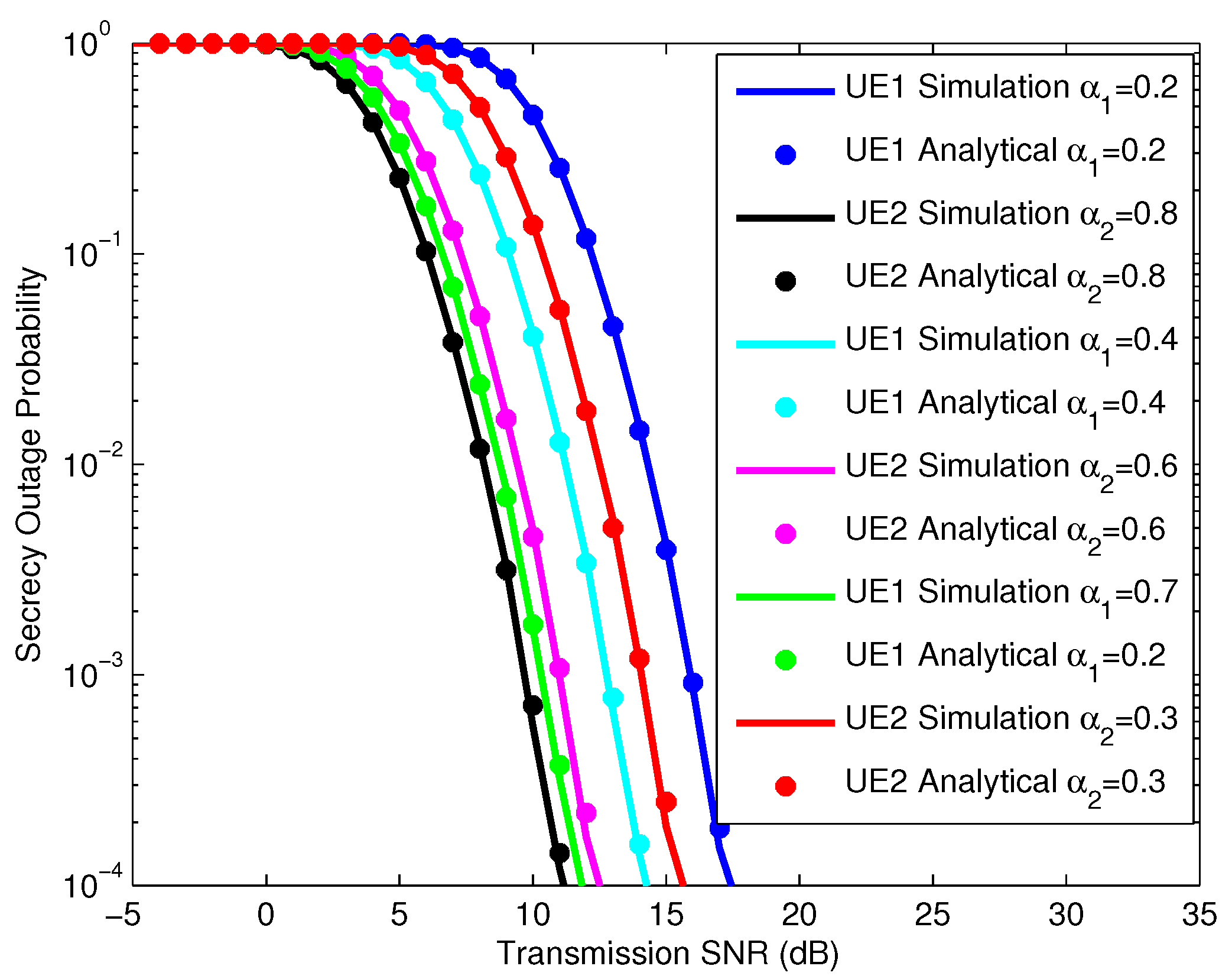
Figure 5.
SOP of UEs with different power allocation factors.
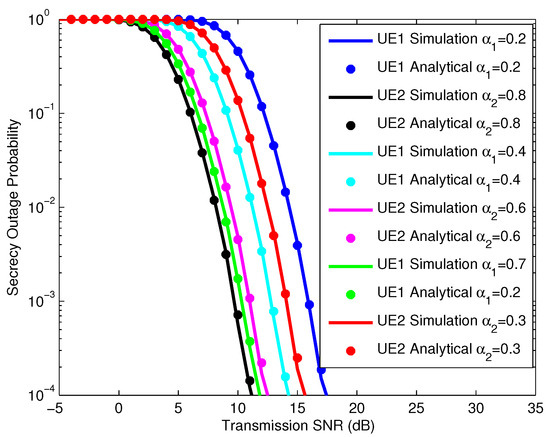
In Figure 5, we simulate the SOP of UE users according to the SNR, where the IRS has 20 reflective elements with NOMA power allocation factors of 0.2, 0.4, and 0.7 for UE1 and NOMA power allocation factors of 0.8, 0.6, and 0.3 for UE2, respectively. The simulation results for the UE SOPs match the analysis results for the UE SOPs. From the analysis results in Figure 4 and Figure 5, it can be seen that the SOPs depend not only on the number of IRS elements but also on the NOMA power allocation factor for each UE. Thus, with the DIRS-NOMA system model, we propose that if the system is designed with a large number of IRS reflective elements plus a reasonable NOMA power allocation factor, the system’s security performance will be high.
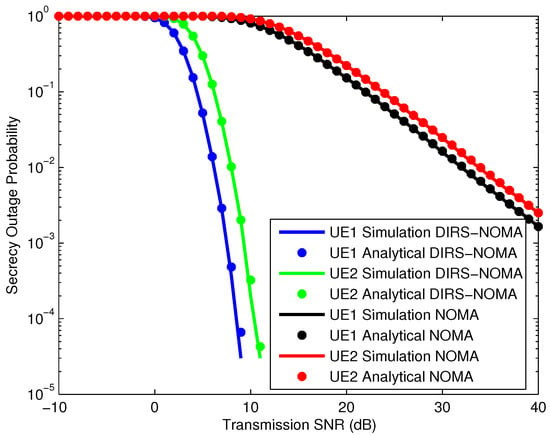
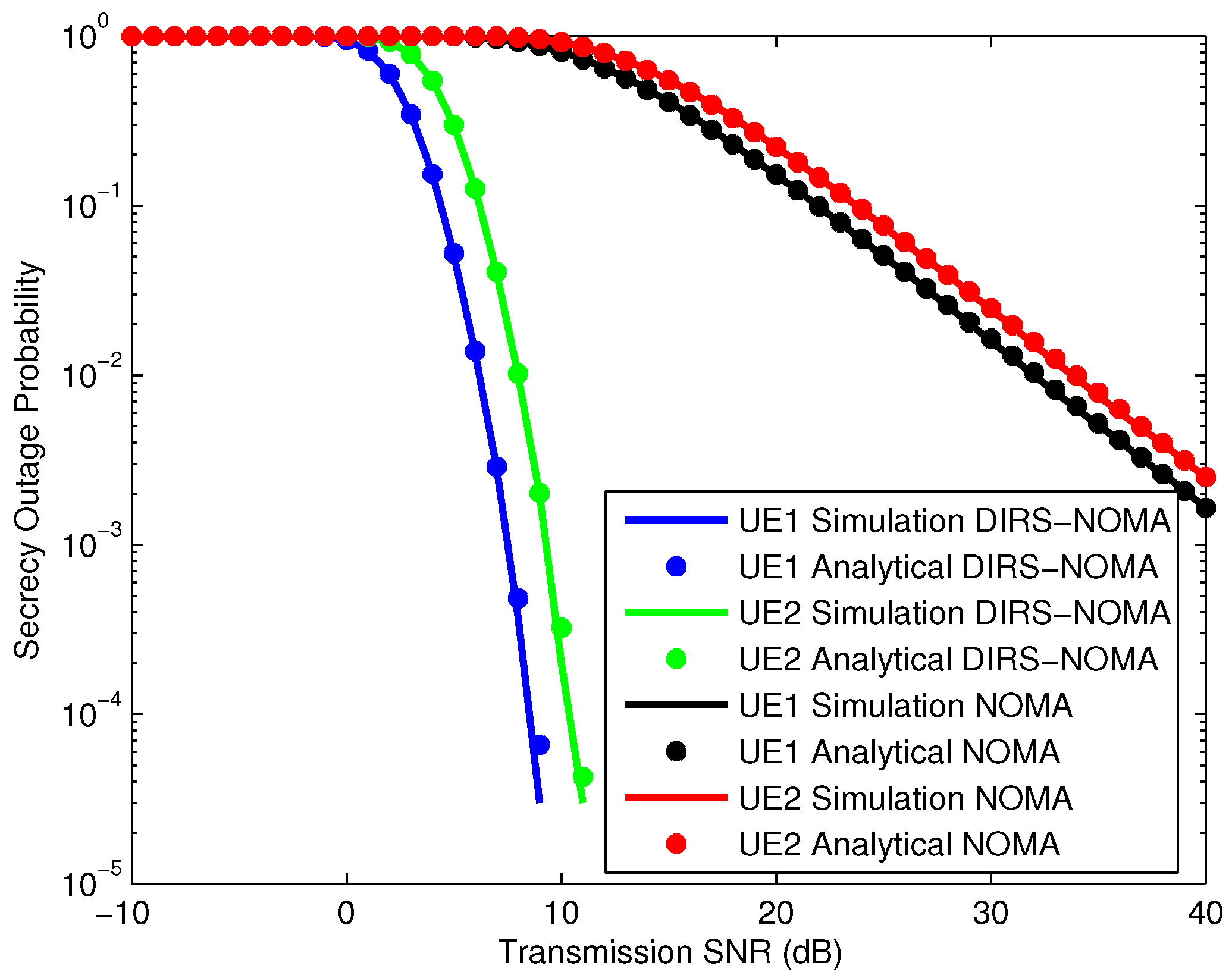
In Figure 6, we simulate the SOP of the DIRS-NOMA system and the NOMA system, where the IRS has 20 reflectors with NOMA power allocation coefficients of 0.6 for UE1 and 0.4 for UE2, respectively. The simulation results for the SOPs of the UEs match the analysis results for the SOPs of the UEs. The curves representing the SOP of the DIRS-NOMA system have a much higher slope than the curves representing the SOP of the NOMA system. This proves that the DIRS-NOMA system has the ability to improve security performance much better than the NOMA system. Specifically, when the SNR reaches 10 dB, the SOP of the DIRS-NOMA system reaches about , while the SOP of the NOMA system reaches below .
Figure 6.
Comparison of SOPs between DIRS-NOMA and NOMA systems.
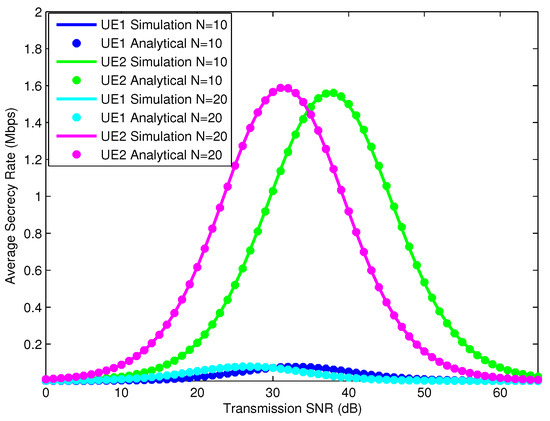
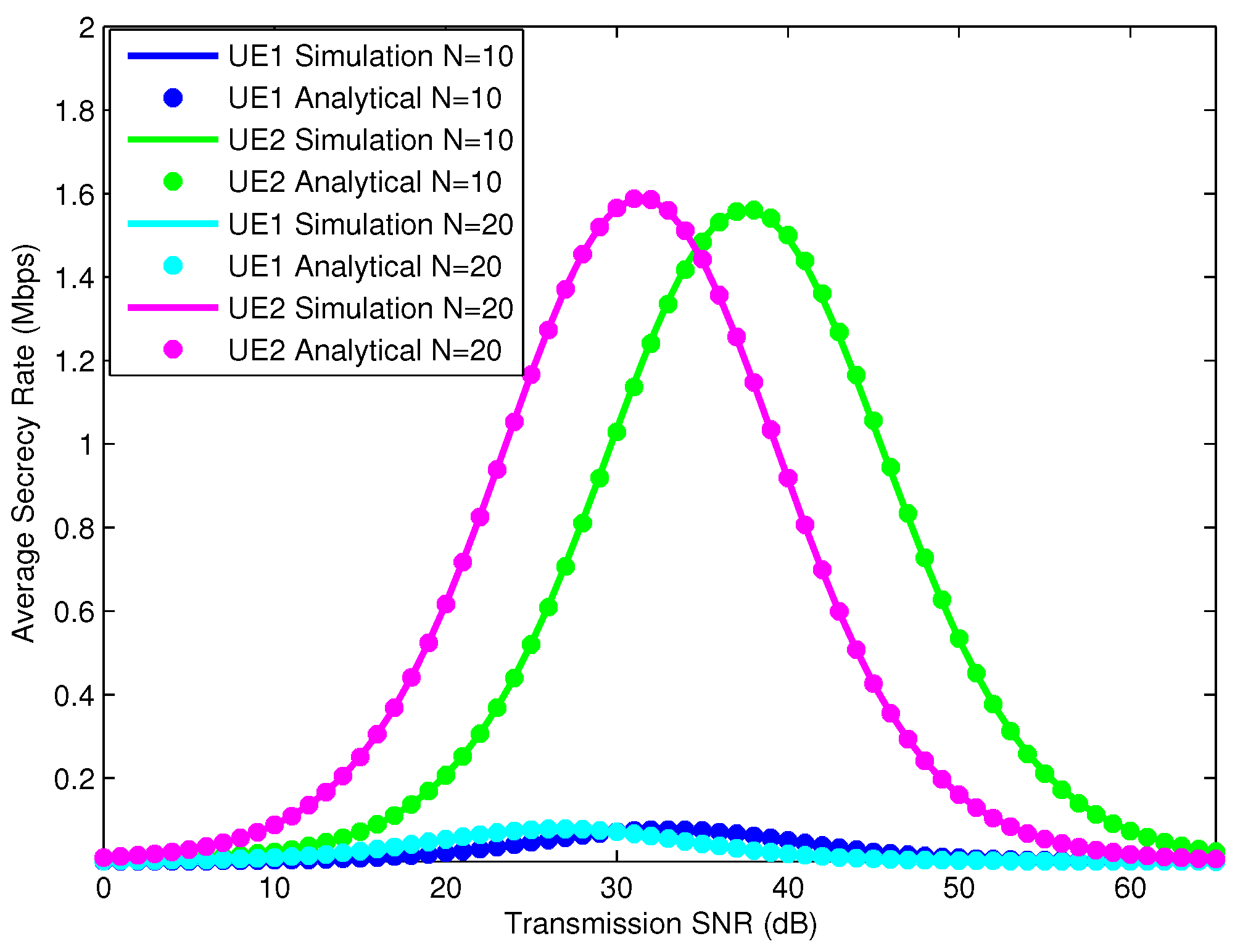
In Figure 7, we use simulations to optimize the ASRs of the UEs according to the SNR, where the IRS has 10 and 20 reflectors and the power allocation factors are 0.1 and 0.9 for UE1 and UE2, respectively. The results of the analysis of the ASRs of the UEs are consistent with the results of the simulation of the ASRs of the corresponding UEs. From the simulation analysis results, we can see that the ASR characteristics reach their maximum values at different SNR values. This proves that the ASR characteristics of the UEs depend on the number of reflectors of the IRS. In addition, the maximum point of the ASR characteristics of the UEs has a small maximum value when the NOMA power allocation factor is small and reaches a large value when the NOMA power allocation factor for the UE is large. To evaluate the influence of the NOMA power allocation factor on the ASR of UEs, we continue to simulate the ASRs of UEs with different NOMA power allocation factors, as shown in Figure 8.
Figure 7.
ASR of UEs with different numbers of IRS reflection elements.
Figure 8.
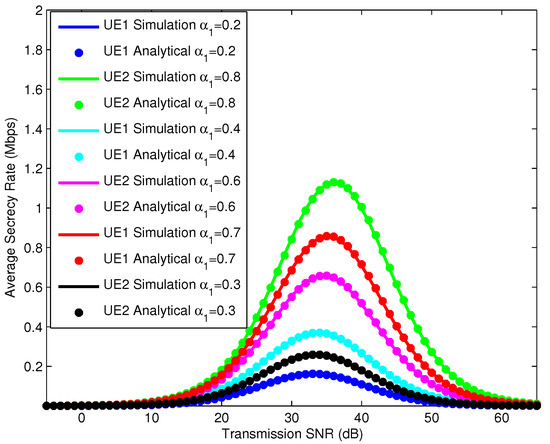
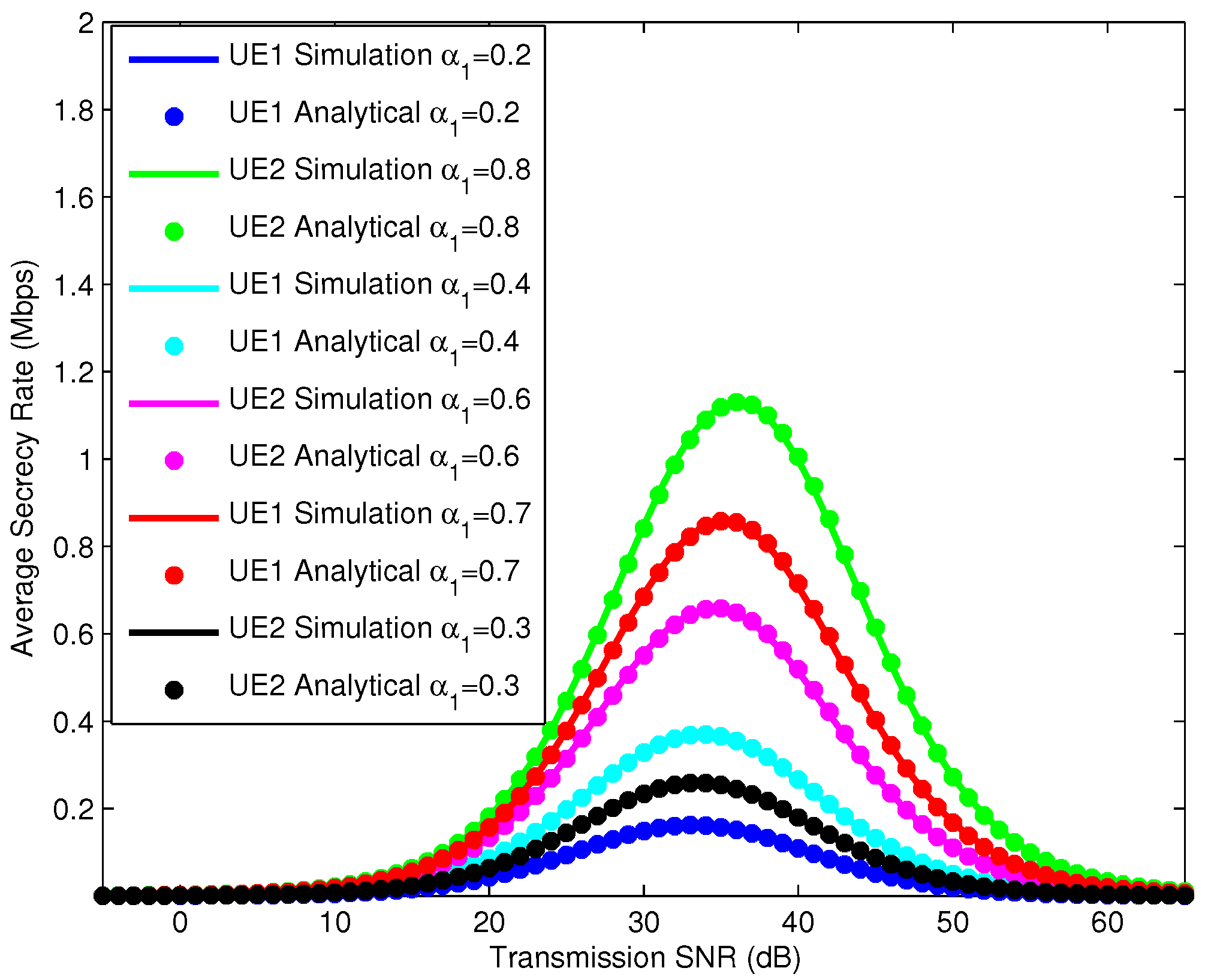
ASR of UEs with different NOMA power allocation factors.
In Figure 8, we simulate the ASRs of the UEs according to the SNR, where the IRS has 10 reflectors. The NOMA power allocation factors are 0.2, 0.4, and 0.7 for UE1 and 0.8, 0.6, and 0.3 for UE2, respectively. The simulation results show us that when the power allocation factors change, the characteristic curve of the ASR changes. The maximum value of ASR achieved by different UEs is different and depends on the NOMA power allocation factors for the UEs. In addition, according to the characteristic curve, we see that the maximum ASR values of the UEs are achieved at a constant SNR and do not depend on the NOMA power allocation factors.
From the above analysis, we can see that the security performance of the proposed DIRS-NOMA system depends not only on the NOMA power allocation factor but also on the number of IRS reflection elements. If we design the number of IRS elements and the NOMA power allocation factor reasonably, we can improve the security performance of the system. We can confirm that an IRS has the ability to improve the security performance of the DIRS-NOMA system.
6. Conclusions
In this paper, we computed the security performance parameters of a DIRS-NOMA system supporting communication with a group of two NOMA UEs at the edge, without direct connection to the BS, where there is an ED associated with each UE. We calculated and derived the closed-form expressions of the SOP and ASR for the UEs of the DIRS-NOMA system. From the closed-form expression of the ASR, we proved that this parameter reaches its maximum value at a given SNR. The maximum value of the ASR depends only on the number of IRS reflection elements and does not depend on the NOMA power allocation factor. We have proven and verified the theoretical arguments through simulation. Through analysis and discussion of the results above, we have confirmed that if we design the number of IRS elements and the NOMA power allocation factor reasonably, we can improve the security performance of the system, and an IRS is capable of improving the security performance of the DIRS-NOMA system. In addition, we formulate and solve an ASR optimization problem by optimizing the NOMA power allocation factor combined with IRS reflection beam optimization by the method to maximize WSR using the fractional programming technique. Furthermore, through the analysis, simulation, and discussion of the results above, it has been demonstrated that the DIRS-NOMA technique is capable of improving the security performance of the system. We hope that the analysis and discussion of the security performance of the DIRS-NOMA system model that we propose will provide useful contributions to other studies in the future.
Author Contributions
Validation, N.H.V.; Writing—original draft, N.T.A.; Writing—review & editing, D.-T.D. and A.S. All authors have read and agreed to the published version of the manuscript.
Funding
This work has received funding from FCT/MCTES through national funds and when applicable co-funded EU funds under the project UIDB/50008/2020-UIDP/50008/2020.
Institutional Review Board Statement
Not applicable.
Informed Consent Statement
Not applicable.
Data Availability Statement
Data are contained within the article.
Conflicts of Interest
The funders had no role in the design of the study; in the collection, analyses, or interpretation of data; in the writing of the manuscript; or in the decision to publish the results.
Nomenclature
| AO | Alternating optimization |
| AP | Access point |
| AN | Artificial noise |
| AWGN | Additive white Gaussian noise |
| ASR | Average secrecy rate |
| B5G | Beyond fifth generation |
| 6G | Sixth generation |
| BER | Bit error rate |
| BS | Base station |
| CDF | Cumulative density function |
| CSI | Channel state information |
| DPSFA | Discrete phase-shift fixed amplitude |
| DPDAV | Discrete phase-dependent amplitude variation |
| ER | Ergodic rate |
| ED | Eavesdropping device |
| IRS | Intelligent reflecting surface |
| ITS | Intelligent transportation system |
| IoT | Internet of Things |
| GA | Genetic algorithm |
| GBS | Ground base station |
| MMF | Max–min fairness |
| NOMA | Non-orthogonal multiple access |
| OMA | Orthogonal multiple access |
| OP | Outage probability |
| SOP | Secrecy outage probability |
| SWIPT | Simultaneous wireless information and power transfer |
| Probability distribution density | |
| PLS | Physical layer security |
| SIC | Successive interference cancellation |
| RSMA | Rate-splitting multiple access |
| TAaPSA | Tile allocation and phase shift adjustment |
| UE | User |
| UAV | Unmanned aerial vehicle |
| WSR | Weighted secrecy rate |
Appendix A. Proof of Theorem 1
Proof.
We have
Substituting the expression into (A1) and transforming it, we have
Using Equation (3.381/4) from [39], it can be written in closed form as
On the other hand,
Substituting the expression into (A4) and transforming it, we have
Using Equation (3.381/4) from [39], it can be written in closed form as
The proof of Theorem 1 is complete. □
Appendix B. Proof of Theorem 2
Proof.
We have
Substituting and into (A7) and transforming the expression, we have
Because and , is rewritten as
is defined as
The proof of Theorem 2 is complete. □
Appendix C. Proof of Theorem 3
Proof.
We have
Substituting and into (A12) and transforming the expression, we have
Because and , is rewritten as
It is noted that is defined as
The proof of Theorem 3 is complete. □
Appendix D. Proof of Theorem 4
Proof.
We have
is calculated as
We can substitute the values and into (A18) to determine :
We have
is calculated as
We can substitute the values and into (A21) to determine :
The proof of Theorem 4 is complete. □
Appendix E. Proof of Theorem 5
Proof.
We have
is calculated as
We can substitute the values and into (A24) to determine :
We have
is calculated as
We can substitute the values and into (A27) to determine :
The proof of Theorem 5 is complete. □
Appendix F. Proof of Theorem 6
Proof.
Using the same approach that was used for the proof of Theorem 4, we can easily prove Theorem 6.
The proof of Theorem 6 is complete. □
Appendix G. Proof of Theorem 7
Proof.
Using the same approach that was used for the proof of Theorem 5, we can easily prove Theorem 7.
The proof of Theorem 7 is complete. □
Appendix H. Proof of Theorem 8
Proof.
is rewritten as
Function is represented as follows:
We have
Therefore,
when
Solvimg Equation (A33), we obtain
The proof of Theorem 8 is complete. □
Appendix I. Proof of Theorem 9
Proof.
is rewritten as
Function is represented as follows:
We have
Therefore,
when
Solving Equation (A39), we obtain
The proof of Theorem 9 is complete. □
References
- Al-Obiedollah, H.; Salameh, H.B.; Cumanan, K.; Ding, Z.; Dobre, O.A. Competitive IRS Assignment for IRS-Based NOMA System. IEEE Wirel. Commun. Lett. 2024, 13, 505–509. [Google Scholar] [CrossRef] [Scilit]
- Almaghthawi, S.; Alsusa, E.; Al-Dweik, A. On the Performance of IRS-Aided NOMA in Interference-Limited Networks. IEEE Wirel. Commun. Lett. 2024, 13, 560–564. [Google Scholar] [CrossRef] [Scilit]
- Zhang, J.; Wang, W.; Tang, J.; Zhao, N.; Wong, K.-K.; Wang, X. Robust Secure Transmission for IRS-Aided NOMA Networks With Hybrid Beamforming. IEEE Trans. Wirel. Commun. 2024, 23, 3086–3101. [Google Scholar] [CrossRef] [Scilit]
- Liu, Y.; Xiong, K.; Zhu, Y.; Yang, H.-C.; Fan, P.; Letaief, K.B. Outage Analysis of IRS-Assisted UAV NOMA Downlink Wireless Networks. IEEE Internet Things J. 2024, 11, 9298–9311. [Google Scholar] [CrossRef] [Scilit]
- Li, K.; Cui, M.; Zhang, G.; Wu, Q.; Li, D.; He, J. Robust Transmit and Reflect Beamforming Design for IRS-Assisted Offshore NOMA Communication Systems. IEEE Trans. Veh. Technol. 2024, 73, 783–798. [Google Scholar] [CrossRef] [Scilit]
- Wu, Q.; Zhang, R. Beamforming optimization for wireless network aided by intelligent reflecting surface with discrete phase shifts. IEEE Trans. Wirel. Commun. 2020, 68, 1838–1851. [Google Scholar] [CrossRef] [Scilit]
- Nguyen, T.-A.; Nguyen, H.-V.; Do, D.-T.; Silva, A. Performance Analysis of Downlink Double-IRS Systems Relying on Non-Orthogonal Multiple Access. IEEE Access 2023, 11, 110208–110220. [Google Scholar] [CrossRef] [Scilit]
- Nguyen, T.-A.; Nguyen, H.-V.; do, D.-T.; Lee, B.M. Impacts of Co-Channel Interference Performance of Downlink IRS-NOMA Systems. IEEE Access 2024, 12, 61860–61876. [Google Scholar] [CrossRef] [Scilit]
- Nguyen, P.X.; Nguyen, V.-D.; Nguyen, H.V.; Shin, O.-S. UAV-Assisted Secure Communications in Terrestrial Cognitive Radio Networks: Joint Power Control and 3D Trajectory Optimization. IEEE Trans. Veh. Technol. 2021, 70, 3298–3313. [Google Scholar] [CrossRef] [Scilit]
- Pan, Y.; Li, R.; Da, X.; Hu, H.; Zhang, M.; Zhai, D.; Cumanan, K.; Dobre, O.A. Cooperative Trajectory Planning and Resource Allocation for UAV-Enabled Integrated Sensing and Communication Systems. IEEE Trans. Veh. Technol. 2024, 73, 6502–6516. [Google Scholar] [CrossRef] [Scilit]
- Tuan, V.P.; Hong, I.P. Secrecy Performance Analysis and Optimization of Intelligent Reflecting Surface-Aided Indoor Wireless Communications. IEEE Access 2020, 8, 109440–109452. [Google Scholar] [CrossRef] [Scilit]
- Yang, L.; Yang, J.; Xie, W.; Hasna, M.O.; Tsiftsis, T.; Renzo, M.D. Secrecy Performance Analysis of RIS-Aided Wireless Communication Systems. IEEE Trans. Veh. Technol. 2020, 69, 12296–12300. [Google Scholar] [CrossRef] [Scilit]
- Trigui, I.; Ajib, W.; Zhu, W.-P. Secrecy Outage Probability and Average Rate of RIS-Aided Communications Using Quantized Phases. IEEE Commun. Lett. 2021, 25, 1820–1824. [Google Scholar] [CrossRef] [Scilit]
- Do, T.; Le, A.T.; Vahid, A.; Sicker, D.; Jamalipour, A. A Deep Neural Network for Physical Layer Security Analysis in NOMA Reconfigurable Intelligent Surfaces-Aided IoT Systems. TechRxiv 2022. [Google Scholar] [CrossRef]
- Xu, P.; Chen, G.; Pan, G.; Di Renzo, M. Ergodic secrecy rate of RIS-assisted communication systems in the presence of discrete phase shifts and multiple eavesdroppers. arXiv 2020, arXiv:2009.00517. [Google Scholar] [CrossRef] [Scilit]
- Li, D. Ergodic capacity of intelligent reflecting surface-assisted communication systems with phase errors. IEEE Commun. Lett. 2020, 24, 1646–1650. [Google Scholar] [CrossRef] [Scilit]
- ZZhu; Wang, H.; Wang, P.; Shi, Z. On Cooperative Double-IRS Aided Downlink NOMA System with Multiple Channels. In Proceedings of the IEEE Wireless Communications and Networking Conference (WCNC), Dubai, United Arab Emirates, 21–24 April 2024; pp. 1–6. [Google Scholar] [CrossRef] [Scilit]
- Xie, Z.; Li, X.; Zeng, M.; Deng, D.; Zhang, J.; Mumtaz, S.; Nallanathan, A. Resource Allocation for Double IRSs Assisted Wireless Powered NOMA Networks. IEEE Wirel. Commun. Lett. 2023, 12, 823–827. [Google Scholar] [CrossRef] [Scilit]
- Yang, Z.; Xia, L.; Cui, J.; Li, X.; Wu, Y.; Dong, Z.; Ding, Z. User Fairness Optimization of IRS-Assisted Cooperative MISO-NOMA for ITS With SWIPT. IEEE Trans. Intell. Transp. Syst. 2024, 25, 6861–6872. [Google Scholar] [CrossRef] [Scilit]
- Mondal, S.; Singh, K.; Li, C.-P.; Ding, Z. Mixed FSO/Active IRS-Aided MISO NOMA Communication with Imperfect CSI and SIC. IEEE Internet Things J. 2025, 12, 623–636. [Google Scholar] [CrossRef] [Scilit]
- Cao, K.; Shen, C. Analysis of Outage Probability for Intelligent Reflecting Surface Assisted Downlink NOMA Symbiotic Radio System in κ—μ Fading. In Proceedings of the IEEE 15th International Conference on Advanced Infocomm Technology (ICAIT), Hefei, China, 13–16 October 2023; pp. 36–41. [Google Scholar] [CrossRef] [Scilit]
- Huang, Q.; Song, Z.; Xiong, Z.; Xu, G.; Zhao, N.; Niyato, D. Joint Resource and Trajectory Optimization in Active IRS-Aided UAV Relaying Networks. IEEE Trans. Wirel. Commun. 2024, 23, 13082–13094. [Google Scholar] [CrossRef] [Scilit]
- Liu, P.; Li, Y.; Cheng, W.; Dong, X.; Dong, L. Active Intelligent Reflecting Surface Aided RSMA for Millimeter-Wave Hybrid Antenna Array. IEEE Trans. Commun. 2023, 71, 5287–5302. [Google Scholar] [CrossRef] [Scilit]
- Zhai, Z.; Lei, W.; Lei, H.; Tang, H. Robust Design of the Security Scheme in IRS-Assisted MISO Systems with Imperfect Eavesdropping CSI. IEEE Trans. Veh. Technol. 2024, 73, 12815–12827. [Google Scholar] [CrossRef] [Scilit]
- Qi, Y.; Vaezi, M. IRS-Assisted Physical Layer Security in MIMO-NOMA Networks. IEEE Commun. Lett. 2023, 27, 792–796. [Google Scholar] [CrossRef] [Scilit]
- Hu, S.; Wei, Z.; Cai, Y.; Liu, C.; Ng, D.W.K.; Yuan, J. Robust and Secure Sum-Rate Maximization for Multiuser MISO Downlink Systems with Self-Sustainable IRS. IEEE Trans. Commun. 2021, 69, 7032–7049. [Google Scholar] [CrossRef] [Scilit]
- Li, M.; Yuan, H.; Maple, C.; Cheng, W.; Epiphaniou, G. Physical Layer Security Analysis of Cognitive NOMA Internet of Things Networks. IEEE Syst. J. 2023, 17, 1045–1055. [Google Scholar] [CrossRef] [Scilit]
- Pakravan, S.; Chouinard, J.Y.; Li, X.; Zeng, M.; Hao, W.; Pham, Q.V.; Dobre, O.A. Physical Layer Security for NOMA Systems: Requirements, Issues, and Recommendations. IEEE Internet Things J. 2023, 10, 21721–21737. [Google Scholar] [CrossRef] [Scilit]
- Le, S.P.; Nguyen, H.N.; Nguyen, N.T.; Van, C.H.; Le, A.T.; Voznak, M. Physical layer security analysis of IRS-based downlink and uplink NOMA networks. J. Wirel. Commun. Netw. 2023, 2023, 105. [Google Scholar] [CrossRef] [Scilit]
- Souzani, A.; Pourmina, M.A.; Azmi, P.; Naser-Moghadasi, M. Physical Layer Security Enhancement via IRS Based on PD-NOMA and Cooperative Jamming. IEEE Access 2023, 11, 65956–65967. [Google Scholar] [CrossRef] [Scilit]
- Xu, P.; Chen, G.; Pan, G.; Di Renzo, M. Ergodic Secrecy Rate of RIS-Assisted Communication Systems in the Presence of Discrete Phase Shifts and Multiple Eavesdroppers. IEEE Wirel. Commun. Lett. 2021, 10, 629–633. [Google Scholar] [CrossRef] [Scilit]
- Guo, H.; Liang, Y.-C.; Chen, J.; Larsson, E.G. Weighted Sum-Rate Maximization for Reconfigurable Intelligent Surface Aided Wireless Networks. IEEE Trans. Wirel. Commun. 2020, 19, 3064–3076. [Google Scholar] [CrossRef] [Scilit]
- Ding, Z.; Lei, X.; Karagiannidis, G.K.; Schober, R.; Yuan, J.; Bhargava, V.K. A Survey on Non-Orthogonal Multiple Access for 5G Networks: Research Challenges and Future Trends. IEEE J. Sel. Areas Commun. 2017, 35, 2181–2195. [Google Scholar] [CrossRef] [Scilit]
- Palitharathna, K.W.S.; Suraweera, H.A.; Godaliyadda, R.I.; Herath, V.R.; Thompson, J.S. Average Rate Analysis of Cooperative NOMA Aided Underwater Optical Wireless Systems. IEEE Open J. Commun. Soc. 2021, 2, 2292–2310. [Google Scholar] [CrossRef] [Scilit]
- Primak, S.; Kontorovich, V.; Lyandres, V. Stochastic Methods and Their Applications to Communications Stochastic Differential Equations Approach; Wiley: Bognor Regis, UK, 2004. [Google Scholar]
- Shen, K.; Yu, W. Fractional Programming for Communication Systems-Part I: Power Control and Beamforming. IEEE Trans. Signal Process. 2018, 66, 2616–2630. [Google Scholar] [CrossRef] [Scilit]
- Shen, K.; Yu, W. Fractional Programming for Communication Systems-Part II: Uplink Scheduling via Matching. IEEE Trans. Signal Process. 2018, 66, 2631–2644. [Google Scholar] [CrossRef] [Scilit]
- Abumarshoud, H.; Chen, C.; Tavakkolnia, I.; Haas, H.; Imran, M.A. Intelligent Reflecting Surfaces for Enhanced Physical Layer Security in NOMA VLC Systems. In Proceedings of the ICC 2023—IEEE International Conference on Communications, Rome, Italy, 28 May–1 June 2023; pp. 3284–3289. [Google Scholar] [CrossRef] [Scilit]
- Gradshteyn, I.S.; Ryzhik, I.M. Table of Integrals, Series, and Products, 6th ed.; Academic: New York, NY, USA, 2000. [Google Scholar]

Disclaimer/Publisher’s Note: The statements, opinions and data contained in all publications are solely those of the individual author(s) and contributor(s) and not of MDPI and/or the editor(s). MDPI and/or the editor(s) disclaim responsibility for any injury to people or property resulting from any ideas, methods, instructions or products referred to in the content. |
© 2025 by the authors. Licensee MDPI, Basel, Switzerland. This article is an open access article distributed under the terms and conditions of the Creative Commons Attribution (CC BY) license (https://creativecommons.org/licenses/by/4.0/).