


Abstract
One of the challenges that wireless sensor networks (WSNs) need to address is achieving security and privacy while keeping low power consumption at sensor nodes. Physically unclonable functions (PUFs) offer a challenge–response functionality that leverages the inherent variations in the manufacturing process of a device, making them an optimal solution for sensor node authentication in WSNs. Thus, identifiability is the fundamental property of any PUF. Consequently, it is necessary to design structures that optimize the PUF in terms of identifiability. This work studies different architectures of oscillators to analyze which ones exhibit the best properties to construct a RO-based PUF. For this purpose, Generalized Galois Ring Oscillators (GenGAROs) are used. A GenGARO is a novel type of oscillator formed by a combination of up to two input logical operations connected in cascade, where one input is the output of the previous operation and the other is the feedback signal. GenGAROs include some previously proposed oscillators as well as many new oscillator designs. Thus, the architecture of GenGAROs is analyzed to implement a GenGARO-PUF on an Artix-FPGA. With this purpose, an exhaustive study of logical operation combinations that optimize PUF performance in terms of identifiability has been conducted. From this, it has been observed that certain logic gates in specific positions within the oscillator contribute to constructing a PUF with good properties, and by applying certain constraints, any oscillator generated with these constraints can be used to construct a PUF with an equal error rate on the order of or below using 100-bit responses. As a result, a design methodology for FPGA-based RO-PUFs has been developed, enabling the generation of multiple PUF primitives with high identifiability that other designers could exploit to implement RO-based PUFs with good properties.
1. Introduction
Wireless sensor networks (WSNs) have gained particular relevance in recent years with the growth of the Internet of Things (IoT) due to their ability to exchange information while meeting low-cost and low-power-consumption requirements. WSNs consist of a network of sensor nodes that detect different types of physical data from the environment. These networks have been demonstrated to have applications in monitoring, tracking, and control in different fields such as medical, military, and environmental monitoring. In these environments where the exchanged information must be protected, it is essential to ensure that the sensor nodes participating in the WSN are properly authenticated [1,2]. However, proposed authentication solutions must also align with the inherent characteristics of WSNs and particularly low energy consumption.
Therefore, it is evident that one of the main risks that must be addressed in the field of hardware security is authentication. Typically, sensor nodes have restricted computational and memory resources, which significantly complicates protection against different types of attacks. To address this issue, currently, different Trusted Platform Modules (TPMs) are used for secure storage of cryptographic keys. However, while these are comprehensive solutions, they involve high costs and do not consider physical attacks [3].
Physically unclonable functions (PUFs) exploit the inherent variability of device manufacturing processes to generate binary sequences that uniquely authenticate devices [3,4,5,6]. In this way, given a certain challenge, a PUF generates a response which can be seen as the fingerprint of the device [7], a promising solution for secure device authentication [8] and key generation and storage [9]. In this regard, several PUF-based authentication schemes have already been proposed and analyzed, showing good performance and suitability in authentication of IoT devices [10,11,12].
RO-PUFs have been widely used because of their good performance and simple implementation in FPGAs [13]. Due to variations in the manufacturing process of devices, two identical ROs implemented in the same device oscillate at slightly different frequencies. An RO-PUF operates by comparing frequencies of identical ROs in pairs, so that the output bit depends on which RO oscillates faster [14]. However, RO-PUFs have also been demonstrated to be vulnerable against modeling attacks [15], partly caused by the spatial correlation of ROs in the FPGA [16,17]. To improve the performance of the RO-PUF, other types of oscillators have already been proposed and analyzed as PUF primitives, including configurable ring oscillators (CROs) [18,19], transient effect ring oscillators (TEROs) [20], self-timed ring oscillators (STROs) [21], Fibonacci ring oscillators (FIROs) [22], Galois ring oscillators (GAROs) [23], and generalized Galois ring oscillators (GenGAROs) [24,25], a novel type of oscillator consisting of a certain combination of up to two input logic gates in cascade, which is the focus of this work.
GenGAROs present an optimal approach for analyzing and proposing novel types of RO-based PUFs, as they include some previously proposed oscillators along with many new configurations of oscillators. In this work, an exhaustive study of the logic combinations of gates of GenGAROs is conducted with the objective of identifying new RO-based PUF primitives which can be used to create novel types of PUFs optimized for identifiability, which is the main property for sensor node authentication applications. Thus, the primary contribution of this work is the creation of a new design methodology for FPGA-based RO-PUFs, enabling the generation of multiple PUF primitives with high identifiability that other designers can leverage to implement RO-based PUFs with good properties.
This paper is organized as follows: Section 2 introduces GenGAROs and presents some key metrics of PUFs; Section 3 shows the optimization process followed to determine which GenGAROs present better properties; Section 4 analyzes the quality of several weak PUFs based on these GenGAROs; finally, conclusions are drawn in Section 5.
2. Background
2.1. GenGARO-PUF
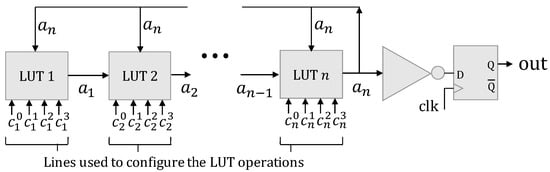
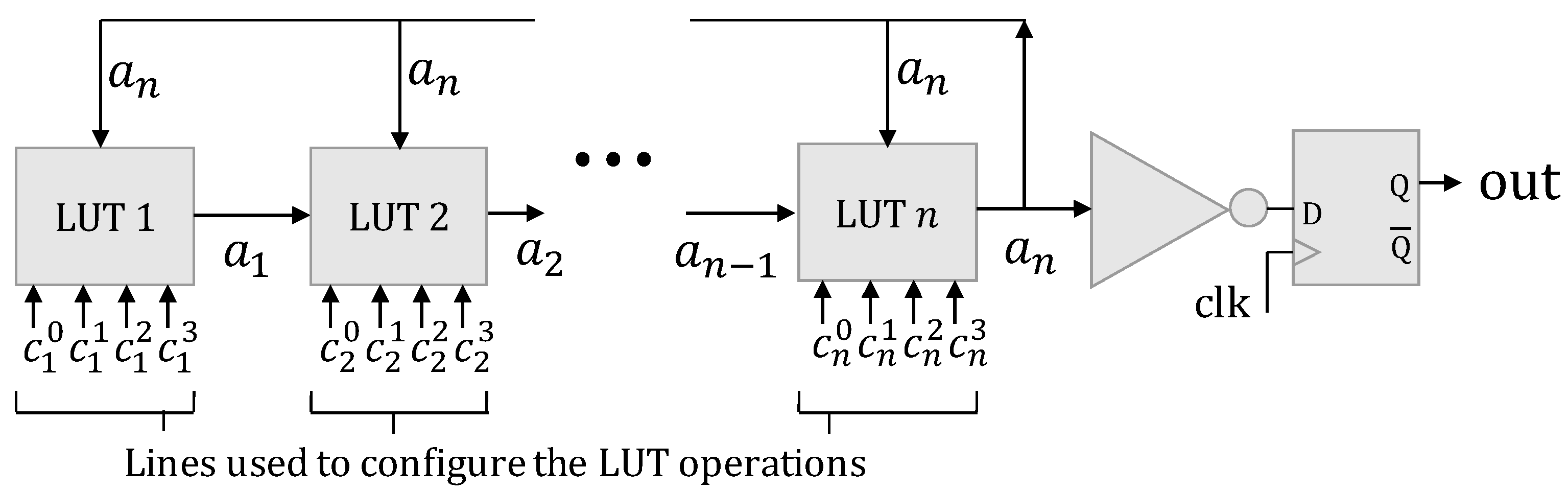
In [24], the authors introduced the concept of generalized GARO-PUF (GenGARO-PUF). A GenGARO is a novel type of oscillator formed by a set of logical operations connected in cascade. Each operation takes as input the feedback signal and the output of the previous operation (Figure 1). In the first logic operation, as there is only one input, only a delay () or negation operation () can be implemented. Throughout this work, the logic gate that performs the “delay” operation () will be referred as the “DEL” gate. As each LUT can be configured with a specific logic operation, this architecture of oscillator includes some of the previously proposed oscillators such as ROs (using only NOT operations) and GAROs (using XOR and NOT), but also many other additional oscillators. In previous work, it was observed that these structures presented low spatial correlation and good uniqueness and reproducibility compared to the spatial correlation of ROs [16].
Figure 1.
GenGARO architecture. refers to the feedback signal and () to the configurations lines of LUT i.
GenGAROs also offer a higher number of possible oscillators compared to GAROs, thereby allowing the construction of a larger number of potential PUFs. Furthermore, uniqueness and reproducibility seemed to improve with the length of the oscillator. However, a configuration of GenGARO which outperformed the RO-PUF in terms of identifiability could not be obtained. Here, the word “configuration” refers to a certain combination of logic operations. Additionally, the authors opened the door to studying novel configurations of larger GenGAROs which simultaneously combine the properties of low spatial correlation and high uniqueness. In this work, the architecture of GenGAROs is analyzed to find which are the optimal configurations to construct a PUF with high identifiability.
2.2. PUF Evaluation Metrics
A PUF must generate a stable response over time (reproducibility). Furthermore, responses generated by different devices must be different (uniqueness). Typically, the intra-Hamming distance (HD) is used to measure the reproducibility of the PUF, while the inter-HD assesses uniqueness. Ideally, the intra-HD should be 0% while the inter-HD should be 50% on average.
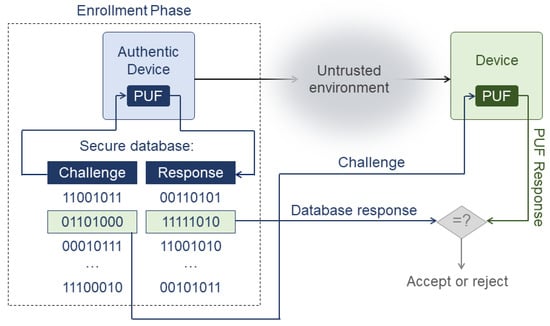
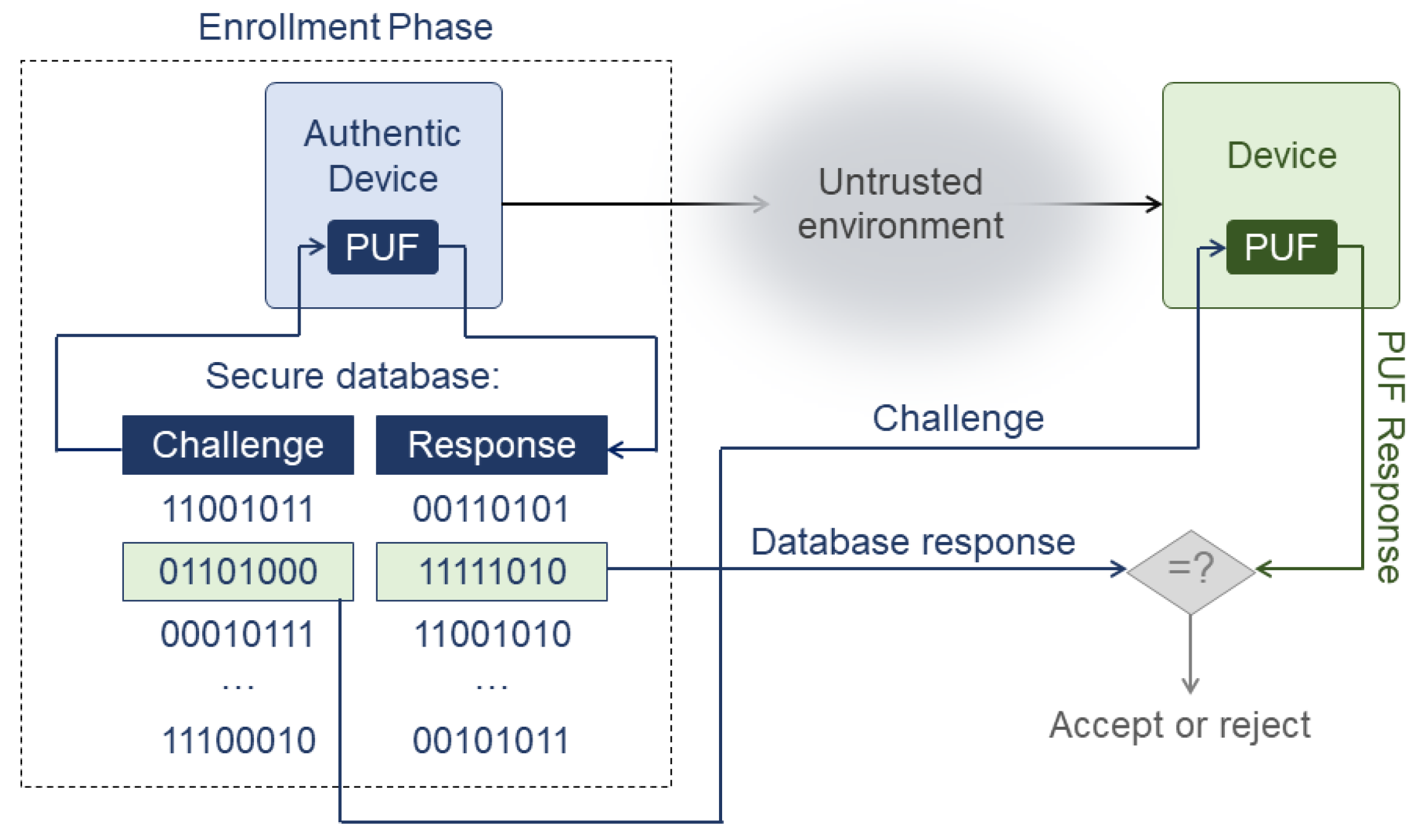
As previously discussed, one of the main applications of PUFs is device authentication. Typically, in a PUF-based authentication scheme, the PUF response is compared with a list of previously saved responses (Figure 2), so that if there is a response with an HD equal to or less than a an identification threshold , the device is authenticated.
Figure 2.
PUF-based authentication [26].
To quantify the identifiability of the PUF, the equal error rate (EER) [7] is used as figure of merit as it gives the probability of an identification attempt to result in a false rejection (false rejection rate, FRR) or false acceptance(false acceptance rate, FAR):
where is the corresponding identification threshold, defined as
This parameter is especially interesting as it simultaneously combines the properties of uniqueness and reproducibility. Therefore, a low EER means a high reproducibility and uniqueness.
3. Methodology
3.1. FPGA Implementation
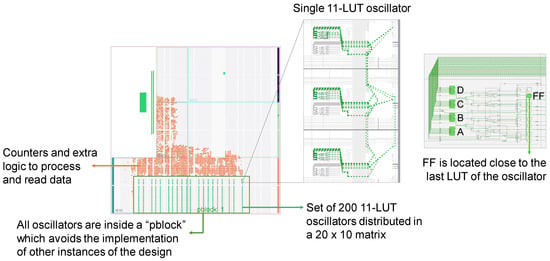
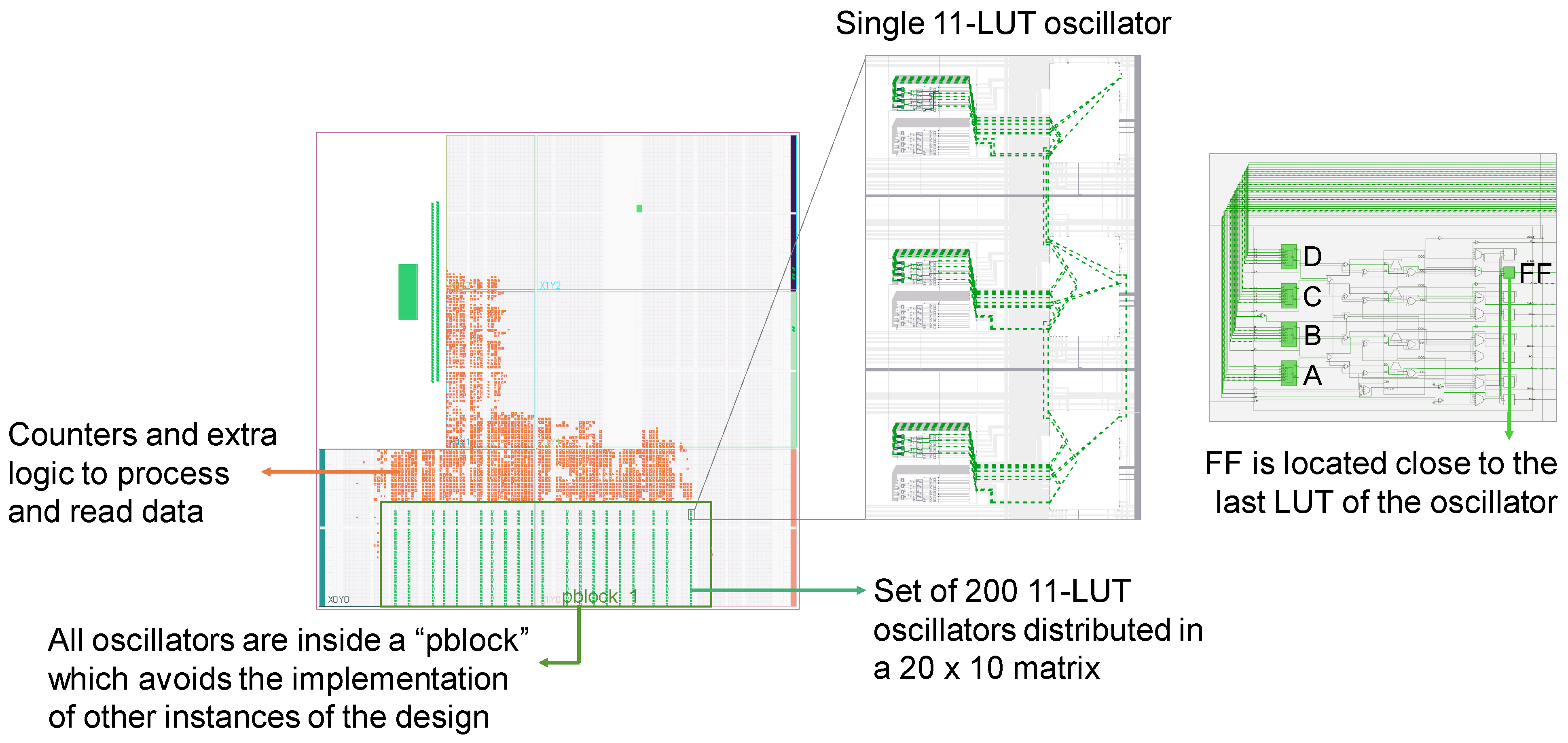
In this work, a set of 200 11-LUT GenGAROs was implemented in 40 Artix-7 FPGAs (Figure 3). Artix-7 FPGAs have two slices per configurable logic block (CLB). Each slice contains 4 six-input LUTs, 8 flip-flops (FFs), and 4 multiplexers (MUXs). The 11-LUT GenGAROs are used because this allows each oscillator to be implemented using only three slices of the FPGA. Furthermore, as the number of LUTs of the oscillators increases, a higher number of configurations of oscillators can be evaluated. However, it must be noted that implementing oscillators with a high number of LUTs would result in a large consumption of the FPGA area. Each oscillator was implemented in LUT A, B, C, and D of slice ; LUT A, B, C, and D of slice ; and LUT A, B, and C of slice ; while an extra inverter was implemented in LUT D of slice to minimize possible frequency couplings.
Figure 3.
GenGARO-PUF implementation in Artix-7 FPGA.
An FF was also implemented to measure the bias of the signal of the oscillators. The FF was placed close to the extra inverter to prevent signal degradation. Additionally, locations and routing were carefully selected so that all oscillators were identical.
3.2. Experimental Scheme and Data Collection Process
The data collection process was performed in parallel so that every measurement was performed simultaneously in all FPGAs under the same voltage and temperature conditions. Furthermore, once the bitfile was generated, oscillators were externally reconfigured without the need to change the bitfile each time a novel configuration of GenGAROs was implemented.
To estimate the bias, samples were taken using a 1 MHz clock reference signal. These parameter choices stem from the compromise of achieving a reasonable authentication time while also avoiding the use of high-frequency reference clocks, as previous works have shown that high-frequency clocks lead to correlations between biases of oscillators implemented in the same FPGA [27].
The challenge with regard to the PUFs was the configuration of the logic gates. To obtain the PUF response, biases were compared in pairs using the non-overlapping comparison topology, ensuring that no oscillator was repeated in each comparison, thus avoiding correlations between successive bits of the response. Regarding oscillator comparison, one issue with the conventional RO-PUF is the spatial frequency correlation among oscillators. This makes it critical to compare nearby oscillators to obtain the PUF response. As the bias of GenGAROs do not present spatial correlation within the FPGA [24], this would eliminate the need to compare oscillators in a specific order, although close oscillators were compared in this work.
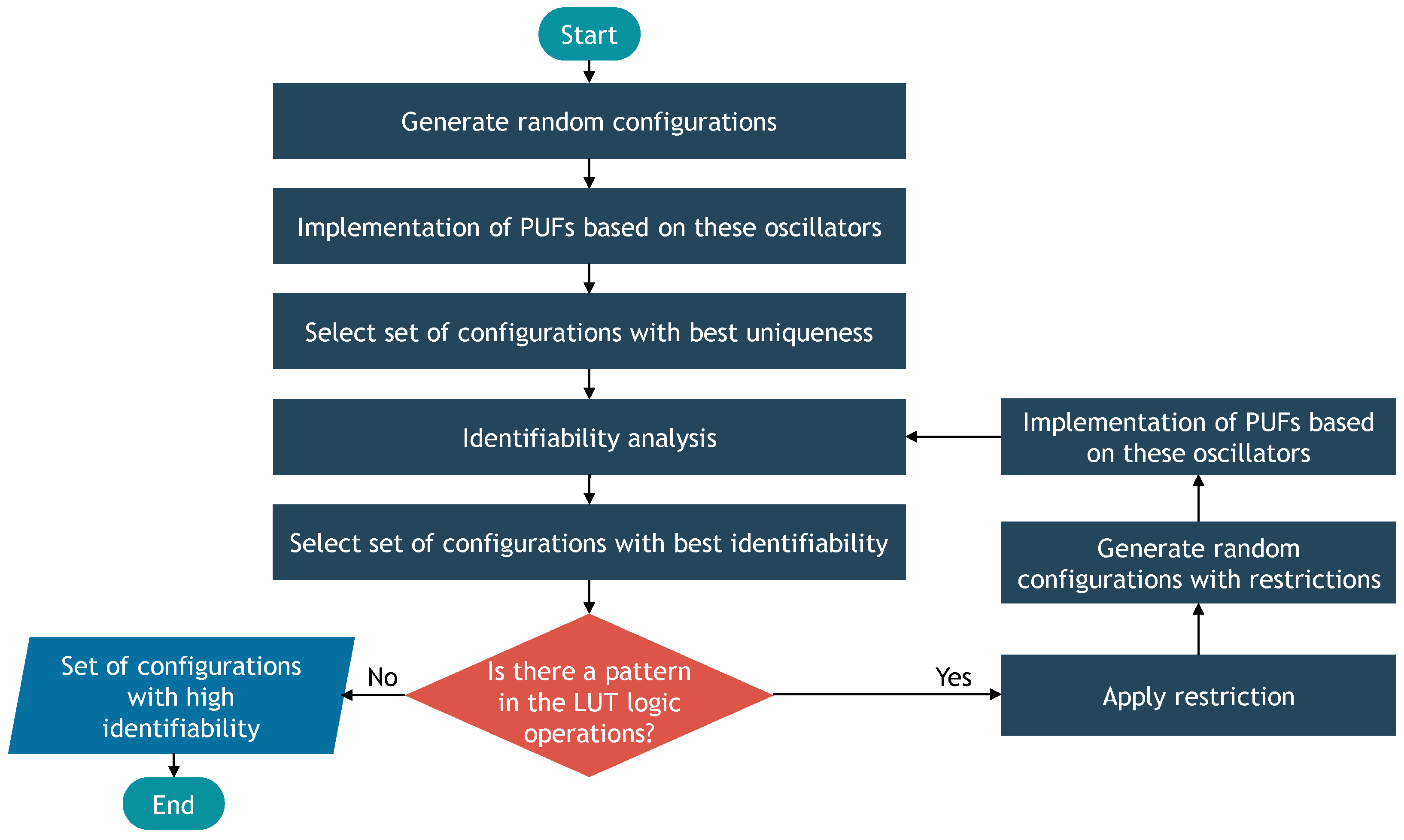
3.3. Optimization Process Description
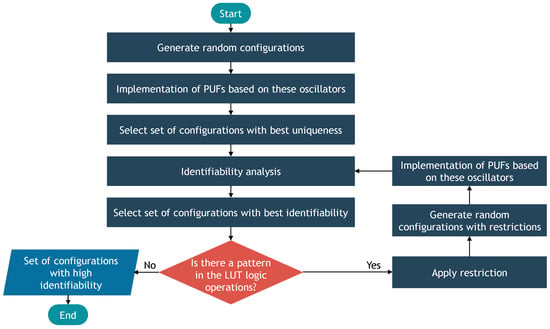
Using a logic simulation, it was observed that approximately only one-third of all configurations lead to an oscillating output, while the other oscillators present a “logic fixed point”, i.e., stable output. Therefore, using 11-LUT GenGAROs, there are approximately possible configurations that could be used to generate the PUF response. To determine which are the best configurations to construct a PUF with optimal properties, several restrictions were applied to study which combination of logic operations most contributed to obtaining a PUF with high identifiability.
This process is summarized in Figure 4.
Figure 4.
Optimization process.
4. Results
Following the optimization process, several constraints on LUT operations were applied to analyze the relation between logical operations of GenGAROs and PUF quality.
4.1. Without Restrictions
4.1.1. Uniqueness
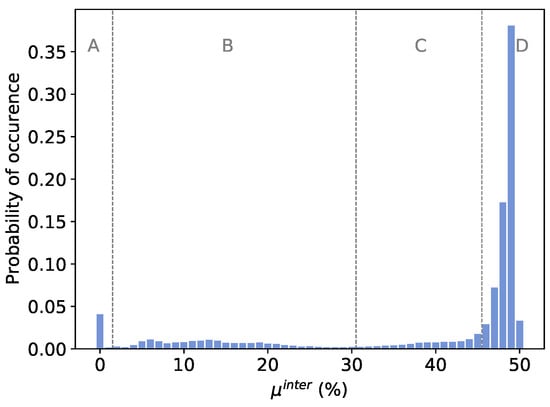
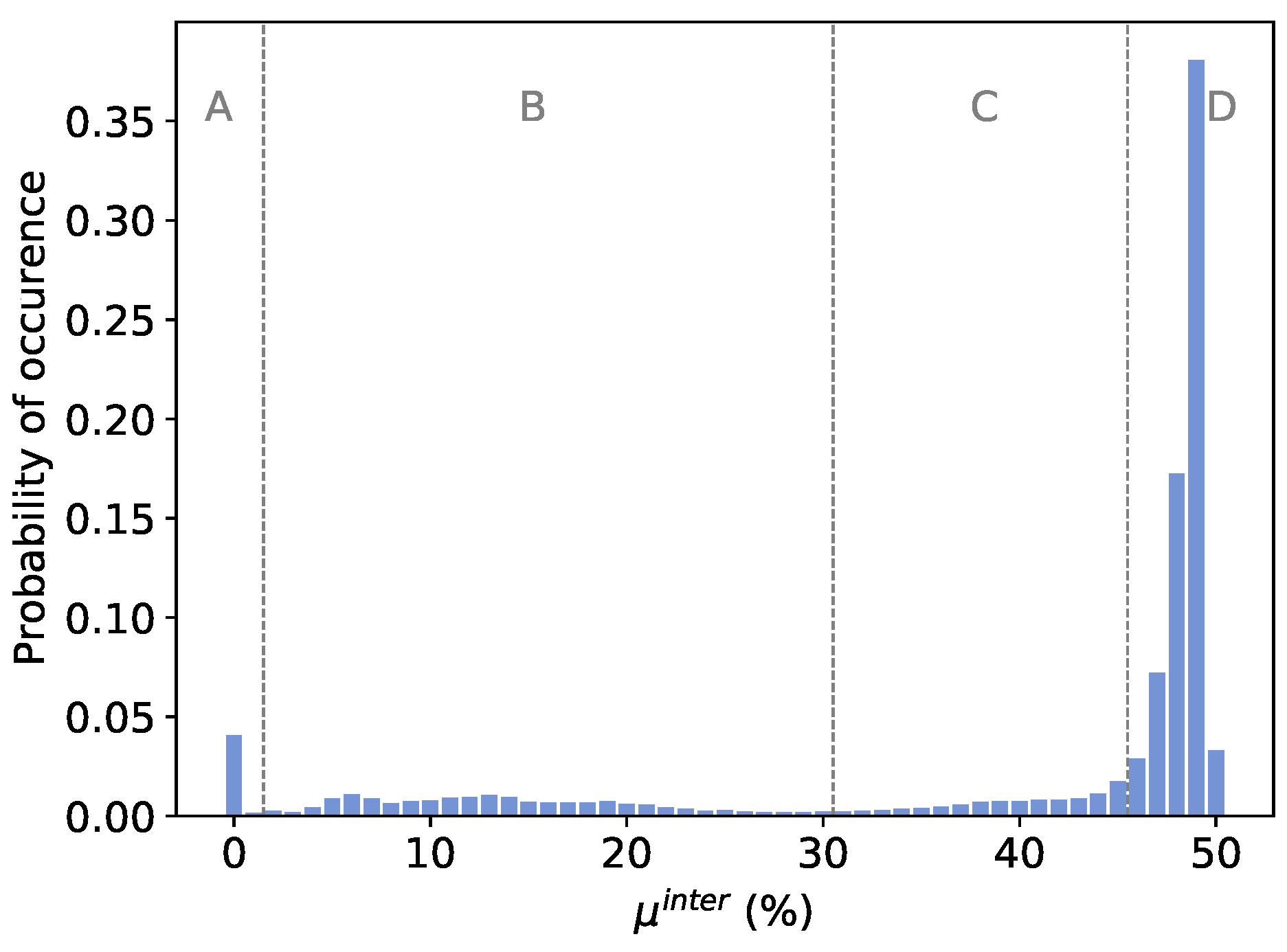
Firstly, as the total number of possible configurations is too large to be analyzed in a reasonable time, a set of 72,000 configurations was randomly selected. Once the biases of the oscillators for each configuration were measured, the responses that would be obtained when using these oscillators to construct a GenGARO-PUF were simulated. In Figure 5, a histogram of the average inter-HDs () obtained for each configuration is shown.
Figure 5.
Average inter-HDs of 72,000 GenGARO-PUFs, each one implemented in 40 FPGAs using random configurations. A, B, C and D refer to each one of the four intervals.
As can be seen, the majority of the configurations (70.5%) present a high uniqueness, with . To analyze the combination of logic gates with the best uniqueness, the histogram was divided into four intervals: A, B, C, and D. Furthermore, the logic operations of to do not seem to have an impact on the uniqueness of the responses. Therefore, the study was centered on the last positions of the oscillators ( to ). In Table 1, the number of configurations presenting a certain logic gate in each position and interval is shown:
Table 1.
Percentage of configurations (%) in each position and interval using GenGAROs without restrictions.
- : A total of 4.08% of the configurations present . Those configurations with bad uniqueness usually present a NOT in and a NAND in .
- : A total of 16.76% of the configurations present are in this interval. These configurations usually present a DEL in .
- : A total of 8.66% of the configurations present are in this interval. These configurations usually present a NOT in and XOR, XNOR, NAND, or NOR gates in .
- : A total of 70.5% of the configurations are in this interval. Those configurations with high uniqueness usually present AND/OR gates in , while they do not present NOT/NAND/NOR gates in this position. Furthermore, they usually present NAND/NOR gates in , while they do not present DEL/AND/OR gates in this position.
4.1.2. Reproducibility
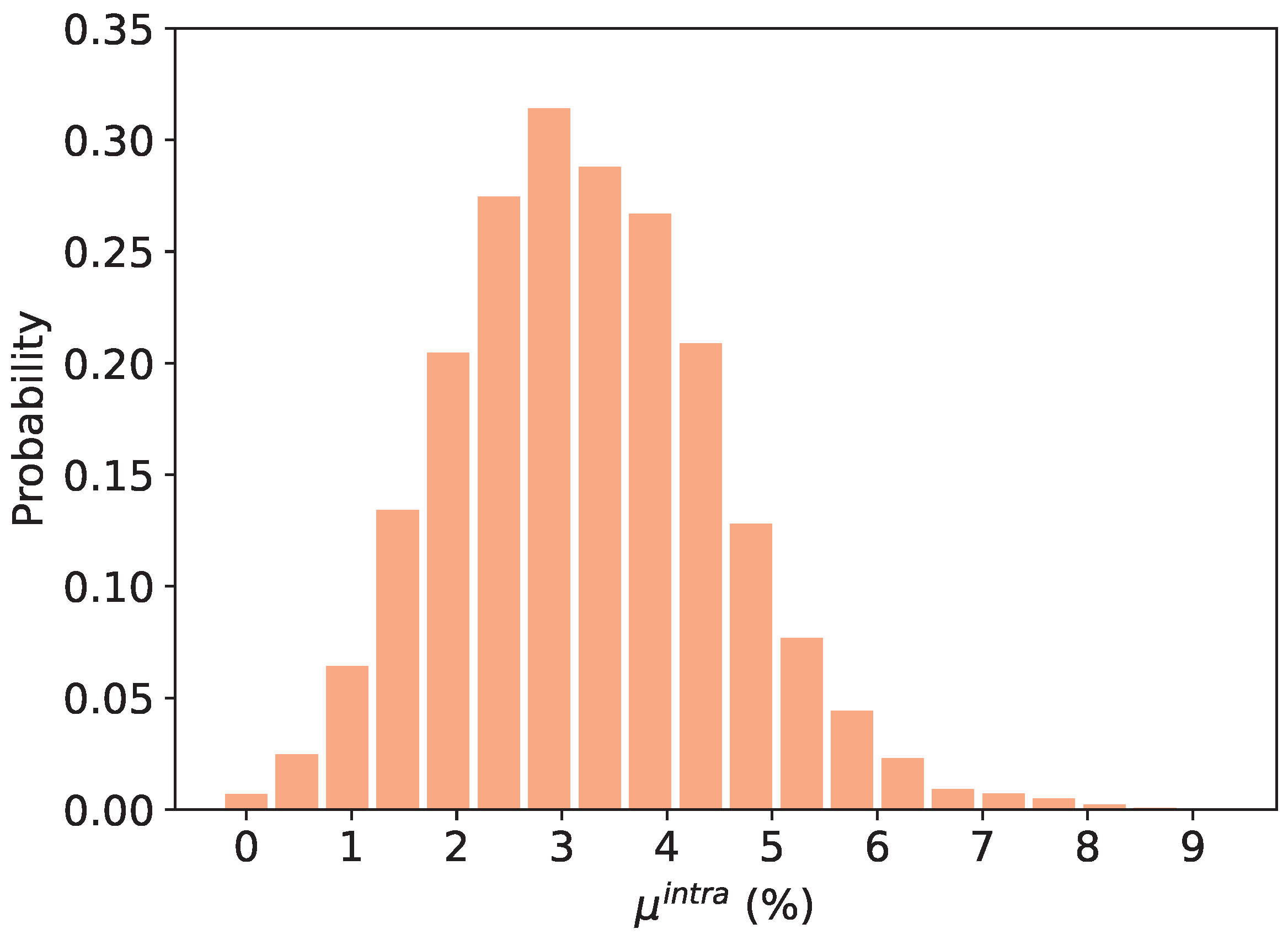
Then, a selection of some oscillators with good uniqueness was made and they were studied to verify if they also exhibited good reproducibility. For this, a set of 6000 configurations with were selected from the set of 72,000 configurations. Then, the bias of the selected configurations was measured 20 times in 20 FPGAs, and the average intra-HD () was calculated for each configuration. The obtained histogram is shown in Figure 6. As can be seen, the majority of configurations with high uniqueness also present good reproducibility and . Furthermore, there is a certain number of configurations with , i.e., a low EER.
4.1.3. Identifiability
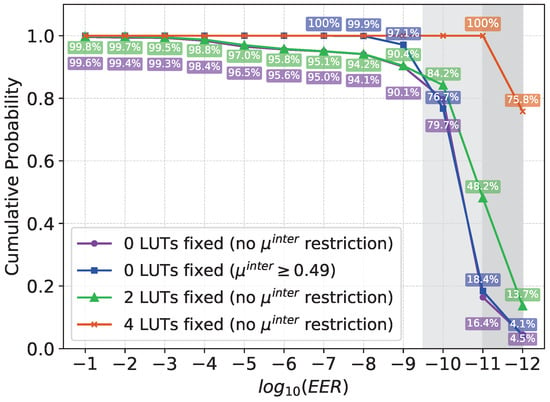
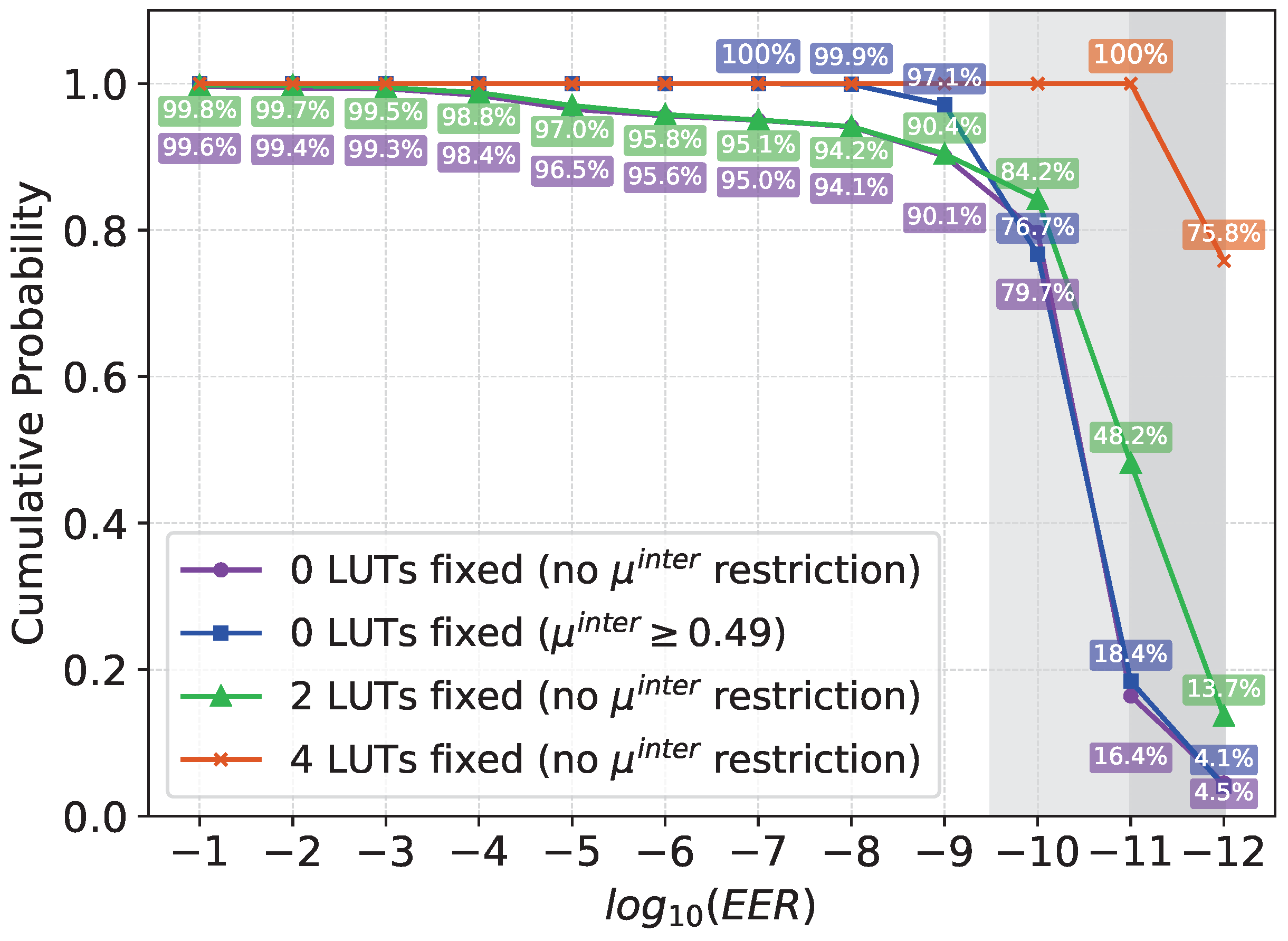
In Figure 7, the EER obtained for the same set of 6000 configurations was found (blue). As can be seen, all configurations present a good identifiability, with EERs . Furthermore, there are some configurations with EERs , i.e., with very good identifiability. The curve obtained without applying any restriction to is presented in purple.
Figure 7.
Configurations with EER using GenGAROs without fixed LUTs (purple), without fixed LUTs but (blue), two fixed LUTs (green), and four fixed LUTs (orange).
Figure 6.
’s of 6000 configurations with .
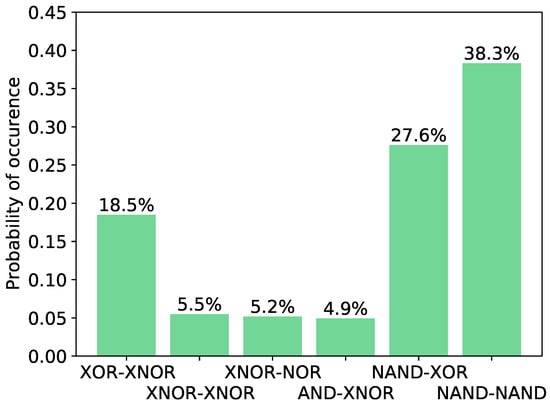
As previously seen, the last two LUTs of the oscillators are crucial to obtain a PUF with high identifiability. To determine which combinations of logic operations lead to a PUF with a low EER, the number of configurations with EER depending on the logic operations of the last two LUTs is represented in Figure 8. These combinations of logic operations do not appear to correspond to configurations with EERs . Furthermore, the number of configurations with high identifiability was normalized with respect to the initial number of configurations, with the corresponding combination of logic gates selected. As can be seen, there are two combinations of logic operations in {LUT10, LUT11} that most contribute to the set of oscillators with best identifiability: {NAND, XOR} and {NAND, NAND}. For simplicity, from this point onward, only identifiability analyses are shown; a PUF with a low EER implies a PUF with high reproducibility and uniqueness.
Figure 8.
Number of configurations with EER .
4.2. Restrictions to Two LUTs
Once it was found that the configurations which lead to a PUF with high identifiability tend to present these combinations of logic operations in the last two positions, the identifiability analysis was repeated using only configurations presenting these restrictions in LUT10 and LUT11. In Figure 7, the curve with the EERs obtained for all the selected configurations with these restrictions is shown (green). As can be seen, 84% of all the configurations present an , 48% an , and 14% an , i.e., the majority of configurations present a high identifiability. Then, a set of 6000 configurations with restrictions over the last two LUTs was randomly generated, and the responses of the PUF instances in 40 FPGAs were analyzed. The pattern of the oscillators is analyzed in Table 2:
- Two LUTs fixed: By fixing {, } with {NAND,NAND} or {NAND,XOR} gates, in both cases the best combinations tend to present a NOT gate in . This restrictions were applied to and the analysis was repeated.
- Three LUTs fixed: By fixing the last three LUTs to the combination of logic gates NOT, NAND, NAND, or NOT, NAND, XOR, the best combinations tend to present an OR gate in . This restriction was applied to and the analysis was repeated.
- Four LUTs fixed: If the last four LUTs are fixed to OR, NOT, NAND, NAND, or OR, NOT, NAND, XOR, a clear pattern in the rest of LUTs of the oscillators is not observed. In this way, all the generated configurations can be used to construct a PUF with high identifiability.
4.3. Restrictions to Four LUTs
Finally, a set of 6000 random configurations with and gates (Figure 9 and Figure 10) in the last four LUTs was generated. Again, 20 measurements of the bias of all oscillators were measured in 40 FPGAs and the EER was calculated.
Figure 9.
Optimal GenGAROs used to construct a GenGARO-PUF with high identifiability with OR-NOT-NAND-NAND restriction.
Figure 10.
Optimal GenGAROs used to construct a GenGARO-PUF with high identifiability with OR-NOT-NAND-XOR restriction.
Table 2.
Percentage of logic operations (%) in each position depending on the applied restrictions.
As can be seen in Figure 7, 24.2% of the generated configurations present an EER , while for 75.8% the EER , using 100-bit responses. Furthermore, all configurations present ranging from 1.64% to 2.37%, and an extremely high of 49.56% and 50.13% in the worst cases. Applying these restrictions, all configurations of GenGAROs can be used to construct a GenGARO-PUF with high identifiability.
4.4. Comparison with Other RO-Based PUFs
In Table 3, a comparison of the GenGARO-PUF with the proposed constraints to other state-of-the-art RO-based PUFs is shown. As observed, this proposal offers high reproducibility while also exhibiting the best uniqueness.
Table 3.
Comparison with other RO-based PUFs.
5. Conclusions
An experimental study of GenGAROs has been performed to identify which configurations of logical operations exhibit better properties to construct a PUF with high identifiability. These oscillators are of particular interest, as they include some previously proposed types of oscillators as well as other new types. Several restrictions have been applied to the logic operations of the GenGAROs.
First, it has been observed that the logical operations implemented in the last LUTs of the oscillators are critical for constructing a PUF with good properties. It has been observed that without applying any restrictions to the logical operations of the oscillators, only 18.4% of the oscillators exhibit an equal error rate on the order of or lower. However, by fixing the last two logic gates of the oscillators, this percentage increases to 48.2%. Finally, it has been observed that by applying restrictions to the last four LUTs of the GenGAROs, 100% of the generated configurations can be used to construct a PUF with an EER lower than using 100-bit responses.
Following the design methodology proposed in this work, multiple GenGARO configurations can be generated and used as primitives to construct PUFs with high identifiability. These constructed PUFs improve the properties of other state-of-the-art PUFs, particularly in terms of uniqueness, identifiability, and spatial correlation of the bias of the oscillators within the FPGA. Furthermore, the significant low equal error rates obtained using these architectures makes these RO-PUF primitives promising candidates for future security applications, particularly for authentication of sensor nodes in WSNs. This approach offers valuable potential for other designers to develop novel RO-based PUFs with enhanced identifiability, contributing to creating more efficient and secure device authentication systems.
Future lines of research would include using these oscillators to construct a strong GenGARO-PUF.
Author Contributions
Conceptualization, R.A.-T., M.G.-B. and G.D.-S.; methodology, R.A.-T.; software, R.A.-T.; validation, R.A.-T., M.G.-B. and G.D.-S.; formal analysis, R.A.-T., M.G.-B. and G.D.-S.; investigation, R.A.-T., M.G.-B. and G.D.-S.; resources, M.G.-B., G.D.-S., F.A. and S.C.; data curation, R.A.-T., M.G.-B. and G.D.-S.; writing—original draft preparation, R.A.-T.; writing—review and editing, R.A.-T., M.G.-B., G.D.-S., F.A. and S.C.; visualization, R.A.-T., M.G.-B., G.D.-S., F.A. and S.C.; supervision, R.A.-T., M.G.-B., G.D.-S., F.A. and S.C.; project administration, M.G.-B., G.D.-S., F.A. and S.C.; funding acquisition, M.G.-B., G.D.-S., F.A. and S.C. All authors have read and agreed to the published version of the manuscript.
Funding
This work has been partially supported by the Spanish State Research Agency (PID2020-114110RA-I00 and PID2023-150244OB-I00) and Diputación de Aragón (DGA) fellowship to Raúl Aparicio-Téllez.
Institutional Review Board Statement
Not applicable.
Informed Consent Statement
Not applicable.
Data Availability Statement
The data that support the findings of this study are available from the corresponding author upon reasonable request.
Conflicts of Interest
The authors declare no conflicts of interest.
Abbreviations
The following abbreviations are used in this manuscript:
| EER | Equal error rate |
| FAR | False acceptance rate |
| FF | Flip-flop |
| FPGA | Field-programmable gate array |
| FRR | False rejection rate |
| GARO | Galois ring oscillator |
| HD | Hamming distance |
| IoT | Internet of Things |
| LUT | Look-up table |
| MUX | Multiplexer |
| PUF | Physically unclonable function |
| RO | Ring oscillator |
References
- Mall, P.; Amin, R.; Obaidat, M.S.; Hsiao, K.F. CoMSeC++: PUF-based secured light-weight mutual authentication protocol for Drone-enabled WSN. Comput. Netw. 2021, 199, 108476. [Google Scholar] [CrossRef] [Scilit]
- Mahalat, M.H.; Karmakar, D.; Mondal, A.; Sen, B. PUF based Secure and Lightweight Authentication and Key-Sharing Scheme for Wireless Sensor Network. ACM J. Emerg. Technol. Comput. Syst. 2021, 18, 1–23. [Google Scholar] [CrossRef] [Scilit]
- Wachsmann, C.; Sadeghi, A.R. Physically Unclonable Functions (PUFs): Applications, Models, and Future Directions; Morgan & Claypool Publishers: San Rafael, CA, USA, 2014. [Google Scholar]
- Zerrouki, F.; Ouchani, S.; Bouarfa, H. A survey on silicon PUFs. J. Syst. Archit. 2022, 127, 102514. [Google Scholar] [CrossRef] [Scilit]
- McGrath, T.; Bagci, I.E.; Wang, Z.M.; Roedig, U.; Young, R.J. A PUF taxonomy. Appl. Phys. Rev. 2019, 6, 011303. [Google Scholar] [CrossRef] [Scilit]
- Gao, Y.; Al-Sarawi, S.F.; Abbott, D. Physical unclonable functions. Nat. Electron. 2020, 3, 81–91. [Google Scholar] [CrossRef] [Scilit]
- Maes, R. Physically Unclonable Functions: Concept and Constructions. In Physically Unclonable Functions: Constructions, Properties and Applications; Springer Berlin Heidelberg: Berlin/Heidelberg, Germany, 2013; pp. 11–48. [Google Scholar] [CrossRef] [Scilit]
- Manivannan, S.; Chakraborty, R.S.; Chakrabarti, I.; Rangasamy, J. Practical and Efficient PUF-Based Protocol for Authentication and Key Agreement in IoT. IEEE Embed. Syst. Lett. 2024, 16, 118–121. [Google Scholar] [CrossRef] [Scilit]
- Thirumoorthi, M.; Jovanovic, M.; Mirhassani, M.; Khalid, M. Design and Evaluation of a Hybrid Chaotic-Bistable Ring PUF. IEEE Trans. Very Large Scale Integr. (VLSI) Syst. 2021, 29, 1912–1921. [Google Scholar] [CrossRef] [Scilit]
- Tun, N.W.; Mambo, M. Secure PUF-Based Authentication Systems. Sensors 2024, 24, 5295. [Google Scholar] [CrossRef] [Scilit] [PubMed]
- Sun, D.Z.; Gao, Y.N.; Tian, Y. On the Security of a PUF-Based Authentication and Key Exchange Protocol for IoT Devices. Sensors 2023, 23, 6559. [Google Scholar] [CrossRef] [Scilit] [PubMed]
- Gong, X.; Feng, T.; Albettar, M. PEASE: A PUF-Based Efficient Authentication and Session Establishment Protocol for Machine-to-Machine Communication in Industrial IoT. Electronics 2022, 11, 3920. [Google Scholar] [CrossRef] [Scilit]
- Gao, M.; Lai, K.; Qu, G. A Highly Flexible Ring Oscillator PUF. In Proceedings of the 2014 51st ACM/EDAC/IEEE Design Automation Conference (DAC), San Francisco, CA, USA, 1–5 June 2014; pp. 1–6. [Google Scholar] [CrossRef] [Scilit]
- Suh, G.E.; Devadas, S. Physical Unclonable Functions for Device Authentication and Secret Key Generation. In Proceedings of the 2007 44th ACM/IEEE Design Automation Conference, San Diego, CA, USA, 4–8 June 2007; pp. 9–14. [Google Scholar]
- Rührmair, U.; Sehnke, F.; Sölter, J.; Dror, G.; Devadas, S.; Schmidhuber, J. Modeling Attacks on Physical Unclonable Functions. In Proceedings of the 17th ACM Conference on Computer and Communications Security, Chicago IL, USA, 4–8 October 2010; CCS ’10. pp. 237–249. [Google Scholar] [CrossRef] [Scilit]
- Aparicio-Téllez, R.; Garcia-Bosque, M.; Díez-Señorans, G.; Celma, S. Oscillator Selection Strategies to Optimize a Physically Unclonable Function for IoT Systems Security. Sensors 2023, 23, 4410. [Google Scholar] [CrossRef] [Scilit] [PubMed]
- Lata, K.; Cenkeramaddi, L.R. FPGA-Based PUF Designs: A Comprehensive Review and Comparative Analysis. Cryptography 2023, 7, 55. [Google Scholar] [CrossRef] [Scilit]
- Li, K.l.; Meng, Y.; Li, J.; Wang, S.K.; Yang, J. Research and Design of a High-Security Configurable RO-PUF Based on FPGA; Elsevier: Amsterdam, The Netherlands, 2021; Volume 183, pp. 40–45. [Google Scholar]
- Martínez-Rodríguez, M.C.; Camacho-Ruiz, E.; Brox, P.; Sánchez-Solano, S. A Configurable RO-PUF for Securing Embedded Systems Implemented on Programmable Devices. Electronics 2021, 10, 1957. [Google Scholar] [CrossRef] [Scilit]
- Marchand, C.; Bossuet, L.; Mureddu, U.; Bochard, N.; Cherkaoui, A.; Fischer, V. Implementation and Characterization of a Physical Unclonable Function for IoT: A Case Study with the TERO-PUF. IEEE Trans. Comput.-Aided Des. Integr. Circuits Syst. 2018, 37, 97–109. [Google Scholar] [CrossRef] [Scilit]
- Gimenez, G.; Cherkaoui, A.; Fesquet, L. A Self-Timed Ring based PUF. In Proceedings of the 2020 26th IEEE International Symposium on Asynchronous Circuits and Systems (ASYNC), Salt Lake City, UT, USA, 17–20 May 2020; pp. 69–77. [Google Scholar] [CrossRef] [Scilit]
- Matuszewski, L.; Nikonowicz, J.; Kubczak, P.; Woźniak, W. Physical Unclonable Function Based on the Internal State Transitions of a Fibonacci Ring Oscillator. Sensors 2021, 21, 3920. [Google Scholar] [CrossRef] [Scilit] [PubMed]
- Garcia-Bosque, M.; Díez-Señorans, G.; Sánchez-Azqueta, C.; Celma, S. Proposal and Analysis of a Novel Class of PUFs Based on Galois Ring Oscillators. IEEE Access 2020, 8, 157830–157839. [Google Scholar] [CrossRef] [Scilit]
- Garcia-Bosque, M.; Naya, A.; Díez-Señorans, G.; Sánchez-Azqueta, C.; Celma, S. Suitability of Generalized GAROs on FPGAs as PUFs or TRNGs Considering Spatial Correlations. IEEE Open J. Ind. Electron. Soc. 2023, 4, 112–122. [Google Scholar] [CrossRef] [Scilit]
- Aparicio-Téllez, R.; Garcia-Bosque, M.; Díez-Señorans, G.; Celma, S. Novel PUF based on Generalized Galois Ring Oscillators with 10-15 EER and 0.53% BER. In Proceedings of the 2024 IEEE International Symposium on Circuits and Systems (ISCAS), Singapore, 19–22 May 2024; pp. 1–5. [Google Scholar] [CrossRef] [Scilit]
- Anagnostopoulos, N.A.; Katzenbeisser, S.; Chandy, J.; Tehranipoor, F. An Overview of DRAM-Based Security Primitives. Cryptography 2018, 2, 7. [Google Scholar] [CrossRef] [Scilit]
- Addabbo, T.; Fort, A.; Mugnaini, M.; Vignoli, V.; Garcia-Bosque, M. Digital Nonlinear Oscillators in PLDs: Pitfalls and Open Perspectives for a Novel Class of True Random Number Generators. In Proceedings of the 2018 IEEE International Symposium on Circuits and Systems (ISCAS), Florence, Italy, 27–30 May 2018. [Google Scholar] [CrossRef] [Scilit]





Disclaimer/Publisher’s Note: The statements, opinions and data contained in all publications are solely those of the individual author(s) and contributor(s) and not of MDPI and/or the editor(s). MDPI and/or the editor(s) disclaim responsibility for any injury to people or property resulting from any ideas, methods, instructions or products referred to in the content. |
© 2024 by the authors. Licensee MDPI, Basel, Switzerland. This article is an open access article distributed under the terms and conditions of the Creative Commons Attribution (CC BY) license (https://creativecommons.org/licenses/by/4.0/).