Article

MCW: A Generalizable Deepfake Detection Method for Few-Shot Learning
1
Department of Electronic Engineering, Tsinghua University, Beijing 100190, China
2
Department of Cyberspace Security, Beijing University of Posts and Telecommunications, Beijing 100876, China
*
Author to whom correspondence should be addressed.
Sensors 2023, 23(21), 8763; https://doi.org/10.3390/s23218763
Submission received: 5 September 2023 / Revised: 9 October 2023 / Accepted: 17 October 2023 / Published: 27 October 2023
(This article belongs to the Special Issue AI Technology for Cybersecurity and IoT Applications)

Abstract

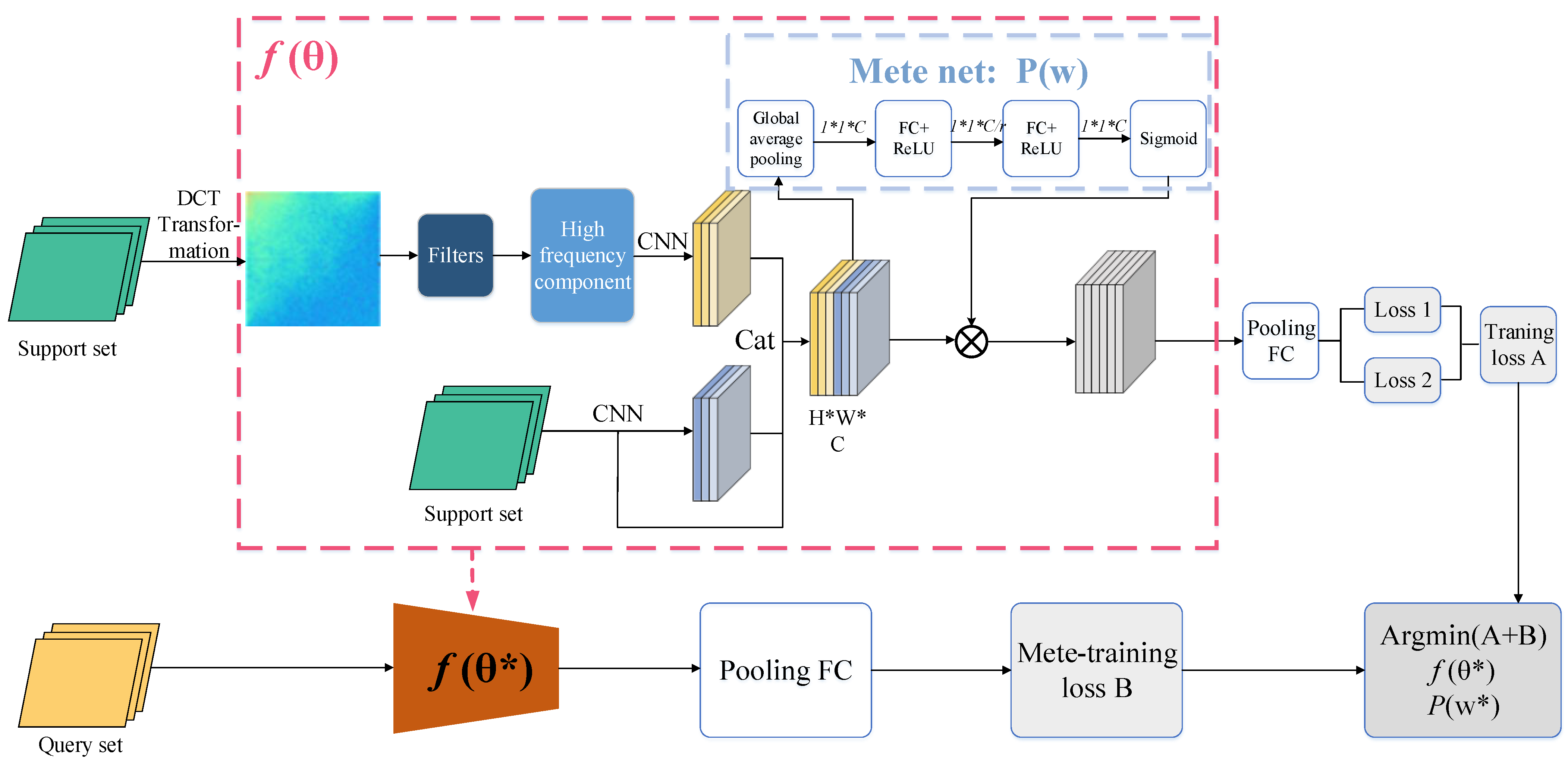
With the development of deepfake technology, deepfake detection has received widespread attention. Although some deepfake forensics techniques have been proposed, they are still very difficult to implement in real-world scenarios. This is due to the differences in different deepfake technologies and the compression or editing of videos during the propagation process. Considering the issue of sample imbalance with few-shot scenarios in deepfake detection, we propose a multi-feature channel domain-weighted framework based on meta-learning (MCW). In order to obtain outstanding detection performance of a cross-database, the proposed framework improves a meta-learning network in two ways: it enhances the model’s feature extraction ability for detecting targets by combining the RGB domain and frequency domain information of the image and enhances the model’s generalization ability for detecting targets by assigning meta weights to channels on the feature map. The proposed MCW framework solves the problems of poor detection performance and insufficient data compression resistance of the algorithm for samples generated by unknown algorithms. The experiment was set in a zero-shot scenario and few-shot scenario, simulating the deepfake detection environment in real situations. We selected nine detection algorithms as comparative algorithms. The experimental results show that the MCW framework outperforms other algorithms in cross-algorithm detection and cross-dataset detection. The MCW framework demonstrates its ability to generalize and resist compression with low-quality training images and across different generation algorithm scenarios, and it has better fine-tuning potential in few-shot learning scenarios.
Keywords: deepfake detection; meta-learning; few-shot; zero-shot deepfake detection; meta-learning; few-shot; zero-shot