Review

A Review on Rainfall Measurement Based on Commercial Microwave Links in Wireless Cellular Networks

1
School of Water Conservancy and Hydroelectric Power, Hebei University of Engineering, Handan 056038, China
2
Hebei Key Laboratory of Intelligent Water Conservancy, Hebei University of Engineering, Handan 056038, China
3
School of Information and Electrical Engineering, Hebei University of Engineering, Handan 056038, China
4
Hebei Key Laboratory of Security & Protection Information Sensing and Processing, Hebei University of Engineering, Handan 056038, China
5
Department of Electrical and Computing Engineering, University of New Mexico, Albuquerque, NM 87131, USA
*
Author to whom correspondence should be addressed.
Sensors 2022, 22(12), 4395; https://doi.org/10.3390/s22124395
Submission received: 18 May 2022 / Revised: 7 June 2022 / Accepted: 8 June 2022 / Published: 10 June 2022
(This article belongs to the Special Issue Rain Sensors)

Abstract

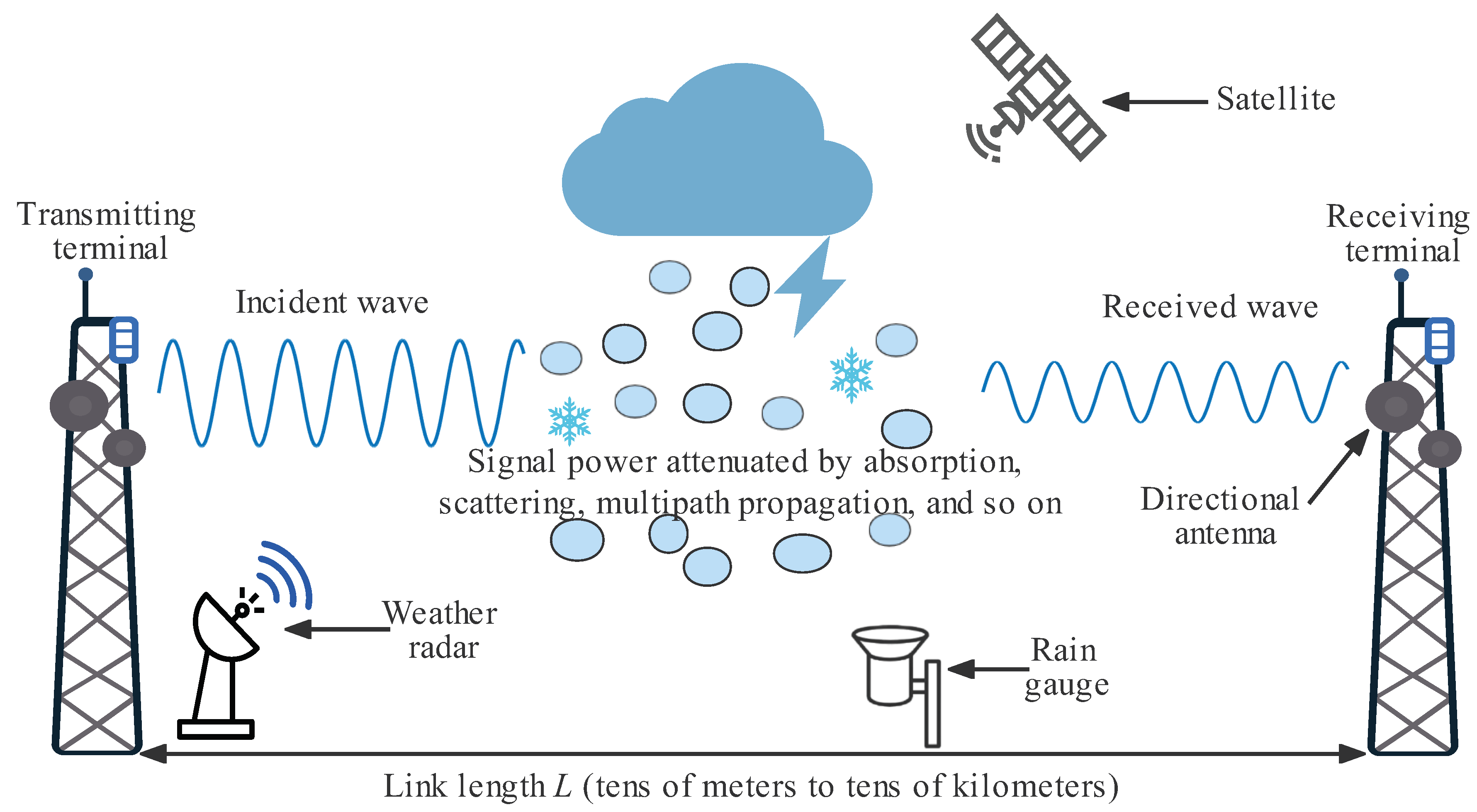
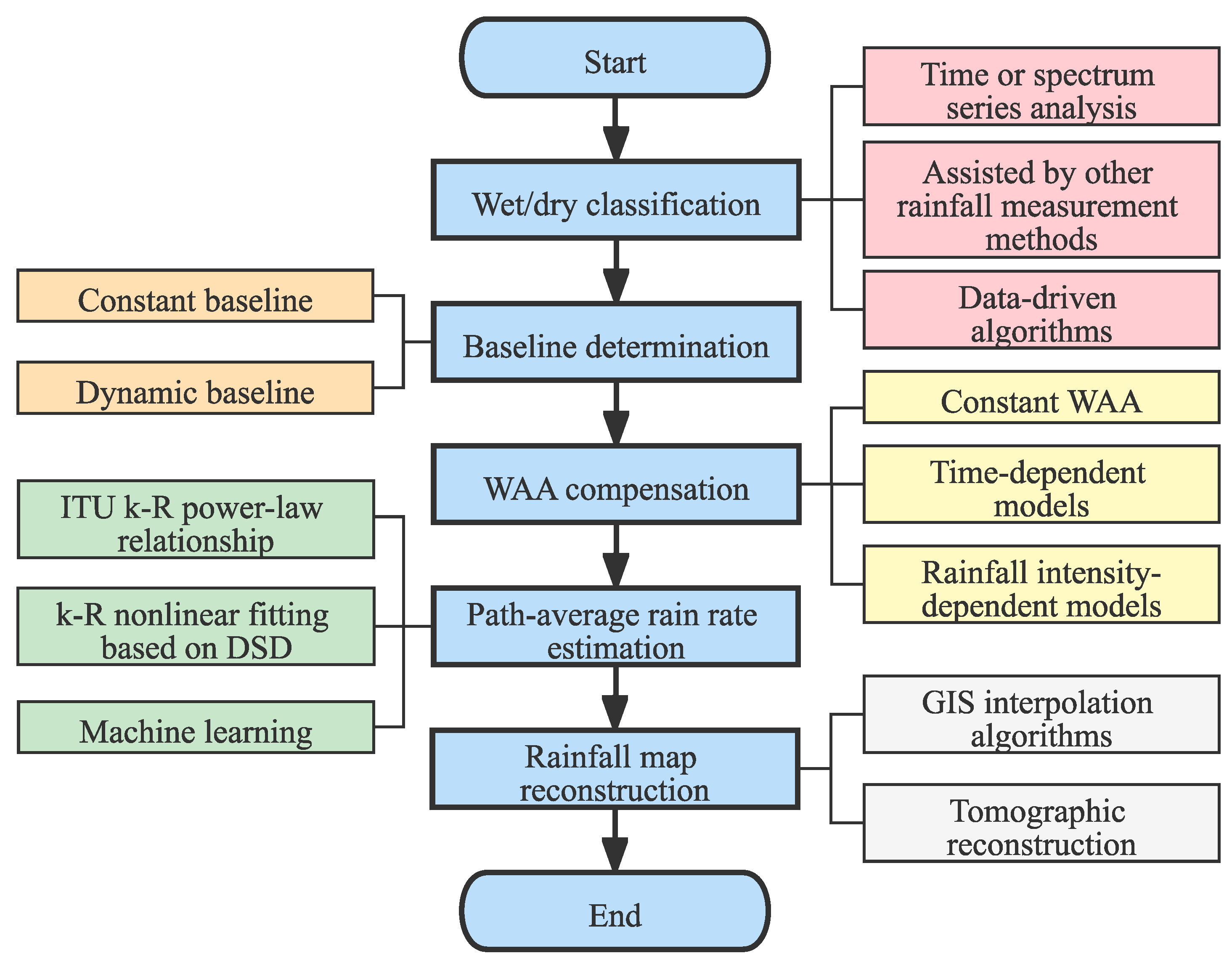
As one of the most critical elements in the hydrological cycle, real-time and accurate rainfall measurement is of great significance to flood and drought disaster risk assessment and early warning. Using commercial microwave links (CMLs) to conduct rainfall measure is a promising solution due to the advantages of high spatial resolution, low implementation cost, near-surface measurement, and so on. However, because of the temporal and spatial dynamics of rainfall and the atmospheric influence, it is necessary to go through complicated signal processing steps from signal attenuation analysis of a CML to rainfall map. This article first introduces the basic principle and the revolution of CML-based rainfall measurement. Then, the article illustrates different steps of signal process in CML-based rainfall measurement, reviewing the state of the art solutions in each step. In addition, uncertainties and errors involved in each step of signal process as well as their impacts on the accuracy of rainfall measurement are analyzed. Moreover, the article also discusses how machine learning technologies facilitate CML-based rainfall measurement. Additionally, the applications of CML in monitoring phenomena other than rain and the hydrological simulation are summarized. Finally, the challenges and future directions are discussed.
Keywords: wireless cellular networks; microwave links; rainfall measurement; machine learning; remote sensing wireless cellular networks; microwave links; rainfall measurement; machine learning; remote sensing