


When Eyes Wander Around: Mind-Wandering as Revealed by Eye Movement Analysis with Hidden Markov Models
 , , , and
Abstract
1. Introduction
2. Materials and Methods
2.1. Participants
2.2. Apparatus and Stimuli
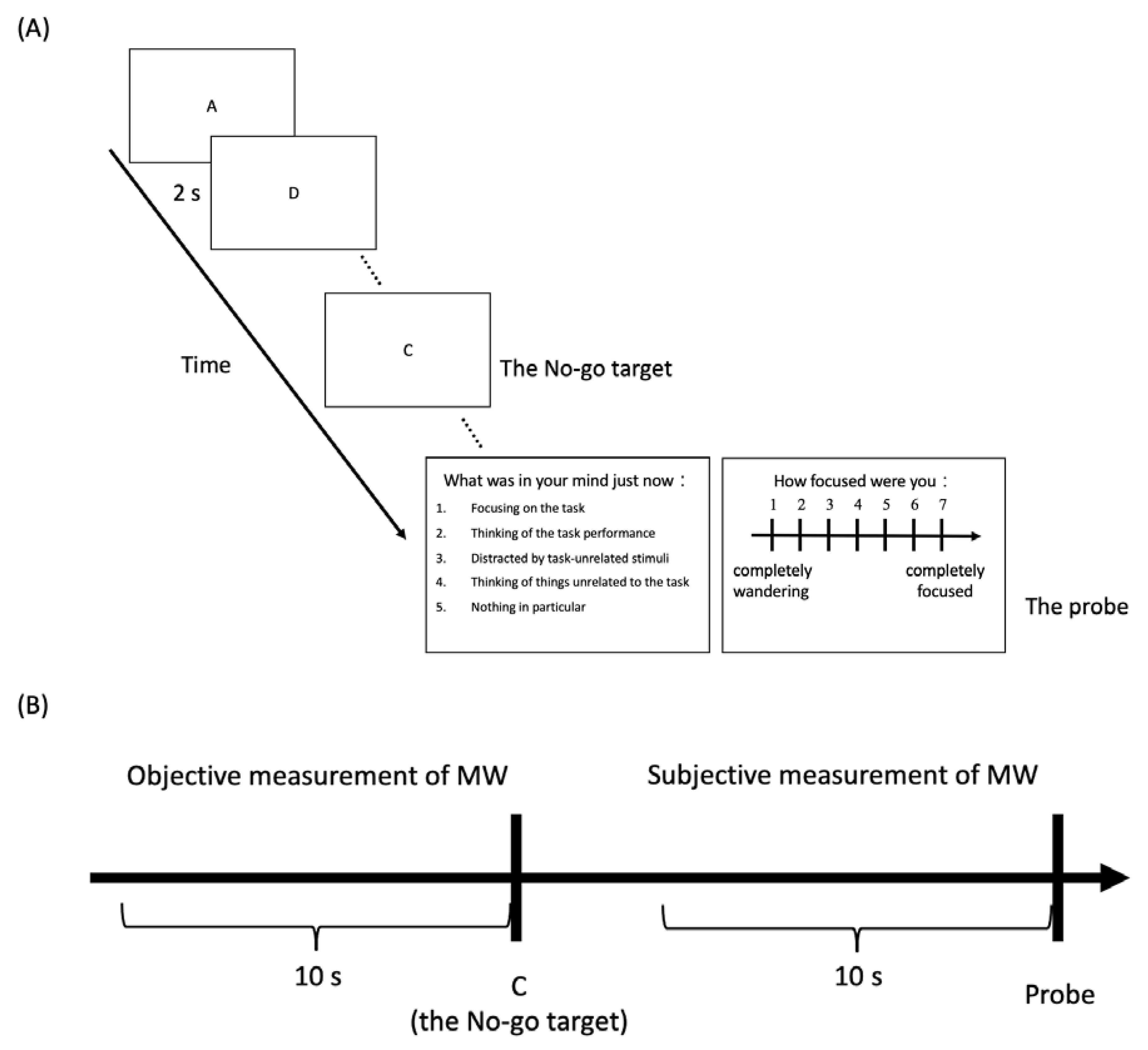
2.3. Procedure
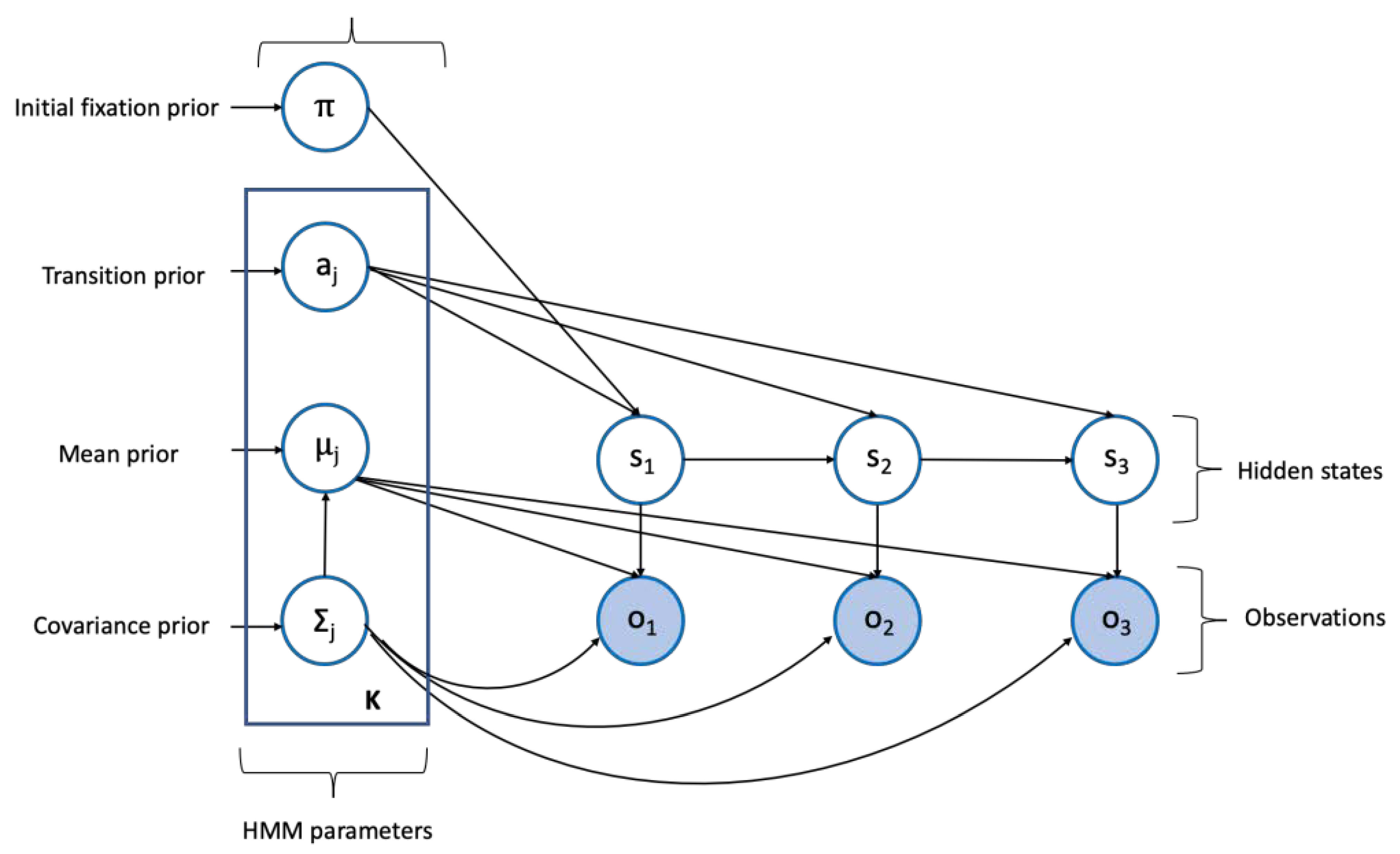
2.4. Data Analysis
3. Results
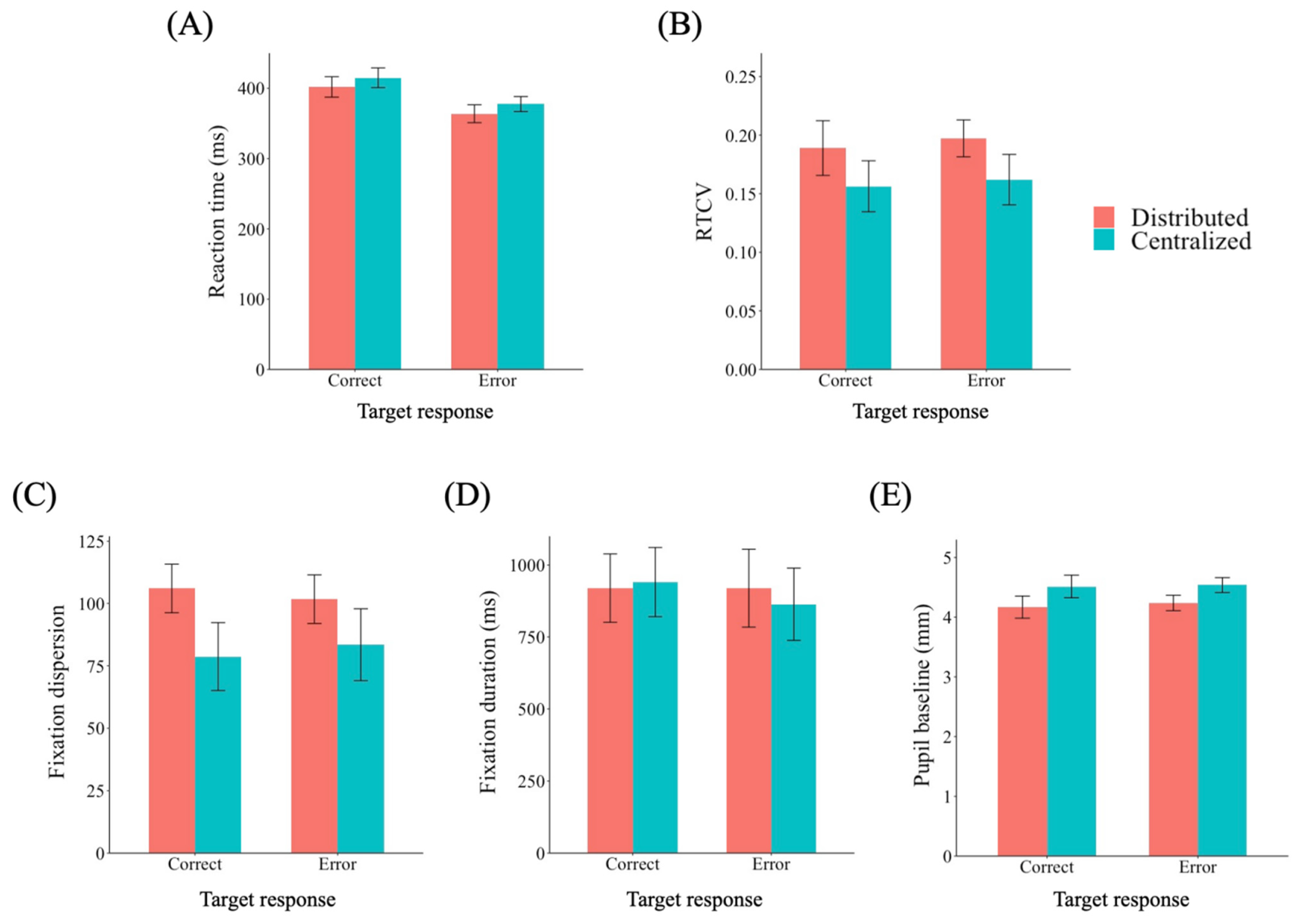
3.1. Eye Movement Data during the 10-s Pre-Target Period
3.2. Behavioral Performance during the 10-s Pre-Target Period
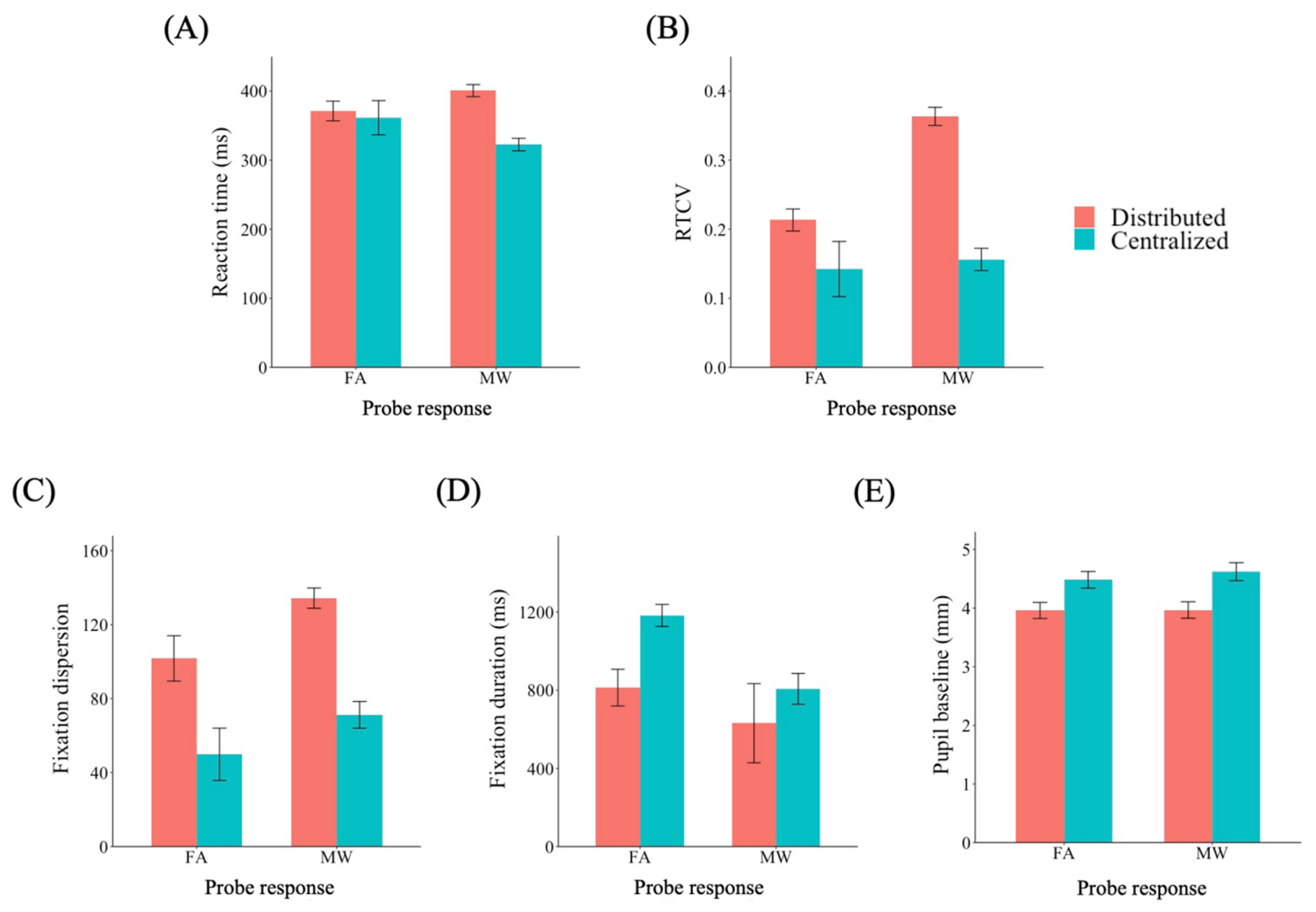
3.3. Eye Movement Data during the 10-s Pre-Probe Period
3.4. Behavioral Performance during the 10-s Pre-Probe Period
3.5. Trial by Trial Analysis
4. Discussion
4.1. The Relationships between Mind-Wandering and Eye Movement Patterns
4.2. Applications and Future Works
5. Conclusions
Author Contributions
Funding
Institutional Review Board Statement
Informed Consent Statement
Data Availability Statement
Acknowledgments
Conflicts of Interest
Appendix A

| Estimate | SE | t | p | |
|---|---|---|---|---|
| RT | ||||
| (Intercept) | 363.83 | 12.94 | 28.12 | <0.001 *** |
| Target response | 38.12 | 6.63 | 5.70 | <0.001 *** |
| Eye movement pattern | 13.78 | 18.60 | 0.74 | 0.464 |
| Target response × Eye movement pattern | −0.74 | 9.62 | −0.08 | 0.939 |
| RTCV | ||||
| (Intercept) | 0.20 | 0.02 | 9.57 | <0.001 *** |
| Target response | −0.01 | 0.02 | −0.55 | 0.590 |
| Eye movement pattern | −0.04 | 0.03 | −1.19 | 0.243 |
| Target response × Eye movement pattern | 0.003 | 0.02 | 0.12 | 0.908 |
| Fixation dispersion | ||||
| (Intercept) | 101.72 | 11.87 | 8.57 | <0.001 *** |
| Target response | 4.29 | 8.43 | 0.51 | 0.615 |
| Eye movement pattern | −18.26 | 17.07 | −1.07 | 0.291 |
| Target response × Eye movement pattern | −9.06 | 12.12 | −0.75 | 0.461 |
| Fixation duration | ||||
| (Intercept) | 892.75 | 123.08 | 7.25 | <0.001 *** |
| Target response | 26.60 | 33.22 | 0.80 | 0.430 |
| Eye movement pattern | −29.22 | 176.94 | −0.17 | 0.870 |
| Target response × Eye movement pattern | 50.28 | 47.75 | 1.05 | 0.301 |
| Pupil baseline | ||||
| (Intercept) | 4.24 | 0.16 | 26.45 | <0.001 *** |
| Target response | −0.07 | 0.03 | −2.29 | 0.029 * |
| Eye movement pattern | 0.30 | 0.23 | 1.31 | 0.201 |
| Target response × Eye movement pattern | 0.05 | 0.04 | 1.05 | 0.302 |
| Estimate | SE | t | p | |
|---|---|---|---|---|
| RT | ||||
| (Intercept) | 363.27 | 17.81 | 20.40 | <0.001 *** |
| Probe response | 21.07 | 17.03 | 1.24 | 0.229 |
| Eye movement pattern | −3.69 | 27.92 | −0.13 | 0.896 |
| Probe response × Eye movement pattern | −58.81 | 30.49 | −1.93 | 0.065 |
| RTCV | ||||
| (Intercept) | 0.24 | 0.03 | 8.17 | <0.001 *** |
| Probe response | 0.17 | 0.03 | 5.18 | <0.001 *** |
| Eye movement pattern | −0.09 | 0.05 | −1.97 | 0.055 |
| Probe response × Eye movement pattern | −0.15 | 0.06 | −2.58 | 0.015 * |
| Fixation dispersion | ||||
| (Intercept) | 101.73 | 10.70 | 9.51 | <0.001 *** |
| Probe response | 30.52 | 11.16 | 2.73 | 0.012 * |
| Eye movement pattern | −52.25 | 16.80 | −3.11 | 0.003 ** |
| Probe response × Eye movement pattern | −5.94 | 19.50 | −0.31 | 0.763 |
| Fixation duration | ||||
| (Intercept) | 813.67 | 108.01 | 7.53 | <0.001 *** |
| Probe response | −192.01 | 106.36 | −1.81 | 0.087 |
| Eye movement pattern | 365.86 | 169.40 | 2.16 | 0.037 * |
| Probe response × Eye movement pattern | −211.32 | 186.65 | −1.13 | 0.270 |
| Pupil baseline | ||||
| (Intercept) | 3.96 | 0.13 | 30.16 | <0.001 *** |
| Probe response | 0.09 | 0.06 | 1.36 | 0.189 |
| Eye movement pattern | 0.48 | 0.20 | 2.38 | 0.024 * |
| Probe response × Eye movement pattern | 0.11 | 0.12 | 0.97 | 0.344 |
| Centralized Pattern | Distributed Pattern | |
|---|---|---|
| Correct | 514 (58.68%) | 362 (41.32%) |
| Error | 144 (42.99%) | 191 (57.01%) |
| Centralized Pattern | Distributed Pattern | |
|---|---|---|
| Self-rated FA | 329 (55.02%) | 269 (44.98%) |
| Self-rated MW | 90 (33.83%) | 176 (66.17%) |
References
- Smallwood, J.; Schooler, J.W. The restless mind. Psychol. Bull. 2006, 132, 946–958. [Google Scholar] [CrossRef] [Scilit]
- Mooneyham, B.W.; Schooler, J.W. The costs and benefits of mind-wandering: A review. Can. J. Exp. Psychol. 2013, 67, 11–18. [Google Scholar] [CrossRef] [Scilit] [PubMed]
- Ottaviani, C.; Couyoumdjian, A. Pros and cons of a wandering mind: A prospective study. Front. Psychol. 2013, 4, 524. [Google Scholar] [CrossRef] [Scilit]
- Killingsworth, M.A.; Gilbert, D.T. A wandering mind is an unhappy mind. Science 2010, 330, 932. [Google Scholar] [CrossRef] [Scilit]
- Stothart, C.; Mitchum, A.; Yehnert, C. The attentional cost of receiving a cell phone notification. J. Exp. Psychol. Hum. Percept. Perform. 2015, 41, 893–897. [Google Scholar] [CrossRef] [Scilit] [PubMed]
- Feng, S.; D’Mello, S.; Graesser, A.C. Mind wandering while reading easy and difficult texts. Psychon. Bull. Rev. 2013, 20, 586–592. [Google Scholar] [CrossRef] [Scilit]
- Schooler, J.W.; Smallwood, J.; Christoff, K.; Handy, T.C.; Reichle, E.D.; Sayette, M.A. Meta-awareness, perceptual decoupling and the wandering mind. Trends. Cogn. Sci. 2011, 15, 319–326. [Google Scholar] [CrossRef] [Scilit]
- He, J.; Becic, E.; Lee, Y.-C.; McCarley, J.S. Mind wandering behind the wheel: Performance and oculomotor correlates. Hum. Factors 2011, 53, 13–21. [Google Scholar] [CrossRef] [Scilit] [PubMed]
- Szpunar, K.K.; Moulton, S.T.; Schacter, D.L. Mind wandering and education: From the classroom to online learning. Front. Psychol. 2013, 4, 495. [Google Scholar] [CrossRef] [Scilit]
- Wammes, J.D.; Seli, P.; Cheyne, J.A.; Boucher, P.O.; Smilek, D. Mind wandering during lectures II: Relation to academic performance. Scholarsh. Teach. Learn. Psychol. 2016, 2, 33–48. [Google Scholar] [CrossRef] [Scilit]
- Ju, Y.-J.; Lien, Y.-W. Who is prone to wander and when? Examining an integrative effect of working memory capacity and mindfulness trait on mind wandering under different task loads. Conscious. Cogn. 2018, 63, 1–10. [Google Scholar] [CrossRef] [Scilit] [PubMed]
- Saito, T.; Sudo, R.; Takano, Y. The gaze bias effect in toddlers: Preliminary evidence for the developmental study of visual decision-making. Dev. Sci. 2020, 23, e12969. [Google Scholar] [CrossRef] [Scilit] [PubMed]
- Deubel, H.; Schneider, W.X. Saccade target selection and object recognition: Evidence for a common attentional mechanism. Vis. Res. 1996, 36, 1827–1837. [Google Scholar] [CrossRef] [Scilit]
- Rizzolatti, G.; Riggio, L.; Dascola, I.; Umiltá, C. Reorienting attention across the horizontal and vertical meridians: Evidence in favor of a premotor theory of attention. Neuropsychologia 1987, 25, 31–40. [Google Scholar] [CrossRef] [Scilit]
- Ikkai, A.; Dandekar, S.; Curtis, C.E. Lateralization in alpha-band oscillations predicts the locus and spatial distribution of attention. PLoS ONE 2016, 11, e0154796. [Google Scholar] [CrossRef] [Scilit]
- Lee, H.-H.; Yeh, S.-L. Blue-light effects on saccadic eye movements and attentional disengagement. Atten. Percept. Psychophys. 2021, 83, 1713–1728. [Google Scholar] [CrossRef] [Scilit] [PubMed]
- Rolfs, M. Microsaccades: Small steps on a long way. Vision Res. 2009, 49, 2415–2441. [Google Scholar] [CrossRef] [Scilit]
- Hutt, S.; Hardey, J.; Bixler, R.; Stewart, A.; Risko, E.F.; D’Mello, S. Gaze-based detection of mind wandering during lecture viewing. In Proceedings of the International Educational Data Mining Society, Wuhan, China, 25–28 June 2017. [Google Scholar]
- Mills, C.; Bixler, R.; Wang, X.; D’Mello, S.K. Automatic gaze-based detection of mind wandering during narrative film comprehension. In Proceedings of the International Educational Data Mining Society, Raleigh, NC, USA, 29 June–2 July 2016. [Google Scholar]
- Zhang, H.; Miller, K.F.; Sun, X.; Cortina, K.S. Wandering eyes: Eye movements during mind wandering in video lectures. Appl. Cogn. Psychol. 2020, 34, 449–464. [Google Scholar] [CrossRef] [Scilit]
- Mills, C.; Graesser, A.; Risko, E.F.; D’Mello, S.K. Cognitive coupling during reading. J. Exp. Psychol. Gen. 2017, 146, 872–883. [Google Scholar] [CrossRef] [Scilit]
- Uzzaman, S.; Joordens, S. The eyes know what you are thinking: Eye movements as an objective measure of mind wandering. Conscious. Cogn. 2011, 20, 1882–1886. [Google Scholar] [CrossRef] [Scilit]
- Van Opheusden, B.; Galbiati, G.; Kuperwajs, I.; Bnaya, Z.; Ma, W.J. Revealing the impact of expertise on human planning with a two-player board game. PsyArXiv 2021. [Google Scholar] [CrossRef] [Scilit]
- Radach, R.; Heller, D. Relations between spatial and temporal aspects of eye movement control. In Reading as a Perceptual Process; Kennedy, A., Heller, D., Pynte, J., Radach, R., Eds.; Elsevier: Amsterdam, The Netherlands, 2000; pp. 165–191. [Google Scholar]
- Chuk, T.; Chan, A.B.; Hsiao, J.H. Is having similar eye movement patterns during face learning and recognition beneficial for recognition performance? Evidence from hidden Markov modeling. Vision Res. 2017, 141, 204–216. [Google Scholar] [CrossRef] [Scilit]
- Chuk, T.; Chan, A.B.; Hsiao, J.H. Understanding eye movements in face recognition using hidden Markov models. J. Vis. 2014, 14, 8. [Google Scholar] [CrossRef] [Scilit] [PubMed]
- Chan, F.H.; Barry, T.J.; Chan, A.B.; Hsiao, J.H. Understanding visual attention to face emotions in social anxiety using hidden Markov models. Cogn. Emot. 2020, 34, 1704–1710. [Google Scholar] [CrossRef] [Scilit]
- Chan, C.Y.; Chan, A.B.; Lee, T.M.; Hsiao, J.H. Eye-movement patterns in face recognition are associated with cognitive decline in older adults. Psychon. Bull. Rev. 2018, 25, 2200–2207. [Google Scholar] [CrossRef] [Scilit]
- Lodge, J.M.; Harrison, W.J. Focus: Attention science: The role of attention in learning in the digital age. Yale J. Biol. Med. 2019, 92, 21–28. [Google Scholar] [PubMed]
- Faul, F.; Erdfelder, E.; Buchner, A.; Lang, A.-G. Statistical power analyses using G* Power 3.1: Tests for correlation and regression analyses. Behav. Res. Methods 2009, 41, 149–160. [Google Scholar] [CrossRef] [Scilit] [PubMed]
- Hu, N.; He, S.; Xu, B. Different efficiencies of attentional orienting in different wandering minds. Conscious. Cogn. 2012, 21, 139–148. [Google Scholar] [CrossRef] [Scilit] [PubMed]
- Robertson, I.H.; Manly, T.; Andrade, J.; Baddeley, B.T.; Yiend, J. Oops!: Performance correlates of everyday attentional failures in traumatic brain injured and normal subjects. Neuropsychologia 1997, 35, 747–758. [Google Scholar] [CrossRef] [Scilit]
- Smallwood, J.; Beach, E.; Schooler, J.W.; Handy, T.C. Going AWOL in the brain: Mind wandering reduces cortical analysis of external events. J. Cogn. Neurosci. 2008, 20, 458–469. [Google Scholar] [CrossRef]
- Chen, Y.-T.; Lee, H.-H.; Shih, C.-Y.; Chen, Z.-L.; Beh, W.-K.; Yeh, S.-L.; Wu, A.Y. An effective entropy-assisted mind-wandering detection system with EEG signals based on MM-SART database. arXiv, 2020; arXiv:2005.12076.
- Ibaceta, M.; Madrid, H.P. Personality and Mind-Wandering Self-Perception: The role of meta-awareness. Front. Psychol. 2021, 12, 1247. [Google Scholar] [CrossRef] [Scilit]
- Christoff, K.; Gordon, A.M.; Smallwood, J.; Smith, R.; Schooler, J.W. Experience sampling during fMRI reveals default network and executive system contributions to mind wandering. Proc. Natl. Acad. Sci. USA 2009, 106, 8719–8724. [Google Scholar] [CrossRef] [Scilit]
- Braboszcz, C.; Delorme, A. Lost in thoughts: Neural markers of low alertness during mind wandering. Neuroimage 2011, 54, 3040–3047. [Google Scholar] [CrossRef] [Scilit]
- Chuk, T.; Crookes, K.; Hayward, W.G.; Chan, A.B.; Hsiao, J.H. Hidden Markov model analysis reveals the advantage of analytic eye movement patterns in face recognition across cultures. Cognition 2017, 169, 102–117. [Google Scholar] [CrossRef] [Scilit] [PubMed]
- Bishop, C.M. Pattern Recognition and Machine Learning; Springer: Berlin, Germany, 2006. [Google Scholar]
- An, J.; Hsiao, J.H. Modulation of mood on eye movement and face recognition performance. Emotion 2020, 21, 617–630. [Google Scholar] [CrossRef] [Scilit]
- Hsiao, J.H.; An, J.; Zheng, Y.; Chan, A.B. Do portrait artists have enhanced face processing abilities? Evidence from hidden Markov modeling of eye movements. Cognition 2021, 211, 104616. [Google Scholar] [CrossRef] [Scilit] [PubMed]
- Hsiao, J.H.; Chan, A.B.; An, J.; Yeh, S.-L.; Jingling, L. Understanding the collinear masking effect in visual search through eye tracking. Psychon. Bull. Rev. 2021. [Google Scholar] [CrossRef] [Scilit]
- Hsiao, J.H.; Lan, H.; Zheng, Y.; Chan, A.B. Eye Movement analysis with Hidden Markov Models (EMHMM) with co-clustering. Behav. Res. Methods 2021. [Google Scholar] [CrossRef] [Scilit]
- Zhang, J.; Chan, A.B.; Lau, E.Y.Y.; Hsiao, J.H. Individuals with insomnia misrecognize angry faces as fearful faces while missing the eyes: An eye-tracking study. Sleep 2019, 42, zsy220. [Google Scholar] [CrossRef] [Scilit] [PubMed]
- Zheng, Y.; Ye, X.; Hsiao, J.H. Does adding video and subtitles to an audio lesson facilitate its comprehension? Learn. Instr. 2021, 2021, 101542. [Google Scholar] [CrossRef] [Scilit]
- Coviello, E.; Chan, A.B.; Lanckriet, G.R. Clustering hidden Markov models with variational HEM. J. Mach. Learn. Res. 2014, 15, 697–747. [Google Scholar]
- Rao, J.N.; Scott, A.J. The analysis of categorical data from complex sample surveys: Chi-squared tests for goodness of fit and independence in two-way tables. J. Am. Stat. Assoc. 1981, 76, 221–230. [Google Scholar] [CrossRef]
- Nasreddine, Z.S.; Phillips, N.A.; Bédirian, V.; Charbonneau, S.; Whitehead, V.; Collin, I.; Cummings, J.L.; Chertkow, H. The Montreal Cognitive Assessment, MoCA: A brief screening tool for mild cognitive impairment. J. Am. Geriatr. Soc. 2005, 53, 695–699. [Google Scholar] [CrossRef] [Scilit] [PubMed]
- Chan, C.Y.; Wong, J.; Chan, A.B.; Lee, T.M.; Hsiao, J.H. Analytic eye movement patterns in face recognition are associated with better performance and more top-down control of visual attention: An fMRI study. In Proceedings of the 38th Annual Conference of the Cognitive Science Society, Philadelphia, PA, USA, 10–13 August 2016. [Google Scholar]
- Debettencourt, M.T.; Norman, K.A.; Turk-Browne, N.B. Forgetting from lapses of sustained attention. Psychon. Bull. Rev. 2018, 25, 605–611. [Google Scholar] [CrossRef] [Scilit] [PubMed]
- Head, J.; Helton, W.S. Perceptual decoupling or motor decoupling? Conscious. Cogn. 2013, 22, 913–919. [Google Scholar] [CrossRef] [Scilit]
- Seli, P. The attention-lapse and motor decoupling accounts of SART performance are not mutually exclusive. Conscious. Cogn. 2016, 41, 189–198. [Google Scholar] [CrossRef] [Scilit]
- Murray, S.; Krasich, K.; Schooler, J.W.; Seli, P. What’s in a task? Complications in the study of the task-unrelated-thought variety of mind wandering. Perspect. Psychol. Sci. 2020, 15, 572–588. [Google Scholar] [CrossRef] [Scilit]
- Smallwood, J.; Schooler, J.W. The science of mind wandering: Empirically navigating the stream of consciousness. Annu. Rev. Psychol. 2015, 66, 487–518. [Google Scholar] [CrossRef] [Scilit]
- Robison, M.K.; Miller, A.L.; Unsworth, N. Examining the effects of probe frequency, response options, and framing within the thought-probe method. Behav. Res. Methods 2019, 51, 398–408. [Google Scholar] [CrossRef] [Scilit]
- Faber, M.; Bixler, R.; D’Mello, S.K. An automated behavioral measure of mind wandering during computerized reading. Behav. Res. Methods 2018, 50, 134–150. [Google Scholar] [CrossRef] [Scilit]
- Johnson, K.A.; White, M.; Wong, P.S.; Murrihy, C. Aspects of attention and inhibitory control are associated with on-task classroom behaviour and behavioural assessments, by both teachers and parents, in children with high and low symptoms of ADHD. Child Neuropsychol. 2020, 26, 219–241. [Google Scholar] [CrossRef] [Scilit]
- Pashler, H. Dual-task interference in simple tasks: Data and theory. Psychol. Bull. 1994, 116, 220–244. [Google Scholar] [CrossRef] [Scilit] [PubMed]
- Faber, M.; Krasich, K.; Bixler, R.E.; Brockmole, J.R.; D’Mello, S.K. The eye–mind wandering link: Identifying gaze indices of mind wandering across tasks. J. Exp. Psychol. Hum. Percept. Perform. 2020, 46, 1201–1221. [Google Scholar] [CrossRef] [Scilit] [PubMed]
- Pepin, G.; Fort, A.; Jallais, C.; Moreau, F.; Ndiaye, D.; Navarro, J.; Gabaude, C. Impact of mind-wandering on visual information processing while driving: An electrophysiological study. Appl. Cogn. Psychol. 2020, 35, 508–516. [Google Scholar] [CrossRef] [Scilit]
- Kopp, K.; D’Mello, S. The impact of modality on mind wandering during comprehension. Appl. Cogn. Psychol. 2016, 30, 29–3040. [Google Scholar] [CrossRef] [Scilit]
- Adadi, A.; Berrada, M. Peeking inside the black-box: A survey on explainable artificial intelligence (XAI). IEEE Access 2018, 6, 52138–52160. [Google Scholar] [CrossRef] [Scilit]
- Hsiao, J.H.; Ngai, H.H.T.; Qiu, L.; Yang, Y.; Cao, C.C. Roadmap of designing cognitive metrics for explainable artificial intelligence (XAI). arXiv 2021, arXiv:2108.01737. [Google Scholar]
- Hsiao, J.H.; An, J.H.; Chan, A.B. The role of eye movement consistency in learning to recognise faces: Computational and experimental examinations. In Proceedings of the 42nd Annual Conference of the Cognitive Science Society, Virtual Meeting, 29 July–1 August 2020. [Google Scholar]
- Bates, D.; Maechler, M.; Bolker, B.; Walker, S. Linear mixed-effects models using lme4. J. Stat. Softw. 2015, 67, 1–48. [Google Scholar] [CrossRef] [Scilit]
- Chen, Y.-C.; Yeh, S.-L.; Huang, T.-R.; Chang, Y.-L.; Goh, J.O.; Fu, L.-C. Social robots for evaluating attention state in older adults. Sensors 2021, 21, 7142. [Google Scholar] [CrossRef] [Scilit]
- Lee, H.-H.; Tu, Y.-C.; Yeh, S.-L. In search of blue-light effects on cognitive control. Sci. Rep. 2021, 11, 15505. [Google Scholar] [CrossRef] [Scilit]
Publisher’s Note: MDPI stays neutral with regard to jurisdictional claims in published maps and institutional affiliations. |
© 2021 by the authors. Licensee MDPI, Basel, Switzerland. This article is an open access article distributed under the terms and conditions of the Creative Commons Attribution (CC BY) license (https://creativecommons.org/licenses/by/4.0/).
Share and Cite
Lee, H.-H.; Chen, Z.-L.; Yeh, S.-L.; Hsiao, J.H.; Wu, A.-Y. When Eyes Wander Around: Mind-Wandering as Revealed by Eye Movement Analysis with Hidden Markov Models. Sensors 2021, 21, 7569. https://doi.org/10.3390/s21227569
Lee H-H, Chen Z-L, Yeh S-L, Hsiao JH, Wu A-Y. When Eyes Wander Around: Mind-Wandering as Revealed by Eye Movement Analysis with Hidden Markov Models. Sensors. 2021; 21(22):7569. https://doi.org/10.3390/s21227569
Chicago/Turabian StyleLee, Hsing-Hao, Zih-Ling Chen, Su-Ling Yeh, Janet Huiwen Hsiao, and An-Yeu (Andy) Wu. 2021. "When Eyes Wander Around: Mind-Wandering as Revealed by Eye Movement Analysis with Hidden Markov Models" Sensors 21, no. 22: 7569. https://doi.org/10.3390/s21227569
APA StyleLee, H.-H., Chen, Z.-L., Yeh, S.-L., Hsiao, J. H., & Wu, A.-Y. (2021). When Eyes Wander Around: Mind-Wandering as Revealed by Eye Movement Analysis with Hidden Markov Models. Sensors, 21(22), 7569. https://doi.org/10.3390/s21227569

