

RCSS: A Real-Time On-Demand Charging Scheduling Scheme for Wireless Rechargeable Sensor Networks



Abstract
:1. Introduction
- We propose a prediction model of energy consumption rate because the sensor nodes usually have different task burdens due to the environmental impact and the phenomenon results in a dynamic change of the energy consumption rate at different nodes. Based on the model and the distance between the MC and sensor nodes, the next charging node selection algorithm is presented. The algorithm can adapt to the real-time dynamic change of energy consumption in the network.
- Starting from the reality, the MC with limited energy is considered and we devise the feasible conditions of charging path to make sure the long-term operation of WRSNs. In addition, we optimize the charging threshold in charging process. The optimization of this parameter reduces the charging delay and the overall performance of the system has been significantly optimized.
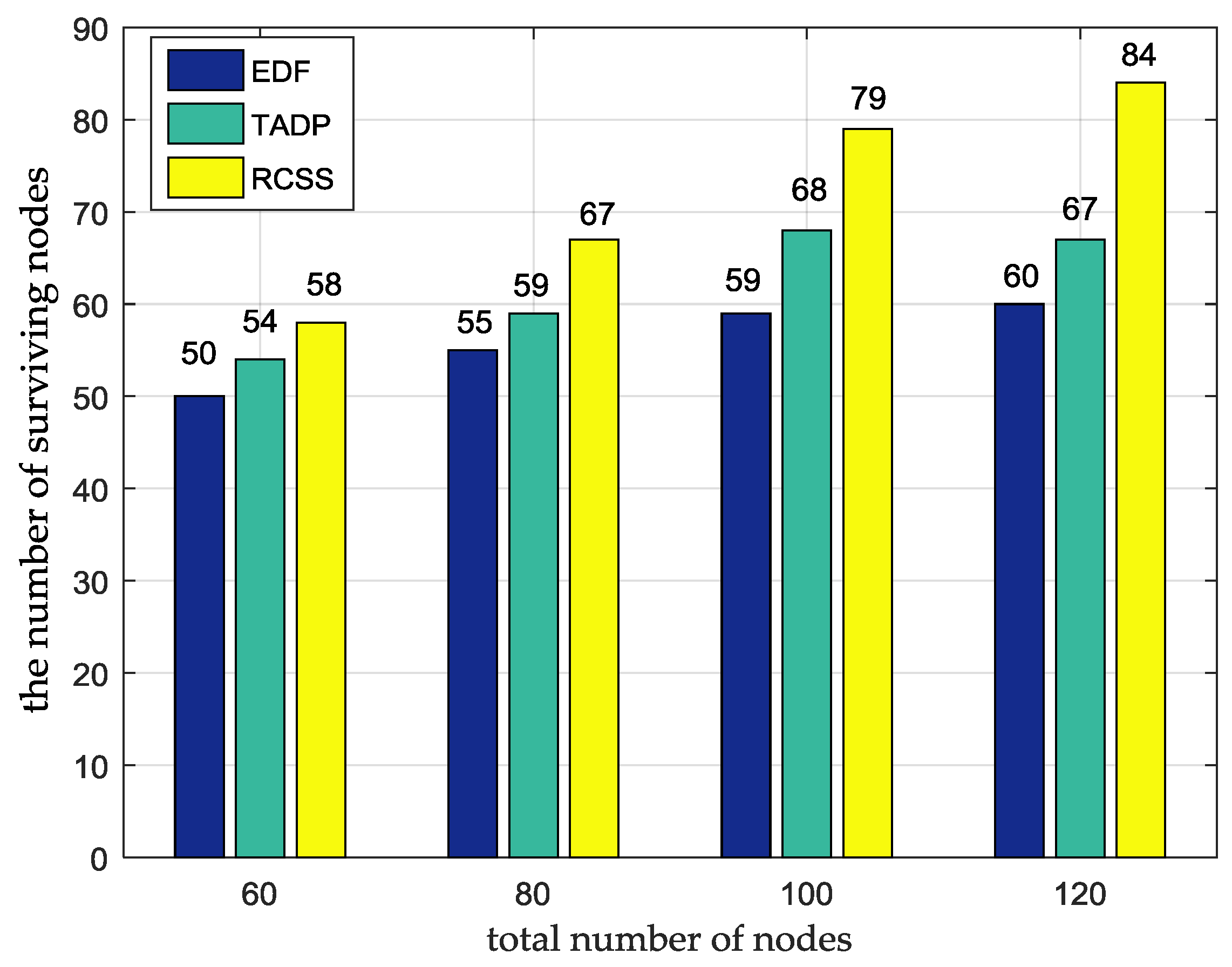
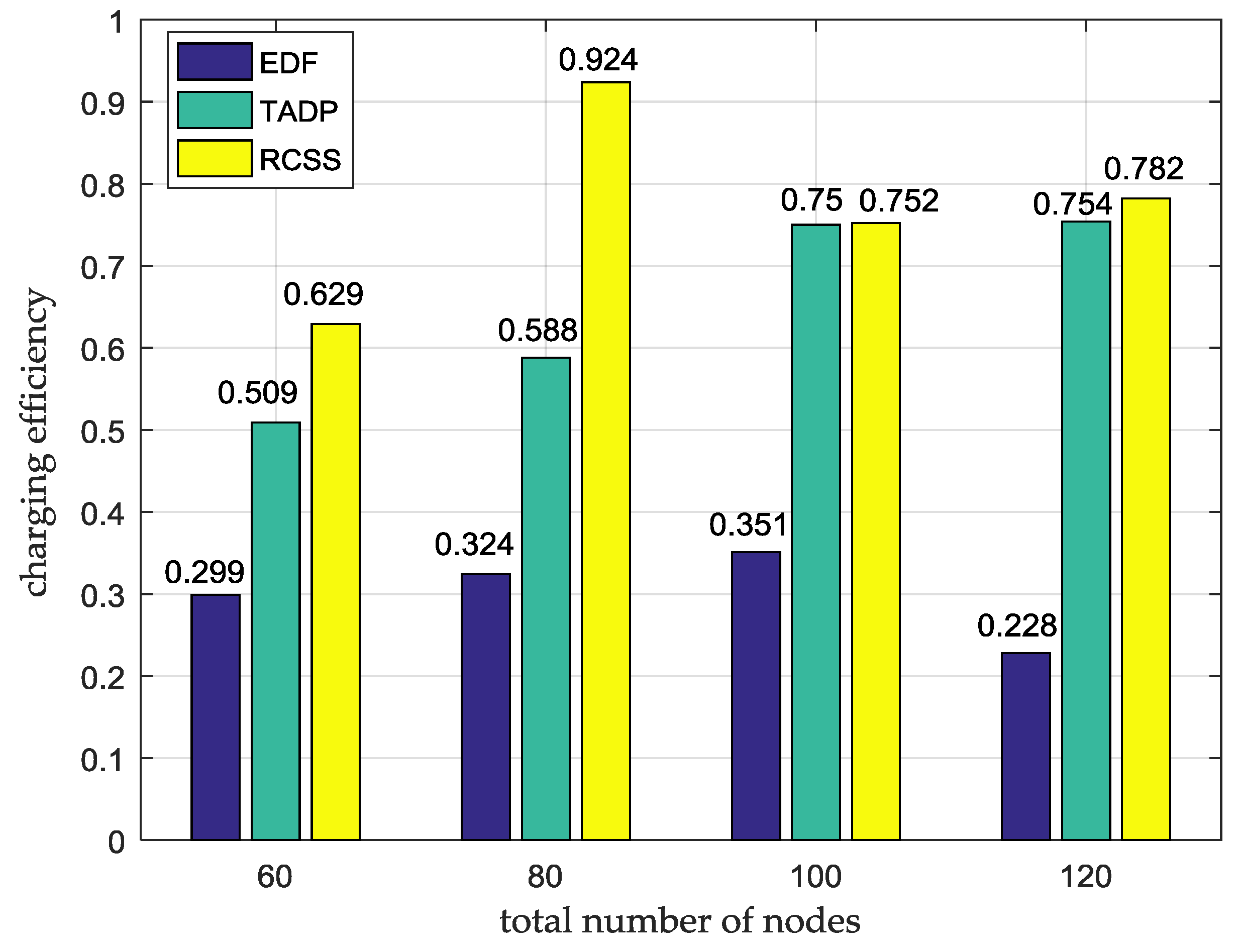
- Through our extensive theoretical analysis and simulation study, we verify the accuracy of the model based on network simulation tool NS-3. The experiment has shown that, the proposed RCSS has a better performance in the number of survival nodes, the average service time and charging efficiency, which demonstrates the outstanding performance of the charging scheme.
2. Related Work
3. Problem Description and System Model
3.1. Problem Description
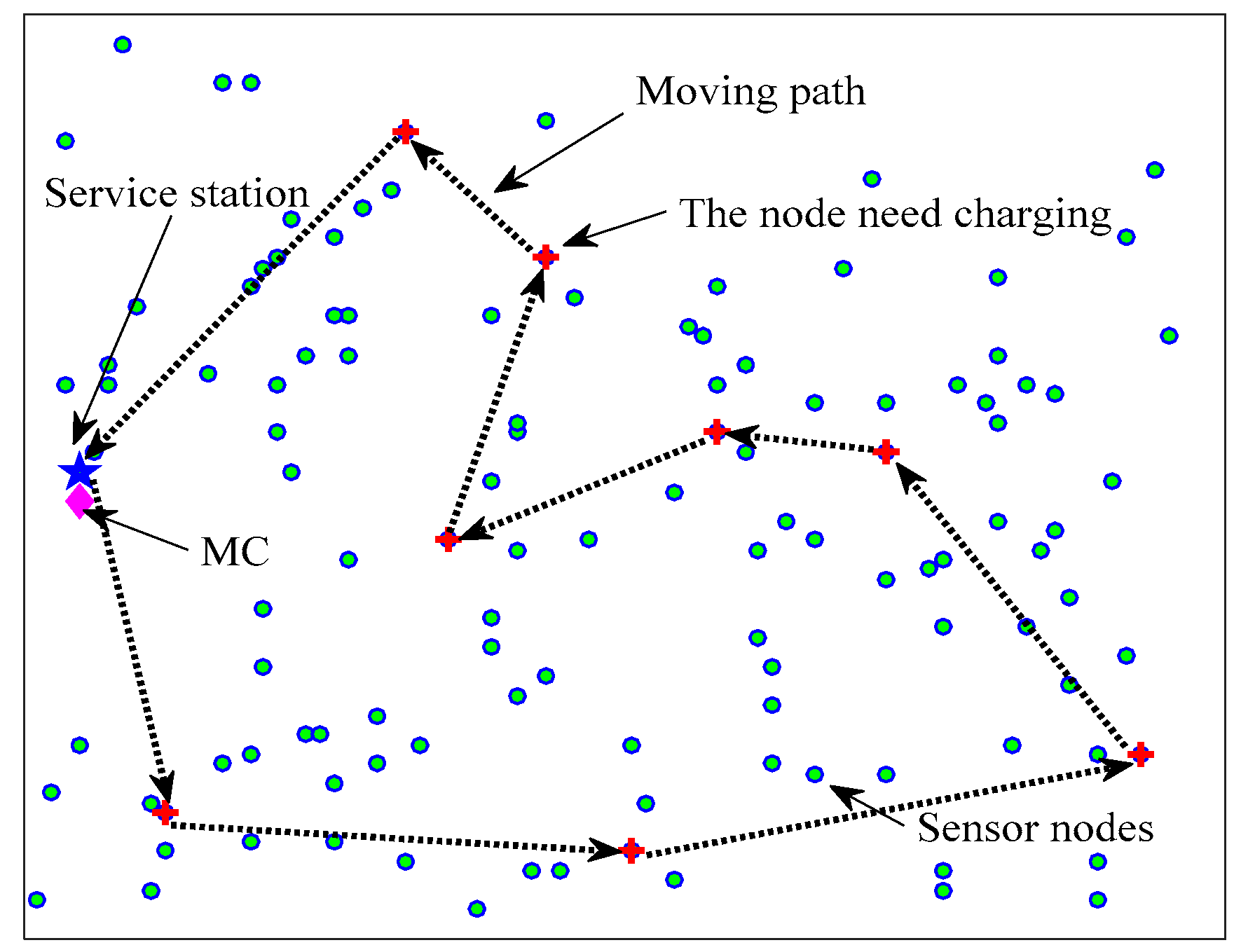
- We consider the MC can only charge one node at the same time. When the MC receives multiple charging requests from nodes that need recharging, how to effectively arrange the charging order for MC to prevent nodes from dying due to energy exhaustion.
- To prevent other nodes from dying due to long waiting time, our method is to replenish proper amount of energy to the nodes instead of charging to its battery capacity. The problem is how to set the adaptive energy charging threshold.
- The service time and the number of charged nodes are limited due to MC limited energy capacity, thus we need to set up a proper path for MC to return to the service station for energy replenishment when its energy is pretty low.
3.2. System Model
4. Real-Time On-Demand Charging Scheduling Scheme
4.1. Next Charging Node Selection
4.1.1. Prediction Model of Energy Consumption Rate for Sensor Nodes
4.1.2. Next Charging Node Selection Algorithm
| Algorithm 1 Next Charging Node Selection Algorithm |
| Input: n (the number of charging nodes requested), , D(i) (the distance between MC and node i) Output: the minimum weight corresponding node While (n) The nodes that need to be charged are arranged in descending order according to the energy consumption rate . The sequence number of node I is marked as ; The nodes that need to be charged are arranged in ascending order according to D(i). The sequence number of node i is marked as ; ; If min P(i) is unique The node corresponding to the min P(i) is selected as the next charging node; Else Select the node with minimum residual energy as the next charging node; End if n = n – 1; End while |
4.2. Feasible Conditions for Charging Path
4.3. Real-Time On-Demand Charging Scheduling Scheme
4.3.1. Adaptive Energy Charging Threshold
4.3.2. Real-Time On-Demand Charging Scheduling Algorithm
| Algorithm 2 Real-Time On-Demand Charging Scheduling Algorithm |
| Input: n (the number of charging nodes requested), Ni (the node ID, ) Output: charging path X Mark as service station While () do MC starts from ; Select the first charging node Ni using the Algorithm 1; Build a virtual closed charging path ; While (X is feasible && n) do If () Put the selected node into charging path, the MC moves to the selected node and charge it until its energy is ; MC updates its residual energy; Else ; If () Select the next charging node with the Algorithm 1; Update the virtual closed path ; End if End if End while The MC returns to for energy replenishment; End while |
4.4. Case Study
5. Performance Evaluation
5.1. Charging Throughput
5.2. Average Service Time
5.3. Average Charging Response Time
5.4. The Number of Surviving Nodes
5.5. Charging Efficiency
6. Conclusions
Author Contributions
Funding
Acknowledgments
Conflicts of Interest
References
- Yang, Y.; Wang, C. Wireless Rechargeable Sensor Networks; Springer: Berlin, Germany, 2015; ISBN 978-3-319-17655-0. [Google Scholar]
- Tang, J.; Liu, A.; Zhang, J.; Zeng, Z.; Xiong, N.; Wang, T. A trust-based secure routing scheme using the traceback approach for energy-harvesting wireless sensor networks. Sensors 2018, 18, 751. [Google Scholar] [CrossRef] [PubMed]
- Han, G.; Li, Z.; Jiang, J.; Shu, L.; Zhang, W. MCRA: A multi-charger cooperation recharging algorithm based on area division for WSNs. IEEE Access 2017, 5, 15380–15389. [Google Scholar] [CrossRef]
- Wang, C.; Li, J.; Yang, Y.; Ye, F. Combining solar energy harvesting with wireless charging for hybrid wireless sensor networks. IEEE Trans. Mob. Comput. 2018, 17, 560–576. [Google Scholar] [CrossRef]
- Zhang, D.; Chen, Z.; Zhou, H.; Shen, X. Energy harvesting-aided spectrum sensing and data transmission in heterogeneous cognitive radio sensor network. IEEE Trans. Veh. Technol. 2017, 66, 831–843. [Google Scholar] [CrossRef]
- Zhang, D.; Chen, Z.; Zhou, H.; Shen, X. Energy-balanced cooperative transmission based on relay selection and power control in energy harvesting wireless sensor network. Comput. Netw. 2016, 104, 189–197. [Google Scholar] [CrossRef]
- Kim, J.; Lee, J. Energy adaptive MAC protocol for wireless sensor networks with RF energy transfer. In Proceedings of the 3th International Conference of Ubiquitous and Future Networks (ICUFN), Dalian, China, 15–17 June 2011; pp. 89–94. [Google Scholar]
- Fu, L.; Cheng, P.; Gu, Y.; Chen, J.; He, T. Minimizing charging delay in wireless rechargeable sensor networks. In Proceedings of the Conference on Computer Communications INFOCOM, Turin, Italy, 14–19 April 2013; pp. 2922–2930. [Google Scholar]
- Guo, S.; Wang, C.; Yang, Y. Mobile data gathering with Wireless Energy Replenishment in rechargeable sensor networks. In Proceedings of the Conference on Computer Communications INFOCOM, Turin, Italy, 14–19 April 2013; pp. 1932–1940. [Google Scholar]
- Dong, M.; Ota, K.; Liu, A. RMER: Reliable and energy efficient data collection for large-scale wireless sensor networks. IEEE Int. Things J. 2016, 3, 511–519. [Google Scholar] [CrossRef]
- Ren, J.; Liang, W.; Xu, W. Maximizing charging throughput in rechargeable sensor networks. In Proceedings of the 23th International Conference on Computer Communication Networks (ICCCN), Shanghai, China, 4–7 August 2014; pp. 1095–2055. [Google Scholar]
- Dai, H.; Wu, X.; Xu, L.; Chen, H.; Li, S. Using minimum mobile chargers to keep large-scale wireless rechargeable sensor networks running forever. In Proceedings of the 22th International Conference on Computer Communication Networks (ICCCN), Nassau, Bahamas, 30 July–2 August 2013; pp. 1–7. [Google Scholar]
- Chen, L.; Lin, S.; Huang, H. Charge me if you can: Charging path optimization and scheduling in mobile networks. In Proceedings of the 17th ACM International Symposium Mobile Ad Hoc Network and Computer, Paderborn, Germany, 5–8 July 2016; pp. 101–110. [Google Scholar]
- Han, H.; Ding, X.; Shi, L.; Han, D.; Wei, Z. Research on the time-varying charging and dynamic data routing strategy for rechargeable wireless sensor networks. J. China Inst. Commun. 2012, 33, 1–10. [Google Scholar]
- Tong, B.; Li, Z.; Wang, G.; Zhang, W. How wireless power charging technology affects sensor network deployment and routing. In Proceedings of the IEEE 30th Conference on Distribution Computer System (ICDCS), Genova, Italy, 21–25 June 2010; pp. 438–447. [Google Scholar]
- Xie, G.; Shi, Y.; Hou, Y.; Lou, W.; Sherali, H.D. On traveling path and related problems for a mobile station in a rechargeable sensor network. In Proceedings of the 4th ACM International Symposium Mobile Ad Hoc Networking and Computing, Bangalore, India, 29 July–1 August 2013; pp. 109–118. [Google Scholar]
- Suo, J.; Yao, Z.; Zhang, B.; Li, C. Charger mobility scheduling and modeling in wireless rechargeable sensor networks. In Proceedings of the International Wireless Communications and Mobile Computing Conference (IWCMC), Paphos, Cypru, 5–9 September 2016; pp. 953–957. [Google Scholar]
- Fu, L.; Cheng, P.; Gu, Y.; Chen, J.; He, T. Optimal charging in wireless rechargeable sensor networks. IEEE Trans. Veh. Technol. 2016, 65, 278–291. [Google Scholar] [CrossRef]
- Zhong, P.; Li, Y.; Liu, W.; Duan, G.; Chen, Y.; Xiong, N. Joint mobile data collection and wireless energy transfer in wireless rechargeable sensor networks. Sensors 2017, 17, 1881. [Google Scholar] [CrossRef] [PubMed]
- Liu, A.; Huang, M.; Zhao, M.; Wang, T. A smart high-speed backbone path construction approach for energy and delay optimization in WSNs. IEEE Access 2018, 6, 13836–13854. [Google Scholar] [CrossRef]
- Gao, J.; Wang, J.; Zhong, P.; Wang, H. On Threshold free Error Detection for Industrial Wireless Sensor Networks. IEEE Trans. Ind. Inf. 2018, 14, 2199–2209. [Google Scholar] [CrossRef]
- Liu, Y.; Ota, K.; Zhang, K.; Ma, M.; Xiong, N.; Liu, A.; Long, J. QTSAC: An energy efficient MAC protocol for delay minimized in wireless sensor networks. IEEE Access 2018, 6, 8273–8291. [Google Scholar] [CrossRef]
- Wang, J.; Si, T.; Wu, X.; Hu, X.; Yang, Y. Sustaining a perpetual wireless sensor network by multiple on-demand mobile wireless chargers. In Proceedings of the IEEE International Conference on Networking, Sensing and Control (ICNSC), Taipei, Taiwan, 9–11 April 2015; pp. 533–538. [Google Scholar]
- Lin, C.; Wu, Y.; Liu, Z.; Obaidat, M.; Yu, C.; Wu, G. GTCharge: A game theoretical collaborative charging scheme for wireless rechargeable sensor networks. J. Syst. Softw. 2016, 121, 88–104. [Google Scholar] [CrossRef]
- Peng, Y.; Li, Z.; Zhang, W.; Qiao, D. Prolonging sensor network lifetime through wireless charging. In Proceedings of the IEEE Real-Time Systems Symposium (RTSS), San Diego, CA, USA, 30 November–3 December 2010; pp. 129–139. [Google Scholar]
- He, L.; Gu, Y.; Pan, J.; Zhu, T. On-demand charging in wireless sensor networks: Theories and applications. In Proceedings of the Mobile Ad Hoc and Sensor System, Hangzhou, China, 14–16 October 2013; pp. 28–36. [Google Scholar]
- He, L.; Kong, L.; Gu, Y.; Pan, J.; Zhu, T. Evaluating the on-demand mobile charging in wireless sensor networks. IEEE Trans. Mob. Comput. 2015, 9, 1861–1875. [Google Scholar] [CrossRef]
- Lin, C.; Wang, Z.; Han, D.; Wu, Y.; Yu, C.; Wu, G. TADP: Enabling temporal and distantial priority scheduling for on-demand charging architecture in wireless rechargeable sensor networks. J. Syst. Archit. 2016, 70, 26–38. [Google Scholar] [CrossRef]
- Feng, Y.; Liu, N.; Wang, F.; Qian, Q.; Li, X. Starvation avoidance mobile energy replenishment for wireless rechargeable sensor networks. In Proceedings of the IEEE International Conference on Communications (ICC), Kuala Lumpur, Malaysia, 22–27 May 2016; pp. 1–6. [Google Scholar]
- Hu, C.; Wang, Y. Minimizing the number of mobile chargers to keep large-scale WRSNs working perpetually. Int. J. Distrib. Sens. Netw. 2015, 11, 782952. [Google Scholar] [CrossRef]
- Lin, C.; Han, D.; Deng, J.; Wu, G. P2S: A primary and passer-by scheduling algorithm for on-demand charging architecture in wireless rechargeable sensor networks. IEEE Trans. Veh. Technol. 2017, 66, 8047–8058. [Google Scholar] [CrossRef]
- Jiang, G.; Lam, S.; Sun, Y.; Tu, L.; Wu, J. Joint charging tour planning and depot positioning for wireless sensor networks using mobile chargers. IEEE/ACM Trans. Netw. 2017, 25, 2250–2266. [Google Scholar] [CrossRef]
- Hu, C.; Wang, Y. Schedulability decision of charging missions in wireless rechargeable sensor networks. In Proceedings of the IEEE International Conference on Sensing, Communication Network (SECON), Singapore, 30 June–3 July 2014; pp. 450–458. [Google Scholar]
- Ye, X.; Liang, W. Charging utility maximization in wireless rechargeable sensor networks. Wirel. Netw. 2016, 23, 2069–2081. [Google Scholar] [CrossRef]
- Rao, X.; Yang, P.; Yan, Y.; Zhou, H.; Wu, X. Optimal recharging with practical considerations in wireless rechargeable sensor network. IEEE Access 2017, 5, 4401–4409. [Google Scholar] [CrossRef]
- Ota, K.; Dong, M.; Gui, J.; Liu, A. QUOIN: Incentive mechanisms for crowd sensing networks. IEEE Netw. Mag. 2018, 32, 114–119. [Google Scholar]
- Liu, X.; Xiong, N.; Zhang, N.; Liu, A.; Shen, H.; Huang, C. A trust with abstract information verified routing scheme for cyber-physical network. IEEE Access 2018, 6, 3882–3898. [Google Scholar] [CrossRef]

| Literature | Real-Time Scheduling | Constraints of MC Energy | Adaptive Charging Threshold | Feasibility Guarantee |
|---|---|---|---|---|
| J. Wang et al. [23] | Yes | No | No | No |
| C. Lin et al. [24] | Yes | Yes | No | No |
| L. He et al. [26] | Yes | No | No | No |
| L. He et al. [27] | Yes | No | No | No |
| C. Hu et al. [30] | No | Yes | No | Yes |
| C. Lin et al. [28] | Yes | No | No | No |
| J. X. Ren et al. [11] | No | Yes | No | Yes |
| Y. Feng et al. [29] | Yes | No | No | Yes |
| C. Lin et al. [31] | No | Yes | No | Yes |
| G. Y. Jiang et al. [32] | No | Yes | No | Yes |
| X. Ye et al. [34] | No | No | No | Yes |
| X. Rao et al. [35] | No | No | No | Yes |
| Our paper | Yes | Yes | Yes | Yes |
| A | B | C | D | E | |
|---|---|---|---|---|---|
| 1 | 3 | 4 | 5 | 2 | |
| 3 | 5 | 1 | 2 | 4 | |
| 4 | 8 | 5 | 7 | 6 |
| B | C | D | E | |
|---|---|---|---|---|
| 3 | 4 | 2 | 1 | |
| 1 | 3 | 4 | 2 | |
| 4 | 7 | 6 | 3 |
| B | C | D | |
|---|---|---|---|
| 2 | 1 | 3 | |
| 1 | 3 | 2 | |
| 3 | 4 | 5 |
| C | D | |
|---|---|---|
| 1 | 2 | |
| 1 | 2 | |
| 2 | 4 |
| Parameters | Value |
|---|---|
| Number of nodes | 20–100 |
| Operating voltage | 3.6 V |
| Energy capacity of nodes | 500 J |
| Energy capacity of the MC | 50,000 J |
| Threshold for charging requests | 225 J |
| Charging rate | 5 w/s |
| Moving consumption | 10 J/m |
| Mobile speed of MC | 3 m/s |
| Simulation time | 36,000 s |
| β | 0.8 |
| Algorithm | Average Service Time |
|---|---|
| TADP | 79.78 s |
| EDF | 87.72 s |
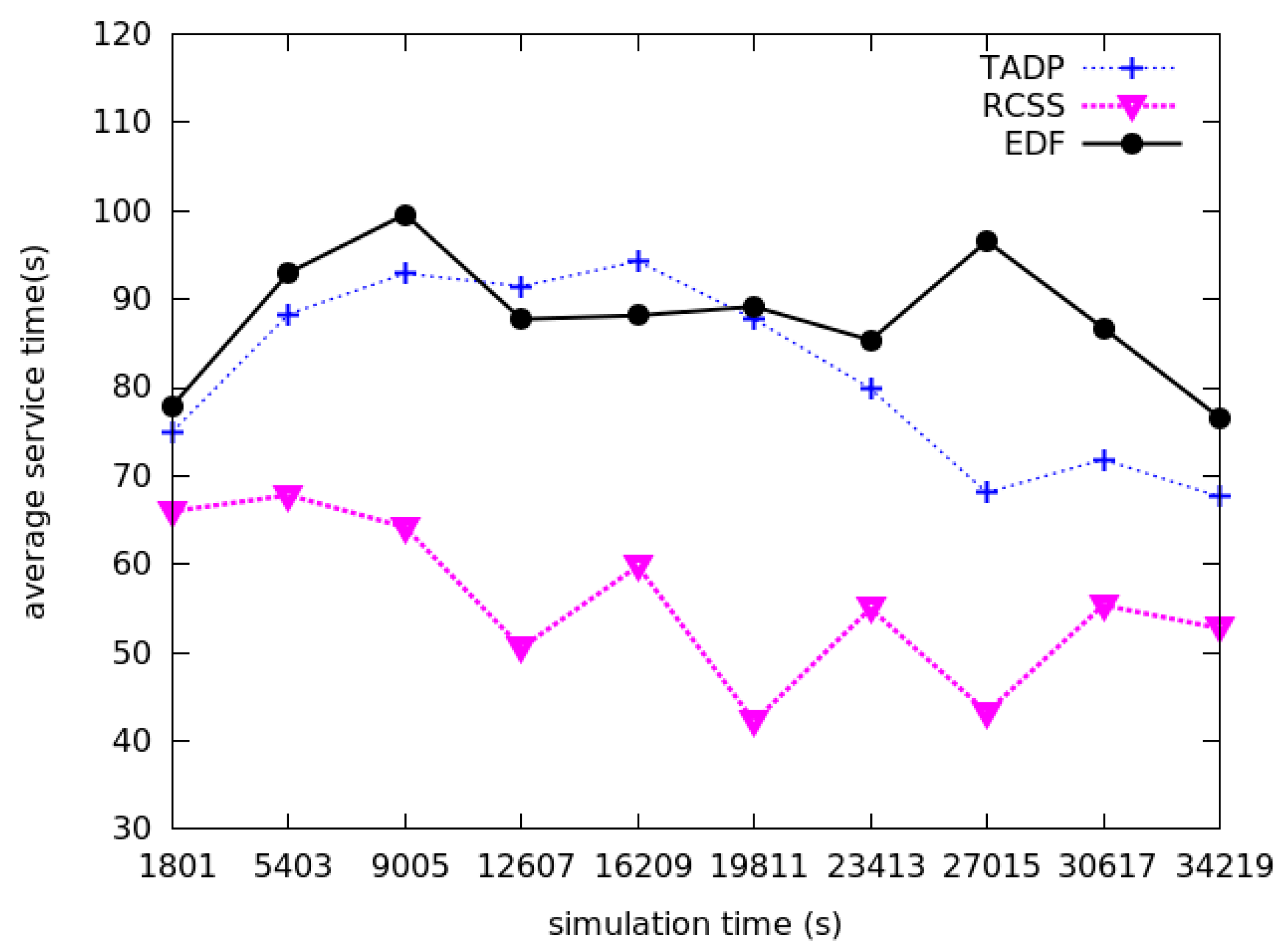
| RCSS | 55 s |
| Algorithm | Average Charging Response Time |
|---|---|
| TADP | 1923.46 s |
| EDF | 2616.65 s |
| RCSS | 1168.15 s |
| Algorithm | Total Number of Nodes | The Number of Survival Nodes |
|---|---|---|
| TADP | 100 | 59 |
| EDF | 100 | 68 |
| RCSS | 100 | 79 |
| RCSS without adaptive charging threshold | 100 | 75 |
© 2018 by the authors. Licensee MDPI, Basel, Switzerland. This article is an open access article distributed under the terms and conditions of the Creative Commons Attribution (CC BY) license (http://creativecommons.org/licenses/by/4.0/).
Share and Cite
Zhong, P.; Zhang, Y.; Ma, S.; Kui, X.; Gao, J. RCSS: A Real-Time On-Demand Charging Scheduling Scheme for Wireless Rechargeable Sensor Networks. Sensors 2018, 18, 1601. https://doi.org/10.3390/s18051601
Zhong P, Zhang Y, Ma S, Kui X, Gao J. RCSS: A Real-Time On-Demand Charging Scheduling Scheme for Wireless Rechargeable Sensor Networks. Sensors. 2018; 18(5):1601. https://doi.org/10.3390/s18051601
Chicago/Turabian StyleZhong, Ping, Yiwen Zhang, Shuaihua Ma, Xiaoyan Kui, and Jianliang Gao. 2018. "RCSS: A Real-Time On-Demand Charging Scheduling Scheme for Wireless Rechargeable Sensor Networks" Sensors 18, no. 5: 1601. https://doi.org/10.3390/s18051601
APA StyleZhong, P., Zhang, Y., Ma, S., Kui, X., & Gao, J. (2018). RCSS: A Real-Time On-Demand Charging Scheduling Scheme for Wireless Rechargeable Sensor Networks. Sensors, 18(5), 1601. https://doi.org/10.3390/s18051601

