


Abstract
Grooming is the first line of defense against ectoparasites by birds. Avian grooming consists of preening with the bill and scratching with the feet. Captive birds are effective at controlling ectoparasites by grooming. However, the effectiveness of grooming for controlling parasites of wild birds is relatively unknown. We investigated the relationship between the grooming behavior of Galápagos Mockingbirds (Mimus parvulus) and the abundance of their parasitic lice and feather mites, which are considered commensals. We captured, measured, and color-banded 26 mockingbirds on Santa Cruz Island, Galápagos. We estimated the abundance of lice and mites on each bird. After the birds were color-banded and released, we collected at least 30 min of behavioral data from each of 15 mockingbirds in the field. These data revealed a significant negative correlation between time devoted to grooming and the abundance of lice on birds. In contrast, there was no correlation between grooming time and the abundance of feather mites. The length of the upper mandibular overhang of the bill, which is used in grooming, was not correlated with the abundance of lice or mites. Our results suggest that grooming has a greater effect on parasitic lice than feather mites. Ultimately, experiments will be needed to demonstrate the mechanisms underlying these correlative differences.
1. Introduction
Grooming is an essential behavior of birds, mammals, and arthropods. It cares for the body surface by keeping the integument clean, properly arranged, and parasite-free [1,2,3]. Avian grooming consists of preening with the bill and scratching with the feet [4]. Scratching is used to flush ectoparasites from the head and neck to lower regions of the body, where they can be preened with the bill [5]. Preening is effective at killing and removing ectoparasites such as chewing lice (Insecta: Phthiraptera) [6], which have negative effects on host fitness. When present in large numbers, lice are known to reduce both mating success and survival [7,8,9].
Individual birds vary in the amount of time they spend grooming. Some of this variation is due to parasites. For example, Brown [10] reported a significant increase in the grooming rates of chickens (Gallus domesticus) experimentally infested with lice. Additionally, Villa et al. [11] reported a significant increase in the grooming rates of experimentally infested Rock Pigeons (Columba livia). Both of these studies were done with captive birds, which are less time constrained than wild birds. Captive birds typically groom twice as much as wild counterparts of the same species [12]. Indeed, some captive birds groom so much that they are capable of clearing themselves of lice [13,14]. In the wild, birds have other demands on their time (e.g., foraging, defending territories, raising offspring) limiting time available for grooming which may, in turn, influence louse abundance. The relationship between grooming behavior and the abundance of lice on wild birds is poorly understood. To our knowledge, no study of wild birds has shown that high grooming individuals have fewer ectoparasites than individuals which devote less time to grooming.
Bush et al. [15] compared the grooming rates and abundance of lice on wild American Kestrels (Falco sparverius) but found no correlation between grooming time and louse load. Their estimates of grooming time may have been imprecise because they averaged only three observation sessions per bird, with a median observation duration of 14.1 min [15]. A study of grooming behavior in a natural population with more observation periods might provide more precise estimates of grooming time. We performed such a study using Galápagos mockingbirds (Mimus parvulus), which are relatively easy to observe at close range [16].
The effectiveness of grooming is influenced by bill morphology. When preening, the tip of the lower mandible crushes lice against the inside of the upper mandibular overhang. Clayton et al. [6] demonstrated the importance of the 1–2 mm long bill overhang by removing it from captive Rock Pigeons. When the overhang was removed, pigeons experienced dramatic increases in louse load. Birds with long overhangs experienced more breakage, which impairs preening and perhaps feeding [6,9]. Thus, intermediate length overhangs are better at controlling lice. This pattern is consistent with parasite-mediated stabilizing selection on overhang length.
The bill morphology of some wild birds further suggests that intermediate bill overhangs are better tools for preening. Woodhouse’s scrub-jays (Aphelocoma woodhouseii, formerly A. californica) with intermediate overhangs have fewer lice than scrub-jays with relatively long or short overhangs [17]. Similarly, Darwin’s ground finches (Geospiza spp.) with intermediate overhangs have fewer mites (Acari: Astigmata) than finches with long or short overhangs [18].
We compared bill overhang length and grooming time to the abundance of lice and mites on Galápagos Mockingbirds. Our study was conducted January–February 2022 at “La Barranca”, a plateau above the Charles Darwin Research Station in Puerto Ayora, Santa Cruz Island, Galápagos. This arid coastal zone site is characterized by sloping lava rock terrain and thick vegetation like Galápagos acacia trees (Vachellia rorudiana) and painful giant prickly pear cacti (Opuntia echios). At this location, Galápagos Mockingbirds are common and relatively tame. Galápagos Mockingbirds are infested with both parasitic lice and feather mites [19], providing an opportunity to test whether bill morphology and grooming time are correlated with the abundance of one or both of these groups of arthropods.
2. Methods
We used mist nets to capture 26 mockingbirds between 28 January and 12 February 2022. Each captured bird was fitted with a numbered metal band and a unique combination of three Darvic color bands. The color bands allowed us to keep track of individuals while collecting behavioral data. Upon capture, we measured body mass and length of the upper bill overhang with calipers, as in Clayton et al. [17] and Villa et al. [18].
We quantified the abundance of lice and feather mites on each bird using non-invasive visual methods [20]. Two species of lice are known to infest Galápagos mockingbirds: Myrsidea nesomimi (parvorder Amblycera) and Guimaraesiella (formerly Brueelia) galapagensis (parvorder Ischnocera) [19]. Although we were unable to export voucher specimens, SEB examined lice on these birds with a Bausch and Lomb 10x Coddington hand lens. This level of magnification is sufficient to easily identify amblyceran versus ischnoceran lice and, to a trained taxonomist, it is sufficient to identify lice to species group (SEB co-authored the taxonomic revision of the genus Guimaraesiella, including the species G. galapagensis [21]).
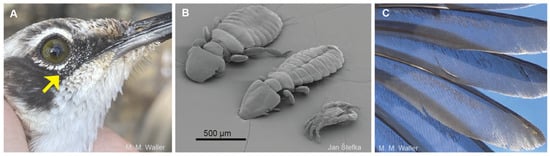
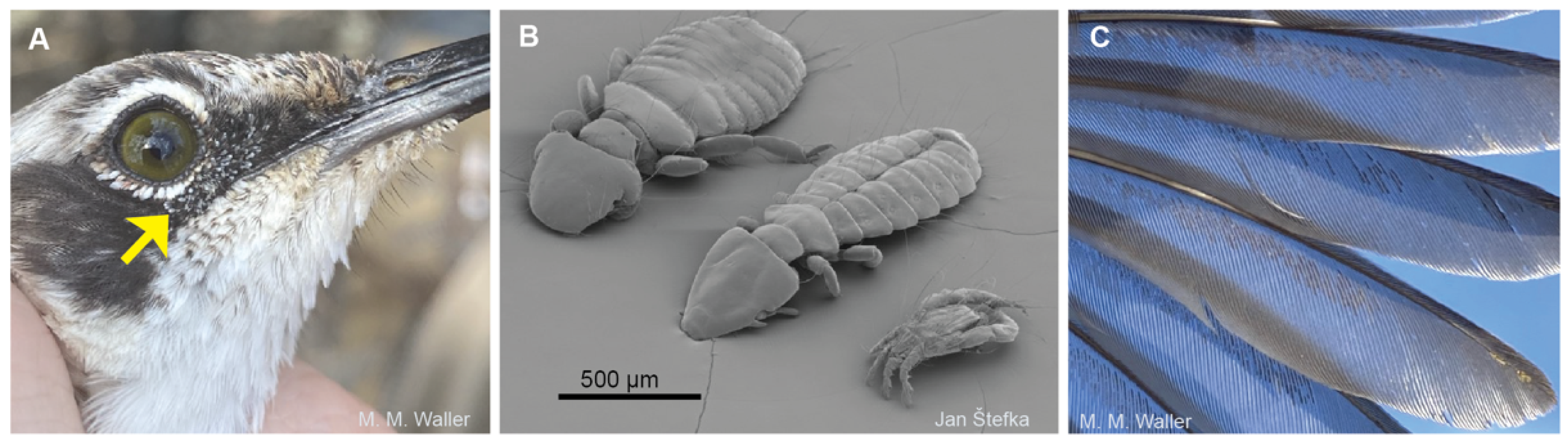
The different parvorders of lice lay eggs that differ greatly in appearance and are attached to different microhabitats on the host’s body [22]. Although oviposition sites of lice on Galápagos Mockingbirds have not been documented, data for lice on other South American passerines show that lice in the Amblyceran genus Myrsidea attach large eggs to facial feathers of the host [23], whereas Ischnoceran lice in the Brueelia-complex attach small eggs to abdominal feathers [24]. We encountered large eggs found around the eyes of mockingbirds (Figure 1A), which we assumed to be Myrsidea.
Figure 1.
(A) Galápagos Mockingbird with louse eggs attached to feathers beneath the eye (arrow points to one of the many eggs). (B) Arthropods associated with Galápagos Mockingbirds, Myrsidea nesomimi, an Amblyceran louse (top), Guimaraesiella galapagensis (formerly Brueelia galapagensis), an Ischnoceran louse (middle), and Analges sp., a feather mite (bottom), SEM courtesy of Jan Štefka. (C) Feather mites on primary feathers of a Darwin’s Finch. Feather mites position themselves between barbs of flight feathers and are most easily counted by holding the wing against sunlight to create backlighting.
Feather mites are much smaller than lice (Figure 1B), and it is not possible to identify them to genus in the field with a hand lens. Given the distribution of mites along the vanes of the primary feathers, however, we can identify with certainty that these were feather mites. Štefka et al. [19] thoroughly surveyed mites of Galápagos Mockingbirds and documented that this species is commonly infested with an undescribed species of feather mite in the genus Analges. It is likely that the mites we observed were the same Analges sp. recorded by Štefka et al. [19] (Figure 1B).
To estimate louse abundance, we used a 4X OptiVISOR (Donegan Optical Co., Lenexa, KS, USA)to count the number of eggs glued to the feathers of the head, including the crown, nape, throat and face (both sides) (Figure 1A). Because louse eggs are attached to the feathers, both before and after hatching, they provide a cumulative record of louse reproduction until feathers are molted and new ones grow in. If grooming kills or removes lice at any developmental stage (egg, nymph or adult) it will reduce the number of reproductive adults and, consequently, the number of louse eggs attached to the feathers. Thus, the number of louse eggs is an accurate indicator of the size of a louse population on one bird relative to another bird examined with the same methods. We used this noninvasive approach because it is a method that can be performed in the field without removing parasites from birds. Parasite removal could have unwanted effects on grooming behavior.
To estimate feather mite abundance, we scored the approximate number of mites on each of the ten primary feathers of the left wing (Figure 1C). As described by Brown et al. [20], every primary feather was scored according to the following scale: 0 = no mites; 1 = 1–10 mites; 2 = 11–20 mites; 3 = 21–30 mites; 4 = 31–40 mites; 5 = >40 mites. The scores for all ten feathers were added together to provide an overall index of mite abundance.
Once the abundances of lice and mites were estimated, each bird was released at the capture site. We subsequently collected data on the grooming behavior of mockingbirds using focal animal sampling [25]. Birds were observed and identified with binoculars and their behavior quantified using the Animal Behaviour Pro v.1.5 App for iPhone [26,27], as in previous studies [15,28].
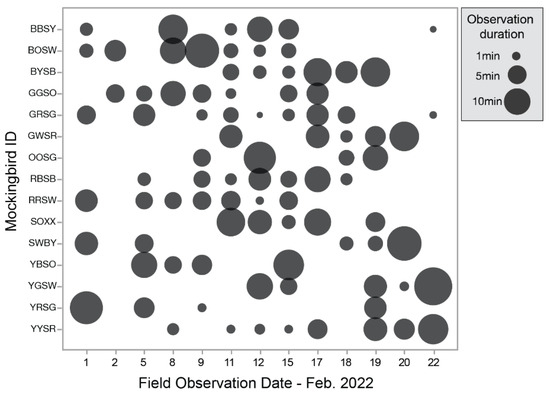
All grooming data were collected during the month of February (Figure 2). Observations were opportunistic, lasting from a few seconds to 15 min, at which point we stopped collecting data to avoid collecting too much data in a single session. Grooming data were collected in the morning hours (06:00–12:00) to avoid intense afternoon heat.
Figure 2.
Distribution of behavioral observations for 15 Galápagos Mockingbirds. Data for each color-banded bird (Y axis) were collected over an average of six observation periods varying in duration (point size) and date (x axis).
Each bout of grooming ended when a bird stopped preening or scratching for more than three seconds, or switched to a different behavior [4]. The proportion of time each mockingbird spent grooming was calculated as the sum of time spent preening and scratching, divided by total observation time. Our goal was to collect a minimum of 30 min of data per bird, as in other recent studies [15,28].
Statistical Analyses
To explore the relationship between louse abundance, bill morphology and grooming behavior we used zero-inflated negative binomial models (ZINB) with a log link. This distribution was selected because louse abundance was overdispersed (NB dispersion parameter P = 0.03) and the data contained more zeros than expected under a standard negative binomial distribution (ZI parameter P = 0.02). To explore the relationship between mite abundance, bill morphology and grooming behavior we used a generalized regression with a negative binomial distribution with a log link because mite index was overdispersed (NB dispersion parameter P = 0.04), and the data did not contain more zeros than expected under a standard negative binomial distribution (ZI parameter P = 0.12). To examine the relationship between bill overhang length and the proportion of time mockingbirds spent grooming we used a generalized linear model (GLM) with a beta distribution and a logit link. The beta distribution is well suited for proportional response variables constrained between 0 and 1, making it appropriate for modeling the proportion of time spent grooming. Statistical analyses were conducted with the statistical software JMP v.19.1.0 using maximum likelihood estimation.
3. Results
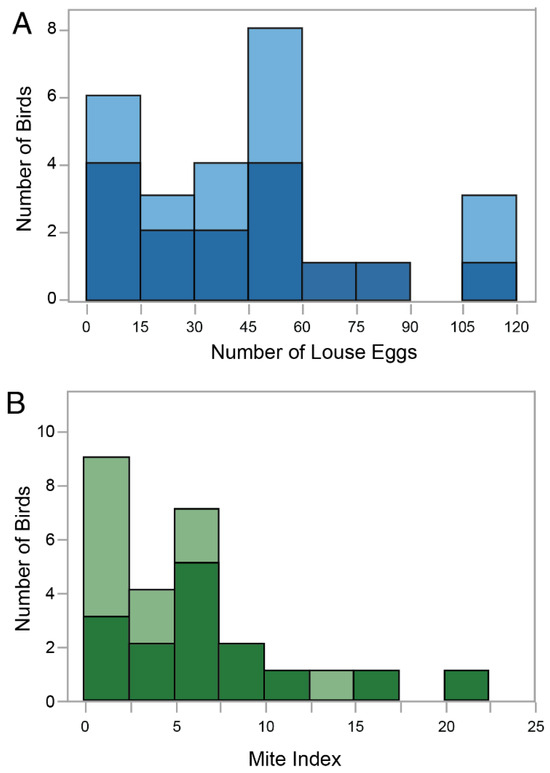
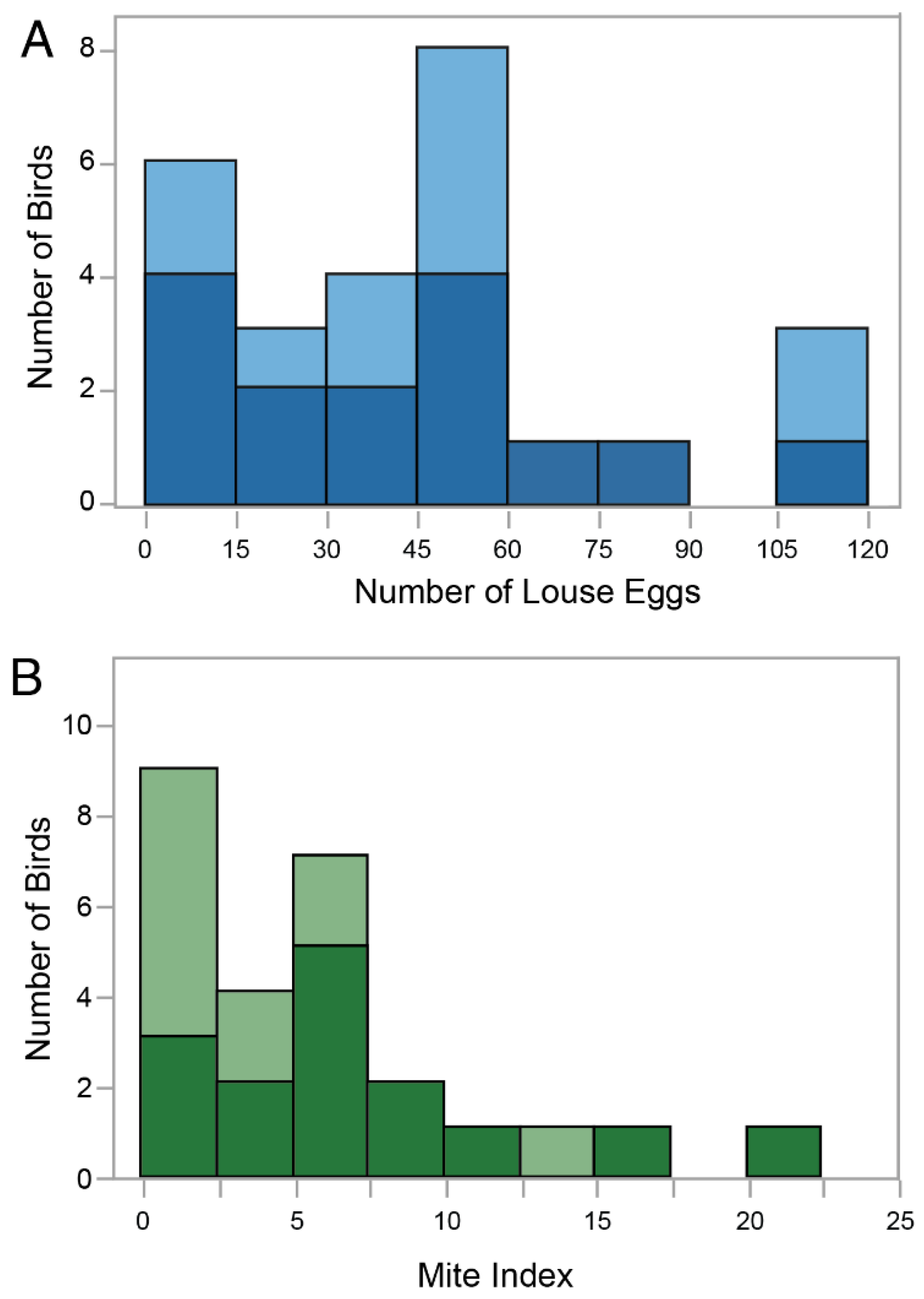
Louse eggs were observed on the facial feathers of 20 of 26 mockingbirds (76.9%), with egg number ranging from 15 to 118, and a mean of 54.2 eggs (Figure 3A, Table S1 in the Supplementary Materials). In addition to feather lice, we observed feather mites on 21 of 26 mockingbirds (80.8%). The mite index on infested birds varied from 1 to 22, with a mean index of 6.7 (Figure 3B, Table S1).
Figure 3.
(A) Distribution of louse eggs on the facial feathers of 26 mockingbirds; (B) Distribution of mite indices among the same 26 mockingbirds. Birds with at least 30 min of grooming data are represented by dark blue in (A) and dark green in (B).
We collected at least 30 min of behavioral data from 15 of the 26 mockingbirds (Table S2 in the Supplementary Materials). These 15 birds were not randomly selected; they were birds that we observed opportunistically in the field. It is possible that these birds differed in some way from the birds we did not observe [29]; however, the 15 mockingbirds we observed did not differ significantly from 11 unobserved mockingbirds in bill overhang length (Welch’s t-test, t = 1.08, df = 22.25, P = 0.29), louse abundance (ZINB generalized regression, Wald χ2 = 0.24, df = 1, P = 0.62, Figure 3A), nor mite abundance (NB generalized regression, Wald χ2 = 0.15, df = 1, P = 0.70, Figure 3B).
The birds for which we have behavioral data were observed, on average, for six observation sessions per bird (Figure 2). The median duration for each observation session was 4.9 min. Mockingbirds spent a mean of 12.7% of their time grooming (range = 1.5–31.0%). Most of the grooming time was preening (mean = 89.3%), with the remainder being scratching (mean = 10.7%).
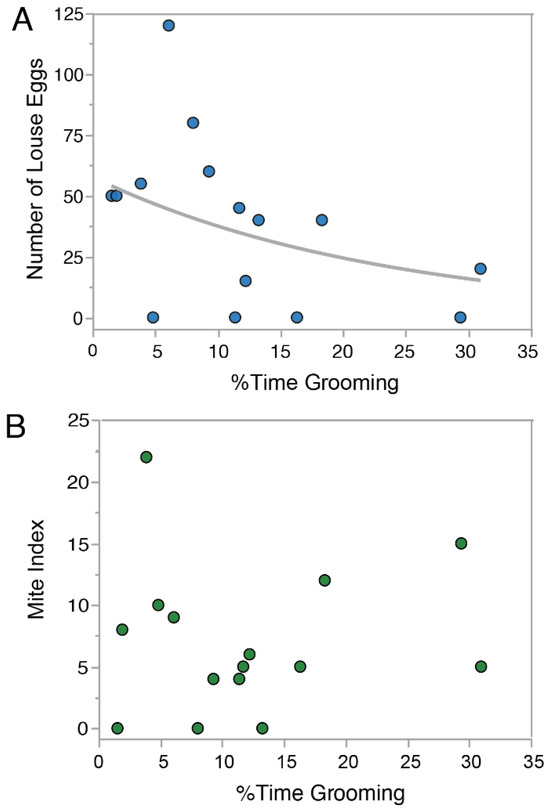
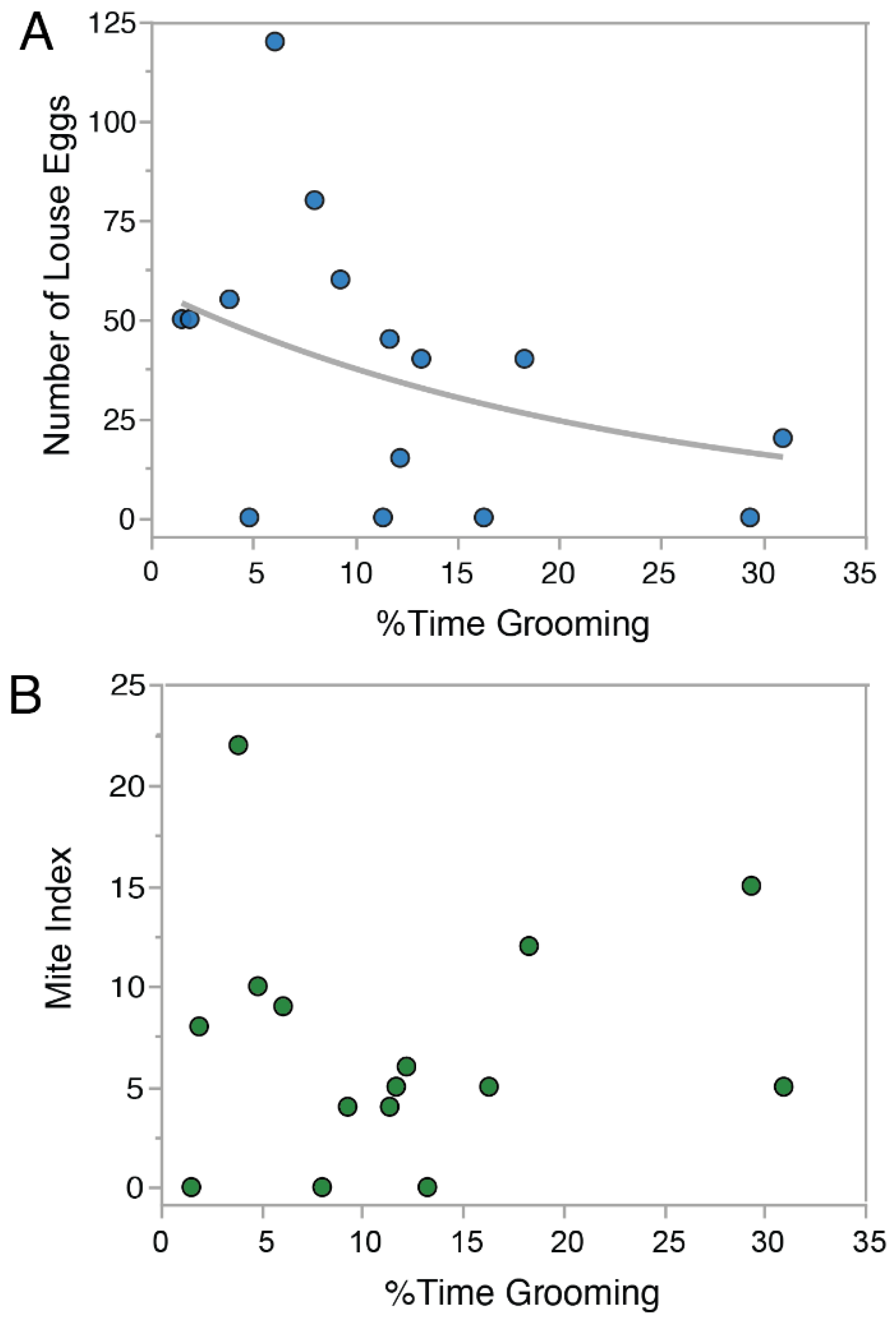
Louse abundance was negatively correlated with time spent grooming (Figure 4A, generalized regression, ZINB distribution, n = 15, Wald χ2 = 6.57, P = 0.01). In contrast, there was no significant relationship between time spent grooming and mite abundance among the 15 mockingbirds (Figure 4B; generalized regression, NB distribution, n = 15, Wald χ2 = 0.16, P = 0.69).
Figure 4.
(A) Mockingbirds that groomed more had significantly fewer lice (generalized regression, ZINB distribution P = 0.01, see text). (B) Grooming time and mite abundance were not significantly correlated (generalized regression, NB distribution P = 0.69, see text).
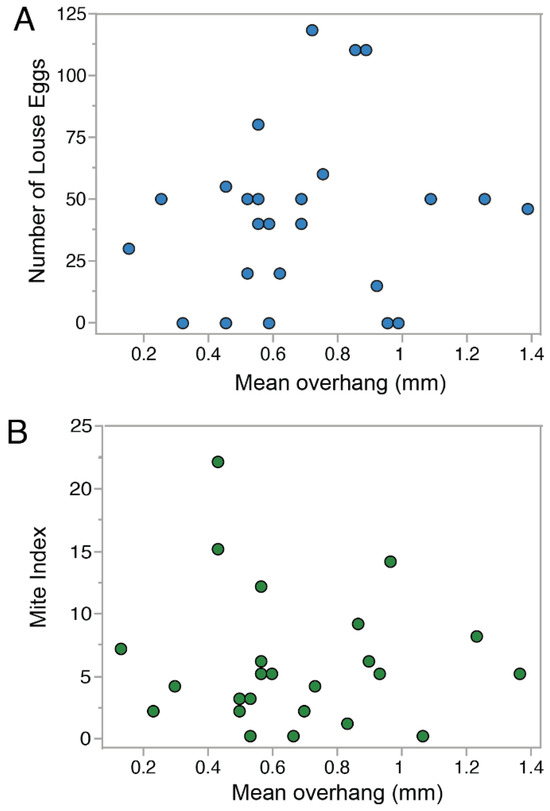
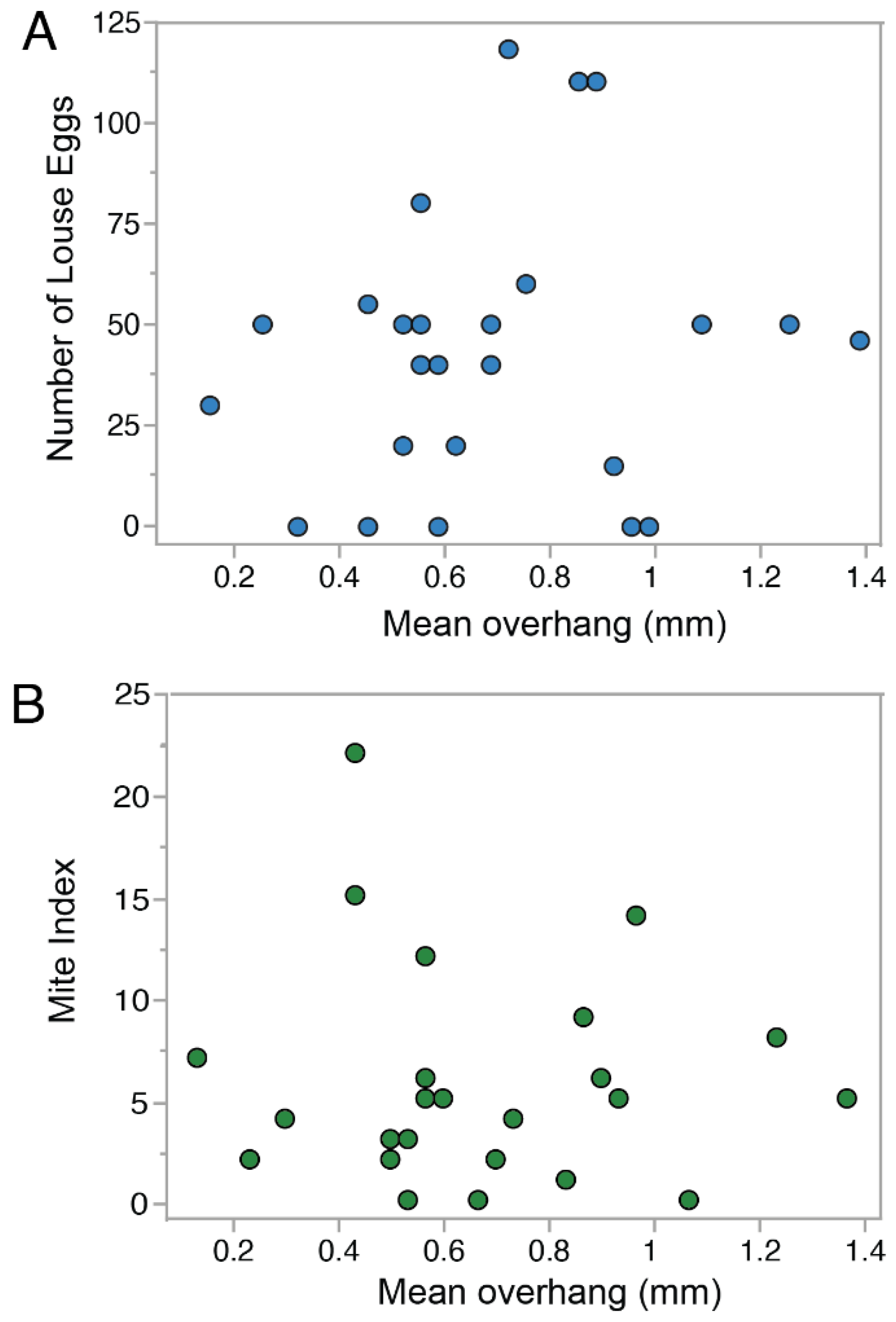
Mockingbirds had a mean bill overhang length of 0.67mm (σ = 0.29, n = 26). Overhang length was not significantly correlated with louse abundance (Figure 5A; generalized regression, ZINB distribution, n = 26, Wald χ2 = 0.69, P = 0.41), nor was there a significant relationship between overhang length and mite abundance (Figure 5B; generalized regression, NB distribution, n = 26, Wald χ2 = 0.03, P = 0.86). Overhang length was not significantly associated with grooming time (GLM, beta distribution; n = 15, Wald χ2 = 0.63, P = 0.43, Table S3 in the Supplementary Materials).
Figure 5.
Bill overhang length of Galápagos Mockingbirds in relation to louse and mite abundance for 26 Galápagos Mockingbirds. (A). There was no significant correlation between bill overhang and the number of louse eggs (generalized regression, ZINB distribution P = 0.41, see text). (B). There was no significant correlation between bill overhang and the mite index (generalized regression, NB distribution P = 0.86, see text).
4. Discussion
We examined Galápagos Mockingbirds for chewing lice and feather mites on Santa Cruz Island in the Galápagos. Of the 26 birds in our study, most were infested with lice (76.9%) and mites (80.8%). Our data for lice are similar to those of Vlček and Štefka [30], who reported that most of the Galápagos Mockingbirds they surveyed were infested with lice. We tested whether host grooming behavior and bill morphology were correlated with the abundance of lice or mites. We also tested whether bill morphology was correlated with grooming behavior.
4.1. Grooming Behavior and Lice
Grooming time was negatively correlated with louse abundance (Figure 4A), such that higher grooming mockingbirds had fewer lice. To our knowledge, this is the first demonstration of a negative correlation between grooming time and louse abundance in a natural population of birds. One explanation for this correlation is that grooming is effective at controlling lice on wild birds. However, the precise mechanism is unknown. One possibility is that regular grooming kills immature and adult lice, which, in turn, results in fewer eggs on the feathers. Another possibility is that the scratching component of grooming removes eggs directly from the facial feathers. Yet another possibility is that scratching flushes hatched lice onto the body and thus into the range of preening [5].
Because our data are correlational, however, it is important to consider alternative explanations for the observed relationship. For example, like many Amblyceran lice, Myrsidea feed on blood in addition to feathers [31]. Birds with heavy Myrsidea infestations may thus experience anemia, which could reduce grooming activity, yielding a negative correlation between louse abundance and grooming. In this case the causal arrow would be reversed, with lice causing a reduction in grooming, rather than grooming causing a reduction in lice. It is also possible that unmeasured variable(s) are contributing to a spurious correlation between grooming and lice. Experimental manipulations are needed to establish the causal factor(s) responsible for the correlation we have documented.
The negative correlation between mockingbird grooming time and louse abundance differs from Bush et al.’s [15] study of American Kestrels, which showed no correlation between grooming time and louse abundance. The contrasting results of these studies may be due to differences in the precision of the grooming data. While the birds in both studies were observed for at least 30 min, our observations of mockingbirds were more evenly distributed over time. We observed mockingbirds for an average of six sessions per individual (Figure 2), while Bush et al. [15] observed kestrels for an average of only three sessions per individual [15].
Differing foraging habits also may have affected the precision of the grooming data. Kestrels feed intermittently, while mockingbirds feed more continuously. After feeding on a large prey item, kestrels tend to groom for longer periods of time (pers. obs.). For this reason, data collected soon after a kestrel consumed a large prey item (unbeknownst to the observer) may have overestimated the mean grooming time for that bird. In contrast, the continuous foraging of mockingbirds is likely to yield more precise estimates of grooming time.
4.2. Grooming Behavior and Mites
In contrast to feather lice, we found that mockingbird grooming was not correlated with mite abundance (Figure 4B). This result may be a consequence of the relatively small sample size, and the coarseness of our measurement of mite abundance. However, it is also possible that there is a biological basis for this pattern; grooming may be relatively ineffective against feather mites, which are smaller than lice (Figure 1B), and escape grooming by inserting between the barbs of flight feathers (Figure 1C). Our results are similar to those of Dowling et al. [32], who found no significant relationship between grooming and feather mites in Seychelles Warblers (Acrocephalus sechellensis).
Mites are increasingly viewed as commensals rather than parasites [33,34,35], in which case they would not be expected to exert selection on host grooming to remove them. Recent work suggests that feather mites may even be mutualists that benefit birds [36], in which case they might exert selection on hosts not to remove them. Matthews et al. [37] showed that feather mites selectively consume keratin degrading microbes known to damage feathers, consistent with the mutualism hypothesis.
Two studies have measured the fitness of birds after experimentally reducing feather mite abundance. Pap et al. [38] found no effect on the survival or reproductive success of Barn Swallows (Hirundo rustica) after removing feather mites from experimental birds with an insecticide. More recently, Matthews et al. [39] found no effect on the survival of Cerulean Warblers (Setophaga cerulea) or Prothonotary Warblers (Protonotaria citrea) after removing feather mites by hand, which has the advantage of avoiding effects on other members of the pterosphere, such as lice. The results of these two experimental studies are consistent with the hypothesis that feather mites are commensals.
4.3. Bill Overhang and Mites
If feather mites are not parasites, then what explains Villa et al.’s [18] finding that Darwin’s ground finches with intermediate bill overhangs had fewer mites than finches with long or short overhangs, consistent with mite-imposed stabilizing selection? One possibility is that the community of mites on Darwin’s ground finches includes one or more species that do, in fact, reduce host fitness. Unlike the current study, which quantified mites only on the primary feathers of one wing, Villa et al. [18,40] removed mites by dusting the entire bodies of the finches they studied. This approach yielded seven different genera of mites, all of which were included in their mite tallies [40]. Yet another factor relevant to the differing results of the mockingbird and finch studies is that Villa et al. [18] lumped three species of Darwin’s ground finches (Geospiza fuliginosa, G. fortis and G. magnirostris) in their analyses. Although the three species do hybridize [41], lumping them increased variation in bill overhang length, which had a coefficient of variation (σ/) = 74% (n = 88, unpublished data).
Bill overhang length in our study did not correlate significantly with feather mite abundance on Galápagos Mockingbirds (Figure 5B). But the coefficient of variation (CV) for mockingbird overhang length was only 44%. This lower CV for mockingbirds, compared to finches, may have reduced the chance of detecting a correlation between mockingbird overhang length and mites. Our study is broadly similar to that of Bodawatta et al. [42], who found no significant correlation between the bill overhangs and the abundance of feather mites among species of New Guinea birds.
4.4. Bill Overhang and Lice
Similarly, bill overhang length did not correlate significantly with the abundance of lice on Galápagos Mockingbirds (Figure 5A). This result differs from Woodhouse’s Scrub-jays, in which birds with intermediate overhangs had fewer lice than those with long or short overhangs [17]. Woodhouse’s Scrub-jays have variable bill overhangs (CV = 66%, n = 57, unpublished data). Scrub-jay populations in oak woodlands have relatively long, curved overhangs used to open acorns, whereas scrub-jay populations in pinyon–juniper woodlands have relatively straight overhangs that are used to extract pine nuts from pinyon pinecones [43]. Relatively low variation in the bills of Galápagos Mockingbirds may explain why there was no significant correlation between bill overhangs and lice, in contrast to the case for Woodhouse’s Scrub-jays and their lice.
4.5. Bill Overhang and Grooming Behavior
Bill overhang length was not significantly associated with the grooming time of Galápagos Mockingbirds, which is not surprising, given their low variation in overhang length. To our knowledge, no data exist on the grooming times of Darwin’s finches, or Woodhouse’s scrub-jays. In the future, collecting grooming data for Darwin’s finches may be practical because, like Galápagos Mockingbirds, they are relatively tame [16]. Florida scrub-jays (Aphelocoma coerulescens) are also relatively tame and would be the best choice in the future for collecting grooming data on scrub-jays [44]. Regardless of species, additional data are needed on the relationship between grooming time, bill morphology, and the abundance of different arthropod associates of birds.
Supplementary Materials
The following supporting information can be downloaded at: https://www.mdpi.com/article/10.3390/d18090551/s1, Tables S1–S3 provide the model structure, parameter estimates, and additional information related to the analyses presented in the main text. Two CSV data files are also included in the supplementary materials, which provide the raw data on which the analyses in the main text are based.
Author Contributions
Conceptualization, S.E.B. and D.H.C.; methodology, S.E.B., A.R.C., and M.M.W.; formal analysis, S.E.B., A.R.C., M.M.W., and D.H.C.; resources, S.E.B. and D.H.C.; data curation, S.E.B. writing—original draft preparation, S.E.B., A.R.C. and D.H.C.; writing—review and editing, S.E.B., A.R.C., M.M.W., and D.H.C. All authors have read and agreed to the published version of the manuscript.
Funding
This work was supported by the National Science Foundation, USA grant NSF: DEB-2025085.
Institutional Review Board Statement
All survey protocols were reviewed and approved by the Institutional Animal Care and Review Committees (IACUC) at the University of Utah (protocol 21-10016, 21 October 2021).
Data Availability Statement
The original contributions presented in this study are included in the article. Further inquiries can be directed to the corresponding author.
Acknowledgments
We thank the Galápagos National Park and Charles Darwin Foundation for logistical support and permits to do fieldwork in the Galápagos. We thank Ricardo Palma and Daniel Gustafsson for valuable comments on a conference poster that preceded this paper, Jan Štefka for sharing the SEM in Figure 2, and two anonymous reviewers who provided helpful comments on the manuscript. This publication is contribution number 2872 of the Charles Darwin Foundation for the Galapagos Islands. This study was framed under the Research Permit No. 041-2022 issued by the DPNG.
Conflicts of Interest
The authors declare no conflicts of interest.
References
- Bush, S.E.; Clayton, D.H. Anti-parasite behaviour of birds. Philos. Trans. R. Soc. B 2018, 373, 20170196. [Google Scholar] [CrossRef] [Scilit] [PubMed]
- Kalueff, A.V.; La Porte, J.L.; Bergner, C.L. (Eds.) Neurobiology of Grooming Behavior; Cambridge University Press: Cambridge, UK, 2010. [Google Scholar]
- Zhukovskaya, M.; Yanagawa, A.; Forschler, B.T. Grooming behavior as a mechanism of insect disease defense. Insects 2013, 4, 609–630. [Google Scholar] [CrossRef] [Scilit] [PubMed]
- Clayton, D.H.; Cotgreave, P. Relationship of bill morphology to grooming behaviour in birds. Anim. Behav. 1994, 47, 195–201. [Google Scholar] [CrossRef] [Scilit]
- Goodman, G.B.; Klingensmith, M.C.; Bush, S.E.; Clayton, D.H. The role of scratching in the control of ectoparasites on birds. Auk 2020, 137, ukaa010. [Google Scholar] [CrossRef] [Scilit]
- Clayton, D.H.; Moyer, B.R.; Bush, S.E.; Gardiner, D.; Rhodes, B.; Jones, T.; Goller, F. Adaptive significance of avian beak morphology for ectoparasite control. Proc. R. Soc. B Biol. Sci. 2005, 272, 811–817. [Google Scholar] [CrossRef] [Scilit] [PubMed]
- Clayton, D.H. Mate choice in experimentally parasitized Rock Doves: Lousy males lose. Am. Zool. 1990, 30, 251–262. [Google Scholar] [CrossRef] [Scilit]
- Booth, D.T.; Clayton, D.H.; Block, B.A. Experimental demonstration of the energetic cost of parasitism in free-ranging hosts. Proc. R. Soc. Lond. B 1993, 253, 125–129. [Google Scholar] [CrossRef] [Scilit]
- Clayton, D.H.; Lee, P.L.M.; Tompkins, D.M.; Brodie, E.D., III. Reciprocal natural selection on host-parasite phenotypes. Am. Nat. 1999, 154, 261–270. [Google Scholar] [CrossRef] [PubMed]
- Brown, N.S. The effect of louse infestation, wet feathers, and relative humidity on the grooming behavior of the domestic chicken. Poult. Sci. 1974, 53, 1717–1719. [Google Scholar] [CrossRef] [Scilit] [PubMed]
- Villa, S.M.; Campbell, H.E.; Bush, S.E.; Clayton, D.H. Does anti-parasite behavior improve with experience? An experimental test of the priming hypothesis. Behav. Ecol. 2016, 27, 1167–1171. [Google Scholar] [CrossRef] [Scilit]
- Walther, B.A.; Clayton, D.H. Elaborate ornaments are costly to maintain: Evidence for high maintenance handicaps. Behav. Ecol. 2005, 16, 89–95. [Google Scholar] [CrossRef] [Scilit]
- Bush, S.E.; Clayton, D.H. Does preening behavior reduce the prevalence of avian feather lice (Phthiraptera: Ischnocera)? J. Parasitol. 2023, 109, 145–147. [Google Scholar] [CrossRef] [Scilit] [PubMed]
- Waller, M.M.; Warr, H.M.; Goodman, G.B.; Bush, S.E.; Clayton, D.H. Influence of grooming on permanent arthropod associates of birds: Cattle egrets, lice, and mites. J. Parasitol. 2024, 110, 143–149. [Google Scholar] [CrossRef] [Scilit] [PubMed]
- Bush, S.E.; Waller, M.M.; Herman, J.M.; Hobbs, K.S.; Clayton, A.R.; Watson, J.; Oleyar, M.D.; Clayton, D.H. Birds groom more in geographic regions with higher parasite pressure: A comparison of temperate and subtropical American Kestrels. Anim. Behav. 2023, 201, 125–135. [Google Scholar] [CrossRef] [Scilit]
- Darwin, C. The Voyage of the Beagle; Wordsworth Classics: London, UK, 1839. [Google Scholar]
- Clayton, D.H.; Koop, J.A.; Harbison, C.W.; Moyer, B.R.; Bush, S.E. How birds combat ectoparasites. Open Ornithol. J. 2010, 3, 41–71. [Google Scholar] [CrossRef] [Scilit]
- Villa, S.M.; Koop, J.A.H.; Le Bohec, C.; Clayton, D.H. Beak of the pinch: Anti-parasite traits are similar among Darwin’s finch species. Evol. Ecol. 2018, 32, 443–452. [Google Scholar] [CrossRef] [Scilit]
- Štefka, J.; Hoeck, P.E.; Keller, L.F.; Smith, V.S. A hitchhiker’s guide to the Galápagos: Co-phylogeography of Galápagos Mockingbirds and their parasites. BMC Evol. Biol. 2011, 11, 284. [Google Scholar] [CrossRef] [Scilit] [PubMed]
- Brown, C.R.; Brazeal, K.R.; Strickler, S.A.; Brown, M.B. Feather mites are positively associated with daily survival in cliff swallows. Can. J. Zool. 2006, 84, 1307–1314. [Google Scholar] [CrossRef] [Scilit]
- Gustafsson, D.R.; Bush, S.E. Morphological revision of the hyperdiverse Brueelia-complex (Insecta: Phthiraptera: Ischnocera: Philopteridae) with new taxa, checklists and generic key. Zootaxa 2017, 4313, 1–443. [Google Scholar] [CrossRef] [Scilit]
- Nelson, B.C.; Murray, M.D. The distribution of Mallophaga on the domestic pigeon (Columba livia). Int. J. Parasitol. 1971, 1, 21–29. [Google Scholar] [CrossRef] [Scilit] [PubMed]
- Cicchino, A.C.; Valim, M.P. Notes on taxonomy and distribution of Myrsidea serini (Séguy, 1944) (Phthiraptera: Amblycera: Menoponidae) on southern South American passerine birds (Aves: Passeriformes). Pap. Avulsos Zool. 2015, 55, 231–243. [Google Scholar] [CrossRef] [Scilit]
- Valim, M.P.; Cicchino, A.C. Immature stages of chewing lice (Insecta: Phthiraptera) from Neotropical Icteridae (Aves: Passeriformes), and descriptions of three new species. Ann. Zool. 2015, 65, 491–521. [Google Scholar] [CrossRef] [Scilit]
- Altmann, J. Observational study of behavior: Sampling methods. Behaviour 1974, 49, 227–267. [Google Scholar] [CrossRef] [Scilit] [PubMed]
- Newton-Fisher, N.E. Animal Behaviour Pro Mobile App Version 1.5. 2021. Available online: https://apps.apple.com/us/app/animal-behaviour-pro/id579588319 (accessed on 1 January 2022).
- van der Marel, A.; O’Connell, C.L.; Prasher, S.; Carminito, C.; Francis, X.; Hobson, E.A. A comparison of low-cost behavioral observation software applications for handheld computers and recommendations for use. Ethology 2022, 128, 275–284. [Google Scholar] [CrossRef] [Scilit]
- Bush, S.E.; Clayton, D.H. Grooming time predicts survival: American Kestrels, Falco sparverius, on a sub-tropical island. Am. Nat. 2023, 201, 603–609. [Google Scholar] [CrossRef] [Scilit] [PubMed]
- Webster, M.M.; Rutz, C. How STRANGE are your study animals? Nature 2020, 582, 337–340. [Google Scholar] [CrossRef] [Scilit] [PubMed]
- Vlček, J.; Štefka, J. Association between louse abundance and MHC II supertypes in Galápagos mockingbirds. Parasitol. Res. 2020, 119, 1597–1605. [Google Scholar] [CrossRef] [Scilit] [PubMed]
- Kolencik, S.; Loaiza-Muñoz, M.A.; Londono, G.A.; Allen, J.M.; Plskova, K.; Sychra, O. Understanding the life history characteristics of bird lice: Amblycera versus Ischnocera. Ecol. Entomol. 2025, 50, 453–467. [Google Scholar] [CrossRef] [Scilit]
- Dowling, D.K.; Richardson, D.S.; Komdeur, J. No effects of a feather mite on body condition, survivorship, or grooming behavior in the Seychelles warbler, Acrocephalus sechellensis. Behav. Ecol. Sociobiol. 2001, 50, 257–262. [Google Scholar] [CrossRef] [Scilit]
- Blanco, G.; Tella, J.L.; Potti, J.; Baz, A. Feather mites on birds: Costs of parasitism or conditional outcomes? J. Avian Biol. 2001, 32, 271–274. [Google Scholar] [CrossRef] [Scilit]
- Proctor, H.; Owens, I. Mites and birds: Diversity, parasitism and coevolution. Trends Ecol. Evol. 2010, 15, 358–364. [Google Scholar]
- Galván, I.; Aguilera, E.; Atiénzar, F.; Barba, E.; Blanco, G.; Cantó, J.L.; Cortés, V.; Frías, Ó.; Kovács, I.; Meléndez, L.; et al. Feather mites (Acari: Astigmata) and body condition of their avian hosts: A large correlative study. J. Avian Biol. 2012, 43, 273–279. [Google Scholar] [CrossRef] [Scilit]
- Doña, J.; Proctor, H.; Serrano, D.; Johnson, K.P.; Oploo, A.O.V.; Huguet-Tapia, J.C.; Ascunce, M.S.; Jovani, R. Feather mites play a role in cleaning host feathers: New insights from DNA metabarcoding and microscopy. Mol. Ecol. 2019, 28, 203–218. [Google Scholar] [CrossRef] [Scilit] [PubMed]
- Matthews, A.E.; Trevelline, B.K.; Wijeratne, A.J.; Boves, T.J. Picky eaters: Selective microbial diet of avian ectosymbionts. J. Anim. Ecol. 2025, 94, 466–481. [Google Scholar] [CrossRef] [Scilit] [PubMed]
- Pap, P.L.; Tökölyi, J.; Szép, T. Host–symbiont relationship and abundance of feather mites in relation to age and body condition of the barn swallow (Hirundo rustica): An experimental study. Can. J. Zool. 2005, 83, 1059–1066. [Google Scholar] [CrossRef] [Scilit]
- Matthews, A.E.; Donahue, E.R.; Boves, T.J. Experimental evidence of a consistent commensal relationship between avian hosts and feather mites of differing host specificities. Ornithology 2026, 143, 1–12. [Google Scholar] [CrossRef] [Scilit]
- Villa, S.M.; Le Bohec, C.; Koop, J.A.H.; Proctor, H.D.; Clayton, D.H. Diversity of feather mites (Acari: Astigmata) on Darwin’s Finches. J. Parasitol. 2013, 99, 756–762. [Google Scholar] [CrossRef] [Scilit] [PubMed]
- Grant, B.R.; Grant, P.R. Fission and fusion of Darwin’s finches populations. Philos. Trans. R. Soc. B 2008, 363, 2821–2829. [Google Scholar] [CrossRef] [Scilit] [PubMed]
- Bodawatta, K.H.; Shriner, I.; Pigott, S.; Koane, B.; Vinagre-Izquierdo, C.; Rios, R.S.; Jønsson, K.A.; Tori, W.P. Ecological factors driving the feather mite associations in tropical avian hosts. J. Avian Biol. 2022, 2022, e02951. [Google Scholar] [CrossRef] [Scilit]
- Peterson, A.T. Adaptive geographical variation in bill shape of scrub jays (Aphelocoma coerulescens). Am. Nat. 1993, 142, 508–527. [Google Scholar] [CrossRef] [Scilit] [PubMed]
- Woolfenden, G.E.; Fitzpatrick, J.W. Florida Scrub-Jay (Aphelocoma coerulescens), version 1.0. In Birds of the World; Poole, A.F., Gill, F.B., Eds.; Cornell Lab of Ornithology: Ithaca, NY, USA, 2020. [Google Scholar]
Disclaimer/Publisher’s Note: The statements, opinions and data contained in all publications are solely those of the individual author(s) and contributor(s) and not of MDPI and/or the editor(s). MDPI and/or the editor(s) disclaim responsibility for any injury to people or property resulting from any ideas, methods, instructions or products referred to in the content. |
© 2026 by the authors. Licensee MDPI, Basel, Switzerland. This article is an open access article distributed under the terms and conditions of the Creative Commons Attribution (CC BY) license.