


Abstract
Rhizosphere microbes play a critical role in plant stress adaptation; however, the diversity and functional potential across different tea cultivars remain poorly understood. Here, we employed high-throughput sequencing and fungal isolation across five distinct tea cultivars (cv. A–E). Our results reveal significant divergence among the sampled tea populations: Mucoromycota-dominated communities with higher diversity were observed in cultivars A, B, and C, whereas Ascomycota-dominated communities with lower diversity characterized cultivars D and E. Concomitantly, bacterial heavy MRGs profiles exhibited a parallel dichotomy, with Cd/Zn/Co/As/Mn-related resistance functions enriched in cultivars A, B, and C and Ni/W/Mo-related functions enriched in cultivars D and E. Spearman correlation analysis demonstrated that these divergent MRGs profiles were significantly associated with soil characteristics, such as Ex Al and OM, but not with pH, indicating that edaphic filtering independently shapes bacterial functional potential in the tea rhizosphere. Furthermore, four fungal isolates (L3, L4, L5, and L19) exhibited robust Al tolerance and multiple in vitro plant growth-promoting traits. These findings highlight the tea rhizosphere as a complex environment that drives parallel differentiation in fungal community structure and bacterial resistance gene profiles, providing a foundation for the development of microbial strategies to enhance stress adaptation in acidic tea agroecosystems.
1. Introduction
Tea plants (Camellia sinensis L.), owing to their metabolite-rich leaves, have become one of the world’s major beverage crops and are widely consumed globally [1,2]. In recent years, with the increasing demand for tea, the global area of tea cultivation has expanded by approximately 2.6 million hectares, and production has continued to rise annually [3,4]. Consequently, tea plantation management has relied heavily on long-term fertilization to improve yield and quality; however, this practice has also exacerbated soil acidification, posing a serious challenge to agricultural sustainability [5]. Aluminum (Al) toxicity is usually considered the second most important abiotic stress limiting crop growth and yield in acidic soils after drought [6,7,8]. Unlike most crops, which are highly sensitive to Al toxicity, tea plants exhibit strong acid preference and Al tolerance, enabling them to thrive under such conditions. Studies have shown that Al is not merely a stress factor for tea plants; rather, it can act as a beneficial element that significantly promotes root growth [9,10]. At appropriate concentrations, Al enhances tea plant development, whereas inhibitory effects are generally observed only when Al concentrations exceed 2 mmol/L [9,11]. However, Al tolerance in tea plants is not solely determined by the host plant itself, as rhizosphere microorganisms also play a crucial regulatory role. For instance, plant growth-promoting rhizobacteria and fungi can enhance tea plant growth and yield through nitrogen fixation, phosphorus solubilization, and the production of indole-3-acetic acid (IAA), while also inducing systemic resistance against both biotic and abiotic stresses [12,13,14]. Thus, the inherent Al tolerance of tea plants, together with their interactions with growth-promoting microorganisms, may jointly enhance their adaptability to acidic soil environments.
Rhizosphere microbiotas are rich and complex, comprising bacteria, fungi, archaea, nematodes, and protists, among which bacteria and fungi are the dominant groups. Fungal phyla such as Ascomycota, Mucoromycota, and Basidiomycota are common inhabitants of the rhizosphere and exhibit diverse strategies for metal(loid) tolerance, including intracellular complexation, spore-associated sequestration, and organic matter-mediated metal immobilization [15,16,17,18,19,20,21]. Concurrently, bacteria possess specialized heavy metal resistance genes (MRGs) that encode efflux pumps, transporters, and detoxification enzymes, rendering their resistance gene repertoires sensitive indicators of environmental metal bioavailability and toxicity [22]. While previous studies have independently examined fungal community responses or bacterial MRGs profiles to metal stress in contaminated soils, few have investigated whether these two microbial components exhibit parallel, cultivar-dependent differentiation within the same rhizosphere environment. According to the environmental filtering hypothesis, host plants can modify rhizosphere edaphic properties-such as pH, organic matter (OM) content, and metal bioavailability-which may independently shape fungal community assembly and bacterial functional potential without necessitating direct cross-kingdom interactions [23]. Nevertheless, the relative contributions of cultivar genotype versus site-specific edaphic factors in driving these parallel microbial patterns remain poorly resolved in tea agroecosystems.
Plant rhizosphere growth-promoting microorganisms can directly or indirectly enhance plant growth and improve rhizosphere microecological conditions through multiple functional traits, including phosphate (P) solubilization, nitrogen (N) fixation, potassium (K) solubilization, indole-3-acetic acid (IAA) production, siderophore secretion, and 1-aminocyclopropane-1-carboxylate (ACC) deaminase activity, thereby increasing plant tolerance to environmental stresses. Previous studies have shown that, compared with long-term chemical fertilizer application that contributes to soil acidification, the use of microbial fertilizers to regulate soil nutrients represents a more sustainable strategy for the tea industry [6,24,25]. For example, tea plants treated with growth-promoting microorganisms exhibit significant improvements in growth performance, tea quality, and soil available nutrient content [9,26,27,28,29,30]. In addition, root inoculation with growth-promoting strains such as C15 and C20 not only increases tea yield and the levels of key soil nutrients but also enhances the abundance of beneficial rhizosphere microorganisms and improves root metabolic activity through plant–microbe interactions [1]. Thus, inoculation of endophytic fungi can improve the Al tolerance of host plants while these effects vary with the degree of Al stress and the fungi genus [31]. However, the extent to which such functional traits are distributed among cultivar-specific rhizosphere fungal communities remain poorly understood.
In this study, we employed high-throughput sequencing and the isolation of functional rhizosphere microorganisms to investigate variations in fungal community diversity and bacterial MRGs profiles across five distinct tea cultivars: Camellia sinensis cv. Wuniuzao (hereafter referred to as A), Fudingdahao (B), Fuyun 6 (C), Jinxuan (D), and Fudingdabai (E). Each tea cultivar has distinct agronomic traits and adaptability. Wuniuzao is extremely early sprouting, rich in amino acids, ideal for sweet, refreshing green tea. Fudingdahao is tolerant to drought and frost, high-yielding, adapts well and produces both sweet green tea and mellow white tea. Fuyun 6 is extremely early sprouting, high-yielding, resilient, mainly used for green tea, but also suited for black tea. Jinxuan offers high quality and a unique aroma with naturally buttery/milky flavour, favored for oolong. Fudingdabai is early sprouting, high amino acids, stands out for its drought and cold resistance. With over a decade of cultivation, their rhizosphere microbiomes have stabilized, making them ideal for exploring microbial diversity and function. We hypothesized that (i) rhizosphere fungal community structure and bacterial MRGs profiles exhibit parallel divergence; (ii) these patterns are primarily driven by edaphic factors, particularly the exchangeable Al (Ex Al)–OM axis; and (iii) Al-tolerant fungal isolates with in vitro plant growth-promoting traits can be recovered from these environments as candidate microbial resources. By integrating community-level sequencing with isolate-level functional characterization, this study aims to elucidate the tea rhizosphere could drive parallel differentiation in fungal community structure and bacterial resistance gene profiles and to provide a foundation for microbial strategies to enhance stress adaptation in acidic tea agroecosystems.
2. Materials and Methods
2.1. Sample Collection
Rhizosphere soil samples were collected from five tea cultivars: Camellia sinensis cv. Wuniuzao (A), Fudingdahao (B), Fuyun 6 (C), Jinxuan (D), and Fudingdabai (E). These cultivars, which had been grown for more than 10 years as woody plants in tea plantations, were sampled at Guangxi Polytechnic University, Nanning, Guangxi Zhuang Autonomous Region, China (22°34′56″ N, 108°14′8″ E). The study area has a subtropical monsoon climate, with a mean annual temperature of 21.6 °C and a mean annual precipitation of 1304.2 mm (https://data.cma.cn/ accessed on 19 August 2026). The soil type is Ultisols with loamy clay texture (https://openknowledge.fao.org/handle/20.500.14283/i3794en accessed on 19 August 2026). The tea plantation covers an area of approximately 20 hectares and contains about 80 tea cultivars. Cultivars A, B, and C were planted in the South Plantation, while cultivars D and E were planted in the North Plantation, with a direct distance of approximately 2 km between them. For each cultivar, three sampling locations were selected using an S-shaped sampling design to ensure representativeness. At each location, surface soil was carefully removed to a depth of 10–20 cm to expose the root system. Rhizosphere soil was then collected by gently shaking the roots to remove loosely attached soil, followed by harvesting the tightly adhering soil. Root segments of at least 10 cm in length from the root tip, together with approximately 50 g of closely attached soil, were placed into sterilized plastic tubes. All samples were immediately flash-frozen in liquid nitrogen and transported to the laboratory for subsequent analysis. This procedure was repeated to obtain three biological replicates for each cultivar. The following tests and analyses of rhizosphere soil samples were all based on these five tea cultivars, unless otherwise noted. All samples were collected in October 2024. The basic properties of the tea plantation soil were shown in Table 1.
Table 1.
Soil pH, Ex Al, and Basic Nutrient Content in Tea Plantation.
2.2. Soil DNA Extraction and Metagenomic Sequencing
DNA was extracted within 24 h of sample collection using the E.Z.N.A.® Soil DNA Kit (Omega Bio-Tek, Norcross, GA, USA) according to the manufacturer’s protocol for microbial DNA extraction from 0.5 g of soil. DNA quality was assessed using a NanoDrop 2000 spectrophotometer (NanoDrop, Wilmington, DE, USA), and DNA concentration was quantified using a TBS-380 mini-fluorometer (Turner BioSystems, Sunnyvale, CA, USA). Three replicate DNA extractions for each sample were sheared into fragments of approximately 400 bp using an M220 Focused-ultrasonicator (Covaris Inc., Woburn, MA, USA). Paired-end libraries were then constructed using the EXTFLEX Rapid DNA-Seq Kit (Bioo Scientific, Austin, TX, USA). Sequencing was performed on the DNBSEQ-T7 platform at Sanshu Bio Co., Ltd. (Nantong, China) following the standard protocol. The raw sequencing data generated in this study have been deposited in the Genome Sequence Archive at the National Genomics Data Center, China National Center for Bioinformation/Beijing Institute of Genomics, Chinese Academy of Sciences, under accession number GSA: CRA024833, and are publicly accessible at https://ngdc.cncb.ac.cn/gsa (accessed on 31 December 2025) [32,33].
2.3. Biodiversity Indices
The Chao1, ACE, Shannon, and Simpson indices were used to assess the richness and diversity of rhizosphere soil fungal communities. The Chao1 and ACE indices estimate community species richness, whereas the Shannon and Simpson indices reflect both diversity and evenness. All α-diversity indices were calculated using QIIME 2. Significant differences among cultivars were evaluated using IBM SPSS Statistics 27.
2.4. Gene Prediction, Taxonomy, and MRGS Annotation
Open reading frames (ORFs) were predicted from assembled contigs of each sample using Prodigal (https://github.com/hyattpd/Prodigal accessed on 21 December 2024) [34]. ORFs longer than 200 bp were translated into amino acid sequences and subsequently annotated by alignment against the NCBI NR database using DIAMOND (version 0.8.35) with an E-value cutoff of 10−5 [35]. A non-redundant gene catalog was constructed using CD-HIT (version 4.6.1) with a sequence identity threshold of 95% and a minimum coverage of 90% [36]. High-quality clean reads were then mapped to the non-redundant gene catalog using Bowtie2 (https://bowtie-bio.sourceforge.net/bowtie2/index.shtml accessed on 21 December 2024) with a sequence identity threshold of 95%. Afterwards, the Gene counts were normalized using the TPM (Transcripts Per Million) method. Annotation of MRGs was performed based on the BacMet (Antibacterial Biocide and MRGs Database).
2.5. Determination of Al Tolerance of Rhizosphere Fungi
One gram of rhizosphere soil was weighed into a centrifuge tube containing 9 mL of sterile distilled water and shaken at 200 rpm for 3 h to obtain a soil suspension. Serial dilutions were then prepared up to 10−5. Aliquots (100 μL) from each dilution were spread onto potato dextrose agar (PDA) plates. After incubation for 7–8 days, 22 colony-forming units (CFUs) were selected.
Each selected strain was cultured in 100 mL of potato dextrose broth (PDB; pH 4.5) at 30 °C and 180 rpm for 48 h. Then, 1 mL of each cell suspension was inoculated into PDB medium supplemented with different concentrations of Al3+ (0, 0.1, 0.2, 0.4, and 0.6 mmol/L). Cultures were incubated at 30 °C, and the plaque size was measured. Strains that can still maintain high activity under 0.6 mmol/L Al3+ conditions were considered aluminum-tolerant strains.
2.6. Determination of Growth-Promoting Abilities of Rhizosphere Fungi
The strain was evaluated for multiple plant growth-promoting traits. For IAA production, mycelial plugs (0.5 cm) were inoculated into PDB medium supplemented with L-tryptophan (200 mg/L) and incubated at 30 °C and 180 rpm for 5 days. The culture supernatant was then reacted with Salkowski’s reagent (ARARAT-bio, Guangzhou, China), and absorbance was measured at 530 nm. For K solubilization, the strain was first cultured in PDB medium at 30 °C and 180 rpm for 48 h. Subsequently, 1 mL of culture was inoculated onto solid K-solubilizing medium and incubated at 28 °C for 5 days. K solubilization capacity was evaluated using the ratio of halo zone diameter to colony diameter (A1/a1). Siderophore production was assessed using Chrome Azurol S (CAS) agar medium (Hope bio-technology, Qingdao, China) at 28 °C for 5 days, and activity was expressed as the ratio of halo diameter to colony diameter (D/d). In addition, siderophore production was further confirmed in liquid culture: samples were grown in PDB medium at 28 °C and 180 rpm for 5 days, and the supernatant was mixed with CAS reagent. Siderophore activity was quantified spectrophotometrically as As/Ar, where As represents the OD630 of the sample and Ar represents the OD630 of the reference blank. Phosphate solubilization was assessed on both organic phosphorus and Pikovskaya (PVK) agar media at 28 °C for 5 days and expressed as the ratio of halo diameter to colony diameter (Dp/dp).
2.7. Statistical Analysis
All statistical analyses were performed using IBM SPSS Statistics 27. Fungal community composition was characterized based on the relative abundance of the top eight phyla and top twenty species. Significant differences in community composition were assessed using one-way analysis of variance (ANOVA) followed by the least significant difference (LSD) post hoc test. Fungal community structure was visualized at both the phylum and species levels. Beta diversity was evaluated using PCoA based on Bray–Curtis dissimilarity. Spearman correlations between edaphic factors and relative abundances of heavy metal resistance genes were computed.
3. Results
3.1. The Fungal Alpha Diversity and Community Structures Among Rhizosphere Soils of Different Tea Cultivars
Significant differences in rhizosphere soil fungal richness and diversity were observed among the different tea cultivars. The Chao1, ACE, Shannon, and Simpson indices were higher in the rhizosphere soils of cultivars A, B, and C than in cultivars D and E (Table 2, p < 0.05). In addition, both diversity and richness indices were lowest in cultivar D, followed by cultivar E. These results indicate that fungal richness and diversity in the rhizosphere soils of cultivars A, B, and C were relatively higher than those in cultivars D and E.
Table 2.
Fungal diversity and richness index among rhizosphere soils of different tea cultivars.
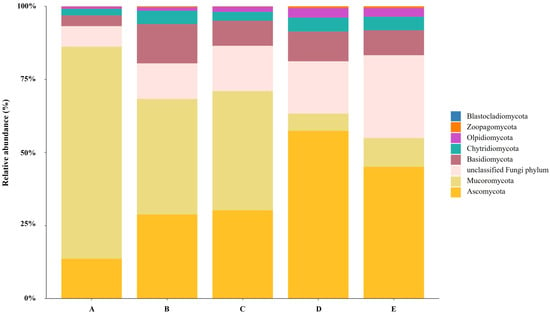
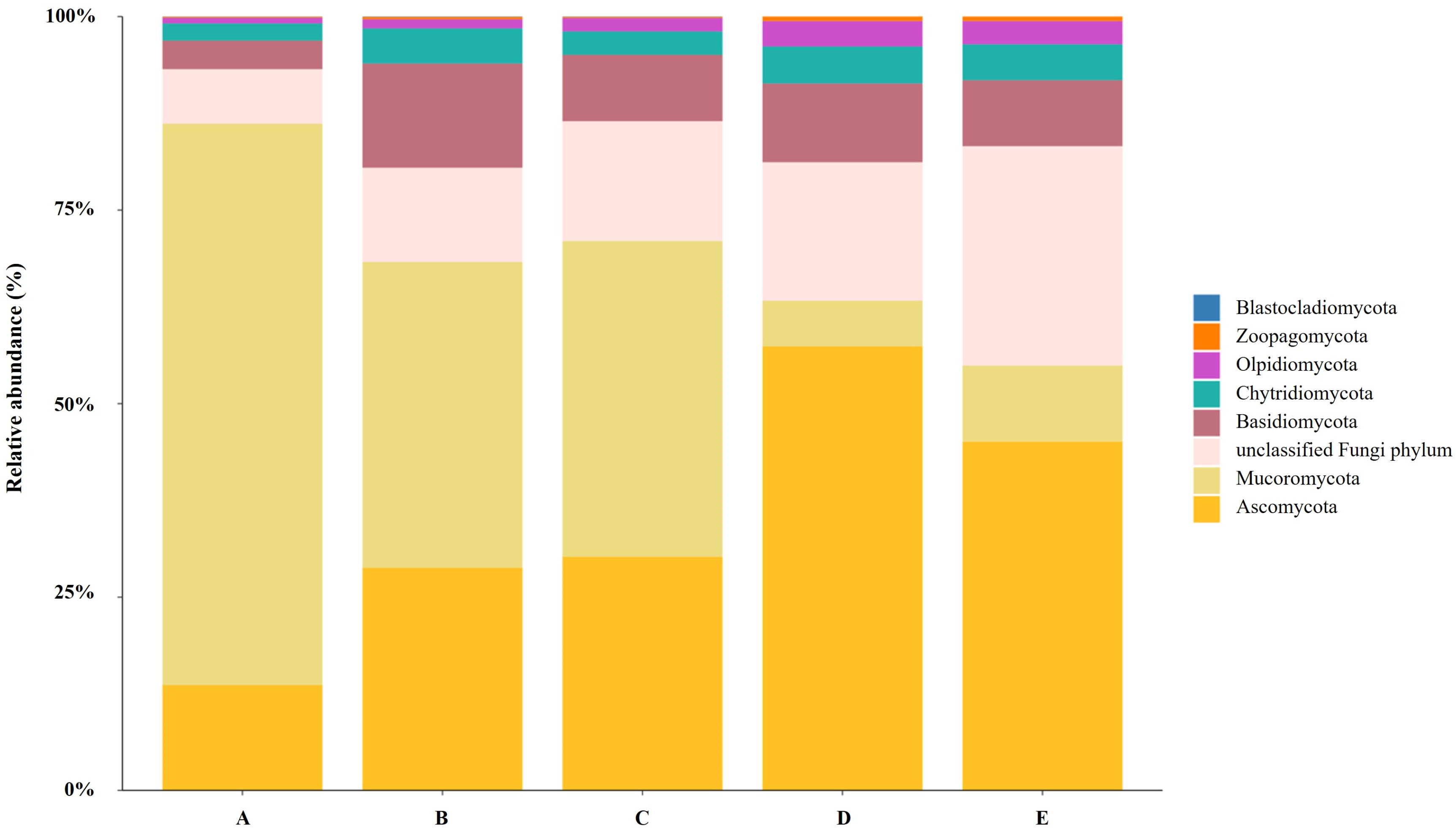
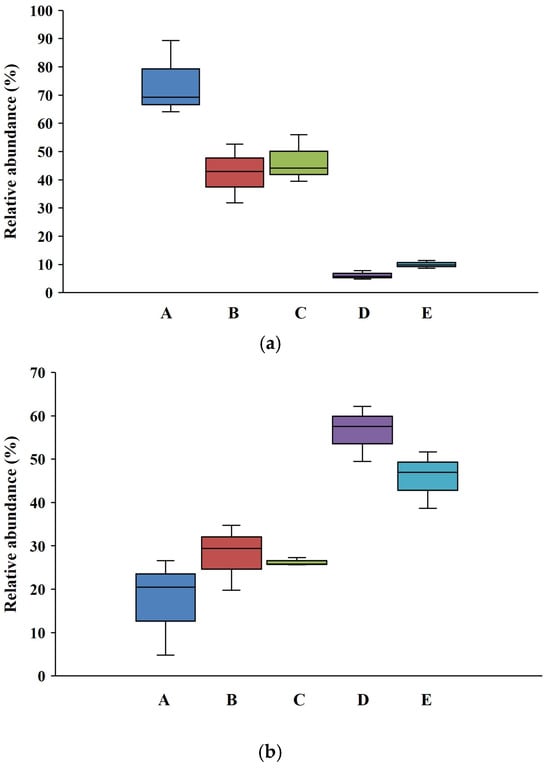
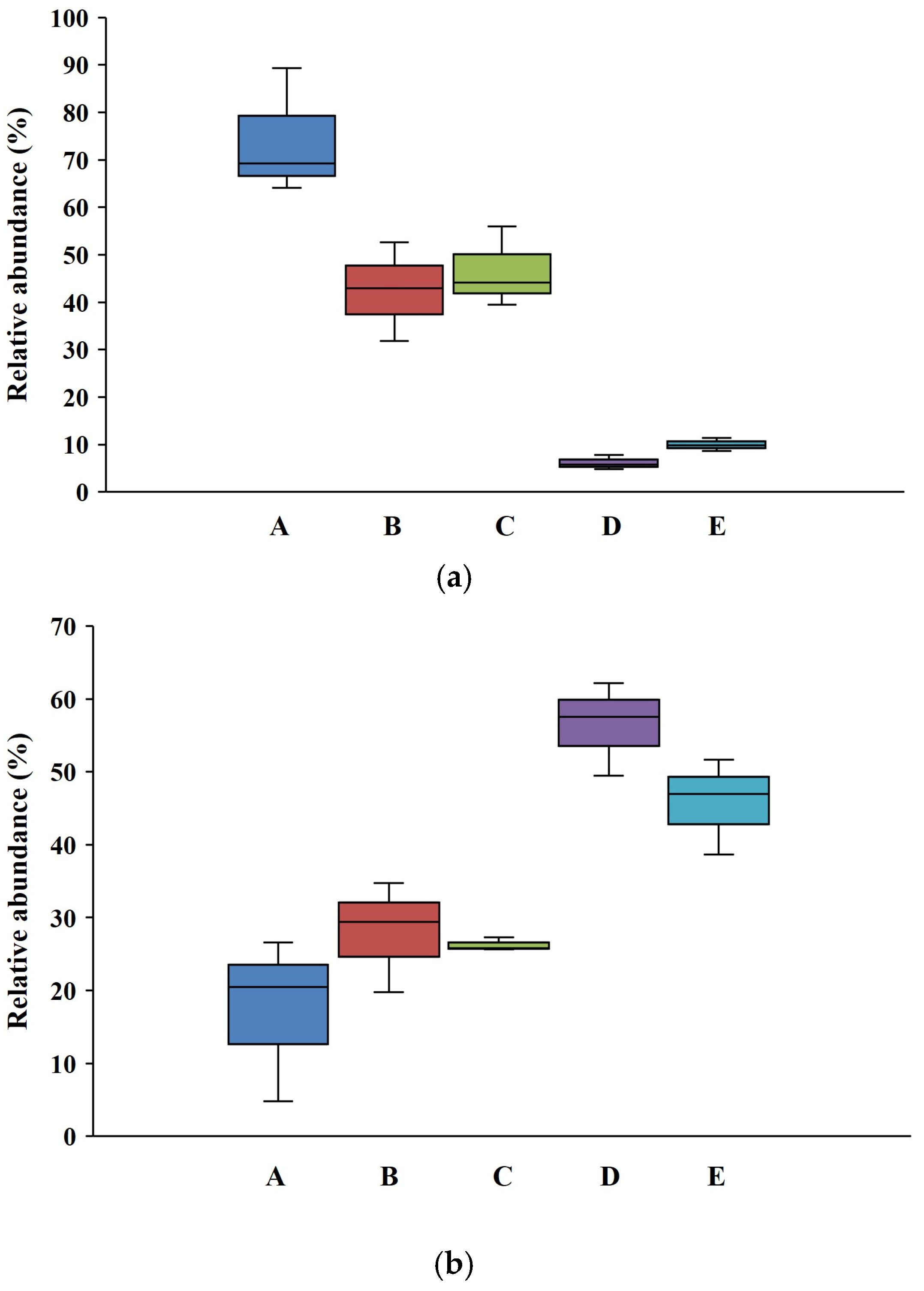
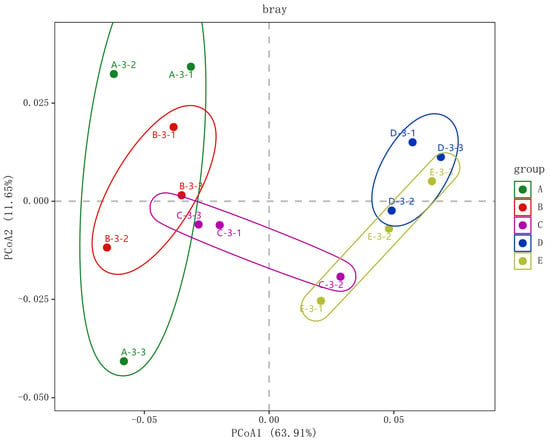
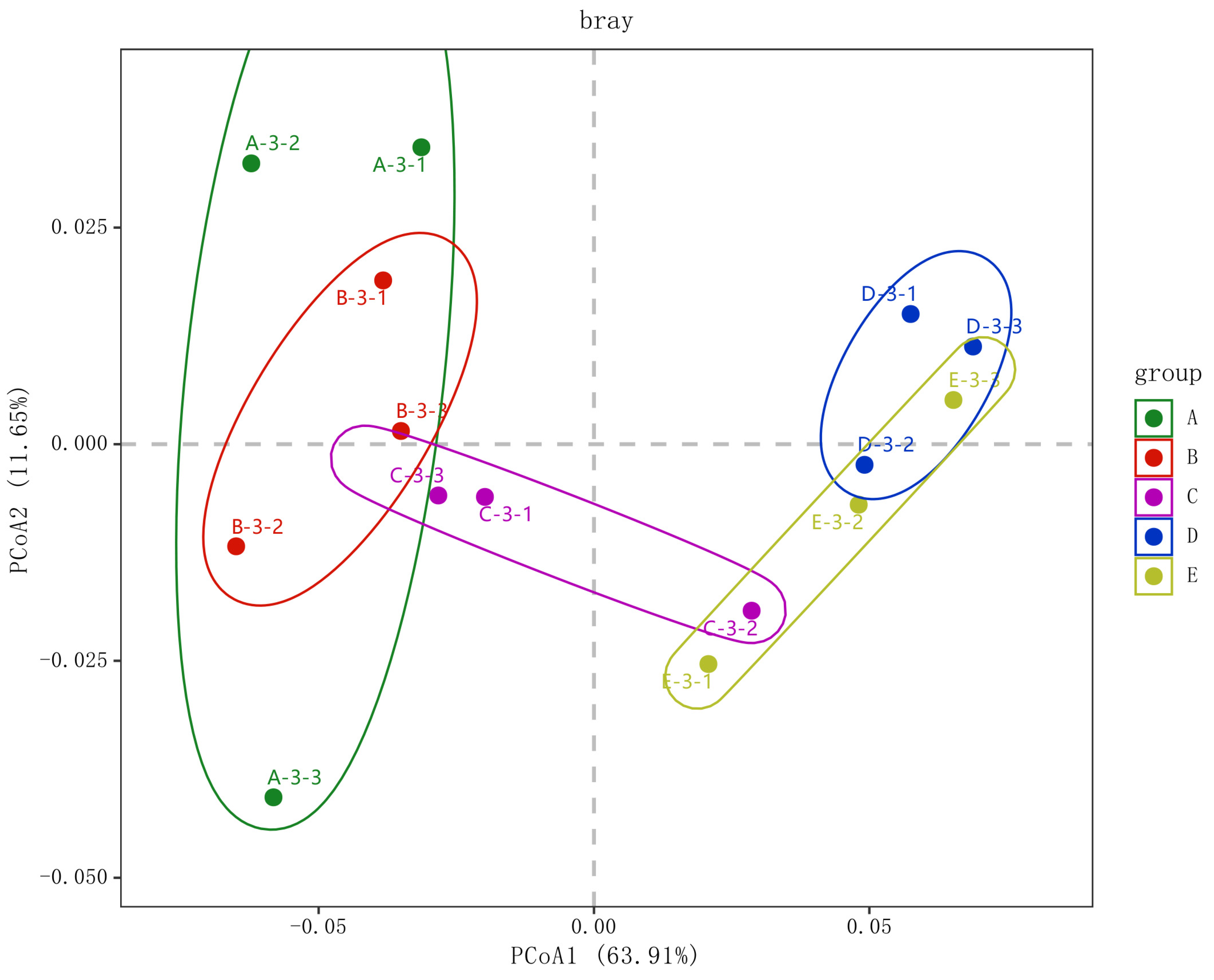
The relative abundance of fungal communities at the phylum level was analyzed and presented in bar charts (Figure 1). The top 5 dominant fungal groups included Mucoromycota, Ascomycota, unclassified Fungi phylum, Basidiomycota, and Chytridiomycota (Figure 1). Comparative analysis of rhizosphere soils across different tea cultivars revealed that the relative abundance of Mucoromycota was significantly higher in cultivars A (74.24%), B (42.48%), and C (46.57%) than in cultivars D (6.14%) and E (9.94%) (Figure 2a). In contrast, the relative abundance of Ascomycota was markedly higher in cultivars D (56.40%) and E (45.75%) compared with cultivars A (17.31%), B (27.97%), and C (26.25%) (Figure 2b). To further assess fungal diversity among the rhizosphere soils of different tea cultivars, the Principal Coordinates Analysis (PCoA) based on Bray–Curtis dissimilarity was employed. The PCoA axe explained approximately 76% of the variation in fungal community structure (Figure 3). These findings indicate that the overall taxonomic structure of the rhizosphere fungal communities in cultivars A and B were similar and notably distinct from that observed in cultivars D and E.
Figure 1.
Relative abundance of rhizosphere soil fungal communities among different tea cultivars at phylum level. Camellia sinensis cv. Wuniuzao (referred to as A), Fudingdahao (B), Fuyun 6 (C), Jinxuan (D), and Fudingdabai (E).
Figure 2.
Relative abundance of Mucoromycota (a) and Ascomycota (b) among different tea cultivars. Camellia sinensis cv. Wuniuzao (referred to as A), Fudingdahao (B), Fuyun 6 (C), Jinxuan (D), and Fudingdabai (E).
Figure 3.
PCoA ordination visualizing the fungal community assemblages in the rhizosphere soil of different tea cultivars. Camellia sinensis cv. Wuniuzao (referred to as A), Fudingdahao (B), Fuyun 6 (C), Jinxuan (D), and Fudingdabai (E).
3.2. Analysis of Heavy MRGs Among Rhizosphere Soils of Different Tea Cultivars
In previous research, we also found that rhizosphere bacteria show similar differences between tea cultivars [37]. Given that rhizosphere bacteria are important mediators of heavy metal biogeochemistry and that their resistance gene pools are sensitive indicators of environmental metal stress [22], we next examined the profiles of bacterial heavy MRGs within the same set of rhizosphere soil samples.
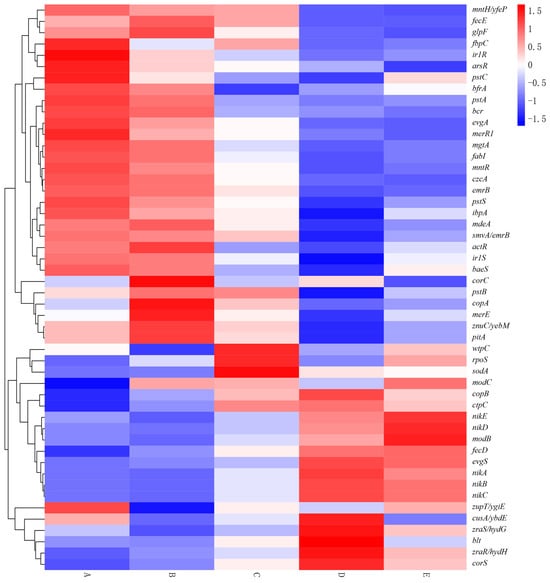
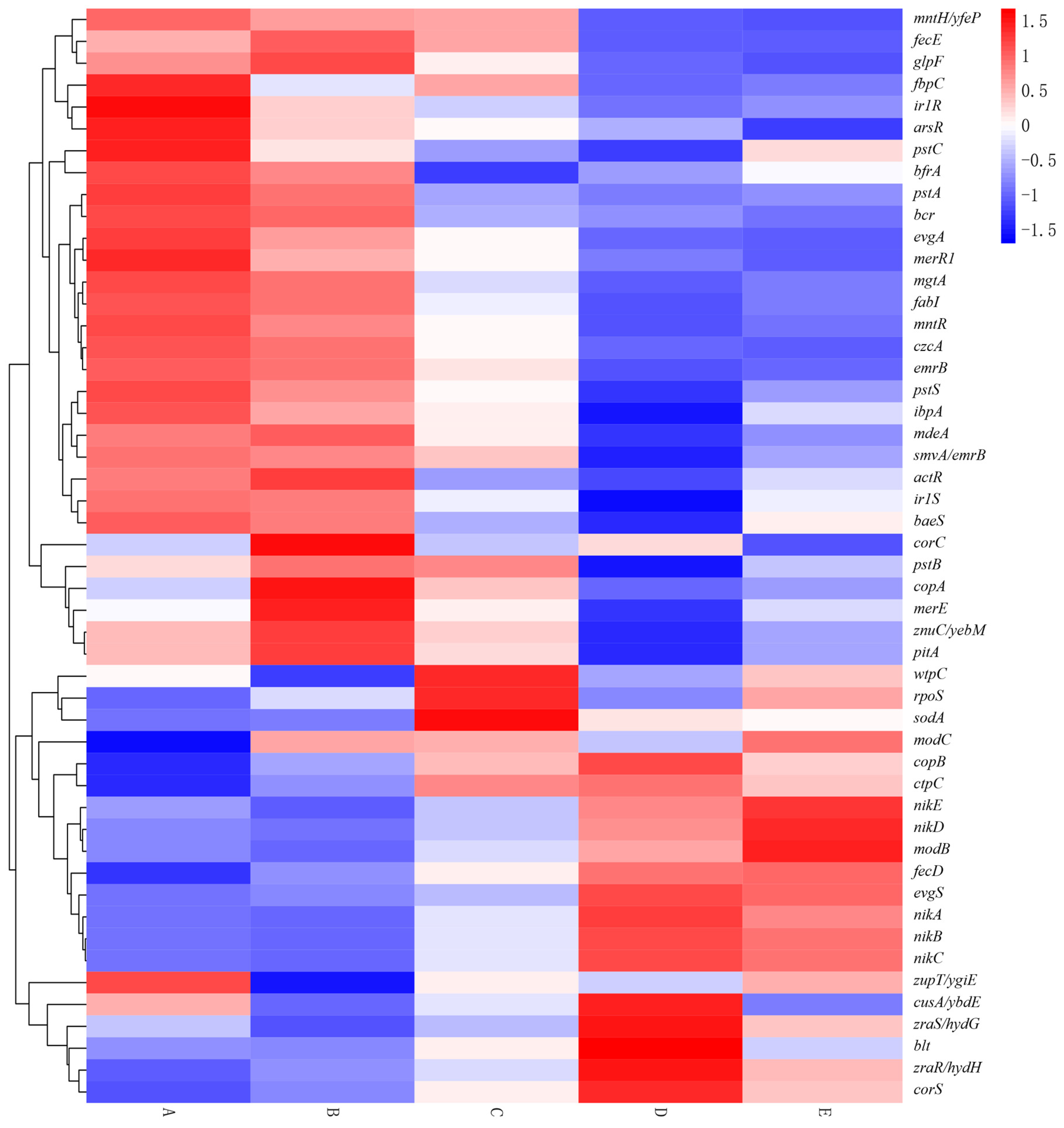
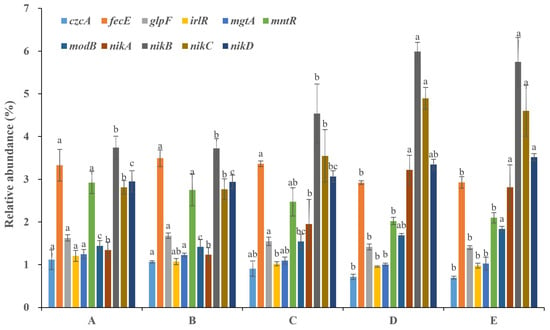
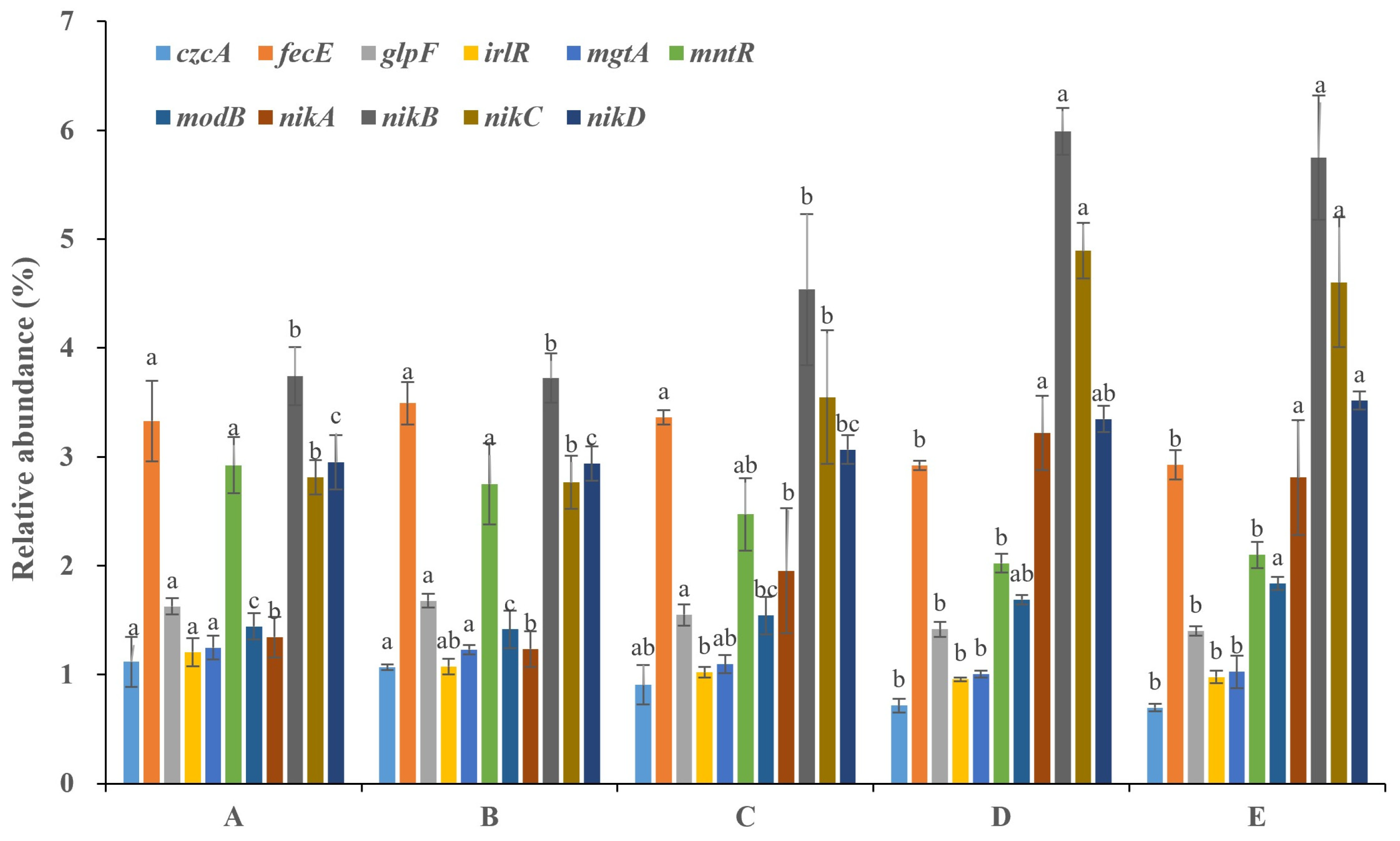
To explore the differences in MRGs in the rhizosphere bacteria of different tea cultivars, 297 resistance genes were screened based on high-throughput sequencing. Among them, 184 MRGs were identified in the rhizosphere soils of different tea cultivars based on the BacMet (Antibacterial Biocide and MRGs) database (Table S1). The top 10 dominant MRGs included zraR/hydH (predicted heavy metal: Zinc), fbpC (verified heavy metal: Iron, Gallium), nikB (predicted heavy metal: Nickel), nikE (predicted heavy metal: Nickel), nikC (predicted heavy metal: Nickel), znuC/yebM (predicted heavy metal: Zinc), nikD (predicted heavy metal: Nickel), fecE (predicted heavy metal: Nickel, Cobalt), nikA (predicted heavy metal: Nickel), and wtpC (verified heavy metal: Tungsten, Molybdenum). Cluster analysis revealed significant differences in the relative abundance of resistance genes among tea cultivars (Figure 4). Among the MRGs, 11 genes with a mean relative abundance ≥1% showed significant variation across cultivars (p < 0.05, Figure 5). Specifically, fecE and glpF (predicted heavy metal: Antimony, Arsenic) were more abundant in the rhizosphere soils of cultivars A, B, and C than in cultivars D and E. Similarly, czcA (verified heavy metal: Cadmium, Zinc, Cobalt), mgtA (predicted heavy metal: Cobalt, Magnesium), and mntR (predicted heavy metal: Manganese, Magnesium) were significantly higher in cultivars A and B compared with cultivars D and E. In contrast, nikA, nikB, nikC, nikD, and modB (predicted heavy metal: Tungsten, Molybdenum) exhibited significantly higher abundance in cultivars D and E than in cultivars A and B. Taken together, these results revealed significant differences in the MRGs of rhizosphere soil among the different tea cultivars.
Figure 4.
Heatmaps comparing the relative abundance of the top 50 MRGs among different tea cultivars. Camellia sinensis cv. Wuniuzao (referred to as A), Fudingdahao (B), Fuyun 6 (C), Jinxuan (D), and Fudingdabai (E). The Gene counts were normalized using the TPM (Transcripts Per Million) method.
Figure 5.
The relative abundance of MRGs among rhizosphere soils of different tea cultivars. The means of relative abundance of MRGs %) ± SD values of the three replicates are shown. English letters a–c in each cultivar represent significant differences among all tea cultivars (LSD test; p < 0.05). Camellia sinensis cv. Wuniuzao (referred to as A), Fudingdahao (B), Fuyun 6 (C), Jinxuan (D), and Fudingdabai (E).
3.3. Edaphic Factors Associated with Heavy MRGs Profiles
Table 1 shows significant differences in soil pH, exchangeable aluminum (Ex Al), and basic nutrient contents among the rhizosphere soils of the five tea cultivars. Notably, cultivars D and E exhibited significantly higher Ex Al levels (5.7 and 4.9 cmol/kg, respectively) compared with cultivars A, B, and C (ranging from 4.4 to 4.7 cmol/kg). To elucidate the environmental drivers underlying the divergent MRG profiles observed among tea cultivars (Figure 4 and Figure 5), Spearman correlation analysis was performed between the relative abundance of MRGs and key edaphic factors, including pH, Ex Al, and organic matter (OM). Notably, soil pH exhibited no significant correlation with any of the 11 MRGs (Table 3), suggesting that hydrogen ion concentration does not represent the primary selective gradient shaping MRG distribution across the rhizosphere soils studied. In contrast, Ex Al and OM displayed significant associations with distinct MRG subsets (Table 3). The MRGs could be broadly partitioned into two response groups based on their covariation patterns with these edaphic factors. The first group, comprising czcA, fecE, glpF, irlR, mgtA, and mntR, showed significant negative correlations with Ex Al (r = −0.557 to −0.696, p < 0.05 or p < 0.01) and significant positive correlations with OM (r = 0.514 to 0.743, p < 0.05 or p < 0.01). Conversely, the second group, encompassing the nik gene cluster (nikA, nikB, nikC, and nikD) and, to a lesser extent, modB, exhibited the opposite trend: significant positive correlations with Ex Al (r = 0.518 to 0.618, p < 0.05 or p < 0.01 for nikA–nikD) and significant negative correlations with OM (r = −0.668 to −0.775, p < 0.01 for nikA–nikD).
Table 3.
Spearman correlation coefficients between soil edaphic factors and the relative abundance of heavy MRGs.
3.4. Isolation and Preliminary Screening of Al Tolerance and Growth-Promoting Fungi from Rhizosphere Soils of Tea Plants
The identification of Ex Al as a covariate of bacterial MRG profiles underscores the importance of Al as a major abiotic selective force in the acidic tea rhizosphere (pH 4.3–4.7, Table 1 and Table 3). In addition to shaping bacterial functional potential, Al stress may also act as a critical filter on fungal community assembly and physiological adaptation. To investigate whether the cultivar-specific rhizosphere environments harbor functionally distinct fungal populations adapted to Al stress, we assessed the Al tolerance of 20 fungal strains isolated from the rhizosphere soils of the five tea cultivars. We found that there were several strains that were able to grow normally under different Al concentrations. In particular, strains L3, L4, L5, and L19 (isolated from rhizosphere of cultivars D and E, respectively) maintained high growth activity across 0.1, 0.2, 0.4, and 0.6 mmol/L Al3+. Strains L2 and L13 remained active at 0.1 and 0.2 mmol/L Al3+, while strain L15 maintained relatively high activity at 0.2 and 0.4 mmol/L Al3+ (Table 4). These results indicate that strains L3, L4, L5, and L19 exhibited the strongest growth performance even at 0.6 mmol/L Al3+.
Table 4.
Aluminum tolerance of fungi in the rhizosphere soil of tea plants.
To further evaluate whether the isolated rhizosphere fungi have the ability of in vitro plant growth-promoting, multiple plant growth-promoting traits were assessed in the 20 strains, including K solubilization, P solubilization, IAA production, and siderophore production. The results showed that none of the strains exhibited P-solubilizing activity. However, eight strains displayed relatively strong K-solubilizing ability, including L4, L5, L6, L7, L9, L10, L11, and L20, with strain L9 showing the highest activity (Table 5). In terms of IAA production, only five strains demonstrated relatively high levels, namely L2, L10, L11, L14, and L19. For siderophore production, 13 strains showed positive activity, whereas L2, L7, L8, L13, L16, L18, and L19 were negative (Table 5).
Table 5.
The growth-promoting abilities of fungi in the rhizosphere soil of tea plants.
Among the 20 isolates, seven Al-tolerant strains were identified. Within this subset, L4 and L5 exhibited both K solubilization and siderophore production, while L2 and L19 showed relatively strong IAA-producing ability. Strains L3 and L15 demonstrated higher siderophore production, whereas L13 exhibited only limited Al tolerance (up to 0.2 mmol/L). Taken together, these findings identify several fungal isolates with combined Al tolerance and multiple in vitro plant growth-promoting traits. However, the ecological significance of these phenotypes in the native rhizosphere and their potential contribution to tea plant growth under natural or greenhouse conditions remain validated through controlled inoculation experiments.
4. Discussion
4.1. Fungal Community Structure and Diversity in Tea Rhizosphere Soils
Fungi play a crucial role in maintaining ecosystem balance due to their strong adaptability to diverse environments, including participation in biogeochemical cycling of carbon, nitrogen, and sulfur, decomposition of plant residues, and metal bioremediation processes [15,16,38,39,40]. In this study, we characterized the taxonomic structure and diversity of rhizosphere fungal communities across the five sampled tea populations. We observed that the overall taxonomic structure of the rhizosphere fungal communities in cultivars A and B was similar and notably distinct from that observed in cultivars D and E (Figure 3). For instance, Mucoromycota was more abundance in cultivars A, B, and C (Figure 2a), whereas Ascomycota was predominantly detected in the rhizosphere of cultivars D and E (Figure 2b). For tea plants, the genotype is a key driver of rhizosphere microbiome assembly, acting through cultivar-specific metabolic profiles that selectively shape associated microbial communities [37,41]. Our findings are partially consistent with this view, in that substantial within-site variation was observed even among cultivars sharing broadly similar edaphic conditions. Within the South Plantation (cultivars A, B, and C), fungal alpha diversity indices (Chao1, ACE, Shannon) differed significantly among the three cultivars (Table 2; p < 0.05). Specifically, cultivar B exhibited the highest Shannon diversity (4.61 ± 0.09), whereas cultivar C was significantly lower (4.40 ± 0.05). Furthermore, PCoA revealed that cultivar C occupied an intermediate position between cultivars A/B and D/E (Figure 3), and the relative abundance of Mucoromycota varied markedly from 74.24% (A) to 42.48% (B) and 46.57% (C) (Figure 2a). These within-site differences suggest that even under broadly shared South Plantation edaphic conditions, fungal community structure was not uniform.
The variation observed in this study might also be influenced by the factor that cultivars A, B, and C were planted in the South Plantation, while cultivars D and E were planted in the North Plantation, with a direct distance of approximately 2 km between them. Geographic separation could introduce differences in various environmental factors, including microclimate and edaphic properties. For example, the content of Ex Al in the soil of cultivars D and E (4.4 to 4.7 cmol/kg) was higher than that in cultivars A, B, and C (4.9 to 5.7 cmol/kg, Table 1). While our experimental design does not allow us to disentangle cultivar genotype effects from geographic location effects, the concomitant divergence in both fungal communities and bacterial functional genes (Figure 1 and Figure 5) across the same cultivar grouping suggests that shared rhizosphere environmental conditions—rather than geography alone—may underlie these patterns. Future studies employing spatially intermixed cultivar plantings or reciprocal transplant experiments are needed to isolate the relative contributions of host genotype and site effects.
4.2. Environmental Filtering Shapes Bacterial Heavy MRGs Profiles
Bacteria are generally more sensitive than fungi to heavy metal stress, and their resistance gene repertoires serve as sensitive indicators of environmental metal bioavailability and toxicity [22]. In this study, bacterial heavy MRGs profiles exhibited significant divergence (Figure 4 and Figure 5). Notably, two distinct MRGs response groups were identified: czcA, fecE, glpF, irlR, mgtA, and mntR were enriched in cultivars A, B, and C, whereas the nik gene cluster (nikA–nikD) and modB were enriched in cultivars D and E. Spearman correlation analysis revealed that these divergent MRGs profiles were significantly associated with soil Ex Al and OM, but not with pH (Table 3). The first group of MRGs showed significant negative correlations with Ex Al and positive correlations with OM, whereas the nik cluster exhibited the opposite trend. In acidic soils, Ex Al represents a major abiotic stressor that can indirectly influence the bioavailability and speciation of trace metals [42,43]. For example, under conditions of low OM and elevated Ex Al, the competitive desorption or co-solubilization of nickel and other trace metals may increase, thereby intensifying selection for nickel resistance mechanisms encoded by the nik operon [44,45]. Conversely, higher OM content can form stable organo-metal complexes, potentially reduce the bioavailability of free metal ions while simultaneously supporting a metabolically diverse bacterial community with enriched background metal homeostasis functions, such as those encoded by czcA and mntR [46,47,48,49,50]. Therefore, the acidic soil conditions (pH 4.3–4.7, Table 1) prevalent across all sampled sites in this study may not only enhance Al bioavailability but also increase the bioavailability of other trace heavy metals, thereby generating a metal-stress environment that simultaneously shapes fungal tolerance traits and bacterial resistance functions.
4.3. Rhizosphere Fungal Strains as Candidates for Al Tolerance and Plant Growth Promotion
Al, as a light metal, can promote the growth of tea plants at appropriate concentrations, although it is a primary limiting factor inhibiting the growth of most crops in acidic soils [51]. Al stress may also act as a critical filter on fungal community assembly and physiological adaptation. In this study, we found that Mucoromycota was more abundance in cultivars A, B, and C (Figure 2a), whereas Ascomycota was predominantly detected in the rhizosphere of cultivars D and E (Figure 2b). Ascomycota exhibits strong capacity for metal (loid) metabolism [52,53,54]. For example, fungal consortia affiliated with Ascomycota have been reported to efficiently remove As, Mn, Cr, Pb, Mo, Ni, and Cu through intracellular complexation and spore-associated sequestration mechanisms [15,16,17,18,19,20]. Thus, the finding of the enrichment of Ascomycota in the tea plant rhizosphere provides an important theoretical basis for the subsequent selection of functional rhizosphere fungi.
Variations in soil Al concentration can promote the enrichment of Al-tolerant microorganisms in tea plant rhizosphere soils [51]. In this study, the Ex Al-content in the soils of different tea cultivars ranged from 4.4 to 5.7 cmol/kg (Table 1), representing a substantial selective pressure. Among the 20 fungal strains isolated from the rhizosphere of the five cultivars, strains L3, L4, L5, and L19 (isolated from rhizosphere of cultivars D and E, respectively) exhibited the strongest growth performance even at 0.6 mmol/L Al3+ (Table 4). This finding aligns with the significantly higher Ex Al levels observed in the soils of cultivars D and E compared with the other cultivars (Table 1), and is consistent with previous reports indicating that appropriate Al concentrations can stimulate tea plant growth, whereas inhibitory effects generally occur only when Al exceeds 2.0 mmol/L [11,55]. To further evaluate the functional potential of these isolates, multiple in vitro plant growth-promoting traits were assessed. Among the four strains with higher Al tolerance, L4 and L5 exhibited both potassium solubilization and siderophore production, while L3 showed higher siderophore production capacity, and L19 demonstrated relatively strong IAA production (Table 5). It has been reported that moderate Al levels can increase the accumulation of essential mineral elements such as magnesium (Mg), K, and calcium (Ca) in young tea leaves, thereby promoting growth [56]. The capacity of these fungal isolates to solubilize potassium and produce siderophores and IAA suggests that they may represent promising candidates for future biotechnological applications. However, it must be stressed that these phenotypes were assessed solely under in vitro conditions. The ecological significance of these traits in the native rhizosphere and their actual contribution to tea plant growth and Al tolerance under greenhouse or field conditions remain to be validated through controlled inoculation experiments.
5. Conclusions
In conclusion, our results reveal significant differences in the community diversity of rhizosphere fungi across the sampled tea populations. The rhizosphere of cultivars A, B, and C was characterized by Mucoromycota-dominated fungal communities and higher taxonomic diversity, whereas cultivars D and E harbored Ascomycota-dominated communities with comparatively lower diversity. Concomitantly, bacterial heavy MRGs profiles exhibited a parallel dichotomy across cultivars: Cd/Zn/Co/As/Mn-related resistance functions were enriched in cultivars A, B, and C, whereas Ni/W/Mo-related functions were enriched in cultivars D and E. Spearman correlation analysis further demonstrated that these bacterial functional differences were also associated with soil characteristics, such as Ex Al and OM, suggesting that edaphic filtering—rather than direct biotic interactions—underlies the observed microbial patterns. Additionally, several fungal isolates (L3, L4, L5, and L19) exhibited robust Al tolerance and multiple in vitro plant growth-promoting traits, representing promising candidates for future biotechnological development. However, the ecological significance of these phenotypes in the native rhizosphere and their actual contribution to tea plant growth and Al tolerance under greenhouse or field conditions remain validated through controlled inoculation experiments. Overall, our findings highlight the tea rhizosphere as a complex environment that independently shapes fungal community assembly and bacterial functional potential, providing a foundation for future studies on microbial-mediated stress adaptation in acidic agroecosystems.
Supplementary Materials
The following supporting information can be downloaded at: https://www.mdpi.com/article/10.3390/d18090527/s1, Table S1: The relative abundance of resistance genes detected in the rhizosphere soil of different tea cultivars.
Author Contributions
Conceptualization, L.W. and W.W.; methodology, L.W. and T.L.; software, Y.L. and L.M.; validation, Y.L., Q.R. and Y.W. (Yan Wei); formal analysis, L.W.; investigation, L.M., D.L., F.A., R.M. and W.W.; resources, G.H., Z.Z. and E.C.; data curation, L.W. and W.W.; writing—original draft preparation, L.W.; writing—review and editing, L.W., W.W. and Y.W. (Yongzhuang Wang); visualization, L.W. and Y.W. (Yongzhuang Wang); supervision, W.W., Z.Z. and E.C.; project administration, L.W., W.W. and Y.W. (Yongzhuang Wang); funding acquisition, L.W. and Y.W. (Yongzhuang Wang). All authors have read and agreed to the published version of the manuscript.
Funding
This research was funded by Guangxi Natural Science Foundation, grant numbers 2024GXNSFBA010358 and 2021GXNSFBA196009; National Natural Science Foundation of China, grant number 42467008; Middle-aged and Young Teachers’ Basic Ability Promotion Project of Guangxi, grant number KY26ZQN015; Guangxi Polytechnic University Research Fund, grant number 261104y. The APC was funded by L.W., W.W. and Y.W.
Data Availability Statement
Data will be made available on request.
Acknowledgments
The authors would like to thank Sanshu Technology Co., Ltd. (Nantong, China) for assistance with soil sample testing.
Conflicts of Interest
The authors declare no conflicts of interest.
References
- Wang, M.; Sun, H.; Dai, H.; Xu, Z. Characterization of Plant-Growth-Promoting Rhizobacteria for Tea Plant (Camellia sinensis) Development and Soil Nutrient Enrichment. Plants 2024, 13, 2659. [Google Scholar] [CrossRef] [Scilit]
- Ma, J.; Yao, M.; Chen, L. Research Progress on Germplasms of Tea Plant (Camellia sinensis). J. Tea Sci. 2015, 35, 11–16. [Google Scholar] [CrossRef]
- Xi, S.; Chu, H.; Zhou, Z.; Li, T.; Zhang, S.; Xu, X.; Pu, Y.; Wang, G.; Jia, Y.; Liu, X. Effect of Potassium Fertilizer on Tea Yield and Quality: A Meta-Analysis. Eur. J. Agron. 2023, 144, 126767. [Google Scholar] [CrossRef] [Scilit]
- Mei, Y.; Liang, X. Analysis of China’s Tea Production, Sales, Import and Export Situation in 2023. China Tea 2024, 46, 18–26. [Google Scholar]
- Tian, J.; Lu, P.; Sun, C.; Wu, X.; Li, F.; Qi, F. Analysis on the Development Trends of Microbial Fertilizer Research Based on the Web of Science Database. J. Agric. Sci. Technol. 2019, 21, 1–12. [Google Scholar]
- Zhou, Z.; Li, Y.; Duan, L.; Zhou, R.; Wu, F.; Xiong, M.; Zhang, B.; Geng, S.; Qiao, L.; Zhang, F.; et al. Effect of Streptomyces Costaricanus Strain A-M1 as a Bioinoculant on Tea Garden Soil and Tea Quality. Agronomy 2024, 14, 1901. [Google Scholar] [CrossRef] [Scilit]
- Han, X.; Li, Z.; Zhang, L.; Huang, X. Screening, Identification and Inoculation Effect of Azotobacter from the Soils of Tea Garden. J. Tea Sci. 2014, 34, 497–505. [Google Scholar] [CrossRef]
- Wang, Y.; Huang, C.; Zhang, B.; Liu, X.; Zhao, S.; Wang, T.; Zhang, T.; Shi, X.; Chen, X.; Zhang, F. Effects of different nutrient management on the yield, nutrients, quality and benefits of organic tea. J. China Agric. Univ. 2025, 30, 131–140. [Google Scholar]
- Yamashita, H.; Fukuda, Y.; Yonezawa, S.; Morita, A.; Ikka, T. Tissue Ionome Response to Rhizosphere PH and Aluminum in Tea Plants (Camellia sinensis L.), a Species Adapted to Acidic Soils. Plant-Environ. Interact. 2020, 1, 152–164. [Google Scholar] [CrossRef] [Scilit]
- Sun, L.; Zhang, M.; Liu, X.; Mao, Q.; Shi, C.; Kochian, L.V.; Liao, H. Aluminium Is Essential for Root Growth and Development of Tea Plants (Camellia sinensis). J. Integr. Plant Biol. 2020, 62, 984–997. [Google Scholar] [CrossRef] [Scilit]
- Hajiboland, R.; Bahrami Rad, S.; Barceló, J.; Poschenrieder, C. Mechanisms of Aluminum-Induced Growth Stimulation in Tea (Camellia sinensis). J. Plant Nutr. Soil Sci. 2013, 176, 616–625. [Google Scholar] [CrossRef] [Scilit]
- Zhang, Z.; Ge, S.B.; Fan, L.C.; Guo, S.; Hu, Q.; Ahammed, G.J.; Yan, P.; Zhang, L.P.; Li, Z.Z.; Zhang, J.Y.; et al. Diversity in Rhizospheric Microbial Communities in Tea Varieties at Different Locations and Tapping Potential Beneficial Microorganisms. Front. Microbiol. 2022, 13, 1027444. [Google Scholar] [CrossRef] [Scilit]
- Sun, L.; Li, X.; Shen, J.; Wang, S.; Xu, X.; Fan, K.; Wang, Y.; Bi, C.; Ding, Z. Optimizing Tea Plantation through Rapeseed Intercropping: Ecological and Pest-Resistant Benefits. Ind. Crops Prod. 2025, 227, 120821. [Google Scholar] [CrossRef] [Scilit]
- Zhang, T.; Zhang, L.; Zhang, Y.; Zheng, R.; Xiang, F.; Li, J. Application Progress of Plant Growth Promoting Bacteria in Crops. J. Hebei Agric. Sci. 2022, 26, 33–37. [Google Scholar]
- Liu, B.; Yao, J.; Chen, Z.; Ma, B.; Liu, J.; Li, H.; Zhu, X.; Li, M.; Cao, Y.; Pang, W.; et al. Unraveling Ecological Risk of As/Sb and Other Metal(Loid)s and Fungal Community Responses in As/Sb Smelting-Intensive Zone: A Typical Case Study of Southwest China. J. Clean. Prod. 2022, 338, 130525. [Google Scholar] [CrossRef] [Scilit]
- Cui, Z.; Lian, X.; Lv, X.; Yue, W.; Lv, J.; Yang, Y. Freeze-Thaw Leaching Promotes the Removal of Heavy Metals and Reshapes the Microbial Community in Soil. Environ. Technol. Innov. 2025, 40, 104672. [Google Scholar] [CrossRef] [Scilit]
- Hassan, A.; Pariatamby, A.; Ossai, I.C.; Hamid, F.S. Bioaugmentation Assisted Mycoremediation of Heavy Metal and/Metalloid Landfill Contaminated Soil Using Consortia of Filamentous Fungi. Biochem. Eng. J. 2020, 157, 107550. [Google Scholar] [CrossRef] [Scilit]
- Awasthi, S.K.; Duan, Y.; Liu, T.; Zhou, Y.; Qin, S.; Liu, H.; Varjani, S.; Awasthi, M.K.; Zhang, Z.; Pandey, A.; et al. Sequential Presence of Heavy Metal Resistant Fungal Communities Influenced by Biochar Amendment in the Poultry Manure Composting Process. J. Clean. Prod. 2021, 291, 125947. [Google Scholar] [CrossRef] [Scilit]
- Cai, S.; Cheng, J.; Wang, Q.; Fan, L. Bioavailable Metals and Soil General Properties Co-Mediate Microbial Communities in Uncovered and Vegetated Areas during Different Seasons in an Abandoned Mo-Ni Mining Area. J. Environ. Manag. 2026, 401, 128920. [Google Scholar] [CrossRef] [Scilit] [PubMed]
- Ling, C.; Liang, D.; Gao, L.; Zhou, Q.; Huang, H. Flooding Effects on Soil Properties, Heavy Metals and Microbial Communities in Tea Plantations. iScience 2026, 29, 114650. [Google Scholar] [CrossRef] [Scilit]
- Beimforde, C.; Feldberg, K.; Nylinder, S.; Rikkinen, J.; Tuovila, H.; Dörfelt, H.; Gube, M.; Jackson, D.J.; Reitner, J.; Seyfullah, L.J.; et al. Estimating the Phanerozoic History of the Ascomycota Lineages: Combining Fossil and Molecular Data. Mol. Phylogenet. Evol. 2014, 78, 386–398. [Google Scholar] [CrossRef] [Scilit]
- Yang, R.; Ma, G.; Liu, C.; Wang, C.; Kang, X.; Wu, M.; Zhang, B. Effects of Different Heavy Metal Pollution Levels on Microbial Community Structure and Risk Assessment in Zn-Pb Mining Soils. Environ. Sci. Pollut. Res. 2023, 30, 52749–52761. [Google Scholar] [CrossRef] [Scilit]
- Byers, A.K.; Condron, L.M.; O’Callaghan, M.; Waller, L.; Dickie, I.A.; Wakelin, S.A. Plant Species Identity and Plant-Induced Changes in Soil Physicochemistry—But Not Plant Phylogeny or Functional Traits—Shape the Assembly of the Root-Associated Soil Microbiome. FEMS Microbiol. Ecol. 2023, 99, fiad126. [Google Scholar] [CrossRef] [Scilit]
- Sun, L.; Shen, J.; Wang, H.; Song, Y.; Li, X.J.; Bi, C.; Wang, S.S.; Xu, X.; Wang, Y.; Ding, Z. Tea Varieties Modulate Rhizosphere Microbiome Assembly via Root Metabolite-Mediated Selection. Rhizosphere 2025, 36, 101189. [Google Scholar] [CrossRef] [Scilit]
- Wu, Q.; Zhu, A.; Jv, X.; Li, S.; Ren, H.; Han, G. Effects of W arming and Nitrogen Addition on Soil Bacterial Communities in the Non-rhizosphere, Rhizosphere and Rhizosheath of Cleistogenes songorica. Acta Agrestia Sin. 2025, 33, 1345–1354. [Google Scholar]
- Yuan, S.; Shen, C.; Gao, K.; Feng, S.; Li, D.; Hu, Q.; Liu, Y.; Luo, Z. Microbial Nutrient Limitation of Different Tea Cultivars: Evidence from Five Representative Cultivars. Agronomy 2024, 14, 467. [Google Scholar] [CrossRef] [Scilit]
- Xin, W.; Zhang, J.; Yu, Y.; Tian, Y.; Li, H.; Chen, X.; Li, W.; Liu, Y.; Lu, T.; He, B.; et al. Root Microbiota of Tea Plants Regulate Nitrogen Homeostasis and Theanine Synthesis to Influence Tea Quality. Curr. Biol. 2024, 34, 868–880.e6. [Google Scholar] [CrossRef] [Scilit]
- Jia, X.; Lin, S.; Zhang, Q.; Wang, Y.; Hong, L.; Li, M.; Zhang, S.; Wang, T.; Jia, M.; Luo, Y.; et al. The Ability of Different Tea Tree Germplasm Resources in South China to Aggregate Rhizosphere Soil Characteristic Fungi Affects Tea Quality. Plants 2024, 13, 2029. [Google Scholar] [CrossRef] [Scilit]
- Kochian, L.V.; Hoekenga, O.A.; Piñeros, M.A. How Do Crop Plants Tolerate Acid Soils? Mechanisms of Aluminum Tolerance and Phosphorous Efficiency. Annu. Rev. Plant Biol. 2004, 55, 459–493. [Google Scholar] [CrossRef] [Scilit]
- von Uexküll, H.R.; Mutert, E. Global Extent, Development and Economic Impact of Acid Soils. Plant Soil 1995, 171, 1–15. [Google Scholar] [CrossRef] [Scilit]
- Wu, Q.; Zhang, Y.; Lin, H.; Chen, C.; Xie, A.; Fan, H. Influence of Endophytic Fungi Treatments on Aluminum Contents in Vernicia Montana Seedlings and Soils under Different Concentrations of Aluminum Stress. Rhizosphere 2024, 32, 100982. [Google Scholar] [CrossRef] [Scilit]
- Chen, T.; Chen, X.; Zhang, S.; Zhu, J.; Tang, B.; Wang, A.; Dong, L.; Zhang, Z.; Yu, C.; Sun, Y.; et al. The Genome Sequence Archive Family: Toward Explosive Data Growth and Diverse Data Types. Genom. Proteom. Bioinforma. 2021, 19, 578–583. [Google Scholar] [CrossRef] [Scilit]
- Xue, Y.; Bao, Y.; Zhang, Z.; Zhao, W.; Xiao, J.; He, S.; Zhang, G.; Li, Y.; Zhao, G.; Chen, R.; et al. Database Resources of the National Genomics Data Center, China National Center for Bioinformation in 2022. Nucleic Acids Res. 2022, 50, D27–D38. [Google Scholar] [CrossRef] [Scilit]
- Hyatt, D.; Chen, G.L.; LoCascio, P.F.; Land, M.L.; Larimer, F.W.; Hauser, L.J. Prodigal: Prokaryotic Gene Recognition and Translation Initiation Site Identification. BMC Bioinform. 2010, 11, 119. [Google Scholar] [CrossRef] [Scilit]
- Buchfink, B.; Xie, C.; Huson, D.H. Fast and Sensitive Protein Alignment Using DIAMOND. Nat. Methods 2014, 12, 59–60. [Google Scholar] [CrossRef] [Scilit]
- Fu, L.; Niu, B.; Zhu, Z.; Wu, S.; Li, W. CD-HIT: Accelerated for Clustering the next-Generation Sequencing Data. Bioinformatics 2012, 28, 3150–3152. [Google Scholar] [CrossRef] [Scilit]
- Wu, L.; Wu, W.; Mao, L.; Wang, Y.; Liu, D.; An, F.; Liang, J.; Wu, D.; Ye, J.; Wei, X.; et al. Rhizosphere Microbial Diversity and Functional Roles in Tea Cultivars: Insights from High-Throughput Sequencing and Functional Isolates. Plant Signal. Behav. 2025, 20, 2543448. [Google Scholar] [CrossRef] [Scilit]
- Fukasawa, Y.; Matsukura, K. Decay Stages of Wood and Associated Fungal Communities Characterise Diversity-Decomposition Relationships. Sci. Rep. 2021, 11, 8972. [Google Scholar] [CrossRef] [Scilit]
- Kyaschenko, J.; Clemmensen, K.E.; Karltun, E.; Lindahl, B.D. Below-Ground Organic Matter Accumulation along a Boreal Forest Fertility Gradient Relates to Guild Interaction within Fungal Communities. Ecol. Lett. 2017, 20, 1546–1555. [Google Scholar] [CrossRef] [Scilit]
- Dietzel, K.; Valle, D.; Fierer, N.; U’ren, J.M.; Barberán, A. Geographical Distribution of Fungal Plant Pathogens in Dust across the United States. Front. Ecol. Evol. 2019, 7, 304. [Google Scholar] [CrossRef] [Scilit]
- Ji, L.; Fang, X.; Chen, S.; Ai, Z.; Ni, K.; Yang, Y.; Ruan, J. Tea Cultivar Genotype Shapes Rhizosphere Microbiome Assembly Through Metabolic Differentiation. Plants 2026, 15, 414. [Google Scholar] [CrossRef] [Scilit]
- Guo, L.; Yan, J.; Shi, Y.; Li, K.W.; Guan, P.; Xu, R.K. Active Aluminum Promoted Copper Uptake by Chinese Cabbage Grown in an Acidic Cu-Contaminated Soil: A New Insight with the Diffusive Gradients in Thin-Films Technique (DGT). Plant Soil 2025, 513, 473–487. [Google Scholar] [CrossRef] [Scilit]
- Wang, T.; Yu, L.; Wang, Z.; Yang, C.; Dong, F.; Yang, D.; Xi, H.; Sun, Z.; Bol, R.; Awais, M.; et al. Effect of Simulated Acidification on Soil Properties and Plant Nutrient Uptake of Eggplant in Greenhouse. Front. Plant Sci. 2025, 16, 1558458. [Google Scholar] [CrossRef] [Scilit]
- Pokrovsky, O.S.; Dupré, B.; Schott, J. Fe-Al-Organic Colloids Control of Trace Elements in Peat Soil Solutions: Results of Ultrafiltration and Dialysis. Aquat. Geochem. 2005, 11, 241–278. [Google Scholar] [CrossRef] [Scilit]
- Hassan, N.; Murimboh, J.D.; Chakrabarti, C.L. Kinetic Speciation of Ni(II) in Model Solutions and Freshwaters: Competition of Al(III) and Fe(III). Water. Air. Soil Pollut. 2008, 193, 131–146. [Google Scholar] [CrossRef] [Scilit]
- Gillan, D.C.; Pan, H.; Roulez, A.; Wattiez, R. The Metaphenome of a Calaminiferous Soil. Microbe 2023, 1, 100002. [Google Scholar] [CrossRef] [Scilit]
- Fortin, C. Metal Bioavailability in Aquatic Systems— beyond Complexation and Competition. Front. Environ. Chem. 2024, 5, 1345484. [Google Scholar] [CrossRef] [Scilit]
- Zhang, Y.; Wang, H.; Hh, M.; Cai, R.; Miao, Y.; Zhu, X. Heavy Metals Potentially Drive Co-Selection of Antibiotic Resistance Genes by Shifting Soil Bacterial Communities in Paddy Soils along the Middle and Lower Yangtze River. Pedosphere 2024, 34, 606–619. [Google Scholar] [CrossRef] [Scilit]
- Wang, Q.; Lv, R.; Rene, E.R.; Qi, X.; Hao, Q.; Du, Y.; Zhao, C.; Xu, F.; Kong, Q. Characterization of Microbial Community and Resistance Gene (CzcA) Shifts in up-Flow Constructed Wetlands-Microbial Fuel Cell Treating Zn (II) Contaminated Wastewater. Bioresour. Technol. 2020, 302, 122867. [Google Scholar] [CrossRef] [Scilit]
- Que, Q.; Helmann, J.D. Manganese Homeostasis in Bacillus Subtilis Is Regulated by MntR, a Bifunctional Regulator Related to the Diphtheria Toxin Repressor Family of Proteins. Mol. Microbiol. 2000, 35, 1454–1468. [Google Scholar] [CrossRef] [Scilit]
- Jiang, X.; Shen, T.; Han, M.; Chen, G.; Lai, S.; Zhang, S.; Deng, W.; Qian, Y.; Gao, L.; Xia, T. Aluminum-Tolerant, Growth-Promoting Rhizosphere Bacteria Improve Growth and Alleviate Aluminum Stress in Tea Plants. Hortic. Plant J. 2025, 12, 1465–1478. [Google Scholar] [CrossRef] [Scilit]
- Rousk, J.; Bååth, E.; Brookes, P.C.; Lauber, C.L.; Lozupone, C.; Caporaso, J.G.; Knight, R.; Fierer, N. Soil Bacterial and Fungal Communities across a PH Gradient in an Arable Soil. ISME J. 2010, 4, 1340–1351. [Google Scholar] [CrossRef] [Scilit]
- Zeng, X.Y.; Li, S.W.; Leng, Y.; Kang, X.H. Structural and Functional Responses of Bacterial and Fungal Communities to Multiple Heavy Metal Exposure in Arid Loess. Sci. Total Environ. 2020, 723, 138081. [Google Scholar] [CrossRef] [Scilit]
- Xiao, E.; Ning, Z.; Sun, W.; Jiang, S.; Fan, W.; Ma, L.; Xiao, T. Thallium Shifts the Bacterial and Fungal Community Structures in Thallium Mine Waste Rocks. Environ. Pollut. 2021, 268, 115834. [Google Scholar] [CrossRef] [Scilit]
- Ghanati, F.; Morita, A.; Yokota, H. Effects of Aluminum on the Growth of Tea Plant and Activation of Antioxidant System. Plant Soil 2005, 276, 133–141. [Google Scholar] [CrossRef] [Scilit]
- Chen, Y.M.; Tsao, T.M.; Liu, C.C.; Lin, K.C.; Wang, M.K. Aluminium and Nutrients Induce Changes in the Profiles of Phenolic Substances in Tea Plants (Camellia sinensis CV TTES, No. 12 (TTE)). J. Sci. Food Agric. 2011, 91, 1111–1117. [Google Scholar] [CrossRef] [Scilit]

Disclaimer/Publisher’s Note: The statements, opinions and data contained in all publications are solely those of the individual author(s) and contributor(s) and not of MDPI and/or the editor(s). MDPI and/or the editor(s) disclaim responsibility for any injury to people or property resulting from any ideas, methods, instructions or products referred to in the content. |
© 2026 by the authors. Licensee MDPI, Basel, Switzerland. This article is an open access article distributed under the terms and conditions of the Creative Commons Attribution (CC BY) license.