


Abstract
Marine coastal ecosystems are increasingly affected by habitat degradation and loss of structural complexity, with negative consequences for biodiversity, particularly in the Mediterranean Sea. In the Talamone coastal area (Northern Tyrrhenian Sea), additional local pressures include episodes of illegal bottom trawling; however, anti-trawling mitigation actions in the area have been implemented through the deployment of concrete blocks along the coast, whereas underwater artistic installations were conceived primarily to enhance habitat heterogeneity, support conservation outreach and promote community engagement. This study provides the first systematic scientific assessment of an art-based marine conservation initiative promoted by the association “Casa dei Pesci”, based on the deployment of underwater marble sculptures as nature-based artificial reef structures. Five marble statues were deployed in September 2024 in the Baia del Cannone and monitored over one year using standardized underwater visual census techniques to evaluate early biodiversity and community responses associated with the newly introduced hard substrates, considering benthic cover and diversity, fish abundance and assemblage composition, and biological colonization directly on the sculptures. The results show clear early colonization patterns, with the sculptures supporting diverse fish assemblages and increasing local habitat heterogeneity in a predominantly soft-bottom setting. This study provides baseline ecological data for future long-term monitoring and supports the evaluation of underwater marble artworks as complementary nature-based interventions. However, artificial reefs may also generate ecological trade-offs, and longer-term monitoring is required to assess both potential biodiversity benefits and unintended effects in Mediterranean coastal ecosystems.
1. Introduction
Coastal marine ecosystems provide essential services to society, yet they are experiencing rapid biodiversity loss driven by cumulative human pressures and habitat degradation [1,2,3,4]. In the Mediterranean Sea, a global hotspot of marine biodiversity, impacts such as climate change, coastal development, pollution, overexploitation, and destructive fishing practices have contributed to widespread declines in habitat quality and ecosystem resilience [2,3,4]. Among physical disturbances, bottom-contact fishing gears can strongly alter benthic habitats and associated communities, particularly in shallow coastal areas where recovery may be slow and fragmentation can persist over long time scales [4].
In this context, artificial reefs (ARs) are deployed for a range of ecological and management purposes, including habitat restoration, biodiversity enhancement, fisheries enhancement, recreational use, and, in some cases, the physical exclusion of bottom-contact fishing gears [5,6,7,8,9]. However, ecological outcomes are not uniform, and long-standing debate persists over whether ARs primarily attract organisms from surrounding habitats or can also increase production at relevant spatial scales [10,11,12,13]. Artificial reefs may also generate unintended ecological effects, including the concentration or redistribution of mobile organisms, changes in community composition, facilitation of non-indigenous species, and local alterations of hydrodynamic or sedimentary processes. The occurrence and magnitude of these effects depend strongly on reef design, construction material, environmental setting, and management context [7,8,14]. Performance depends on multiple interacting factors, including material, structural complexity, site selection, the biology and baseline abundance of target species, and the explicit definition of quantitative objectives, together with robust monitoring designs capable of distinguishing AR effects from background variability [8,9,15].
An emerging and complementary perspective concerns the ecological role of underwater cultural and artistic installations. Submerged heritage structures (shipwrecks, archaeological sites) can function as secondary habitats, influencing local biodiversity patterns, and also represent important recreational diving resources, providing opportunities to integrate conservation with education and public engagement, and broader social acceptance of marine conservation interventions [16,17,18,19,20,21]. Recent Mediterranean studies have begun to quantify biodiversity associated with submerged cultural structures, strengthening the evidence base for “Maritime Heritage Ecology” as a framework that explicitly links biological and cultural values in marine spatial planning and conservation [16,19].
The Baia del Cannone area (Talamone, Northern Tyrrhenian Sea) provides a relevant setting to evaluate these concepts within a community-led conservation initiative. In this coastal sector, illegal bottom trawling has been reported historically, contributing to concerns about seabed disturbance and the vulnerability of shallow habitats. The non-profit association “Casa dei Pesci” has implemented multi-component actions in the area, including the deployment of concrete anti-trawling blocks along the coast to physically deter illegal trawling activities [22]. In parallel, but with a different primary function, marble sculptures have been deployed as underwater installations aimed primarily at habitat enrichment, biodiversity enhancement, and environmental awareness, while the dedicated concrete blocks serve the specific function of mechanically deterring illegal trawling.
Here, we present the first systematic scientific assessment of the newest artistic deployment in the Baia del Cannone. This work establishes a quantitative ecological baseline for a site where earlier artistic deployments were not monitored systematically and provides an initial evaluation of early biodiversity and fish-assemblage responses associated with underwater marble sculptures used as nature-based artificial reef structures.
2. Materials and Methods
2.1. Study Area and Preliminary Assessment
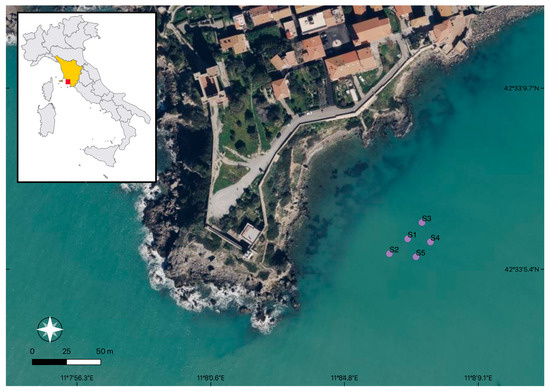
The study was conducted in the Baia del Cannone (Figure 1), off Talamone (Grosseto, Tuscany; Northern Tyrrhenian Sea, Italy). The deployment area lies at 5.5–6.5 m depth on soft-bottom habitat, selected to be free of Posidonia oceanica meadows. This bay already hosted two marble sculptures deployed at greater depth in 2016 [22]. Together with an additional set of 22 underwater marble sculptures located beneath the Rocca di Talamone and in front of the “Bagno delle Donne”, these installations form the local underwater museum [22,23]. A preliminary underwater inspection was conducted in May 2024 to assess seabed characteristics, the extent of nearby Posidonia meadows, and the suitability of the area for subsequent monitoring activities.
Figure 1.
Study area at Talamone (northern Tyrrhenian Sea, Italy) showing the location of the five marble statues (S1, Cimitero senza nome; S2, Guardiano; S3, Sigillo; S4, Genesi; S5, Porta per gli abissi) deployed in September 2024 and monitored in this study. The red dot in the inset map indicates the position of the study site along the Tuscan coast.
2.2. Marble Sculpture Deployment
The five marble sculptures monitored in this study (Figure S1) represent the most recent additions to the underwater museum and were deployed on 19 September 2024. Deployment was conducted using a pontoon with the assistance of scuba divers, who supported positioning on the seabed and ensured stability and correct placement. The five statues (S1—“Cimitero senza nome”; S2—“Guardiano”; S3—“Sigillo”; S4—“Genesi”; S5—“Porta per gli abissi”) were arranged in two rows, approximately 7 m from each other. Each sculpture was carved from a marble block with an approximate initial weight of 12 tonnes.
2.3. Sampling Design and Field Data Collection
Monitoring surveys were performed over one year seasonally: 19 September 2024 (Deploy), 4 March 2025 (Mar25), 19 June 2025 (Jun25), 7 August 2025 (Aug25), and 18 October 2025 (Oct25). Surveys were carried out during daylight hours under calm sea state (wave height ≤ 40 cm), weak or absent wind, and underwater visibility ranging from 3 to 7 m. The site was reached by boat and two scuba divers conducted all field activities.
2.3.1. Transects and Photoquadrat Sampling
At each survey, three 20 m transects (T1–T3) were deployed starting from the lower edge of the Posidonia meadow and extending seaward. Transect direction was maintained using a compass while unrolling a metric tape. Transect T1 crossed the central portion of the statue array, while T2 and T3 were positioned along the two external margins. Along each transect, five 50 × 50 cm photoquadrats (0.25 m2) were collected at fixed distances (0, 5, 10, 15, and 20 m), resulting in five photoquadrats per transect and 15 photoquadrats per survey. Photoquadrats were taken on the seabed adjacent to the sculptures, within 5 m of the nearest statue.
2.3.2. Fish Visual Census
Fish visual census surveys were conducted along the same 20 m transects used for photoquadrat sampling, following established underwater visual census approaches [24]. The observer swam at a constant speed along each transect, recording all fish observed within 3 m on either side of the transect line, corresponding to a surveyed area of 120 m2 per transect (20 × 6 m). Fish observations were recorded separately for each transect and pooled at the transect level; the position of individual fishes along the transect and their distance from the nearest sculpture were not recorded. For each species, the number of individuals was noted whenever possible; when large schools were present, abundance was estimated. Fish size was not recorded.
2.3.3. Qualitative Observations on the Sculptures
In addition to transect-based sampling, divers performed standardized qualitative surveys on each sculpture. Each statue was inspected for 2 min, covering both exposed surfaces and the underside. The underside was illuminated with underwater torches to improve visibility and support in situ identification. All visible biological taxa, including algae, sessile and mobile invertebrates, and fishes, were recorded as presence-only without abundance estimates. When field identification was uncertain, photographs were taken for subsequent confirmation.
2.4. Image and Data Processing
2.4.1. Image Acquisition and Organization
Photoquadrats were acquired using an Olympus TG-7 camera with PT-059 housing (OM Digital Solutions Corporation, Hachioji City, Tokyo, Japan), without strobe or artificial lights. Images were taken perpendicularly (90°) to the seabed from approximately 1 m distance. Following each survey, images were transferred to a computer, sorted by transect, and renamed using a standardized convention encoding sampling position: date_transectID_distance (e.g., YYYYMMDD_T1_10m).
2.4.2. Photoquadrat Analysis Using Photoquad
Benthic community composition was quantified from photoquadrats using the photoQuad software v. 1.4 through a random point count approach [25]. For each image, 100 random points were generated within the quadrat area; each point was assigned to the lowest feasible taxonomic level (species or morphotype) based on visible diagnostic features. When species-level identification was not possible, points were classified to higher taxonomic levels. In addition to biological taxa, algal turf and bare substrate were included as categories.
Percent cover for each taxon/category was calculated as:
where is the number of points assigned to category .
Photoquadrat scoring and image acquisition were performed by the same operators throughout the study. When identification uncertainty occurred, operators consulted each other and used identification guides [26] to support consistent classification.
2.5. Data Analysis
Benthic cover, fish assemblage structure, and colonization patterns on the sculptures were analysed separately to match the different sampling designs and response variables. For the photoquadrat data, analyses focused on dominant benthic components and target taxa; taxa occurring in 15% or fewer of photoquadrats were retained only for descriptive purposes. Cover was modelled as binomial count data (successes out of 100 random points per image) using generalized linear models with survey date, transect, their interaction, and distance from the sculpture array as predictors. When overdispersion was detected, models were refitted using a beta-binomial distribution. Alpha diversity metrics derived from the photoquadrat point counts were analysed with the same fixed-effects structure, using linear models for Shannon and Simpson diversity and a Poisson generalized linear model for richness. For descriptive summaries, the five photoquadrats collected along each transect were first averaged for each survey date and response variable, yielding one transect-level value. The resulting three transect-level values were then summarized as mean ± standard deviation (SD) for each survey date. Transect-specific model contrasts were retained to describe small-scale spatial heterogeneity within the monitored area and were interpreted as local patterns rather than independent estimates of reef-wide effects. Post hoc contrasts compared each post-deployment survey with the deployment baseline within transects, with multiplicity-adjusted p-values [27]. Results are reported as odds ratios, mean differences, or response-scale ratios, depending on the response variable.
Fish visual census data were analysed at the transect-by-survey level. The three transects represented repeated spatial sampling units within the single deployment site, rather than independent replicate reef sites, and were resurveyed across the five monitoring dates. Total abundance, species richness, and diversity indices were tested for temporal differences using Friedman tests, with transect treated as a blocking factor. For descriptive presentation, total abundance, species richness, and Shannon diversity were also summarized for each survey date as mean ± SD across the three transects. Community composition was assessed on square-root-transformed abundances using Bray–Curtis dissimilarities, permutational multivariate analysis of variance (PERMANOVA), and constrained permutations within transect to preserve the repeated observations of the same transects through time [28]. Homogeneity of multivariate dispersion among dates was checked with betadisper, and temporal patterns were visualized with non-metric multidimensional scaling. Pairwise PERMANOVA comparisons were corrected for multiple testing, and SIMPER was used to identify the taxa contributing most to between-date dissimilarities. Given the limited number of transect-level sampling units, these multivariate analyses were used primarily as exploratory tools to describe temporal structure in the assemblage and to identify patterns and taxa that may be examined through longer-term monitoring. Survey date was not interpreted as an independent effect of sculpture deployment, because time since deployment and seasonal variation could not be separated within the present one-year design.
Observations made directly on the sculptures were treated as presence/absence data. Community composition was analysed using Jaccard dissimilarities and PERMANOVA with permutations constrained within sculpture identity to account for repeated observations through time and across microhabitats [28]. Separate models were run for exposed surfaces and sheltered undersides to examine temporal trajectories within each microhabitat, and microhabitat contrasts were evaluated within survey dates. Because the number of unique constrained permutations was limited, within-date p-values were interpreted cautiously and in combination with effect sizes. To summarize colonization intensity, directional turnover between the first and last post-deployment surveys was calculated for each sculpture and microhabitat as gains, losses, and net richness change.
All analyses were conducted in R v. 2025.09.1+401 using the packages dplyr, tidyr, vegan, emmeans, and glmmTMB [29] R Foundation for Statistical Computing. Detailed analytical procedures, including model specifications, post hoc contrasts, permutation settings, and software options, are provided in the Supplementary Materials.
3. Results
Across the five monitoring dates (Deploy, Mar25, Jun25, Aug25, and Oct25), a total of 43 taxa were recorded across all datasets, spanning 13 major taxonomic groups. The assemblage included benthic primary producers (seagrass and macroalgae), sessile/encrusting and vagile invertebrates, and coastal fish fauna. The taxa recorded during the different surveys are reported in Table S1.
3.1. Photoquadrat Surveys
Across the five survey dates and three transects (T1–T3), benthic assemblages were dominated by a small set of recurrent components, namely Turf, Caulerpa prolifera, Bare substrate, and Posidonia oceanica. The remaining taxa, including Padina pavonica, Acetabularia acetabulum, and Holothuria poli, occurred at low frequency and were excluded from univariate cover models according to the prevalence threshold defined in the Methods; these taxa are reported descriptively only.
To provide an overall representation of temporal patterns at the study-site level, benthic cover and diversity descriptors were also summarized for each survey date as mean ± SD across the three transects (Table 1). Transect-specific contrasts are reported below to describe spatial heterogeneity within the monitored area.
Table 1.
Descriptive temporal patterns of benthic cover and alpha-diversity descriptors across the study area. Values are reported as mean ± standard deviation (SD) across the three transects (n = 3) for each survey date. Each transect-level value was derived from the five photoquadrats sampled along that transect.
All retained cover variables showed extra-binomial variation and were therefore analysed using beta-binomial models. Overall, temporal changes in benthic cover were limited and differed among transects, with the clearest responses involving Bare substrate and C. prolifera.
At transect T1, bare substrate increased significantly in Mar25 relative to Deploy, while C. prolifera decreased significantly in both Mar25 and Aug25. A significant decrease in C. prolifera was also detected at T3 in Mar25 (Table 2). No significant post-deployment contrasts versus Deploy were detected for Turf in any transect, and P. oceanica did not differ significantly among survey dates within transects (all adjusted p > 0.05).
Table 2.
Significant post-deployment contrasts detected in photoquadrat analyses. Cover variables were analysed using beta-binomial models and are reported as odds ratios relative to Deploy. Shannon diversity was analysed separately and is reported as the estimated difference relative to Deploy. p-values were adjusted using Dunnett correction.
Alpha diversity metrics showed limited temporal change overall. Shannon diversity (H′) increased significantly at transect T2 in Aug25 relative to Deploy (ΔH′ = +0.4365; adjusted p = 0.0221), whereas no other within-transect contrasts were significant (Table 2). Simpson diversity did not differ significantly from Deploy in any transect (all adjusted p > 0.05). Taxon richness per photoquadrat ranged from 2 to 6 and did not vary significantly relative to Deploy in any transect or survey date (response-scale ratios, all adjusted p > 0.05). The Poisson richness model showed no evidence of overdispersion (φ ≈ 0.18).
3.2. Fish Assemblage Composition
Univariate descriptors of the fish assemblage did not show significant temporal differences among survey dates. Descriptive values of total fish abundance, species richness, and Shannon diversity across survey dates are reported in Table S2. Total abundance showed a weak but non-significant tendency to vary through time (Friedman test, p = 0.0757), and neither species richness (p = 0.1387) nor Shannon diversity (p = 0.2654) differed significantly among dates.
Exploratory multivariate analysis indicated temporal structure in fish assemblage composition. PERMANOVA based on Bray–Curtis dissimilarities of square-root-transformed abundance data showed a significant effect of survey date (F4,10 = 2.186, R2 = 0.467, p = 0.027), with permutations constrained within transects. Homogeneity of multivariate dispersion among dates was supported by both betadisper ANOVA (p = 0.784) and permutation test (p = 0.80). Pairwise PERMANOVA comparisons among dates were not significant after false discovery rate correction (all adjusted p ≥ 0.417).
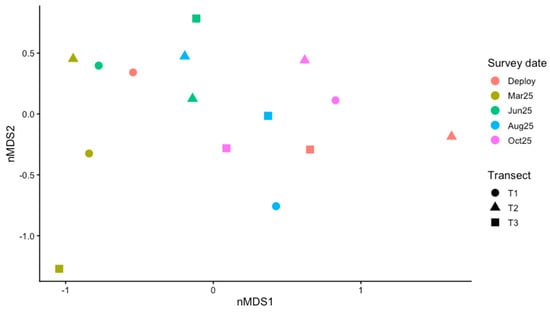
The nMDS ordination provided a good two-dimensional representation of the fish assemblage dissimilarities (stress = 0.101) and suggested temporal structuring among survey dates (Figure 2). Given that each survey corresponded to a different season, this pattern may reflect a combination of seasonal turnover and changes occurring through time after deployment.
Figure 2.
nMDS ordination of fish assemblage composition based on Bray–Curtis dissimilarities of square-root-transformed abundance data. Points represent transect-level samples, colours indicate survey dates, and symbols indicate transects. The ordination showed a good two-dimensional representation of the data (stress = 0.101) and illustrates exploratory temporal patterns in assemblage composition. Because survey date covaries with season and time since deployment, the observed separation should not be interpreted as a deployment effect alone.
SIMPER analysis identified the taxa contributing most to temporal dissimilarity. Because SIMPER was performed on the square-root-transformed abundance matrix, the values reported below represent mean transformed abundances rather than absolute fish counts. Dissimilarity between Deploy and Mar25 was driven mainly by Atherina hepsetus, which had a higher mean square-root-transformed abundance at Deploy (4.18) and was absent in Mar25. The Mar25–Oct25 contrast was primarily associated with higher mean transformed abundance of Coris julis (0.67 to 3.41), together with the occurrence in Oct25 of species absent in Mar25, including Diplodus vulgaris (0 to 2.14), Sarpa salpa (0 to 2.35), Mullus barbatus (0 to 1.72), and Serranus scriba (0 to 1.28). The Deploy–Oct25 contrast reflected the contribution of A. hepsetus at Deploy and higher abundances in Oct25 of S. salpa, C. julis, and D. vulgaris, while Chromis chromis contributed more moderately.
3.3. Qualitative Observations on the Sculptures
Qualitative observations on the sculptures were analysed across the four post-deployment surveys (Mar25, Jun25, Aug25, and Oct25). Community composition based on presence/absence data differed according to both survey date and microhabitat. PERMANOVA with permutations constrained within sculptures detected a significant survey date × microhabitat interaction (R2 = 0.0906, F = 2.0664, p = 0.0156), indicating that temporal compositional change differed between exposed surfaces and sheltered undersides. The two-dimensional nMDS ordination based on Jaccard dissimilarities provided an adequate representation of the data (stress ≈ 0.123).
When analysed separately by microhabitat, temporal variation was significant in both cases but stronger on exposed surfaces. Within Surface samples, survey date explained 43.996% of multivariate variation (R2 = 0.43996, F = 4.1899, p = 0.0001). Within Under samples, temporal variation was also significant but accounted for a smaller proportion of variance (R2 = 0.2263, F = 1.56, p = 0.0089).
Microhabitat contrasts examined within each survey date showed no significant difference between Surface and Under in Mar25 (R2 = 0.2506, p = 0.125). From Jun25 onward, effect sizes were consistently high (Jun25 R2 = 0.4467; Aug25 R2 = 0.5559; Oct25 R2 = 0.4412). Because only 31 unique constrained permutations were available for these within-date tests, p-values were coarse and were interpreted together with effect sizes and pattern consistency across dates.
SIMPER analyses highlighted different contributors to temporal turnover in the two microhabitats. On Surface, overall dissimilarity between Mar25 and Oct25 was 0.547. The main contributors were taxa with higher occurrence in Oct25 than in Mar25, particularly Padina pavonica (average contribution = 0.0846; permutation p = 0.001; cumulative contribution = 0.155), Balanus perforatus (0.0737; p = 0.001; cumulative = 0.289), Sertularella sp. (0.0477; p = 0.010; cumulative = 0.464), Cratena peregrina (0.0368; p = 0.001; cumulative = 0.531), and Arbacia lixula (0.0285; p = 0.046; cumulative = 0.767). Coris julis also contributed markedly to this contrast (0.0477; p = 0.008; cumulative = 0.376).
On Under surfaces, overall Mar25–Oct25 dissimilarity was lower (0.383) and was dominated by fewer taxa. Apogon imberbis was the strongest contributor (average contribution = 0.1060; permutation p = 0.015; cumulative = 0.277), shifting from absence in Mar25 to frequent occurrence in Oct25 (ava = 0.0; avb = 0.8). Holothuria poli also contributed significantly (average contribution = 0.0233; p = 0.001; cumulative = 0.756), again reflecting occurrence in Oct25 but not in Mar25 (ava = 0.0; avb = 0.2). Other taxa contributed to overall dissimilarity but were not significant in permutation tests.
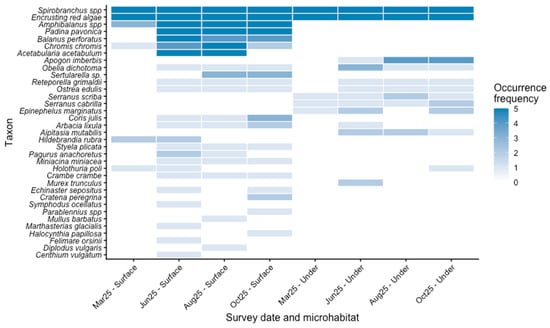
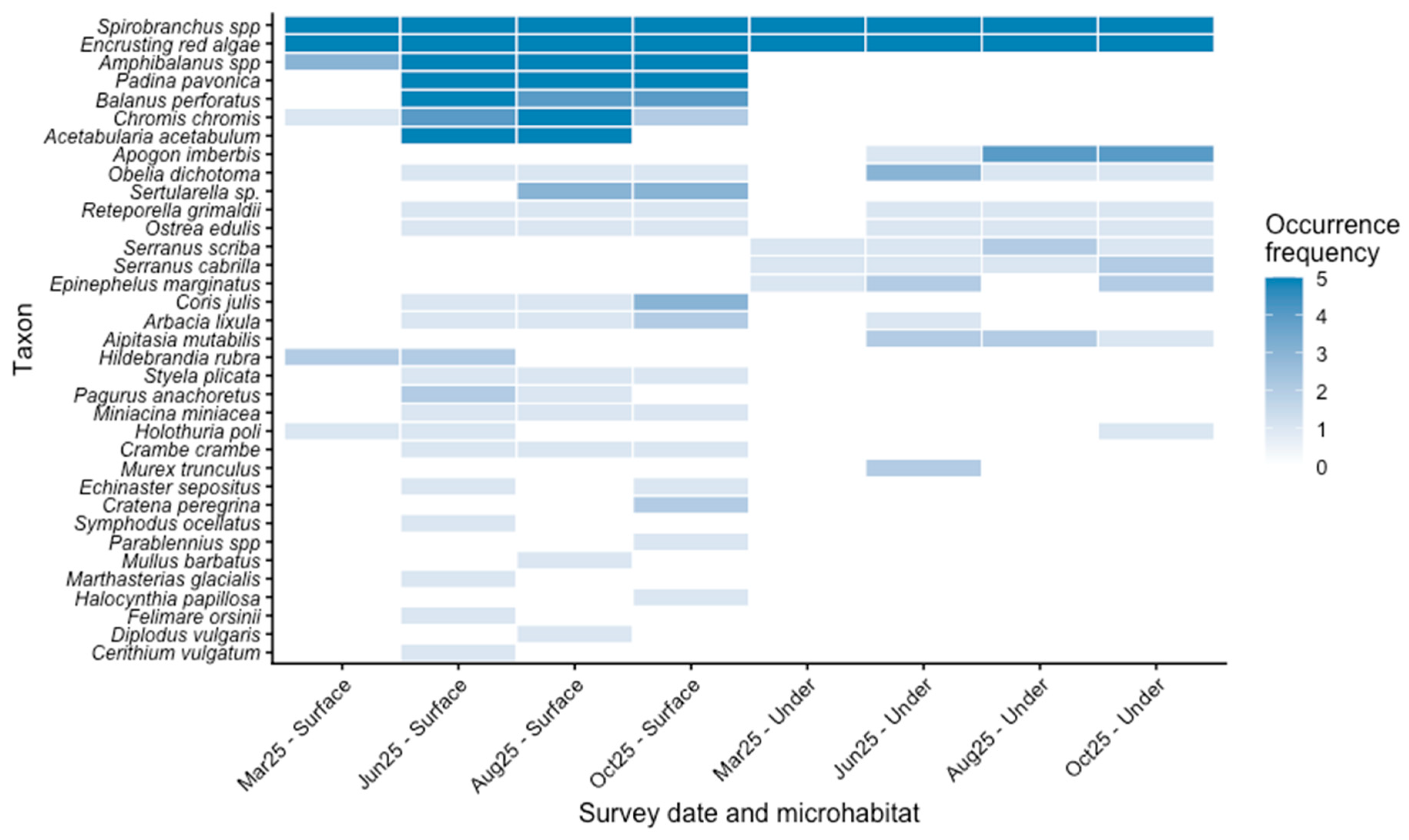
The contrasting temporal patterns observed on exposed and sheltered portions of the sculptures are further illustrated by the occurrence heatmap of all recorded taxa (Figure 3). The figure shows the progressive increase in epibiotic and mobile taxa on exposed surfaces, particularly from Jun25 onward, and the later occurrence of refuge-associated taxa beneath the sculptures.
Figure 3.
Occurrence frequency of all taxa recorded on exposed surfaces and sheltered undersides of the sculptures across the four post-deployment surveys. Cell colour represents the number of sculptures on which each taxon was recorded during each survey, ranging from 0 to 5. The heatmap highlights the progressive development of surface assemblages and the later occurrence of taxa associated with sheltered microhabitats.
Between-sculpture variation was also evident when temporal and microhabitat structure were taken into account. In a PERMANOVA model including sculpture identity together with the survey date × microhabitat interaction, sculpture identity was significant (R2 = 0.13369, F = 2.8019, p = 0.0005), and the interaction remained significant (R2 = 0.09060, F = 2.5318, p = 0.0031). By contrast, sculpture identity alone was not significant in a model excluding temporal and microhabitat terms (R2 = 0.13369, F = 1.3503, p = 0.132).
Directional turnover metrics between the first and last post-deployment surveys further summarised sculpture-specific colonisation patterns. On exposed surfaces, sculpture S1 (“Cimitero Senza Nome”) showed the largest increase in observed taxa, from 4 taxa in Mar25 to 15 in Oct25, with 12 taxa gained, 1 taxon lost, and a net change of +11. The remaining sculptures showed smaller gains, with 4–6 taxa gained and net changes ranging from +4 to +5. On undersides, changes were generally smaller (maximum richness in Oct25 = 6 taxa). The greatest gains were again observed for S1 (2 to 6 taxa; 4 gained; net change +4) and for S3 (“Sigillo”; 3 to 6 taxa; 4 gained, 1 lost; net change +3), whereas S5 (“Porta per gli abissi”) showed no net increase (3 taxa in both Mar25 and Oct25; 1 gained, 1 lost; net change 0).
4. Discussion
This study should be considered a pilot-scale ecological assessment, and some limitations should be considered when interpreting the results. Monitoring covered only the first year after deployment and was carried out at a single site, with three transects and no independent control area. A comparable control site could not be identified in the immediate surroundings because the same seabed conditions found at the deployment site were not available nearby; selecting a more distant area would have introduced the risk of comparing sites exposed to different environmental conditions. For this reason, the temporal changes observed cannot be attributed exclusively to the sculptures and may also reflect seasonal or background environmental variability. The limited spatial replication also reduces the extent to which these patterns can be generalized beyond the study area. Fish counts provide an additional source of uncertainty, as large schools were estimated visually and fish size was not recorded, making it difficult to distinguish short-term attraction or redistribution from longer-term production effects. In addition, observations made directly on the sculptures were based on presence/absence data, so they describe colonization and community turnover rather than changes in abundance. Overall, the results should therefore be interpreted as early ecological responses and as a baseline for longer-term monitoring.
4.1. Photoquadrat Surveys
During the first year after deployment, the benthic assemblage surrounding the marble sculptures remained dominated by a small number of recurrent components, as Turf, Caulerpa prolifera, Bare substrate, and Posidonia oceanica. The remaining taxa occurred only occasionally and, because of their low frequency, were not suitable for formal inference in the univariate cover models. The need to model all dominant cover variables with beta-binomial distributions indicates marked small-scale heterogeneity, consistent with a patchy soft-bottom mosaic in which temporal variation is expressed unevenly in space rather than as uniform shifts across the whole site.
The clearest temporal signal involved C. prolifera and bare substrate. At T1, located within the central part of the statue array, the decline in C. prolifera observed in Mar25 coincided with a significant increase in bare substrate. A similar decline in C. prolifera was also detected at T3 in the same survey. This pattern is more consistent with seasonal variation in vegetated cover during late winter or early spring than with a directional trajectory linked directly to deployment. However, because monitoring covered only a single annual cycle, seasonal effects cannot be separated from longer-term temporal trends. Seasonal hydrodynamics, sediment remobilization, and reduced underwater clarity during this period may all have contributed to the temporary contraction of macroalgal cover and the greater exposure of underlying substrate [30]. The broad confidence interval associated with bare substrate at T1 also suggests that this response was not spatially uniform, but instead driven by stronger changes in a subset of photoquadrats. The second decrease in C. prolifera recorded at T1 in Aug25 indicates that this taxon did not follow a simple seasonal recovery after spring. Its trajectory appears irregular, with more than one phase of contraction over the course of the year. This is not unexpected for an opportunistic macrophyte whose local cover may vary in response to shifting sediment conditions, grazing pressure, or competition for space [31]. Similar irregularity in Caulerpa prolifera cover is consistent with the known seasonal functioning of this species in shallow coastal systems, where biomass, morphology, and productivity can vary markedly over annual cycles [32,33].
This apparent stability is plausible, because turf is an operational morpho-functional category rather than a single taxonomic entity. Therefore, stable proportional cover does not necessarily imply an unchanged internal composition but rather indicates that the turf-forming component continued to occupy a similar fraction of the seabed through time. Turf assemblages are often able to persist as background components of benthic mosaics and may show fine-scale compositional or seasonal changes without producing clear shifts in total cover at the resolution adopted here [34]. In the present study, turf therefore represented the most stable component of the surrounding assemblage.
No significant temporal changes were detected for P. oceanica. This result was expected, given both the short duration of the monitoring period and the slow dynamics of seagrass meadows. Over a single year, the present dataset does not allow any inference on meadow expansion or regression. The absence of detectable short-term change indicates that the meadow margin adjacent to the monitored area remained locally stable throughout the study period. This suggests that the seabed conditions, including sediment movement and substrate stability, were suitable enough to support the nearby meadow and did not create stress or disturbance [35,36]. Any hypothesis concerning future expansion, however, would require a much longer monitoring period and the use of seagrass-specific descriptors.
Changes in alpha diversity were limited and spatially restricted. Shannon diversity increased only at T2 in Aug25, whereas Simpson diversity and taxon richness remained unchanged. This pattern suggests a localized redistribution in the relative cover of existing benthic components rather than the addition of new taxa or a broader reorganization of the assemblage. The interpretation is also consistent with the high natural variability commonly observed in Mediterranean macroalgal assemblages, where small-scale changes in relative abundances may affect diversity indices without necessarily indicating a directional ecological shift [37].
The photoquadrat data therefore describe a surrounding seabed in which temporal variation was modest and strongly conditioned by local heterogeneity. During the first year after deployment, the adjacent soft bottom remained governed mainly by its own patchiness and seasonal dynamics, while the marble sculptures did not produce detectable short-term changes in the composition of the surrounding benthic cover.
4.2. Fish Assemblage Composition
The fish visual census data showed a temporal signal that was clearer at the multivariate level than in the univariate descriptors. Total abundance, species richness, and Shannon diversity did not differ significantly among survey dates, whereas assemblage composition did. This indicates that the main change through time concerned the relative contribution and identity of species, rather than the overall number of individuals recorded along transects. However, because each survey date also represents a different season, temporal change cannot be separated from seasonal variation in the present design. The multivariate pattern should therefore be regarded as exploratory and may reflect both seasonal turnover in coastal fish assemblages and changes associated with the progressive availability and colonization of the new structures. Similar patterns have been observed in Mediterranean artificial shallow habitats, where Shannon diversity may remain comparatively stable while species-specific abundance and habitat occupancy vary across sites and seasons [38]. This distinction is important in the context of newly deployed structures. In the early phase after the introduction of hard substrate into a soft-bottom environment, the first faunal response is not necessarily an increase in abundance. A more plausible initial pattern is a gradual redistribution in habitat use, with some taxa beginning to exploit the new structure and its immediate surroundings more than others. Similar early responses have been reported for recently introduced substrates and artificial reefs, where fish assemblages can show rapid compositional change or localized attraction before longer-term community development is fully established [39,40,41]. The PERMANOVA result, together with the absence of differences in multivariate dispersion, supports the presence of temporal structure in the dataset. However, given the limited replication and the confounding between survey date, season, and time since deployment, this pattern cannot be interpreted as a directional response to the sculptures alone. The taxa contributing most strongly to the differences observed in the later surveys support this interpretation.
By Oct25, the assemblage was characterized by higher abundances, or by the appearance, of Coris julis, Diplodus vulgaris, Sarpa salpa, Mullus barbatus, and Serranus scriba. These species differ in trophic ecology and habitat use, but several are commonly associated with structured coastal habitats, benthic feeding opportunities, or the availability of shelter and edge habitats [42]. Their increased importance in the later surveys is therefore consistent with the use of structurally complex coastal habitat, although seasonal variation in fish occurrence and abundance may also have contributed to this pattern. At the same time, the strong contribution of Atherina hepsetus to the early temporal contrasts indicates that part of the observed shift was also related to the reduction or redistribution of schooling taxa that were more prominent at deployment.
The immediate soft-bottom patch selected for deployment lacked natural rocky refuges, although rocky and Posidonia oceanica habitats occur in the surrounding area. In such a setting, even a limited number of hard structures can alter local habitat availability in biologically relevant ways before large changes in total fish abundance become evident. Evidence from the central Mediterranean shows that isolated hard structures such as shipwrecks can support fish assemblages that differ significantly from adjacent soft bottoms, with higher richness and abundance linked to increased habitat complexity [43]. Shelter, vertical relief, surfaces available for colonization, and the first stages of epibiotic development may all increase habitat attractiveness for a subset of coastal fishes. This interpretation is consistent with evidence that artificial reef performance is strongly influenced by structural complexity, refuge availability, and the match between reef design and target ecological functions [40,44,45]. The pattern observed here is compatible with this type of early structural effect rather than a fully developed reef response.
The response was not spatially uniform among transects, which is not unusual around small artificial structures. Fish occurrence can vary markedly over short distances according to proximity to the structure, schooling behaviour, visibility conditions, and local hydrodynamics, which may themselves be modified at small spatial scales by the presence and morphology of the sculptures. Such heterogeneity is consistent with artificial-habitat studies showing that fish occupancy may depend on habitat type, location, season, and species-specific habitat use rather than on structure presence alone [38]. In addition, some counts included visually estimated schooling abundances and fish size was not recorded. For this reason, raw abundance values were particularly sensitive to short-term fluctuations, whereas the multivariate analysis provided a complementary exploratory description of changes in assemblage composition that was less dominated by individual schooling events.
Seasonal turnover may therefore account for part of the temporal signal. Moreover, artificial reefs do not necessarily develop rapidly into stable or natural-reef-like assemblages; multi-year studies show that artificial reef assemblages may remain distinct from natural reefs and display interannual variability associated with successional processes [46]. Recent comparisons also show that artificial and natural reefs may differ both compositionally and functionally, reinforcing the need to interpret artificial reefs in relation to their specific objectives rather than as automatic substitutes for natural habitats [47]. Overall, assemblage composition varied through time while multivariate dispersion among samples remained stable. However, within the present one-year design, the contribution of seasonal turnover cannot be separated from changes potentially associated with the progressive colonization and use of the newly introduced structures.
The first year after deployment thus appears to correspond to a phase of faunal reorganization rather than accumulation. The main effect detected in the fish assemblage was a change in composition, not a generalized increase in abundance. This interpretation should be considered an early ecological signal rather than evidence of increased fish production. Distinguishing attraction, redistribution, and actual production would require a longer monitoring period, repeated size-structure data, and ideally complementary approaches able to track residence time, recruitment, and individual movement [13,48].
More generally, the ecological effects of artificial reefs should not be assumed to be exclusively positive. By concentrating mobile organisms and introducing novel hard substrate into otherwise soft-bottom environments, artificial structures may alter local community composition, facilitate the establishment of non-indigenous taxa, or modify small-scale hydrodynamic and sedimentary processes [8,14]. These potential effects cannot be adequately evaluated from the present one-year dataset. Future monitoring should therefore assess not only colonization and potential biodiversity benefits, but also possible unintended changes in community structure and ecosystem functioning.
4.3. Qualitative Observations on the Sculptures
The qualitative surveys conducted directly on the sculptures showed a much stronger biological response than the photoquadrats collected on the surrounding seabed. Community development was clearly structured by microhabitat, and this distinction became more pronounced through time. Exposed surfaces and sheltered undersides did not simply host different taxa; they followed different assembly trajectories over the monitoring period. Such microhabitat-dependent trajectories are consistent with evidence that surface orientation and structural configuration can strongly influence the development of epibenthic communities on artificial reefs [49,50].
Temporal turnover was stronger on exposed surfaces than beneath the sculptures. This pattern is expected on newly deployed hard substrate. Open surfaces receive more light, experience stronger water movement, and are more directly exposed to larval supply. These conditions favour the early establishment of algae and sessile epibionts and promote faster turnover during the first stages of colonization. Early succession on artificial reefs is typically characterized by rapid settlement of opportunistic and sessile taxa, followed by progressive changes in assemblage composition as the substrate becomes biologically conditioned [51,52]. However, these early stages should not be interpreted as evidence of a mature or stable reef community. Long-term studies show that artificial-reef assemblages may continue to change for several years after deployment, and that patterns observed during the initial colonization phase do not necessarily persist over longer time scales. For example, decadal monitoring has documented substantial changes in benthic community composition and diversity, highlighting the importance of extended monitoring to assess whether early successional patterns eventually lead to more stable assemblages [18,53]. The underside provides a narrower range of environmental conditions, with lower light, greater shelter, and generally lower physical variability. Colonization there was not absent, but it proceeded more slowly and involved fewer recurrent taxa.
The taxa contributing to turnover on exposed surfaces are consistent with this sequence. Padina pavonica, Balanus perforatus, Sertularella sp., Cratena peregrina, and Arbacia lixula became more frequent by Oct25. Because the analysis was based on presence/absence data, these results indicate repeated establishment across sampling units rather than increasing abundance within them. These taxa therefore became part of the developing surface assemblage in a consistent way. The joint appearance of hydroids and the nudibranch C. peregrina is particularly informative, because it suggests that the surface was no longer functioning only as a settlement substrate, but had begun to support early trophic relationships. This interpretation is supported by the known trophic link between aeolid nudibranchs and hydroid colonies, including C. peregrina, which can exploit hydroid prey and associated plankton-derived resources [54].
The underside followed a different trajectory. Its temporal turnover was lower and was driven mainly by Apogon imberbis and Holothuria poli. The growing occurrence of A. imberbis is especially meaningful because this species is closely associated with shaded cavities and sheltered microhabitats. This association is well documented in Mediterranean marine caves, where A. imberbis is often among the most frequent cave-dwelling fishes and may contribute to trophic connectivity between dark habitats and surrounding open areas [55,56]. Its later presence indicates that the undersides had become suitable as refuge habitat. H. poli points in the same direction from the perspective of benthic vagile fauna, indicating the occupation of protected micro-environments by detritivorous or grazing invertebrates.
The contrast between Surface and Under was weak at the first post-deployment survey and became progressively stronger from Jun25 onward. This suggests that microhabitat differentiation was not immediate, but emerged as colonization progressed. The sculptures were initially more similar because they were still only weakly colonized. As biotic cover developed, the environmental differences between exposed and sheltered portions of the structures became increasingly expressed in community composition. This progressive divergence is consistent with artificial-reef studies showing that orientation, exposure, substrate configuration, and local environmental conditions can interact to shape epibenthic colonization patterns [44,49,50].
Variation among sculptures adds a second level of heterogeneity. Sculpture identity showed a significant effect only when considered together with time and microhabitat, while it was not supported when analysed on its own. This indicates that the sculptures did not differ in a fixed compositional way from the start, but diverged in the pace and extent of colonization. S1 was particularly distinct in this respect, showing a much larger gain in taxa on exposed surfaces than the other sculptures. Beneath the structures, differences among sculptures were smaller. This asymmetry suggests that local conditions had a stronger influence on colonization on the exposed faces, where factors such as propagule supply, water movement, surface orientation, and sediment accumulation are likely to vary more among units. Sheltered undersides, by contrast, acted as more uniformly filtered microhabitats. This is also consistent with the broader view that artificial reef performance depends not only on the presence of hard substrate, but also on the structural properties and ecological functions generated by each unit [44,57].
These observations show that the sculptures rapidly became biologically differentiated structures rather than remaining inert objects on the seabed. Within the first year, exposed surfaces developed as zones of active epibiotic build-up, whereas undersides functioned increasingly as refuge habitat. This internal ecological heterogeneity would have been lost if each sculpture had been treated as a single undivided sampling unit.
The qualitative surveys offer the most direct indication of ecological change linked to the intervention. Colonization followed a pattern typical of newly introduced hard substrates in soft-bottom environments, beginning with initial settlement and gradually leading to clearer differentiation between microhabitats, along with the establishment of mobile and shelter-associated species. Although the sculptures functioned as artificial hard substrates from the moment of deployment, by the end of the monitoring period they supported increasingly differentiated biological assemblages and provided a broader range of microhabitats for sessile and mobile taxa. This interpretation aligns with recent studies on submerged anthropogenic and heritage features, which highlight their role as secondary hard substrates capable of supporting diverse benthic and nektonic assemblages and enhancing local habitat complexity [19,58].
5. Conclusions
The first year of monitoring revealed three main ecological responses to the deployment of the marble sculptures. The surrounding soft-bottom benthic assemblage, assessed through photoquadrat sampling, showed only limited and spatially confined changes, with no clear evidence of large-scale benthic reorganization within the monitored area. In contrast, the fish assemblage exhibited a more evident temporal shift in composition than in abundance, suggesting an early adjustment in habitat use rather than an immediate increase in fish numbers. The most pronounced response was observed directly on the sculptures, where progressive settlement of epifaunal taxa and the occurrence of mobile organisms led within a few months to the development of increasingly differentiated exposed and sheltered assemblages.
These findings suggest that the marble installations quickly began to act as localized habitat-forming structures. Their influence was strongest on the structures themselves, where the availability of hard substrate promoted settlement processes, epibiotic growth, and the emergence of distinct microhabitats supporting taxa associated with both exposed surfaces and sheltered, refuge-like conditions. By contrast, their effect on the adjacent soft-bottom environment remained weak during the first year and did not emerge as a consistent pattern across sites.
The ecological signal generated by the intervention was early, detectable, and spatially concentrated. It was mainly expressed through the colonization of the sculptures and shifts in fish assemblage composition, rather than through widespread changes in the surrounding seabed or a general increase in fish abundance. The first year after deployment should therefore be interpreted as an initial phase of habitat colonization and faunal reorganization, rather than as evidence of mature reef development or enhanced fish production.
This study provides the first quantitative baseline for assessing the ecological role of underwater marble sculptures within the “Casa dei Pesci” initiative. The results support their interpretation as small artificial reef units capable of increasing local habitat heterogeneity in soft-bottom coastal environments. Whether these early responses will translate into long-term habitat enhancement remains to be determined through extended monitoring, including repeated assessments of fish size structure and the use of benthic and seagrass descriptors able to capture slower ecological changes over time.
Supplementary Materials
The following supporting information can be downloaded at: https://www.mdpi.com/article/10.3390/d18090512/s1, Figure S1. (A) Representative photographs of the five marble sculptures monitored in this study. S1, “Cimitero senza nome”; S2, “Guardiano”; S3, “Sigillo”; S4, “Genesi”; S5, “Porta per gli abissi”. The photographs also illustrate differences in morphology and structural complexity among sculptures. (B) Rear view of sculpture S2 immediately after deployment, showing the local soft-bottom setting surrounding the sculpture. Table S1. Presence/absence of species recorded during the five monitoring dates (Deploy-Oct25), pooled across all sampling approaches. Species are grouped by major taxonomic group. For each timepoint, “v” indicates that the species was observed at least once, whereas “–” indicates that it was not detected. Table S2. Descriptive fish assemblage metrics across survey dates. Values are reported as mean ± standard deviation (SD) across the three 20 m belt transects (n = 3) surveyed at each date. Fish abundance includes both exact counts and visual estimates of large schools.
Author Contributions
Conceptualization, L.M. (Letizia Marsili) and G.C. (Guia Consales); methodology, G.C. (Guia Consales); validation, L.M. (Letizia Marsili), E.F. and P.S.; formal analysis, G.C. (Guia Consales); investigation, G.C. (Guia Consales), L.M. (Lorenzo Minoia), F.C., B.B. and P.S.; resources, L.M. (Letizia Marsili), G.C. (Giovanni Contardi), P.S. and M.M.; data curation, G.C. (Guia Consales); writing—original draft preparation, G.C. (Guia Consales); writing—review and editing, L.M. (Lorenzo Minoia), F.C., B.B., P.S., E.F., L.M. (Letizia Marsili) and M.M.; visualization, G.C. (Guia Consales); supervision, L.M. (Letizia Marsili), E.F. and P.S.; project administration, L.M. (Letizia Marsili), E.F. and P.S.; funding acquisition, L.M. (Letizia Marsili), E.F. and G.C. (Giovanni Contardi). All authors have read and agreed to the published version of the manuscript.
Funding
This research was funded by the European Social Fund Plus 2021–2027 (ESF+) under the Giovanisì programme of Regione Toscana, within the research project VESPESCA (“Valutazione dell’efficacia delle strutture dissuasive contro la pesca a strascico illegale della ‘Casa dei Pesci’ di Talamone come strategie di pesca sostenibile”), CUP B63C23000510002, ID FSE 310590.
Institutional Review Board Statement
Not applicable.
Data Availability Statement
The original data presented in the study are openly available.
Acknowledgments
The authors would like to sincerely thank Paolo Fanciulli, whose vision, commitment, and continuous support made this study possible. We are also grateful to Acquasport and Argentario Scuba Point for their logistical and operational support during field activities. Special thanks go to Santiago Burin des Roziers for filming part of this study in his documentary “House of Fish”.
Conflicts of Interest
The authors declare no conflicts of interest.
References
- Assessment, M.E. Ecosystems and Human Well-Being: Synthesis; The Millennium Ecosystem Assessment series; Island Press: Washington, DC, USA, 2005. [Google Scholar]
- Halpern, B.S.; Walbridge, S.; Selkoe, K.A.; Kappel, C.V.; Micheli, F.; D’Agrosa, C.; Bruno, J.F.; Casey, K.S.; Ebert, C.; Fox, H.E.; et al. A Global Map of Human Impact on Marine Ecosystems. Science 2008, 319, 948–952. [Google Scholar] [CrossRef] [Scilit]
- Coll, M.; Piroddi, C.; Steenbeek, J.; Kaschner, K.; Ben Rais Lasram, F.; Aguzzi, J.; Ballesteros, E.; Bianchi, C.N.; Corbera, J.; Dailianis, T.; et al. The Biodiversity of the Mediterranean Sea: Estimates, Patterns, and Threats. PLoS ONE 2010, 5, e11842. [Google Scholar] [CrossRef] [Scilit] [PubMed]
- Airoldi, L.; Beck, M.W. Loss, Status and Trends for Coastal Marine Habitats of Europe. In Oceanography and Marine Biology: An Annual Review; CRC Press: Boca Raton, FL, USA, 2007; Volume 45, pp. 345–405. [Google Scholar]
- Seaman, W. Artificial Habitats and the Restoration of Degraded Marine Ecosystems and Fisheries. Hydrobiologia 2007, 580, 143–155. [Google Scholar] [CrossRef] [Scilit]
- Baine, M. Artificial Reefs: A Review of Their Design, Application, Management and Performance. Ocean Coast. Manag. 2001, 44, 241–259. [Google Scholar] [CrossRef] [Scilit]
- Ramm, L.A.; Florisson, J.H.; Watts, S.L.; Becker, A.; Tweedley, J.R. Artificial Reefs in the Anthropocene: A Review of Geographical and Historical Trends in Their Design, Purpose, and Monitoring. Bull. Mar. Sci. 2021, 97, 699–728. [Google Scholar] [CrossRef] [Scilit]
- Vivier, B.; Dauvin, J.-C.; Navon, M.; Rusig, A.-M.; Mussio, I.; Orvain, F.; Boutouil, M.; Claquin, P. Marine Artificial Reefs, a Meta-Analysis of Their Design, Objectives and Effectiveness. Glob. Ecol. Conserv. 2021, 27, e01538. [Google Scholar] [CrossRef] [Scilit]
- Lemoine, H.R.; Paxton, A.B.; Anisfeld, S.C.; Rosemond, R.C.; Peterson, C.H. Selecting the Optimal Artificial Reefs to Achieve Fish Habitat Enhancement Goals. Biol. Conserv. 2019, 238, 108200. [Google Scholar] [CrossRef] [Scilit]
- Bohnsack, J.A. Are High Densities of Fishes at Artificial Reefs the Result of Habitat Limitation or Behavioral Preference? Bull. Mar. Sci. 1989, 44, 631–645. [Google Scholar]
- Pickering, H.; Whitmarsh, D. Artificial Reefs and Fisheries Exploitation: A Review of the ‘Attraction versus Production’ Debate, the Influence of Design and Its Significance for Policy. Fish. Res. 1997, 31, 39–59. [Google Scholar] [CrossRef] [Scilit]
- Grossman, G.D.; Jones, G.P.; Seaman, W.J. Do Artificial Reefs Increase Regional Fish Production? A Review of Existing Data. Fisheries 1997, 22, 17–23. [Google Scholar] [CrossRef] [Scilit]
- Brickhill, M.J.; Lee, S.Y.; Connolly, R.M. Fishes Associated with Artificial Reefs: Attributing Changes to Attraction or Production Using Novel Approaches. J. Fish Biol. 2005, 67, 53–71. [Google Scholar] [CrossRef] [Scilit]
- Bracho-Villavicencio, C.; Matthews-Cascon, H.; Rossi, S. Artificial Reefs around the World: A Review of the State of the Art and a Meta-Analysis of Its Effectiveness for the Restoration of Marine Ecosystems. Environments 2023, 10, 121. [Google Scholar] [CrossRef] [Scilit]
- Paxton, A.B.; Shertzer, K.W.; Bacheler, N.M.; Kellison, G.T.; Riley, K.L.; Taylor, J.C. Meta-Analysis Reveals Artificial Reefs Can Be Effective Tools for Fish Community Enhancement but Are Not One-Size-Fits-All. Front. Mar. Sci. 2020, 7, 282. [Google Scholar] [CrossRef] [Scilit]
- Meyer-Kaiser, K.S.; Mires, C.H. Underwater Cultural Heritage Is Integral to Marine Ecosystems. Trends Ecol. Evol. 2022, 37, 815–818. [Google Scholar] [CrossRef] [Scilit]
- Macreadie, P.I.; Fowler, A.M.; Booth, D.J. Rigs-to-reefs: Will the Deep Sea Benefit from Artificial Habitat? Front. Ecol. Environ. 2011, 9, 455–461. [Google Scholar] [CrossRef] [Scilit]
- Perkol-Finkel, S.; Benayahu, Y. Recruitment of Benthic Organisms onto a Planned Artificial Reef: Shifts in Community Structure One Decade Post-Deployment. Mar. Environ. Res. 2005, 59, 79–99. [Google Scholar] [CrossRef] [Scilit]
- Basile, V.; Mezzasalma, M.; Talarico, F.; La Russa, M.F.; Brunelli, E. Biodiversity Assessment of the Ancient Submerged Port of Egnazia (Southern Adriatic Sea, Mediterranean Sea): New Evidence for Conservation. Fishes 2025, 10, 431. [Google Scholar] [CrossRef] [Scilit]
- Stolk, P.; Markwell, K.; Jenkins, J.M. Artificial Reefs as Recreational Scuba Diving Resources: A Critical Review of Research. J. Sustain. Tour. 2007, 15, 331–350. [Google Scholar] [CrossRef] [Scilit]
- Ramos, J.; Santos, M.N.; Whitmarsh, D.; Monteiro, C.C. The Usefulness of the Analytic Hierarchy Process for Understanding Reef Diving Choices: A Case Study. Bull. Mar. Sci. 2006, 78, 213–219. Available online: https://www.ingentaconnect.com/content/umrsmas/bullmar/2006/00000078/00000001/art00020 (accessed on 21 August 2026).
- Casa dei Pesci ETS. Available online: https://www.casadeipesci.it/ (accessed on 31 December 2025).
- Nauen, C.E. When Mediterranean Artisanal Fishers Protect Coastal Ecosystems. Fishes 2024, 9, 472. [Google Scholar] [CrossRef] [Scilit]
- Samoilys, M.A.; Carlos, G. Determining Methods of Underwater Visual Census for Estimating the Abundance of Coral Reef Fishes. Environ. Biol. Fishes 2000, 57, 289–304. [Google Scholar] [CrossRef] [Scilit]
- Trygonis, V.; Sini, M. photoQuad: A Dedicated Seabed Image Processing Software, and a Comparative Error Analysis of Four Photoquadrat Methods. J. Exp. Mar. Biol. Ecol. 2012, 424–425, 99–108. [Google Scholar] [CrossRef] [Scilit]
- Trainito, E.; Baldacconi, R. Atlante Di Flora e Fauna Del Mediterraneo; Sesta Edizione; Il Castello Editore: Assisi, Italy, 2021. [Google Scholar]
- Lenth, R.V.; Piaskowski, J. Emmeans: Estimated Marginal Means, Aka Least-Squares Means 2017, version 2.0.4; Russell V. Lenth: Iowa City, IA, USA, 2026.
- Anderson, M.J. A New Method for Non-parametric Multivariate Analysis of Variance. Austral Ecol. 2001, 26, 32–46. [Google Scholar] [CrossRef] [Scilit]
- R Core Team. R: A Language and Environment for Statistical Computing; R Foundation for Statistical Computing: Vienna, Austria, 2024. [Google Scholar]
- García-Sánchez, M.; Korbee, N.; Pérez-Ruzafa, I.M.; Marcos, C.; Domínguez, B.; Figueroa, F.L.; Pérez-Ruzafa, Á. Physiological Response and Photoacclimation Capacity of Caulerpa Prolifera (Forsskål) J.V. Lamouroux and Cymodocea Nodosa (Ucria) Ascherson Meadows in the Mar Menor Lagoon (SE Spain). Mar. Environ. Res. 2012, 79, 37–47. [Google Scholar] [CrossRef] [Scilit]
- Pérez-Ruzafa, A.; Marcos, C.; Bernal, C.M.; Quintino, V.; Freitas, R.; Rodrigues, A.M.; García-Sánchez, M.; Pérez-Ruzafa, I.M. Cymodocea Nodosa vs. Caulerpa Prolifera: Causes and Consequences of a Long Term History of Interaction in Macrophyte Meadows in the Mar Menor Coastal Lagoon (Spain, Southwestern Mediterranean). Estuar. Coast. Shelf Sci. 2012, 110, 101–115. [Google Scholar] [CrossRef] [Scilit]
- Terrados, J.; Ros, J. Temporal Variation of the Biomass and Structure of Caulerpa Prolifera (Forsskal) Lamouroux Meadows in the Mar Menor Lagoon (SE Spain). Sci. Mar. 1995, 59, 49–56. [Google Scholar]
- Vergara, J.J.; García-Sánchez, M.P.; Olivé, I.; García-Marín, P.; Brun, F.G.; Pérez-Lloréns, J.L.; Hernández, I. Seasonal Functioning and Dynamics of Caulerpa Prolifera Meadows in Shallow Areas: An Integrated Approach in Cadiz Bay Natural Park. Estuar. Coast. Shelf Sci. 2012, 112, 255–264. [Google Scholar] [CrossRef] [Scilit]
- Milazzo, M.; Badalamenti, F.; Riggio, S.; Chemello, R. Patterns of Algal Recovery and Small-Scale Effects of Canopy Removal as a Result of Human Trampling on a Mediterranean Rocky Shallow Community. Biol. Conserv. 2004, 117, 191–202. [Google Scholar] [CrossRef] [Scilit]
- Telesca, L.; Belluscio, A.; Criscoli, A.; Ardizzone, G.; Apostolaki, E.T.; Fraschetti, S.; Gristina, M.; Knittweis, L.; Martin, C.S.; Pergent, G.; et al. Seagrass Meadows (Posidonia Oceanica) Distribution and Trajectories of Change. Sci. Rep. 2015, 5, 12505. [Google Scholar] [CrossRef] [Scilit]
- Gacia, E.; Duarte, C.M. Sediment Retention by a Mediterranean Meadow: The Balance between Deposition and Resuspension. Estuar. Coast. Shelf Sci. 2001, 52, 505–514. [Google Scholar] [CrossRef] [Scilit]
- Piazzi, L.; Ceccherelli, G. Alpha and Beta Diversity in Mediterranean Macroalgal Assemblages: Relevancy and Type of Effect of Anthropogenic Stressors vs Natural Variability. Mar. Biol. 2020, 167, 32. [Google Scholar] [CrossRef] [Scilit]
- Ntouni, M.-M.; Lazaris, A.; Tzanatos, E. Patterns of Fish Occupancy of Artificial Habitats in the Eastern Mediterranean Shallow Littoral. Mar. Biol. 2023, 170, 105. [Google Scholar] [CrossRef] [Scilit]
- Paxton, A.B.; Revels, L.W.; Rosemond, R.C.; Van Hoeck, R.V.; Lemoine, H.R.; Taylor, J.C.; Peterson, C.H. Convergence of Fish Community Structure between a Newly Deployed and an Established Artificial Reef along a Five-Month Trajectory. Ecol. Eng. 2018, 123, 185–192. [Google Scholar] [CrossRef] [Scilit]
- Hylkema, A.; Debrot, A.O.; Osinga, R.; Bron, P.S.; Heesink, D.B.; Izioka, A.K.; Reid, C.B.; Rippen, J.C.; Treibitz, T.; Yuval, M.; et al. Fish Assemblages of Three Common Artificial Reef Designs during Early Colonization. Ecol. Eng. 2020, 157, 105994. [Google Scholar] [CrossRef] [Scilit]
- Watson, M.S.; Dickson, J.; Franken, O.; Govers, L.L.; Van Der Heide, T.; Witte, S.; Eriksson, B.K. Introduced Substrates Trigger Colonization by Reef-Associated Fish in a Degraded Coastal System. PLoS ONE 2025, 20, e0317431. [Google Scholar] [CrossRef] [Scilit]
- Giakoumi, S.; Kokkoris, G.D. Effects of Habitat and Substrate Complexity on Shallow Sublittoral Fish Assemblages in the Cyclades Archipelago, North-Eastern Mediterranean Sea. Medit. Mar. Sci. 2013, 14, 58. [Google Scholar] [CrossRef]
- Consoli, P.; Martino, A.; Romeo, T.; Sinopoli, M.; Perzia, P.; Canese, S.; Vivona, P.; Andaloro, F. The Effect of Shipwrecks on Associated Fish Assemblages in the Central Mediterranean Sea. J. Mar. Biol. Ass. 2015, 95, 17–24. [Google Scholar] [CrossRef] [Scilit]
- Riera, E.; Mauroy, B.; Francour, P.; Hubas, C. Establishing Complexity Targets to Enhance Artificial Reef Designs. Sci. Rep. 2024, 14, 22060. [Google Scholar] [CrossRef] [Scilit]
- Marshall, B.T.; Russell, S.R.; Florisson, J.H.; Saunders, B.J.; Newman, S.J.; Harvey, E.S. The Influence of Artificial Reef Structural Complexity on Fish Assemblage Composition. Mar. Environ. Res. 2025, 208, 107103. [Google Scholar] [CrossRef] [Scilit]
- Becker, A.; Taylor, M.D.; Lowry, M.B. Monitoring of Reef Associated and Pelagic Fish Communities on Australia’s First Purpose Built Offshore Artificial Reef. ICES J. Mar. Sci. 2017, 74, 277–285. [Google Scholar] [CrossRef] [Scilit]
- Schram, M.J.; Emory, M.E.; Kilborn, J.P.; Peake, J.A.; Wall, K.R.; Williams, I.; Stallings, C.D. Reef Fish Assemblages Differ Both Compositionally and Functionally on Artificial and Natural Reefs in the Eastern Gulf of Mexico. ICES J. Mar. Sci. 2024, 81, 1150–1163. [Google Scholar] [CrossRef] [Scilit]
- Carver, J.M.; Falterman, B.J.; Midway, S.R.; Walker, C.; Branham, C.C.; Dance, M.A. Reef Fish Movement and Community Assemblages Associated with a Newly Deployed Artificial Reef. Ecosphere 2025, 16, e70250. [Google Scholar] [CrossRef] [Scilit]
- Ushiama, S.; Smith, J.A.; Suthers, I.M.; Lowry, M.; Johnston, E.L. The Effects of Substratum Material and Surface Orientation on the Developing Epibenthic Community on a Designed Artificial Reef. Biofouling 2016, 32, 1049–1060. [Google Scholar] [CrossRef] [Scilit]
- Herbert, R.J.H.; Collins, K.; Mallinson, J.; Hall, A.E.; Pegg, J.; Ross, K.; Clarke, L.; Clements, T. Epibenthic and Mobile Species Colonisation of a Geotextile Artificial Surf Reef on the South Coast of England. PLoS ONE 2017, 12, e0184100. [Google Scholar] [CrossRef] [Scilit]
- Rallis, I.; Chatzigeorgiou, G.; Florido, M.; Sedano, F.; Procopiou, A.; Chertz-Bynichaki, M.; Vernadou, E.; Plaiti, W.; Koulouri, P.; Dounas, C.; et al. Early Succession Patterns of Benthic Assemblages on Artificial Reefs in the Oligotrophic Eastern Mediterranean Basin. JMSE 2022, 10, 620. [Google Scholar] [CrossRef] [Scilit]
- Taormina, B.; Percheron, A.; Marzloff, M.P.; Caisey, X.; Quillien, N.; Lejart, M.; Desroy, N.; Dugornay, O.; Tancray, A.; Carlier, A. Succession in Epibenthic Communities on Artificial Reefs Associated with Marine Renewable Energy Facilities within a Tide-Swept Environment. ICES J. Mar. Sci. 2020, 77, 2656–2668. [Google Scholar] [CrossRef] [Scilit]
- Ng, C.S.L.; Toh, T.C.; Chou, L.M. Artificial Reefs as a Reef Restoration Strategy in Sediment-affected Environments: Insights from Long-term Monitoring. Aquat. Conserv. 2017, 27, 976–985. [Google Scholar] [CrossRef] [Scilit]
- Willis, T.J.; Berglöf, K.T.L.; McGill, R.A.R.; Musco, L.; Piraino, S.; Rumsey, C.M.; Fernández, T.V.; Badalamenti, F. Kleptopredation: A Mechanism to Facilitate Planktivory in a Benthic Mollusc. Biol. Lett. 2017, 13, 20170447. [Google Scholar] [CrossRef] [Scilit]
- Bussotti, S.; Franco, A.D.; Pey, A.; Vieux-Ingrassia, J.-V.; Planes, S.; Guidetti, P. Distribution Patterns of Marine Cave Fishes and the Potential Role of the Cardinal Fish Apogon Imberbis (Linnaeus, 1758) for Cave Ecosystem Functioning in the Western Mediterranean. Aquat. Living Resour. 2017, 30, 15. [Google Scholar] [CrossRef] [Scilit]
- Bussotti, S.; Di Franco, A.; Bianchi, C.N.; Chevaldonné, P.; Egea, L.; Fanelli, E.; Lejeusne, C.; Musco, L.; Navarro-Barranco, C.; Pey, A.; et al. Fish Mitigate Trophic Depletion in Marine Cave Ecosystems. Sci. Rep. 2018, 8, 9193. [Google Scholar] [CrossRef] [Scilit]
- Perkol-Finkel, S.; Shashar, N.; Benayahu, Y. Can Artificial Reefs Mimic Natural Reef Communities? The Roles of Structural Features and Age. Mar. Environ. Res. 2006, 61, 121–135. [Google Scholar] [CrossRef] [Scilit]
- Mires, C.H.; Meyer-Kaiser, K.S. A Case Study in Maritime Heritage Ecology: Understanding How Structural Changes to the 1898 Shipwreck Portland Affect Biological Diversity and Colonization. J. Marit. Archaeol. 2023, 18, 197–218. [Google Scholar] [CrossRef] [Scilit]

Disclaimer/Publisher’s Note: The statements, opinions and data contained in all publications are solely those of the individual author(s) and contributor(s) and not of MDPI and/or the editor(s). MDPI and/or the editor(s) disclaim responsibility for any injury to people or property resulting from any ideas, methods, instructions or products referred to in the content. |
© 2026 by the authors. Licensee MDPI, Basel, Switzerland. This article is an open access article distributed under the terms and conditions of the Creative Commons Attribution (CC BY) license.