Interesting Images

Adhesive Monitoring Traps as a Mortality Risk for the Common Pipistrelle in Mediterranean Olive Agroecosystems: First Evidence from Greece and Implications for Bat Conservation


by
Giorgos Stavrianakis
1,*,
Katerina Koulagini
1,
Thanasis Kizos
1 and
Yiannis G. Zevgolis
2,*
1
PrecFarm Laboratory, Department of Geography, University of the Aegean, 81132 Mytilene, Greece
2
Biodiversity Conservation Laboratory, Department of Environment, University of the Aegean, 81132 Mytilene, Greece
*
Authors to whom correspondence should be addressed.
Diversity 2026, 18(8), 489; https://doi.org/10.3390/d18080489
Submission received: 9 July 2026 / Revised: 11 August 2026 / Accepted: 14 August 2026 / Published: 14 August 2026
(This article belongs to the Section Biodiversity Conservation)

Abstract

Yellow adhesive chromotropic traps are widely deployed across Mediterranean olive cultivation to monitor B. oleae population dynamics, yet their adhesive surfaces can also retain non-target organisms. Here we report the first documented entrapment of the common pipistrelle Pipistrellus pipistrellus (Schreber, 1774) on an adhesive monitoring trap in Greece, recorded on 15 May 2026 in a traditionally managed olive grove on Lesvos Island (North Aegean). The adult specimen (wingspan of 23.1 cm, body mass of 5.9 g) was independently identified by two specialist chiropterologists and confirmed dead by direct examination. The trap surface bore small-bodied Diptera belonging to groups known to occur in the diet of P. pipistrellus, raising the possibility that prey-associated cues may have contributed to the encounter. We argue that this record exposes an agroecological contradiction relevant to conservation-oriented olive management: the monitoring device deployed to track B. oleae may incidentally eliminate an insectivorous bat belonging to the broader natural enemy community associated with olive agroecosystems. Given the extent of adhesive trap deployment across Mediterranean olive cultivation and the strict legal protection afforded to all European bats under the Habitats Directive (92/43/EEC), systematic bycatch recording, mechanistic investigation and evaluation of simple mitigation measures are warranted.

Traditional Mediterranean olive groves provide structurally heterogeneous habitat for diverse vertebrate fauna [1], including insectivorous bats that exploit their open-to-cluttered canopy airspace, linear foraging elements, and diverse nocturnal prey assemblages [2]. Among them, the common pipistrelle Pipistrellus pipistrellus (Schreber, 1774), broadly distributed across mainland Greece and most island groups [3], is consistently among the most active bat species recorded in Mediterranean olive farms [4]. As aerial insectivores, bats can exert measurable predation pressure on olive-associated insects, including the olive fruit fly, Bactrocera oleae (Rossi), the primary biotic constraint on Mediterranean olive production [5].
Yet the same olive systems used by foraging bats are routinely monitored with yellow adhesive chromotropic traps deployed to track B. oleae population dynamics [6], creating potential for unintended vertebrate bycatch. Ancillotto et al. [7] compiled 222 bat entrapments on adhesive traps across Europe encompassing 17 species between 1998 and 2023; bat bycatch in other passive entomological devices further attests to a broader vulnerability of insectivorous bats to monitoring infrastructure [8]. Viewed within the broader conservation context outlined by Frick et al. [9], such incidents may represent an overlooked form of anthropogenic mortality acting alongside the multiple pressures already affecting bat populations worldwide. Critically, records from the eastern Mediterranean remain scarce leaving their frequency and conservation significance poorly resolved.
Here, we document the first incident, to our knowledge, of P. pipistrellus entrapment on an adhesive monitoring trap in Greece, from a traditionally managed olive grove on Lesvos Island, North Aegean. By situating this observation within its documented trap-deployment context, we consider the mechanisms that may have led to entrapment, revealing a conservation paradox: a device deployed to monitor a major agricultural pest may itself create mortality risk for a protected insectivorous bat.
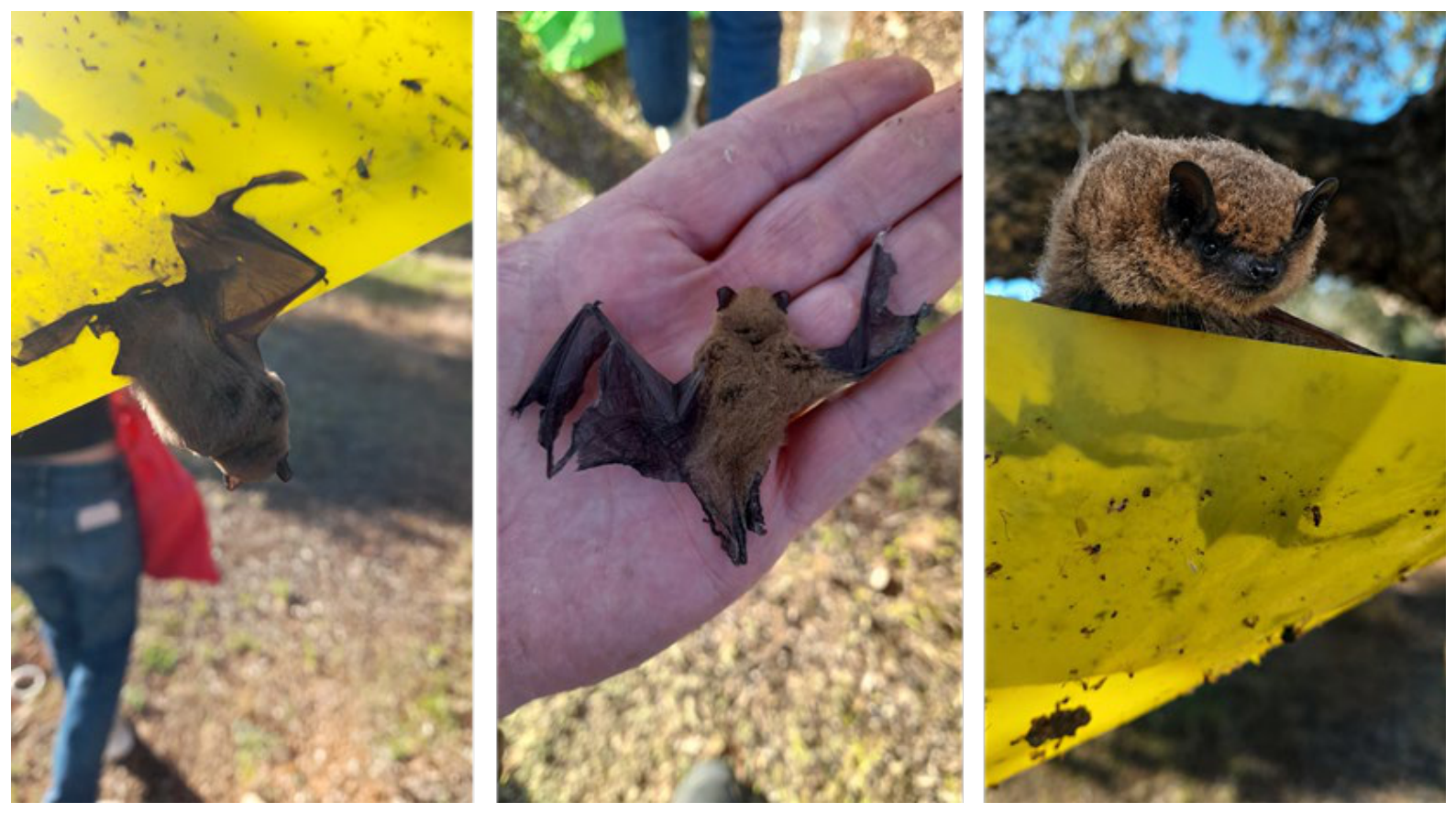
On 15 May 2026, during collection of adhesive panels deployed for flying-insect monitoring, a member of our team (K.K.) documented a dead adult bat attached to a yellow chromotropic panel in a traditionally managed olive grove in the central part of Lesvos Island, North Aegean, Greece. Direct examination confirmed that the individual was dead before the panel was repositioned for photographic documentation (Figure 1).
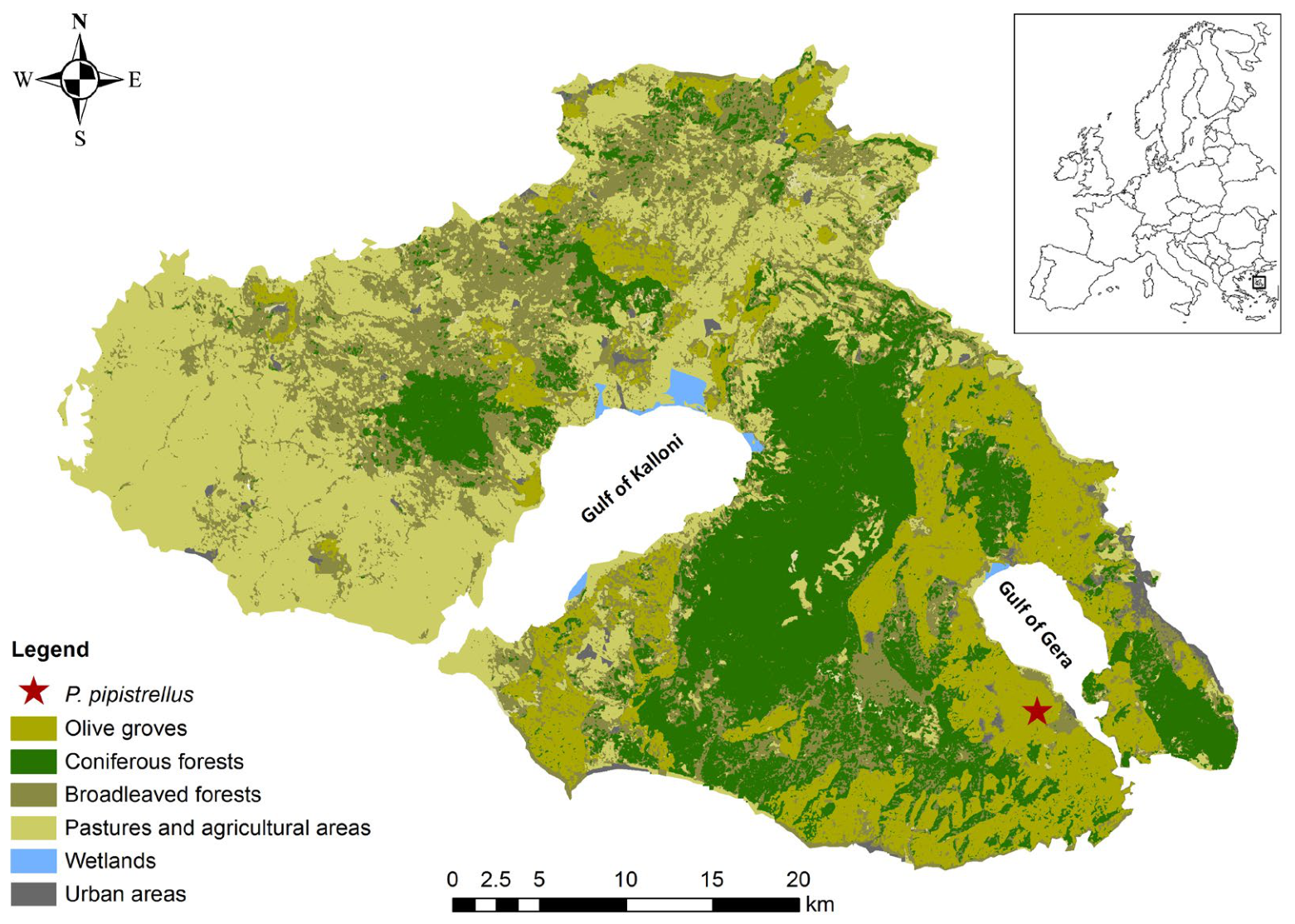
The bat was captured as part of a flying-insect monitoring scheme initiated in April 2026, in a grove which was managed under low-intensity conditions, with limited agrochemical inputs and periodic mechanical cutting of the understorey (Figure 2). Yellow chromotropic adhesive panels measuring 10 × 23 cm were deployed without chemical attractants at a density of three panels per hectare and suspended from olive branches at approximately 1.9–2.0 m above ground. In each monthly sampling round, the panels were exposed for seven consecutive days and subsequently removed and examined; no panels remained in the field between rounds. The bat was recovered during the second monthly round in May from the second panel examined during collection. Accordingly, four panels had been examined before the observation, and the bat was encountered on the fifth panel examined since monitoring began, following two seven-day deployment periods, equivalent to 14 calendar days of field exposure.
At the time of inspection, the panel had accumulated small-bodied Diptera (Ceratopogonidae, Sciaridae, Phoridae, Hybotidae, Psychodidae, Muscidae, Anthomyiidae), including several groups reported in the diet of P. pipistrellus [10]. Following removal from the panel, the specimen was independently examined for taxonomic identification by two specialist chiropterologists, while standard external measurements and post-mortem body mass were recorded from the specimen.
The specimen was identified as an adult P. pipistrellus (Schreber, 1774; wingspan of 23.1 cm, post-mortem body mass of 5.9 g). The individual was confirmed dead by direct examination before photographic documentation, as it was extensively adhered to the panel surface, with its wings spread and the patagium in direct contact with the glue layer. To our knowledge, this constitutes the first documented record of bat bycatch on an adhesive monitoring panel in Greece and one of the few reported from the eastern Mediterranean [7].
A deployment height of 1.9–2.0 m was used when placing the trap within the foraging and commuting flight stratum of P. pipistrellus in cluttered edge environments [11,12], and the mid-May timing coincides with both peak bat foraging effort following spring emergence [13] and the onset of the B. oleae monitoring season [14]; this phenological alignment may increase encounter probability, although the magnitude of this risk cannot be inferred from a single observation.
Within this context, two non-exclusive capture pathways merit consideration. Passive echolocation failure—a bat unable to resolve the flat adhesive panel in time to execute avoidance—is plausible, on two grounds. First, smooth flat surfaces behave as acoustic mirrors: when insonified at an oblique angle, they reflect most of the incident energy away from the emitting bat returning stronger echoes mainly at near-perpendicular incidence and potentially leaving insufficient time for avoidance [15]. Second, acoustic clutter from the surrounding olive canopy could further reduce the probability of timely detection and avoidance [16].
Another plausible pathway is active prey-associated attraction: the trap surface bore a visible accumulation of Ceratopogonidae, Sciaridae, Phoridae and Muscidae—families within the core dietary spectrum of this species [10] and dominant in the arthropod assemblages of low-intensity Lesvos olive groves [17]—constituting a concentrated prey patch potentially detectable through insect volatiles and acoustic emissions of struggling prey. The yellow colour of the panel functions as a visual attractant for insects; any attraction of the bat would therefore have been indirect and mediated by prey-derived cues. A bat investigating such a patch and contacting the adhesive surface may have approached the panel in response to these cues, although this mechanism remains hypothetical because the bat’s approach was not observed.
That pathway, if confirmed, would expose a feedback not previously explicitly incorporated into the bat bycatch literature. The individual documented here belonged to an insectivorous species potentially contributing to arthropod suppression in olive agroecosystems, yet was eliminated by a device deployed to monitor a major insect pest. Pipistrelle bats consume small-bodied Diptera [10], and bat insectivory is recognized more generally as an ecosystem service in farmland [18]. However, direct dietary evidence for Tephritidae, and specifically for B. oleae, in P. pipistrellus is currently lacking, so consumption of the olive fly itself is therefore inferred from prey-size compatibility. Whether adhesive traps remove foraging bats at rates sufficient to impair this potential pest-suppression function remains unknown because European records derive predominantly from opportunistic reports [7] and routine B. oleae surveillance does not systematically document vertebrate bycatch. Resolving this uncertainty requires standardized bycatch records linked to trap density, deployment duration, and inspection effort. Until such evidence becomes available, the conservation significance of the present record rests on the documented mortality of a strictly protected species caused by a monitoring device used in Mediterranean olive cultivation, irrespective of the strength of the inferred dietary link. This paradox extends beyond adhesive traps, as other routine agricultural practices and equipment may also generate unintended vertebrate mortality. [19] provides a comparable example of unintended vertebrate mortality associated with routine olive-management equipment.
This shift from habitat-level value to object-level risk is especially important because P. pipistrellus is protected under Annex IV of the Habitats Directive (92/43/EEC) and Appendix II of the Bern Convention, while its low reproductive output increases its vulnerability to recurrent additional mortality [20]. Although a single record cannot establish population-level risk, the cumulative effects on bat populations are entirely unquantified. Systematic incorporation of bat bycatch recording into routine trap inspections, a low-cost addition to existing protocols, would generate the prevalence data needed to move from isolated observations to quantitative risk assessment; if recurrent bycatch is demonstrated, modified trap placement, physical barriers, and temporal adjustments could then be evaluated as potential mitigation measures without compromising B. oleae monitoring.

Author Contributions

Conceptualization, G.S. and Y.G.Z.; methodology, G.S., K.K., T.K. and Y.G.Z.; investigation, G.S. and K.K.; resources, G.S., K.K., T.K. and Y.G.Z.; writing—original draft preparation, G.S. and Y.G.Z.; writing—review and editing, G.S., K.K., T.K. and Y.G.Z.; visualization, G.S. and Y.G.Z. All authors have read and agreed to the published version of the manuscript.

Funding

This research received no external funding.

Data Availability Statement

The original contributions presented in this study are included in the article. Further inquiries can be directed to the corresponding authors.

Acknowledgments

We would like to thank G. Papamichael and P. Georgiakakis for the identification of the bat. All aspects of this study were conducted in full compliance with Hellenic national law (Presidential Decree 67/81: “On the protection of native flora and wild fauna and the determination of the coordination and control procedure of related research”) on the humane use of animals. No live animals were captured, handled, or subjected to experimental procedures.

Conflicts of Interest

The authors declare no conflicts of interest.

References

  1. Zevgolis, Y.G.; Kamatsos, E.; Christopoulos, A.; Valeta, C.; Rekouti, E.; Xagoraris, C.; Mitsainas, G.P.; Lymberakis, P.; Youlatos, D.; Dimitrakopoulos, P.G. A Squirrel’s Guide to the Olive Galaxy: Tree-Level Determinants of Den-Site Selection in the Persian Squirrel within Traditional Mediterranean Olive Groves. Biology 2025, 14, 1676. [Google Scholar] [CrossRef] [Scilit] [PubMed]
  2. Herrera, J.M.; Costa, P.; Medinas, D.; Marques, J.T.; Mira, A. Community composition and activity of insectivorous bats in Mediterranean olive farms. Anim. Conserv. 2015, 18, 557–566. [Google Scholar] [CrossRef] [Scilit]
  3. Georgiakakis, P.; Kafkaletou Diez, A.; Salvarina, I.; Benda, P.; Billington, G.; Dietz, C.; Billington, J.; Cove, D.; Davison, S.; Cooke, M.; et al. The Bats of Greece: An Updated Review of Their Distribution, Ecology and Conservation. Animals 2023, 13, 2529. [Google Scholar] [CrossRef] [Scilit] [PubMed]
  4. Ancillotto, L.; Scaramella, C.; Dartora, F.; Migliozzi, A.; Russo, D. Organic farming sustains bats in Mediterranean farmland. Agric. Ecosyst. Environ. 2023, 342, 108230. [Google Scholar] [CrossRef] [Scilit]
  5. Daane, K.M.; Johnson, M.W. Olive Fruit Fly: Managing an Ancient Pest in Modern Times. Annu. Rev. Entomol. 2010, 55, 151–169. [Google Scholar] [CrossRef] [Scilit] [PubMed]
  6. Stavrianakis, G.; Sentas, E.; Tscheulin, T.; Kizos, T. Does biodiversity affect Olive fly populations? Evidence from different understorey treatments. Discov. Conserv. 2024, 1, 3. [Google Scholar] [CrossRef] [Scilit]
  7. Ancillotto, L.; Cosentino, F.; Festa, F.; Mori, E. Adhesive traps for suppressing pest insects represent a serious threat to bats across Europe. Eur. J. Wildl. Res. 2024, 70, 119. [Google Scholar] [CrossRef] [Scilit]
  8. Sallé, A.; Arthur, L.; Parmain, G.; Williams, D.; Chrétien, A.; Le Souchu, E.; Moliard, C.; Roques, A.; Bouget, C. Preventing unintentional Bat captures in canopy traps used for insect surveys. Eur. J. Wildl. Res. 2026, 72, 37. [Google Scholar] [CrossRef] [Scilit]
  9. Frick, W.F.; Kingston, T.; Flanders, J. A review of the major threats and challenges to global bat conservation. Ann. N. Y. Acad. Sci. 2020, 1469, 5–25. [Google Scholar] [CrossRef] [Scilit] [PubMed]
  10. Barlow, K.E. The diets of two phonic types of the bat Pipistrellus pipistrellus in Britain. J. Zool. 1997, 243, 597–609. [Google Scholar] [CrossRef] [Scilit]
  11. Russo, D.; Jones, G. Use of foraging habitats by bats in a Mediterranean area determined by acoustic surveys: Conservation implications. Ecography 2003, 26, 197–209. [Google Scholar] [CrossRef] [Scilit]
  12. Racey, P.A.; Swift, S.M. Feeding Ecology of Pipistrellus pipistrellus (Chiroptera: Vespertilionidae) during Pregnancy and Lactation. I. Foraging Behaviour. J. Anim. Ecol. 1985, 54, 205. [Google Scholar] [CrossRef] [Scilit] [PubMed]
  13. Speakman, J.R.; Racey, P.A. Hibernal Ecology of the Pipistrelle Bat: Energy Expenditure, Water Requirements and Mass Loss, Implications for Survival and the Function of Winter Emergence Flights. J. Anim. Ecol. 1989, 58, 797. [Google Scholar] [CrossRef] [Scilit] [PubMed]
  14. Stavrianakis, G.; Sentas, E.; Zafeirelli, S.; Tscheulin, T.; Kizos, T. Utilizing Olive Fly Ecology Towards Sustainable Pest Management. Biology 2025, 14, 125. [Google Scholar] [CrossRef] [Scilit] [PubMed]
  15. Greif, S.; Zsebők, S.; Schmieder, D.; Siemers, B.M. Acoustic mirrors as sensory traps for bats. Science 2017, 357, 1045–1047. [Google Scholar] [CrossRef] [Scilit] [PubMed]
  16. Schnitzler, H.; Kalko, E.K.V. Echolocation by insect-eating bats: We define four distinct functional groups of bats and find differences in signal structure that correlate with the typical echolocation tasks faced by each group. Bioscience 2001, 51, 557–569. [Google Scholar] [CrossRef] [Scilit]
  17. Stavrianakis, G.; Sentas, E.; Stattegger, S.R.; Tscheulin, T.; Kizos, T. Effect of olive grove’s understorey management on arthropod diversity. Agroecol. Sustain. Food Syst. 2024, 48, 1115–1138. [Google Scholar] [CrossRef] [Scilit]
  18. Russo, D.; Bosso, L.; Ancillotto, L. Novel perspectives on bat insectivory highlight the value of this ecosystem service in farmland: Research frontiers and management implications. Agric. Ecosyst. Environ. 2018, 266, 31–38. [Google Scholar] [CrossRef] [Scilit]
  19. Zevgolis, Y.G.; Christopoulos, A. Entrapped in Olive-Harvesting Nets: A Case of a Grass Snake Natrix natrix from an Olive-Growing Greek Aegean Island. Diversity 2023, 15, 452. [Google Scholar] [CrossRef] [Scilit]
  20. Wilkinson, G.S.; South, J.M. Life history, ecology and longevity in bats. Aging Cell 2002, 1, 124–131. [Google Scholar] [CrossRef] [Scilit] [PubMed]
Figure 1. In situ documentation of Pipistrellus pipistrellus (Schreber, 1774) attached to a yellow adhesive panel in an olive grove on Lesvos, Greece.
Diversity 18 00489 g001
Figure 2. Geographic context of the record in central Lesvos Island, North Aegean, Greece. The map situates the olive-grove locality within the olive-dominated landscape of the island.
Diversity 18 00489 g002
Disclaimer/Publisher’s Note: The statements, opinions and data contained in all publications are solely those of the individual author(s) and contributor(s) and not of MDPI and/or the editor(s). MDPI and/or the editor(s) disclaim responsibility for any injury to people or property resulting from any ideas, methods, instructions or products referred to in the content.