


Abstract
Benthic foraminifera are widely used as indicators of marine environmental conditions due to their sensitivity to ecological changes and their excellent preservation in sediments. In this study, benthic foraminiferal assemblages from a sediment core collected in the central Yellow Sea were investigated to document faunal composition and examine temporal changes since the Late Pleistocene. A total of 54 benthic foraminiferal species belonging to 33 genera, 25 families, seven orders, three classes, and one phylum were identified. Among them, 12 species are newly recorded in Korean waters, reflecting the current incompleteness of regional faunal inventories and the importance of detailed taxonomic studies. The assemblages exhibit distinct stratigraphic variations. The lower interval (>30 ka) is characterized by low-diversity assemblages dominated by taxa commonly associated with marginal marine environments. The middle interval (ca. 20–25 ka) shows the occurrence of taxa typically reported from boreal to subarctic environments, suggesting changes in environmental conditions during the Last Glacial Maximum. In contrast, the upper interval (Holocene) is marked by increased species diversity and the dominance of taxa characteristic of normal marine shelf environments. These assemblage changes are interpreted as reflecting long-term responses of benthic communities to sea-level fluctuations, sedimentary conditions, and regional oceanographic variability in the Yellow Sea. In particular, the development of fine-grained deposits in the Central Yellow Sea Mud (CYSM) and the establishment of stable marine shelf conditions during the Holocene likely played important roles in shaping benthic habitats. This study provides new baseline data on benthic foraminiferal diversity in the Yellow Sea and demonstrates the potential of these assemblages as useful, though indirect, indicators for reconstructing past environmental changes. The results highlight the importance of integrating detailed taxonomic analyses with stratigraphic records to improve our understanding of marine biodiversity and paleoenvironmental variability in marginal seas.
1. Introduction
Benthic foraminifera are widely distributed marine protists that produce mineralized tests and are abundantly preserved in marine sediments, making them one of the most widely used proxies for reconstructing past marine environments [1,2,3]. Because foraminiferal diversity and distribution patterns are highly sensitive to environmental variables, such as temperature, salinity, oxygen availability, organic matter supply, and sediment grain size, they have been widely used in paleoceanographic and paleoenvironemtal studies to infer environmental changes across a wide range of temporal and spatial scales [1,2]. In addition, benthic foraminifera also serve as valuable components of marine biodiversity, contributing to our understanding of species diversity, biogeographic distribution, and ecosystem responses to environmental changes [4,5].
The Yellow Sea is a shallow epicontinental shelf sea located between the Korean Peninsula and the Chinese mainland. This region has been strongly influenced by repeated sea-level fluctuations since the Late Pleistocene [6,7,8]. During glacial periods, including the Last Glacial Maximum (LGM), large portions of the continental shelf were exposed due to lowered sea levels, whereas subsequent Holocene transgressions led to the re-establishment of marine conditions [7,9,10]. These sea-level changes, combined with complex oceanographic processes such as the influence of the Yellow Sea Warm Current, coastal currents, and seasonal stratification, have shaped the sedimentary and ecological environments of the region [6,11]. As a result, the Yellow Sea provides an ideal natural laboratory for investigating the interactions between climatic forcing, oceanographic variability, and benthic ecosystems over geological timescales [8].
Despite its importance, studies on benthic foraminifera in the Yellow Sea have predominantly focused on ecological distribution patterns and environmental interpretations, while comprehensive taxonomic investigations and faunal inventories remain relatively limited [12,13]. In particular, baseline data on benthic foraminiferal diversity in Korean waters are still insufficient compared to those from adjacent regions such as China and Japan [13,14]. This lack of taxonomic resolution and faunal documentation hampers accurate biodiversity assessments and limits the reliability of paleoenvironmental reconstructions based on foraminiferal assemblages [1,15]. Furthermore, recent advances in marine biodiversity research emphasize the importance of establishing region-specific baseline datasets to detect long-term environmental changes and to support ecosystem-based management strategies [16,17].
In this context, detailed taxonomic studies and faunal documentation of benthic foraminifera are essential for improving our understanding of species diversity and biogeographic patterns in the Yellow Sea [4,12]. Such studies not only contribute to refining regional biodiversity inventories but also enhance the interpretive power of foraminiferal assemblages as environmental proxies [1,2]. Moreover, documenting newly recorded species expands our knowledge of species distribution ranges and provides critical data for future comparative and evolutionary studies [5,18].
Therefore, this study aims to investigate the taxonomic composition and stratigraphic distribution of benthic foraminiferal assemblages from the CYSM, a major fine-grained sedimentary deposit in the central Yellow Sea [8]. Specifically, this study seeks to (1) document the benthic foraminiferal fauna preserved in sediment cores, (2) report newly recorded species from the Yellow Sea, and (3) examine temporal changes in assemblage composition since the Late Pleistocene. By providing a comprehensive faunal dataset and stratigraphic framework, this study contributes to improving baseline knowledge of benthic foraminiferal biodiversity and offers valuable insights into paleoenvironmental changes in the Yellow Sea.
2. Materials and Methods
2.1. Study Area
The Yellow Sea is a semi-enclosed marginal sea located between the Korean Peninsula and the Chinese mainland, covering an area of approximately 400,000 km2 [6]. Water depths generally range from 20 to 100 m, with a mean depth of ~45 m, characterizing the basin as a broad and shallow epicontinental shelf [19]. The central Yellow Sea, in particular, consists of an extensive and gently sloping shelf with average water depths of 45–55 m [6,20]. This region is strongly influenced by terrigenous sediment supply derived primarily from major Chinese rivers, including the Yangtze River, resulting in the development of fine-grained, clay-dominated deposits known as the CYSM [6,20]. The accumulation of these sediments reflects long-term interactions among sediment supply, sea-level fluctuations, and hydrodynamic processes [6,21]. Oceanographically, the Yellow Sea exhibits a complex circulation system formed by the interaction between the Yellow Sea Warm Current and freshwater discharge from both the Korean Peninsula and the Chinese mainland [22]. This interaction generates distinct water masses, including the Korean Coastal Current, the China Coastal Current, and the Yellow Sea Cold Water mass [11,22]. Strong tidal currents and seasonal hydrographic stratification further contribute to sediment redistribution and environmental variability across the shelf [23]. Owing to its shallow bathymetry, dynamic hydrodynamic regime, and sensitivity to Quaternary sea-level fluctuations, the central Yellow Sea preserves sedimentary records that reflect both climatic forcing and oceanographic variability [24,25]. Fine-grained depositional environments in this region favor the preservation of benthic foraminiferal assemblages, making it an ideal setting for reconstructing past environmental and circulation changes associated with glacial–interglacial climate variability [2,24].
2.2. Sample Collection and Morphological Analysis
The sediment core (2021-YS-A10; length 635 cm, water depth 68.9 m) was collected from the central Yellow Sea (Figure 1; 36°18′17′′ N, 123°21′0′′ E). The sampling-site map was generated using QGIS software (version 4.0; QGIS Development Team, https://qgis.org). The core was longitudinally split, and samples were obtained at 10 cm intervals in the upper section and at 20 cm intervals in the middle and lower sections (Table 1). The sample pretreatment was followed. Briefly, sediment samples were wet-sieved with distilled water through a 63 μm mesh sieve, and the residues were dried at 50–55 °C. The dried samples were subsequently divided into representative splits using a microsplitter (MS-1, ASC Scientific, Narragansett, RI, USA). Foraminiferal specimens were examined and taxonomically classified under a stereomicroscope (Stemi 305, ZEISS, Oberkochen, Germany) at magnifications of 20–80×, and representative individuals were photographed. Selected specimens were mounted on aluminum stubs, coated with platinum, and observed using a field-emission scanning electron microscope (FE-SEM; JSM-7600F, JEOL, Akishima, Japan) to document detailed morphological features. Species identification followed established taxonomic descriptions and published references. New recorded species were recognized based on the checklist of Korean foraminifera [26].
Figure 1.
(A) Sampling site in the Central Yellow Sea Mud (CYSM), Yellow Sea. (B) Photograph showing the representative core sediment section.
Table 1.
Core information, age, and sediment characteristics of core 2021YS-A10 from the central Yellow Sea.
2.3. Chronology
For chronological control, shell materials were selected from four stratigraphic levels and analyzed by accelerator mass spectrometry (AMS) radiocarbon (14C) dating at the Korea Institute of Geoscience and Mineral Resources (KIGAM). All radiocarbon ages were calibrated to calendar years before present (cal yr BP) using an appropriate marine calibration curve, and a regional reservoir correction was applied to account for marine reservoir effects [27]. Based on the calibrated ages, an age–depth model was constructed using linear interpolation between dated horizons.
The resulting age model provides the chronological framework for interpreting stratigraphic variations in benthic foraminiferal assemblages identified in this study.
3. Results
3.1. Age Model
The age–depth model of core 2021YS-A10 was established based on four AMS radiocarbon (14C) dates (Figure 2). The calibrated ages indicate that the core spans approximately the last ~37,000 years, from the Late Pleistocene to the Holocene. Sedimentation rates vary throughout the core, with relatively higher rates observed in the upper interval and lower rates in the deeper sections. Based on the age–depth relationship, the core can be broadly divided into three intervals: the Holocene (<10 ka BP), the LGM (~20–25 ka BP), and the Late Pleistocene (>30 ka BP). This chronological framework provides the basis for interpreting stratigraphic variations in benthic foraminiferal assemblages.
Figure 2.
Age–depth model and sedimentation rate of core 2021YS-A10 from the central Yellow Sea.
3.2. Benthic Foraminiferal Taxonomy
A total of 54 benthic foraminiferal species were identified in this study, comprising one phylum, three classes, seven orders, 25 families, and 33 genera. All recovered specimens belong to benthic taxa. The higher-level taxonomic classification follows Pawlowski et al. (2013). Among the identified taxa, 12 species are newly recorded in Korean waters: Eggerelloides scabrum, Trochammina squamata, Ammonia maruhasii, Ammonia sobrina, Discorbinella subcomplanata, Cryptoelphidiella magellanica, Toddinella matsukawauraensis, Elphidium limpidum, Elphidium dispar, Emayerella frigida, Haynesina glabra and Rosalina natlandi. Brief morphological descriptions are provided only for these newly recorded species, whereas information on global distribution is presented for all identified taxa. Foraminiferal abundance was generally higher in the upper core interval, where taxa such as Ammonia ketienziensis and Bulimina marginata were commonly observed. In the middle interval, overall abundance remained relatively elevated, with taxa including Ammonia beccarii and Elphidium advenum. In contrast, the lower interval exhibited markedly reduced foraminiferal abundance, and taxa such as Cryptoelphidiella magellanica and Elphidium limpidum, commonly reported from boreal–subarctic marine environments, were identified.
Phylum Foraminifera d’Orbigny, 1826
Class Globothalamea Pawlowski, Holzmann & Tyszka, 2013
Order Lituolida Lankester, 1885
Family Prolixoplectidae Loeblich & Tappan, 1985
Genus Eggerelloides Haynes, 1973
1. Eggerelloides scabrum (Williamson, 1858)
[Figure 3A,B (Stereo microscope)]
Reference: Kireenko et al. [28], p. 15, Figure 10.
Samples: 2021YS-A10-5; 2021YS-A10-8
Dimensions: 566.7 μm long, 291.7 μm wide, long:board ratio about 1.9:1.
Figure 3.
Stereo microscope images. (A,B) Eggerelloides scabrum, (C) Sigmoilopsis schlumbergeri, (D,E) Trochammina squamata, (F–I) Ammonia beccarii, (J–M) Ammonia ketienziensis, (N,O) Ammonia maruhasii, (P,Q) Ammonia aomoriensis. Scale bar = 100 µm.
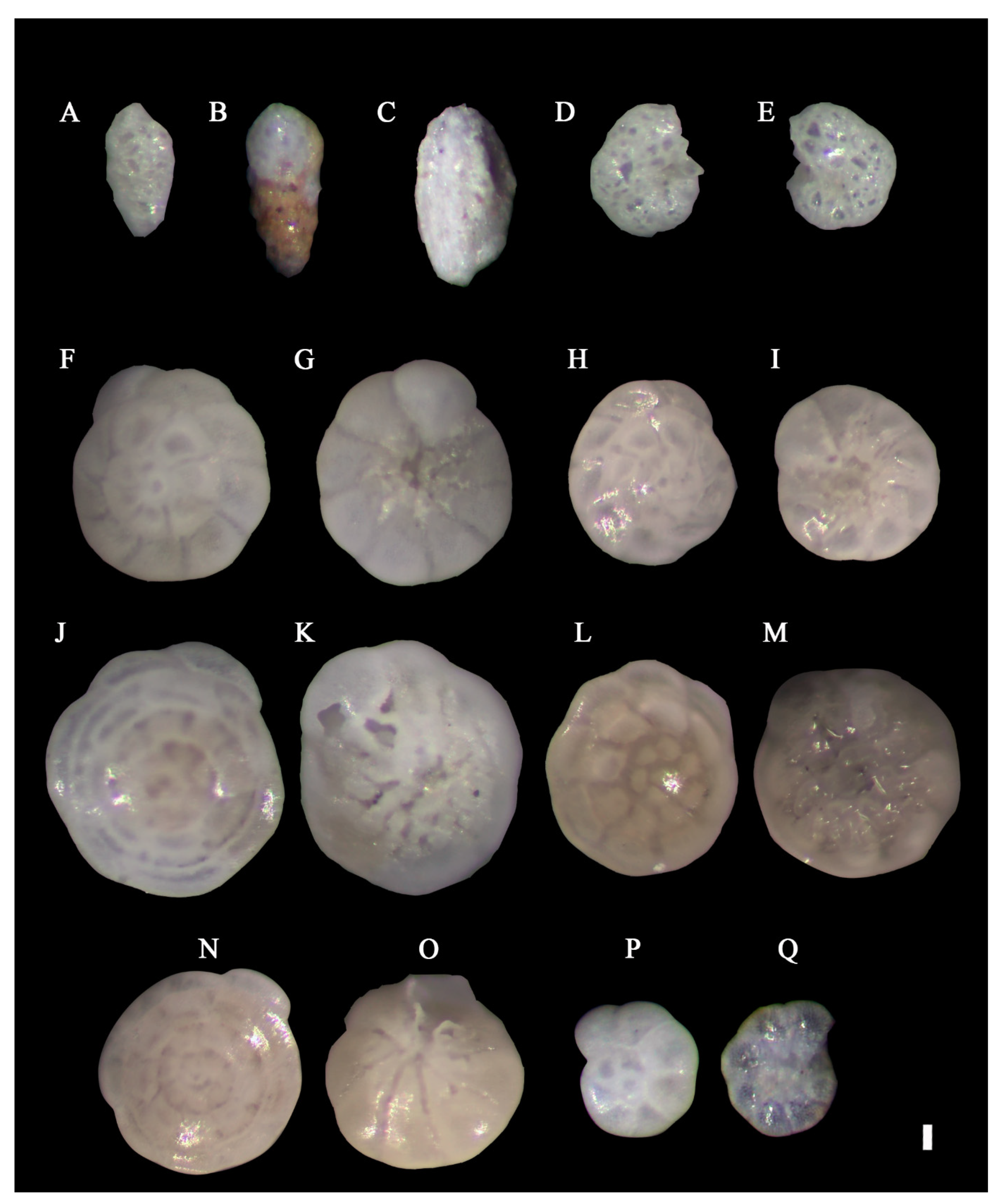
Description: The overall test is elongate and somewhat compressed, with a rough agglutinated wall texture. Chambers are low and broad in shape and gradually increase in size toward the final chamber. The early stage shows a trochospiral arrangement, and the sutures are distinctly depressed. The aperture is narrow and elongate, located at the terminal part of the final chamber.
World distribution: Eggerelloides scabrum was originally described from London, England, by Williamson (1858) [29]. It is a marine species widely distributed in the North Atlantic, North Pacific, and coastal regions of East Asia, and is generally reported from temperate to subpolar marine environments [30]. This species is newly recorded in Korean waters.
Family Sigmoilopsidae Vella, 1957
Genus Sigmoilopsis Finlay, 1947
2. Sigmoilopsis schlumbergeri (Silvestri, 1904)
Reference: Vats et al. [31], p. 4, Figure 2; Tikhonova et al. [32], p. 17, Figure 2; Lei and Li [12], p. 133, Figure 27; Hanagata and Nobuhara [14], p. 24, Figure 9.
Samples: 2021YS-A10-8.
Dimensions: 770.8 μm long, 433.3 μm wide, long:board ratio about 1.8:1.
World distribution: Sigmoilopsis schlumbergeri was originally described from Italy by Silvestri (1904) [33]. It is a marine species known from both modern environments and the fossil record. The species is widely distributed in the North Atlantic, North Pacific, Europe, and coastal regions of East Asia, and occurs over a broad depth range from continental shelf to deep-sea environments [2,12,30]. In Korean waters, this species has been reported to occur in the southwestern sea [26,34].
Family Trochamminidae Schwager, 1877
Genus Trochammina Parker & Jones, 1859
3. Trochammina squamata Jones & Parker, 1860
Reference: Lei and Li [12], p. 43, Figure 18.
Samples: 2021YS-A10-8.
Dimensions: 566.7 μm long, 475.0 μm wide, long:board ratio about 1.2:1.
Description: The test is rounded, circular, and flattened in overall shape, exhibiting trochospiral coiling. The wall is agglutinated and composed of sand grains and other sediment particles, resulting in a rough and irregular surface texture. The test typically consists of 4–5 chambers arranged in a trochospiral coil, with chambers broad and oval, gradually increasing in size toward the final chamber. Sutures are distinct. The aperture is narrow and located on the final chamber.
World distribution: Trochammina squamata was originally described from Italy by Jones and Parker (1860). It is a marine species widely distributed in the North Atlantic, North Pacific, Europe, and coastal regions of East Asia. The species occurs across a broad range of environmental conditions, from intertidal areas to deep-sea environments, and has been reported from waters with temperatures ranging approximately from 0 to 30 °C [2,30]. This is the first report from Korean waters.
Order Rotaliida Lankester, 1885
Family Ammoniidae Saidova, 1981
Genus Ammonia Brünnich, 1771
4. Ammonia beccarii (Linnaeus, 1758)
Reference: Pi et al. [35], p. 5, Figure 3; Takata et al. [36], p. 288, Figure 6; Symphonia and Senthil [37], p. 15, Figure 4; Lei and Li [12], p. 315, Figure 60.
Samples: 2021YS-A10-20; 2021YS-A10-23; 2021YS-A10-24; 2021YS-A10-25; 2021YS-A10-27.
Dimensions: 908.3 μm long, 845.8 μm wide, long:board ratio about 1.1:1.
World distribution: Ammonia beccarii was originally described by Linnaeus (1758) in Systema Naturae, although a specific type locality was not designated [38]. It is a marine species known from both modern environments and the fossil record. The species is widely distributed in the North Atlantic, North Pacific, the Mediterranean Sea, the Indian Ocean, and coastal regions of East Asia, and commonly occurs in temperate to subtropical marine environments [3,30,39]. In Korean waters, this species has been reported to occur widely in coastal environments [13,26,34,40].
5. Ammonia ketienziensis (Ishizaki, 1943)
Reference: Abd El Naby et al. [41], p. 5, Figure 3; Takata, Irino, Katsuki, Woo, Lee, Lim, Ha and Khim [36], p. 289, Figure 7; Lei and Li [12], p. 320, Figure 62; p. 321, Figure 63.
Samples: 2021YS-A10-8; 2021YS-A10-23; 2021YS-A10-11; 2021YS-A10-23.
Dimensions: 1054.2 μm long, 1012.5 μm wide, long:board ratio about 1:1.
World distribution: Ammonia ketienziensis was originally described from Taiwan by Ishizaki (1943) [42]. It is a marine species known from both modern environments and the fossil record. The species is widely distributed in the North Pacific and along the coasts of East Asia, particularly in Korea, China, and Japan, and is generally reported from temperate marine environments [2,12,30]. In Korean waters, Ammonia ketienziensis has been reported from the Yellow Sea and the southeastern East Sea [26,34,40].
6. Ammonia maruhasii (Kuwano, 1950)
Reference: Pi, Chang, Nan, Cui, Liu, Zhang, Li, Chen and Li [35], p. 5, Figure 3; Lei and Li [12], p. 323, Figure 64; Hanagata and Nobuhara [14], p. 120, Figure 35.
Samples: 2021YS-A10-5.
Dimensions: 866.7 μm long, 870.8 μm wide, long:board ratio about 1:1.
Description: The test is rounded and trochospiral in overall outline. The central area is slightly convex but lower than that of Ammonia ketienziensis. The wall is calcareous and appears opaque white, with irregularly distributed pustules on the surface. Chambers, numbering about seven, are arranged in a trochospiral coil and gradually increase in size toward the final chamber. Sutures are distinct and slightly depressed. The aperture is narrow and elongate, located along the margin of the final chamber.
World distribution: Ammonia maruhasii was originally described from Japan by Kuwano (1950) [43]. It is a marine species known mainly from the fossil record. Previous reports indicate its occurrence in coastal regions of East Asia, particularly from China [2,12,30]. The species has been regarded as an indicator taxon of coastal environments [2]. This species is newly recorded in Korean waters.
7. Ammonia aomoriensis (Asano, 1951)
[Figure 3P,Q (Stereomicroscope)]
Reference: Pi, Chang, Nan, Cui, Liu, Zhang, Li, Chen and Li [35], p. 5, Figure 3; Lei et al. [44], p. 52, Figure 2; Lei and Li [12], p. 312, Figure 58.
Samples: 2021YS-A10-22.
Dimensions: 543.1 μm long, 468.2 μm wide, long:board ratio about 1.2:1.
World distribution: Ammonia aomoriensis was originally described from Japan by Asano (1951) [45]. This species is known as a marine taxon and has been reported mainly from coastal regions of the northwestern Pacific, including Japan, Korea, and China [30]. It is generally regarded as a temperate coastal species [44]. In Korea, Ammonia aomoriensis has been reported from the Yellow Sea and the South Sea [26].
8. Ammonia sobrina (Shupack, 1934)
[Figure 4A,B (Stereomicroscope)]
Reference: Lei and Li [12], p. 326, Figure 66; Panchang and Nigam [46], p. 158, pl. 36
Samples: 2021YS-A10-22.
Dimensions: 521.6 μm long, 456.9 μm wide, long:board ratio about 1.2:1.
Figure 4.
Stereo microscope images. (A,B) Ammonia sobrina, (C) Pseudoeponides japonicus, (D,E) Astrononion italicum, (F) Bolivina robusta, (G) Bolivina striatula, (H) Bulimina marginata, (I) Bulimina subornata, (J) Bulimina gibba, (K,L) Discorbis vilardeboanus, (M,N) Discorbinella subcomplanata, (O,P) Hanzawaia nipponica, (Q,R) Cryptoelphidiella magelllanica, (S,T) Toddinella matsukawauraensis. Scale bar = 100 µm.
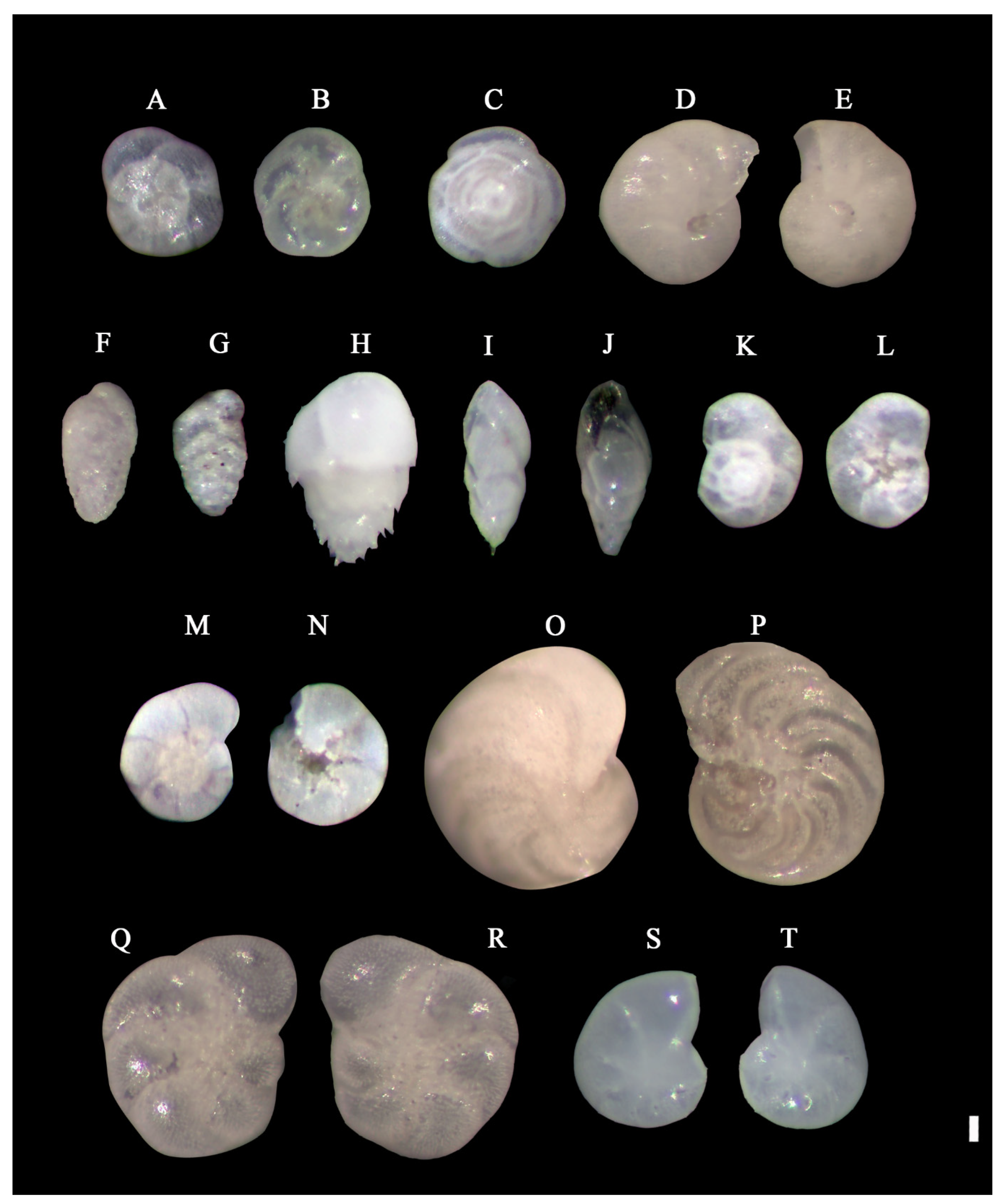
Description: The test is generally rounded in outline and slightly biconvex. The umbilical side is somewhat depressed at the center, forming a divided discoidal shape. The test is calcareous, opaque white in color, and its surface is smooth with distinct perforations. The final whorl consists of six chambers. Sutures are indistinct and gently curved. The aperture is arched in shape.
World distribution: Ammonia sobrina was originally described from Long Island, New York, USA, by Shupack (1934) [47]. This species is a marine taxon that is k nown from fossil records to the present day. It has been reported from temperate marine environments in both the North Pacific and the North Atlantic [2,3,30]. This is the first report from Korean waters.
Genus Pseudoeponides Uchio in Kawai et al., 1950
9. Pseudoeponides japonicus Uchio in Kawai et al., 1950
[Figure 4C (Stereomicroscope)]
Reference: Lei and Li [12], p. 266, Figure 34; Hanagata and Nobuhara [14], p. 105, Figure 31; Panchang and Nigam [46], p. 154, pl. 32.
Samples: 2021YS-A10-6.
Dimensions: 566.7 μm long, 551.0 μm wide, long:board ratio about 1:1.
World occurrence: Pseudoeponides japonicus was originally described from the Otaki area, Chiba Prefecture, Japan, by Uchio (1950) [48]. This species is a marine taxon known only from fossil records. It has been reported from warm continental shelf environments of the northwestern Pacific, particularly along the coasts of Japan and East Asia [2,30]. In Korea, This species has been reported from the Yellow Sea and the South Sea of Korea [13,26,34,40].
Family Astrononionidae Cushman & Edwards, 1937
Genus Astrononion Cushman & Edwards, 1937
10. Astrononion italicum Cushman & Edwards, 1937
Reference: Pi, Chang, Nan, Cui, Liu, Zhang, Li, Chen and Li [35], p. 5, Figure 3; p. 6, Table 1; Kim, Frontalini, Martins and Lee [13], p. 344, Table 2.
Samples: 2021YS-A10-5.
Dimensions: 654.9 μm long, 566.7 μm wide, long:board ratio about 1.2:1.
World distribution: Astrononion italicum was originally described from marine sediments of the Mediterranean region of Italy by Cushman (1937) [49]. This species is a marine taxon and has been reported from temperate continental shelf environments of the North Pacific, North Atlantic, and the Mediterranean Sea [2,30,39]. In Korea, this species has been reported from the southern sea of Korea, particularly around the Jeju area [13,26].
Family Bolivinitidae Cushman, 1927
Genus Bolivina d’Orbigny, 1839
11. Bolivina robusta (Brady, 1881)
Reference: Takata et al. [50], p. 154, Figure 4; Hiroyuki et al. [51], p. 288, Figure 6; Takata et al. [52], p. 16, Figure 3; Lei and Li [12], p. 205, Figure 4; Panchang and Nigam [46], 145, pl. 23.
Samples: 2021YS-A10-11.
Dimensions: 549.0 μm long, 303.9 μm wide, long:board ratio about 1.8:1.
World distribution: Bolivina robusta was originally described from specimens collected during the HMS Challenger Expedition by Brady (1881) [53]. This species is a marine taxon known from both modern and fossil records. It is widely distributed in temperate to subtropical marine environments, including the North Pacific, North Atlantic, Mediterranean Sea, and coastal regions of East Asia [2,3,30]. In Korea, this species has been reported from the Yellow Sea and the South Sea of Korea [26,34].
12. Bolivina striatula Cushman, 1922
[Figure 4G (Stereomicroscope)]
Reference: Takata, Irino, Katsuki, Woo, Lee, Lim, Ha and Khim [36], p. 288, Figure 6; Kireenko, Tikhonova, Kozina and Matul [28], p. 7, Figure 2; Symphonia and Senthil [37], p. 36, Figure 10; Lei and Li [12], p. 209, Figure 6; Debenay [54], p. 171.
Samples: 2021YS-A10-5.
Dimensions: 494.1 μm long, 296.1 μm wide, long:board ratio about 1.7:1.
World distribution: Bolivina striatula was originally described from the Dry Tortugas region, southern United States, by Cushman (1922) [55]. This species is a marine taxon known from both modern and fossil records. It is widely distributed in temperate to subtropical marine environments, including the North Pacific, North Atlantic, Mediterranean Sea, and coastal regions of East Asia [30,54]. In Korea, this species has been reported from the Yellow Sea and the South Sea of Korea [26,34,40].
13. Bolivina cf. d’Orbigny, 1839
[Figure 7K (SEM)]
Samples: 2021YS-A10-11.
Dimensions: 533.3 μm long, 323.7 μm wide, long:board ratio about 1.6:1.
Description: This species exhibits general morphological characteristics of the genus Bolivina, including an elongate and compressed biserial test with narrow chambers. The test surface is characterized by the presence of perforation. However, slight morphological differences from previously described species make precise identification at the species level difficult; therefore, it is referred to as Bolivina cf. in this study.
Family Buliminidae Jones, 1875
Genus Bulimina d’Orbigny, 1826
14. Bulimina marginata d’Orbigny, 1826
Reference: Pi, Chang, Nan, Cui, Liu, Zhang, Li, Chen and Li [35], p. 5, Figure 3; [28], p. 7, Figure 2; p. 17, Figure 12; Vats, Singh, Das, Holbourn, Gupta, Gallagher and Pandey [31], p. 4, Figure 2; Hiroyuki, Seok Hwi, Dong Geun, Jin-Cheul, Daekyo and Boo-Keun [51], p. 288, Figure 6; Symphonia and Senthil [37], p. 36, Figure 10; Tikhonova, Merenkova, Matul and Korsun [32], p. 33, pl. 22.
Samples: 2021YS-A10-5; 2021YS-A10-11.
Dimensions: 760.8 μm long, 523.5 μm wide, long:board ratio about 1.5:1.
World distribution: Bulimina marginata was originally described by d’Orbigny (1826) based on various specimens without a specific type locality [56]. This species is a marine taxon known from both modern and fossil records. It is widely distributed in temperate to subtropical marine environments, including the North Pacific, North Atlantic, Mediterranean Sea, and coastal regions of East Asia [30,39,54]. In Korea, this species has been reported from the Yellow Sea and the South Sea of Korea [26,34,40,57].
15. Bulimina subornata Brady, 1884
Reference: Hanagata and Nobuhara [14], p. 83, Figure 26; Panchang and Nigam [46], p. 148, pl. 26.
Samples: 2021YS-A10-5; 2021YS-A10-11.
Dimensions: 711.8 μm long, 270.6 μm wide, long:board ratio about 2.6:1.
World distribution: Bulimina subornata was originally described by Brady (1884) based on specimens collected during the HMS Challenger Expedition, without a specific type locality [58]. This species is a marine taxon known from both modern and fossil records. It is widely distributed in temperate to subtropical marine environments, including the North Pacific, North Atlantic, and coastal regions of East Asia, where it commonly occurs on continental shelves and upper slope settings. [2,3,30]. In Korea, this species has been reported from the Yellow Sea and the South Sea of Korea [13,26,59].
16. Bulimina gibba Fornasini, 1902
Reference: [12], p. 219, Figure 11; [13], p. 344; [60], p. 94, 96–67.
Samples: 2021YS-A10-5; 2021YS-A10-11.
Dimensions: 698.0 μm long, 303.9 μm wide, long:board ratio about 2.3:1.
World distribution: Bulimina gibba was originally described from the Adriatic Sea, Italy, by Fornasini (1902) [61]. This species is a marine taxon known from both modern and fossil records. It is distributed in the North Pacific, North Atlantic, and Mediterranean regions, typically occurring in temperate to subtropical marine environments on continental shelves and upper slope settings [30,39,60]. In Korea, this species has been reported from the Yellow Sea and the South Sea of Korea [13,26].
Family Discorbidae Ehrenberg, 1838
Genus Discorbis Lamarck, 1804
17. Discorbis vilardeboanus (d’Orbigny, 1839)
[Figure 4K,L (Stereomicroscope)]
Reference: Charrieau et al. [62], p.24, Figure 5; Kireenko, Tikhonova, Kozina and Matul [28], p. 11, Figure 6; p. 19, Figure 14; Tikhonova, Merenkova, Matul and Korsun [32], p.33, pl. 22; p. 34, pl. 23; Lei and Li [12], p. 245, Figure 24.
Samples: 2021YS-A10-23.
Dimensions: 552.9 μm long, 392.2 μm wide, long:board ratio about 1.4:1.
World distribution: Discorbis vilardeboanus was originally described from coastal sediments of South America by d’Orbigny (1839) [63]. This species is a marine taxon widely distributed in temperate to subtropical marine environments, including the North Pacific, North Atlantic, Mediterranean, and coastal regions of East Asia, where it typically occurs in coastal and continental shelf settings [30,39]. In Korea, this species has been reported from the Yellow Sea and the South Sea of Korea [13,26,40].
Family Discorbinellidae Sigal, 1952
Genus Discorbinella Cushman & Martin, 1935
18. Discorbinella subcomplanata (Parr, 1950)
[Figure 4M,N (Stereomicroscope)]
Reference: Lei and Li [12], p. 255, Figure 29.
Samples: 2021YS-A10-27.
Dimensions: 556.9 μm long, 435.3 μm wide, long:board ratio about 1.3:1.
Description: The test is nearly circular to slightly oval in outline and trochospiral in coiling. The spiral side is gently convex, whereas the umbilical side is flat or slightly depressed in the central area, forming a relatively flattened test. Although similar to Discorbis vilardeboanus, this species generally exhibits a more flattened morphology. Chambers number seven to eight in the final whorl and gradually increase in size toward the last chamber. The test is calcareous-hyaline, translucent to opaque white in color, with a smooth surface bearing fine perforations. Sutures are curved and distinct. The aperture is a low arch located on the final chamber.
World distribution: Discorbinella subcomplanata was originally described from specimens collected during the B.A.N.Z. Antarctic Research Expedition (1929–1931) from Antarctic and subantarctic marine regions by Parr (1950) [64]. This species is a marine taxon known from both modern and fossil records. It has been reported from the North Pacific and coastal regions of East Asia and generally occurs in temperate to subtropical coastal and continental shelf environments [2,30,65]. This species is newly recorded in Korean waters.
Genus Hanzawaia Asano, 1944
19. Hanzawaia nipponica Asano, 1944
Reference: Ha et al. [66], p. 32, Figure 5; Pi, Chang, Nan, Cui, Liu, Zhang, Li, Chen and Li [35], p. 5, Figure 3; Takata, Lim, Kang, Woo, Nishida, Ikehara, Khim, Cheong and Hyun [50], p. 155, Figure 5; Hiroyuki, Seok Hwi, Dong Geun, Jin-Cheul, Daekyo and Boo-Keun [51], p. 289, Figure 7; Lei and Li [12], p. 300, Figure 52; Hanagata and Nobuhara [14], p. 117, Figure 34; Panchang and Nigam [46], p. 158, pl. 36.
Samples: 2021YS-A10-5; 2021YS-A10-11.
Dimensions: 976.5 μm long, 786.3 μm wide, long:board ratio about 1.2:1.
World distribution: Hanzawaia nipponica was originally described from Japan by Asano (1944) [67]. This species is a marine taxon known from both modern and fossil records. It is widely distributed in the northwestern Pacific and coastal regions of East Asia, particularly in the China Sea, where it commonly occurs as an epifaunal species under well-oxygenated conditions and is considered an indicator of continental shelf environments [2,12,30,39]. In Korea, this species has been reported from the Yellow Sea, the South Sea, and the southern East Sea of Korea [13,26,66].
Family Elphidiellidae Holzmann & Pawlowski, 2017
Genus Cryptoelphidiella Feyling-Hanssen, 1971
20. Cryptoelphidiella magellanica (Heron-Allen & Earland, 1932)
Reference: Lei and Li [12], p. 351, Figure 79; Cutter et al. [68], p. 963; Dorst and Schönfeld [69], p. 254
Samples: 2021YS-A10-20; 2021YS-A10-25; 2021YS-A10-28; 2021YS-A10-31.
Dimensions: 874.5 μm long, 705.9 μm wide, long:board ratio about 1.2:1.
Description: The test is circular and flattened in outline and planispiral in coiling. Chambers number five to six in the final whorl and are arranged in a spiral pattern, gradually increasing in size toward the final chamber. The test is calcareous-hyaline and relatively thick, translucent to opaque white in color, with distinct surface perforations. Sutures are curved and radially arranged. The aperture is narrow and elongate, located along the margin of the final chamber.
World distribution: Cryptoelphidiella magellanica was originally described from specimens collected from the Falkland Islands and adjacent subantarctic seas by Heron-Allen and Earland (1932) [70]. This species is a marine taxon known from both modern and fossil records. It is widely distributed in high-latitude marine regions, including the North Pacific, North Atlantic, and areas surrounding Antarctica, typically occurring on continental shelves in polar to subpolar environments [2,12,30]. This is the first report from Korean waters.
Genus Toddinella Gudina & Levchuk, 1983
21. Toddinella matsukawauraensis (Takayanagi, 1955)
[Figure 4S,T (Stereomicroscope)]
Reference: Lei et al. [71], p. 12, pl. 6; Lei and Li [12], p. 353, Figure 80.
Samples: 2021YS-A10-22; 2021YS-A10-23; 2021YS-A10-24.
Dimensions: 611.8 μm long, 509.8 μm wide, long:board ratio about 1.2:1.
Description: The test is nearly circular to slightly oval in outline and trochospiral in coiling, with both the spiral and umbilical sides gently convex. Chambers number seven in the final whorl and gradually increase in size toward the final chamber. The test is calcareous-hyaline and relatively thick, translucent to opaque white in color, with distinct surface perforations. Sutures are curved and radially arranged. The aperture is a low arch located on the margin of the final chamber.
World distribution: Toddinella matsukawauraensis was originally described from Fukushima, Japan, by Takayanagi (1955) [72]. This species is a marine taxon distributed in the northwestern Pacific, particularly along the coastal regions of East Asia, including Japan and the East China Sea, where it typically occurs in temperate coastal and continental shelf environments [30,73]. This is the first report from Korean waters.
Family Elphidiidae Galloway, 1933
Genus Elphidium Montfort, 1808
22. Elphidium limpidum He, Hu & Wang, 1965
[Figure 5A,B (Stereomicroscope)]
Reference: Pi, Chang, Nan, Cui, Liu, Zhang, Li, Chen and Li [35], p. 5, Figure 3; Lei and Li [12], p. 374, fig. p 90.
Samples: 2021YS-A10-31; 2021YS-A10-38.
Dimensions: 560.0 μm long, 408.0 μm wide, long:board ratio about 1.4:1.
Figure 5.
Stereo microscope images. (A,B) Elphidium limpidum, (C,D) Elphidium advena, (E,F) Elphidium dispar, (G,H) Elphidium macellum, (I,J) Emayerella frigida, (K,L) Haynesina depressula, (M,N) Haynesina glabra, (O,P) Haynesina sp., (Q,R) Melonis affinis, (S,T) Nonionella sp., (U,V) Nonion sinense. Scale bar = 100 µm.
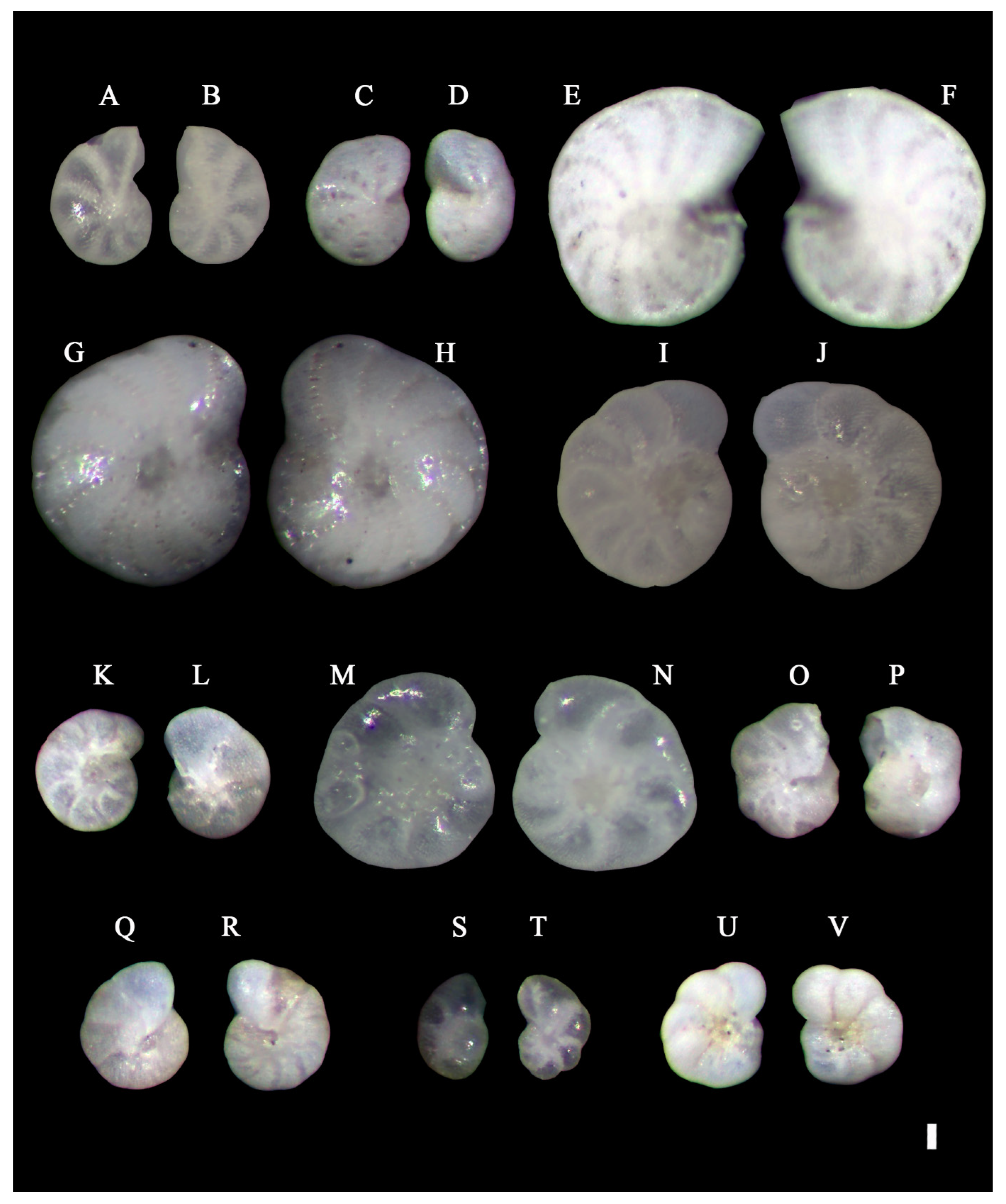
Description: The test is circular in outline and planispiral, with the spiral and umbilical sides showing nearly symmetrical morphology. A rounded umbilical plug is present at the center of both sides. The chambers number approximately 9–10 in the final whorl and gradually increase in size toward the last chamber. The test is calcareous, opaque white in color, and has a smooth surface. Sutures are curved and arranged radially. The aperture is narrow and elongate, forming a low slit located at the margin of the final chamber.
World distribution: Elphidium limpidum was originally described from the Quaternary deposits of northeastern China by He, Hu, and Wang (1965) [48]. It is a marine species reported from high-latitude regions including the northwestern Pacific, particularly along the East Asian coasts, as well as the North Atlantic. The species is generally distributed in coastal to continental shelf environments of transitional to cold-water regions and is regarded as a cold-water species [2,12,30]. This is the first report from Korean waters.
23. Elphidium advena (Cushman, 1922)
Reference: Takata, Lim, Kang, Woo, Nishida, Ikehara, Khim, Cheong and Hyun [50], p. 155, Figure 5; Lei and Li [12], p. 357, Figure 82; Hanagata and Nobuhara [14], p. 122, Figure 36; Kim and Kucera [59], p. 1072, Figure 3.
Samples: 2021YS-A10-8; 2021YS-A10-20; 2021YS-A10-24.
Dimensions: 532.0 μm long, 424.1 μm wide, long:board ratio about 1.3:1.
World distribution: Elphidium advena was originally described from the Mediterranean region by Cushman (1922) [55]. It is a marine benthic foraminiferal species known from both modern environments and the fossil record. The species is widely distributed in temperate to subtropical coastal regions of the North Atlantic, North Pacific, and the Mediterranean Sea [12,30,39,74,75]. In Korean waters, this species has been reported to occur in the Yellow Sea and the South Sea [13,26,40,75].
24. Elphidium dispar Cushman, 1954
[Figure 5E,F (Stereomicroscope)]
Reference: Parker and Gischler [76], p. 6, Figure 4.
Samples: 2021YS-A10-6.
Dimensions: 972.0 μm long, 756.4 μm wide, long:board ratio about 1.3:1.
Description: The test is slightly flattened with a suboval outline and planispiral coiling, with the spiral and umbilical sides showing nearly symmetrical morphology. The chambers number approximately 8–10 in the final whorl and gradually increase in size toward the last chamber. The test is calcareous-hyaline and appears translucent to opaque white. Fine perforations are present along the sutures. Sutures are curved and arranged radially. The aperture is narrow and elongate, forming a low slit located at the margin of the final chamber.
World distribution: Elphidium dispar was originally described from coral atoll environments of the Marshall Islands in the central Pacific Ocean by Cushman (1954) [77]. It is a marine species reported from the Pacific Ocean, the North Atlantic, European coasts, and the coastal regions of East Asia. The species is generally distributed in coastal to brackish environments of temperate regions. This is the first report from Korean waters.
25. Elphidium macellum (Fichtel & Moll, 1798)
[Figure 5G,H (Stereomicroscope)]
Reference: Pi, Chang, Nan, Cui, Liu, Zhang, Li, Chen and Li [35], p. 6; Symphonia and Senthil [37], p. 21, Figure 6; Lei and Li [12], p. 375, Figure 91; Panchang and Nigam [46], p. 159, pl. 37.
Samples: 2021YS-A10-8; 2021YS-A10-24; 2021YS-A10-25.
Dimensions: 1015.7 μm long, 880.1 μm wide, long:board ratio about 1.2:1.
World distribution: Elphidium macellum was originally described from the Mediterranean Sea by Fichtel and Moll (1798) [78]. It is a marine benthic foraminiferal species known from both modern environments and the fossil record. The species is widely distributed in coastal and shallow shelf environments of the North Atlantic, North Pacific, and the Mediterranean region [2,79,80]. In Korean waters, this species has been reported to occur in coastal environments of the Yellow Sea and the South Sea [13,26].
Genus Emayerella Yanko in Hayward et al., 2025
26. Emayerella frigida (Cushman, 1933)
[Figure 5I,J (Stereomicroscope)]
Reference: Lab [81], Lei and Li [12], p. 349, Figure 78.
Samples: 2021YS-A10-24.
Dimensions: 844.3 μm long, 716.2 μm wide, long:board ratio about 1.2:1.
Description: The test is nearly circular in outline, flattened, and planispiral, with the spiral and umbilical sides showing nearly symmetrical morphology. Pustules are concentrated around the umbilical area at the center of the test. The chambers number approximately 7–9 in the final whorl and gradually increase in size toward the last chamber. The test is calcareous-hyaline and appears translucent to opaque white. The surface is smooth with fine perforations. Sutures are curved and arranged radially. The aperture is narrow and elongate, forming a low slit located at the margin of the final chamber.
World distribution: Emayerella frigida was originally described from foraminiferal specimens collected northeast of Greenland by Cushman (1933) [82]. It is a marine species that occurs in both modern and fossil records. The species has been reported from high-latitude regions including the North Atlantic, the North Pacific, and the coastal regions of East Asia. It is generally distributed in continental shelf environments of polar to subpolar marine regions [30,73,81]. This is the first report from Korean waters.
Family Haynesinidae Mikhalevich, 2013
Genus Haynesina Banner & Culver, 1978
27. Haynesina depressula (Walker & Jacob, 1798)
[Figure 5K,L (Stereomicroscope)]
Reference: Symphonia and Senthil [37], p. 25, Figure 7; Lei and Li [12], p. 268, Figure 35.
Samples: 2021YS-A10-24; 2021YS-A10-28.
Dimensions: 496.8 μm long, 404.3 μm wide, long:board ratio about 1.2:1.
World distribution: Haynesina depressula was originally described from the North Atlantic by Walker and Jacob (1798) [83]. It is a marine benthic foraminiferal species known from both modern environments and the fossil record. The species is widely distributed in temperate coastal and shelf environments of the North Atlantic, North Pacific, and European coastal seas [2,12,30]. In Korean waters, this species has been reported to occur in the Yellow Sea and the South Sea [13,26].
28. Haynesina glabra (He, Hu & Wang, 1965)
Reference: Lei and Li [12], p. 285, Figure 44.
Samples: 2021YS-A10-8; 2021YS-A10-22.
Dimensions: 808.6 μm long, 732.5 μm wide, long:board ratio about 1.1:1.
Description: The test is nearly circular in outline, flattened, and planispiral, with the spiral and umbilical sides showing nearly symmetrical morphology. Small pustules are concentrated around the umbilical area at the center of the test. The chambers number approximately 8–9 in the final whorl and gradually increase in size toward the last chamber. The test is calcareous-hyaline and appears translucent to opaque white with a pale yellowish tint. The surface is smooth. Sutures are curved and arranged radially. The aperture is narrow and elongate, forming a low slit located at the margin of the final chamber.
World distribution: Haynesina glabra was originally described from the Quaternary deposits of northeastern China by He, Hu, and Wang (1965) [48]. It is a marine species reported from the North Pacific and the coastal regions of East Asia. Due to its high tolerance to salinity variations, it commonly occurs in coastal and brackish environments of temperate regions [30,84]. This is the first report from Korean waters.
29. Haynesina sp.
[Figure 5O,P (Stereomicroscope)]
Samples: 2021YS-A10-6.
Dimensions: 732.1 μm long, 416.4 μm wide, long:board ratio about 1.8:1.
Description: The test is nearly circular to slightly oval in outline and is flattened, exhibiting a planispiral coiling. The umbilical side is characterized by a distinct rounded umbilical area at the center. The final whorl consists of approximately 7–8 chambers, which increase progressively in size toward the last chamber. The test surface is opaque white and bears fine pustules, with well-developed perforations.
Family Melonidae Holzmann & Pawlowski, 2017
Genus Melonis Montfort, 1808
30. Melonis affinis (Reuss, 1851)
Reference: Hesemann [85], p. 19, fig. A8; Kireenko, Tikhonova, Kozina and Matul [28], p. 10, Figure 5; p. 21, Figure 16; Vats, Singh, Das, Holbourn, Gupta, Gallagher and Pandey [31], p. 4, Figure 2; Kender et al. [86], p. 102, pl. 20.
Samples: 2021YS-A10-6.
Dimensions: 516.1 μm long, 400.6 μm wide, long:board ratio about 1.3:1.
World distribution: Melonis affinis was originally described from the North Atlantic by Williamson (1858) [29]. It is a marine benthic foraminiferal species known from both modern environments and the fossil record. The species is widely distributed in shelf to slope environments of the North Atlantic, North Pacific, and the Mediterranean Sea [12,30,80]. In Korean waters, this species has been reported to occur in the East Sea and the South Sea [13,26,40].
Family Nonionidae Schultze, 1854
Genus Nonionella Cushman, 1926
31. Nonionella sp.
Samples: 2021YS-A10-22; 2021YS-A10-25.
Dimensions: 440.7 μm long, 280.2 μm wide, long:board ratio about 1.6:1.
Description: The test is elongate oval in outline and flattened, with a trochospiral coiling. The final whorl consists of approximately six chambers. The umbilical side is flat to slightly depressed in the central area. The test surface is translucent white, smooth, and glossy. Sutures are distinct and gently curved. Fine pustules are developed along the sutures and extend across the central part of the test.
Genus Nonion Montfort, 1808
32. Nonion sinense [Wang, 1978]
[Figure 5U,V (Stereomicroscope)]
Reference: Lei and Li [12], p. 273, Figure 28.
Samples: 2021YS-A10-33.
Dimensions: 512.1 μm long, 407.9 μm wide, long:board ratio about 1.3:1.
World distribution: Nonion sinense was originally described from coastal waters of China by Wang (1978) [87]. It is a marine benthic foraminiferal species known from both modern environments and the fossil record. The species is widely distributed in coastal and shelf environments of the western Pacific, particularly along the coasts of China, Korea, and Japan [2,30,39]. In Korean waters, this species has been reported to occur in the Yellow Sea and the South Sea [26].
Family Notorotaliidae Hornibrook, 1961
Genus Buccella Andersen, 1952
33. Buccella frigida (Cushman, 1922)
Reference: Pi, Chang, Nan, Cui, Liu, Zhang, Li, Chen and Li [35], p. 5, Figure 3; Hiroyuki, Seok Hwi, Dong Geun, Jin-Cheul, Daekyo and Boo-Keun [51], p. 289, Figure 7; Lei and Li [12], p. 304, Figure 34; Panchang and Nigam [46], p. 158, pl. 36.
Samples: 2021YS-A10-6; 2021YS-A10-8.
Dimensions: 582.1 μm long, 510.7 μm wide, long:board ratio about 1.1:1.
Figure 6.
Stereo microscope images. (A,B) Buccella frigida, (C,D) Buccella tenerrima, (E,F) Epistominella naraensis, (G,H) Rosalina bradyi, (I,J) Rosalina natlandi, (K,L) Cribroelphidium excavatum, (M,N) Cribroelphidium sp., (O) Globocassidulina crassa, (P) Islandiella norcrossi, (Q) Lagena spicata, (R) Lagena striata, (S) Fissurina laevigata, (T) Fissurina lucida, (U) Fissurina sp., (V) Oolina globosa, (W) Glandulina ovula, (X) Lenticulina orbicularis, (Y) Lenticulina nicobarensis, (Z) Saracenaria italica, (aa) Reophax scorpiurus, (ab) Quinqueloculina pygmaea, (ac) Quinqueloculina lamarckiana. Scale bar = 100 µm.
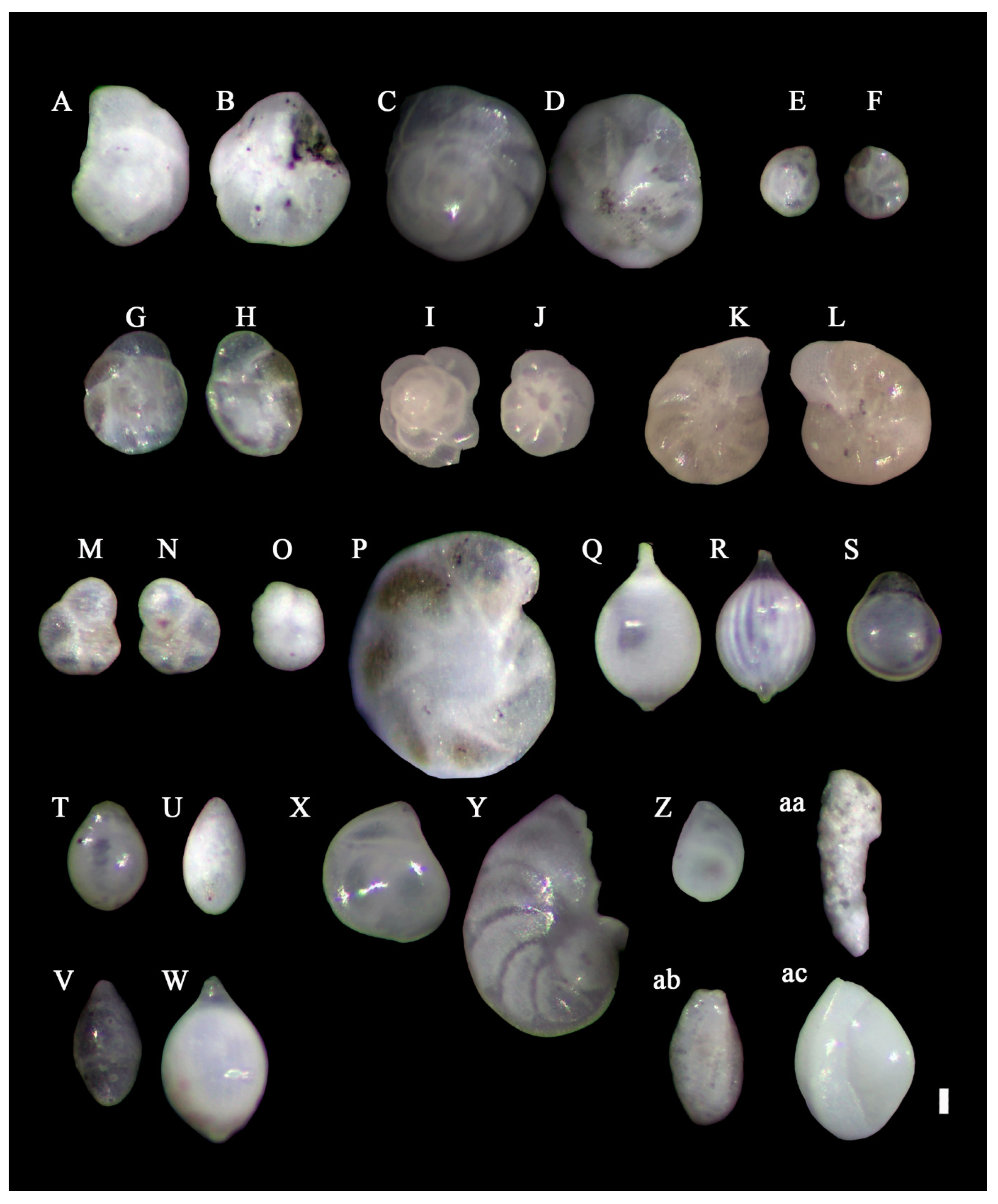
World distribution: Buccella frigida was originally described from the North Atlantic by Cushman (1922) [88]. It is a marine benthic foraminiferal species known from both modern environments and the fossil record. The species is widely distributed in temperate to cold-water coastal and shelf environments of the North Atlantic and North Pacific [2,30,80]. In Korean waters, this species has been reported to occur in the East Sea and the Yellow Sea [13,40,89].
34. Buccella tenerrima (Bandy, 1950)
[Figure 6C,D (Stereomicroscope)]
Reference: Lozinskaia et al. [90], p. 8, pl. 4; Lei and Li [12], p. 302, Figure 53.
Samples: 2021YS-A10-5.
Dimensions: 646.4 μm long, 575.0 μm wide, long:board ratio about 1.1:1.
World distribution: Buccella tenerrima was originally described from the North Pacific by Bandy (1950) [91]. It is a marine benthic foraminiferal species known from both modern environments and the fossil record. The species commonly occurs in temperate coastal and shelf environments of the North Pacific and adjacent marginal seas [2,30,80]. In Korean waters, this species has been reported to occur in the Yellow Sea and the South Sea [26,40].
Family Pseudoparrellidae Voloshinova, 1952
Genus Epistominella Husezima & Maruhasi, 1944
35. Epistominella naraensis (Kuwano, 1950)
Reference: Hiroyuki, Seok Hwi, Dong Geun, Jin-Cheul, Daekyo and Boo-Keun [51], p. 289, Figure 7; Lei and Li [12], p. 253, Figure 28; Takata, Khim, Cheong, Shin, Takayasu, Park and Lim [52], p. 16, Figure 4.
Samples: 2021YS-A10-5.
Dimensions: 286.5 μm long, 252.9 μm wide, long:board ratio about 1.1:1.
World distribution: Epistominella naraensis was originally described from Japan by Kuwano (1950) [43]. It is a marine benthic foraminiferal species known from both modern environments and the fossil record. The species is widely distributed in shelf environments of the northwest Pacific, particularly along the coasts of Japan, Korea, and China [2,30,80]. In Korean waters, this species has been reported to occur in the East Sea and the South Sea [13,26,34,92].
Family Rosalinidae Reiss, 1963
Genus Rosalina d’Orbigny, 1826
36. Rosalina bradyi (Cushman, 1915)
[Figure 6G,H (Stereomicroscope)]
Reference: Kireenko, Tikhonova, Kozina and Matul [28], p. 11, Figure 6; p. 19, Figure 14; Symphonia and Senthil [37], p. 31, Figure 9; Tikhonova, Merenkova, Matul and Korsun [32], p. 33; Lei and Li [12], p. 241, Figure 22.
Samples: 2021YS-A10-23.
Dimensions: 482.7 μm long, 407.7 μm wide, long:board ratio about 1.2:1.
World distribution: Rosalina bradyi was originally described from the North Atlantic by Cushman (1915) [93]. It is a marine benthic foraminiferal species known from both modern environments and the fossil record. The species is widely distributed in coastal and shelf environments of the North Atlantic, North Pacific, and the Mediterranean Sea [2,30,80]. In Korean waters, this species has been reported to occur in the Yellow Sea and the South Sea [13,26,40,92].
37. Rosalina natlandi Church, 1968
Reference: MIkrotax [39]; WoRMS [30], Lab [81].
Samples: 2021YS-A10-20; 2021YS-A10-24.
Dimensions: 471.2 μm long, 363.5 μm wide, long:board ratio about 1.3:1.
Description: The test is nearly circular in outline and flattened, with trochospiral coiling. The spiral side is convex and shows a petal-like arrangement of chambers, while the umbilical side is flat to slightly concave. The chambers number approximately 7–9 in the final whorl and gradually increase in size toward the last chamber. The test is calcareous-hyaline and appears translucent to opaque white. The surface is smooth. Sutures are curved, distinctly developed, and arranged radially. The aperture is narrow and elongate, forming a low slit located at the margin of the final chamber.
World distribution: Rosalina natlandi was originally described from foraminiferal specimens collected off California, USA, by Church (1968) [94]. It is a marine species that is mainly known from fossil records. The species has been reported from the North Atlantic, North Pacific, European coasts, and the coastal regions of East Asia. It is generally distributed in continental shelf environments of temperate marine regions [2,30]. This is the first report from Korean waters.
Family Cribroelphidiidae Voloshinova, 1958
Genus Cribroelphidium Cushman & Brönnimann, 1948
38. Cribroelphidium excavatum (Terquem, 1875)
Reference: Tikhonova, Merenkova, Matul and Korsun [32], p. 26, pl. 18; p. 27, pl. 19; p. 29, pl. 20; p. 31. Pl. 21; p. 35, pl. 24; Gallagher et al. [95], p. 690, Figure 6; Lei and Li [12], p. 364, Figure 85.
Samples: 2021YS-A10-5; 2021YS-A10-11; 2021YS-A10-33.
Dimensions: 554.8 μm long, 490.4 μm wide, long:board ratio about 1.1:1.
World distribution: Cribroelphidium excavatum was originally described from northern Europe by Terquem (1875) [96]. It is a marine benthic foraminiferal species known from both modern environments and the fossil record. The species is widely distributed in cold to temperate coastal and shelf environments of the North Atlantic, Arctic seas, and the North Pacific [2,3,30,54,80]. In Korean waters, this species has been reported to occur in the East Sea and the Yellow Sea [13,26,34].
39. Cribroelphidium sp.
[Figure 6M,N (Stereomicroscope)]
Samples: 2021YS-A10-31.
Dimensions: 380.8 μm long, 309.6 μm wide, long:board ratio about 1.2:1.
Description: The test is circular in outline and exhibits planispiral coiling. The final whorl consists of approximately 6–7 chambers, which increase progressively in size toward the last chamber. The central area of the test is flat to slightly depressed. The test surface is opaque white, with curved sutures. Pustules are irregularly distributed on the surface.
Family Cassidulinidae d’Orbigny, 1839
Genus Globocassidulina Voloshinova, 1960
40. Globocassidulina crassa (d’Orbigny, 1839)
Reference: Ha, Kang, Kum, Shin, Kang, Cho, Jung and Park [66], p. 30, Figure 3; p. 34, Figure 7; Dejardin et al. [97], p. 58, Figure 13; Lei and Li [12], p. 213. Figure 8; Hanagata and Nobuhara [14], p. 73, Figure 23.
Samples: 2021YS-A10-8.
Dimensions: 380.8 μm long, 309.6 μm wide, long:board ratio about 1.2:1.
World distribution: Globocassidulina crassa was originally described from the North Atlantic by d’Orbigny (1839) [98]. It is a marine benthic foraminiferal species known from both modern environments and the fossil record. The species is widely distributed in temperate to cold marine environments of the North Atlantic and North Pacific [2,30,54,66,80]. In Korean waters, this species has been reported to occur in the East Sea and South Sea [13,26,66].
Genus Islandiella Nørvang, 1958
41. Islandiella norcrossi (Cushman, 1933)
Reference: Ha, Kang, Kum, Shin, Kang, Cho, Jung and Park [66], p. 30, Figure 3; Kireenko, Tikhonova, Kozina and Matul [28], p. 8, Figure 3; p. 18, Figure 13; Das et al. [99], p. 4, Figure 3; Kender, Aturamu, Zalasiewicz, Kaminski and Williams [86], p. 92, pl. 10.
Samples: 2021YS-A10-8.
Dimensions: 971.2 μm long, 811.5 μm wide, long:board ratio about 1.2:1.
World distribution: Islandiella norcrossi was originally described from the North Atlantic by Cushman (1933) [82]. It is a marine benthic foraminiferal species known from both modern environments and the fossil record. The species commonly occurs in cold-water shelf environments of the North Atlantic and Arctic regions and has also been reported from the North Pacific [2,30]. In Korean waters, this species has been reported to occur in the East Sea and South Sea [13,26,66].
Class Nodosariata Mikhalevich, 1993 emend. Rigaud et al., 2015
Order Nodosariida Calkins, 1926
Family Lagenidae Reuss, 1862
Genus Lagena Walker & Jacob, 1798
42. Lagena spicata Cushman & McCulloch, 1950
[Figure 6Q (Stereomicroscope)]
Reference: Lei and Li [12], p. 160, Figure 14; p. 165, Figure 17; Panchang and Nigam [46], p. 141, pl. 19; Debenay [54], p. 152.
Samples: 2021YS-A10-5.
Dimensions: 665.4 μm long, 415.4 μm wide, long:board ratio about 1.6:1.
World distribution: Lagena spicata was originally described from the Mediterranean Sea by Cushman (1950). It is a marine benthic foraminiferal species known from both modern environments and the fossil record. The species is widely distributed in shelf and slope environments of the North Atlantic, North Pacific, and the Mediterranean Sea [2,30,39,80]. In Korean waters, this species has been reported to occur in the Yellow Sea, South Sea, and East Sea [26,34,66,76].
43. Lagena striata (d’Orbigny, 1839)
Reference: Hesemann [85], p. 17, Figure 6; Symphonia and Senthil [37], p. 10, Figure 2; Lee et al. [100], p. 86, pl. 4; Lei and Li [12], p. 167, Figure 18.
Samples: 2021YS-A10-6.
Dimensions: 607.7 μm long, 388.5 μm wide, long:board ratio about 1.6:1.
World distribution: Lagena striata was originally described from the Mediterranean region by d’Orbigny (1839) [101]. It is a marine benthic foraminiferal species known from both modern environments and the fossil record. The species is widely distributed in shelf and deep-sea environments of the North Atlantic, North Pacific, and the Mediterranean Sea [2,30,80]. In Korean waters, this species has been reported to occur in the Yellow Sea, South Sea and East Sea [13,26,66,75].
Order Polymorphinida Mikhalevich, 1980
Family Ellipsolagenidae A. Silvestri, 1923
Genus Fissurina Reuss, 1850
44. Fissurina laevigata Reuss, 1850
Reference: Symphonia and Senthil [37], p. 12, Figure 3; Lei and Li [12], p. 189, Figure 31.
Samples: 2021YS-A10-6; 2021YS-A10-11.
Dimensions: 434.6 μm long, 376.9 μm wide, long:board ratio about 1.2:1.
World distribution: Fissurina laevigata was originally described from the Mediterranean region by Reuss (1850) [102]. It is a marine benthic foraminiferal species known from both modern environments and the fossil record. The species commonly occurs in shelf and slope environments of the North Atlantic, North Pacific, and the Mediterranean Sea [2,30,39]. In Korean waters, this species has been reported to occur in the Yellow Sea and South Sea [26,40,75].
45. Fissurina lucida (Williamson, 1848)
Reference: Ha, Kang, Kum, Shin, Kang, Cho, Jung and Park [66], p. 33, Figure. 6; Lei and Li [12], p. 191, Figure 32, Debenay [100], p. 147.
Samples: 2021YS-A10-6.
Dimensions: 436.5 μm long, 317.3 μm wide, long:board ratio about 1.4:1.
World distribution: Fissurina lucida was originally described from the Mediterranean Sea by Williamson (1848) [103]. It is a marine benthic foraminiferal species known from both modern environments and the fossil record. The species is widely distributed in shelf and slope environments of the North Atlantic, North Pacific, and the Mediterranean region [2,30,39]. In Korean waters, this species has been reported to occur in the South Sea and East Sea [13,26,34,66].
46. Fissurina sp.
Samples: 2021YS-A10-6.
Dimensions: 463.5 μm long, 242.3 μm wide, long:board ratio about 1.9:1.
Description: The test is oval in outline, tapering toward the upper end to form a slightly pointed, teardrop shape, and is biconvex. It consists of a single calcareous chamber. The test surface is smooth and glossy, with fine perforations. The aperture is elongate, narrow, and horizontally oriented, located at the upper end of the test.
Genus Oolina d’Orbigny, 1839
47. Oolina globosa (Montagu, 1803)
Reference: Hesemann [85], p. 16, Figure. A5; Dejardin, Kender, Allen, Leng, Swann and Peck [97], p. 53, Figure 12; Panchang and Nigam [46], p. 142, pl. 20.
Samples: 2021YS-A10-8.
Dimensions: 494.2 μm long, 273.1 μm wide, long:board ratio about 1.8:1.
World distribution: Oolina globosa was originally described from the coastal waters of Devon, England, by Montagu (1803) [104]. It is a marine benthic foraminiferal species known from both modern environments and the fossil record. The species commonly occurs in shelf to deep-sea environments of the North Atlantic, North Pacific, and the Mediterranean Sea [2,30,100]. In Korean waters, this species has been reported to occur in the South Sea [13,26].
Family Glandulinidae Reuss, 1860
Genus Glandulina d’Orbigny, 1839
48. Glandulina ovula d’Orbigny, 1846
Reference: Ha, Kang, Kum, Shin, Kang, Cho, Jung and Park [66], p. 33, Figure 6; Das, Singh, Holbourn, Farooq, Vats and Pandey [99], p. 4, Figure 3; p. 36, Figure 9; Symphonia and Senthil [37], p. 12, Figure 3; Lei and Li [12], p. 195, Figure 34.
Samples: 2021YS-A10-6.
Dimensions: 494.2 μm long, 273.1 μm wide, long:board ratio about 1.8:1.
World distribution: Glandulina ovula was originally described from foraminiferal specimens collected off California, USA, by d’Orbigny (1846) [105]. It is a marine species recorded from both modern and fossil deposits. The species has been reported from the North Atlantic, North Pacific, the Mediterranean Sea, and the coastal regions of East Asia. It generally occurs in continental shelf and slope environments of temperate regions, typically associated with organic-rich and well-oxygenated sediments [2,12,30]. In Korean waters, this species has been reported to occur in the South Sea and East Sea [13,66].
Order Vaginulinida Mikhalevich, 1993
Family Vaginulinidae Reuss, 1860
Genus Lenticulina Lamarck, 1804
49. Lenticulina orbicularis (d’Orbigny, 1826)
[Figure 6X (Stereomicroscope)]
Reference: Symphonia and Senthil [37], p. 10, Figure 2; Lei and Li [12], p. 145, Figure 6; Hanagata and Nobuhara [14], p. 31, Figure 11; Panchang and Nigam [46], p. 138, pl. 16.
Samples: 2021YS-A10-5; 2021YS-A10-8; 2021YS-A10-33.
Dimensions: 563.5 μm long, 500.0 μm wide, long:board ratio about 1.1:1.
World distribution: Lenticulina orbicularis was originally described from the Mediterranean Sea by d’Orbigny (1826) [56]. It is a marine benthic foraminiferal species known from both modern environments and the fossil record. The species is widely distributed in shelf to slope environments of the North Atlantic, North Pacific, and the Mediterranean Sea [2,30,39]. In Korean waters, this species has been reported to occur in the South Sea [13,26].
50. Lenticulina nikobarensis (Schwager, 1866)
Reference: Buck et al. [106], p. 305, pl. 4; Chang [75], pl. 17, Figures 11–13.
Samples: 2021YS-A10-8.
Dimensions: 963.5 μm long, 611.5 μm wide, long:board ratio about 1.6:1.
World distribution: Lenticulina nicobarensis was originally described from the Nicobar Islands by Schwager (1866) [107]. It is a marine benthic foraminiferal species known from both modern environments and the fossil record. The species is widely distributed in shelf to slope environments of the Indo-Pacific and adjacent marginal seas [30,39,80]. In Korean waters, this species has been reported to occur in the Yellow sea and South Sea [13,26,75].
Genus Saracenaria Defrance, 1824
51. Saracenaria italica Defrance, 1824
[Figure 6Z (Stereomicroscope)]
Reference: Lei and Li [12], p. 147, Figure 7; Hanagata and Nobuhara [14], p. 33, Figure 12.
Samples: 2021YS-A10-6.
Dimensions: 398.1 μm long, 282.7 μm wide, long:board ratio about 1.4:1.
World distribution: Saracenaria italica was originally described from Italy by Defrance (1824) [108]. It is a marine benthic foraminiferal species known from both modern environments and the fossil record. The species commonly occurs in shelf to slope environments of the North Atlantic, North Pacific, and the Mediterranean Sea [2,30,80]. In Korean waters, this species has been reported to occur in the South Sea [13,26].
Order Hormosinoidea Haeckel, 1894
Family Reophacidae Cushman, 1927
Genus Reophax Montfort, 1808
52. Reophax scorpiurus Montfort, 1808
[Figure 6aa (Stereomicroscope)]
Reference: [85], p. 12, fig. A1; [12], p. 16, Figure 3; [46], p. 123, pl. 1; [60], p. 484.
Samples: 2021YS-A10-22; 2021YS-A10-28.
Dimensions: 748.1 μm long, 238.5 μm wide, long:board ratio about 3.1:1.
World distribution: Reophax scorpiurus was originally described from the North Atlantic by Montfort (1808) [109]. It is an agglutinated benthic foraminiferal species known from both modern environments and the fossil record. The species is widely distributed in shelf to deep-sea environments of the North Atlantic and North Pacific [12,30,60]. In Korean waters, this species has been reported to occur in the Yellow Sea and South Sea [13,26,92].
Class Tubothalamea Pawlowski, Holzmann & Tyszka, 2013
Order Miliolida Delage & Hérouard, 1896
Family Hauerinidae Schwager, 1876
Genus Quinqueloculina d’Orbigny, 1826
53. Quinqueloculina pygmaea Reuss, 1850
[Figure 6ab (Stereomicroscope)]
Reference: Ha, Kang, Kum, Shin, Kang, Cho, Jung and Park [66], p. 33, Figure 6; p. 36, Figure 9; Panchang and Nigam [46], p. 132, pl. 10.
Samples: 2021YS-A10-11.
Dimensions: 532.7 μm long, 292.3 μm wide, long:board ratio about 1.8:1.
World distribution: Quinqueloculina pygmaea was originally described from the Tertiary deposits of the Vienna Basin, Austria, by Reuss (1850) [102]. It is a marine species reported from the North Atlantic, North Pacific, the Mediterranean Sea, and the coastal regions of East Asia. The species is generally distributed in coastal and continental shelf environments of temperate marine regions [2,30,81]. In Korean waters, this species has been reported to occur in the East sea [66].
54. Quinqueloculina lamarckiana d’Orbigny, 1839
Reference: Takata, Lim, Kang, Woo, Nishida, Ikehara, Khim, Cheong and Hyun [50], p. 154, Figure 4; Symphonia and Senthil [37], p. 62, Figure 18; Lei and Li [12], p. 108, Figure 11; Panchang and Nigam [46], p. 131, pl. 9.
Samples: 2021YS-A10-6.
Dimensions: 636.5 μm long, 469.2 μm wide, long:board ratio about 1.4:1.
World distribution: Quinqueloculina lamarckiana was originally described from the Mediterranean Sea by d’Orbigny (1839) [110]. It is a marine benthic foraminiferal species known from both modern environments and the fossil record. The species is widely distributed in temperate to subtropical coastal and shelf environments of the North Atlantic, North Pacific, and the Mediterranean Sea [2,30,39]. In Korean waters, this species has been reported to occur in the Yellow Sea and the South Sea [26,80].
Figure 7.
Scanning electron microscope images. (A) Sigmoilopsis schlumbergeri, (B) Trochammina squamata, (C,D) Ammonia beccarii, (E,F) Ammonia ketienziensis, (G,H) Ammonia maruhasii, (I) Astrononion italicum, (J) Bolivina robusta, (K) Bolivina cf., (L) Bulimina marginata. Scale bar = 100 µm (E,F,I,L); 10 µm (A–D,G,H,J,K).
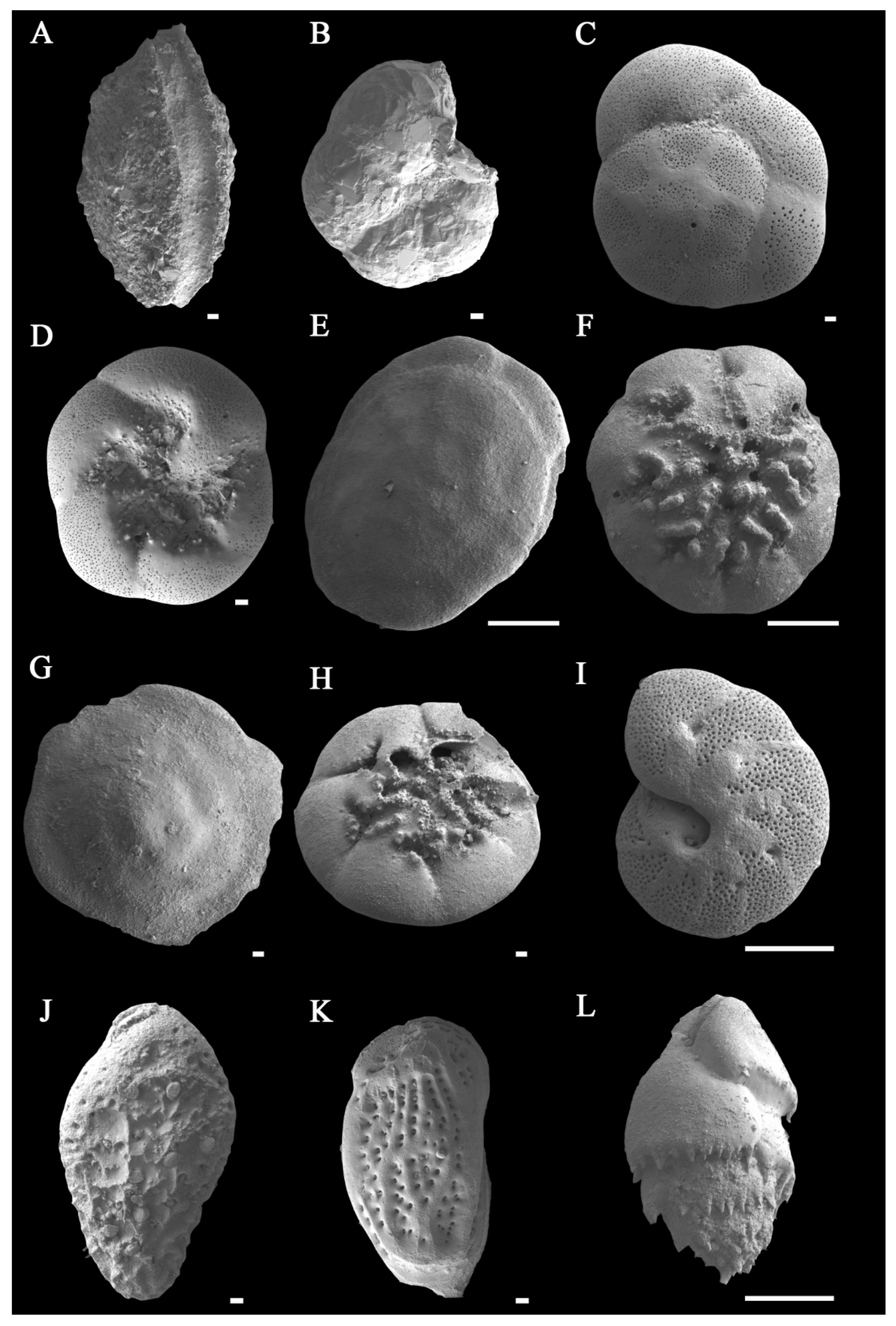
Figure 8.
Scanning electron microscope images. (A) Bulimina subornata, (B) Bulimina gibba, (C,D) Hanzawaia nipponica, (E,F) Elphidium advena, (G) Haynesina glabra, (H) Melonis affinis, (I) Nonionella sp., (J,K) Buccella frigida, (L) Epistominella naraensis. Scale bar = 100 µm (A–G,J); 10 µm (H–I,K,L).
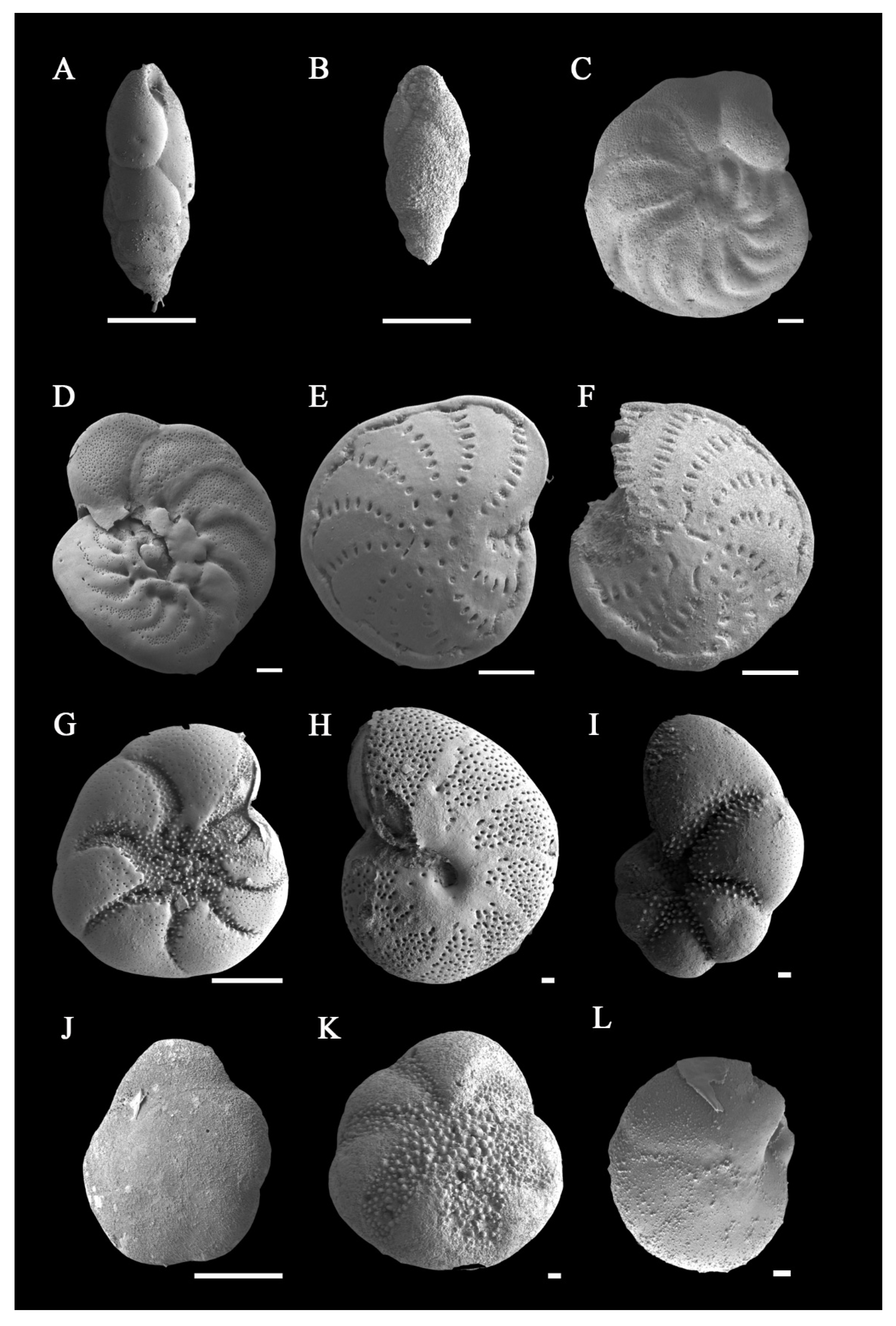
Figure 9.
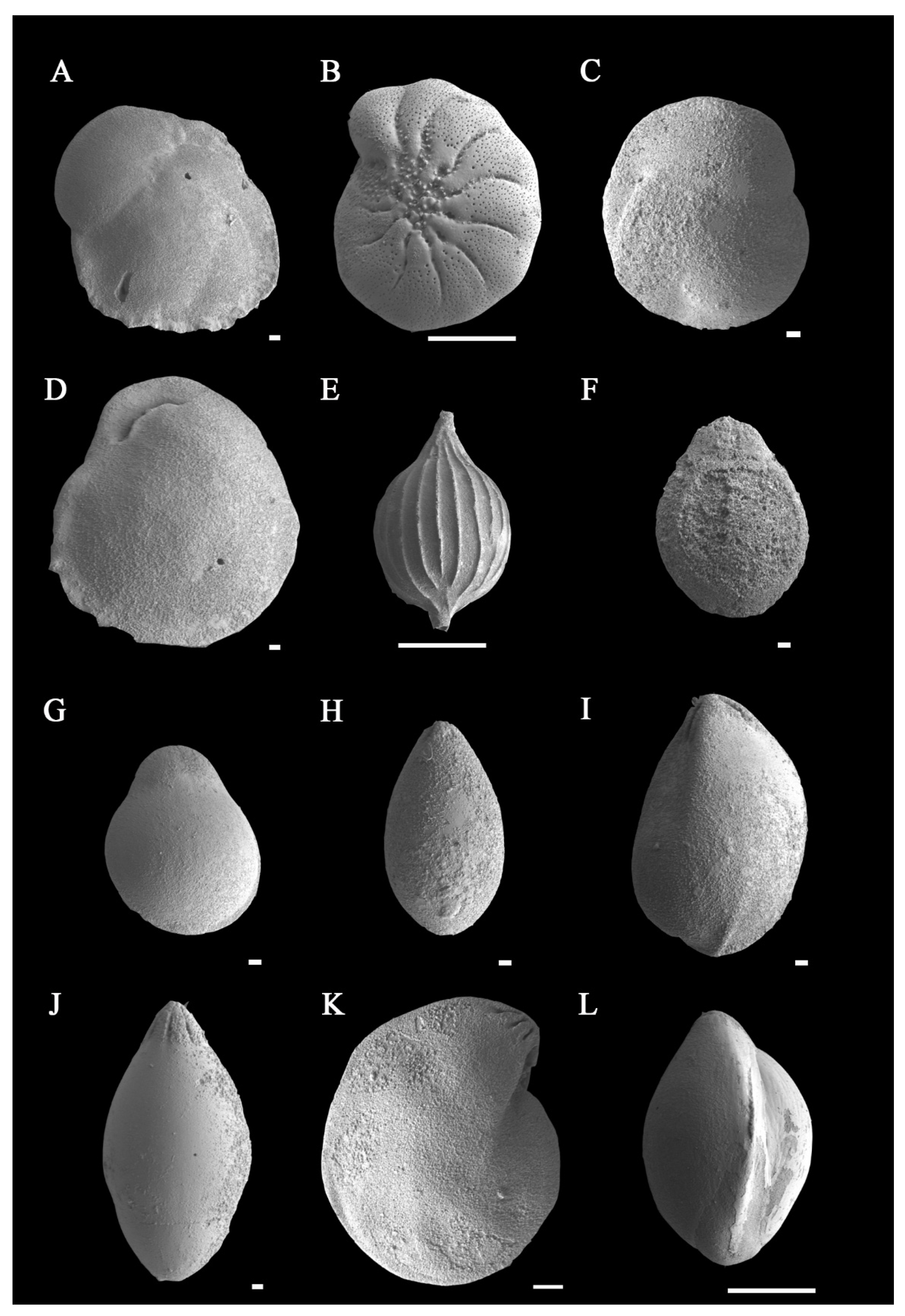
Scanning electron microscope images. (A) Rosalina natlandi, (B) Cribroelphidium excavatum, (C) Globocassidulina crassa, (D) Islandiella norcrossi, (E) Lagena striata, (F) Fissurina laevigata, (G) Fissurina lucida, (H) Fissurina sp., (I) Oolina globosa, (J) Glandulina ovula, (K) Lenticulina nicobarensis, (L) Quinqueloculina lamarckiana. Scale bar = 100 µm (C,E,I,K,L); 10 µm (A,B,D,F–H,J).
3.3. Stratigraphic Distribution of Dominant Benthic Foraminifera
The stratigraphic distribution of dominant benthic foraminiferal taxa shows distinct faunal changes from the Late Pleistocene to the Holocene (Figure 10). In the Holocene interval, A. ketienziensis, B. marginata, H. nipponica, and A. beccarii are relatively abundant, and they are mainly concentrated in the upper part of the core and decrease markedly downward. A. beccarii shows a broader distribution, with relatively high abundances in the middle to lower part of the Holocene interval. In the LGM interval, the assemblage composition changes markedly, as C. magellanica, H. depressula, and E. macellum increase in relative abundance. C. magellanica is particularly abundant in this interval, whereas it is rare in the upper Holocene section. In the Late Pleistocene interval, E. limpidum becomes an important component of the assemblage, increasing downward and reaching its highest abundance near the base of the core. H. depressula and E. macellum also occur persistently in the lower part of the core, while the upper-core taxa, including A. ketienziensis, B. marginata, and H. nipponica, are rare or absent. These results demonstrate a clear downcore faunal succession, from a Holocene assemblage dominated by shallow-water and upper-core taxa to a lower-core assemblage characterized by increased E. limpidum, H. depressula, and E. macellum. Detailed relative abundance data for benthic foraminiferal species are provided in Supplementary Table S1.
Figure 10.
Downcore distribution of major benthic foraminiferal species in core 2021-YS-A10 from central Yellow Sea. Relative abundances (%) of dominant taxa and major paleoenvironmental intervals are shown.
4. Discussion
4.1. Benthic Foraminiferal Fauna and Newly Recorded Species in Korean Waters
In this study, a total of 54 species of benthic foraminifera were identified from the sediment core collected in the central Yellow Sea. Among them, 12 species are reported for the first time from the Yellow Sea and are therefore regarded as newly recorded species in this region. These newly recorded taxa include Eggerelloides scabrum, Trochammina squamata, Ammonia maruhasii, Ammonia sobrina, Discorbinella subcomplanata, Cryptoelphidiella magellanica, Toddinella matsukawauraensis, Elphidium limpidum, Elphidium dispar, Emayerella frigida, Haynesina glabra, Rosalina natlandi. These findings indicate that the benthic foraminiferal fauna in the central Yellow Sea is more taxonomically diverse than previously recognized. In particular, this study provides the first documentation of these taxa in the Yellow Sea region.
The identification of 12 newly recorded benthic foraminiferal species in Korean waters highlights the current incompleteness of regional faunal inventories and underscores the need for continued taxonomic investigations in the Yellow Sea [2,3,15]. Although benthic foraminifera from this region have been studied primarily in the context of ecological distribution and paleoenvironmental reconstruction, detailed taxonomic assessments at the species level remain relatively limited [3,12]. As a result, a number of taxa may have been previously overlooked or grouped under morphologically similar species, particularly in genera characterized by high morphological variability (e.g., Ammonia, Elphidium, and Haynesina) [4,54,111]. The present findings therefore likely reflect, at least in part, improvements in taxonomic resolution facilitated by detailed morphological observations and updated classification frameworks [4,5].
In addition, the occurrence of newly recorded species can be attributed to the unique environmental and sedimentological characteristics of the CYSM. This region is characterized by fine-grained, low-energy depositional conditions that enhance the preservation potential of foraminiferal tests and provide suitable habitats for a wide range of benthic taxa [6,8]. The CYSM is influenced by complex hydrographic processes, including the interaction of coastal currents, the Yellow Sea Warm Current, and the Yellow Sea Cold Water Mass, which together create a heterogeneous and dynamic environmental setting [11,22,23]. Such conditions may facilitate the coexistence of taxa with differing ecological preferences, including coastal, shelf, and cold-water species, thereby increasing the likelihood of detecting taxa that have not been previously documented in Korean waters [15,54].
Furthermore, the use of sediment core material spanning the Late Pleistocene to the Holocene introduces an important temporal dimension to the observed faunal composition. Unlike surface sediment studies that reflect only present-day assemblages, sediment cores integrate faunal records accumulated over long timescales, encompassing a range of paleoenvironmental conditions associated with glacial–interglacial cycles [7,10]. Consequently, some of the newly recorded species may represent taxa that were present in the Yellow Sea under past environmental conditions, such as lowered sea levels or cooler climates, but are currently rare or absent in the modern ecosystem [9]. This temporal integration increases the probability of identifying taxa that would otherwise remain undetected in studies restricted to modern surface sediments [2,15].
Another factor contributing to the recognition of newly recorded species is the advancement of analytical techniques and taxonomic resources. The use of high-resolution imaging, particularly scanning electron microscopy (SEM), enables more precise identification of diagnostic morphological features that are not readily observable under light microscopy [4]. In addition, the availability of comprehensive taxonomic databases and updated systematic frameworks has improved the consistency and accuracy of species-level identification [5,18]. These developments reduce the likelihood of taxonomic lumping and allow for the recognition of distinct taxa that may have previously been misidentified or unreported in regional studies [4,54].
Taken together, the newly recorded species reported in this study are interpreted not as evidence of recent faunal introductions, but rather as a consequence of the combined effects of historically limited taxonomic coverage, the complex environmental setting of the Yellow Sea, the integration of long-term sedimentary records, and recent advances in taxonomic methodology. These findings suggest that the diversity of benthic foraminifera in Korean waters has likely been underestimated, and highlight the importance of comprehensive, high-resolution taxonomic studies for establishing reliable baseline datasets [2,15,16]. Such datasets are essential for improving biogeographic interpretations and enhancing the use of benthic foraminiferal assemblages as proxies for reconstructing past marine environments in the Yellow Sea [3,112].
4.2. Temporal Changes in Benthic Foraminiferal Assemblages
Distinct stratigraphic variations in benthic foraminiferal assemblages were identified in the sediment core from the central Yellow Sea, spanning the Late Pleistocene to the Holocene. A total of 54 benthic foraminiferal species were recognized, and their occurrences show clear differences among stratigraphic intervals. These faunal variations primarily reflect shifts in species composition and assemblage structure, which are interpreted to be associated with large-scale environmental changes in the Yellow Sea since the Late Pleistocene [2,3,15].
In the lower part of the core (older than ~30 ka), the assemblage is characterized by relatively low species diversity and the dominance of taxa commonly associated with marginal marine to coastal environments. Species such as Ammonia beccarii, Elphidium macellum, and Buccella inusitata are frequently observed in this interval. These taxa are widely known to tolerate broad salinity ranges and are typically reported from shallow coastal and estuarine environments [54,113]. The predominance of such taxa suggests that the depositional environment during this period was likely influenced by nearshore conditions. This interpretation is consistent with the lowered sea level during the Late Pleistocene, when large portions of the Yellow Sea continental shelf were exposed [7,9,10].
In the middle part of the core (20–25 ka; Last Glacial Maximum), a noticeable shift in assemblage composition is observed, including the occurrence of taxa such as Cryptoelphidiella magellanica, Haynesina depressula, and Emayerella frigida. These species are commonly reported from boreal to subarctic shelf environments [111,114,115]. Although their presence may indicate cooler environmental conditions relative to other intervals, it should be noted that the ecological ranges of many benthic foraminiferal species are broad, and their occurrences alone do not necessarily indicate strict paleoclimatic conditions [2,54]. Nevertheless, the appearance of these taxa suggests a change in environmental conditions during the LGM, likely related to the combined effects of sea-level lowering, changes in water mass structure, and regional hydrographic variability [7].
In the upper part of the core (Holocene, younger than ~10 ka), species diversity increases and assemblages typical of normal marine shelf environments become dominant. Representative taxa include Ammonia ketienziensis, Bolivina robusta, Bulimina marginata, and Hanzawaia nipponica. These species are generally associated with relatively stable marine conditions and are commonly reported from fine-grained, organic-rich shelf sediments [54,116]. The increased diversity and the establishment of these assemblages are consistent with the post-glacial transgression and the progressive development of a stable marine shelf environment in the Yellow Sea [6,8].
Overall, the stratigraphic changes in benthic foraminiferal assemblages observed in this study are interpreted as reflecting shifts in faunal composition in response to environmental changes since the Late Pleistocene. However, given the broad ecological tolerances of many taxa and the potential influence of taphonomic and depositional processes, these interpretations should be considered cautiously [2,15]. Rather than indicating discrete environmental states, the observed assemblage changes likely represent integrated biological responses to multiple factors, including sea-level fluctuations, sedimentary conditions, and regional oceanographic variability [3,17].
4.3. Environmental Implications of Benthic Foraminiferal Assemblages in CYSM
The CYSM represents a major fine-grained depositional system developed on the central continental shelf of the Yellow Sea. This unit is predominantly composed of silt and clay and reflects the long-term accumulation of fine sediments under relatively low-energy marine conditions [6,8]. These sediments are generally interpreted to originate from terrigenous inputs delivered mainly by large rivers along the Chinese coast and subsequently transported and deposited in the central Yellow Sea [8,117]. The persistence of low hydrodynamic energy in this region facilitates the settling and preservation of fine particles, resulting in the formation of extensive muddy deposits [6,8].
Such fine-grained depositional environments are generally considered favorable for benthic foraminifera, as muddy substrates can support relatively stable benthic habitats and promote the accumulation of organic matter [2,118]. In the present study, several genera commonly reported from fine-grained shelf sediments, including Bolivina, Bulimina, and Nonionella, were identified. These taxa are frequently associated with environments characterized by elevated organic matter availability, although their ecological preferences may vary depending on local conditions [2,119]. In particular, the recurrent occurrence of Bulimina marginata in the Holocene interval suggests the presence of muddy shelf environments, potentially accompanied by increased organic matter supply [115,118]. However, given the broad ecological tolerances of many taxa, such interpretations should be considered indicative rather than diagnostic [2].
In addition to sedimentary conditions, the benthic environment of the central Yellow Sea is influenced by regional oceanographic processes. The Yellow Sea Warm Current plays an important role in transporting offshore water masses into the central Yellow Sea, particularly during winter, and contributes to water-mass mixing and nutrient redistribution [11,22,23]. These processes may enhance primary productivity in the overlying water column, thereby increasing the flux of organic matter to the seafloor and influencing benthic habitats [11,17]. Nevertheless, the extent to which such processes directly control benthic foraminiferal distributions remains complex and likely reflects the combined effects of multiple environmental factors [2,116].
The benthic foraminiferal assemblages observed in the Holocene interval include genera such as Hanzawaia, Rosalina, and Quinqueloculina, which are commonly reported from shelf environments with relatively stable salinity conditions [2,54]. These taxa are generally associated with normal marine settings, although they are not restricted to specific environmental parameters [2]. The frequent occurrence of Ammonia ketienziensis further suggests the establishment of relatively stable shelf conditions in the central Yellow Sea following post-glacial sea-level rise [7]. However, these interpretations should be viewed in the context of assemblage-level patterns, rather than individual species, as strict environmental indicators [2,116].
Overall, the benthic foraminiferal assemblages identified in this study appear to reflect the combined influence of sedimentary conditions and regional oceanographic processes in the CYSM. Rather than indicating discrete environmental states, the observed assemblages likely represent integrated biological responses to multiple interacting factors, including sediment grain size, organic matter availability, and hydrographic variability [2,116].
Furthermore, benthic foraminiferal assemblages preserved in fine-grained depositional systems such as the CYSM provide valuable, albeit indirect, information on past environmental conditions [2,112]. The present results contribute to improving the baseline knowledge of benthic foraminiferal diversity in the Yellow Sea and demonstrate the potential utility of these assemblages for reconstructing long-term environmental changes [6,8]. However, careful consideration of ecological plasticity and depositional processes is necessary when interpreting these assemblages as paleoenvironmental proxies [2,116].
5. Conclusions
This study documents benthic foraminiferal assemblages from a sediment core in the central Yellow Sea and provides new insights into faunal diversity and stratigraphic variability since the Late Pleistocene. A total of 54 species were identified, including 12 newly recorded species in Korean waters, indicating that the regional diversity of benthic foraminifera has likely been underestimated due to the previously limited taxonomic resolution and sampling coverage. Stratigraphic variations in assemblage composition reveal gradual changes in benthic communities through time. Assemblages in the lower interval are dominated by taxa associated with marginal marine environments, whereas those in the middle interval include species commonly reported from cooler or boreal–subarctic settings. In the Holocene, increased diversity and the dominance of shelf-related taxa reflect the establishment of relatively stable marine conditions following post-glacial sea-level rise. The observed assemblage patterns are interpreted as integrated biological responses to multiple environmental factors, including sea-level fluctuations, sedimentary processes, and regional oceanographic conditions in the Yellow Sea. In particular, the fine-grained depositional environment of the Central Yellow Sea Mud appears to provide favorable habitats for diverse benthic foraminiferal communities. Overall, this study expands the current understanding of benthic foraminiferal diversity and downcore faunal variability in the central Yellow Sea. The results demonstrate that benthic foraminiferal assemblages preserved within the Central Yellow Sea Mud provide useful information for reconstructing long-term paleoenvironmental and oceanographic changes in marginal sea environments.
Supplementary Materials
The following supporting information can be downloaded at: https://www.mdpi.com/article/10.3390/d18060323/s1, Table S1: Stratigraphic distribution and relative abundance (%) of benthic foraminiferal taxa from core YS-A10 in the Central Yellow Sea Mud (CYSM). Ages are based on the interpolated age–depth model.
Author Contributions
Conceptualization, H.J.H. and J.S.P.; methodology, H.J.H.; software, H.J.H.; validation, H.J.H. and J.S.P.; formal analysis, H.J.H.; investigation, D.-H.S. and B.-C.K.; resources, D.-H.S. and B.-C.K.; data curation, H.J.H.; writing—original draft preparation, H.J.H.; writing—review and editing, J.W.K., D.-H.S. and J.S.P.; visualization, H.J.H.; supervision, J.S.P.; project administration, D.-H.K.; funding acquisition, D.-H.K. All authors have read and agreed to the published version of the manuscript.
Funding
This research was funded by the Korea Institute of Marine Science and Technology Promotion (KIMST), funded by the Ministry of Oceans and Fisheries, Republic of Korea (Grant No. 20210696).
Data Availability Statement
The data presented in this study are available for use and will be provided by the corresponding author upon reasonable request.
Acknowledgments
We express our sincere gratitude to Daun Jeong for introducing us to benthic foraminiferal research and for inspiring our interest in this field. We also thank the three anonymous reviewers for their constructive comments and valuable suggestions, which greatly improved the quality of this manuscript.
Conflicts of Interest
The authors declare no conflict of interest.
References
- Katz, M.E.; Cramer, B.S.; Franzese, A.; Hönisch, B.; Miller, K.G.; Rosenthal, Y.; Wright, J.D. Traditional and emerging geochemical proxies in foraminifera. J. Foraminifer. Res. 2010, 40, 165–192. [Google Scholar] [CrossRef] [Scilit]
- Murray, J.W. Ecology and Applications of Benthic Foraminifera; Cambridge University Press: Cambridge, UK, 2006. [Google Scholar]
- Gupta, B.K.S. Modern Foraminifera; Springer: Berlin/Heidelberg, Germany, 1999. [Google Scholar]
- Pawlowski, J.; Holzmann, M.; Tyszka, J. New supraordinal classification of Foraminifera: Molecules meet morphology. Mar. Micropaleontol. 2013, 100, 1–10. [Google Scholar] [CrossRef] [Scilit]
- Holzmann, M.; Pawlowski, J. An updated classification of rotaliid foraminifera based on ribosomal DNA phylogeny. Mar. Micropaleontol. 2017, 132, 18–34. [Google Scholar] [CrossRef] [Scilit]
- Liu, J.P.; Milliman, J.D.; Gao, S.; Cheng, P. Holocene development of the Yellow River’s subaqueous delta, North Yellow Sea. Mar. Geol. 2004, 209, 45–67. [Google Scholar] [CrossRef] [Scilit]
- Wang, Y.; Li, G.; Zhang, W.; Dong, P. Sedimentary environment and formation mechanism of the mud deposit in the central South Yellow Sea during the past 40ákyr. Mar. Geol. 2014, 347, 123–135. [Google Scholar] [CrossRef] [Scilit]
- Lim, D.; Xu, Z.; Choi, J.; Li, T.; Kim, S. Holocene changes in detrital sediment supply to the eastern part of the central Yellow Sea and their forcing mechanisms. J. Asian Earth Sci. 2015, 105, 18–31. [Google Scholar] [CrossRef] [Scilit]
- Lambeck, K.; Rouby, H.; Purcell, A.; Sun, Y.; Sambridge, M. Sea level and global ice volumes from the Last Glacial Maximum to the Holocene. Proc. Natl. Acad. Sci. USA 2014, 111, 15296–15303. [Google Scholar] [CrossRef] [Scilit] [PubMed]
- Clark, P.U.; Dyke, A.S.; Shakun, J.D.; Carlson, A.E.; Clark, J.; Wohlfarth, B.; Mitrovica, J.X.; Hostetler, S.W.; McCabe, A.M. The last glacial maximum. Science 2009, 325, 710–714. [Google Scholar] [CrossRef] [Scilit]
- Lie, H.-J.; Cho, C.-H. Seasonal circulation patterns of the Yellow and East China Seas derived from satellite-tracked drifter trajectories and hydrographic observations. Prog. Oceanogr. 2016, 146, 121–141. [Google Scholar] [CrossRef] [Scilit]
- Lei, Y.; Li, T. Atlas of Benthic Foraminifera from China Seas The Bohai Sea and the Yellow Sea; Springer: Berlin/Heidelberg, Germany, 2016. [Google Scholar]
- Kim, S.; Frontalini, F.; Martins, V.; Lee, W. Modern benthic foraminiferal diversity of Jeju Island and initial insights into the total foraminiferal diversity of Korea. Mar. Biodivers. 2016, 46, 337–354. [Google Scholar] [CrossRef] [Scilit]
- Hanagata, S.; Nobuhara, T. Illustrated guide to Pliocene foraminifera from Miyakojima, Ryukyu Island Arc, with comments on biostratigraph. Palaeontol. Electron. 2015, 18, 1–140. [Google Scholar] [CrossRef] [Scilit] [PubMed]
- Schönfeld, J. History and development of methods in Recent benthic foraminiferal studies. J. Micropalaeontol. 2012, 31, 53–72. [Google Scholar] [CrossRef] [Scilit]
- Costello, M.J.; Coll, M.; Danovaro, R.; Halpin, P.; Ojaveer, H.; Miloslavich, P. A census of marine biodiversity knowledge, resources, and future challenges. PLoS ONE 2010, 5, e12110. [Google Scholar] [CrossRef] [Scilit]
- Tittensor, D.P.; Mora, C.; Jetz, W.; Lotze, H.K.; Ricard, D.; Berghe, E.V.; Worm, B. Global patterns and predictors of marine biodiversity across taxa. Nature 2010, 466, 1098–1101. [Google Scholar] [CrossRef] [Scilit]
- Appeltans, W.; Ahyong, S.T.; Anderson, G.; Angel, M.V.; Artois, T.; Bailly, N.; Bamber, R.; Barber, A.; Bartsch, I.; Berta, A. The magnitude of global marine species diversity. Curr. Biol. 2012, 22, 2189–2202. [Google Scholar] [CrossRef] [Scilit]
- Hu, B.; Yang, Z.; Zhao, M.; Saito, Y.; Fan, D.; Wang, L. Grain size records reveal variability of the East Asian Winter Monsoon since the Middle Holocene in the Central Yellow Sea mud area, China. Sci. China Earth Sci. 2012, 55, 1656–1668. [Google Scholar] [CrossRef] [Scilit]
- Li, J.; Hu, B.; Wei, H.; Zhao, J.; Zou, L.; Bai, F.; Dou, Y.; Wang, L.; Fang, X. Provenance variations in the Holocene deposits from the southern Yellow Sea: Clay mineralogy evidence. Cont. Shelf Res. 2014, 90, 41–51. [Google Scholar] [CrossRef] [Scilit]
- Milliman, J.D.; Meade, R.H. World-wide delivery of river sediment to the oceans. J. Geol. 1983, 91, 1–21. [Google Scholar] [CrossRef] [Scilit] [PubMed]
- Jilan, S. Circulation dynamics of the China Seas north of 18° N. Sea 1998, 11, 483–505. [Google Scholar]
- Park, S.; Chu, P.C.; Lee, J.-H. Interannual-to-interdecadal variability of the Yellow Sea Cold Water Mass in 1967–2008: Characteristics and seasonal forcings. J. Mar. Syst. 2011, 87, 177–193. [Google Scholar] [CrossRef] [Scilit]
- Lim, D.; Choi, J.; Jung, H.; Rho, K.; Ahn, K. Recent sediment accumulation and origin of shelf mud deposits in the Yellow and East China Seas. Prog. Oceanogr. 2007, 73, 145–159. [Google Scholar] [CrossRef] [Scilit]
- Xiang, R.; Yang, Z.; Saito, Y.; Fan, D.; Chen, M.; Guo, Z.; Chen, Z. Paleoenvironmental changes during the last 8400 years in the southern Yellow Sea: Benthic foraminiferal and stable isotopic evidence. Mar. Micropaleontol. 2008, 67, 104–119. [Google Scholar] [CrossRef] [Scilit]
- MABIK. National List of Biological Species. Available online: https://www.mabik.re.kr/prog/rsrchLtrry/kor/sub03_02_04/list.do (accessed on 10 March 2025).
- Reimer, P.J.; Austin, W.E.; Bard, E.; Bayliss, A.; Blackwell, P.G.; Ramsey, C.B.; Butzin, M.; Cheng, H.; Edwards, R.L.; Friedrich, M. The Marine20 Northern Hemisphere radiocarbon age calibration curve (0–55 cal kBP). Radiocarbon 2020, 62, 725–757. [Google Scholar] [CrossRef] [Scilit]
- Kireenko, L.; Tikhonova, A.; Kozina, N.; Matul, A. Image dataset of benthic foraminifera in multicorer and gravity corer sediments from north-western Scotland shelf (North Atlantic Ocean). Biodivers. Data J. 2022, 10, e87457. [Google Scholar] [CrossRef] [Scilit]
- Williamson, W.C. On the recent foraminifera of Great Britain. J. Cell Sci. 1859, 1, 104–107. [Google Scholar] [CrossRef] [Scilit]
- WoRMS. Foraminifera. Available online: https://www.marinespecies.org/aphia.php?p=taxdetails&id=1410 (accessed on 18 March 2025).
- Vats, N.; Singh, R.K.; Das, M.; Holbourn, A.; Gupta, A.K.; Gallagher, S.J.; Pandey, D.K. Linkages Between East China Sea Deep-Sea Oxygenation and Variability in the East Asian Summer Monsoon and Kuroshio Current Over the Last 400,000 years. Paleoceanogr. Paleoclimatol. 2021, 36, e2021PA004261. [Google Scholar] [CrossRef] [Scilit]
- Tikhonova, A.; Merenkova, S.; Matul, A.; Korsun, S. Image dataset of common benthic foraminiferal taxa in the North Atlantic seafloor surface sediments (59.5° N transect) between the Labrador Sea and Faeroe-Shetland sill. Data Brief 2019, 26, 104554. [Google Scholar] [CrossRef] [Scilit] [PubMed]
- Silvestri, A. Ricerche strutturali su alcune forme dei Trubi di Bontfornello (Palermo). Mem. Della Pontif. Accad. Romana Dei Nuovi Lincei 1904, 22, 235–276. [Google Scholar]
- Jeong, D.U.; Choi, Y.H.; Lee, Y.G. Relativity of sedimentary environment and effect on benthic foraminiferal assemblage and geochemistry of sediment in abalone farming. Korean J. Malacol. 2020, 36, 185–200. [Google Scholar]
- Pi, Z.; Chang, C.C.; Nan, Q.; Cui, Y.; Liu, Q.; Zhang, J.; Li, H.; Chen, J.; Li, T. The evolution and relationship of the Yellow Sea warm current and the Yellow Sea Cold Water Mass since the Mid-Holocene and possible ENSO influences. Palaeogeogr. Palaeoclimatol. Palaeoecol. 2024, 655, 112494. [Google Scholar] [CrossRef] [Scilit]
- Takata, H.; Irino, T.; Katsuki, K.; Woo, H.J.; Lee, J.-H.; Lim, H.S.; Ha, S.; Khim, B.-K. Benthic foraminifera in the Nakdong River Delta (southeast Korea) and their response to middle Holocene climatic change in the coastal environment of the East Asian margin. J. Asian Earth Sci. 2022, 234, 105273. [Google Scholar] [CrossRef] [Scilit]
- Symphonia, T.; Senthil, N. Taxonomic notes on Recent Foraminifera from the Continental Shelf-Slope Region of Southwestern Bay of Bengal, East Coast of India. Palaeontol. Electron. 2019, 22, 1–89. [Google Scholar] [CrossRef] [Scilit] [PubMed]
- Linnaeus, C. Systema Naturae per regna tria naturae, secundum classes, ordines, genera, species, cum characteribus, differentiis, synonymis, locis. [The system of nature through the three kingdoms of nature, according to classes, orders, genera, species, with characters, differences, synonyms, places.]. Impensis Direct. Laurentii Salvii. Holmiae [Stockh.] 1758, 2, 825–1384. [Google Scholar]
- MIkrotax. Benthic foraminifera. Available online: https://www.mikrotax.org/bforams/index.php?dir=bf_main (accessed on 24 April 2025).
- Jeong, D.; Lee, Y.G. The Formation Mechanism and Distribution of Benthic Foraminiferal Assemblage in Continental Shelf of the northern East China Sea. Mar. Life Sci. 2023, 8, 8–31. [Google Scholar]
- Abd El Naby, A.I.; Boukhary, M.; Hussein, A.I. New Middle Eocene Nummulites from Kait Bey, Gebel Mokattam, Egypt. Hist. Biol. 2012, 24, 525–536. [Google Scholar]
- Ishozaki, K. On the species of Streblus in Taiwan. Taiwan Tigaku Kizi 1943, 14, 47–60. [Google Scholar]
- Kuwano, Y. New species of foraminifera from the Pliocene formations of Tama Hills in the vicinity of Tokyo. J. Geol. Soc. Jpn. 1950, 56, 311–321. [Google Scholar] [CrossRef] [Scilit]
- Lei, Y.; Li, T.; Nigam, R.; Holzmann, M.; Lyu, M. Environmental significance of morphological variations in the foraminifer Ammonia aomoriensis (Asano, 1951) and its molecular identification: A study from the Yellow Sea and East China Sea, PR China. Palaeogeogr. Palaeoclimatol. Palaeoecol. 2017, 483, 49–57. [Google Scholar] [CrossRef] [Scilit]
- Asano, K. Illustrated Catalogue of Japanese Tertiary Smaller Foraminifera, Part 14, Rotaliidae; Hosokawa Printing Co.: Tokyo, Japan, 1951; pp. 1–21. [Google Scholar]
- Panchang, R.; Nigam, R. Benthic ecological mapping of the Ayeyarwady Delta Shelf using foraminiferal assemblages. J. Palaeontol. Soc. India 2014, 59, 121–168. [Google Scholar] [CrossRef] [Scilit]
- Shupack, B. Some Foraminifera from western Long Island and New York Harbor. Am. Mus. Novit. 1934, 737, 1–12. [Google Scholar]
- He, Y.; Hu, L.; Wang, K. Quaternary foraminifera of the eastern part of the Tzeyang and Kitai provinces. Mem. Inst. Geol. Palaeontol. Nanjing Acad. Sin. 1965, 4, 51–162. [Google Scholar]
- Cushman, J.A.; Edwards, P.G. Astrononion a new genus of the foraminifera and its species. Contrib. Cushman Lab. Foraminifer. Res. 1937, 13, 29–36. [Google Scholar]
- Takata, H.; Lim, H.S.; Kang, J.; Woo, H.J.; Nishida, N.; Ikehara, K.; Khim, B.-K.; Cheong, D.; Hyun, S. Fossil Benthic Foraminifera in the Nakdong River Delta (Southeast Korea) and off Fukuoka (Southwestern Japan) during the Early Holocene–Responses of the Neritic Faunas Under the Holocene Rapid Sea-Level Rise–. Paleontol. Res. 2023, 28, 148–165. [Google Scholar] [CrossRef] [Scilit]
- Hiroyuki, T.; Seok Hwi, H.; Dong Geun, Y.; Jin-Cheul, K.; Daekyo, C.; Boo-Keun, K. Fossil Benthic Foraminifera in the Nakdong River Delta (Southeast Korea) during the Early to Middle Holocene. Paleontol. Res. 2022, 26, 283–300. [Google Scholar]
- Takata, H.; Khim, B.-K.; Cheong, D.; Shin, S.; Takayasu, K.; Park, Y.-H.; Lim, H.S. Holocene benthic foraminiferal faunas in coastal deposits of the Nakdong River delta (Korea) and Izumo Plain (Japan). Quat. Int. 2016, 392, 13–24. [Google Scholar] [CrossRef] [Scilit]
- Brady, H.B. Notes on some of the Reticularian Rhizopoda of the “Challenger” Expedition. Part III. Q. J. Microsc. Sci. 1881, 21, 31–71. [Google Scholar]
- Debenay, J.-P. A Guide to 1000 Foraminifera from Southwestern Pacific: New Caledonia; IRD Editions: Marseille, France, 2012. [Google Scholar]
- Cushman, J.A. Shallow-Water Foraminifera of the Tortugas Region; Department of Marine Biology of the Carnegie Institution of Washington: Washington, DC, USA, 1922; Volume 17, pp. 1–85. [Google Scholar]
- d’Orbigny, A.D. Tableau méthodique de la classe des Céphalopodes. Ann. Sci. Nat. 1826, 7, 245–314. [Google Scholar]
- Chang, S.; Lee, H. Foraminiferal Research in the Korean Yellow Sea. Ocean Sci. J. 1999, 4, 383–389. [Google Scholar]
- Brady, H.B. Report on the Foraminifera dredged by H.M.S. Challenger during the Years 1873–1876. Rep. Sci. Res. Voyag. H.M.S. Challenger. Zool. 1884, 9, 1–814. [Google Scholar]
- Kim, J.-M.; Kucera, M. Benthic foraminifer record of environmental changes in the Yellow Sea (Hwanghae) during the last 15,000 years. Quat. Sci. Rev. 2000, 19, 1067–1085. [Google Scholar] [CrossRef] [Scilit]
- Holbourn, A.; Henderson, A.S.; MacLeod, N. Atlas of Benthic Foraminifera; John Wiley & Sons: Hoboken, NJ, USA, 2013. [Google Scholar]
- Fornasini, C. Contributo a la Conoscenza de le Bulimine Adriatiche; Gamberini: Bologna, Italy, 1902. [Google Scholar]
- Charrieau, L.M.; Kawagata, S.; McIntosh, I.; Tamura, Y.; Nagai, Y.; Toyofuku, T. Recent Deep-Sea Benthic Foraminifera from an Active Volcanic Area: First Insights around Nishinoshima, Northwest Pacific. Paleontol. Res. 2023, 28, 117–139. [Google Scholar] [CrossRef] [Scilit]
- d’Orbigny, A.D. Voyage dans l’Amérique Méridionale (le Brésil, la République Orientale de l’Uruguay, la République Argentine, la Patagonie, la République du Chili, la République de Bolivia, la République du Pérou), Exécuté Pendant les Années 1826, 1827, 1828, 1829, 1830, 1831, 1832, et 1833; Pitois-Levrault: Paris, France, 1839. [Google Scholar]
- Parr, L.J.; Alfred, R. Foraminifera. BANZ Antarctic Research Expedition 1929–1931 Under the Command of Sir Douglas Mawson; Expedition Committee: Adelaide, Australia, 1950. [Google Scholar]
- Brenckle, P.L. Urbanellina, New Name for the Mississippian Foraminiferal Genus Urbanella Malakhova, 1963, Emended Brenckle, 1997. J. Foraminifer. Res. 2022, 52, 57–59. [Google Scholar] [CrossRef] [Scilit]
- Ha, H.J.; Kang, J.W.; Kum, B.-C.; Shin, D.-H.; Kang, D.-H.; Cho, S.; Jung, S.W.; Park, J.S. Foraminifera Fauna in the Core Sediments of the Ulleung Basin, East Sea (Sea of Japan) of Republic of Korea. Diversity 2025, 17, 841. [Google Scholar] [CrossRef] [Scilit]
- Asano, K. Hanzawaia, a New Genus of Foraminifera, from the Pliocene of Japan (Resume). J. Geol. Soc. Jpn. 1944, 51, 97–99. [Google Scholar] [CrossRef] [Scilit]
- Cutter, G.R.; Diaz, R.J.; Lee, J. Foraminifera from the continental slope off Cape Hatteras, North Carolina. Deep Sea Res. Part II Top. Stud. Oceanogr. 1994, 41, 951–963. [Google Scholar]
- Dorst, S.; Schönfeld, J. Diversity of benthic foraminifera on the shelf and slope of the ne atlantic: Analysis of datasets. J. Foraminifer. Res. 2013, 43, 238–254. [Google Scholar] [CrossRef] [Scilit]
- Heron-Allen, E.; Earland, A. Foraminifera; Part 1 The ice-free area of the Falkland Islands and adjacent seas. Discov. Rep. 1932, 4, 291–460. [Google Scholar]
- Lei, Y.; Li, T.; Jian, Z.; Nigam, R. Taxonomy and distribution of benthic foraminifera in an intertidal zone of the Yellow Sea, PR China: Correlations with sediment temperature and salinity. Mar. Micropaleontol. 2017, 133, 1–20. [Google Scholar] [CrossRef] [Scilit]
- Takayanagi, Y. Recent Foraminifera from Matsukawa-Ura and its Vicinity (Studies on the Ecology and Sedimentation of Matsukawa-Ura, Soma City, Fukushima Prefecture (No. 1)); Tohoku University: Sendai, Japan, 1955. [Google Scholar]
- Nomura, R. List of bibliography of the Recent benthonic foraminifera of Japan, 1925–1981. Shimane Univ. Fac. Educ. Mem. 1982, 16, 21–54. [Google Scholar]
- Li, Z.-Y.; Liu, D.-S.; Long, H.-Y. Living and dead benthic foraminifera assemblages in the Bohai and northern Yellow Seas: Seasonal distributions and paleoenvironmental implications. Quat. Int. 2014, 349, 113–126. [Google Scholar] [CrossRef] [Scilit]
- Chang, S.K. Foraminiferal implications in the Korean Yellow Sea. In Studies in Benthic Foraminifera: Proceedings of the Fourth International Symposium on Benthic Foraminifera, Sendai, 1990; Tokai University Press: Tokyo, Japan, 1992; pp. 199–206. [Google Scholar]
- Parker, J.H.; Gischler, E. Distribution of benthic foraminifera in an oceanic (Darwinian) barrier reef lagoon, Bora Bora, French Polynesia. Mar. Micropaleontol. 2021, 167, 102028. [Google Scholar] [CrossRef] [Scilit]
- Cushman, J.A.; Todd, R.; Post, R.J. Recent Foraminifera of the Marshall Islands: Bikini and Nearby Atolls, Part 2, Oceanography (Biologic); US Government Printing Office: Washington, DC, USA, 1954. [Google Scholar]
- von Fichtel, L. Testacea Microscopica Aliaque Minuta ex Generibus Argonauta et Nautilus ad Naturam Delineata et Descripta a Leopoldo a Fichtel et Jo. Paulo Carolo a Moll: Cum 24 Tabulis Ćri Incisis; In der Camesinaischen Buchhandlung: Vienna, Austria, 1798. [Google Scholar]
- Bernhard, J.M.; Sen Gupta, B.K. Foraminifera of Oxygen Depleted Environments; Kluwer Academic Publishers: Dordrecht, The Netherlands, 1999; pp. 201–216. [Google Scholar]
- Loeblich, A.R., Jr.; Tappan, H. Foraminiferal Genera and Their Classification; Springer: Berlin/Heidelberg, Germany, 2015. [Google Scholar]
- Lab, F.E. Foraminifera Database. Available online: https://foraminifera.eu/index.html (accessed on 24 April 2025).
- Cushman, J.A. New Arctic Foraminifera collected by Capt R. A. Bartlett from Fox Basin and off the northeast coast of Greenland. Smithson. Misc. Collect. 1933, 89, 1–28. [Google Scholar]
- Kanmacher, F. Essays on the Microscope, 2nd ed.; Dillon & Keating: London, UK, 1798. [Google Scholar]
- Zheng, S.; Fu, Z. Class Foraminifera. In Checklist of Marine Biota of China Seas; Science Press: Beijing, China, 2008; pp. 108–174. [Google Scholar]
- Hesemann, M. Benthic Foraminifera Diversity of the Abyssal Northwest Atlantic. Diversity 2023, 15, 381. [Google Scholar] [CrossRef] [Scilit]
- Kender, S.; Aturamu, A.; Zalasiewicz, J.; Kaminski, M.A.; Williams, M. Benthic foraminifera indicate Glacial North Pacific Intermediate Water and reduced primary productivity over Bowers Ridge, Bering Sea, since the Mid-Brunhes Transition. J. Micropalaeontol. 2019, 38, 177–187. [Google Scholar] [CrossRef] [Scilit]
- Wang, P.; Min, Q.; Bian, Y. Distribution of Foraminifera and Ostracoda in Bottom Sediments of the Northwestern Part of the Southern Yellow Sea; Laboratory of Marine Micropaleontology, Department of Marine Geology, Tongji University: Shanghai, China, 1978; pp. 1–115. [Google Scholar]
- Cushman, J.A. Results of the Hudson Bay Expedition. I. The Foraminifera. Contrib. Can. Biol. Fish. 1922, 9, 133–147. [Google Scholar]
- Chang, Y.P.; Chang, C.C.; Wang, L.W.; Chen, M.T.; Wang, C.H.; Yu, E.F. Planktonic foraminiferal sea surface temperature variations in the southeast Atlantic Ocean: A high-resolution record MD962085 of the past 400,000 years from the IMAGES II-NAUSICAA Cruise. Terr. Atmos. Ocean. Sci. 1999, 10, 185–200. [Google Scholar] [CrossRef] [Scilit]
- Lozinskaia, L.; Tikhonova, A.; Kozina, N.; Matul, A. Image dataset of benthic foraminifera taxa from Denmark Strait sediments on the northwestern Iceland slope (North Atlantic Ocean). Data Brief 2022, 42, 108040. [Google Scholar]
- Bandy, O.L. Some later Cenozoic foraminifera from Cape Blanco, Oregon. J. Paleontol. 1950, 24, 269–281. [Google Scholar]
- Woo, H.J.; Oh, J.-K.; Kim, H.-Y.; Choi, D.L.; Lee, C.-W. Benthic Foraminiferal Communities of Surface Sediments in the Southwestern Continental Shelf of the East Sea, Korea. Seaj J. Korean Soc. Oceanogr. 1997, 2, 14–20. [Google Scholar]
- Cushman, J.A. A monograph of the Foraminifera of the North Pacific Ocean. Part V. Rotaliidae. Bull. United States Natl. Mus. 1915, 71, 1–87. [Google Scholar]
- Church, C. Shallow water foraminifera from Cape San Lucas, Lower California. Proc. Calif. Acad. Sci. 1968, 30, 357–380. [Google Scholar]
- Gallagher, S.; Sagawa, T.; Henderson, A.; Saavedra, M.; De Vleeschouwer, D.; Black, H.; Itaki, T.; Toucanne, S.; Bassetti, M.; Clemens, S.; et al. East Asian Monsoon History and Paleoceanography of the Japan Sea Over the Last 460,000 Years. Paleoceanogr. Paleoclimatol. 2018, 33, 1146–1163. [Google Scholar] [CrossRef] [Scilit]
- Terquem, O. Essai sur le classement des animaux qui vivent sur le plage et dans les environs de Dunkerque (premier fascicule). Mém. Soc. Dunkerquoise Encour. Sci. Lett. Arts 1875, 19, 405–457. [Google Scholar]
- Dejardin, R.; Kender, S.; Allen, C.S.; Leng, M.J.; Swann, G.E.A.; Peck, V.L. “Live” (stained) benthic foraminiferal living depths, stable isotopes, and taxonomy offshore South Georgia, Southern Ocean: Implications for calcification depths. J. Micropaleontol. 2018, 37, 25–71. [Google Scholar] [CrossRef] [Scilit]
- d’Orbigny, A.D. Voyage dans l’Amérique Méridionale; Part 5: Foraminifères; Pitois-Levrault: Paris, France, 1839; Volume 5, pp. 1–86. [Google Scholar]
- Das, M.; Singh, R.K.; Holbourn, A.; Farooq, S.H.; Vats, N.; Pandey, D.K. Paleoceanographic evolution of the Japan Sea during the Pleistocene—A benthic foraminiferal perspective. Palaeogeogr. Palaeoclimatol. Palaeoecol. 2021, 566, 110238. [Google Scholar] [CrossRef] [Scilit]
- Lee, S.; Frontalini, F.; Lee, W. Thirty new records of marine benthic Foraminifera from Korean waters. JSR 2017, 6, 75–93. [Google Scholar]
- Cushman, J.; Mcculloch, I. Reports on the collections obtained by Allan Hancock Expeditions of Velero III off the coast of Mexico, Central America, South America and Galapagos Islands in 1932–1941, and Velero IV in 1949. Some Lagenidae in the collections of the Allan Hancock Foundation. Allan Hancock Pac. Exped. 1950, 6, 295–364. [Google Scholar]
- von Reuss, A.E. Neue Foraminiferen aus den Schichten des Österreichischen Tertiärbeckens. Denkschr. K. Akad. Wiss. Wien Math.-Nat. Cl. 1800, 1, 365–390. [Google Scholar]
- Williamson, W.C. On the Recent British species of the genus Lagena. Ann. Mag. Nat. Hist. 1848, 1, 1–20. [Google Scholar] [CrossRef] [Scilit]
- Montagu, G. Testacea Britannica or Natural History of British Shells, Marine, Land, and Fresh-Water; JS Hollis: Romsey, UK; J. White: London, UK, 1803. [Google Scholar]
- d’Orbigny, A.D. Die Fossilen Foraminiferen des Tertiären Beckens von Wien. Foraminifères Fossiles du Bassin Tertiaire de Vienne; Gide: Paris, France, 1846. [Google Scholar]
- Buck, K.F.; Olson, H.C.; Austin, J.A. Paleoenvironmental evidence for latest Pleistocene sea-level fluctuations on the New Jersey outer continental shelf: Combining high-resolution sequence stratigraphy and foraminiferal analysis. Mar. Geol. 1999, 154, 287–304. [Google Scholar] [CrossRef] [Scilit]
- Schwager, C. Fossile Foraminiferen von Kar Nikobar; KK Hof-und Staatsdruckerei: Wien, Österreich, 1866. [Google Scholar]
- Defrance, J.L.M. [Mineralogie et Geologie]. In Dictionnaire des Sciences Naturelles; Dans Lequel on Traite Méthodiquement des Diffrents êtres de la Nature (par Plusieurs Professeurs du Jardin du Roi…, F[rédéric] Cuvier, ed.); Paris. Volume 1–2 [1804]. Volume 3–4 [1806]. Suppl. 1 [1816]. Volume 5–9 [1817]. Volume 10–12 [1818]. Volume 13–15 [1819]. Volume 16–17 [1820]. Volume 18–22 [1821]. Volume 23–25 [1822]. Volume 26–29 [1823] Volume 30–33 [1824]. Volume 34–38 [1825]. Volume 39–44 [1826]. Volume 45–51 [1827]. Volume 52–53 [1828]. Volume 54 [1829]. Volume 55–57 [1828]. Volume 58–59 [1829]. Volume 60 [1830]. Volume 61 [1845]. 1804–1845. Available online: https://www.marinespecies.org/foraminifera/aphia.php?p=sourcedetails&id=39498 (accessed on 10 March 2025).
- de Montfort, P.D. Conchyliologie Systématique et Classification Méthodique des Coquilles; Schoell: Paris, France, 1808; Volume 1–2, pp. lxxxvii + 409. [Google Scholar]
- d’Orbigny, A.D. Foraminifères. In Histoire Physique, Politique et Naturelle de l’ile de Cuba; de la Sagra, R., Ed.; A. Bertrand: Paris, France, 1839; pp. 1–224. [Google Scholar]
- Hayward, B.W.; Holzmann, M.; Grenfell, H.R.; Pawlowski, J.; Triggs, C.M. Morphological distinction of molecular types in Ammonia–towards a taxonomic revision of the world’s most commonly misidentified foraminifera. Mar. Micropaleontol. 2004, 50, 237–271. [Google Scholar] [CrossRef] [Scilit]
- De Rijk, S.; Troelstra, S.R.; Rohling, E.J. Benthic foraminiferal distribution in the Mediterranean Sea. J. Foraminifer. Res. 1999, 29, 93–103. [Google Scholar] [CrossRef] [Scilit]
- Alve, E. Benthic foraminiferal distribution and recolonization of formerly anoxic environments in Drammensfjord, southern Norway. Mar. Micropaleontol. 1995, 25, 169–186. [Google Scholar] [CrossRef] [Scilit]
- Murray, J.W.; Lee, J.; Anderson, O. Ecology and distribution of benthic foraminifera. In Biology of Foraminifera; Academic Press: London, UK, 1991; pp. 221–254. [Google Scholar]
- Kaiho, K. Benthic foraminiferal dissolved-oxygen index and dissolved-oxygen levels in the modern ocean. Geology 1994, 22, 719–722. [Google Scholar] [CrossRef] [Scilit]
- Schönfeld, J.; Alve, E.; Geslin, E.; Jorissen, F.; Korsun, S.; Spezzaferri, S. The FOBIMO (FOraminiferal BIo-MOnitoring) initiative—Towards a standardised protocol for soft-bottom benthic foraminiferal monitoring studies. Mar. Micropaleontol. 2012, 94, 1–13. [Google Scholar] [CrossRef] [Scilit]
- Milliman, J.D.; Farnsworth, K.L. Runoff, erosion, and delivery to the coastal ocean. In River Discharge to the Coastal Ocean: A Global Synthesis; Cambridge University Press: Cambridge, UK, 2011; pp. 13–69. [Google Scholar]
- Jorissen, F.J.; Fontanier, C.; Thomas, E. Chapter Seven Paleoceanographical Proxies Based on Deep-Sea Benthic Foraminiferal Assemblage Characteristics. In Developments in Marine Geology; Hillaire–Marcel, C., De Vernal, A., Eds.; Elsevier: Amsterdam, The Netherlands, 2007; Volume 1, pp. 263–325. [Google Scholar]
- Gooday, A.J. Benthic foraminifera (Protista) as tools in deep-water palaeoceanography: Environmental influences on faunal characteristics. Earth-Sci. Rev. 2003, 242, 103816. [Google Scholar]
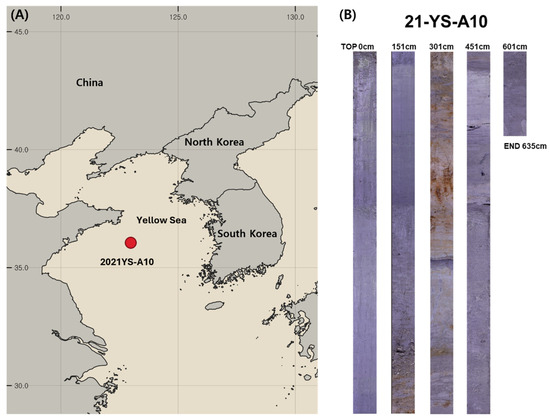
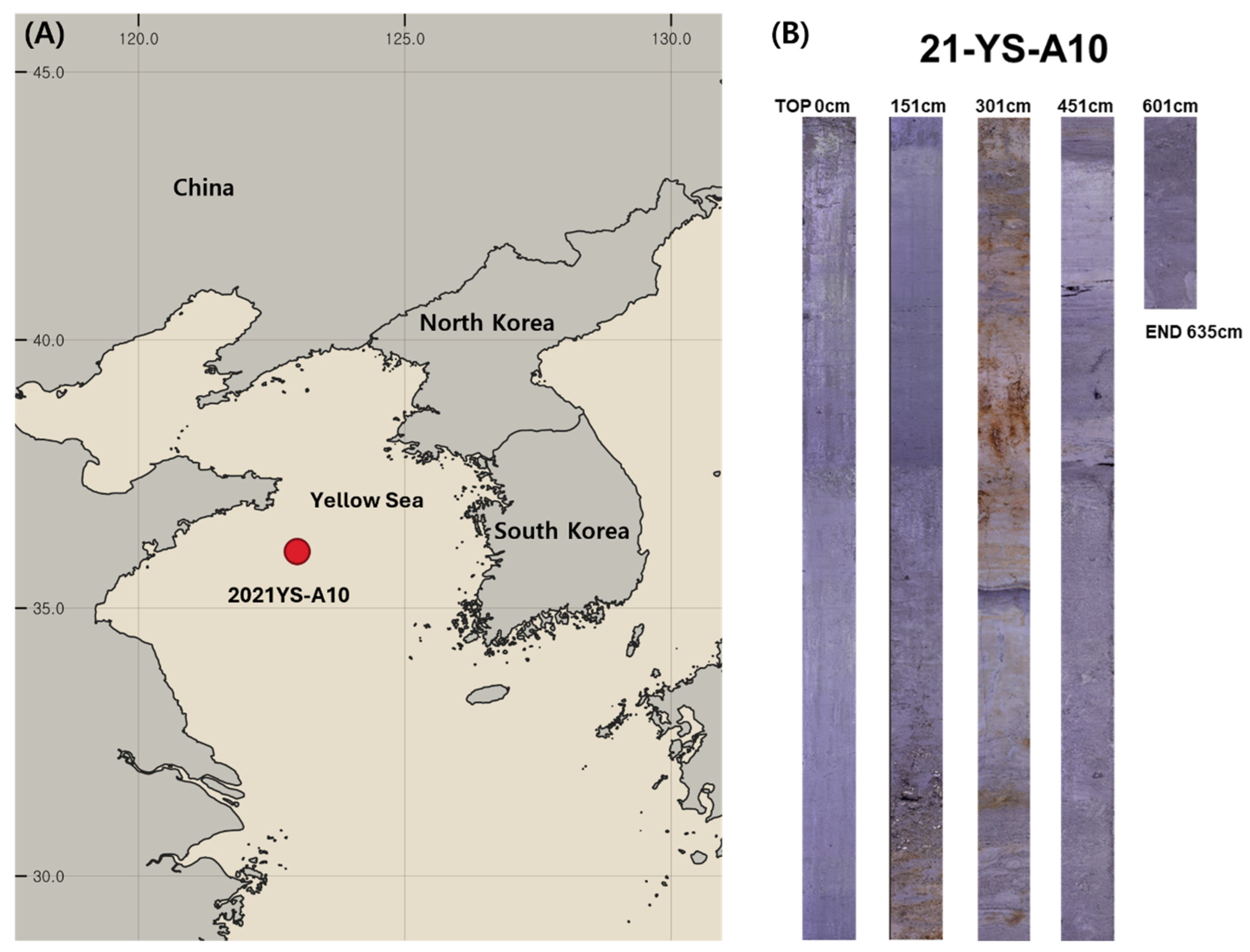
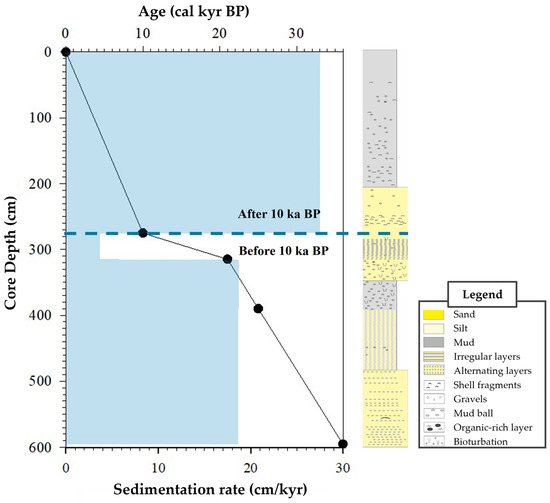
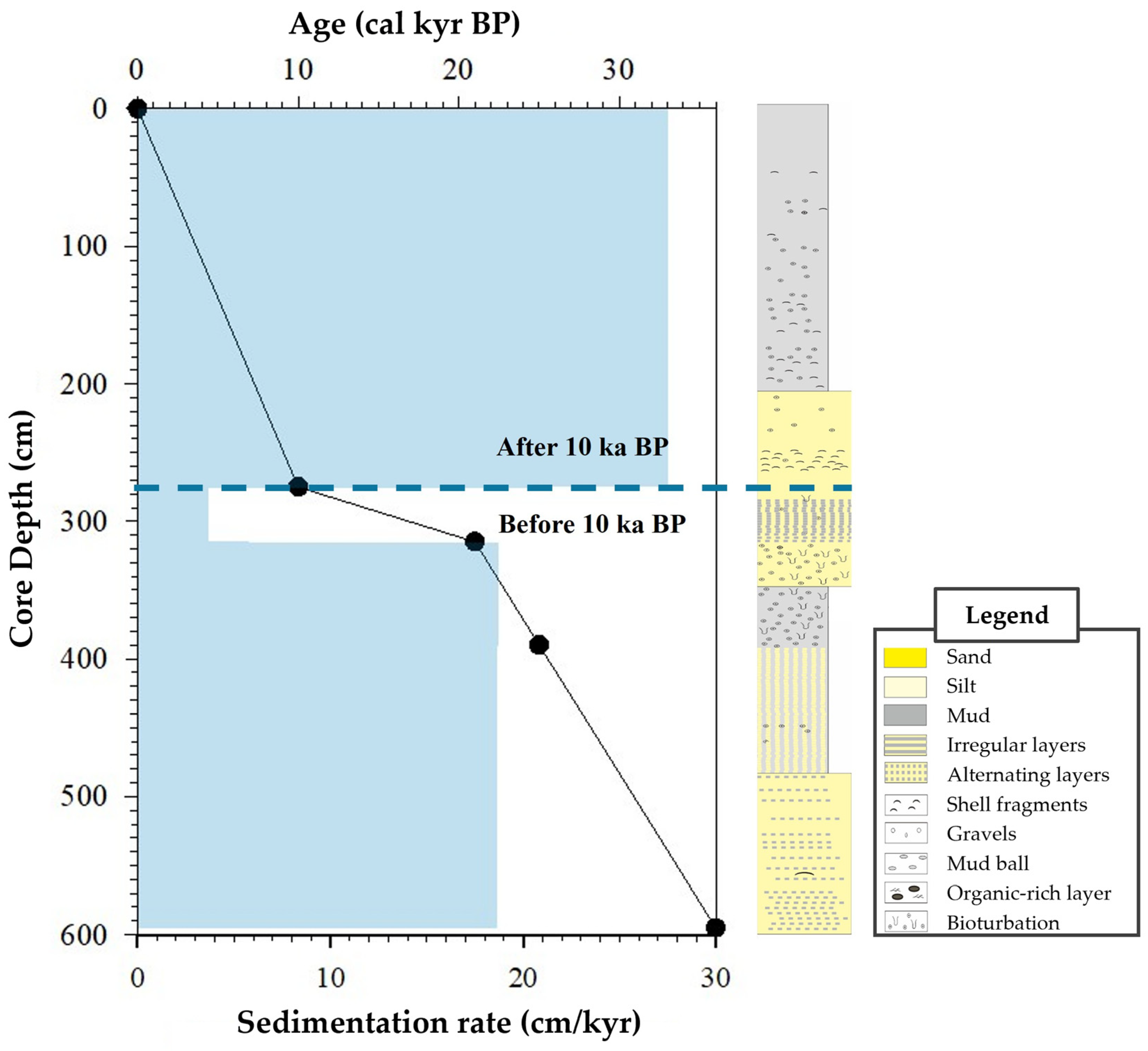
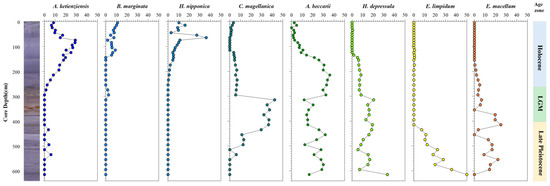
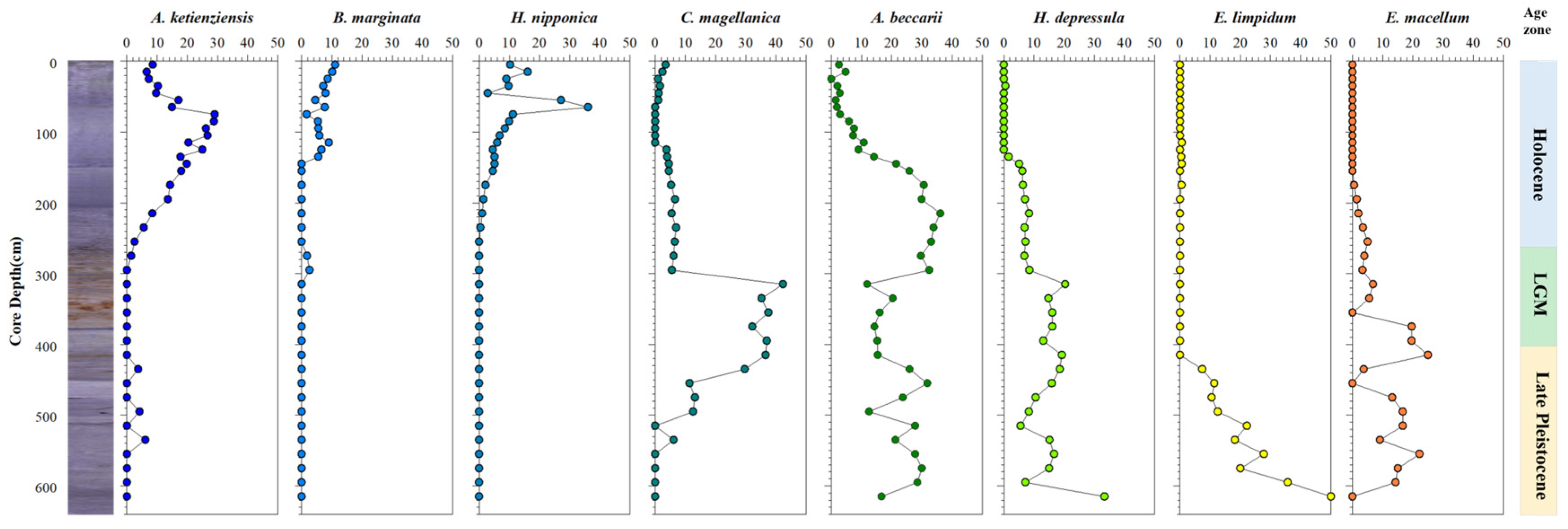

Disclaimer/Publisher’s Note: The statements, opinions and data contained in all publications are solely those of the individual author(s) and contributor(s) and not of MDPI and/or the editor(s). MDPI and/or the editor(s) disclaim responsibility for any injury to people or property resulting from any ideas, methods, instructions or products referred to in the content. |
© 2026 by the authors. Licensee MDPI, Basel, Switzerland. This article is an open access article distributed under the terms and conditions of the Creative Commons Attribution (CC BY) license.