


Abstract
The Mediterranean Sea is a major biodiversity hotspot increasingly affected by biological invasions, climate warming, and habitat degradation. Among the most successful invaders are the rabbitfish species Siganus luridus and Siganus rivulatus, Lessepsian migrants from the Red Sea that are now widespread across the eastern Mediterranean. This study examined how these invasive herbivores influence native herbivore assemblages in shallow coastal habitats around Lipsi Island in the Aegean Sea, Greece. Using Underwater Visual Census (UVC) surveys and in situ feeding observations, we quantified the abundance and grazing activity of invasive rabbitfish relative to that of the native herbivores Sparisoma cretense and Sarpa salpa. Invasive rabbitfish represented approximately 35% of the herbivore assemblages and showed clear habitat and dietary preferences. Significant negative correlations were observed between invasive foraging activity and the feeding rate of the native S. cretense, while no such effect was found for S. salpa. High habitat overlap between S. luridus and S. cretense suggests that this native species may be more susceptible to competition on rocky substrates. Evidence of partial resource partitioning was observed, including increased use of seagrass habitats by S. salpa. These findings highlight how invasive herbivores can restructure native herbivore communities and alter grazing dynamics in eastern Aegean coastal ecosystems. Given the ongoing sea warming and widespread decline of seagrass habitats across the Mediterranean, understanding these competitive interactions is therefore essential for assessing future biodiversity trajectories and informing management strategies.
1. Introduction
The Mediterranean Sea is recognised as one of the world’s major marine biodiversity hotspots, hosting an exceptional diversity of species and a high proportion of endemism [1]. However, this biodiversity is increasingly threatened by multiple anthropogenic pressures, including climate warming, habitat degradation, overexploitation, and biological invasions [2,3]. Among these drivers, the opening of the Suez Canal in 1869 has facilitated a continuous influx of Red Sea species into the Mediterranean, a process known as Lessepsian migration [4]. Ongoing biogeographical exchanges have resulted in the introduction of more than 1000 non-indigenous species in the basin [5], a growing proportion of which have become invasive and capable of reshaping native communities and ecosystem functioning [6,7].
Herbivorous fishes play a fundamental role in regulating algal communities and maintaining ecosystem functioning in Mediterranean coastal habitats [8]. However, the recent expansion of invasive herbivores from the Red Sea has substantially altered grazing dynamics in many areas of the eastern Mediterranean [9,10]. Among the most successful invaders are the rabbitfish species Siganus luridus (Rüppel, 1829) (commonly known as marbled spinefoot) and Siganus rivulatus Forsskål & Niebuhr, 1775 (commonly known as dusky spinefoot), which have rapidly expanded across the Mediterranean since their first records in the early twentieth century [11,12]. These diurnal herbivores graze intensively on benthic algae in shallow rocky habitats and can exert strong grazing pressure capable of transforming algal-dominated reefs into simplified barren states [9,10].
The ecological consequences of rabbitfish invasion extend beyond benthic habitat modification. By exploiting similar resources, invasive rabbitfishes may directly compete with native herbivores, potentially altering species interactions, feeding behaviour, and habitat use within Mediterranean fish assemblages [13]. Two native herbivorous fish species that may be particularly affected are Sarpa salpa (Linnaeus, 1758) and Sparisoma cretense (Linnaeus, 1758), both of which are strictly herbivorous fish species in Mediterranean coastal ecosystems [14]. For example, S. salpa accounts for a large proportion of grazing on Posidonia oceanica (Linnaeus) Delile, 1813 meadows in the Mediterranean, while S. cretense is an important grazer of algal communities on rocky substrates [15,16].
Previous studies have shown that invasive rabbitfish species can dramatically reduce algal biomass and contribute to the development of herbivore-driven barrens in parts of the eastern Mediterranean [9,10]. However, the direct effects of invasive rabbitfishes on native herbivore behaviour and resource use remain comparatively understudied, particularly in coastal ecosystems of the Aegean Sea, where these species frequently co-occur. Understanding how invasive and native herbivores interact is essential for assessing how biological invasions reshape trophic relationships and influence the resilience of Aegean ecosystems.
This study investigates the interactions between invasive rabbitfish (S. luridus and S. rivulatus) and native herbivorous fish species (S. salpa and S. cretense) in shallow coastal habitats around Lipsi Island in the Aegean Sea, Greece. While previous studies have primarily focused on the ecosystem-level impact of invasive rabbitfish species, such as algal depletion and the formation of barrens, their effects on the behavioural dynamics and feeding interactions of native herbivores remain poorly understood, particularly in the Aegean Sea where these species frequently co-occur. Using underwater visual census surveys and in situ herbivory observations, we examine patterns of species abundance, habitat preference, and feeding behaviour across rocky and seagrass habitats. By assessing how invasive and native herbivores interact within these habitats, this study aims to provide new insights and improve understanding of how Lessepsian invasions may alter trophic dynamics and ecosystem functioning in the Aegean Sea, with broader implications for the Mediterranean.
2. Materials and Methods
2.1. Data Collection
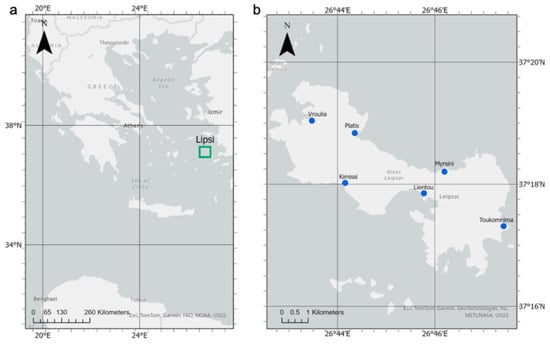
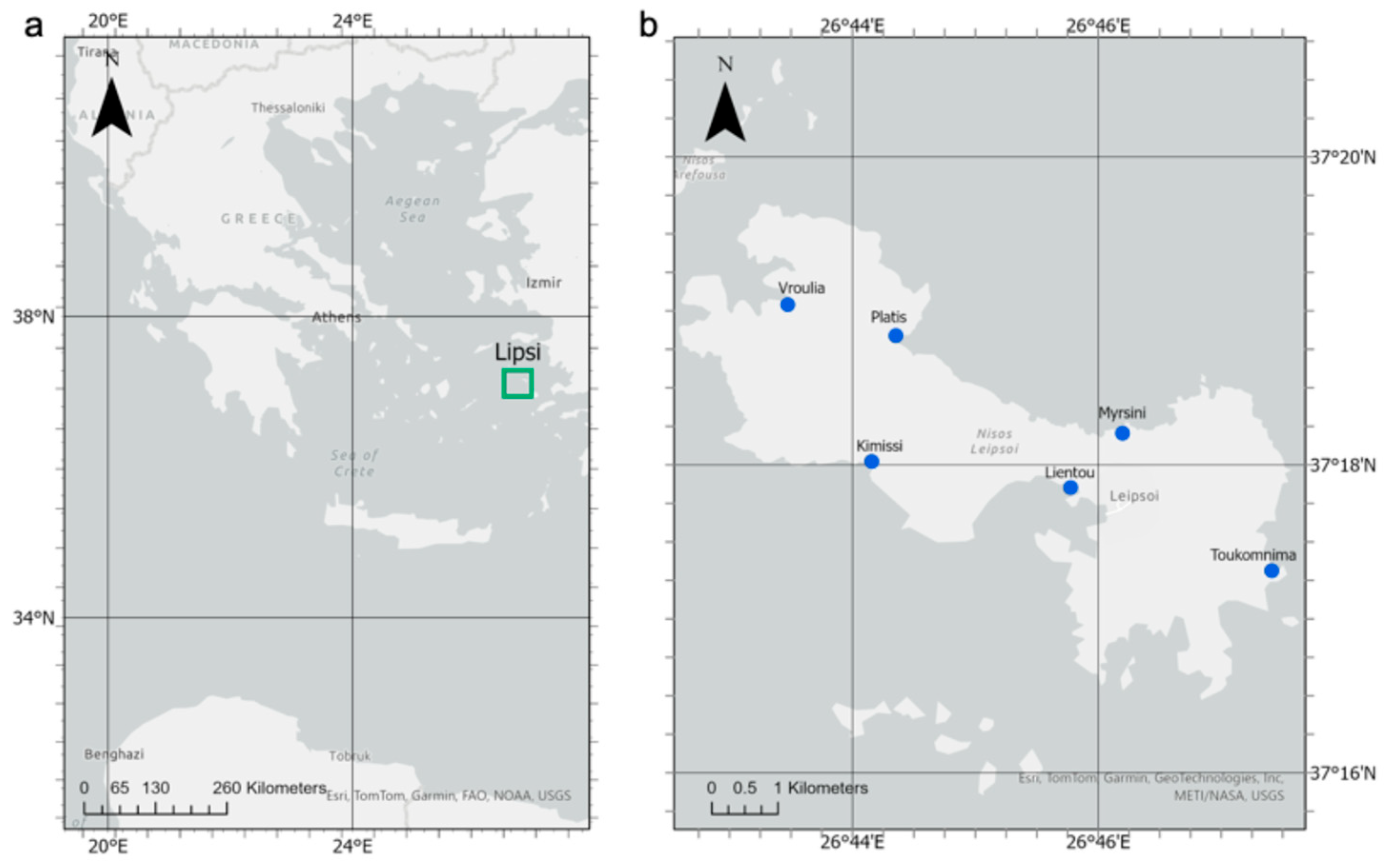
The study was conducted in Spring (March to May) 2023 in the littoral zone around Lipsi Island (37.3011° N, 26.7438° E), located in the south-eastern Aegean Sea, and part of the Greek Dodecanese Archipelago (Figure 1a). The island is included in the Natura 2000 Habitat Directive of the EU ecological network [17,18]. Six survey sites were selected around the island to represent a range of depths, habitat types, and exposure conditions (Figure 1b; Supplementary Material S1).
Figure 1.
Study area in the Aegean Sea. (a) Location of Lipsi Island within the eastern Mediterranean. (b) Map of the study sites around Lipsi Island, Greece, where Underwater Visual Census (UVC) surveys were conducted. Blue dots indicate the six sites surveyed in this study. Maps were created with ArcGIS pro v.2.7 [19].
Species abundance and feeding activity were assessed using Underwater Visual Census (UVC) surveys through snorkeling across the six sites. To account for potential diurnal variation in feeding behaviour, surveys were conducted twice daily: between 09:00–13:00 and between 15:30–19:00 [20]. At each of the six sites, five 50 m transects were surveyed twice daily (morning and afternoon), resulting in 10 transect surveys per site per day. Surveys were then repeated on two separate sampling days at each site, yielding a total of 120 transect surveys. Each transect survey represents a distinct temporal replicate and was treated as an independent sampling unit in all analyses. Transects were spatially and temporally separated to minimize the likelihood of repeatedly sampling the same individuals. The number of transects differed between habitat types (48 rocky, 72 seagrass) due to variation in habitat availability among study sites. Seagrass meadows were more extensive and consistently present, resulting in a higher number of transects in this habitat. This unbalanced design was accounted for in the analyses, which were based on per-transect measures rather than total counts (Supplementary Material S2).
Herbivore abundance was recorded along the 50 m transects positioned parallel to the shoreline at depths ranging from 1 to 6 m (Supplementary Material S2). Transects were deployed five minutes before starting the surveys to allow fishes to acclimate to snorkelers’ presence and minimize disturbance. Two observers snorkeled simultaneously at a constant pace along opposite sides of the transect line and recorded all target species within a 2-m belt width. Observers also searched within crevices to account for the behavior of the target herbivores. Juveniles (<10 cm in total length [21]) of each of the four target species were excluded from abundance estimated to maintain consistency with feeding rate observations. To minimize observer bias and ensure consistency between observers, both snorkelers followed a standardized survey protocol and were trained together prior to fieldwork. During surveys, observers maintained fixed positions on opposite sides of the transect and recorded non-overlapping areas, reducing the likelihood of double counting and inter-observer variability.
2.2. Herbivory Census
Feeding rate was defined as the number of bites per foray (bpf) during a timed behavioural observation [22]. A foray was defined as the period during which a fish feeds with its head positioned near the substrate and its body angled downward towards the substate [23]. Per capita consumption rates were calculated as bites per minute by dividing the total number of bites recorded by the observation duration [24].
Upon locating a target individual, observers allowed a 60 s acclimation period before beginning the behavioural observation [22] (Supplementary Material S3). Each individual was then observed for 12–15 min while maintaining a distance of 2–3 m to minimise disturbance [25]. The variation in the observation duration reflects field constraints and the need to maximise the number of valid observations while individuals remained within view. To account for this, feeding activity was standardised as bite rate (bites per minute) for all analyses. During each observation, the number of bites and substrate type (seagrass or algae) were recorded. Observations were discarded if the fish exhibited disturbance behaviours, including rapid swimming away, hiding within crevices, or other abnormal activity. Observations lasting less than two minutes were excluded from the dataset. Juvenile individuals (<10 cm in total length) were also excluded due to known ontogenetic differences in feeding behaviour [26].
2.3. Statistical Analyses
Statistical analyses were conducted to evaluate differences in abundance, habitat use, feeding behaviour, and potential interactions between invasive and native herbivorous fishes.
Species abundance and feeding rate values were averaged across surveys to obtain site-level estimates. Prior to analysis, data normality was assessed using the Shapiro–Wilk test [27]. Because the majority of the datasets exhibited significant non-normal distributions and Levene’s test indicated marginal homogeneity of variance (W = 2.70, p = 0.051), non-parametric statistical tests were applied. These methods were selected for their robustness to outliers and unequal sample sizes, which are inherent in ecological count and rate data.
To test whether herbivore abundance differed among sites, a Kruskal–Wallis test [28] was used. To quantify the magnitude of differences, effect sizes (epsilon-squared) were calculated. Habitat preference among species across rocky and seagrass habitats was examined using Chi-squared tests [29]. The strength of habitat association was assessed using the Phi coefficient (ϕ) as an effect size measure.
Resource overlap between invasive and native herbivores was quantified using Pianka’s niche overlap index [30], allowing evaluation of the degree to which species exploited similar habitat or feeding resources.
Differences in feeding behaviour were further assessed by comparing total feeding rates (bites per minute) among species using a Kruskal–Wallis [28] test with effect sizes followed by a post hoc Dunn’s test with Bonferroni correction [31]. Additionally, feeding selectivity within each species across substrate types (seagrass vs. algal) was examined using the Mann–Whitney U test, with rank-biserial correlation (r) reported as effect size [32].
To evaluate potential competitive relationships, Spearman rank correlation (ρ) was used to test whether the foraging activity of invasive species (pooled forays per survey session) influenced the feeding rates of native herbivores. This approach was chosen to account for the non-linear nature of competitive interactions and the non-normal distribution of the count data. Linear regression models with 95% confidence intervals were fitted to visualize these relationships where trends were observed.
Differences in feeding selectivity between substrate types within each species, as well as pairwise comparisons of algal and seagrass consumption between species, were examined using Mann–Whitney U tests [32], with rank-biserial correlation (r) reported as the effect size.
All statistical analyses were performed using python v3.14.3 [33], scipy.stats v1.17.1 and scikit-posthocs v0.12.0 libraries for statistical tests and matplotlib v3.10.8 for the visualisation. The maps were made in ArcGIS Pro v.2.70 [19].
3. Results
3.1. Habitat Partitioning
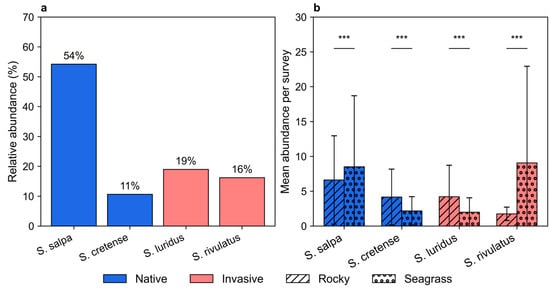
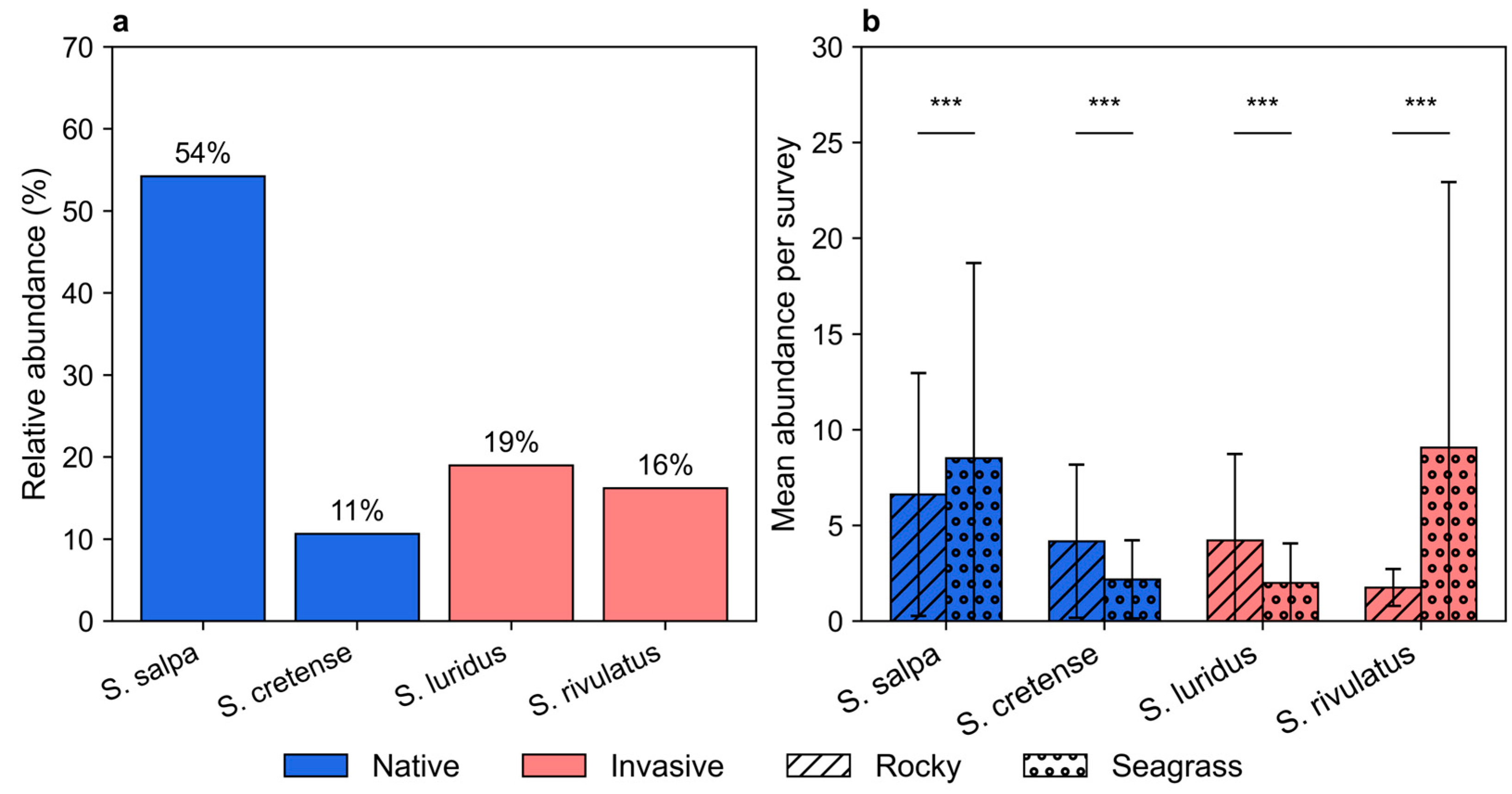
A total of 828 individuals (N = 828) were recorded across all surveys (Figure 2a; Supplementary Material S2). The native herbivore S. salpa accounted for the largest proportion of observations (54%), followed by the invasive species S. luridus (19%) and S. rivulatus (16%), while the native S. cretense was the least abundant (11%; Figure 2a). Significant differences in abundance were detected around Lipsi among the four species (Kruskal–Wallis: H = 9.88, df = 3, p < 0.05). However, the effect size was moderate (ϵ2 = 0.07), suggesting that while differences exist, there is considerable overlap in abundance distributions across the survey sites.
Figure 2.
Distribution and habitat abundance of native and invasive herbivorous fish species at Lipsi Island. (a) Relative abundance (%) of each species across all surveys; (b) Mean abundance (±SD) per survey compared between rocky (diagonal hatch) and seagrass (circle hatch) habitats. Native species (S. salpa, S. cretense) are shown in blue, and invasive species (S. luridus, S. rivulatus) in red. Significance levels for habitat preference are indicated by asterisks (*** p < 0.001).
Clear differences in habitat use were observed between species during the surveys (Figure 2b). The invasive S. luridus occurred predominantly on rocky substrates and showed a strong habitat preference for rocky shores compared with seagrass habitats (χ2 = 81.33, p < 0.001, ϕ = 0.72; Figure 2b). In contrast, S. rivulatus showed even more pronounced preference for seagrass meadows (χ2 = 107.46, p < 0.001, ϕ = 0.90; Figure 2b). Among the native species S. cretense was more regularly observed in rocky substrates (χ2 = 43.68, p < 0.001, ϕ = 0.71) while S. salpa exhibited a significant but notably weaker association with seagrass habitats (χ2 = 13.90, p < 0.001, ϕ = 0.18).
Although overall differences in habitat use were not statistically significant (p > 0.05), niche overlap analysis revealed complete overlap between the rock-associated species S. luridus and S. cretense (Pianka’s O = 1), indicating identical habitat use based on the variables considered. This represents the maximum possible overlap value and was higher than for any other species pair. Considerable overlap was also observed between the seagrass-preferring species S. rivulatus and S. salpa (O = 0.849), suggesting similar resource use among these species. Between S. salpa and the rock-preferring S. luridus (O = 0.698) and S. cretense (O = 0.705) the overlap was still considerable. Conversely, overlap between S. rivulatus and the rock-preferring species S. luridus (O = 0.215) and S. cretense (O = 0.225) was relatively low, reflecting their distinct habitat associations.
3.2. Feeding Selectivity
Feeding behaviour was recorded for 145 individuals over a total of 1114 min of observation (Supplementary Material S3). Total observation times were 307 min for S. salpa, 299 min for S. cretense, 284 min for S. luridus and 224 min for S. rivulatus.
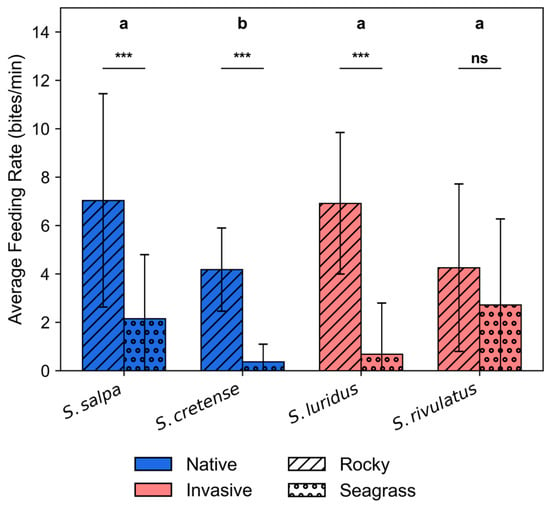
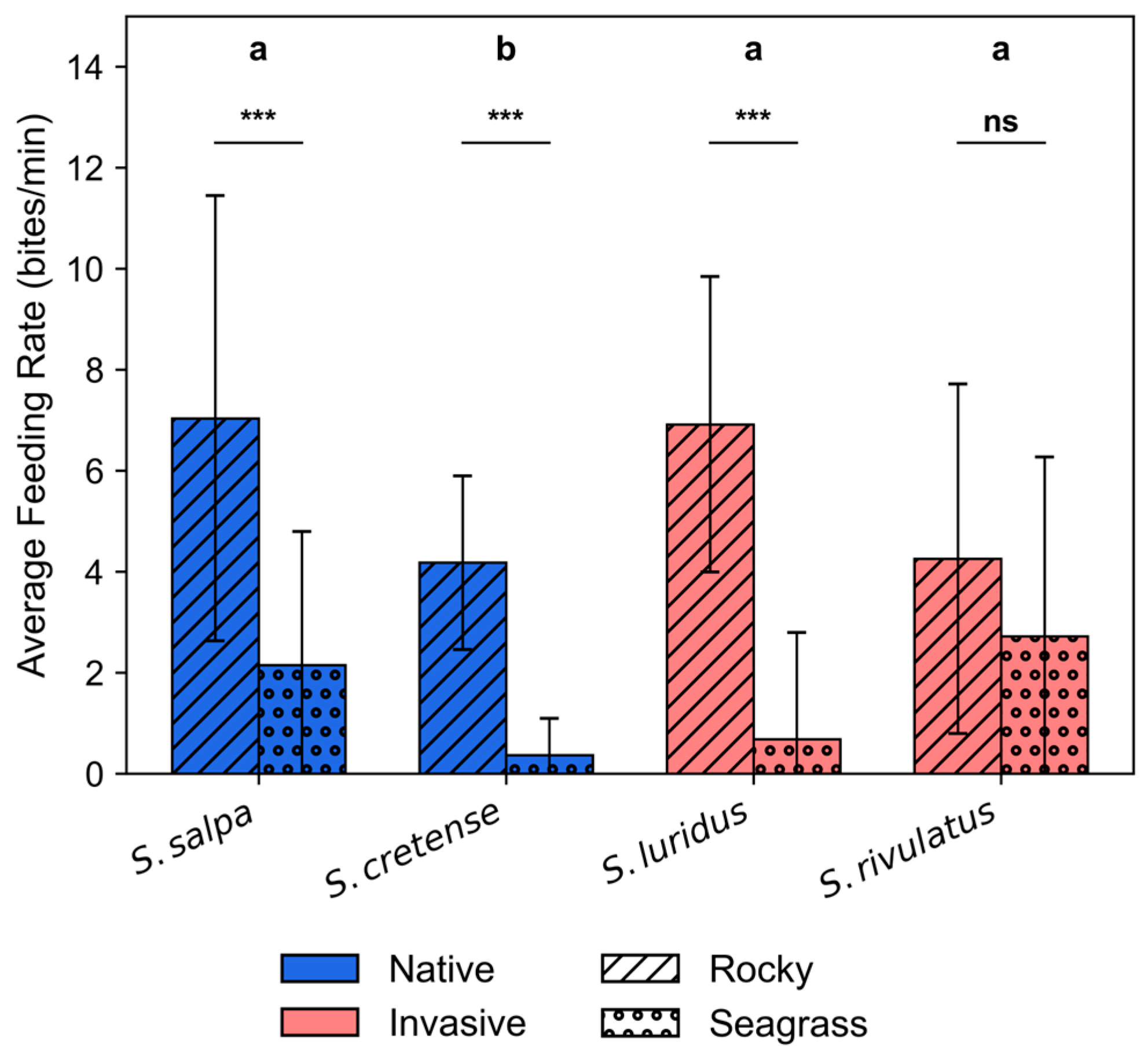
Feeding activity was distributed between turf algae on the rocky substrate and seagrass (Figure 3). The strength of the food preference was high, particularly for S. cretense (U = 570, p < 0.001, r = −0.98) and S. luridus (U = 452, p < 0.001, r = −0.87), followed by S. salpa (U = 487, p < 0.001, r = −0.69). In contrast, S. rivulatus exhibited a more balanced feeding pattern between algae and seagrass, with no significant difference in feeding rates between the two substrates and a notably lower effect size (U = 210.5, p = 0.127, r = −0.30).
Figure 3.
Average feeding rates (bites min−1 ± SD) of native and invasive herbivorous fish species across different substrates. Bars represent mean feeding rates (±SD) on rocky substrate (diagonal hatch) and seagrass (circle hatch). Native species are shown in blue and invasive species in red. Horizontal brackets indicate significant differences in substrate selectivity within each species (Mann–Whitney U test; *** p < 0.001, ns: not significant). Different lowercase letters (a, b) above the brackets denote significant differences in total feeding rates between species based on a Kruskal–Wallis test followed by a post hoc Dunn’s test (p < 0.05).
Among the four species, S. salpa exhibited the highest feeding rate (9.19 ± 3.23 bites min−1), followed by S. luridus (7.61 ± 2.42 bites min−1) and S. rivulatus (6.99 ± 2.23 bites min−1). The lowest feeding rate was recorded for S. cretense (4.45 ± 1.62 bites min−1). A Kruskal–Wallis test revealed a strong and significant differences in feeding rates among species (H = 31, p < 0.001, ϵ2 = 0.36). Post hoc Dunn’s tests confirmed that while S. cretense differed significantly from all other species (p < 0.05; Figure 3), no significant differences were found between the feeding rates of S. salpa, S. luridus, and S. rivulatus (p > 0.05).
3.3. Interactions Between Invasive and Native Herbivores
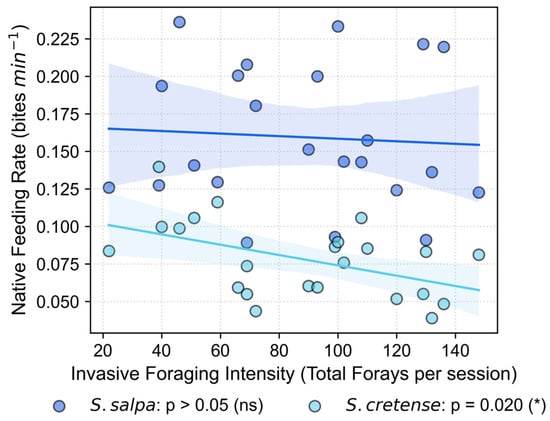
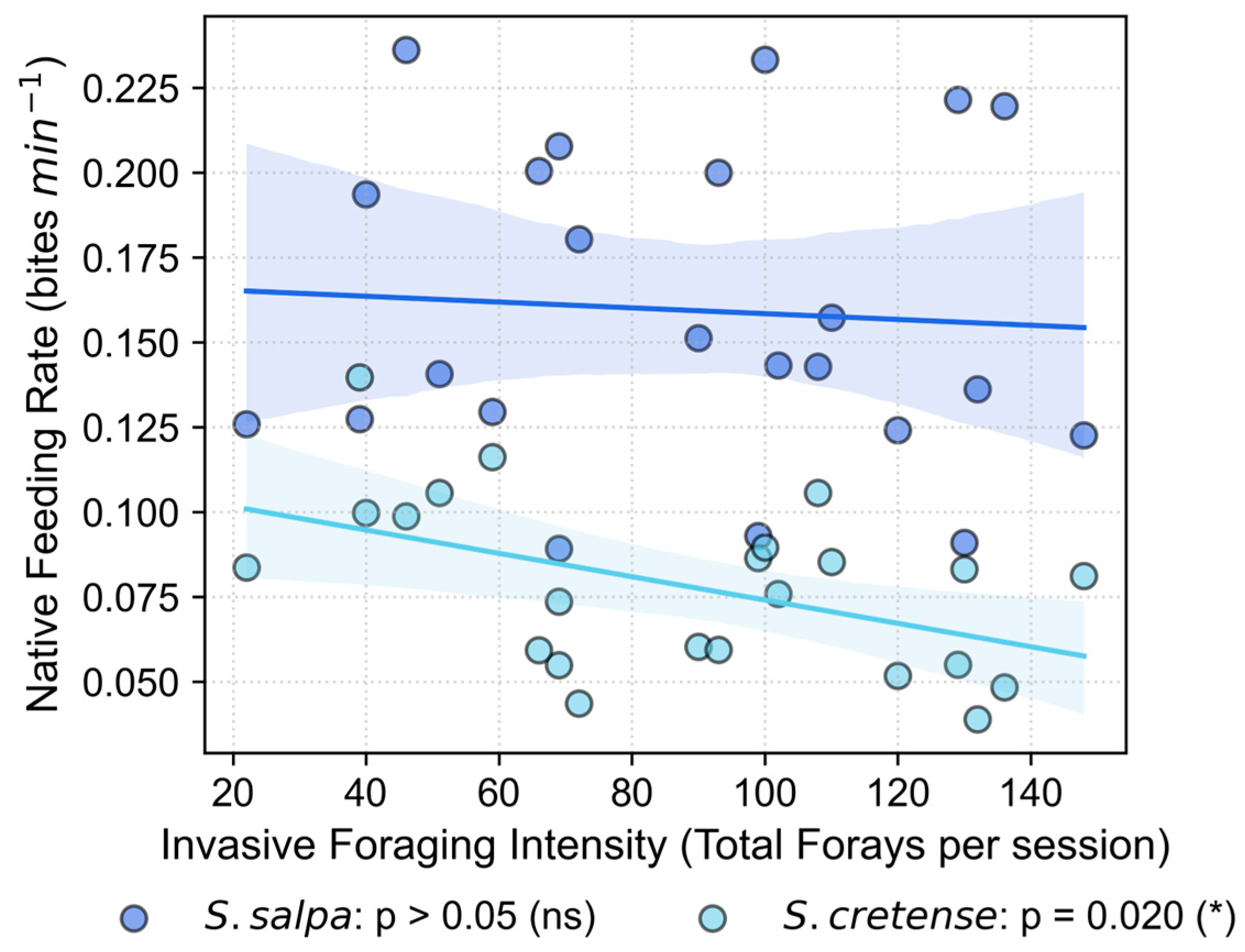
Spearman rank correlation analysis indicated no significant relationship between the total invasive foraging activity and the feeding rate of the native herbivore S. salpa (ρ = −0.07, p > 0.05). Further disaggregation of the invasive community confirmed this lack of interaction, with no significant correlations found for either S. luridus (ρ = −0.14, p = 0.52) or S. rivulatus (ρ = 0.15, p = 0.48). In contrast, the feeding rate of the native S. cretense was significantly negatively correlated with the cumulative foraging activity of invasive rabbitfishes (pooled forays of S. luridus and S. rivulatus; ρ = −0.48, p < 0.05) (Figure 4). However, when analysed separately, the correlations for S. cretense were non-significant for both S. luridus (ρ = 0.03, p = 0.90) and S. rivulatus (ρ = −0.35, p = 0.09), although a moderate negative trend was observed with the latter. This means that the foraging activity of S. cretense is not suppressed by a single invasive species, but rather by the cumulative grazing pressure exerted by the total invasive herbivore community. Unlike the S. salpa, S. cretense foraging activity appears to be suppressed by the high foraging intensity of invasive rabbitfishes.
Figure 4.
Correlation between total invasive foraging activity and native feeding rates. Each point represents the mean foraging activity recorded during a single survey session (morning or afternoon). The solid line (S. cretense) and dashed line (S. salpa) represent the Spearman rank correlation model, with shaded areas indicating the 95% confidence interval. Significant negative interaction was observed for the native S. cretense (p < 0.05), while no significant relationship was found for S. salpa (p > 0.05). Invasive activity includes the pooled foraging forays of S. luridus and S. rivulatus. The symbol (*) indicates significant p-values.
3.4. Competition-Driven Resource Partitioning
Pairwise competition analysis using Mann–Whitney U tests further indicated dietary shifts when species co-occurred (Table 1). Significant differences in algal consumption were observed between S. luridus and S. cretense (U = 427, p < 0.001, r = −0.62), with the invasive species showing significantly higher rates. Differences in seagrass consumption were also detected between S. luridus and S. salpa (U = 159, p < 0.05, r = 0.40) and between S. rivulatus and S. cretense (U = 316, p < 0.01, r = −0.47), suggesting resource partitioning when invasive and native herbivores occur together.
Table 1.
Pairwise comparison of feeding behaviour between invasive (S. luridus and S. rivulatus) and native (S. salpa and S. cretense) herbivores. p-values indicate differences in feeding intensity on algae and seagrass substrates when species co-occurred during observations. The symbol (*) indicates significant p-values.
4. Discussion
4.1. Herbivore Community Structure and Invasive Species Pressure
This study provides evidence that invasive rabbitfish are influencing herbivore community structure and resource use in shallow Mediterranean coastal ecosystems. The two invasive species S. luridus and S. rivulatus together accounted for approximately 35% of the observed herbivore assemblage, indicating that Lessepsian migrants now represent a substantial component of local grazing communities. Despite this increasing presence, the native herbivore S. salpa remained the most abundant species across the surveyed sites. This contrasts with observations from other areas of the eastern Mediterranean where invasive rabbitfish have become dominant herbivores and native species have declined substantially (e.g., in Lebanon waters; [34]). The coexistence of invasive and native herbivores observed in this study suggests that competitive interactions may currently occur without complete displacement of native species. Our findings indicate that the impact of this coexistence is not uniform across native species, with certain natives showing higher sensitivity to invasive foraging activity than others. It is however important to note that our observations were restricted to the spring season (March–May 2023), and herbivore abundance, feeding activity, and competitive interaction may vary seasonally in response to reproductive cycles and temperature fluctuations. Consequently, the patterns of coexistence and competition reported should be interpreted as a description of the dynamics observed during the analysed spring season, rather than a consistent year-round behaviour.
Habitat use may have played a key role in structuring these interactions. The invasive S. luridus was strongly associated with rocky habitats, while S. rivulatus showed a preference for seagrass meadows. In contrast, native species were more broadly distributed across habitats. Notably, S. luridus and S. cretense exhibited complete niche overlap (Pianka’s O = 1), indicating identical use of rocky habitats. Such complete overlap represents the highest possible level of resource sharing and suggests a strong potential for exploitative competition for algal resources on these substrates. Such overlap in resource use is often associated with increased competitive pressure among herbivorous fishes, particularly where grazing resources are spatially restricted [35].
4.2. Herbivory Patterns and Resource Use
Feeding observations revealed clear differences in grazing intensity among species. The native S. salpa displayed the highest feeding rate on algae, reflecting its well-established role as a dominant herbivore in Mediterranean ecosystems [9]. Crucially, the Spearman rank correlation analysis revealed that the feeding rate of S. salpa was not significantly affected by the foraging intensity of invasive species (ρ = −0.07, p > 0.05). In contrast, the invasive rabbitfish S. luridus also exhibited high feeding rates, approaching those of S. salpa, while the native S. cretense showed comparatively lower feeding intensity. These differences suggest that invasive rabbitfishes may contribute substantially to overall grazing pressure within coastal habitats [10,36]. Most importantly, S. cretense was the only native species to show a significant negative relationship between its feeding rate and total invasive foraging activity. While this pattern is consistent with competition, the data do not allow us to distinguish the underlying mechanism. The observed decline could result from interference competition, exploitative competition through resource depletion, or spatial avoidance of areas with high invasive activity. Additional behavioural observations (e.g., agonistic interactions or displacement events) would be required to confirm interference competition. While shoaling behaviour in S. salpa has been documented [16] and may influence foraging dynamics, this mechanism was not directly measured in the present study, and further research is needed to fully assess its impact in this system.
All species except S. rivulatus showed a strong preference for algal resources over seagrass. This pattern is consistent with previous studies highlighting the importance of algal communities as primary food resources for Mediterranean herbivorous fishes [37,38]. The relatively balanced diet observed in S. rivulatus suggests a greater trophic flexibility, which may facilitate its successful establishment across multiple habitats [39,40]. Such flexibility is often considered a key trait of successful invasive species, allowing them to exploit a wider range of resources under changing environmental conditions [41].
Evidence of competitive interactions was particularly apparent when examining feeding behaviour. Dietary shifts were detected in several species pairs, suggesting that herbivores may adjust their feeding strategies in response to the presence of potential competitors. For example, significant shifts in algal consumption were observed when S. luridus and S. cretense co-occurred, indicating competition for algal resources within rocky habitats. Similarly, interactions between S. rivulatus and S. salpa suggest potential competition within seagrass-associated feeding niches. Nevertheless, these findings should be interpreted in light of the study’s limitations, including its temporal restriction to a single season, its limited spatial scale, and the observational nature of the data, which does not allow direct analyses of the mechanisms underlying species interactions.
4.3. Habitat Shifts and Potential Resource Partitioning
Although invasive and native herbivores shared habitat space, species did not always co-occur at the transect scale, suggesting a degree of spatial segregation that may reduce direct interference between competitors. The lack of a significant correlation between invasive activity and S. salpa feeding rates suggests that S. salpa effectively partitions resources or maintains foraging efficiency through its shoaling behavior, even in the presence of high rabbitfish activity. S. salpa displayed increased feeding activity within seagrass habitats; however, this pattern was not significantly correlated with invasive species foraging intensity (ρ = −0.07, p > 0.05). While S. salpa is known to consume both algae and seagrass [16], the increased use of seagrass habitats observed in this study may indicate a shift in habitat use under conditions of increased grazing pressure on rocky substrates. Seagrass meadows can provide both food resources and refuge from predation, making them attractive alternative habitats when competition for algal resources intensifies [42]. Conversely, the significant suppression of S. cretense feeding rates indicates that for this species, resource partitioning may be insufficient to buffer the impacts of invasive foraging intensity on rocky substrates.
These observations suggest that resource partitioning may currently facilitate the coexistence of invasive and native herbivores [43]. However, if grazing pressure by rabbitfish continues to increase, particularly in rocky habitats, such partitioning may become insufficient to prevent competitive exclusion or long-term shifts in herbivore community composition [10].
4.4. Environmental Context and Future Ecosystem Change
Environmental conditions are likely to play a key role in shaping future interactions between native and invasive herbivores [44,45]. The Mediterranean Sea is currently experiencing rapid warming [46], which has already facilitated the northward expansion of many Lessepsian migrants, including rabbitfish species [10,47,48]. Warmer conditions may enhance rabbitfish population growth and feeding activity, potentially intensifying grazing pressure on benthic communities [10,49]. Seagrass habitats may partially buffer these effects by providing alternative feeding grounds for native herbivores such as S. salpa [50]. In this study, S. salpa was observed to feed on seagrass, suggesting that P. oceanica meadows may play an important role in supporting herbivore populations under conditions of increasing competition. However, widespread declines in Mediterranean seagrass habitats due to anthropogenic pressures and climate change may reduce this buffering capacity, potentially amplifying competitive interactions among herbivores [51]. Seasonal variation in herbivore behaviour and habitat use may further influence the intensity of competitive interactions. Long-term, multi-season monitoring will therefore be essential to fully assess these dynamics and accurately examine the potential for competitive displacement or resource partitioning across the year.
Nevertheless, the findings of this study have important implications for long-term ecosystem functioning in Aegean and Mediterranean coastal systems. In fact, increasing dominance of invasive herbivores, together with their high grazing rates and trophic flexibility, may progressively shift benthic communities toward simplified, algal-poor states, with cascading effects on habitat complexity, biodiversity, and ecosystem services. This process is consistent with broader patterns of “tropicalization” observed across the Mediterranean, where warming-driven range expansions of thermophilic and Lessepsian species are reshaping community structure and trophic interactions. In this context, the behavioural interactions and potential competitive imbalances observed in this study may represent early-stage dynamics that precede more pronounced community-level shifts, including the decline of native herbivores and increased prevalence of barren habitats.
4.5. Implications for Aegean Coastal Biodiversity and Management
The results of this study highlight the need for management strategies that explicitly account for the ecological impacts of invasive herbivores on trophic interactions and ecosystem functioning, in both the Aegean and the wider Mediterranean region [50,51]. In particular, the potential for invasive rabbitfish to alter grazing dynamics and competitively affect native herbivores suggests that monitoring programs should prioritise both species abundance and behavioural interactions, rather than presence alone. In fact, early detection of shifts in feeding behaviour, habitat use, and community composition may provide critical indicators of ecosystem change before large-scale habitat degradation occurs [52].
Given the continuing expansion of Lessepsian migrants and the accelerating pace of climate change in the Mediterranean basin [53,54], understanding these ecological interactions is increasingly important for biodiversity conservation and ecosystem management. Long-term monitoring of invasive species presence, herbivore community composition, grazing pressure, and habitat availability will be essential to track ecosystem change [55]. In doing so, both targeted scientific surveys and citizen science observations can be fundamental for detecting early presence of invasive species and habitat shifts in the Aegean region [56,57]. Expanding standardised UVC surveys to include complementary approaches, such as image-based monitoring, remote underwater video (RUV) systems (e.g., [58]), and photo-quadrat analyses (e.g., [59]), could also further improve the ability to detect temporal variability and changes in ecosystem and community composition.
Management strategies aimed at mitigating the impacts of invasive herbivores may include strengthening marine protected areas that support native populations [60,61,62] and reducing additional anthropogenic pressures on coastal ecosystems [63]. Such approaches may help maintain ecological balance and enhance the resilience of Mediterranean marine ecosystems in the face of ongoing biological invasions. Integrating these approaches into adaptive management frameworks will be essential to mitigate the long-term impacts of biological invasions under ongoing climate-driven tropicalization of the Aegean and the Mediterranean region.
5. Conclusions
This study demonstrates that invasive rabbitfish are already influencing herbivore interactions and grazing dynamics in shallow Mediterranean coastal habitats. The high habitat overlap between invasive and native herbivores suggests increasing potential for exploitative competition, particularly within rocky reef environments. Observed shifts in habitat use by native species may represent early responses to this pressure. As ocean warming continues to facilitate the expansion of Lessepsian migrants, these interactions are likely to intensify, with important implications for the future structure and functioning of the eastern Aegean coastal ecosystems.
Supplementary Materials
The following supporting information can be downloaded at: https://www.mdpi.com/article/10.3390/d18040225/s1.
Author Contributions
Conceptualization, R.W., T.G., M.M.-G. and L.M.; methodology, R.W., S.B., M.M.-G. and L.M.; software, R.W. and T.G.; validation, L.M., T.G. and R.P.; formal analysis, R.W. and T.G.; investigation, R.W., S.B., R.A. and L.M.; resources, T.G., A.M. and L.M.; data curation, R.W. and S.B.; writing—original draft preparation, R.W., T.G. and L.M.; writing—review & editing, R.W., T.G., M.M.-G., R.P. and L.M.; visualization, R.W., T.G. and L.M.; supervision, L.M., T.G., M.M.-G., R.A. and R.P.; project administration, L.M. and A.M.; funding acquisition, A.M. All authors have read and agreed to the published version of the manuscript.
Funding
This research received no external funding.
Institutional Review Board Statement
Not applicable.
Data Availability Statement
The original contributions presented in this study are included in the article/Supplementary Material. Further inquiries can be directed to the corresponding authors.
Acknowledgments
The authors would like to thank the Archipelagos Institute of Marine Conservation (Greece) for logistic support during the surveys and Theodoros Tsimpidis for his contribution with the logistics of this project and his inputs for the conservation of marine life in the Aegean Sea. We are grateful to the Costas M. Lemos Foundation and the Lipsi Municipality for their cooperation in the conservation work of Archipelagos Institute. We thank all the interns at Archipelagos who supported fieldwork and the data collection that led to the completion of this study.
Conflicts of Interest
The authors declare no conflicts of interest.
Abbreviations
The following abbreviations are used in this manuscript:
| UVC | Underwater Visual Census |
| bpf | bites per foray |
| S. luridus | Siganus luridus |
| S. rivulatus | Siganus rivulatus |
| S. salpa | Sarpa salpa |
| S. cretense | Sparisoma cretense |
References
- Coll, M.; Piroddi, C.; Steenbeek, J. The biodiversity of the Mediterranean Sea: Estimates, patterns, and threats. PLoS ONE 2010, 5, e11842. [Google Scholar] [CrossRef] [Scilit] [PubMed]
- Coll, M.; Piroddi, C.; Albouy, C.; Ben Rais Lasram, F.; Cheung, W.W.L.; Christensen, V.; Karpouzi, V.S.; Guilhaumon, F.; Mouillot, D.; Paleczny, M.; et al. The Mediterranean Sea under siege: Spatial overlap between marine biodiversity, cumulative threats and marine reserves. Glob. Ecol. Biogeogr. 2011, 21, 465–480. [Google Scholar] [CrossRef] [Scilit]
- Lejeusne, C.; Chevaldonné, P.; Pergent-Martini, C.; Bordouresque, C.F.; Pérez, T. Climate change effects on a miniature ocean: The highly diverse, highly impacted Mediterranean Sea. Trends Ecol. Evol. 2010, 25, 250–260. [Google Scholar] [CrossRef] [Scilit]
- Mavruk, S.; Avsar, D. Non-native fishes in the Mediterranean from the Red Sea, by way of the Suez Canal. Rev. Fish Biol. Fish. 2008, 18, 251–262. [Google Scholar] [CrossRef] [Scilit]
- Galanidi, M.; Aissi, M.; Ali, M.; Bakalem, A.; Bariche, M.; Bartolo, A.G.; Bazairi, H.; Beqiraj, S.; Bilecenoglu, M.; Bitar, G.; et al. Validated inventories of non-indigenous species (NIS) for the Mediterranean Sea as tools for regional policy and patterns of NIS spread. Diversity 2023, 15, 962. [Google Scholar] [CrossRef] [Scilit]
- Ulman, A.; Tuncer, S.; Kizilkaya, I.T.; Zilifli, A.; Alford, P.; Giovos, I. The lionfish expansion in the Aegean Sea in Turkey: A looming potential ecological disaster. Reg. Stud. Mar. Sci. 2020, 36, 101271. [Google Scholar] [CrossRef] [Scilit]
- Tiralongo, F.; Hall-Spencer, J.M.; Giovos, I.; Kleitou, P. Editorial: Biological invasions in the Mediterranean Sea. Front. Mar. Sci. 2022, 9, 1016168. [Google Scholar] [CrossRef] [Scilit]
- Pagès, J.F.; Gera, A.; Romero, J.; Farina, S.; Garcia-Rubies, A.; Hereu, B.; Alcoverro, T. The Mediterranean benthic herbivores show diverse responses to extreme storm disturbances. PLoS ONE 2013, 8, e62719. [Google Scholar] [CrossRef] [Scilit]
- Sala, E.; Kizilkaya, Z.; Yildirim, D.; Ballesteros, E. Alien marine fishes deplete algal biomass in the eastern Mediterranean. PLoS ONE 2011, 6, 17356. [Google Scholar] [CrossRef] [Scilit]
- Vergés, A.; Steinberg, P.D.; Hay, M.E.; Poore, A.G.B.; Campbell, A.H.; Ballesteros, E.; Heck, K.L., Jr.; Booth, D.J.; Coleman, M.A.; Feary, D.A.; et al. The tropicalization of temperate marine ecosystems: Climate-mediated changes in herbivory and community phase shifts. Proc. Biol. Soc. 2014, 281, 20140846. [Google Scholar] [CrossRef] [Scilit]
- Tortonese, E. La fauna del Mediterraneo e i suoi rapport con quelle dei mari vicini. Pubbl. Stn. Zool. Napoli 1970, 37, 369–384. [Google Scholar]
- Kavalakis, G. Siganus luridus and Siganus rivulatus in the Dodecanese Islands. Aliia 1969, 248, 307–308. [Google Scholar]
- Pickholtz, R.S.M.; Kiflawi, M.; Friedlander, A.M.; Belmaker, J. Habitat utilization by an invasive herbivorous fish (Siganus rivulatus) in its native and invaded range. Biol. Invasions 2018, 20, 3499–3512. [Google Scholar] [CrossRef] [Scilit]
- Dimitriadis, C.; Marampouti, C.; Calò, A.; Di Franco, A.; Giakoumi, S.; Di Franco, E.; Di Lorenzo, M.; Gerovasileiou, V.; Guidetti, P.; Pey, A.; et al. Evaluating the long term effectiveness of a Mediterranean marine protected area to tackle the effects of invasive and range expanding herbivorous fish on rocky reefs. Mar. Environ. Res. 2024, 193, 106293. [Google Scholar] [CrossRef] [Scilit]
- Cebrián, J.; Duarte, C.; Marbà, N.; Enríquez, S.; Gallegos, M.; Olesen, B. Herbivory on Posidonia oceanica: Magnitude and variability in the Spanish Mediterranean. Mar. Ecol. Prog. Ser. 1996, 130, 147–155. [Google Scholar] [CrossRef] [Scilit]
- Buñuel, X.; Alcoverro, T.; Pagès, J.F.; Romero, J.; Ruiz, J.M.; Arthur, R. The dominant seagrass herbivore Sarpa salpa shifts its shoaling and feeding strategies as they grow. Sci. Rep. 2020, 10, 10622. [Google Scholar] [CrossRef] [Scilit] [PubMed]
- European Commission; Directorate-General for Environment; Sundseth, K. Natura 2000: Protecting Europe’s Biodiversity; Information Press: Oxford, London, UK, 2008. [Google Scholar]
- Hawkins, E.R.; Macrina, L.; Malcolm-McKay, A.; Cotterill, N.; Miliou, A.; O’Gorman, E.J. Low-intensity urbanisation alters community composition across multiple trophic levels on Lipsi Island, Greece. Ecol. Evol. 2024, 14, e70135. [Google Scholar] [CrossRef] [Scilit]
- Esri ArcGis Pro v.2.7. Redlands, CA. Environmental Systems Research Insititute. 2020. Available online: http://www.esri.com/en-us/arcgis/products/arcgis-pro/overview (accessed on 30 January 2026).
- Ferreira, D.; Peret, A.C.; Coutinho, R. Seasonal grazing rates and food processing by tropical herbivorous fishes. J. Fish Biol. 1998, 53, 222–235. [Google Scholar] [CrossRef] [Scilit]
- Green, A.L.; Bellwood, D.R. Monitoring Functional Groups of Herbivorous Reef Fishes as Indicators of Coral Reef Resilience; IUCN Working Group on Climate Change and Coral Reefs; IUCN: Gland, Switzerland, 2009; 70p. [Google Scholar]
- Smith, T.B. Temperature effects on herbivory for an Indo-Pacific parrotfish in Panamá: Implications for coral–algal competition. Coral Reefs 2008, 27, 397–405. [Google Scholar] [CrossRef] [Scilit]
- Bellwood, D.R.; Choat, J.H. A functional analysis of grazing in parrotfishes (family Scaridae): The ecological implications. Environ. Biol. Fishes 1990, 28, 189–214. [Google Scholar] [CrossRef] [Scilit]
- Fox, R.; Bellwood, D. Quantifying herbivory across a coral reef depth gradient. Mar. Ecol. Prog. Ser. 2007, 339, 49–59. [Google Scholar] [CrossRef] [Scilit]
- Ebrahim, A.; Bijoux, J.P.; Mumby, P.J.; Tibbetts, I.R. The commercially important shoemaker spinefoot, Siganus sutor, connects coral reefs to neighbouring seagrass meadows. J. Fish Biol. 2020, 96, 1034–1044. [Google Scholar] [CrossRef] [Scilit]
- Adam, T.C.; Duran, A.; Fuchs, C.E.; Roycroft, M.V.; Rojas, M.C.; Ruttenberg, B.I.; Burkepile, D.E. Comparative analysis of foraging behaviour and bite mechanics reveals complex functional diversity among Caribbean parrotfishes. Mar. Ecol. Prog. Ser. 2018, 597, 207–220. [Google Scholar] [CrossRef] [Scilit]
- Shapiro, S.S.; Wilk, M.B. An analysis of variance test for normality (complete samples). Biometrika 1965, 52, 591–611. [Google Scholar] [CrossRef] [Scilit]
- Kruskal, W.H.; Wallis, W.A. Use of ranks in one-criterion variance analysis. J. Am. Stat. Assoc. 1952, 47, 583–621. [Google Scholar] [CrossRef]
- Pearson, K. On the criterion that a given system of deviations from the probable in the case of a correlated system of variables is such that it can be reasonably supposed to have arisen from random sampling. Philos. Mag. 1990, 50, 157–175. [Google Scholar] [CrossRef] [Scilit]
- Pianka, E.R. The structure of lizard communities. Ann. Rev. Ecol. Syst. 1973, 4, 53–74. [Google Scholar] [CrossRef] [Scilit]
- Dunn, O.J. Multiple comparisons using rank sums. Technometrics 1964, 6, 241–252. [Google Scholar] [CrossRef]
- Mann, H.B.; Whitney, D.R. On a test of whether one of two random variables is stochastically larger than the other. Ann. Math. Stat. 1947, 18, 50–60. [Google Scholar] [CrossRef] [Scilit]
- Python Software Foundation. Python (Version 3.14.3). 2026. Available online: https://www.python.org/ (accessed on 30 January 2026).
- Bariche, M.; Letourneur, Y.; Harmelin-Vivien, M. Temporal fluctuations and settlement patterns of native and Lessepsian herbivorous fishes on the Lebanese coast (Eastern Mediterranean). Environ. Biol. Fishes 2004, 70, 81–90. [Google Scholar] [CrossRef] [Scilit]
- Thareja, H.; Paul, A.; Alcoverro, T.; Karkarey, R.; Pinto, W.; Jaishankar, S.; Bhagat, S.; Arthur, R. Density dependence and territorial competitors can modulate parrotfish social foraging and herbivory on coral reefs. Proc. Biol. Sci. 2026, 293, 20251919. [Google Scholar] [CrossRef] [Scilit]
- Ruetz, C.R.; Hurford, A.L.; Vondracek, B. Interspecific interactions between brown trout and slimy sculpin in stream enclosures. Trans. Am. Fish. Soc. 2003, 132, 611–618. [Google Scholar] [CrossRef] [Scilit]
- Ruitton, S.; Francour, P.; Bourdouresque, C.F. Relationships between algae, benthic herbivorous invertebrates and fishes in rocky sublittoral communities of a temperate sea (Mediterranean). Estuar. Coast. Shelf Sci. 2000, 50, 217–230. [Google Scholar] [CrossRef] [Scilit]
- Tomas, F.; Cebrian, E.; Ballesteros, E. Differential herbivory of invasive algae by native fish in the Mediterranean Sea. Estuar. Coast. Shelf Sci. 2011, 92, 27–34. [Google Scholar] [CrossRef] [Scilit]
- Shakman, E.; Boedenker, C.; Bariche, M.; Kinzelbach, R. Food and feeding habits of the Lessepsian migrants Siganus luridus Rüppell, 1828 and Siganus rivulatus Forsskal, 1775 (Teleostei: Siganidae) in the southern Mediterranean (Libyan coast). J. Biol. Res. Thessalon. 2009, 12, 115–124. [Google Scholar]
- Tsadok, R.; Zemah-Shamir, Z.; Shemesh, E.; Martinez, S.; Ramon, D.; Kolski, I.; Tsemel, A.; Tchernov, D. Dietary habits change of Lessepsian migrants’ fish from the Red Sea to the Eastern Mediterranean Sea. Aquat. Invasions 2010, 18, 521–531. [Google Scholar] [CrossRef] [Scilit]
- Camacho-Cervantes, M.; Ojanguren, A.F. Within-population variation in an invasive fish’ sociability when associating with conspecifics or heterospecifics. Ecol. Evol. 2024, 14, e70118. [Google Scholar] [CrossRef] [Scilit]
- Lattanzi, A.; Bellisario, B.; Cimmaruta, R. A review of fish diversity in Mediterranean seagrass habitats, with a focus on functional traits. Rev. Fish Biol. Fish. 2024, 34, 1329–1349. [Google Scholar] [CrossRef] [Scilit]
- Minguito-Frutos, M.; Buñuel, X.; Marco-Méndez, C.; Sanmartí, N.; Skouradakis, G.; Boada, J.; Pagès, J.F.; Alcoverro, T.; Arthur, R. Tropical range extending herbivorous fishes gain foraging benefits by shoaling with native temperate species. Sci. Rep. 2025, 15, 35137. [Google Scholar] [CrossRef] [Scilit]
- Sorte, C.; Ibáñez, I.; Blumenthal, D.M.; Molinari, N.A.; Miller, L.P.; Grosholz, E.D.; Diez, J.M.; D’Antonio, C.M.; Olden, J.D.; Jones, S.J.; et al. Poised to prosper? A cross-system comparison of climate change effects on native and non-native species performance. Ecol. Lett. 2012, 16, 261–270. [Google Scholar] [CrossRef] [Scilit]
- D’Amen, M.; Azzurro, E. Lessepsian fish invasion in Mediterranean marine protected areas: A risk assessment under climate change scenarios. ICES J. Mar. Sci. 2019, 77, 388–397. [Google Scholar] [CrossRef] [Scilit]
- Napolitano, E.; Carillo, A.; Iacono, R.; Struglia, M.V.; dell’Aquila, A.; Palma, M.; Marullo, S.; De Sabata, E.; Bordone, A.; Eusebi Borzelli, G. Unprecedented Mediterranean Sea warming in 2024: Analysis of the driving mechanisms. Front. Mar. Sci. 2025, 12, 1668204. [Google Scholar] [CrossRef] [Scilit]
- Raitsos, D.E.; Beaugrand, G.; Georgopoulos, D.; Zenetos, A.; Pancucci-Papadopoulou, A.M.; Theocharis, A.; Papathanassiou, E. Global climate change amplifies the entry of tropical species into the eastern Mediterranean Sea. Limnol. Oceanogr. 2010, 55, 1478–1484. [Google Scholar] [CrossRef] [Scilit]
- Khalil, M.T.; Mostafa, A.B.; El-Naggar, M.M. Climate change and Lessepsian migration to the Mediterranean Sea. In Earth and Environmental Sciences Library; Khalil, M.T., Emam, W.W.M., Negm, A., Eds.; Climate Changes Impacts on Aquatic Environment; Springer: Cham, Switzerland. [CrossRef] [Scilit]
- Zarco-Perello, S.; Fairclough, D.; Dowling, C.; DiBattista, J.; Austin, R.; Wernberg, T.; Taylor, B. Maximization of fitness by phenological and phenotypic plasticity in range expanding rabbitfish (Siganidae). J. Anim. Ecol. 2022, 91, 1666–1678. [Google Scholar] [CrossRef] [Scilit]
- Buñuel, X.; Alcoverro, T.; Romero, J.; Arthur, R.; Ruiz, J.M.; Pérez, M.; Ontoria, Y.; Raventós, N.; Macpherson, E.; Torrado, H.; et al. Warming intensifies the interaction between the temperate seagrass Posidonia oceanica and its dominant fish herbivore Sarpa salpa. Mar. Environ. Res. 2021, 165, 105237. [Google Scholar] [CrossRef] [Scilit] [PubMed]
- Santana-Garcon, J.; Bennett, S.; Marbà, N.; Vergés, A.; Arthur, R.; Alcoverro, T. Tropicalization shifts herbivore pressure from seagrass to rocky reef communities. Proc. Biol. Sci. 2023, 290, 20221744. [Google Scholar] [CrossRef] [Scilit]
- Giakoumi, S. Distribution patterns of the invasive herbivore Siganus luridus (Rüppell, 1829) and its relation to native benthic communities in the central Aegean Sea, Northeastern Mediterranean. Mar. Ecol. 2013, 35, 96–105. [Google Scholar] [CrossRef] [Scilit]
- Azzurro, E.; Smeraldo, S.; D’Amen, M. Spatio-temporal dynamics of exotic fish species in the Mediterranean Sea: Over a century of invasion reconstructed. Glob. Change Biol. 2022, 28, 6268–6279. [Google Scholar] [CrossRef] [Scilit]
- D’Amen, M.; Smeraldo, S.; Di Franco, A.; Azzurro, E. The spread of Lessepsian fish does not track native temperature conditions. ICES J. Mar. Sci. 2022, 79, 1864–1873. [Google Scholar] [CrossRef] [Scilit]
- Dimitriadis, C.; Fournari-Konstantinidou, I.; Sourbès, L.; Koutsoubas, D.; Katsanevakis, S. Long term interactions of native and invasive species in a marine protected area suggest complex cascading effects challenging conservation outcomes. Diversity 2021, 13, 71. [Google Scholar] [CrossRef] [Scilit]
- Tsirintanis, K.; Sini, M.; Ragkousis, M.; Zenetos, A.; Katsanevakis, S. Cumulative negative impacts of invasive alien species on marine ecosystems of the Aegean Sea. Biology 2023, 12, 933. [Google Scholar] [CrossRef] [Scilit] [PubMed]
- Calton-Seal, M.; Macrina, L.; Yonow, N.; Miliou, A.; Zenetos, A. The first record of the Lessepsian sacoglossan Elysia sp. 2 from the Aegean Sea, with discussion of its taxonomy and habitat preferences. Acta Adriat. 2025, 66, 1–10. [Google Scholar] [CrossRef] [Scilit]
- Hamilton, J.; Stephens, N.; Calton Seal, M.; Miliou, A.; Macrina, L. Monitoring fish diversity: A case study using remote underwater video surveys in the Aegean Sea. In Proceedings of the IEEE International Workshop on Metrology for the Sea; Learning to Measure Sea Health Parameters (MetroSea), Portorose, Slovenia, 14–16 October 2024; pp. 552–557. [Google Scholar] [CrossRef] [Scilit]
- Lauricella, F.; Morán García, M.; Calton Seal, M.; Miliou, A.; Macrina, L. Bionomic characterisation of benthic communities on rocky shores of Lipsi Island (Aegean Sea, Greece). In Proceedings of the IEEE International Workshop on Metrology for the Sea; Learning to Measure Sea Health Parameters (MetroSea), Portorose, Slovenia, 14–16 October 2024; pp. 207–212. [Google Scholar] [CrossRef] [Scilit]
- Giakoumi, S.; Scianna, C.; Plass-Johnson, J.; Micheli, F.; Groroud-Colvert, K.; Thiriet, P.; Claudet, J.; Di Carlo, G.; Di Franco, A.; Gaines, S.D.; et al. Ecological effects of full and partial protection in the crowded Mediterranean Sea: A regional meta-analysis. Sci. Rep. 2017, 7, 8940. [Google Scholar] [CrossRef] [Scilit]
- Giakoumi, S.; Katsanevakis, S.; Albano, P.G.; Azzurro, E.; Cardoso, A.C.; Cebrian, E.; Deidun, A.; Edelist, D.; Francour, P.; Jimenez, C.; et al. Management priorities for marine invasive species. Sci. Total Environ. 2019, 688, 976–982. [Google Scholar] [CrossRef] [Scilit] [PubMed]
- Kleitou, P.; Crocetta, F.; Giakoumi, S.; Giovos, I.; Hall-Spencer, J.M.; Kalogirou, S.; Kleotu, D.; Moutopoulos, D.M.; Rees, S. Fishery reforms for the management of non-indigenous species. J. Environ. Manag. 2021, 280, 111690. [Google Scholar] [CrossRef] [Scilit] [PubMed]
- Filz, P.; Beas-Luna, R.; Rindi, L.; Lorda, J.; Freiwald, J.; Malpica-Cruz, L. Coastal resilience could be enhanced by co-interventions and synergistic Nature-based Solutions. Nat.-Based Solut. 2025, 8, 100244. [Google Scholar] [CrossRef] [Scilit]
Disclaimer/Publisher’s Note: The statements, opinions and data contained in all publications are solely those of the individual author(s) and contributor(s) and not of MDPI and/or the editor(s). MDPI and/or the editor(s) disclaim responsibility for any injury to people or property resulting from any ideas, methods, instructions or products referred to in the content. |
© 2026 by the authors. Licensee MDPI, Basel, Switzerland. This article is an open access article distributed under the terms and conditions of the Creative Commons Attribution (CC BY) license.