


Abstract
Understanding the mechanisms driving patterns of alpha and beta-diversity through temporal variation in taxonomic diversity remains a fundamental question in community ecology surveys. Insects represent a species-rich group playing several roles in ecological processes. However, knowledge of their temporal distribution and seasonality remains limited, particularly in subtropical regions. We investigated intra-annual patterns of alpha and beta-diversity of butterflies in Restinga ecosystems of southern Brazil, a subtropical region characterised by marked seasonality. Butterflies were monitored throughout one year using Malaise interception traps, and data were grouped by season. We tested seasonal differences in temperature and humidity and evaluated their association with patterns of richness, abundance, evenness, and species composition. Temperature was the main environmental filter structuring butterfly assemblages compared to humidity. Butterfly richness and abundance peaked in summer, followed by spring, coinciding with higher temperatures, while diversity declined markedly during winter. Although we expected winter assemblages to represent nested subsets of other seasons, beta-diversity analyses revealed high species turnover among seasons. Our findings demonstrate that temperature drove the structure of butterfly assemblages across seasons, highlighting the importance of monitoring to increase knowledge on the temporal dynamics and distribution of insects in the subtropical region.
Keywords:
monitoring; pampa biome; restinga ecosystem; southern Brazil; temporal diversity; turnover 1. Introduction
A persistent challenge in community ecology is understanding the mechanisms underlying patterns of alpha- and beta-diversity variation [1,2] and their correlations with seasonal, temporal, and biological variables [3]. In this context, short-term inventories and species monitoring using distinct and efficient sampling methods provide valuable information on the structure and functioning of assemblages of organisms coexisting in a given locality [4,5,6].
Insects are the most diverse group of organisms, and their remarkable species richness, ability to adapt to a wide range of habitats, and numerous important roles in ecological processes have been well-documented [7,8,9]. The order Lepidoptera (butterflies and moths) comprises insects of great ecological importance [10,11]. Butterflies play a key role in maintaining ecosystem dynamics [12]. These insects participate in several ecological processes: they serve as food resources for a wide range of animals, contribute to trophic interactions, regulate plant growth during their immature stages, and act as effective pollinators of many flowering plants [12,13,14], including, mainly, Nymphalidae and Pieridae as fundamental pollinators [13,14], as well as Lycaenidae and Hesperiidae as indicators of abundant flowering resources [15]. Many species are closely associated with their environment, showing strong relationships with both biotic and abiotic factors, from microhabitat conditions to landscape-scale patterns [16]. Long-term monitoring of butterfly populations and communities can provide critical information for the implementation of conservation measures before the effects of environmental disturbance become irreversible [17,18]. However, knowledge of their temporal distribution remains limited compared to that of vertebrates [19], particularly in tropical and subtropical regions.
Climatic conditions play a key role in insect ecology, as insects exhibit distinct temporal variation in abundance, activity, and distribution, particularly in regions where rainfall, humidity, temperature, and photoperiod vary markedly over the year [19,20,21,22]. Accordingly, insect populations may occur during only a single period of the year, persist throughout the year with one or more fluctuations, or show no marked temporal patterns [21]. In temperate regions, most insects exhibit pronounced variation in abundance and activity, with increasing diversity during the warmer months of spring and summer [21]. In tropical regions, life cycles tend to begin earlier, with more generations and greater year-round diversity, resulting in less distinct peaks of abundance [21]. Within tropical sites, studies conducted in the forested areas revealed consistent temporal patterns in butterfly assemblage dynamics. Short- and long-term monitoring in the Atlantic Forest of southeastern Brazil has indicated the presence of two peaks in butterfly abundance and richness along horizontal and vertical gradients (canopy and understory), occurring during the transition from the dry to the wet season and from the wet to the dry season [23,24]. In the Amazon Forest, there is a clear segregation in the structure of butterfly assemblages concerning diel and seasonal variation, driven by variations in temperature across the day and between cold and warmer seasons [25]. However, in subtropical regions, there is a gap in the knowledge of the effects of temporal distribution across distinct environments, in which most studies are restricted to forested areas in southern Brazil [19]. In general, butterfly richness and abundance vary over time with pronounced diversity in late spring, summer, and early autumn, and species composition differs among the four seasons of the year [19], characterised by marked thermal amplitudes. Therefore, in subtropical environments, the variation in the temporal dynamics and the distribution of butterflies across years shapes the diversity of their assemblages, associated mainly with temperature variation [19].
Butterfly monitoring is commonly conducted using passive sampling with Van Someren–Rydon bait traps and active sampling through Pollard walk transects with entomological nets [5]. However, it is challenging to maintain both collection techniques constant and daily sampling throughout the year, given the high logistics demands in the field. Recent studies have demonstrated that Malaise interception traps have high potential for butterfly monitoring, despite not being the most commonly used method for butterfly sampling [5]. This passive sampling method allows traps to remain active in the field for extended sampling periods [5] and offers several advantages: (i) sampling is conducted without the use of bait; (ii) the collected data provide a reliable indication of richness and abundance over time due to continuous exposure for one week or longer without the presence of collectors [5,26]; and (iii) the possibility of using multiple traps simultaneously in different locations [27], which increases sampling across distinct habitats.
Our study aims to describe the patterns of the annual variation in the alpha and beta-diversity of butterflies in a Restinga ecosystem in southern Brazil in only one year of sampling across 12 months of evaluation. We hypothesise that (i) butterfly abundance and richness will be higher during the months of spring and summer (October to March), due to increased resource availability and more favourable environmental conditions in subtropical regions; (ii) butterfly assemblages will exhibit greater evenness during the months of spring (October to December) and autumn (April to June), as these periods represent a transition in which temperature and resource availability tend to be more balanced compared to the extremes of summer and winter; and (iii) the butterfly species composition recorded during the months of winter (July to September) will constitute a subset of the composition observed in the other periods of the year, characterising a nested pattern, as winter conditions tend to be more restrictive, limiting activity, survival, and resource availability for many species. Consequently, only a reduced subset of species more tolerant of low temperatures or with more flexible life cycles is expected to remain active during this period.
2. Materials and Methods
2.1. Study Area
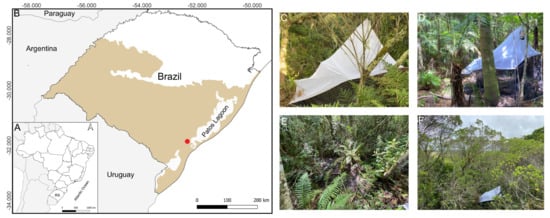
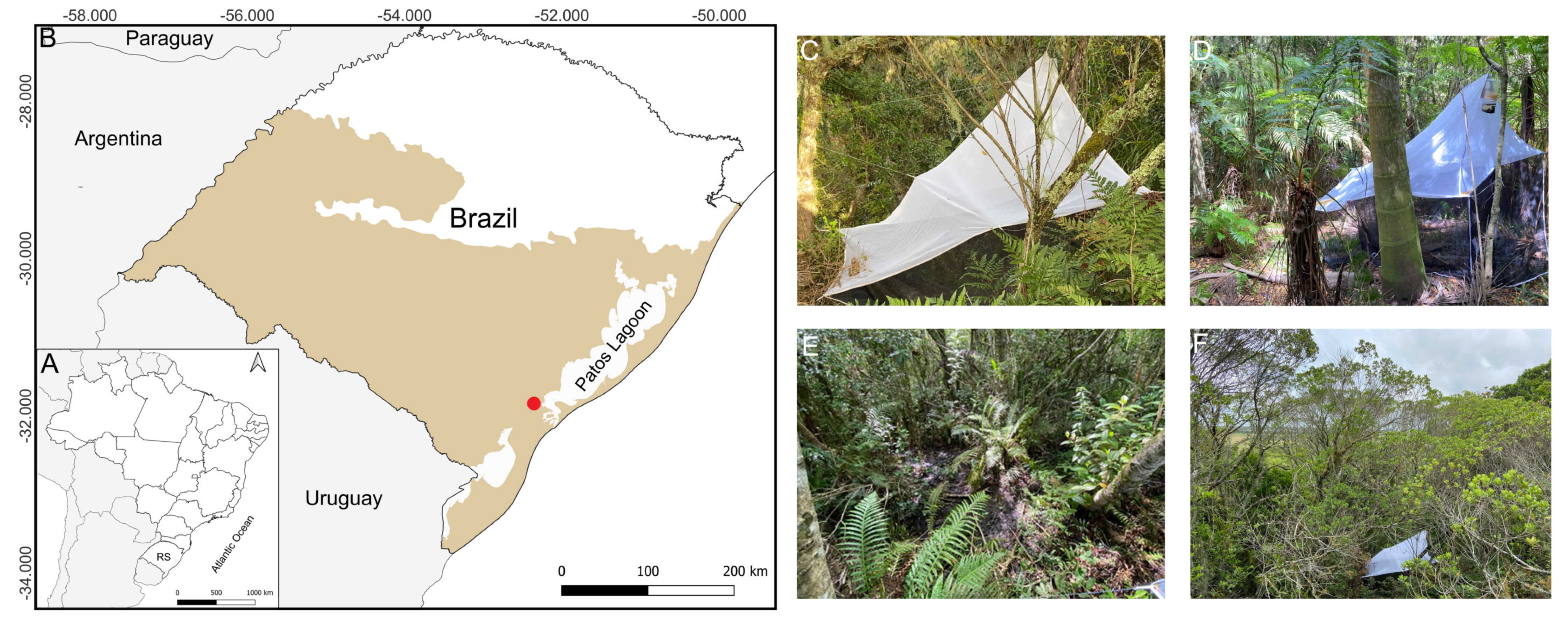
The study was conducted at Pontal da Barra, located within Laranjal Beach, municipality of Pelotas, in the southern Coastal Plain of Rio Grande do Sul State, Brazil [28]. The area lies at the confluence of the São Gonçalo Channel and the Patos Lagoon, with a maximum length of 6800 m and a maximum width of 2000 m [29] (Figure 1A,B). Pontal da Barra is situated within the Pampa biome, under Atlantic Forest biome influence near the Atlantic Ocean, in the coastal sandy grassland ecoregion [30] (Figure 1B).
Figure 1.
Map showing (A) the location of Rio Grande do Sul State in Brazil and South America; (B) the limits of the Brazilian Pampa (brown area) and the studied site in Pelotas municipality (red dot) in Rio Grande do Sul State; (C) sampling site 1; (D) sampling site 2; (E) sampling site 3; (F) sampling site 4.
The area comprises a complex mosaic of wetlands and paleodune systems, including diverse landforms typical of lacustrine plains, alluvial–lagoon plains, lagoon terraces, and dune systems [31]. Historical data (1971–2000) indicate that the annual average temperature at the study site is 17.8 °C, and the average seasonal rainfall is well-distributed, totalling 1366 mm per year. During the winter, frost events are common [32].
2.2. Sampling Design
Four areas were studied at Pontal da Barra, in which the selection of the sites was based on the representativeness of distinct forest formations of the region in previous field expeditions to properly represent the Restinga ecosystems of the southern Brazilian Coastal Plain. Site 1 was characterised by wetlands surrounded by Restinga ecosystems with distinct types of vegetation (−31.76481, −52.268619) (Figure 1C). Site 2 was located inside a forest on the dune slope (−31.766800, −52.266549) (Figure 1D). Site 3 was established within the same forest, close to a water body (−31.767727, −52.265723) (Figure 1E). Site 4 was installed on top of the dunes, adjacent to a forest fragment (−31.767761, −52.265434) (Figure 1F). At each sampling site, one Townes Malaise trap model with a high, wide, white roof was installed, equipped with a collecting bottle containing 70% ethanol. The trap length was 165 cm, the front side height was 170 cm, the back side height was 110 cm, and the width of both ends was 115 cm. All Malaise traps remained open and active throughout 2021, and all sites were sampled fortnightly from January to December.
After collecting, each sample was sorted to separate butterflies from other organisms. Given that butterflies were stored in 70% ethanol, all individuals were dried in an oven at 60 degrees for 24 h to facilitate characterisation of wing details and structures for accurate and reliable identification. Despite the preservation in ethanol, after drying, the collected individuals retained their characteristics, allowing for the identification of most specimens at the species level. Butterflies from the families Hesperiidae and Lycaenidae were photographed, arranged on a plate, and sent to specialists with taxonomic expertise on the identification of Neotropical butterflies (see Acknowledgments and Figure S1). In this way, the butterflies of the subfamily Hersperiinae and some Lycaenidae individuals were morphotyped, ensuring that each species/phenotype was a distinct entity. The nomenclature of butterfly species follows the site of “Butterflies of America” (available on https://www.butterfliesofamerica.com/). Fortnightly samples were subsequently pooled by month for data analyses.
2.3. Abiotic Variables
We measured the temperature and relative humidity obtained from the Instituto Nacional de Meteorologia (INMET; https:///portal.inmet.gov.br/) using data from the nearest available meteorological station [station A887], located in Capão do Leão (Pelotas), Rio Grande do Sul, about 19 km from the study area. Hourly meteorological bulletins for the year 2021 were used. Temperature and humidity values were calculated as weekly and monthly means for each season across the year.
2.4. Data Analysis
2.4.1. Temperature and Humidity
To assess the temporal variation in the butterflies of Pontal da Barra across one year of sampling, we pooled subsets of three months within each season in the Southern Hemisphere, in which January to March indicate summer, April to June indicate autumn, July to September indicate winter, and October to December indicate spring. Thus, the data analysed were based on this approach.
Seasonal means of temperature and humidity in the sampled months were first tested for normality and homoscedasticity of the variances using the Shapiro–Wilk test, which is appropriate for small sample sizes. Temperature data met the assumptions of normality, whereas humidity data followed a non-parametric distribution (Table 1). Consequently, differences in temperature among seasons were analysed using one-way ANOVA followed by Tukey’s post hoc test. Differences in humidity were assessed using the Kruskal–Wallis test, with subsequent pairwise comparisons conducted using Dunn’s test. All analyses were performed in the software PAST version 4.14 [33].
Table 1.
Normality test results for the temperature and humidity variables by season.
2.4.2. Alpha and Beta-Diversity Measures
The butterfly alpha diversity across months within each season was analysed using sample coverage to assess sampling sufficiency and through diversity profiles based on observed (empirical) data. To standardise the diversity of butterflies among seasons across the studied year, given distinct sampling coverage, we performed a sampling-based rarefaction with extrapolation through the q statistic based on entropy with q = 0 and 999 permutations [34]. Additionally, Hill numbers and the diversity order q were used to estimate diversity patterns for rarefied species richness (q = 0), evenness (q = 1), and dominance (q = 2) [34]. Statistical significance was determined using 95% confidence intervals obtained via data rarefaction. These analyses were conducted using the online iNEXT software [35].
To avoid the influence of spatial variation in the distinct sampled sites on the evaluated data, we performed a Principal Coordinates Analysis (PCoA) using the Simpson similarity in each site (pooling the months representing each season). The Simpson index evaluates shared species with great differences in species richness among samples. To test the significance of the data, we calculated a PERMANOVA with the same resemblance measure and 9999 permutations. Then, the variation in butterfly species composition among seasons was analysed using a presence–absence matrix and the Sørensen dissimilarity index (βSOR), which was partitioned into two complementary components, namely species turnover (βSIM) and nestedness (βSNE), following the framework proposed by BASELGA [36]. Analyses were performed in R software [37] using the package betapart version 1.6 [38], through the function beta.pair (index.family = “sor”). This approach allows total dissimilarity (βSOR) among communities to be decomposed into a fraction attributable to species replacement (βSIM) and another resulting from richness differences associated with nestedness patterns (βSNE).
3. Results
3.1. Abiotic Variables—Temperature and Humidity
The mean temperature indicated that summer (22.9 °C) was the warmest season, followed by spring (19.9 °C), autumn (15.6 °C), and winter (14.3 °C), being similar to the historical records [32]. Relative humidity was more similar among seasons, with winter (85.3%) and summer (81.6%) being the most humid seasons, followed by autumn (81.3%) and spring (76.4%). Statistical analyses revealed significant differences in temperature among seasons (ANOVA: F = 29.0; p < 0.001), in which winter and autumn were similar and cooler than spring and summer, which were the warmest seasons (Table 2). The Kruskal–Wallis test indicated, for humidity, significant seasonal differences (H = 17.05; p < 0.001), with winter being significantly more humid than the other seasons, whereas the other seasons did not differ from each other (Table 3).
Table 2.
Results of Tukey’s pairwise comparison test for temperature among the seasons. The numbers on the upper diagonal represent p-values, and the numbers on the lower diagonal represent the Tukey test statistic (Q).
Table 3.
Results of Dunn’s pairwise comparison test for humidity among the seasons. The numbers on the upper diagonal represent p-values, and the numbers on the lower diagonal represent the Dunn test statistic (z).
3.2. Alpha Diversity and Temporal Variation in Butterflies
After 365 days of sampling in 2021, a total of 173 individuals representing 58 butterfly species/phenotypes was recorded in the Pontal da Barra region throughout the year (Table S1). Species richness was highest in the months of summer (39 species), followed by the months of spring (24 species), autumn (11 species), and winter (only four species). Seasonal sample coverage indicated lower sampling completeness in winter (0.18), whereas summer (0.87), spring (0.85), and autumn (0.60) showed substantially higher sampling completeness. Thus, in the year 2021, except for winter, all seasons exhibited good representativeness of the recorded butterfly assemblages, with summer and spring showing the highest completeness. Given the low sampling completeness in the winter, the sample-based rarefaction (q = 0 statistic) still indicated low values of butterfly diversity, even with an increase of about four times the sampling coverage in the extrapolated data (Figure S2). The annual variation in summer had the greatest number of individuals (N = 92), followed by spring (N = 60), autumn (N = 17), and winter (N = 4). Accordingly, increases in temperature during the months of the warmer seasons were associated with higher butterfly species richness and abundance.
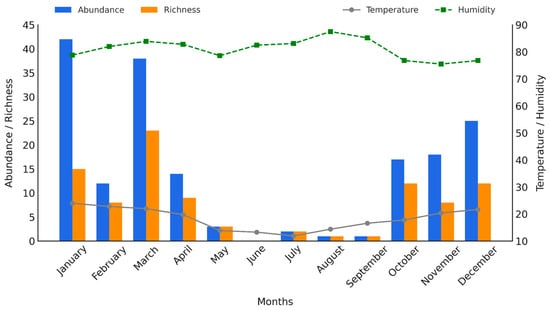
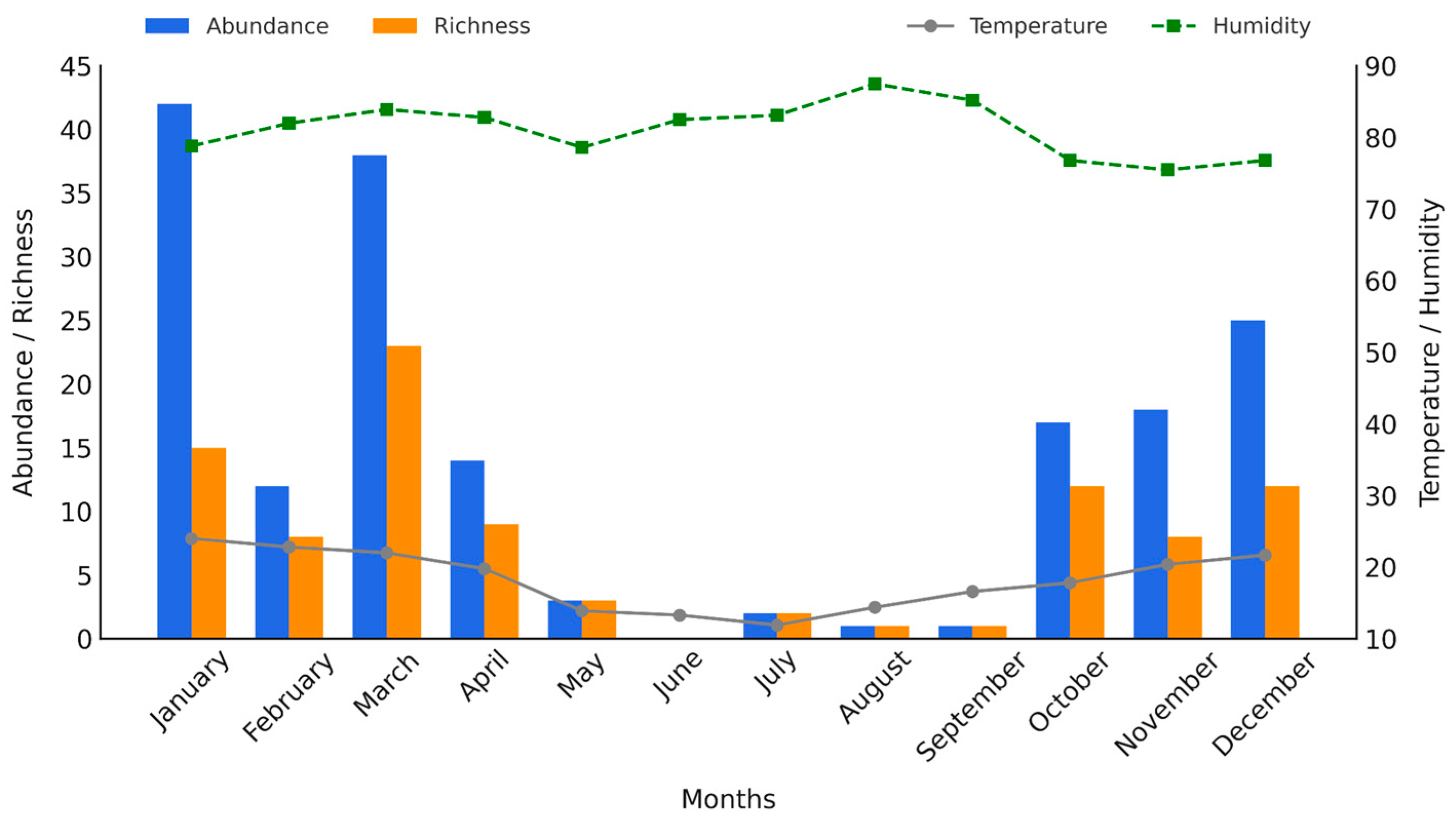
When the monthly variation in butterfly abundance and richness was compared with the temperature and humidity throughout the sampling year (Figure 2), peaks in richness and abundance closely followed periods of higher temperature, but not necessarily higher humidity. The warmest months corresponded to summer and spring, whereas values remained consistently lower during the other seasons, particularly in winter.
Figure 2.
Species richness and butterfly abundance in relation to temperature and humidity recorded from January to December 2021 in Restinga areas at Pontal da Barra, Pelotas.
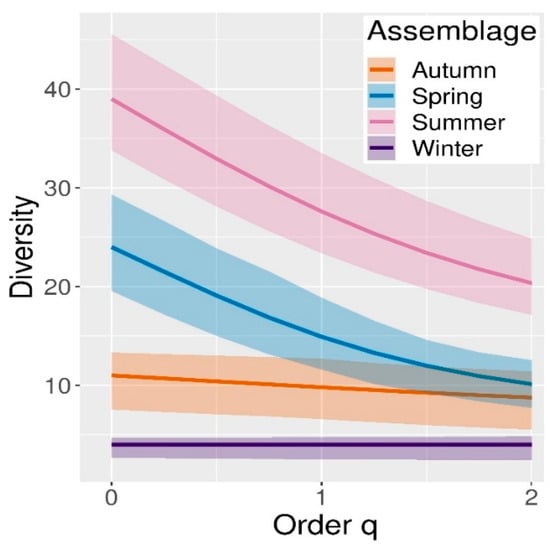
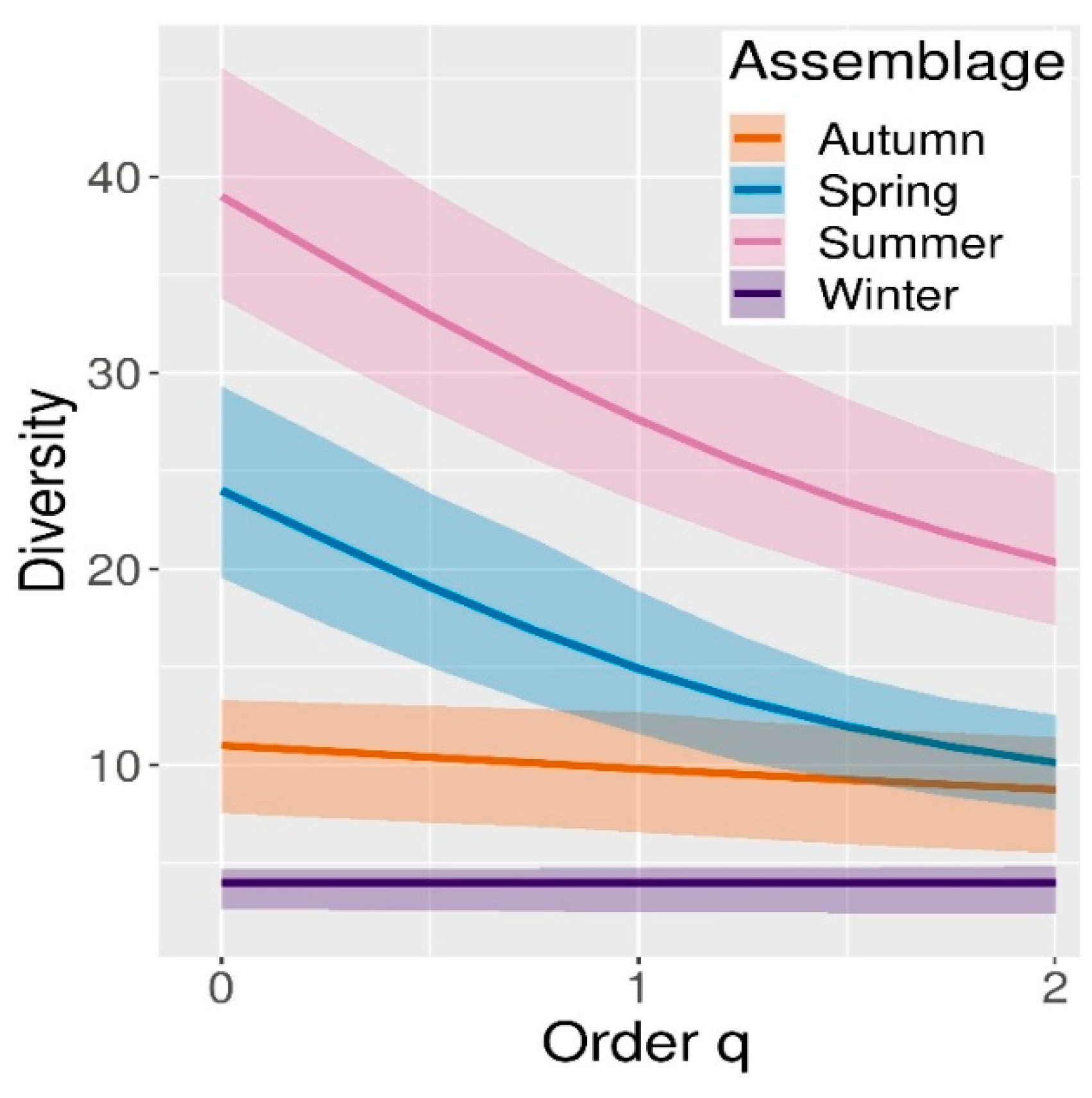
An analysis of diversity profiles showed that rarefied butterfly species richness (q = 0) was highest in summer, followed by spring, autumn, and winter, with the latter being the least rich season. When the abundance was considered in the analysis, patterns indicated that evenness (q = 1) was higher in summer compared to the other seasons, as shown by the slight overlap of confidence intervals in spring and autumn (Figure 3). In contrast, winter differed markedly and was the least diverse season in terms of both evenness and dominance (q = 2) (Figure 3). Autumn and spring exhibited statistically similar dominance values, while summer consistently showed the highest diversity (Figure 3).
Figure 3.
Butterfly diversity profile by season recorded in Restinga areas at Pontal da Barra, Pelotas. Each curve represents the diversity of a season of the year according to Hill numbers and the parameter q, where q = 0 corresponds to rarefied richness, q = 1 to evenness, and q = 2 to dominance.
3.3. Annual Variation in Butterfly Species Composition
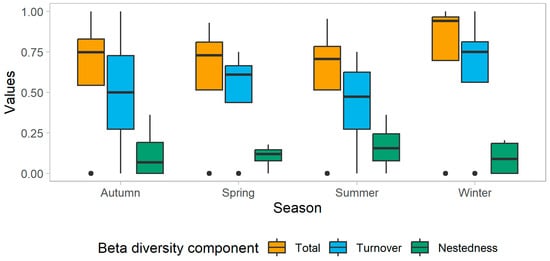
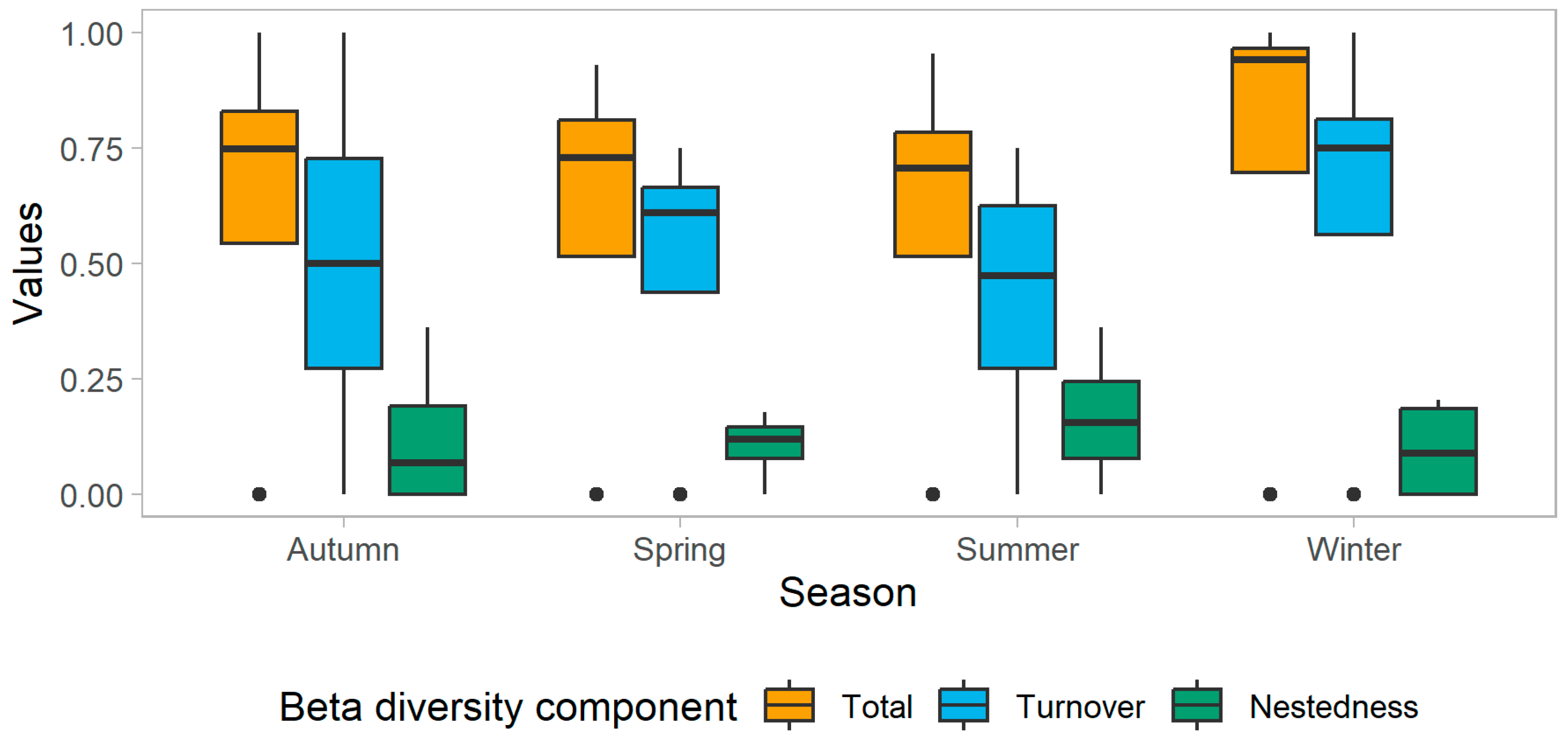
The PCoA showed similar species composition of butterflies among the four sampled sites, with no statistical differences according to the PERMANOVA (Figure S3), indicating that the temporal dimension drove the species composition throughout the sampled year. Thus, temporal variation assessed through the decomposition of beta-diversity into nestedness and turnover components (Figure 4) indicated that species turnover was the dominant contributor to butterfly assemblage dissimilarity across seasons. Turnover values were higher than the nestedness component, which remained low during the entire sampling period. This pattern indicates substantial species replacement, with each season presenting the butterfly species absent in other seasons. Total beta-diversity followed the variation in turnover, being highest in the months of winter and lowest in spring (Figure 4).
Figure 4.
Seasonal variation across months in 2021 in beta-diversity components of butterflies recorded in Restinga ecosystems (autumn, spring, summer, and winter), including total beta-diversity, species turnover, and nestedness. Boxes represent the interquartile range with the central line indicating the median.
4. Discussion
Our study showed the intra-annual variation in the diversity and structure of butterfly assemblages at a subtropical site in southernmost Brazil. Bearing in mind only one year of sampling without a true replication of the evaluated seasons, our results should be discussed with caution. Although temperature data were obtained from a meteorological station 19 km from the study area, and local microclimatic conditions may vary throughout the year, our purpose was to assess the influence of regional-scale climatic conditions on temporal patterns of butterfly diversity over one year. Thus, the measurement of the temperature in a broad manner characterises these dynamics in the subtropical region. In this way, this climatic variable may act as an environmental filter with a stronger influence than humidity, being the most important driver of temporal patterns of butterflies’ distribution in the studied Restinga ecosystems. Several studies have highlighted the importance of temperature in shaping butterfly diversity patterns [19,21,39,40,41], given its direct and indirect effects on multiple aspects of butterfly life cycles [42], particularly in regions with pronounced climatic severity with marked temperature variation. Additionally, peaks in richness and abundance, as well as higher evenness, were observed during the summer months, followed by spring, coinciding with increasing temperatures. However, butterfly diversity declined substantially during the colder winter months. Contrary to our expectation, the temporal species composition across a single year revealed that each season had a highly distinct subset of species with little overlap, indicating that the beta-diversity component was associated with species turnover rather than the nestedness component, which contributed very little to overall beta-diversity variation.
The association between increased richness, abundance, and higher evenness of butterflies in the warmest months may be related to more favourable environmental conditions during spring and summer. In temperate regions of the Northern Hemisphere, spring is often considered one of the most diverse periods with high insect activity [21], associated with increased leaf production for immature stages and the presence of flowering for nectar-feeding adults [43]. Although this difference in resource availability during spring may occur later in the year, it acts as an important mechanism to explain the high richness and abundance patterns observed in summer. Consequently, this season provides greater availability and higher quality resources, particularly for adult insects, which commonly synchronise their activity with this period [21,39,44] and are directly influenced by higher temperatures [39]. The greater evenness observed among species in the study area supports this interpretation, as it suggests improved resource availability, promoting higher butterfly diversity.
The reduction in the number of adult butterflies during colder months, characterised by large daily thermal amplitudes, may be associated with the climatic severity of the winter. This may occur due to limited food resources or as a consequence of survival strategies such as diapause at specific life stages in response to declining temperatures and the beginning of unfavourable conditions, as well as adult migration to areas with more suitable climates [21,22,43]. Although autumn is recognised as the second-most diverse season in some subtropical studies [10,38], in our study, it exhibited lower diversity than spring, representing a colder period in the extreme south of Brazil (Southern Hemisphere) from mid-April to early May, preceding the harsh conditions of winter.
The predominance of turnover in the temporal distribution of butterflies across a year indicates that the species are being replaced as environmental conditions change. Low sampling completeness in winter may partly bias the observed species replacement, as fewer recorded species can influence beta-diversity estimation. Nevertheless, most species recorded during winter were distinct from those in other seasons, suggesting possible adaptations to colder conditions. Additionally, sample-based rarefaction indicates that even with increased sampling effort (about four times the sampling coverage), winter remains characterised by low species representativeness, indicating that the colder months in the subtropics naturally promote low representativeness of butterflies [19]. Therefore, temperature is a primary factor structuring plant phenology and, consequently, butterfly community patterns, acting as an environmental filter that selects different species subsets within a season in the subtropical region [19]. Thus, each period of the year favours specific butterfly groups due to resource availability or distinct physiological requirements. One mechanism that may contribute to this pattern is reduced competition through temporal niche partitioning, whereby organisms minimise overlapping in resource use, leading different species to dominate at different times of the year [45]. This strategy is effective for mitigating interspecific competition and structuring assemblages over time [45]. Thus, the observed temporal turnover may reflect this strategy, particularly those better adapted to harsher winter conditions. However, additional observation and experiments are necessary to produce direct evidence that competition is shaping these patterns.
Phenotypic plasticity may also help explain the high species turnover, as environmental conditions can induce changes in development, morphology, and behaviour, allowing some species to express phenotypes suited to specific times of the year [46], such as seasonal polyphenism [47,48,49]. Behavioural and physiological thermoregulation represents another important factor influencing the temporal distribution of species composition, in which the ability to regulate body temperature through basking behaviour, microhabitat selection and use, and daily activity variation determines when the organism can fly, feed, and reproduce [50,51,52]. Consequently, species with different functional traits and thermoregulatory strategies (variation in body size, wing coloration, and wing shape) tend to differ in their activity across the year [50,51,52]. The temporal variation in temperature or solar radiation may therefore select distinct butterfly groups in different periods throughout the year, resulting in high species replacement [44].
The use of the specific Townes Malaise trap model [53] seems to be effective for monitoring butterfly assemblages over time [27], particularly by enabling continuous and standardised daily sampling over a complete year, increasing the representativeness of butterflies in each month [5], even though it is not the traditional method of collecting butterflies. This approach is especially valuable for detecting temporal variation in communities and accurately identifying periods of peak activity and diversity [54]. Given that our study area is located further south than most subtropical Neotropical studies, it is plausible that the higher diversity recorded during warmer periods is associated with more suitable climatic conditions, reinforcing the described patterns of pronounced temporal diversity observed in the local species pool. Based on our findings, butterflies in extreme southern Brazil reach peaks in abundance during greater periods, although population sizes never reach zero throughout the year [21]. Nevertheless, substantial variation remains in the drivers of temporal diversity and distribution in subtropical insects, with transitional periods represented by autumn and spring showing contrasting effects on butterfly assemblage structure [19].
Supplementary Materials
The following supporting information can be downloaded at https://www.mdpi.com/article/10.3390/d18040226/s1; Table S1: Species list of butterflies occurring in the studied Restinga ecosystems sites. Figure S1: Plates with representatives of Lycaenidae and Hesperiidae sent to specialists with expertise on the identification of Neotropical butterflies. Figure S2: Sample-based rarefaction of the diversity of butterflies in each season across one year of sampling in Restinga ecosystems, southern Brazil. Figure S3: Principal Coordinates Analysis (PCoA) of butterfly species composition in the four studied sites in Restinga ecosystems, southern Brazil, with PERMANOVA result. Black dots = Site 1; orange dots = Site 2; green dots = Site 3; pink dots = Site 4.
Author Contributions
Conceptualization, Y.C.d.M.d.F., C.A.I. and J.V.-B.; methodology, R.F.K.; validation, Y.C.d.M.d.F., C.A.I., R.F.K. and J.V.-B.; formal analysis, Y.C.d.M.d.F. and C.A.I.; investigation, Y.C.d.M.d.F. and C.A.I.; resources, R.F.K. and C.A.I.; data curation, Y.C.d.M.d.F. and C.A.I.; writing—original draft preparation, Y.C.d.M.d.F.; writing—review and editing, C.A.I., R.F.K. and J.V.-B.; visualisation, Y.C.d.M.d.F. and C.A.I.; supervision, C.A.I. and J.V.-B.; project administration, C.A.I.; funding acquisition, R.F.K. and C.A.I. All authors have read and agreed to the published version of the manuscript.
Funding
This research received no external funding.
Data Availability Statement
The data that support the findings of this study are available from https://doi.org/10.5281/zenodo.19389691.
Acknowledgments
The authors thank Vera Moreira and family for granting access to their property at Fundação Tupahue and all colleagues who helped in the study. We thank Ricardo Siewert (Universidade Federal de Santa Maria, Brazil) and Lucas A. Kaminski (INECOL, Mexico) for helping with the identification of Hesperiidae and Lycaenidae, respectively. We also thank Juliana Cordeiro, Milton de Souza Mendonça Jr., Kauane Maiara Bordin, Luc Legal, and three anonymous reviewers who made a careful revision of an earlier version of the manuscript, improving the quality of this study.
Conflicts of Interest
The authors declare no conflicts of interest.
References
- Keddy, P.A. Assembly and response rules: Two goals for predictive community ecology. J. Veg. Sci. 1992, 3, 157–164. [Google Scholar] [CrossRef] [Scilit]
- Götzenberger, L.; de Bello, F.; Bråthen, K.A.; Davison, J.; Dubuis, A.; Guisan, A.; Lepš, J.; Lindborg, R.; Moora, M.; Pärtel, M.; et al. Ecological assembly rules in plant communities: Approaches, patterns and prospects. Biol. Rev. 2012, 87, 111–127. [Google Scholar] [CrossRef] [Scilit] [PubMed]
- Ricklefs, R.E. A Economia da Natureza, 5th ed.; Guanabara Koogan: Rio de Janeiro, Brazil, 2003. [Google Scholar]
- Melo Silva, A.R.; de Castro, C.O.; Mafia, P.O.; Mendonça, M.O.C.; Alves, T.C.C.; do Vale Beirão, M. Borboletas frugívoras (Lepidoptera: Nymphalidae) de uma área urbana em Belo Horizonte, Minas Gerais, Brasil. Biota Neotrop. 2012, 12, 292–297. [Google Scholar] [CrossRef] [Scilit]
- Freitas, A.V.L.; Santos, J.P.; Rosa, A.H.; Iserhard, C.A.; Richter, A.; Siewert, R.R.; Gueratto, P.E.; Carreira, J.Y.O.; Lourenço, G.M. Sampling methods for butterflies (Lepidoptera). In Measuring Arthropod Biodiversity: A Handbook of Sampling Methods; Santos, J.C., Fernandes, G.W., Eds.; Springer: Cham, Switzerland, 2021; pp. 101–123. [Google Scholar] [CrossRef] [Scilit]
- Freitas, A.V.L.; Gueratto, P.E.; Carreira, J.Y.O.; Lourenço, G.M.; Shirai, L.T.; Santos, J.P.; Rosa, A.H.B.; Evora, G.B.; Ramos, R.R.; Uribe, M.A.M. Fruit-feeding butterfly assemblages: Trends, changes, and the importance of monitoring schemes in Neotropical environments. In Insect Decline and Conservation in the Neotropics; Springer: Berlin/Heidelberg, Germany, 2024; pp. 205–233. [Google Scholar] [CrossRef] [Scilit]
- Janzen, D.H. Insect diversity of a Costa Rica dry forest: Why keep it, and how? Biol. J. Th Linn. Soc. 1987, 30, 343–356. [Google Scholar] [CrossRef] [Scilit]
- Wolda, H. Trends in abundance of tropical forest insects. Oecologia 1992, 89, 47–52. [Google Scholar] [CrossRef] [Scilit] [PubMed]
- Ruppert, E.E.; Fox, R.S.; Barnes, R.D. Zoologia dos Invertebrados: Uma Abordagem Funcional-Evolutiva; Roca: São Paulo, Brazil, 2005; pp. 1–1145. [Google Scholar]
- Hammond, P.C.; Miller, J.C. Comparison of the biodiversity of Lepidoptera within three forested ecosystems. Ann. Entomol. Soc. Am. 1998, 91, 323–328. [Google Scholar] [CrossRef] [Scilit]
- Hegland, S.J.; Nielsen, A.; Lázaro, A.; Bjerknes, A.-L.; Totland, Ø. How does climate warming affect plant–pollinator interactions? Ecol. Lett. 2014, 17, 184–195. [Google Scholar] [CrossRef] [Scilit]
- Bonebrake, T.C.; Ponisio, L.C.; Boggs, C.L.; Ehrlich, P.R. More than just indicators: A review of tropical butterfly ecology and conservation. Biol. Conserv. 2010, 143, 1831–1841. [Google Scholar] [CrossRef] [Scilit]
- Rader, R.; Cunningham, S.A.; Howlett, B.G.; Inouye, D.W. Non-Bee Insects as Visitors and Pollinators of Crops: Biology, Ecology, and Management. Annu. Rev. Entomol. 2020, 65, 391–407. [Google Scholar] [CrossRef] [Scilit]
- Zhang, H.; Wang, W.; Yu, Q.; Xing, D.; Xu, Z.; Duan, K.; Zhu, J.; Zhang, X.; Li, Y.; Hu, S. Spatial Distribution of Pollinating Butterflies in Yunnan Province, Southwest China with Resource Conservation Implications. Insects 2020, 11, 525. [Google Scholar] [CrossRef] [Scilit]
- Brown, K.S.; Freitas, A.V.L. Lepidoptera. In Biodiversidade do Estado de São Paulo, Brasil: Síntese do Conhecimento ao Final do Século; Brandão, C.R.F., Cancello, E.M., Eds.; FAPESP: São Paulo, Brazil, 1999; pp. 225–243. [Google Scholar]
- Brown, K.S. Conservation of Neotropical environments: Insects as indicators. In The Conservation of Insects and Their Habitats; Collins, N.M., Thomas, J.A., Eds.; Academic Press: London, UK, 1991; pp. 349–404. [Google Scholar]
- Merckx, T.; Feber, R.E.; Hoare, D.J.; Parsons, M.S.; Kelly, C.J.; Bourn, N.A.D.; Macdonald, D.W. Conserving threatened Lepidoptera: Towards an effective woodland management policy in landscapes under intense human land-use. Biol. Conserv. 2013, 159, 146–156. [Google Scholar] [CrossRef] [Scilit]
- Uehara-Prado, M.; Freitas, A.V.L.; Francini, R.B.; Brown, K.S., Jr. Guia das borboletas frugívoras da Reserva Estadual do Morro Grande e região de Caucaia do Alto. Biota Neotrop. 2004, 4, 1–9. [Google Scholar] [CrossRef] [Scilit]
- Iserhard, C.A.; Romanowski, H.P.; Richter, A.; Mendonça, M.S., Jr. Monitoring temporal variation to assess changes in the structure of subtropical Atlantic Forest butterfly communities. Environ. Entomol. 2017, 46, 804–813. [Google Scholar] [CrossRef] [Scilit]
- Janzen, D.H.; Schoener, T.W. Differences in insect abundance and diversity between wetter and drier sites during a tropical dry season. Ecology 1967, 49, 96–110. [Google Scholar] [CrossRef] [Scilit]
- Wolda, H. Insect seasonality: Why? Annu. Rev. Ecol. Evol. Syst. 1988, 19, 1–18. [Google Scholar] [CrossRef]
- Kishimoto-Yamada, K.; Itioka, T. How much have we learned about seasonality in tropical insect abundance since Wolda (1988)? Entomol. Sci. 2015, 18, 407–419. [Google Scholar] [CrossRef] [Scilit]
- Carreira, J.Y.O.; Brown Jr., K.S.; Freitas, A.V.L. Species List and Temporal Trends of a Butterfly Community in an Urban Remnant in the Atlantic Forest. Diversity 2025, 17, 604. [Google Scholar] [CrossRef] [Scilit]
- Santos, J.P.; Iserhard, C.A.; Carreira, J.Y.O.; Freitas, A.V.L. Monitoring Fruit-Feeding Butterfly Assemblages in Two Vertical Strata in Seasonal Atlantic Forest: Temporal Species Turnover Is Lower in the Canopy. J. Trop. Ecol. 2017, 33, 345–355. [Google Scholar] [CrossRef] [Scilit]
- Mena, S.; Rentería, J.; Checa, M.F. Diel Versus Seasonal Butterfly Community Partitioning in a Hyperdiverse Tropical Rainforest. Insects 2025, 16, 1247. [Google Scholar] [CrossRef] [Scilit]
- Owen, D.F. Species diversity in butterflies in a tropical garden. Biol. Conserv. 1971, 3, 191–198. [Google Scholar] [CrossRef] [Scilit]
- Ginn, M.H.; Britton, D.R.; Bulbert, M.W. New records of butterflies (Lepidoptera) in the Pilbara region of Western Australia, with comments on the use of malaise traps for monitoring. Aust. Entomol. 2007, 34, 65–75. Available online: https://search.informit.org/doi/10.3316/informit.071163447650797 (accessed on 21 February 2024).
- RADAMBRASIL. Levantamento de Recursos Naturais: Folha SH.22 Porto Alegre; Ministério das Minas e Energia: Rio de Janeiro, Brazil, 1986; Volume 3. [Google Scholar]
- Barcellos, S.C.B. Fundamentação Técnico Científica para a Criação da Unidade de Conservação Pontal da Barra do Laranjal, Pelotas, RS; Technical Report; Universidade Federal de Pelotas (UFPEL): Pelotas, Brazil, 2019; 88p. [Google Scholar]
- Hasenack, H.; Weber, E.; Boldrini, I.I.; Trevisan, R. Mapa de Sistemas Ecológicos da Ecorregião da Planície Costeira do Rio Grande do Sul; Technical Report; Universidade Federal do Rio Grande do Sul (UFRGS)/The Nature Conservancy: Porto Alegre, Brazil, 2010. [Google Scholar]
- Silva, A.R.E.; Rehbein, M.O. Análise e mapeamento geomorfológico da área de influência da Planície Costeira de Pelotas (Rio Grande do Sul). Rev. Bras. Geomorfol. 2018, 19, 567–585. [Google Scholar] [CrossRef] [Scilit]
- Mauricio, G.N.; Souza, C.A.; Soares, L.R.; Vizentin-Bugoni, J. Spatiotemporal variation in the diet of Hooded Berryeater (Carpornis cucullata) in the southernmost section of the Atlantic Forest ecoregion. J. Field Ornithol. 2025, 96, 10. [Google Scholar] [CrossRef] [Scilit]
- Hammer, Ø.; Harper, D.A.T.; Ryan, P.D. PAST: Paleontological statistics software package for education and data analysis. Palaeontol. Electron. 2001, 4, 1–9. [Google Scholar]
- Chao, A.; Ma, K.H.; Hsieh, T.C. iNEXT (iNterpolation and EXTrapolation). 2021. Available online: https://chao.shinyapps.io/iNEXTOnline/ (accessed on 21 February 2024).
- Hsieh, T.C.; Ma, K.H.; Chao, A. iNEXT: An R package for rarefaction and extrapolation of species diversity (Hill numbers). Methods Ecol. Evol. 2016, 7, 1451–1456. [Google Scholar] [CrossRef] [Scilit]
- Baselga, A. The relationship between species replacement, dissimilarity derived from nestedness, and nestedness. Glob. Ecol. Biogeogr. 2012, 21, 1223–1232. [Google Scholar] [CrossRef] [Scilit]
- R Core Team. R: A Language and Environment for Statistical Computing; R Foundation for Statistical Computing: Vienna, Austria, 2025; Available online: https://www.r-project.org/ (accessed on 21 February 2024).
- Baselga, A.; Orme, C.D.L. betapart: An R package for the study of beta diversity. Methods Ecol. Evol. 2012, 3, 808–812. [Google Scholar] [CrossRef] [Scilit]
- Ribeiro, D.B.; Prado, P.I.; Brown, K.S., Jr.; Freitas, A.V.L. Temporal diversity patterns and phenology in fruit-feeding butterflies in the Atlantic Forest. Biotropica 2010, 42, 710–716. [Google Scholar] [CrossRef] [Scilit]
- Nobre, C.E.B.; Iannuzzi, L.; Schlindwein, C. Seasonality of fruit-feeding butterflies (Lepidoptera, Nymphalidae) in a Brazilian semiarid area. ISRN Zool. 2012, 2012, 1–8. [Google Scholar] [CrossRef] [Scilit]
- Checa, M.F.; Barragán, Á.; Rodríguez, J.; Christman, M.C. Microclimate variability significantly affects the composition, abundance and phenology of butterfly communities in a highly threatened Neotropical dry forest. Fla. Entomol. 2014, 97, 1–13. [Google Scholar] [CrossRef] [Scilit]
- Radchuk, V.; Turlure, C.; Schtickzelle, N. Each life stage matters: The importance of assessing the response to climate change over the complete life cycle in butterflies. J. Anim. Ecol. 2013, 82, 275–285. [Google Scholar] [CrossRef] [Scilit]
- Wolda, H. Seasonal fluctuations in rainfall, food, and abundance of tropical insects. J. Anim. Ecol. 1978, 47, 369–381. [Google Scholar] [CrossRef] [Scilit]
- Pozo, C.; Luis-Martínez, A.; Llorente-Bousquets, J.; Salas-Suárez, N.; Maya-Martínez, A.; Vargas-Fernández, I.; Warren, A.D. Seasonality and phenology of the butterflies (Lepidoptera: Papilionoidea and Hesperioidea) of Mexico’s Calakmul region. Fla. Entomol. 2008, 91, 407–422. [Google Scholar] [CrossRef] [Scilit]
- Hood, G.R.; Waters, J.S.; Rundle, H.D.; Forbes, A.A. Temporal resource partitioning mitigates interspecific competition and promotes coexistence. Biol. Rev. 2021, 96, 1858–1878. [Google Scholar] [CrossRef] [Scilit] [PubMed]
- Halali, S.; Brakefield, P.M.; Brattström, O. Phenotypic plasticity in tropical butterflies is linked to climatic seasonality on a macroevolutionary scale. Evolution 2024, 78, 1302–1316. [Google Scholar] [CrossRef] [Scilit]
- Shapiro, A.M. Seasonal polyphenism. In Evolutionary Biology; Hecht, M.K., Steere, W.C., Wallace, B., Eds.; Springer: Boston, MA, USA, 1976; Volume 9, pp. 259–333. [Google Scholar]
- Brakefield, P.M. Seasonal polyphenism in butterflies and natural selection. In The Ecology and Evolution of Butterflies; Johnston, R.J., Edwards, J.A., Eds.; Cambridge University Press: Cambridge, UK, 1996; pp. 43–59. [Google Scholar]
- Halali, S.; Brakefield, P.M.; Brattström, O. Predictability of Temporal Variation in Climate and the Evolution of Seasonal Polyphenism in Tropical Butterfly Communities. J. Evol. Biol. 2021, 34, 1970–1983. [Google Scholar] [CrossRef] [Scilit] [PubMed]
- Bonebrake, T.C.; Boggs, C.L.; Stamberger, J.A.; Deutsch, C.A.; Ehrlich, P.R. From Global Change to a Butterfly Flapping: Biophysics and Behaviour Affect Tropical Climate Change Impacts. Proc. R. Soc. B Biol. Sci. 2014, 281, 20141264. [Google Scholar] [CrossRef] [Scilit] [PubMed]
- Wenda, E.; Kharouba, H.M.; Vellend, M. Trait–Environment Relationships Predict Sensitivity of Butterflies to Climate Warming. Glob. Ecol. Biogeogr. 2021, 30, 170–181. [Google Scholar] [CrossRef] [Scilit]
- Cómbita, L.M.; Checa, M.F.; Andrade-C., M.G.; Rodríguez, J.; Willmott, K.R. Microclimatic Drivers of Butterfly Activity and Community Structure in a Neotropical Forest. Ecol. Entomol. 2022, 47, 564–576. [Google Scholar] [CrossRef] [Scilit]
- Townes, H. A light-weight Malaise trap. Entomol. News 1972, 83, 239–247. [Google Scholar]
- Fraser, S.E.; Dytham, C.; Mayhew, P.J. Determinants of parasitoid abundance and diversity in woodland habitats. J. Appl. Entomol. 2007, 131, 593–601. [Google Scholar] [CrossRef] [Scilit]

Disclaimer/Publisher’s Note: The statements, opinions and data contained in all publications are solely those of the individual author(s) and contributor(s) and not of MDPI and/or the editor(s). MDPI and/or the editor(s) disclaim responsibility for any injury to people or property resulting from any ideas, methods, instructions or products referred to in the content. |
© 2026 by the authors. Licensee MDPI, Basel, Switzerland. This article is an open access article distributed under the terms and conditions of the Creative Commons Attribution (CC BY) license.