


Abstract
(1) Background: The acceleration of urbanization poses an increasingly serious threat to avian diversity. Consequently, accurate species identification of avian remains is essential for biodiversity monitoring, bird rescue operations, and conservation management. (2) Methods: This study employed DNA barcoding technology based on the cytochrome c oxidase subunit I (COI) gene to analyze 112 avian remains samples collected from urban and peri-urban areas of Tianjin city. (3) Results: A total of 47 bird species were identified, belonging to 11 orders, 24 families, and 30 genera, achieving an overall identification success rate of 95.54%. Passeriformes were dominant, accounting for 70.21% of the identified species. The species list includes 3 species listed as Class I nationally protected birds and 7 species as Class II nationally protected birds. Discrepancies between preliminary morphological identification and molecular identification results highlighted the complementary roles of the two approaches. (4) Conclusions: This study demonstrates that DNA barcoding is an effective tool for efficiently identifying degraded avian remains in urban environments. It provides reliable data for biodiversity assessments, wildlife rescue, and conservation management, while also supporting improved identification accuracy through the integration of molecular and morphological methods.
1. Introduction
With the continuous advancement of urbanization, the structure and function of urban ecosystems are undergoing profound transformations. In urban ecosystems, wildlife constitutes a vital resource for human survival and development, playing a key role in maintaining ecosystem security, stability, and ecological services [1,2]. Birds are among the most common wild animals in urban environments, characterized by their wide distribution and accessibility [3]. They play indispensable roles in maintaining ecological balance, facilitating seed dispersal, and managing pest. The community composition and population dynamics directly of avians reflect the ecological quality and biological carrying capacity of urban environments, substantially enhancing both the physical and mental health, as well as the overall welfare of urban dwellers [4].
Avian diversity, serving as a crucial indicator of ecosystem health and stability, faces mounting pressures from habitat fragmentation, environmental pollution, and human disturbances. Particularly in urban settings, incidents leading to bird mortality, such as collisions with buildings, illegal trade, and poisoning, occur frequently [5]. Without effective identification and documentation of these remains, gaps in biodiversity monitoring data will arise, subsequently compromising the scientific basis for conservation decisions and forensic investigations [6]. Against the backdrop of increasing integration between ecological conservation and judicial practice, there is a growing demand for the scientific and accurate identification of wildlife remains. This need extends to critical areas such as species protection, determination of legal liability, ecological and environmental damage compensation assessments, and compliance with international conventions [7,8].
Tianjin (38°34′–40°15′ N, 116°43′–118°04′ E), located in the northeastern part of the North China Plain and bordering the Bohai Sea to the east, is one of the four municipalities directly under the central government of China. The city covers an area of approximately 11,917 km2, with plains accounting for about 94% of its territory and low mountains in the north reaching an elevation of 1078 m at Jiushanding. These diverse habitats, ranging from mountains to coastal wetlands, support abundant bird populations, particularly along the East Asian–Australasian Flyway.
Tianjin encompasses diverse habitats ranging from mountains to coastal wetlands that support abundant bird populations. Over the past two decades, avian diversity in this region has been extensively documented. Within Tianjin alone, 251 species have been documented in urban areas, with species richness being higher in rural and wild landscapes, underscoring the suppressive effect of urbanization on local avian diversity [9].
Focusing specifically on Tianjin, recent studies have identified 228 protected bird species as conservation targets, revealing a synergistic relationship between avian biodiversity and ecosystem services [10]. However, protected areas cover only 37.7% of the overlapping biodiversity and ecosystem service hotspots, highlighting critical conservation gaps. To address these gaps, an ecological network comprising 20 ecological sources and 31 corridors has been proposed [10]. Research on wetland waterbirds further emphasizes the ecological importance of Tianjin’s wetlands, which cover approximately 21.05% of the city’s total area, with key habitats spanning 2695 km2 [11].
Despite these contributions, existing studies have predominantly focused on natural reserves and coastal wetlands, with limited attention to avian diversity within urban built-up areas such as parks, green spaces, and building perimeters. Methodologically, traditional morphological identification and field observation have been the primary approaches, whereas the application of DNA barcoding for identifying degraded avian remains has not yet been systematically explored in Tianjin. Traditional methods for monitoring avian diversity primarily rely on direct field observations, vocalization recognition, or feather morphology identification [12]. Nevertheless, these approaches often prove inadequate for deceased, fragmented, or morphologically indistinct individuals. In recent years, DNA barcoding technology has emerged as a powerful tool that employs sufficiently variable, easily amplified, and relatively short standardized DNA fragments, which specificity within species and diversity between species, for species identification [13,14]. Consequently, this method maintains high reliability even when samples are incomplete, degraded, or consist of minimal tissue, allowing for the simultaneous processing of multiple specimens [15]. Previous studies, which encompassed an extensive analysis of 13,320 species across 11 animal phyla has demonstrated that a segment of the mitochondrial cytochrome c oxidase subunit I (COI) gene near the 5′ end enables effective species identification within the animal kingdom, while also revealing significant sequence variation in the COI gene across the majority of animal groups [16]. This gene exhibits characteristics such as maternal inheritance, a relatively fast evolutionary rate, and a high nucleotide substitution rate, leading to its widespread application in wildlife forensics, biodiversity monitoring, and conservation biology research [17].
With the continuous improvement of the COI gene database, DNA barcoding has been applied to the identification of remains from a variety of organisms. In the fields of conservation biology and forensic science, accurate species identification forms a critical foundation for implementing effective conservation management and law enforcement supervision. However, when confronted with materials lacking morphological features or highly degraded specimens—such as wildlife products, trade residues, or environmental samples—traditional morphological identification methods often face significant limitations. In such cases, mitochondrial DNA barcoding provides a key tool for the precise identification of wildlife and endangered plants [18,19,20]. By amplifying short and conserved gene fragments, this technique can effectively overcome the challenges posed by incomplete morphological information or severe degradation of samples, making it particularly suitable for identifying materials such as hair, scales, bone fragments, wood remnants, and powdered products.
In law enforcement and regulatory practice, this technology has been widely applied in tracing the origin of illegally traded products, identifying components in mixed herbal medicines, and determining the species of decomposed biological samples. For instance, it has supplied reliable molecular evidence in cases involving illegal trade of animal skins [21,22] and identification of ivory remains [23]. Moreover, a study based on the COI gene involving over 23,000 avian remains [24] further demonstrates its practical value in forensic identification. Markedly, research indicates that building collisions rank as the second leading direct human-caused source of bird mortality in the United States, following predation by both wild and free-ranging domestic cats [25], with bird–window collisions being a major contributing factor among such human-related causes of death [26]. DNA barcoding has played a significant role in the rapid and accurate identification of avian remains in such contexts, providing standardized molecular evidence that supports efforts against poaching and smuggling, and enhances the scientific rigor and effectiveness of species conservation. For instance, a study successfully identified three species of Ascidiacea from northeastern China utilizing COI sequences, while another research effort determined that bird remains from an aircraft belonged to Hirundo rustica using COI and cytochrome b (Cytb) genes [5,27]. Thus, the COI sequence is the earliest proposed and most extensively used barcode marker, widely employed for precise species identification [28].
This study, focusing on the Tianjin urban area and its surrounding regions, collected avian remains from locations such as parks, green spaces, and building collision sites, and employed DNA barcoding technology for species identification, to elucidate their taxonomic status and analyze the species composition, faunal characteristics, and threat status of the urban avian community. This study employed DNA barcoding technology based on the COI gene to conduct molecular identification of 112 avian remains collected from urban Tianjin and its surrounding areas. A total of 47 bird species were successfully identified, belonging to 30 genera, 24 families, and 11 orders, achieving an overall identification success rate of 95.54%. Among these, three species are classified as national first-class protected species and seven as second-class protected species. The study also revealed discrepancies and complementary relationships between morphological and molecular identification results.
By unveiling the current state of avian diversity and primary risk factors within the urban environment, this research provides fundamental data for local avian resource inventorying, endangered species protection, and facilitating ecological restoration efforts, while simultaneously contributing valuable genetic information to advance studies in species biology and systematics. On a practical level, the identification results can aid in tracing illegal hunting and trade activities, offering technical support for wildlife conservation law enforcement and the refinement of relevant regulations. Moreover, this study provides scientific reference and practical support for enhancing public ecological awareness, reconciling urban development with biodiversity conservation, and promoting harmonious coexistence between humanity and the natural world.
2. Materials and Methods
2.1. Sample Collection
This study conducted avian sample collection within Tianjin urban area and its surrounding regions in 2025, accumulating a total of 112 avian remains samples. These samples encompassed various tissue types, including blood, muscle, and feathers. The collection methods and sources of the samples are summarized in Table 1.
Table 1.
Summary of sample collection sites, causes of death, and sources.
All collected samples, accompanied by clear background information, were obtained and utilized in strict compliance with ethical review approval and applicable regulations, providing a solid foundation for this study.
Among the collected samples, 87 were severely damaged in their external morphological features, rendering species identification based solely on morphology impossible. The remaining 25 samples underwent preliminary identification based on morphological characteristics, corresponding to 25 different bird species. Among the 112 samples collected, 48 were blood samples, 35 were muscle samples, and the remaining 29 were feather samples. All samples were stored at −20 °C for subsequent experimental analysis.
2.2. DNA Extraction and PCR Amplification
An appropriate amount of tissue sample was used to extract genomic DNA with the QIAGEN DNeasy Blood & Tissue Kit (Tiangen Biochemical Technology Co., Ltd., Beijing, China), strictly following the manufacturer’s instructions, for subsequent PCR use. PCR primers for amplifying the COI sequence (Fa1COFa, BirdR2) were referenced from Hebert et al. [29]:
Fa1COFa: 5′-TCAACAAACCACAAAGACATCGGCAC-3′;
BirdR2: 5′-ACTACATGTGAGATGATTCCGAATCCAG-3′.
Primers were synthesized by Sangon Biotech (Shanghai ) Co., Ltd, Shanghai, China. The PCR reaction volume was 50 μL, containing 25 μL of TaqTM HS Perfect Mix, 2 μL each of Fa1COFa and BirdR2 primers, 2 μL of DNA template, and 19 μL of ultrapure sterile water.
The PCR program commenced with an initial denaturation step at 94 °C for 1 min to ensure complete denaturation of the template DNA into single strands. This was followed by the first-stage amplification, consisting of 5 cycles. Each cycle comprised denaturation at 94 °C for 1 min, annealing at 45 °C for 1.5 min, and extension at 72 °C for 1.5 min. This stage employed a lower annealing temperature to facilitate effective primer binding during the initial cycles. Subsequently, the reaction proceeded to the second-stage amplification for 35 cycles. In this stage, the annealing temperature was increased to 52 °C, with each cycle including 94 °C for 1 min, 52 °C for 1.5 min, and 72 °C for 1 min. The higher annealing temperature promoted stringent and specific primer-template pairing, significantly reducing non-specific amplification. After the cycling steps, a final extension was performed at 72 °C for 5 min to ensure the integrity of the newly synthesized DNA strands. Upon completion, PCR products were stored at 4 °C for subsequent use.
PCR amplification products were detected via 1% TAE agarose gel electrophoresis, using Marker 2000 (Silca, Treviso, Italy) as the reference marker. The PCR products were then sent to Beijing Genomics Institute Co., Ltd., Beijing, China for bidirectional sequencing using the Sanger method [30].
2.3. Data Comparison and Analysis
Sequences in FASTA format were subjected to local alignment analysis using the Basic Local Alignment Search Tool (BLAST, version 4.0) provided by the National Center for Biotechnology Information (NCBI) database and BOLD Identification Engine provided by BOLD Systems v4. Upon sequence submission, the system automatically returned alignment results. For further screening, sequences with a length and sequence identity greater than 99% were selected for subsequent phylogenetic analysis. Concurrently, COI sequences of Dromaius novaehollandiae (accession number: HQ910428.1) and Struthio camelus (accession number: MG930899.1) were downloaded from NCBI to serve as outgroups for sequence comparison [31,32]. Utilizing MEGA 11 software [33], a phylogenetic tree was constructed using the Neighbor-Joining (NJ) method, with the reliability of the phylogenetic relationships for each branch was assessed through Bootstrap analysis with 1000 replicates, ensuring the scientific rigor and robustness of the findings [34].
3. Results
3.1. Taxonomic Identification Results
Among the total of 112 samples obtained in this study, 25 samples were preliminarily identified as corresponding to 25 valid bird species. This initial identification was based on a comprehensive assessment integrating collection location, time, and specific morphological characteristics. The preliminary identification results are presented in Table 2.
Table 2.
Summary of Preliminary Identification Results for the 25 Avian Remains.
3.2. Molecular Sequencing and Identification Results
DNA was successfully extracted from all 112 avian remains samples. Among the resulting DNA samples, the COI gene was successfully amplified and sequenced from 107 samples, while amplification failed in two samples and three samples exhibited double peaks in their sequencing profiles. Using the online NCBI BLAST tool and the BOLD Identification Engine, sequences with similarity greater than 99% were selected for species assignment, resulting in the identification of 47 bird species. The overall identification success rate was 95.54%. Success rates varied by tissue type, with blood samples showing 97.92% success, muscle samples 88.57%, and feather samples 100%. A total of 47 bird species were successfully identified using DNA barcoding. The molecular identification results, together with the local residency status of each species, are summarized in Table 3.
Table 3.
Summary of Molecular Identification Results for the 47 Avian Remains.
Table 3 lists the species identified through DNA barcoding, along with their English common names, scientific names, and residency status (including breeding residents, migrants, winter visitors, and vagrants) and relative abundance (rare, uncommon, common, abundant) in Tianjin. This information provides essential ecological context for interpreting the species composition derived from molecular identification.
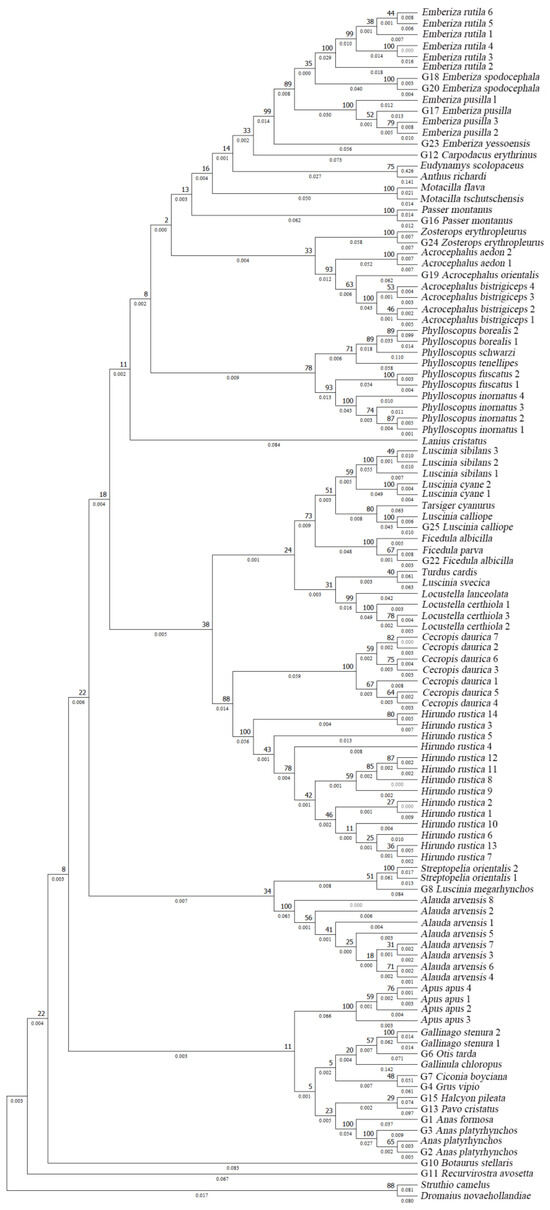
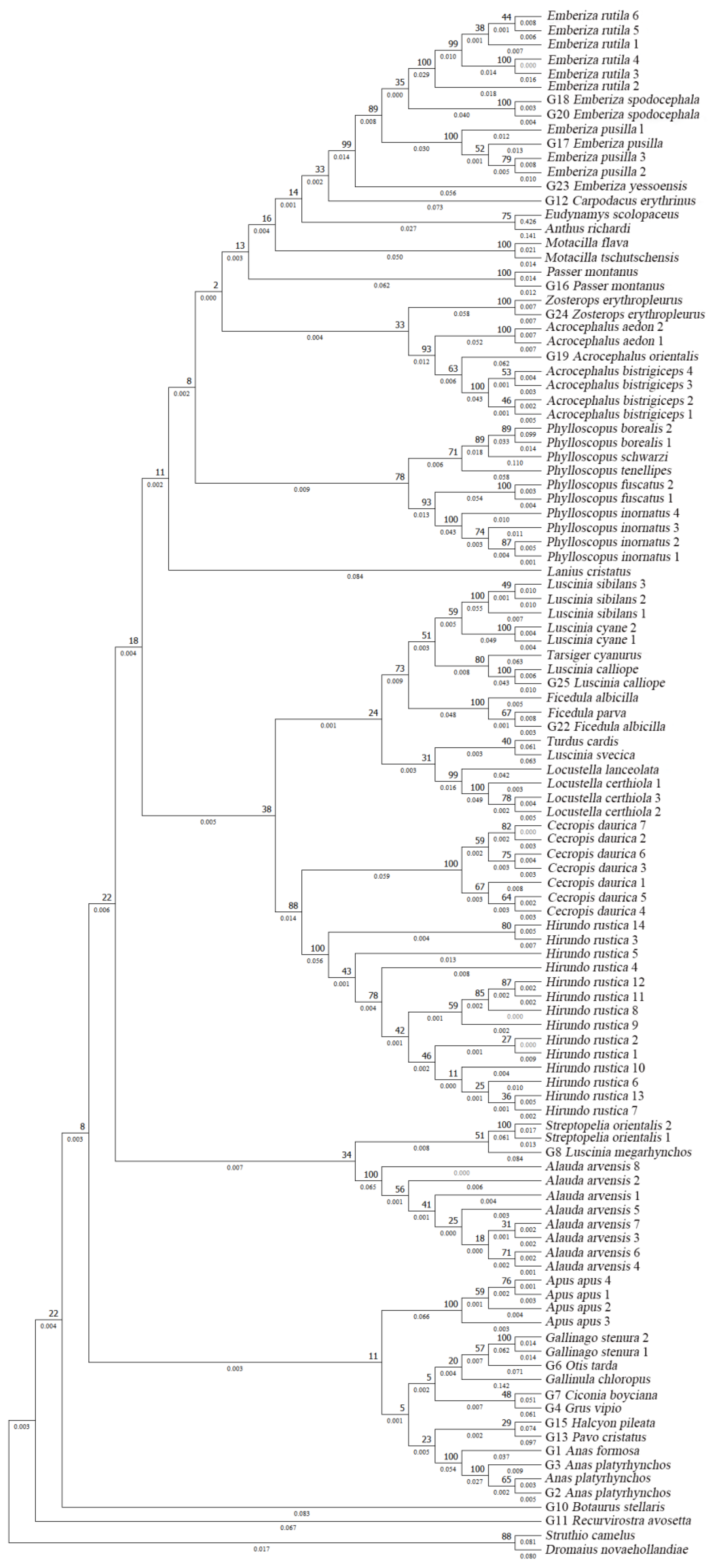
The 107 COI sequences obtained from the 47 bird species were compiled and consolidated. Additionally, COI sequences of D. novaehollandiae and S. camelus were downloaded from NCBI to serve as the outgroup. An NJ phylogenetic tree was constructed using the total set of 109 sequences, with the results presented in Figure 1.
Figure 1.
Phylogenetic tree of the 109 sequences based on the COI gene.
The topological analysis demonstrated that sequences corresponding to the same species consistently formed distinct, well-supported monophyletic clades, confirming the high resolution of the COI gene at the species level. Genetic distances were markedly lower among congeners than between different genera, and even subtle differentiations among closely related species, such as within the Hirundo rustica complex, were clearly resolved. These findings further validate the precision of COI-based species identification and the reliability of the phylogenetic reconstruction.
It is noteworthy that several discrepancies were observed between preliminary morphological identifications and molecular phylogenetic placements. Sample G2, initially identified as Anas zonorhyncha, clustered within the clade of A. platyrhynchos with high sequence similarity and a divergence of less than 2%. Similarly, sample G20, preliminarily assigned to Emberiza rutila, grouped with E. spodocephala, exhibiting high similarity and less than 1% sequence divergence. Likewise, sample G22, tentatively identified as Rhyacornis fuliginosus, clustered with Ficedula parva, also showing high sequence similarity and a divergence below 2%.
3.3. Analysis of Species Composition Based on Molecular Sequencing Results
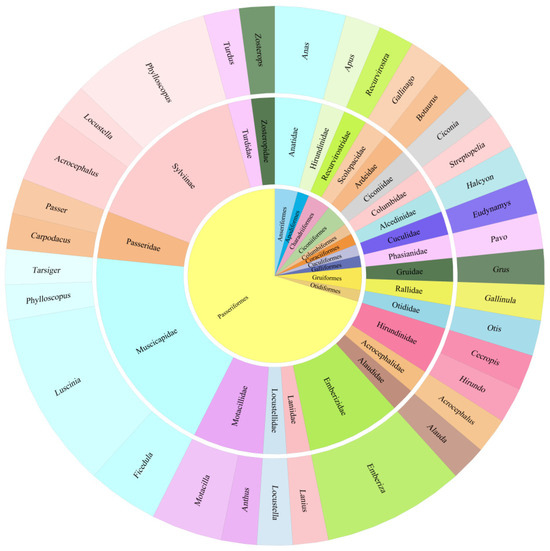
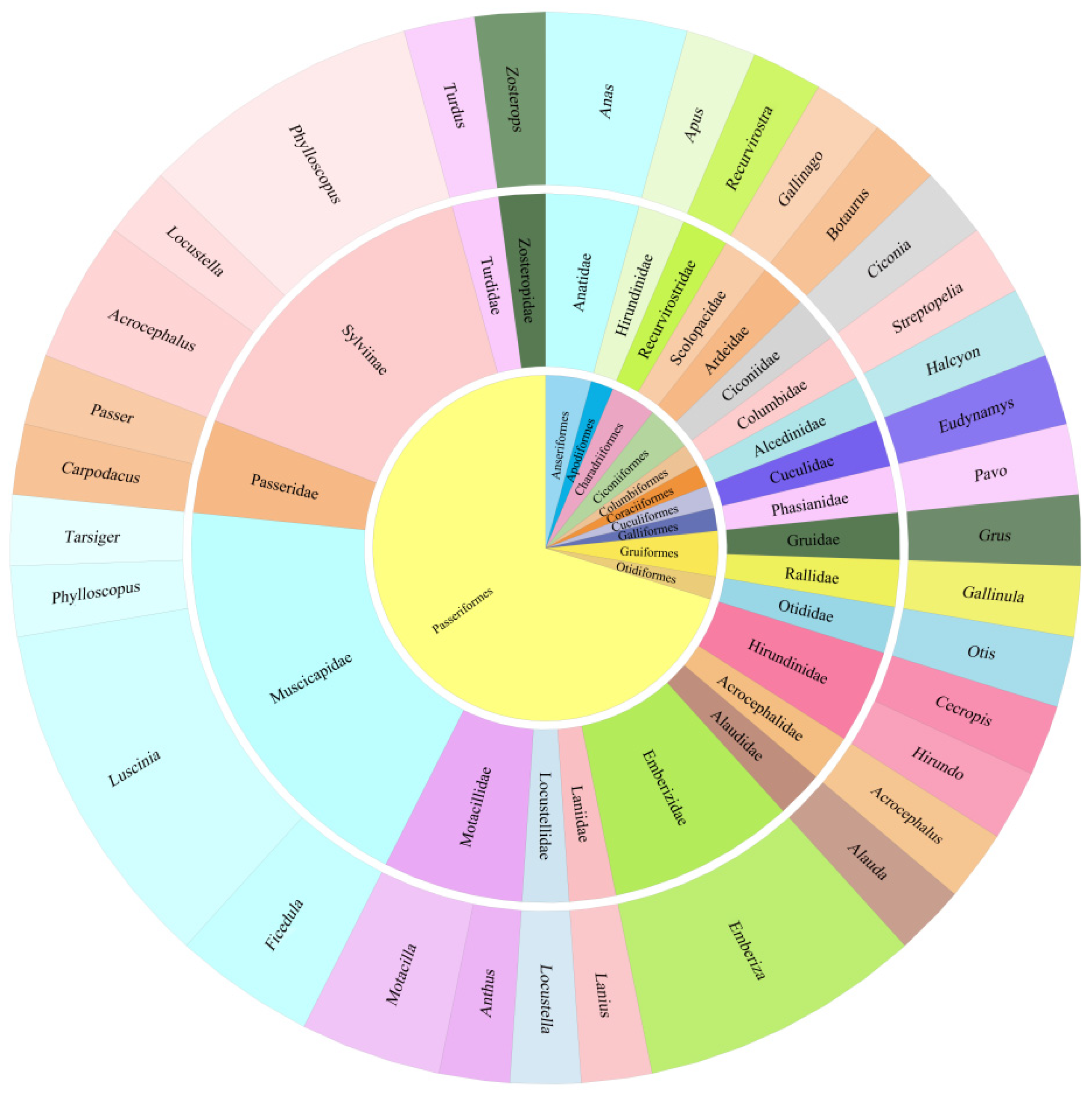
The 47 bird species identified via molecular methods belong to 11 orders, 24 families, and 30 genera. Among them, Passeriformes comprised 33 species, accounting for 70.21% of the total species count. Furthermore, this order represented 12 families, constituting 50% of all families identified. Thus, Passeriformes dominated both in terms of family-level diversity and species richness, which aligns with general patterns of avian diversity distribution [35,36]. At the genus level, most genera were represented by only a single species, reflecting a high degree of genus-level differentiation. Of note, the genus Luscinia contained five species, the highest among all genera, followed by the genus Emberiza with four species. The detailed species composition is presented in Figure 2.
Figure 2.
Composition of 47 Species. The diagram consists of three concentric rings from the inside out, corresponding to Order, Family, and Genus, respectively. The size of each sector represents the percentage of that taxonomic unit within the sample.
The conservation status of the 47 bird species identified in this survey exhibits a hierarchical distribution. According to China’s national wildlife protection classification system, the list includes three Class I nationally protected species, seven Class II nationally protected species, and 33 terrestrial wildlife species identified as having significant ecological, scientific, and social value (Three-Value Protected Species). Four species were not listed under any of these statutory protection categories. When assessed against the IUCN Red List threat categories, most species are classified as Least Concern (LC). Nonetheless, the assemblage also includes threatened species, with 4 classified as Vulnerable (VU); 3 as Near Threatened (NT); and 1 as Endangered (EN).
A striking divergence between national and global assessments is observed for five species—Luscinia calliope, Luscinia megarhynchos, Luscinia svecica, Turdus cardis, and Zosterops erythropleurus—which are listed as Class II protected species in China but are globally assessed as LC on the IUCN Red List. This discrepancy highlights the differences between regional conservation policies and global species risk assessments. The detailed conservation profiles of all species are summarized in Table 4.
Table 4.
Conservation Status of the Identified Bird Species.
4. Discussion
4.1. Applicability and Success Rate of DNA Barcoding for Identifying Avian Remains in Urban Environments
Utilizing DNA barcoding technology based on the COI gene, this study conducted molecular identification on 112 avian remains collected from Tianjin’s urban area and its surroundings, achieving an overall identification success rate of 95.54%. Remarkably, feather samples achieved a 100% success rate, strongly underscoring the substantial advantage of DNA barcoding in accurately identifying avian remains that are incomplete, degraded, or lacking distinct morphological features [37]. Compared to traditional methods reliant on intact morphology, DNA barcoding requires only trace amounts of tissue for accurate identification, thereby greatly expanding the range of identifiable samples, which is particularly valuable for the highly damaged, decomposed, or feather-only remains commonly encountered in urban settings [38,39]. The variation in success rates across different tissue types observed in this study, 97.92% for blood, 88.57% for muscle, also reflects the impact of sample preservation status and DNA extraction quality on identification outcomes [40,41,42].
In addition, the successful identification of 47 bird species, spanning 11 orders and 24 families, demonstrates the high resolution of the COI gene at the avian species level. Intraspecific genetic variation rarely exceeds 2% and is generally less than 1% [19,43], enabling effective discrimination of closely related species and accurately reflecting phylogenetic relationships among taxa. In total, DNA barcoding not only serves as a powerful tool for rapid species identification in forensic investigations and biodiversity monitoring, but it also provides reliable technical support for assessing the structure, composition, and conservation status of urban avian communities [8,44].
4.2. Complementarity and Conflict Resolution Between Morphological and Molecular Identification
In this research, 25 samples initially underwent morphological identification, followed by molecular identification for all samples. The findings revealed a high degree of concordance between most morphological identifications and their molecular results, confirming that traditional morphology remains valuable when samples are intact and features are distinct. Conversely, discrepancies were observed between preliminary morphological and final molecular identifications for several samples. For instance, sample G2 was initially identified as Anas zonorhyncha but matched A. platyrhynchos molecularly; sample G20 was initially identified as Emberiza rutila but matched E. spodocephala, among others. These discrepancies may stem from misjudgment due to damaged morphological features, morphological similarities caused by subspecies or geographic variation, or lagging updates in taxonomic systems.
Morphological and molecular identification are not mutually exclusive but are distinctly complementary. Morphological identification is rapid and intuitive, suitable for initial field screening and whole-specimen examination. In contrast, molecular identification offers objectivity, repeatability, and minimal influence from sample condition, proving particularly effective for identifying damaged remains, juveniles, females, or morphologically conservative groups [45]. In practical application, it is advisable to adopt a combined strategy that involves initial morphological screening followed by molecular verification. Furthermore, fostering the development of local integrated databases containing both morphological and molecular reference data for birds is crucial to reduce identification ambiguity and enhance the overall reliability of the identification system.
4.3. The Value of Avian Remains for Rescue and Conservation in Urban Environments
Of the 112 samples analyzed in this study, 25 avian specimens were provided by public security authorities during rescue and law enforcement operations, highlighting the critical role of species identification in wildlife rescue and conservation practices. DNA barcoding can provide species-level scientific evidence for avian conservation and rescue efforts, supporting the characterization and sentencing for illegal activities such as hunting, trade, and poisoning, and also furnishes a basis for species identification in ecological and environmental damage assessments [46]. In the context of animal rescue, precise species identification not only serves as a prerequisite for appropriate intervention measures but also provides essential baseline data for subsequent ecological monitoring, population assessment, and conservation management. Characterized by standardization, traceability, and verifiability, DNA barcoding constitutes a valuable technical tool for wildlife protection, demonstrating considerable potential for improving the efficiency of species identification and strengthening the scientific foundation of conservation strategies.
From a conservation management standpoint, the identification of remains in this study reveals the composition and conservation status of avian diversity within and around Tianjin’s urban area. Notably, among the 47 identified species, 3 are nationally Class I protected, 7 are Class II protected, and 8 are assessed as Vulnerable or higher on the IUCN Red List, highlighting the critical conservation needs in the area. These data offer a crucial addition to the existing inventories and dynamic monitoring efforts of local avian resources. They also indicate the presence of a notable number of threatened species within urban habitats, underscoring the need to strengthen the protection and restoration of key habitats such as urban green spaces and wetlands, as well as to reduce anthropogenic threats such as glass collisions and illegal hunting activities.
5. Conclusions
This study employed DNA barcoding based on the COI gene to conduct molecular identification and diversity analysis of 112 avian remains collected from Tianjin urban area and its surrounding regions. A total of 47 bird species belonging to 11 orders, 24 families, and 30 genera were successfully identified, yielding an overall identification success rate of 95.54%. Notably, feather samples achieved a 100% success rate, underscoring the robustness of DNA barcoding in identifying highly degraded or morphologically unidentifiable avian remains across different tissue types.
While the avian diversity of this region is already relatively well documented, the principal value of this study lies not in such descriptive accounts, but in demonstrating the effectiveness and reliability of DNA barcoding for species identification of avian remains under challenging urban conditions. The high success rate and the ability to resolve taxonomically challenging cases highlight the advantages of this molecular approach over traditional morphological methods, especially when samples are fragmented or lack diagnostic features. The discrepancies observed between morphological and molecular identification further emphasize the necessity of integrating both approaches to enhance identification accuracy in practical applications.
Overall, this study provides robust technical validation for the application of DNA barcoding in wildlife forensic investigations, biodiversity monitoring, and conservation management. It supplies essential molecular data for regional avian resource inventories and establishes a scientific foundation for rescue operations, species conservation, and urban ecological planning. Future efforts should focus on developing integrated local databases combining morphological and molecular reference data to further strengthen the comprehensiveness and utility of avian identification systems.
Supplementary Materials
The following supporting information can be downloaded at: https://www.mdpi.com/article/10.3390/d18040210/s1, The FASTA file contains 107 COI sequences used for constructing the NJ tree.
Author Contributions
J.-X.N. wrote the initial manuscript, developed software, mobilized resources. Y.-J.Z. designed visualizations, validated data. C.-M.L. developed software and research methodology. B.-K.S. led data validation and software development. B.W. reviewed and edited the manuscript, conducted formal data analysis. Q.Z. developed software and validated data. T.-G.N. reviewed and edited the manuscript, supervised project progress. W.-B.L. oversaw the manuscript review and editing process. All authors have read and agreed to the published version of the manuscript.
Funding
This research was supported by Tianjin Natural Science Foundation Project (25JCZDSN00050).
Data Availability Statement
The original contributions presented in this study are included in the article/Supplementary Materials. Further inquiries can be directed to the corresponding author.
Conflicts of Interest
The authors declare no conflicts of interest.
References
- Zhou, W.; Han, L.X. Wildlife Utilization, Trade and Biodiversity Conservation. Territ. Nat. Resour. Study 1997, 50–54. [Google Scholar] [CrossRef]
- Xiao, Z.S.; Li, X.H.; Wang, X.Z.; Zhou, Q.H.; Quan, R.C.; Shen, X.L.; Li, S. Discussion on the Protocol for Monitoring Forest Wildlife with Infrared Cameras in China. Biodivers. Sci. 2014, 22, 704–711. [Google Scholar]
- Shwartz, A.; Turbé, A.; Simon, L.; Julliard, R. Enhancing urban biodiversity and its influence on city-dwellers: An experiment. Biol. Conserv. 2014, 171, 82–90. [Google Scholar] [CrossRef] [Scilit]
- Fuller, R.A.; Irvine, K.N.; Devine-Wright, P.; Warren, P.H.; Gaston, K.J. Psychological benefits of greenspace increase with biodiversity. Biol. Lett. 2007, 3, 390–394. [Google Scholar] [CrossRef] [Scilit] [PubMed]
- Feng, H.; Wang, L.; Feng, C.L. Molecular identification of avian remains after aircraft collisions using mitochondrial DNA. J. Biol. 2020, 37, 62–65. [Google Scholar]
- Liu, D.W.; Ying, G.D.; Zhou, Y.W.; Fei, Y.L.; Wu, W.D.; Xie, C.P.; Hou, S.L. Identification of Avian Remains from Criminal Cases Based on COI and 16S rRNA Genes. Chin. J. Wildl. 2022, 43, 715–724. [Google Scholar]
- Chen, J.M. Governance Challenges and Countermeasures for Illegal Wildlife Trade from the Perspective of the Life Community. For. Resour. Manag. 2020, 15–21. [Google Scholar] [CrossRef]
- Gong, S.; Wu, J.; Gao, Y.; Fong, J.J.; Parham, J.F.; Shi, H. Integrating and updating wildlife conservation in China. Curr. Biol. 2020, 30, R915–R919. [Google Scholar] [CrossRef] [Scilit]
- Duan, F.; Liu, M.; Bu, H.; Yu, L.; Li, S. Effects of urbanization on bird community composition and functional traits: A case study of the Beijing-Tianjin-Hebei region. Biodivers. Sci. 2024, 32, 23473. [Google Scholar] [CrossRef] [Scilit]
- Zhang, D.; Zeng, S.; Shi, W.; Namaiti, A.; Zeng, J. Constructing an ecological network integrating avian biodiversity and ecosystem services in highly urbanized areas: A Case Study of Tianjin, China. Glob. Ecol. Conserv. 2025, 61, e03677. [Google Scholar] [CrossRef] [Scilit]
- Zou, P.X.; Gao, Z.W.; Cao, L.; Li, H.Y.; Anderson, B.C. Construction and optimization of ecological security pattern for wetland waterbirds in Tianjin based on habitat suitability. Wetl. Sci. 2024, 22, 884–894. [Google Scholar] [CrossRef]
- Xia, X.F.; Wang, Y.; Zeng, Z.H.; Li, X.T. Review and Prospects of Bird Feather Identification Technology and Classification Research. Sichuan J. Zool. 2011, 30, 831–834. [Google Scholar]
- Witt, J.D.; Threloff, D.L.; Hebert, P.D. DNA barcoding reveals extraordinary cryptic diversity in an amphipod genus: Implications for desert spring conservation. Mol. Ecol. 2006, 15, 3073–3082. [Google Scholar] [CrossRef] [Scilit] [PubMed]
- Liao, J.; Liang, Z.B.; Zhang, L.; Li, J.D.; Chao, Z. DNA Barcoding of Common Medicinal Snakes. Chin. Pharm. J. 2013, 48, 1255–1260. [Google Scholar]
- Yang, Q.Q.; Liu, S.W.; Yu, X.P. Research Advances in DNA Barcoding Analysis Methods. Chin. J. Appl. Ecol. 2018, 29, 1006–1014. [Google Scholar] [CrossRef]
- Hebert, P.D.; Cywinska, A.; Ball, S.L.; de Waard, J.R. Biological identifications through DNA barcodes. Proc. Biol. Sci. 2003, 270, 313–321. [Google Scholar] [CrossRef] [Scilit]
- Wang, T.; Tu, F.Y.; Liu, J.; Huang, X.F. Forensic Identification of Bird Species Based on DNA Barcoding. South China For. Sci. 2019, 47, 46–47+55. [Google Scholar] [CrossRef]
- Rubiola, S.; Chiesa, F.; Zanet, S.; Civera, T. Molecular identification of Sarcocystis spp. in cattle: Partial sequencing of Cytochrome C Oxidase subunit 1 (COI). Ital. J. Food Saf. 2018, 7, 7725. [Google Scholar] [CrossRef] [Scilit]
- Dinh, T.D.; Ngatia, J.N.; Cui, L.Y.; Ma, Y.; Dhamer, T.D.; Xu, Y.C. Influence of pairwise genetic distance computation and reference sample size on the reliability of species identification using Cyt b and COI gene fragments in a group of native passerines. Forensic Sci. Int. Genet. 2019, 40, 85–95. [Google Scholar] [CrossRef] [Scilit]
- Intharuksa, A.; Sasaki, Y.; Ando, H.; Charoensup, W.; Suksathan, R.; Kertsawang, K.; Sirisa-Ard, P.; Mikage, M. The combination of ITS2 and psbA-trnH region is powerful DNA barcode markers for authentication of medicinal Terminalia plants from Thailand. J. Nat. Med. 2020, 74, 282–293. [Google Scholar] [CrossRef] [Scilit]
- Mariacher, A.; Garofalo, L.; Fanelli, R.; Lorenzini, R.; Fico, R. A combined morphological and molecular approach for hair identification to comply with the European ban on dog and cat fur trade. PeerJ 2019, 7, e7955. [Google Scholar] [CrossRef] [Scilit]
- Garofalo, L.; Mariacher, A.; Fanelli, R.; Fico, R.; Lorenzini, R. Hindering the illegal trade in dog and cat furs through a DNA-based protocol for species identification. PeerJ 2018, 6, e4902. [Google Scholar] [CrossRef] [Scilit] [PubMed]
- Ngatia, J.N.; Lan, T.M.; Ma, Y.; Dinh, T.D.; Wang, Z.; Dahmer, T.D.; Xu, Y.C. Distinguishing extant elephants ivory from mammoth ivory using a short sequence of cytochrome b gene. Sci. Rep. 2019, 9, 18863. [Google Scholar] [CrossRef] [Scilit] [PubMed]
- Lijtmaer, D.A.; Kerr, K.C.; Stoeckle, M.Y.; Tubaro, P.L. DNA barcoding birds: From field collection to data analysis. Methods Mol. Biol. 2012, 858, 127–152. [Google Scholar] [CrossRef] [Scilit] [PubMed]
- Loss, S.R.; Will, T.; Loss, S.S.; Marra, P.P. Bird-building collisions in the United States: Estimates of annual mortality and species vulnerability. Condor Ornithol. Appl. 2014, 116, 8–23. [Google Scholar] [CrossRef] [Scilit]
- Żmihorski, M.; Kotowska, D.; Zyśk-Gorczyńska, E. Using citizen science to identify environmental correlates of bird-window collisions in Poland. Sci. Total Environ. 2022, 811, 152358. [Google Scholar] [CrossRef] [Scilit]
- Punit, B.; Runyu, Q.; Bo, D. Identification and population genetic comparison of three ascidian species based on mtDNA sequences. Ecol. Evol. 2020, 10, 3758–3768. [Google Scholar] [CrossRef] [Scilit]
- Ratnasingham, S.; Hebert, P.D. Bold: The Barcode of Life Data System (http://www.barcodinglife.org). Mol. Ecol. Notes 2007, 7, 355–364. [Google Scholar] [CrossRef] [Scilit]
- Hebert, P.D.; Stoeckle, M.Y.; Zemlak, T.S.; Francis, C.M. Identification of Birds through DNA Barcodes. PLoS Biol. 2004, 2, e312. [Google Scholar] [CrossRef] [Scilit]
- Hebert, P.D.N.; Braukmann, T.W.A.; Prosser, S.W.J.; Ratnasingham, S.; de Waard, J.R.; Ivanova, N.V.; Janzen, D.H.; Hallwachs, W.; Naik, S.; Sones, J.E.; et al. A Sequel to Sanger: Amplicon sequencing that scales. BMC Genom. 2018, 19, 219. [Google Scholar] [CrossRef] [Scilit]
- Jarvis, E.D.; Mirarab, S.; Aberer, A.J.; Li, B.; Houde, P.; Li, C.; Ho, S.Y.; Faircloth, B.C.; Nabholz, B.; Howard, J.T.; et al. Whole-genome analyses resolve early branches in the tree of life of modern birds. Science 2014, 346, 1320–1331. [Google Scholar] [CrossRef] [Scilit]
- Hackett, S.J.; Kimball, R.T.; Reddy, S.; Bowie, R.C.K.; Braun, E.L.; Braun, M.J.; Chojnowski, J.L.; Cox, W.A.; Han, K.-L.; Harshman, J.; et al. A Phylogenomic Study of Birds Reveals Their Evolutionary History. Science 2008, 320, 1763–1768. [Google Scholar] [CrossRef] [Scilit] [PubMed]
- Tamura, K.; Stecher, G.; Kumar, S. MEGA11: Molecular Evolutionary Genetics Analysis Version 11. Mol. Biol. Evol. 2021, 38, 3022–3027. [Google Scholar] [CrossRef] [Scilit] [PubMed]
- Ye, X.K.; Li, Y.F.; Dong, H.; Wang, S.Q.; Wen, X.B.; Lin, F. Species Identification of Common Croaker Fish Maws Based on DNA Barcoding Technology. J. Food Saf. Qual. 2023, 14, 236–244. [Google Scholar] [CrossRef]
- Zhang, H.B. Sequencing and Phylogenetic Analysis of Mitochondrial Genomes in Six Passerine Bird Species. Master’s Thesis, Anhui Normal University, Wuhu, China, 2015. [Google Scholar]
- Chen, X. DNA Barcoding of Passerine Birds in East Asia. Master’s Thesis, Southwest Forestry University, Kunming, China, 2018. [Google Scholar]
- Kress, W.J.; García-Robledo, C.; Uriarte, M.; Erickson, D.L. DNA barcodes for ecology, evolution, and conservation. Trends Ecol. Evol. 2015, 30, 25–35. [Google Scholar] [CrossRef] [Scilit]
- Stoeckle, M. Taxonomy, DNA and the barcode of life. BioScience 2009, 53, 796–797. [Google Scholar] [CrossRef] [Scilit]
- Chen, M.; Fang, Y.; Cheng, R.B.; Huang, Z.; Zhang, G.J.; Chen, J.Z. Application Progress of Mitochondrial DNA Markers in Molecular Identification of Animal-Derived Medicinal Materials. Chin. Tradit. Herb. Drugs 2018, 49, 3134–3142. [Google Scholar]
- Fernandes, T.J.; Oliveira, M.B.; Mafra, I. Tracing transgenic maize as affected by breadmaking process and raw material for the production of a traditional maize bread, broa. Food Chem. 2013, 138, 687–692. [Google Scholar] [CrossRef] [Scilit]
- Gryson, N. Effect of food processing on plant DNA degradation and PCR-based GMO analysis: A review. Anal. Bioanal. Chem. 2010, 396, 2003–2022. [Google Scholar] [CrossRef] [Scilit]
- Di Bernardo, G.; Del Gaudio, S.; Galderisi, U.; Cascino, A.; Cipollaro, M. Comparative evaluation of different DNA extraction procedures from food samples. Biotechnol. Prog. 2007, 23, 297–301. [Google Scholar] [CrossRef] [Scilit]
- Du, H.Y.; Zhang, X.Y.; Dinh, T.D.; Ma, Y.; Zong, C.; Li, G.L.; Dahmer, T.D.; Xu, Y.C. Identification of hybrid green peafowl using mitochondrial and nuclear markers. Conserv. Genet. Resour. 2020, 12, 669–683. [Google Scholar] [CrossRef] [Scilit]
- Huang, Y.L. Species Identification of Animal Products Using 12S rRNA Gene Sequence: A Case Report. Chin. J. Forensic Med. 2012, 27, 314–315. [Google Scholar] [CrossRef]
- Murrell, A.; Campbell, N.J.H.; Barker, S.C. Phylogenetic Analyses of the Rhipicephaline Ticks Indicate That the Genus Rhipicephalus Is Paraphyletic. Mol. Phylogenetics Evol. 2000, 16, 1–7. [Google Scholar] [CrossRef] [Scilit]
- Yiming, L. Threats to Vertebrate Species in China and the United States. BioScience 2009, 55, 147–153. [Google Scholar] [CrossRef] [Scilit]

Disclaimer/Publisher’s Note: The statements, opinions and data contained in all publications are solely those of the individual author(s) and contributor(s) and not of MDPI and/or the editor(s). MDPI and/or the editor(s) disclaim responsibility for any injury to people or property resulting from any ideas, methods, instructions or products referred to in the content. |
© 2026 by the authors. Licensee MDPI, Basel, Switzerland. This article is an open access article distributed under the terms and conditions of the Creative Commons Attribution (CC BY) license.