


Abstract
Haloxylon ammodendron plantations constitute a dominant vegetation component of the desert–oasis ecotone in the arid and semi-arid regions of northwest China, playing a critical role in maintaining oasis stability and ecological security. However, the effects of converting natural desert ecosystems into plantations on the soil food webs of arthropods remain poorly understood, particularly with respect to how these effects vary across plantation age. To address this knowledge gap, we conducted a field investigation in the desert–oasis ecotone of the middle reaches of the Hexi Corridor, Gansu Province. Using pitfall trapping, we sampled two key arthropod taxa (arachnids and soil mesofauna) from control areas (natural deserts) and H. ammodendron plantations representing different ages (young and old). The results indicated that both young and old plantations were associated with significantly higher abundance and richness of arachnids, soil mesofauna, mites, and springtails compared with natural deserts, with springtail richness exhibiting a further significant increase in old plantations. Arachnid responses to plantation conversion were strongly structured by body size. Medium arachnid abundance increased in both young and old plantations, whereas large arachnid abundance increased only in young plantations and declined in older ones. In contrast, small arachnid abundance exhibited significant increases exclusively in old plantations. In addition, relationships between arachnid, mite and springtail abundance varied with plantation age: the ratio of large arachnids to mites and springtails declined significantly in old plantations relative to young ones, while the corresponding ratio for small arachnids showed an opposite pattern. Variations in soil mesofauna community composition were primarily explained by shrub cover, herbaceous cover, coarse sand proportion, silt-clay content, and soil soluble salt, which together accounted for 48.9% of observed variation. For arachnids, soil mesofauna as a food resource significantly enhanced abundance and richness. Moreover, shrub cover and silt-clay content were also drivers of arachnid community variation, jointly explaining 6.7% of variance. Overall, the establishment of H. ammodendron plantations promoted the diversity of both arachnids and soil mesofauna, but their relationships shifted dynamically with plantation age, leading to a reorganization of detrital food web structure and functioning.
1. Introduction
Arachnids and soil mesofauna occupy distinct yet interconnected trophic positions within desert detrital food webs and play fundamental roles in regulating key ecosystem progresses, including insect pest control, litter decomposition, and nutrient cycling [1,2,3,4]. Arachnids contribute to ecosystem functioning both indirectly—by serving as an important prey resource for vertebrate populations such as reptiles, birds, and mammals—and directly, by exerting top-down control in soil mesofauna diversity, thereby influencing the structure and function of the detrital food web [1,2,5,6]. In addition, interspecific variation in the body size of arachnids has been shown to differentially regulate the diversity of herbivorous arthropods and soil mesofauna, highlighting body size as a key functional trait mediating trophic interactions [7,8,9,10]. In low-productivity desert ecosystems, vertebrate and arthropod predators facilitate the coexistence of arthropod assemblages by dampening interspecific competition via top-down regulation [5,11]. The conversion of natural desert into shrub-dominated plantations modifies resource availability and soil properties while increasing vegetation cover, which in turn reshapes predator–prey size relationships and the functional organization of desert food webs [12,13,14,15]. However, the ecological stability of these anthropogenically altered systems remains vulnerable to climatic fluctuations and external disturbances, including grazing pressure [16,17,18]. Despite increasing efforts to restore artificial sand-fixing vegetation, the trajectories of arthropod diversity change during this process remain insufficiently characterized. Moreover, how shifts in arthropod community composition influence the stability, complexity, and regulatory capacity of arthropod-based food webs is still largely unresolved. Accordingly, examining the responses and interactions of key arthropod taxa from a food web structural and functional perspective, rather than relying solely on diversity metrics, provides a more mechanistic framework for understanding ecosystem dynamics and offers essential guidance for the management of artificial sand-fixing vegetation.
Haloxylon ammodendron (Chenopodiaceae) is a tree-like shrub widely distributed in Central Asia and represents a cornerstone species for establishing desert–oasis ecotones surrounding oases in the arid regions of northwestern China [19,20]. The use of H. ammodendron plantations for the rehabilitation of desertification landscapes not only mitigates wind erosion and stabilizes sand dunes, but also improves the soil environment by enhancing soil carbon and nitrogen sequestration [21,22,23]. In addition, such plantations have been shown to support higher diversity of selected arthropod groups and vertebrates [24]. Nevertheless, the establishment and long-term development of H. ammodendron plantations may lead to progressive soil moisture depletion, increased soil salinization, and declines in plant diversity, thereby potentially constraining ecosystem service provision [21,25,26]. Such adverse effects tend to intensify during the later successional stages of H. ammodendron plantations [20,26]. Conversely, empirical evidence suggests that appropriate thinning of H. ammodendron plantations at oasis margins can promote the emergence of relatively stable and self-organized vegetation structures [27]. Herbaceous cover, diversity, and seedling density tend to increase with declining canopy density [28]. In contrast, biotic stressors such as plant diseases, insect pests, and rodent activity can accelerate the degradation of H. ammodendron plantations. Notably, the presence of predatory arthropods and vertebrates enhances biological control capacity, thereby supporting plantation resilience and long-term stability [24,29].
In arid and semi-arid ecosystems, the establishment of artificial sand-fixing vegetation has been shown to progressively enhance the abundance and diversity of herbivorous and omnivorous arthropods [13,28,30,31]. These bottom-up effects subsequently promote increases in predatory arthropods assemblages. However, arthropod diversity responds heterogeneously to vegetation restoration, with the magnitude and direction of change varying across habitats, climatic contexts, and successional stages [28,31]. During the restoration of H. ammodendron plantations, two dominant omnivorous arthropod families, Tenebrionidae and Formicidae, have been reported to exhibit contrasting temporal trajectories [28]. As plantation age increased, ant communities exhibited higher abundance and diversity, whereas tenebrionid beetles showed a marked decline, resulting in pronounced shifts in the trophic structure of ground-dwelling arthropods [28,31]. In contrast, the response of arachnids and soil mesofauna to H. ammodendron plantation restoration, as well as the interactions between these groups, remain largely unresolved. Based on these considerations, we propose three hypotheses: (1) although the abundance and richness of arachnids and soil mesofauna increase significantly with plantation establishment, these increases do not differ significantly between young and old plantations; (2) plantation establishment drives shifts in the arachnid–soil mesofauna abundance relationship, which changes with arachnid taxa and plantation stage, which in turn influences detrital food web architecture; (3) changes in soil mesofauna assembly are driven primarily by vegetation and soil environmental factors, whereas the dynamics of arachnids are governed by a combination of both resource availability and environmental factors. Research on changes in the structure of the debris food web and its functions during the restoration of H. ammodendron plantations will provide a scientific basis for improving soil health management in desert–oasis ecotones.
2. Materials and Methods
2.1. Study Site
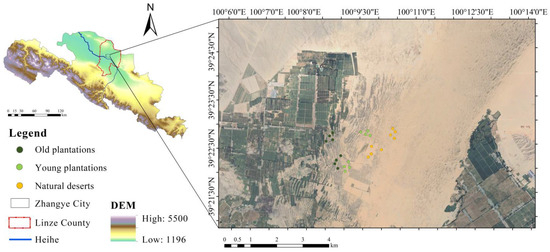
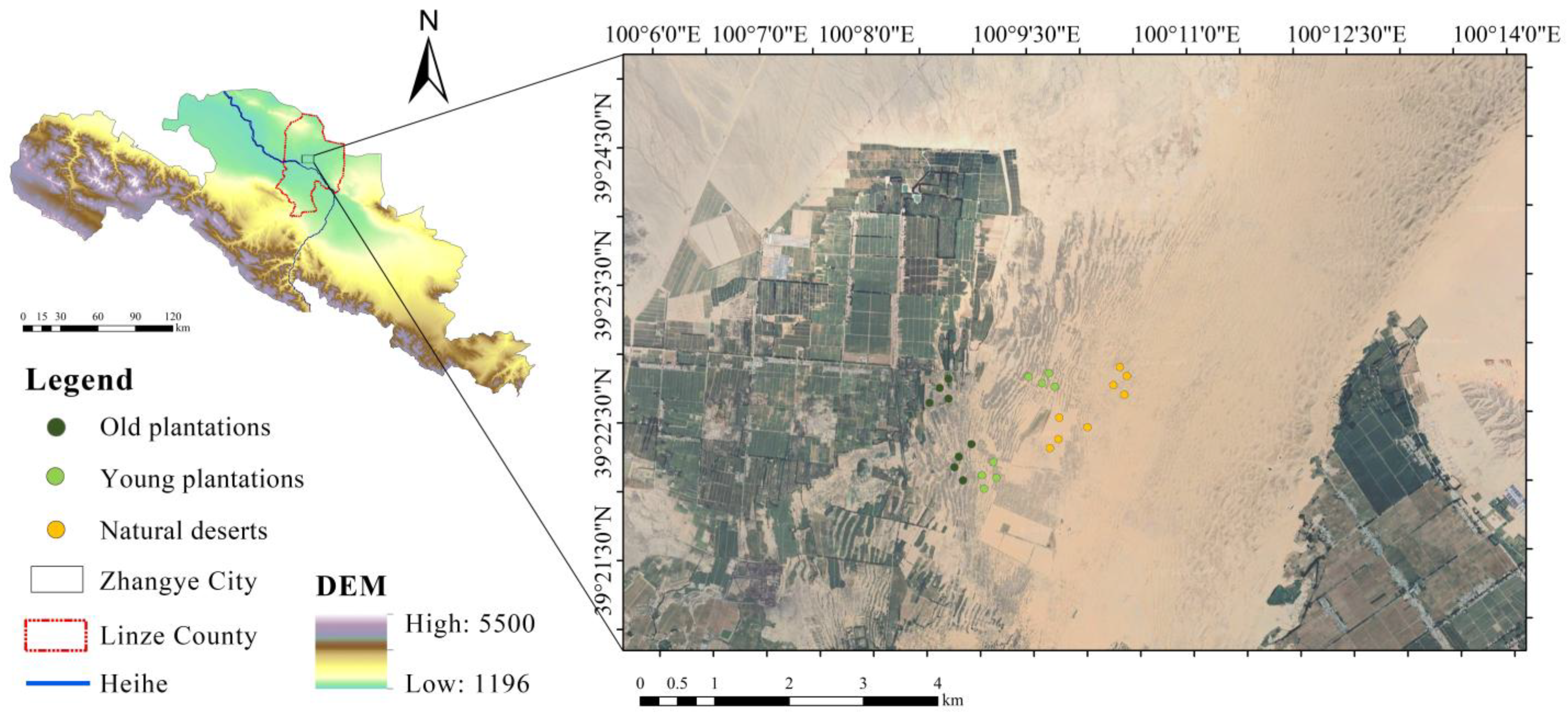
The study area is situated in Linze County, positioned along the northwestern edge of the Zhangye Oasis within the central part of the Hexi Corridor, Gansu Province, northwestern China (Figure 1). The central region of the county adjoins the Gobi Desert as well as the transitional zone of the Badain Jaran Desert, both of which extend into the Hexi Corridor. Recognized as an ecologically vulnerable region, it has consistently served as a key target for vegetation rehabilitation and ecological governance programs within the Hexi Corridor. The region exhibits a markedly continental climate, characterized by cold winters (mean January temperature: −10.7 °C) and hot summers (mean July temperature: 23.0 °C), with an annual mean temperature of 7.6 °C. Precipitation is scarce, averaging 117.0 mm per year, approximately 72% of which falls between July and September. Meanwhile, annual evaporation reaches approximately 2390 mm, which is nearly 20 times the amount of yearly precipitation. The native desert vegetation is dominated by shrub species, primarily Nitraria sphaerocarpa, N. sibirica, and Calligonum mongolicum. The herbaceous layer mainly consists of Phragmites australis, Psammochloa villosa, Agriophyllum squarrosum, Halogeton glomeratus, Bassia dasyphylla, Pugionium spp., and a few species of Echinops spp. The predominant soil type is sandy desert soil of aeolian origin, and the groundwater table generally occurs at a depth of 4–5 m.
Figure 1.
Location of the study sites.
Haloxylon ammodendron (C. A. Mey.) Bunge, commonly referred to as saxaul, is a characteristic woody shrub species that is broadly distributed across the deserts and Gobi landscapes of Central Asia. It demonstrates strong tolerance to drought and salinity, as well as effective sand-stabilizing capacity, and has been extensively employed in artificial sand-fixation vegetation projects in the Hexi Corridor of Gansu Province and along the oasis fringes of Xinjiang. Owing to its ecological importance in vegetation restoration and wind-sand control, H. ammodendron has been widely adopted in the region. Plantations were initially established in the peripheral sandy areas of central Linze County, including both mobile and fixed dunes systems, in the late 1970s [28,31]. Driven by long-term ecological restoration and environmental management projects, continuous planting has been undertaken to date, resulting in the development of a clear successional sequence in vegetation regeneration. The initial planting density of H. ammodendron was 44.4 plants per 100 m2, with an interplant spacing of 1.5 × 1.5 m. Seedlings were positioned inside straw checkerboard barriers and received continuous irrigation during the initial two-year period, whereas subsequent growth was supported primarily by natural precipitation and groundwater.
2.2. Experimental Design
The desert–oasis ecotone consists of artificial vegetation interspersed with residual natural desert patches and forms a transitional zone between the artificial oasis and the natural desert, extending from several hundred meters to several kilometers in width. Across the desert–oasis ecotone, H. ammodendron plantations displayed a heterogeneous spatial distribution and exhibited sequence of restoration stages. During the early development stage, plant growth is predominantly vegetative, whereas in older stands, reproductive growth becomes dominant. Significant differences exist in aboveground vegetation, soil properties, and associated ecosystem service functions between these stages [20,26]. In this study, H. ammodendron plantations representing young (<20 years) and old (>20 years) age classes were selected as the target ecosystems, while adjacent mobile and fixed sandy dunes in the surrounding areas of the plantations were used as controls (Figure 1).
Sampling was conducted at eight sites for each habitat type, including young and old plantations and control areas (natural desert). Sites were selected based on establishment age, topography, and patch size, and spaced by distances of 500–800 m apart (Figure 1). At each site, three relatively independent shrub patches or sandy dunes were selected as sampling plots. Within each plot, five pitfall traps filled with 75% ethanol were installed to collect soil fauna [28]. Each pitfall trap comprised an outer permanent PVC cup (8.5 cm in diameter and 20.0 cm in depth) embedded flush with the soil surface, with an inner removable plastic cup inside [28]. This sampling design resulted in 8 sites × 3 plots × 5 pitfall traps = 120 pitfall traps per habitat type for each sampling period, yielding a total of 360 pitfall traps across all habitats per sampling period. Pitfall trapping was conducted in May and September 2018. Each sampling campaign extended over three consecutive days and nights, during which traps were inspected daily. When ethanol levels were depleted due to evaporation, 75% ethanol was replenished as necessary. Arachnids captured in pitfall traps (preserved in 75% ethanol) were counted and identified to the species or family level as per Song et al. [32]. Arachnid species are categorized were large (≥10 mm), medium (5–10 mm), or small (≤5 mm) based on the mean body size measurements of mature individuals [8,32,33]. Soil mesofauna, including mites and springtails, were also preserved in 75% ethanol and were quantified and identified to the family level under a stereomicroscope (SMZ-168; approximately 20 × magnification; Motic Instruments Inc., Xiamen, China) following the identification provided by Yin [34]. In addition, taxonomic identifications were verified by relevant taxonomic experts.
To evaluate the effects of vegetation and soil attributes on the distribution and activity patterns of predatory arthropods, all plots were surveyed in late September 2018. This period was selected because plant biomass and species diversity typically peak during this period [28]. Shrub canopy cover and herbaceous understory layers were visually estimated using five 100 m2 subplots and five 1 m2 subplots, respectively. All herbaceous species present within each plot were identified and recorded. Soil samples were subsequently collected from each plot using a soil auger with 5 cm diameter, yielding ten cores to a depth of 20 cm per plot. The ten cores from each plot were polled and homogenized to produce a single composite sample, which was then sieved through a 2 mm mesh to remove roots and stones. The processed composite soil samples were subjected to laboratory analyses to quantify soil texture, soil soluble salt, organic carbon content, and total nitrogen content. Particle size distribution was determined using the dry sieving procedure, allowing classification into coarse sand (0.25–2 mm), fine sand (0.05–0.25 mm), and silt plus clay (<0.05 mm). Soil soluble salt content was quantified as the cumulative concentration of major ions in the soil solution, including K+, Na+, Ca2+, Mg2+, HCO3−, Cl−, and SO42−. Concentrations of K+ and Na+ were measured using flame photometry, whereas Ca2+ and Mg2+ were determined by atomic absorption spectrophotometry. The HCO3− content was analyzed using a double-indicator neutralization titration, Cl− by a silver nitrate titration, and SO42− by the barium sulfate gravimetric method. Soil organic carbon (SOC) was determined using the Walkley–Black dichromate oxidation method, and total nitrogen (TN) was measured with the Kjeldahl procedure using a DK heating digester and a UDK140 automatic steam distilling unit (Titroline 96, VELP Scientifica, Milan, Italy) (Table 1).
Table 1.
Mean (± standard error) values of measured vegetation and soil variables in the control areas; young and old H. ammodendron plantations. Different lowercase letters mean significant differences (p<0.05).
2.3. Statistical Analyses
For data analysis, arachnid and soil mesofauna samples from the two sampling periods were pooled, and data from the five pitfall traps within each plot were combined prior to statistical analysis, in order to characterize overall community composition and abundance patterns across young and old H. ammodendron plantations and control areas. Abundance (number of individuals per plot) and richness (number of species per plot) of total, large, medium, and small arachnids were calculated for each plot. In addition, abundance and richness were calculated for soil mesofauna as well as for mites and springtails separately. Differences in arachnids and soil mesofauna communities among natural desert and the two H. ammodendron plantation types were evaluated using one-way analysis of variance (ANOVA) within a generalized linear model (GLM) framework. When significant effects were detected, Tukey’s honestly significant difference (HSD) test was employed for multiple comparisons. The relationship between the abundances of arachnid and soil mesofauna was examined across natural desert sites, the two H. ammodendron plantations and the control areas. In some plots of the control areas, mites and springtails were not collected, and thus the ratio involving arachnid and soil mesofauna could not be calculated. Accordingly, ratios of total, large, medium, and small arachnids to soil mesofauna, mites, and springtails were calculated for young and old plantations, and differences between the two plantation types were evaluated using independent-sample t-tests. To satisfy normality assumptions, all variables were log-transformed [log(x + 1)] prior to analysis. Statistical analyses were conducted using SPSS 21.0 for Windows (Chicago, IL, USA). The effect of H. ammodendron plantations on arachnid and soil mesofauna community composition were evaluated using one-way PERMANOVA based on Bray–Curtis similarity using PAST 4.13, and the difference between habitats was also calculated. In addition, similarity percentage (SIMPER) analysis, also based on Bray–Curtis similarity, was applied to identify community compositional differences in arachnid and soil mesofauna among young and old H. ammodendron plantations and control areas.
Firstly, Pearson correlation analysis was conducted on nine vegetation and soil factors from plantations and control areas to identify groups of factors with correlation coefficients exceeding 0.7 (Table A1). For each group of highly correlated factors, one representative factor was selected for subsequent analysis based on its established close relationship with soil fauna as documented in the literature [28]. Based on this process, the following six key factors were ultimately selected to analyze their driving effects on the community changes of arachnids and soil mesofauna: shrub cover, herbaceous cover, herbaceous species richness, soil coarse sand content, silt and clay content, and soluble salt content. The relationships between arachnid and mesofauna communities and environmental factors were analyzed independently, following an initial detrended correspondence analysis (DCA). Following DCA, the gradient length of Axis 1 for the arachnid community measured 3.6. In accordance with the criterion that a gradient length >3.0 indicates unimodal species response, CCA (canonical correspondence analysis) was utilized to analyze arachnid associations with six environmental factors [35]. For mesofauna, whose gradient length was 2.2 (<3.0), RDA (redundancy analysis) was selected in line with the recommendation for linear response models [35]. The statistical significance of the CCA and RDA ordination axes was evaluated using the Monte Carlo permutation test with 999 permutations. The relative contributions of individual environmental variables were quantified using interactive forward selection within partial CCA (pCCA) and partial RDA (pRDA), with significance also evaluated by Monte Carlo permutation tests (999 permutations). Results from CCA and RDA were displayed using biplots with scaling focused on interspecific distances, where environmental variables were shown as vectors and species as points. Prior to analysis, abundance data of arachnid and soil mesofauna taxa, along with environmental variables, were log-transformed [log(x + 1)]. All CCA and RDA analyses were conducted using Canoco 5.0 [35].
3. Results
3.1. Effects of Haloxylon ammodendron Plantation on Arachnid Community
In total, 244 arachnid individuals representing nine species were recorded across the control areas (natural desert) and the young and old H. ammodendron plantations. The arachnid community was dominated by Araneae (spiders), which accounted for 77.8% of the species and 71.7% of the total individuals (Table A2). Solifugae (sun spiders) and Opiliones (harvestmen) each accounted for 11.1% of the species, contributing 11.1% and 17.2% of the individuals, respectively (Table A2). Both arachnid abundance and species richness were greater in the young and old plantations than in the control areas (Table A2).
PERMANOVA revealed a significant overall difference in arachnid community composition among young and old plantations and control areas (F = 11.37, p < 0.001); pairwise comparisons of PERMANOVA detected significant difference among the three habitat types (p < 0.05). Average community dissimilarity was substantially higher between the control areas and plantations (82.5% for young and 92.9% for old plantations) than between young and old plantations (71.4%). Dissimilarity between the control areas and young plantations was largely attributable to three species (Drassodes sp., Lacinius bidens, and Eusimonia spp.), with a cumulative contribution of 81.8% of total variation. In comparison, community differentiation between the control areas and old plantations was mainly explained by three species (Drassodes sp., Linyphiinae sp., and Yllenus sp.), accounting for 72.1%. In addition, four species—Drassodes sp., Lacinius bidens, Eusimonia spp., and Linyphiinae sp.—collectively explained 78.1% of the dissimilarity between young and old plantations.
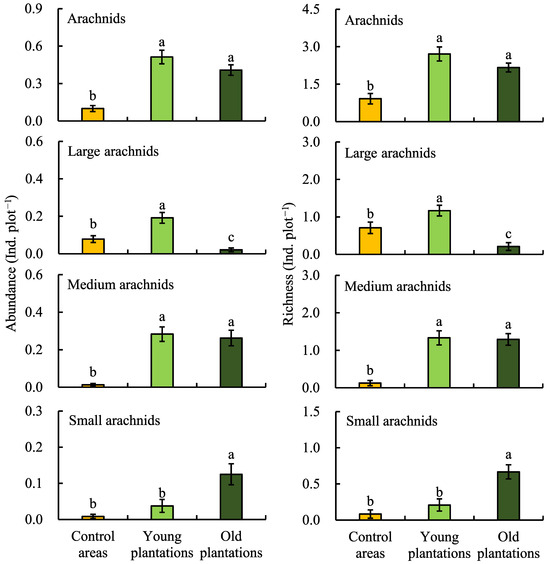
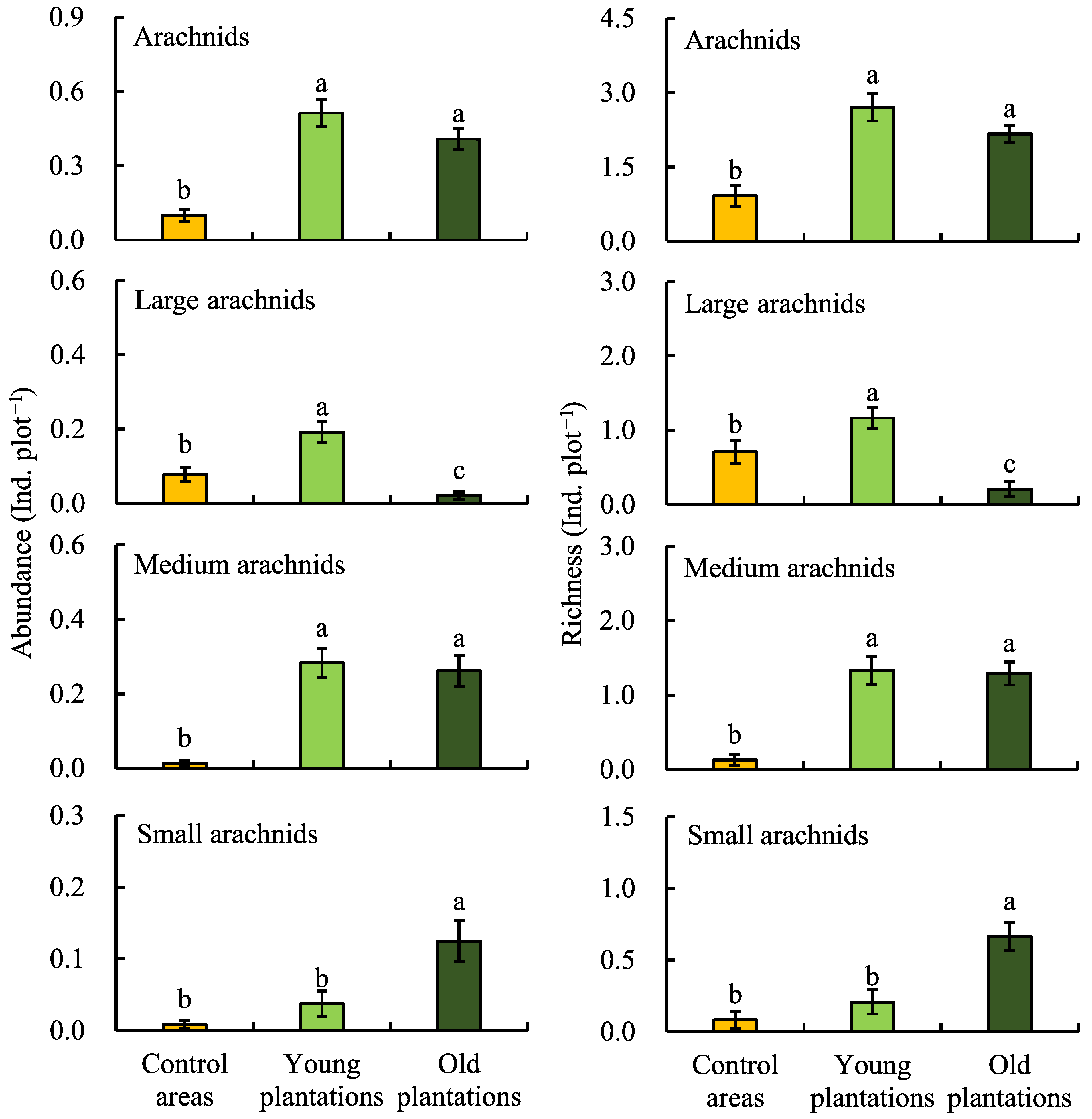
Conversion of the natural desert into H. ammodendron plantations resulted in significant increases in arachnid abundance and richness (Figure 2). Although values were numerically lower in old than in young plantations, the difference between the two age classes was not statistically significant (Figure 2). We also found that arachnid responses to plantation establishment exhibited a body-size-dependent pattern. The abundance and richness of large arachnids increased significantly in young plantations, while they declined in older plantations compared to control areas (Figure 2). In contrast, both the abundance and richness of medium arachnids increased significantly in young and old plantations compared to control areas (Figure 2). Small arachnids, however, exhibited a more restricted response, with significant increases in abundance and richness detected only in old plantations compared to control areas (Figure 2).
Figure 2.
Abundance and richness of arachnids, large arachnids, medium arachnids, and small arachnids in the control areas, young, and old H. ammodendron plantations. Means (± standard error) with different letters indicate significant differences among habitat types (p < 0.05).
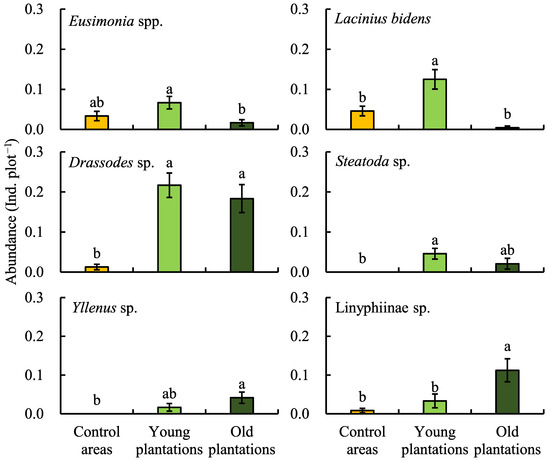
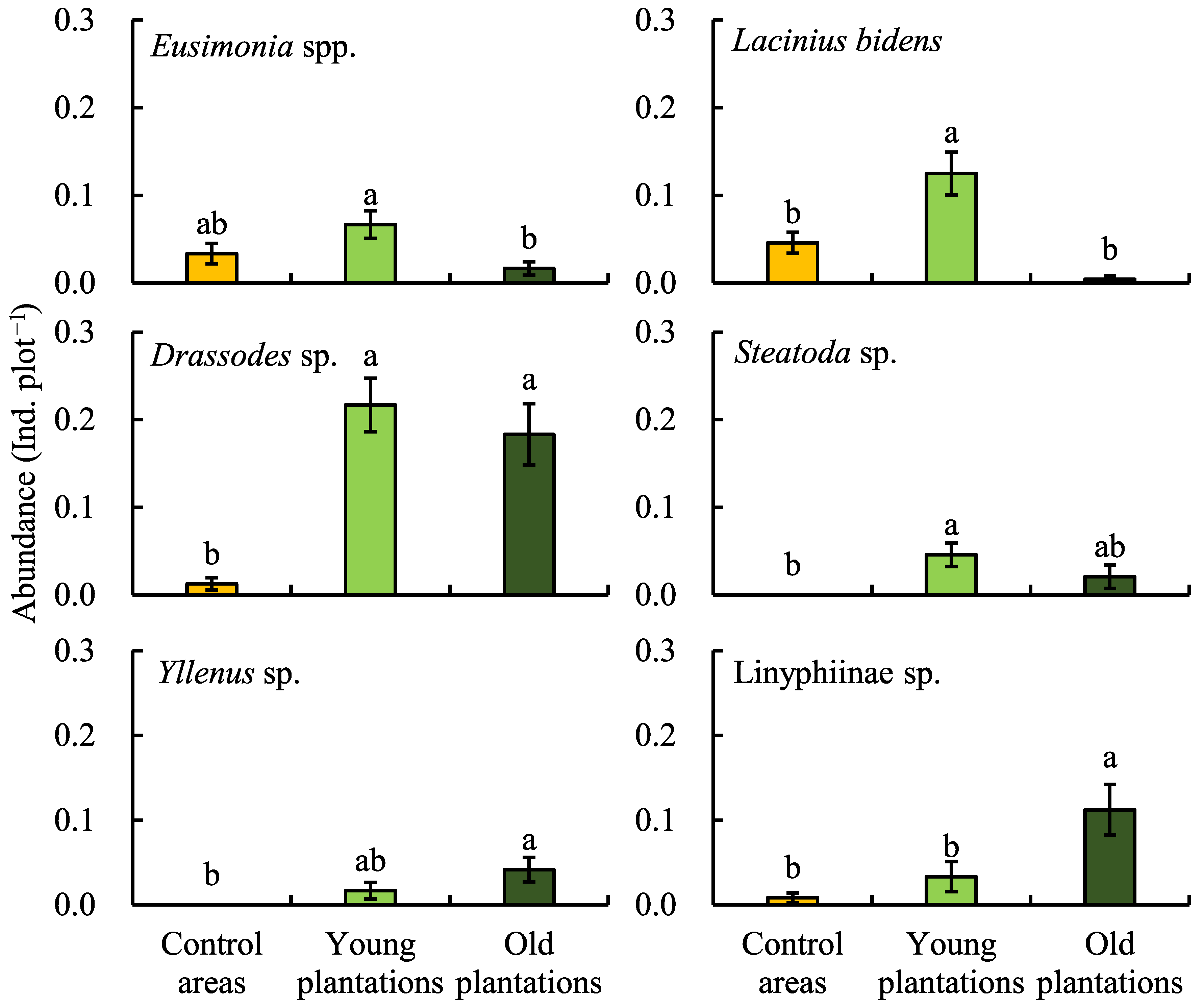
Abundance of Eusimonia spp., Lacinius bidens, Drassodes sp., and Steatoda sp. exhibited similar responses to the establishment of H. ammodendron plantations: their abundance increased in young plantations relative to control areas but declined in old plantations (Figure 3). Abundances of Lacinius bidens, Drassodes sp., and Steatoda sp. were higher in young plantations than in control areas, while Drassodes sp. also showed a significant increase in old plantations (Figure 3). In contrast, abundances of Eusimonia spp. and Lacinius bidens were significantly lower in old plantations compared to young plantations (Figure 3).
Figure 3.
Abundance of six arachnid arthropod species in the control areas, young, and old H. ammodendron plantations. Means (± standard error) with different letters indicate significant differences among habitat types (p < 0.05).
3.2. Effects of Haloxylon ammodendron Plantations on Soil Mesofauna Community
In total, 4980 soil mesofauna individuals were collected across natural areas sites and H. ammodendron plantations, representing eight families (Table A3). The community was dominated by Acari (mites) and Collembola (springtails), which together accounted for the majority of the total individuals, contribution 54.9% and 45.1%, respectively (Table A3). Both the abundance and species richness of mites and springtails were consistently higher in young and old H. ammodendron plantations than in the control areas (Table A3).
The composition of the soil mesofauna community differed significantly among control areas, young, and old H. ammodendron plantations, as confirmed by PERMANOVA (F = 18.58, p < 0.001). SIMPER results further indicated that community dissimilarity was higher between the control and the plantations sites (74.3% for young and 74.8% for old plantations) than between plantations of different ages (71.4%). SIMPER analysis showed that differences between the control and young plantations were largely driven by three families—Lohmanniidae, Entomobryidae, and Trombidiidae—which together accounted for 92.4% of the observed dissimilarity. In contrast, variation between the control and old plantations was mainly explained by Lohmanniidae, Entomobryidae, and Sminthuridae, contributing 86.6%. Comparisons between young and old plantations indicated that these four families collectively explained 88.3% of the overall dissimilarity.
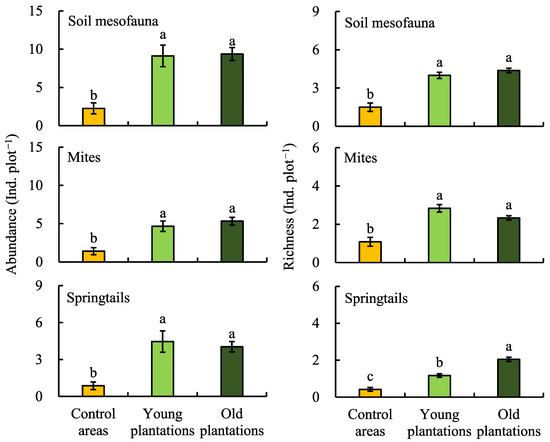
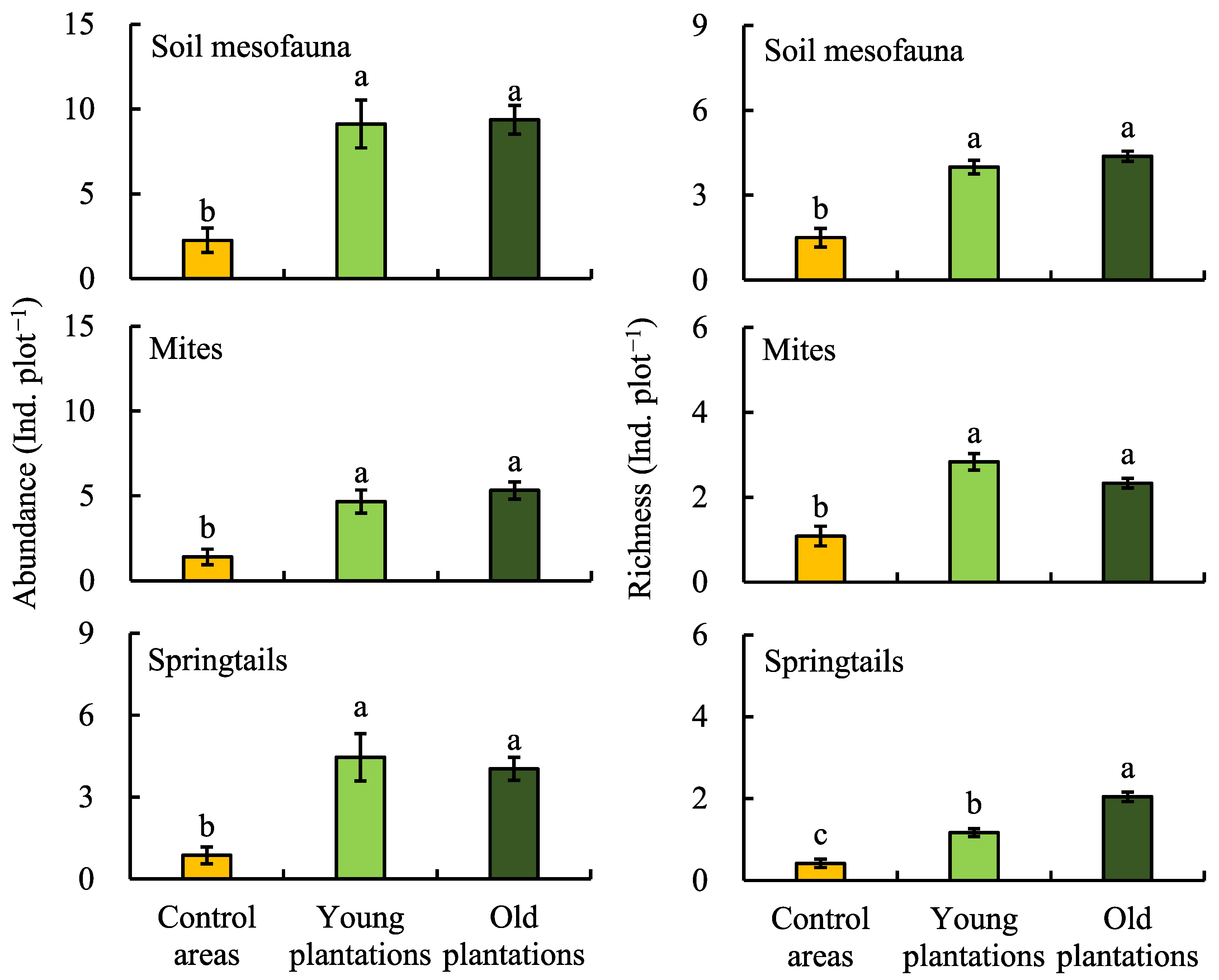
Conversion of natural desert into H. ammodendron plantations led to a marked increase in the overall abundance and richness of soil mesofauna (Figure 4). At the group level, both mites and springtails exhibited significant increases in these metrics following plantation establishment (Figure 4). Along the plantation chronosequence, springtail richness was significantly higher in older plantations than in younger ones, whereas mite richness and springtail abundance showed a slight declining tendency in older plantations (Figure 4).
Figure 4.
Abundance and richness of soil mesofauna, mites, and springtails in the control areas, young and old H. ammodendron plantations. Means (± standard error) with different letters indicate significant differences among habitat types (p < 0.05).
3.3. Trophic Relationships Between Arachnids and Soil Mesofauna
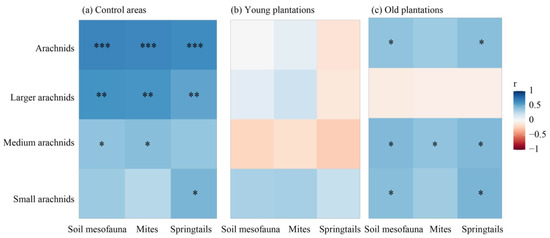
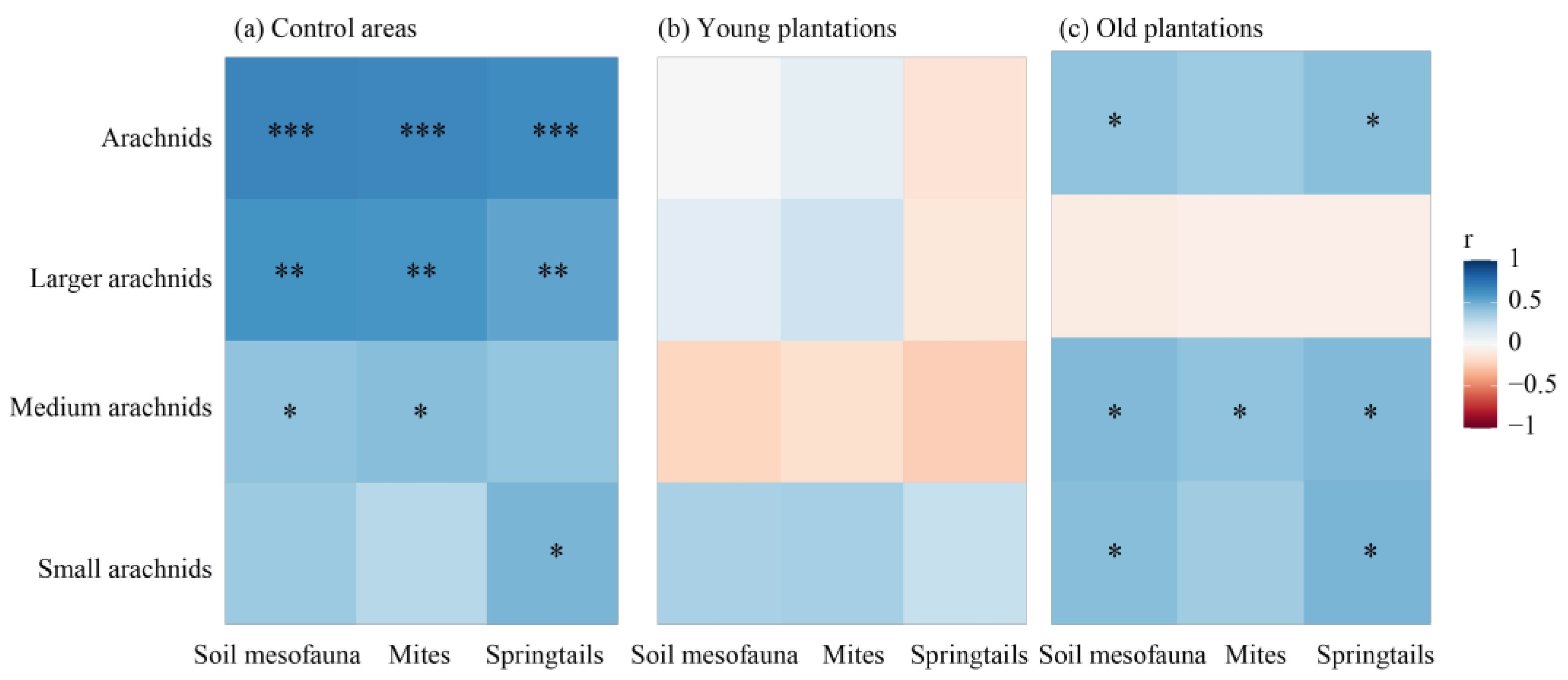
Across all habitat types, including the control desert and H. ammodendron plantations, a strong positive association was detected between overall arachnid and soil mesofauna abundance (r = 0.62, p < 0.001, n = 72). Nevertheless, correlation relationships of arachnids and soil mesofauna varied substantially among habitats (Figure 5). In the control desert, abundance of soil mesofauna, mites, and springtails were positively related to both total arachnid abundance and the abundance of large arachnids (Figure 5). Soil mesofauna and mite abundance was also positively associated with medium-sized arachnids, whereas a significant relationship with small arachnids was detected only for springtails (Figure 5). In contrast, such associations were largely absent in young H. ammodendron plantations, where no significant correlations were observed between any arachnid size class and soil mesofauna, mites, or springtails (Figure 5). In old H. ammodendron plantations, some trophic associations re-emerged: soil mesofauna, mites, and springtails were positively associated with medium-size arachnids, while soil mesofauna and springtails—but not mites—showed a positive relationship with total and small arachnids (Figure 5). By contrast, no significant correlations involving large arachnids were detected in either plantation age class (Figure 5).
Figure 5.
Correlation matrices of abundance of arachnids, larger arachnids, medium arachnids, small arachnids, soil mesofauna, mites, and springtails in the control areas (a), young (b), and old (c) H. ammodendron plantations. Blue indicates positive correlations and red indicates negative correlations. Color intensity reflects correlation strength. Significance levels are denoted by * (p < 0.05), ** (p < 0.01), and *** (p < 0.001).
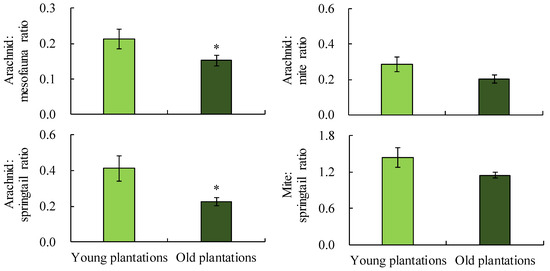
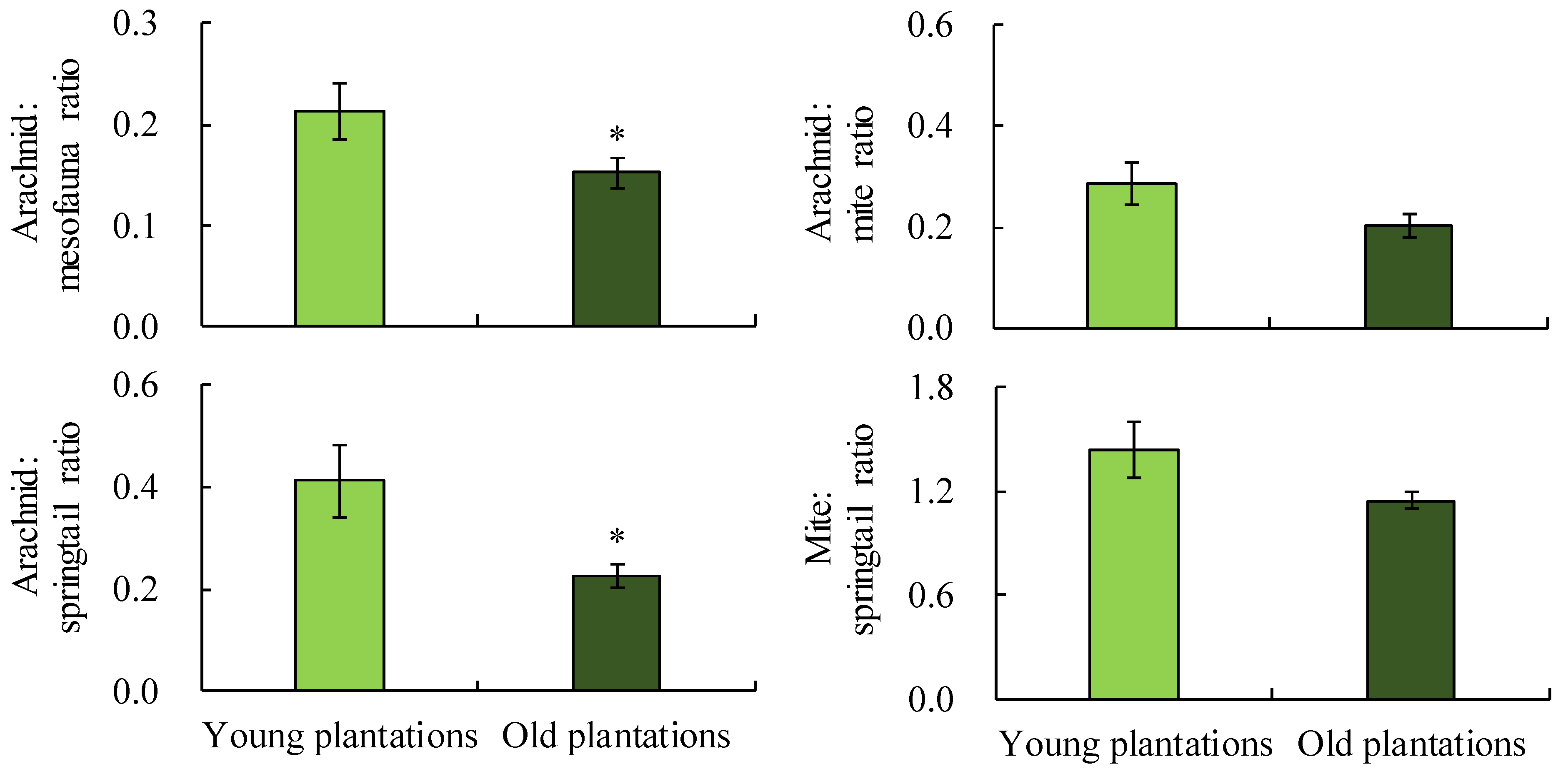
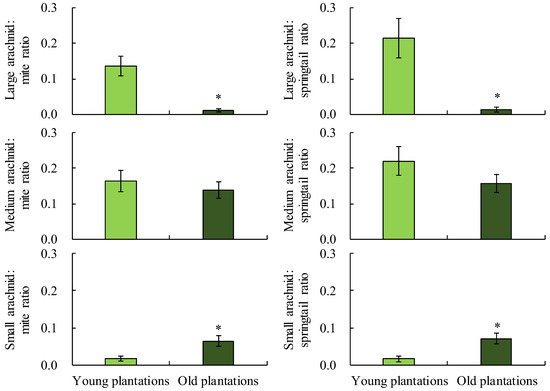
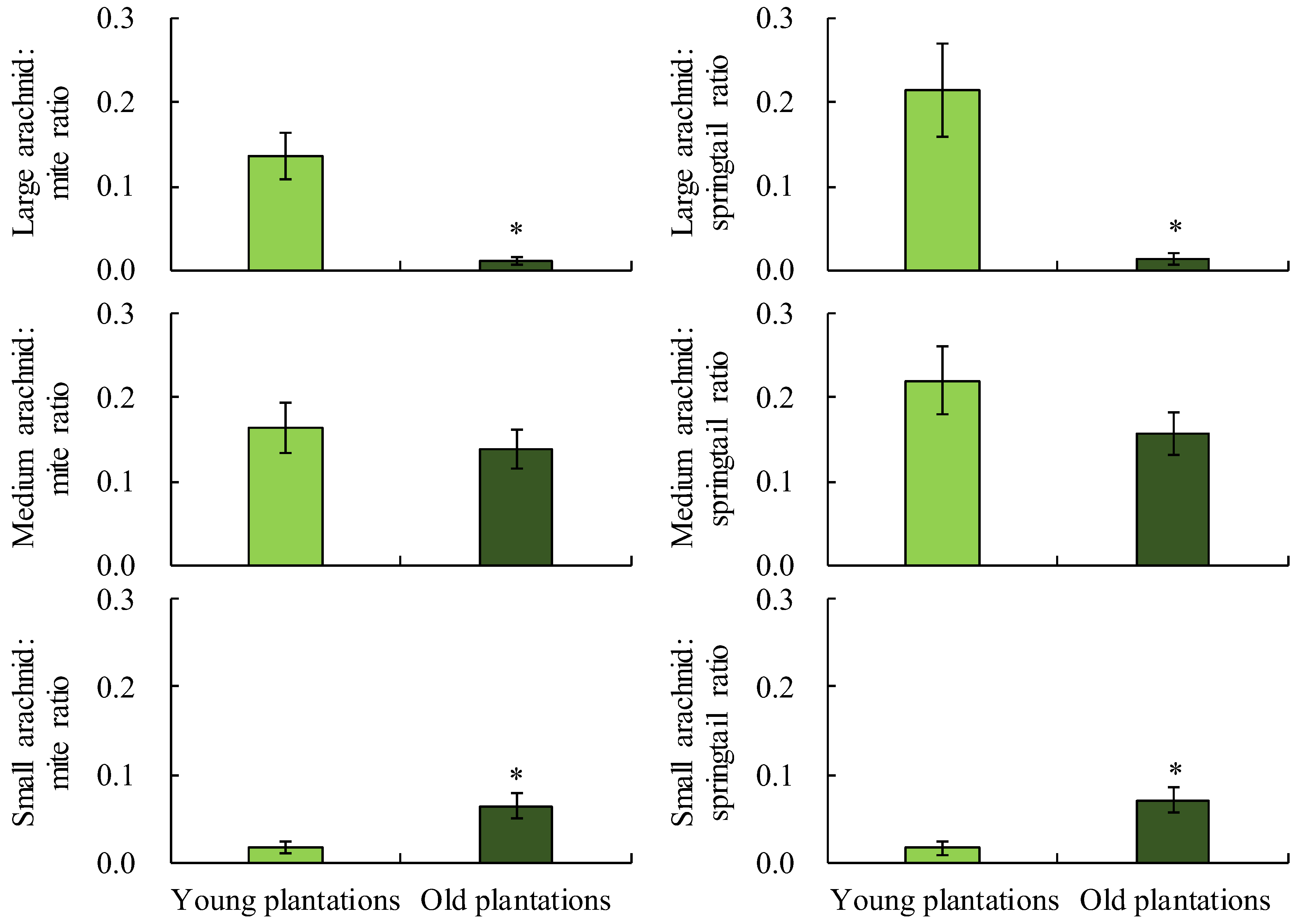
Compared with young plantations, older plantations exhibited lower ratios of total arachnids to soil mesofauna, mites, and springtails, as well as a reduced mite-to-springtail ratio. Among these metrics, declines in the arachnid-to-mesofauna and arachnid-to-springtail ratios were statistically significant (Figure 6). Ratios of large arachnids to both mites and springtails were significantly reduced in older plantations. In contrast, ratios involving small arachnids exhibited the opposite pattern, with higher values observed in older plantations. No significant age-related differences were detected for ratios associated with medium-sized arachnids (Figure 7).
Figure 6.
The ratios of arachnids to mesofauna, arachnids to mites, arachnids to springtails, and mites to springtails in the young and old H. ammodendron plantations. Means (± standard error) with asterisk indicate significant differences among habitat types (p < 0.05).
Figure 7.
The ratio of large, medium and small arachnids to mites and springtails in the young and old H. ammodendron plantations. Means (± standard error) with asterisk indicate significant differences among habitat types (p < 0.05).
3.4. Environmental Drivers of Arachnid and Soil Mesofauna Community Structure
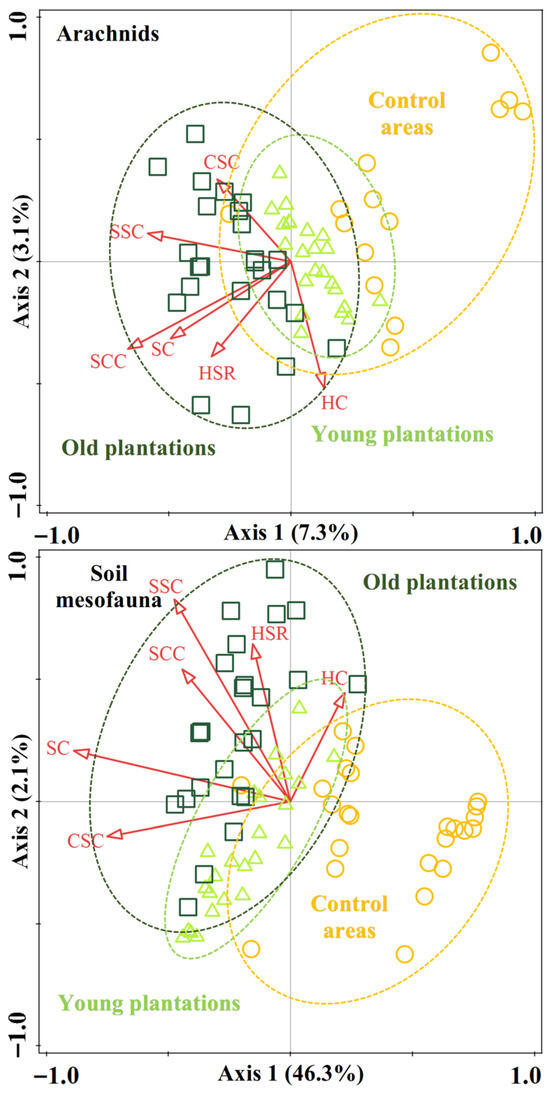
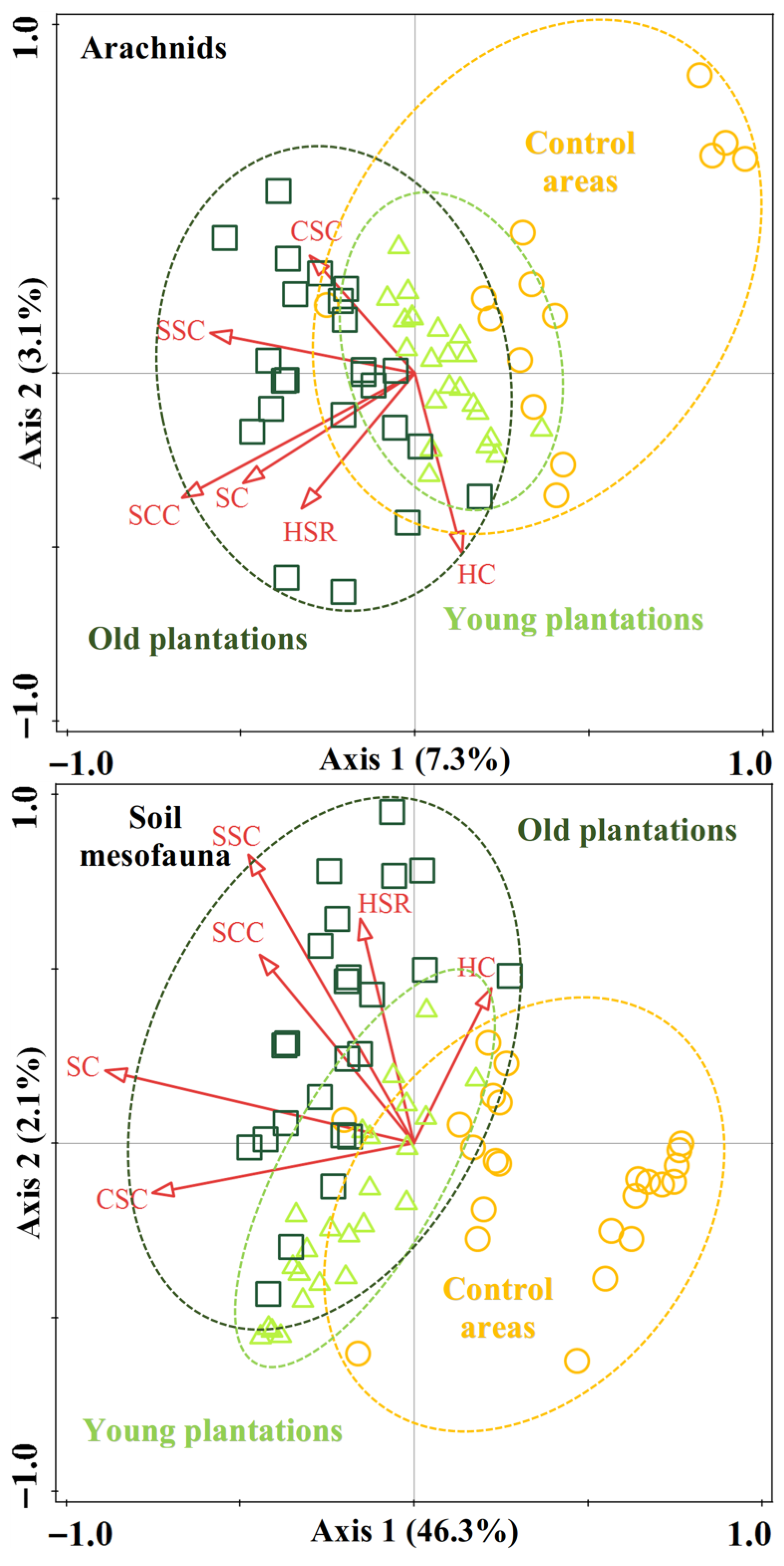
Multivariate analyses indicated that arachnid community composition was significantly shaped by six environmental variables, with the CCA model accounting for 12.3% of the total variance (all axes: F = 2.40, p < 0.001). Partial RDA highlighted shrub cover (SC) and silt-clay content (SCC) as the dominant explanatory factors, together explaining 6.7% of the variance in arachnid communities (Table 2). SC, coarse sand content (CSC), SCC, and soluble salt content (SSC) were all significantly negatively associated with Axis 1 (p < 0.05), whereas no environmental variables showed significantly correlations with Axis 2 (p > 0.05). The pronounced separation of control sites, young plantations, and old plantations along Axis 1 suggests that increases in SC, CSC, SCC, and SSC within plantations were the principal drivers of shifts in arachnid community changes (Figure 8). Moreover, these variables also contributed to compositional differentiation between young and old plantations (Figure 8).
Table 2.
Variation partitioning analysis for quantifying the relative contribution of explanatory variables to the variation in the community composition of arachnids and soil mesofauna. Significant effects are shown in bold (p < 0.05). Explanatory variables include shrub cover (SC), herbaceous cover (HC), herbaceous species richness (HSR), coarse sand content (CSC), silt and clay content (SCC), and soluble salt content (SSC).
Figure 8.
The CCA (canonical correspondence analysis) and RDA (redundancy analysis) two-dimensional ordination diagram of arachnids and soil mesofauna community with six explanatory variables across control areas (○), young (△), and old (□) H. ammodendron plantations. Arrows show the explanatory variables shrub cover (SC), herbaceous cover (HC), herbaceous species richness (HSR), coarse sand content (CSC), silt-clay content (SCC), and soluble salt content (SSC).
TheRDA model accounted for 49.3% of the total variation in soil mesofauna assemblage composition, with Axis 1 and Axis 2 contributing 46.3% and 2.1% of the variance, respectively (all axes: F = 12.50, p < 0.001). Results from partial RDA further indicated that SC, herbaceous cover (HC), CSC, SCC, and SSC were the dominant environmental determinants, together accounting for 48.9% of the explained variation (Table 2). SC, CSC, SCC, and SSC were significantly negatively associated with Axis 1 (p < 0.05), whereas SC, herbaceous species richness (HSR), SCC, and SSC exhibited significant positive correlations with Axis 2 (p < 0.05). The distinct separation of control sites, young plantations, and old plantations along Axes 1 and 2 indicates that plantation-induced increases in these environmental variables were the principal drivers of soil mesofauna community differentiation (Figure 8). Moreover, progressive increases in these environmental variables further contributed to shifts in soil mesofauna community composition between young and old plantations (Figure 8). SSC followed a trajectory comparable to that SC and SCC, and their combined effects partially offset the positive influence of plantation-induced increases in SC and SCC on soil mesofauna, ultimately resulting in lower abundance and richness in the old plantations (Figure 8). Additionally, the reduction in soil mesofauna abundance, together with elevated SCC, imposed both direct and indirect constraints on arachnid diversity.
4. Discussion
4.1. Change in Arachnid and Soil Mesofauna Assembly
Arachnids and soil mesofauna are important predatory and litter decomposition components of the detrital food web in desert ecosystems [1,2,4]. H. ammodendron plantation establishment significantly increased the abundance and richness of both arachnids and soil mesofauna compared to natural desert. This result was consisted with Li et al. [13] and Liu et al. [30] on the edge of the Tengger Desert and Pan et al. [31] on the edge of the Badain Jaran Desert. In contrast, a substantial body of research indicates that artificial plantations generally sustain lower arthropod diversity and weakened pest control function relative to natural vegetation [16,36,37]. This enhancement is likely driven by improvements in soil water availability, greater food availability, and reduced predation pressure associated with greater shrub cover [11,14,15,38,39]. Supporting this interpretation, evidence from semi-arid steppe ecosystems shows that declines in vegetation cover and/or shifts in vegetation patterns toward smaller and more over-dispersed patches can rapidly result in substantial loss of meso- and micro-arthropod diversity in dryland systems [39]. Similarly to precipitation, vegetation restoration in desert regions elevates soil fauna diversity through bottom-up and trophic cascade effects on resources; concurrently, the presence of invertebrate and vertebrate predators acts as a key biotic factor sustaining the coexistence of multiple soil fauna taxa [11,14,15,38]. Our results also indicated that the establishment of plantations within natural desert landscapes promotes higher diversity of arachnids and soil mesofauna, and this positive effect was observed across different trophic levels. This result was different with two key taxa (tenebrionid beetles and ants). Ants and soil mesofauna (mites and springtails) serve as a food resource for arachnids; therefore, increases in their abundance and diversity can indirectly promote higher arachnid diversity [28]. Collectively, these finds indicate that H. ammodendron plantation establishment can facilitate both arachnids and soil mesofauna diversity in desert ecosystems.
We also found that establishment of plantations boosts arachnid diversity, but this increase is not uniform across all groups, potentially impacting their assembly and ecological function. At body size level, arachnid assemblages did not display clear stage-specific shifts following the establishment of H. ammodendron plantations; instead, their responses along the chronosequence were primarily expressed as changes in body size and species identity. More broadly, land-use practices (e.g., artificial vegetation restoration, crop cultivation, and intensive management) are known to influence arthropod ecological functions by altering key functional traits, particularly body size [7,8]. Large arachnid abundance increased markedly in young plantations but declined in old plantations compared to natural deserts. The disappearance of two arachnid species, which prefer desert habitats, following long-term plantation development is consistent with the pattern observed in some tenebrionid beetle species [28,40,41]. Some large arachnid species show negative response the establishment of plantations and solar parks [12,42]. Soykan et al. [43] also reported some desert arthropod species are only found in desert habitats, and not found in the riparian–upland. In contrast, medium-sized arachnids exhibited consistent increases across both plantation ages, whereas small arachnid abundance showed significant gains only in the old plantations. Desert spider species appeared particularly sensitive to revegetation, exhibiting marked declines in abundance, a pattern consistent with previous findings [44]. For example, Herrmann et al. [44] reported substantially higher spider abundance and diversity in exotic Eucalyptus plantations than in adjacent semi-desert habitats, accompanied by pronounced shifts in the spider community composition, with desert spider species being nearly absent from the plantations. By contrast, the elevated abundance and richness of arachnids observed in both young and old plantations were largely attributable to increases in medium and small species, a pattern consistent with findings from the northern Negev Desert, Israel [44]. Similarly, Shochat et al. [45] reported that although overall spider diversity decreased in urban desert landscapes of Phoenix, AZ, certain spider taxa, like wolf spiders, acted as urban exploiters, reaching higher population densities in modified habitats. Overall, the response of arachnid species to H. ammodendron plantations varied with body size and species identity, which in turn influences their relationship with soil mesofauna.
4.2. Change in Relationship of Arachnid and Soil Mesofauna
As generalist predators in desert ecosystems, arachnids prey on a wide range of organisms, including mesofauna and larger arthropods such as beetles and ants [1,12,46]. Additionally, they engage in intraguild predation between spiders and non-spider arachnids. Compared to the natural desert, both the abundance and species richness of spiders and soil mesofauna increased in the plantations, and a positive correlation was observed between them. One study observed that the resource pulse from simulated rainfall boosted springtail populations, which subsequently elevated spider and predatory mite densities and altered spider predatory behavior [46,47,48,49]. These results closely align with our own findings. Some researchers also reported that water stress not only alters the interaction between adjacent trophic levels but can also affect non-adjacent levels through trophic cascades [50,51]. Furthermore, predators may respond to drought stress by a compensatory increase in predation rate [50,51]. In contrast to the studies above, both mite and springtail abundances increased with plantation establishment in our study, showing a significantly positive correlation. Our results show that the interactive dynamics between arachnid, mite, and springtail abundances shifted significantly across different stages of plantation restoration. Compared to the natural desert, the interactions among soil mesofauna in plantations changed with stand age—disappearing in young stands and weakening in mature ones—a pattern linked to shifts in arachnid species composition and body size. This shift is likely to have important implications for the detrital food web in desert ecosystems [52,53].
The relationship between arachnid body size and mites and springtails abundance was strongly influenced by plantation age. This pattern reflects previous findings showing that the responses of ground-dwelling arthropod trophic groups and dormant taxa vary with plantation age [28,31]. Compared with natural desert habitats, the establishment of H. ammodendron plantations have been widely reported to alter vegetation, soil environments, soil functions, and ecosystem functions [20,21,23,26]. Our results further indicated a shift in the relationship between large, medium, and small arachnid abundance and mite and springtail abundance with plantation age. Specifically, the proportion of large arachnids relative to mites and springtails declined in old plantations compared with young ones, whereas the relative contributions of small arachnids to these prey groups increased. Furthermore, a non-significant decline in the mite-to-springtail ratio was observed in the old plantations compared to the young plantations. Previous studies have reported that alternation in predation intensity by arthropods, reptiles and birds can affect the abundance and diversity of arthropods in non-adjacent trophic levels, which contrasts with our findings [5,14]. The establishment of H. ammodendron plantations replaced native shrub species and changed soil environments, especially in the old plantations [23,25,28]. Together, these changes modify inhabitant and reproductive conditions, and strongly impacted desert large arachnid species such as sun spiders (Solifugae) and harvestmen (Opiliones) [12,40,41]. In summary, the establishment of H. ammodendron plantations substantially modified the trophic relationships between both large and small arachnids and mites and springtails, whereas interactions between mites and springtails themselves remained unaffected.
4.3. Key Factors Driving the Assemblage of Arachnids and Soil Mesofauna
Along the restoration age of H. ammodendron plantations, arachnid and soil mesofauna assemblages exhibited distinct response patterns. These variations were strongly associated with concurrent shifts in vegetation structure and soil conditions. In particular, shrub cover, herbaceous cover, coarse sand content, silt and clay content, and soluble salt content were identified as the dominant environmental factors shaping soil mesofauna community dynamics. The establishment of plantations enhanced the quantity and quality of food resources (litter) and improved soil water content and fertility, thereby promoting the development of the soil mesofauna assemblage [47]. Consistent with this pattern, mite and springtail diversity has been reported to increase in irrigated plantations and farmlands, whereas rain-fed plantations exerted a negative effect on these taxa [54]. With increasing plantation age, the accumulation of soil soluble salts and the formation of salt crusts intensified soil hardness and salinity, thereby constraining the survival and reproductive capacity of mites and springtails [55,56]. Moreover, our results indicate that soil mesofauna responded more strongly to plantation establishment than arachnids, with shift in their community structure being jointly regulated by soil conditions and vegetation attributes.
The establishment of plantations also led to a gradual increase in the abundance and species richness of arthropods such as mites, springtails, and ants [28]. This increase was a primary driver of arachnid assembly, similarly to results reported for irrigation farmland and plantations [54]. Short-term controlled experiments simulating rainfall increases have found that rainfall pulses drive increases in springtail abundance, which in turn lead to higher spider diversity [46,49]. Similarly, long-term studies on rainfall variation have identified rainfall-driven resource increases as an important factor influencing spider community dynamics [57]. Plantation establishment also shapes arachnid assembly through modifications to the vegetation and soil environment. Our results further indicate that the expansion of shrub cover following plantation establishment constituted a primary factor shaping arthropod community structure. Nevertheless, the combined effects of all seven measured soil and vegetation variables explained only 12.3% of the total variation in arachnid community composition. Variations in body size and species identity shape the diverse response patterns of arachnids to plantation establishment [12,40,41]. In contrast, medium and small arachnids appear to respond primarily to the availability of food resources, such as mites, springtails, and other insects, a pattern consistent with the findings of Wang et al. [28,58]. Shochat et al. [45] reported that the abundance of wolf spider (Lycosidae) was positively associated with habitat productivity but inversely related to the presence of other predatory arthropods, a pattern that partially contrasts with our results. In desert agroecosystems, agricultural cultivation and plantation have been shown to enhance the abundance and diversity of herbivorous arthropods and other functional groups, which subsequently promotes higher abundance and diversity of predatory arthropods [54,58]. In short, plantation establishment led to changes in vegetation and soil factors that drove soil mesofauna assembly, with these changes then interacting to shape arachnid assembly.
5. Conclusions
The conversion of natural sand dunes to Haloxylon ammodendron plantations markedly reshaped the composition of arachnid and soil mesofauna communities, with additional differences observed between plantations of varying ages. Establishment of H. ammodendron resulted in a significant increase in the overall abundance and richness of arachnids, soil mesofauna, mites, and springtails. Notably, the abundance of large arachnids increased significantly only in young plantations, whereas small arachnids exhibited a significant increase exclusively in older plantations. In older plantations, the ratios of total arachnids to mesofauna and large arachnids to mites and springtails declined significantly, whereas the ratio of small arachnids to mites and springtails increased. Shrub cover together with silt and clay content accounted for only 6.7% of the variation in arachnid community structure, while these factors collectively explained 48.9% of the variation in soil mesofauna communities. Additionally, the abundance of mites and springtails was positively correlated with arachnid diversity, particularly influencing small arachnid species. In summary, the decline in arachnid body size with plantation age following the establishment of H. ammodendron plantations has reshaped the detrital food web, consequently diminishing the pest control and litter decomposition provided by these arthropods.
Author Contributions
Conceptualization, Q.M. and Y.L.; investigation, J.L., Y.W., X.Z. (Xiuzhen Zhao), X.Z. (Xiaogan Zhou) and F.L.; data curation, J.L., Z.W. and X.Z. (Xiuzhen Zhao); writing—original draft, Z.W.; writing—review and editing, J.L. and Y.L.; formal analysis, Z.W. and Y.W.; visualization, X.L., Y.W. and X.Z. (Xiuzhen Zhao); project administration, Q.M.; funding acquisition, Q.M.; supervision, Y.L. All authors have read and agreed to the published version of the manuscript.
Funding
This study was supported by the National Key Research and Development Program of China (No. 2024YFD2201105), the National Natural Science Foundation of China (No. 41771290; No. 42201043), and the Central-Government-Guided Local Science and Technology Development Fund (No. 2024ZY0001).
Data Availability Statement
The data presented in this study are available from the corresponding author upon reasonable request.
Acknowledgments
We would like to acknowledge Zhi-Sheng Zhang for the identification of arthropod species and Hong-Jian Wang for the identification of spider species.
Conflicts of Interest
The authors declare no conflicts of interest. The funders had no role in the design of the study; in the collection, analyses, or interpretation of data; in the writing of the manuscript; or in the decision to publish the results.
Appendix A
Table A1.
Pearson correlation coefficients among the nine vegetation and soil environmental factors.
Table A2.
Number of individuals on arachnids and body sizes captured in the control areas, young, and old H. ammodendron plantations.
Table A3.
Number of individuals on soil mesofauna captured in the control areas, young, and old H. ammodendron plantations.
References
- Polis, G.A. Complex trophic interactions in deserts: An empirical critique of food-web theory. Am. Nat. 1991, 138, 123–155. [Google Scholar] [CrossRef] [Scilit]
- Whitford, W.G. The importance of the biodiversity of soil biota in arid ecosystems. Biodivers. Conserv. 1996, 5, 185–195. [Google Scholar] [CrossRef] [Scilit]
- Sagi, N.; Hawlena, D. Arthropods as the Engine of Nutrient Cycling in Arid Ecosystems. Insects 2021, 12, 726. [Google Scholar] [CrossRef] [Scilit] [PubMed]
- Cardoso, P.; Pekár, S.; Birkhofer, K.; Chuang, A.; Fukushima, C.S.; Hebets, E.A.; Henaut, Y.; Hesselberg, T.; Malumbres-Olarte, J.; Michálek, O.; et al. Ecosystem services provided by spiders. Bio. Rev. 2025, 100, 2217–2236. [Google Scholar] [CrossRef] [Scilit]
- Ayal, Y. Trophic structure and the role of predation in shaping hot desert communities. J. Arid. Environ. 2007, 68, 171–187. [Google Scholar] [CrossRef] [Scilit]
- Vonshak, M.; Dayan, T.; Kronfeld-schor, N. Arthropods as a prey resource: Patterns of diel, seasonal, and spatial availability. J. Arid. Environ. 2009, 73, 458–462. [Google Scholar] [CrossRef] [Scilit]
- Turney, S.; Buddle, C.M. Body size mediates the relationship between spider (Arachnida: Araneae) assemblage composition and prey consumption rate: Results of a mesocosm experiment in the Yukon, Canada. Oecologia 2019, 189, 757–768. [Google Scholar] [CrossRef] [Scilit]
- Plath, E.; Rischen, T.; Mohr, T.; Fischer, K. Biodiversity in agricultural landscapes: Grassy field margins and semi-natural fragments both foster spider diversity and body size. Agric. Ecosyst. Environ. 2021, 316, 107457. [Google Scholar] [CrossRef] [Scilit]
- Martínez-Núñez, C.; Gossner, M.M.; Maurer, C.; Neff, F.; Obrist, M.K.; Moretti, M.; Bollmann, K.; Herzog, F.; Knop, E.; Luka, H.; et al. Land-use change in the past 40 years explains shifts in arthropod community traits. J. Anim. Ecol. 2024, 93, 540–553. [Google Scholar] [CrossRef] [Scilit]
- Khum, W.; Košulič, O.; Michalko, R. Trait diversity and spider community composition are associated with lower herbivory in young forest plantations. Biol. Control 2025, 200, 105666. [Google Scholar] [CrossRef] [Scilit]
- Segoli, M.; Groner, E.; Ayal, Y. The importance of plant cover and predation in shaping a desert community. J. Arid. Environ. 2016, 135, 33–38. [Google Scholar] [CrossRef] [Scilit]
- Cloudsley-Thompson, J.L. Desert adaptations in spiders. Arid. Environ. 1983, 6, 307–317. [Google Scholar] [CrossRef] [Scilit]
- Li, X.R.; Zhao, H.L.; Zhang, J.G.; Wang, X.P. Long-term ecosystem effects of sand-binding vegetation in the Tengger Desert, northern China. Restor. Ecol. 2004, 12, 376–390. [Google Scholar] [CrossRef] [Scilit]
- Schmitz, O.J.; Hawlena, D.; Trussell, G.C. Predator control of ecosystem nutrient dynamics. Ecol. Lett. 2010, 13, 1199–1209. [Google Scholar] [CrossRef] [Scilit]
- Shaner, P.-J.L.; Macko, S.A. Trophic shifts of a generalist consumer in response to resource pulses. PLoS ONE 2011, 6, e17970. [Google Scholar] [CrossRef] [Scilit]
- Horák, J.; Materna, J.; Halda, J.P.; Mladenović, S.; Bogusch, P.; Pech, P. Biodiversity in remnants of natural mountain forests under conservation-oriented management. Sci. Rep. 2019, 9, 89. [Google Scholar] [CrossRef] [Scilit]
- Moreno-Mateos, D.; Alberdi, A.; Morriën, E.; van der Putten, W.H.; Rodríguez-Uña, A.; Montoya, D. The long-term restoration of ecosystem complexity. Nat. Ecol. Evol. 2020, 4, 676–685. [Google Scholar] [CrossRef] [Scilit]
- Atkinson, J.; Brudvig, L.A.; Mallen-Cooper, M.; Nakagawa, S.; Moles, A.T.; Bonser, S.P. Terrestrial ecosystem restoration increases biodiversity and reduces its variability, but not to reference levels: A global meta-analysis. Ecol. Lett. 2022, 25, 1725–1737. [Google Scholar] [CrossRef] [Scilit]
- Li, J.Y.; Chang, H.; Liu, T.; Zhang, C. The potential geographical distribution of Haloxylon across Central Asia under climate change in the 21st century. Agric. Forest Meteorol. 2019, 275, 243–254. [Google Scholar] [CrossRef] [Scilit]
- Huang, N.; Li, X.Y.; Liu, H.Y.; Tang, J.N.; Ji, Y.F.; Zhao, C.M.; Li, J.H. Effects of stand structure on ecological benefits and tree growth of Haloxylon ammodendron plantations: A meta-analysis. Land. Degrad. Dev. 2024, 35, 4406–4418. [Google Scholar] [CrossRef] [Scilit]
- Fan, B.L.; Zhang, A.P.; Yang, Y.; Ma, Q.; Li, X.; Zhao, C. Long-term effects of xerophytic shrub Haloxylon ammodendron plantations on soil properties and vegetation dynamics in Northwest China. PLoS ONE 2016, 11, e0168000. [Google Scholar] [CrossRef] [Scilit]
- Zhang, K.; Su, Y.Z.; Wang, T.; Liu, T.N. Soil properties and herbaceous characteristics in an age sequence of Haloxylon ammodendron plantations in an oasis-desert ecotone of northwestern China. J. Arid. Land. 2016, 8, 960–972. [Google Scholar] [CrossRef] [Scilit]
- Yu, K.L.; Wang, G.H. Long-term impacts of shrub plantations in a desert-oasis ecotone: Accumulation of soil nutrients, salinity, and development of herbaceour layer. Land. Degrad. Dev. 2018, 29, 2681–2693. [Google Scholar] [CrossRef] [Scilit]
- Liu, J.L.; Feng, Y.L.; Wang, Y.Z.; Pan, C.C.; Bao, T.L.; Ren, J.L.; Zhao, W.Z. Effects of restoration of artificial sand-fixing vegetation on the diversity of reptiles and mammals in the middle reaches of the Heihe River Basin. J. Desert Res. 2024, 44, 167–177. [Google Scholar]
- Su, Y.Z.; Liu, T.N.; Kong, J.Q. The establishment and development of Haloxylon ammodendron promotes salt accumulation in surface soil of arid sandy land. Sci. Cold Arid. Reg. 2019, 11, 116–125. [Google Scholar] [CrossRef]
- Ren, J.L.; Zhao, W.Z.; He, Z.B.; Wang, Y.Z.; Feng, Y.L.; Niu, Y.P.; Xin, W.D.; Pan, C.C.; Liu, J.L. Spatiotemporal variations of tenebrionid beetles (Coleoptera: Tenebrionidae) in the Gobi desert, Northwest China. J. Arid. Land. 2025, 17, 112–129. [Google Scholar] [CrossRef] [Scilit]
- Zheng, Y.; Zhao, W.Z.; Zhang, G.F. Spatial analysis of a Haloxylon ammodendron plantation in an oasis-desert ecotone in the Hexi corridor, northwestern China. Forests 2017, 8, 200. [Google Scholar] [CrossRef] [Scilit]
- Wang, Z.T.; Liu, J.L.; Luo, Y.Z.; Ma, Q.L. Changes in tenebrionid beetle and ant assembly influenced by different-aged Haloxylon ammodendron plantations in Northwest China. Land. Degrad. Dev. 2025, 36, 2940–2954. [Google Scholar] [CrossRef] [Scilit]
- Kang, N.; Guo, J.; Jiang, L.; Zhang, D.; Zhao, Q.; Hu, H. Biology, parasitoid complex and potential distribution of saxaul’s dominant defoliators, Teia dubia (Lepidoptera: Lymantriidae). Bull. Entomol. Res. 2022, 112, 162–170. [Google Scholar] [CrossRef] [Scilit]
- Liu, R.T.; Zhu, F.; Steinberger, Y. Effectiveness of afforested shrub plantation on ground-active arthropod communities and trophic structure in desertified regions. Catena 2015, 125, 1–9. [Google Scholar] [CrossRef] [Scilit]
- Pan, C.C.; Wang, Z.T.; Wang, Y.Z.; Zhao, C.Z.; Niu, R.X.; Feng, Y.; Li, Y.L.; Liu, J.L. Long-term impact of Haloxylon ammodendron plantations on the trophic structure of ground arthropods in a desert-oasis ecotone. Glob. Ecol. Conserv. 2025, 62, e03786. [Google Scholar] [CrossRef] [Scilit]
- Song, D.X.; Zhu, M.S.; Chen, J. The spiders of China; Hebei Science and Technology Publishing House: Baoding, China, 1999. [Google Scholar]
- Duan, M.; Liu, Y.; Li, X.; Wu, P.; Hu, W.; Zhang, F.; Shi, H.; Yu, Z.; Baudry, J. Effect of present and past landscape structures on the species richness and composition of ground beetles (Coleoptera: Carabidae) and spiders (Araneae) in a dynamic landscape. Landsc. Urban Plann. 2019, 192, 103649. [Google Scholar] [CrossRef] [Scilit]
- Yin, W.Y. Pictorial Keys to Soil Animals of China; Science Press: Beijing, China, 1998. [Google Scholar]
- Ter Braak, C.J.F.; Smilauer, P. Canoco Reference Manual and User’s Guide: Software for Ordination; Version 5.0; Microcomputer Power: Ithaca, NY, USA, 2012. [Google Scholar]
- Bremer, L.L.; Farley, K.A. Does plantation forestry restore biodiversity or create green deserts? A synthesis of the effects of land-use transitions on plant species richness. Biodivers. Conserv. 2010, 19, 3893–3915. [Google Scholar] [CrossRef] [Scilit]
- Tudge, S.J.; Harris, Z.M.; Murphy, R.J.; Purvis, A.; De Palma, A. Global trends in biodiversity with tree plantation age. Glob. Ecol. Conserv. 2023, 48, e02751. [Google Scholar] [CrossRef] [Scilit]
- Groner, E.; Ayal, Y. The interaction between bird predation and plant cover in determining habitat occupancy of darkling beetles. Oikos 2001, 93, 22–31. [Google Scholar] [CrossRef] [Scilit]
- Meloni, F.; Civieta, B.F.; Zaragoz, J.A.; Moraza, M.L.; Bautista, S. Vegetation pattern modulates ground arthropod diversity in semi-arid mediterranean steppes. Insects 2020, 11, 59. [Google Scholar] [CrossRef] [Scilit]
- Fan, W.L.; Zhang, C.; Zhang, F. First report of the family Karschiidae (Arachnida, Solifugae) from Gansu Province, China, with description of two new species. Zootaxa 2025, 5492, 369–394. [Google Scholar] [CrossRef] [Scilit]
- Allard, C.M.; Yeargan, K.V. Effect of diet on development and reproduction of the harvestman Phalangium opilio (Opiliones: Phalangiidae). Environ. Entomol. 2005, 34, 6–13. [Google Scholar] [CrossRef] [Scilit]
- Suuronen, A.; Muñoz-Escobar, C.; Lensu, A.; Kuitunen, M.; Celis, N.G.; Astudillo, P.E.; Ferrú, M.; Taucare-Ríos, A.; Miranda, M.; Kukkonen, J.V.K. The Influence of Solar Power Plants on Microclimatic Conditions and the Biotic Community in Chilean Desert Environments. Environ. Manag. 2017, 60, 630–642. [Google Scholar] [CrossRef] [Scilit]
- Soykan, C.U.; Brand, L.A.; Ries, L.; Stromberg, J.C.; Hass, C.; Simmons, D.A.; Patterson, W.J.D.; Sabo, J.L. Multitaxonomic diversity patterns along a desert riparian-upland gradient. PLoS ONE 2012, 7, e28235. [Google Scholar] [CrossRef] [Scilit]
- Herrmann, J.D.; Opatovsky, I.; Lubin, Y.; Pluess, T.; Gavish-Regev, E.; Entling, M.H. Effects of non-native Eucalyptus plantations on epigeal spider communities in the northern Negev desert, Israel. J. Arachnol. 2015, 43, 101–106. [Google Scholar] [CrossRef] [Scilit]
- Shochat, E.; Stefanov, W.L.; Whitehouse, M.E.A.; Faeth, S.H. Urbanization and spider diversity: Influences of human modification of habitat structure and productivity. Ecol. Appl. 2004, 14, 268–280. [Google Scholar] [CrossRef] [Scilit]
- Lensing, J.R.; Todd, S.; Wise, D.H. The impact of altered precipitation on spatial stratification and activity-densities of springtails (Collembola) and spiders (Araneae). Ecol. Entomol. 2005, 30, 194–200. [Google Scholar] [CrossRef] [Scilit]
- Ferguson, S.H.; Joly, D.O. Dynamics of springtail and mite populations: The role of density dependence, predation, and weather. Ecol. Entomol. 2002, 27, 565–573. [Google Scholar] [CrossRef] [Scilit]
- Fischer, C.; Gerstmeier, R.; Wagner, T.C. Seasonal and temporal patterns of rainfall shape arthropod community composition and multi-trophic interactions in an arid environment. Sci. Rep. 2022, 12, 3742. [Google Scholar] [CrossRef] [Scilit]
- Qin, C.; Liu, J.L.; Ren, J.L.; Yan, Q.H.; Zhao, W.Z.; Fang, J.; Xin, W.D. Short-term response of spiders, mites and springtails to increased rainfall in arid desert ecosystems. J. Desert Res. 2025, 45, 141–150. [Google Scholar] [CrossRef]
- Verdeny-Vilalta, O.; Moya-Laraño, J. Seeking water while avoiding predators: Moisture gradients can affect predator–prey interactions. Anim. Behav. 2014, 90, 101–108. [Google Scholar] [CrossRef] [Scilit]
- McCluney, K.E.; Sabo, J.L. Animal water balance drives top-down effects in a riparian forest—Implications for terrestrial trophic cascades. Proc. R. Soc. Biol. Sci. 2016, 283, 20160881. [Google Scholar] [CrossRef] [Scilit]
- Gallé, R.; Happe, A.K.; Baillod, A.B.; Tscharntke, T.; Batáry, P. Landscape configuration, organic management, and within-field position drive functional diversity of spiders and carabids. J. Appl. Ecol. 2019, 56, 63–72. [Google Scholar] [CrossRef] [Scilit]
- Wan, B.B.; Kardol, P.; Barnes, A.D.; Chen, X.Y.; Hu, F.; Mori, A.S.; Liu, M.Q. Body size determines soil multitrophic diversity along a litter stoichiometry gradient in agroecosystems. J. Appl. Ecol. 2026, 63, e70276. [Google Scholar] [CrossRef] [Scilit]
- Li, F.R.; Liu, J.L.; Ren, W.; Liu, L.L. Land-use change alters patterns of soil biodiversity in arid lands of northwestern China. Plant Soil. 2018, 428, 371–388. [Google Scholar] [CrossRef] [Scilit]
- Owojori, O.J.; Reinecke, A.J.; Voua-Otomo, P.; Reinecke, S.A. Comparative study of the effects of salinity on life-cycle parameters of four soil dwelling species (Folsomia candida, Enchytraeus doerjesi, Eisenia fetida and Aporrectodea caliginosa). Pedobiologia 2009, 52, 351–360. [Google Scholar] [CrossRef] [Scilit]
- Magoba, R.N.; Samways, M.J.; Simaika, J.P. Soil compaction and surface-active arthropods in historic, agricultural, alien, and recovering vegetation. J. Insect Conserv. 2015, 19, 501–508. [Google Scholar] [CrossRef] [Scilit]
- Langlands, P.R.; Brennan, K.E.C.; Pearson, D.J. Spiders, spinifex, rainfall and fire: Long-term changes in an arid spider assemblage. J. Arid. Environ. 2006, 67, 36–59. [Google Scholar] [CrossRef] [Scilit]
- Wang, Y.Z.; Ren, J.L.; Zhao, W.Z.; He, Z.B.; Chen, L.F.; Ren, W.; Liu, J.L. Soil macrofauna trophic structure and its relationship with soil factors in oases of contrasting cultivation ages. Agriculture, Agric. Ecosyst. Environ. 2025, 377, 109277. [Google Scholar] [CrossRef] [Scilit]

Disclaimer/Publisher’s Note: The statements, opinions and data contained in all publications are solely those of the individual author(s) and contributor(s) and not of MDPI and/or the editor(s). MDPI and/or the editor(s) disclaim responsibility for any injury to people or property resulting from any ideas, methods, instructions or products referred to in the content. |
© 2026 by the authors. Licensee MDPI, Basel, Switzerland. This article is an open access article distributed under the terms and conditions of the Creative Commons Attribution (CC BY) license.