


Abstract
Bothrops atrox is a medically important venomous snake in northern Brazil, but its helminth communities remain poorly understood across Amazonian habitats. We investigated helminth community structure and its associations with habitat and host attributes in 18 snakes from ombrophilous rainforest and flooded natural grasslands (nine per locality). Helminths were identified and community metrics compared between localities; abundance was also analyzed in a negative binomial model accounting for snout–vent length (SVL) and sex. We recorded 11 helminth taxa, including seven nematodes, three cestodes, and one acanthocephalan. Total helminth abundance was higher in forest snakes, but habitat was not significantly associated with abundance after adjustment for SVL and sex. SVL was positively associated with abundance. Taxon richness and Shannon diversity did not differ significantly between localities, whereas community composition differed significantly (PERMANOVA, R2 = 0.296, p = 0.001). We report five new helminth host records for B. atrox (Kalicephalus costatus costatus, Hastospiculum nordestinum, Physaloptera sp. (L3 larvae), Ortleppascaris sp. (larvae), and Pachysentis sp.). Our results indicate that helminth community composition is associated with locality, whereas host body size is positively associated with helminth abundance. These findings highlight the value of parasitological surveys in under-sampled Amazonian habitats for documenting helminth diversity.
1. Introduction
Understanding the mechanisms that structure parasite diversity in host populations is a central question in ecology and evolutionary biology [1,2,3]. Consequently, biological aspects of the host and environmental conditions are recognized as predictors of parasite diversity in vertebrates [4,5,6].
At local and regional scales, environmental heterogeneity plays a decisive role in community assembly, as variations in microclimate and physical habitat structure modulate both the survival of free-living parasite stages and the trophic overlap between prey and predators [2,7]. In this context, the Amazon biome provides an ideal model to investigate such gradients due to its remarkable ecological heterogeneity, encompassing continuous dense forests, as well as open vegetation enclaves, such as Amazonian savannas, “campinaranas”, and natural grasslands [8].
The ecological mosaic of this biome creates contrasts in moisture, temperature, and prey availability, which alter vertebrate species distribution and may influence parasite transmission. These differences may be particularly relevant for parasites with distinct life cycles. Direct-life-cycle nematodes depend on the survival and dispersal of infective stages in the environment, whereas cestodes, acanthocephalans, and some nematodes have heteroxenous life cycles that depend on intermediate or paratenic hosts and trophic transmission [9,10].
Over the last few decades, few studies have focused on Neotropical reptiles’ helminth communities [2,6,9]. One such species is the common lancehead, Bothrops atrox (Linnaeus, 1758) (Viperidae), which is the most medically important venomous snake in northern Brazil [11]. This species has terrestrial habits and a generalist diet, feeding mainly on small mammals, anurans and lizards [12,13]. Prior to this study, 13 helminth taxa had been recorded from B. atrox in the Neotropics [14,15,16,17,18,19,20,21]. However, despite its wide geographic range and ecological, veterinary and medical relevance, studies exploring how habitat variation and natural history influence the composition and structure of helminth communities in B. atrox are still limited [22,23,24,25,26]. Furthermore, ontogenetic shifts in diet may alter exposure to different transmission pathways throughout host development. As a predator, B. atrox may also link distinct terrestrial and aquatic trophic compartments, potentially facilitating the acquisition of helminths with diverse life cycles.
To address this knowledge gap, the present study investigated ecological correlates of the helminth parasite community of B. atrox across two contrasting Amazonian ecosystems (ombrophilous rainforest and natural grasslands). Specifically, we aimed to: (i) characterize and compare the composition and structure of the helminth parasite community between these habitats; (ii) evaluate the influence of host-related intrinsic factors (body size and sex) and environmental extrinsic factors (habitat type) on infection parameters and parasite diversity; and (iii) infer potential transmission pathways based on parasite life cycles, larval stages, and host trophic ecology. Based on differences in microclimatic and hydrological conditions and in the life-cycle characteristics of helminths, we predicted that snakes from forest habitats would exhibit higher abundance of parasites whose transmission is associated with free-living stages, whereas flooded grasslands would show greater turnover in parasite community composition due to greater heterogeneity in trophic pathways involving aquatic environments. We also predicted that larger hosts would exhibit greater helminth richness and abundance, potentially reflecting longer exposure times and/or greater opportunities for parasite acquisition.
2. Materials and Methods
2.1. Study Area and Host Sampling
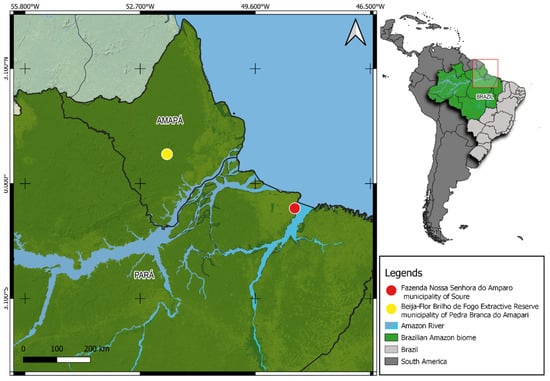
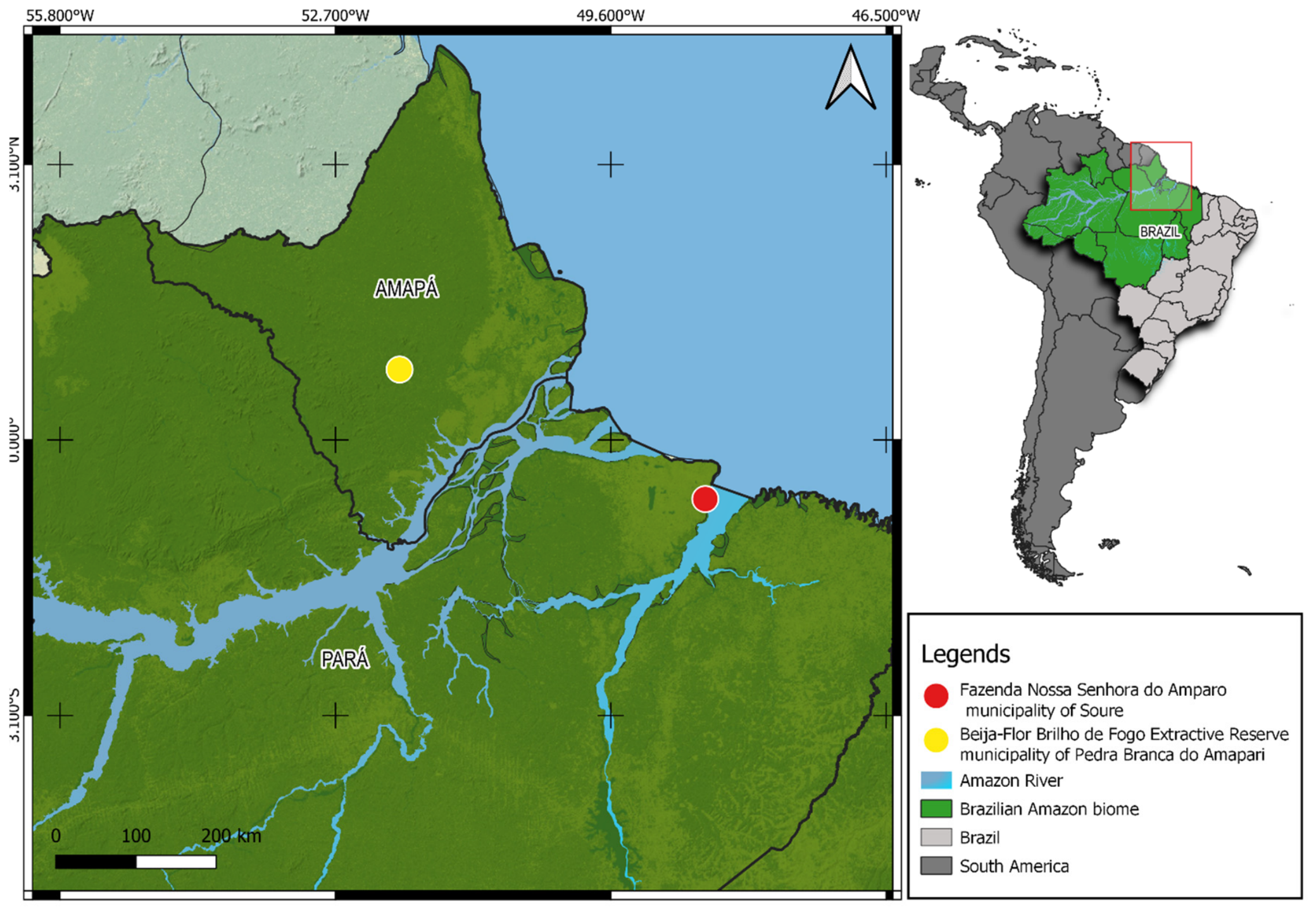
We obtained specimens for this study from two localities in the Brazilian Amazon with contrasting ecological characteristics. The first study area corresponds to the Beija–Flor Brilho de Fogo Extractive Reserve, located south of the municipality of Pedra Branca do Amapari, state of Amapá, Brazil (0°47′30.6″ N, 51°58′42.1″ W). This protected area covers approximately 68,524 hectares and is predominantly composed of submontane dense ombrophilous forest (rainforest). According to the Köppen–Geiger climate classification, the regional climate is equatorial (Af), with a mean annual temperature of 27.6 °C and a range of 25.8 to 29.0 °C, influenced by local geomorphologic and microclimatic conditions. Mean annual precipitation is approximately 2850 mm, with monthly peaks approaching 400 mm [27].
The second study locality was Nossa Senhora do Amparo Farm (112 hectares), located in the municipality of Soure, state of Pará, Brazil (0°40′01.83″ S, 48°32′11.06″ W), on Marajó Island. The area is enclosed by the Paracauari River and is characterized primarily by natural grasslands (or flooded grasslands, a unique ecosystem of Marajó Island influenced by both rainfall and oceanic tides), with secondary formations such as riparian forests, floodplains, mangroves, restingas, and secondary vegetation. The local climate, also classified as equatorial, presents mean temperatures ranging from 25 °C to 29 °C, influenced by hydrological regimes and the island’s maritime conditions [28] (Figure 1).
Figure 1.
Map showing the sampled study areas in the Brazilian Amazon: Beija-Flor Brilho de Fogo Extractive Reserve, located in the southern portion of the municipality of Pedra Branca do Amapari, state of Amapá, and Nossa Senhora do Amparo Farm, located in the municipality of Soure, state of Pará, Brazil.
Three field expeditions were conducted at Nossa Senhora do Amparo Farm between August 2022 and January 2023. At Beija-Flor Brilho de Fogo, we conducted five sampling expeditions in September 2020, June and September 2021, March 2023, and July 2024. Collection permits were issued by the Brazilian Institute of Environment and Renewable Natural Resources (IBAMA/ICMBio) and by the Animal Ethics Committee (CEUA; protocol ID 8341260821; SISBio 53557; SISBio 48102-2). Sampling dates were constrained by the authorization and availability of the municipal authorities. Consequently, sampling periods differed between localities, and the sampling design was not intended to evaluate temporal variation in helminth communities.
In the natural grasslands, three specimens were collected during each of the three field expeditions. In the ombrophilous rainforest, four field expeditions yielded two, three, three, and one specimen, respectively. Host specimens were captured through active visual searches and opportunistic encounters. Animals were anesthetized and euthanized following the protocol approved by the Institutional Animal Use Ethics Committee (CEUA), which is based on American Veterinary Medical Association (AVMA) guidelines. Lidocaine (2%) was administered by intracardiac injection in repeated doses of 5 mL until death was confirmed, followed by decapitation as a secondary method to ensure death; then snout–vent length (SVL) was measured, and individuals were weighed, sexed, and necropsied (see Supplementary Materials Table S1).
After euthanasia, the internal organs were removed and examined individually under a stereomicroscope. The internal organs: trachea, esophagus, stomach, small intestine, large intestine, rectum, kidneys, lungs, and the entire coelomic cavity were systematically inspected for helminths. All recovered helminths were collected and counted individually, washed in saline solution (0.9% NaCl), fixed in heated 70% ethanol, and stored in the same solution at room temperature and transported to the laboratory.
2.2. Helminth Identification
For morphological analysis, nematodes and acanthocephalans were hydrated in distilled water and cleared in Amann’s lactophenol and subsequently mounted in temporary slides. For Platyhelminthes, we followed the protocol of Amato [29]: the specimens were washed in saline solution (0.9% NaCl), fixed in hot 70% ethanol, stained with acetic carmine, differentiated in 1% hydrochloric acid alcohol, neutralized, dehydrated through a graded ethanol series, cleared in methyl salicylate, and mounted in Damar gum as permanent slides.
We examined the specimens under an Olympus BX41 light and photomicrographs were obtained using an Olympus BX53 microscope coupled to an image capture system. We used catalogs, checklists, identification keys, and original species descriptions available in the scientific literature to aid morphological diagnosis of parasites [17,20,21,22,30,31,32,33,34].
We also conducted a literature compilation search to compile records of helminths parasitizing B. atrox. For this purpose, we used six electronic databases: Google Scholar, PubMed, SciELO, ScienceDirect, Scopus, and Web of Science. The search terms applied were: (“Bothrops atrox”) AND (“helminth” OR “parasites” OR “nematodes” OR “platyhelminthes” OR “acanthocephalan”). Based on this search, we prepared a table compiling all available records from 1929 to 2025, including data from the published literature in English, Portuguese and Spanish languages, online sources, and new records from the present study.
2.3. Statistical Analyses
We calculated prevalence (Clopper–Pearson 95% confidence interval), mean intensity (Bootstrap BCa 95% confidence interval), and mean abundance (Bootstrap BCa 95% confidence interval) following Bush et al. [35] and Reiczigel et al. [36] using the software Quantitative Parasitology 3.0. Ecological descriptors of parasite community richness and diversity included species richness (number of helminth species), Shannon diversity index (H′), and evenness (E′ = H′/H′max). We used the Berger–Parker dominance index (d) to determine the most abundant species, and the frequency of dominance (FD) was used to determine the percentage of infra communities in which a parasite species is numerically dominant. All these parameters were calculated using the PAST 4.11 software [37,38,39].
The structure of the helminth community was assessed according to the methodology described by Thul et al. [40], in which helminth species are classified into four groups (dominant, codominant, subordinate and unsuccessful), according to prevalence, intensity and the maturation factor (equal to 1.0 if at least one mature specimen of the species is found and equal to 0 otherwise), which is related to the degree of host specificity. The classification of helminths was based on the importance value index: I ≥ 1.0 indicated dominant species; 0.01 ≤ I < 1.0 indicated codominant species; and I < 0.01 (or I = 0 for undetected species) indicated species of lower importance or not detected.
Differences in total helminth abundance, species richness, and Shannon diversity between rainforest and flooded grassland habitats were initially assessed using the Kruskal–Wallis test, one-way analysis of variance (ANOVA), and Welch’s t-test, respectively. The choice of tests was based on the distributional properties of the response variables assessed using the Shapiro–Wilk test. Differences in parasite prevalence between habitats were assessed using Fisher’s exact test. Differences in host snout–vent length (SVL) between habitats were also assessed using the Kruskal–Wallis test.
To evaluate the independent associations of habitat, host body size (SVL), and sex with total helminth abundance, we fitted a generalized linear model (GLM) with a negative binomial error distribution and log link using the MASS package in R [41]. Total helminth abundance was used as the response variable, whereas habitat, snout–vent length (SVL), and sex were included as explanatory variables. Because the initial Poisson model showed substantial overdispersion (Pearson dispersion ratio = 6.63), the negative binomial distribution was considered more appropriate for the abundance of data. SVL was centered around its meaning before inclusion in the model to facilitate parameter interpretation and improve numerical stability. Differences in host sex distribution between habitats were assessed using Fisher’s exact test because of the small sample size and the low expected frequencies in the contingency table.
Model adequacy was assessed using Akaike’s Information Criterion (AIC), comparison with a model excluding habitat, and simulation-based residual diagnostics implemented in the DHARMa package. Dispersion, zero inflation, and residual uniformity were evaluated using the corresponding DHARMa tests. Incidence rate ratios (IRRs) and their 95% confidence intervals were calculated by exponentiating model coefficients and confidence limits.
To assess whether the relationship between host body size and helminth abundance differed between habitats, an additional negative binomial model including the habitat × SVL interaction was fitted. Because of the limited sample size, this interaction analysis was considered exploratory.
The effects of habitat, SVL, and sex on Shannon diversity were assessed using a linear model, with Shannon diversity as the response variable. Model residuals were examined graphically to assess deviations from model assumptions.
Differences in helminth community composition between habitats were evaluated using permutational multivariate analysis of variance (PERMANOVA) based on Bray–Curtis dissimilarities, implemented with the adonis2 function in the vegan package in R [36], using 999 permutations. Habitat was used as the explanatory factor. Homogeneity of multivariate dispersions was assessed using PERMDISP with the betadisper and permutest functions. Mean Bray–Curtis dissimilarity within and between habitats was calculated using the meandist function, and non-metric multidimensional scaling (NMDS) was used to visualize patterns of community composition.
All statistical analyses were conducted in R (version 4.6.1) [41], except for the calculation of ecological descriptors, which was performed in PAST 4.11 [40,41,42]. Statistical significance was evaluated at α = 0.05. Given the small sample size and the exploratory nature of the study, individual statistical tests were interpreted based on effect estimates, confidence intervals, and p-values rather than applying a global multiple-testing correction.
3. Results
We examined 18 specimens of B. atrox, nine from each sampled locality (nine males, seven females and 2 individuals of undetermined sex). Of these, 17 were infected with at least one helminth taxon, resulting in an overall prevalence of 94.4%. In total, 260 helminths were collected, with a mean infection intensity of 15.29 and an overall mean abundance of 14.44.
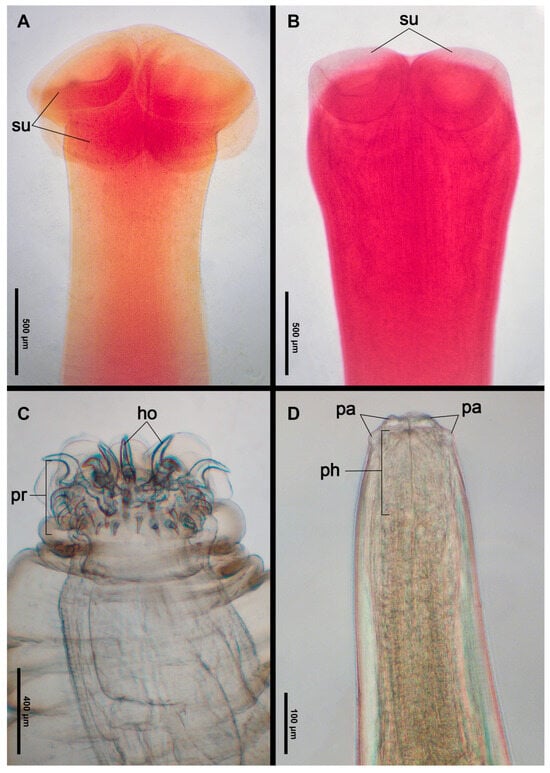
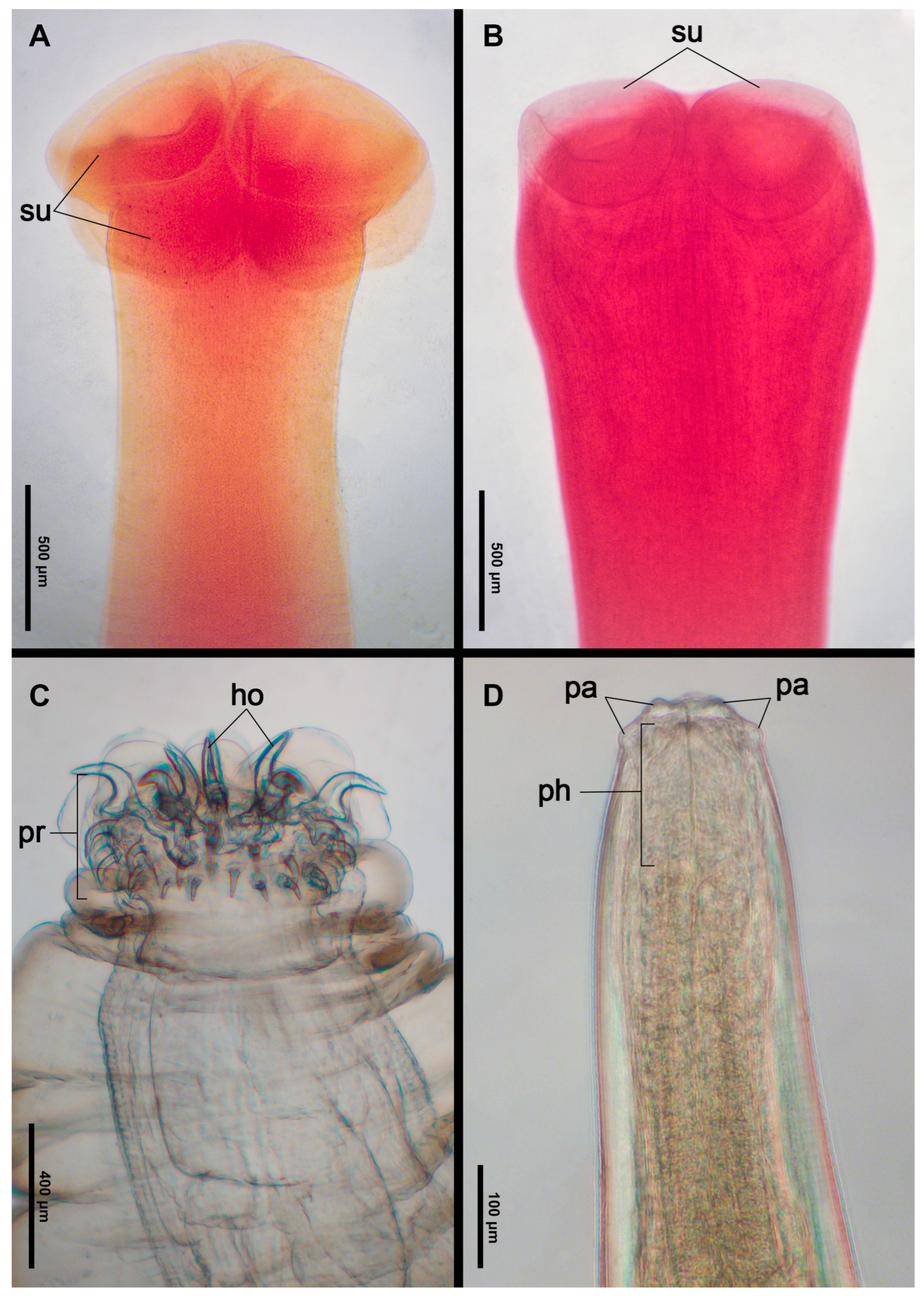
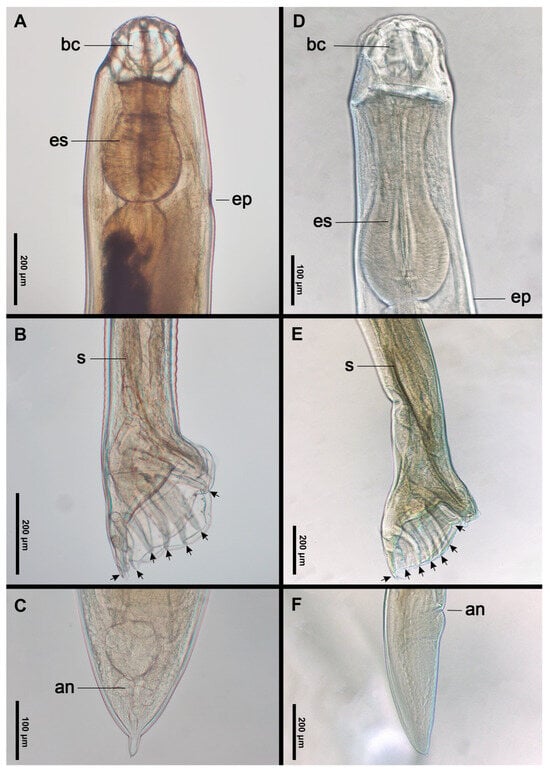
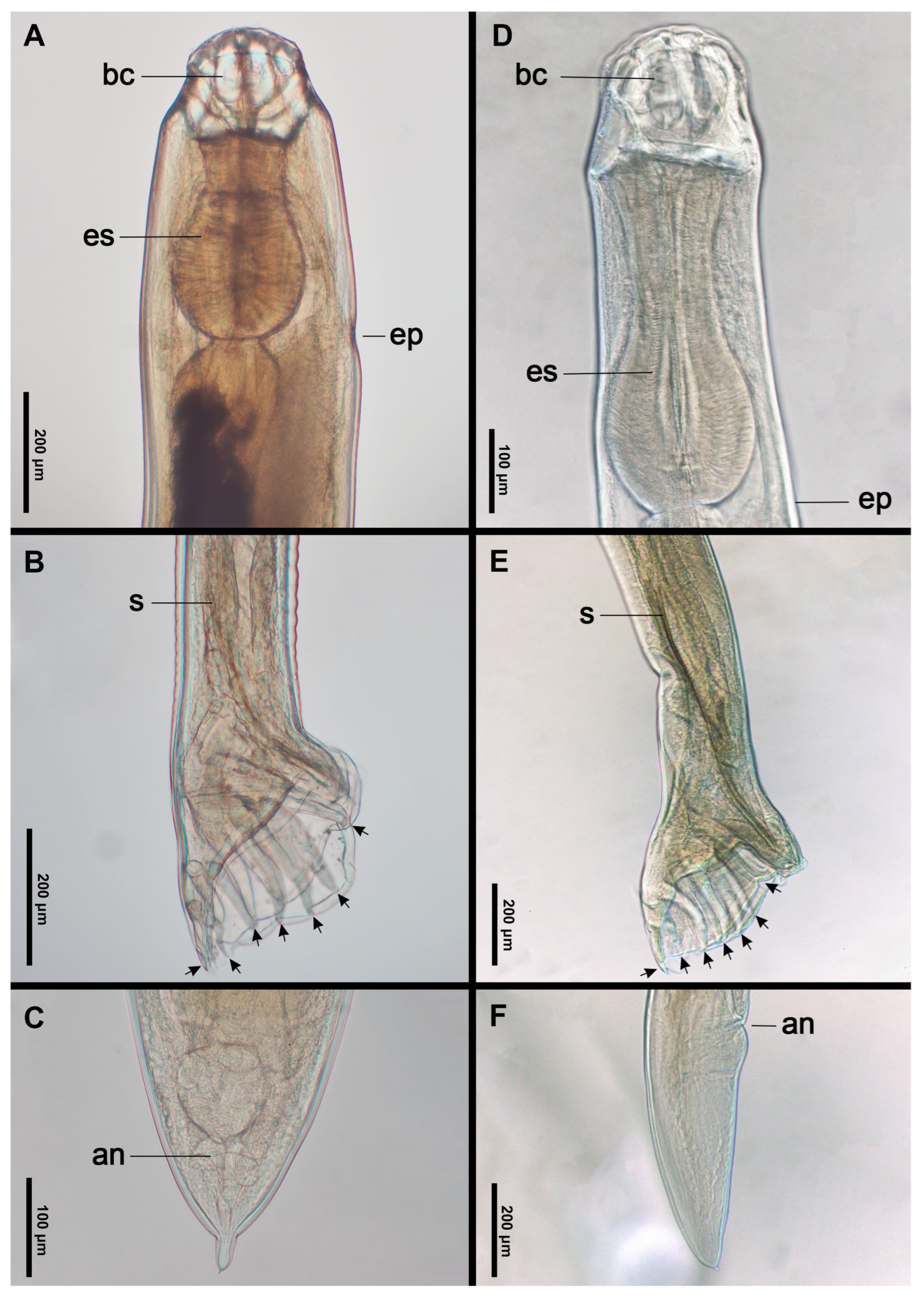
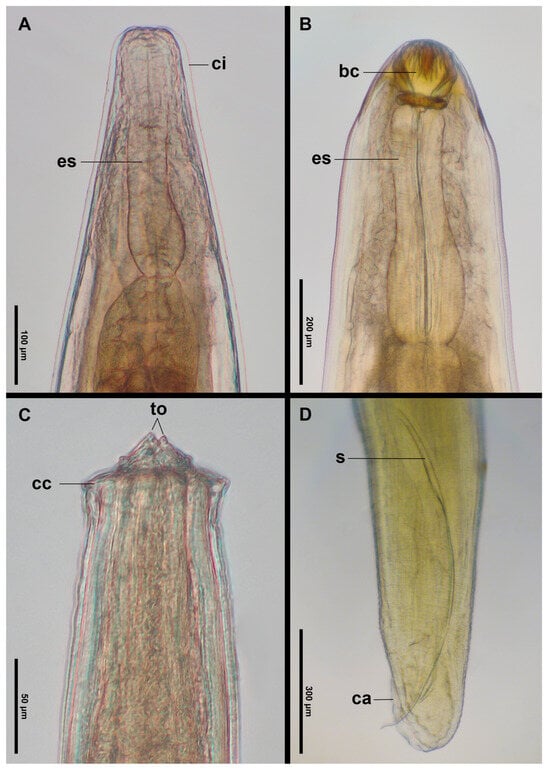
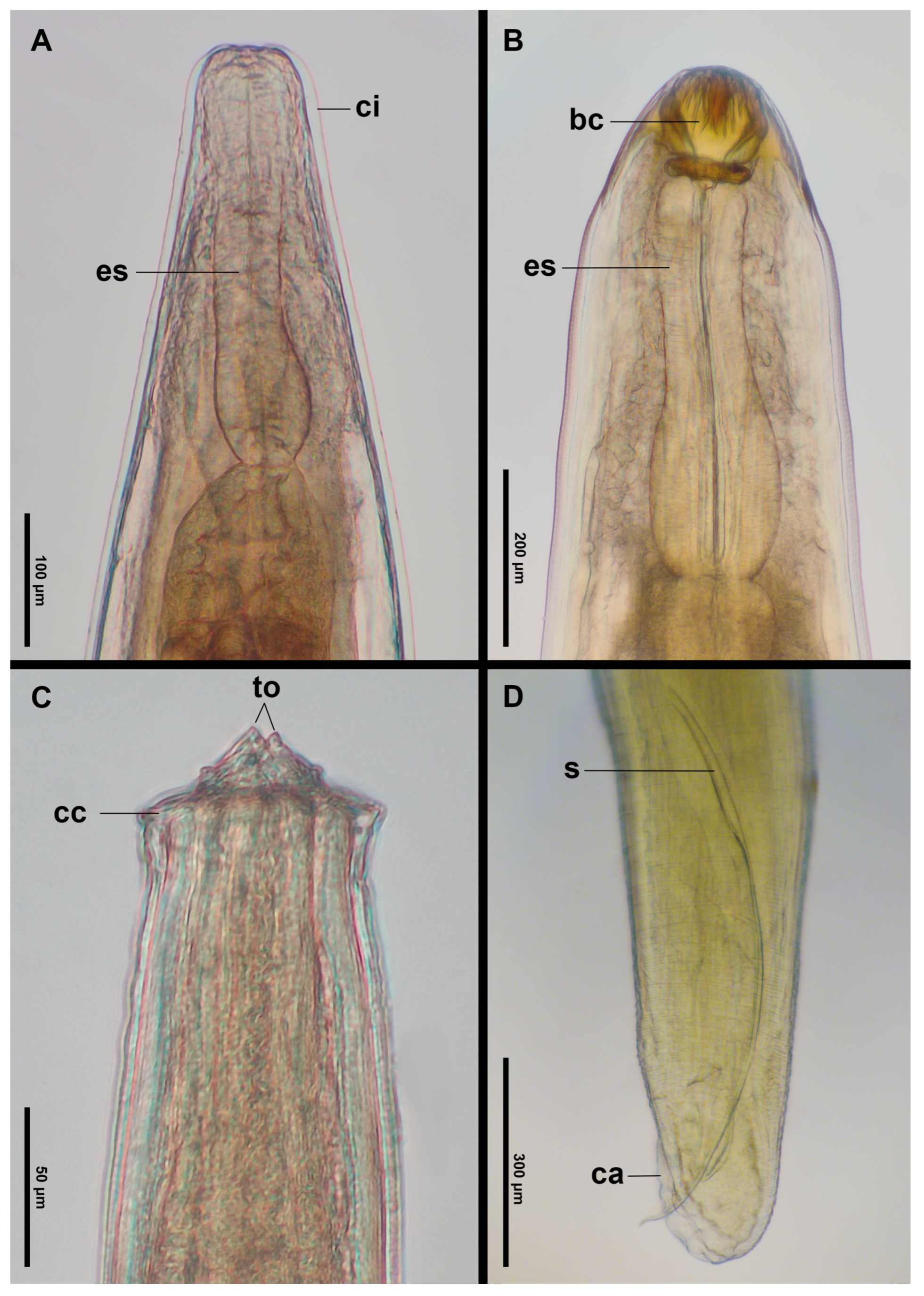
The snakes were parasitized by 11 endoparasite taxa belonging to three major parasite groups: Acanthocephala, Nematoda and Platyhelminthes (Table 1; Figure 2, Figure 3 and Figure 4). Nematodes represented the most diverse group, with seven taxa recorded: Kalicephalus atroxi, Kalicephalus costatus costatus (Rudolphi, 1819), Serpentirhabdias atroxi Kuzmin, Giese, Vasconcelos Melo, da Costa, Maschio & dos Santos, 2016, Hastospiculum nordestinum Ferreira-Silva, Alcantara, Ávila & Silva, 2020, Camallanus sp., L3 larvae of Physaloptera sp., and larvae of Ortleppascaris sp. These were followed by three cestode taxa: Ophiotaenia sp. 1, Ophiotaenia sp. 2, and Crepidobothrium sp., and, finally, one acanthocephalan, Pachysentis sp.
Table 1.
Helminths of B. atrox from forest and natural grassland environments. N: number of helminths; prevalence (%) with 95% confidence intervals; mean intensity with intervals; mean abundance with 95% confidence intervals; importance value (I); and dominance frequency. Classification of helminths according to importance value: I ≥ 1.0, dominant species; I = 0, species not detected; 0.01 ≤ I < 1.0, codominant species. Abbreviations: P = prevalence; CI = confidence interval; MI = mean intensity; MA = mean abundance; FD = dominance frequency; TR = trachea; ESO = esophagus; CC = coelomic cavity; SI = small intestine; L = lung; S = stomach.
Figure 2.
Photomicrographs of helminths associated with Bothrops atrox from the Brazilian Amazon. (A) Crepidobothrium sp., anterior end; (B) Ophiotaenia sp. 2., anterior end; (C) Pachysentis sp., anterior end; (D) Ortleppascaris (L3 larva), anterior end. Abbreviations: su, sucker; ho, hook; pr, proboscis; pa, papillae; ph, pharynx.
Figure 3.
Photomicrographs of Kalicephalus spp. associated with Bothrops atrox from the Brazilian Amazon. (A) Kalicephalus costatus costatus, anterior end of male; (B) K. costatus costatus, posterior end of male, bursa copulatory and bursal rays (arrows); (C) K. costatus costatus, posterior end of female; (D) Kalicephalus atroxi, anterior end; (E) K. atroxi, posterior end, copulatory bursa and bursal rays (arrows); (F) K. atroxi, posterior end of female. Abbreviations: bc, buccal capsule; es, esophagus; ep, excretory pore; s, spicules; an, anus.
Figure 4.
Photomicrographs of nematodes parasites of Bothrops atrox from the Brazilian Amazon. (A) Serpentirhabdias atroxi, anterior end; (B) Camallanus sp., anterior end; (C) Physaloptera sp. (L3 larva), anterior end; (D) Hastospiculum nordestinum, posterior end. Abbreviations: ci, cuticular inflation; es, esophagus; bc, buccal capsule; to, tooth; cc, cephalic collar; s, spicule; ca, caudal alae.
In forest areas, we recorded 196 specimens belonging to seven helminth species; four species of Nematoda, two Cestoda and one Acanthocephala: Kalicephalus atroxi, Serpentirhabdias atroxi, Ophiotaenia sp. 1, Pachysentis sp., Hastospiculum nordestinum, Camallanus sp., and Crepidobothrium sp. 1.
In natural grasslands, 64 specimens of seven endoparasite species were recorded; five species of Nematoda, one Cestoda and one Acanthocephala: Ophiotaenia sp. 2, Kalicephalus costatus costatus, Serpentirhabdias atroxi, Hastospiculum nordestinum, Pachysentis sp., Physaloptera sp. (L3 larvae), and Ortleppascaris sp. (larvae). Two morphologically distinct taxa of Ophiotaenia La Rue, 1911 were identified and designated as Ophiotaenia sp. 1 and Ophiotaenia sp. 2, as they exhibited distinct morphological characteristics but could not be identified to the species level. The parasitic community of B. atrox in forest environments showed lower diversity, higher dominance, and lower evenness at both the infracommunity and component community levels (Table 2). In contrast, in natural grasslands we observed higher diversity and a more balanced distribution of parasite species, with lower taxa dominance than in forest environments (Table 3).
Table 2.
Characteristics of the helminth infracommunity and component community of B. atrox in the state of Amapá, Brazil. Abbreviation: SD = standard deviation.
Table 3.
Characteristics of the helminth infracommunity and component community of B. atrox in the state of Pará, Brazil. Abbreviation: SD, standard deviation.
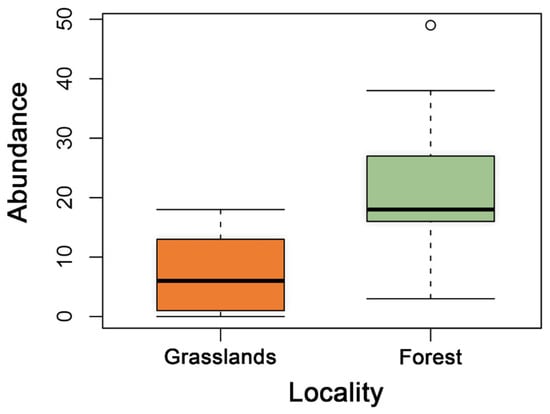
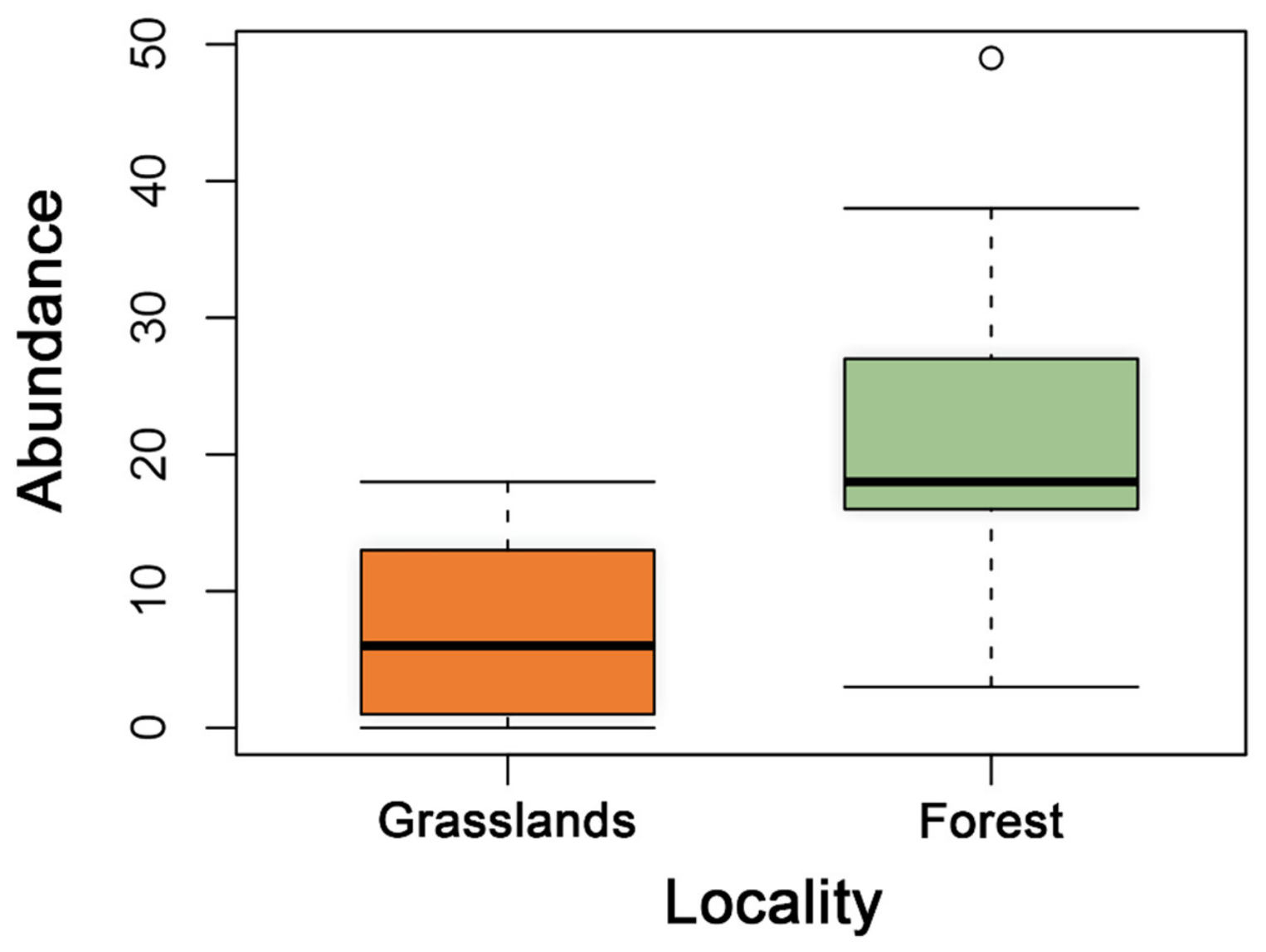
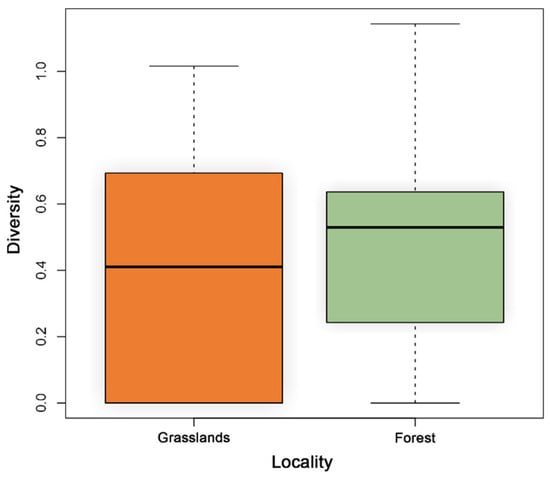
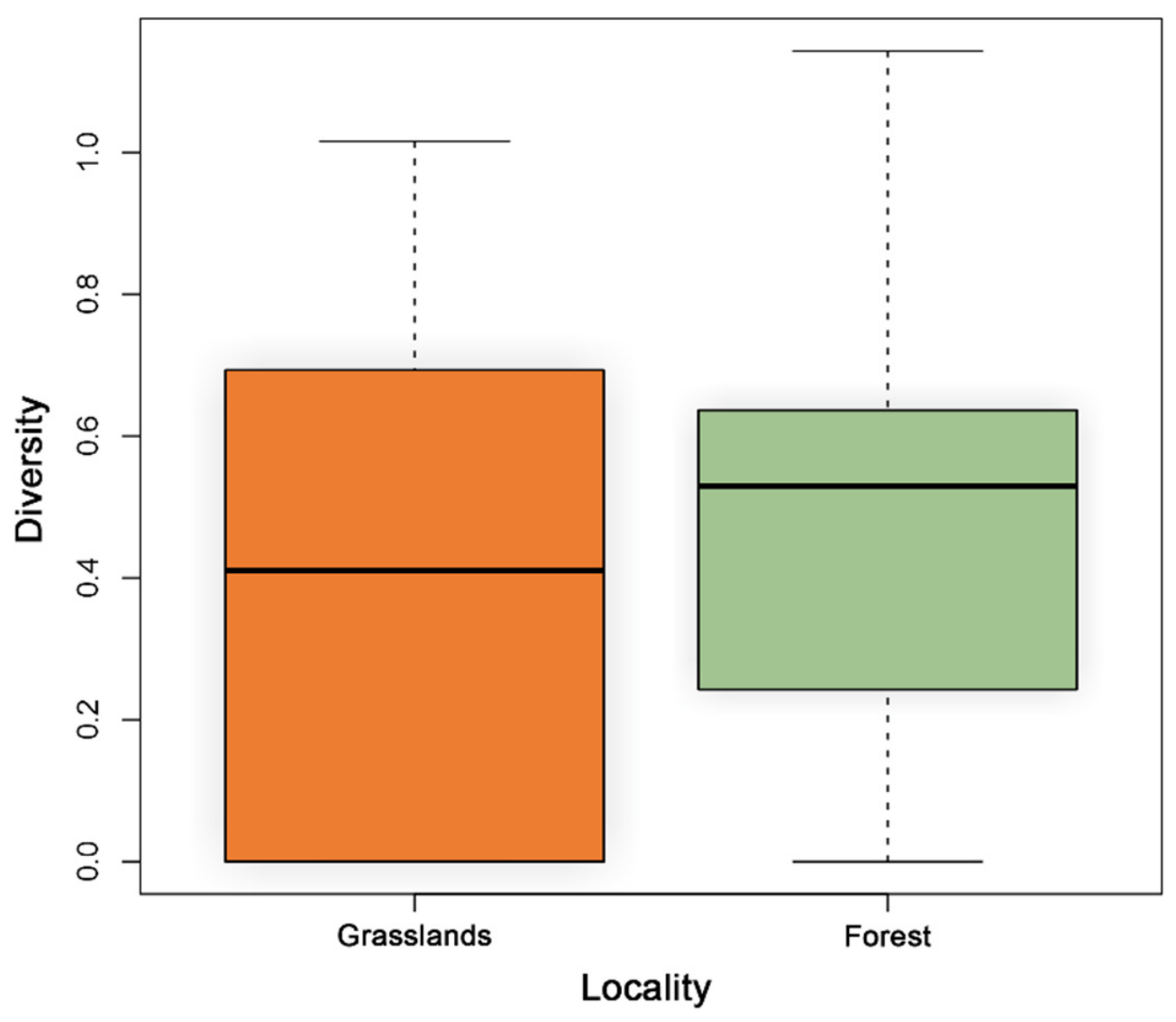
The comparison of parasite abundance between the forest and open-field environments showed a significant difference (Kruskal–Wallis test: χ2 = 7.06, p = 0.0079), with higher parasite abundance observed in snakes from the forested environment (Figure 5). In contrast, species richness did not differ significantly between habitats (one-way ANOVA: F1,16 = 0.676, p = 0.423). Shannon diversity also showed no significant difference between habitats (Welch’s t-test: t = −0.31, df = 14.09, p = 0.7615) (Figure 6). Prevalence was 100% (9/9) in the rainforest and 88.9% (8/9) in the flooded grasslands; this difference was not statistically significant (Fisher’s exact test, p = 1.000).
Figure 5.
Helminth abundance in B. atrox captured in forest and natural grassland habitats. Forest environments showed significantly higher abundance (Kruskal–Wallis test, p < 0.01).
Figure 6.
Helminth diversity in Bothrops atrox from forest and natural grassland habitats. Although a trend towards higher diversity was observed in natural grasslands, no statistically significant difference was detected between environments (Welch’s t-test, p > 0.05).
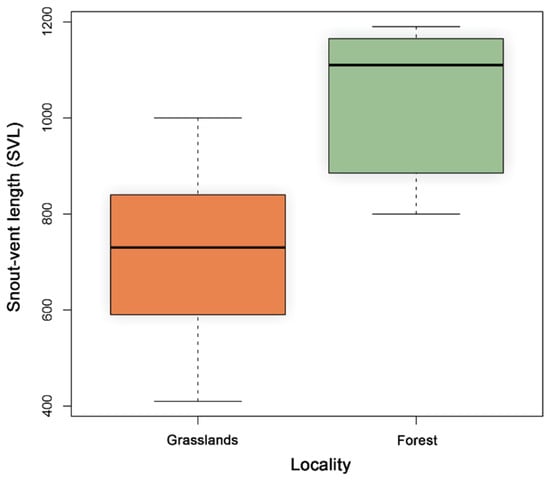
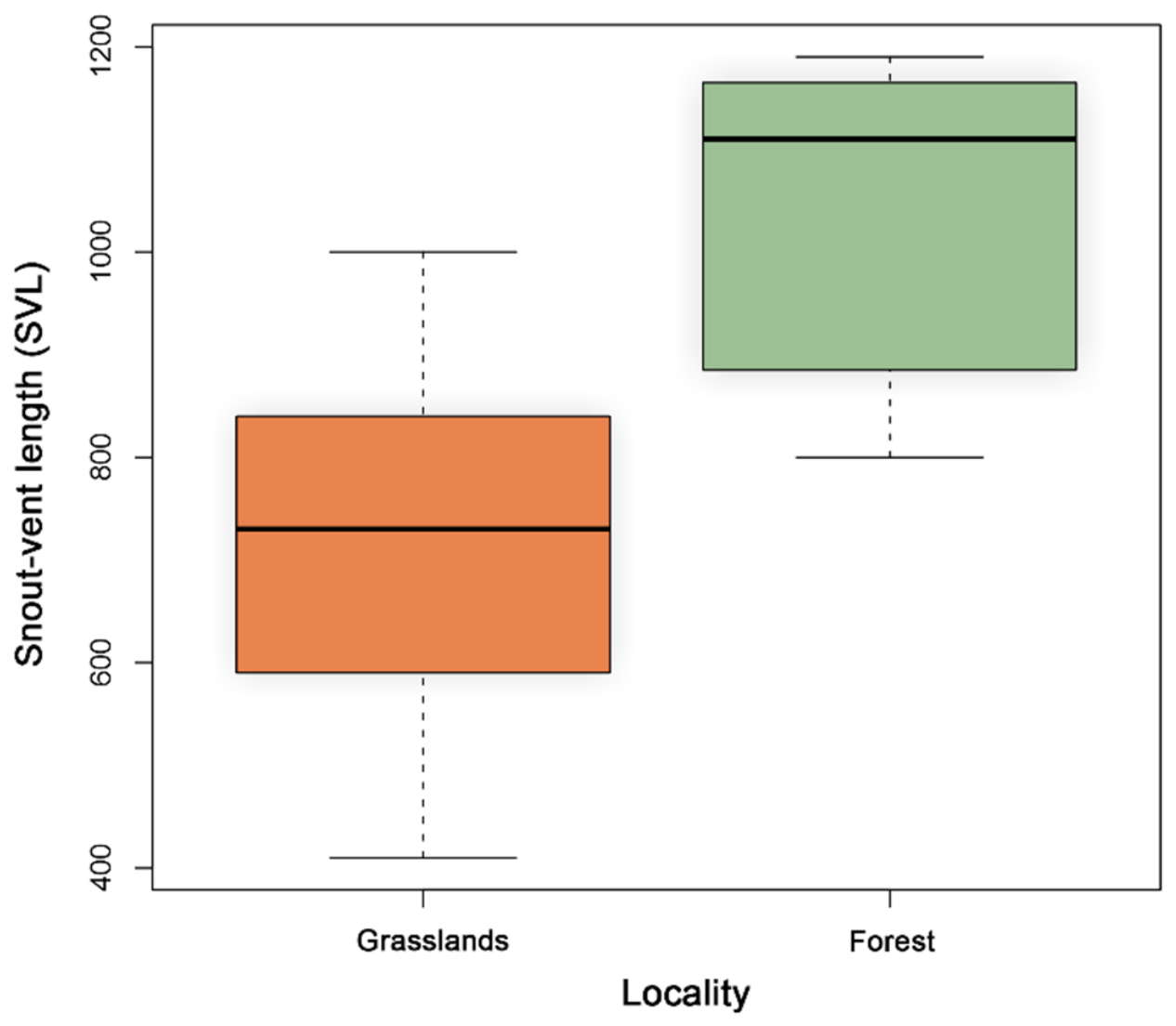
Additionally, snake body size varied significantly between the analyzed environments (p = 0.00218) (Figure 7). Host sex distribution did not differ significantly between habitats (Fisher’s exact test, p = 1.000; odds ratio = 1.06; 95% CI = 0.10–12.09).
Figure 7.
Snout–vent length (SVL) of Bothrops atrox captured in forest and natural grassland habitats. Individuals from forested environments were significantly larger than those from natural grasslands (p < 0.01).
In a negative binomial generalized linear model controlling for host snout–vent length (SVL) and sex, SVL was positively associated with parasite abundance (incidence rate ratio [IRR] = 1.003, 95% CI: 1.0003–1.0057, p = 0.0244). In contrast, neither habitat (forest relative to natural grassland: IRR = 1.33, 95% CI: 0.45–3.84, p = 0.605) nor host sex (male relative to female: IRR = 1.19, 95% CI: 0.49–2.90, p = 0.694) was significantly associated with parasite abundance after controlling for the other predictors. The Poisson model showed evidence of overdispersion (Pearson dispersion ratio = 6.63); therefore, the negative binomial model was used for inference. A separate model of Shannon diversity including habitat, SVL, and sex did not identify any significant predictors (overall model: F3,11 = 1.197, p = 0.3559).
Helminth community composition differed significantly between habitats according to the PERMANOVA based on Bray–Curtis dissimilarities (F1,16 = 6.726, R2 = 0.296, 95% bootstrap CI = 0.222–0.509, p = 0.001). The PERMDISP analysis did not detect a significant difference in multivariate dispersion between habitats (p > 0.05), suggesting that the observed segregation between environments reflects a true difference in community composition rather than an artifact of unequal multivariate variance. The overall mean Bray–Curtis dissimilarity across all host specimens was 0.7717 (77.17%). Mean dissimilarity between habitats reached 0.8798 (87.98%), demonstrating a substantial turnover in parasite species composition and relative abundances across ecosystems. Intra-habitat dissimilarity was higher among natural grassland hosts (0.7017; 70.17%) than among rainforest hosts (0.5983; 59.83%), indicating greater variation in parasite acquisition in open fields compared to a more uniform infracommunity structure in forested environments.
In our literature review, we found 13 helminth taxa previously reported parasitizing B. atrox from Neotropics (Table 4). With five new records obtained in the present study, this number increases to 20 helminth taxa associated with B. atrox in Neotropics, thereby expanding current knowledge of the parasitic diversity of this snake species.
Table 4.
Records of helminth parasites of B. atrox. NH = New host record. NL = New locality record for the states of Pará and Amapá.
4. Discussion
The helminth communities of B. atrox showed contrasting structural patterns between the two localities, particularly at the component community level. Infracommunity diversity and evenness were relatively similar between forest and natural grasslands. Despite having the same species richness, the forest component community exhibited lower diversity and evenness and greater dominance, whereas the grassland community showed a more balanced distribution of helminth abundance among taxa. These patterns suggest differences in community structure between the localities and may reflect the influence of local environmental conditions [2,43,44,45].
Differences in community composition were supported by the overall Bray–Curtis dissimilarity between rainforest and natural grassland host infracommunities (87.98%). PERMANOVA also indicated a significant difference in community composition between the two sampled localities, whereas the non-significant PERMDISP result (p > 0.05) provided no evidence that this result was attributable solely to differences in multivariate dispersion. Locality accounted for 29.60% of the observed variation, leaving most variation unexplained by this factor. Differences in host characteristics, trophic ecology, temporal variation, stochastic processes, and other unmeasured factors may also contribute to the observed patterns. However, these potential explanations could not be directly evaluated with the data available in this study [46].
The parasitic communities of B. atrox exhibited higher overall richness and prevalence compared with previous parasitological surveys of this host in South America [see 21]. In total, we identified five new host records, expanding the known parasite richness for this viperid. Parasite community composition diverged clearly between habitats, with only three endoparasite taxa (Hastospiculum nordestinum, Pachysentis sp., and Serpentirhabdias atroxi) shared between localities, despite both environments harboring similar overall species richness. Beyond structural differences in vegetation cover, the physical and hydrological dynamics of the two regions may contribute to the observed differences in parasite communities. However, distinguishing environmental effects from geographic isolation will require replicated populations across each habitat.
Although our analyses did not detect a significant difference in Shannon diversity between ombrophilous rainforest and natural grassland localities, the descriptive indices showed a trend toward higher diversity and evenness in natural grasslands. Parasite abundance was significantly higher among forest snakes in the unadjusted comparison. However, snakes from the forest locality were also significantly larger than those from natural grasslands. In a negative binomial generalized linear model controlling for host SVL and sex, habitat was not significantly associated with parasite abundance, whereas SVL showed a significant positive association. Thus, the unadjusted difference in abundance cannot be attributed independently to habitat based on our data. Previous studies have suggested that relatively stable microclimatic conditions in rainforest environments may favor some nematodes [46,47], but this mechanism remains a possible explanation rather than a process demonstrated by our results. These results highlight the importance of accounting for host characteristics when comparing parasite abundance across populations.
Host diet is an important determinant of helminth exposure and can influence the composition of parasite communities by mediating contact with infective stages through trophic interactions [43]. Infective larval helminths were recorded exclusively in snakes from natural grasslands, suggesting that differences in prey availability and associated transmission pathways may contribute to the observed differences in helminth community composition between the sampled localities. Among the recorded larval taxa, nematodes of the genus Physaloptera Rudolphi, 1819 have heteroxenous life cycles involving insects as intermediate hosts [6,48]. These insects may be consumed by anurans, which are an important component of the diet of B. atrox [13]. Thus, ingestion of infected prey is a biologically plausible route of infection for these nematodes, consistent with their known life-cycle requirements and the trophic ecology of the snake.
Similarly, the life cycle of Ortleppascaris Sprent, 1978 involves larval development in anurans acting as intermediate or paratenic hosts [49], whereas crocodilians serve as definitive hosts [50]. This study provides the first record of Ortleppascaris (larvae) parasitizing a snake, expanding the understanding of its life cycle and suggesting that snakes may act as paratenic hosts in the life cycle of Ortleppascaris. Host diet is increasingly recognized as a key driver structuring parasite communities in reptiles [2]. Generalist predators like B. atrox accumulate diverse parasitic lineages over their lifetime [7]. This trophic accumulation process is further amplified by the ontogenetic diet shift characteristic of this pit viper [13,22].
Kalicephalus atroxi and Serpentirhabdias atroxi showed higher prevalence, intensity, and abundance in forest environments than in natural grasslands (Table 2 and Table 3). In these nematodes, infection occurs through active penetration of infective larvae into host mucosa or by ingestion of prey containing third-stage larvae [51,52]. These findings may reflect more favorable environmental conditions in forested areas for free-living larval development, such as higher soil moisture and milder temperatures, which enhance larval survival and increase the likelihood of infection in definitive hosts [53,54,55]. However, we did not measure these environmental variables or assess larval survival in either locality. Consequently, the possibility that local environmental conditions influence parasite establishment remains a hypothesis that requires direct testing.
The differences in helminth community composition between the forest and natural grassland localities may be consistent with ecological filtering, whereby environmental conditions influence the establishment and persistence of parasite taxa. However, ecological filtering was not directly tested in this study because environmental variables and the survival of free-living larval stages were not measured. The lower within-locality Bray–Curtis dissimilarity among rainforest hosts (59.83%), compared with natural grassland hosts (70.17%), indicates that the sampled forest infracommunities were more homogeneous in composition. This pattern may reflect differences in environmental conditions, host ecology, prey availability, or other unmeasured factors.
The occurrence of Kalicephalus costatus costatus in natural grasslands underscores the remarkable persistence and adaptability of this parasite group across contrasting habitats. Recognized as one of the most successful lineages of gastrointestinal parasites in squamate reptiles [31,47], this genus serves as an excellent biological model for understanding transmission dynamics and host–parasite co-adaptation in snakes.
We also recorded the filarioid nematode Hastospiculum nordestinum in both study sites. Originally described from the body cavity of the colubrid Xenodon merremii (Wagler, 1824) in northeastern Brazil [32], this finding represents the first record of H. nordestinum in B. atrox, expanding both its geographical distribution and host range. Furthermore, this record corroborates the biogeographical pattern observed for Hastospiculum Skryabin, 1923, whose species are predominantly associated with snakes in the Neotropics, whereas Old World species more frequently infect lizards [56,57].
Nematodes of the family Camallanidae are widespread parasites of fish, amphibians, and reptiles [58]. In the Neotropical region, the genus Camallanus Railliet & Henry, 1915 was previously reported in B. atrox from Marajó Island [21], where specimens were recovered from the coelomic cavity. In the present study, Camallanus sp. was found in the trachea, representing an unusual anatomical location for this genus. The occurrence of Camallanus in snakes remains rare, likely due to its heteroxenous life cycle requiring copepods as intermediate hosts [31], making infection contingent upon the ingestion of aquatic prey or paratenic hosts.
Proteocephalid cestodes of the genera Ophiotaenia and Crepidobothrium Monticelli, 1900 are frequently reported from Neotropical snakes, representing species-rich lineages characterized by high host specificity and evolutionary ties to squamate hosts [33,34]. The Ophiotaenia specimen from B. atrox in Marajó had distinct morphological traits when compared with the specimen from Amapá state. These morphological differences and high specificity of this group may suggest that the two specimens may represent distinct taxa. Proteocephalid cestodes are transmitted along the trophic chain, with life cycles involving two or three hosts [34,59,60]. Thus, B. atrox likely acquires these parasites through predation on such organisms during foraging in flooded environments. In more complex cycles, intermediate hosts may include fish, tadpoles and other amphibians [33].
Furthermore, we report fully developed adult specimens of Pachysentis sp. in B. atrox from both study localities, adding to the known diversity of acanthocephalans recorded in Amazonian snakes. Species of this genus are typically found in carnivorous mammals, particularly canids, which serve as definitive hosts [61,62]. The recovery of fully developed adults suggests that Pachysentis Meyer, 1931 can undergo substantial development in B. atrox and that this association may not represent merely an accidental occurrence. Notably, cystacanths of Pachysentis canicola Meyer, 1931 have previously been reported in another viperid, the western diamondback rattlesnake (Crotalus atrox Baird & Girard, 1853) [63]. Together, these findings suggest that viperids may be involved in the life cycles of Pachysentis, although their specific roles as hosts remain to be established.
Our analyses identified a positive association between host SVL and helminth abundance. This finding is consistent with the hypothesis that larger hosts may provide more resources and space for parasites and may experience greater cumulative exposure to infective stages over their lifetime [64,65,66,67]. The larger body size of lanceheads in forest environments may help explain the higher parasite burden observed, since macrohabitat also influences body size in the genus Bothrops, depending on prey availability and predation pressure [68].
Overall, our study expands the known helminth fauna of B. atrox by documenting five new host records and eight new geographical records (Table 4). The diversity of helminths identified, including nematodes with heteroxenous life cycles, cestodes, and acanthocephalans, highlights the complexity of the parasite fauna associated with this pit viper. Some of these helminths have life cycles involving multiple host groups, including amphibians, crocodilians, and carnivorous mammals, illustrating the diversity of transmission strategies represented in the helminth fauna of B. atrox.
Sample size limitations should be considered when interpreting our findings. The relatively small sample size (18 snakes, nine per locality) may have limited statistical power of our estimates. However, sample acquisition should also be considered in the context of the distribution and natural history of pit vipers [23,69], whose ecological characteristics and population densities may constrain the number of individuals encountered during field surveys. Previous field assessments have reported substantial search effort requirements for encountering individual snakes, ranging from 30 to 180 person-hours per specimen [70,71,72,73,74]. These challenges make it difficult to obtain large samples of free-ranging individuals under natural conditions. Therefore, although our sample size limits the statistical power and generalizability of our findings, the data provide valuable information on the helminth communities of B. atrox in two under-sampled Amazonian environments.
In conclusion, this is the first comparative investigation of helminth parasite communities in B. atrox populations between contrasting Amazonian ecosystems: ombrophilous rainforest and natural grasslands. Our findings suggest differences in helminth community composition, structure and abundance between B. atrox populations from two contrasting Amazonian environments. However, these patterns should be interpreted cautiously, as they may reflect a combination of host characteristics, particularly body size, and location-specific factors, rather than habitat differences alone. Additional sampling across replicated habitats is needed to disentangle habitat effects from geographic variation. Despite these limitations, our findings contribute to knowledge of helminth diversity in eastern Amazonia and highlight the value of community-level parasitological studies for documenting parasite diversity and investigating patterns of host–parasite associations in understudied Neotropical ecosystems.
Supplementary Materials
The following supporting information can be downloaded at: https://www.mdpi.com/article/10.3390/d18120726/s1, Table S1: Biometric data (snout-vent length) and sex of Bothrops atrox hosts sampled across two distinct habitats (natural grassland and ombrophilous forest) in the Brazilian Amazon.
Author Contributions
Conceptualization, J.K.S.N., A.J.S.F., A.N.S. and G.L.R.; methodology, F.G.H. and M.R.D.-S.; software, J.K.S.N. and F.G.H.; validation, G.L.R. and A.J.S.F.; formal analysis, F.G.H.; investigation, L.F.F.T.; resources, A.N.S.; data curation, F.G.H.; writing—original draft preparation, F.G.H.; writing—review and editing, F.T.d.V.M. and G.F.M.; funding acquisition, F.T.d.V.M. All authors have read and agreed to the published version of the manuscript.
Funding
This research was funded by Coordination for the Improvement of High Higher Education Personnel, Brazil (CAPES); Postgraduate Program in Zoology (PPGZOOL); University Federal of Pará (UFPA); PROPESP/UFPA; Amazon Foundation for Research and Studies Support (FAPESPA)/CNPq–PRONEM (01/2021); and The National Council for Scientific and Technological Development (CNPq) Productivity Scholarship Grant (CNPq) F.T.V. Melo. CNPq (process: 314116/2021-4).
Institutional Review Board Statement
All procedures contributing to this work comply with all applicable institutional, national, and international guidelines for animal care and use outlined by the Animal Research Ethics Committee, Federal University of Pará, under license N8341260821CEUA/UFPA. The present study was approved by Instituto Chico Mendes de Conservação da Biodiversidade (ICMBio), Brazil, and host specimens were collected under license number SISBIO: 48102-2.
Data Availability Statement
All data supporting the findings of this study are available in this paper.
Acknowledgments
This study forms part of the Ph.D. thesis of Fred Gabriel Haick, developed in the Postgraduate Program in Zoology (PPGZOOL/UFPA). We are grateful to the students of the Laboratory of Cell Biology and Helminthology “Profa. Dra. Reinalda Marisa Lanfredi” (Federal University of Pará, Belém, Brazil). We thank Emanuele, owner of Amparo Farm, where the study was conducted. We appreciate the assistance of all farm staff, especially Bahia, for help on the trails. We acknowledge the institutional support of ADEPARÁ for providing vehicle and research equipment. We also thank the professionals of the Chico Mendes Institute for Biodiversity Conservation (ICMBio) for granting the necessary collection permits. We further acknowledge the Municipality of Pedra Branca do Amapari for all logistical and personnel support provided for this research. We are especially grateful to Carlos Eduardo Costa-Campos (in memorian) for his invaluable assistance during field expeditions and for fostering institutional partnerships that made this study possible. Sadly, he passed away during the final stages of this work. We dedicate this study to his memory in recognition of his contributions to research and collaboration.
Conflicts of Interest
The authors declare no conflicts of interest.
References
- Spickett, A.; Junker, K.; Krasnov, B.R.; Haukisalmi, V.; Matthee, S. Helminth Parasitism in Two Closely Related South African Rodents: Abundance, Prevalence, Species Richness and Impinging Factors. Parasitol. Res. 2017, 116, 1395–1409. [Google Scholar] [CrossRef] [Scilit] [PubMed]
- Leung, T.L.F.; Koprivnikar, J. Your Infections Are What You Eat: How Host Ecology Shapes the Helminth Parasite Communities of Lizards. J. Anim. Ecol. 2019, 88, 416–426. [Google Scholar] [CrossRef] [Scilit] [PubMed]
- Junker, K.; Horak, I.G.; Boomker, J.; Krasnov, B.R. Nestedness and beta diversity of gastrointestinal helminth communities in common warthogs, Phacochoerus africanus (Suidae), at 2 localities in South Africa. Parasitology 2023, 150, 911–921. [Google Scholar] [CrossRef] [Scilit] [PubMed]
- Poulin, R.; Morand, S. Parasite Biodiversity; Smithsonian Institution: Washington, DC, USA, 2014. [Google Scholar]
- Bordes, F.; Morand, S. Impacts of parasite diversity on wild vertebrates: Limited knowledge but important perspectives. In Parasite Diversity and Diversification: Evolutionary Ecology Meets Phylogenetics; Krasnov, B.R., Littlewood, D.T.J., Morand, S., Eds.; Cambridge University Press: Cambridge, UK, 2015; pp. 77–90. [Google Scholar] [CrossRef] [Scilit]
- Oliveira, M.C.; Ferreira-Silva, C.; Silva, R.J.; França, F.G.R.; Lorenço-de-Moraes, R. Water Snakes Have a High Diversity of parasites in anthropized environments. Urban Ecosyst. 2024, 27, 1435–1449. [Google Scholar] [CrossRef] [Scilit]
- Marcogliese, D.J. Food webs and the transmission of parasites to marine fish. Parasitology 2002, 124, 83–99. [Google Scholar] [CrossRef] [Scilit] [PubMed]
- Devecchi, M.F.; Lovo, J.; Moro, M.F.; Andrino, C.O.; Barbosa-Silva, R.G.; Viana, P.L.; Giulietti, A.M.; Antar, G.; Watanabe, M.T.C.; Zappi, D.C. Beyond forests in the Amazon: Biogeography and floristic relationships of the amazonian savannas. Bot. J. Linn. Soc. 2020, 193, 478–503. [Google Scholar] [CrossRef] [Scilit]
- Bush, A.O. Parasitism: The Diversity and Ecology of Animal Parasites; Cambridge University Press: Cambridge, UK, 2001. [Google Scholar]
- Poulin, R. Evolutionary Ecology of Parasites; Princeton University Press: Princeton, NJ, USA, 2007. [Google Scholar]
- Resiere, D.; Monteiro, W.; Houcke, S.; Pujo, J.M.; Mathien, C.; Mayence, C.; Neviere, R.; Hommel, D.; de Almeida Gonçalves Sachett, J.; Mehdaoui, H.; et al. Bothrops snakebite envenomings in the Amazon region. Curr. Trop. Med. Rep. 2020, 7, 48–60. [Google Scholar] [CrossRef] [Scilit]
- Santos-Costa, M.; Maschio, G.; Prudente, A. Natural history of snakes from floresta Nacional de Caxiuanã, eastern Amazonia, Brazil. Herpetol. Notes 2015, 8, 69. [Google Scholar]
- Bisneto, P.F.; Kaefer, I.L. Reproductive and feeding biology of the common lancehead Bothrops atrox (Serpentes, Viperidae) from central and southwestern Brazilian Amazonia. Acta Amaz. 2019, 49, 105–113. [Google Scholar] [CrossRef] [Scilit]
- Pereira, C. Revisão do gênero Opisthogonimus (Trematoda). Rev. Mus. Paul. 1929, 16, 995–1014. [Google Scholar]
- Caballero, C.E.; Vogelsang, E.G. Fauna helmintologica venezolana. I. Ochetosoma miladelarocai n. sp. de Bothrops atrox L. y hallazgo de Physaloptera retusa (Rud., 1819) en Cnemidophorus lemniscatus. Rev. Med. Vet. Parasitol. Caracas 1947, 6, 53–62. [Google Scholar]
- dos Santos, J.; Rolas, F.T.-S. Sobre alguns cestóides de Bothrops e de Liophis miliaris. Atas Soc. Biol. Rio Jan. 1973, 17, 35–40. [Google Scholar]
- Vicente, J.; Rodrigues, H.; Gomes, D.; Pinto, R. Nematóides do Brasil. Parte III: Nematóides de répteis. Rev. Bras. Zool. 1993, 10, 19–168. [Google Scholar] [CrossRef] [Scilit]
- McAllister, C.; Bursey, C.; Freed, P. Helminth parasites of herpetofauna from the Rupunini District, Southwestern Guyana. Comp. Parasitol. 2010, 77, 184–201. [Google Scholar] [CrossRef] [Scilit]
- McAllister, C.; Bursey, C.; Freed, P. Helminth parasites of selected amphibians and reptiles from the Republic of Ecuador. Comp. Parasitol. 2009, 77, 52–66. [Google Scholar] [CrossRef] [Scilit]
- Kuzmin, Y.; Giese, E.G.; Melo, F.T.d.V.; da Costa, P.A.F.B.; Maschio, G.F.; dos Santos, J.N. Description of Serpentirhabdias atroxi n. sp. (Nematoda: Rhabdiasidae), a parasite of Bothrops atrox (Linnaeus) (Reptilia: Serpentes: Viperidae) in Brazilian Amazonia. Syst. Parasitol. 2016, 93, 37–45. [Google Scholar] [CrossRef] [Scilit] [PubMed]
- Conga, D.F.; da Silva, C.S.; de Oliveira, G.C.; Bezerra, A.M.; de Almeida, B.L.; Pereira, W.L.A.A. New records of helminth infections in Bothrops atrox Linnaeus, 1758 from Marajó Island-Brazil and a literature review with a check list of helminths infecting Bothrops species (Squamata, Viperidae) in the neotropical region. Vet. Parasitol. Reg. Stud. Rep. 2024, 53, 101060. [Google Scholar] [CrossRef] [Scilit] [PubMed]
- Oliveira, M.; Martins, M. When and where to find a Pitviper: Activity patterns and habitat use of the lancehead, Bothrops atrox, in Central Amazonia, Brazil. Herpetol. Nat. Hist. 2001, 8, 101–109. [Google Scholar]
- Núñez, V.; Cid, P.; Sanz, L.; De La Torre, P.; Angulo, Y.; Lomonte, B.; Gutiérrez, J.M.; Calvete, J.J. Snake venomics and antivenomics of Bothrops atrox venoms from Colombia and the Amazon regions of Brazil, Perú and Ecuador suggest the occurrence of geographic variation of venom phenotype by a trend towards paedomorphism. J. Proteom. 2009, 73, 57–78. [Google Scholar] [CrossRef] [Scilit] [PubMed]
- de Fraga, R.; Magnusson, W.E.; Abrahão, C.R.; Sanaiotti, T.; Lima, A.P. Habitat selection by Bothrops atrox (Serpentes: Viperidae) in central Amazonia, Brazil. Copeia 2013, 2013, 684–690. [Google Scholar] [CrossRef] [Scilit]
- Silva, K.M.P.; Silva, K.B.; Sueiro, L.R.; Oliveira, M.E.E.S.; Almeida-Santos, S.M. Reproductive biology of Bothrops atrox (Serpentes, Viperidae, Crotalinae) from the Brazilian Amazon. Herpetologica 2019, 75, 198–207. [Google Scholar] [CrossRef] [Scilit]
- Hatakeyama, D.M.; Tasima, L.J.; Bravo-Tobar, C.A.; Serino-Silva, C.; Tashima, A.K.; Rodrigues, C.F.B.; Aguiar, W.d.S.; Galizio, N.d.C.; de Lima, E.O.V.; Kavazoi, V.K.; et al. Venom complexity of Bothrops atrox (common lancehead) Siblings. J. Venom. Anim. Toxins Incl. Trop. Dis. 2020, 26, e20200018. [Google Scholar] [CrossRef] [Scilit] [PubMed]
- Alvares, C.A.; Stape, J.L.; Sentelhas, P.C. Köppen’s climate classification map for Brazil. Meteorol. Z. 2013, 22, 711–728. [Google Scholar] [CrossRef] [Scilit] [PubMed]
- de Lima, A.M.M.; de Oliveira, L.L.; Fontinhas, R.L.; Lima, R.J.d.S. Ilha do Marajó: Revisão histórica, hidroclimatologia, bacias hidrográficas e propostas de gestão. Holos Environ. 2005, 5, 65–80. [Google Scholar] [CrossRef] [Scilit]
- Amato, J.F.R. Coleta e Processamento de Parasitos de Pescado; UFRRJ: Seropédica, Brasil, 1991. [Google Scholar]
- Haick, F.G.; Tavares-Costa, L.F.S.; Rebêlo, G.L.; Neves, J.K.S.; Félix, A.J.S.; Müller, M.I.; Trindade, L.F.F.; Costa-Campos, C.E.; Maschio, G.F.; Melo, F.T.V. A new species of Kalicephalus (Nematoda: Diaphanocephalidae), a parasite of Bothrops atrox (Serpentes: Viperidae) from the brazilian amazon. J. Helminthol. 2025, 99, e76. [Google Scholar] [CrossRef] [Scilit] [PubMed]
- Anderson, R.C. Nematode Parasites of Vertebrates. Their Development and Transmission, 2nd ed.; CABI Publishing: Wallingford, UK, 2000. [Google Scholar]
- Ferreira-Silva, C.; Alcantara, E.P.; Ávila, R.W.; Silva, R.J. A new species of Hastospiculum Skrjabin (Spirurida: Diplotriaenidae) parasite of Xenodon merremii (Walger in Spix) (Serpentes: Dipsadidae) from Northeastern Brazil. Zootaxa 2020, 4878, 362–374. [Google Scholar] [CrossRef] [Scilit] [PubMed]
- De Chambrier, A.; Waeschenbach, A.; Fisseha, M.; Scholz, T.; Mariaux, J. A large 28S rDNA-Based phylogeny confirms the limitations of established morphological characters for classification of proteocephalidean tapeworms (Platyhelminthes, Cestoda). ZooKeys 2015, 500, 25–59. [Google Scholar] [CrossRef] [Scilit] [PubMed]
- Freze, V.I. Proteocephalata cestodes of fishes, amphibians and reptiles. In Principles of Cestodology; Skrjabin, K.I., Ed.; Nauka Publishing House: Moscow, Russia, 1965. [Google Scholar]
- Bush, A.O.; Lafferty, K.D.; Lotz, J.M.; Shostak, A.W. Parasitology meets ecology on its own terms: Margolis et al. Revisited. J. Parasitol. 1997, 83, 575–583. [Google Scholar] [CrossRef] [Scilit]
- Reiczigel, J.; Marozzi, M.; Fábián, I.; Rózsa, L. Biostatistics for parasitologists—A primer to quantitative parasitology. Trends Parasitol. 2019, 35, 277–281. [Google Scholar] [CrossRef] [Scilit] [PubMed]
- Rohde, K.; Hayward, C.; Heap, M. Aspects of the ecology of metazoan ectoparasites of marine fishes. Int. J. Parasitol. 1995, 25, 945–970. [Google Scholar] [CrossRef] [Scilit] [PubMed]
- Hammer, O.; Harper, D.A.T.; Ryan, P.D. PAST: Paleontological statistics software package for education and data analysis. Palaeontol. Electron. 2001, 4, 4. [Google Scholar]
- Magurran, A.E. Measuring Biological Diversity; Wiley: Hoboken, NJ, USA, 2004. [Google Scholar]
- Thul, J.; Forrester, D.; Abercrombie, C. Ecology of parasitic helminthes of wood ducks, Aix sponsa, in the Atlantic Flyway. Proc. Helminthol. Soc. Wash. 1985, 52, 297–310. [Google Scholar]
- R Core Team. R: A Language and Environment for Statistical Computing; R Foundation for Statistical Computing: Vienna, Austria, 2026; Available online: https://www.r-project.org/ (accessed on 2 October 2026).
- Sarmento, A.C.O.; Chagas-de-Souza, D.; Alves-Coêlho, T.; Corrêa, L.L.; Santos-Jr, A.P. First record of Crepidobothrium sp. (Cestoda, Proteocephalidae) in Bothrops atrox (Serpentes, Viperidae) in Amazonian Brazil. Braz. J. Biol. 2025, 85, e291999. [Google Scholar] [CrossRef] [Scilit] [PubMed]
- Aho, J.M. Helminth Communities of amphibians and reptiles: Comparative approaches to Understanding patterns and processes. In Parasite Communities: Patterns and Processes; Esch, G.W., Bush, A.O., Aho, J.M., Eds.; Springer: Dordrecht, The Netherlands, 1990; pp. 157–195. [Google Scholar] [CrossRef] [Scilit]
- Sharpilo, V.P.; Biserkov, V.; Kostadinova, A.; Behnke, J.M.; Kuzmin, Y.I. Helminths of the sand lizard, Lacerta agilis (Reptilia, Lacertidae), in the Palaearctic: Faunal diversity and spatial patterns of variation in the composition and structure of component communities. Parasitology 2001, 123, 389–400. [Google Scholar] [CrossRef] [Scilit] [PubMed]
- Poulin, R. Uneven distribution of cryptic diversity among higher taxa of parasitic worms. Biol. Lett. 2010, 7, 241–244. [Google Scholar] [CrossRef] [Scilit] [PubMed]
- Shao, Y.; Wang, Z.; Liu, T.; Kardol, P.; Ma, C.; Hu, Y.; Cui, Y.; Zhao, C.; Zhang, W.; Guo, D.; et al. Drivers of nematode diversity in forest soils across climatic zones. Proc. Biol. Sci. 2023, 290, 20230107. [Google Scholar] [CrossRef] [Scilit] [PubMed]
- Kergunteuil, A.; Campos-Herrera, R.; Sánchez-Moreno, S.; Vittoz, P.; Rasmann, S. The abundance, diversity, and metabolic footprint of soil nematodes is highest in high elevation Alpine Grasslands. Front. Ecol. Evol. 2016, 4, 84. [Google Scholar] [CrossRef] [Scilit]
- Teles, D.; Rodrigues, J.; Teixeira, A.; Filho, J.; Gonçalves-Sousa, J.G.; Ribeiro, S. Diet of Leptodactylus macrosternum (Miranda-Ribeiro 1926) (Anura: Leptodactylidae) in the Caatinga domain, Northeastern Brazil, Neotropical Region. Herpetol. Notes 2018, 11, 223–226. [Google Scholar]
- Silva, J.P.E.; Melo, F.T.V.; Silva, L.C.N.; Gonçalves, E.C.; Giese, E.G.; Furtado, A.P.; Santos, J.N. Morphological and molecular characterization of Ortleppascaris sp. larvae, parasites of the cane toad Rhinella marina from Eastern Amazonia. Herpetologica 2013, 99, 118–123. [Google Scholar] [CrossRef] [Scilit] [PubMed]
- Zhao, J.; Wang, S.; Tu, G.; Zhou, Y.K.; Wu, X. Morphological and molecular characterization of Ortleppascaris sinensis sp. nov. (Nematoda: Ascaridoidea) from the chinese alligator Alligator sinensis. J. Helminthol. 2016, 90, 303–311. [Google Scholar] [CrossRef] [Scilit] [PubMed]
- Schad, G.A. Studies on the genus Kalicephalus (Nematoda: Diaphanocephalidae): I. On the life histories of the North American species K. parvus, K. agkistrodontis, and K. rectiphilus. Can. J. Zool. 1956, 34, 425–452. [Google Scholar] [CrossRef] [Scilit]
- Tkach, V.V.; Kuzmin, Y.; Snyder, S.D. Molecular insight into systematics, host associations, life cycles and geographic distribution of the nematode family Rhabdiasidae. Int. J. Parasitol. 2014, 44, 273–284. [Google Scholar] [CrossRef] [Scilit] [PubMed]
- Baker, M.R. The free-living and parasitic development of Rhabdias spp. (Nematoda: Rhabdiasidae) in amphibians. Can. J. Zool. 1979, 57, 161–178. [Google Scholar] [CrossRef] [Scilit]
- Langford, G.J.; Janovy, J., Jr. Comparative life cycles and life histories of North American Rhabdias spp. (Nematoda: Rhabdiasidae): Lungworms from snakes and anurans. J. Parasitol. 2009, 95, 1145–1155. [Google Scholar] [CrossRef] [Scilit] [PubMed]
- Kuzmin, Y. Review of Rhabdiasidae (Nematoda) from the Holarctic. Zootaxa 2013, 3639, 1–76. [Google Scholar] [CrossRef] [Scilit] [PubMed]
- Ashour, A.A. Description of Hastospiculum bipinnatum (Linstow 1899) Chandler, 1929 (Nematoda: Diplotriaenoidea) from Egyptian Varanus griseus. J. Egypt. Soc. Parasitol. 1994, 24, 579–583. [Google Scholar] [PubMed]
- Bolette, D.P. Hastospiculum spiralis n. sp. (Nematoda: Diplotriaenoidea: Dicheilonematinae), from an Indonesian mangrove monitor, Varanus indicus (Reptilia: Sauria: Varanidae). J. Parasitol. 1998, 84, 366–369. [Google Scholar] [CrossRef] [Scilit]
- Moravec, F. Nematodes of Freshwater Fishes of the Neotropical Region; Academia: Prague, Czech Republic, 1998. [Google Scholar]
- Rees, G. A contribution to the morphology and life history of Proteocephalus niloticus (Beddard, 1913) from Varanus niloticus (L.) in Ghana. Parasitology 1963, 53, 201–215. [Google Scholar] [CrossRef] [Scilit]
- Freeman, R.S. Ontogeny of cestodes and its bearing on their phylogeny and systematics. Adv. Parasitol. 1973, 11, 481–557. [Google Scholar] [CrossRef] [Scilit] [PubMed]
- Amin, O.M.; Chaudhary, A.; Heckmann, R.A.; Swenson, J.; Singh, H.S. Redescription and molecular characterization of Pachysentis canicola Meyer, 1931 (Acanthocephala: Oligacanthorhynchidae) from the maned wolf, Chrysocyon brachyurus (Illiger, 1815) in Texas. Acta Parasit. 2022, 67, 275–287. [Google Scholar] [CrossRef] [Scilit] [PubMed]
- Aleuy, O.A.; Woods, L.W.; Padilla, B.J.; Richardson, D.; Schamel, J.T.; Baker, S.; García-Varela, M.; Hammond, C.; Lawson, S.P.; Childress, J.N.; et al. The invasive acanthocephalan parasite Pachysentis canicola is associated with a declining endemic island fox population on San Miguel Island. Int. J. Parasitol. 2024, 54, 723–732. [Google Scholar] [CrossRef] [Scilit] [PubMed]
- Bolette, D.P. First Record of Pachysentis Canicola (Acanthocephala: Oligacanthorhynchida) and the occurrence of Mesocestoides sp. Tetrathyridia (Cestoidea: Cyclophyllidea) in the Western Diamondback Rattlesnake, Crotalus atrox (Serpentes: Viperidae). J. Parasitol. 1997, 83, 751–752. [Google Scholar] [CrossRef] [Scilit]
- Kuris, A.M.; Blaustein, A.R.; Alio, J.J. Hosts as islands. Am. Nat. 1980, 116, 570–586. [Google Scholar] [CrossRef] [Scilit]
- Korallo, N.P.; Vinarski, M.V.; Krasnov, B.R.; Shenbrot, G.I.; Mouillot, D.; Poulin, R. Are there general rules governing parasite diversity? Small mammalian hosts and gamasid mite assemblages. Divers. Distrib. 2007, 13, 353–360. [Google Scholar] [CrossRef] [Scilit]
- Kamiya, T.; O’Dwyer, K.; Nakagawa, S.; Poulin, R. What determines species richness of parasitic organisms? A meta-analysis across animal, plant and fungal hosts. Biol. Rev. 2014, 89, 123–134. [Google Scholar] [CrossRef] [Scilit] [PubMed]
- Morand, S. (Macro-) Evolutionary ecology of parasite diversity: From determinants of parasites species richness to host diversification. Int. J. Parasitol. Parasites Wildl. 2015, 4, 80–87. [Google Scholar] [CrossRef] [Scilit] [PubMed]
- Martins, M.; Araujo, M.S.; Sawaya, R.J.; Nunes, R. Diversity and evolution of macrohabitat use, body size and morphology in a monophyletic group of Neotropical pitvipers (Bothrops). J. Zool. 2001, 254, 529–538. [Google Scholar] [CrossRef] [Scilit]
- Tan, S.-W.; Wu, Y.-Y.; Wang, J.-J.; Lyu, B.; Yu, M.; Zhang, H.; Guo, P.; Shi, L. Spatial ecology and microhabitat selection of the nocturnal pitviper Viridovipera stejnegeri (Squamata: Viperidae) in relation to prey. Ecol. Evol. 2024, 14, e11445. [Google Scholar] [CrossRef] [Scilit] [PubMed]
- Fonseca, W.L.; Correa, R.R.; Oliveira, A.S.; Martins, M.; Bernade, P.S. Activity and substrate use of Bothrops atrox (Serpentes: Viperidae) in a floodplain forest in the western Brazilian Amazon. Cuad. Herpetol. 2025, 39, 85–94. [Google Scholar] [CrossRef]
- Martins, M.; Oliveira, M.E. Natural history of snakes in forests of the Manaus region, Central Amazonia, Brazil. Herpetol. Nat. Hist. 1998, 6, 78–150. [Google Scholar]
- Turci, L.C.B.; Albuquerque, S.; Bernarde, P.S.; Miranda, D.B. Habitat use, activity and behavior of Bothriopsis bilineatus and Bothrops atrox (Snakes: Viperidae) in the Moa river forest, Acre, Brazil. Biota Neotrop. 2009, 9, 197–206. [Google Scholar]
- Turci, L.C.B.; Machado, R.A.; Bernarde, P.S. Snake assemblage in an unflooded forest in Western Brazilian Amazon. S. Am. J. Basic Educ. Tech. Technol. 2021, 8, 203–221. [Google Scholar]
- Turci, L.C.B.; Bernarde, P.S. Composition and natural history of snakes from the Zona da Mata, Rondônia, southwestern Brazilian Amazon. Rev. Biol. Neotrop. 2022, 19, 111–126. [Google Scholar] [CrossRef] [Scilit]

Disclaimer/Publisher’s Note: The statements, opinions and data contained in all publications are solely those of the individual author(s) and contributor(s) and not of MDPI and/or the editor(s). MDPI and/or the editor(s) disclaim responsibility for any injury to people or property resulting from any ideas, methods, instructions or products referred to in the content. |
© 2026 by the authors. Licensee MDPI, Basel, Switzerland. This article is an open access article distributed under the terms and conditions of the Creative Commons Attribution (CC BY) license.