


Abstract
Arundo donax is a widely distributed perennial grass with value for ecological restoration and bioenergy production. Five complete plastomes from samples collected at four sites in Guangxi and one site in Shandong, China, were assembled and compared. The plastomes were 137,153–137,187 bp long and had an overall GC content of 38.62%. Each assembly contained 129 functional gene features (83 protein-coding genes, 38 tRNA genes, and eight rRNA genes) plus two 759 bp truncated ycf2-related features, giving 131 annotated features in total. MISA detected 188–190 candidate simple sequence repeat motifs per plastome, and genome structure and collinearity were highly conserved among the five samples. Remapping of the recovered paired-end reads yielded mean genome-wide depths of 1762.05–2932.37×, with every plastome position covered at ≥502×. All ten ycf2-related copies had 100% breadth at ≥100×, a minimum per-base depth of 1510×, read-supported boundaries, and no position with an alternative-base fraction ≥5%. A complete plastome maximum-likelihood tree rooted with Anomochloa marantoidea placed the XL/YS haplotype as sister to A. plinii Turra and A. formosana Hack. as sister to Phragmites australis (Cav.) Trin. ex Steud., both with 100% bootstrap support. These relationships remained the same after removal of the mixed diagnostic site and after deletion of one IR copy from every plastome. This study expands publicly verifiable plastome resources for A. donax. Moreover, it shows that both the genus Arundo and the species A. donax may not be monophyletic, although extensive sampling will be desired to confirm these results. Finally, the truncated ycf2 gene found here will be worth further study to determine its evolutionary genomic and functional status in the genus and family.
1. Introduction
Chloroplast genomes of higher plants generally possess a conserved quadripartite structure and gene composition. Nevertheless, comparative studies have documented intraspecific sequence and structural variation, including single-nucleotide substitutions, insertions/deletions, differences in repeat content, and expansions or contractions of inverted-repeat (IR) boundaries [1,2,3,4]. For example, chloroplast genome size varies by approximately 13 kb among individuals of Campanula americana [5], and Peucedanum japonicum has two stable plastome architectures associated with IR variation [6]. In Poaceae, ycf1 and ycf2 have undergone lineage-specific reduction, pseudogenization, or loss [7]. Additional plastome sampling can therefore clarify the extent of structural conservation within species and provide sequence resources for comparative analyses.
Arundo donax (giant reed) is a perennial grass with a broad geographic distribution and has applications in ecological restoration and bioenergy production [8,9,10,11]. Arundo donax is native to a broad belt extending from the Mediterranean basin to East Asia and has been introduced and has become naturalized in tropical, subtropical, and warm-temperate regions worldwide [12]. In China, it occurs from the warm-temperate north (e.g., Shandong, Hebei) to the subtropical south (e.g., Guangxi, Guangdong, Yunnan), where it is widely planted along rivers and roads and harvested for biomass and forage [13]. Its genetic variation and germplasm characteristics have been evaluated using molecular markers and agronomic traits [14,15,16,17]. Luo et al. [18] reported the complete chloroplast genome of the cultivar A. donax cv. Lvzhou No. 1, and Liu et al. [19] used plastome evidence as part of an integrative assessment of Arundo smaragdina. Comparative plastome data from multiple Chinese A. donax samples nevertheless remain limited. Such data can document structural similarity, identify candidate repeat motifs, and expand taxon sampling for plastome phylogenetic analysis.
This study assembled and compared complete plastomes from five A. donax samples, characterized genome structure and repeat features, examined a truncated ycf2-related annotation, and evaluated plastome relationships among Arundo and related grasses. Recovered paired-end reads were additionally used to validate the submitted assemblies, the ycf2-related regions, and variants associated with the unexpected plastome placements. The sampling was designed as a comparison of accessions from two climatically contrasting provinces rather than as a range-wide population survey.
2. Materials and Methods
2.1. Plant Materials, DNA Extraction, and Sequencing
Five Arundo donax samples were collected in 2022 from Guilin Prison, Luzhai County, Xili Bay (Qinzhou), and Zhoujia (Yanshan) in Guangxi, and from Yantai in Shandong (Table 1). The two provinces are ca. 1700 km apart and differ markedly in climate: Guangxi has a subtropical monsoon climate, whereas Shandong has a warm-temperate monsoon climate with a much shorter growing season. The sampling was therefore designed to compare accessions from the southern and northern parts of the species’ range in China and not to represent a range-wide population sample.
Table 1.
Sampling information, voucher identifiers, and database accessions for the five newly sequenced Arundo donax samples.
All samples were collected and identified by the first author, Jinhan Sang, based on morphological characteristics. Voucher specimens were prepared for the five individuals and assigned the identifiers listed in Table 1. Fresh leaves were dried immediately in silica gel. Total genomic DNA was extracted using a Plant Genomic DNA Extraction Kit (TIANGEN, Beijing, China). Sequencing libraries were constructed after mechanical fragmentation and sequenced on an Illumina NovaSeq 6000 platform with 150 bp paired-end reads by Nanjing Genepioneer Biotechnology Co., Ltd. Publicly available plastome sequences used for comparative and phylogenetic analyses were downloaded from GenBank (Table 2).
Table 2.
Publicly available chloroplast genomes used in the phylogenetic analysis.
2.2. Chloroplast Genome Assembly and Annotation
Raw reads from all five samples were processed independently using the same software versions and workflow. Reads were quality-filtered using fastp [21], and plastomes were assembled de novo using GetOrganelle v1.6.3 [22]. Annotation combined ab initio prediction and homology searches: protein-coding genes were predicted with Prodigal [23], tRNA genes with ARAGORN [24], rRNA genes with HMMER [25], and homologous regions with BLAST v2.6 (https://blast.ncbi.nlm.nih.gov/Blast.cgi, accessed on 30 October 2026) [26]. The outputs were compared and manually curated to produce the final annotation set. Circular genome maps were prepared with OGDRAW v1.3.1 [27], and region lengths, GC contents, and gene counts were summarized in Geneious Prime 2025.1 [28]. Two 759 bp ycf2-related regions, one in each IR, were classified as truncated ycf2-related ORFs/remnants and excluded from the functional protein-coding gene count because no full-length ycf2 coding region was present. The recovered paired-end FASTQ files were subsequently used for independent read-mapping validation of the submitted assemblies.
2.3. Repetitive Sequence and SSR Analysis
Candidate simple sequence repeat (SSR) motifs were identified with MISA-web v2.1 [29] using thresholds of ten repeat units for mononucleotides, five for dinucleotides, and three each for tri-, tetra-, penta-, and hexanucleotides. MISA output was treated as motif detection; a motif was not described as a polymorphic locus unless repeat length or sequence variation was demonstrated at a homologous position among samples. Other long repeats were identified with REPuter (https://bio.tools/REPuter (accessed on 30 October 2026)) [30] using a Hamming distance of 3, a maximum of 90 computed repeats, and a minimum repeat length of 30 bp.
2.4. Comparative Chloroplast Genome Analysis
Comparative analyses focused on the quadripartite boundary regions and whole-genome collinearity of the sampled and publicly available plastomes.
2.4.1. Visualization of Quadripartite Boundary Regions
The four junctions between the large single-copy, small single-copy, and inverted-repeat regions (LSC/IRb, IRb/SSC, SSC/IRa, and IRa/LSC) were visualized and compared with IRscope (https://irscope.shinyapps.io/irapp/ (accessed on 30 October 2026)) [31] to assess possible IR expansion or contraction.
2.4.2. Whole-Genome Collinearity Analysis
Whole-plastome collinearity was assessed with Mauve v2.4.0 [32] to screen for large-scale rearrangements, inversions, or translocations and to compare overall gene order.
2.5. Codon Usage Bias Analysis
Protein-coding sequences longer than 300 bp with complete start and stop codons and no internal stop codons were selected for codon-usage analysis. Relative synonymous codon usage (RSCU) was calculated as the observed frequency of a codon divided by its expected frequency under equal use of synonymous codons. RSCU values were computed as described by Parvathy et al. [33]. The analysis was descriptive because the five samples did not provide independent replication for testing associations with growth form.
2.6. Phylogenetic and Read-Level Validation Analyses
Complete circular plastome sequences were standardized to the same starting position and orientation before alignment. The SSC region of accession OP572359.1 was reverse-complemented to match the predominant plastome isomer represented by the other accessions. Both IR copies were retained in every sequence for the primary analysis. The dataset comprised the five newly sequenced plastomes and 12 publicly available plastomes, representing three Arundo species and related grass lineages (Table 2). Two plastome sequences, MF035971.1 and MF035972.1, were originally reported by Teisher et al. [20]. Anomochloa marantoidea (NC_014062.1) was used to root the tree. Sequences were aligned with MAFFT v7.526 using the automatic strategy [34]. Exact duplicate sequences were represented by one plastome haplotype during tree inference, while all corresponding sample names were retained. Maximum-likelihood trees were reconstructed with RAxML v8.2.10 under GTRGAMMA with 1000 rapid bootstrap replicates [35]. Two sensitivity analyses repeated this workflow after (i) exclusion of the mixed diagnostic site at alignment column 86,374 and (ii) deletion of one homologous IR copy from every plastome before realignment.
Quality-filtered paired-end reads from each sample were mapped to its corresponding submitted plastome using Bowtie2 v2.5.5 with the --very-sensitive-local preset [36]. Secondary and supplementary alignments were excluded. Genome-wide mean, median, and minimum depth and coverage breadth at 10×, 20×, and 100× were calculated from primary alignments. For the two 759 bp ycf2-related regions, per-base depth, reference-base concordance, alternative-base fraction, and reads spanning each fragment boundary by at least 20 aligned bases on both sides were calculated. Because the two IR copies are highly similar, mapping was interpreted as evidence for sequence presence and assembly continuity rather than gene function.
Fixed differences between the JY/SD/A. donax var. versicolor and XL/YS haplotypes were identified from the complete-plastome MAFFT alignment. Strict diagnostic sites were defined as positions at which XL and YS shared the A. plinii state, JY, SD, and A. donax var. versicolor shared the alternative state, and the five public A. donax plastomes matched the latter state. SNP support was quantified from mapped reads, and indel states were evaluated using continuous reads spanning each insertion/deletion boundary by at least 20 aligned bases on each side.
3. Results
3.1. General Features of the Arundo donax Chloroplast Genome
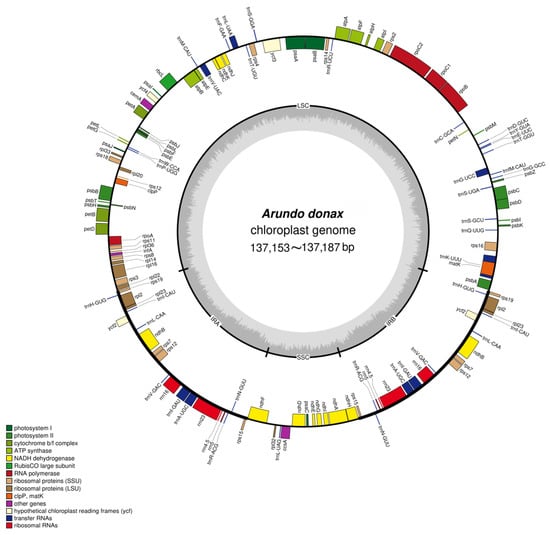
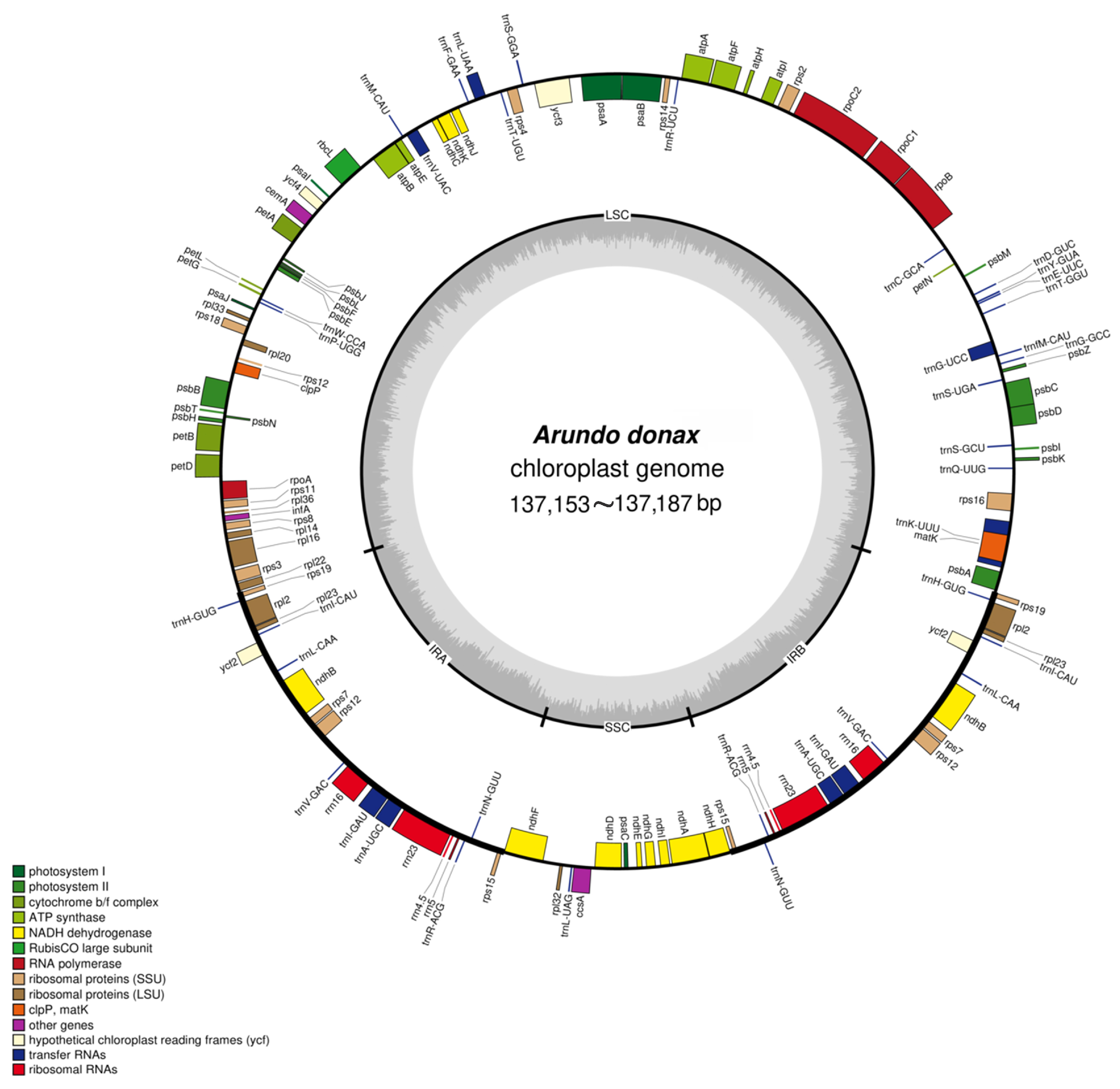
The five A. donax plastomes exhibited the typical circular quadripartite structure, comprising an LSC region, an SSC region, and two IR regions (Figure 1). Genome lengths ranged from 137,153 to 137,187 bp. The LSC and SSC regions were 82,044 and 12,629 bp, respectively, and each IR was 21,240–21,257 bp. Overall GC content was 38.62%; regional GC contents were 36.61% in the LSC, 32.88–32.90% in the SSC, and 44.20% in the IR (Table 3). Total-genomic reads aligned to the corresponding plastomes at overall rates of 4.15–5.63%, yielding high plastome depth in every sample (Table 4; Figure S1).
Figure 1.
Chloroplast genome map of Arundo donax.
Table 3.
General features of the chloroplast genomes of five Arundo donax samples.
Table 4.
Read-mapping validation summary for the five submitted plastome assemblies.
Each plastome contained 131 annotated gene features: 129 functional features comprising 83 protein-coding genes, 38 tRNA genes, and eight rRNA genes, plus two truncated ycf2-related features (Table 5). Re-audit of the feature tables identified 20 feature names represented twice in each circular annotation: seven protein-coding genes (ndhB, rpl2, rpl23, rps12, rps15, rps19, and rps7), four rRNA genes (rrn16, rrn23, rrn4.5, and rrn5), eight tRNA genes (trnA-UGC, trnH-GUG, trnI-CAU, trnI-GAU, trnL-CAA, trnN-GUU, trnR-ACG, and trnV-GAC), and the truncated ycf2-related feature. Sixteen functional genes contained introns; 14 had one intron, and two had two introns.
Table 5.
Functional classification of chloroplast genes.
Each plastome contained two 759 bp ycf2-related fragments, one in each IR. All ten oriented copies were identical and contained an ATG start codon, a terminal TGA codon, and no internal stop codon, corresponding to a 252 aa ORF. Read mapping gave mean depths of 1736.37–2932.61× across the ten copies and a minimum per-base depth of 1510×; every copy had 100% breadth at ≥100×. No position had an alternative-base fraction ≥5%, and both boundaries of every fragment were supported by numerous continuous and properly paired reads. Because 759 bp is far shorter than a full-length canonical ycf2 gene, the features were interpreted as read-supported truncated ycf2-related ORFs/remnants rather than intact functional genes (Table 6; Figure S2).
Table 6.
Sequence features of the read-supported truncated ycf2-related ORFs/remnants.
3.2. Analysis of Long Repeat Sequences and Candidate Simple Sequence Repeat (SSR) Motifs
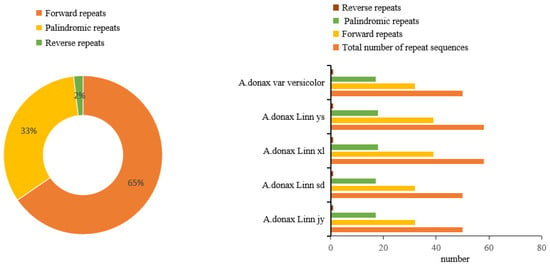
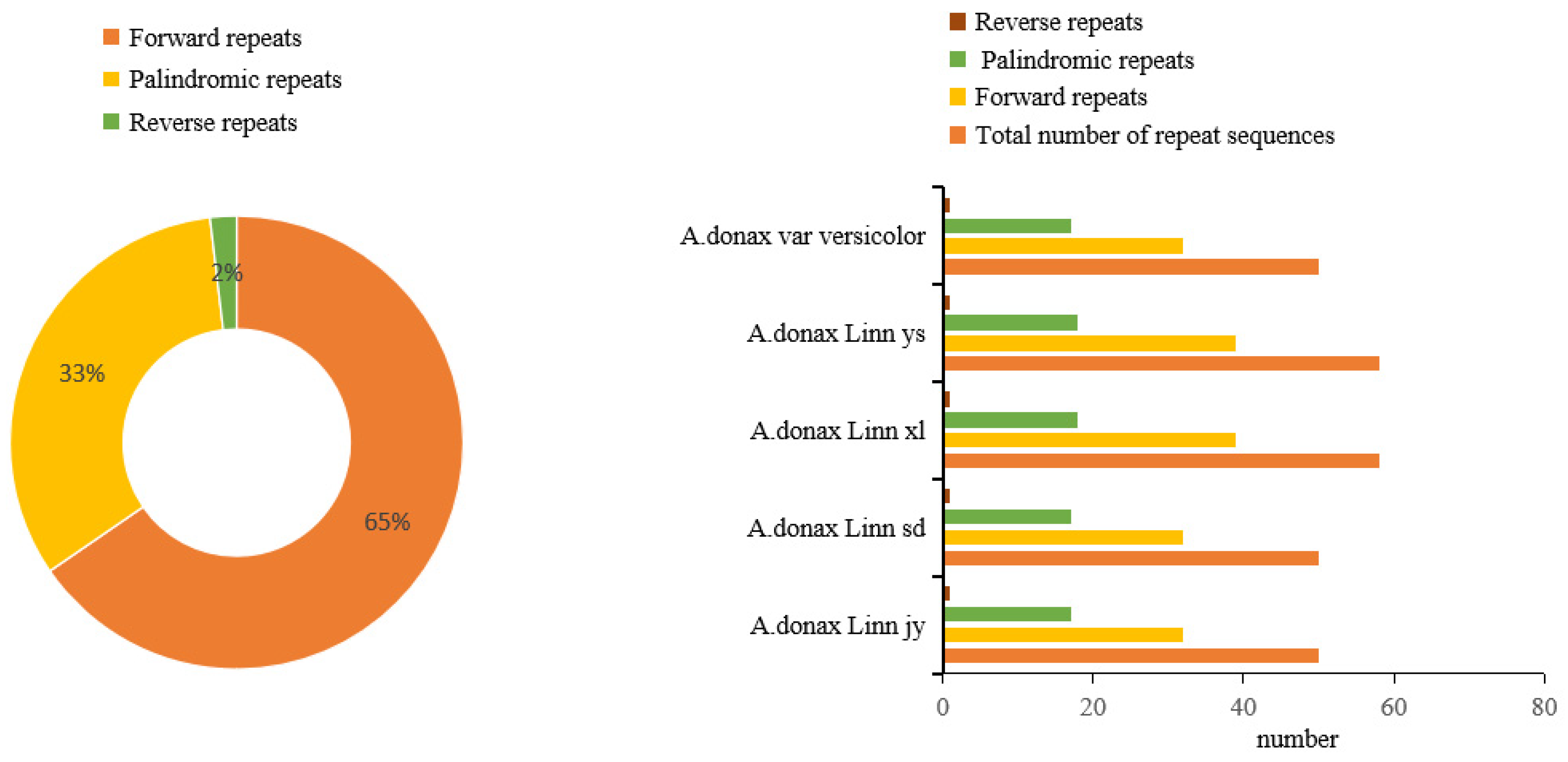
REPuter detected 266 long repeats across the five plastomes, comprising 174 forward repeats (65.41%), 87 palindromic repeats (32.71%), and five reverse repeats (1.88%). Individual plastomes contained 50–58 long repeats, most of which were 30–40 bp in length (Figure 2).
Figure 2.
Long repeats detected in the five Arundo donax plastomes.
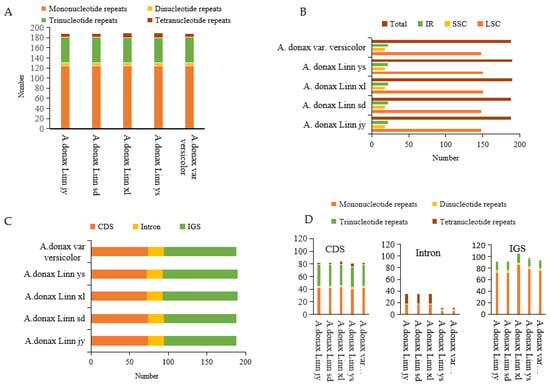
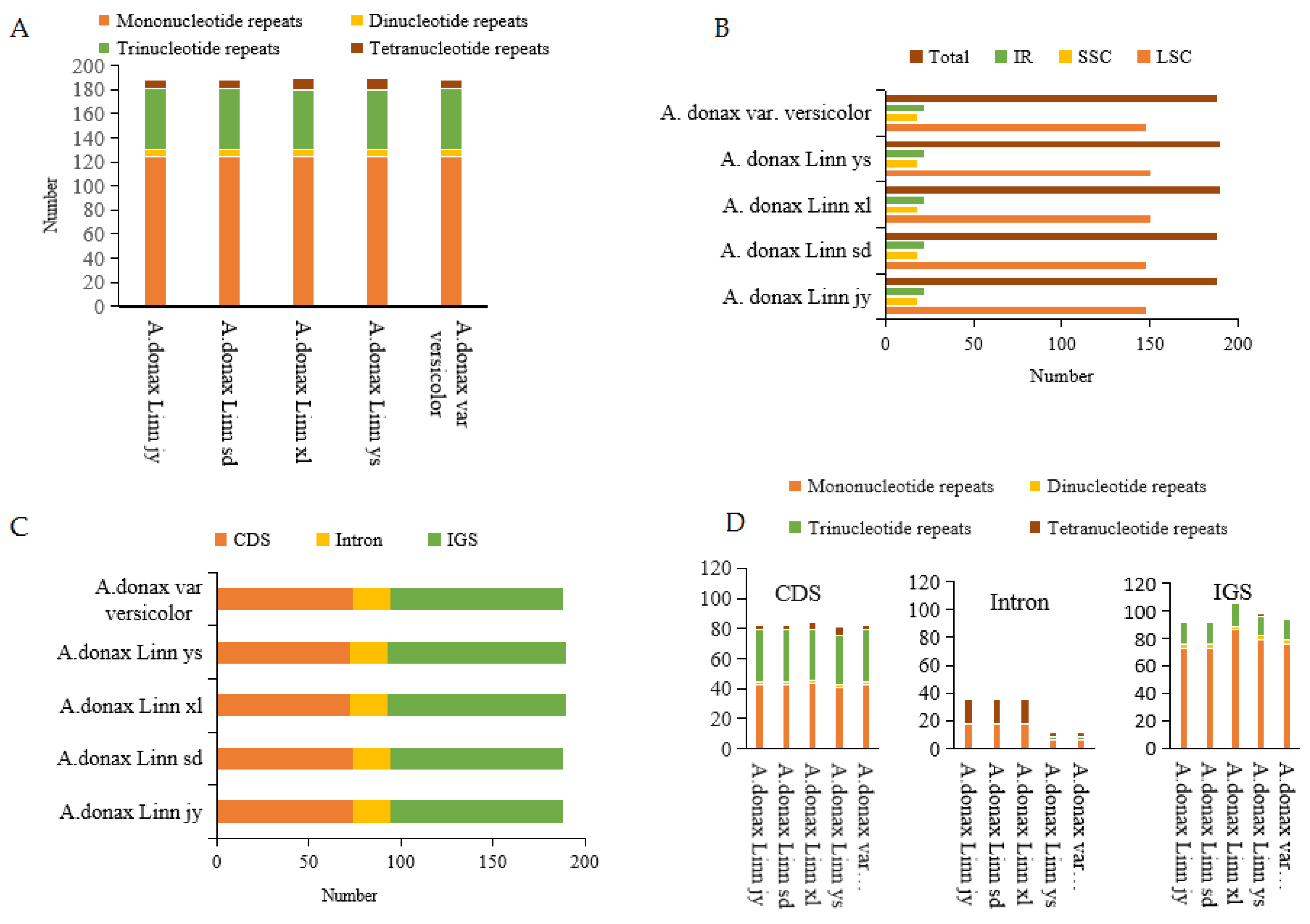
MISA detected 188 motifs in JY, SD, and A. donax var. versicolor, and 190 motifs in XL and YS. Each of the first three plastomes contained 125 mononucleotide, five dinucleotide, 51 trinucleotide, and seven tetranucleotide motifs; each of the latter two contained 125 mononucleotide, five dinucleotide, 50 trinucleotide, and ten tetranucleotide motifs (Figure 3A). No penta- or hexanucleotide motifs were detected. JY, SD, and A. donax var. versicolor each contained 148 motifs in the LSC, 18 in the SSC, and 22 in the IR regions, whereas XL and YS each contained 150, 18, and 22 motifs in these regions, respectively (Figure 3B). Counts in coding regions, introns, and intergenic spacers were 74, 20, and 94 for the first group and 72, 21, and 97 for the second group, respectively (Figure 3C,D).
Figure 3.
Distribution of candidate SSR motifs in five Arundo donax plastomes (JY, SD, XL, YS, and A. donax var. versicolor): (A) motif types; (B) distribution among LSC, SSC, and IR regions; (C,D) distribution among coding regions, introns, and intergenic spacers. The motifs were detected by MISA and were not treated as confirmed polymorphic loci.
3.3. Analysis of Quadripartite Boundary Regions
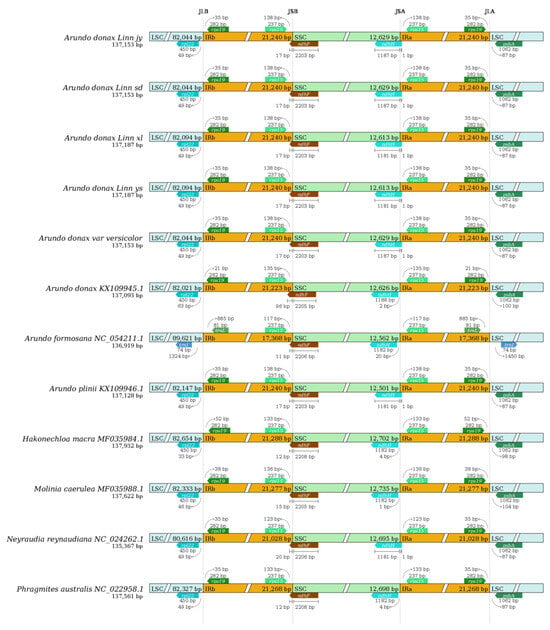
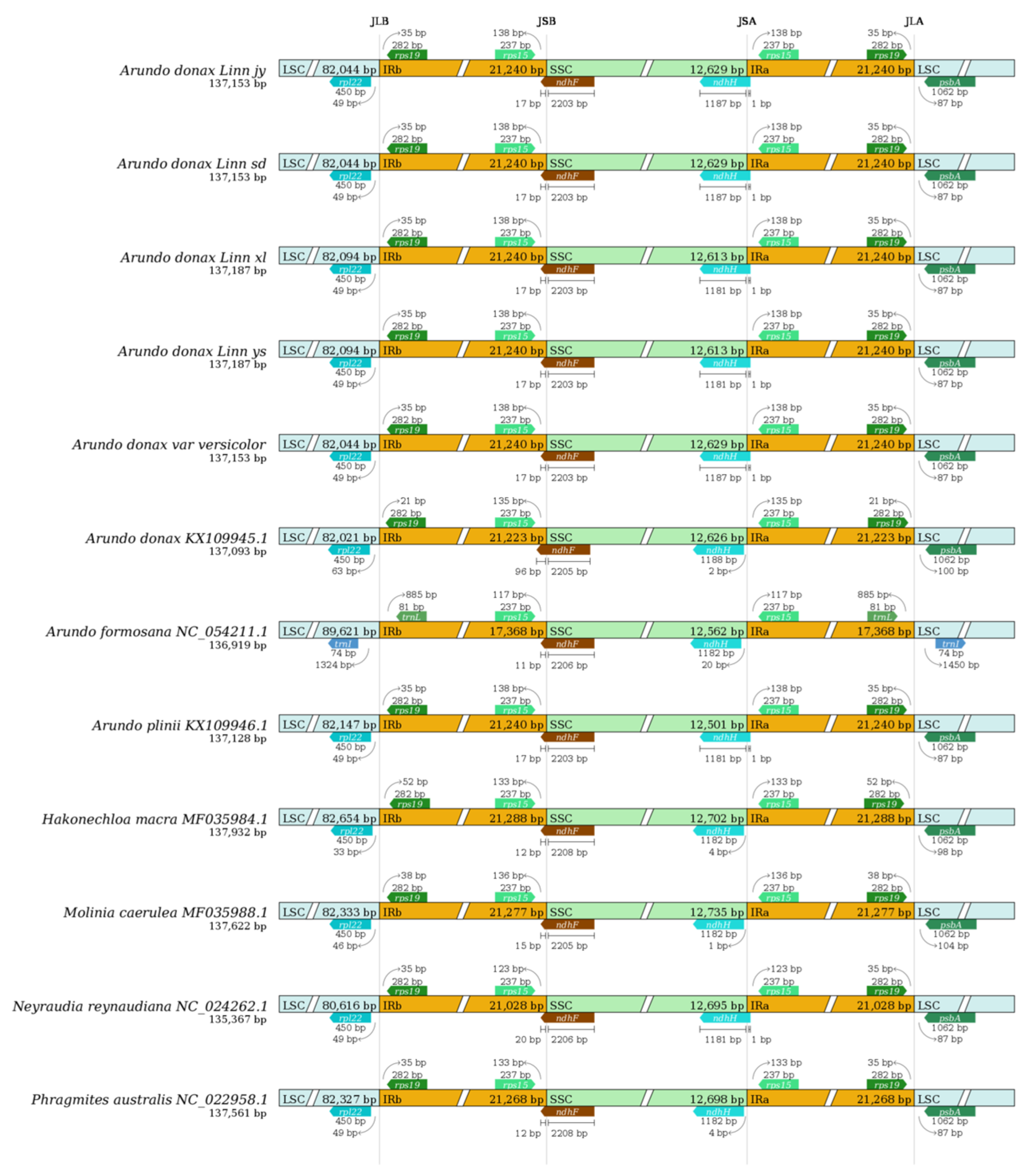
The four IR/SC boundary regions were compared across the five plastomes (Figure 4). Boundary-gene positions were identical among the five samples, and no expansion or contraction that displaced a boundary gene was observed.
Figure 4.
Comparison of the LSC/IRb, IRb/SSC, SSC/IRa, and IRa/LSC boundaries in five Arundo donax plastomes.
At the LSC/IRb boundary, rpl22 was located in the LSC, 49 bp from the junction, and rps19 was located in IRb, 35 bp from the junction. At the IRb/SSC boundary, ndhF extended 17 bp into IRb and 2203 bp into the SSC; rps15 was located in IRb, 138 bp from the junction. At the SSC/IRa boundary, ndhH extended 1 bp into IRa and 1187 bp into the SSC, and the second rps15 copy was 138 bp from the junction. At the IRa/LSC boundary, psbA was located in the LSC, 87 bp from the junction. These positions were also similar to those in A. donax KX109945.1 and A. formosana [37].
Genome length differed by only 34 bp among the five samples, reflecting the 17 bp difference in IR length, whereas LSC and SSC lengths were identical. Together with the unchanged boundary-gene positions, these observations indicate high structural similarity among the sampled plastomes.
3.4. Chloroplast Genome Collinearity Analysis
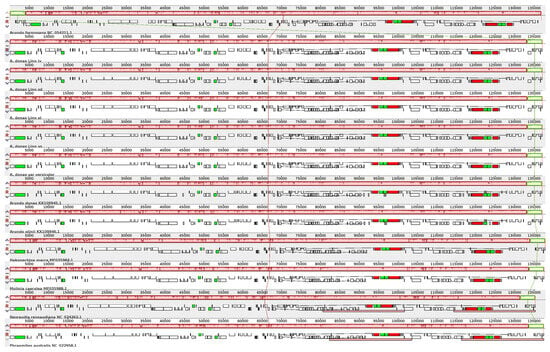
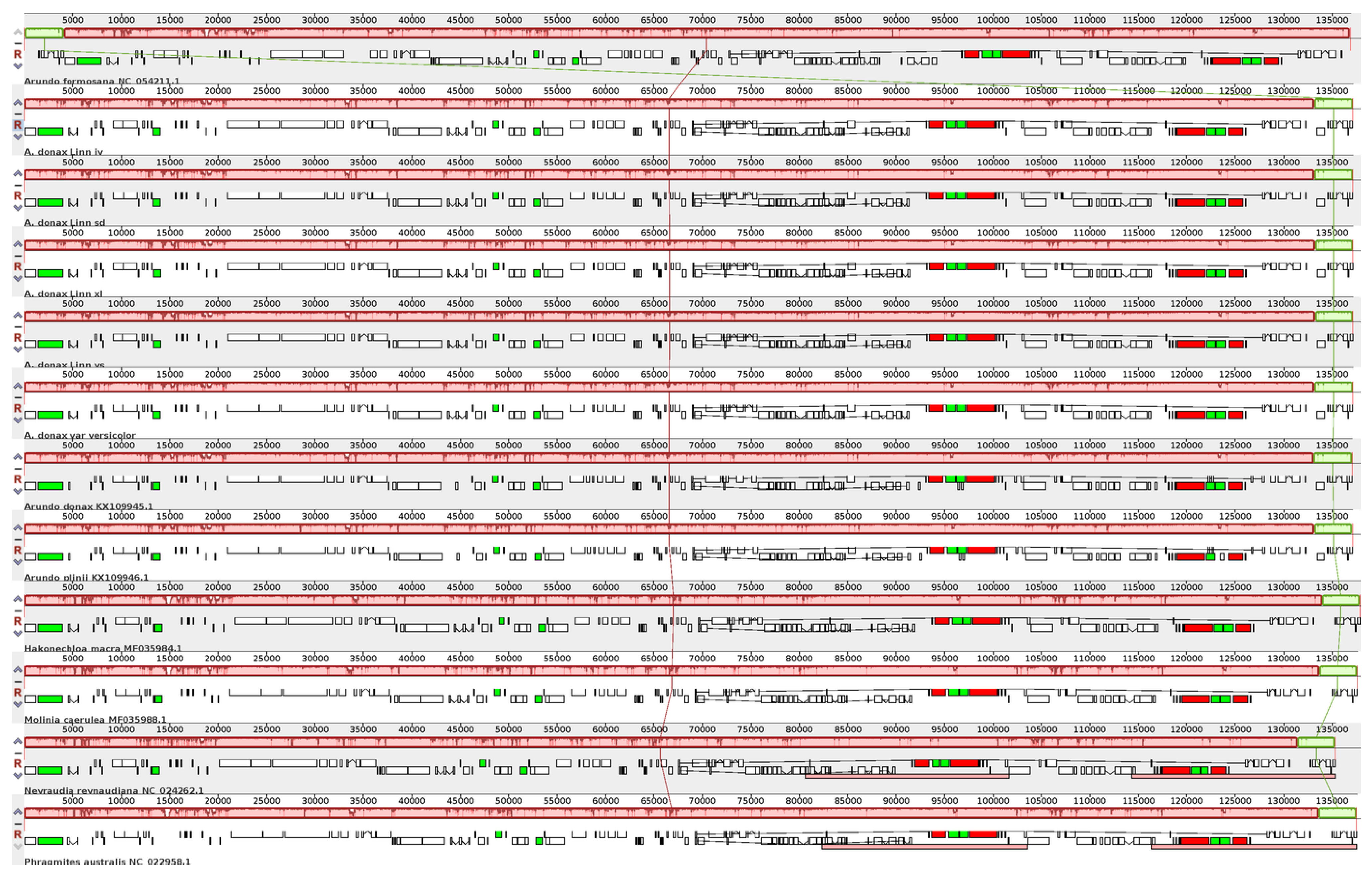
Whole-genome collinearity was compared among the five newly assembled plastomes and six publicly available plastomes: Arundo donax KX109945.1, A. plinii KX109946.1, Hakonechloa macra MF035984.1, Molinia caerulea MF035988.1, Neyraudia reynaudiana NC_024262.1, and Phragmites australis NC_022958.1 (Figure 5). The locally collinear blocks occurred in the same order and orientation, and no large-scale rearrangement, inversion, or translocation was detected in this comparison.
Figure 5.
Whole-plastome collinearity analysis of five newly assembled Arundo donax plastomes and six publicly available grass plastomes.
3.5. Relative Synonymous Codon Usage (RSCU) Analysis
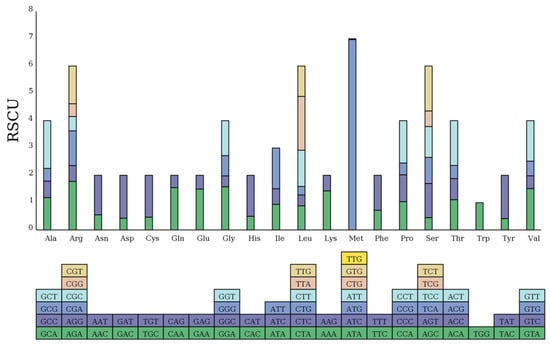
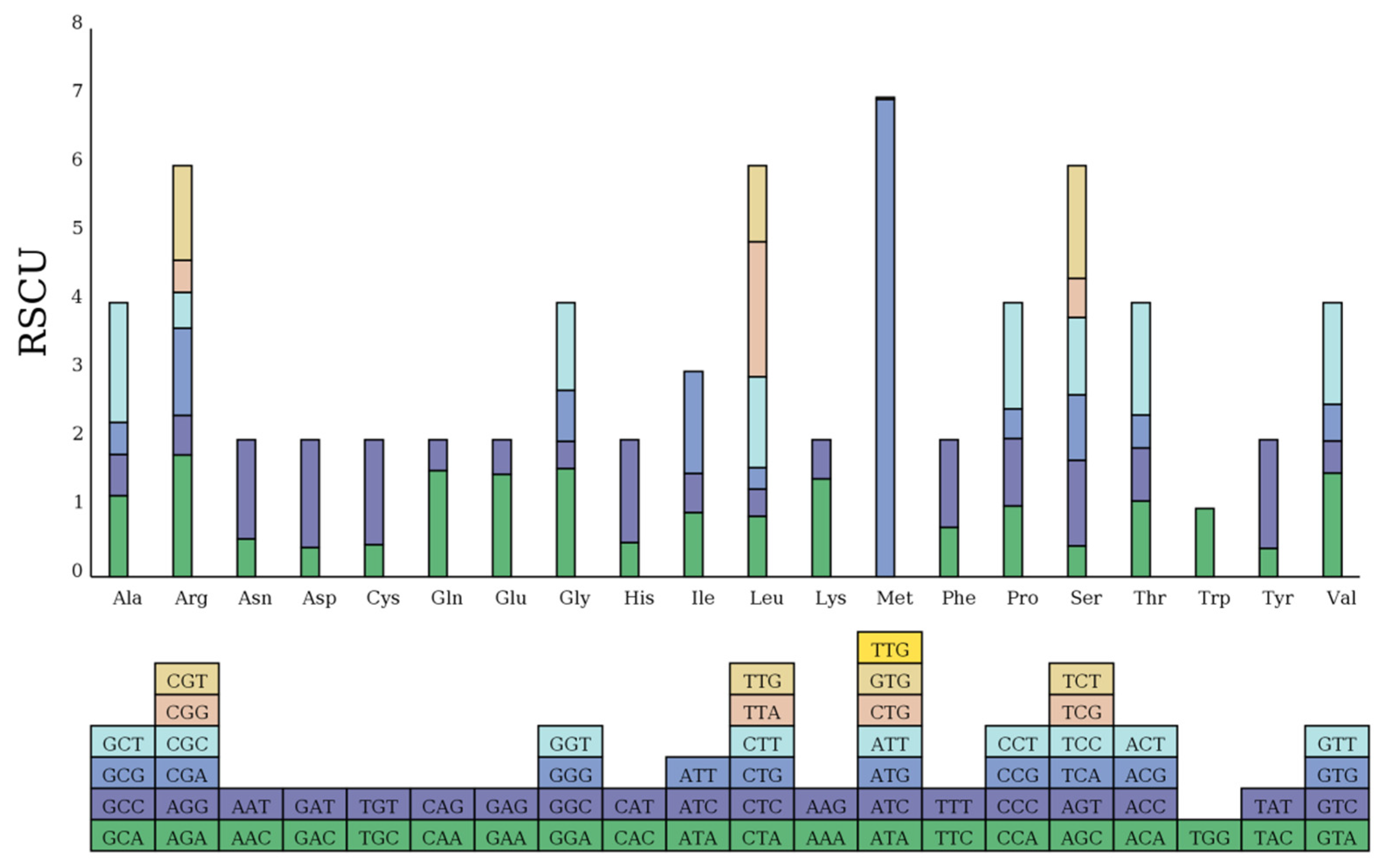
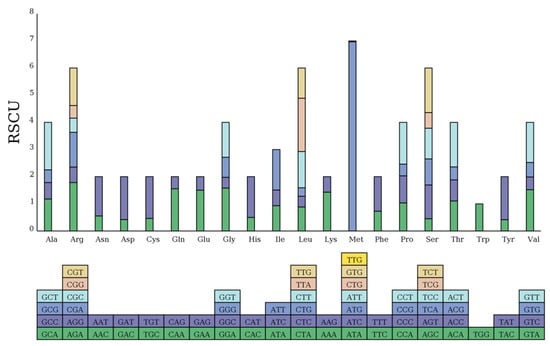
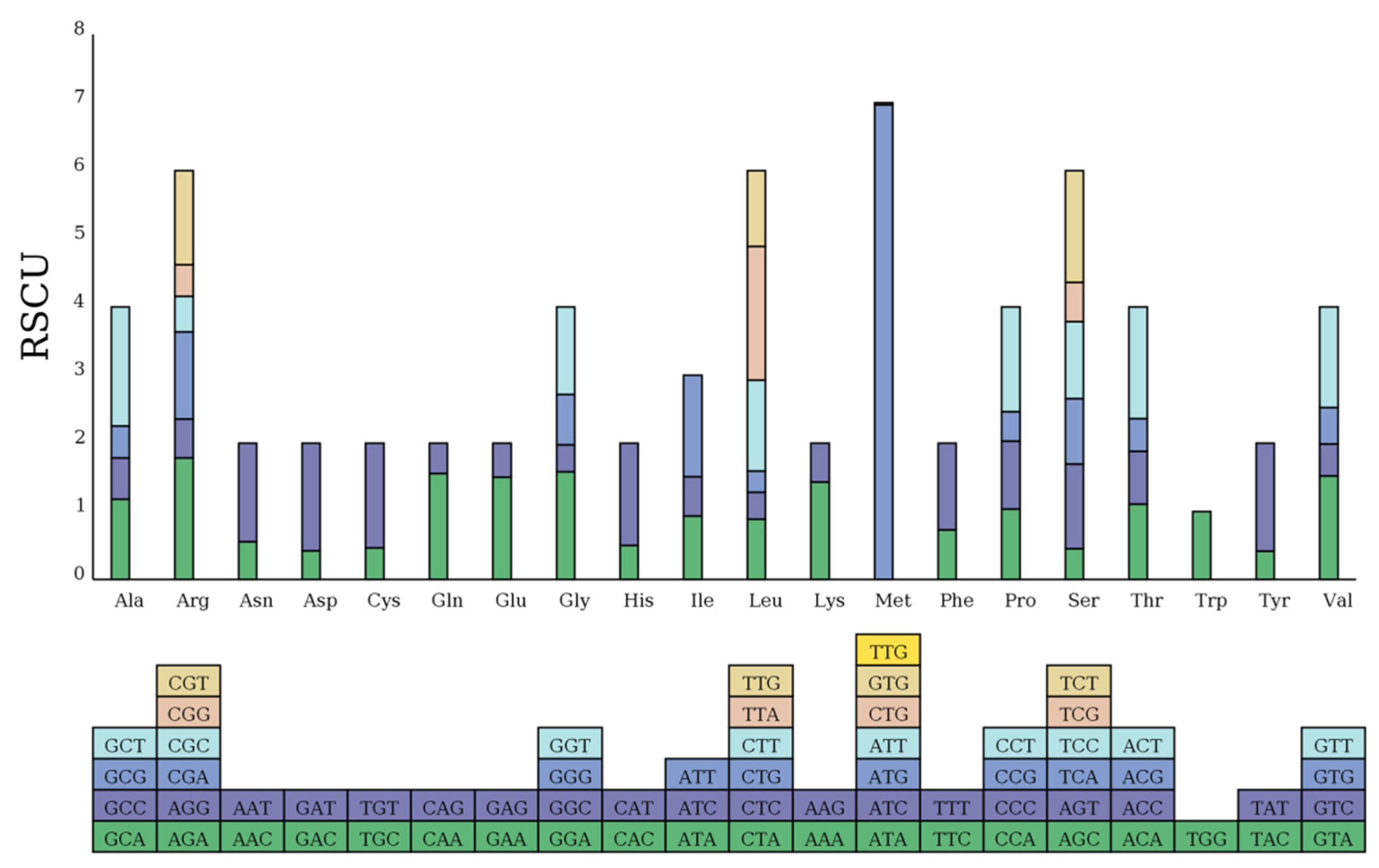
RSCU profiles were highly similar among the five plastomes. For visualization, JY, SD, and A. donax var. versicolor were displayed as Group 1, and XL and YS as Group 2 (Figure 6 and Figure 7). Differences between the two descriptive groups were small and occurred mainly in the third or fourth decimal place (Table 7).
Figure 6.
Relative synonymous codon usage in the chloroplast genomes of JY, SD, and Arundo donax var. versicolor (Group 1).
Figure 7.
Relative synonymous codon usage in the chloroplast genomes of XL and YS (Group 2).
Table 7.
Codon counts and relative synonymous codon usage in the five Arundo donax plastomes.
Both groups contained 32 codons with RSCU values greater than 1: 12 ended in A, 16 in U, three in G, and one in C (Table 7). This distribution describes an overall preference for A/U-ending synonymous codons. Because the analysis included five samples without independent biological replication or expression measurements, the small RSCU differences were not tested as an association with growth form.
3.6. Phylogenetic Analysis and Read-Level Validation
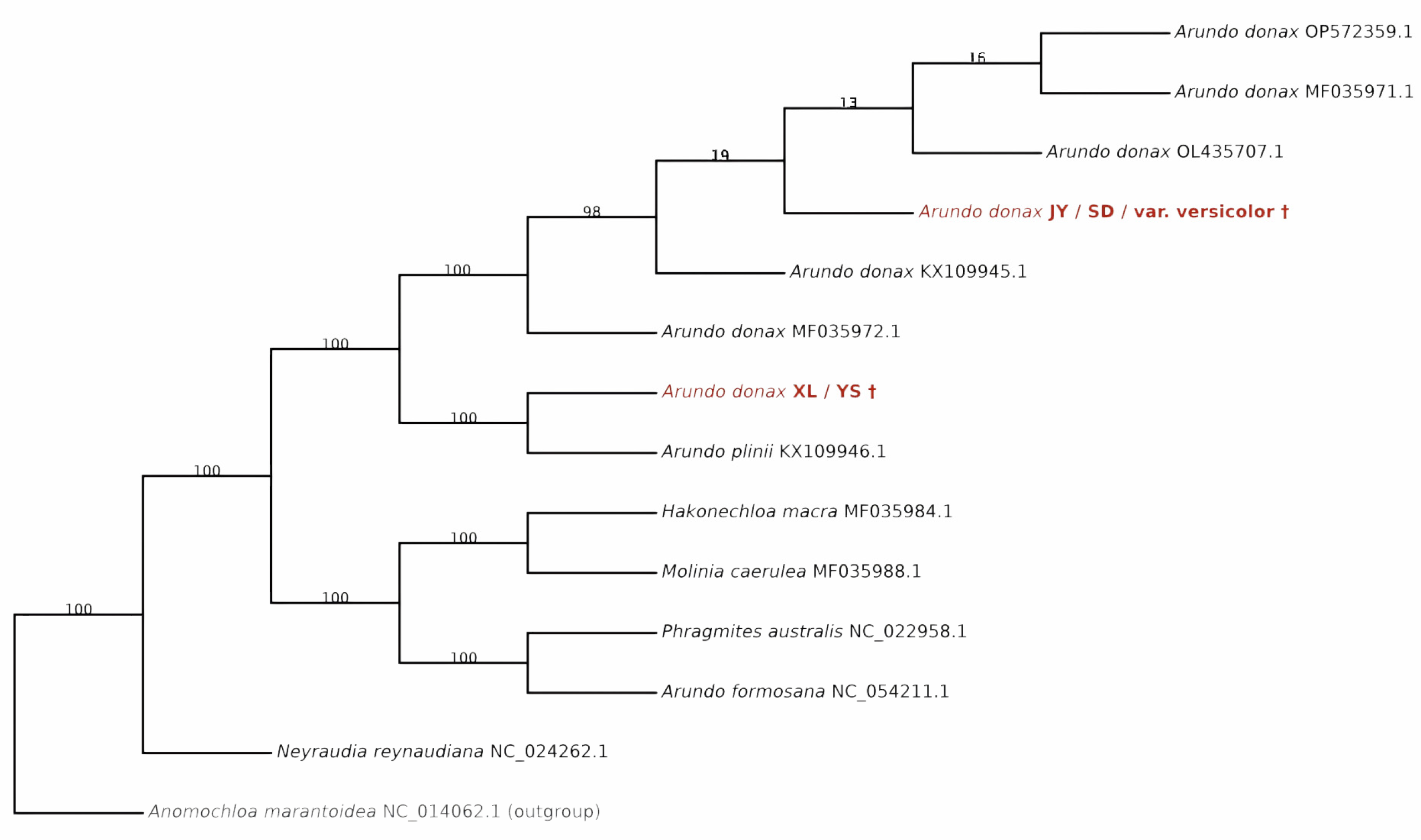
The final alignment comprised 148,448 nucleotide positions, including 12,491 variable sites and 2447 parsimony-informative sites. JY, SD, and A. donax var. versicolor had identical aligned plastome sequences and were represented by one haplotype during tree inference; XL and YS were also identical and were represented by a second haplotype (Figure 8). The two haplotypes differed at 107 fixed SNPs and 57 indel events.
Figure 8.
Maximum-likelihood tree (RAxML v8.2.10/GTRGAMMA, 1000 rapid bootstrap replicates) of complete plastomes with both IR copies retained, rooted with Anomochloa marantoidea (NC_014062.1). Branches are drawn at uniform length rather than to scale, because the A. donax plastomes differ by less than 0.001 substitutions per site; this affects neither the topology nor the bootstrap values shown at the nodes. Newly sequenced plastomes are in red bold; slash-separated names denote accessions with identical sequences, collapsed to one haplotype before inference.
The JY/SD/A. donax var. versicolor haplotype grouped with several previously published A. donax plastomes, whereas XL/YS was recovered as sister to A. plinii KX109946.1 with 100% bootstrap support. There were 42 strict SNPs that produced one group with the A. donax XL/YS accessions being sister to A. plinii and the other group with all sampled other A. donax accessions. Among these SNPs, 41 were strongly supported by reads in both XL and YS (Figure S3), and one position (alignment column 86,374; XL/YS coordinate 80,243 in the rpl16 intron) showed a reproducible G/T mixture: G was supported by 78.23% and 82.54% of reads in XL and YS, respectively. This site was excluded from the fully fixed diagnostic set. A total of 23 strict diagnostic indels also supported the above grouping. All these indel junctions were supported by continuous reads, with sample-level minima of at least 845 boundary-spanning reads.
Arundo formosana NC_054211.1 was recovered as sister to Phragmites australis NC_022958.1 with 100% bootstrap support. Removing the mixed site left both the XL/YS–A. plinii and A. formosana–P. australis relationships at 100% support. Removing one IR copy from every plastome before realignment recovered the same relationships with 99% and 100% support, respectively. Thus, the unexpected placements were not caused by the single mixed site or by double weighting of the IR. Neither sampled A. donax accessions nor sampled Arundo species were recovered as monophyletic groups in these plastome trees. Nevertheless, the interpretation of species-level relationships derived from this study is constrained by taxon sampling, absence of nuclear genome data, and lack of read-level evidence for the public accessions.
4. Discussion
4.1. Conserved Chloroplast Genome Structure and Repeat Features of A. donax
The five plastomes had the typical quadripartite structure and were highly similar in genome size, gene order, and IR/SC boundary configuration. Genome length varied by 34 bp, corresponding to a 17 bp difference in the length of each IR, while LSC and SSC lengths were unchanged. No large-scale rearrangement or inversion was detected. These observations support structural conservation among the five sampled plastomes but do not estimate species-wide or population-level variation.
Published Arundo plastomes show broadly similar genome sizes and quadripartite organization [18,37]. The present analysis also identified 266 long repeats and 188–190 candidate SSR motifs per plastome. SSR totals were internally consistent when classified by motif type, genomic region, and functional region. Direct comparisons of SSR abundance among studies remain sensitive to detection thresholds, repeat definitions, annotation boundaries, and treatment of duplicated IR sequences [38,39,40]. The counts reported here therefore characterize this dataset rather than demonstrating unusually high plastome variability.
Most SSR motifs occurred in the LSC and in intergenic regions. Because MISA detects repeat motifs rather than allelic variation, these features are candidate targets for future screening; polymorphism at homologous loci was not established in this study.
4.2. Truncated ycf2-Related Fragments
Each plastome contained two identical 759 bp ycf2-related fragments within the IR regions. The fragments were also identical among the five samples. In the reading frame identified by the initial annotation, each fragment began with ATG, ended with TGA, and contained no internal stop codon. However, the remaining sequence required for a full-length ycf2 coding region was absent. Because ycf2 is normally one of the largest plastid-encoded open reading frames [41], the short features were classified as truncated ycf2 pseudogene fragments rather than intact protein-coding genes.
Direct remapping of the recovered FASTQ files yielded mean genome-wide depths of 1762.05–2932.37×, and every plastome position was covered at ≥502×. The ycf2-related regions had still higher minimum support (1510×), complete breadth at ≥100×, and read-supported boundaries. These results verify the presence and continuity of the 759 bp sequence in the submitted assemblies, but they do not demonstrate protein expression or biological function. Luo et al. [18] did not annotate ycf2 in the cultivar Lvzhou No. 1, but that public plastome was not reassembled and reannotated with the workflow used here. Differences among annotation workflows therefore cannot be excluded. The present evidence documents a conserved, read-supported ycf2-related remnant in the five assemblies, not retention of an intact functional gene and not an effect of domestication, selection, or gene degeneration.
4.3. Descriptive Chloroplast Codon-Usage Patterns
The five plastomes shared a strong preference for A/U-ending synonymous codons, a common compositional feature of plastid genomes [42,43,44]. RSCU profiles were nearly identical, and the observed between-group differences were confined mainly to the third or fourth decimal place.
The two plotting groups reflected field-recorded growth forms, but the study included only five samples. The grouping is therefore descriptive and does not establish correspondence between plastome codon usage and growth phenotype. No transcript-abundance, tRNA-abundance, translation-efficiency, or protein-expression data were collected. Accordingly, the RSCU results describe codon composition but do not identify altered translational regulation or a mechanism underlying biomass or growth architecture.
Testing a relationship between codon usage and phenotype would require larger replicated sampling together with statistical association analyses and complementary expression, nuclear-genomic, and environmental data.
4.4. Phylogenetic Relationships
The primary plastome phylogeny did not recover the sampled A. donax accessions as a monophyletic group because the identical XL/YS haplotype was sister to A. plinii. This placement and the grouping of the remaining accessions with the public A. donax plastomes were supported by 41 of 42 strict diagnostic SNPs and 23 diagnostic indels, which received strong support from read-level examination of the sequences. The remaining SNP was a genuine mixed G/T site and was excluded from the fixed set. The topology was unchanged after removing that site and after deleting one IR copy from every plastome, indicating that these placements were not simple consequences of the mixed base, an unsupported indel, or double weighting of the IR. The placement of A. formosana with P. australis was also stable, but equivalent read-level validation was not possible for those public accessions. Because A. formosana was placed outside the clade formed by the remaining Arundo accessions, the genus Arundo was likewise not recovered as monophyletic in this tree. A plastome phylogeny represents a single, predominantly maternally inherited history and may differ from the species history. Broader sampling, consistently curated public assemblies, verified specimens, and independent nuclear markers are therefore needed. The tree is interpreted as a comparison among the sampled plastomes rather than a definitive reconstruction of species relationships.
5. Conclusions
Five complete Arundo donax plastomes were assembled and compared. Their size, quadripartite structure, gene order, and IR/SC boundary configuration were highly similar. MISA identified 188–190 candidate SSR motifs per plastome, but polymorphism at homologous loci was not tested. Each IR contained a read-supported 759 bp truncated ycf2-related ORF/remnant rather than an intact ycf2 gene. Remapping of the deposited reads provided complete high-depth support for the five assemblies and the fragment boundaries. Diagnostic SNPs and indels supporting the sister relationship between the XL/YS haplotype and A. plinii were also read-supported, and the relevant phylogenetic placements remained unchanged after removal of the mixed site and one IR copy. These results provide publicly verifiable plastome resources and observations for the five accessions; they should help future studies to reveal genetic variation levels among populations across the entire range of the species, to determine the functional status of ycf2, or to reconstruct a complete species phylogeny with markers from both organellar and nuclear genomes.
Supplementary Materials
The following supporting information can be downloaded at https://www.mdpi.com/article/10.3390/d18110702/s1, Tables S1–S7 provide ycf2, diagnostic SNP/indel, pairwise-difference, sensitivity-analysis, and IR-coordinate results; Figures S1–S3 show genome-wide depth, ycf2 validation, diagnostic SNP support, and phylogenetic sensitivity; and the associated Newick files provide the inferred trees.
Author Contributions
Conceptualization, K.X.; methodology, C.F.; validation, J.S. (Jiang Su); formal analysis, J.S. (Jinhan Sang) and J.S. (Jiang Su); investigation, C.F. and J.S. (Jiang Su) (resources) and J.W. (data analysis); writing—original draft preparation, J.S. (Jinhan Sang) and K.X.; writing—review and editing, J.S. (Jinhan Sang) and N.H.; supervision, J.S. (Jiang Su) and B.L.; funding acquisition, K.X. and J.H. All authors have read and agreed to the published version of the manuscript.
Funding
This research was funded by the Key Research and Development Program of Guangxi (No. GXKAB21220008); the Guangxi Science and Technology Program (cultivation of young sci-tech talents) (No. GKAD23026013); the Natural Science Foundation of Guangxi Zhuang Autonomous Region (No. 2026GXNSFAA00641005); and the Guangxi Zhuang Autonmous Region Forestry Department (No. [2022]34).
Institutional Review Board Statement
Not applicable.
Data Availability Statement
The paired-end sequencing datasets are available in the NCBI Sequence Read Archive under BioProject PRJNA1538555: SRR41000350 (JY; SAMN63859082), SRR41000349 (A. donax var. versicolor; SAMN63859083), SRR41000348 (XL; SAMN63859084), SRR41000347 (YS; SAMN63859085), and SRR41000346 (SD; SAMN63859086). The corresponding plastome assemblies are available in GenBank under PZ868107 (JY), PZ868108 (A. donax var. versicolor), PZ868109 (XL), PZ868110 (YS), and PZ868111 (SD). The GenBank submission identifier is SUB16418518. Read-mapping summaries, diagnostic-site tables, phylogenetic sensitivity analyses, and Newick trees are provided in the supplementary reproducibility files.
Conflicts of Interest
The authors declare no conflicts of interest.
References
- Jansen, R.K.; Raubeson, L.A.; Boore, J.L.; DePamphilis, C.W.; Chumley, T.W.; Haberle, R.C.; Wyman, S.K.; Alverson, A.J.; Peery, R.; Herman, S.J.; et al. Methods for obtaining and analyzing whole chloroplast genome sequences. Methods Enzymol. 2005, 395, 348–384. [Google Scholar] [CrossRef] [Scilit] [PubMed]
- Zhang, Y.J.; Li, D.Z. Research progress in chloroplast phylogenomics. Plant Divers. Resour. 2011, 33, 365–375. [Google Scholar]
- Widmer, A.; Baltisberger, M. Molecular evidence for allopolyploid speciation and a single origin of the narrow endemic Draba ladina (Brassicaceae). Am. J. Bot. 1999, 86, 1282–1289. [Google Scholar] [CrossRef] [Scilit]
- Muraguri, S.; Xu, W.; Chapman, M.; Muchugi, A.; Oluwaniyi, A.; Oyebanji, O.; Liu, A.Z. Intraspecific variation within Castor bean (Ricinus communis L.) based on chloroplast genomes. Ind. Crops Prod. 2020, 155, 112779. [Google Scholar] [CrossRef] [Scilit]
- López-Caamal, A.; Gandee, T.; Galloway, L.F.; Barnard-Kubow, K.B. Substantial structural variation and repetitive DNA content contribute to intraspecific plastid genome evolution. BMC Genom. 2025, 26, 340. [Google Scholar] [CrossRef] [Scilit] [PubMed]
- Joh, H.J.; Park, Y.S.; Kang, J.S.; Kim, J.T.; Lado, J.P.; Han, S.I.; Chin, Y.W.; Park, H.S.; Park, J.Y.; Yang, T.J. A recent large-scale intraspecific IR expansion and evolutionary dynamics of the plastome of Peucedanum japonicum. Sci. Rep. 2025, 15, 104. [Google Scholar] [CrossRef] [Scilit] [PubMed]
- Guisinger, M.M.; Chumley, T.W.; Kuehl, J.V.; Boore, J.L.; Jansen, R.K. Implications of the plastid genome sequence of Typha (Typhaceae, Poales) for understanding genome evolution in Poaceae. J. Mol. Evol. 2010, 70, 149–166. [Google Scholar] [CrossRef] [Scilit] [PubMed]
- Chen, H.Y.; Lü, J. Cutting propagation technique of Arundo donax in northern Xinjiang. North. Hortic. 2013, 15, 171. [Google Scholar]
- Han, Z.P.; Wang, C.Y. Accumulation and distribution of Cd, Hg, Pb and Cu in different ecotypes of Arundo donax. Ecol. Environ. 2007, 16, 1092–1097. [Google Scholar]
- Badache, S.; Seghairi, N. Heavy metals removal from industrial wastewater of Biskra (Algeria) by Arundo donax and Phragmites australis. Environ. Monit. Assess. 2024, 196, 703, Correction in Environ. Monit. Assess. 2024, 196, 740. [Google Scholar] [CrossRef] [Scilit] [PubMed]
- Yu, Z.; Li, J.L.; Li, G.Y. Potential analysis of Arundo donax as clean biomass energy forage. Pratacult. Sci. 2009, 26, 62–69. [Google Scholar]
- Hardion, L.; Verlaque, R.; Saltonstall, K.; Leriche, A.; Vila, B. Origin of the invasive Arundo donax (Poaceae): A trans-Asian expedition in herbaria. Ann. Bot. 2014, 114, 455–462. [Google Scholar] [CrossRef] [Scilit] [PubMed]
- Editorial Committee of Flora Reipublicae Popularis Sinicae. Flora Reipublicae Popularis Sinicae; Science Press: Beijing, China, 2002; Volume 9, p. 21. (In Chinese) [Google Scholar]
- Liang, M.; Li, Y.; Xie, S.Q.; Guo, F.; Zou, J.Z.; Li, Z.J. AFLP and ISSR analysis of genetic diversity of Arundo donax germplasm. Mol. Plant Breed. 2024; early view. Available online: https://link.cnki.net/urlid/46.1068.S.20240304.1442.003 (accessed on 30 October 2026).
- Sun, Y.C.; Wang, T.Y.; Luo, L.; Cai, Y.X.; Lin, H.; Lin, D.M.; Zhang, J.S.; Lin, Z.X. Molecular identification and adaptive evolution analysis of Arundo species. Pratacult. Sci. 2023, 40, 1568–1581. [Google Scholar]
- Pilu, R.; Cassani, E.; Landoni, M.; Badone, F.C.; Passera, A.; Cantaluppi, E.; Corno, L.; Adani, F. Genetic characterization of an Italian Giant Reed (Arundo donax L.) clones collection: Exploiting clonal selection. Euphytica 2014, 196, 169–181. [Google Scholar] [CrossRef] [Scilit]
- Danelli, T.; Laura, M.; Savona, M.; Landoni, M.; Adani, F.; Pilu, R. Genetic improvement of Arundo donax L.: Opportunities and challenges. Plants 2020, 9, 1584. [Google Scholar] [CrossRef] [Scilit] [PubMed]
- Luo, L.; Qu, Q.; Lin, H.; Chen, J.M.; Lin, Z.X.; Shao, E.S.; Lin, D.M. Exploring the evolutionary history and phylogenetic relationships of giant reed (Arundo donax) through comprehensive analysis of its chloroplast genome. Int. J. Mol. Sci. 2024, 25, 7936. [Google Scholar] [CrossRef] [Scilit] [PubMed]
- Liu, F.; Li, B.; He, Q.; Zhao, A.X.; Xi, B.; Shen, X.T. Arundo smaragdina (Poaceae): A novel species revealed by integrative taxonomy and its implications for the phylogeny of the genus. Front. Plant Sci. 2025, 16, 1660442. [Google Scholar] [CrossRef] [Scilit] [PubMed]
- Teisher, J.K.; McKain, M.R.; Schaal, B.A.; Kellogg, E.A. Polyphyly of Arundinoideae (Poaceae) and evolution of the twisted geniculate lemma awn. Ann. Bot. 2017, 120, 725–738. [Google Scholar] [CrossRef] [Scilit] [PubMed]
- Chen, S.; Zhou, Y.; Chen, Y.; Gu, J. fastp: An ultra-fast all-in-one FASTQ preprocessor. Bioinformatics 2018, 34, i884–i890. [Google Scholar] [CrossRef] [Scilit] [PubMed]
- Jin, J.J.; Yu, W.B.; Yang, J.B.; Song, Y.; dePamphilis, C.W.; Yi, T.S.; Li, D.Z. GetOrganelle: A fast and versatile toolkit for accurate de novo assembly of organelle genomes. Genome Biol. 2020, 21, 241. [Google Scholar] [CrossRef] [Scilit] [PubMed]
- Hyatt, D.; Chen, G.L.; LoCascio, P.F.; Land, M.L.; Larimer, F.W.; Hauser, L.J. Prodigal: Prokaryotic gene recognition and translation initiation site identification. BMC Bioinform. 2010, 11, 119. [Google Scholar] [CrossRef] [Scilit] [PubMed]
- Laslett, D.; Canback, B. ARAGORN, a program to detect tRNA genes and tmRNA genes in nucleotide sequences. Nucleic Acids Res. 2004, 32, 11–16. [Google Scholar] [CrossRef] [Scilit] [PubMed]
- Eddy, S.R. Accelerated profile HMM searches. PLoS Comput. Biol. 2011, 7, e1002195. [Google Scholar] [CrossRef] [Scilit] [PubMed]
- Camacho, C.; Coulouris, G.; Avagyan, V.; Ma, N.; Papadopoulos, J.; Bealer, K.; Madden, T.L. BLAST+: Architecture and applications. BMC Bioinform. 2009, 10, 421. [Google Scholar] [CrossRef] [Scilit] [PubMed]
- Greiner, S.; Lehwark, P.; Bock, R. OrganellarGenomeDRAW (OGDRAW) version 1.3.1: Expanded toolkit for the graphical visualization of organellar genomes. Nucleic Acids Res. 2019, 47, W59–W64. [Google Scholar] [CrossRef] [Scilit] [PubMed]
- Kearse, M.; Moir, R.; Wilson, A.; Stones-Havas, S.; Cheung, M.; Sturrock, S.; Buxton, S.; Cooper, A.; Markowitz, S.; Duran, C.; et al. Geneious Basic: An integrated and extendable desktop software platform for the organization and analysis of sequence data. Bioinformatics 2012, 28, 1647–1649. [Google Scholar] [CrossRef] [Scilit] [PubMed]
- Beier, S.; Thiel, T.; Münch, T.; Scholz, U.; Mascher, M. MISA-web: A web server for microsatellite prediction. Bioinformatics 2017, 33, 2583–2585. [Google Scholar] [CrossRef] [Scilit] [PubMed]
- Kurtz, S.; Choudhuri, J.V.; Ohlebusch, E.; Schleiermacher, C.; Stoye, J.; Giegerich, R. REPuter: The manifold applications of repeat analysis on a genomic scale. Nucleic Acids Res. 2001, 29, 4633–4642. [Google Scholar] [CrossRef] [Scilit] [PubMed]
- Amiryousefi, A.; Hyvönen, J.; Poczai, P. IRscope: An online program to visualize the junction sites of chloroplast genomes. Bioinformatics 2018, 34, 3030–3031. [Google Scholar] [CrossRef] [Scilit] [PubMed]
- Darling, A.C.E.; Mau, B.; Blattner, F.R.; Perna, N.T. Mauve: Multiple alignment of conserved genomic sequence with rearrangements. Genome Res. 2004, 14, 1394–1403. [Google Scholar] [CrossRef] [Scilit] [PubMed]
- Parvathy, S.T.; Udayasuriyan, V.; Bhadana, V. Codon usage bias. Mol. Biol. Rep. 2022, 49, 539–565. [Google Scholar] [CrossRef] [Scilit] [PubMed]
- Katoh, K.; Standley, D.M. MAFFT multiple sequence alignment software version 7: Improvements in performance and usability. Mol. Biol. Evol. 2013, 30, 772–780. [Google Scholar] [CrossRef] [Scilit] [PubMed]
- Stamatakis, A. RAxML version 8: A tool for phylogenetic analysis and post-analysis of large phylogenies. Bioinformatics 2014, 30, 1312–1313. [Google Scholar] [CrossRef] [Scilit] [PubMed]
- Langmead, B.; Salzberg, S.L. Fast gapped-read alignment with Bowtie 2. Nat. Methods 2012, 9, 357–359. [Google Scholar] [CrossRef] [Scilit] [PubMed]
- Feng, L.Y.; Shi, C.; Gao, L.Z. The complete chloroplast genome sequence of Arundo formosana Hack. (Poaceae). Mitochondrial DNA Part B 2021, 6, 2819–2821. [Google Scholar] [CrossRef] [Scilit] [PubMed]
- Liu, F.X.; Movahedi, A.; Yang, W.G.; Xu, L.; Xie, J.G.; Zhang, Y. The complete chloroplast genome and characteristics analysis of Callistemon rigidus R.Br. Mol. Biol. Rep. 2020, 47, 5013–5024. [Google Scholar] [CrossRef] [Scilit] [PubMed]
- Wang, Z.S.; Guo, Y.Z.; Chen, Y.N.; Gao, F.; Xue, Y.; Niu, Q.C.; Li, D.; Smagghe, G.; Gai, Y.P. Chloroplast genome sequencing of Poa pratensis and comparative chloroplast genomics analysis with other 29 grass species. Funct. Integr. Genom. 2026, 26, 44. [Google Scholar] [CrossRef] [Scilit] [PubMed]
- Skuza, L.; Androsiuk, P.; Gastineau, R.; Paukszto, Ł.; Jastrzębski, J.P.; Cembrowska-Lech, D. Molecular structure, comparative and phylogenetic analysis of the complete chloroplast genome sequences of weedy rye Secale cereale ssp. segetale. Sci. Rep. 2023, 13, 5412. [Google Scholar] [CrossRef] [Scilit] [PubMed]
- Tripathy, K.; Singh, B.; Misra, G.; Singh, N.K. Identification, distribution and comparative analysis of microsatellites in the chloroplast genome of Oryza species. Indian J. Genet. Plant Breed. 2019, 79, 536–544. [Google Scholar] [CrossRef] [Scilit]
- Wang, Y.; Gao, L.L.; Yuan, Y.J.; Scharff, L.B.; Armarego-Marriott, T.; Ruf, S.; Krall, L.; Wu, X.N.; Bock, R.; Wu, G.Z. Overexpression of protein import machinery subunit ycf1/Tic214 represses photosynthetic complex biogenesis by inhibiting the synthesis of plastid-encoded core subunits in tobacco. J. Exp. Bot. 2025, 76, 5982–6004. [Google Scholar] [CrossRef] [Scilit] [PubMed]
- Yang, H.Y.; Wang, L.Q.; Chen, H.M.; Jiang, M.; Wu, W.W.; Liu, S.Y.; Wang, J.H.; Liu, C. Phylogenetic analysis and development of molecular markers for five medicinal Alpinia species based on complete plastome sequences. BMC Plant Biol. 2021, 21, 431. [Google Scholar] [CrossRef] [Scilit] [PubMed]
- Shen, L.W.; Chen, S.Q.; Liang, M.; Qu, S.; Feng, S.J.; Wang, D.W.; Wang, G. Comparative analysis of codon usage bias in chloroplast genomes of ten medicinal species of Rutaceae. BMC Plant Biol. 2024, 24, 424. [Google Scholar] [CrossRef] [Scilit] [PubMed]

Disclaimer/Publisher’s Note: The statements, opinions and data contained in all publications are solely those of the individual author(s) and contributor(s) and not of MDPI and/or the editor(s). MDPI and/or the editor(s) disclaim responsibility for any injury to people or property resulting from any ideas, methods, instructions or products referred to in the content. |
© 2026 by the authors. Licensee MDPI, Basel, Switzerland. This article is an open access article distributed under the terms and conditions of the Creative Commons Attribution (CC BY) license.