


Abstract
The Pyraloidea are among the largest superfamilies of Lepidoptera, yet their distribution in the eastern Mediterranean is documented unevenly. Light-trapping was carried out on 54 nights between 2008 and 2024 at 45 localities in the districts of Erdemli and Mezitli, Mersin Province, southern Türkiye, along an elevational gradient from 150 to 1800 m a.s.l. The survey yielded 492 occurrence records of 1330 specimens belonging to 161 species in 91 genera, 129 of them identified with confidence and 32 provisionally; the Pyralidae are represented by 78 species and the Crambidae by 83, and the largest subfamilies are the Phycitinae (61 species), the Crambinae (23) and the Spilomelinae (22). Seventy-seven species are reported for the first time from Mersin Province, as assessed against the national catalogue, the nineteenth-century records of Staudinger, two annotated lists for the district of Anamur, an unpublished doctoral thesis on the region and the applied entomological literature; seven further species recorded from the province by Staudinger were not found. Checking the nomenclature species by species against the Global Information System on Pyraloidea altered 28 entries relative to the source material, including five changes in generic placement and one synonymy. Sample-based rarefaction and the Chao2 estimator indicate that only about three-quarters of the pyraloid fauna likely to be present has been recorded, and the distributional patterns are therefore regarded as provisional. Species composition tended to become more dissimilar with increasing elevational distance between sampling events (Spearman ρ = 0.187, p < 0.001), independently of season, and most of the dissimilarity (94%) was attributable to species replacement rather than to nestedness; no significant relationship between elevation and species richness per night was found. Neither district contains a protected area. The occurrence data are published in Darwin Core format.
1. Introduction
The Pyraloidea, with more than 15,000 described species, form one of the largest superfamilies of Lepidoptera [1,2]. Their larvae are ecologically diverse: most feed on living plants, a smaller number on stored plant products and other dry organic matter, and those of the Acentropinae are aquatic [3,4]. Several species are pests of stored products, field crops, orchards and forests [3,5]. Because the adults come readily to light, the superfamily is well represented in light-trap catches and lends itself to inventory by this method.
Türkiye lies at the junction of the Euro-Siberian, Mediterranean and Irano-Turanian phytogeographical regions, and most of its territory falls within three biodiversity hotspots, the Mediterranean, the Irano-Anatolian and the Caucasus [6]. Its lepidopteran fauna reflects this position; the national catalogue, which treats butterflies, larger moths and microlepidoptera alike, lists 672 species of Pyraloidea [7]. Mersin Province, on the Mediterranean coast of southern Türkiye, compresses much of this diversity of settings into a short distance. The land rises from the Çukurova plain and the coastal strip to the southern slopes of the central Taurus, so that irrigated lowland, Mediterranean maquis, coniferous forest and karstic upland grassland occur within a few tens of kilometers of one another [8]. A gradient of this kind, with its sequence of vegetation belts, can be expected to support a rich and compositionally varied pyraloid fauna, and it makes the province a suitable area in which to ask how much of that fauna remains undocumented.
Knowledge of the Turkish Pyraloidea has accumulated along two largely separate lines. The first is faunistic. Much of the older information derives from nineteenth-century collectors, whose material was summarized by Staudinger [9]; for Mersin Province, it amounts to a small number of records from “Mersin” itself, from the Gülek pass and from Karlı Boğaz. Modern faunistic work is patchy: 22 species have been reported from Hatay [10], 15 Crambidae from Gaziantep [11], 193 taxa from a single district of Bitlis [12] and 92 species from Adana, Mersin and Osmaniye in an unpublished thesis [13]. The second line is applied and concerns a few pest species, among them Ectomyelois ceratoniae (Zeller, 1839) and Cryptoblabes gnidiella (Millière, 1867) in orchards [14,15,16], Chilo partellus (Swinhoe, 1885) in maize [17] and Loxostege sticticalis (Linnaeus, 1761) on forage crops [18]; these studies record biology, damage and control, and the localities they give are those of crops rather than of the fauna. Taken together, the two lines show that economic importance has drawn sustained attention to a handful of species, whereas the regional fauna as a whole has been sampled only sporadically. New discoveries nevertheless continue: Elegia feminina Kemal, Kızıldağ & Koçak, 2020 was described from Anamur, in Mersin Province [19], and a light-trap survey of Köprülü Canyon added 72 species to the list for Antalya Province [20]. Within Mersin, recent work has concentrated on Anamur, at the western end of the province [19,21]; the central and eastern districts, including Erdemli and Mezitli, have received far less attention.
Three aims are pursued here. The first is to provide an annotated checklist of the Pyraloidea of two districts that span the whole elevational range from the Mediterranean plain to the upper montane belt of the central Taurus. The second is to establish, against the several sources now available, which of the species are new to the province. The third is to describe how the fauna is distributed along the gradient, and to assess how completely it has been sampled.
2. Materials and Methods
2.1. Study Area
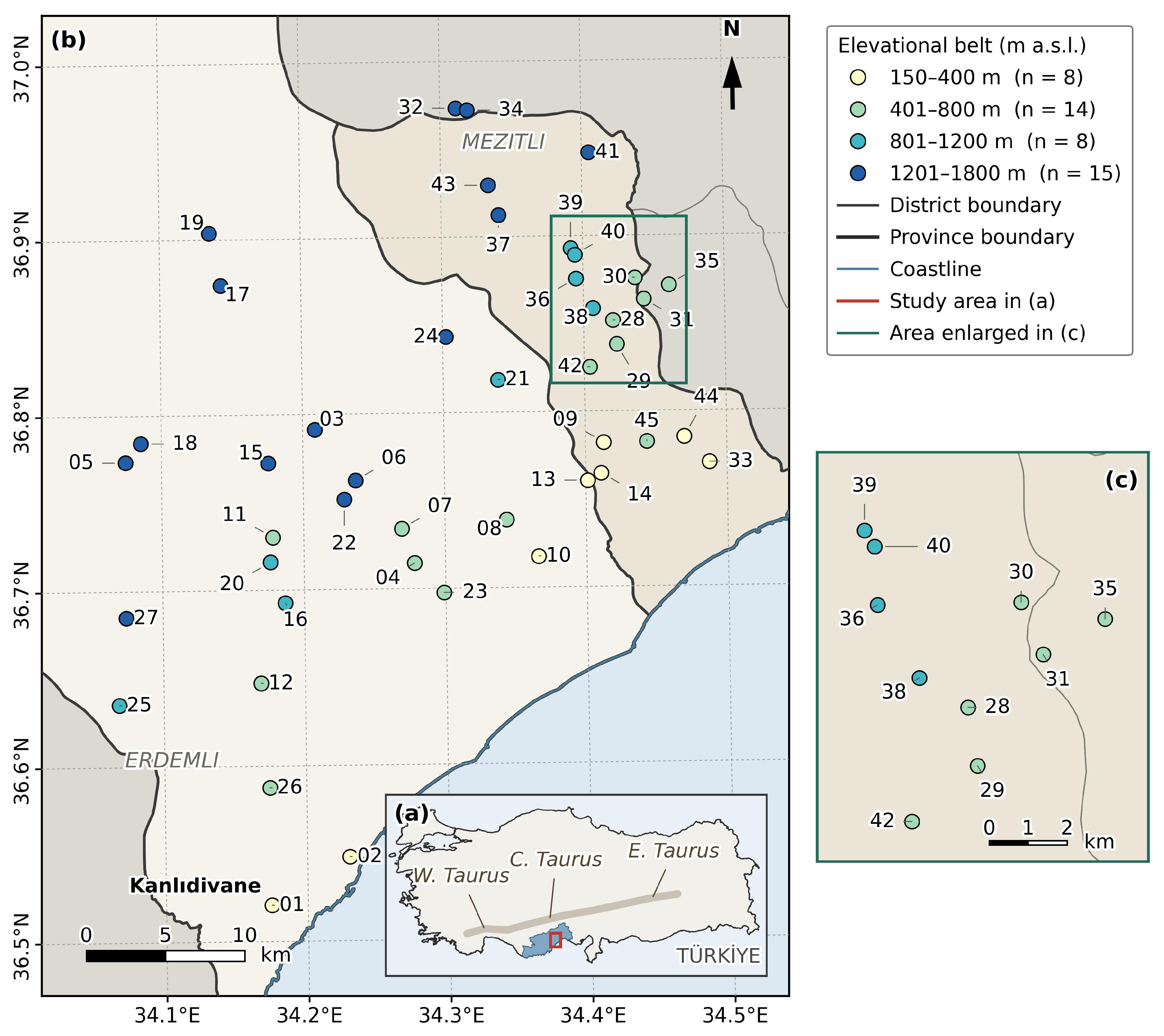
The study was carried out in the districts of Erdemli and Mezitli, Mersin Province, on the Mediterranean coast of southern Türkiye (Figure 1). Both districts extend from the coastal plain northwards onto the southern slopes of the central Taurus range, so that a short horizontal distance spans a wide altitudinal range. Sampling localities lie between 150 and 1800 m a.s.l., between 36°31′21″ and 36°58′31″ N and between 34°04′06″ and 34°29′15″ E.
The region falls within the Mediterranean bioclimatic zone, with mild wet winters and hot dry summers. The vegetation changes with elevation, from irrigated cultivation and coastal scrub on the plain, through Mediterranean maquis and Pinus brutia Ten. woodland at intermediate elevations, to an oro-Mediterranean belt of Pinus nigra J.F.Arnold, Cedrus libani A.Rich. and Abies cilicica (Antoine & Kotschy) Carrière with open karstic grassland above [8].
The localities were chosen to cover the full elevational range of the two districts and the principal vegetation types along it, from the coastal plain to the upper forest and karstic grassland belt; within this framework their exact positions were determined by road access and by the availability of an open, level site for the light screen. Coordinates were recorded with a Garmin GPSMAP 64sx receiver (Garmin Ltd., Olathe, KS, USA; nominal accuracy ±5 m) in decimal degrees on the WGS84 datum. Sampling points lying within 500 m of one another were treated as a single locality and their coordinates averaged; the coordinate uncertainty is 250 m for single-point localities and up to 850 m for the two clustered ones. This yielded 45 localities, 27 in Erdemli and 18 in Mezitli: 8 below 400 m, 14 at 401–800 m, 8 at 801–1200 m and 15 above 1200 m (Table 1). They are numbered 01–45 in Table 1 and Figure 1 and carry the identifiers L01–L45 in the occurrence dataset (File S1). Figure 1 was drawn in Python with GeoPandas [22], pandas [23] and Matplotlib 3.10.8 [24] in UTM zone 36N (EPSG:32636), with administrative boundaries from [25] and the ColorBrewer YlGnBu scheme for the elevational belts [26,27].
Table 1.
Sampling localities. Localities are numbered as in Figure 1. Coordinates are in decimal degrees on the WGS 84 datum. The coordinate uncertainty is derived from the spread of the sampling points combined within each locality (Section 2.1); elevations are given as a range where points at different elevations were combined.
Figure 1.
Sampling localities in the districts of Erdemli and Mezitli, Mersin Province, southern Türkiye. (a) Position of the study area (red outline) within Türkiye, on the southern flank of the central Taurus range; the three conventional subdivisions of the Taurus are indicated. (b) The 45 sampling localities, numbered as in Table 1 and colored by elevational belt; the green frame marks the area enlarged in (c). (c) Enlargement of the eastern Mezitli cluster. Coordinates are on the WGS 84 datum, projected to UTM zone 36N. Boundary data from ttezer [25].
2.2. Sampling
The material derives from four MSc theses carried out at Mersin University, two on the Pyralidae and two on the Crambidae of the two districts [28,29,30,31], and from additional collections held in the Entomological Research Laboratory (ENTOLAB) of Mersin University. Adult moths were collected at light on 54 nights between 2008 and 2024 (3 nights in 2008, 4 in 2009, 7 in 2012, 6 in 2013, 4 in 2014, 8 in 2021, 9 in 2022, 10 in 2023 and 3 in 2024). Sampling was concentrated in the warm season: 224 records derive from July, 122 from August, 56 from September, 36 from June and 30 from May, with smaller numbers from April, October and November. The date of every record is given in File S1, and the months in which each species was collected are given in the checklist (Section 3.2) and in Table S1.
At each locality the equipment was set up before dusk; collecting began at nightfall and continued until approximately 02:00, giving five to six hours per night. A 160 W self-ballasted high-pressure mercury lamp of the mixed-light type, in which a tungsten filament in series with the discharge tube acts as the ballast (Philips ML 160 W, E27; Koninklijke Philips N.V., Amsterdam, The Netherlands), was operated against a white screen measuring 2 × 3 m. A second, ultraviolet source was run simultaneously a short distance away, so that the two lights did not overlap: a fluorescent floodlight in which the standard tube had been replaced with an 18 W blacklight-blue tube (BLB T8, JB-Light), a low-pressure mercury fluorescent lamp emitting in the near ultraviolet. Both lamps were powered by a portable 1000 W petrol generator. One locality was worked per night. Specimens were killed in ethyl acetate vapor and transported in paper envelopes. In the laboratory they were held at −45 °C in a deep freezer (Uğur) to eliminate parasites, then pinned with entomological pins, set with the wings spread on setting boards using tracing paper, and dried in a drying oven (Nüve EN 500) at 65 °C for 24 h. Dried specimens were provided with printed labels and are deposited in the Entomological Research Laboratory (ENTOLAB), Mersin University.
2.3. Identification and Nomenclature
Specimens were identified based on external characters, principally wing pattern, wing shape and labial palp structure, and by comparison with named material in ENTOLAB. Two works served as the principal identification sources, between them covering 159 of the 161 species reported here. Slamka’s Pyraloidea of Europe was used for the Pyralinae, Galleriinae and Odontiinae [32], the Crambinae and Schoenobiinae [33], the Pyraustinae and Spilomelinae [34] and the Phycitinae [35]; the last of these covers the Cryptoblabini and part of the Phycitini, and a small number of phycitine species in the present list fall outside its scope. The volume by Goater, Nuss and Speidel [36] was used for the Scopariinae and Evergestinae, which are not treated in the Slamka series, and as a second source for the Schoenobiinae. The two Glaphyriinae recorded here, Hyperlais dulcinalis (Treitschke, 1835) and Prochoristis crudalis (Lederer, 1863), are covered by neither work; they were determined by comparison with identified material figured on Lepiforum, Lepidoptera.eu and UKMoths, and both should be regarded as requiring confirmation. Genitalic dissection was not undertaken, and no molecular work was carried out.
Records of taxa that cannot be separated with confidence on external characters alone are treated as provisional. This applies to the genera Cadra, Delplanqueia, Ephestia, Epischnia, Homoeosoma, Pempelia, Pempeliella and Phycitodes (Pyralidae: Phycitinae) and to Eudonia and Scoparia (Crambidae: Scopariinae). In these groups, wing-pattern variation within a species commonly exceeds the differences between species, and reliable determination requires examination of the genitalia. Thirty of the 161 species (18.6%) fall into this category, accounting for 84 records (17.1%) and 218 specimens (16.4%). They are listed separately in Table S1, flagged in File S1 (identificationQualifier “cf.”) and excluded from any statement of first provincial record. The effect is uneven: it is most consequential in Phycitodes (five species, 71 specimens) and Eudonia (five species, 77 specimens), where long series were assigned to single species on external appearance alone; it is least consequential in Cadra, Ephestia, Homoeosoma, Delplanqueia and Pempeliella, where the material amounts to one or two specimens per species. Because all material is preserved as vouchers in ENTOLAB, these identifications remain open to verification.
Nomenclature and generic placement follow GlobIZ [2], consulted for every species, and the provisions of the International Code of Zoological Nomenclature [37]. Where a species is now placed in a genus other than the one in which it was described, the name of the author and the date are enclosed in parentheses (Article 51.3). Following GlobIZ, original spellings of species-group names are retained without gender agreement, as in Catoptria acutangulellus (Herrich-Schäffer, 1847) and Pseudobissetia terrestrellus (Christoph, 1885); under Article 31.2.2 a species-group name whose grammatical status cannot be determined is treated as a noun in apposition and keeps its original spelling. Changes of generic placement and synonymies relative to the source material are set out in Section 3.4; no new nomenclatural acts are proposed.
2.4. Assessment of New Provincial Records
A species is reported as new to Mersin Province when it is not recorded from the province in any of six sources: the national catalogue [7], checked species by species against the provincial range codes; the nineteenth-century account of the Lepidoptera of Asia Minor by Staudinger [9]; the two annotated lists for the district of Anamur [19,21]; the updated distributional list of the Turkish Phycitinae [38]; an unpublished doctoral thesis on the Pyraloidea of Adana, Mersin and Osmaniye [13]; and the applied entomological literature, which is not always incorporated in the national catalogue. Some of the records were first obtained in unpublished MSc theses of the authors [28,29,30,31]; they are included here with their full data, and the new-record status refers to the published provincial literature. Provisional identifications (Section 2.3) are not counted as new records.
Staudinger’s account [9] was included because the national catalogue [7] does not incorporate all of his provincial records: Laristania lydella (Lederer, 1865), for example, is recorded by him from Mersin but is not listed for the province in the catalogue. Because many of the names he used have since changed, each was matched to its current valid name through the synonymies given in GlobIZ [2]; his Ancylolomia contritella, for instance, is a junior synonym of A. disparalis Hübner, 1825. One name, Myelois cribrum, could be matched only probably to M. circumvoluta (Geoffroy, 1785). A record was accepted as provincial when the locality given can be placed in the present Mersin Province: “Mersin”, the Taurus near Mersin, “Külek” (Gülek) and “Karli Boghas” (Karlı Boğaz). Records given only as “Taurus”, by which Staudinger meant the Cilician Taurus, cannot be placed with certainty within the province; to avoid overstating novelty, species of the present list recorded from the Taurus were not counted as new, whereas Taurus records of other species were not treated as provincial records. Records from “Kerasdere”, which Staudinger places near Amasya, were disregarded.
2.5. Data Analysis
A night at one locality is treated as one sampling unit, giving 54 units. Sample-based rarefaction curves were computed by randomizing the order of the units 1000 times and averaging the accumulated number of species at each step, with a 95% band taken as ±1.96 standard deviations. Total richness was estimated with the incidence-based Chao2 estimator [39] and, for comparison, with the abundance-based Chao1.
The relationship between elevation and the number of species recorded per night was examined with generalized linear models. Because the counts were strongly overdispersed (Pearson dispersion 3.2 for the analyzed subset and 4.6 for the whole dataset), a negative binomial model was fitted rather than a Poisson one, with elevation and sampling month as covariates and district included as an additional term in a second model.
Compositional turnover was measured as the Sørensen dissimilarity between all pairs of sampling events and related to the elevational distance and to the difference in sampling month between them by Spearman rank correlation. Turnover was also compared within and between elevational belts with a Mann–Whitney test. Total dissimilarity was partitioned into its turnover and nestedness components following Baselga [40], the turnover component being the Simpson dissimilarity and the nestedness component the remainder, and each component was in turn related to elevational distance.
The analyses of richness and turnover were restricted to the 30 nights of 2021–2024, and the turnover analysis further to the 28 of those that yielded five or more species. The material collected between 2008 and 2014 was not determined to the same standard as the later collections, and those nights are systematically lower in elevation than the later ones (median 600 m against 1090 m, Mann–Whitney p = 0.003) as well as far poorer in species (3.6 against 13.5 species per night). Including them would confound elevation with the completeness of determination. They are retained in the checklist and in the occurrence dataset but excluded from the analyses. The provisional identifications (Table S1) were included in the analyses as distinct taxa.
All calculations were made in Python 3.12 with NumPy 2.4.4 [41] and SciPy 1.17.1; the estimators and models were implemented directly from the published formulae rather than taken from a package. The code is provided as Supplementary File S2.
3. Results
3.1. Completeness of the Inventory
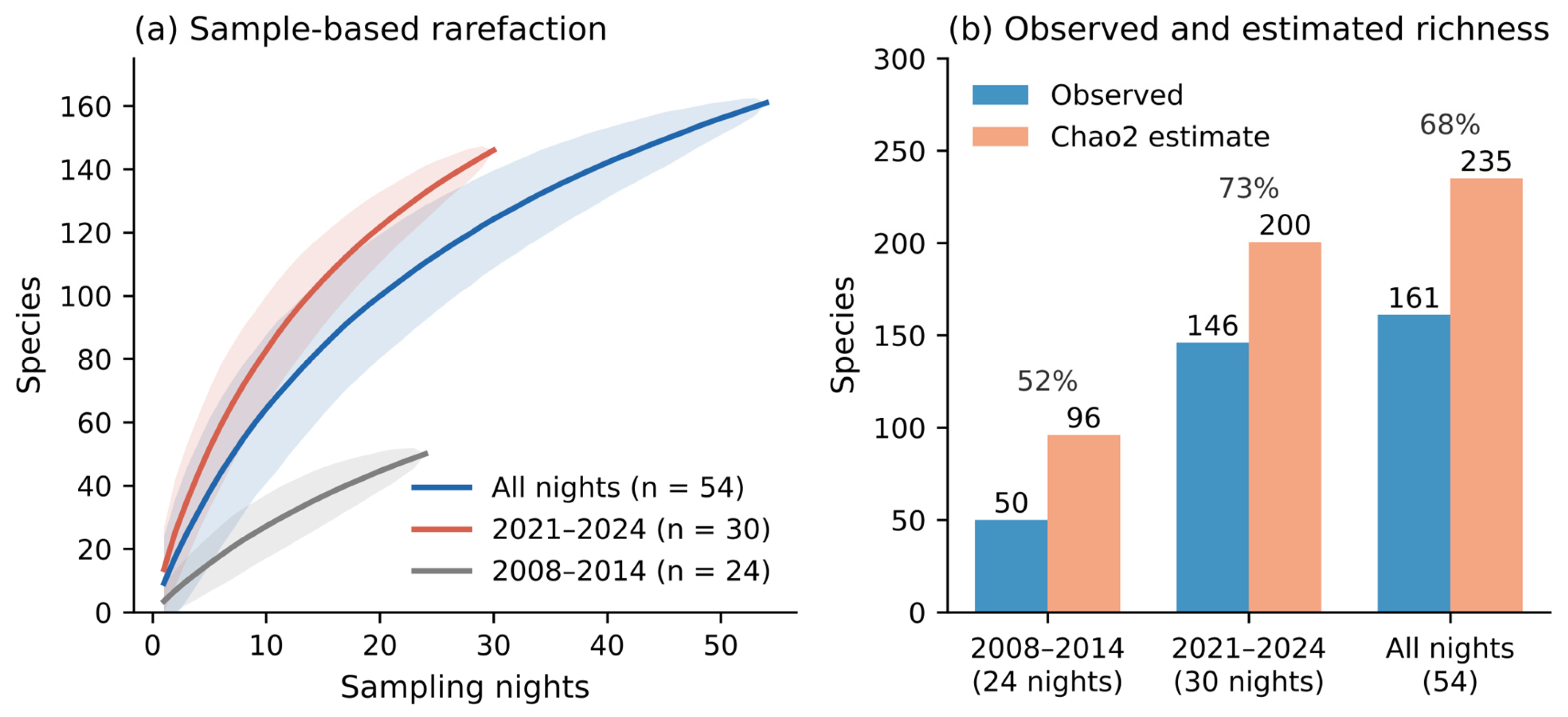
Sixty-five of the 161 species were taken on only one of the 54 nights and 28 on two. Restricted to the 30 nights of 2021–2024, the Chao2 estimator gives 200 species against 146 observed, so that roughly three-quarters of the fauna likely to be present has been recorded (Figure 2). Applied to all 54 nights, the estimator gives 235 against 161 observed, the inflation coming from the singletons contributed by the earlier, incompletely determined material. The rarefaction curve for the 24 nights of 2008–2014 flattens at 50 species, of which 31 are known from a single night; a singleton proportion of 62% over 24 nights is implausible for a fauna of this kind and reflects incomplete determination rather than genuine rarity. Because roughly a quarter of the fauna remains unrecorded and the localities were not sampled repeatedly, the patterns reported in the following sections are descriptive.
Figure 2.
Completeness of the Pyraloidea inventory. (a) Sample-based rarefaction curves for all 54 sampling nights and for the two collecting periods separately, with 95% confidence bands from 1000 randomizations of sample order. (b) Observed species richness and the incidence-based Chao2 estimate for the same three sets of nights, with the percentage of the estimated fauna recorded above each pair of bars.
3.2. Composition of the Fauna
The survey yielded 492 occurrence records of 1330 specimens, representing 161 species in 91 genera. The two families are almost equally represented, with 78 species of Pyralidae and 83 of Crambidae. The Phycitinae are by far the largest subfamily, with 61 species in 35 genera, followed by the Crambinae (23 species, 14 genera) and the Spilomelinae (22 species, 12 genera); the Scopariinae contribute 10 species in only two genera, and the Schoenobiinae a single species. Of the 161 species, 129 are identified with confidence and are listed in Table 2; the 32 provisional identifications (30 in genera requiring genitalic examination and two provisional on other grounds; Section 2.3) are listed separately in Table S1.
Table 2.
Checklist of the Pyraloidea identified with confidence (provisional identifications are listed in Table S1). Species are arranged by family and subfamily and alphabetically within each subfamily. Symbols after the name: *, new record for Mersin Province; a, known from a single record; b, reported by [13] in an unpublished thesis but not in any published source. Combinations used in the source theses that differ from the current one are given in square brackets. “Months” gives the months of collection (Roman numerals) and “Locality numbers” refers to Table 1; the date, number of individuals, and coordinates of every record are given in File S1. Family and subfamily headings are shown in bold.
The catch is dominated by a small number of species. Udea ferrugalis (Hübner, 1796) alone accounts for 243 of the 1330 specimens (18.3%), followed by Endotricha flammealis ([Denis & Schiffermüller], 1775) (97 specimens), Metasia ophialis (Treitschke, 1829) (81), Eudonia lacustrata (Panzer, 1804) (61) and Palpita vitrealis (Rossi, 1794) (46); the ten commonest species together account for 678 specimens (51.0%). At the other extreme, 44 species are known from a single specimen and 67 from a single locality.
3.3. New Records for Mersin Province
Seventy-seven of the 161 species are reported here for the first time from Mersin Province (Table 2), based on the criteria set out in Section 2.4.
The sources other than the national catalogue changed the count as follows. Eight species absent from the 2018 catalogue had already been published from Anamur, three of them explicitly as new to the provincial fauna. Ectomyelois ceratoniae (Zeller, 1839) and Cryptoblabes gnidiella (Millière, 1867) have been recorded from citrus and pomegranate orchards in the province by agricultural entomologists [14,15]. Four species (Angustalius malacellus (Duponchel, 1836), Metacrambus carectellus (Zeller, 1847), Pediasia luteella ([Denis & Schiffermüller], 1775) and Udea prunalis ([Denis & Schiffermüller], 1775)) appear in the thesis [13] but in no published source; they are retained as first published records and are marked accordingly in Table 2.
The new records are not evenly distributed among the subfamilies: 28 are Phycitinae and 16 Crambinae, together more than half of the total. Eight of the nine species of Acrobasis and all four of Evergestis recorded here are new to the province. Thirty-six of the seventy-seven rest on a single record and are marked as such.
Staudinger [9] recorded eleven species of Pyraloidea from localities within the province. Four of them are in the present list: Laristania lydella, which is therefore not counted as new, and Euchromius bella (Hübner, 1796), Tretopteryx pertusalis (Geyer, 1832) and Pyrausta falcatalis Guenée, 1854, which had in any case already been recorded from the province in other sources. Two further species of the present list, Pyrausta ostrinalis (Hübner, 1796) and Mecyna flavalis ([Denis & Schiffermüller], 1775), were recorded by him from the Taurus and are not counted as new (Section 2.4). The seven species recorded by Staudinger but not found in the present survey are considered in Section 4.3.
3.4. Taxonomic and Nomenclatural Notes
No new nomenclatural acts are proposed here: all names and combinations used are available and have been published previously, and their status follows GlobIZ [2]. Checking every name against GlobIZ altered 28 entries relative to the source theses [28,29,30,31]. Five species are placed in genera other than those under which they had been listed, and the author and date are cited in parentheses because the current genus differs from the original one (Article 51.3 [37]): Laodamia combustella (Herrich-Schäffer, [1855]) (previously as Alophia combustella), Chrysocramboides craterella (Scopoli, 1763) (as Chrysocrambus craterella), Ectomyelois ceratoniae (Zeller, 1839) (as Apomyelois ceratoniae), Myelopsis tetricella ([Denis & Schiffermüller], 1775) (as Episcythrastis tetricella) and Thopeutis cicatricella (Hübner, [1824]) (as Friedlanderia cicatricella). One instance of synonymy is applied: Pyrausta neglectalis Caradja, 1916 was placed as a junior subjective synonym of Pyrausta virginalis Duponchel, 1832 by Agenjo [42], and under the Principle of Priority (Article 23) the older name is valid; the records of the two were therefore merged. The remaining 22 changes correct the spelling of names, the authorship or date, or the use of parentheses. The earlier combinations are given against each species in Table 2 because much of the regional literature uses them.
3.5. Distribution Along the Elevational Gradient
Because the inventory is incomplete (Section 3.1), the patterns in this section are provisional; they are summarized mainly at the level of elevational belts, pooling the localities within each belt. The number of species recorded rises with elevation across the four belts: 37 below 400 m, 55 between 401 and 800 m, 74 between 801 and 1200 m and 110 above 1200 m (Table 3). Sampling effort, however, also rises (12, 14, 11 and 17 nights; 8, 14, 8 and 15 localities), and a negative binomial model of the number of species per night against elevation and sampling month, fitted to the 30 nights of 2021–2024, gave no significant effect of elevation (β = 0.344, SE = 0.238, p = 0.149); adding the district as a term did not change this (β = 0.305, p = 0.211). The apparent increase in richness with elevation is therefore reported as an observation, not as a tested result.
Table 3.
Distribution among elevational belts. Sampling effort is given as the number of localities and the number of sampling nights falling within each belt. “Exclusive species” is the number recorded in that belt only; 72 species occur in more than one belt.
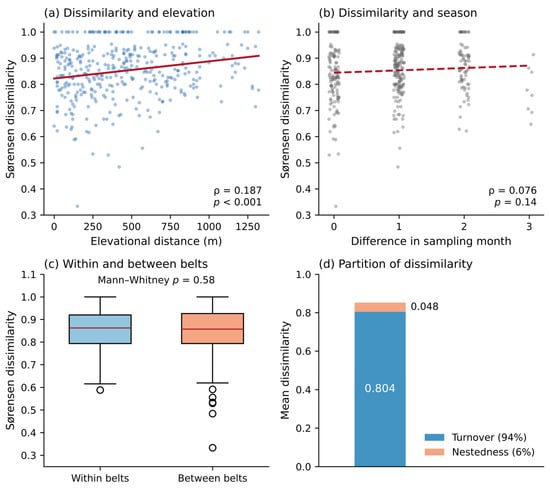
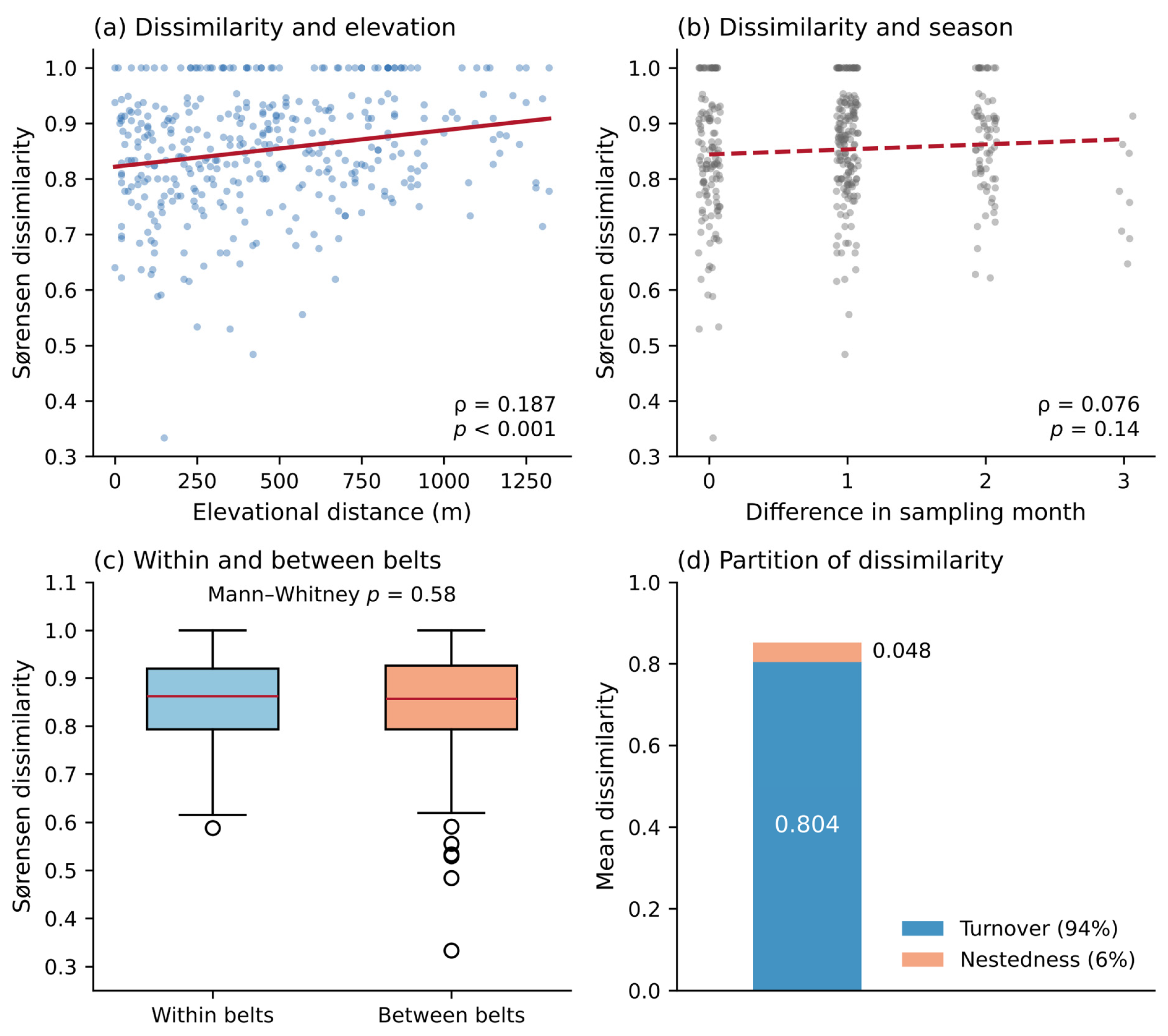
Compositional turnover showed a weak but consistent pattern. Across the 378 pairs of sampling events from the 28 nights analyzed, the Sørensen dissimilarity increased with the elevational distance between the events (Spearman ρ = 0.187, p = 2.5 × 10⁻⁴). The effect is not attributable to season: dissimilarity was unrelated to the difference in sampling month (ρ = 0.076, p = 0.14), and controlling for month left the elevational correlation essentially unchanged (partial ρ = 0.178). Dissimilarity was high throughout, averaging 0.852, and did not differ between pairs within the same belt and pairs in different belts (0.847 against 0.855, Mann–Whitney p = 0.58), suggesting that turnover is gradual rather than organized into discrete belts (Figure 3).
Figure 3.
Compositional turnover, from 378 pairs of the 28 sampling events analyzed. Each point is one pair of sampling events. (a) Sørensen dissimilarity against the elevational distance between events; the red line is a least-squares fit (dashed in (b), where the correlation is not significant). (b) The same against the difference in sampling month; the points are jittered horizontally for visibility. (c) Dissimilarity within (blue) and between (orange) elevational belts; boxes show the interquartile range, the red line the median, whiskers extend to 1.5 times the interquartile range, and circles are outlying values. (d) Partition of the mean total Sørensen dissimilarity (0.852) into its turnover (blue) and nestedness (orange) components following Baselga [40]. Statistics are Spearman rank correlations in (a,b) and a Mann–Whitney test in (c).
Partitioning the total dissimilarity into its components shows that the difference between assemblages is almost entirely one of species replacement rather than of impoverishment. Of a mean total dissimilarity of 0.852, the turnover component accounts for 0.804 (94%) and the nestedness component for only 0.048 (6%). The two components behave oppositely along the gradient: the turnover component increases with elevational distance (ρ = 0.177, p = 5.5 × 10⁻⁴) while the nestedness component decreases (ρ = −0.135, p = 0.009). Within the limits of the present sampling, the fauna of the upper belts thus appears to be a different assemblage rather than a depauperate subset of the lowland fauna.
Forty-six species were found only in the highest belt, against 17 confined to the 801–1200 m belt, 16 to the 401–800 m belt and 10 to the lowest; 72 species occur in more than one belt (Table 3). The species confined to the upper belt include most of the specialized Phycitinae of dry karstic grassland, while the lowest belt, almost entirely under irrigated cultivation and urban expansion, holds mainly species of disturbed and cultivated ground. The proportions of the larger subfamilies also shift with elevation: the Phycitinae rise from 35% of the species in the lowest belt to 42% in the highest, while the Spilomelinae fall from 27% to 13% (computed from the species lists in Table 2 and Table S1).
4. Discussion
4.1. Limitations
Sampling: Effort was not standardized. Collecting took place on 54 nights between 2008 and 2024, spread over nine sampling years with long gaps, and 35 of the 54 nights fell in July–September. Only one locality was worked per night, and 38 of the 45 localities were worked on a single night, five on two and two on three. The material from 2008–2014 was, moreover, not worked up as fully as the more recent collections, so that the early nights are represented by fewer species than the later ones. For these reasons the data are presented as a faunistic inventory and as an occurrence dataset, and no quantitative comparison is drawn between the two districts or between seasons. The consequences of this for the richness estimate are set out in Section 3.1, and the diversity and distributional patterns discussed below should be read as provisional.
Identification: Genitalic dissection could not be undertaken in the present study, and this is the principal limitation of the work. The 30 provisional species (84 records, 218 specimens; Section 2.3), reported at the level of reliability that external characters allow, are listed separately in Table S1, flagged in File S1, and excluded from the count of new provincial records; all are preserved as vouchers in ENTOLAB and remain available for re-examination. Two further species are provisional on different grounds. Kemal et al. [19] describe Elegia feminina Kemal, Kızıldağ & Koçak, 2020 from Anamur and state that the specimen concerned had previously been identified as E. fallax (Staudinger, 1881) on external similarity alone; the two records of E. fallax reported here were determined in the same way. The same authors describe their identification of Mecyna trinalis ([Denis & Schiffermüller], 1775) as temporary and note that the Taurus populations of the genus require examination of the genitalia and of genetic distances; the eight records here come from the same range.
4.2. Richness of the Fauna and Its Possible Causes
With 161 species from two districts, this is among the larger regional pyraloid lists from Türkiye, where comparable surveys have reported between 15 and 193 species [10,11,12,13,20]. Three features of the study area probably contribute to this. The first is the length of the elevational gradient: within a horizontal distance of about 50 km, the localities span 1650 m of elevation and the full sequence of vegetation belts, from irrigated lowland to oro-Mediterranean conifer forest and karstic grassland [8]. Within the limits of the present sampling, the fauna appears to change along this gradient by replacement rather than by loss: 94% of the dissimilarity between sampling events was due to turnover, and 89 of the 161 species were recorded in a single belt (Section 3.5). Along such a gradient, each belt can contribute species of its own, so that the list for the two districts combines several partly distinct assemblages. The second is the biogeographical position of the region, where Mediterranean and Irano-Turanian influences meet [6]. The list combines widespread Palaearctic species with species whose type localities lie in Anatolia, the Levant or Central Asia (Section 4.5). The third is historical rather than biological. Before the present work, the provincial record consisted of the few nineteenth-century records summarized by Staudinger [9], which come from Mersin itself, Gülek and Karlı Boğaz, the two lists for Anamur [19,21], an unpublished thesis [13] and the applied literature [14,15,16]. None of these sources concern the central districts, and the light trap had hardly been used in them; the large number of new provincial records most likely reflects this gap in collecting rather than any peculiarity of the fauna.
The only comparable survey from the Turkish Mediterranean is that of Şen and Akın [20], who worked the Köprülü Canyon National Park in Antalya Province with light traps between 2022 and 2024 and recorded 88 species from 24 localities between 127 and 1459 m. Forty-five species are common to the two lists, and in both, the Phycitinae are by far the largest subfamily (61 species here, 44 at Köprülü Canyon). The difference in species number cannot be attributed to a single factor, because the surveys differ in the number of localities, elevational range, collecting period and sampling design. Şen and Akın used genital preparations and could report species of Ephestia, Epischnia, Phycitodes and Cadra without qualification, whereas the corresponding records here are provisional. In both provinces, the proportion of new records was high (72 of 88 there, 77 of 161 here), which suggests that provincial lists for this superfamily in Türkiye still rest on very little collecting.
4.3. Nineteenth-Century Records Not Found in the Present Survey
Seven species recorded from Mersin Province by Staudinger [9] were not found in the present survey. Their absence from the present material does not show that they no longer occur in the province: most were recorded from “Mersin”, which in the nineteenth century referred to the town and its surroundings, or from the Taurus passes at Gülek and Karlı Boğaz, which lie outside the study area. They are listed below with the name used by Staudinger and the source of the record in parentheses.
Ancylolomia disparalis Hübner, 1825 (as Ancylolomia contritella; Crambus contritellus Zeller, 1847 is a junior synonym of A. disparalis [2]; Mersin, leg. Kindermann).
Ancylolomia tentaculella (Hübner, 1796) (as Ancylolomia tentaculella; Mersin, leg. Kindermann).
Agriphila tersellus (Lederer, 1855) (as Orenaia tersellus; Mersin, leg. Kindermann).
Myelois circumvoluta (Geoffroy, 1785) (as Myelois cribrum; Mersin, Lederer). The identity is probable rather than certain: Tinea cribrella Hübner, 1796 is a synonym of M. circumvoluta in GlobIZ [2], but the name cribrum is not listed there.
Myelois fuscicostella Mann, 1861 (as Myelois fuscicostella; Gülek [“Külek”], Lederer).
Mecyna subsequalis (Herrich-Schäffer, 1855) (as Botys subsequalis; Karlı Boğaz [“Karli Boghas”], Lederer).
Evergestis sophialis (Fabricius, 1787) (as Orobena sophialis; Karlı Boğaz [“Karli Boghas”], Lederer).
4.4. Species of Economic Importance
Nine of the 161 species are treated as pests in the sources cited here, and they fall into three groups. The stored-product species are Aphomia cephalonica (Stainton, 1866), Cadra cautella (Walker, 1863), C. figulilella (Gregson, 1871), Ephestia elutella (Hübner, 1796) and E. kuehniella Zeller, 1879 [5]; the last four are among the provisional identifications. All were taken at light in the field, at elevations between 400 and 1320 m, rather than in stores, and each is represented by one to four specimens. The orchard pests are Ectomyelois ceratoniae and Cryptoblabes gnidiella, known from citrus, pomegranate and persimmon orchards in the region [14,15,16], and Palpita vitrealis (Rossi, 1794), reported as P. unionalis from olive nurseries and orchards [43]. The first two were taken at only three localities between 855 and 1590 m (two specimens of each), whereas P. vitrealis was among the five commonest species in the catch (46 specimens in 15 records, 150–1700 m). The field-crop pest Loxostege sticticalis, known from forage crops elsewhere in Türkiye [18], was recorded three times between 855 and 1700 m. Two of the nine, A. cephalonica and L. sticticalis, are new to the province.
For agriculture and storage, the value of these records lies less in the pest species themselves, which are well known, than in documenting their occurrence outside crops and stores. Stored-product moths and orchard pests were caught at light in semi-natural habitats well above the cultivated plain, which shows that they occur there independently of the commodities on which they are pests; whether these populations contribute to infestations in orchards and stores cannot be judged from light-trap data. The records of A. cephalonica and L. sticticalis, both new to the province, may be of interest to plant protection services in the region. The remaining 152 species are not treated as pests in the literature cited here, and they make up the bulk of the fauna in every belt.
4.5. Species Described from Anatolia
Ten of the species recorded here were described from Anatolian type localities: Cadra delattinella Roesler, 1965 (Akşehir), Elegia fallax (Staudinger, 1881) (Amasya), Ephelis cruentalis (Geyer, 1832) (İzmir), Euclasta splendidalis (Herrich-Schäffer, 1848) (Asia Minor), Phycitodes inquinatella (Ragonot, 1887) (Kahramanmaraş), Polyocha venosa (Zeller, 1847) (Asia Minor), Scotomera caesarealis (Ragonot, 1891) (Kayseri), Taftania serratella (Ragonot, 1893) (Mardin), Tegostoma lepidalis (Herrich-Schäffer, 1851) (Amasya) and Zophodiodes leucocostella Ragonot, 1887 (Amasya). These localities are not centers of endemism but places where nineteenth-century collectors worked or through which they passed, and the pattern reflects the itineraries of Staudinger, Mann, Lederer and their contemporaries rather than any biological concentration.
Four of the ten (Scotomera caesarealis (Ragonot, 1891), Taftania serratella (Ragonot, 1893), Tegostoma lepidalis (Herrich-Schäffer, 1851) and Zophodiodes leucocostella Ragonot, 1887) are reported here for the first time from Mersin Province, and a fifth, Cadra delattinella Roesler, 1965, would have been, were it not among the species left provisional.
4.6. Conservation
The species of conservation interest are largely distinct from the pest species and are concentrated in the upper belt: 46 species were recorded only above 1200 m, many of them phycitines of dry karstic grassland, and most of them are known from one or two records. Three of the 46 are stored-product or orchard pests known from single records; the remaining 43 include no species treated as pests in the sources cited here. None of the 45 localities lie within a protected area, and neither Erdemli nor Mezitli contains a protected area designated under the Turkish protected-area system. The upper belt is at the same time the part of the gradient most exposed to the expansion of summer settlements, road building and grazing, and the lowest belt has been almost entirely converted to irrigated cultivation and urban land. Without population data the present records cannot establish whether any species is declining; their value for conservation lies in providing a dated and georeferenced baseline (File S1) against which future change at the same localities can be measured, and in identifying the upper belt, with its concentration of rarely recorded species, as the part of the gradient in which repeated sampling would be most informative.
5. Conclusions
The Pyraloidea of Erdemli and Mezitli comprise at least 161 species, seventy-seven of them not previously recorded from Mersin Province; seven further species recorded from the province in the nineteenth century were not found. The richness of the fauna appears to reflect a steep elevational gradient along which species are replaced rather than lost, together with the near absence of earlier collecting in the central districts of the province; because about a quarter of the fauna remains unrecorded, these patterns are provisional. Thirty-two species await confirmation, thirty of them by genitalic examination. Nine species are pests of stored products, orchards or field crops, and two of them, Aphomia cephalonica and Loxostege sticticalis, are new to the province. The species confined to the upper belt, which lies outside any protected area, are of particular faunistic and conservation interest, and the georeferenced records published here provide a baseline for future monitoring.
Supplementary Materials
The following supporting information can be downloaded at: https://www.mdpi.com/article/10.3390/d18110667/s1, File S1: Occurrence dataset; File S2: Analysis code; Table S1: Provisional identifications.
Author Contributions
Conceptualization, Y.H.; methodology, Y.H.; software, Y.H.; formal analysis, Y.H.; investigation, Y.H., E.K., A.K., S.A. and E.B.; resources, E.K., A.K., S.A. and E.B.; data curation, Y.H., E.K., A.K., S.A. and E.B.; writing—original draft preparation, Y.H.; writing—review and editing, E.K., A.K., S.A. and E.B.; visualization, Y.H.; supervision, Y.H.; project administration, Y.H.; funding acquisition, Y.H. All authors have read and agreed to the published version of the manuscript.
Funding
This research was supported in part by the Scientific Research Projects Unit of Mersin University (Project Numbers: 2021-1-TP2-4326, 2021-2-TP2-4521, 2022-1-TP2-4701, 2023-2-TP2-4962).
Institutional Review Board Statement
Not applicable.
Data Availability Statement
All occurrence records underlying the study are provided in Supplementary File S1, in Darwin Core format. The analysis code is provided in Supplementary File S2. Voucher specimens are deposited in the Entomological Research Laboratory (ENTOLAB), Department of Biology, Mersin University.
Acknowledgments
The authors thank Serdar Sönmez for preparing Figure 1. The fieldwork and the identification of the material were carried out at Mersin University, where all five authors were based at the time. During the preparation of this manuscript, the authors used Claude Opus 5.5 (Anthropic) for the purposes of drafting and editing the English text, compiling and checking the occurrence dataset, producing Figure 2 and Figure 3, and writing the code used for the statistical analyses (File S2). All taxonomic decisions, identifications, verification against the primary literature and interpretation of the results are the authors’ own. The authors have reviewed and edited the output and take full responsibility for the content of this publication.
Conflicts of Interest
The authors declare no conflicts of interest.
References
- van Nieukerken, E.J.; Kaila, L.; Kitching, I.J.; Kristensen, N.P.; Lees, D.C.; Minet, J.; Mitter, C.; Mutanen, M.; Regier, J.C.; Simonsen, T.J.; et al. Order Lepidoptera Linnaeus, 1758. In Animal Biodiversity: An Outline of Higher-Level Classification and Survey of Taxonomic Richness; Zhang, Z.-Q., Ed.; Zootaxa: Auckland, New Zealand, 2011; Volume 3148, pp. 212–221. [Google Scholar] [CrossRef] [Scilit]
- Nuss, M.; Landry, B.; Mally, R.; Vegliante, F.; Tränkner, A.; Bauer, F.; Hayden, J.; Segerer, A.; Schouten, R.; Li, H.; et al. Global Information System on Pyraloidea, 2003–2024. Available online: www.pyraloidea.org (accessed on 10 July 2026).
- Munroe, E.; Solis, M.A. The Pyraloidea. In Lepidoptera, Moths and Butterflies, Volume 1: Evolution, Systematics, and Biogeography; Kristensen, N.P., Ed.; Handbook of Zoology; Part 35; Walter de Gruyter: Berlin, Germany; New York, NY, USA, 1999; Volume IV, pp. 233–256. [Google Scholar]
- Mey, W.; Speidel, W. Global diversity of butterflies (Lepidotera) in freshwater. Hydrobiologia 2008, 595, 521–528. [Google Scholar] [CrossRef] [Scilit]
- Hagstrum, D.W.; Klejdysz, T.; Subramanyam, B.; Nawrot, J. Atlas of Stored-Product Insects and Mites; AACC International: St. Paul, MN, USA, 2013. [Google Scholar]
- Şekercioğlu, Ç.H.; Anderson, S.; Akçay, E.; Bilgin, R.; Can, Ö.E.; Semiz, G.; Tavşanoğlu, Ç.; Yokeş, M.B.; Soyumert, A.; İpekdal, K.; et al. Turkey’s globally important biodiversity in crisis. Biol. Conserv. 2011, 144, 2752–2769. [Google Scholar] [CrossRef] [Scilit]
- Koçak, A.Ö.; Kemal, M. A Synonymous and Distributional List of the Species of the Lepidoptera of Turkey; Centre for Entomological Studies Ankara: Ankara, Türkiye, 2018; 489p. [Google Scholar]
- Atalay, İ. Vegetation Geography of Turkey; Ege Üniversitesi Basımevi: İzmir, Türkiye, 1994; 352p. [Google Scholar]
- Staudinger, O. Lepidopteren-Fauna Kleinasien’s (Fortsetzung). Horae Soc. Entomol. Ross. 1880, 15, 159–435. [Google Scholar]
- Atay, E. Hatay İlinde Bulunan Pyraloidea (Lepidoptera) Faunası Üzerine Taksonomik-Sistematik Çalışmalar. Master’s Thesis, Mustafa Kemal University, Hatay, Türkiye, 2000. (In Turkish) [Google Scholar]
- Aytekin, H.U.; Kütük, M. Gaziantep İli Crambidae (Lepidoptera: Pyraloidea) Faunasının Belirlenmesi. Kafkas Üniv. Fen Bilim. Enst. Derg. 2011, 4, 9–16. (In Turkish) [Google Scholar]
- Akın, K. Mutki İlçesi (Bitlis) Pyralidae (Lepidoptera) Faunası ve Ekolojisi Üzerine Araştırmalar. Ph.D. Thesis, Van Yüzüncü Yıl University, Graduate School of Natural and Applied Sciences, Van, Türkiye, 2014. (In Turkish) [Google Scholar]
- Atay, E. Adana, Mersin, Osmaniye İllerinde Bulunan Pyraloidea (Lepidoptera) Faunası Üzerine Taksonomik ve Sistematik Çalışmalar. Ph.D. Thesis, Çukurova University, Adana, Türkiye, 2005. (In Turkish) [Google Scholar]
- Öztürk, N.; Ölçülü, M.; Ulusoy, M.R. Adana ve Mersin ili turunçgil bahçelerinde harnup güvesi [Ectomyelois ceratoniae Zell. (Lepidoptera: Pyralidae)]’nin ergin popülasyon değişimi. Bitki Koruma Bülteni 2011, 51, 347–358. (In Turkish) [Google Scholar]
- Öztürk, N.; Ulusoy, M.R. Determination of adult population dynamics and generation number of honeydew moth, Cryptoblabes gnidiella Millière, 1867 (Lepidoptera: Pyralidae), in pomegranate orchards in the Eastern Mediterranean Region. Türk. Entomol. Derg. 2012, 36, 101–112. [Google Scholar]
- Elekçioğlu, N.Z. Adana’da Trabzon hurması bahçelerinde portakal güvesi [Cryptoblabes gnidiella Millière, 1867 (Lepidoptera: Pyralidae)]’nin popülasyon değişimi, zarar oranı ve mücadelesi. Çukurova Tarım Gıda Bilim. Derg. 2019, 34, 149–160. (In Turkish) [Google Scholar] [CrossRef] [Scilit]
- Sertkaya, E.; Akmeşe, V.; Atay, E. Türkiye’de mısırda yeni bir zararlı, Chilo partellus (Swinhoe) (Lepidoptera: Crambidae). Türk. Entomol. Bült. 2014, 4, 197–200. (In Turkish) [Google Scholar] [CrossRef] [Scilit]
- Kaçar, G.; Atay, E.; Koca, A.S.; Şahin, B. New distribution areas and identification characters of Loxostege sticticalis L. (Lepidoptera: Crambidae). Mustafa Kemal Univ. J. Agric. Sci. 2023, 28, 153–165. [Google Scholar] [CrossRef] [Scilit]
- Kemal, M.; Kızıldağ, S.; Koçak, A.Ö. Annotated list of the Heterocera (Lepidoptera) of Anamur district (İçel Province, South Turkey) with description of a new species. Priamus 2020, 19, 1–72. [Google Scholar]
- Şen, M.M.; Akın, K. Studies on the fauna of Pyraloidea (Lepidoptera) of Köprülü Canyon National Park (Antalya). Bitlis Eren Üniv. Fen Bilim. Derg. 2025, 14, 1655–1671. [Google Scholar] [CrossRef] [Scilit]
- Kemal, M.; Koçak, A.Ö. Annotated list of the moth fauna of Anamur district (İçel Prov., South Turkey), with descriptions of new species. Misc. Pap. Cent. Entomol. Stud. Ank. 2018, 167, 1–45. [Google Scholar]
- Fleischmann, M.; Van den Bossche, J.; Jordahl, K.; Richards, M.J.; McBride, J.; Wasserman, J.; Ward, B.; Wolf, L.J. GeoPandas: Fundamental data structures for vector spatial data in Python. Comput. Environ. Urban Syst. 2026, 130, 102495. [Google Scholar] [CrossRef] [Scilit]
- McKinney, W. Data structures for statistical computing in Python. In Proceedings of the 9th Python in Science Conference, Austin, TX, USA, 28 June–3 July 2010; van der Walt, S., Millman, J., Eds.; pp. 56–61. [Google Scholar] [CrossRef] [Scilit]
- Hunter, J.D. Matplotlib: A 2D graphics environment. Comput. Sci. Eng. 2007, 9, 90–95. [Google Scholar] [CrossRef] [Scilit]
- ttezer. Türkiye Harita verisi: Administrative Boundary Data for Türkiye. GitHub Repository, 2026. Available online: https://github.com/ttezer/turkiye-harita-verisi (accessed on 3 September 2026).
- Harrower, M.; Brewer, C.A. ColorBrewer.org: An online tool for selecting colour schemes for maps. Cartogr. J. 2003, 40, 27–37. [Google Scholar] [CrossRef] [Scilit]
- Brewer, C.A.; Hatchard, G.W.; Harrower, M. ColorBrewer in print: A catalog of color schemes for maps. Cartogr. Geogr. Inf. Sci. 2003, 30, 5–32. [Google Scholar] [CrossRef] [Scilit]
- Kılıç, A. Mersin İli Erdemli İlçesi Pyralidae (Lepidoptera) Familyası Üzerine Faunistik ve Taksonomik Araştırmalar. Master’s Thesis, Mersin University, Mersin, Türkiye, 2022. (In Turkish) [Google Scholar]
- Kılıç, E. Mersin İli Erdemli İlçesi Crambidae (Lepidoptera) Familyası Üzerine Faunistik ve Taksonomik Araştırmalar. Master’s Thesis, Mersin University, Mersin, Türkiye, 2022. (In Turkish) [Google Scholar]
- Atak, S. Mersin İli Mezitli İlçesi Crambidae (Lepidoptera) Familyası Üzerine Faunistik ve Taksonomik Araştırmalar. Master’s Thesis, Mersin University, Mersin, Türkiye, 2024. (In Turkish) [Google Scholar]
- Bahçeci, E. Mersin İli Mezitli İlçesi Pyralidae (Lepidoptera) Familyası Üzerine Faunistik ve Taksonomik Araştırmalar. Master’s Thesis, Mersin University, Mersin, Türkiye, 2025. (In Turkish) [Google Scholar]
- Slamka, F. Pyraloidea of Europe, Volume 1: Pyralinae, Galleriinae, Epipaschiinae, Cathariinae, Odontiinae; František Slamka: Bratislava, Slovakia, 2006; 138p. [Google Scholar]
- Slamka, F. Pyraloidea of Europe, Volume 2: Crambinae and Schoenobiinae; František Slamka: Bratislava, Slovakia, 2008; 224p. [Google Scholar]
- Slamka, F. Pyraloidea of Europe, Volume 3: Pyraustinae and Spilomelinae; František Slamka: Bratislava, Slovakia, 2013; 357p. [Google Scholar]
- Slamka, F. Pyraloidea of Europe, Volume 4: Phycitinae, Part 1; František Slamka: Bratislava, Slovakia, 2019; 432p. [Google Scholar]
- Goater, B.; Nuss, M.; Speidel, W. Pyraloidea I (Crambidae: Acentropinae, Evergestinae, Heliothelinae, Schoenobiinae, Scopariinae). In Microlepidoptera of Europe; Huemer, P., Karsholt, O., Eds.; Apollo Books: Stenstrup, Denmark, 2005; Volume 4, 304p. [Google Scholar]
- International Commission on Zoological Nomenclature. International Code of Zoological Nomenclature, 4th ed.; International Trust for Zoological Nomenclature: London, UK, 1999. [Google Scholar]
- Kemal, M.; Koçak, A.Ö. On the Phycitinae of Turkey: Updated synonymic and distributional list of species (Lepidoptera) with some remarks. Priamus 2020, 18, 130–154. [Google Scholar]
- Chao, A. Estimating the population size for capture–recapture data with unequal catchability. Biometrics 1987, 43, 783–791. [Google Scholar] [CrossRef] [Scilit]
- Baselga, A. Partitioning the turnover and nestedness components of beta diversity. Glob. Ecol. Biogeogr. 2010, 19, 134–143. [Google Scholar] [CrossRef] [Scilit]
- Harris, C.R.; Millman, K.J.; van der Walt, S.J.; Gommers, R.; Virtanen, P.; Cournapeau, D.; Wieser, E.; Taylor, J.; Berg, S.; Smith, N.J.; et al. Array programming with NumPy. Nature 2020, 585, 357–362. [Google Scholar] [CrossRef] [Scilit]
- Agenjo, R. Las Pyrausta melanalis Caradja, 1916 y neglectalis Caradja, 1916 descritas de Cuenca, nuevas sinónimas, respectivamente, de Pyrausta purpuralis (Linneo, 1758) y Syllythria virginalis (Duponchel, 1831). Eos Rev. Esp. Entomol. 1974, 50, 7–18. (In Spanish) [Google Scholar]
- Yilmaz, Ç.; Genç, H. Determination of the life cycle of the olive fruit leaf moth, Palpita unionalis (Lepidoptera: Pyralidae) in the laboratory. Fla. Entomol. 2012, 95, 162–170. [Google Scholar] [CrossRef] [Scilit]

Disclaimer/Publisher’s Note: The statements, opinions and data contained in all publications are solely those of the individual author(s) and contributor(s) and not of MDPI and/or the editor(s). MDPI and/or the editor(s) disclaim responsibility for any injury to people or property resulting from any ideas, methods, instructions or products referred to in the content. |
© 2026 by the authors. Licensee MDPI, Basel, Switzerland. This article is an open access article distributed under the terms and conditions of the Creative Commons Attribution (CC BY) license.