


Abstract
Seagrass restoration seeks to recover vegetation, benthic biodiversity, and ecosystem functioning, but these components may recover at different rates. This critical narrative review synthesizes literature identified through 15 September 2026 on canopy-associated and sediment-dwelling fauna, relevant microbial interactions, habitat comparisons, experiments, restoration monitoring, and molecular surveys. Targeted searches and reference checking informed a thematic synthesis, supplemented by descriptive re-expression of published summary estimates and recovery observations. Evidence is dominated by temperate eelgrass and macrofaunal studies, with limited coverage of tropical systems and meiofauna. Seagrass meadows often support greater faunal abundance and diversity than unvegetated sediments, although responses vary with taxa, environmental context, spatial scale, and reference habitat. Some restored meadows rapidly attain community composition and functional traits resembling natural references, but other attributes remain distinct, persistence is uncertain, and no universal recovery timeline is supported. Similarity in community traits does not demonstrate recovery of grazing, secondary production, or nutrient exchange, which require process-specific evidence; carbon storage should be evaluated separately using measurements of carbon stocks and, where relevant, accumulation rates. Environmental DNA broadens detection but is constrained by transport, taxonomic assignment, and sampling completeness. We propose a recovery-assessment framework integrating habitat condition, taxonomic and functional community attributes, directly measured processes, appropriate references, uncertainty, and long-term monitoring. Conservation should preserve complementary meadow habitats and interactions with demonstrated ecological benefits.
1. Introduction
Seagrass meadows link vegetation, sediment, and the overlying coastal water. Their leaves offer attachment surfaces and shelter, while roots and rhizomes alter the physical and chemical environment occupied by sediment fauna [1]. These changes support organisms with contrasting feeding modes, body sizes, dispersal strategies, and sediment interactions. Benthic biodiversity is therefore both an outcome of habitat formation and a contributor to the processes that sustain a meadow. Assessments of seagrass meadow condition or restoration success based solely on vegetation extent may overlook associated fauna, while those relying on a single faunal diversity index may fail to capture both seagrass facilitation of benthic fauna and faunal feedbacks through grazing and bioturbation [2,3,4].
Seagrass decline is well documented, although the record of loss varies considerably across places and periods. Global compilations show substantial declines alongside local stabilization and recovery, but records remain sparse in West Africa, northeastern South America, and parts of Southeast Asia, and historical records before the 1940s are generally limited. Major reported drivers include coastal development and nutrient-driven deterioration of water quality. Following reductions in nutrient loading, seagrass recovery has been documented in Tampa Bay, whereas recovery trajectories have varied among regions of the Wadden Sea [5,6,7]. Trends from monitored meadows do not provide a complete account of changes in the world’s seagrasses, and an association with an environmental driver does not by itself establish causation. Similarly, differences in faunal biodiversity between seagrass meadows and unvegetated sediments vary among locations, so average results across studies may not reliably guide restoration at a particular site.
A key challenge in assessing seagrass restoration is that monitoring often focuses on vegetation extent, while restoration goals also include the recovery of benthic biodiversity and ecosystem processes. Following seagrass restoration, faunal abundance, species richness, and evenness may show different patterns of change, and unchanged species richness can mask the replacement of specialists by generalists. Trait diversity can change without a detectable alteration in the particular process measured, and a process can recover through compensating species even when composition differs from the reference. These differences may reflect distinct ecological responses and need to be considered when studies with different recovery measures are combined [8,9,10].
The expansion of seagrass restoration projects and the increasing use of molecular methods to monitor benthic biodiversity highlight the importance of distinguishing vegetation recovery, changes in benthic community attributes, and recovery of ecosystem processes. Recent studies report rapid recovery of several faunal attributes, showing that a prolonged biodiversity deficit is not inevitable [11,12]. Environmental DNA (eDNA) surveys can reveal taxa missed by conventional sampling, but eDNA detections alone cannot confirm that living benthic organisms have recolonized restored meadows. They should therefore complement conventional faunal surveys rather than serve as stand-alone evidence of biodiversity recovery [13,14].
We examine how seagrass habitat influences benthic biodiversity and how these communities contribute to ecosystem functioning through a critical narrative synthesis of observational habitat comparisons, manipulative experiments, and studies measuring ecosystem processes. We then assess the evidence for recovery after degradation or restoration, including the extent to which conclusions depend on observation methods. For each line of evidence, we ask which recovery outcomes were measured and which conclusions the study design supports. Specifically, the objectives are to (i) compare habitat-associated biodiversity responses, (ii) identify mechanisms linking benthic fauna to ecosystem processes, (iii) assess evidence for recovery following restoration, and (iv) evaluate how study design and observation methods influence these conclusions. These objectives inform the recovery-assessment framework proposed in Section 3.6.
Throughout the review, benthic biodiversity refers to the diversity of animal communities associated with the canopy, sediment surface, and sediment interior, including macrofauna (typically retained on a 0.5-mm sieve) and meiofauna (typically passing through a 0.5-mm sieve but retained on a 63-μm sieve). Microorganisms are discussed where they help explain sediment processes. Fish and other non-benthic consumers are considered where relevant to food-web interactions, nursery functions, or restoration evidence but are not included in the definition of benthic faunal biodiversity. Microbial sequence diversity and seagrass genetic diversity are treated separately.
Restoration is an intentional intervention to assist ecosystem recovery; recovery is ecological change toward an explicitly stated reference condition or set of objectives [15]. The intervention and its outcome should therefore be evaluated separately. Biodiversity encompasses variation in organisms and their attributes, whereas community composition identifies the taxa and their relative representation. Ecosystem functioning concerns processes such as production and nutrient transformation. Ecosystem services are benefits to people arising from ecological structures and processes and require a further link to beneficiaries or valued outcomes [3,4]. For example, animal biomass is a standing stock, secondary production is a rate, and a fishery benefit requires evidence connecting production to harvested populations. Recovery of a measured component is thus distinguished from recovery of the whole ecosystem.
2. Methodology
2.1. Review Design and Scope
This study is a critical narrative review rather than a systematic review or meta-analysis. Published evidence was organized around four questions: habitat-associated biodiversity responses, mechanisms linking benthic fauna to ecosystem processes, evidence for recovery after restoration, and the influence of study design and observation methods on interpretation. The review integrates observational habitat comparisons, manipulative experiments, restoration monitoring, published quantitative syntheses, and molecular surveys. It focuses on canopy-associated and sediment-dwelling fauna, while microbial observations, plant genetic diversity, and non-benthic consumers are considered where they provide relevant mechanistic or restoration context.
2.2. Literature Search and Selection
Literature was identified through targeted web searches, publisher websites, Crossref metadata, author repositories, and reference checking. Searches combined “seagrass” or “eelgrass” with terms including “benthic biodiversity”, “macrofauna”, “meiofauna”, “restoration”, “functional diversity”, “fragmentation”, and “environmental DNA”. Literature identification was completed on 15 September 2026, without an earliest-year restriction. The cited literature spans 1984–2026.
Sources were selected thematically based on their relevance to the review questions, considering focal organisms, habitat compartments, study design, response variables, and comparison or reference habitats. Primary studies provided empirical evidence, published syntheses offered broader context, and foundational reviews and methodological studies informed the interpretation of biodiversity, ecosystem functioning, recovery, and observation uncertainty. Selection was not restricted to restoration studies, as habitat comparisons and mechanistic experiments also contribute to understanding ecological recovery.
No prespecified exhaustive screening protocol or formal exclusion criteria were used. Accordingly, the cited literature represents a purposively selected evidence base for critical synthesis rather than a comprehensive inventory of all potentially relevant studies.
2.3. Data Analyses
2.3.1. Qualitative Evidence Synthesis
Reported findings were compared across ecological questions, biological compartments, study designs, response variables, reference habitats, and observation periods. Abundance, biomass, taxon richness, community composition, functional traits, directly measured ecosystem process rates, and temporal persistence were treated as distinct outcomes. Observational associations were distinguished from effects supported by manipulative experiments, and similarity in community composition or functional traits was not interpreted as evidence of ecosystem process recovery. For the selected restoration studies, information on study design, sampling units and replication, reference sites, focal organisms, measured endpoints, reported outcomes, and study-specific limitations was extracted and compared qualitatively.
2.3.2. Published Habitat Contrasts
Endpoint-specific log response ratios (ln RR) and their reported 95% confidence limits were extracted from published model summaries and author-deposited analysis outputs. Estimates and confidence limits were exponentiated separately to obtain seagrass-to-unvegetated ratios on the original response scale. The published effect counts (k) were retained for each endpoint but were not interpreted as numbers of independent studies. No new meta-analysis was fitted, and differences among endpoints were not statistically tested. Ratios of Shannon diversity indices were interpreted as index ratios rather than ratios of effective species numbers.
2.3.3. Recovery Observations
Reported restoration outcomes were compared according to restoration age or observation period, reference habitat, sampling unit, replication, measured endpoints, and study-specific restrictions, including sampling restricted to surviving plantings. Recovery outcomes were classified descriptively as reference-like, approaching reference conditions, or remaining intermediate, based on the original studies. These categories were not interpreted as evidence of statistical equivalence. Because the studies differed in design, endpoints, and reference conditions, reported observation periods were not combined to estimate a common recovery time.
2.3.4. Molecular Evidence and Conceptual Synthesis
Molecular findings were evaluated in relation to field and technical replication, taxonomic resolution, quality-control exclusions, and the ecological interpretation of waterborne DNA. Taxonomic records from archived molecular datasets were assessed according to identification resolution and sample support, without assuming that every detected taxon represented a resident benthic species. Thematic findings were subsequently integrated with biodiversity–ecosystem functioning theory and ecological restoration standards to develop a conceptual framework for recovery assessment. This synthesis was qualitative and did not involve statistical model fitting. Analytical approaches discussed as recommendations for future research were distinguished from analyses performed in the present review.
No new primary ecological data were collected. Descriptive transformations were based on published estimates and archived outputs, while statistical results from individual studies were reported as provided by the original authors unless otherwise specified. Descriptive data transformations and figures were prepared using Microsoft Excel for Microsoft 365 (Version 2610).
3. Results and Discussion
3.1. Limitations of the Review
The scope and interpretation of this synthesis are constrained by its narrative design. Targeted searches and thematic selection do not ensure exhaustive coverage, and literature omissions or selection bias cannot be excluded. The evidence discussed is dominated by temperate eelgrass systems and macrofauna, with more limited representation of tropical seagrasses and meiofauna. Consequently, patterns in the selected literature should not be treated as an unbiased estimate of their prevalence across all seagrass ecosystems.
Cross-study comparisons are also limited by differences in sampling compartments, taxonomic resolution, reference habitats, restoration methods, and monitoring duration. Observational habitat contrasts do not isolate vegetation effects, and chronosequences can confound restoration age with site. Recovery observations may concern only successful plantings or short intervals, while community attributes, ecosystem process rates, and persistence are not interchangeable endpoints. Figure 1 and Figure 2 therefore provide descriptive comparisons rather than new pooled effects, formal equivalence tests, or a universal recovery timetable. The following thematic synthesis interprets each finding within its study design and distinguishes published observations from our assessment recommendations.
3.2. Interpreting Benthic Biodiversity Responses
3.2.1. Response Variables and Sampling Comparability
This section examines how the choice of biodiversity metrics and sampling compartments affects the interpretation of published habitat comparisons and the selection of indicators for restoration monitoring. Published comparisons of seagrass and unvegetated habitats report several distinct faunal attributes. Density measures the concentration of individuals, while biomass also reflects differences in body size. Richness counts distinguishable taxa and is sensitive to sampling effort and taxonomic resolution. Evenness concerns the distribution of individuals among taxa. Community composition identifies which taxa are present, and beta diversity characterizes differences among samples or locations. Functional diversity describes variation in selected traits; it does not directly measure every ecosystem process associated with those traits [16,17,18].
Interpretation of these comparisons also depends on the part of the meadow sampled. Canopy epifauna include attached or mobile animals sampled from leaves and their surfaces; sediment-surface fauna and infauna occupy different physical environments even when collected inside the same meadow. Macrofauna and meiofauna are operational sampling categories whose boundaries depend on the retained size fraction. A canopy collection and a sediment core cannot be treated as interchangeable estimates of the same assemblage. Surveys across coastal habitats show that species-based and trait-based descriptions provide complementary information, while long-term eelgrass observations distinguish epifaunal from infaunal relationships with vegetation and environment [8,19]. A biodiversity comparison therefore needs information on the compartment sampled, area or volume, sediment depth, size threshold, and taxonomic resolution.
For restoration monitoring, the choice of indicator affects how progress toward recovery objectives is interpreted. An abundance increase driven by one opportunistic species may contribute substantially to prey production but little to taxonomic or functional breadth. A loss of rare taxa can reduce richness without strongly affecting an abundance-weighted index. Replacement of a large, deep-burrowing animal by several small surface dwellers may increase richness while changing sediment transport. Conversely, distinct communities can sustain similar aggregate rates if they contain species with overlapping effects. Selecting an index to answer a defined ecological question avoids treating the largest response among several measures as the criterion for success.
Hill numbers offer one means of expressing taxonomic diversity on a common effective-number scale: richness (q = 0) emphasizes all taxa, the exponential of Shannon entropy (q = 1) includes their proportional representation, and inverse Simpson concentration (q = 2) emphasizes common taxa [20,21]. However, conversion to a common numerical scale does not remove sampling bias or make different biological compartments interchangeable. A sample of sediment nematodes and a canopy sweep can have comparable effective diversity while representing different habitats, taxonomic resolution, and ecological processes. For recovery assessments, we recommend reporting all three orders (q = 0, 1, 2), with caution for q = 0 under incomplete sampling. Sample coverage should be estimated from abundance or incidence data, and diversity compared at a common attainable coverage using rarefaction/extrapolation (e.g., the R package iNEXT), with coverage estimates and confidence intervals reported. Table 1 summarizes the different types of evidence used to assess seagrass-associated benthic biodiversity and ecosystem recovery, distinguishing faunal community attributes from measured ecosystem processes and temporal persistence. Vegetation condition and microbial observations provide habitat or mechanistic context rather than direct measures of benthic faunal biodiversity.
Table 1.
Evidence types, assessment questions, and interpretive limitations for seagrass-associated benthic biodiversity and ecosystem recovery. Synthesis based on diversity, trait, and ecosystem-functioning frameworks [3,16,17,20,21].
Different sampling standards answer different ecological questions. Equal sampled area estimates biodiversity encountered in a fixed amount of habitat, whereas equal numbers of individuals compare assemblages at a common abundance. If vegetation increases animal density, these comparisons can yield different richness contrasts without either being erroneous. Coverage-based approaches instead compare samples at a similar estimated level of completeness [21]. For recovery assessments, the choice should follow the management question: biodiversity per unit restored area calls for equal-area comparisons; diversity at a fixed number of individuals calls for equal-individual comparisons; and diversity at comparable sampling completeness calls for coverage-based standardization. The selected standard and remaining sampling uncertainty should be reported. Pooling species-level identifications with unresolved higher taxa can further alter apparent richness; taxonomic records need to be harmonized consistently before differences are interpreted as ecological change.
Composition adds information that richness cannot supply. Two samples can contain the same number of taxa but share few of them, and an abundance-weighted comparison can emphasize dominant taxa while an incidence comparison gives greater influence to rare detections. Functional richness, evenness, and divergence likewise describe different aspects of a chosen trait space [18]. Their meaning depends on which traits are included, how categories are coded, and whether taxa with missing information are omitted. A restored community can appear functionally similar to a reference under a broad feeding-guild classification while differing in body size, burrowing depth, or mobility. When these traits affect the process under study, their differences remain relevant even if the overall index indicates similarity.
3.2.2. A Quantitative Contrast Among Endpoints
In a global meta-analysis of seagrass carbon storage, pollution mitigation, and benthic biodiversity enhancement, Piñeiro-Juncal et al. [22] reported separate habitat contrasts for several attributes of sediment-associated fauna. Re-expressing its published log response ratios as described in Section 2.3 gives seagrass-to-unvegetated ratios of 6.10 for biomass per area, 2.42 for density per area, and 1.81 for taxon richness. Ratios for the Shannon index and Pielou evenness are 1.24 and 1.04, respectively; the evenness confidence interval includes one (Figure 1). These values are derived from published model summaries and author-deposited outputs [23], rather than a new meta-analysis. They describe comparisons with adjacent unvegetated sediments and should not be generalized to every faunal compartment or interpreted as restoration effects.
Figure 1.
Descriptive replot of five published habitat-contrast estimates for sediment-associated fauna from Piñeiro-Juncal et al. [22,23], illustrating differences among measures of faunal quantity, taxonomic richness, and relative-abundance structure. Points and bars show exponentiated log response ratios and their reported 95% confidence limits; the dashed line marks a ratio of one. k is the number of endpoint effect sizes, not independent studies. The graph re-expresses published model summaries without fitting a new meta-analysis or testing differences among endpoints. A ratio of Shannon indices is not a ratio of effective species numbers. An interval including one does not establish equivalence, and these habitat contrasts do not measure recovery after restoration. Endpoints are arranged from top to bottom to reflect a descriptive ecological progression from community quantity (biomass and density), through taxonomic richness, to relative-abundance structure (Shannon diversity and Pielou evenness). This ordering also follows decreasing point estimates of the seagrass-to-unvegetated ratio of means. The x-axis is logarithmic.
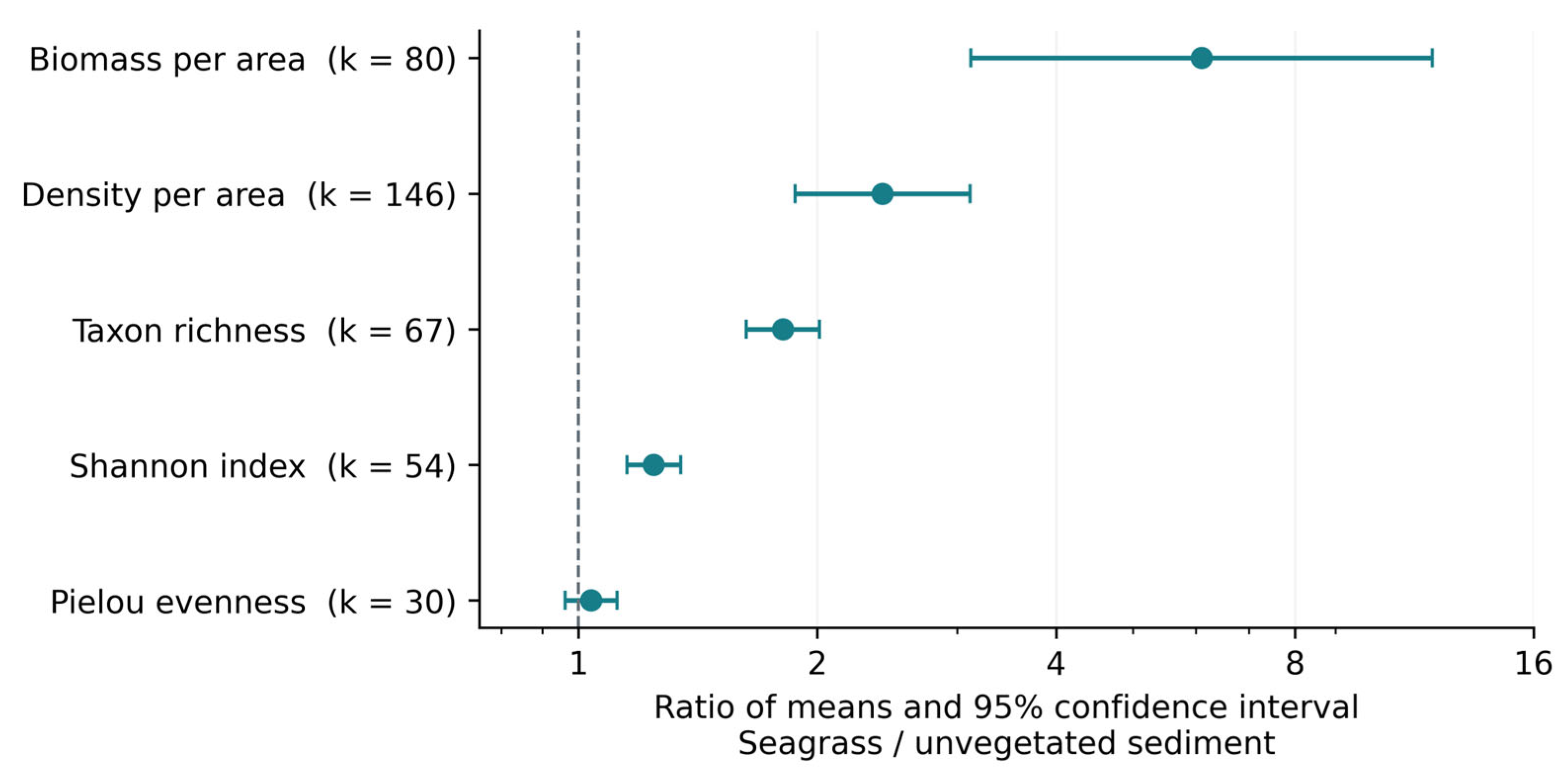
The numerical pattern is consistent with stronger habitat-associated enhancement of abundance and biomass than of some diversity indices, but differences among endpoints were not formally tested. Each estimate draws on a different, partly overlapping evidence set, and effect counts are not independent-study counts [24]. A ratio of Shannon indices is not a ratio of effective species numbers, because transforming each community’s entropy into an effective number differs from taking a ratio of the indices [20]. An interval including one also does not demonstrate ecological equivalence. Together, these published estimates illustrate that faunal quantity, taxonomic richness, and relative-abundance structure represent distinct dimensions of biodiversity evidence; they do not provide a single biodiversity multiplier or establish community or ecosystem process recovery after restoration.
3.2.3. Choosing Reference Habitats
Nearby unvegetated sediment is valuable for estimating local habitat contrasts, but it is not a universal counterfactual. Vegetation occurs nonrandomly with respect to depth, sediment, exposure, and water quality. A bare area may represent persistent natural habitat, recent meadow loss, disturbance, or unsuitable conditions. It may also receive material and mobile organisms from adjacent vegetation. Consequently, a seagrass–bare difference can combine habitat engineering, environmental filtering, and spatial exchange. Four aspects are particularly relevant when assessing the suitability of unvegetated reference habitats: habitat history, depth or tidal-level comparability, sediment characteristics, and proximity to seagrass edges. Where these aspects are poorly documented, causal attribution should be interpreted cautiously rather than assuming that vegetation alone explains the habitat contrast. Observational comparisons need to account for these potential influences before attributing the entire difference to vegetation [19,25].
A restored–bare contrast and a restored–reference contrast answer different management questions. The first asks whether an intervention provides an improvement over its chosen baseline; the second asks how closely it resembles a reference ecosystem. A restored site can show gains over bare sediment while remaining unlike an established meadow. A naturally sparse meadow may also support a distinctive assemblage and should not be classified as degraded because it contains fewer taxa than a dense meadow elsewhere. The conservation value of low-richness sites thus depends partly on whether they support taxa absent from other habitats [26].
Reference choice can consequently change whether an observed difference is interpreted as a gain or a loss. A naturally unvegetated patch may support taxa absent from dense vegetation; converting that patch into seagrass is not automatically a biodiversity gain at the seascape scale. Conversely, a bare patch left by recent seagrass loss may retain sediment conditions and biological legacies unlike those of a long-established unvegetated habitat. Seascape comparisons demonstrate that contrasting meadow types contribute distinct assemblages [26]. Recovery assessments should document the history and suitability of both the intervention and comparison habitats and assess gains against the stated ecological objective.
3.2.4. Seascape Heterogeneity and Complementary Communities
Meadows are embedded in mosaics of bare sediment, rocky habitats, algal patches, marshes, and other vegetation. Their fauna respond to both local conditions and dispersal across this mosaic. Studies that partition habitat characteristics across scales show that community composition can respond to landscape configuration even when richness or total density responds mainly to local plant biomass [9]. A local index may therefore miss ecologically important changes in the distribution of feeding and dispersal strategies.
Edge and fragmentation effects arise from different comparisons. An edge comparison concerns a boundary within a patch; a fragmentation comparison also incorporates patch size, isolation, matrix conditions, and the amount of habitat in the landscape. Meta-analysis shows that responses can differ among faunal groups and that variability in fragmentation effects exceeds that in edge effects [27]. Concentrating samples at edges, or extrapolating an edge response across a degraded landscape, may therefore misrepresent broader community responses.
Turnover and nestedness have different implications for spatial conservation. If differences among meadows arise mainly through species replacement, protecting only the richest site can omit taxa associated with other meadow types. If lower-richness sites are largely subsets of richer sites, the spatial prioritization problem is different. Seascape research has demonstrated turnover-dominated macrofaunal patterns and the value of retaining contrasting meadow types [26]. These findings support conserving complementary habitats, while leaving open how consistently that conclusion holds across observation methods and conservation contexts.
Spatial complementarity alone does not explain why communities differ. Dispersal limitation, environmental filtering, historical disturbance, and unequal detectability can each contribute to turnover. The appropriate management response depends on which explanation applies. Maintaining connections to source populations may aid colonization, whereas protecting contrasting sediment or exposure conditions may preserve taxa with different habitat requirements [25,26]. Assessments of patch configuration also need to consider habitat amount and the surrounding matrix. A small patch within an extensive meadow complex need not function like an equally small, isolated remnant. Neither high local richness nor a high turnover component alone identifies an optimal reserve network.
3.3. Mechanisms Linking Benthic Diversity and Ecosystem Functioning
3.3.1. Habitat Structure Acts Through Biological and Physical Pathways
The canopy influences attachment opportunities, predator access, water movement, and the availability of epiphytic food. Roots and rhizomes alter belowground structure and the sediment environment experienced by infauna. These effects operate at different scales and need not vary in parallel. Shoot density is only one description of habitat structure: equal densities can produce different leaf areas, canopy heights, belowground volumes, and seasonal persistence. Early studies of habitat complexity and faunal recruitment still inform the interpretation of current monitoring [2,28,29].
Long-term observations of nine eelgrass beds distinguished environmental relationships for epifauna and infauna and identified plant biomass as more informative than shoot density for several faunal attributes [19]. The analysis included structural equation models, but the relationships remained observational rather than experimentally isolated causal effects. Habitat assessments therefore need measurements of aboveground structure and the sediment environment.
An experiment comparing artificial canopies and surface rhizomes with natural eelgrass and bare sediment found greater macrofaunal abundance and diversity in natural eelgrass after three months [10]. The measured oxygen and nutrient fluxes did not differ detectably among treatments. Because fluxes were measured in dark incubations, effects on daytime production and whole-day metabolism remain unresolved. Comparisons with artificial plants also include differences in physiology, food supply, and belowground development. The faunal differences were therefore not accompanied by detectable differences in the fluxes measured under these conditions.
Other artificial-vegetation experiments report increases in infaunal density and taxon number relative to bare sediment, including effects of belowground structure [29]. This contrasts with the inability of artificial structure to reproduce the natural-meadow assemblage in the Colvin and Snelgrove comparison [10]. The studies used different controls and structural treatments, and enhancement relative to bare sediment does not imply reproduction of a living meadow’s community.
Physical habitat and resource supply are best considered together. Living vegetation can modify both the space available to animals and the resources they encounter, while belowground structures create a distinct environment for infauna [2,28,29]. An increase in shoot density need not produce a proportional increase in every faunal group. Experiments that manipulate structure while measuring food availability, sediment conditions, and colonization can separate these alternatives more effectively than correlations with shoot density alone. Season, exposure, and the time allowed for colonization remain important to interpreting such experiments.
3.3.2. Trophic Interactions and Secondary Production
Benthic animals use multiple food pathways, including epiphytes, microphytobenthos, suspended particles, detritus, and animal prey. Consequently, high seagrass production does not imply that all associated fauna consume seagrass tissue directly. Grazers can benefit plants by removing competing algae, while predators influence the distribution and activity of those grazers. The ecological effect of losing a consumer therefore depends on its trophic role and on the other organisms remaining in the web [3,30].
A coordinated experiment across 15 eelgrass sites manipulated nutrient supply and grazer pressure, demonstrating context-dependent top-down effects [31]. Grazer and eelgrass diversity varied naturally across those sites, so these cross-site associations did not isolate causal effects of diversity. Evidence from a recovering sea-otter system combines observational and experimental support for a trophic pathway that moderates eutrophication effects [32]. Together, the studies provide experimental evidence for trophic effects, while the cross-site role of diversity remains observational.
Animal abundance alone cannot reveal a community’s regulatory role. A community dominated by grazers that consume epiphytes differs functionally from one dominated by deposit feeders, even if the two contain similar numbers of individuals. Large-bodied predators and ecosystem engineers may be rare but disproportionately influential. Management should therefore examine both dominant functional contributions and vulnerable, nonredundant roles. Trait selection should follow the mechanism being tested. Combining traits without explaining their links to the process of interest can obscure that mechanism.
Response traits and effect traits describe different links between organisms and their environment. Response traits describe how organisms are associated with environmental change; effect traits concern their potential influence on a process [16,17]. Mobility may help explain recolonization after disturbance, whereas feeding mode or sediment-reworking behavior may help explain effects after arrival. For trait-based recovery assessments, we recommend a minimum trait set comprising feeding mode, body size, burrowing depth (where applicable), and mobility. A trait can serve both purposes, but those roles should not be assumed to be identical. Trait–process predictions require validation in the relevant habitat, particularly when databases assign a single value to species whose size or behavior changes during development. Missing trait information should also be reported, because exclusion of poorly described taxa can make a community appear less diverse or more similar to a reference than the observations justify.
Secondary production connects benthic communities with fisheries and bird conservation but differs from standing biomass. Production depends on growth, recruitment, mortality, and turnover. Broad nursery syntheses similarly emphasize that high juvenile density is not sufficient to establish improved survival or recruitment to adult populations [33,34]. Conservation assessments should distinguish a meadow that concentrates consumers from one that increases their demographic performance.
Combining measured seafloor oxygen exchange with model-based estimates of animal metabolism, Rodil et al. estimated that macrofaunal respiration contributed almost 40% of total seafloor community respiration in the investigated meadows [35]. Secondary production was also estimated from body size and temperature. The estimates suggest a substantial faunal contribution, although animal respiration was modelled and the effect of diversity was not isolated. Differences in the processes and methods assessed also limit comparison with the artificial-structure experiment [10].
3.3.3. Sediment Fauna and Biogeochemical Processes
Bioturbation and bioirrigation modify sediment transport, oxygen exposure, and exchanges across the sediment–water interface [36,37]. These processes can influence nutrient regeneration and the conditions experienced by roots. Their net effects depend on the identities and activities of organisms, sediment permeability, organic loading, and hydrodynamics. Because these effects can conflict, a more diverse assemblage of sediment reworkers need not enhance all processes of management interest. Greater oxygenation may alleviate reduced conditions while also promoting mineralization of organic matter [37].
Effects within individual burrows need to be related to exchange across the sediment as a whole. Burrow ventilation can alter a local chemical gradient, but its contribution to an areal flux depends on animal density, activity, and the surrounding physical environment [3,16]. Consequently, a trait-based index of sediment mixing is most appropriately interpreted as potential capacity unless calibrated against observed reworking or exchange. A nutrient flux measured across a chamber boundary integrates several simultaneous pathways and does not identify which organisms caused it. Complementary measurements or manipulations can help attribute a flux to community change, provided they also account for direct plant and microbial effects.
The lucinid–bacterial–seagrass association provides a well-developed example of reciprocal facilitation: sulfur-oxidizing symbionts associated with bivalves can relieve sulfide stress, while the plant–sediment system supplies resources that support the association [38]. Nevertheless, bivalve interactions vary among species and environmental settings; filtration, biodeposition, sediment disturbance, and belowground conditions can produce different outcomes [39,40]. Restoration applications need to be based on interactions shown to be beneficial under the relevant environmental conditions.
Microbial community composition likewise needs to be distinguished from activity. Seagrass rhizospheres support microbial assemblages distinct from surrounding sediment, although patterns need not be host-species-specific [41]. Brodersen et al. found microscale associations between oxygen conditions and microbial composition around Zostera muelleri roots [42]. In their experimental microenvironment, greater representation of putative sulfur oxidizers did not yield an additional measurable sulfide-oxidation effect beyond the plant-associated physicochemical conditions. The finding is specific to that substrate and microscale comparison. Linking microbial composition to meadow-scale processes requires measurements of activity as well as functional annotation.
Biodiversity and blue-carbon objectives likewise require separate measurements. Animal communities can affect plant performance, sediment exchange, and organic-matter processing, but the net effect on carbon storage depends on competing pathways [3,39,40]. A positive biodiversity–carbon association cannot establish that increasing animal richness increases long-term burial. Carbon stock, accumulation, and net greenhouse-gas benefit are different outcomes; sediment texture, organic inputs, and hydrodynamics can affect both the fauna and the carbon measurement. Conservation claims should identify which of these outcomes was measured and avoid inferring a climate benefit from trait diversity alone.
3.4. Disturbance and Recovery Under Changing Coastal Conditions
3.4.1. Environmental Change Can Affect Fauna Directly and Through Vegetation
Nutrient enrichment, sediment disturbance, altered salinity, and warming can influence benthic animals independently of their effects on seagrass. They also change the habitat, food, and sediment environment mediated by the plants. A decline in fauna during meadow degradation can therefore reflect direct physiological stress, reduced habitat provision, altered trophic interactions, or combinations of these pathways. Plant cover can mediate an environmental effect; treating it as the sole explanatory variable can obscure the original driver [19,43].
A nutrient association needs to be interpreted in its environmental context. Resource availability can coincide with greater plant or faunal abundance in a survey, whereas sustained enrichment can change algal loads, oxygen conditions, and habitat quality. A Qingdao survey reported environmental associations and marked variation among bays [44]. Such observational relationships cannot establish that adding nutrients would improve a meadow. They suggest hypotheses for experiments or repeated observations to distinguish resource limitation from deteriorating water quality, including direct effects on fauna and indirect effects through vegetation [30,32].
Multiple stressors complicate extrapolation. In a seagrass meta-analysis, interactions were most frequently classified as additive, while synergistic and antagonistic responses also occurred [45]. The additive category included interactions whose confidence interval overlapped zero, so this classification does not prove exact additivity. The synthesis primarily concerns plant responses and cannot establish corresponding effects on every benthic group. How faunal responses vary with life stage, exposure, and behavior is not resolved by this plant-focused synthesis.
Experiments show that diversity within the habitat-forming plant can affect disturbance responses, but resistance, recovery rate, and time to return are distinct. Hughes and Stachowicz found greater resistance at higher eelgrass genotypic diversity and a shorter time to regain shoot density, without a higher measured recovery rate [46]. Reusch et al. found enhanced shoot recovery following a heat extreme and greater associated faunal abundance in more genotypically diverse plots [47]. These outcomes do not establish recovery of animal richness or every ecosystem function. They support considering plant diversity and provenance but do not imply that any mixed planting will maximize benthic biodiversity.
3.4.2. Evidence for Faunal Recovery
Faunal recovery can begin soon after planting, but its extent varies among restored meadows. Restored eelgrass can support epifaunal biodiversity, and large restoration efforts can recover multiple coastal services [48,49]. However, these outcomes depend on the ecological setting, the attributes measured, and the reference used. Recovery times from individual projects are therefore difficult to generalize.
The long Virginia restoration record provides evidence that extensive eelgrass establishment can accompany increases in associated fauna and other ecosystem attributes [49]. Attribution is complicated by concurrent interventions: bay scallops were subject to a separate active restoration programme, so their return should not be attributed to eelgrass recovery alone. In an epifaunal comparison, the natural reference meadow deteriorated during the study [48]. A narrowing restored–reference difference can therefore reflect change on both sides of the comparison. Both restored and reference habitats therefore need to be followed through time.
In the Wadden Sea, a restored intertidal plot was sampled within two years of establishment and compared with adjacent bare sediment and 22 natural meadows [11]. Richness and biomass were higher inside the restored vegetation, whereas total animal numbers did not differ significantly in that comparison. Several taxonomic and trait patterns resembled natural-meadow patterns, but natural and restored meadows were sampled in different years, and only one restored site was sampled. These results concern selected community attributes at one restoration site; process recovery and a general time to equivalence remain unresolved. No further faunal response was observed along the sampled vegetation gradient, but the role of canopy density outside that comparison remains uncertain.
An exposed southern Swedish restoration reported taxonomic and functional diversity comparable to nearby reference plots within four months where eelgrass survival was high [12]. The rapid convergence was observed where vegetation established successfully; performance across all planted areas and persistence through later disturbances remain uncertain. A faunal comparison restricted to surviving vegetation assesses the performance of established habitat; assessing the entire intervention also requires the area or number of planting units that failed.
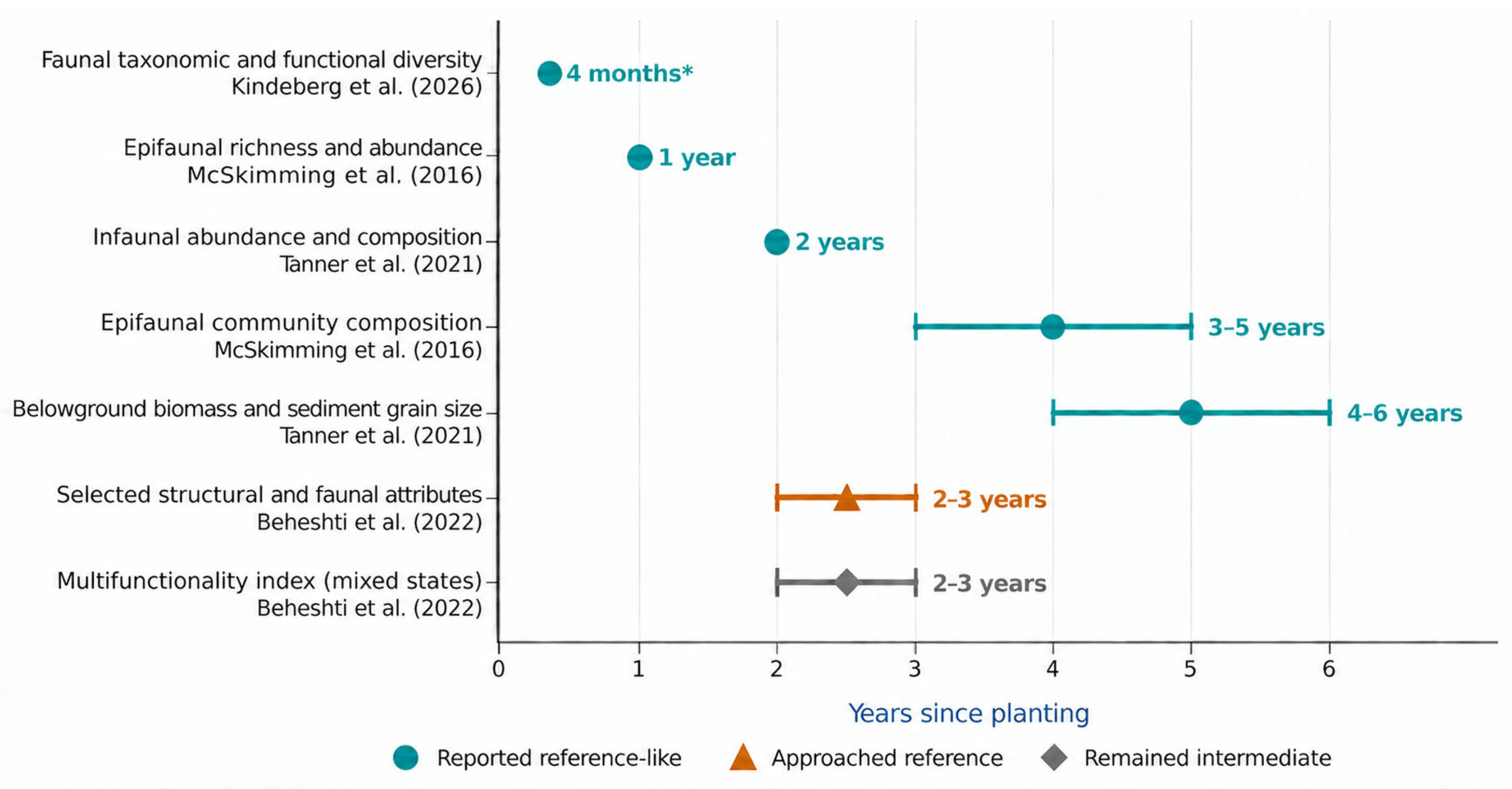
In central California, several attributes of restored plots approached reference conditions within three years, while an integrated multifunctionality index remained intermediate between reference and unvegetated habitats [50]. That index combined biological and environmental indicators, including state variables, and should not be described as a set of directly measured process rates. Survival was also uneven: 71 of 117 transplanted plots retained at least one shoot at the reported 2018 assessment, despite expansion in total vegetated area. Expansion in vegetated area should therefore be reported alongside the proportion of planting units that survived. A global restoration synthesis identifies planting scale and environmental context as relevant to establishment but does not supply a universal recovery time for benthic communities [51]. Table 2 compares study designs, sample sizes, reference sites, focal taxa, recovery metric types, and interpretive limitations, while Figure 2 summarizes reported attribute-specific recovery times without implying a universal recovery trajectory.
Table 2.
Study designs, sampling and reference replication, measured endpoints, and interpretive limits in selected seagrass restoration studies.
Figure 2.
Descriptive comparison of recovery-related observations from selected seagrass restoration studies [12,50,54,55]. Single markers indicate reported observation times; for ranged observations, horizontal bars show restoration-age ranges or observation windows, and central symbols indicate their midpoints for visualization only. These intervals are not confidence intervals or model-estimated times to recovery. Symbols distinguish attributes reported as reference-like, approaching reference conditions, or remaining intermediate; these descriptive labels do not establish statistical equivalence. The asterisk indicates that the rapid faunal recovery reported by Kindeberg et al. [12] was observed only in plots with high eelgrass survival. For Beheshti et al. [50], the 2–3-year label reflects the authors’ broad summary; several 2018 endpoint measurements were obtained approximately 30–40 months after transplantation. The plotted endpoints represent ecological state variables or composite indicators, not directly measured ecosystem process rates.
A synthesis across restored coastal habitats found that differences from reference communities in fish and decapod trait diversity were often not detected; some abundance-weighted fish metrics were associated with restoration age [52]. These outcomes are consistent with convergence in the taxa and traits assessed. They do not establish equivalent performance within predefined ecological limits, recovery of less mobile sediment fauna, or restoration of measured process rates. Relationships across sites of different ages should also be distinguished from repeated observations of the same community.
Vegetation, faunal communities, and ecosystem processes can follow different but connected recovery trajectories. Plant establishment creates habitat for colonists, whose arrival depends on dispersal and environmental filters. Subsequent interactions and sediment development affect process rates, while later disturbances reveal whether early gains persist. Resistance, rate of change, and time to reach a reference condition are different properties [56]. Monitoring should be designed to distinguish them, particularly where an apparently successful restoration has only been observed within one growing season.
3.4.3. Process Recovery and the Interpretation of Time
A Swedish field comparison measured oxygen and dissolved inorganic carbon exchange in bare sediment, three- and seven-year-old restored eelgrass, and a natural meadow [53]. Gross production and respiration increased across the meadow-age gradient, while the vegetated sites were net heterotrophic during the July observation interval. That short-term balance does not establish an annual carbon budget or negate longer-term storage. The sites formed a spatial chronosequence, with site identity and age inseparable and deployments not fully simultaneous. These are direct measurements of process rates, but the age pattern remains confounded with differences among sites.
Recovery of a rate can occur through several ecological pathways. The same taxa may return, different taxa may provide overlapping contributions, or changes in plants and sediment conditions may compensate for incomplete faunal recovery [3,16]. Similar process rates can thus occur in communities with different species composition. Explaining this divergence requires attention to the biological and environmental contributions to each rate. Studies linking fauna to ecosystem fluxes are especially useful when they measure environmental covariates and distinguish estimated animal contributions from integrated community metabolism [10,35].
Comparisons among restorations of different ages are informative but are not necessarily time series. Older and younger projects may differ in sediment, source populations, planting methods, or the disturbances they experienced. A chronosequence describes age-associated differences that may also reflect differences among sites; repeated observation of the same sites measures their trajectories more directly. Neither design alone guarantees causal attribution, and their combination can reveal whether apparent age effects are consistent with within-site changes. Estimates of the time needed to resemble a reference should specify the attribute, sampling interval, comparison habitat, and uncertainty. Whether mobile fauna colonize before sediment conditions recover needs to be tested at each project.
Persistence concerns whether these outcomes endure. Observations during one favorable season establish conditions during that interval; they do not demonstrate resistance to a future heatwave, storm, or oxygen deficit. Similarly, a community that returns after a disturbance demonstrates recovery over the measured interval, whereas a community that changes little demonstrates resistance. These properties depend on the relative timing of disturbance and response [56]. Repeated seasonal and post-disturbance observations are therefore needed where durability is an objective. Monitoring frequency and duration should reflect the likely stressors and life histories at the site, rather than a universal number of years assumed necessary for success.
3.5. Molecular Monitoring and Observation Uncertainty
3.5.1. Taxonomic Detection and Ecological Interpretation
eDNA expands the range of organisms that can be detected using small, minimally invasive samples. This is particularly useful for cryptic or difficult-to-identify invertebrates, as illustrated by the complementary records from eDNA and historical conventional surveys in Nova Scotia [13]. Nevertheless, comparisons between recent molecular surveys and historical species lists also combine differences in sampling period, spatial coverage, effort, and taxonomy. Differences between the records can therefore reflect survey methods and coverage, as well as colonization or local loss.
The ecological meaning of a waterborne DNA signal is broader than benthic residency. It can originate from benthic adults, planktonic larvae, mobile organisms, or transported material. Different markers also have distinct taxonomic sensitivities. A COI survey in the Sea of Japan illustrated the need to evaluate suspect assignments before treating them as local occurrences [14]. A Black Sea study reported taxon-specific seagrass associations alongside comparable community-level molecular signals across vegetated and adjacent bare habitats [57]. Local adult occurrence and recovery need to be assessed with additional observations.
3.5.2. Sampling Units and Detection Support
The Nova Scotia study sampled 17 eelgrass sites using seawater eDNA [13]. Each site was represented by three independently collected one-litre water samples, and PCR replicates were technical replicates within those field samples. The deposited table contains 138 named invertebrate taxon entries, not 138 verified resident benthic species [58]. Taxonomic assignments include unresolved designations, and water samples cannot locate each signal in canopy, sediment, or plankton. This broad taxonomic coverage is useful, but comparison with conventional surveys still requires accounting for differences in the sampled compartment, date, effort, and taxonomic resolution.
Biological replication and technical replication address different uncertainties. Independent field samples characterize variation at the sampling scale; repeated extraction, amplification, or sequencing of the same material describes aspects of analytical repeatability. More technical replicates do not create additional independent meadow observations. Monitoring reports should describe the sampling hierarchy, from site and field sampling to filtering, extraction, PCR, and library construction, and identify the level used for inference. Combining libraries without that information can exaggerate apparent spatial replication or conceal differences in detection support. Controls and replication should be designed around the intended inference rather than added only at the sequencing stage [59].
A requirement for repeated detection may remove records supported by one field sample, but it can also exclude genuinely rare or spatially aggregated organisms. Repeated occurrence cannot eliminate a systematic taxonomic misassignment. Controls, assay performance, reference databases, and ecological plausibility must therefore be evaluated alongside replicate support [14,59]. In the Nova Scotia study, two of 51 field samples were excluded because of contamination and very few invertebrate reads [13]. Its archived taxon table retains one all-zero column, which should not be interpreted as an animal-free water sample [58]. Reporting quality-control exclusions and sensitivity to detection rules helps distinguish uncertainty in detection from biological loss.
3.5.3. Beta Diversity in Recovery Assessments
For incidence-based recovery assessments, we recommend the Baselga Sørensen-based partition (βsor = βsim + βsne) as the primary descriptive framework for distinguishing turnover from nestedness-resultant dissimilarity [60]. The former captures replacement under the specified index; the latter is the part of dissimilarity attributable to nestedness after accounting for replacement. It is not a universal measure of ecological degradation or a direct estimate of temporal species loss. Different beta-diversity families and abundance-based formulations answer related but distinct questions. Alternative partitioning approaches, including the Podani framework, may be useful when the ecological question focuses on species replacement and richness differences; Jaccard-based partitions can provide complementary sensitivity checks. Interpretation therefore depends on the index, data transformation, and partition used.
Spatial dissimilarity among meadows does not establish a recovery trajectory. A predominance of turnover describes how the observed compositional differences are partitioned under the chosen comparison. It cannot determine whether a restoration is approaching a reference without appropriate restored–reference observations through time. Comparisons among different sites sampled in different years also confound space and time. When summarizing pairwise values, pairs that share sites must not be treated as independent experimental replicates. The ratio of mean components and the mean of pair-specific ratios are different summaries and should not be interchanged.
3.5.4. Integrating Molecular and Conventional Evidence
Relative read counts should not be treated as absolute numbers of animals, cells, or biomass without assay-specific calibration. Amplification and annotation influence the resulting table, while amplicon sequence variants and operational taxonomic units are sequence-based units rather than automatically distinct biological species. These differences affect comparisons across markers, laboratories, or sampling years. Incidence transformations avoid an unsupported abundance interpretation but do not remove detection error or unequal sampling completeness. A monitoring programme should retain the underlying data and processing history so that an observed difference can be separated from a change in analytical procedure. These limitations apply broadly to aquatic eDNA surveys [59]. A controlled freshwater mesocosm study found positive but variable relationships between sequence reads and organism abundance [61]. Abundance information may therefore be obtained with suitable calibration, but the relationship cannot be assumed for an uncalibrated marine benthic assay.
Molecular and morphological observations constrain different uncertainties. A well-supported sequence assignment can identify a candidate taxon for targeted sampling, while a specimen provides evidence of local occurrence and can improve the reference database. Neither method detects every organism. Pairing water samples with canopy collections or sediment cores can test whether molecular habitat associations correspond to the benthic compartment of interest. Paired community and process measurements can show whether a change in detected composition coincides with altered ecological activity. These observations should be reported separately, even when combined in an overall assessment.
3.6. An Evidence Framework for Conservation and Restoration
3.6.1. Evaluate Recovery Across Complementary Attributes
We propose assessing recovery by combining evidence on habitat, biodiversity, and measured processes, while evaluating persistence over ecologically relevant periods. Habitat evidence includes vegetation extent, canopy properties, belowground structure, and environmental suitability. Biodiversity evidence includes taxonomic composition, selected functional attributes, and the reliability of detections. Process evidence includes rates such as grazing, secondary production, sediment reworking, or nutrient exchange, chosen according to the stated conservation objective. Each provides information that the others may not capture (Figure 3).
Figure 3.
Evidence framework for assessing recovery of seagrass-associated benthic communities. Solid arrows indicate proposed ecological pathways and feedbacks, whereas dashed arrows represent observations of the corresponding attributes. Reference selection, observation uncertainty, and temporal persistence apply to all three evidence categories. The framework illustrates complementary lines of evidence rather than a fixed sequence, a common recovery rate, or universal criteria for restoration success. Indicator selection and interpretation depend on explicitly defined restoration objectives and ecological context. Conceptual synthesis informed by biodiversity–ecosystem functioning theory and restoration standards [3,15].
We use biodiversity–ecosystem functioning theory and restoration standards [3,15] to guide the selection and interpretation of evidence in relation to explicitly defined restoration objectives. Restoration success cannot be inferred from a fixed set of biodiversity or functional indicators, because appropriate measures and reference conditions depend on the ecological processes, community attributes, and outcomes targeted by each intervention. Trait data can inform the selection of relevant process measurements, and richness comparisons can be complemented by analyses of species composition. Targeted sampling can help determine whether taxa detected by eDNA occur in the benthic habitat of interest. These examples illustrate complementary lines of evidence rather than an exhaustive or universally applicable assessment framework; their relevance and interpretation must be evaluated against the specific restoration objectives and ecological context.
Wherever possible, reference conditions should encompass natural variation rather than be represented by a single mean. Multiple reference meadows and repeated seasonal sampling reveal the natural variation within which recovery is being judged. An equivalence margin should be justified ecologically before analysis, rather than inferred from a nonsignificant difference after sampling [62]. If uncertainty around a restored–reference contrast includes both a meaningful deficit and acceptable similarity, the conclusion remains unresolved.
The reference should also match the intended ecosystem and environmental setting. Matching depth, exposure, sediment characteristics, and sampling season can reduce avoidable differences, but selecting references post hoc because their biological responses resemble those at the restored site would bias the evaluation. Restoration standards encourage explicit reference models that incorporate relevant environmental change and multiple information sources [15]. Where historical conditions cannot be recreated, explicit objectives are needed to judge which changes constitute recovery. Reporting both distance from a reference and change from the degraded starting condition helps distinguish ecological progress from attainment of the chosen target.
An integrated index can aid communication, provided its component measures remain available for separate interpretation. Combining correlated measures can count the same response repeatedly, while averaging can conceal the loss of a nonreplaceable function. The component values and their weights should therefore be reported. General evidence linking biodiversity to multifunctionality supports examining multiple processes but does not justify assuming that any selected average measures ecosystem integrity [63]. Conservation decisions may require minimum performance for a particular function even when the overall mean is high.
Recovery thresholds are decision criteria as well as statistical quantities. A tolerance suitable for a variable with large natural seasonal fluctuations may be unacceptable for the loss of a rare functional role. The choice should therefore follow the ecological objective and consequences of error, with uncertainty reported for each component [15,62]. Where statistical power is low, the data may be insufficient to distinguish success from failure. Reporting the effect estimate and interval is more informative than reporting only whether a conventional significance threshold was crossed.
3.6.2. Preserve Complementary Habitats and Interactions
Protection should include distinct meadow types and their surrounding habitat mosaic where those areas sustain complementary taxa, dispersal pathways, or life stages. Protecting this heterogeneity does not justify further fragmentation. Natural heterogeneity and degradation-induced fragmentation can have different consequences, and small patches can contribute to regional diversity while still being vulnerable to further isolation. Management should distinguish the value of an existing patch from the desirability of creating additional edges through habitat loss [25,27].
Restoration should address environmental conditions that permit plants and associated communities to persist, including the pressures responsible for degradation [64]. Planting scale and site suitability can influence establishment [51], although greater planting effort may still fail where conditions are unsuitable. Interventions directed at fauna, such as bivalve additions or recovery of trophic interactions, require evidence for the relevant mechanism and its local applicability [32,38,40]. Correlations between community attributes alone do not justify these interventions.
Project evaluations should report both the condition of established habitat and the outcome of the whole intervention, including failed planting units, area treated, maintenance, and later losses. A project can produce high-quality habitat in surviving patches while achieving a limited total gain. Reporting both prevents selective monitoring of successful patches from overstating project outcomes [12,50]. It also identifies whether further work should address colonization within viable habitat or the environmental conditions preventing habitat establishment.
3.6.3. Testable Predictions and Research Priorities
The synthesis identifies four priorities: separating canopy and sediment response pathways, validating trait–process relationships, quantifying sensitivity to observation methods, and explaining variation in recovery among both successful and failed planting units. Table 3 pairs each question with a study design and findings that would help distinguish competing explanations.
Table 3.
Questions arising from the synthesis, with proposed study designs and alternative outcomes.
These questions call for coordinated field and experimental studies. Before–after comparisons with multiple suitable controls can help distinguish intervention responses from background change. Restoration sites are the independent units where an intervention operates at site scale; cores or libraries within one site are subsamples. Mechanistic experiments should manipulate a specified driver while measuring plausible alternatives. Studies that jointly quantify canopy fauna, sediment fauna, relevant microbial processes, and habitat conditions at compatible temporal and spatial scales would be especially useful. Measuring one component at a different season or footprint can create an apparent mismatch that is attributable to observation rather than ecological response.
Data archiving is also a research priority. Archives should preserve study and sample identifiers, site and date, taxonomic resolution, sampling area or volume, mesh size, depth interval, replication, uncertainty, and the relationships among repeated observations. Molecular datasets should retain controls, taxonomic confidence, marker information, and replicate-level detections. Trait databases should state whether information is observed, inferred, or missing. These details allow subsequent syntheses to distinguish ecological variability from differences in measurement.
Future quantitative reviews should stratify response variables and habitat compartments, model dependence among effects, and assess sensitivity to reference selection and study design. They should also examine evidence coverage before fitting complex moderator models. The predominance of temperate eelgrass and macrofaunal studies limits the transferability of reference benchmarks, equivalence margins, and recovery times in the proposed framework. For tropical genera (e.g., Halophila, Thalassia, and Enhalus), references and monitoring intervals should reflect local species composition, growth form, and seasonality. For meiofauna, sampling should target the relevant habitat compartment (e.g., fine-mesh sediment cores for infauna), standardize taxonomic resolution, and evaluate recovery separately from macrofaunal responses. An interaction cannot be estimated reliably if a habitat type or region appears only in one study, regardless of the number of samples reported. Even a complex global model may offer little ecological insight if its moderators confound taxon, method, and geography. Clear comparisons and adequate evidence are prerequisites for choosing an appropriate statistical model.
4. Conclusions
Seagrass meadows commonly enhance benthic abundance and taxonomic diversity, although responses vary among the attributes assessed. Community identity, functional traits, ecosystem rates, and persistence provide distinct information. Living vegetation supports fauna through structural, trophic, and sediment pathways, while the fauna can help maintain the conditions on which the meadow depends. Recovery assessments need to consider both habitat formation and the faunal processes that help sustain it.
Faunal communities can approach reference conditions rapidly where vegetation establishes successfully. The interpretation depends on which attributes were measured, how reference conditions varied, and whether monitoring covered all planting units or only surviving habitats. Ecological equivalence requires more than a nonsignificant difference from a reference.
Current evidence supports recovery of particular benthic attributes in some restored meadows but offers no common timetable for whole-ecosystem recovery. Assessments should report changes in community composition and relevant process rates alongside vegetation recovery and identify the reference, observation period, and uncertainty. Conservation should retain meadow types that support complementary taxa and ecological interactions with demonstrated benefits.
Author Contributions
Conceptualization, Y.F., Y.L. and S.X.; methodology, Y.F., Y.L. and S.X.; formal analysis, Y.F., S.S., F.M. and X.L.; validation, S.S., F.M., X.L., Y.L. and S.X.; writing—original draft preparation, Y.F.; writing—review and editing, Y.F., S.S., F.M., X.L., Y.L. and S.X.; visualization, Y.F.; supervision, Y.L. and S.X.; project administration, Y.L. and S.X.; funding acquisition, Y.L. and S.X. All authors have read and agreed to the published version of the manuscript.
Funding
This research was supported by the National Key Research and Development Program (2022YFD2401301) and Taishan Scholars Program (Distinguished Taishan Scholars).
Data Availability Statement
No new primary ecological data were collected for this review. The published summary estimates used to prepare Figure 1 are publicly available from the repository cited in [23]. Figure 2 summarizes observations reported in the cited studies [12,50,54,55], and the descriptive plotting data are available from the corresponding authors upon reasonable request.
Acknowledgments
We would like to express our sincere gratitude to the four anonymous reviewers for their insightful comments and constructive suggestions, which greatly contributed to improving the quality and clarity of this manuscript. We also thank all members of our team for their support and cooperation throughout the research process.
Conflicts of Interest
The authors declare no conflicts of interest.
References
- Rattanachot, E.; Prathep, A. Species specific effects of three morphologically different belowground seagrasses on sediment properties. Estuar. Coast. Shelf Sci. 2015, 167, 427–435. [Google Scholar] [CrossRef] [Scilit]
- Orth, R.J.; Heck, K.L.; van Montfrans, J. Faunal Communities in Seagrass Beds: A Review of the Influence of Plant Structure and Prey Characteristics on Predator: Prey Relationships. Estuaries 1984, 7, 339–350. [Google Scholar] [CrossRef] [Scilit] [PubMed]
- Duffy, J.E. Biodiversity and the functioning of seagrass ecosystems. Mar. Ecol. Prog. Ser. 2006, 311, 233–250. [Google Scholar] [CrossRef] [Scilit]
- Nordlund, L.M.; Koch, E.W.; Barbier, E.B.; Creed, J.C. Seagrass Ecosystem Services and Their Variability across Genera and Geographical Regions. PLoS ONE 2016, 11, e0163091. [Google Scholar] [CrossRef] [Scilit] [PubMed]
- Orth, R.J.; Carruthers, T.J.B.; Dennison, W.C.; Duarte, C.M.; Fourqurean, J.W.; Heck, K.L.; Hughes, A.R.; Kendrick, G.A.; Kenworthy, W.J.; Olyarnik, S.; et al. A Global Crisis for Seagrass Ecosystems. BioScience 2006, 56, 987–996. [Google Scholar] [CrossRef] [Scilit]
- Waycott, M.; Duarte, C.M.; Carruthers, T.J.B.; Orth, R.J.; Dennison, W.C.; Olyarnik, S.; Calladine, A.; Fourqurean, J.W.; Heck, K.L.; Hughes, A.R.; et al. Accelerating loss of seagrasses across the globe threatens coastal ecosystems. Proc. Natl. Acad. Sci. USA 2009, 106, 12377–12381. [Google Scholar] [CrossRef] [Scilit] [PubMed]
- Dunic, J.C.; Brown, C.J.; Connolly, R.M.; Turschwell, M.P.; Côté, I.M. Long-term declines and recovery of meadow area across the world’s seagrass bioregions. Glob. Change Biol. 2021, 27, 4096–4109. [Google Scholar] [CrossRef] [Scilit] [PubMed]
- Henseler, C.; Nordström, M.C.; Törnroos, A.; Snickars, M.; Pecuchet, L.; Lindegren, M.; Bonsdorff, E. Coastal habitats and their importance for the diversity of benthic communities: A species- and trait-based approach. Estuar. Coast. Shelf Sci. 2019, 226, 106272. [Google Scholar] [CrossRef] [Scilit]
- Yeager, L.A.; Geyer, J.K.; Fodrie, F.J. Trait sensitivities to seagrass fragmentation across spatial scales shape benthic community structure. J. Anim. Ecol. 2019, 88, 1743–1754. [Google Scholar] [CrossRef] [Scilit] [PubMed]
- Colvin, T.J.; Snelgrove, P.V.R. Role of seagrass physical structure in macrofaunal biodiversity-ecosystem functioning relationships. Mar. Ecol. Prog. Ser. 2025, 754, 35–49. [Google Scholar] [CrossRef] [Scilit]
- Gräfnings, M.L.E.; Grimm, I.; Valdez, S.R.; Findji, I.; van der Heide, T.; Heusinkveld, J.H.T.; Meijer, K.J.; Eriksson, B.K.; Smeele, Q.; Govers, L.L. Restored intertidal eelgrass (Z. marina) supports benthic communities taxonomically and functionally similar to natural seagrasses in the Wadden Sea. Front. Mar. Sci. 2024, 10, 1294845. [Google Scholar] [CrossRef] [Scilit]
- Kindeberg, T.; Carlsson, P.; Hollander, J. Benthic fauna dynamics following large-scale seagrass restoration in an exposed environment. Restor. Ecol. 2026, 34, e70248. [Google Scholar] [CrossRef] [Scilit]
- Trask, C.G.; Jeffery, N.W.; Stanley, R.R.E.; Van Wyngaarden, M.; McBride, M.C.; He, X.; Abbott, C.L.; Rawlings, T.A. Applying eDNA metabarcoding to assess invertebrate biodiversity of eelgrass (Zostera marina) meadows across Nova Scotia. Can. J. Fish. Aquat. Sci. 2025, 82, 1–18. [Google Scholar] [CrossRef] [Scilit]
- Turanov, S.V. Environmental DNA Metabarcoding of a Seagrass Meadow in Vostok Bay (Peter the Great Bay, Sea of Japan): A COI Snapshot of Coastal Biodiversity and Its Limitations. Diversity 2026, 18, 120. [Google Scholar] [CrossRef] [Scilit]
- Gann, G.D.; McDonald, T.; Walder, B.; Aronson, J.; Nelson, C.R.; Jonson, J.; Hallett, J.G.; Eisenberg, C.; Guariguata, M.R.; Liu, J.; et al. International principles and standards for the practice of ecological restoration. Second edition. Restor. Ecol. 2019, 27, S1–S46. [Google Scholar] [CrossRef] [Scilit]
- Bremner, J. Species’ traits and ecological functioning in marine conservation and management. J. Exp. Mar. Biol. Ecol. 2008, 366, 37–47. [Google Scholar] [CrossRef] [Scilit]
- Violle, C.; Navas, M.L.; Vile, D.; Kazakou, E.; Fortunel, C.; Hummel, I.; Garnier, E. Let the concept of trait be functional! Oikos 2007, 116, 882–892. [Google Scholar] [CrossRef]
- Villéger, S.; Mason, N.W.H.; Mouillot, D. New multidimensional functional diversity indices for a multifaceted framework in functional ecology. Ecology 2008, 89, 2290–2301. [Google Scholar] [CrossRef] [Scilit] [PubMed]
- Millot, J.; Grall, J.; Toumi, C.; Maguer, M.; Boyé, A. Quantifying the direct and indirect relationships linking the environment, seagrass, and their associated fauna. Ecosphere 2024, 15, e4708. [Google Scholar] [CrossRef] [Scilit]
- Jost, L. Entropy and diversity. Oikos 2006, 113, 363–375. [Google Scholar] [CrossRef] [Scilit]
- Chao, A.; Gotelli, N.J.; Hsieh, T.C.; Sander, E.L.; Ma, K.H.; Colwell, R.K.; Ellison, A.M. Rarefaction and extrapolation with Hill numbers: A framework for sampling and estimation in species diversity studies. Ecol. Monogr. 2014, 84, 45–67. [Google Scholar] [CrossRef] [Scilit]
- Piñeiro-Juncal, N.; de los Santos, C.B.; Dahl, M.; Gagnon, K.; Lafratta, A.; Marco-Mendez, C.; Mazarrasa, I.; Githaiga, M.N.; Rahayu, Y.P.; Samper-Villarreal, J.; et al. Global Meta-Analysis Reveals Variability in Seagrass Carbon Storage, Pollution Mitigation and Benthic Biodiversity Enhancement Provisioning. Ecosystems 2026, 29, 62. [Google Scholar] [CrossRef] [Scilit]
- Piñeiro-Juncal, N. SeagrassVsBare: R Code, Data and Analysis Outputs. Available online: https://github.com/NPJuncal/SeagrassVsBare (accessed on 18 September 2026).
- Nakagawa, S.; Santos, E.S.A. Methodological issues and advances in biological meta-analysis. Evol. Ecol. 2012, 26, 1253–1274. [Google Scholar] [CrossRef] [Scilit]
- Boström, C.; Jackson, E.L.; Simenstad, C.A. Seagrass landscapes and their effects on associated fauna: A review. Estuar. Coast. Shelf Sci. 2006, 68, 383–403. [Google Scholar] [CrossRef] [Scilit]
- Rodil, I.F.; Lohrer, A.M.; Attard, K.M.; Hewitt, J.E.; Thrush, S.F.; Norkko, A. Macrofauna communities across a seascape of seagrass meadows: Environmental drivers, biodiversity patterns and conservation implications. Biodivers. Conserv. 2021, 30, 3023–3043. [Google Scholar] [CrossRef] [Scilit]
- Yarnall, A.H.; Byers, J.E.; Yeager, L.A.; Fodrie, F.J. Comparing edge and fragmentation effects within seagrass communities: A meta-analysis. Ecology 2022, 103, e3603. [Google Scholar] [CrossRef] [Scilit] [PubMed]
- Boström, C.; Bonsdorff, E. Zoobenthic community establishment and habitat complexity—The importance of seagrass shoot-density, morphology and physical disturbance for faunal recruitment. Mar. Ecol. Prog. Ser. 2000, 205, 123–138. [Google Scholar] [CrossRef] [Scilit]
- González-Ortiz, V.; Egea, L.G.; Jiménez-Ramos, R.; Moreno-Marín, F.; Pérez-Lloréns, J.L.; Bouma, T.; Brun, F. Submerged vegetation complexity modifies benthic infauna communities: The hidden role of the belowground system. Mar. Ecol. 2016, 37, 543–552. [Google Scholar] [CrossRef] [Scilit]
- Hughes, A.R.; Bando, K.J.; Rodriguez, L.F.; Williams, S.L. Relative effects of grazers and nutrients on seagrasses: A meta-analysis approach. Mar. Ecol. Prog. Ser. 2004, 282, 87–99. [Google Scholar] [CrossRef] [Scilit]
- Duffy, J.E.; Reynolds, P.L.; Boström, C.; Coyer, J.A.; Cusson, M.; Donadi, S.; Douglass, J.G.; Eklöf, J.S.; Engelen, A.H.; Eriksson, B.K.; et al. Biodiversity mediates top–down control in eelgrass ecosystems: A global comparative-experimental approach. Ecol. Lett. 2015, 18, 696–705. [Google Scholar] [CrossRef] [Scilit] [PubMed]
- Hughes, B.B.; Eby, R.; Van Dyke, E.; Tinker, M.T.; Marks, C.I.; Johnson, K.S.; Wasson, K. Recovery of a top predator mediates negative eutrophic effects on seagrass. Proc. Natl. Acad. Sci. USA 2013, 110, 15313–15318. [Google Scholar] [CrossRef] [Scilit] [PubMed]
- McDevitt-Irwin, J.M.; Iacarella, J.C.; Baum, J.K. Reassessing the nursery role of seagrass habitats from temperate to tropical regions: A meta-analysis. Mar. Ecol. Prog. Ser. 2016, 557, 133–143. [Google Scholar] [CrossRef] [Scilit]
- Lefcheck, J.S.; Hughes, B.B.; Johnson, A.J.; Pfirrmann, B.W.; Rasher, D.B.; Smyth, A.R.; Williams, B.L.; Beck, M.W.; Orth, R.J. Are coastal habitats important nurseries? A meta-analysis. Conserv. Lett. 2019, 12, e12645. [Google Scholar] [CrossRef] [Scilit]
- Rodil, I.F.; Lohrer, A.M.; Attard, K.M.; Thrush, S.F.; Norkko, A. Positive contribution of macrofaunal biodiversity to secondary production and seagrass carbon metabolism. Ecology 2022, 103, e3648. [Google Scholar] [CrossRef] [Scilit] [PubMed]
- Kristensen, E.; Penha-Lopes, G.; Delefosse, M.; Valdemarsen, T.B.; Quintana, C.O.; Banta, G.T. What is bioturbation? The need for a precise definition for fauna in aquatic sciences. Mar. Ecol. Prog. Ser. 2012, 446, 285–302. [Google Scholar] [CrossRef] [Scilit]
- Meysman, F.J.R.; Middelburg, J.J.; Heip, C.H.R. Bioturbation: A fresh look at Darwin’s last idea. Trends Ecol. Evol. 2006, 21, 688–695. [Google Scholar] [CrossRef] [Scilit] [PubMed]
- van der Heide, T.; Govers, L.L.; de Fouw, J.; Olff, H.; van der Geest, M.; van Katwijk, M.M.; Piersma, T.; van de Koppel, J.; Silliman, B.R.; Smolders, A.J.P.; et al. A Three-Stage Symbiosis Forms the Foundation of Seagrass Ecosystems. Science 2012, 336, 1432–1434. [Google Scholar] [CrossRef] [Scilit] [PubMed]
- Fales, R.J.; Boardman, F.C.; Ruesink, J.L. Reciprocal Interactions between Bivalve Molluscs and Seagrass: A Review and Meta-Analysis. J. Shellfish Res. 2020, 39, 547–562. [Google Scholar] [CrossRef] [Scilit]
- Meysick, L.; Norkko, A.; Gagnon, K.; Gräfnings, M.; Boström, C. Context-dependency of eelgrass-clam interactions: Implications for coastal restoration. Mar. Ecol. Prog. Ser. 2020, 647, 93–108. [Google Scholar] [CrossRef] [Scilit]
- Cúcio, C.; Engelen, A.H.; Costa, R.; Muyzer, G. Rhizosphere Microbiomes of European Seagrasses Are Selected by the Plant, But Are Not Species Specific. Front. Microbiol. 2016, 7, 440. [Google Scholar] [CrossRef] [Scilit] [PubMed]
- Brodersen, K.E.; Siboni, N.; Nielsen, D.A.; Pernice, M.; Ralph, P.J.; Seymour, J.; Kühl, M. Seagrass rhizosphere microenvironment alters plant-associated microbial community composition. Environ. Microbiol. 2018, 20, 2854–2864. [Google Scholar] [CrossRef] [Scilit] [PubMed]
- Maxwell, P.S.; Eklöf, J.S.; van Katwijk, M.M.; O’Brien, K.R.; de la Torre-Castro, M.; Boström, C.; Bouma, T.J.; Krause-Jensen, D.; Unsworth, R.K.F.; van Tussenbroek, B.I.; et al. The fundamental role of ecological feedback mechanisms for the adaptive management of seagrass ecosystems—A review. Biol. Rev. 2017, 92, 1521–1538. [Google Scholar] [CrossRef] [Scilit] [PubMed]
- Sha, J.; Song, X.; Sun, P.; Yang, Z.; Bao, M.; Wang, H.; Wen, R.; Yu, Q.; Wei, M. Ecological Characteristics of Temperate Seagrass Beds in Qingdao Coastal Waters and Ecological Response Relationships with Benthic Macrofauna Communities and Environmental Factors. Diversity 2025, 17, 816. [Google Scholar] [CrossRef] [Scilit]
- Stockbridge, J.; Jones, A.R.; Gillanders, B.M. A meta-analysis of multiple stressors on seagrasses in the context of marine spatial cumulative impacts assessment. Sci. Rep. 2020, 10, 11934. [Google Scholar] [CrossRef] [Scilit] [PubMed]
- Hughes, A.R.; Stachowicz, J.J. Genetic diversity enhances the resistance of a seagrass ecosystem to disturbance. Proc. Natl. Acad. Sci. USA 2004, 101, 8998–9002. [Google Scholar] [CrossRef] [Scilit] [PubMed]
- Reusch, T.B.H.; Ehlers, A.; Hämmerli, A.; Worm, B. Ecosystem recovery after climatic extremes enhanced by genotypic diversity. Proc. Natl. Acad. Sci. USA 2005, 102, 2826–2831. [Google Scholar] [CrossRef] [Scilit] [PubMed]
- Lefcheck, J.S.; Marion, S.R.; Orth, R.J. Restored Eelgrass (Zostera marina L.) as a Refuge for Epifaunal Biodiversity in Mid-Western Atlantic Coastal Bays. Estuaries Coasts 2017, 40, 200–212. [Google Scholar] [CrossRef] [Scilit]
- Orth, R.J.; Lefcheck, J.S.; McGlathery, K.S.; Aoki, L.; Luckenbach, M.W.; Moore, K.A.; Oreska, M.P.J.; Snyder, R.; Wilcox, D.J.; Lusk, B. Restoration of seagrass habitat leads to rapid recovery of coastal ecosystem services. Sci. Adv. 2020, 6, eabc6434. [Google Scholar] [CrossRef] [Scilit] [PubMed]
- Beheshti, K.M.; Williams, S.L.; Boyer, K.E.; Endris, C.; Clemons, A.; Grimes, T.; Wasson, K.; Hughes, B.B. Rapid enhancement of multiple ecosystem services following the restoration of a coastal foundation species. Ecol. Appl. 2022, 32, e02466. [Google Scholar] [CrossRef] [Scilit] [PubMed]
- van Katwijk, M.M.; Thorhaug, A.; Marbà, N.; Orth, R.J.; Duarte, C.M.; Kendrick, G.A.; Althuizen, I.H.J.; Balestri, E.; Bernard, G.; Cambridge, M.L.; et al. Global analysis of seagrass restoration: The importance of large-scale planting. J. Appl. Ecol. 2016, 53, 567–578. [Google Scholar] [CrossRef] [Scilit]
- Malanguis, J.M.; Connolly, R.M.; Gilby, B.L.; Henderson, C.J.; Sievers, M. Global meta-analysis highlights recovery of animal functional diversity in restored coastal ecosystems. Restor. Ecol. 2026, e70501. [Google Scholar] [CrossRef] [Scilit]
- Kindeberg, T.; Attard, K.M.; Hüller, J.; Müller, J.; Quintana, C.O.; Infantes, E. Structural complexity and benthic metabolism: Resolving the links between carbon cycling and biodiversity in restored seagrass meadows. Biogeosciences 2024, 21, 1685–1705. [Google Scholar] [CrossRef] [Scilit]
- McSkimming, C.; Connell, S.D.; Russell, B.D.; Tanner, J.E. Habitat restoration: Early signs and extent of faunal recovery relative to seagrass recovery. Estuar. Coast. Shelf Sci. 2016, 171, 51–57. [Google Scholar] [CrossRef] [Scilit]
- Tanner, J.E.; McSkimming, C.; Russell, B.D.; Connell, S.D. Rapid restoration of belowground structure and fauna of a seagrass habitat. Restor. Ecol. 2021, 29, e13289. [Google Scholar] [CrossRef] [Scilit]
- O’Brien, K.R.; Waycott, M.; Maxwell, P.; Kendrick, G.A.; Udy, J.W.; Ferguson, A.J.P.; Kilminster, K.; Scanes, P.; McKenzie, L.J.; McMahon, K.; et al. Seagrass ecosystem trajectory depends on the relative timescales of resistance, recovery and disturbance. Mar. Pollut. Bull. 2018, 134, 166–176. [Google Scholar] [CrossRef] [Scilit] [PubMed]
- Dzhembekova, N.; Ivanova, P.; Zlateva, I.; Valchev, N.; Prodanov, B. Biodiversity in seagrass meadows in contrast to adjacent bare sand habitats of Foros Bay (Bulgarian Black Sea coast) assessed using environmental DNA (eDNA) metabarcoding. Nat. Conserv. 2026, 63, 259–274. [Google Scholar] [CrossRef] [Scilit]
- Trask, C.; Jeffery, N.; Stanley, R.; Van Wyngaarden, M.; McBride, M.; He, X.; Abbott, C.; Rawlings, T. Data from: Applying eDNA Metabarcoding to assess invertebrate biodiversity of Eelgrass (Zostera marina) meadows across Nova Scotia [Dataset]. Dryad 2025. [Google Scholar] [CrossRef]
- Goldberg, C.S.; Turner, C.R.; Deiner, K.; Klymus, K.E.; Thomsen, P.F.; Murphy, M.A.; Spear, S.F.; McKee, A.; Oyler-McCance, S.J.; Cornman, R.S.; et al. Critical considerations for the application of environmental DNA methods to detect aquatic species. Methods Ecol. Evol. 2016, 7, 1299–1307. [Google Scholar] [CrossRef] [Scilit]
- Baselga, A. Partitioning the turnover and nestedness components of beta diversity. Glob. Ecol. Biogeogr. 2010, 19, 134–143. [Google Scholar] [CrossRef] [Scilit]
- Evans, N.T.; Olds, B.P.; Renshaw, M.A.; Turner, C.R.; Li, Y.; Jerde, C.L.; Mahon, A.R.; Pfrender, M.E.; Lamberti, G.A.; Lodge, D.M. Quantification of mesocosm fish and amphibian species diversity via environmental DNA metabarcoding. Mol. Ecol. Resour. 2016, 16, 29–41. [Google Scholar] [CrossRef] [Scilit] [PubMed]
- Lakens, D. Equivalence Tests: A Practical Primer for t Tests, Correlations, and Meta-Analyses. Soc. Psychol. Personal. Sci. 2017, 8, 355–362. [Google Scholar] [CrossRef] [Scilit] [PubMed]
- Lefcheck, J.S.; Byrnes, J.E.K.; Isbell, F.; Gamfeldt, L.; Griffin, J.N.; Eisenhauer, N.; Hensel, M.J.S.; Hector, A.; Cardinale, B.J.; Duffy, J.E. Biodiversity enhances ecosystem multifunctionality across trophic levels and habitats. Nat. Commun. 2015, 6, 6936. [Google Scholar] [CrossRef] [Scilit] [PubMed]
- Unsworth, R.K.F.; McKenzie, L.J.; Collier, C.J.; Cullen-Unsworth, L.C.; Duarte, C.M.; Eklöf, J.S.; Jarvis, J.C.; Jones, B.L.; Nordlund, L.M. Global challenges for seagrass conservation. Ambio 2019, 48, 801–815. [Google Scholar] [CrossRef] [Scilit] [PubMed]
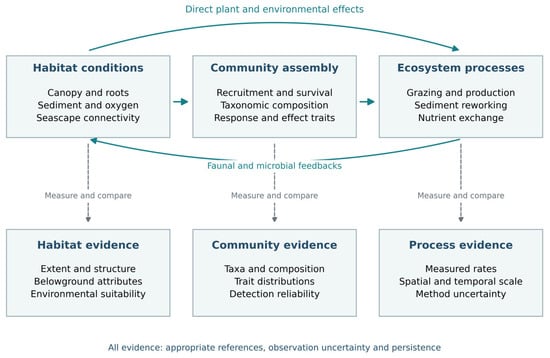
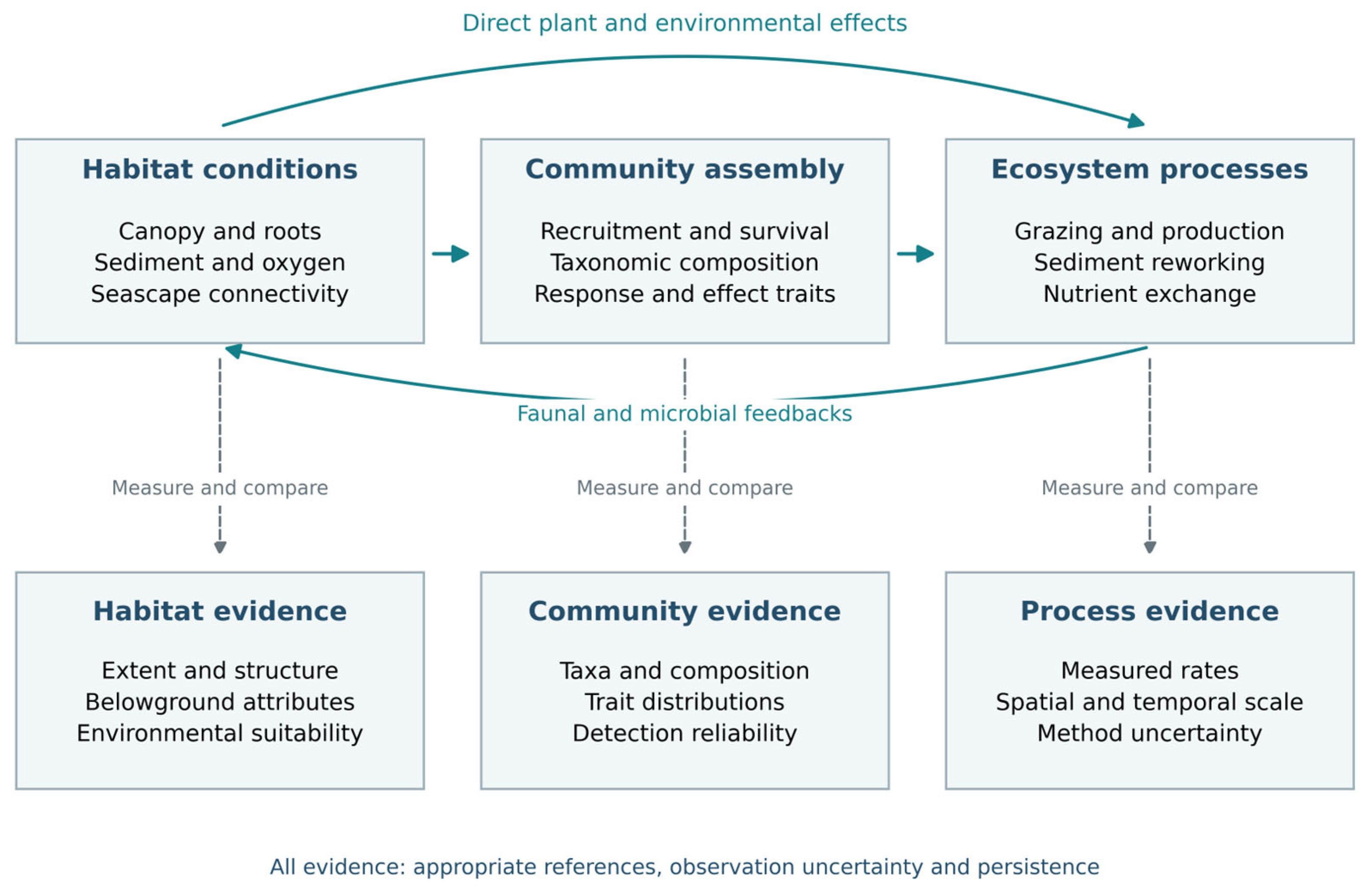

Disclaimer/Publisher’s Note: The statements, opinions and data contained in all publications are solely those of the individual author(s) and contributor(s) and not of MDPI and/or the editor(s). MDPI and/or the editor(s) disclaim responsibility for any injury to people or property resulting from any ideas, methods, instructions or products referred to in the content. |
© 2026 by the authors. Licensee MDPI, Basel, Switzerland. This article is an open access article distributed under the terms and conditions of the Creative Commons Attribution (CC BY) license.