


Abstract
We presented a synthesis of Brazilian Entomobryomorpha species and new records of the Brazilian oceanic islands located in the Equatorial Atlantic. In this work, we observed the global distributions of the species that inhabit the Brazilian oceanic islands. We presented distribution maps for all species found on the islands and the closest records on the continent. Our study showed that species that occur in the islands also occur in the American continent, mainly in the neotropical region, or are widespread. We established a new neotype of the first species of Collembola described in Brazil together with a detailed morphological study.
1. Introduction
Entomobryomorpha is the most diverse order of Collembola, with more than 4000 described species in 200 genera, distributed among eight families and four superfamilies: Isotomoidea Schäffer, 1896 [1]; Entomobryoidea Womersley, 1934 [2]; Tomoceroidea Szeptycki, 1979 [3]; Coenaletoidea Soto-Adames et al. 2008 [4]. This order can be found in all biogeographic regions [5].
Among the most diverse families are Isotomidae (Isotomoidea), Entomobryidae andParonellidae (Entomobryoidea). The Isotomidae family Schäffer, 1896, contain four subfamilies, 112 genera and about 1440 species. Entomobryidae is the largest family of Collembola, with about 1900 species in 64 genera. Paronellidae is also distributed worldwide, with about 550 species in 38 genera.
Abrantes et al. 2012 [6] summarized a list of Brazilian Collembola with 102 species of Entomobryomorpha. In this summary, the only species recorded on a Brazilian oceanic island was Seira musarum Ridley, 1890, which is the first species of Collembola recorded in Brazil. In the description of this species, Ridley [7] mentions: “Very abundant between the wet bases of the petioles of the bananas, at the base of the Peak (...) these small Collembola have been much neglected by collectors, and it is most probable that this species was introduced in the bananas.”
After Ridley, in the Brazilian oceanic islands, the only Collembola fauna survey was made by Lima and Zeppelini, 2015 [8] at Fernando de Noronha Archipelago, which presented 13 morphospecies and 9 species; later, Cipola et al. 2019 [9] had access to this material and registered Seira dowlingi in Fernando de Noronha, and Rafael et al. 2020 [10] presented a checklist with taxonomic advances from the 2015 survey.
The growing human impact on biodiversity requires great efforts in the development of conservation strategies. These efforts must be a priority in oceanic islands. These environments have great barriers to dispersion and colonization, especially for terrestrial fauna, which generally present very particular diversities [8]. In this way, the survey of Collembola fauna is important for conservation, due to its known bioindicator potential.
In this study, we present the taxonomic advances from Lima and Zeppelini, 2015 [8], Cipola et al. 2019 [9] and Rafael et al. 2020 [10] (in Fernando de Noronha) and the results of the first surveys for the Rocas Atoll and São Pedro e São Paulo Archipelago [8,9,10]. We present new records of Isotomidae, Entomobryidae and Paronellidae, as well as an update on the distribution and habitat synthesis of the Brazilian Entomobryomorpha, including contributions after Abrantes et al. 2012 [6].
2. Materials and Methods
2.1. Study Area
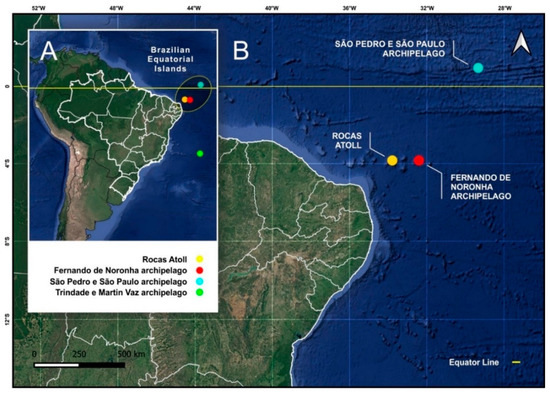
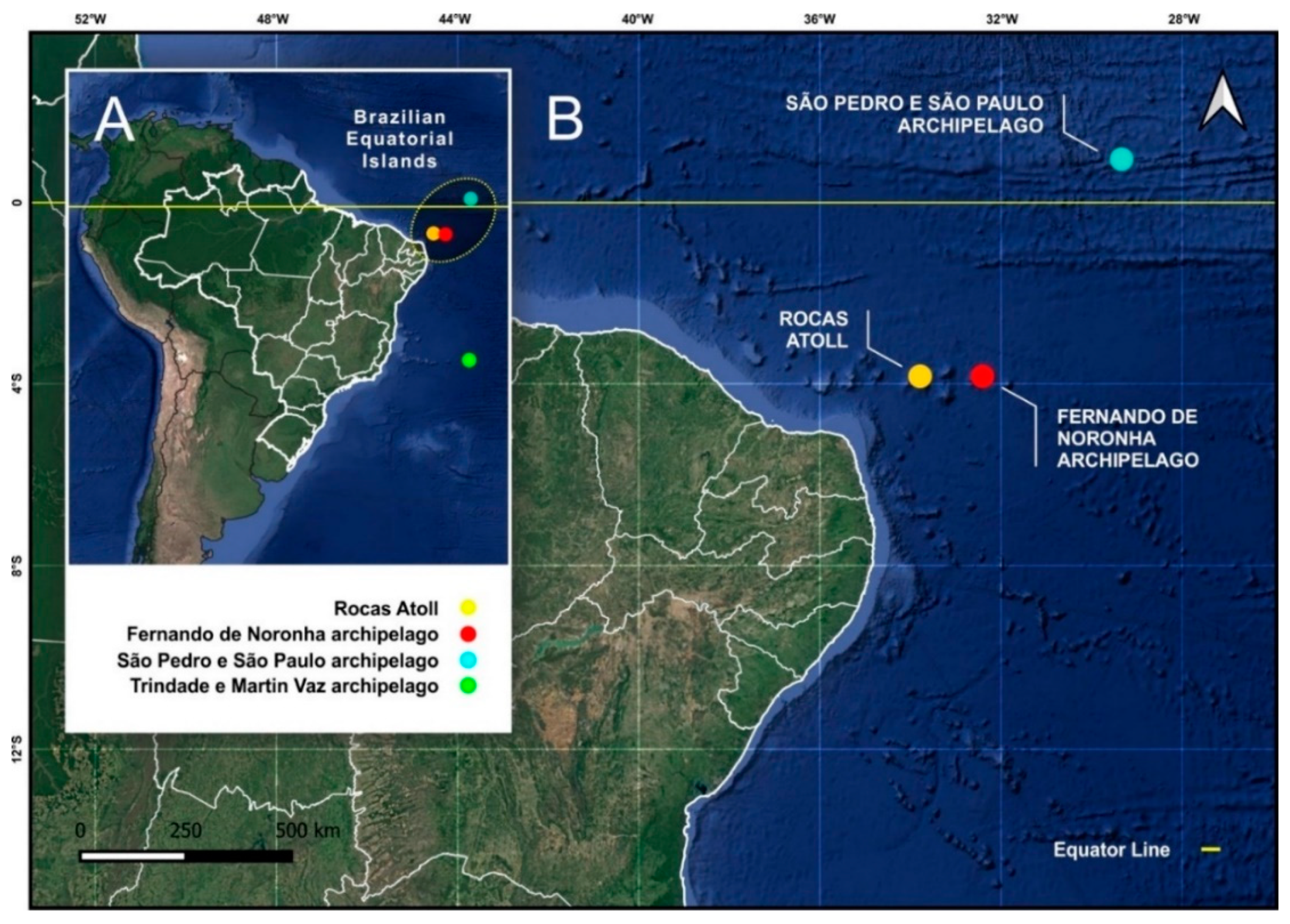
This survey was conducted in 3 Brazilian oceanic islands (2 Archipelagos and 1 Atoll) located in the Equatorial Atlantic Ocean, all belonging to the Brazilian national territory, as follows: Fernando de Noronha Archipelago—FN (3°50′ S, 32°15′ O), São Pedro e São Paulo Archipelago—SPSP (0°55′ N, 29°20′ O) and Rocas Atoll—RA (3°51′ S, 33°48′ O), about 360, 1010 and 267 km from the American continent, respectively (Figure 1). All maps were generated using Geographic Information System QGIS 3.16. Base maps from Google Satellite were used. Datum: SIRGAS 2000.
Figure 1.
Brazilian oceanic islands. (A). Geographical position of all Brazilian oceanic islands showing the equatorial islands. (B). Details of the geographic position of the Brazilian equatorial oceanic islands.
2.2. Taxonomic Nomenclature of Seira Musarum
The terminology used in the descriptions mainly follows: [11] to labial chaetotaxy, with additions of [12,13] to labial palp papillae; [14] to labral chaetotaxy; [15] to dorsal head chaetotaxy, with additions of [4,16] for abdomen V; to S-chaetotaxy with additions of [4,17] to dorsal chaetotaxy and [18] to the manubrial formula of ventral chaetae. For comparisons of the dorsal chaetotaxy, we also used the system of macrochaetae fields in [19], with adaptations provided by [18].
2.3. Sample Procedure
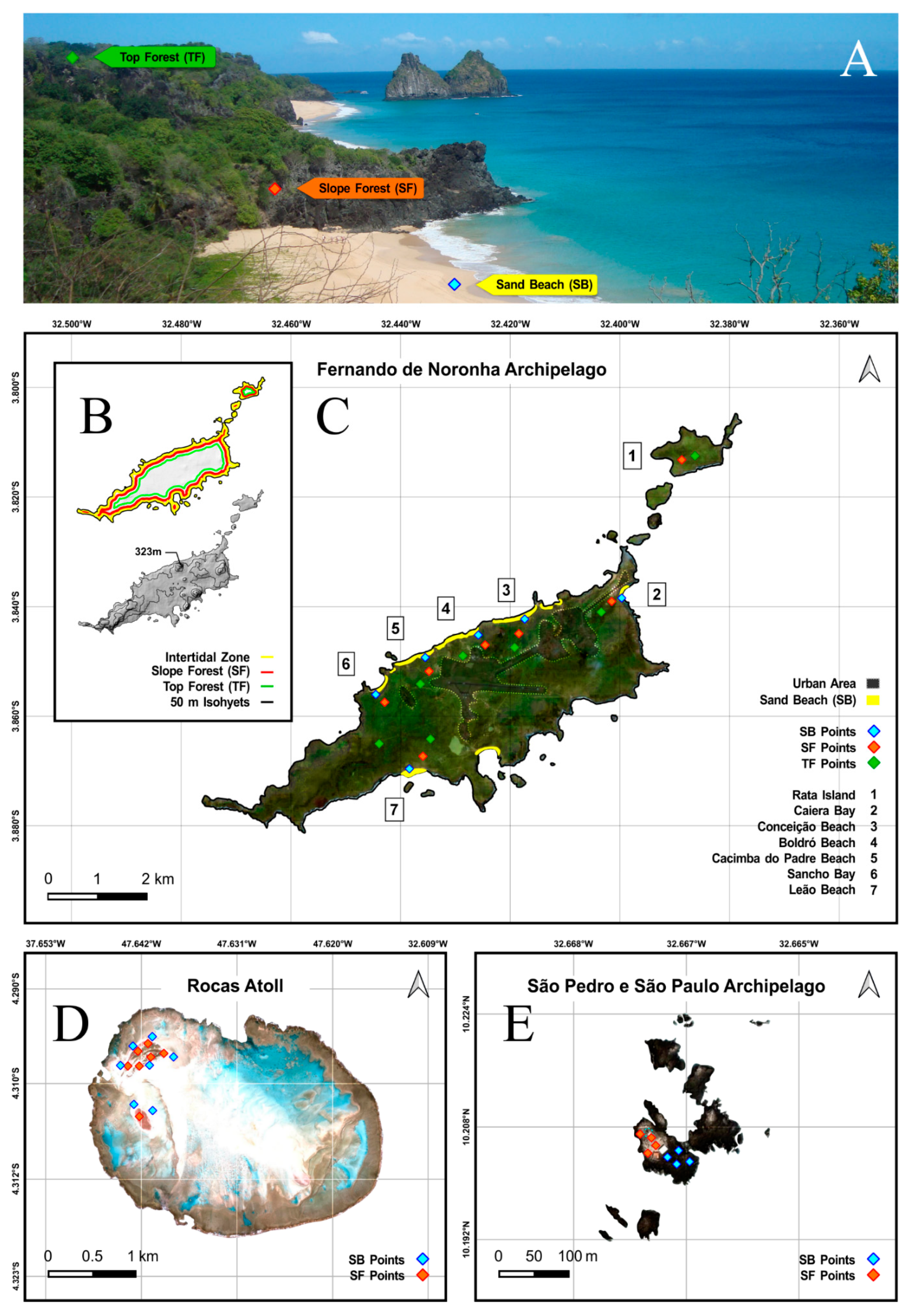
The Entomobryomorpha specimens were collected in three coastal environmental areas: the intertidal zone in sand or rock areas, without vegetation, referred to as sandy beach (SB); the sloping land closest to the intertidal zone, with vegetation, referred to as slope forest (SF) and the forest more distant from the beach, referred to as top forest (TF); the latter area only exists in Fernando de Noronha (Figure 2).
Collembola were captured with Berlese–Tullgren funnels (in SF and TF), and the washing technique and the extraction of floating specimens was carried out manually with aid of brushes (in SB) [8].
Specimens were preserved in ethanol, cleared in Nesbitt’s solution and then mounted on glass slides in Hoyer’s medium. Morphological analyses and measurements were obtained using a Zeiss Axio Scope A1 microscope with Axiocam 105 color and Zen 2 Blue software, and for analysis with a Scanning Electronic Microscope (SEM), specimens were dehydrated with ethanol, dried in a critical point dryer, and covered in gold. All species was deposited in the Coleção de Referência de Fauna de Solo (CRFS) at the Universidade Estadual da Paraíba, João Pessoa, PB, Brazil.
2.4. Species List of Brazilian Entomobryomorpha
Species records, collection location, habitat and biotope information for each species were modified from [6], which includes: newly described species, new records published between 2012 and 2022 and a survey of the Brazilian oceanic islands between 2012 and 2017. Publications that do not provide identifications of species with epithet have been omitted. Information on the world distribution of species was based on [20] and original new records. The biogeographical distribution regions according to [21], modified by [20,22], were as follows: Boreal (Bor) included regions 1–8, Paleotropical (Pal) regions 9–23, Neotropical (Neo) regions 24–30, South African (SAf) region 31, Australian (Aus) regions 32–34 and Antarctic (Ant) regions 35–37. Species restricted to Brazil were based on [20], defining the Brazilian biogeographic subregions: Amazon (Amz), North and Central Brazil (NCB) and Pampa (Pam), corresponding to biogeographic regions 26, 27 and 29, respectively [20]. Species distributed in at least four of the major regions (Neo, Pal, etc.) are considered widespread (WSP).
2.5. Abbreviations
Brazilian states, oceanic island and sites sampled: AC—Acre; AL—Alagoas; AM—Amazonas; AP—Amapá; BA—Bahia; CE—Ceará; ES—Espiro Santo; GO—Goiás; MA—Maranhão; MG—Minas Gerais; MS—Mato Grosso do Sul; MT—Mato Grosso; PA—Pará; PB—Paraíba; PE—Pernambuco; PI—Piauí; PR—Paraná; RJ—Rio de Janeiro; RN—Rio Grande do Norte; RO—Rondônia; RR—Roraima; RS—Rio Grande do Sul; SC—Santa Catarina; SE—Sergipe; SP—São Paulo; SPSP—São Pedro e São Paulo; TO—Tocantins; FN—Fernando de Noronha; RA—Rocas Atoll; TR—Trindade e Martim Vaz. SB—sandy beach sites; SF—slope forest site; TF—top forest site.
Taxonomic: a.a.—apical appendage; a—anterior; Abd.—abdominal segment; Ant. —antennal segment; b.c.—basal chaeta; Cd.—cephalic diagonal; l.p.—lateral process; mac—macrochaetae; meso—mesochaetae; mic—macrochaetae; m—medial; PC—papillary crests; Pl—prelabral, p—posterior; PSP—pseudopore; sens—sens, specialized ordinary chaetae (sensillum); Th.— thoracic segment, Tita—tibiotarsus.
Figure 2.
Maps of distribution sites sampled: (A), example of sampled environments; (B), map with delimitation of areas and elevation map; (C), Fernando de Noronha sites; (D), Rocas Atoll sites; (E), São Pedro e São Paulo sites.
3. Results
3.1. Entomobryomorpha Survey of the Brazilian Oceanic Islands
Twenty Entomobryomorpha species are recorded in Brazilian oceanic islands distributed in the families: Isotomidae, Entomobryidae and Paronellidae. Except Archisotoma jariani Lima, Zeppelini & Mendonça 2019 and Psammisotoma sp., all species found in the islands studied have distribution in the American continent (Table 1).
Table 1.
Entomobryidae species recorded in Fernando de Noronha, São Pedro e São Paulo and Rocas Atoll. Abundance in environmental areas (SB, SF and TF), and biogeographic region of occurrence of the species. Neo, neotropical species, WSP, occurs in at least 3 biogeographic regions. *, new records; -, non-existent environment.
In Fernando de Noronha, six Isotomidae, six Entomobryidae and five Paronellidae were found. Of this total (15 spp.), eight are widespread, four are exclusive species from Brazil, five are neotropical and one occurs in the Nearctic region (Table 1).
In São Pedro e São Paulo, three species were found, two Isotomidae and one Entomobryidae; these species have known distribution in the neotropical region and are widespread and restricted to Brazil, respectively (Table 1).
On Rocas Atoll, five species were found, three Isotomidae and one Paronellidae. Rocas Atoll was the only oceanic island that presented one endemic species (A. jariani), a possible new endemic species (Psammisotoma sp.), one distributed in Brazil and another in the neotropical region (Table 1).
The species Hemisotoma thermophila and Seira musarum occur in the three studied islands, and Cyphoderus innominatus occurs in Fernando de Noronha and Rocas Atoll. The only species of Entomobryomorpha that are shared between the islands are as follows:
Entomobryomorpha Börner, 1913;
Isotomoidea Szeptycki, 1979;
Isotomidae Schäffer, 1896.
Archisotoma jariani Lima, Zeppelini & Mendonça, 2019
Brazilian Oceanic Island Records: RA (3°51′26.39″ S; 33°48′54.77″ W), SB, 14 Oct 2015, E. C. A. Lima leg., CRFS #15071—15073, 15076. RA (3°51′33.91″ S; 33°48′58.48″ W), SB, 13 Oct 2015, E. C. A. Lima leg., CRFS #15074-15075.
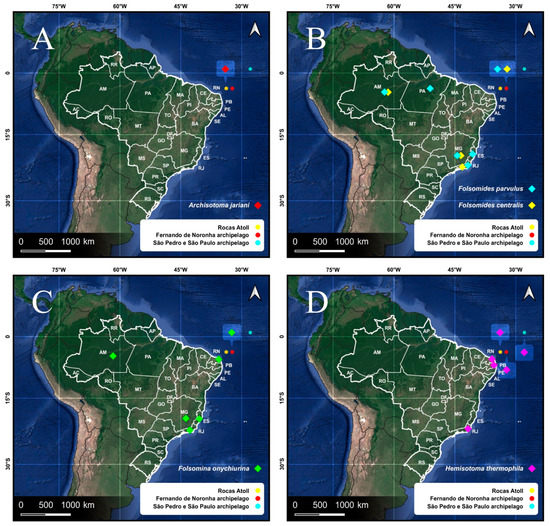
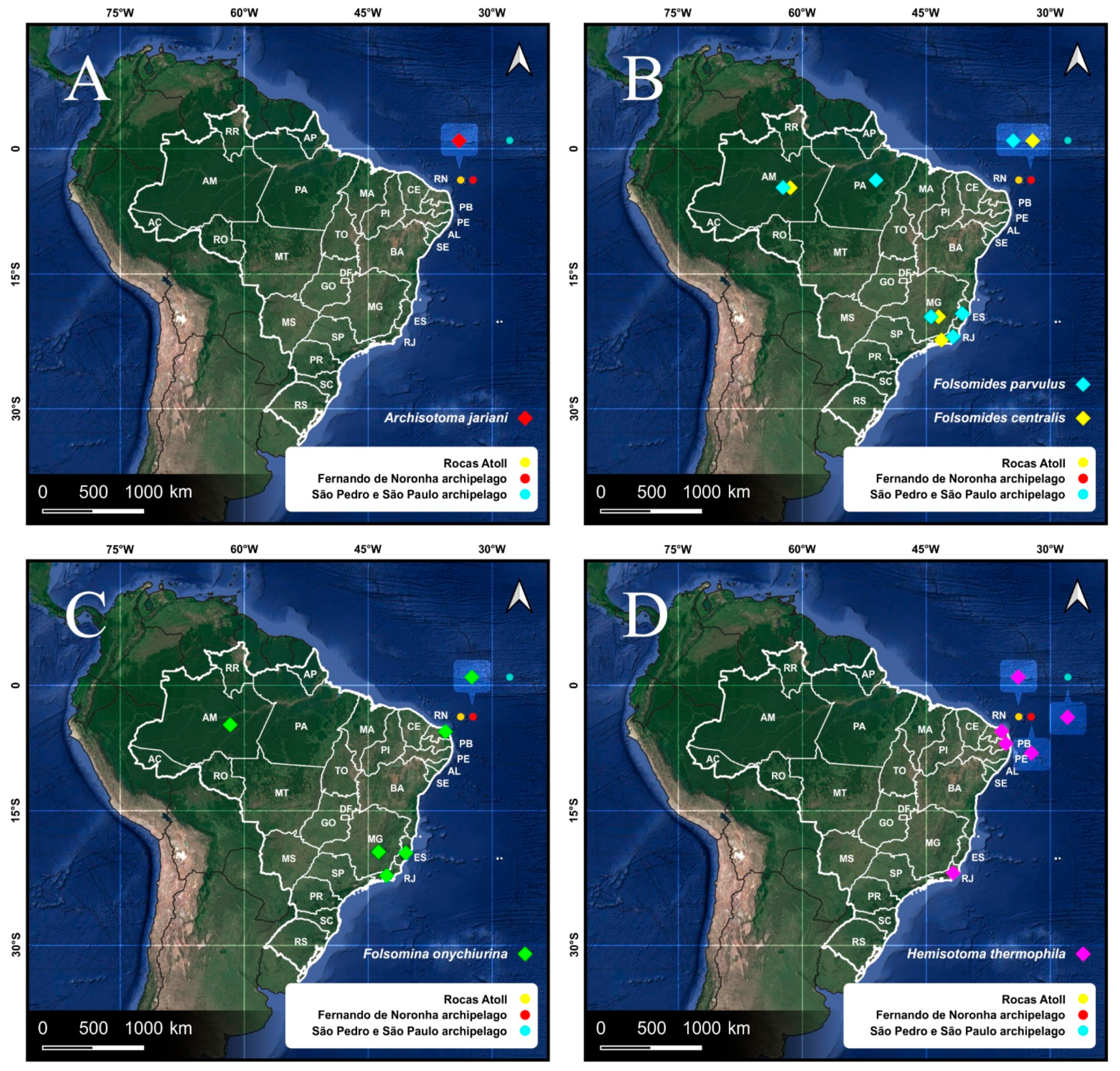
Brazil Occurrence: RA endemic species (Figure 3A).
Figure 3.
Distribution map for Isotomidae records in Brazil mainland and oceanic islands. (A). Archisotoma jariani; (B). Folsomides parvulus and F. centralis; (C). Folsomina onychiurina; (D). Hemisotoma thermophila.
Biogeographic distribution: Achisotoma distribution see Lima et al. 2019.
Folsomides centralis Denis, 1931
Brazilian Oceanic Island Records: FN (3°51′21.93″ S; 32°26′37.78″ W), SF, 31 Jul 2012, E. C. A. Lima & A. S. Ferreira Leg., CRFS #14785—14788.
Brazil Occurrence: RJ, MG, AM and FN (Figure 3B).
Biogeographic distribution: 6, 8, 15, 18, 20, 21, 22, 23, 24a, 24b, 26, 27, 28, 32. Widespread species.
Folsomides parvulus Stach, 1922
Brazilian Oceanic Island Records: FN (3°52′8.88″ S; 32°26′13.57″ W), SF, 01 Aug 2012, E. C. A. Lima & A. S. Ferreira Leg., CRFS #14771—14783. FN (3°51′50.41″ S; 32°26′5.44″ W), TF, 01 Aug 2012, E. C. A. Lima & A. S. Ferreira Leg., CRFS #14791, #14793. FN (3°52′8.88″ S; 32°26′13.57″ W), SF, 01 Aug 2012, E. C. A. Lima & A. S. Ferreira Leg., CRFS #14794. FN (3°50′31.85″ S; 32°24′14.74″ W), TF, 07 Aug 2012, E. C. A. Lima & D. D. Silva leg., CRFS #14775. FN (3°48′45.61″ S; 32°23′26.17″O), SF, 19 Jul 2012, E. C. A. Lima & A. S. Ferreira Leg., CRFS #15066—15067. FN (3°48′45.06″ S; 32°23′14.07″ W), TF, 19 Jul 2012, E. C. A. Lima & A. S. Ferreira Leg., CRFS #15068. FN (3°50′43.00″ S; 32°25′34.04″ W), SF, 20 Jul 2012, E. C. A Lima & D. Zeppelini leg., CRFS #14769—14770, #14776, #14780, #15165. FN (3°50′58.48″ S; 32°26′3.83″ W), SF, 25 Jul 2012, E. C. A. Lima & A. S. Ferreira Leg., CRFS #14772, #14778, #14789. FN (3°51′14.32″ S; 32°26′12.62″ W), TF, 25 Jul 2012, E. C. A. Lima & A. S. Ferreira Leg., CRFS #14773—14774. FN (3°51′14.32″ S; 32°26′12.62″ W), TF, 25 Jul 2012, E. C. A. Lima & A. S. Ferreira Leg., CRFS #14779, #14781—14782, #14784, #14790. FN (3°51′3.73″ S; 32°26′0.38″ W), SF, 27 Jul 2012, E. C. A. Lima & A. S. Ferreira Leg., CRFS #15164. FN (3°51′52.31″ S; 32°26′38.80″ W), TF, 31 Jul 2012, E. C. A. Lima & A. S. Ferreira Leg., CRFS #14777. FN (3°51′21.93″ S; 32°26′37.78″ W), SF, 31 Jul 2012, E. C. A. Lima & A. S. Ferreira Leg., CRFS #14792.
Brazil Occurrence: RJ, MG, Espírito Santo, AM, Pará and FN (Figure 3B).
Biogeographic distribution: 1, 2a, 2b, 3a, 3b, 4, 5, 6, 7a, 7b, 8, 9, 13, 14, 15, 17, 19, 20, 21, 23, 24a, 24b, 26, 27, 28, 29, 32, 34, 35. Widespread species.
Folsomina onychiurina Denis, 1931
Brazilian Oceanic Island Records: FN (3°51′50.41″ S; 32°26′5.44″ W), TF, 01 Aug 2012, E. C. A. Lima & A. S. Ferreira Leg., CRFS #14805. FN (3°52′8.88″ S; 32°26′13.57″ W), SF, 01 Aug 2012, E. C. A. Lima & A. S. Ferreira Leg., CRFS #14806. FN (3°51′14.32″ S; 32°26′12.62″ W), TF, 25 Jul 2012, E. C. A. Lima & A. S. Ferreira Leg., CRFS #14807, #14810. FN (3°50′58.48″ S; 32°26′3.83″ W), SF, 25 Jul 2012, E. C. A. Lima & A. S. Ferreira Leg., CRFS #14808—14809, #14811—14817. FN (3°51′21.93″ S; 32°26′37.78″ W), SF, 25 Jul 2012, E. C. A. Lima & A. S. Ferreira Leg., CRFS #14815, #14816. FN (3°51′14.32″ S; 32°26′12.62″ W), TF, 25 Jul 2012, E. C. A. Lima & A. S. Ferreira Leg., CRFS #15166.
Brazil Occurrence: AM, RN, Espírito Santo, MG, RJ and FN (Figure 3C).
Biogeographic distribution: 2a, 3a, 3b, 4, 5, 7a, 7b, 8, 9, 12, 13, 14, 15, 17, 18, 19, 20, 21, 22, 23, 24a, 24b, 26, 27, 28, 29, 32, 33, 34, 35. Widespread species.
Hemisotoma thermophila Axelson, 1900
(as Cryptopgus sp1 and sp2 Lima & Zeppelini, 2015)
Brazilian Oceanic Island Records: FN (3°52′8.88″ S; 32°26′13.57″ W), SF, 01 Jul 2012, E. C. A. Lima & A. S. Ferreira Leg., CRFS #14853—14859, #15057. FN (3°51′21.93″ S; 32°26′37.78″ W), SF, 31 Jul 2012, E. C. A. Lima & A. S. Ferreira Leg., CRFS #14839. FN (3°51′52.31″ S; 32°26′38.80″ W), TF, 31 Jul 2012, E. C. A. Lima & A. S. Ferreira Leg., CRFS #14840, #14841, #14842, #14844, #14865, #14877. FN (3°48′45.61″ S; 32°23′26.17″ W), SF, 19 Jul 2012, E. C. A. Lima & A. S. Ferreira Leg., CRFS #14838, #15064. FN (3°48′45.06″ S; 32°23′14.07″ W), TF, 19 Jul 2012, E. C. A. Lima & A. S. Ferreira Leg., CRFS #14878—14879, #15053. FN (3°51′14.32″ S; 32°26′12.62″ W), TF, 25 Jul 2012, E. C. A. Lima & A. S. Ferreira Leg., CRFS #14860—14861. FN (3°50′48.92″ S; 32°25′13.61″ W), TF, 26 Jul 2012, E. C. A. Lima & A. S. Ferreira Leg., CRFS #9616, #9552—9554, #15078. FN (3°50′36.76″ S; 32°25′12.64″ W), SF, 26 Jul 2012, E. C. A. Lima & A. S. Ferreira Leg., CRFS #9534—9551, #9555—9561, #15049—15052. FN (3°51′3.73″ S; 32°26′0.38″ W), SF, 27 Jul 2012, E. C. A. Lima & A. S. Ferreira Leg., CRFS #14880—14883, #14885—14927, #14845—14852. FN (3°50′18.66″ S; 32°24′3.09″ W), SF, 07 Aug 2012, E. C. A. Lima & D. D. Silva leg., CRFS #14843, #14862—14864, #14870—14876, #14884. FN (3°50′31.85″ S; 32°24′14.74″ W), TF, 07 Aug 2012, E. C. A. Lima & D. D. Silva leg., CRFS #14866—14869.
Brazil Occurrence: Paraíba and RJ. FN, RA and SPSP (Figure 3D).
Biogeographic distribution: 1, 2a, 3a, 3b, 4, 5, 6, 7a, 7b, 7c, 8, 9, 12, 13, 15, 17, 18, 20, 22, 23, 24a, 24b, 26, 27, 28, 29, 30, 32, 33, 34, 35. Widespread species.
Isotomiella nummulifer Deharveng & Oliveira, 1990
Brazilian Oceanic Island Records: FN (3°51′52.31″ S; 32°26′38.80″ W), TF, 31 Jul 2012, E. C. A. Lima & A. S. Ferreira Leg., CRFS #14795, #14798—14799. FN (3°51′14.32″ S; 32°26′12.62″ W), TF, 25 Jul 2012, E. C. A. Lima & A. S. Ferreira Leg., CRFS #14796. FN (3°50′54.21″ S; 32°25′45.56″ W), TF, 20 Jul 2012, E. C. A Lima & D. Zeppelini leg., CRFS #14797. FN (3°52′8.88″ S; 32°26′13.57″ W), SF, 01 Aug 2012, E. C. A. Lima & A. S. Ferreira Leg., CRFS #14800—14802, #14804. FN (3°50′18.66″ S; 32°24′3.09″ W), SF, 07 Aug 2012, E. C. A. Lima & D. D. Silva leg., CRFS #14803.
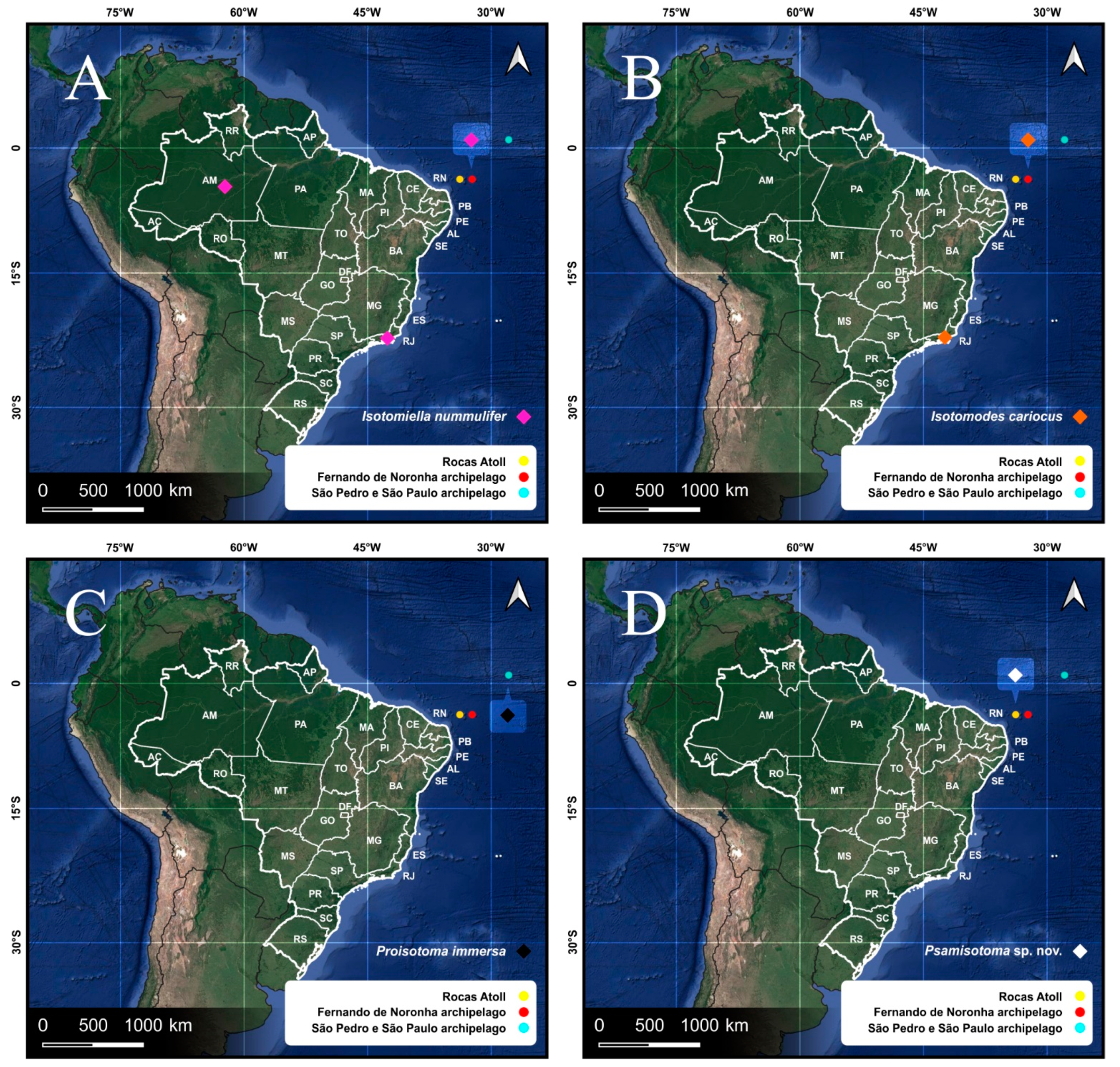
Brazil Occurrence: AM, RJ and FN (Figure 4A).
Figure 4.
Distribution map for Isotomidae records in Brazil mainland and oceanic islands. (A). Isotomiella nummulifer; (B). Isotomodes cariocus; (C). Proisotoma immersa; (D). Psammisotoma sp.
Biogeographic distribution: 13, 18, 19, 24a, 26, 27. Widespread species.
Isotomodes cariocus Thibaud & Palacios-Vargas, 1999
Brazilian Oceanic Island Records: FN (3°50′43.00″ S; 32°25′34.04″ W), SF, 20 Jul 2012, E.C.A Lima & D. Zeppelini leg., CRFS #14820, #14831. FN (3°50′54.21″ S; 32°25′45.56″ W), TF, 20 Jul 2012, E. C. A Lima & D. Zeppelini leg., CRFS #14823, #14827, #14830, #14835. FN (3°50′58.48″ S; 32°26′3.83″ W), SF, 25 Jul 2012, E. C. A. Lima & A. S. Ferreira Leg., CRFS #14826, #14828, #14836. FN (3°51′14.32″ S; 32°26′12.62″ W), TF, 25 Jul 2012, E. C. A. Lima & A. S. Ferreira Leg., CRFS #14833. FN (3°50′48.92″ S; 32°25′13.61″ W), TF, 26 Jul 2012, E. C. A. Lima & A. S. Ferreira Leg., CRFS #9600—9610, #9613. FN (3°50′36.76″ S; 32°25′12.64″ W), SF, 26 Jul 2012, E. C. A. Lima & A. S. Ferreira Leg., CRFS #9611—9612. FN (3°51′21.93″ S; 32°26′37.78″ W), SF, 31 Jul 2012, E. C. A. Lima & A. S. Ferreira Leg., CRFS #14818—14819, #14824—14825, #14832. FN (3°51′52.31″ S; 32°26′38.80″ W), TF, 31 Jul 2012, E. C. A. Lima & A. S. Ferreira Leg., CRFS #14834, #14837, #14821, #14822. FN (3°50′31.85″ S; 32°24′14.74″ W), TF, 07 Aug 2012, E. C. A. Lima & D. D. Silva leg., CRFS #14829.
Brazil Occurrence: RJ and FN (Figure 4B).
Biogeographic distribution: Endemic species of Brazil.
Proisotoma immersa Folsom, 1924
Brazilian Oceanic Island records: SPSP (0°55′0.09″N, 29°20′45.36″O) SF, 01 May 2017, E. C. A. Lima & D. Zeppelini Leg., CRFS #15047.
Brazil Occurrence: SPSP (Figure 4C).
Biogeographic distribution: 7a, 7b, 8, 24a. Proisotoma immersa is distributed in neotropical and Nearctic regions. The closest registration to the SPSP was made by Cutz-Pool and Vázquez-González, 2012 in México, Quintana Roo, Felipe Carrillo Puerto.
Psammisotoma Greenslade & Deharveng, 1986
Psammisotoma sp.
Brazilian Oceanic Island Records: RA (3°51′27.44″ S; 33°48′53.66″ W), SF, 14 Oct 2015, E.C. A. Lima leg., CRFS #15089—15093, #15182, #15185. RA (3°51′33.33″ S; 33°48′54.05″ W), SF, 08 Oct 2015, E. C. A. Lima leg., CRFS #15181, #15183—15184, #15092.
Brazil Occurrence: RA (Figure 4D).
Biogeographic distribution: RA.
Remarks. Psammisotoma sp. is similar to P. restingae Abrantes & Mendonça, 2009 (Brasil, RJ) in many ways, such as the habitus, sensory organ of antennal segment III, number of eyes, furcal chaetotaxy and mucro. Psammisotoma sp. present manubrium anteriorly with 30–36 chaetae and a lateral line with 6 + 6 to 8 + 8, and 1 + 1 to 2 + 2 distal spine-like chaetae, while P. restingae present manubrium anteriorly normally with 44 chaetae and a lateral line with 8 + 8, and 2 + 2 distal spine-like chaetae. Abrantes and Mendonça, 2009 [23] mention possible variations such as reduced chaetotaxy on the manubrium, dens with small numbers of setae and only one pair of spine-like chaetae on the internal margin, which could be attributed to different ontogenetic stages.
These variations and the impossibility of analyzing the P. restingue type did not allow the establishment of a new taxon.
Entomobryoidea Womersley, 1934
Entomobryidae Schäffer, 1896
Entomobrya atrocincta Schött, 1896
Brazilian Oceanic Island Records: FN (3°51′52.31″ S; 32°26′38.80″ W), TF, 31 Jul 2012,
E. C. A. Lima & A. S. Ferreira Leg., CRFS #15100.
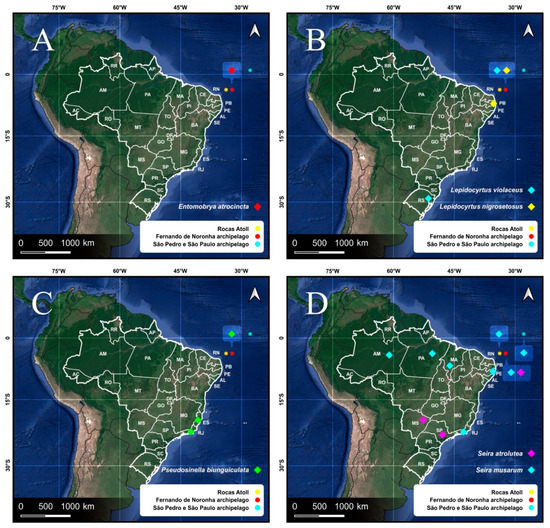
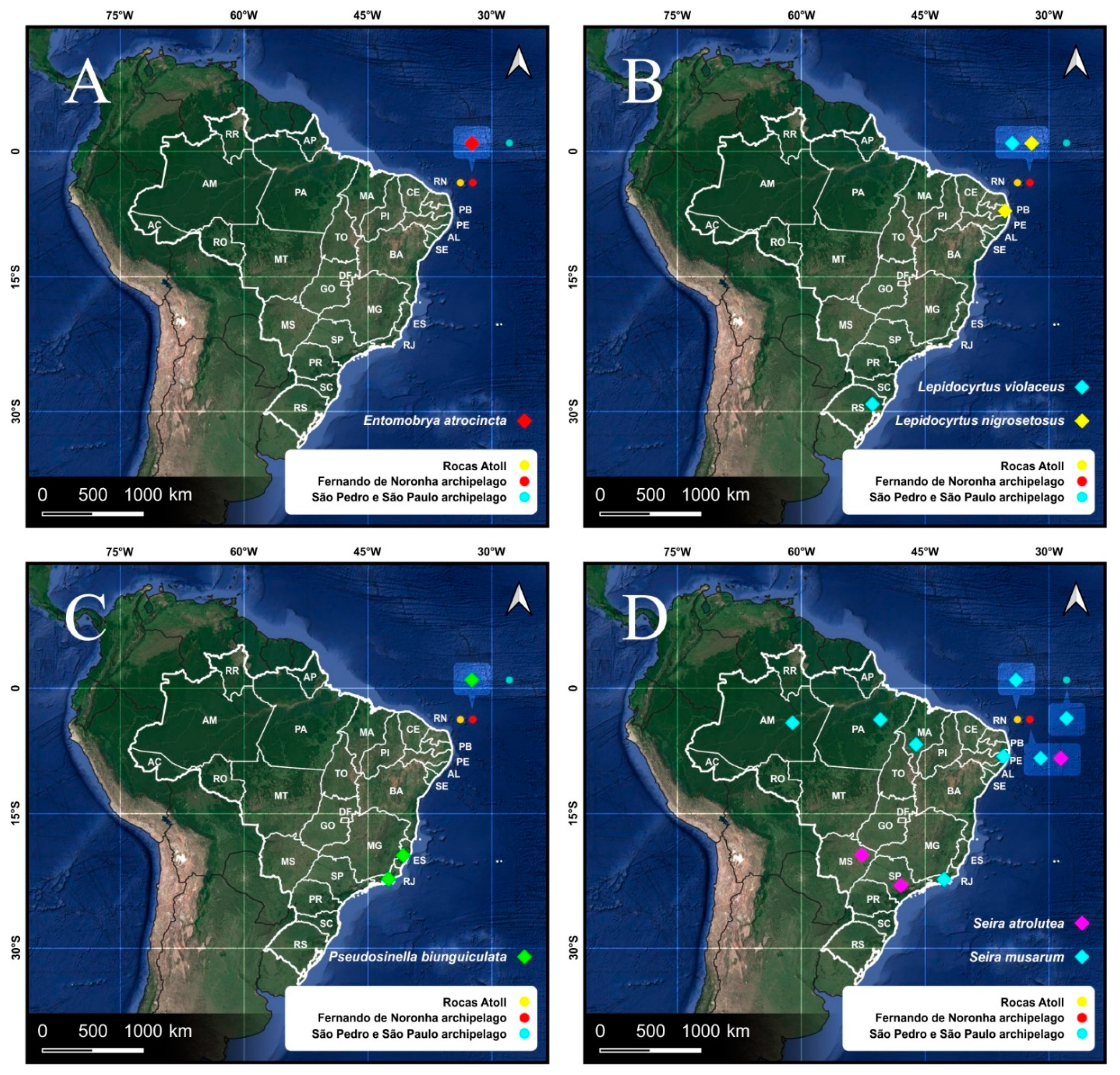
Brazil Occurrence: FN (Figure 5A).
Figure 5.
Distribution map for Entomobryidae records in Brazil mainland and oceanic islands. (A). Entomobrya atrocincta; (B). Lepidocyrtus violaceus and L. nigrosetosus; (C). Pseudosinella biunguiculata; (D). Seira atrolutea and Seira musarum.
Biogeographic distribution: 7a, 7b, 8. Nearctic species.
Lepidocyrtus nigrosetosus Folsom, 1927
(as Pseudosinella flatua, in Lima & Zeppelini (2015))
Brazilian Oceanic Island Records: FN (3°48′45.61″ S; 32°23′26.17″ W), SF, 19 Jul 2012, E. C. A. Lima & A. S. Ferreira Leg., CRFS #14942—14943, #14945—14954, #14956—14959. FN (3°50′18.66″ S; 32°24′3.09″ W), SF, 07 Aug 2012, E. C. A. Lima & D. D. Silva leg., CRFS #14156—14165, #14241—14307, #14320—14326, #14377—14379. FN (3°50′31.85″ S; 32°24′14.74″ W), TF, 07 Aug 2012, E. C. A. Lima & D. D. Silva leg., CRFS #14166—14169, #14372, #14380—14383, #14387—14398. FN (3°50′43.00″ S; 32°25′34.04″ W), SF, 20 Jul 2012, E. C. A Lima & D. Zeppelini leg., CRFS #14227, #14236—14237, #14374—14376, #14228—14235. FN (3°50′58.48″ S; 32°26′3.83″ W), SF, 25 Jul 2012, E. C. A. Lima & A. S. Ferreira Leg., CRFS #14337—14347. FN (3°51′14.32″ S; 32°26′12.62″ W), TF, 25 Jul 2012, E. C. A. Lima & A. S. Ferreira Leg., CRFS #14230, #14232, #14238—14240, #14327—14331, #14384—14386. FN (3°51′21.93″ S; 32°26′37.78″ W), SF, 31 Jul 2012, E. C. A. Lima & A. S. Ferreira Leg., CRFS #14138—14140, #14142—14155, #14369—14371, #14373. FN (3°51′3.73″ S; 32°26′0.38″ W), SF, 27 Jul 2012, E. C. A. Lima & A. S. Ferreira Leg., CRFS #14332—14336, #14348—14367. FN (3°51′52.31″ S; 32°26′38.80″ W), TF, 31 Jul 2012, E. C. A. Lima & A. S. Ferreira Leg., CRFS #14121—14137. FN (3°51′52.31″ S; 32°26′38.80″ W), TF, 31 Jul 2012, E. C. A. Lima & A. S. Ferreira Leg., CRFS #14141, #14308—14319, #14365, #14368. FN (3°48′45.06″ S; 32°23′14.07″ W), TF, 19 Jul 2012, E. C. A. Lima & A. S. Ferreira Leg., CRFS #14944, #14955, #14960.
Brazil Occurrence: Paraíba and FN (Figure 5B).
Biogeographic distribution: 24a, 24b, 26, 27, 28. Neotropical species.
Lepidocyrtus violaceus Fourcroy, 1785
Brazilian Oceanic Island Records: FN (3°50′54.21″ S; 32°25′45.56″ W), TF, 20 Jul 2012, E. C. A Lima & D. Zeppelini leg., CRFS #14928. Brazil Occurrence: FN (Figure 5B).
Biogeographic distribution: 1, 2a, 2b, 4, 5, 7a, 8, 17, 20, 24a, 37. The closest registration to the FN was made by Cutz-Pool & Vázquez-González, 2012 in México, Quintana Roo, Felipe Carrillo Puerto. Widespread species.
Pseudosinella biunguiculata Ellis, 1967
(as Pseudosinella aera and Pseudosinella sp., in Lima & Zeppelini, 2015)
Brazilian Oceanic Island Records: FN (3°50′54.21″ S; 32°25′45.56″ W), TF, 20 Jul 2012, E.C.A Lima & D. Zeppelini leg., CRFS# 15155. FN (3°51′52.31″ S; 32°26′38.80″ W), TF, 31 Jul 2012, E. C. A. Lima & A. S. Ferreira Leg., CRFS #15102—15106, #15123—15125. FN (3°51′14.32″ S; 32°26′12.62″ W), TF, 25 Jul 2012, E. C. A. Lima & A. S. Ferreira Leg., CRFS #15150—15153, #15156, #15158, #15160. FN (3°51′3.73″ S; 32°26′0.38″ W), SF, 27 Jul 2012, E. C. A. Lima & A. S. Ferreira Leg., CRFS #15154, #15159. FN (3°50′58.48″ S; 32°26′3.83″ W), SF, 25 Jul 2012, E. C. A. Lima & A. S. Ferreira Leg., CRFS #15157.
Brazil Occurrence: RJ and FN (Figure 5C).
Biogeographic distribution: 24a, 24b, 27. Neotropical species.
Seiridae Yosii, 1961
Seira atrolutea (Arlé, 1939)
Brazilian Oceanic Island Records: FN (3°48′45.61″ S; 32°23′26.17″ W), SF, 19 Jul 2012, E. C. A. Lima & A. S. Ferreira Leg., CRFS #15186.
Brazil Occurrence: SP, MS and FN (Figure 5D).
Biogeographic distribution: 27. Brazilian species.
Seira musarum Ridley, 1890
Syn.:Seira dowlingi (Wray, 1953)
Neotype designation. Seira musarum was first described by Ridley, 1890 based on specimens from the Fernando de Noronha Archipelago, Brazil. It is probable that Ridley’s original collection was deposited at the British Museum, London; nevertheless, efforts to trace it failed, and the type material probably no longer exists. Thus, following Article 75.3.4 of the International Code of Zoological Nomenclature (ICZN) [24], here, we designate a female as a neotype on a slide; SF, Fernando de Noronha (3°50′44.85″ S; 32°25′44.80″ W), PE, Brazil. 17.VII.2008. D. Zeppelini leg., deposited at CRFS # 15119.
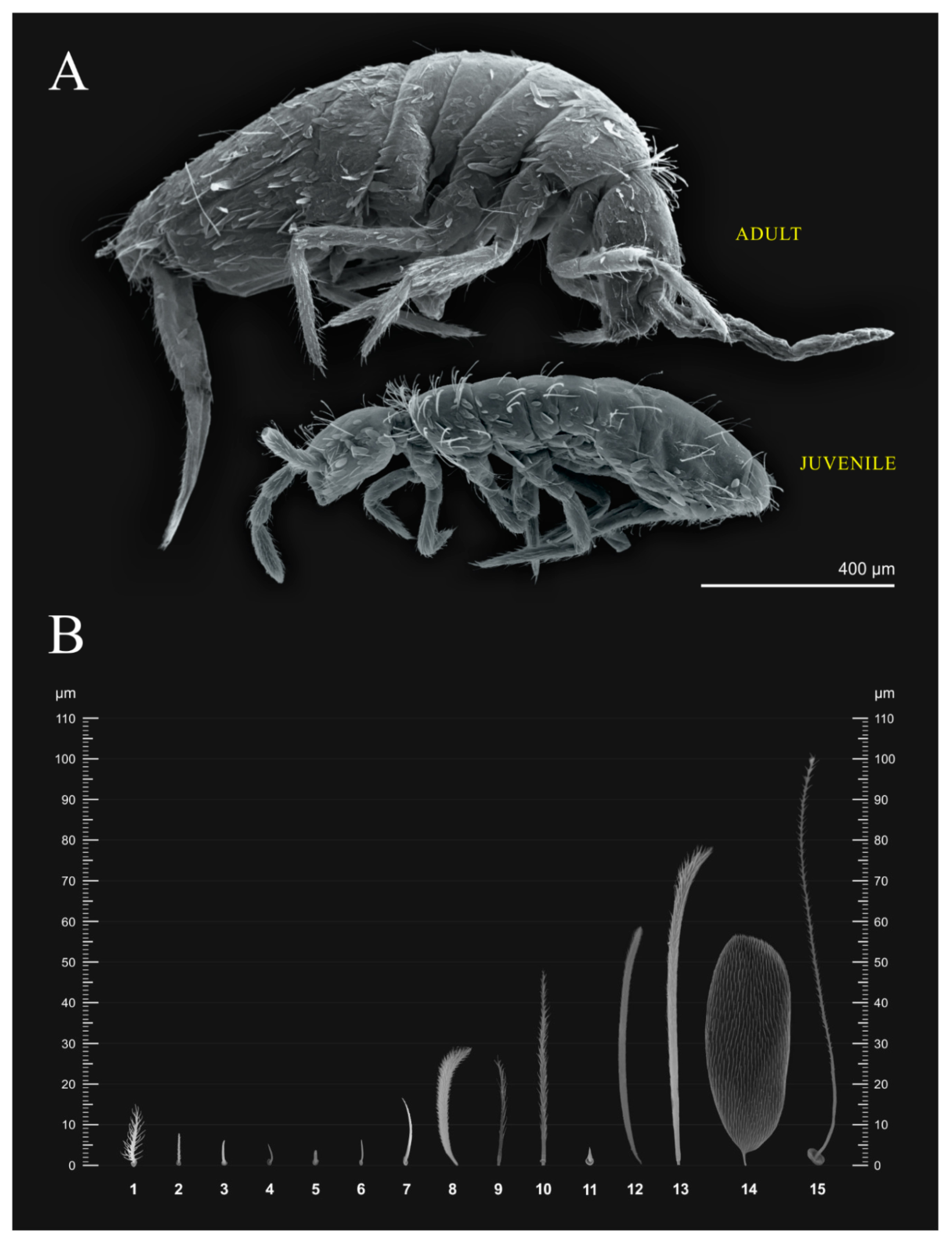
Redescription. Measurements according to Table 2. The habitus typical of genus (Figure 6A) and coloration are according to Ridley, 1890 [7] and the update by Cipola et al., 2019 [9]. Scales are presented from Ant I to the basal third of Ant III, all over the head, thorax, abdomen, legs (except empodia) and manubrium, anterior collophore and ventral dens. Chaetae and scale type are according to Figure 6(B1–15).
Table 2.
Seira musarum—measurements (μm) of neotype body parts.
Figure 6.
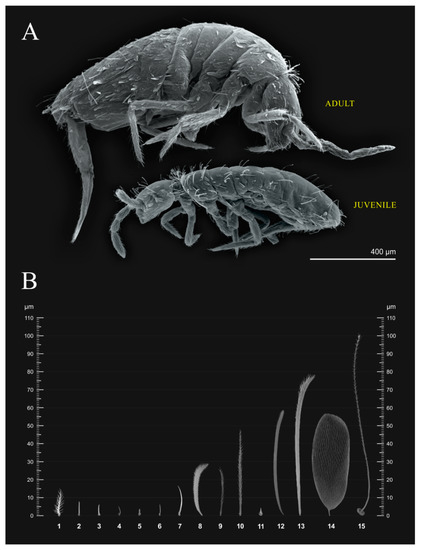
Seira musarum SEM (lateral view). (A). Habitus adult and juvenile; (B), general body chaetae; (B1), microchaeta with long ciliation; (B2), wrinkly sens; (B3), finger-shaped sens; (B4), microchaetae smooth; (B5), rod sens; (B6), smooth microchaeta; (B7), serrate chaetae; (B8), fan-shape chaeta; (B9), chaetae ciliated; (B10), strait macrochaeta with long ciliation; (B11), labial r macrochaetae; (B12), macrochaetae ciliated with rounded apex; (B13), macrochaetae ciliated with trucated apex; (B14), ordinary scale; (B15), bothriotrichum.
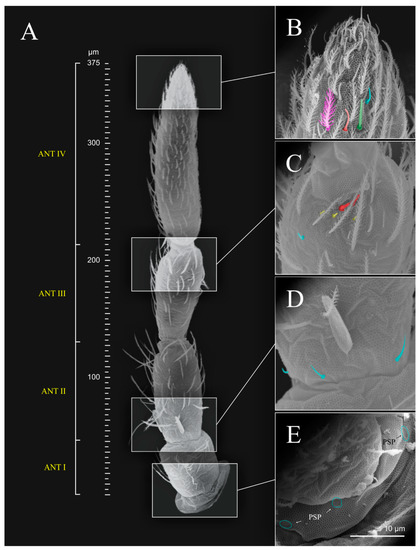
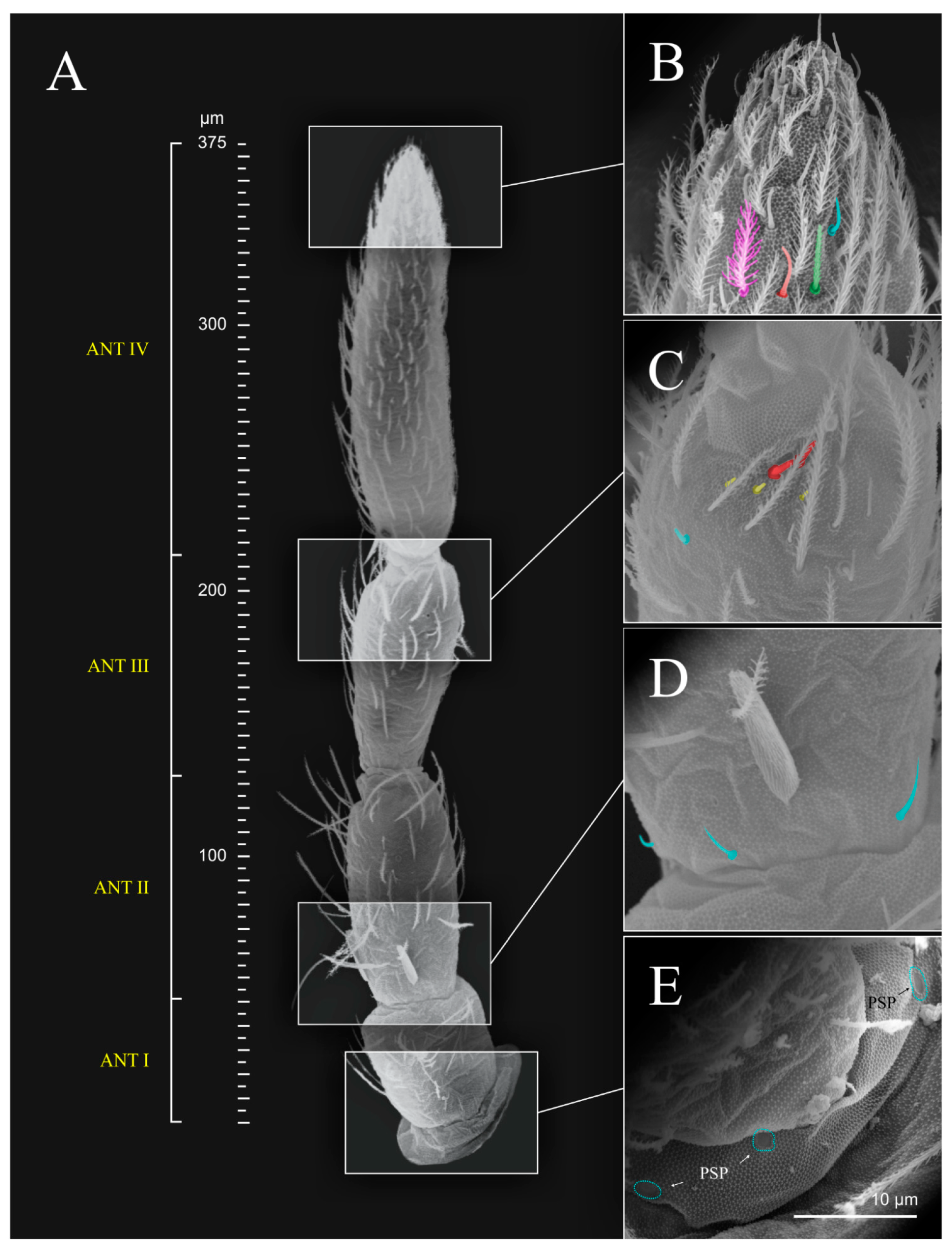
Antenna (Figure 7A). Ant IV (Figure 7B): not annulated, without an apical bulb, with four chaetae type according to Figure 6(B1–4). Ant III (Figure 7C): distal with two apical organs as rod sens (Figure 6(B5)), three guard sens (Figure 7C), numerous mic and mesochaetae with long ciliation (Figure 6(B1)) and two sens types: wrinkly and finger-shaped sens (Figure 6(B2,3)). Ant II (Figure 7D): numerous mic and mesochaetae with long ciliation (Figure 6(B1)), numerous wrinkly and bristle-like sens (Figure 6(B2,6)) and one rod sens (Figure 6(B5)) and three smooth microchaetae at the base of Ant II (Figure 6(B4)). Ant I (Figure 7E): numerous mic and meso with long ciliation (Figure 6(B1,7)), numerous wrinkly and bristle-like sens (Figure 6(B2,6)) and four microchaetae (Figure 6(B4)) in the antennobasal plate with three pseudopores, two internal and one external (Figure 7E).
Figure 7.
Seira musarum SEM. (A), antenna (right side) lateral view; (B), antennal segment IV apex, with the different types of chaetae shown in color; (C), antennal segment III apex, detail of the apical organ; (D), antennal segment II base with colored details for the microchaetae; (E), antennal segment I base, with dashed lines in the pseudopores.
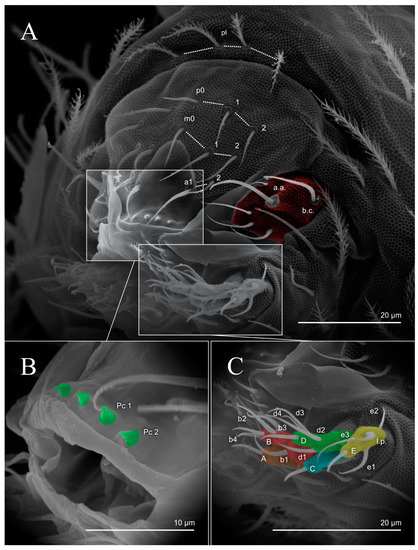
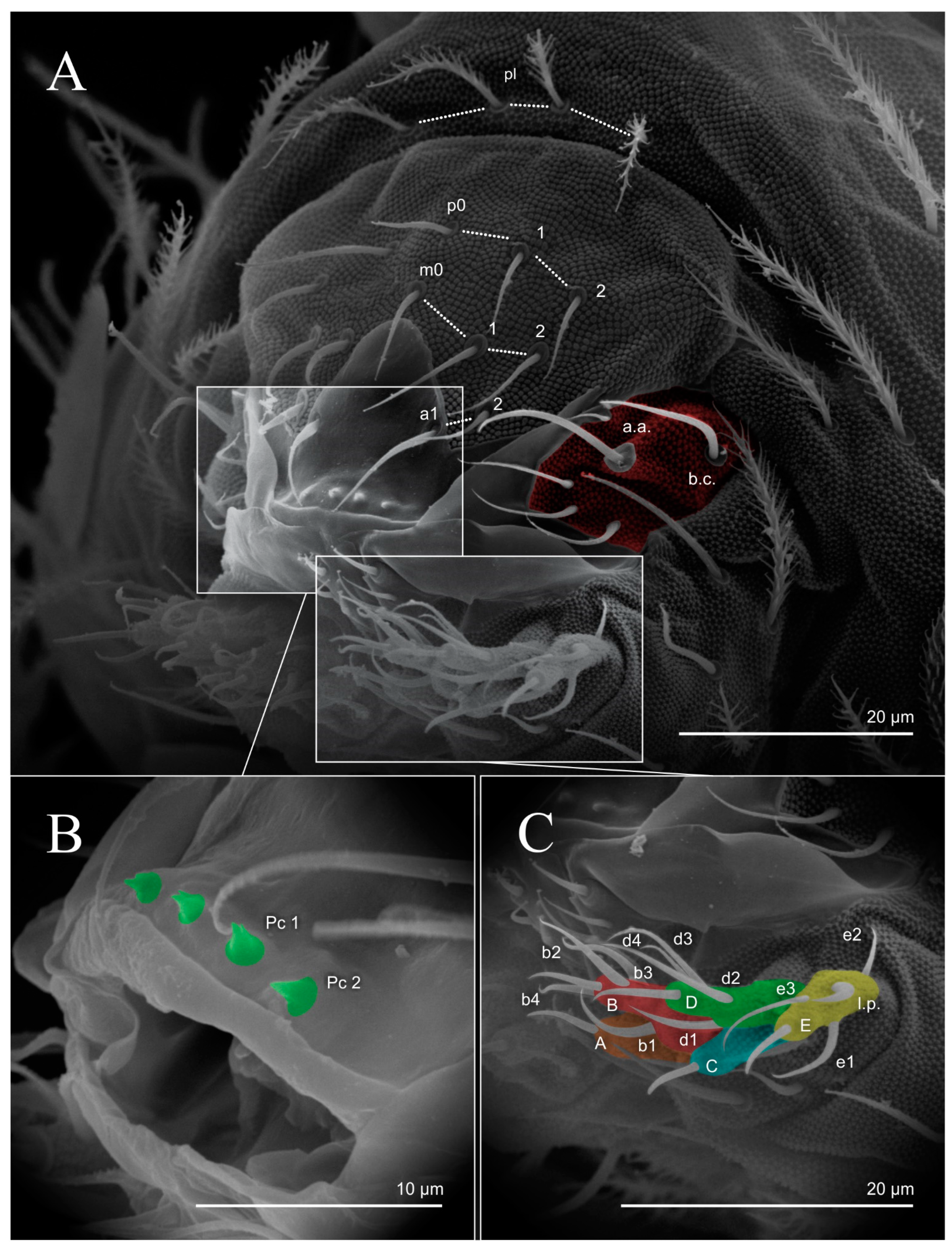
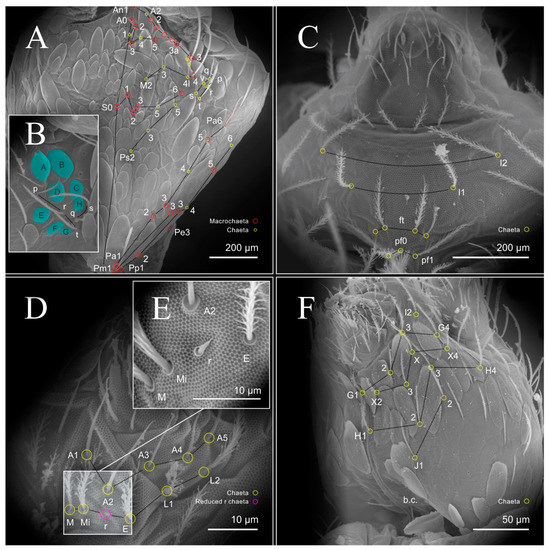
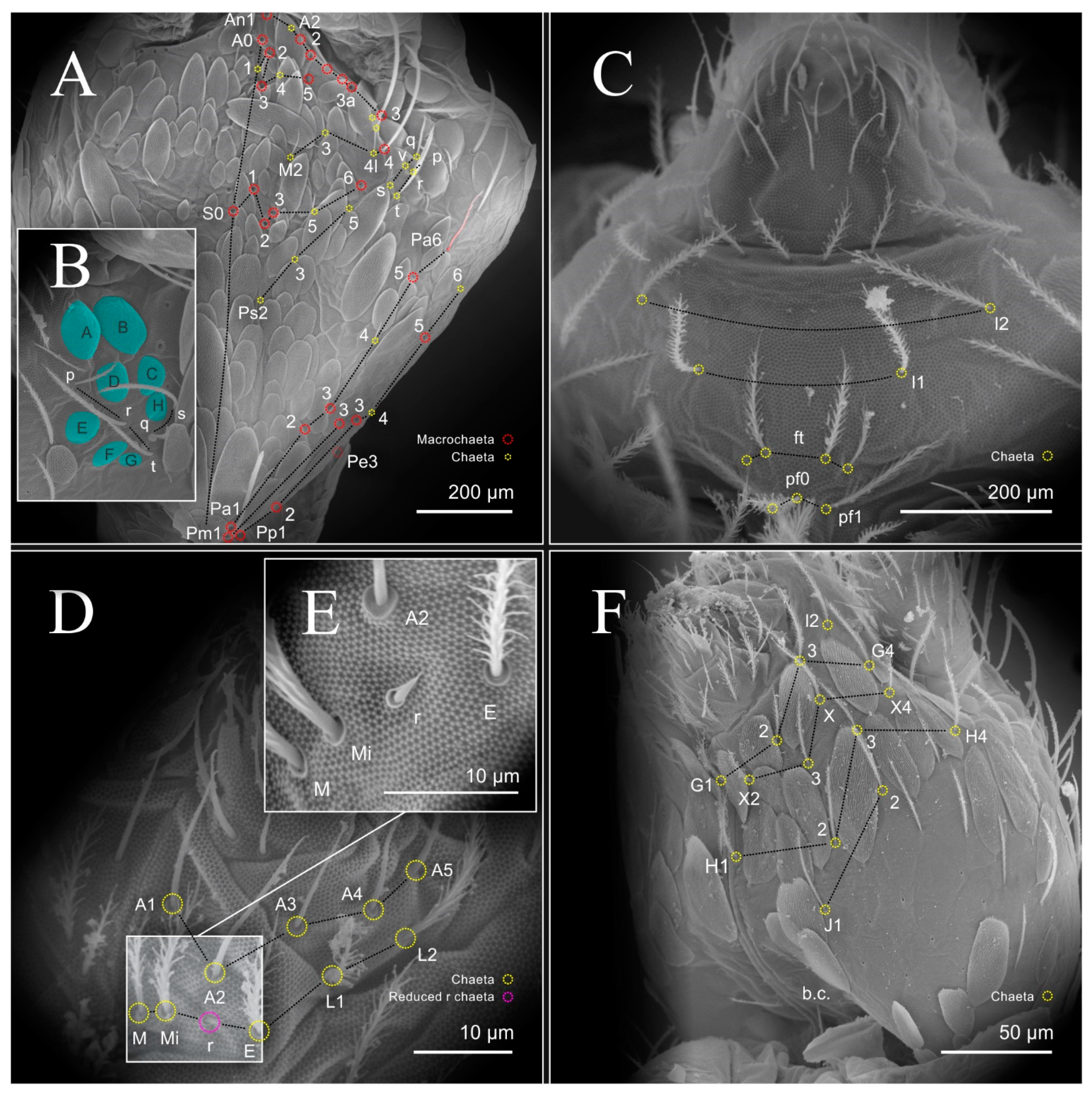
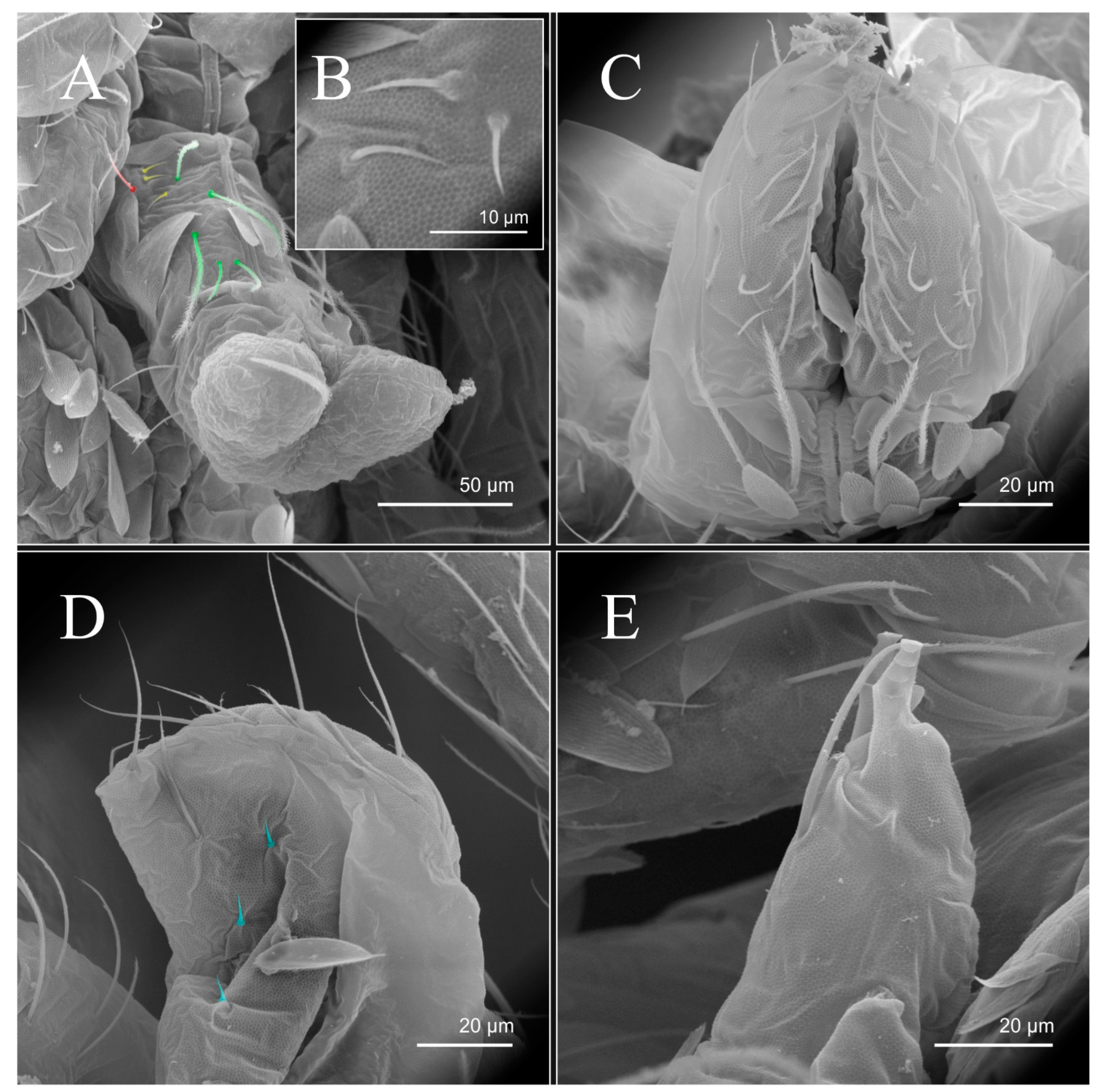
Head (Figure 8 and Figure 9). Prelabral and labral formula 4/5, 5, 4 a, m, a, p, smooth and pl ciliated (Figure 8A and Figure 6(B7)), a1 longer than a2, others subequal in length, four labral papillary crests Pc1–2 (Figure 8B). Maxillary palp with apical appendage (a.a.) and basal chaeta (b.c.) subequal, sublobal plate with four chaetae; of these, one lateral minute (Figure 8C). Labial palps with E papilla with l.p. (lateral process does not extend beyond the base of papilla E) and e1–3; D with d1–4; C; B with b1–4 and A (Figure 8C). Head dorsal chaetotaxy (Figure 9A), eyes G and H smaller than others, with six interocular chaetae (q, v, s, p, r, t) (Figure 9B); with eight An (An1a–3p), An1 as mic, six A (A0–5), A4 as mic, four M (M2–4), M2–4l as mic, six S (S0–S6), S5 as mic, three Ps (Ps2–3 and Ps5), six Pa (Pa1–6), Pa4 as mic and Pa6 as bothriotrichum, two Pm (Pm1 and Pm3), six Pp (Pp1–6), Pp4 and Pp6 as mic and two Pe (Pe3 and Pe5) chaetae. A0, A2–3, A5, M4, S0–S3, S6, Pa1—3, Pa5, Pm1—3, Pp1—3, Pp5 and Pe3 as mac. Clypeal formula with four (l1–2), four (ft) and three (pf0–1) chaetae (Figure 9C). Basomedial and basolateral labial fields (Figure 9D) with A1–5 smooth, M, Mi, E and L1–2 ciliate, r reduced (Figure 9E). Head ventral chaetotaxy with about 11 ciliate chaetae, without lateral reduced spines, postlabial formula four (G1–G4), four (H1–H4), four (X—4) and two (J1–J2); basal chaeta (b.c.) present (Figure 9F).
Figure 8.
Seira musarum SEM: mouth parts. (A), prelabral, labral chaetotaxy; maxillary palp and sublobal plate; (B), papillary crests; (C), labial palps.
Figure 9.
Seira musarum SEM: head chaetotaxy: (A), dorsal head; (B), eyes; (C), clypeus; (D), ventral head basomedial and basolateral labial fields; (E), r-chaeta position details; (F), postlabial.
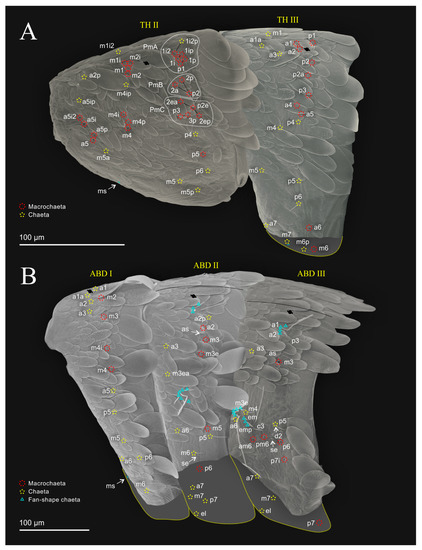
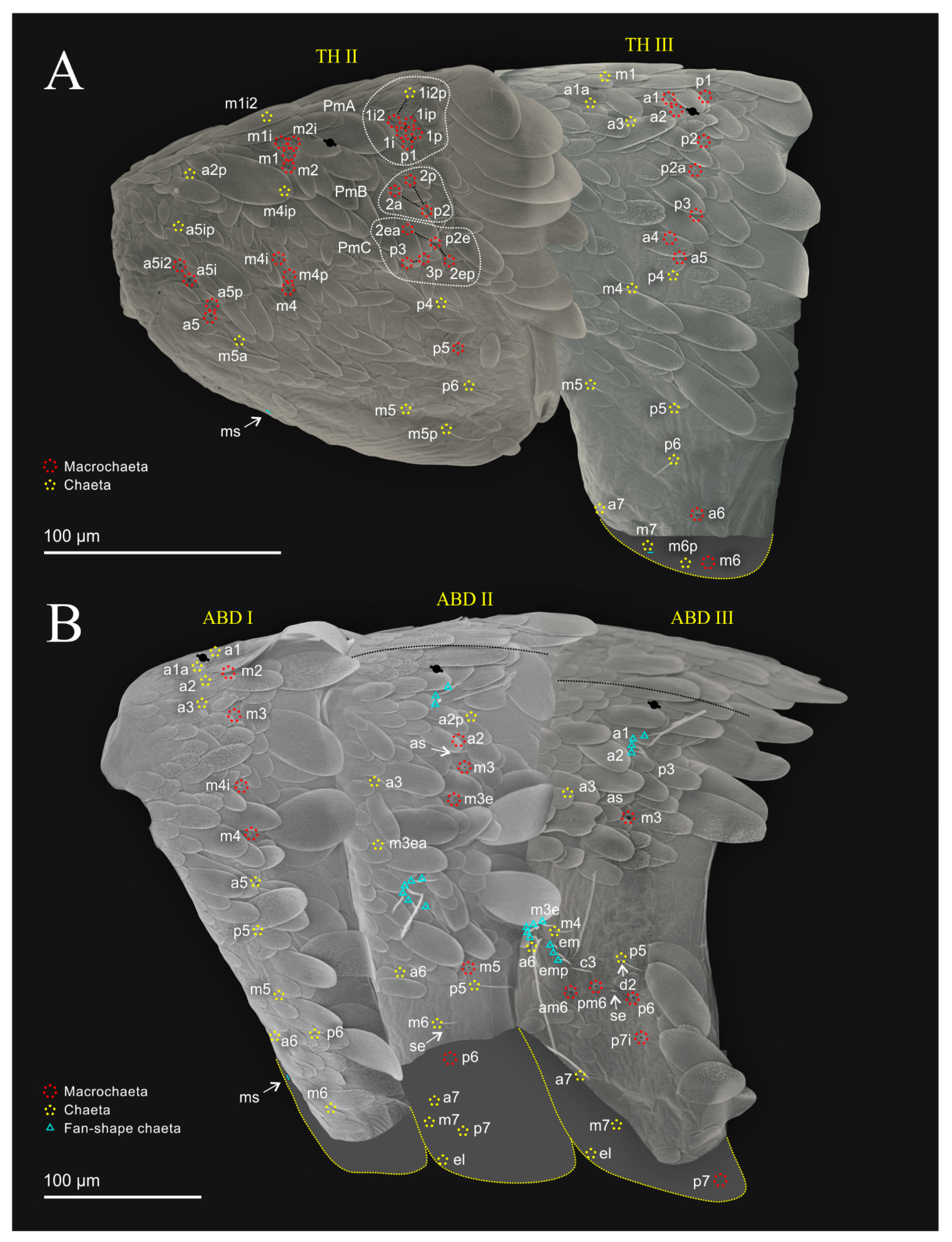
Thorax chaetotaxy (Figure 10). Th II (Figure 10A): a, m and p series with two mic (a2p and a5ip), four mac (a5–i2 and a5p), four mic (m1i2, m4ip, m5 and m5p), seven mac (m1i, m2i, m4i, m1, m2, m4 and m4p), three mic (Pma 1i2p, p4 and p6) and fourteen mac (PmA p1, 1p, 1i, 1ip and 1i2; PmB 2a, p2 and 2p; PmC p3, 3p, 2ea, p2e and 2ep; p5), respectively; apex distal with numerous mac, meso and scales interspersed. Th III (Figure 10A): a, m and p series with three mic (a1a, a3 and a7), five mac (a1, a2, a4, a5 and a6), five mic (m1, m4, m5, m7, m6p), one mac (m6), three mic (p4—6) and four mac (p1, p2, p2a and p3), respectively.
Figure 10.
Seira musarum SEM: body chaetotaxy: (A), thorax II and III; (B), abdomen I to III.
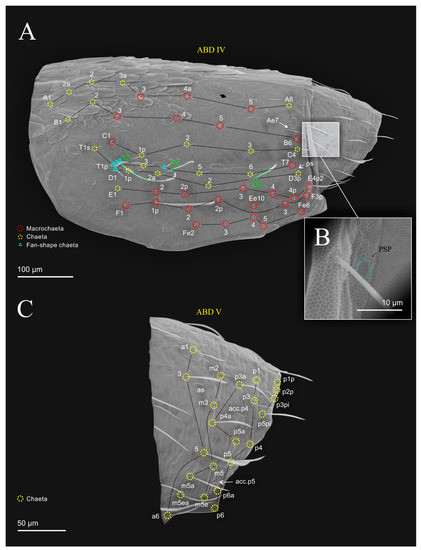
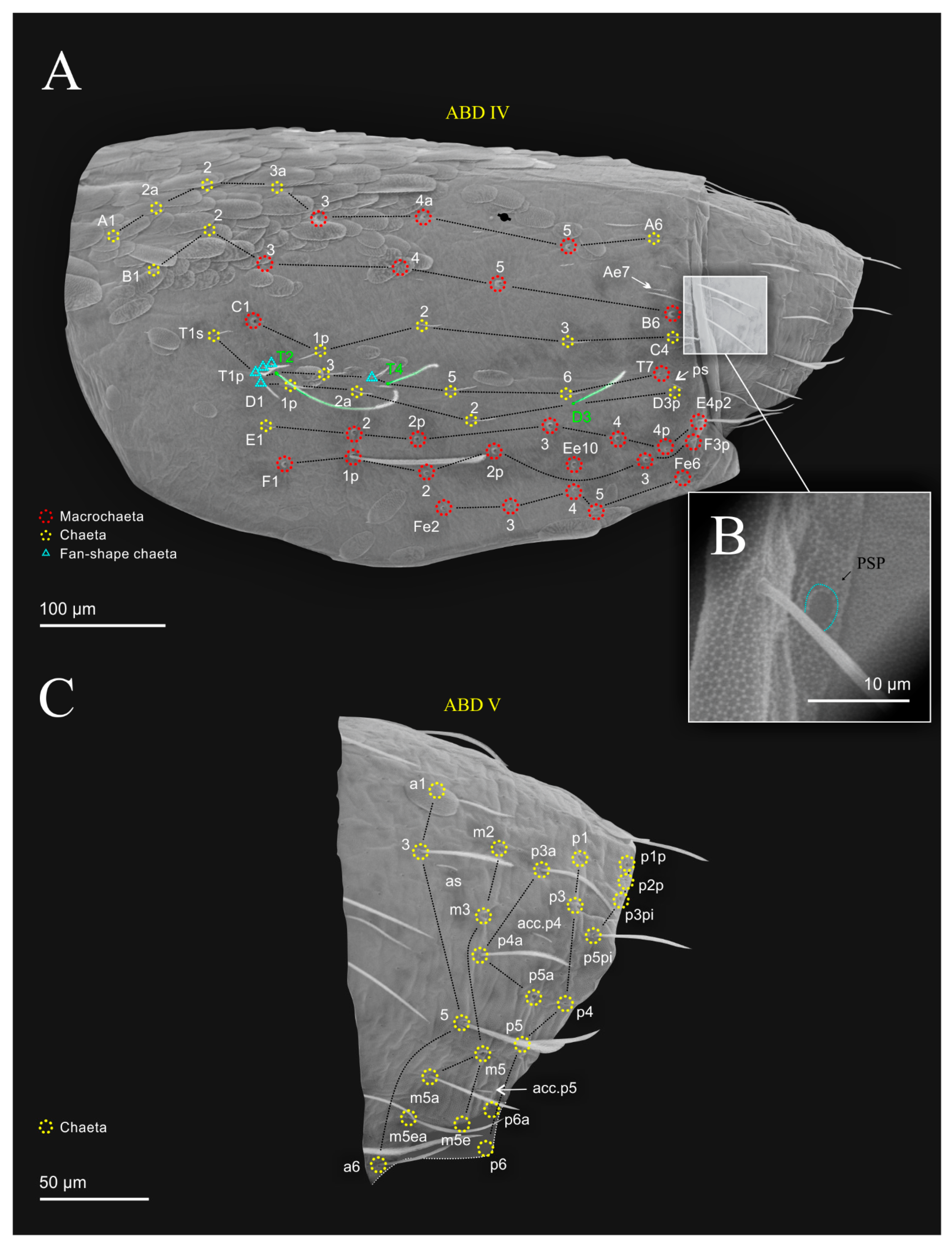
Abdomen chaetotaxy (Figure 9 and Figure 10). Abd I: a, m and p series with six mic (a1, a1a, a2, a3, a5 and a6), four mac (m2, m3, m4i and m4), two mic (m5—6) and two mic (p5–6), respectively. Abd II: a, m and p series with four mic (a2p, a3 and a6—7), one mac (a2), three mic (m3ea and m6–7), three mac (m3–3e and m5), two mic (p5 and p7) and one mac (p6), as, se present and el as mic. Abd III: a, m and p series with two fan-shaped (a1–2), one mic (a3), two meso (a7–8), mic (m7), three mac (m3, am6 and pm6), two mic (p3 and p5), three mac (p6, p7 and p7i) and p8 as meso, respectively, with as, ms, el, d2 and se present. Abd IV: A–Fe series with five mic (A1, A2a, A2, A3a, A6 and Ae7), three mac (A3, A4a and A5), two mic (B1–2), four mac (B3–6), four mic (C1p–4), one mac (C1), four mic (T1s, T3 and T5–6), one mac (T7), four mic (D1p, D2a, D2 and D3P), one mic (E1), seven mac (E2, E2P, E3, E4, E4P, E4P2 and Ee10), eleven mac (F1—F3p and Fe2—Fe6) chaetae, respectively, and T2, T4 and D3 bothriotricha with four (T1p, s, m and D1) and three (T4a, pe and pi) fan-shaped chaetae, respectively, ps sens and x uncertain homology sens present, and posterior side of Abd IV with a transversal row of seven chaetae and one pseudopore (Figure 11A,B). Abd V: a, m and p series with four mac (a1, a3, a5 and a6), six mac (m2, m3, m5, m5a, m5e and m5ae), four mac (p3a, p4a, p5a and p6a), five mac (p1, p3, p4, p5 and p6), five mac (p1 and p3–6), two mic (p1p and p3pi) and four mac (p1p, p2p, p3pi and p5pi), respectively; as, acc.p4 and acc.p5 present.
Figure 11.
Seira musarum SEM: body chaetotaxy: (A), abdomen IV and V, (B), pseudopore details; (C), abdomen V.
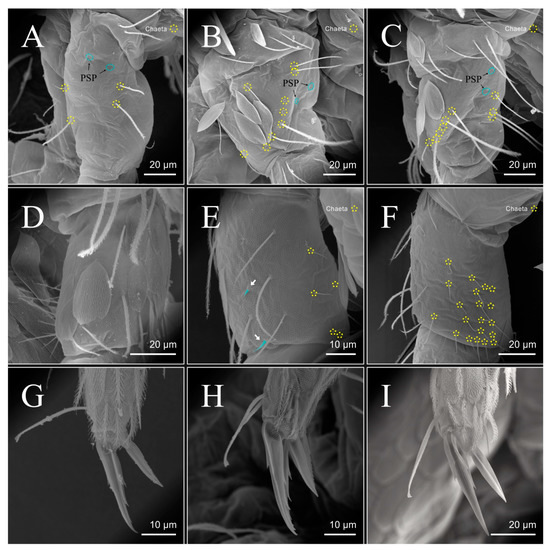
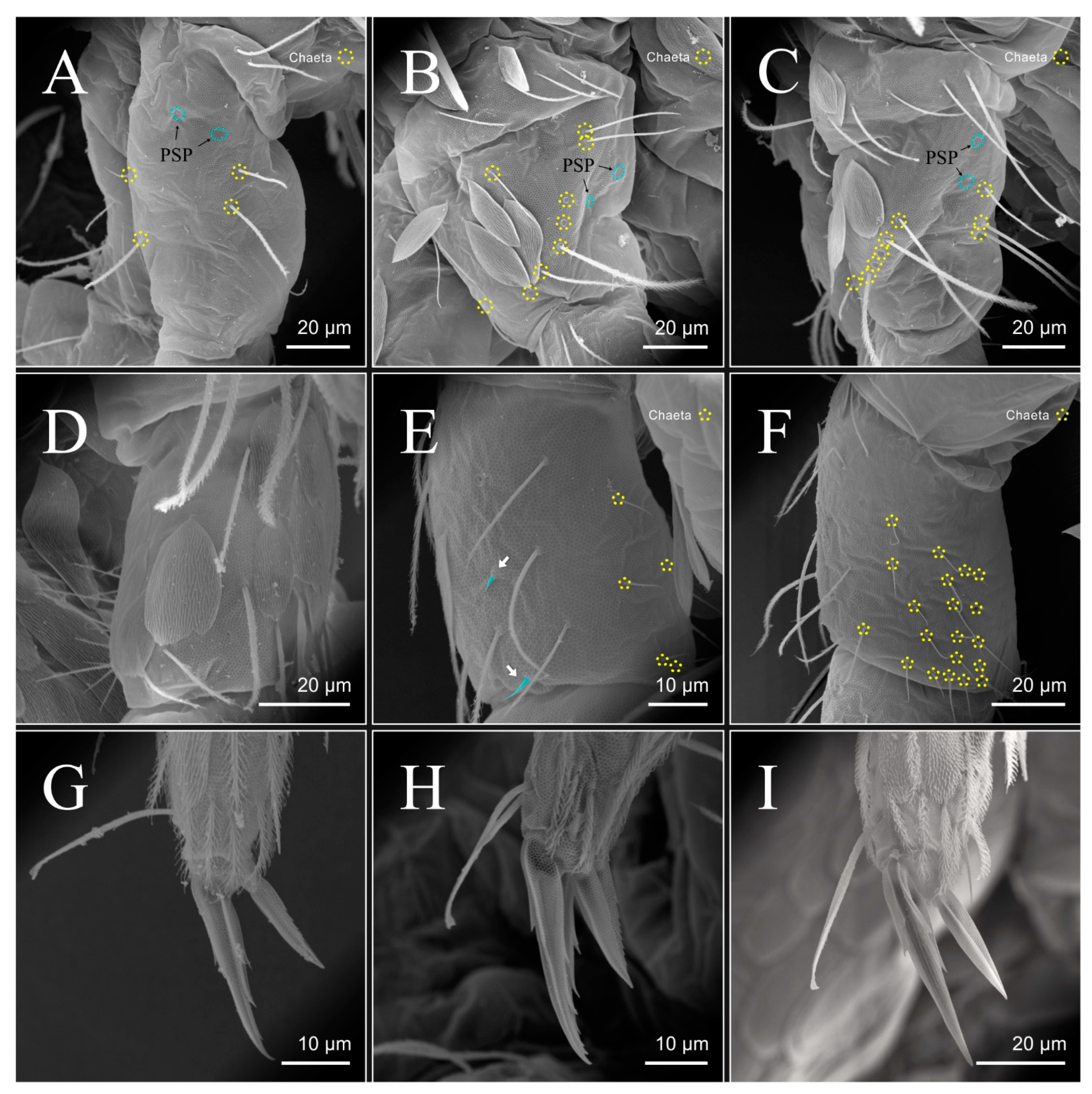
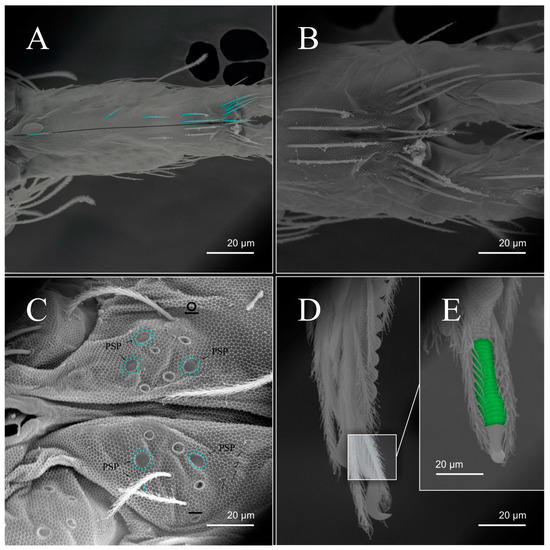
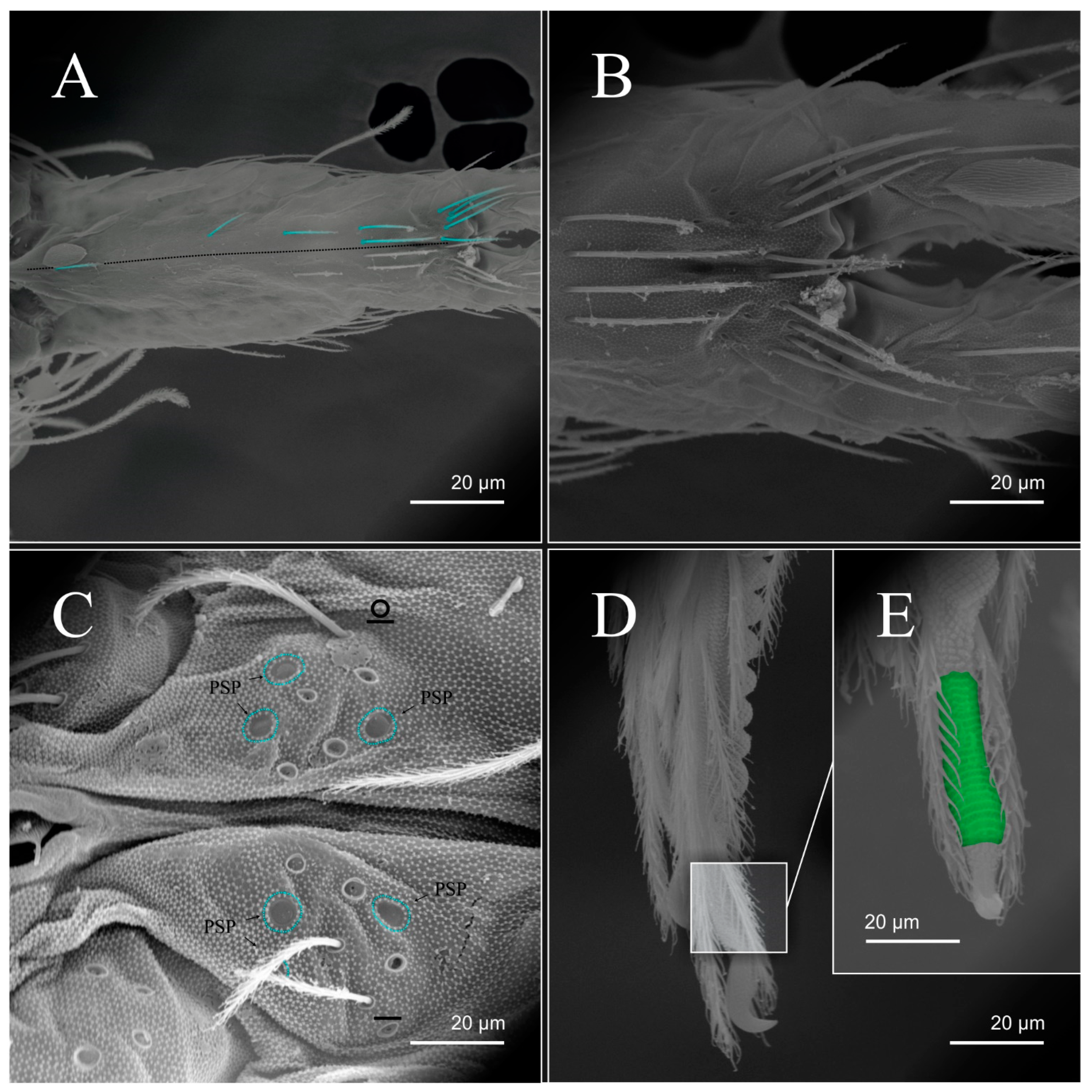
Legs. Subcoxa I with four chaetae and two psp (Figure 12A); subcoxa II with a row with four chaetae and a p row with six chaetae and two psp (Figure 12B); subcoxa III with a row with six chaetae and a p row with three and two psp (Figure 12C). Trochanteral with 12 chaetae anterior, 2 spine internos and an organ with about 15 spine-like chaetae (Figure 12F). Unguis with four inner teeth, basal and medial teeth with the same length and a smaller apical tooth. Unguiculus with all lamellae acuminate and smooth (ai, ae, pi and pe), except for pe serrated; tenent hair capitate, finely ciliate (Figure 12G–I).
Figure 12.
Seira musarum SEM: Legs: (A–C), subcoxa I, II and III; (D–F), metatrocater; (G–I), claws I, II and III.
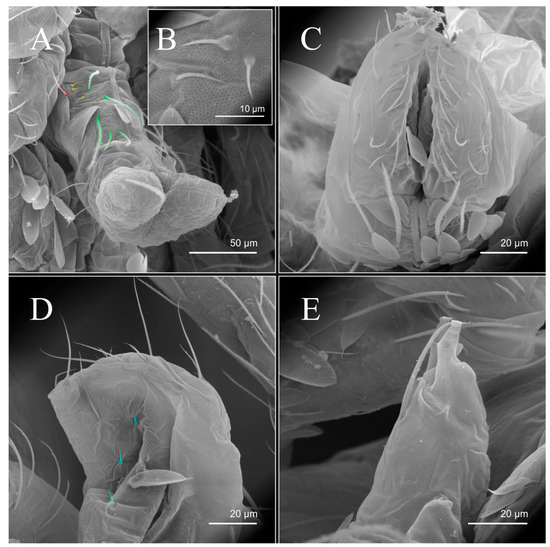
Collophore (Figure 13). Anterior side (Figure 13A) with three proximal reduced spines (Figure 13B), five strait chaetae with long ciliation (Figure 6(B9)) and one smooth chaeta apically acuminate (Figure 6(B7)); lateral flap with about 13—16 smooth chaetae (Figure 13C); distal posterior side with two distal smooth chaetae and three subdistal reduced spines per side (Figure 13D). Tenaculum with one chaeta on the corpus, ramus tenacular with four teeth (Figure 13E).
Figure 13.
Seira musarum SEM: colophore and tenaculum. (A), anterior colophore; (B), spine of anterior colophore; (C), lateral flaps; (D), posterior colophore; (E), corpus tenaculum.
Furcula: manubrium ventral (Figure 14A) formula with 1, 0, 1, 1/2 (subapical) and 5 (apical) chaetae (Figure 14B); manubrial plate (dorsally) with five to six chaetae, two internal and three to four external, and three psp (Figure 14C). Mucro dorsally falcate, without basal spine (Figure 14D,E), crenulate dens with different crenulation distally (Figure 14E).
Figure 14.
Seira musarum SEM: furca: (A), ventral manubrium, (B), manubrium ventral distally; (C), manubrial plate; (D), dens distally and mucro; (E), details of the dens distally and mucro.
Brazilian Oceanic Island Records: RA (3°51′32.38″ S; 33°48′56.96″ W), SF, 08 Oct 2015, E. C. A. Lima leg., CRFS #15079—15081. SPSP (0°54′59.98″N; 29°20′44.03″ W), SB, 25 Apr 2017, E. C. A Lima & D. Zeppelini leg., CRFS #15083, #15085, #15088. SPSP (0°54′59.74″N; 29°20′44.57″ W), SF, 24 Apr 2017, E. C. A Lima & D. Zeppelini leg., CRFS #15084, #15087. SPSP (0°55′1.00″N; 29°20′45.60″ W), SF, 26 Apr 2017, E. C. A Lima & D. Zeppelini leg., CRFS #15086. FN (3°51′3.73″ S; 32°26′0.38″ W), SF, 27 Jul 2012, E. C. A. Lima & A. S. Ferreira Leg., CRFS #15117, #15118, #15121. FN (3°50′44.85″ S; 32°25′44.80″ W), SF, 17 Jul 2008, D. Zeppelini leg., CRFS #15119, #15120, #15122.
Brazil Occurrence: FN, RA, SPSP, AM, MA, RN, RJ, PE. (Figure 5D)
Biogeographic distribution: 3a 7b 24a 24b 26 27 28. Widespread species.
Remark. Seira musarum Ridley, 1890 was the first species of Collembola recorded and described in Brazil (type locality Fernando de Noronha). However, after its description, there was no other record of it until the specific survey to study the Collembola fauna on Brazilian oceanic islands was carried out by Lima and Zeppelini, 2015 [8] (more than one hundred years after the original description). In this survey, the authors recorded Seira musarum. Cipola et al. 2019 [9] had access to the same material and registered it as S. dowlingi (Wray, 1953); later, Rafael et al. 2020 [10] presented a study of the diversity of hexapods from Fernando de Noronha where existing and new records for the archipelago were compiled. Rafael et al. 2020 [10] recorded S. musarum and S. dowlingi (according to Lima and Zeppelini, 2015 [8] and Cipola et al. 2019 [9], respectively). The description of S. musarum is very old (Ridley 1890) and does not include characters used in the modern taxonomy of the genus. It is impossible to differentiate S. musarum from S. dowlingi (Wray, 1953) on the basis of the original description of the species. S dowlingi is known to be widespread and common on the islands [9,18]. Ernest Bernard analyzed Wray’s types in [18], and in a recent study by Soto-Adames, 2008 [4], they presented further elucidation of the morphology of Seira dowlingi which is not different from the topotypes of Seira musarum analyzed in this study. Therefore, here, we use S. dowlingi (Wray, 1953), cited by [4,18,25,26,27,28,29,30,31,32,33,34,35,36,37,38,39,40,41,42,43,44] as a junior synonym of Seira musarum Ridley, 1890, as a new synonym according to “The Principle of Priority” (ICZN Article 23) that establishes “the valid name of a taxon is the oldest available name applied to it”.
Paronellidae Börner, 1913
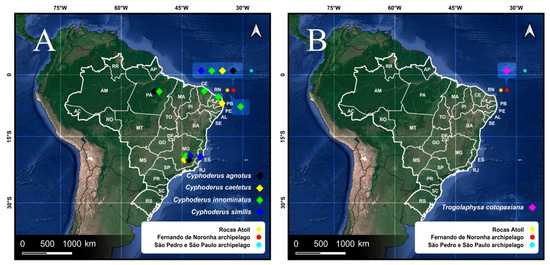
Cyphoderus agnotus Börner, 1906
Brazilian Oceanic Island Records: FN (3°50′58.48″ S; 32°26′3.83″ W), SF, 25 Jul 2012, E. C. A. Lima & A. S. Ferreira Leg., CRFS #14934.
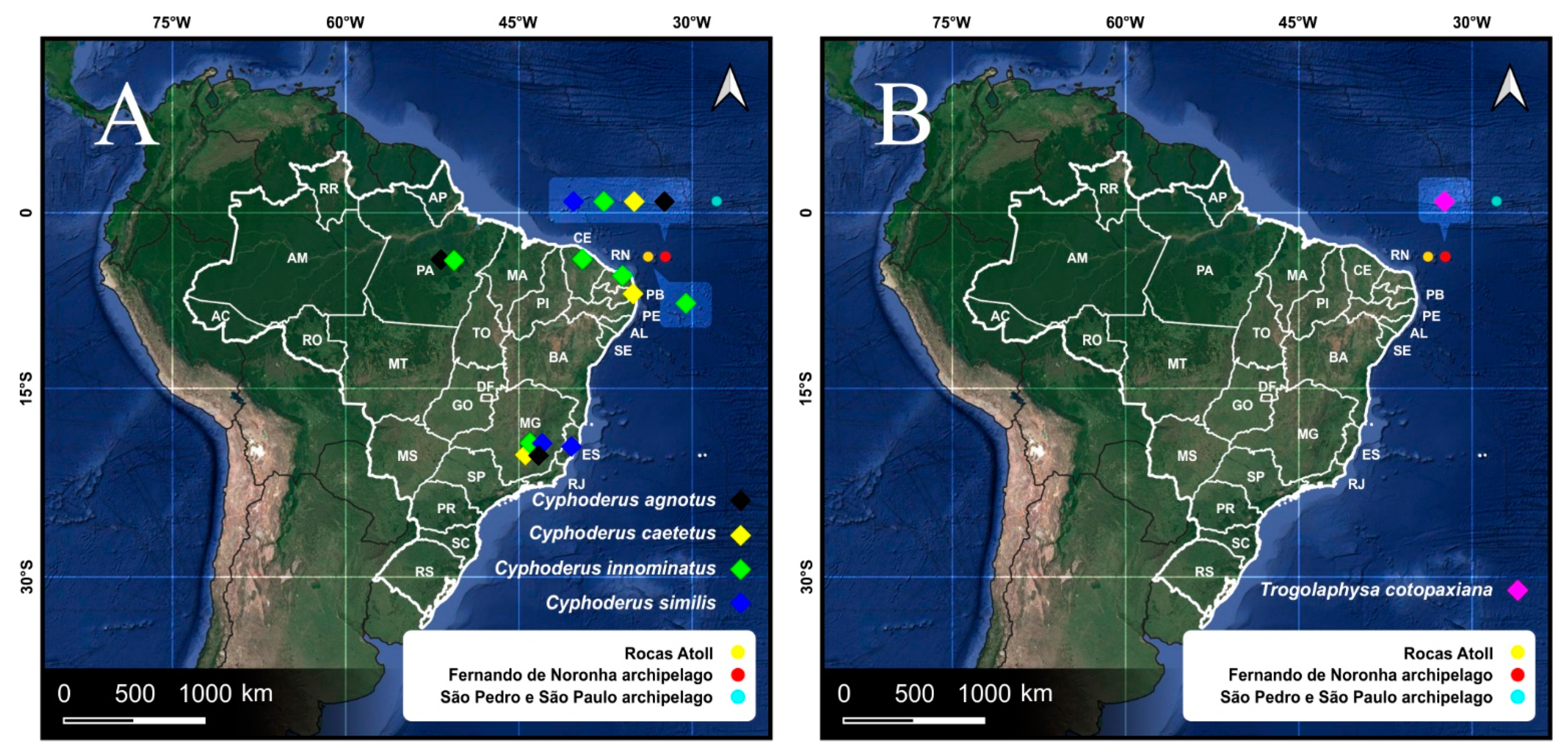
Brazil Occurrence: Pará, Pernambuco, MG (Figure 15A)
Figure 15.
Distribution map for Paronellidae records in Brazil mainland and oceanic islands. (A). Cyphoderus agnotus, C. caetetus, C. innominatus and C. similis; (B), Trogolaphysa cotopaxiana.
Biogeographic distribution: 9?, 24b, 26, 27, 28, 29. Neotropical species.
Cyphoderus caetetus Zeppelini & Oliveira, 2016
Brazilian Oceanic Island Records: FN (3°50′36.76″ S; 32°25′12.64″ W), TF, 26 Jul 2012, E. C. A. Lima & A. S. Ferreira Leg., CRFS #6146, #15161−16163.
Brazil Occurrence: MG, Paraíba and FN (Figure 15A)
Biogeographic distribution: 27. Brazilian species.
Cyphoderus innominatus Mills, 1938
Brazilian Oceanic Island Records: FN (3°48′45.61″ S; 32°23′26.17″ W), SF, 19 Jul 2012, E. C. A. Lima & A. S. Ferreira Leg., CRFS #14939−14941, #15077. FN (3°50′31.85″ S; 32°24′14.74″ W), TF, 07 Aug 2012, E. C. A. Lima & D. D. Silva leg., CRFS #14936. FN (3°50′36.76″ S; 32°25′12.64″ W), SF, 26 Jul 2012, E. C. A. Lima & A. S. Ferreira Leg., CRFS #9614—9615. FN (3°51′21.93″ S; 32°26′37.78″ W), SF, 31 Jul 2012, E. C. A. Lima & A. S. Ferreira Leg., CRFS #15107−15108, #15110−15111, #15113, #15116. FN (3°51′3.73″ S; 32°26′0.38″ W), SF, 27 Jul 2012, E. C. A. Lima & A. S. Ferreira Leg., CRFS #14935, #14937, #14938. FN (3°51′52.31″ S; 32°26′38.80″ W), TF, 31 Jul 2012, E. C. A. Lima & A. S. Ferreira Leg., CRFS #15109, #15112, #15114−15115.
Brazil Occurrence: Pará, Ceara, Pernambuco, MG and RJ (Figure 15A).
Biogeographic distribution: 24a, 26, 27, 28, 29. Neotropical species.
Cyphoderus similis Folsom, 1927
(as Cyphoderus javanus, in Lima & Zeppelini, 2015)
Brazilian Oceanic Island Records: FN (3°48′45.61″ S; 32°23′26.17″ W), SF, 19 Jul 2012, E. C. A. Lima & A. S. Ferreira Leg., CRFS #14939—14941, #15077. FN (3°50′31.85″ S; 32°24′14.74″ W), TF, 07 Aug 2012, E. C. A. Lima & D. D. Silva leg., CRFS #14936. FN (3°51′21.93″ S; 32°26′37.78″ W), SF, 31 Jul 2012, E. C. A. Lima & A. S. Ferreira Leg., CRFS #15107. FN (3°51′21.93″ S; 32°26′37.78″ W), SF, 31 Jul 2012, E. C. A. Lima & A. S. Ferreira Leg., CRFS #15108-15111, #15113, #15116. FN (3°51′3.73″ S; 32°26′0.38″ W), SF, 27 Jul 2012, E. C. A. Lima & A. S. Ferreira Leg., CRFS #14935, #14937—14938. FN (3°51′52.31″ S; 32°26′38.80″ W), TF, 31 Jul 2012, E. C. A. Lima & A. S. Ferreira Leg., CRFS #15109, #15112, #15114-15115.
Brazil Occurrence: MG and FN (Figure 15A)
Biogeographic distribution: 6, 7a, 7b, 8, 12, 20, 24a, 24b, 26, 27, 29. Widespread species.
Trogolaphysa cotopaxiana Thibaud & Najt, 1988
(as Lepidonella sp., in Lima & Zeppelini, 2015)
Brazilian Oceanic Island Records: FN (3°50′43.00″ S; 32°25′34.04″ W), SF, 20 Jul 2012,
E. C. A Lima & D. Zeppelini leg., CRFS #15146, #15149. FN (3°50′54.21″ S; 32°25′45.56″ W), SF, 20 Jul 2012, E. C. A Lima & D. Zeppelini leg., CRFS #15147—15148.
Brazil Occurrence: FN (Figure 15B)
Biogeographic distribution: 28. South America species.
3.2. Species List of Brazilian Entomobryomorpha
In Brazil, Entomobryomorpha fauna is registered in all states and three oceanic islands. The only oceanic Archipelago of Trindade and Martim Vaz have no record of Entomobryomorpha. Including the new records presented in this study, 247 Brazilian species of Entomobryomorpha are distributed in the families Entomobryidae (124 spp.); Paronellidae (41 spp.); Oncopoduridae, 1901 (2 spp.); Isotomidae (80 spp.) and 44 genera; see Table 3. This number presents an increase of 125 new species records since the last synthesis by Abrantes et al. 2012 [6].
Table 3.
Species of Entomobryomorpha recorded from Brazilian states and oceanic islands, modified and updated from [6]. *—recorded after [6]. In parentheses, information obtained from non-original reference. “?” following state abbreviation—questionable state record. “un”—unspecified or unknown Brazilian collection habitats. World distribution—see Methods/Species list of Brazilian Poduromorpha. “?” following the distribution abbreviation—questionable distribution record. Habitat—representative type of habitat for the species. “un”—unspecified or unknown habitat (Brazilian distribution; locality abbreviations refer to Brazilian states and insular locality, as listed in Table 1). Family names in bold.
4. Discussion
We presented 14 new records for the Brazilian oceanic islands, 7 of which were in Fernando de Noronha (Folsomides centralis, Denis 1931; Folsomides parvulus Stach, 1922; Folsomina onychiurina Denis, 1931; Isotomiella nummulifer Deharveng & Oliveira, 1990; Isotomodes cariocus Thibaud & Palacios-Vargas, 1999; Seira atrolutea Arlé, 1939; Trogolaphysa cotopaxiana Thibaud & Najt, 1988), 3 in São Pedro e São Paulo (Hemisotoma thermophila Axelson, 1900; Proisotoma immersa Folsom, 1924; Seira musarum Ridley, 1890) and 4 on Rocas Atoll (Hemisotoma thermophila Axelson, 1900; Psammisotoma sp.; Seira musarum Ridley, 1890; Cyphoderus innominatus Mills, 1938).
Among the islands studied, we can highlight Fernando de Noronha as the island that most changed in its biodiversity. According to Teixeira et al. 2003 [155], Serafini et al. 2010 [156] and Rafael et al. 2020 [10], the archipelago has faced serious ecological disturbances due to various human interventions. In 1737, the archipelago was turned into a penal colony for nearly 200 years. During this period, much of the native vegetation was devastated and exotic plants and animals were introduced to serve as food. The human population in the archipelago increased significantly in 1942 through military occupation in World War II. During the 1980s, tourism intensified in the archipelago and is an important economic activity today [155,156]. Our results show that Entomobryomorpha fauna of the Fernando de Noronha showed a high percentage of widespread species, which indicates the high rate of the introduction of species, likely by human activity.
The São Pedro archipelago and São Paulo presented the lowest richness in Entomobryomorpha species compared to the other islands, with its small size (0.17 Km2), low variety of habitats and location (mid-Atlantic) being the main factors responsible for the low biodiversity. Our results corroborate the data presented by Teixeira et al. 2003 [155], Serafini et al. 2010 [156] and Campos et al. 2005 [157].
Taking into account the distribution of the species in the Brazilian oceanic islands, we can highlight that Rocas Atoll presented the highest percentage of potentially endemic Entomobryomorpha species, which increases the relevance of the conservation strategies already adopted in this environment. The survey carried out by Lima et al. 2021 [158] on Poduromorpha species reinforces the idea that, among the islands studied, Rocas Atoll has the most preserved environment in relation to the other study areas.
Although the increase in the number of Brazilian Entomobriomopha species over the past decade has been relevant (about 103% since [6]), when we consider the variety of Brazilian continental biomes and the complex physiognomy of these areas, current knowledge of the Enomobryomorpha fauna can still be considered scarce and far from providing a reliable overview of its biogeographical panorama.
Author Contributions
Conceptualization, all authors; methodology, E.C.A.d.L.; formal analysis, all authors; investigation, E.C.A.d.L. and D.Z.; resources, all authors; data curation, D.Z.; writing—original draft preparation, E.C.A.d.L. and M.A.O.-N.; writing—original draft preparation, E.C.A.d.L. and B.C.H.L.; writing—review and editing, E.C.A.d.L. and B.C.H.L.; supervision, M.C.d.M. and D.Z.; project administration, E.C.A.d.L. All authors have read and agreed to the published version of the manuscript.
Funding
E.C.A.d. Lima, M.C.d. Mendonça and D. Zeppelini are funded by CNPq (Process: Protax 440521/2015-7; 307644/2015-4 and 301803/2012-9, respectively), B.C.H. Lopes is granted by CAPES (Process 88882.440392/2019-01).
Institutional Review Board Statement
The study was conducted according to the guidelines of the Declaration of Helsinki and approved by the Institutional Review Board of Chico Mendes Institutefor Biodiversity Conservation (ICMBio) (SISBIO 32469).
Data Availability Statement
All the specimens collected and used in this research are deposited in the Coleção de Referência de Fauna de Solo at the State University of Paraiba (CRFS-UEPB) under tumble numbers as cited in this work.
Acknowledgments
The ICMBio provided the permits for collection and logistical support; Marinha do Brasil provided the transportation to São Pedro e São Paulo, the preparatory training and support during the scientific expeditions; Aíla Soares Ferreira and Diego Dias da Silva gave support during the fieldwork in Fernando de Noronha; Luís Carlos Stievano helped in the ordination of the samples and assisted in all laboratory work; João Victor Lemos Cavalcante de Oliveira provided taxonomic help; the British Natural History Museum and British Museum curators provided information and helped in the search for types; anonymous reviewers greatly improved the manuscript. A special thanks to the crew members of the boats Borandá and Alfa, for passages to the most incredible places I have yet had the opportunity to know: the Brazilian oceanic islands.
Conflicts of Interest
The authors declare no conflict of interest.
References
- Schäffer, C. Die Collembolen der Umgebung von Hamburg und benachtbaren Gebiete. Mitt. Dem Nat. Mus. 1896, 13, 147–216. [Google Scholar]
- Womersley, H. On some collembola-arthropleona from South Africa and Southern Rhodesia. Ann. S. Afr. Mus. 1934, 30, 441–475. [Google Scholar]
- Szeptycki, A. Chaetotaxy of the Entomobryidae and its Phylogenetical Significance. Morphosystematic Studies of Collembola IV. Polska Akademia Nauk, Zakład Zoologii Systematycznej i Doświadczalnej; Państwowe Wydawnictwo Naukowe: Warszawa, Kraków, 1979; p. 219. [Google Scholar]
- Soto-Adames, F.N.; Barra, J.A.; Christiansen, K.; Jordana, R. Suprageneric Classification of the entomobryomorpha Collembola. Ann. Entomol. Soc. Am. 2008, 101, 501–513. [Google Scholar] [CrossRef] [Scilit]
- Bellinger, P.F.; Christiansen, K.A.; Janssens, F. Checklist of the Collembola of the World. Available online: http://www.collembola.org (accessed on 7 January 2022).
- Abrantes, E.A.; Bellini, B.C.; Bernardo, A.N.; Fernandes, L.H.; Mendonça, M.C.; Oliveira, E.P.; Queiroz, G.C.; Sautter, K.D.; Silveira, T.C.; Zeppelini, D. Errata Corrigenda and update for the “Synthesis of Brazilian Collembola: An update to the species list”. Zootaxa 2012, 3168, 1–21. [Google Scholar] [CrossRef] [Scilit]
- Ridley, H.N. Notes on the zoology of Fernando Noronha; Thysanura and Collembola. Zool. J. Linn. Soc. 1890, 20, 556–559. [Google Scholar] [CrossRef] [Scilit]
- Lima, E.C.A.; Zeppelini, D. First survey of Collembola (Hexapoda: Entognatha) fauna in soil of Archipelago Fernando de Noronha, Brazil. Flor. Entomol. 2015, 98, 368–369. [Google Scholar] [CrossRef] [Scilit]
- Cipola, N.G.; Godeiro, N.N.; Bellini, B.C. New records of Seira dowlingi (Wray, 1953) (Collembola, Entomobryidae, Seirinae) for New World. Entomol. Commun. 2019, 1, ec01003-1. [Google Scholar] [CrossRef] [Scilit]
- Rafael, J.A.; Limeira-de-Oliveira, F.; Hutchings, R.W.; Miranda, G.F.G.; Neto, A.M.S.; Somavilla, A.; Camargo, A.; Asenjo, A.; Pinto, A.P.; Bello, A.M.; et al. Insect (Hexapoda) diversity in the oceanic archipelago of Fernando de Noronha. Brazil: Updated taxonomic checklist and new records. Rev. Bras. Entomol. 2020, 64, e20200052. [Google Scholar] [CrossRef] [Scilit]
- Gisin, H. Espèces nouvelles et lignées évolutives de Pseudosinella endogés. Memórias Estud. Mus. Zoológico Univ. Coimbra 1967, 301, 5–25. [Google Scholar]
- Zhang, F.; Pan, Z.-X. Homology of labial chaetae in Entomobryoidea (Collembola). Zootaxa 2020, 4766, 498–500. [Google Scholar] [CrossRef] [Scilit]
- Fjellberg, A. The labial palp in Collembola. Zool. Anz. 1999, 237, 309–330. [Google Scholar]
- Cipola, N.G.; Morais, J.W.; Bellini, B.C. A new species of Seira (Collembola: Entomobryidae: Seirini) from Northern Brazil, with the addition of new chaetotaxic characters. Zoologia 2014, 31, 489–495. [Google Scholar] [CrossRef] [Scilit]
- Mari-Mutt, J.A. A revision of the genus Dicranocentrus Schött (Insecta: Collembola: Entomobryidae). Agric. Exp. Stn. Bull. 1979, 259, 1–79. [Google Scholar]
- Szeptycki, A. Morpho-systematic studies on Collembola. III. Body chaetotaxy in the first instars of several genera of the Entomobryomorpha. Acta Zool. Cracov. 1972, 17, 341–372. [Google Scholar]
- Zhang, F.; Deharveng, L. Systematic revision of Entomobryidae (Collembola) by integrating molecular and new morphological evidence. Zool. Scrip. 2015, 44, 298–311. [Google Scholar] [CrossRef] [Scilit]
- Christiansen, K.; Bellinger, P. A survey of the genus Seira (Hexapoda: Collembola: Entomobryidae) in the Americas. Caribb. J. Sci. 2000, 36, 39–75. [Google Scholar]
- Jacquemart, S. Résultats de la mission Anthropologique Belge au Niger. Collemboles nouveaux du Sahara. Bull. Inst. R. Sci. Nat. Belg. 1974, 50, 1–46. [Google Scholar]
- Culik, M.P.; Zeppelini, D. Diversity and distribution of Collembola (Arthropoda: Hexapoda) of Brazil. Biodivers. Conserv. 2003, 12, 1119–1143. [Google Scholar] [CrossRef] [Scilit]
- Good, R. The Geography of Flowering Plants; Longman Group: London, UK, 1974; pp. 1–574. [Google Scholar]
- Christiansen, K.; Bellinger, P. The biogeography of Collembola. Bull. Entomol. Polog. 1995, 64, 279–294. [Google Scholar]
- Abrantes, E.A.; Mendonça, M.C. A new species of Psammisotoma Greenslade and Deharveng (Collembola: Isotomidae) from Brazil. Zootaxa 2009, 2295, 25–30. [Google Scholar] [CrossRef] [Scilit]
- International Commission on Zoological Nomenclature. International Code of Zoological Nomenclature, 4th ed.; International Trust for Zoological Nomenclature: London, UK, 1999; p. 306. [Google Scholar]
- Wray, D.L. New Collembola from Puerto Rico. J. Agric. Univ. P. R. 1953, 37, 140–150. [Google Scholar]
- Callahan, P.S. Evolution of Insects, 1st ed.; Holiday House: New York, NY, USA, 1972; p. 192. [Google Scholar]
- Palacios-Vargas, J.G. Guide of Springtails of Panama and Costa Rica (Collembola). In Insects of Panama and Mesoamerica; Quintero, D., Aiello, A., Eds.; Selected Studies; Oxford University Press: Cambridge, UK, 1992; pp. 25–36. [Google Scholar]
- Barra, J. Springtails of the genus Seira Lubbock, 1969 (Collembola: Entomobryidae) from Socotra Island. Fauna Arab. 2004, 20, 399–408. [Google Scholar]
- Bellini, B.C.; Zeppelini, D. A new species of Seira (Collembola: Entomobryidae: Seirini) from the Northeastern Brazilian coastal region. Zoologia 2011, 28, 403–406. [Google Scholar] [CrossRef] [Scilit]
- Pan, Z.-X.; Shi, S.; Zhang, F. New species of Homidia (Collembola, Entomobryidae) from eastern China with description of the first instar larvae. ZooKeys 2011, 152, 21–42. [Google Scholar]
- Zhang, F.; Yu, D.-Y.; Xu, G.-L. Transformational homology of the tergal setae during postembryonic development in the Sinella-Coecobrya group (Collembola: Entomobryidae). Contrib. Zool. 2011, 80, 213–230. [Google Scholar] [CrossRef] [Scilit]
- Soto-Adames, F.N.; Taylor, S.J. New species and new records of Springtails (Hexapoda: Collembola) from caves in the Salem Plateau of Illinois, USA. J. Caves Karst. Stud. 2013, 75, 146–175. [Google Scholar] [CrossRef] [Scilit]
- Katz, A.D.; Giordano, R.; Soto-Adames, F. Taxonomic review and phylogenetic analysis of fifteen North American Entomobrya (Collembola, Entomobryidae), including four new species. ZooKeys 2015, 525, 1–75. [Google Scholar] [CrossRef] [Scilit]
- Soto-Adames, F.N. The dorsal chaetotaxy of first instar Trogolaphysa jataca, with description of twelve new species of Neotropical Trogolaphysa (Hexapoda: Collembola: Paronellidae). Zootaxa 2015, 4032, 1. [Google Scholar] [CrossRef] [Scilit]
- Bernard, E.C.; Soto-Adames, F.N.; Wynne, J.J. Collembola of Rapa Nui (Easter Island) with description of five endemic cave-restricted species. Zootaxa 2015, 3949, 239–267. [Google Scholar] [CrossRef] [Scilit]
- Katz, A.D.; Taylor, S.J.; Soto-Adames, F.N.; Addison, A.; Hoese, G.B.; Sutton, M.R.; Toulkeridis, T. New records and new species of springtails (Collembola: Entomobryidae, Paronellidae) from lava tubes of the Galapagos Islands (Ecuador). Subterr. Biol. 2016, 17, 77–120. [Google Scholar]
- Soto-Adames, F.N. Chaetotaxy of first-instar Campylothorax sabanus (Wray), and description of three new Campylothorax species from Hispaniola (Collembola, Paronellidae). J. Nat. Hist. 2016, 50, 1–30. [Google Scholar] [CrossRef] [Scilit]
- Soto-Adames, F.N.; Anderson, E.W. Two new species and new records of springtails (Collembola: Entomobryidae, Paronellidae) from Nevis, Lesser Antilles. Fla. Entomol. 2017, 100, 32–41. [Google Scholar] [CrossRef] [Scilit]
- Oliveira, J.V.L.C.; Ferreira, A.S.; Zeppelini, D. Two new species of Collembola (Arthropoda: Hexapoda) from Minas Gerais, Brazil. Neotrop. Entomol. 2020, 49, 420–434. [Google Scholar] [CrossRef] [Scilit]
- Cipola, N.G.; Morais, J.W.; Bellini, B.C. Review of Lepidocyrtinus Börner, 1903 (Collembola, Entomobryidae, Seirinae): The African species. Zootaxa 2020, 4898, 1–110. [Google Scholar] [CrossRef] [Scilit] [PubMed]
- Godeiro, N.N.; Pacheco, G.; Liu, S.; Cipola, N.G.; Berbel-Filho, W.M.; Zhang, F.; Gilbert, M.T.P.; Bellini, B.C. Phylogeny of Neotropical Seirinae (Collembola, Entomobryidae) based on mitochondrial genomes. Zool. Scr. 2020, 49, 329–339. [Google Scholar] [CrossRef] [Scilit]
- Godeiro, N.N.; Zhang, F.; Cipola, N.G. First partial mitogenome of a new Seira Lubbock species (Collembola, Entomobryidae, Seirinae) from Cambodia reveals a possible separate lineage from the Neotropical Seirinae. Zootaxa 2020, 4890, 451–472. [Google Scholar] [CrossRef] [Scilit]
- Cucini, C.; Fanciulli, P.P.; Frati, F.; Convey, P.; Nardi, F.; Carapelli, A. Re-evaluating the internal phylogenetic relationships of collembola by means of mitogenome data. Genes 2021, 12, 44. [Google Scholar] [CrossRef] [Scilit]
- Godeiro, N.N.; Zhang, F. First record of Seira dowlingi (Wray, 1953) (Collembola, Entomobryidae, Seirinae) from China and mitogenome comparison with the New World specimens. Zootaxa 2021, 5020, 191–196. [Google Scholar] [CrossRef] [Scilit]
- Cipola, N.G.; Morais, J.W.; Bellini, B.C. New subgenus and four species of Lepidocyrtus Bourlet (Collembola, Entomobryidae, Lepidocyrtinae) from Amazon. Insect Syst. Evol. 2018, 50, 189–234. [Google Scholar] [CrossRef] [Scilit]
- Nunes, R.C.; Santos-Costa, R.C.; Bellini, B.C. The first Neotropical Capbrya Barra, 1999 (Collembola: Orchesellidae: Nothobryinae) and the reinterpretation of Nothobryinae systematics. Zool. Anz. 2020, 288, 24–42. [Google Scholar] [CrossRef] [Scilit]
- Brito, R.A.; Lima, E.C.A.; Zeppelini, D. Three new species of Collembola (Arthropoda: Hexapoda) from Brazil. Zootaxa 2019, 4700, 401–430. [Google Scholar] [CrossRef] [Scilit] [PubMed]
- Bellini, B.C.; Cipola, N.G.; Siqueira, O.J.R. A Survey of the Brazilian Dicranocentrus Schött (Collembola, Orchesellidae, Heteromurini) with the description of a new species and notes on the genus. Insect 2020, 11, 709. [Google Scholar] [CrossRef] [Scilit] [PubMed]
- Xisto, T.; Mendonça, M.C. New species and new records of Dicranocentrus Schött, 1893 (Collembola: Entomobryidae) from Southeastern Brazil. Insect Syst. Evol. 2017, 49, 23–58. [Google Scholar] [CrossRef] [Scilit]
- Bellini, B.C.; Morais, J.W.; Oliveira, F.G.L. A new species of Dicranocentrus Schött (Collembola, Entomobryidae, Orchesellinae) from Brazilian Amazon. Zootaxa 2013, 3709, 296–300. [Google Scholar] [CrossRef] [Scilit]
- Handschin, E. Neue myrmecophile und termitophile collembolenformen aus Süd Amerika. Neue Beiträge Syst. Insektenkunde Berl. 1924, 3, 13–28. [Google Scholar]
- Xisto, T.; Mendonça, M.C. Two new species of Dicranocentrus Schött, 1893 (Collembola: Entomobryidae) from Serra do Gandarela, Minas Gerais State, Brazil. Zootaxa 2016, 4079, 223–227. [Google Scholar] [CrossRef] [Scilit]
- Arlé, R.; Mendonça, C. Estudo preliminar das espécies de Dicranocentrus Schött, 1893, ocorrentes no Parque Nacional da Tijuca, Rio de Janeiro (Collembola). Rev. Bras. Biol. 1982, 42, 41–49. [Google Scholar]
- Cassagnau, P. 1963 Collemboles d’Amérique du Sud, II. Orchesellini, Paronellinae, Cyphoderinae. Biol. Amérique Australe 1963, 2, 127–148. [Google Scholar]
- Börner, C. Das System der Collembolen nebst Beschreibung neuer Collembolen des Hamburger Naturhistorischen museums. Mitt. Nat. Mus. Hambg. 1906, 23, 147–188. [Google Scholar]
- Arlé, R. Collembola Arthropleona do Brasil oriental e central. Arch. Mus. Nac. 1959, 49, 155–211. [Google Scholar]
- Bellini, B.C.; Cipola, N.G.; Godeiro, N.N. New species of Lepidocyrtus Bourlet and Entomobrya Rondani (Collembola: Entomobryoidea: Entomobryidae) from Brazil. Zootaxa 2015, 4027, 227–242. [Google Scholar] [CrossRef] [Scilit] [PubMed]
- Santos, N.M.C.; Santos-Costa, R.C.; Siqueira, O.J.R.; Godeiro, N.N.; Bellini, B.C. Two new species of Entomobrya Rondani (Collembola, Entomobryidae) from northeastern Brazil and comments on the genus. Zootaxa 2020, 4731, 43–62. [Google Scholar] [CrossRef] [Scilit] [PubMed]
- Christiansen, K. Preliminary notes on the genus Entomobrya in South America with special reference to Patagonia. Biol. Amérique Australe 1963, 2, 149–168. [Google Scholar]
- Arlé, R.; Guimarães, A.E. Novas espécies de Entomobrya Rondani, 1861, do estado do Pará (Collembola, Entomobryomorpha). Bol. Mus. Para. Emilio Goeldi Nova Ser. Zool. 1978, 89, 1–18. [Google Scholar]
- Oliveira, E.P.; Deharveng, L. Response of soil Collembola (Insecta) communities to forest disturbance in central Amazonia (Brazil). In Functioning and Dynamics of Natural and Perturbed Ecosystems, Technique et Documentation; Bellan, D., Bonin, G., Emig, C., Eds.; Lavoisier, Intercept Ltd.: Mauritius, NJ, USA, 1995; pp. 361–376. [Google Scholar]
- Zeppelini, D.; Bellini, B.C.; Creão-Duarte, A.J.; Hernández, M.I.M. Collembola as bioindicators of restoration in mined sand dunes of Northeastern Brazil. Biodivers. Conserv. 2009, 18, 1161–1170. [Google Scholar] [CrossRef] [Scilit]
- Denis, J.R. Sur les Collemboles du Muséum de Paris (1er Partie). Ann. Soc. Entomol. Fr. 1924, 93, 211–260. [Google Scholar]
- Reuter, O.M. Notiser om finska Collembola. Medd. Af Soc. Pro Fauna Flora Fenn. Helfingfors 1892, 18, 231–232. [Google Scholar]
- Reuter, O.M. Apterygogenea Fennica Finlands Collembola och Thysanura. Acta Soc. Fauna Flora 1895, 11, 1–35. [Google Scholar]
- Kraepelin, K. Uber die durch den Schiffsverkehr in Hamburg eingeschleppten Tiere. Mitt. Aus. Dem. Nat. Mus. Hambg. 1901, 18, 183–209. [Google Scholar]
- Arlé, R. Collemboles nouveaux de Rio de Janeiro. An. Acad. Bras. Ciênc. 1939, 11, 25–32. [Google Scholar]
- Cipola, N.G.; Oliveira, F.G.L.; Morais, J.W.; Bellini, B.C. The Heteromurini Absolon & Ksenemann (Collembola, Entomobryidae): A review of the genera status and diagnoses, keys for species of Alloscopus Börnerand Heteromurtrella Mari Mutt and description of a new species. Zootaxa 2016, 4084, 151–186. [Google Scholar] [PubMed]
- Cipola, N.G.; Morais, J.W.; Bellini, B.C. The discovery of Lepidocyrtoides Schött, 1917 (Collembola, Entomobryidae, Entomobryinae) from the New World, including three new species from Brazil and one from Australia. Zootaxa 2017, 4324, 201–248. [Google Scholar] [CrossRef] [Scilit]
- Santos-Rocha, I.M.; Andreazze, R.; Bellini, B.C. Registros de Collembola (Arthropoda, Hexapoda) no Estado do Rio Grande do Norte, Brasil. Biota Neotrop. 2011, 11, 167–170. [Google Scholar] [CrossRef] [Scilit]
- Bellini, B.C.; Zeppelini, D. First records of Collembola (Ellipura) from the state of Paraíba, Northeastern Brazil. Rev. Bras. Entomol. 2004, 48, 587–588. [Google Scholar] [CrossRef] [Scilit]
- Börner, C. Collembolen aus Ostafrika, Madagascar und Südamerika. In Reise in Ostafrika in den Jahren 1903–1905; Voeltzkow, A., Ed.; E. Schweizerbartsche Verlagsbuchhandlung: Stuttgart, Germany, 1907; Volume 2, pp. 147–178. [Google Scholar]
- Oliveira Filho, L.C.I.; Zeppelini, D.; Baretta, D.; Sousa, J.P.; Klauberg-Filho, O. Collembola community structure under different land management in subtropical Brazil. Ann. Appl. Biol. 2020, 177, 294–307. [Google Scholar] [CrossRef] [Scilit]
- Nunes, R.C.; Godeiro, N.N.; Pacheco, G.; Liu, S.; Gilbert, M.T.P.; Alvarez-Valin, F.; Zhang, F.; Bellini, B.C. The discovery of Neotropical Lepidosira (Collembola, Entomobryidae) and its systematic position. Zool. Scr. 2019, 48, 783–800. [Google Scholar] [CrossRef] [Scilit]
- Stach, J. Eine neue attophile collembole aus Brasilien. Zool. Anz. 1935, 110, 154–158. [Google Scholar]
- Mari Mutt, J.A. A review of the genus Mastigoceras with remarks on its systematic position (Collembola: Entomobryidae). Pan-Pac. Entomol. 1978, 54, 43–47. [Google Scholar]
- Cassagnau, P.; Oliveira, E. Sur Mastigoceras camponoti Handschin, collembole Orchesellinae d’Amazonie. Bull. Soc. Hist. Nat. 1992, 128, 27–31. [Google Scholar]
- Silveira, T.C.; Mendonça, M.C. New species of Nothobrya (Collembola: Entomobryidae) from Southeast Brazil. Zool. 2016, 33, e20160126. [Google Scholar] [CrossRef] [Scilit]
- Arlé, R. Novas espécies de colêmbolas aquáticas (Nota preliminar). Atas Soc. Biol. 1961, 5, 34–37. [Google Scholar]
- Nunes, R.C.; Bellini, B.C. A new species of Nothobrya Arlé, 1961 (Collembola: Entomobryidae) from Brazil and notes on key characters for Nothobryinae taxonomy, with an identification key to the species of the subfamily. Zootaxa 2019, 4615, 375–391. [Google Scholar] [CrossRef] [Scilit] [PubMed]
- Cipola, N.G.; Oliveira, J.V.L.C.; Bellini, B.C.; Ferreira, A.S.; Lima, E.C.A.; Brito, R.A.; Stievano, L.C.; Souza, P.G.C.; Zeppelini, D. Review of Eyeless Pseudosinella Schäffer (Collembola, Entomobryidae, and Lepidocyrtinae) from Brazilian Caves. Insects 2020, 11, 194. [Google Scholar] [CrossRef] [Scilit] [PubMed]
- Fernandes, L.H.; Mendonça, M.C. A new species of Xennyla (Collembola, Poduromorpha, Hypogastruridae) with new records for the State of Espírito Santo, southeastern Brazil. Rev. Bras. Zool. 2010, in press. [Google Scholar]
- Zeppelini, D.; Brito, R.A.; Lima, E.C.A. Three new species of Collembola (Arthropoda: Hexapoda) from Central Brazilian shallow caves: Side effects of long term application of environmental law on conservation. Zootaxa 2018, 4500, 059–081. [Google Scholar] [CrossRef] [Scilit] [PubMed]
- Culik, M.P.; Martins, D.S.; Ventura, J.A. Collembola (Arthropoda: Hexapoda) communities in the soil of papaya orchards managed with conventional and integrated production in Espírito Santo, Brazil. Biota Neotrop. 2006, 6, 1–8. [Google Scholar] [CrossRef] [Scilit]
- Christiansen, K. The genus Pseudosinella (Collembola, Entomobryidae) in caves of the United States. Psyche 1960, 67, 1–25. [Google Scholar] [CrossRef] [Scilit]
- Nunes, R.C.; Bellini, B.C. Three new species of Entomobryoidea (Collembola: Entomobryomorpha) from Brazilian Caatinga-Cerrado transition, with identification keys to Brazilian Cyphoderus, Pseudosinella and Trogolaphysa species. Zootaxa 2018, 4420, 071–096. [Google Scholar] [CrossRef] [Scilit] [PubMed]
- Mendonça, M.C.; Fernandes, L.H. Rhynchocyrtus gen. nov. (Collembola, Entomobryidae) from the Southeast and Northeast Brazilian regions. Zootaxa 2007, 1660, 45–51. [Google Scholar] [CrossRef] [Scilit]
- Bellini, B.C.; Zeppelini, D. Three new species of Seira Lubbock (Collembola, Entomobryidae) from Mataraca, Paraíba State, Brazil. Zootaxa 2008, 1773, 44–54. [Google Scholar] [CrossRef] [Scilit]
- Arlé, R. Collembola, anexo nº. 2, ao relatório da excursão científica do Instituto Oswaldo Cruz realizada na zona da E. F. N. O. B., em outubro de 1938. Bol. Biol. 1939, 4, 295–300. [Google Scholar]
- Godeiro, N.N.; Bellini, B.C. Two new species and two detailed chaetotaxy descriptions of Seira (Collembola: Entomobryidae) from Brazil. Zootaxa 2015, 3972, 209–215. [Google Scholar] [CrossRef] [Scilit] [PubMed]
- Bellini, B.C.; Santos, N.M.C.; Souza, P.G.C.; Weiner, W.M. Two new species of Brazilian springtails (Hexapoda: Collembola) with comments on Neotropical Brachystomella Ågren and Seira (Lepidocyrtinus) Börner. Insect Syst. Evol. 2019, 50, 297–326. [Google Scholar] [CrossRef] [Scilit]
- Arlé, R. Quelques collemboles de l´etat d´Espirito Santo (Brésil). Physis 1939, 17, 125–131. [Google Scholar]
- Godeiro, N.N.; Bellini, B.C. A new species of Seira (Collembola: Entomobryidae) from the state of Paraíba, Brazil. Zoologia 2013, 30, 343–345. [Google Scholar] [CrossRef] [Scilit]
- Godeiro, N.N.; Bellini, B.C. Three new species of Seira Lubbock (Collembola, Entomobryidae) from Caatinga Domain, northeastern Brazil. Zootaxa 2014, 3764, 131–151. [Google Scholar] [CrossRef] [Scilit]
- Arlé, R.; Guimarães, A.E. Nova espécie saxícola do gênero Seira Lubbock, 1869, do Rio de Janeiro (Collembola). Rev. Bras. Entomol. 1981, 25, 1–3. [Google Scholar]
- Bellini, B.C.; Fernandes, L.H.; Zeppelini, D. Two new species of Seira (Collembola, Entomobryidae) from Brazilian coast. Zootaxa 2010, 2448, 53–60. [Google Scholar] [CrossRef] [Scilit]
- Nunes, R.C.; Cipola, N.G.; Bellini, B.C. Two new species of Seira Lubbock, 1870 (Collembola: Entomobryidae: Seirinae) from Brazilian Caatinga. Zootaxa 2021, 5048, 001–030. [Google Scholar] [CrossRef] [Scilit]
- Bellini, B.C.; Pais, A.P.; Zeppelini, D. A new species of Seira Lubbock (Collembola: Entomobryidae) from Brazil with sexually dimorphic legs. Zootaxa 2009, 2080, 38–46. [Google Scholar] [CrossRef] [Scilit]
- Bellini, B.C.; Godeiro, N.N. A new species of Tyrannoseira (Collembola: Entomobryidae: Seirini) from the Brazilian coastal region. Zoologia 2012, 29, 81–84. [Google Scholar] [CrossRef] [Scilit]
- Zeppelini, D.; Lima, E.C.A. A new species of Tyrannoseira (Collembola, Entomobryidae, Seirini) from Paraiba, Northeastern Brazil. Zootaxa 2012, 3423, 37–42. [Google Scholar] [CrossRef] [Scilit]
- Zeppelini, D.; Bellini, B.C. Two Seira Lubbock 1869 (Collembola, Arthropleona, Entomobryidae) new to science, with remarkable secondary sexual characters. Zootaxa 2006, 1185, 21–35. [Google Scholar] [CrossRef] [Scilit]
- Bellini, B.C.; Meneses, L.F. A new species of Campylothorax (Collembola: Entomobryoidea: Paronellidae) from the state of Alagoas, Brazil. Zoologia 2012, 29, 451–454. [Google Scholar] [CrossRef] [Scilit]
- Cipola, N.G.; Oliveira, F.G.L. A new species of Campylothorax Schött, 1893 (Collembola, Paronellidae) from Brazilian Amazon, with an identification key to the genus. Zootaxa 2016, 4109, 487–495. [Google Scholar] [CrossRef] [Scilit]
- Mitra, S.K.; Dallai, R. Studies of the genus Campylothorax Schött, 1893 (Collembola Entomobryidae Paronellinae) with the description of a new species from Zaire. Monit. Zool. Ital. NS Suppl. 1980, 13, 273–321. [Google Scholar] [CrossRef] [Scilit]
- Santos, I.P.S.; Cipola, N.G.; Morais, J.W.; Bellini, B.C. A new species of Campylothorax (Collembola: Paronellidae: Paronellinae) from Northern Brazil. Zoologia 2016, 33, 1–6. [Google Scholar] [CrossRef] [Scilit]
- Börner, C. Neue Cyphoderinen. Zool. Anz. 1913, 41, 274–284. [Google Scholar]
- Zeppelini, D.; Oliveira, J.V.L.C. Chaetotaxy of Neotropical Cyphoderus caetetus sp. nov. with comments on the taxonomic position of Cyphoderinae within Paronellidae (Collembola, Entomobryoidea). Zootaxa 2016, 4098, 560–570. [Google Scholar] [CrossRef] [Scilit]
- Oliveira, J.V.L.C.; Alves, J.L.S.; Zeppelini, D. Two new Cyphoderus (Collembola: Paronellidae) of “tridenticulati” and “bidenticulati” groups from Brazilian Amazon. Zootaxa 2017, 4350, 047–060. [Google Scholar] [CrossRef] [Scilit]
- Soto-Adames, F.N.; Bellini, B.C. Dorsal Chaetotaxy of Neotropical Species Supports a Basal Position for the Genus Lepidonella Among Scaled Paronellidae (Collembola, Entomobryoidea). Fla. Entomol. 2015, 98, 330–341. [Google Scholar] [CrossRef] [Scilit]
- Oliveira, F.G.L.; Cipola, N.G.; Almeida, E.A.B. Systematics and biogeography of Salina MacGillivray (Collembola: Entomobryoidea), with emphasis on the species groups in the New World. Insect Syst. Evol. 2018, 2018, 1–58. [Google Scholar] [CrossRef] [Scilit]
- Oliveira, F.G.L.; Cipola, N.G. Two new species of Salina MacGillivray (Collembola, Paronellidae) with rectangular mucro from South America. Rev. Bras. Entomol. 2016, 60, 128–136. [Google Scholar] [CrossRef] [Scilit]
- Bellini, B.C.; Cipola, N.G. The Neotropical genera of Paronellinae (Collembola, Entomobryoidea, Paronellidae) with description of two new species and redescription of Campylothorax mitrai. Zootaxa 2017, 4300, 151–179. [Google Scholar] [CrossRef] [Scilit]
- Cipola, N.G.; Morais, J.W.; Bellini, B.C. A New Epigeous Species of Troglobius (Collembola: Paronellidae: Cyphoderinae) from Brazil and Notes on the Chaetotaxy of the Genus. Fla. Entomol. 2016, 99, 658–666. [Google Scholar] [CrossRef] [Scilit]
- Palacios-Vargas, J.G.; Zeppelini, D. A new species of Troglobius (Collembola, Paronellidae) from Brazil. Int. J. Speleol. 1995, 23, 173–177. [Google Scholar] [CrossRef] [Scilit]
- Zeppelini, D.; Silva, D.D.; Palacios-Vargas, J.G. A new species of Troglobius (Collembola, Paronellidae, Cyphoderinae) from a Brazilian iron cave. Subterr. Biol. 2014, 14, 1–14. [Google Scholar] [CrossRef] [Scilit]
- Yoshii, R. Paronellid Collembola from caves of Central and South America collected by P. Strinati. Rev. Suisse Zool. 1988, 95, 449–459. [Google Scholar]
- Silva, D.D.; Bellini, B.C. Trogolaphysa formosensis sp. nov. (Collembola: Paronellidae) from Atlantic Forest, Northeast Region of Brazil. Zoologia 2015, 32, 53–58. [Google Scholar] [CrossRef] [Scilit]
- Arlé, R.; Guimarães, A.E. Nova espécie do gênero Paronella Schott, 1893 do Rio de Janeiro (Collembola). Rev. Bras. Entomol. 1979, 23, 213–217. [Google Scholar]
- Arlé, R. Notas sôbre a família Oncopoduridae, com descrição de duas espécies novas do Brasil (Collembola). Arch. Mus. Nac. 1960, 50, 9–23. [Google Scholar]
- Neves, A.C.; Mendonça, M.C. New Brazilian species of Archisotoma Linnaniemi, 1912 (Collembola: Isotomidae). J. Insect Biodivers. 2014, 2, 1–7. [Google Scholar] [CrossRef] [Scilit]
- Strenzke, K. Axelsonia tubifera n. sp., ein neuer arthropleoner Collembole mit Geschlechtsdimorphismus aus der brasilianischen Mangrove. Acta Zool. Cracov. 1958, 2, 607–619. [Google Scholar]
- Abrantes, E.A.; Mendonça, M.C. New species and a new record of Isotomidae (Collembola) from the coast of Brazil. Zootaxa 2007, 1500, 55–60. [Google Scholar] [CrossRef] [Scilit]
- Thibaud, J.M.; Palacios-Vargas, J.G. Révision du genre Archisotoma Linnaniemi, 1912 (Collembola: Isotomidae). Ann. Soc. Entomol. Fr. 2001, 37, 347–356. [Google Scholar]
- Lima, E.C.A.; Zeppelini, D.; Mendonça, M.C. Brazilian Archisotoma Linnaniemi (Collembola, Isotomidae), with description of a new species from an oceanic atoll. Zootaxa 2019, 4543, 52–62. [Google Scholar] [CrossRef] [Scilit]
- Mendonça, M.C.; Abrantes, E.A.; Fernandes, L.H. Novas espécies de Arlea do sudeste do Brasil (Collembola, Isotomidae). Iheringia Série Zool. 2006, 96, 57–60. [Google Scholar] [CrossRef] [Scilit]
- Abrantes, E.A.; Mendonça, M.C. Uma nova espécie de Arlea Wormersley do sudeste do Brasil (Collembola, Isotomidae). Rev. Bras. Entomol. 2005, 22, 936939. [Google Scholar]
- Mendonça, C.; Arlé, R. Nova espécie brasileira de Arlea Womersley, 1939 (Collembola, Isotomidae). Bol. Mus. Nac. 1987, 315, 1–7. [Google Scholar]
- Arlé, R. Generalidades e importância ecológica da ordem Collembola (Apterygota). Atas Soc. Biol. 1959, 3, 4–7. [Google Scholar]
- Mendonça, C.; Reis, S.F. Geographic and interspecific variation in two Proisotoma species (Collembola, Isotomidae). Rev. Bras. Entomol. 1990, 34, 643–649. [Google Scholar]
- Mendonça, C.; Reis, S.F. Multivariate morphometric analysis of selected Proisotoma species (Collembola: Isotomidae). Zool. Anz. 1991, 227, 98–103. [Google Scholar]
- Queiroz, G.C.; Mendonça, M.C. Two new Isotomidae species (Collembola) from Espírito Santo State, Brazil. Zootaxa 2010, 2480, 37–44. [Google Scholar] [CrossRef] [Scilit]
- Mendonça, M.C. Contribuição para o Conhecimento de Collembola Entomobrymorpha (Insecta) do Parque Nacional da Tijuca, Rio de Janeiro, Brasil; UFRJ: Rio de Janeiro, Brasil, 1981; p. 150. [Google Scholar]
- Massoud, Z.; Rapoport, E.H. Collemboles Isotomides d’Amerique du Sud et de l’Antarctique. Biol. Amérique Australe 1968, 4, 307–337. [Google Scholar]
- Potapov, M.; Culik, M. A new species of Folsomia (Collembola: Isotomidae) from Brazil, with notes on foilsetae in the fimetaria group. Pan. Pac. Entomol. 2002, 78, 69–73. [Google Scholar]
- Mendonça, C. Contribuição ao estudo do gênero Folsomides Stach, 1922 no Brasil (Collembola, Isotomidae). Rev. Bras. Entomol. 1984, 28, 121–128. [Google Scholar]
- Thibaud, J.M.; Palacios-Vargas, J.G. Brazilian Collembola from littoral sand with description of Austrogastrura gen. n. and Isotomodes carioca sp. n. [Hypogastruridae; Isotomidae]. Rev. Fr. Entomol. 1999, 21, 25–31. [Google Scholar]
- Mendonça, M.C.; Abrantes, E.A. A new Brazilian species of Isotomiella (Collembola: Isotomidae), with notes on I. bidentata Delamare Deboutteville, 1950 and I. amazonica Oliveira & Deharveng, 1990. Zootaxa 2007, 1652, 41–48. [Google Scholar]
- Oliveira, E.; Deharveng, L. Isotomiella (Collembola, Isotomidae) d’Amazonie: Les espèces du groupe minor. Bull. Mus. Natl. Hist. Nat. 1990, 12, 75–93. [Google Scholar]
- Mendonça, M.C.; Fernandes, L.H. Três novas espécies de Isotomiella Bagnall, 1939 do sudeste do Brasil (Collembola: Isotomidae). Lundiana 2003, 4, 111–116. [Google Scholar]
- Mendonça, M.C.; Queiroz, G.C. Two new Isotomidae species (Collembola: Entomobryomorpha) from Rio de Janeiro State, Brazil. Zootaxa 2017, 4350, 385–395. [Google Scholar] [CrossRef] [Scilit]
- Mendonça, M.C.; Queiroz, G.C. A new Brazilian species of Isotomiella (Collembola: Isotomidae) from the state of Pará, Brazil. Zoologia 2016, 33, e20160005. [Google Scholar] [CrossRef] [Scilit]
- Mendonça, M.C.; Abrantes, E.; Neves, A.C.R. New species of Isotomiella Bagnall, 1939 from Southeast of Brazil (Collembola, Isotomidae). ZooKeys 2012, 233, 21–30. [Google Scholar] [CrossRef] [Scilit]
- Costa, J.M. Contribuição ao Estudo dos Colembolos Isotomus Palustrias Mueller Collembola—Isotomidae. Boletim Técnico; Instituto Agronômico do Leste: Bahia, Brazil, 1961; Volume 6, pp. 43–59.
- Mendonça, C. Duas novas espécies brasileiras de Isotomurus Börner, 1903 (Collembola: Isotomidae). Rev. Bras. Biol. 1990, 50, 453–462. [Google Scholar]
- Mendonça, M.C.; Queiroz, G.C. A new species of Mucrosomia (Collembola: Isotomidae) from Brazil. Zoologia 2013, 30, 217–220. [Google Scholar] [CrossRef] [Scilit]
- Mendonça, M.C.; Abrantes, E.A.; Fernandes, L.H. Two new Brazilian species of Paracerura Deharveng & Oliveira (Collembola: Isotomidae). Zootaxa 2009, 2310, 24–34. [Google Scholar]
- Abrantes, E.A.; Duarte, M. New species of Paracerura (Collembola: Isotomidae) from the state of São Paulo, Brazil. Fla. Entomol. 2013, 96, 1392–1400. [Google Scholar] [CrossRef] [Scilit]
- Mendonça, M.C.; Silveira, T.C. New species of Paracerura (Collembola: Isotomidae) from Minas Gerais State, Brazil. Zootaxa 2013, 3681, 73–78. [Google Scholar] [CrossRef] [Scilit]
- Deharveng, L.; Oliveira, E.P. Paracerura virgata n. g., n. sp. (Collembola, Isotomidae), nouveau collembole d’Amazonie centrale. Rev. Suisse Zool. 1994, 101, 441–446. [Google Scholar] [CrossRef] [Scilit]
- Mendonça, M.C.; Queiroz, G.C.; Silveira, T.C. Two new species of Proisotoma Börner, 1901 from Southeastern Brazil (Collembola: Isotomidae). Soil Org. 2015, 87, 51–60. [Google Scholar]
- Moniez, R. Isotoma pallida, collembole nouveau de Brésil. Rev. Biol. Nord. Fr. 1894, 6, 354. [Google Scholar]
- Deharveng, L. Un nouveau collembole Isotomidae du Brésil: Proisotoma oliveirae n. sp. Bull. Soc. Hist. Nat. 1984, 120, 123–125. [Google Scholar]
- Arlé, R. Uma nova espécie de Onychiurus (Collembola-Onychiuridae) de ocorrência periódica em Belém (Pará). Bol. Mus. Para. Emilio Goeldi Nova Ser. Zool. 1970, 72, 1–11. [Google Scholar]
- Hüther, W. Eine neue Anurophorinen-Gattung aus NordostBrasilien (Ins, Collembola). Senckenb. Biol. 1967, 48, 169–173. [Google Scholar]
- Teixeira, W.; Cordani, U.G.; Menor, E.A.; Teixeira, M.G.; Linsker, R. Arquipélago Fernando de Noronha–O Paraíso do Vulcão; Terra Virgem: São Paulo, SP, Brasil, 2003; p. 168. [Google Scholar]
- Serafine, T.Z.; França, G.B.; Andriguetto-Filho, J.M. Ilhas oceânicas brasileiras: Biodiversidade conhecida e sua relação com o histórico de uso e ocupação humana. Brazilian oceanic islands: Known biodiversity and its relation to the history of human use and occupation. Rev. Gestão Costeira Integr. J. Integr. Coast. Zone Manag. 2010, 3, 281–301. [Google Scholar] [CrossRef] [Scilit]
- Campos, T.F.C.; Virgens Neto, J.; Srivastava, N.K.; Petta, R.A.; Hartmann, L.A.; Moraes, J.F.S.; Mendes, L.; Silveira, S.R.M. Arquipélago de São Pedro e São Paulo—Soerguimento tectônico de rochas infracrustais no Oceano Atlântico. In Sítios Geológicos e Paleontológicos do Brasil; Winge, M., Schobbenhaus, C., Berbert-Born, M., Queiroz, E.T., Campos, D.A., Souza, C.R.G., Fernandes, A.C.S., Eds.; SIGEP: Brasilia, Brazil, 2005; Volume 2, pp. 253–263. [Google Scholar]
- Lima, E.C.A.; de Mendonça, M.C.; Queiroz, G.C.; da Silveira, T.C.; Zeppelini, D. Synthesis of the Brazilian Poduromorpha (Collembola: Hexapoda) with special emphasis on the Equatorial Oceanic Islands. Insects 2021, 12, 268. [Google Scholar] [CrossRef] [Scilit]

Publisher’s Note: MDPI stays neutral with regard to jurisdictional claims in published maps and institutional affiliations. |
© 2022 by the authors. Licensee MDPI, Basel, Switzerland. This article is an open access article distributed under the terms and conditions of the Creative Commons Attribution (CC BY) license (https://creativecommons.org/licenses/by/4.0/).