


Abstract
Adenoviral vectors are among the most efficient platforms for gene delivery; however, the level and pattern of transgene expression in these vectors are largely shaped by the viral genomic context. This review discusses the mechanisms of adenoviral transcription and alternative splicing and how they influence the expression of inserted expression cassettes. Particular attention is given to the role of insertion orientation and transgene placement within the E1 and E3 regions, as well as to the effects of viral regulatory elements, including the E1A enhancer. We analyze evidence on the use of insulating sequences to reduce nonspecific activation and improve the controllability of transgene expression. We also consider the use of endogenous adenoviral promoters—the major late promoter (MLP) and the E3 region promoter—and their contribution to enhanced transgene expression through late viral transcription. Overall, these findings support principles for the rational design of adenoviral vectors, both for high-level protein production and for building systems with regulated or tissue-specific expression.
1. Introduction
Adenoviruses are non-enveloped DNA viruses of the family Adenoviridae (genus Mastadenovirus) characterized by an icosahedral capsid ~70–100 nm in diameter and a linear double-stranded DNA genome of ~36 kb [1,2,3]. A key feature of adenoviruses is their ability to remain largely episomal rather than integrating into the host-cell genome, which makes them particularly attractive for the development of vector systems for gene delivery [4,5]. Accordingly, adenoviral vectors have been engineered, most commonly based on human adenovirus type 5, as the best-studied serotype and thus the most widely used platform [2,6,7].
Adenoviral vectors offer several important advantages. First, they can transduce both dividing and non-dividing cells, enabling their application across a broad range of diseases. Second, owing to their broad tropism, these vectors often achieve high delivery efficiency [8,9,10]. Viral entry is primarily mediated by the coxsackie and adenovirus receptor (CAR), which is expressed in many tissues, further expanding the potential scope of use [11,12,13,14,15]. Another major advantage is their high packaging capacity: in first-generation vectors, it is ~7.5 kb, whereas in helper-dependent (gutless) systems, it can approach 36 kb—close to the full length of the wild-type adenoviral genome [16,17]. This makes adenoviral vectors preferable to, for example, adeno-associated viruses (AAVs), whose ~4.7 kb genome often limits delivery of multi-component constructs required for modern gene therapy [18,19,20]. In practice, adenoviral vectors are widely used in oncolytic therapy and vaccine development [21]. Approved adenovirus-based therapeutics include Gendicine [22] and Oncorine [23], authorized in 2003 and 2006, respectively, for the treatment of head and neck cancers, leveraging immune activation mechanisms. Examples of adenoviral vaccines include Sputnik V [24], Vaxzevria (AstraZeneca) [25] and Convidecia (CanSino Biologics), which are based on human or animal adenoviruses [26,27].
Most contemporary adenoviral vectors belong to the first generation and carry deletions in the E1 and E3 regions, which are expressed early in the viral life cycle. Deletion of E1, which is required for viral DNA replication, renders the vector replication-defective [28,29,30]. Deletion of E3, which encodes proteins that inhibit host immune responses, reduces viral immunogenicity and provides additional space for transgene cloning [31,32,33,34]. These vectors are propagated in E1-complementing cell lines such as HEK293 [6]. In addition to first-generation vectors, second-generation adenoviral vectors (with additional deletions in E2 and/or E4 [35,36]) and third-generation helper-dependent vectors, which are largely devoid of viral coding sequences [37,38,39], have also been developed; however, in practice, they are used far less frequently due to the complexity of production and scale-up. By contrast, numerous commercial systems and ready-to-use platforms are available for first-generation vectors, substantially simplifying their application in both research and translational settings [40,41,42]. Accordingly, first-generation adenoviral vectors remain the mainstay for both basic studies and the development of commercial products in gene therapy and vaccinology.
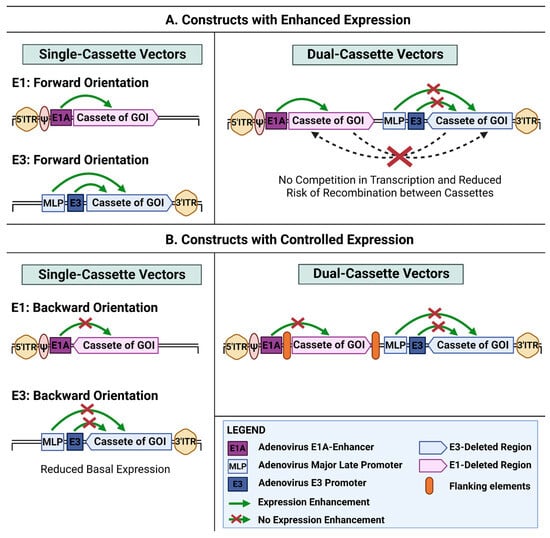
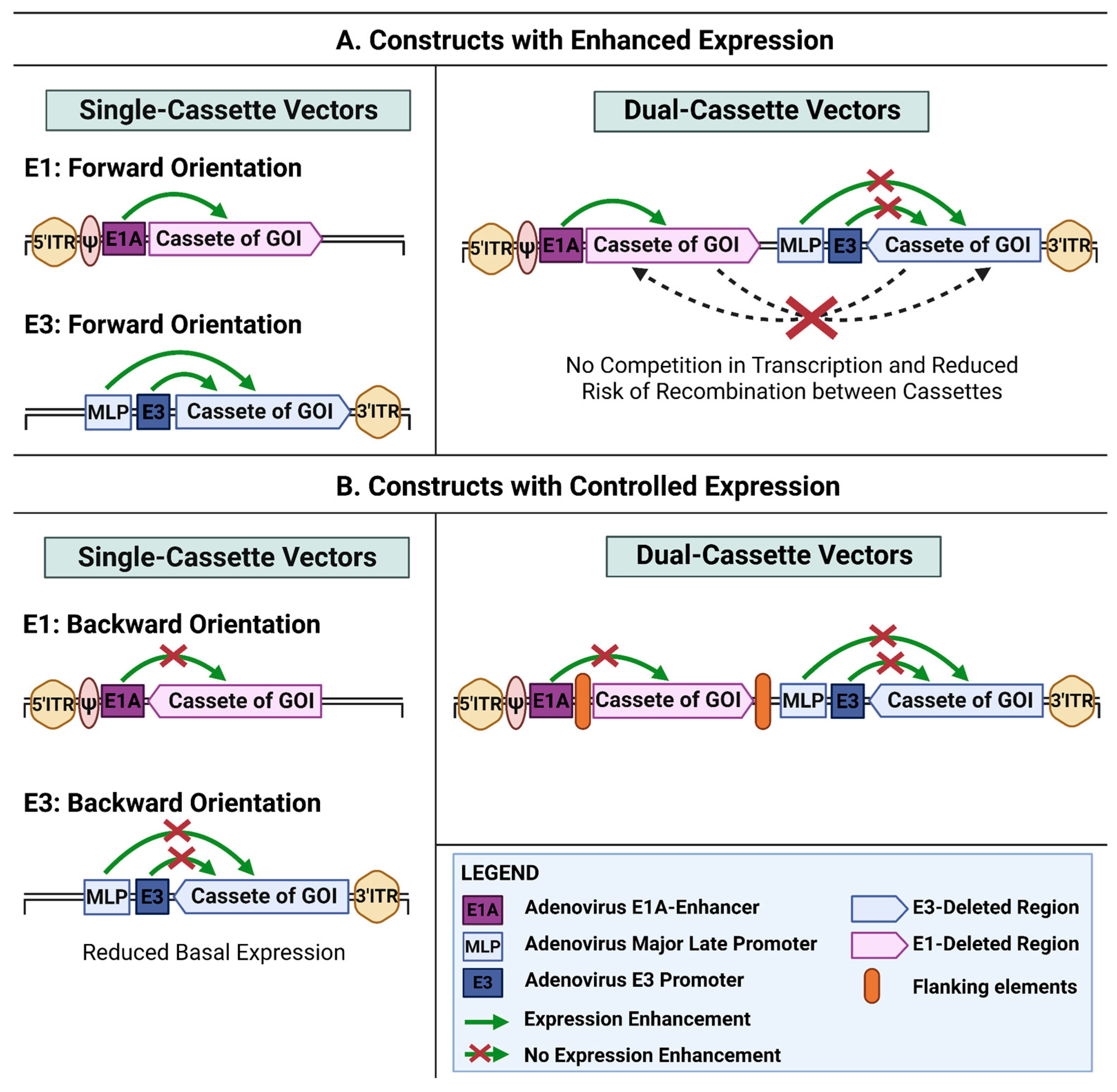
A key design decision for such vectors is the choice of genomic locus and the orientation of the expression cassette. In most cases, transgenes are cloned into the deleted E1 and/or E3 regions, and the cassette can be inserted in either the forward or reverse direction relative to viral transcription. This may affect transgene expression levels, packaging efficiency, viral titer, and genetic stability [43]. The orientation of multiple transgenes in bicistronic or dual-cassette vectors is likewise important, particularly with respect to their interactions with endogenous viral promoters (e.g., the major late promoter, MLP, and the E3 promoter). This review summarizes key approaches to the design of adenoviral vectors carrying one or two expression cassettes, with a focus on how transgene orientation and interactions with viral regulatory elements influence vector assembly efficiency, viral titer, and the level and stability of transgene expression. A summary of this article is shown in Figure 1.
Figure 1.
Insertion orientation and genomic context as regulators of transgene expression in adenoviral systems. The GOI cassette contains its own heterologous promoter and a poly(A) signal. This figure was created by using https://www.biorender.com (accessed on 15 February 2026).
3. Effects of Insertion Orientation and Viral Regulatory Elements on Transgene Expression
3.1. Single-Cassette Adenoviral Vectors
Single-cassette adenoviral vectors are constructs in which a single transgene expression cassette is inserted into the viral genome, most commonly into the E1 region (and less frequently into E3), which is deleted in first-generation vectors. These constructs are widely used in research because they provide the simplest route for cloning transgenes into an adenoviral vector. An analysis of the relevant literature indicates that even when an identical expression cassette is used, the orientation of insertion within the viral genome can substantially affect transgene expression levels, viral titers, and packaging efficiency, making these parameters an important consideration for optimizing adenoviral vector design.
For the E1 region, orientation effects appear to be less uniform and are largely determined by the specific transgene and promoter. In E1, differences between the E1L and E1R orientations in terms of viral titer, expression output, and mRNA and protein levels were inconsistent and depended on the particular transgene and promoter used [108]. Overall, vectors with insertions in E1L/R (as compared with E3 and E4) tended to yield higher titers and expression levels and remain the most common due to the practical convenience of vector construction. In a study aimed at optimizing first-generation vectors for gene therapy and vaccine development, transgene orientation in E1 was also shown to significantly affect viral growth characteristics [109]. In particular, vectors with the cassette inserted in the forward orientation in E1 displayed advantages in titer and genetic stability during extended passaging (up to 21 passages). Similarly, another study reported that a transgene cloned in the forward direction into the E1 locus produced higher and earlier expression across multiple cell lines, with only minor differences in the onset of expression [110]. The orientation of the expression cassette replacing E1 in the vector backbone had a significant effect on the level of transgene expression, with vectors containing expression cassettes directed towards the right end of the Ad genome exhibiting up to 7-fold higher β-galactosidase activity in infected cells than those with inserts in the opposite orientation [111]. It has been suggested that transcription factors binding the E1A enhancer may boost the activity of a heterologous promoter when the insert is in the forward orientation. Thus, even after deletion of the E1 coding sequences, regulatory elements in this region can continue to influence transgene expression.
A key explanation for orientation-dependent effects in E1 is the residual activity of the E1A enhancer retained in the vector after E1 deletion, which may enhance transcription of nearby cassettes when their orientation is aligned [29,30]. This element is part of the left early transcriptional regulatory region and contributes to the initiation of E1A transcription soon after viral DNA enters the cell nucleus [112,113]. It contains binding sites for cellular transcription factors and can therefore enhance not only the native E1A promoter but also heterologous promoters located nearby within recombinant vectors [114,115]. Mechanistically, these effects may arise through several distinct processes, including enhancer-mediated transcriptional activation by regulatory elements within the E1A region, transcriptional read-through from adjacent viral transcription units into the transgene cassette, or incorporation of the transgene transcript into adenoviral splicing pathways.
In the E3 region, by contrast, orientation effects are considerably more pronounced. Several independent studies have shown that cassettes oriented in the direction of E3 transcription and late MLTU transcripts more often support earlier and/or higher expression. In models expressing the vesicular stomatitis virus glycoprotein gene (VSV-G) [116] and the hepatitis B virus surface antigen gene (HBsAg) [117], expression in the forward orientation began at early stages of infection (concurrent with the E2 72K protein) and did not always require viral DNA replication. This, in turn, points to a major contribution of the endogenous early E3 promoter, which is active early in infection, and the MLP, which drives transcription through this region after viral DNA replication [99,118]. Deletion of a splice site within the E3 region was also reported to increase HBsAg expression during the late phase [117]. Thus, insertion orientation and interactions with endogenous promoters influence transcriptional output, and reverse insertion may be useful when expression needs to be constrained. Overall, these observations suggest that orientation relative to the direction of viral transcription influences the timing of transgene expression in the E3 locus. Inserts aligned with the direction of viral transcription may be expressed early through read-through transcription from upstream units and later through major late promoter activity following viral DNA replication, whereas inserts in the opposite orientation tend to show weaker or delayed expression.
Conversely, in an antiparallel orientation, expression was weaker and more often depended on the late phase and activation of the MLP. In a study using the HSV-1 gB gene, a cassette inserted in the reverse orientation in E3 provided little to no early expression in several cell lines, whereas the vector with a forward-oriented insert replicated in all tested lines and produced high-level gB expression [119]. Moreover, the heterologous SV40 promoter was shown to function not as an autonomous promoter but rather as a cryptic splice acceptor for viral transcripts initiated in upstream 5′ regions of the genome [120,121].
Taken together, these findings support several general conclusions for the design of single-cassette adenoviral vectors. First, E1 remains the most suitable locus for single-cassette constructs. This is because insertion into E1 more often yields high titers, passaging stability, and robust expression levels, while orientation plays a modifying rather than a determining role [108,111]. Second, the E3 region can also be used for transgene insertion, but—as multiple studies indicate—requires more careful selection of cassette orientation. A forward-oriented transgene aligned with viral transcription can “hitchhike” on endogenous promoter activity and the MLP to achieve high expression, whereas an antiparallel insertion can serve as a tool to modestly limit expression or shift it toward the late phase of infection [116,117,119].
3.2. Dual-Cassette Adenoviral Vectors
Unlike single-cassette constructs, dual-cassette adenoviral vectors create a markedly more complex transcriptional environment because two independent expression units—often driven by strong heterologous promoters—coexist within the same viral genome. Under these conditions, cassette orientation, their relative arrangement, and their placement in distinct genomic regions (E1, E3, E4) become key determinants of vector performance rather than secondary design choices. Available evidence indicates that dual-cassette designs are more prone to transcriptional interference, promoter competition, and modulation by adenoviral regulatory elements—effects that are typically much less pronounced in single-cassette vectors.
Several studies have highlighted that the E3 region is particularly sensitive to the orientation of a second expression cassette. When a cassette under strong promoters was inserted into E3 in the forward orientation (i.e., aligned with viral transcription), viable recombinant clones were often difficult or impossible to recover, likely reflecting reduced efficiency of viral particle assembly and production of infectious virions. In contrast, inserting the same cassette into E3 in the reverse orientation, or placing it in E1 in the forward orientation, allowed the generation of infectious viruses. In practice, genetically stable vectors with robust expression of both transgenes were obtained with a configuration combining a forward insertion in E1 and a reverse insertion in E3 [122]. It has also been reported that sharing identical regulatory elements between the two cassettes (e.g., introns or enhancers) can measurably alter transcript abundance and protein output. These observations are commonly attributed to transcriptional interference between heterologous promoters and endogenous regulatory elements within E3 and the major late transcription unit (MLTU), as well as to potential perturbation of normal splicing patterns of late viral transcripts [123,124].
With identical cassette designs, no major differences in in vivo expression levels of secreted reporter proteins were observed across dual-cassette adenoviral vectors constructed using different locus combinations (E1/E3, E1/E4) [125]. Thus, the locus itself may not be the limiting factor when promoters and insertion orientations are the same. However, stability profiling revealed a consistent vulnerability of E3-based inserts: during serial passaging, cassettes placed in E3 were more likely to undergo deletions, whereas inserts in other regions remained stable even at later passages [125]. This supports the view that E3—being involved in late transcriptional programs and alternative splicing—provides a less stable platform for the long-term expression of large inserts.
The most informative contrasts in both stability and expression were obtained when comparing (i) strategies placing two expression cassettes within the same E1 locus and (ii) spatially separating the cassettes between E1 and E3 (typically forward in E1 and reverse in E3) [126]. Comparative analyses of co-expression formats showed that vectors expressing two genes from a single cassette via a 2A peptide, as well as bidirectional expression designs within E1, could be efficiently rescued and amplified and remained genetically stable. However, 2A-based constructs tended to yield lower transgene output than matched controls with separate expression, whereas bidirectional E1 designs achieved comparable levels. The highest overall stability combined with strong expression was reported for vectors carrying two independent tandem cassettes within E1; notably, expression of the cassette positioned closer to the left ITR exceeded that of the downstream cassette [126]. This asymmetry may reflect local enhancer effects of the left ITR and the residual E1A enhancer region on nearby promoters [127,128]. Promoter interference is another plausible contributor, as two strong promoters placed in close proximity can impair each other’s activity [129,130]. Thus, even within a single E1 locus, cassette order and orientation can shape the expression balance between the two genes. Although the difference in expression was modest, inclusion of short spacer sequences between adjacent cassettes has been proposed to reduce promoter cross-talk and equalize expression levels [131,132].
3.3. Effects of Insertion Orientation on Regulated Transgene Expression
Regulated expression of therapeutic genes is a central goal of modern gene therapy. The ability to control the level, timing, and tissue specificity of expression can substantially improve the safety of vector systems, particularly when the transgene product is cytotoxic, highly bioactive, or immunogenic. Such applications include adenoviral vectors carrying “suicide” genes for cancer therapy [142], locally produced cytokines and growth factors [143,144], as well as targeted correction of genetic defects in specific cell types. However, even when tissue-specific or inducible promoters are used, transgene expression profiles in adenoviral vectors may deviate markedly from expectations. This is largely due to the influence of endogenous regulatory elements within the adenoviral genome, making cassette locus and orientation key determinants of both the level and pattern of expression.
Several studies have shown that cassette orientation in adenoviral vectors primarily affects basal (uninduced) expression, which is critical when working with toxic or immunologically active genes. In dual-cassette Tet-ON/Tet-OFF vectors, changing the orientation of the transcriptional activator cassette within E3 had little effect on doxycycline-induced expression, but substantially reduced basal activity when the cassette was inserted in the reverse orientation, as measured via reporter gene expression in the absence of doxycycline, likely by attenuating the impact of adjacent viral regulatory elements [145]. In more complex designs combining two independent inducible systems (the streptogramin-responsive PIP system and the tetracycline-responsive TET system), orientation effects in the E1 locus were even more pronounced: reverse orientation of the activator cassette led to loss of control in the TET system and substantial leakiness in the PIP system, likely driven by excessive expression of the PIP activator as the first cistron of the cassette. In contrast, the forward orientation supported balanced and tightly regulated performance of both systems [146]. Thus, cassette orientation influences not only interactions with viral regulatory elements but also intravector transcriptional cross-talk between neighboring promoters and polycistronic designs.
Orientation becomes particularly important in the context of interactions between inserted promoters and adenoviral enhancers. When tissue-specific or inducible promoters are cloned into the E1 locus, their activity can be substantially distorted by the E1A enhancer: forward orientation is often associated with enhanced expression accompanied by loss of tissue specificity and increased basal activity, whereas reverse orientation can partially mitigate these effects. Moreover, positioning cassettes near the right ITR in either orientation has been reported to provide more stable selectivity and lower nonspecific expression than cloning into E1 [147]. A similar impact of the E1A enhancer in an adenoviral vector altered both tissue specificity and activity of a transcription-gene promoter [148]. Other studies examining tissue-specific promoters in adenoviral vectors have suggested that the effect of the E1A enhancer may depend on the promoter type and cellular context. For example, in an adenoviral vector system lacking the E1A enhancer, the albumin promoter supported tissue-specific expression in hepatoma cells but drove relatively low transcriptional activity. In the presence of the E1A enhancer, however, transcription from the albumin promoter increased approximately 5-fold [149]. By contrast, no comparable stimulatory effect of the E1A enhancer on an immunoglobulin promoter was detected in myeloma cells. Together, these findings indicate that the regulatory impact of the E1A enhancer is both tissue- and promoter-dependent, likely reflecting cell-type-specific repertoires of transcription factors.
To address loss of selectivity caused by enhancer effects or cryptic transcription initiation sites within the adenoviral genome, insulating elements flanking the expression cassette and containing transcription termination signals have been proposed. Such insulator sequences effectively blocked undesired transcriptional activation and preserved high selectivity of HSVtk expression from a forward-oriented cassette in the E1 locus, restricting expression to target cells carrying the ERBB2 oncogene [150]. This is particularly relevant for “suicide gene” approaches in cancer gene therapy. Shielding a transgene in the E1 locus by flanking the cassette on both sides markedly reduced basal expression and increased inducibility (by ~40-fold in vitro and ~230-fold in vivo based on measured hAAT expression levels). Vectors lacking insulator sequences showed substantially weaker induction, with induction ratios approximately 40-fold lower in vitro and ~15-fold lower in vivo. The strongest effect was observed when the transgene was inserted in the reverse orientation in E1, whereas forward orientation resulted in high non-inducible activity [127]. These results are consistent with the proposed influence of the viral E1A enhancer on nearby cassettes and are supported by other studies. For instance, in adenoviral vectors carrying the radiation-inducible EGR-1 promoter in the E1 locus in the forward orientation, substantial nonspecific expression was observed in the absence of irradiation. Incorporation of a bGH poly(A) signal as an insulating element—placed upstream of the cassette or on both sides—reduced nonspecific cytotoxicity by 1.6–2.3-fold with minimal impact on induced expression [151].
In summary, cassette orientation and genomic placement are key determinants of transgene expression profiles in adenoviral vectors. In the vicinity of the packaging signal, forward-oriented cassettes can exhibit a pronounced enhancer effect associated with E1A elements, resulting in higher expression relative to placement near the right ITR; this effect appears replication-independent and is consistent with promoter interference. Forward orientation is therefore well suited for achieving high expression when strict selectivity is not required. In contrast, for inducible or tissue-specific expression, alternative insertion sites (E3/E4) and reverse orientation are often preferable, as they reduce basal activity. Additional stabilization can be achieved by flanking the cassette with insulating elements containing poly(A) signals, which limit the influence of viral enhancers and cryptic transcription initiation sites.
5. Conclusions
Transgene expression in adenoviral vectors is shaped not only by promoter choice but also by the transcriptional architecture of the viral genome, the insertion site and orientation, and interactions with endogenous viral regulatory elements. Inserted cassettes may become embedded within viral transcriptional programs, undergo alternative splicing, and be influenced by enhancer activity (including E1A) and RNA processing signals. Expression profiles depend on vector format: in single-cassette designs, the E1 region often supports robust expression, whereas in the E3 region, the orientation of insertion more strongly determines the extent to which the transgene is recruited into viral transcription. In dual-cassette vectors, additional risks arise from transcriptional interference and homologous recombination, necessitating careful selection of cassette orientations, spacing between expression units, and, where appropriate, the use of insulating elements. Endogenous adenoviral regulatory mechanisms, including the MLP and TPL, can be exploited to enhance expression via the late transcriptional program and preferential translation of TPL-containing mRNAs; however, this strategy inherently couples transgene activity to the infection phase. Therefore, rational adenoviral vector design should account for genomic context, insertion orientation, and the degree of cassette insulation, enabling the purposeful development of either high-output protein production systems or vectors with regulated or tissue-specific expression tailored to different gene therapy applications. Although many mechanistic insights summarized herein derive from studies using Ad5-based vectors, similar architectural principles are likely relevant to other adenoviral serotypes, although their transcriptional regulatory landscapes may differ. Nevertheless, these observations should be interpreted as general design guidelines rather than universal rules, as the magnitude and nature of these effects may vary depending on promoter choice, vector configuration, and cell type.
The authors of this review conclude that the literature synthesized herein supports a deeper understanding of how adenoviral transcriptional organization, insert orientation, and interactions with endogenous regulatory elements collectively determine the magnitude and pattern of transgene expression. Systematizing these findings provides a foundation for principles of rational adenoviral vector design—both for maximizing therapeutic protein output and for engineering precisely controlled or tissue-specific expression systems. Such an approach is essential for developing more effective and safer adenoviral platforms across a broad range of gene therapy applications.
Author Contributions
Writing—original draft preparation and visualization, A.M.; Supervision, S.S. All authors have read and agreed to the published version of the manuscript.
Funding
This research was funded by the Ministry of Science and Higher Education of the Russian Federation for RCMG.
Institutional Review Board Statement
Not applicable.
Informed Consent Statement
Not applicable.
Data Availability Statement
No new data were created or analyzed in this study. Data sharing is not applicable to this article.
Conflicts of Interest
The authors declare no conflicts of interest.
References
- Bennett, J.E.; Dolin, R.; Blaser, M.J. Mandell, Douglas, and Bennett’s Principles and Practice of Infectious Diseases E-Book: 2-Volume Set; Elsevier Health Sciences: New York, NY, USA, 2019. [Google Scholar]
- Leikas, A.J.; Ylä-Herttuala, S.; Hartikainen, J.E.K. Adenoviral Gene Therapy Vectors in Clinical Use—Basic Aspects with a Special Reference to Replication-Competent Adenovirus Formation and Its Impact on Clinical Safety. Int. J. Mol. Sci. 2023, 24, 16519. [Google Scholar] [CrossRef] [Scilit]
- Robinson, C.M.; Seto, D.; Jones, M.S.; Dyer, D.W.; Chodosh, J. Molecular Evolution of Human Species D Adenoviruses. Infect. Genet. Evol. 2011, 11, 1208. [Google Scholar] [CrossRef] [Scilit]
- Ehrhardt, A.; Xu, H.; Kay, M.A. Episomal Persistence of Recombinant Adenoviral Vector Genomes during the Cell Cycle In Vivo. J. Virol. 2003, 77, 7689. [Google Scholar] [CrossRef] [Scilit]
- Harui, A.; Suzuki, S.; Kochanek, S.; Mitani, K. Frequency and Stability of Chromosomal Integration of Adenovirus Vectors. J. Virol. 1999, 73, 6141–6146. [Google Scholar] [CrossRef] [Scilit]
- Graham, F.L.; Smiley, J.; Russell, W.C.; Nairn, R. Characteristics of a Human Cell Line Transformed by DNA from Human Adenovirus Type 5. J. Gen. Virol. 1977, 36, 59–72. [Google Scholar] [CrossRef] [Scilit]
- Lopez-Gordo, E.; Doszpoly, A.; Duffy, M.R.; Coughlan, L.; Bradshaw, A.C.; White, K.M.; Denby, L.; Nicklin, S.A.; Baker, A.H. Defining a Novel Role for the Coxsackievirus and Adenovirus Receptor in Human Adenovirus Serotype 5 Transduction In Vitro in the Presence of Mouse Serum. J. Virol. 2017, 91, e02487-16. [Google Scholar] [CrossRef] [Scilit]
- Kawabata, K.; Sakurai, F.; Koizumi, N.; Hayakawa, T.; Mizuguchi, H. Adenovirus Vector-Mediated Gene Transfer into Stem Cells. Mol. Pharm. 2006, 3, 95–103. [Google Scholar] [CrossRef] [Scilit]
- Waddington, S.N.; McVey, J.H.; Bhella, D.; Parker, A.L.; Barker, K.; Atoda, H.; Pink, R.; Buckley, S.M.K.; Greig, J.A.; Denby, L.; et al. Adenovirus Serotype 5 Hexon Mediates Liver Gene Transfer. Cell 2008, 132, 397–409. [Google Scholar] [CrossRef] [Scilit]
- Lenaerts, L.; De Clercq, E.; Naesens, L. Clinical Features and Treatment of Adenovirus Infections. Rev. Med. Virol. 2008, 18, 357–374. [Google Scholar] [CrossRef] [Scilit]
- Kirby, I.; Davison, E.; Beavil, A.J.; Soh, C.P.C.; Wickham, T.J.; Roelvink, P.W.; Kovesdi, I.; Sutton, B.J.; Santis, G. Identification of Contact Residues and Definition of the CAR-Binding Site of Adenovirus Type 5 Fiber Protein. J. Virol. 2000, 74, 2804–2813. [Google Scholar] [CrossRef] [Scilit]
- Santis, G.; Legrand, V.; Hong, S.S.; Davison, E.; Kirby, I.; Imler, J.L.; Finberg, R.W.; Bergelsen, J.M.; Mehtali, M.; Boulanger, P. Molecular Determinants of Adenovirus Serotype 5 Fibre Binding to Its Cellular Receptor CAR. J. Gen. Virol. 1999, 80, 1519–1527. [Google Scholar] [CrossRef] [Scilit]
- Roelvink, P.W.; Lizonova, A.; Lee, J.G.M.; Li, Y.; Bergelson, J.M.; Finberg, R.W.; Brough, D.E.; Kovesdi, I.; Wickham, T.J. The Coxsackievirus-Adenovirus Receptor Protein Can Function as a Cellular Attachment Protein for Adenovirus Serotypes from Subgroups A, C, D, E, and F. J. Virol. 1998, 72, 7909–7915. [Google Scholar] [CrossRef] [Scilit]
- Wang, X.; Bergelson, J.M. Coxsackievirus and Adenovirus Receptor Cytoplasmic and Transmembrane Domains Are Not Essential for Coxsackievirus and Adenovirus Infection. J. Virol. 1999, 73, 2559. [Google Scholar] [CrossRef] [Scilit]
- Cohen, C.J.; Shieh, J.T.C.; Pickles, R.J.; Okegawa, T.; Hsieh, J.T.; Bergelson, J.M. The Coxsackievirus and Adenovirus Receptor Is a Transmembrane Component of the Tight Junction. Proc. Natl. Acad. Sci. USA 2001, 98, 15191–15196. [Google Scholar] [CrossRef] [Scilit]
- Breyer, B.; Jiang, W.; Cheng, H.; Zhou, L.; Paul, R.; Feng, T.; He, T.-C. Adenoviral Vector-Mediated Gene Transfer for Human Gene Therapy. Curr. Gene Ther. 2001, 1, 149–162. [Google Scholar] [CrossRef] [Scilit]
- Muruve, D.A.; Cotter, M.J.; Zaiss, A.K.; White, L.R.; Liu, Q.; Chan, T.; Clark, S.A.; Ross, P.J.; Meulenbroek, R.A.; Maelandsmo, G.M.; et al. Helper-Dependent Adenovirus Vectors Elicit Intact Innate but Attenuated Adaptive Host Immune Responses In Vivo. J. Virol. 2004, 78, 5966. [Google Scholar] [CrossRef] [Scilit]
- Flotte, T.R. Size Does Matter: Overcoming the Adeno-Associated Virus Packaging Limit. Respir. Res. 2000, 1, 16–18. [Google Scholar] [CrossRef] [Scilit]
- Wu, Z.; Yang, H.; Colosi, P. Effect of Genome Size on AAV Vector Packaging. Mol. Ther. 2010, 18, 80–86. [Google Scholar] [CrossRef] [Scilit]
- Grieger, J.C.; Samulski, R.J. Packaging Capacity of Adeno-Associated Virus Serotypes: Impact of Larger Genomes on Infectivity and Postentry Steps. J. Virol. 2005, 79, 9933–9944. [Google Scholar] [CrossRef] [Scilit]
- Ginn, S.L.; Amaya, A.K.; Alexander, I.E.; Edelstein, M.; Abedi, M.R. Gene Therapy Clinical Trials Worldwide to 2017: An Update. J. Gene Med. 2018, 20, e3015, Erratum in J. Gene Med. 2019, 21, e3124. https://doi.org/10.1002/JGM.3015.. [Google Scholar] [CrossRef] [Scilit]
- Zhang, W.W.; Li, L.; Li, D.; Liu, J.; Li, X.; Li, W.; Xu, X.; Zhang, M.J.; Chandler, L.A.; Lin, H.; et al. The First Approved Gene Therapy Product for Cancer Ad-P53 (Gendicine): 12 Years in the Clinic. Hum. Gene Ther. 2018, 29, 160–179. [Google Scholar] [CrossRef] [Scilit]
- Liang, M. Oncorine, the World First Oncolytic Virus Medicine and Its Update in China. Curr. Cancer Drug Targets 2018, 18, 171–176. [Google Scholar] [CrossRef] [Scilit] [PubMed]
- Logunov, D.Y.; Dolzhikova, I.V.; Shcheblyakov, D.V.; Tukhvatulin, A.I.; Zubkova, O.V.; Dzharullaeva, A.S.; Kovyrshina, A.V.; Lubenets, N.L.; Grousova, D.M.; Erokhova, A.S.; et al. Safety and Efficacy of an RAd26 and RAd5 Vector-Based Heterologous Prime-Boost COVID-19 Vaccine: An Interim Analysis of a Randomised Controlled Phase 3 Trial in Russia. Lancet 2021, 397, 671–681, Correction in Lancet 2021, 397, 670. https://doi.org/10.1016/S0140-6736(21)00234-8.. [Google Scholar] [CrossRef] [Scilit] [PubMed]
- Voysey, M.; Clemens, S.A.C.; Madhi, S.A.; Weckx, L.Y.; Folegatti, P.M.; Aley, P.K.; Angus, B.; Baillie, V.L.; Barnabas, S.L.; Bhorat, Q.E.; et al. Safety and Efficacy of the ChAdOx1 NCoV-19 Vaccine (AZD1222) against SARS-CoV-2: An Interim Analysis of Four Randomised Controlled Trials in Brazil, South Africa, and the UK. Lancet 2021, 397, 99–111, Erratum in Lancet 2021, 397, 98. https://doi.org/10.1016/S0140-6736(20)32661-1.. [Google Scholar] [CrossRef] [Scilit]
- Doroftei, B.; Ciobica, A.; Ilie, O.D.; Maftei, R.; Ilea, C. Mini-Review Discussing the Reliability and Efficiency of COVID-19 Vaccines. Diagnostics 2021, 11, 579. [Google Scholar] [CrossRef] [Scilit]
- Rai, S.; Tripathi, S. Comparative Efficacy of Leading COVID-19 Vaccines: A Network Meta-Analysis. Indian J. Med. Res. 2025, 161, 9–20. [Google Scholar] [CrossRef] [Scilit]
- Watanabe, M.; Nishikawaji, Y.; Kawakami, H.; Kosai, K.I. Adenovirus Biology, Recombinant Adenovirus, and Adenovirus Usage in Gene Therapy. Viruses 2021, 13, 2502. [Google Scholar] [CrossRef] [Scilit]
- Zheng, B.; Mittal, S.K.; Graham, F.L.; Prevec, L. The E1 Sequence of Bovine Adenovirus Type 3 and Complementation of Human Adenovirus Type 5 E1A Function in Bovine Cells. Virus Res. 1994, 31, 163–186. [Google Scholar] [CrossRef] [Scilit]
- Hitt, M.M.; Graham, F.L. Adenovirus E1A under the Control of Heterologous Promoters: Wide Variation in E1A Expression Levels Has Little Effect on Virus Replication. Virology 1990, 179, 667–678. [Google Scholar] [CrossRef] [Scilit]
- Bett, A.J.; Haddara, W.; Prevec, L.; Graham, F.L. An Efficient and Flexible System for Construction of Adenovirus Vectors with Insertions or Deletions in Early Regions 1 and 3. Proc. Natl. Acad. Sci. USA 1994, 91, 8802–8806. [Google Scholar] [CrossRef] [Scilit]
- Subramanian, T.; Vijayalingam, S.; Chinnadurai, G. Genetic Identification of Adenovirus Type 5 Genes That Influence Viral Spread. J. Virol. 2006, 80, 2000–2012. [Google Scholar] [CrossRef] [Scilit]
- Bett, A.J.; Krougliak, V.; Graham, F.L. DNA Sequence of the Deletion/Insertion in Early Region 3 of Ad5 Dl309. Virus Res. 1995, 39, 75–82. [Google Scholar] [CrossRef]
- Berencsi, K.; Uri, A.; Valyi-Nagy, T.; Valyi-Nagy, I.; Meignier, B.; Peretz, F.V.; Rando, R.F.; Plotkin, S.A.; Gönczöl, E. Early Region 3-Replacement Adenovirus Recombinants Are Less Pathogenic in Cotton Rats and Mice than Early Region 3-Deleted Viruses. Lab. Investig. 1994, 71, 350–358. [Google Scholar]
- Amalfitano, A.; Hauser, M.A.; Hu, H.; Serra, D.; Begy, C.R.; Chamberlain, J.S. Production and Characterization of Improved Adenovirus Vectors with the E1, E2b, and E3 Genes Deleted. J. Virol. 1998, 72, 926–933. [Google Scholar] [CrossRef] [Scilit]
- Gorziglia, M.I.; Lapcevich, C.; Roy, S.; Kang, Q.; Kadan, M.; Wu, V.; Pechan, P.; Kaleko, M. Generation of an Adenovirus Vector Lacking E1, E2a, E3, and All of E4 except Open Reading Frame 3. J. Virol. 1999, 73, 6048. [Google Scholar] [CrossRef] [Scilit] [PubMed]
- Liu, J.; Seol, D.W. Helper Virus-Free Gutless Adenovirus (HF-GLAd): A New Platform for Gene Therapy. BMB Rep. 2020, 53, 565. [Google Scholar] [CrossRef] [Scilit]
- Jozkowicz, A.; Dulak, J.; Nanobashvili, J.; Polterauer, P.; Prager, M.; Huk, I. Gutless Adenoviral Vectors–Promising Tools for Gene Therapy. Eur. Surg.–Acta Chir. Austriaca 2002, 34, 95–100. [Google Scholar] [CrossRef] [Scilit]
- Parks, R.J.; Graham, F.L. A Helper-Dependent System for Adenovirus Vector Production Helps Define a Lower Limit for Efficient DNA Packaging. J. Virol. 1997, 71, 3293–3298. [Google Scholar] [CrossRef] [Scilit] [PubMed]
- He, T.C.; Zhou, S.; Da Costa, L.T.; Yu, J.; Kinzler, K.W.; Vogelstein, B. A Simplified System for Generating Recombinant Adenoviruses. Proc. Natl. Acad. Sci. USA 1998, 95, 2509–2514. [Google Scholar] [CrossRef] [Scilit]
- Luo, J.; Deng, Z.L.; Luo, X.; Tang, N.; Song, W.X.; Chen, J.; Sharff, K.A.; Luu, H.H.; Haydon, R.C.; Kinzler, K.W.; et al. A Protocol for Rapid Generation of Recombinant Adenoviruses Using the AdEasy System. Nat. Protoc. 2007, 2, 1236–1247. [Google Scholar] [CrossRef] [Scilit] [PubMed]
- Anderson, R.D.; Haskell, R.E.; Xia, H.; Roessler, B.J.; Davidson, B.L. A Simple Method for the Rapid Generation of Recombinant Adenovirus Vectors. Gene Ther. 2000, 7, 1034–1038. [Google Scholar] [CrossRef] [Scilit]
- Youil, R.; Tang, A.; Chen, M.; Emini, E.A.; Kaslow, D.C.; Aunins, J.G.; Altaras, N.E.; Toner, T.J.; Su, Q.; Casimiro, D.; et al. Comparative Analysis of the Effects of Packaging Signal, Transgene Orientation, Promoters, Polyadenylation Signals, and E3 Region on Growth Properties of First-Generation Adenoviruses. Hum. Gene Ther. 2003, 14, 1017–1034. [Google Scholar] [CrossRef] [Scilit]
- Statkute, E.; Wang, E.C.Y.; Stanton, R.J. An Optimized CRISPR/Cas9 Adenovirus Vector (AdZ-CRISPR) for High-Throughput Cloning of SgRNA, Using Enhanced SgRNA and Cas9 Variants. Hum. Gene Ther. 2022, 33, 990–1001. [Google Scholar] [CrossRef] [Scilit]
- Nakahara, T.; Tabata, H.; Kato, Y.; Fuse, R.; Nakamura, M.; Yamaji, M.; Hattori, N.; Kiyono, T.; Saito, I.; Nakanishi, T. Construction and Stability of All-in-One Adenovirus Vectors Simultaneously Expressing Four and Eight Multiplex Guide RNAs and Cas9 Nickase. Int. J. Mol. Sci. 2024, 25, 8783. [Google Scholar] [CrossRef] [Scilit]
- Schlesinger, R.W. Adenoviruses: The Nature of the Virion and of Controlling Factors in Productive or Abortive Infection and Tumorigenesis. Adv. Virus Res. 1969, 14, 1–61. [Google Scholar] [CrossRef] [Scilit]
- Lonberg-Holm, K.; Philipson, L. Early Events of Virus-Cell Interaction in an Adenovirus System. J. Virol. 1969, 4, 323–338. [Google Scholar] [CrossRef] [Scilit] [PubMed]
- Russell, W.C. Adenoviruses: Update on Structure and Function. J. Gen. Virol. 2009, 90, 1–20. [Google Scholar] [CrossRef] [Scilit] [PubMed]
- Nevins, J.R. Mechanism of Activation of Early Viral Transcription by the Adenovirus E1A Gene Product. Cell 1981, 26, 213–220. [Google Scholar] [CrossRef] [Scilit] [PubMed]
- Nevins, J.R.; Raychaudhuri, P.; Yee, A.S.; Rooney, R.J.; Kovesdi, I.; Reichel, R. Transactivation by the Adenovirus E1A Gene. Biochem. Cell Biol. 1988, 66, 578–583. [Google Scholar] [CrossRef] [Scilit]
- Steegenga, W.T.; Shvarts, A.; Riteco, N.; Bos, J.L.; Jochemsen, A.G. Distinct Regulation of P53 and P73 Activity by Adenovirus E1A, E1B, and E4orf6 Proteins. Mol. Cell. Biol. 1999, 19, 3885–3894. [Google Scholar] [CrossRef] [Scilit]
- Shenk, T.; Flint, J. Transcriptional and Transforming Activities of the Adenovirus E1A Proteins. Adv. Cancer Res. 1991, 57, 47–85. [Google Scholar] [CrossRef] [Scilit]
- Berk, A.J. Functions of Adenovirus E1A. Cancer Surv. 1986, 5, 367–387. [Google Scholar]
- Stillman, B. Functions of the Adenovirus E1B Tumour Antigens. Cancer Surv. 1986, 5, 389–404. [Google Scholar]
- Herrmann, C.H.; Dery, C.V.; Mathews, M.B. Transactivation of Host and Viral Genes by the Adenovirus E1B 19K Tumor Antigen. Oncogene 1987, 2, 25–35. [Google Scholar] [PubMed]
- Yew, P.R.; Berk, A.J. Inhibition of P53 Transactivation Required for Transformation by Adenovirus Early 1B Protein. Nature 1992, 357, 82–85. [Google Scholar] [CrossRef] [Scilit] [PubMed]
- Steegenga, W.T.; Riteco, N.; Jochemsen, A.G.; Fallaux, F.J.; Bos, J.L. The Large E1B Protein Together with the E4orf6 Protein Target P53 for Active Degradation in Adenovirus Infected Cells. Oncogene 1998, 16, 349–357. [Google Scholar] [CrossRef] [Scilit] [PubMed]
- Chinnadurai, G. Control of Apoptosis by Human Adenovirus Genes. Semin. Virol. 1998, 8, 399–408. [Google Scholar] [CrossRef] [Scilit]
- Fessler, S.P.; Young, C.S.H. Control of Adenovirus Early Gene Expression during the Late Phase of Infection. J. Virol. 1998, 72, 4049–4056. [Google Scholar] [CrossRef] [Scilit]
- Huang, W.; Flint, S.J. Unusual Properties of Adenovirus E2E Transcription by RNA Polymerase III. J. Virol. 2003, 77, 4015–4024. [Google Scholar] [CrossRef] [Scilit]
- Swaminathan, S.; Thimmapaya, B. Transactivation of Adenovirus E2-Early Promoter by E1A and E4 6/7 in the Context of Viral Chromosome. J. Mol. Biol. 1996, 258, 736–746. [Google Scholar] [CrossRef] [Scilit]
- Swaminathan, S.; Thimmapaya, B. Regulation of Adenovirus E2 Transcription Unit. Curr. Top. Microbiol. Immunol. 1995, 199, 177–194. [Google Scholar] [CrossRef] [Scilit] [PubMed]
- Huang, W.; Pruzan, R.; Flint, S.J. In Vivo Transcription from the Adenovirus E2 Early Promoter by RNA Polymerase III. Proc. Natl. Acad. Sci. USA 1994, 91, 1265–1269. [Google Scholar] [CrossRef] [Scilit] [PubMed]
- Chen, P.; Tian, J.; Kovesdi, I.; Bruder, J.T. Interaction of the Adenovirus 14.7-KDa Protein with FLICE Inhibits Fas Ligand-Induced Apoptosis. J. Biol. Chem. 1998, 273, 5815–5820. [Google Scholar] [CrossRef] [Scilit]
- Tollefson, A.E.; Scaria, A.; Hermiston, T.W.; Ryerse, J.S.; Wold, L.J.; Wold, W.S. The Adenovirus Death Protein (E3-11.6K) Is Required at Very Late Stages of Infection for Efficient Cell Lysis and Release of Adenovirus from Infected Cells. J. Virol. 1996, 70, 2296–2306. [Google Scholar] [CrossRef] [Scilit]
- Doronin, K.; Toth, K.; Kuppuswamy, M.; Krajcsi, P.; Tollefson, A.E.; Wold, W.S.M. Overexpression of the ADP (E3-11.6K) Protein Increases Cell Lysis and Spread of Adenovirus. Virology 2003, 305, 378–387. [Google Scholar] [CrossRef] [Scilit]
- Benedict, C.A.; Norris, P.S.; Prigozy, T.I.; Bodmer, J.L.; Mahr, J.A.; Garnett, C.T.; Martinon, F.; Tschopp, J.; Gooding, L.R.; Ware, C.F. Three Adenovirus E3 Proteins Cooperate to Evade Apoptosis by Tumor Necrosis Factor-Related Apoptosis-Inducing Ligand Receptor-1 and -2. J. Biol. Chem. 2001, 276, 3270–3278. [Google Scholar] [CrossRef] [Scilit] [PubMed]
- Elsing, A.; Burgert, H.G. The Adenovirus E3/10.4K-14.5K Proteins down-Modulate the Apoptosis Receptor Fas/Apo-1 by Inducing Its Internalization. Proc. Natl. Acad. Sci. USA 1998, 95, 10072–10077. [Google Scholar] [CrossRef] [Scilit]
- Krajcsi, P.; Dimitrov, T.; Hermiston, T.W.; Tollefson, A.E.; Ranheim, T.S.; Vande Pol, S.B.; Stephenson, A.H.; Wold, W.S. The Adenovirus E3-14.7K Protein and the E3-10.4K/14.5K Complex of Proteins, Which Independently Inhibit Tumor Necrosis Factor (TNF)-Induced Apoptosis, Also Independently Inhibit TNF-Induced Release of Arachidonic Acid. J. Virol. 1996, 70, 4904–4913. [Google Scholar] [CrossRef] [Scilit]
- Flint, S.J.; Gonzalez, R.A. Regulation of MRNA Production by the Adenoviral E1B 55-KDa and E4 Orf6 Proteins. Curr. Top. Microbiol. Immunol. 2003, 272, 287–330. [Google Scholar] [CrossRef] [Scilit]
- Huang, M.M.; Hearing, P. Adenovirus Early Region 4 Encodes Two Gene Products with Redundant Effects in Lytic Infection. J. Virol. 1989, 63, 2605–2615. [Google Scholar] [CrossRef] [Scilit]
- Hemström, C.; Nordqvist, K.; Pettersson, U.; Virtanen, A. Gene Product of Region E4 of Adenovirus Type 5 Modulates Accumulation of Certain Viral Polypeptides. J. Virol. 1988, 62, 3258–3264. [Google Scholar] [CrossRef] [Scilit] [PubMed]
- Medghalchi, S.; Padmanabhan, R.; Ketner, G. Early Region 4 Modulates Adenovirus DNA Replication by Two Genetically Separable Mechanisms. Virology 1997, 236, 8–17. [Google Scholar] [CrossRef] [Scilit] [PubMed]
- Bridge, E.; Ketner, G. Redundant Control of Adenovirus Late Gene Expression by Early Region 4. J. Virol. 1989, 63, 631–638. [Google Scholar] [CrossRef] [Scilit]
- Bridge, E.; Ketner, G. Interaction of Adenoviral E4 and E1b Products in Late Gene Expression. Virology 1990, 174, 345–353. [Google Scholar] [CrossRef] [Scilit]
- Young, C.S.H. The Structure and Function of the Adenovirus Major Late Promoter. Curr. Top. Microbiol. Immunol. 2003, 272, 213–249. [Google Scholar] [CrossRef] [Scilit]
- Farley, D.C.; Brown, J.L.; Leppard, K.N. Activation of the Early-Late Switch in Adenovirus Type 5 Major Late Transcription Unit Expression by L4 Gene Products. J. Virol. 2004, 78, 1782–1791. [Google Scholar] [CrossRef] [Scilit]
- Alonso-Caplen, F.V.; Katze, M.G.; Krug, R.M. Efficient Transcription, Not Translation, Is Dependent on Adenovirus Tripartite Leader Sequences at Late Times of Infection. J. Virol. 1988, 62, 1606. [Google Scholar] [CrossRef] [Scilit]
- Berkner, K.L.; Sharp, P.A. Effect of the Tripartite Leader on Synthesis of a Non-Viral Protein in an Adenovirus 5 Recombinant. Nucleic Acids Res. 1985, 13, 841–857. [Google Scholar] [CrossRef] [Scilit]
- Törmänen, H.; Backström, E.; Carlsson, A.; Akusjärvi, G. L4-33K, an Adenovirus-Encoded Alternative RNA Splicing Factor. J. Biol. Chem. 2006, 281, 36510–36517. [Google Scholar] [CrossRef] [Scilit]
- Wu, K.; Guimet, D.; Hearing, P. The Adenovirus L4-33K Protein Regulates Both Late Gene Expression Patterns and Viral DNA Packaging. J. Virol. 2013, 87, 6739–6747. [Google Scholar] [CrossRef] [Scilit] [PubMed]
- Biasiotto, R.; Akusjärvi, G. Regulation of Human Adenovirus Alternative RNA Splicing by the Adenoviral L4-33K and L4-22K Proteins. Int. J. Mol. Sci. 2015, 16, 2893–2912. [Google Scholar] [CrossRef] [Scilit]
- Wu, K.; Orozco, D.; Hearing, P. The Adenovirus L4-22K Protein Is Multifunctional and Is an Integral Component of Crucial Aspects of Infection. J. Virol. 2012, 86, 10474–10483. [Google Scholar] [CrossRef] [Scilit]
- Berk, A.J.; Sharp, P.A. Structure of the Adenovirus 2 Early MRNAs. Cell 1978, 14, 695–711. [Google Scholar] [CrossRef] [Scilit]
- Schmitt, P.; Gattoni, R.; Keohavong, P.; Stévenin, J. Alternative Splicing of E1A Transcripts of Adenovirus Requires Appropriate Ionic Conditions in Vitro. Cell 1987, 50, 31–39. [Google Scholar] [CrossRef] [Scilit]
- Mayeda, A.; Krainer, A.R. Regulation of Alternative Pre-MRNA Splicing by HnRNP A1 and Splicing Factor SF2. Cell 1992, 68, 365–375. [Google Scholar] [CrossRef] [Scilit] [PubMed]
- Spector, D.J.; McGrogan, M.; Raskas, H.J. Regulation of the Appearance of Cytoplasmic RNAs from Region 1 of the Adenovirus 2 Genome. J. Mol. Biol. 1978, 126, 395–414. [Google Scholar] [CrossRef] [Scilit] [PubMed]
- Ghosh-Choudhury, G.; Haj-Ahmad, Y.; Graham, F.L. Protein IX, a Minor Component of the Human Adenovirus Capsid, Is Essential for the Packaging of Full Length Genomes. EMBO J. 1987, 6, 1733–1739. [Google Scholar] [CrossRef] [Scilit] [PubMed]
- Tribouley, C.; Lutz, P.; Staub, A.; Kedinger, C. The Product of the Adenovirus Intermediate Gene IVa2 Is a Transcriptional Activator of the Major Late Promoter. J. Virol. 1994, 68, 4450. [Google Scholar] [CrossRef] [Scilit]
- Zhang, W.; Imperiale, M.J. Interaction of the Adenovirus IVa2 Protein with Viral Packaging Sequences. J. Virol. 2000, 74, 2687, Correction in J. Virol. 2007, 81, 3674. https://doi.org/10.1128/jvi.74.6.2687-2693.2000.. [Google Scholar] [CrossRef] [Scilit]
- Stillman, B.W.; Lewis, J.B.; Chow, L.T.; Mathews, M.B.; Smart, J.E. Identification of the Gene and MRNA for the Adenovirus Terminal Protein Precursor. Cell 1981, 23, 497–508. [Google Scholar] [CrossRef] [Scilit]
- Smart, J.E.; Stillman, B.W. Adenovirus Terminal Protein Precursor. Partial Amino Acid Sequence and the Site of Covalent Linkage to Virus DNA. J. Biol. Chem. 1982, 257, 13499–13506. [Google Scholar] [CrossRef] [Scilit]
- Wold, W.S.M.; Tollefson, A.E.; Hermiston, T.W. E3 Transcription Unit of Adenovirus. Curr. Top. Microbiol. Immunol. 1995, 199, 237–274. [Google Scholar] [CrossRef] [Scilit]
- Gooding, L.R. Virus Proteins That Counteract Host Immune Defenses. Cell 1992, 71, 1–4. [Google Scholar] [CrossRef] [Scilit]
- Tigges, M.A.; Raskas, H.J. Splice Junctions in Adenovirus 2 Early Region 4 MRNAs: Multiple Splice Sites Produce 18 to 24 RNAs. J. Virol. 1984, 50, 106–117. [Google Scholar] [CrossRef] [Scilit] [PubMed]
- Rigolet, M.; Galibert, F. Organization and Expres of the E4 Region of Adenovirus 2. Nucleic Acids Res. 1984, 12, 7649–7661. [Google Scholar] [CrossRef] [Scilit]
- Tollefson, A.E.; Ying, B.; Doronin, K.; Sidor, P.D.; Wold, W.S.M. Identification of a New Human Adenovirus Protein Encoded by a Novel Late l -Strand Transcription Unit. J. Virol. 2007, 81, 12918–12926. [Google Scholar] [CrossRef] [Scilit]
- Ying, B.; Tollefson, A.E.; Wold, W.S.M. Identification of a Previously Unrecognized Promoter That Drives Expression of the UXP Transcription Unit in the Human Adenovirus Type 5 Genome. J. Virol. 2010, 84, 11470–11478. [Google Scholar] [CrossRef] [Scilit]
- Larsson, S.; Svensson, C.; Akusjärvi, G. Control of Adenovirus Major Late Gene Expression at Multiple Levels. J. Mol. Biol. 1992, 225, 287–298. [Google Scholar] [CrossRef] [Scilit] [PubMed]
- Hales, K.H.; Birk, J.M.; Imperiale, M.J. Analysis of Adenovirus Type 2 L1 RNA 3′-End Formation in Vivo and in Vitro. J. Virol. 1988, 62, 1464–1468. [Google Scholar] [CrossRef] [Scilit] [PubMed]
- Prescott, J.; Falck-Pedersen, E. Sequence Elements Upstream of the 3′ Cleavage Site Confer Substrate Strength to the Adenovirus L1 and L3 Polyadenylation Sites. Mol. Cell. Biol. 1994, 14, 4682–4693. [Google Scholar] [CrossRef] [Scilit]
- Akusjärvi, G.; Persson, H. Gene and MRNA for Precursor Polypeptide VI from Adenovirus Type 2. J. Virol. 1981, 38, 469–482. [Google Scholar] [CrossRef] [Scilit] [PubMed]
- Le Moullec, J.M.; Akusjärvi, G.; Stålhandske, P.; Pettersson, U.; Chambraud, B.; Gilardi, P.; Nasri, M.; Perricaudet, M. Polyadenylic Acid Addition Sites in the Adenovirus Type 2 Major Late Transcription Unit. J. Virol. 1983, 48, 127–134. [Google Scholar] [CrossRef] [Scilit] [PubMed]
- Moore, C.L.; Chen, J.; Whoriskey, J. Two Proteins Crosslinked to RNA Containing the Adenovirus L3 Poly(A) Site Require the AAUAAA Sequence for Binding. EMBO J. 1988, 7, 3159–3169. [Google Scholar] [CrossRef] [Scilit] [PubMed]
- Morris, S.J.; Scott, G.E.; Leppard, K.N. Adenovirus Late-Phase Infection Is Controlled by a Novel L4 Promoter. J. Virol. 2010, 84, 7096–7104. [Google Scholar] [CrossRef] [Scilit]
- Sittler, A.; Gallinaro, H.; Jacob, M. Upstream and Downstream c/s-Acting Elements for Cleavage at the L4 Polyadenylation Site of Adenovirus-2. Nucleic Acids Res. 1994, 22, 222–231. [Google Scholar] [CrossRef] [Scilit]
- Uhlén, M.; Svensson, C.; Josephson, S.; Aleström, P.; Chattapadhyaya, J.B.; Pettersson, U.; Philipson, L. Leader Arrangement in the Adenovirus Fiber MRNA. EMBO J. 1982, 1, 249–254. [Google Scholar] [CrossRef] [Scilit]
- Suzuki, M.; Kondo, S.; Pei, Z.; Maekawa, A.; Saito, I.; Kanegae, Y. Preferable Sites and Orientations of Transgene Inserted in the Adenovirus Vector Genome: The E3 Site May Be Unfavorable for Transgene Position. Gene Ther. 2015, 22, 421. [Google Scholar] [CrossRef] [Scilit]
- Bramson, J.; Hitt, M.; Gallichan, W.S.; Rosenthal, K.L.; Gauldie, J.; Graham, F.L. Construction of a Double Recombinant Adenovirus Vector Expressing a Heterodimeric Cytokine: In Vitro and in Vivo Production of Biologically Active Interleukin-12. Hum. Gene Ther. 1996, 7, 333–342. [Google Scholar] [CrossRef] [Scilit]
- Xu, Z.Z.; Krougliak, V.; Prevek, L.; Graham, F.L.; Both, G.W. Investigation of Promoter Function in Human and Animal Cells Infected with Human Recombinant Adenovirus Expressing Rotavirus Antigen VP7sc. J. Gen. Virol. 1995, 76, 1971–1980. [Google Scholar] [CrossRef] [Scilit]
- Addison, C.L.; Hitt, M.; Kunsken, D.; Graham, F.L. Comparison of the Human versus Murine Cytomegalovirus Immediate Early Gene Promoters for Transgene Expression by Adenoviral Vectors. J. Gen. Virol. 1997, 78, 1653–1660. [Google Scholar] [CrossRef] [Scilit]
- Hearing, P.; Shenk, T. The Adenovirus Type 5 E1A Transcriptional Control Region Contains a Duplicated Enhancer Element. Cell 1983, 33, 695–703. [Google Scholar] [CrossRef] [Scilit]
- Hearing, P.; Shenk, T. The Adenovirus Type 5 E1A Enhancer Contains Two Functionally Distinct Domains: One Is Specific for E1A and the Other Modulates All Early Units in Cis. Cell 1986, 45, 229–236. [Google Scholar] [CrossRef] [Scilit]
- Imperiale, M.J.; Feldman, L.T.; Nevins, J.R. Activation of Gene Expression by Adenovirus and Herpesvirus Regulatory Genes Acting in Trans and by a Cis-Acting Adenovirus Enhancer Element. Cell 1983, 35, 127–136. [Google Scholar] [CrossRef] [Scilit]
- Yamamoto, M.; Davydova, J.; Takayama, K.; Alemany, R.; Curiel, D.T. Transcription Initiation Activity of Adenovirus Left-End Sequence in Adenovirus Vectors with E1 Deleted. J. Virol. 2003, 77, 1633–1637. [Google Scholar] [CrossRef] [Scilit] [PubMed]
- Schneider, M.; Graham, F.L.; Prevec, L. Expression of the Glycoprotein of Vesicular Stomatitis Virus by Infectious Adenovirus Vectors. J. Gen. Virol. 1989, 70, 417–427. [Google Scholar] [CrossRef] [Scilit] [PubMed]
- Morin, J.E.; Lubeck, M.D.; Barton, J.E.; Conley, A.J.; Davis, A.R.; Hung, P.P. Recombinant Adenovirus Induces Antibody Response to Hepatitis B Virus Surface Antigen in Hamsters. Proc. Natl. Acad. Sci. USA 1987, 84, 4626. [Google Scholar] [CrossRef] [Scilit]
- Liu, L. Characterization of an Upstream Regulatory Element of Adenovirus L1 Poly (A) Site. Virology 2005, 337, 124–135. [Google Scholar] [CrossRef] [Scilit]
- Johnson, D.C.; Ghosh-Choudhury, G.; Smiley, J.R.; Fallis, L.; Graham, F.L. Abundant Expression of Herpes Simplex Virus Glycoprotein GB Using an Adenovirus Vector. Virology 1988, 164, 1–14. [Google Scholar] [CrossRef] [Scilit] [PubMed]
- Thummel, C.; Tjian, R.; Hu, S.L.; Grodzicker, T. Translational Control of SV40 T Antigen Expressed from the Adenovirus Late Promoter. Cell 1983, 33, 455–464. [Google Scholar] [CrossRef] [Scilit]
- Mansour, S.L.; Grodzicker, T.; Tjian, R. Downstream Sequences Affect Transcription Initiation from the Adenovirus Major Late Promoter. Mol. Cell. Biol. 1986, 6, 2684–2694. [Google Scholar] [CrossRef] [Scilit]
- Small, J.C.; Kurupati, R.K.; Zhou, X.; Bian, A.; Chi, E.; Li, Y.; Xiang, Z.; Ertl, H.C.J. Construction and Characterization of E1- and E3-Deleted Adenovirus Vectors Expressing Two Antigens from Two Separate Expression Cassettes. Hum. Gene Ther. 2013, 25, 328. [Google Scholar] [CrossRef] [Scilit] [PubMed]
- Reach, M.; Xu, L.X.; Young, C.S. Transcription from the Adenovirus Major Late Promoter Uses Redundant Activating Elements. EMBO J. 1991, 10, 3439. [Google Scholar] [CrossRef] [Scilit]
- Donovan-Banfield, I.; Turnell, A.S.; Hiscox, J.A.; Leppard, K.N.; Matthews, D.A. Deep Splicing Plasticity of the Human Adenovirus Type 5 Transcriptome Drives Virus Evolution. Commun. Biol. 2020, 3, 124. [Google Scholar] [CrossRef] [Scilit]
- Pham, L.; Nakamura, T.; Rosales, A.G.; Carlson, S.K.; Bailey, K.R.; Peng, K.W.; Russell, S.J. Concordant Activity of Transgene Expression Cassettes Inserted into E1, E3 and E4 Cloning Sites in the Adenovirus Genome. J. Gene Med. 2009, 11, 197. [Google Scholar] [CrossRef] [Scilit]
- Vujadinovic, M.; Wunderlich, K.; Callendret, B.; Koning, M.; Vermeulen, M.; Sanders, B.; Van Der Helm, E.; Gecgel, A.; Spek, D.; De Boer, K.; et al. Adenoviral Type 35 and 26 Vectors with a Bidirectional Expression Cassette in the E1 Region Show an Improved Genetic Stability Profile and Potent Transgene-Specific Immune Response. Hum. Gene Ther. 2018, 29, 337–351. [Google Scholar] [CrossRef] [Scilit]
- Steinwaerder, D.S.; Lieber, A. Insulation from Viral Transcriptional Regulatory Elements Improves Inducible Transgene Expression from Adenovirus Vectors in Vitro and in Vivo. Gene Ther. 2000, 7, 556–567. [Google Scholar] [CrossRef] [Scilit] [PubMed]
- Sakurai, F.; Mizuguchi, H.; Hayakawa, T. Efficient Gene Transfer into Human CD34+ Cells by an Adenovirus Type 35 Vector. Gene Ther. 2003, 10, 1041–1048. [Google Scholar] [CrossRef] [Scilit]
- Curtin, J.A.; Dane, A.P.; Swanson, A.; Alexander, I.E.; Ginn, S.L. Bidirectional Promoter Interference between Two Widely Used Internal Heterologous Promoters in a Late-Generation Lentiviral Construct. Gene Ther. 2008, 15, 384–390. [Google Scholar] [CrossRef] [Scilit]
- Shearwin, K.E.; Callen, B.P.; Egan, J.B. Transcriptional Interference—A Crash Course. Trends Genet. 2005, 21, 339–345. [Google Scholar] [CrossRef] [Scilit]
- Hasegawa, K.; Nakatsuji, N. Insulators Prevent Transcriptional Interference between Two Promoters in a Double Gene Construct for Transgenesis. FEBS Lett. 2002, 520, 47–52. [Google Scholar] [CrossRef] [Scilit] [PubMed]
- Uchida, N.; Hanawa, H.; Yamamoto, M.; Shimada, T. The Chicken Hypersensitivity Site 4 Core Insulator Blocks Promoter Interference in Lentiviral Vectors. Hum. Gene Ther. Methods 2013, 24, 117–124. [Google Scholar] [CrossRef] [Scilit]
- Vogels, R.; Zuijdgeest, D.; van Meerendonk, M.; Companjen, A.; Gillissen, G.; Sijtsma, J.; Melis, I.; Holterman, L.; Radosevic, K.; Goudsmit, J.; et al. High-Level Expression from Two Independent Expression Cassettes in Replication-Incompetent Adenovirus Type 35 Vector. J. Gen. Virol. 2007, 88, 2915–2924. [Google Scholar] [CrossRef] [Scilit] [PubMed]
- Belousova, N.; Harris, R.; Zinn, K.; Rhodes-Selser, M.A.; Kotov, A.; Kotova, O.; Wang, M.; Aurigemma, R.; Zhu, Z.B.; Curiel, D.T.; et al. Circumventing Recombination Events Encountered with Production of a Clinical-Grade Adenoviral Vector with a Double-Expression Cassette. Mol. Pharmacol. 2006, 70, 1488–1493. [Google Scholar] [CrossRef] [Scilit]
- Flint, S.J.; Racaniello, V.R.; Rall, G.F.; Skalka, A.M.; Enquist, L.W. Principles of Virology; ASM Press: Washington, DC, USA, 2015. [Google Scholar]
- Stecher, H.; Carlson, C.A.; Shayakhmetov, D.M.; Lieber, A. Generation of Adenovirus Vectors Devoid of All Viral Genes by Recombination between Inverted Repeats. Methods Mol. Med. 2003, 76, 135–152. [Google Scholar] [CrossRef] [Scilit]
- Murakami, P.; Pungor, E.; Files, J.; Linh, D.O.; Van Rijnsoever, R.; Vogels, R.; Bout, A.; McCaman, M. A Single Short Stretch of Homology between Adenoviral Vector and Packaging Cell Line Can Give Rise to Cytopathic Effect-Inducing, Helper-Dependent E1-Positive Particles. Hum. Gene Ther. 2002, 13, 909–920. [Google Scholar] [CrossRef] [Scilit]
- Hoeben, R.C.; Uil, T.G. Adenovirus DNA Replication. Cold Spring Harb. Perspect. Biol. 2013, 5, a013003. [Google Scholar] [CrossRef] [Scilit]
- Young, C.S.; Cachianes, G.; Munz, P.; Silverstein, S. Replication and Recombination in Adenovirus-Infected Cells Are Temporally and Functionally Related. J. Virol. 1984, 51, 571. [Google Scholar] [CrossRef] [Scilit]
- West, A.G.; Gaszner, M.; Felsenfeld, G. Insulators: Many Functions, Many Mechanisms. Genes Dev. 2002, 16, 271–288. [Google Scholar] [CrossRef] [Scilit] [PubMed]
- Buvoli, M.; Langer, S.J.; Bialik, S.; Leinwand, L.A. Potential Limitations of Transcription Terminators Used as Transgene Insulators in Adenoviral Vectors. Gene Ther. 2002, 9, 227–231. [Google Scholar] [CrossRef] [Scilit]
- Ring, C.J.; Harris, J.D.; Hurst, H.C.; Lemoine, N.R. Suicide Gene Expression Induced in Tumour Cells Transduced with Recombinant Adenoviral, Retroviral and Plasmid Vectors Containing the ERBB2 Promoter. Gene Ther. 1996, 3, 1094–1103. [Google Scholar]
- Havunen, R.; Siurala, M.; Sorsa, S.; Grönberg-Vähä-Koskela, S.; Behr, M.; Tähtinen, S.; Santos, J.M.; Karell, P.; Rusanen, J.; Nettelbeck, D.M.; et al. Oncolytic Adenoviruses Armed with Tumor Necrosis Factor Alpha and Interleukin-2 Enable Successful Adoptive Cell Therapy. Mol. Ther. Oncolytics 2016, 4, 77. [Google Scholar] [CrossRef] [Scilit]
- Siurala, M.; Havunen, R.; Saha, D.; Lumen, D.; Airaksinen, A.J.; Tähtinen, S.; Cervera-Carrascon, V.; Bramante, S.; Parviainen, S.; Vähä-Koskela, M.; et al. Adenoviral Delivery of Tumor Necrosis Factor-α and Interleukin-2 Enables Successful Adoptive Cell Therapy of Immunosuppressive Melanoma. Mol. Ther. 2016, 24, 1435–1443, Erratum in Mol. Ther. 2016, 24, 2023. https://doi.org/10.1038/mt.2016.137.. [Google Scholar] [CrossRef] [Scilit]
- Berenjian, S.; Akusjärvi, G. Binary AdEasy Vector Systems Designed for Tet-ON or Tet-OFF Regulated Control of Transgene Expression. Virus Res. 2006, 115, 16–23. [Google Scholar] [CrossRef] [Scilit]
- Gonzalez-Nicolini, V.; Fussenegger, M. A Novel Binary Adenovirus-Based Dual-Regulated Expression System for Independent Transcription Control of Two Different Transgenes. J. Gene Med. 2005, 7, 1573–1585. [Google Scholar] [CrossRef] [Scilit]
- Rubinchik, S.; Lowe, S.; Jia, Z.; Norris, J.; Dong, J. Creation of a New Transgene Cloning Site near the Right ITR of Ad5 Results in Reduced Enhancer Interference with Tissue-Specific and Regulatable Promoters. Gene Ther. 2001, 8, 247–253. [Google Scholar] [CrossRef] [Scilit]
- Shi, Q.; Wang, Y.; Worton, R. Modulation of the Specificity and Activity of a Cellular Promoter in an Adenoviral Vector. Hum. Gene Ther. 1997, 8, 403–410. [Google Scholar] [CrossRef] [Scilit]
- Babiss, L.E.; Friedman, J.M.; Darnell, J.E. Cellular Promoters Incorporated into the Adenovirus Genome: Effects of Viral Regulatory Elements on Transcription Rates and Cell Specificity of Albumin and Beta-Globin Promoters. Mol. Cell. Biol. 1986, 6, 3798. [Google Scholar] [CrossRef] [Scilit]
- Vassaux, G.; Hurst, H.C.; Lemoine, N.R. Insulation of a Conditionally Expressed Transgene in an Adenoviral Vector. Gene Ther. 1999, 6, 1192–1197. [Google Scholar] [CrossRef] [Scilit] [PubMed]
- Anton, M.; Gomaa, I.E.O.; Von Lukowicz, T.; Molls, M.; Gansbacher, B.; Würschmidt, F. Optimization of Radiation Controlled Gene Expression by Adenoviral Vectors in Vitro. Cancer Gene Ther. 2005, 12, 640–646. [Google Scholar] [CrossRef] [Scilit] [PubMed]
- Brunet, L.J.; Babiss, L.E.; Young, C.S.; Mills, D.R. Mutations in the Adenovirus Major Late Promoter: Effects on Viability and Transcription during Infection. Mol. Cell. Biol. 1987, 7, 1091. [Google Scholar] [CrossRef] [Scilit] [PubMed]
- Papadakis, E.D.; Nicklin, S.A.; Baker, A.H.; White, S.J. Promoters and Control Elements: Designing Expression Cassettes for Gene Therapy. Curr. Gene Ther. 2005, 4, 89–113. [Google Scholar] [CrossRef] [Scilit]
- Concino, M.F.; Lee, R.F.; Merryweather, J.P.; Weinmann, R. The Adenovirus Major Late Promoter TATA Box and Initiation Site Are Both Necessary for Transcription in Vitro. Nucleic Acids Res. 1984, 12, 7423. [Google Scholar] [CrossRef] [Scilit]
- Berk, A.J. Adenovirus Promoters and E1A Transactivation. Annu. Rev. Genet. 1986, 20, 45–77. [Google Scholar] [CrossRef]
- Ziff, E.B.; Evans, R.M. Coincidence of the Promoter and Capped 5′ Terminus of RNA from the Adenovirus 2 Major Late Transcription Unit. Cell 1978, 15, 1463–1475. [Google Scholar] [CrossRef] [Scilit] [PubMed]
- Chow, L.T.; Broker, T.R.; Lewis, J.B. Complex Splicing Patterns of RNAs from the Early Regions of Adenovirus-2. J. Mol. Biol. 1979, 134, 265–303. [Google Scholar] [CrossRef] [Scilit]
- Zhang, Y.; Feigenblum, D.; Schneider, R.J. A Late Adenovirus Factor Induces EIF-4E Dephosphorylation and Inhibition of Cell Protein Synthesis. J. Virol. 1994, 68, 7040–7050. [Google Scholar] [CrossRef] [Scilit] [PubMed]
- Horridge, J.J.; Leppard, K.N. RNA-Binding Activity of the E1B 55-Kilodalton Protein from Human Adenovirus Type 5. J. Virol. 1998, 72, 9374–9379. [Google Scholar] [CrossRef] [Scilit] [PubMed]
- Spurgeon, M.E.; Ornelles, D.A. The Adenovirus E1B 55-Kilodalton and E4 Open Reading Frame 6 Proteins Limit Phosphorylation of EIF2α during the Late Phase of Infection. J. Virol. 2009, 83, 9970–9982. [Google Scholar] [CrossRef] [Scilit]
- El-Mogy, M.; Haj-Ahmad, Y. Transgene Expression under the Adenoviral Major Late Promoter, Tripartite Leader Sequence and E1 Genes in Absence and Presence of Adenovirus Infection. J. Mol. Biol. Res. 2012, 2, 12. [Google Scholar] [CrossRef] [Scilit]
- Bhat, B.M.; Wold, W.S. Genetic Analysis of MRNA Synthesis in Adenovirus Region E3 at Different Stages of Productive Infection by RNA-Processing Mutants. J. Virol. 1986, 60, 54–63. [Google Scholar] [CrossRef] [Scilit]
- Hurst, H.C.; Jones, N.C. Identification of Factors That Interact with the E1A-Inducible Adenovirus E3 Promoter. Genes Dev. 1987, 1, 1132–1146. [Google Scholar] [CrossRef] [Scilit]
- Weeks, D.L.; Jones, N.C. Adenovirus E3-Early Promoter: Sequences Required for Activation by E1A. Nucleic Acids Res. 1985, 13, 5389. [Google Scholar] [CrossRef] [Scilit] [PubMed]
- Mahr, J.A.; Boss, J.M.; Gooding, L.R. The Adenovirus E3 Promoter Is Sensitive to Activation Signals in Human T Cells. J. Virol. 2003, 77, 1112. [Google Scholar] [CrossRef] [Scilit] [PubMed]
- Bristol, J.A.; Zhu, M.; Ji, H.; Mina, M.; Xie, Y.; Clarke, L.; Forry-Schaudies, S.; Ennist, D.L. In Vitro and in Vivo Activities of an Oncolytic Adenoviral Vector Designed to Express GM-CSF. Mol. Ther. 2003, 7, 755–764. [Google Scholar] [CrossRef] [Scilit] [PubMed]
- Bauzon, M.; Castro, D.; Karr, M.; Hawkins, L.K.; Hermiston, T.W. Multigene Expression from a Replicating Adenovirus Using Native Viral Promoters. Mol. Ther. 2003, 7, 526–534. [Google Scholar] [CrossRef] [Scilit]

Disclaimer/Publisher’s Note: The statements, opinions and data contained in all publications are solely those of the individual author(s) and contributor(s) and not of MDPI and/or the editor(s). MDPI and/or the editor(s) disclaim responsibility for any injury to people or property resulting from any ideas, methods, instructions or products referred to in the content. |
© 2026 by the authors. Licensee MDPI, Basel, Switzerland. This article is an open access article distributed under the terms and conditions of the Creative Commons Attribution (CC BY) license.