


Abstract
Mannosylated desmuramyl peptides (DMPs) bearing lipophilic substituents have emerged as candidates for the development of immunomodulatory agents. Building on our previous studies of adamantyl- and ferrocene-containing DMPs, we designed and synthesized two mannosylated derivatives differing in the position and structural environment of the ferrocene moiety. In compound 4, ferrocene was attached to the α-carboxyl group of d-isoGln, whereas in compound 14, a disubstituted ferrocene scaffold linked the peptide and mannose moieties. Their adjuvant activity was evaluated in BALB/c mice immunized with ovalbumin as a model antigen. Serum concentrations of antigen-specific total IgG, IgG1, and IgG2a were determined by ELISA after two booster immunizations. Compound 14 produced the highest total IgG and IgG1 responses, both significantly greater than those obtained with ovalbumin alone (p < 0.05). In contrast, compound 4 significantly increased antigen-specific IgG2a compared with ovalbumin alone (p < 0.01) and compound 14 (p < 0.05). These findings indicate that the two ferrocene-containing DMPs elicit distinct antibody subclass profiles and provide a basis for further investigation of their structure–activity relationships and mechanisms of action.
1. Introduction
Highly purified subunit antigens, recombinant proteins, and synthetic peptides often exhibit limited intrinsic immunogenicity. Adjuvants compensate this limitation by enhancing the magnitude, durability, and functional characteristics of antigen-specific immunity. Alongside established formulations, including aluminum salts and oil-in-water emulsions, contemporary adjuvant research increasingly focuses on chemically defined agonists of pattern-recognition receptors (PRRs); Toll-like receptors (TLRs), NOD-like receptors (NLRs), C-type lectin receptors (CLRs), and RIG-I-like receptors (RLRs), enabling more targeted modulation of innate immune signaling and subsequent adaptive responses [1]. Designing small PRR agonists whose activity can be tuned remains one of the routes to adjuvants with more predictable behavior [2,3].
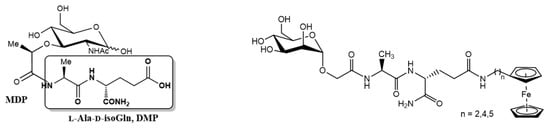
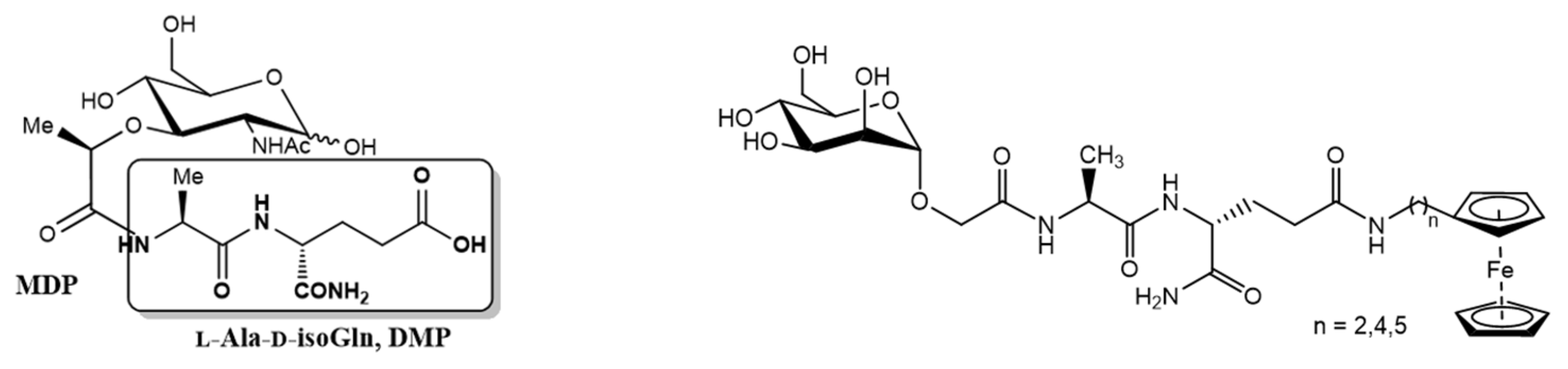
Muramyl dipeptide (MDP, N-acetylmuramyl-l-alanyl-d-isoglutamine, Figure 1) is the smallest peptidoglycan fragment that retains the adjuvant properties of whole mycobacterial cells, and it exerts its activity through the cytosolic receptor NOD2, whose activation proceeds via RIPK2 to NF-κB and MAPK signaling [4,5]. Despite decades of interest, MDP itself has not become a practical vaccine component because it is cleared rapidly, it is pyrogenic at effective doses, and its hydrophilic character limits membrane passage [6]. These limitations have prompted medicinal chemistry efforts to develop structurally simplified MDP analogues with improved biological and physicochemical properties. One strategy involves the replacement of the N-acetylmuramic acid moiety while retaining the l-Ala-d-isoGln pharmacophore (Figure 1), yielding desmuramyl peptides (DMPs). This structural simplification facilitates synthetic access and enables modification at both the N- and C-termini to optimize immunomodulatory activity while preserving the potential for NOD2 activation [7,8].
Figure 1.
Structure of MDP, DMP and mannosylated ferrocene DMP derivatives.
Two structural strategies have proved to be particularly favorable in this series. The first is the attachment of a bulky lipophilic group, most often adamantane, which raises lipophilicity, slows elimination and enables incorporation into liposomes and other carriers; adamantylated DMPs are generally more potent in vivo than their unsubstituted parents [8,9]. The second is glycosylation with mannose, which introduces a ligand for the mannose receptor and related C-type lectin receptors expressed on macrophages and dendritic cells, and is thereby expected to favor uptake by precisely those cells that present antigen [10,11].
Organometallic chemistry offers a further, largely unexplored dimension for this class of compounds. Ferrocene is essentially non-toxic, lipophilic substituent with sandwich geometry which provides a rigid scaffold whose two cyclopentadienyl rings can be functionalized independently. These properties have made it a recurring motif in medicinal chemistry [12,13]. In peptide chemistry, ferrocene amino acids and ferrocene scaffold in general have been widely used as turn-inducing templates that organize attached peptide strands into defined, hydrogen-bonded conformations [14,15,16]. For a NOD2 agonist this is more than a structural curiosity, since the orientation of the dipeptide arm governs the fit within the receptor binding site. Taken together, these considerations suggest that ferrocene could play the role previously assigned to adamantane, supplying lipophilicity and bulk, and contributing conformational organization. Previously, we synthesized mannosylated DMPs with ferrocene substituent attached to the C-terminus (γ-COOH group of isoGln, Figure 1.) [17].
In the present work we describe the preparation of mannosylated DMPs in which a ferrocene unit is attached to the peptide portion at different positions; (i) α-COOH of d-isoGln and (ii) l-Ala. The adjuvant activity of the new compounds was evaluated in BALB/c mice immunized with ovalbumin as a model antigen, using the protocol established in our earlier studies.
2. Results
Based on our previous studies of ferrocene-containing DMPs and mannosylated DMPs bearing lipophilic substituents [17,18], we designed two mannosylated DMPs in which a ferrocene moiety is attached at different positions of the peptide scaffold: either at the α-carboxyl group of d-isoGln or at the l-Ala residue. This design allows us to explore how ferrocene positioning influences the biological activity of the resulting conjugates. The strategy was also informed by our previous work on adamantyl-modified DMPs, in which mannosylation enhanced the immunostimulatory activity of an adamantyl-triazole derivative in a murine model [9].
2.1. Preparation of CompoundsSynthesis
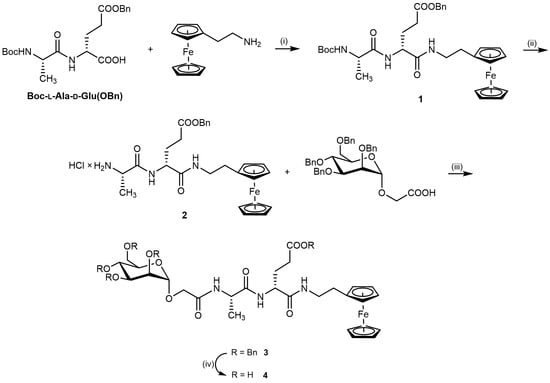
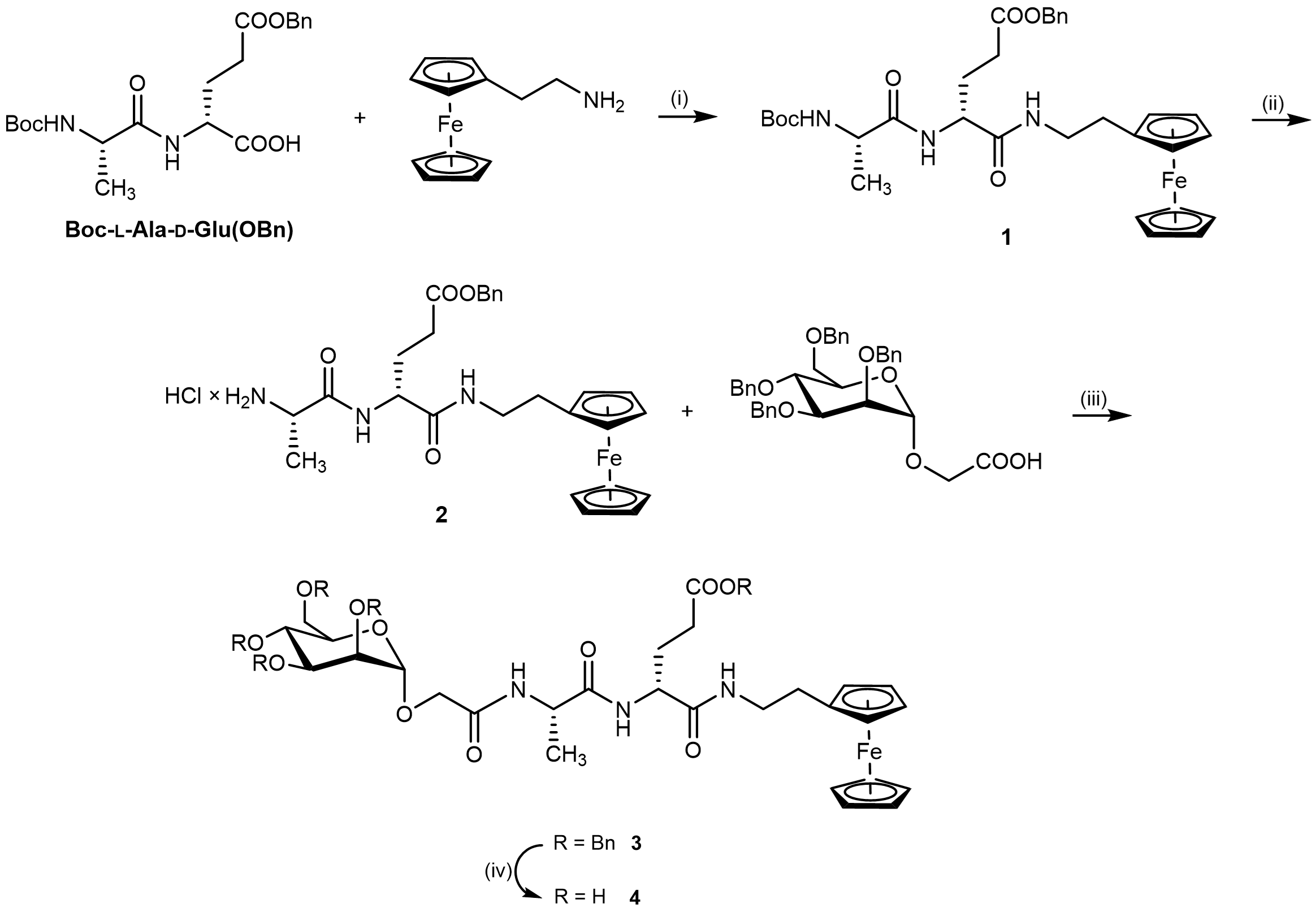
Mannosylated DMPs in which a ferrocene moiety was attached at the α-carboxyl group of d-isoGln was prepared starting from dipeptide Boc-l-Ala-d-lu-OBn (Scheme 1), synthesized according to the previously described procedure [9]. This peptide was coupled with 2-(ferrocenyl)ethanamine [19] using EDC/HOBt amidation method in order to prepare compound 1 (Scheme 1). After deprotection of compound 1 with HCl/dioxane solution, the resulting salt 2 was mannosylated by addition of 2-(2,3,4,6-tetra-O-benzyl-α-d-mannopyranosyloxy)acetic acid [9] in the presence of HBTU condensation reagent to give compound 3. Simultaneous removal of the benzyl groups from the mannose part and the isoGln side chain via catalytic hydrogenolysis yields the final product 4.
Scheme 1.
Reagents and conditions: (i) EDC·HCl, HOBt, dry DCM-dioxane (1:1), Ar, 0 °C 15 min, TEA, rt, 24 h, 90%; (ii) dry HCl/dioxane, Ar, 0 °C 15 min, rt 45 min, 60%; (iii) HBTU, dry THF-DCM (1:1), TEA, rt, 24 h, 53%; (iv) H2, 10% Pd-C, 96% EtOH, 2.8 bar, rt, 24 h, 91%.
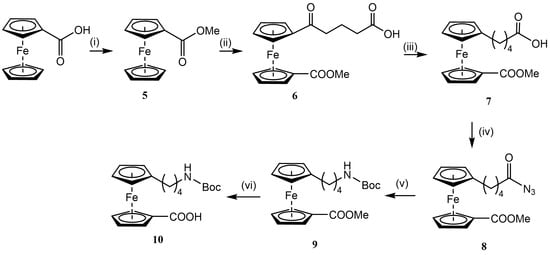
To prepare the mannosylated DMPs bearing a ferrocene moiety at the l-Ala residue, disubstituted precursor 10 was first synthesized from ferrocenecarboxylic acid (Scheme 2). Ferrocenecarboxylic acid was esterified to give 5, followed by acylation and reduction to afford 7 via keto acid 6. Conversion of 7 to acyl azide 8, followed by Curtius rearrangement and Boc protection, provided 9. Finally, hydrolysis of the methyl ester furnished the disubstituted ferrocene precursor 10.
Scheme 2.
Reagents and conditions: (i) 1. MeOH, BF3⋅Et2O, reflux, 6 h; 2. NaHCO3 (aq), 82%; (ii) 1. glutaric anhydride, AlCl3, DCM, Ar, rt, 6 h; 2. 0.5M HCl, 0 °C, 51%; (iii) Zn/Hg, conc. HCl, CH3COOH, 3.5 h, 73%; (iv) 1. TEA, ClCOOEt, acetone, 0–5 °C, 1.5 h; 2. NaN3 (aq); (v) t-BuOH, 65 °C, 2.5 h; (vi) 1. NaOH (aq), 1,4-dioxane, 48 h; 2. HCl (aq), 94%.
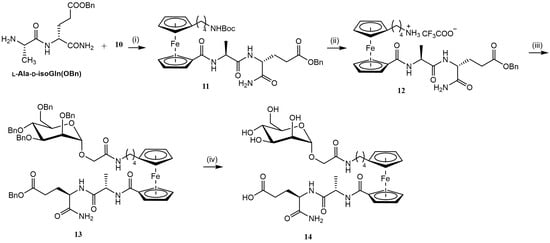
Ferrocene precursor 10 was coupled with l-Ala-d-isoGln(OBn) to afford conjugate 11 in 56% yield (Scheme 3). Removal of the Boc protecting group with TFA gave ammonium trifluoroacetate 12, which subsequently reacted with the protected mannose precursor to yield 13. Finally, hydrogenolysis of the benzyl protecting groups gave mannosylated DMP 14 in 60% yield.
Scheme 3.
Reagents and conditions: (i) 1. EDC⋅HCl, HOBt, dry DCM, Ar, 0 °C, 15 min; 2. TEA, Ar, 0 °C, 1 h; 3. rt, 48 h, 56%; (ii) TFA, dry DCM, rt, 1 h, 96%; (iii) 1. EDC⋅HCl, HOBt, dry DCM, 0 °C, 15 min, Ar; 2. mannose precursor, dry DCM, TEA, 0 °C, Ar, 1 h; 3. rt, 48 h, 58%; (iv) H2, Pd/C, 2.8 bar, EtOH, rt, 3 h, 60%.
2.2. Biological Activity
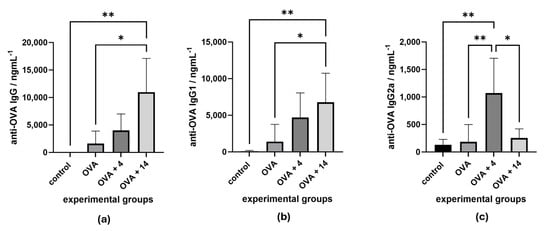
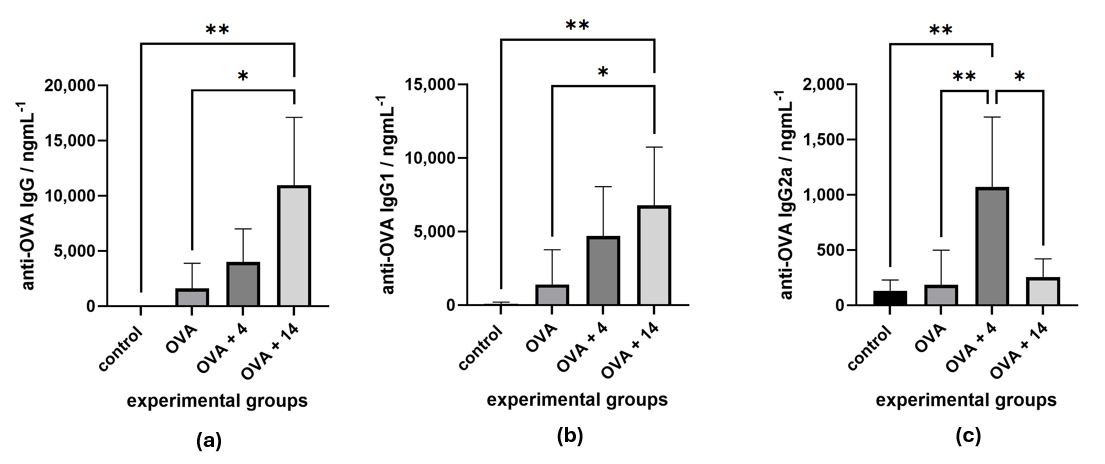
The adjuvant activity of the mannosylated ferrocene-containing DMPs 4 and 14 was evaluated in BALB/c mice using ovalbumin (OVA) as a model antigen. Animals were immunized with either OVA alone or OVA together with one of the test compounds. Antigen-specific antibodies (anti-OVA IgG) were quantified in serum collected seven days after the second booster dose. A group receiving sterile water served as the negative control. Concentrations of total anti-OVA IgG and of the IgG1 and IgG2a subclasses are presented in Figure 2.
Figure 2.
The effect of synthesized DMPs on production of total anti-OVA IgG (a) and subtype of anti-OVA IgG1 (b) and anti-OVA IgG2a (c) in BALB/c mice immunized with OVA as an antigen. Bar graphs represent average values from individual mice from each group (n = 5). * p < 0.05 and ** p < 0.01 denote statistical significance between indicated groups.
Both compounds enhanced the humoral response to OVA, but the magnitude of the enhancement and the subclass distribution of the resulting antibodies differed markedly between them. Compound 14 elicited the strongest total anti-OVA IgG response, raising the mean antibody concentration approximately sevenfold above that of the group immunized with OVA alone. This increase was statistically significant with respect to both the negative control (p < 0.01) and the OVA-only group (p < 0.05). Compound 4 induced an intermediate elevation of total IgG that did not reach statistical significance relative to the OVA-only group.
The two compounds were further distinguished by their IgG subclass profiles. The IgG1 response essentially mirrored the total IgG response: compound 14 produced the highest IgG1 concentrations, significantly exceeding those of the negative control (p < 0.01) and of the OVA-only group (p < 0.05), whereas compound 4 gave a moderate and statistically non-significant elevation. The IgG2a response displayed the opposite ranking. Compound 4 increased anti-OVA IgG2a approximately sixfold over the OVA-only group, the difference being significant against both the negative control (p < 0.01) and the OVA-only group (p < 0.01), while compound 14 left IgG2a at essentially the level obtained with OVA alone. The difference in IgG2a between the two compounds was itself statistically significant (p < 0.05).
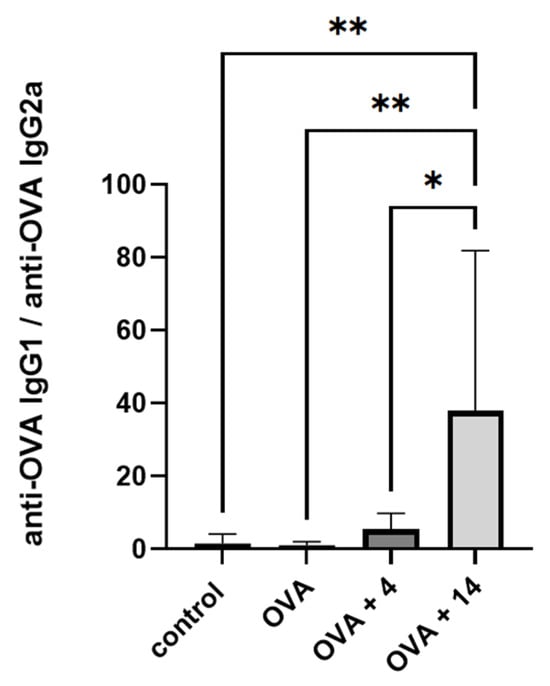
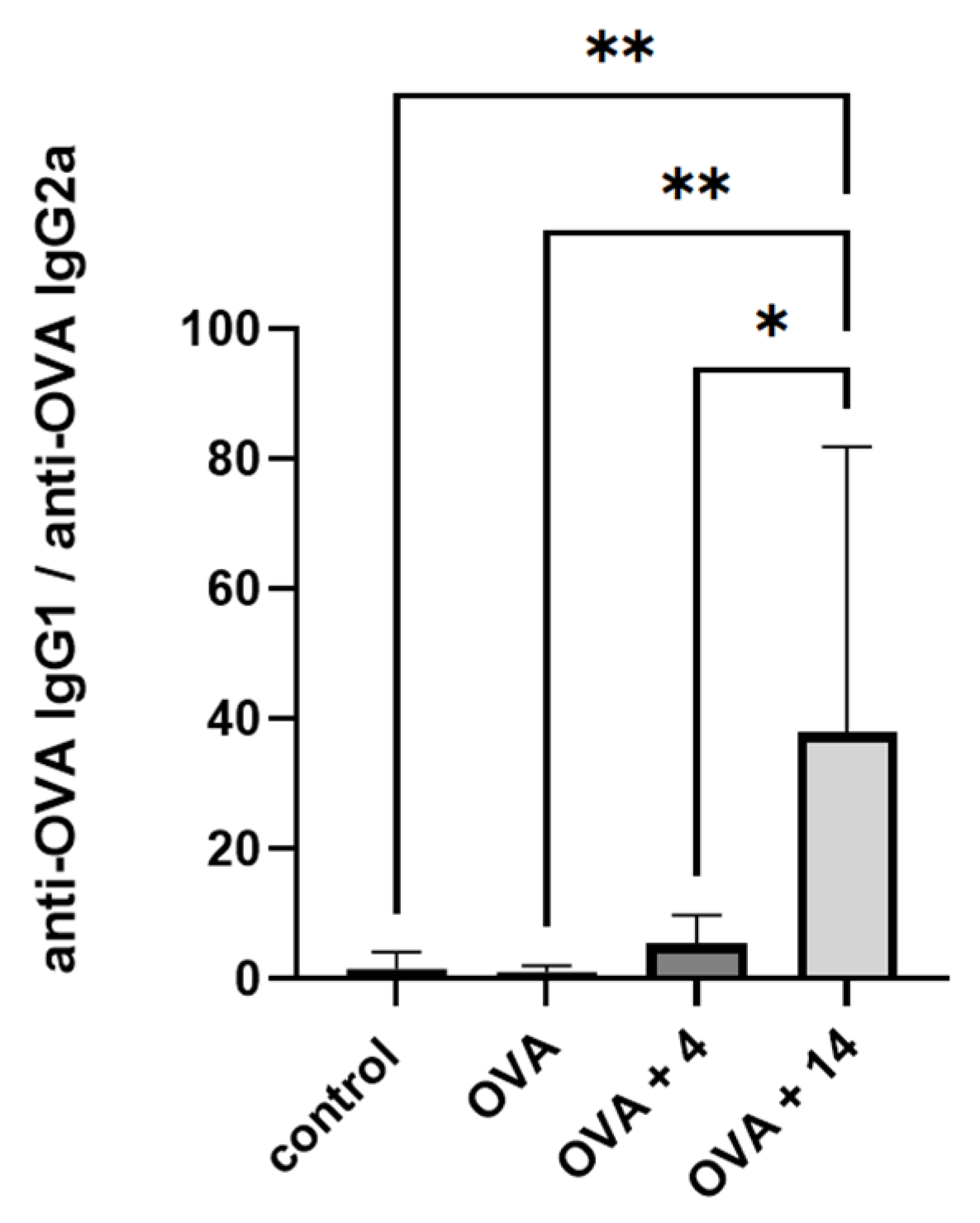
Consequently, the IgG1/IgG2a ratio, used here as an indirect measure of the Th2 versus Th1 orientation of the response, was substantially lower for compound 4 than for compound 14 (Figure 3). The lower ratio obtained with 4 is consistent with a mixed profile in which the IgG2a-associated component contributes more than in the other groups, whereas the higher ratio obtained with 14 is consistent with a predominantly IgG1-associated profile. Since the ratio is derived from antibody subclass concentrations and not from a direct measurement of T-helper cell differentiation, these descriptions are indicative of the orientation of the response.
Figure 3.
The anti-OVA IgG1/IgG2a ratio. Bar graphs represent average values from individual mice from each group (n = 5). * p < 0.05 and ** p < 0.01 denote statistical significance between indicated groups.
3. Discussion
The synthetic strategy developed here was designed to address a structure–activity question: whether the position of the ferrocene unit within the desmuramyl peptide scaffold governs the immunostimulatory properties of the resulting conjugates. Both target compounds retain the α-amide functionality of the d-Glu residue, previously shown to contribute to NOD2 binding [19], as well as the mannose unit, whose beneficial effect on in vivo adjuvant activity we established for adamantyl-modified DMPs [20].
The choice of ferrocene as a lipophilic structural element was informed by our previous work on ferrocene-containing DMPs. Our initial investigation described their synthesis, conformational properties, and predicted interactions with NOD2, indicating that the nature of the linker and the arrangement of the peptide moiety may influence receptor interactions [19]. In a subsequent study, selected ferrocene-DMPs containing l-Ala-d-isoGln and Gly−l-Val−d-lu exhibited NOD2 agonistic activity in a reporter-cell assay, and the most active derivative also induced cytokine production in human peripheral blood mononuclear cells [18]. Our recent investigation of first mannosylated DMPs with attached ferrocene to the γ-COOH of l-Ala-d-isoGln showed that ester and amide derivatives modestly increased TNF-α secretion in THP-1-derived macrophages [17]. The potential of amphiphilic DMPs as immunomodulatory agents has also been explored by Khan and co-workers. In an initial study they prepared a series of amphiphilic DMPs, and found that selected compounds triggered higher TNF-α secretion than murabutide and amplified LPS-induced ICAM-1 expression in THP-1 cells [21]. In a subsequent study the series was extended and complemented by molecular docking, which suggested plausible binding modes within NOD2 [22]. Although both the structures and the biological models differ from those employed here, these findings reinforce the view that the spatial arrangement of hydrophilic and lipophilic components is a determinant of the immunological profile of DMP derivatives. The present study examines compounds with ferrocene moiety attached at different positions of mannosylated DMPs, either at the α-carboxyl group of d-isoGln or the l-Ala residue and provides evidence that ferrocene-containing mannosylated DMPs modulate antigen-specific antibody production depending on the molecular scaffold.
Two derivatives, 4 and 14, differing in molecular architecture were evaluated for their ability to enhance the antibody response to OVA in BALB/c mice. Both compounds influenced the humoral response. Compound 14 elicited the highest total anti-OVA IgG levels, significantly exceeding those in mice immunized with OVA alone, and this increase was driven predominantly by IgG1. Compound 4, in contrast, showed only a mediate increase in total IgG that did not reach statistical significance relative to OVA alone. The opposite pattern was observed for IgG2a. Compound 4 induced approximately sixfold higher IgG2a levels than the OVA-only group, whereas the IgG2a response to compound 14 remained close to that obtained with OVA alone. The resulting IgG1/IgG2a ratios for 4 and 14 suggest that the two compounds shifted the subclass distribution in opposite directions, 4 toward a relatively greater IgG2a contribution and 14 toward a predominantly IgG1 response. In the absence of cytokine data these differences are interpreted as differences in subclass distribution, consistent with a Th1- and a Th2-associated profile respectively, rather than as directly demonstrated T-helper cell polarization. The two conjugates thus differed not only in the magnitude of the overall antibody response but also in the relative contribution of the individual subclasses. These findings suggest that the spatial arrangement of the mannose, ferrocene, and DMP moieties influence the character of the antibody profile elicited upon immunization.
The importance of structural modification was also demonstrated in our previous study of mannosylated DMPs containing lipophilic triazole substituents [23]. In an earlier investigation, we examined an adamantyl-triazole-modified DMP and its mannosylated analogue. Both derivatives increased antigen-specific IgG1 production, while a statistically significant enhancement of IgG2a was observed for the mannosylated compound [9]. This finding suggested that the introduction of mannose could affect the immunological response to an adamantyl-DMP, probably by interacting with mannose-binding C-type lectin receptors expressed by antigen-presenting cells. Such interactions may influence the uptake and intracellular distribution of conjugates and thereby affect the immune response. Mannosylation was therefore incorporated into the molecular design of compounds 4 and 14 [10,11]. Furthermore, it induced a pronounced total anti-OVA IgG response and elevated IgG2a levels, similarly to 4. Compound 4 is designed on the same structural logic as mannosylated adamantyl-triazole-DMP, a mannose was conjugated with a peptide part containing lipophilic substituent at the α-position of d-isoGln, and differing only in that an adamantyl-triazole group is replaced by a ferrocenylethyl moiety. The immunological outcomes are correspondingly similar, showing enhanced IgG2a production relative to OVA alone, which is consistent with the possibility that the combination of mannosylation with α-substitution favors a response in which the IgG2a-associated component is more prominent.
Previous studies by Jakopin and co-workers have shown that the introduction of a bulky lipophilic substituent such as adamantane at the N-terminal part of the desmuramyl peptide scaffold affords NOD2 agonists with single-digit nanomolar potency [3]. In a subsequent study, incorporation of an adamantane-anchored analogue into liposomes substantially improved its in vivo adjuvant activity and markedly enhanced IgG2a production, indicating a shift toward a Th1-type immune response [24].
Additionally, mono- and dimannosylated DMPs containing an adamantane amino acid at the N-terminus were evaluated in an OVA immunization model [20]. The monomannosylated derivative stimulated both IgG1 and IgG2a production. The dimannosylated analogue, bearing two mannose residues attached through a lysine-based branching unit, elicited the highest total IgG response and a predominantly IgG1-associated profile. Similarly, the present ferrocene-containing derivatives produced distinct antibody profiles: the conjugate bearing ferrocene at the α-carboxyl group of d-isoGln enhanced IgG2a, whereas the conjugate incorporating a disubstituted ferrocene scaffold between the peptide and mannose-containing moieties enhanced total IgG and IgG1. Together, these findings suggest that the arrangement of the mannose, lipophilic scaffold, and peptide components may influence the antibody response. Direct comparison remains limited by differences in molecular structure and the use of different mouse strains.
The present study has clear mechanistic limitations. The molecular basis for the differences observed between conjugates 4 and 14 remains unresolved. For these conjugates, we did not assess binding to NOD2, NOD2-dependent reporter activity, engagement of mannose-binding C-type lectin receptors, or activation of downstream NF-κB and MAPK signaling pathways. The interpretation proposed above, namely that the position of the ferrocene unit modulates the presentation of the l-Ala-d-isoGln pharmacophore to NOD2 and the accessibility of the mannose unit to C-type lectin receptors, is consistent with our previous studies of structurally related ferrocene-containing desmuramyl peptides [18,19], but it remains a working hypothesis and not a conclusion established by the present data.
For the same reason, the immunological characterization presented here is restricted to the antigen-specific humoral response and its subclass distribution. Cytokine profiles that would allow the Th1/Th2 interpretation to be tested directly, such as TNF-α, IL-6 and IL-12p70 secretion by macrophages or dendritic cells, or IFN-γ and IL-4 production by splenocytes restimulated with the antigen, were not determined for compounds 4 and 14. NOD2 agonistic activity in a reporter-cell assay and cytokine induction in human peripheral blood mononuclear cells have been demonstrated for ferrocene-containing desmuramyl peptides [18], and a modest increase in TNF-α secretion in THP-1-derived macrophages for mannosylated ferrocene derivatives substituted at the γ-carboxyl group of d-isoGln [17]. Those compounds differ from 4 and 14 in the position of the ferrocene unit, however, so their in vitro profiles cannot be transferred to the present conjugates. In vitro characterization of 4 and 14 in NOD2 reporter cells and in primary antigen-presenting cells is planned as the next step. Further work should therefore include a direct comparison of immunomodulatory properties of ferrocene- and adamantyl-containing analogues under the same conditions, preferably assessing the duration of the antibody response and cytokine production, as well as studies of NOD2 activation and mannose-receptor binding.
4. Materials and Methods
4.1. Materials
Reagents and solvents for the synthesis were obtained from Sigma-Aldrich Corp. (Taufkirchen, Germany). Organic solvents were further purified and/or dried using standard methods. Thin-layer chromatography (TLC) was performed on Fluka (Buchs, Switzerland) silica gel (60 F254) plates (0.25 mm). Visualization was achieved using UV light at 254 nm, 10% sulfuric acid and ninhydrin. Column chromatography was performed on Merck silica gel 60 (size 70–230 mesh ASTM). The 1H and 13C NMR spectra of all compounds were recorded on Bruker (Rheinstetten, Germany) AV-III HD spectrometer at 400 MHz (1H) and 100 MHz (13C). Mass spectra (ESI-MS) were recorded on an Agilent (Santa Clara, CA, USA) 6410 MS instrument. The HPLC analyses were performed using an Agilent Technologies 1290 Infinity II instrument, equipped with a quaternary pump, a degasser, an autosampler, and a diode array detector (DAD). The mobile phase consisted of MS grade water containing 0.1% formic acid (solvent A), and 0.1% formic acid in MS grade methanol (solvent B). Chromatographic separation was performed using a Zorbax Eclipse Plus C18 column (3.0 mm × 50 mm, 1.8 μm). The gradient elution program was as follows: 5% B at 0 min, increase to 95% B at 8 min, return to 5% B in 9 min, and hold at 5% B until 11 min. The flow rate was maintained at 0.3 mL/min, and the injection volume was 2 μL. All reagents were MS grade. Formic acid and methanol were purchased from Carlo Erba, and water was purchased from VWR. HRMS spectra were recorded on Agilent 6550 LC/Q-TOF instrument coupled with 1290 Infinity II HPLC.
4.2. Synthesis
4.2.1. Benzyl-(4R)-4-[2-(ferrocenyl)ethylaminocarbonyl]-4-[(2S)-2-(butyoxycarbonylamino)propanamido]butanoate (1)
Compound 1 was prepared according to a slightly modified previously described procedure [19]. The reaction mixture was stirred at room temperature for 24 h, and the progress of the reaction was monitored by TLC (CHCl3/MeOH, 15:1). The crude product obtained from the described work-up of the reaction mixture was purified by column chromatography using the solvent system CHCl3/MeOH, 20:1. Starting from 59 mg (0.26 mmol) of the 2-(ferrocenyl)ethanamine, 143 mg (90%) of compound 1 was obtained as an orange oil. Rf = 0.82 (CHCl3/MeOH, 15:1). 1H NMR (CDCl3) δ/ppm: 7.39–7.33 (m, 5H, 5 × CH, Bn); 6.94 (d, 2H, J = 7.8 Hz, NH); 6.70 (s, 1H, NH); 5.12 (dd, 2H, J = 17.3 Hz, J = 12.3 Hz, CH2, Bn); 4.97 (br s, NH); 4.44–4.39 (m, 1H, CH, isoGln); 4.11–4.01 (m, 10H: 9H, 9 × CH, Fn; 1H, CH, Ala); 3.35 (q, 2H, J = 7.6 Hz, CH2NH); 2.58–2.37 (m, 4H: 2H, CH2Fn; 2H, CH2, isoGln); 2.21–2.17 (m, 1H, CH2, isoGln); 2.04–1.95 (m, 1H, CH2, isoGln); 1.45 (s, 9H, 3 × CH3, Boc); 1.32 (d, 3H, J = 7.0 Hz, CH3, Ala). 13C NMR (CDCl3) δ/ppm:173.6, 173.0, 170.5 (C=O); 155.8 (C=O, Boc); 135.7 (C, Bn); 128.6, 128.4, 128.3 (CH, Bn); 85.2 (C, Fn); 80.4 (C, Boc); 68.6, 68.3, 68.2, 67.6 (CH, Fn); 66.7 (CH2, Bn); 52.7 (CH, isoGln); 50.8 (CH, Ala); 40.8 (CH2, NH); 30.6, 29.6 (2 × CH2: CH2 isoGln, CH2Fn); 28.3 (CH3, Boc); 27.1 (CH2, isoGln); 17.9 (CH3, Ala). ESI-MS: m/z 620.20 [M+H]+. The NMR spectra are shown in Figures S1–S4, and the ESI-MS spectrum in Figure S5.
4.2.2. (1S)-1-{[N-(1R)-3-(Benzyloxycarbonyl)-1-[2-(ferrocenyl)ethylaminocarbonyl]propan-1-yl]aminocarbonyl}ethylammonium Chloride (2)
A solution of HCl in dioxane (3.55 mL, c = 4 mol dm−3) was added to a flask and cooled for 15 min in an ice bath under an argon atmosphere. A sample of compound 1 (110 mg, 0.18 mmol) was dissolved in dry dioxane (2 mL) and added to the HCl solution. The reaction was then carried out at room temperature. The progress of the reaction was monitored by TLC using the solvent system CHCl3/MeOH, 5:1. After 45 min the reaction mixture was evaporated to dryness and, after purification by column chromatography (CHCl3/MeOH, 5:1), compound 2 was obtained as an orange oil (59 mg, 60%). Rf = 0.38 (CHCl3/MeOH, 5:1). 1H NMR (CD3OD) δ/ppm: 7.39–7.32 (m, 5H, 5 × CH, Bn); 5.15 (s, 2H, CH2, Bn ester); 4.34 (dd, 1H, J = 5.5 Hz, J = 8.7 Hz, CH, isoGln); 4.12–4.04 (m, 9H, 9 × CH, Fn); 3.70–3.64 (m, 1H, CH, Ala); 3.41–3.27 (m, 2H, CH2NH); 2.55 (t, 2H, J = 7.3 Hz, CH2Fn); 2.44 (t, 2H, J = 7.6 Hz, CH2, isoGln); 2.17–2.06 (m, 1H, CH2, isoGln); 2.00–1.90 (m, 1H, CH2, isoGln); 1.37 (d, 3H, J = 7.0 Hz, CH3, Ala). 13C NMR (CD3OD) δ/ppm:173.9, 172.6, 171.8 (C=O); 136.1 (C, Bn); 128.2, 127.9 (CH, Bn); 85.3 (C, Fn); 68.1, 68.0, 67.9, 67.1 (CH, Fn); 66.1 (CH2, Bn); 52.6 (CH, isoGln); 49.5 (CH, Ala); 40.4 (CH2, NH); 29.9, 29.0 (2 × CH2: CH2 isoGln, CH2Fn); 27.1 (CH2, isoGln); 18.4 (CH3, Ala). ESI-MS: m/z 520.70 [M+H]+. The NMR spectra are shown in Figures S6–S9, and the ESI-MS spectrum in Figure S10.
4.2.3. Benzyl-(4R)-4-[2-(ferrocenyl)ethylaminocarbonyl)]-4-{(2S)-2-[(2,3,4,6-tetra-O-benzyl-α-d-mannopyranosyloxy)ethanamido]propanamido}butanoate (3)
The previously prepared mannose precursor 2-(2,3,4,6-tetra-O-benzyl-α-d-mannopyranosyloxy)acetic acid [9] (73 mg, 0.12 mmol) was dissolved in a mixture of dry solvents (DCM/THF, 1:1, V = 4 mL) and HBTU (52 mg, 0.14 mmol) was added. Subsequently, solution of compound 2 (59 mg, 0.11 mmol) in the same mixture of dry solvents (2 mL), and finally TEA (45 μL, 0.32 mmol), were added to the reaction flask. The reaction mixture was stirred overnight at room temperature under an argon atmosphere. The progress of the reaction was monitored by TLC (CHCl3/MeOH, 15:1). After 24 h, the reaction mixture was evaporated to dryness and dissolved in EtOAc (20 mL). The EtOAc solution was then washed with HCl solution (10 mL, c = 1 mol dm−3), saturated NaHCO3 solution (10 mL) and brine (10 mL). The organic layer was dried over sodium sulfate, evaporated in vacuo, and purified by column chromatography (DCM/EtOAc, 3:1). Compound 3 was obtained as an orange oil (49 mg, 53%). Rf = 0.75 (CHCl3/MeOH, 15:1). 1H NMR (CDCl3) δ/ppm: 7.40–7.28 (m, 25H, 25 × CH, Bn); 7.11 (d, 1H, J = 7.8 Hz, NH); 6.87 (d, 1H, J = 6.7 Hz, NH); 6.61 (t, 1H, J = 5.8 Hz, NH); 5.16 (d, 1H, Jgem = 12.3 Hz, CH2, Bn ester); 5.10 (d, 1H, Jgem = 12.3 Hz, CH2, Bn ester); 4.91 (d, 1H, J1,2 = 2.2 Hz, H-1); 4.87–4.51 (m, 8H, 4 × CH2, Bn); 4.45–4.40 (m, 1H, CH, isoGln); 4.37–4.30 (m, 1H, CH, Ala); 4.16 (d, 1H, J = 15.6 Hz, CH2, acetyl linker); 4.12–4.02 (m, 10H: 9 × CH, Fn; 1H, H-4); 4.00 (d, 1H, J = 15.6 Hz, CH2, acetyl linker); 3.93 (dd, 1H, J = 8.4 Hz, J = 3.0 Hz, H-3); 3.82 (t, 1H, J = 2.6 Hz, H-2); 3.79–3.69 (m, 3H: H-5, H-6a, H-6b); 3.44–3.29 (m, 2H, CH2NH); 2.60–2.39 (m, 4H, 2H, CH2, isoGln; 2H, CH2Fn); 2.22–2.13 (m, 1H, CH2, isoGln); 2.07–1.98 (m, 1H, CH2, isoGln); 1.35 (d, 3H, J = 7.0 Hz, CH3, Ala). 13C NMR (CDCl3) δ/ppm: 173.7, 171.9, 170.4, 169.1 (C=O); 138.4, 138.3, 138.2, 138.1, 135.6 (C, Bn); 128.6–127.6 (CH, Bn); 98.6 (C1); 85.3 (C, Fn); 79.3, 74.7, 72.7, 68.7, 68.3, 68.2, 67.6 (C2-C5; CH, Fn); 74.9, 73.4, 72.8, 72.6, 68.9 (CH2, Bn); 66.7 (C6); 66.4 (CH2, acetyl linker); 52.9 (CH, isoGln); 49.0 (CH, Ala); 40.8 (CH2NH); 30.6, 29.4 (2 × CH2: CH2 isoGln, CH2Fn); 27.2 (CH2, isoGln); 18.1 (CH3, Ala). ESI-MS: m/z 1100.25 [M]+. The NMR spectra are shown in Figures S11–S15, and the ESI-MS spectrum in Figure S16.
4.2.4. (4R)-4-[2-(Ferrocenyl)ethylaminocarbonyl)]-4-{(2S)-2-[(α-d-mannopyranosyloxy)ethanamido]propanamido}butanoic Acid (4)
Compound 3 was deprotected according to the previously described procedure to give target molecule 4 [9]. Starting from 40 mg (0.04 mmol) of compound 3, 23 mg (91%) of compound 4 was obtained as an orange oil. Rf = 0.46 (CH3CN/H2O, 5:1). 1H NMR (CD3OD) δ/ppm: 4.87 (s, 1H, H-1); 4.43 (q, 1H, J = 7.1 Hz, CH, Ala); 4.26 (dd, 1H, CH, J = 4.2 Hz, J = 9.2 Hz, isoGln); 4.23 (d, 1H, Jgem = 15.2 Hz, CH2, acetyl linker); 4.13–4.07 (m, 10H: 9H, 9 × CH, Fn; 1H, CH2, acetyl linker); 4.00 (dd, 1H, J2,3 = 3.3 Hz, J1,2 = 1.7 Hz, H-2); 3.87 (dd, 1H, J6a,6b = 11.9 Hz, J5,6a = 2.0 Hz, H-6b); 3.83 (dd, 1H, J3,4 = 8.9 Hz, J2,3 = 3.5 Hz, H-3); 3.73 (dd, 1H, J6a,6b = 11.2 Hz, J5,6b = 5.6 Hz, H-6a); 3.64 (app t, 1H, J = 9.3 Hz, H-4); 3.61–3.57 (m, 1H, H-5); 3.37–3.35 (m, 2H, CH2NH); 2.56 (t, 2H, J = 7.5 Hz, CH2, isoGln); 2.29 (t, 2H, J = 7.2 Hz, CH2, CH2Fn); 2.16–2.08 (m, 1H, CH2, isoGln); 1.99–1.90 (m, 1H, CH2, isoGln); 1.43 (d, 3H, J = 7.1 Hz, CH3, Ala). 13C NMR (CD3OD) δ/ppm: 178.9, 173.5, 172.4, 170.3 (C=O); 100.4 (C1); 85.5 (C, Fn); 73.9, 72.5, 71.8, 69.5, 68.9 (C2-C5; CH, Fn); 65.6 (C6); 61.4 (CH2, acetyl linker); 53.9 (CH, isoGln); 49.0 (CH, Ala); 40.4 (CH2NH); 33.0 (CH2Fn); 29.0 (CH2, isoGln); 27.6 (CH2, isoGln); 16.8 (CH3, Ala). ESI-MS: m/z 672.10 [M+Na]+. HRMS: m/z [M+H]+ Calcd for C28H40FeN3O11 650.2006, found 650.1992. The NMR spectra are shown in Figures S17–S20, the ESI-MS spectrum in Figures S21, the HRMS spectrum in Figure S22 and the HPLC chromatogram in Figure S23.
4.2.5. Methyl Ferrocene-1-carboxylate (5)
Ferrocenecarboxylic acid (0.5 g, 2.18 mmol) was dissolved in dry CH3OH (15 mL) and BF3⋅Et2O (1.54 mL, 12.5 mmol) was added. Reaction mixture was stirred under reflux for 6h and monitored by TLC (DCM/EtOAc, 5:1). 5% aq. NaHCO3 was added, and the mixture was washed with DCM. Organic layer was then additionally washed with brine and dried over sodium sulfate, evaporated in vacuo, and purified by column chromatography (DCM:EtOAc, 5:1). Compound 5 was obtained as an orange solid (0.53 g, 82%). Rf = 0.79; (DCM/EtOAc, 5:1). ϑt = 68.0–69.7 °C. 1H NMR (CDCl3) δ/ppm: 4.83 (t, 2H, J = 1.9 Hz, 2 CH-Fn); 4.42 (t, 2H, J = 1,9 Hz, 2 CH-Fn); 4.23 (s, 5H, 5 CH-Fn); 3.83 (s, 3H, CH3O). DEPTQ NMR (CDCl3) δ/ppm: 172.2 (C=O); 71.3, 70.1, 69.7 (CH-Fn); 71.1 (C-Fn); 51.6 (CH3O). ESI-MS: m/z 245 [M+H]+. The NMR spectra are shown in Figures S24–S27, and the ESI-MS spectrum in Figure S28.
4.2.6. 5-(1′-Methoxycarbonylferrocene-1-yl)-5-oxopentanoic Acid (6)
In the suspension of AlCl3 (1.44 g, 10.7 mmol) in dry DCM (4 mL), the solution of 5 (0.56 g, 2.29 mmol) and glutaric anhydride (0.50 g, 4.21 mmol) in DCM (4 mL), was added. Reaction mixture was stirred at room temperature for 6h in an argon atmosphere and monitored by TLC (DCM:EtOAc, 5:1). Ice cold water was added next (30 mL) while the mixture was kept cold at 0 °C in an iced bath. It was washed with DCM (3 × 30 mL), then with HCl (0.5 M) and the organic layer was dried over sodium sulfate, evaporated in vacuo, and purified by column chromatography with gradient elution (DCM/EtOAc, 5:1; EtOAc; EtOAc/DCM, 10:1). Crude compound 6 was obtained as an orange oil (0.42 g, 51%) and used as such in the next step without further purification. Rf = 0.10 (DCM/EtOAc, 5:1). 1H NMR (CDCl3) δ/ppm: 4.83 (s, 4H, 4 CH-Fn); 4.53 (s, 2H, 2 CH-Fn); 4.43 (s, 2H, 2 CH-Fn); 3.84 (s, 3H, CH3O); 2.82 (t, 2H, J = 6.8 Hz, CH2C=O); 2.54 (t, 2H, J = 6,8 Hz, CH2C=O); 2.09–2.05 (m, 2H, CH2). DEPTQ NMR (CDCl3) δ/ppm: 203.1 (C=O); 171.4, 171.0 (C=O); 80.0 (C-Fn); 73.5, 71.6 (CH-Fn); 72.6 (CH2C=O); 70.7 (CH2C=O); 60.4 (C-Fn); 51.9 (CH3O); 21.0 (CH2). ESI-MS: m/z 381.0 [M+Na]+. The NMR spectra are shown in Figures S29 and S30, and the ESI-MS spectrum in Figure S31.
4.2.7. 5-(1′-Methoxycarbonylferrocene-1-yl)pentanoic Acid (7)
Glacial acetic acid (2 mL) and concentrated HCl (3 mL) were added to compound 6 (0.149 g, 0.42 mmol). The resulting thick, dark red solution was stirred for 5 min, and zinc amalgam (0.350 g) was then added in portions over 1.5 h. Reaction mixture was monitored by TLC (EtOAc/MeOH, 4:1) and cooled in an ice bath whenever the flask warmed up. The reaction was stopped 2 h after the first addition of zinc amalgam. Water (30 mL) was added and the mixture was extracted with DCM (30 mL). Organic layer was washed with brine (4 × 30 mL), dried over sodium sulfate and evaporated in vacuo, giving the pure product without the need for further purification. Compound 7 was obtained as a red–brown oil (0.104 g, 73%). Rf = 0.66 (EtOAc/MeOH, 4:1). 1H NMR (CDCl3) δ/ppm: 4.74 (t, 2H, J = 2.0 Hz, 2 CH-Fn); 4.35 (t, 2H, J = 1.9 Hz, 2 CH-Fn); 4.11–4.08 (m, 4H, 4 CH-Fn); 3.82 (s, 3H, CH3O); 2.37 (t, 2H, J = 7.4 Hz, CH2C=O); 2.30 (t, 2H, J = 7.6 Hz, CH2Fn); 1.70–1.63 (m, 2H, CH2); 1.57–1.54 (m, 2H, CH2). DEPTQ NMR (CDCl3) δ/ppm: 179.5, 172.1 (C=O); 90.2 (C-Fn); 71.8, 70.6, 69.7, 69.0 (CH-Fn); 71.5 (C-Fn); 51.5 (CH3O); 33.8 (CH2C=O); 30.4 (CH2Fn); 28.2, 24.5 (CH2). ESI-MS: m/z 367.0 [M+Na]+. The NMR spectra are shown in Figures S32 and S33, and the ESI-MS spectrum in Figure S34.
4.2.8. Methyl 1′-{4-[N-(tert-butoxycarbonyl)amino]butyl}ferrocene-1-carboxylate (9)
Water (49 μL) was added to a solution of compound 7 (81.5 mg, 0.302 mmol) in acetone (2 mL). The solution was cooled to 0 °C and a solution of TEA (40.8 μL, 0.29 mmol) in acetone (0.522 mL) was added dropwise, followed by a solution of ethyl chloroformate (32.6 μL, 0.302 mmol) in acetone (0.131 mL), taking care that the temperature did not exceed 5 °C. After 30 min of stirring, a solution of sodium azide (26 mg, 0.359 mmol) in water (0.90 mL) was added. Reaction mixture was monitored by TLC (DCM:EtOAc, 5:1). After 45 min the mixture was diluted with cold water (30 mL) and extracted with DCM (3 × 30 mL). Combined organic layers were washed with 5% aq. NaHCO3 and brine, dried over sodium sulfate and evaporated in vacuo. Compound 8 was obtained as a red–brown oil (97.9 mg) and used in the next step without further purification due to its low stability. Rf = 0.75 (DCM/EtOAc, 5:1). ATR-FTIR ν/cm−1: 2924 (νas CH2); 2851 (νs CH2); 2261 (ν N≡N); 1712 (ν C=O); 1464 (δsc CH2). A solution of compound 8 (87.4 mg, 0.237 mmol) in t-BuOH (3 mL) was stirred at 65 °C for 2.5 h and monitored by TLC (DCM/EtOAc, 5:1). After 2.5 h of refluxing, t-BuOH was evaporated in vacuo and the residue was purified by column chromatography (DCM/EtOAc, 5:1). Compound 9 was obtained as an orange oil (48.3 mg, 49%, calculated from crude 8). Rf = 0.58 (DCM/EtOAc, 5:1). ATR-FTIR ν/cm−1: 3079–3338 (ν NH); 2931 (νas CH2); 2856 (νs CH2); 1711 (ν C=O); 1568 (ν NH); 1463 (δsc CH2). The ATR-FTIR spectrum of compound 8 is shown in Figure S35. 1H NMR (CDCl3) δ/ppm: 4.74 (t, 2H, J = 2.0 Hz, 2 CH-Fn); 4.57 (s, 1H, NH); 4.36 (t, 2H, J = 1.9 Hz, 2 CH-Fn); 4.11–4.08 (m, 4H, 4 CH-Fn); 3.82 (s, 3H, CH3O); 3.14–3.12 (m, 2H, CH2N); 2.31–2.27 (m, 2H, CH2Fn); 1.52–1.49 (m, 4H, 2 CH2); 1.46 (s, 9H, 3 × CH3). DEPTQ NMR (CDCl3) δ/ppm: 172.0 (C=O); 156.0 (C=O, Boc); 90.4 (C-Fn); 79.1 (C-Boc); 71.7, 70.6, 69.7, 68.9 (CH-Fn); 71.5 (C-Fn); 51.5 (CH3O); 40.4 (CH2C=O); 29.8 (CH2Fn); 29.8 (CH2); 28.4 (CH3-Boc); 28.2 (CH2). ESI-MS: m/z 438.1 [M+Na]+. The NMR spectra of compound 9 are shown in Figures S36–S38, the ESI-MS spectrum in Figure S39 and the ATR-FTIR spectrum in Figure S40.
4.2.9. 1′-{4-[N-(Tert-butoxycarbonyl)amino]butyl}ferrocene-1-carboxylic Acid (10)
Compound 9 (71.2 mg, 0.171 mmol) was dissolved in 1,4-dioxane (1 mL) and NaOH solution (1.71 mL, c = 1 mol dm−3, 1.71 mmol) was added. Reaction mixture was stirred at room temperature for at least 48 h and monitored by TLC (DCM/EtOAc, 5:1). HCl solution (c = 0.5 mol dm−3) was then added to pH 3 and the mixture was extracted with DCM (3 × 20 mL). Combined organic layers were dried over sodium sulfate, evaporated in vacuo, and purified by column chromatography (DCM/EtOAc, 5:1). Compound 10 was obtained as red oil (65.3 mg, 94%). Rf = 0.15 (DCM/EtOAc, 5:1). 1H NMR (CDCl3) δ/ppm: 4.80 (t, 2H, J = 1.8 Hz, 2 CH-Fn); 4.64 (s, 1H, NH); 4.43 (t, 2H, J = 1.8 Hz, 2 CH-Fn); 4.15–4.13 (m, 4H, 4 CH-Fn); 3.14–3.13 (m, 2H, CH2N); 2.33 (t, 2H, J = 7.2 Hz, CH2Fn); 1.53–1.52 (m, 4H, 2 CH2); 1.47 (s, 9H, 3 × CH3). DEPTQ NMR (CDCl3) δ/ppm: 176.7 (C=O); 156.1 (C=O, Boc); 90.6 (C-Fn); 79.3 (C-Boc); 72.3, 71.1, 69.9, 69.1 (CH-Fn); 70.6 (C-Fn); 40.3 (CH2N); 29.8 (CH2Fn); 28.6 (CH3-Boc); 27.8 (CH2). ESI-MS: m/z 402.2 [M+H]+. The NMR spectra are shown in Figures S41 and S42, and the ESI-MS spectrum in Figure S43.
4.2.10. Benzyl (4R)-4-Carbamoyl-4-{(2S)-2-[1′-(4-{[(tert-butoxy)carbonyl]amino}butyl)ferrocene-1-carboxamido]propanamido}butanoate (11)
Compound 10 (0.106 g, 0.251 mmol) was dissolved in dry DCM (4 mL) and the solution was cooled in an ice bath. EDC⋅HCl (79.9 mg, 0.417 mmol) and HOBt (45.8 mg, 0.339 mmol) were added and, after 15 min, l-Ala-d-isoGln(OBn) (0.143 g, 0.339 mmol) dissolved in dry THF (1 mL) was added, followed by TEA (118.1 μL, 0.847 mmol). Reaction mixture was stirred for 1 h in an ice bath and for a further 48 h at room temperature under an argon atmosphere, and monitored by TLC (CHCl3:MeOH, 7:1). HCl solution (30 mL, c = 0.5 mol dm−3) was then added and the mixture was extracted with DCM. Organic layer was washed with saturated NaHCO3 solution and distilled water, dried over sodium sulfate, evaporated in vacuo, and purified by column chromatography (CHCl3/MeOH, 7:1). Compound 11 was obtained as a red oil (0.106 g, 56%). Rf = 0.69 (CHCl3/MeOH, 7:1). 1H NMR (CDCl3) δ/ppm: 7.72 (d, 1H, J = 7.5 Hz, NH); 7.37–7.33 (m, 5H, 5 CH-Ph); 7.12 (s, 1H, NH); 6.74 (d, 1H, J = 5.6 Hz, NH); 6.15 (s, 1H, NH); 5.13 (d, 2H, J = 2.44 Hz, CH2-Ph); 4.85 (s, 1H, NH); 4.68–4.67 (m, 1H, CH-Fn); 4.60–4.51 (m, 3H, CHα-isoGln, 2 CH-Fn); 4.29–4.28 (m, 2H, 2 CH-Fn); 4.10–4.06 (m, 4H, CHα-Ala, 3 CH-Fn); 3.12–3.11 (m, 2H, CH2N); 2.62–2.46 (m, 2H, CH2-isoGln); 2.36–2.27 (m, 3H, CH-isoGln, CH2Fn); 2.09–2.00 (m, 1H, CH-isoGln); 1.46–1.45 (m, 16H, CH3-Ala, 3 × CH3-Boc, 2 CH2). DEPTQ NMR (CDCl3) δ/ppm: 173.8, 173.5, 173.2, 171.3 (4 × C=O); 156.2 (C=O, Boc); 135.6 (C-Ph); 128.6, 128.3 (CH-Ph); 90.5 (C-Fn); 79.2 (C-Boc); 75.0 (C-Fn); 71.2, 69.9, 69.7, 68.9 (CH-Fn); 66.6 (CH2Ph); 52.5 (CHα-isoGln); 49.7 (CHα-Ala); 40.2 (CH2N); 30.8 (CH2-isoGln); 29.7 (CH2Fn); 28.5 (CH3-Boc); 28.1, 27.9, 26.8 (CH2-isoGln, 2 CH2); 18.1 (CH3-Ala). ESI-MS: m/z 691.4 [M+H]+. The NMR spectra are shown in Figures S44–S46, and the ESI-MS spectrum in Figure S47.
4.2.11. 4-[1′-({(2S)-1-[((2R)-1-Amino-5-benzyloxy-1,5-dioxopentan-2-yl)amino-1-oxopropan-2-yl]carbamoyl}ferrocene-1-yl)]butan-1-ammonium trifluoroacetate (12)
Compound 11 (0.106 g, 0.153 mmol) was dissolved in dry DCM (1.3 mL) and TFA (0.234 mL, 3.06 mmol) was added. Reaction mixture was stirred for 1 h at room temperature and monitored by TLC (CHCl3/MeOH, 7:1). After completion of the reaction, it was evaporated in vacuo and purified by column chromatography with gradient elution (CHCl3/MeOH, 7:1 to 1:1). Compound 12 was obtained as an orange oil (0.104 g, 96%). Rf = 0.38 (CHCl3/MeOH, 7:1). 1H NMR (CD3OD) δ/ppm: 7.38–7.31 (m, 5H, 5 CH-Ph); 5.13 (s, 2H, CH2-Ph); 4.84–4.83 (m, 1H, CH-Fn); 4.78–4.77 (m, 1H, CH-Fn); 4.67–4.38 (m, 4H, CHα-isoGln, 3 CH-Fn); 4.19–4.14 (m, 4H, CHα-Ala, 3 CH-Fn); 2.92 (t, 2H, J = 7.5 Hz, CH2N); 2.53 (app t, 2H, J = 7.7 Hz, J = 7.3 Hz, CH2-isoGln); 2.38 (t, 2H, J = 7.5 Hz, CH2Fn); 2.34–2.25 (m, 1H, CH-isoGln); 2.03–1.93 (m, 1H, CH-isoGln); 1.69–1.62 (m, 2H, CH2); 1.59–1.22 (m, 2H, CH2); 1.45 (d, 3H, J = 7.2 Hz, CH3-Ala). DEPTQ NMR (CD3OD) δ/ppm: 175.2, 174.5, 172.8, 172.3 (4 × C=O); 162.3, 161.9, 161.6, 161.2 (CF3C=O); 136.1 (C-Ph); 128.2, 127.8 (CH-Ph); 89.7 (C-Fn); 74.7 (C-Fn); 71.1, 71.0, 69.8, 69.6, 69.3, 68.9, 68.7, 68.4 (8 CH-Fn); 66.1 (CH2Ph); 52.4 (CHα-isoGln); 49.8 (CHα-Ala); 39.2 (CH2N); 30.1 (CH2-isoGln); 27.8, 27.6, 26.8, 26.6 (CH2-isoGln, CH2Fn, 2 CH2); 16.4 (CH3-Ala). ESI-MS: m/z 591.3 [M]+. The NMR spectra are shown in Figures S48–S51, and the ESI-MS spectrum in Figure S52.
4.2.12. Benzyl (4R)-4-Carbamoyl-4-{(2S)-2-[1′-(4-[(2,3,4,6-tetra-O-benzyl-α-d-mannopyranosyloxy)ethanamido]butyl)ferrocene-1-carboxamido]propanamido}butanoate (13)
2-(2,3,4,6-Tetra-O-benzyl-α-d-mannopyranosyloxy)acetic acid (0.205 g, 0.351 mmol) was dissolved in dry DCM (5 mL) and the solution was cooled in an ice bath. EDC⋅HCl (82.8 mg, 0.432 mmol) and HOBt (47.4 mg, 0.352 mmol) were added and, after 15 min, compound 12 (191.3 mg, 0.270 mmol) dissolved in dry THF (2 mL) was added also, followed by TEA (94.1 μL, 0.675 mmol). Reaction mixture was stirred for 1 h in an ice bath and for a further 48 h at room temperature under an argon atmosphere, and monitored by TLC (CHCl3/MeOH, 7:1). HCl solution (50 mL, c = 0.5 mol dm−3) was then added and the aqueous layer was extracted with DCM. Organic layer was washed with saturated NaHCO3 solution and brine, dried over sodium sulfate, evaporated in vacuo, and purified by column chromatography (CHCl3/MeOH, 10:1). Compound 13 was obtained as a red oil (0.183 g, 58%). Rf = 0.74 (CHCl3/MeOH), 7:1). 1H NMR (CDCl3) δ/ppm: 7.45 (d, 1H, J = 8.0 Hz, NH); 7.40–7.28 (m, 25H, 25 CH-Ph); 7.02 (s, 1H, NH); 6.49 (d, 1H, J = 6.6 Hz, NH); 6.42 (t, 1H, J = 6.0 Hz, NH); 5.69 (s, 1H, NH); 5.13 (d, 2H, J = 2.6 Hz, CH2-Ph, ester); 4.91 (d, 1H, J1,2 = 2.2 Hz, H-1); 4.85 (d, 1H, Jgem = 10.8 Hz, CH2-Ph); 4.77 (d, 1H, Jgem = 12.2 Hz, CH2-Ph); 4.71 (d, 1H, Jgem = 12.2 Hz, CH2-Ph); 4.67–4.63 (m, 4H, 2 CH2-Ph); 4.57–4.56 (m, 1H, CHα-isoGln); 4.55–4.47 (m, 4H, 2 CH-Fn, CHα-Ala, CH2-Ph); 4.31–4.28 (m, 2H, 2 CH-Fn); 4.17 (d, 1H, J = 15.3 Hz, CH2-acetyl); 4.10–4.08 (m, 4H, 4 CH-Fn); 4.05–4.01 (m, 1H, H-2); 3.96 (d, 1H, J = 15.3 Hz, CH2-acetyl); 3.87 (dd, 1H, J3,2 = 8.8 Hz, J3,4 = 3.0 Hz, H-3); 3.80 (t, 1H, J4,3 = 2.6 Hz, H-4); 3.77–3.70 (m, 3H, H-5, H-6a, H-6b); 3.25–3.22 (m, 2H, CH2N); 2.62–2.44 (m, 2H, CH2-isoGln); 2.31–2.23 (m, 3H, CH2Fn, CH-isoGln); 2.08–1.99 (m, 1H, CH-isoGln); 1.48–1.47 (m, 4H, 2 CH2); 1.44 (d, 3H, J = 7.0 Hz, CH3-Ala). DEPTQ NMR (CDCl3) δ/ppm: 173.4, 173.3, 173.2, 170.8, 169.0 (5 × C=O); 138.3, 138.2, 138.1, 138.0 (C-Ph); 135.7 (C-Ph, ester); 128.6–127.6 (CH-Ph); 98.46 (C-1); 90.3 (C-Fn); 79.3, 74.7, 71.1, 68.8 (C-2, C-3, C-4, C-5); 75.3 (C-Fn); 72.7, 69.8, 69.7, 69.0, 68.6 (CH-Fn); 75.0, 73.5, 72.7, 72.3, 68.9 (CH2-Ph); 66.9 (C-6); 66.6 (CH2-acetyl); 52.5 (CHα-isoGln); 49.7 (CHα-Ala); 38.6 (CH2N); 30.7 (CH2-isoGln); 29.4, 27.8, 26.8 (CH2-isoGln, CH2Fn, 2 CH2); 18.1 (CH3-Ala). ESI-MS: m/z 1171.5 [M]+. The NMR spectra are shown in Figures S53–S58, and the ESI-MS spectrum in Figure S59.
4.2.13. (4R)-4-Carbamoyl-4-{(2S)-2-[1′-(4-[(α-d-mannopyranosyloxy)ethanamido]butyl)ferrocene-1-carboxamido]propanamido}butanoic Acid (14)
Compound 13 (89 mg, 0.076 mmol) was dissolved in ethanol (10 mL) and palladium on carbon (30 mg, w(Pd) = 10%) was added. The mixture was stirred for 3 h under a hydrogen atmosphere (p = 2.8 bar) and monitored by TLC (CHCl3/MeOH, 2:1). After completion of the reaction the mixture was filtered to remove the catalyst, the filtrate was evaporated to dryness in vacuo, and the residue was purified by column chromatography (CHCl3/MeOH, 2:1). Compound 14 was obtained as yellow oil (33 mg, 60%). Rf = 0.10 (CHCl3/MeOH, 2:1). 1H NMR (CD3OD) δ/ppm: 4.83 (d, 1H, J1,2 = 1.5 Hz, H-1); 4.83–4.81 (m, 1H, CH-Fn); 4.80–4.78 (m, 1H, CH-Fn); 4.50 (q, 1H, J = 7.1 Hz, CHα-Ala); 4.37 (t, 2H, J = 1.9 Hz, 2 CH-Fn); 4.33 (dd, 1H, J = 9.6 Hz, J = 4.2 Hz, CHα-isoGln); 4.20–4.13 (m, 5H, CH2-acetyl, 4 CH-Fn); 4.03 (d, 1H, J = 15.1 Hz, CH2-acetyl); 4.00 (dd, 1H, J2,3 = 3.6 Hz, J2,1 = 1.7 Hz, H-2); 3.87–3.80 (m, 2H, H-6a, H-3); 3.72 (dd, 1H, J6a,6b = 11.7 Hz, J6b,5 = 6.0 Hz, H-6b); 3.65 (t, 1H, J = 9.6 Hz, H-4); 3.55–3.51 (m, 1H, H-5); 3.27 (app t, 2H, J = 6.7 Hz, J = 6.0 Hz, CH2N); 2.37–2.30 (m, 4H, CH2Fn, CH2-isoGln); 2.26–2.18 (m, 1H, CH-isoGln); 2.02–1.95 (m, 1H, CH-isoGln); 1.54–1.50 (m, 4H, 2 CH2); 1.48 (d, 3H, J = 7.1 Hz, CH3-Ala). 13C NMR (CD3OD) δ/ppm: 180.1, 175.6, 174.3, 172.1, 170.3 (5 × C=O); 100.4 (C-1); 90.3 (C-Fn); 74.8 (C-Fn); 73.9, 71.1, 71.0, 70.9, 70.2, 69.7, 69.6, 69.0, 68.9, 68.7, 68.5, 67.1 (8 CH-Fn, C-2, C-3, C-4, C-5); 65.7 (C-6); 61.4 (CH2-acetyl); 53.6 (CHα-isoGln); 49.7 (CHα-Ala); 38.5 (CH2N); 33.8 (CH2-isoGln); 28.8 (CH2Fn); 28.1, 28.0, 27.9 (CH2-isoGln, 2 CH2); 16.6 (CH3-Ala). ESI-MS: m/z 719.15 [M−H]−. HRMS: m/z [M+H]+ Calcd for C31H45FeN4O12 721.2378, found 721.2367. The NMR spectra are shown in Figures S60–S64, the ESI-MS spectrum in Figure S65, the HPLC chromatogram in Figure S66 and the HRMS spectrum in Figure S67.
4.3. Immunization Protocol
Female BALB/c mice, healthy, nulliparous and non-pregnant, aged 8–12 weeks at the start of the experiment, were supplied by the breeding colony of the Ruđer Bošković Institute (Zagreb, Croatia). The animals were housed five to a cage on sawdust bedding (Scobis Uno®, Mucedola srl, Settimo Milanese, Italy) and received a standard laboratory rodent diet (4RF 21 GLP®, Mucedola srl); food and water were available without restriction. Housing conditions were maintained at 22 °C and 55% relative humidity under a 12 h light/12 h dark cycle. The study was approved by the Ministry of Agriculture of the Republic of Croatia (CLASS: ll P/1-322-01/20 -01/10 Case number: 525-10/05 43-20 -4) and was carried out in compliance with the ILAR Guide for the Care and Use of Laboratory Animals, Directive 2010/63/EU and the Croatian Animal Protection Act (NN 102/17).
Mice were allocated to experimental groups of five animals each: a negative control group receiving sterile water, a group receiving ovalbumin (OVA) alone, and groups receiving OVA together with each of the test compounds 4 and 14. Each animal received a priming dose followed by two booster doses, administered subcutaneously at the base of the tail at 21-day intervals.
OVA was given at 10 µg per animal, and test compounds were administered on an equimolar basis, 0.406 µmol per animal. All substances were dissolved in water, and every animal in every group received an injection volume of 0.1 mL. Seven days after the second booster, the animals were anaesthetized with isoflurane and blood was withdrawn. Serum was separated, heated at 56 °C for 30 min to inactivate complement, and kept at −20 °C until analysis.
No reference-adjuvant group was included in the present experiment. MDP was examined as a positive control in our earlier study of mannosylated desmuramyl peptides containing lipophilic triazole substituents [23], which was performed in the same animal model and according to the same immunization protocol. The equimolar dose of 0.406 µmol per animal used in the present work corresponds to the dose of 200 µg of MDP per animal administered in previous study [23]. We omitted a MDP control group because the response to MDP had already been characterized in this model [23]. This decision limited animal use to the minimum necessary to address the structure–activity question of the present study, in accordance with the principle of Reduction set out in Directive 2010/63/EU and the animal-use permit for this study.
4.4. Determination of Anti-OVA Antibodies
Concentrations of anti-OVA IgG and of the IgG1 and IgG2a subclasses were measured by enzyme-linked immunosorbent assay on flat-bottomed high-binding microtiter plates (Costar, New York, NY, USA) with commercial murine anti-OVA antibody assay kits (Chondrex, Woodinville, WA, USA), following the supplier’s protocol. Antibody concentrations were read from the calibration curves supplied with each kit and are expressed in ng mL−1. For every serum sample the IgG1/IgG2a ratio was calculated individually and the group mean of these ratios is reported, this quantity being taken as an indirect measure of the Th2 versus Th1 orientation of the response. The ratio is used in this sense because murine IgG1 and IgG2a production are reciprocally regulated by IL-4 and IFN-γ [25], so the relative abundance of the two subclasses indirectly reflects the cytokine environment in which the response developed. However, it does not measure T-helper cell differentiation itself.
4.5. Statistical Analysis
Data were processed in GraphPad Prism 11.1.0. Differences between experimental groups were assessed by the Kruskal–Wallis test followed by Dunn’s test for multiple comparisons. A probability below 0.05 was regarded as statistically significant; results are presented as group means with standard deviations.
5. Conclusions
Two mannosylated desmuramyl peptides with ferrocenyl motif differing only in the way the ferrocene unit is incorporated were prepared and compared as adjuvants in mice immunized with ovalbumin. Administered on an equimolar basis, they shifted the distribution of antigen-specific antibody subclasses elicited by the same antigen in opposite directions: compound 14, in which a 1,1′-disubstituted ferrocene bridges the dipeptide and the carbohydrate, gave the highest total anti-OVA IgG and IgG1 concentrations, whereas compound 4, carrying the metallocene as a terminal cap on the α-carboxyl group of d-isoglutamine, selectively raised IgG2a. Since both compounds share the same pharmacophore, the same single mannose unit and the same metallocene, the architecture of the conjugate rather than its composition alone appears to govern the antibody subclass distribution, which makes the substitution pattern of ferrocene a promising design handle. Extending the series to di-mannosylated and non-mannosylated analogues, together with NOD2 reporter and cytokine assays, will be required to link these structural effects to a defined mechanism.
Supplementary Materials
The following supporting information can be downloaded at https://www.mdpi.com/article/10.3390/ijms272310626/s1.
Author Contributions
Conceptualization, R.R.; methodology, Ž.C., V.P.P., R.S. and R.R.; formal analysis, Ž.C. and V.P.P.; investigation, Ž.C., V.P.P., F.K., M.B., M.K., R.S. and R.R.; writing—original draft preparation, Ž.C., V.P.P., R.S., R.R. and L.B.; writing—review and editing, R.R., Ž.C. and V.P.P.; supervision, L.B. and R.R.; funding acquisition, L.B. and R.R. All authors have read and agreed to the published version of the manuscript.
Funding
This work has been fully supported by Croatian Science Foundation under the projects IP-2020-02-9162 and IP-2025-02-5568, and by the European Union—NextGenerationEU through the institutional project IP-UNIN-BIOMED-25-1 at University North.
Institutional Review Board Statement
The in vivo experiments on mice were approved (HR-POK-003, 28 February 2023) by the ethical regulations of the Ministry of Agriculture (Croatia). All experiments were performed according to ILAR Guide for the Care and Use of Laboratory Animals, EU Directive 2010/63/EU and Croatian animal protection law (NN 102/17).
Informed Consent Statement
Not applicable.
Data Availability Statement
The original contributions presented in this study are included in the article/ Supplementary Materials. Further inquiries can be directed to the corresponding author.
Acknowledgments
The authors want to thank Mia Bušljeta for the assistance in the lab.
Conflicts of Interest
The authors declare no conflicts of interest.
References
- Pulendran, B.; Arunachalam, P.S.; O’Hagan, D.T. Emerging Concepts in the Science of Vaccine Adjuvants. Nat. Rev. Drug Discov. 2021, 20, 454–475. [Google Scholar] [CrossRef] [Scilit]
- Guzelj, S.; Nabergoj, S.; Gobec, M.; Pajk, S.; Klančič, V.; Slütter, B.; Frkanec, R.; Štimac, A.; Šket, P.; Plavec, J.; et al. Structural Fine-Tuning of Desmuramylpeptide NOD2 Agonists Defines Their In Vivo Adjuvant Activity. J. Med. Chem. 2021, 64, 7809–7838. [Google Scholar] [CrossRef] [Scilit]
- Guzelj, S.; Bizjak, Š.; Jakopin, Ž. Discovery of Desmuramylpeptide NOD2 Agonists with Single-Digit Nanomolar Potency. ACS Med. Chem. Lett. 2022, 13, 1270–1277. [Google Scholar] [CrossRef] [Scilit]
- Girardin, S.E.; Boneca, I.G.; Viala, J.; Chamaillard, M.; Labigne, A.; Thomas, G.; Philpott, D.J.; Sansonetti, P.J. Nod2 Is a General Sensor of Peptidoglycan through Muramyl Dipeptide (MDP) Detection. J. Biol. Chem. 2003, 278, 8869–8872. [Google Scholar] [CrossRef] [Scilit]
- Caruso, R.; Warner, N.; Inohara, N.; Núñez, G. NOD1 and NOD2: Signaling, Host Defense, and Inflammatory Disease. Immunity 2014, 41, 898–908. [Google Scholar] [CrossRef] [Scilit]
- Kamboj, A.; Patil, M.T.; Petrovsky, N.; Salunke, D.B. Structure-Activity Relationship in NOD2 Agonistic Muramyl Dipeptides. Eur. J. Med. Chem. 2024, 271, 116439. [Google Scholar] [CrossRef] [Scilit]
- Gobec, M.; Tomašič, T.; Štimac, A.; Frkanec, R.; Trontelj, J.; Anderluh, M.; Mlinarič-Raščan, I.; Jakopin, Ž. Discovery of Nanomolar Desmuramylpeptide Agonists of the Innate Immune Receptor Nucleotide-Binding Oligomerization Domain-Containing Protein 2 (NOD2) Possessing Immunostimulatory Properties. J. Med. Chem. 2018, 61, 2707–2724. [Google Scholar] [CrossRef] [Scilit]
- Ribić, R.; Stojković, R.; Milković, L.; Antica, M.; Cigler, M.; Tomić, S. Design, Synthesis and Biological Evaluation of Immunostimulating Mannosylated Desmuramyl Peptides. Beilstein J. Org. Chem. 2019, 15, 1805–1814. [Google Scholar] [CrossRef] [Scilit]
- Peroković Peroković, V.; Car, Ž.; Draženović, J.; Stojković, R.; Milković, L.; Antica, M.; Škalamera, Đ.; Tomić, S.; Ribić, R. Design, Synthesis, and Biological Evaluation of Desmuramyl Dipeptides Modified by Adamantyl-1,2,3-Triazole. Molecules 2021, 26, 6352. [Google Scholar] [CrossRef] [Scilit]
- Geijtenbeek, T.B.H.; Gringhuis, S.I. Signalling through C-Type Lectin Receptors: Shaping Immune Responses. Nat. Rev. Immunol. 2009, 9, 465–479. [Google Scholar] [CrossRef] [Scilit]
- Paurević, M.; Šrajer Gajdošik, M.; Ribić, R. Mannose Ligands for Mannose Receptor Targeting. Int. J. Mol. Sci. 2024, 25, 1370. [Google Scholar] [CrossRef] [Scilit]
- Patra, M.; Gasser, G. The Medicinal Chemistry of Ferrocene and Its Derivatives. Nat. Rev. Chem. 2017, 1, 0066. [Google Scholar] [CrossRef] [Scilit]
- Sharma, B.; Kumar, V. Has Ferrocene Really Delivered Its Role in Accentuating the Bioactivity of Organic Scaffolds? J. Med. Chem. 2021, 64, 16865–16921. [Google Scholar] [CrossRef] [Scilit]
- Kovačević, M.; Čakić Semenčić, M.; Bagović, M.; Radošević, K.; Hanousek Čiča, K.; Mrvčić, J.; Molčanov, K.; Roca, S.; Kodrin, I.; Barišić, L. Hydrogen Bond Patterning and Biological Activity of Ferrocene Conjugates with Homo- and Heterochiral Ala–Pro Dipeptides. Organometallics 2024, 43, 2608–2625. [Google Scholar] [CrossRef] [Scilit]
- Čakić Semenčić, M.; Kovačević, M.; Barišić, L. Recent Advances in the Field of Amino Acid-Conjugated Aminoferrocenes—A Personal Perspective. Int. J. Mol. Sci. 2024, 25, 4810. [Google Scholar] [CrossRef] [Scilit]
- Kovačević, M.; Čakić Semenčić, M.; Radošević, K.; Molčanov, K.; Roca, S.; Šimunović, L.; Kodrin, I.; Barišić, L. Conformational Preferences and Antiproliferative Activity of Peptidomimetics Containing Methyl 1′-Aminoferrocene-1-Carboxylate and Turn-Forming Homo- and Heterochiral Pro-Ala Motifs. Int. J. Mol. Sci. 2021, 22, 13532. [Google Scholar] [CrossRef] [Scilit]
- Petrović Peroković, V.; Kovačević, M.; Car, Ž.; Grgurić, D.; Janež, Š.; Jakopin, Ž.; Markulin, D.; Lovrić, M.; Žužić, M.; Ribić, R.; et al. Mannose Derivatives of Ferrocene-Containing Desmuramyl Peptides: Synthesis, Characterization and In Vitro Immunological Evaluation. Carbohydr. Res. 2026, 565, 109902. [Google Scholar] [CrossRef] [Scilit]
- Car, Ž.; Kovačević, M.; Petrović Peroković, V.; Čižmešija, K.; Ribić, R.; Janež, Š.; Jakopin, Ž.; Barišić, L. Ferrocene-Containing Desmuramylpeptides Adopt A Flexible Conformation and Exhibit NOD2 Agonistic Activity. Organometallics 2025, 44, 2440–2456. [Google Scholar] [CrossRef] [Scilit]
- Peroković, V.P.; Kovačević, M.; Paurević, M.; Bušljeta, M.; Car, Ž.; Ribić, R.; Barišić, L. Ferrocene Derivatives of Desmuramyl Peptide: Synthesis, Conformational Properties, and Interactions with NOD2 Receptor. Polyhedron 2025, 274, 117516. [Google Scholar] [CrossRef] [Scilit]
- Paurević, M.; Maršavelski, A.; Ivanković, S.; Stojković, R.; Ribić, R. Di-Mannosylation Enhances the Adjuvant Properties of Adamantane-Containing Desmuramyl Peptides In Vivo. Org. Biomol. Chem. 2024, 22, 6506–6519. [Google Scholar] [CrossRef] [Scilit]
- Khan, F.-A.; Ulanova, M.; Bai, B.; Yalamati, D.; Jiang, Z.-H. Design, Synthesis and Immunological Evaluation of Novel Amphiphilic Desmuramyl Peptides. Eur. J. Med. Chem. 2017, 141, 26–36. [Google Scholar] [CrossRef] [Scilit]
- Khan, F.-A.; Nasim, N.; Wang, Y.; Alhazmi, A.; Sanam, M.; Ul-Haq, Z.; Yalamati, D.; Ulanova, M.; Jiang, Z.-H. Amphiphilic Desmuramyl Peptides for the Rational Design of New Vaccine Adjuvants: Synthesis, In Vitro Modulation of Inflammatory Response and Molecular Docking Studies. Eur. J. Med. Chem. 2021, 209, 112863. [Google Scholar] [CrossRef] [Scilit]
- Petrović Peroković, V.; Car, Ž.; Bušljeta, M.; Mihelec, D.; Paurević, M.; Ivanković, S.; Stojković, R.; Ribić, R. Synthesis and Immunological Evaluation of Mannosylated Desmuramyl Dipeptides Modified by Lipophilic Triazole Substituents. Int. J. Mol. Sci. 2022, 23, 8628. [Google Scholar] [CrossRef] [Scilit]
- Guzelj, S.; Šišić, M.; Bizjak, Š.; Frkanec, L.; Frkanec, R.; Jakopin, Ž. Lipidation of NOD2 Agonists with Adamantane and Stearoyl Moieties Differentially Regulates Their In Vivo Adjuvant Activity. Pharmaceutics 2022, 14, 2755. [Google Scholar] [CrossRef] [Scilit]
- Snapper, C.M.; Paul, W.E. Interferon-γ and B Cell Stimulatory Factor-1 Reciprocally Regulate Ig Isotype Production. Science 1987, 236, 944–947. [Google Scholar] [CrossRef] [Scilit]
Disclaimer/Publisher’s Note: The statements, opinions and data contained in all publications are solely those of the individual author(s) and contributor(s) and not of MDPI and/or the editor(s). MDPI and/or the editor(s) disclaim responsibility for any injury to people or property resulting from any ideas, methods, instructions or products referred to in the content. |
© 2026 by the authors. Licensee MDPI, Basel, Switzerland. This article is an open access article distributed under the terms and conditions of the Creative Commons Attribution (CC BY) license.