Review

Small Molecule B-RAF Inhibitors as Anti-Cancer Therapeutics: Advances in Discovery, Development, and Mechanistic Insights

by
Yamile Abuchard Anaya
1,2,3,4,
Ricardo Pequeno Bracho
1,3,4,
Subhash C. Chauhan
3,4,
Manish K. Tripathi
3,4 and
Debasish Bandyopadhyay
1,5,*
1
School of Integrative Biological and Chemical Sciences, The University of Texas Rio Grande Valley, 1201 West University Drive, Edinburg, TX 78539, USA
2
Department of Health and Human Performance, College of Health Professions, The University of Texas Rio Grande Valley, 1201 West University Drive, Edinburg, TX 78539, USA
3
South Texas Center of Excellence in Cancer Research, McAllen, TX 78504, USA
4
Division of Cancer Immunology and Microbiology, Medicine, and Oncology ISU, School of Medicine, The University of Texas Rio Grande Valley, 5300 N L St., McAllen, TX 78504, USA
5
School of Earth Environment & Marine Sciences, The University of Texas Rio Grande Valley, 1201 West University Drive, Edinburg, TX 78539, USA
*
Author to whom correspondence should be addressed.
Int. J. Mol. Sci. 2025, 26(6), 2676; https://doi.org/10.3390/ijms26062676
Submission received: 31 December 2024 / Revised: 9 March 2025 / Accepted: 11 March 2025 / Published: 16 March 2025

Abstract

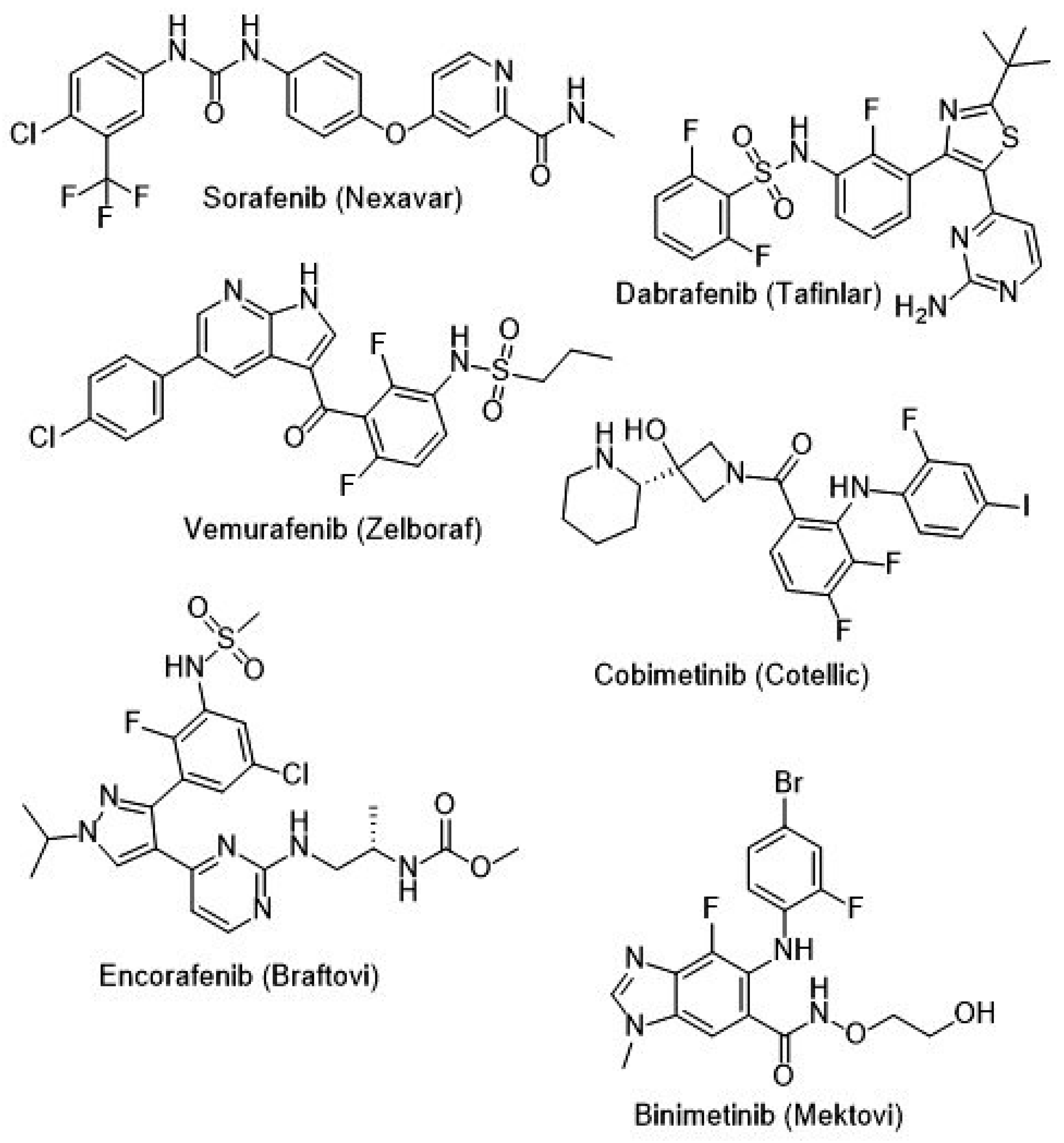
B-RAF is a serine/threonine kinase that plays a crucial role in the MAPK signaling pathway, regulating cell proliferation and survival. Mutations in B-RAF, particularly V600E, are associated with several malignancies, including melanoma, colorectal cancer, and non-small cell lung cancer, making it a key therapeutic target. The development of B-RAF inhibitors, such as Vemurafenib, Dabrafenib, and second-generation inhibitors like Encorafenib, has led to significant advancements in targeted cancer therapy. However, acquired resistance, driven by MAPK pathway reactivation, RAF dimerization, and alternative signaling pathways, remains a major challenge. This review explores the molecular mechanisms of B-RAF inhibitors, their therapeutic efficacy, and resistance mechanisms, emphasizing the importance of combination strategies to enhance treatment outcomes. The current standard of care involves B-RAF and MEK inhibitors, with additional therapies such as EGFR inhibitors and immune checkpoint blockades showing potential in overcoming resistance. Emerging pan-RAF and brain-penetrant inhibitors offer new opportunities for treating refractory cancers, while precision medicine approaches, including genomic profiling and liquid biopsies, are shaping the future of B-RAF-targeted therapy.
Keywords: B-RAF; MAPK pathway; B-RAF V600E mutation; RAF kinase inhibitors; small molecule inhibitors; Vemurafenib; Dabrafenib; Encorafenib; cancer therapy; MEK inhibitors; combination therapy; drug resistance; colorectal cancer; melanoma; thyroid carcinoma; non-small cell lung carcinoma; oncology; clinical trials B-RAF; MAPK pathway; B-RAF V600E mutation; RAF kinase inhibitors; small molecule inhibitors; Vemurafenib; Dabrafenib; Encorafenib; cancer therapy; MEK inhibitors; combination therapy; drug resistance; colorectal cancer; melanoma; thyroid carcinoma; non-small cell lung carcinoma; oncology; clinical trials