


Abstract
Co-infections of dengue serotypes and dengue with other flaviviruses pose substantial hurdles in disease diagnosis, treatment options, and disease management. The overlapping geographic distributions and mosquito vectors significantly enhance the probability of co-infections. Co-infections may result in more severe disease outcomes due to elevated viral loads, modulation of the immune response, and antibody enhancement. Cross-reactivity in serological assays and the likeness of clinical presentations add to the ongoing challenges in disease diagnosis. Molecular diagnostics such as reverse transcription polymerase chain reaction (RT-PCR) and next-generation sequencing (NGS) are, therefore, employed for more specific disease diagnosis although requiring substantial resources. Despite the advancements, specific anti-flaviviral therapy is still limited, hence the urgency for further investigative research into various therapeutic approaches, including peptide inhibitors, host-targeted therapies, and RNA-based interventions. This review discusses the epidemiology, clinical ramifications, and diagnostic obstacles associated with flavivirus co-infections whilst assessing prospective strategies for better disease prevention, treatment, and management. Addressing these critical gaps is essential for disease mitigation whilst improving patient management especially in regions where co-circulation of flaviviruses is common and their diseases are highly endemic.
1. Introduction
Dengue is affecting one third of the world population especially in the subtropical and tropical countries. The disease is transmitted by infected female Aedes mosquitoes such as Aedes albopictus and Aedes aegypti through blood meal. As of 2024, the World Health Organization (WHO) has received more than 12.3 million cases, nearly doubling that of the previous year’s [1]. The causative agent of dengue, the dengue virus (DENV), is a single-stranded, non-segmented RNA virus from the flavivirus genus. The viral positive-strand RNA genome is encased within a capsid, known as nucleocapsid. The nucleocapsid is enveloped and appears in a roughly spherical shape, hence the spherical morphology of DENV [2]. DENV is categorized into four closely related serotypes, which are DENV-1, DENV-2, DENV-3, and DENV-4. They form distinctive interactions with host antibodies, thereby giving rise to their varied antigenicity [3,4].
Given their respective antigenic variations, it is suggested to identify the infecting serotypes in dengue patients because they can produce different clinical outcomes following the infections [5]. For the same reason, in the context of co-infection, it is of utmost importance to identify the serotypes present simultaneously in patients in order to provide more timely and better disease management [6]. Generally, a co-infection refers to a simultaneous infection of two or more different pathogens, which can include various viruses, bacteria, fungi, or parasites in a host [7]. Bosch et al. [8] studied how interactions among DENV serotypes and their seasonal variations impacted dengue transmission and influenced the effectiveness of vector control. The study concluded that interactions among DENV serotypes were rather complicated and, therefore, entail more rigorous investigations to fully delineate the relationship between the infecting agents and the behavior of the disease. Moreover, to better decipher the interactions among DENV serotypes, particularly in co-infections, it warrants long-term data on DENV serotypes in co-infections so one can accurately model and understand the interaction dynamics [9]. This review was, therefore, carried out to discuss the epidemiology, clinical ramifications, and diagnostic obstacles associated with flavivirus co-infections whilst assessing prospective strategies for better disease prevention, treatment, and management. Bridging these critical gaps is essential for effective disease mitigation and improved patient management, particularly in regions where flaviviruses co-circulate and their associated diseases are highly endemic.
2. Methods
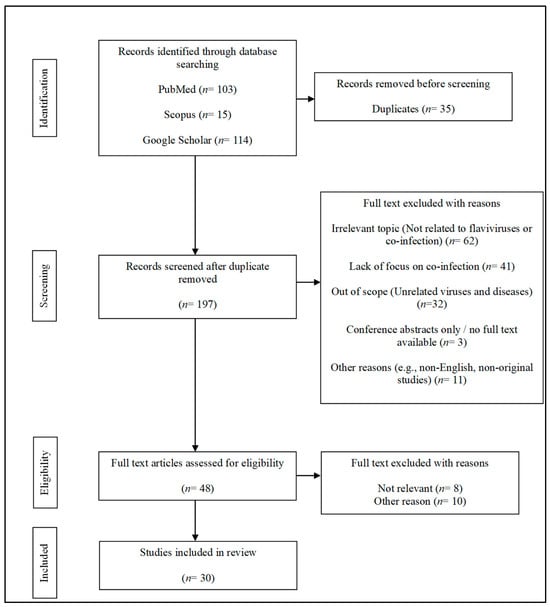
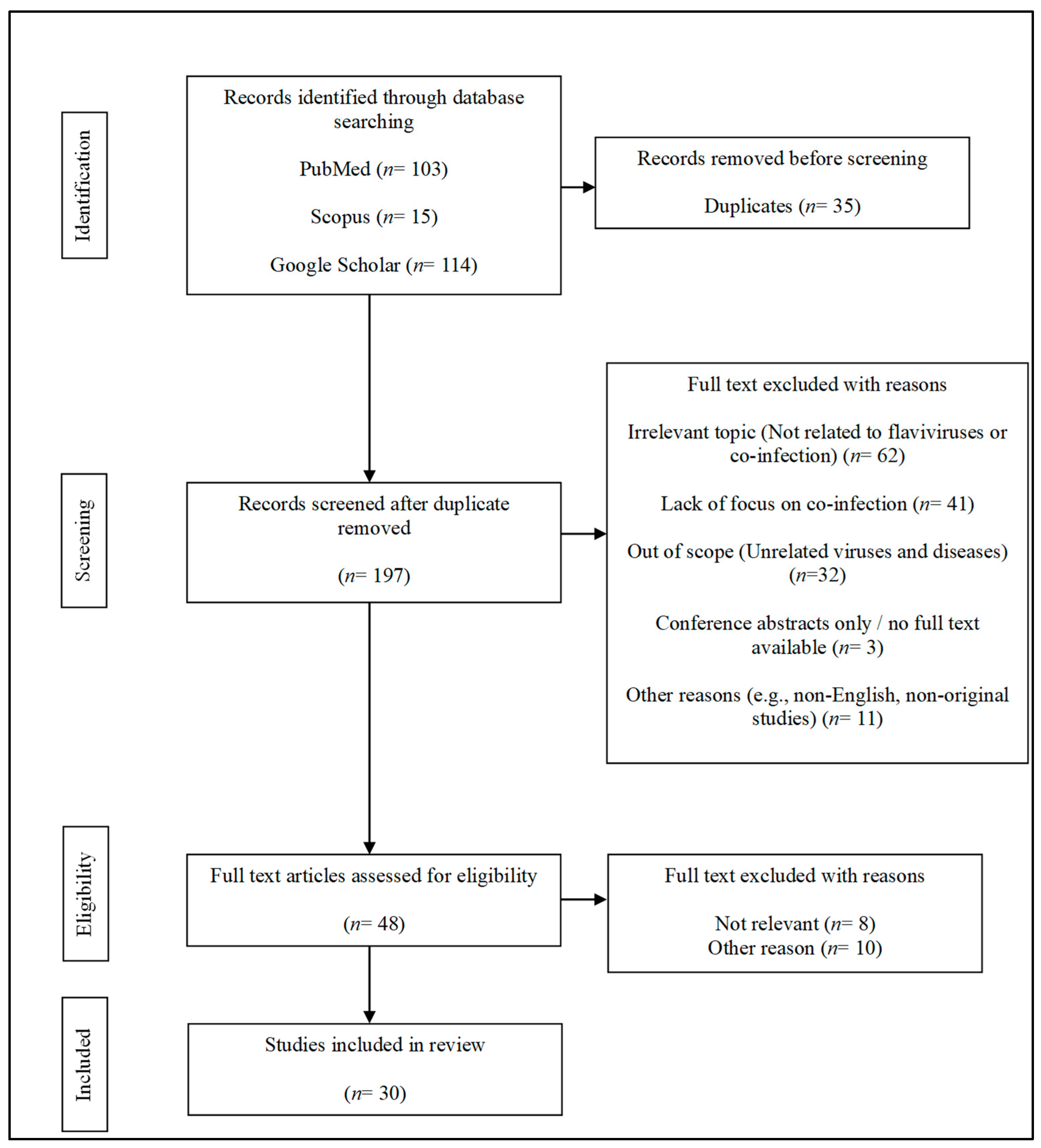
Relevant literature was identified through comprehensive searches of Google Scholar, PubMed, Web of Science (WOS), and Scopus (Figure 1). The search strategy employed combinations of keywords such as “coinfection of flaviviruses” and/or “effect of coinfection” and/or “flavivirus interaction” and/or “future approaches” and/or “diagnosis of flavivirus coinfection”. The search was restricted to English-language articles published between 2002 and 2024, with the inclusion of a limited number of relevant studies from 1990 to 1997. The references from those earlier years were included due to their foundational contributions to the understanding of flavivirus biology and, therefore, were relevant to the scope of the current study.
Figure 1.
PRISMA flowchart of literature search strategy.
In brief, a total of 232 articles were shortlisted and then further screened for duplicate, irrelevant, and inconclusive content. At the end of the article screening and selection, 30 articles were finalized for content analysis. Priority was given to recent and original research articles focusing on co-infections between flaviviruses such as DENV, yellow fever virus (YFV), Zika virus (ZIKV), and West Nile virus (WNV). Studies focusing on the detection of flaviviruses in coinfection contexts were also included to enhance diagnostic and methodological insights. Figure 1 depicts the flow of article selection and screening.
3. Co-Infection: Occurrence and Clinical Relevance
In regions where multiple DENV serotypes are concurrently transmitted, clinical cases caused by more than one serotype may be more prevalent than previously recognized [10]. In endemic or hyperendemic areas, it offers greater opportunities for mosquitoes to acquire two or more DENV serotypes simultaneously [11]. This is partly explained by vector competence, which is shaped by a complex interplay of biological and ecological factors, including viral interactions within the vector, mosquito immune responses, and feeding behavior [12]. In a co-infection, the viruses may interact synergistically or competitively in the mosquito’s midgut, affecting the virus’s capacity to replicate, disseminate, and eventually spread [13].
Simultaneous infections by multiple serotypes are expected to severely impact the clinical manifestations of dengue. When two DENV serotypes coexist within an individual, they might elevate the overall DENV viremia level, infect high numbers of leukocytes, and potentially induce substantial cytotoxicity due to the culminating cytokine storm [14], ultimately leading to severe symptoms and disease emergence [15]. This was evident in previously described dengue co-infections, where a strong correlation with severe clinical disease, including dengue hemorrhagic fever (DHF) and dengue shock syndrome (DSS), was documented, possibly due to markedly heightened immune response and increased viremia [16,17]. Although some studies reported no significant differences in disease severity between mono- and co-infections, there is still a lack of empirical evidence delineating DENV–DENV interactions and immune dysregulation in co-infections, therefore, warranting further rigorous investigations [18,19]. Despite the menacing health effects of dengue co-infections, the exact underlying mechanism remains uncertain.
The complexity of flaviviral co-infections becomes more intricate when it involves different flaviviruses, such as DENV, (ZIKV), WNV, YFV, Saint Louis encephalitis virus (SLEV), and Japanese encephalitis virus (JEV). Among these, co-infections of DENV and ZIKV are particularly noteworthy and frequently reported in prevalent regions, including New Caledonia in 2014 [20], Brazil in 2015, and Colombia in 2016 [21]. The occurrence is primarily due to the overlapping dengue and Zika endemicities. Teng et al. [22] deduced that regions experiencing DENV epidemics are at high risk for ZIKV outbreaks, suggesting a close correlation between the two flaviviruses. The correlation is highly attributable to their shared vectors and similar environmental factors that support their spread and transmission. For example, Aedes aegypti, the main mosquito species responsible for transmitting both DENV and ZIKV, thrives in urban environments with high population density and poor sanitation in tropical regions [23]. A more pressing health concern is the high degree of nucleotide similarity (approximately 60%) between ZIKV and DENV. Increasing clinical and experimental evidence points to a substantial level of antibody cross-reactivity between the two viruses. Specifically, the cross-reactivity can lead to antibody-dependent enhancement (ADE), where antibodies developed against dengue can potentially enhance the adversity of Zika. As a result, it further complicates the disease management and public health response [24,25,26]. Apart from becoming a public health burden, ADE is a significant concern in dengue and Zika vaccine development [27]. ADE arises when antibodies produced from a previous infection or vaccination, characterized as either non-neutralizing or suboptimal, aid in the entry of the virus into host cells, leading to increased viral replication and worsening the disease severity [28]. Therefore, a feasible dengue or Zika vaccine must elicit protective immunity to individuals without compromising the risk of severe diseases upon subsequent infections [29].
Co-infections implicating DENV with ZIKV are continuously reported in endemic areas [30,31]. Comparatively, co-infections with other flaviviruses such as JEV and SLEV, on the other hand, have only been occasionally reported, especially in regions where the viruses are co-endemic [32,33]. Additionally, previous studies on the situation found that co-infections lead to either viral interference or enhanced replication, depending on the timing of the number of infections [34]. One of the major challenges in managing flaviviral co-infections is diagnostic inaccuracies as the clinical symptoms of flaviviral infections often overlap. Table 1 highlights the clinical similarities commonly observed in flaviviral infections, implying the need for more accurate differential diagnoses.
Table 1.
Comparison of clinical symptoms of dengue, Chikugunya, and Zika (adapted from Ioos et al. [35]).
Although the WHO 2012 guideline encompassing clinical parameters, haematology, and dengue-specific diagnostics has been acknowledged as a routine diagnostic practice [36], misattributing a flaviviral infection with another due to clinical similarities can lead to the omission of necessary treatments, resulting in poorer outcomes. As a result, further investigations into more specific diagnostic approaches are warranted [37].
Table 2 presents a comprehensive summary of flavivirus co-infections in which the strengths and controversies in individual articles are explored.
Table 2.
Summary of flavivirus co-infections: occurrence, clinical relevance, strengths, and controversies.
4. Severity and Implications of Co-Infections of DENV Serotypes and with Other Flaviviruses
Lin et al. [38] described the potent mutualistic outcomes of flaviviral co-infections on the viral replication and suggested an enhancement of vector competence [29]. In the arboviral sylvatic cycle, vector competence is defined by whether a mosquito vector can support the exploitation of its circulatory system by the infecting virus [39]. Generally, in the vector, the virus must establish infection in the midgut, produce virions that disseminate to the secondary tissues, and sustain its replication throughout the organ system until newly synthesized progeny reach the salivary glands [40]. DENV-ZIKV co-infected mosquitoes produced significantly greater viral loads than those singly infected, particularly when the co-infection involved DENV-2 [38]. The implications of these findings extend beyond simplistic viral interactions as they highlight the potential for enhanced transmission dynamics within human populations. Given that more than 50 million dengue infections are reported each year, primarily linked to Aedes mosquitoes, comprehending the intricacies of flaviviral co-infections is imperative for repurposing public health strategies to alleviate disease outbreaks [41]. Plus, vector competence, particularly the extrinsic incubation period (EIP), is greatly influenced by ecological factors such as temperature and humidity [39,42]. As a result, any changes to these environmental conditions may exacerbate the consequences of simultaneous infections through the enhancement of viral replication, alteration of mosquito feeding frequency, and prolonged longevity of mosquitoes [43,44].
4.1. Co-Infections of DENV Serotypes
Although all DENV serotypes share a similar infection mechanism, previous findings indicated that some genotypes are more virulent within a particular serotype, leading to a higher likelihood of severe symptoms. This results in a spectrum of disease severity in the affected population [45]. A co-infection of DENV-1 with DENV-2 is associated with a higher frequency of severe thrombocytopenia on admission and lower nadir platelet counts than mono-infected patients [19]. In turn, warning signs and severe disease manifestations are expectedly elevated in co-infected individuals, such as higher risks for developing pleural effusion and at least one severe dengue manifestation. However, some findings reported otherwise where the overall disease severity among co-infected patients was mild, with only a few severe cases without fatality [19,46,47]. In light of the discrepancies, in 2012, WHO broadened the scope of classic dengue fever and introduced the term “expanded dengue syndrome”. Expanded dengue syndrome can be applied to co-infections as it regularly involves multiple vital organs and leads to severe shock [48,49].
Similar to DENV mono-infections, the severity of co-infections can also be divided into mild and severe clinical presentations [3]. For mild cases, a few studies reported that patients concurrently infected with dengue serotypes recovered without relapse. They initially presented with typical dengue symptoms such as high fever, headache, arthralgia, myalgia, retro-orbital pain, and asthenia, but without any haemorrhagic manifestations [50,51,52]. Upon admission, they demonstrated mildly elevated transaminase levels, a common marker for liver inflammation or damage. More interestingly, most of them experienced primary infections [50,53].
In dengue, progression of the disease into severe forms may be influenced by non-viral factors such as the host’s immune response, genetic factors, and predisposing health conditions. Studies conducted in Malaysia, India, and Brazil have recorded a significantly higher intensity of warning signs (90%) and other severe disease manifestations (15%) among patients with concurrent DENV infections [54,55]. A major fraction of patients exhibited elevated creatinine levels, indicating potential kidney involvement, along with pleural effusion. Furthermore, the frequency of patients with severe thrombocytopenia was greater, highlighting the increased risk of haemorrhage and other blood complications [54,55]. Given the multifactorial drivers, it is critical to include DENV co-infections as part of the routine dengue diagnosis to prevent the occurrence of severe dengue, characterized by severe plasma leakage, haemorrhagic manifestations, and organ impairment at the early stage [3]. Although atypical manifestations of dengue are uncommon, patients with concurrent DENV infections did exhibit hepatic, pulmonary, and renal complications [56]. This indicates that co-infections can exacerbate the severity of the diseases, leading to a broader range of organ involvement and more serious health outcomes. In a nutshell, it implies the critical need for close monitoring and timely management of patients with concurrent infections to prevent severe outcomes and improve patient prognosis [57].
4.2. Co-Infections of DENV with Other Flaviviruses
The implications of co-exposure and co-transmission of flaviviruses in terms of epidemiology, pathogenesis, and evolution are not fully understood. Limited clinical data and underdiagnosis of flaviviral co-infections add to the poor understanding of flaviviral co-infections in humans and mosquitoes in natural settings. The capacity of Aedes aegypti mosquitoes to harbour and transmit multiple flaviviruses and arboviruses simultaneously has been demonstrated [13]. Moreover, in the long run, flaviviral co-infections may exert a significant influence on the virus evolution, both within the mammalian host and the mosquito vector [13]. In this light, co-infections of flaviviruses are not merely hypothetical; therefore, accurate differential diagnoses for the co-infections, particularly during arboviral outbreaks, are urgently needed [13].
By far, ZIKV-DENV co-infections are most discussed and documented. Generally, Zika patients are mostly asymptomatic (60–80%), however, milder illnesses, which typically subside 4–7 days after the symptom onset, are possibly seen in symptomatic patients [58,59,60]. ZIKV-DENV co-infections can result in similar mild symptoms such as fever, headache, joint pain, weakness, conjunctivitis, diarrhoea, nausea, and muscle pain. Serologically, co-infected individuals showed mild thrombocytopenia and leukopenia [20]. Although causing mostly less severe symptoms, fatal cases were reported in adults and foetuses succumbing to ZIKV-DENV co-infections. Most of the casualties had underlying comorbidities. Their histopathological results revealed tubulointerstitial nephritis, acute tubular necrosis, acute motor axonal polyneuropathy, acute demyelinating polyneuropathy, and pneumonia [61]. Discrepancies were, nonetheless, seen in Singaporean patients co-infected by DENV and ZIKV [31]. Besides the typical symptoms, they also showed gastrointestinal sicknesses and atypical rashes. The variations pose challenges to the disease diagnosis and require healthcare professionals to be highly vigilant when assessing patients for possible arboviral infections. This was evident during the Zika outbreak in Singapore, where some patients displayed isolated symptoms [62]. Overall, arboviral infections, particularly dengue, Zika and Chikungunya are known for poor disease prognosis, and patients usually succumb to severe complications due to misdiagnosis or late treatments [58,59].
Co-infections of DENV and JEV are also common in Southeast Asia, particularly during the rainy season when Aedes albopictus, Aedes aegypti and Culex tritaeniorhynchus populations surge significantly [33]. As a neurotropic virus, JEV primarily impacts the central nervous system (CNS). Likewise, systemic inflammation induced by DENV can also affect the CNS, making the disease diagnosis more complex [63,64,65]. The pathogenesis of DENV-JEV co-infection remains unclear, nonetheless, DENV and JEV can enter host cells through shared surface receptors, which might be enhanced by non-neutralizing antibodies, if present, hence more adverse outcomes [66,67,68].
Although less frequently reported, cases involving DENV and SLEV have been documented in endemic areas. For example, Heinen et al. [32] reported SLEV and DENV-4 co-infections among Brazilian patients, including a case of triple infection implicating DENV-1, DENV-4, and SLEV. The patients did not exhibit clinical signs and symptoms when the samples were collected, exemplifying the hurdle of early prevention of acute febrile illnesses in those individuals. However, in a co-infection with DENV-3 and SLEV, haemorrhagic symptoms were present but the disease did not exacerbate [69]. The abovementioned scenarios precisely deliberate the complexity and intricacies of flavivirus co-infections, which can be largely influenced by intrinsic and extrinsic factors such as host immune status, viral interference, timing of infections, and environmental conditions [9,70,71].
6. Conclusions
Improving the diagnosis of flavivirus diseases, including co-infections, is of utmost importance to provide timely and precise treatment and disease management to patients. It helps tailor effective therapeutic strategies and enhance preventive and control measures for dengue and other flavivirus diseases. This can ultimately prevent the emergence of severe clinical manifestations in co-infections, particularly those caused by ADE. Identifying the infecting flaviviruses and understanding their complex and intricate interactions in co-infections can help develop better diagnostic plans and tools and treatment protocols, ensuring appropriate and timely medical interventions. Therefore, future research should also focus on elucidating the underlying mechanisms involved in the pathogenesis of flavivirus co-infections and the development of broad-spectrum anti-flavivirus agents and vaccines to address the complexities of the diseases and mitigate their public health impacts.
Author Contributions
R.S.A.S. conceptualized the study, acquired, assembled, and analyzed information in the literature, and prepared and edited the manuscript draft. W.B.Y. and N.A.M.A. conceptualized, reviewed, and finalized the manuscript for submission. W.B.Y. and N.A.M.A. supervised the postgraduate student (R.S.A.S.) who prepared the manuscript draft. All authors have read and agreed to the published version of the manuscript.
Funding
This work was funded by the FUNDAMENTAL RESEARCH GRANT SCHEME, Malaysia Ministry of Higher Education (MoHE), grant number FRGS/1/2021/STG03/UKM/02/2.
Institutional Review Board Statement
Not applicable.
Informed Consent Statement
Not applicable.
Data Availability Statement
Dataset available on request from the authors.
Conflicts of Interest
The authors declare no conflicts of interest.
References
- World Health Organisation. WHO Launches Global Strategic Plan to Fight Rising Dengue and Other Aedes-Borne Arboviral Diseases. Available online: https://www.who.int/news/item/03-10-2024-who-launches-global-strategic-plan-to-fight-rising-dengue-and-other-aedes-borne-arboviral-diseases?utm_source=chatgpt.com (accessed on 18 February 2025).
- Kuhn, R.J.; Zhang, W.; Rossmann, M.G.; Pletnev, S.V.; Corver, J.; Lenches, E.; Jones, C.T.; Mukhopadhyay, S.; Chipman, P.R.; Strauss, E.G.; et al. Structure of Dengue Virus: Implications for Flavivirus Organization, Maturation, and Fusion. Cell 2002, 108, 717–725. [Google Scholar] [CrossRef] [Scilit]
- Sirisena, P.D.N.N.; Mahilkar, S.; Sharma, C.; Jain, J.; Sunil, S. Concurrent Dengue Infections: Epidemiology & Clinical Implications. Indian J. Med. Res. 2021, 154, 669. [Google Scholar] [CrossRef] [Scilit]
- Wang, L.; Zhao, H. Dynamics Analysis of a Zika–Dengue Co-Infection Model with Dengue Vaccine and Antibody-Dependent Enhancement. Phys. A Stat. Mech. Appl. 2019, 522, 248–273. [Google Scholar] [CrossRef] [Scilit]
- Suppiah, J.; Ching, S.M.; Amin-Nordin, S.; Mat-Nor, L.A.; Ahmad-Najimudin, N.A.; Low, G.K.K.; Abdul-Wahid, M.Z.; Thayan, R.; Chee, H.Y. Clinical Manifestations of Dengue in Relation to Dengue Serotype and Genotype in Malaysia: A Retrospective Observational Study. PLoS Negl. Trop. Dis. 2018, 12, e0006817. [Google Scholar] [CrossRef] [Scilit] [PubMed]
- Colombo, T.E.; Vedovello, D.; Mondini, A.; Reis, A.F.N.; Cury, A.A.F.; de Oliveira, F.H.; Cruz, L.E.A.A.; Bronzoni, R.V.d.M.; Nogueira, M.L. Co-Infection of Dengue Virus by Serotypes 1 and 4 in Patient from Medium Sized City from Brazil. Rev. Inst. Med. Trop. Sao Paulo 2013, 55, 275–281. [Google Scholar] [CrossRef] [Scilit]
- Dong, L.; Xing, L. Editorial: The Biological Mechanism and Health Effect of Co-Infection with Multiple Pathogens. Front. Cell Infect. Microbiol. 2024, 14, 1370067. [Google Scholar] [CrossRef] [Scilit] [PubMed]
- ten Bosch, Q.A.; Singh, B.K.; Hassan, M.R.A.; Chadee, D.D.; Michael, E. The Role of Serotype Interactions and Seasonality in Dengue Model Selection and Control: Insights from a Pattern Matching Approach. PLoS Negl. Trop. Dis. 2016, 10, e0004680. [Google Scholar] [CrossRef] [Scilit]
- Khan, E.; Prakoso, D.; Imtiaz, K.; Malik, F.; Farooqi, J.Q.; Long, M.T.; Barr, K.L. The Clinical Features of Co-Circulating Dengue Viruses and the Absence of Dengue Hemorrhagic Fever in Pakistan. Front. Public Health 2020, 8, 541004. [Google Scholar] [CrossRef] [Scilit]
- Senaratne, U.T.N.; Senaratne, U.T.N.; Murugananthan, K.; Murugananthan, K.; Sirisena, P.D.N.N.; Carr, J.M.; Noordeen, F. Dengue Virus Co-Infections with Multiple Serotypes Do Not Result in a Different Clinical Outcome Compared to Mono-Infections. Epidemiol. Infect. 2020, 148, e119. [Google Scholar] [CrossRef] [Scilit]
- Loroño-Pino, M.A.; Cropp, C.B.; Farfán, J.A.; Vorndam, A.V.; Rodríguez-Angulo, E.M.; Rosado-Paredes, E.P.; Flores-Flores, L.F.; Beaty, B.J.; Gubler, D.J. Common Occurrence of concurrent Infections by Multiple Dengue Virus Serotypes. Am. J. Trop. Med. Hyg. 1999, 61, 725–730. [Google Scholar] [CrossRef] [Scilit]
- Lewis, J.; Gallichotte, E.N.; Randall, J.; Glass, A.; Foy, B.D.; Ebel, G.D.; Kading, R.C. Intrinsic Factors Driving Mosquito Vector Competence and Viral Evolution: A Review. Front. Cell Infect. Microbiol. 2023, 13, 1330600. [Google Scholar] [CrossRef] [Scilit] [PubMed]
- Rückert, C.; Weger-Lucarelli, J.; Garcia-Luna, S.M.; Young, M.C.; Byas, A.D.; Murrieta, R.A.; Fauver, J.R.; Ebel, G.D. Impact of Simultaneous Exposure to Arboviruses on Infection and Transmission by Aedes Aegypti Mosquitoes. Nat. Commun. 2017, 8, 15412. [Google Scholar] [CrossRef] [Scilit] [PubMed]
- Gutiérrez-Barbosa, H.; Lyke, K.E.; Leguia, M.; Weiskopf, D.; Khanam, A.; Gutiérrez-Barbosa, H.; Lyke, K.E.; Chua, J. V Immune-Mediated Pathogenesis in Dengue Virus Infection. Viruses 2022, 14, 2575. [Google Scholar] [CrossRef] [Scilit]
- Martins, V.D.C.A.; De Bastos, M.S.; Ramasawmy, R.; De Figueiredo, R.P.; Gimaque, J.B.L.; Braga, W.S.M.; Nogueira, M.L.; Nozawa, S.; Naveca, F.G.; Figueiredo, L.T.M.; et al. Clinical and Virological Descriptive Study in the 2011 Outbreak of Dengue in the Amazonas, Brazil. PLoS ONE 2014, 9, e100535. [Google Scholar] [CrossRef] [Scilit]
- Bhatt, P.; Jayaram, A.; Varma, M.; Mukhopadhyay, C. Kinetics of Dengue Viremia and Its Association with Disease Severity: An Ambispective Study. VirusDisease 2024, 35, 250–259. [Google Scholar] [CrossRef] [Scilit]
- Phanthanawiboon, S.; Ekalaksananan, T.; Chuerduangphui, J.; Suwannatrai, A.T.; Aromseree, S.; Alexander, N.; Overgaard, H.J.; Thongchai, P.; Burassakarn, A.; Pientong, C. Prevalence and Characteristics of Dengue Virus Co-Infection in Patients and Mosquitoes Collected from Patients’ Houses. PLoS ONE 2025, 20, e0314553. [Google Scholar] [CrossRef] [Scilit]
- Sujitha, S.; Murugesan, R. Double Trouble: A Review of Dengue Virus Co-Infections and Their Impact on Disease Severity. Int. J. Entomol. Res. 2024, 9, 117–121. [Google Scholar]
- Dhanoa, A.; Hassan, S.S.; Ngim, C.F.; Lau, C.F.; Chan, T.S.; Adnan, N.A.A.; Eng, W.W.H.; Gan, H.M.; Rajasekaram, G. Impact of Dengue Virus (DENV) Co-Infection on Clinical Manifestations, Disease Severity and Laboratory Parameters. BMC Infect. Dis. 2016, 16, 406. [Google Scholar] [CrossRef] [Scilit]
- Dupont-Rouzeyrol, M.; O’Connor, O.; Calvez, E.; Daures, M.; John, M.; Grangeon, J.P.; Gourinat, A.C. Co-Infection with Zika and Dengue Viruses in 2 Patients, New Caledonia, 2014. Emerg. Infect. Dis. 2015, 21, 381. [Google Scholar] [CrossRef] [Scilit]
- Villamil-Gómez, W.E.; González-Camargo, O.; Rodriguez-Ayubi, J.; Zapata-Serpa, D.; Rodriguez-Morales, A.J. Dengue, Chikungunya and Zika Co-Infection in a Patient from Colombia. J. Infect. Public Health 2016, 9, 684–686. [Google Scholar] [CrossRef] [Scilit]
- Teng, Y.; Bi, D.; Xie, G.; Jin, Y.; Huang, Y.; Lin, B.; An, X.; Tong, Y.; Feng, D. Model-Informed Risk Assessment for Zika Virus Outbreaks in the Asia-Pacific Regions. J. Infect. 2017, 74, 484–491. [Google Scholar] [CrossRef] [Scilit] [PubMed]
- Ribeiro, M.F.M.; Prudente, C.O.M.; de Queiróz, K.B.P. Motor Development of Children Exposed to The Zika Virus: Systematic Reviews. Rev. Bras. Saúde Matern. Infant. 2023, 22, 739–751. [Google Scholar] [CrossRef] [Scilit]
- Priyamvada, L.; Quicke, K.M.; Hudson, W.H.; Onlamoon, N.; Sewatanon, J.; Edupuganti, S.; Pattanapanyasat, K.; Chokephaibulkit, K.; Mulligan, M.J.; Wilson, P.C.; et al. Human Antibody Responses after Dengue Virus Infection Are Highly Cross-Reactive to Zika Virus. Proc. Natl. Acad. Sci. USA 2016, 113, 7852–7857. [Google Scholar] [CrossRef] [Scilit] [PubMed]
- Paul, L.M.; Carlin, E.R.; Jenkins, M.M.; Tan, A.L.; Barcellona, C.M.; Nicholson, C.O.; Michael, S.F.; Isern, S. Dengue Virus Antibodies Enhance Zika Virus Infection. Clin. Transl. Immunol. 2016, 5, e117. [Google Scholar] [CrossRef] [Scilit] [PubMed]
- Dejnirattisai, W.; Supasa, P.; Wongwiwat, W.; Rouvinski, A.; Barba-Spaeth, G.; Duangchinda, T.; Sakuntabhai, A.; Cao-Lormeau, V.M.; Malasit, P.; Rey, F.A.; et al. Dengue Virus Sero-Cross-Reactivity Drives Antibody-Dependent Enhancement of Infection with Zika Virus. Nat. Immunol. 2016, 17, 1102–1108. [Google Scholar] [CrossRef] [Scilit]
- Vannice, K.S.; Durbin, A.; Hombach, J. Status of Vaccine Research and Development of Vaccines for Dengue. Vaccine 2016, 34, 2934–2938. [Google Scholar] [CrossRef] [Scilit]
- Katzelnick, L.C.; Gresh, L.; Halloran, M.E.; Mercado, J.C.; Kuan, G.; Gordon, A.; Balmaseda, A.; Harris, E. Antibody-Dependent Enhancement of Severe Dengue Disease in Humans. Science 2017, 358, 929–932. [Google Scholar] [CrossRef] [Scilit]
- Halstead, S.B. Dengvaxia Sensitizes Seronegatives to Vaccine Enhanced Disease Regardless of Age. Vaccine 2017, 35, 6355–6358. [Google Scholar] [CrossRef] [Scilit]
- Pessoa, R.; Patriota, J.V.; De Lourdes De Souza, M.; Felix, A.C.; Mamede, N.; Sanabani, S.S. Investigation into an Outbreak of Dengue-like Illness in Pernambuco, Brazil, Revealed a Cocirculation of Zika, Chikungunya, and Dengue Virus Type 1. Medicine 2016, 95, e3201. [Google Scholar] [CrossRef] [Scilit]
- Chia, P.Y.; Yew, H.S.; Ho, H.; Chow, A.; Sadarangani, S.P.; Chan, M.; Kam, Y.W.; Chong, C.Y.; Thoon, K.C.; Yung, C.F.; et al. Clinical Features of Patients with Zika and Dengue Virus Co-Infection in Singapore. J. Infect. 2017, 74, 611–615. [Google Scholar] [CrossRef] [Scilit]
- Heinen, L.B.d.S.; Zuchi, N.; Serra, O.P.; Cardoso, B.F.; Gondim, B.H.F.; dos Santos, M.A.M.; Souto, F.J.D.; de Paula, D.A.J.; Dutra, V.; Dezengrini-Slhessarenko, R. Saint Louis Encephalitis Virus in Mato Grosso, Central-Western Brazil. Rev. Inst. Med. Trop. Sao Paulo 2015, 57, 215. [Google Scholar] [CrossRef] [Scilit] [PubMed]
- Saxena, S.K.; Kumar, S.; Maurya, V.K.; Bhatt, M.L.B. The Global Distribution and Burden of Dengue and Japanese Encephalitis Co-Infection in Acute Encephalitis Syndrome. Curr. Top. Negl. Trop. Dis. 2019, 496, 504–507. [Google Scholar]
- Kumar, N.; Sharma, S.; Barua, S.; Tripathi, B.N.; Rouse, B.T. Virological and Immunological Outcomes of Coinfections. Clin. Microbiol. Rev. 2018, 31, e00111-17. [Google Scholar] [CrossRef] [Scilit] [PubMed]
- Ioos, S.; Mallet, H.P.; Leparc Goffart, I.; Gauthier, V.; Cardoso, T.; Herida, M. Current Zika Virus Epidemiology and Recent Epidemics. Med. Mal. Infect. 2014, 44, 302–307. [Google Scholar] [CrossRef] [Scilit]
- WHO. Handbook for Clinical Management of Dengue WHO and Special Programme for Research and Training in Tropical Diseases (TDR) Report; WHO: Geneva, Switzerland, 2012; p. 111. [Google Scholar]
- Made Susila Utama, I.; Lukman, N.; Sukmawati, D.D.; Alisjahbana, B.; Alam, A.; Murniati, D.; Made Gede Dwi Lingga Utama, I.; Puspitasari, D.; Kosasih, H.; Laksono, I.; et al. Dengue Viral Infection in Indonesia: Epidemiology, Diagnostic Challenges, and Mutations from an Observational Cohort Study. PLoS Negl Trop Dis 2019, 13, e0007785. [Google Scholar] [CrossRef] [Scilit]
- Lin, D.C.D.; Weng, S.C.; Tsao, P.N.; Chu, J.J.H.; Shiao, S.H. Co-Infection of Dengue and Zika Viruses Mutually Enhances Viral Replication in the Mosquito Aedes Aegypti. Parasit. Vectors 2023, 16, 160. [Google Scholar] [CrossRef] [Scilit]
- Agarwal, A.; Parida, M.; Dash, P.K. Impact of Transmission Cycles and Vector Competence on Global Expansion and Emergence of Arboviruses. Rev. Med. Virol. 2017, 27, e1941. [Google Scholar] [CrossRef] [Scilit]
- Wu, P.; Yu, X.; Wang, P.; Cheng, G. Arbovirus Lifecycle in Mosquito: Acquisition, Propagation and Transmission. Expert. Rev. Mol. Med. 2019, 21, e1. [Google Scholar] [CrossRef] [Scilit]
- Wei, Y.; Wang, J.; Wei, Y.H.; Song, Z.; Hu, K.; Chen, Y.; Zhou, G.; Zhong, D.; Zheng, X. Vector Competence for DENV-2 Among Aedes Albopictus (Diptera: Culicidae) Populations in China. Front. Cell Infect. Microbiol. 2021, 11, 649975. [Google Scholar] [CrossRef] [Scilit]
- Bellone, R.; Failloux, A.B. The Role of Temperature in Shaping Mosquito-Borne Viruses Transmission. Front. Microbiol. 2020, 11, 584846. [Google Scholar] [CrossRef] [Scilit]
- Tahir, F.; Bansal, D.; Rehman, A.U.; Ajjur, S.B.; Skariah, S.; Belhaouari, S.B.; Al-Romaihi, H.; Al-Thani, M.H.J.; Farag, E.; Sultan, A.A.; et al. Assessing the Impact of Climate Conditions on the Distribution of Mosquito Species in Qatar. Front. Public Health 2023, 10, 970694. [Google Scholar] [CrossRef] [Scilit] [PubMed]
- Brown, J.J.; Pascual, M.; Wimberly, M.C.; Johnson, L.R.; Murdock, C.C. Humidity—The Overlooked Variable in the Thermal Biology of Mosquito-Borne Disease. Ecol. Lett. 2023, 26, 1029. [Google Scholar] [CrossRef] [Scilit]
- Tuiskunen Bäck, A.; Lundkvist, Å. Dengue Viruses—An Overview. Infect. Ecol. Epidemiol. 2013, 3, 19839. [Google Scholar] [CrossRef] [Scilit]
- Soo, K.M.; Khalid, B.; Ching, S.M.; Chee, H.Y. Meta-Analysis of Dengue Severity during Infection by Different Dengue Virus Serotypes in Primary and Secondary Infections. PLoS ONE 2016, 11, e0154760. [Google Scholar] [CrossRef] [Scilit]
- Tazeen, A.; Afreen, N.; Abdullah, M.; Deeba, F.; Haider, S.H.; Kazim, S.N.; Ali, S.; Naqvi, I.H.; Broor, S.; Ahmed, A.; et al. Occurrence of Co-Infection with Dengue Viruses during 2014 in New Delhi, India. Epidemiol. Infect. 2017, 145, 67–77. [Google Scholar] [CrossRef] [Scilit] [PubMed]
- Mohanty, B.; Sunder, A.; Pathak, S. Clinicolaboratory Profile of Expanded Dengue Syndrome—Our Experience in a Teaching Hospital. J. Fam. Med. Prim. Care 2019, 8, 1022. [Google Scholar] [CrossRef] [Scilit] [PubMed]
- Turuk, J.; Palo, S.; Rath, S.; Subhadra, S.; Sabat, J.; Sahoo, P.; Panda, S.; Pati, S. Viral Characteristics and Clinical Presentation in Dengue Co-Infection- Findings from a Facility Based Observational Study in Odisha, India. J. Fam. Med. Prim. Care 2021, 10, 2958. [Google Scholar] [CrossRef] [Scilit]
- Briseño-García, B.; Gómez-Dantés, H.; Argott-Ramírez, E.; Montesano, R.; Vázquez-Martínez, A.L.; Ibáñez-Bernal, S.; Madrigal-Ayala, G.; Ruíz-Matus, C.; Flisser, A.; Tapia-Conyer, R. Potential Risk for Dengue Hemorrhagic Fever: The Isolation of Serotype Dengue-3 in Mexico. Emerg. Infect. Dis. 1996, 2, 133. [Google Scholar] [CrossRef] [Scilit]
- Laille, M.; Deubel, V.; Sainte-Marie, F.F. Demonstration of Concurrent Dengue 1 and Dengue 3 Infection in Six Patients by the Polymerase Chain Reaction. J. Med. Virol. 1991, 34, 51–54. [Google Scholar] [CrossRef] [Scilit]
- Mishra, B.; Turuk, J.; Sahu, S.J.; Khajuria, A.; Kumar, S.; Dey, A.; Praharaj, A.K. Co-Circulation of All Four Dengue Virus Serotypes: First Report from Odisha. Indian. J. Med. Microbiol. 2017, 35, 293–295. [Google Scholar] [CrossRef] [Scilit]
- Thai, K.T.D.; Nishiura, H.; Hoang, P.L.; Tran, N.T.T.; Phan, G.T.; Le, H.Q.; Tran, B.Q.; Van Nguyen, N.; de Vries, P.J. Age-Specificity of Clinical Dengue during Primary and Secondary Infections. PLoS Negl. Trop. Dis. 2011, 5, e1180. [Google Scholar] [CrossRef] [Scilit] [PubMed]
- Anoop, M.; Issac, A.; Mathew, T.; Philip, S.; Kareem, N.A.; Unnikrishnan, R.; Sreekumar, E. Genetic Characterization of Dengue Virus Serotypes Causing Concurrent Infection in an Outbreak in Ernakulam, Kerala, South India. Indian. J. Exp. Biol. 2010, 48, 849–857. [Google Scholar]
- Fahri, S.; Yohan, B.; Trimarsanto, H.; Sayono, S.; Hadisaputro, S.; Dharmana, E.; Syafruddin, D.; Sasmono, R.T. Molecular Surveillance of Dengue in Semarang, Indonesia Revealed the Circulation of an Old Genotype of Dengue Virus Serotype-1. PLoS Negl. Trop. Dis. 2013, 7, e2354. [Google Scholar] [CrossRef] [Scilit] [PubMed]
- Lardo, S.; Utami, Y.; Yohan, B.; Tarigan, S.M.M.U.; Santoso, W.D.; Nainggolan, L.; Sasmono, R.T. Concurrent Infections of Dengue Viruses Serotype 2 and 3 in Patient with Severe Dengue from Jakarta, Indonesia. Asian Pac. J. Trop. Med. 2016, 9, 134–140. [Google Scholar] [CrossRef] [Scilit] [PubMed]
- Chahar, H.S.; Bharaj, P.; Dar, L.; Guleria, R.; Kabra, S.K.; Broor, S. Co-Infections with Chikungunya Virus and Dengue Virus in Delhi, India. Emerg. Infect. Dis. 2009, 15, 1077. [Google Scholar] [CrossRef] [Scilit] [PubMed]
- Pinto Junior, V.L.; Luz, K.; Parreira, R.; Ferrinho, P. Zika Virus: A Review to Clinicians. Acta Med. Port. 2015, 28, 760–765. [Google Scholar] [CrossRef] [Scilit]
- Stamm, L.V. Zika Virus in the Americas: An Obscure Arbovirus Comes Calling. JAMA Dermatol. 2016, 152, 621–622. [Google Scholar] [CrossRef] [Scilit]
- Suwanmanee, S.; Luplertlop, N. Dengue and Zika Viruses: Lessons Learned from the Similarities between These Aedes Mosquito-Vectored Arboviruses. J. Microbiol. 2017, 55, 81–89. [Google Scholar] [CrossRef] [Scilit]
- Mercado-Reyes, M.; Acosta-Reyes, J.; Navarro-Lechuga, E.; Corchuelo, S.; Rico, A.; Parra, E.; Tolosa, N.; Pardo, L.; González, M.; Martìn-Rodriguez-Hernández, J.; et al. Dengue, Chikungunya and Zika Virus Coinfection: Results of the National Surveillance during the Zika Epidemic in Colombia. Epidemiol. Infect. 2019, 147, e77. [Google Scholar] [CrossRef] [Scilit]
- Bang, Y.X.; Sher, G.L.; Richard, T.H.T.; Farhad, F.V. A Case Series of Atypical Presentation of Zika Virus Infection in Singapore. BMC Infect. Dis. 2016, 16, 681. [Google Scholar] [CrossRef] [Scilit]
- Borawake, K.; Prayag, P.; Wagh, A.; Dole, S. Dengue Encephalitis. Indian J. Crit. Care Med. 2011, 15, 190–193. [Google Scholar] [CrossRef] [Scilit] [PubMed]
- Kathuria, R.; Choudhary, P.; Kashyap, A.; Ansari, E.; Kamal, M. Dengue Virus and Japanese Encephalitis Virus Co-Infection: A Case Report. IP Int. J. Med. Paediatr. Oncol. 2020, 6, 169–171. [Google Scholar] [CrossRef] [Scilit]
- Sivamani, K.; Dhir, V.; Singh, S.; Sharma, A. Diagnostic Dilemma—Dengue or Japanese Encephalitis? Neurol. India 2017, 65, 105–107. [Google Scholar] [CrossRef] [Scilit] [PubMed]
- Laureti, M.; Narayanan, D.; Rodriguez-Andres, J.; Fazakerley, J.K.; Kedzierski, L. Flavivirus Receptors: Diversity, Identity, and Cell Entry. Front. Immunol. 2018, 9, 396205. [Google Scholar] [CrossRef] [Scilit]
- Salas-Benito, J.S.; De Nova-Ocampo, M. Viral Interference and Persistence in Mosquito-Borne Flaviviruses. J. Immunol. Res. 2015, 2015, 73404. [Google Scholar] [CrossRef] [Scilit]
- Singh, K.P.; Mishra, G.; Jain, P.; Pandey, N.; Nagar, R.; Gupta, S.; Prakash, S.; Prakash, O.; Khan, D.N.; Shrivastav, S.; et al. Co-Positivity of Anti-Dengue Virus and Anti-Japanese Encephalitis Virus IgM in Endemic Area: Co-Infection or Cross Reactivity? Asian Pac. J. Trop. Med. 2014, 7, 124–129. [Google Scholar] [CrossRef] [Scilit]
- Mondini, A.; Bronzoni, R.V.d.M.; Cardeal, I.L.S.; dos Santos, T.M.I.L.; Lázaro, E.; Nunes, S.H.P.; Silva, G.C.D.; Madrid, M.C.F.S.; Rahal, P.; Figueiredo, L.T.; et al. Simultaneous Infection by DENV-3 and SLEV in Brazil. J. Clin. Virol. 2007, 40, 84–86. [Google Scholar] [CrossRef] [Scilit]
- Bifani, A.M.; Siriphanitchakorn, T.; Choy, M.M. Intra-Host Diversity of Dengue Virus in Mosquito Vectors. Front. Cell Infect. Microbiol. 2022, 12, 888804. [Google Scholar] [CrossRef] [Scilit]
- Yong, Y.K.; Wong, W.F.; Vignesh, R.; Chattopadhyay, I.; Velu, V.; Tan, H.Y.; Zhang, Y.; Larsson, M.; Shankar, E.M. Dengue Infection—Recent Advances in Disease Pathogenesis in the Era of COVID-19. Front. Immunol. 2022, 13, 889196. [Google Scholar] [CrossRef] [Scilit]
- Herencia, J.S.S. Lessons Learned and Recent Advances in Dengue Research. In Dengue Fever in a One Health Perspective; Intech Open: London, UK, 2020. [Google Scholar] [CrossRef] [Scilit]
- WHO; TDR. Dengue Guidelines, for Diagnosis, Treatment, Prevention and Control; World Health Organization: Geneva, Switzerland, 2009; Volume 41, p. 29. [Google Scholar]
- Beltrán-Silva, S.L.; Chacón-Hernández, S.S.; Moreno-Palacios, E.; Pereyra-Molina, J.Á. Clinical and Differential Diagnosis: Dengue, Chikungunya and Zika. Rev. Méd Hosp. General. México 2018, 81, 146–153. [Google Scholar] [CrossRef] [Scilit]
- World Health Organization. Comprehensive Guideline for Prevention and Control of Dengue and Dengue Haemorrhagic Fever; Revised and Expanded Edition; World Health Organization: Geneva, Switzerland, 2011; ISBN 978-92-9022-387-0. [Google Scholar]
- Prommool, T.; Sethanant, P.; Phaenthaisong, N.; Tangthawornchaikul, N.; Songjaeng, A.; Avirutnan, P.; Mairiang, D.; Luangaram, P.; Srisawat, C.; Kasinrerk, W.; et al. High Performance Dengue Virus Antigen-Based Serotyping-NS1-ELISA (plus): A Simple Alternative Approach to Identify Dengue Virus Serotypes in Acute Dengue Specimens. PLoS Negl. Trop. Dis. 2021, 15, e0009065. [Google Scholar] [CrossRef] [Scilit] [PubMed]
- Guzman, M.G.; Jaenisch, T.; Gaczkowski, R.; Hang, V.T.T.; Sekaran, S.D.; Kroeger, A.; Vazquez, S.; Ruiz, D.; Martinez, E.; Mercado, J.C.; et al. Multi-Country Evaluation of the Sensitivity and Specificity of Two Commercially-Available NS1 ELISA Assays for Dengue Diagnosis. PLoS Negl. Trop. Dis. 2010, 4, e811. [Google Scholar] [CrossRef] [Scilit] [PubMed]
- Tan, L.K.; Wong, W.Y.; Yang, H.T.; Huber, R.G.; Bond, P.J.; Ng, L.C.; Maurer-Stroh, S.; Hapuarachchi, H.C. Flavivirus Cross-Reactivity to Dengue Nonstructural Protein 1 Antigen Detection Assays. Diagnostics 2019, 10, 11. [Google Scholar] [CrossRef] [Scilit] [PubMed]
- Coronel-Ruiz, C.; Velandia-Romero, M.L.; Calvo, E.; Camacho-Ortega, S.; Parra-Alvarez, S.; Beltrán-Zuñiga, E.; Calderón-Pelaez, M.-A.; Cortés-Muñoz, F.; Rojas-Hernandez, J.P.; Velasco-Alvarez, S.; et al. Improving Dengue Case Confirmation by Combining Rapid Diagnostic Test, Clinical, and Laboratory Variables. medRxiv 2021, 2021.05.21.21257609. [Google Scholar] [CrossRef] [Scilit]
- Luvira, V.; Thawornkuno, C.; Lawpoolsri, S.; Thippornchai, N.; Duangdee, C.; Ngamprasertchai, T.; Leaungwutiwong, P. Diagnostic Performance of Dengue NS1 and Antibodies by Serum Concentration Technique. Trop. Med. Infect. Dis. 2023, 8, 117. [Google Scholar] [CrossRef] [Scilit]
- Lai, S.C.; Huang, Y.Y.; Wey, J.J.; Tsai, M.H.; Chen, Y.L.; Shu, P.Y.; Chang, S.F.; Hung, Y.J.; Hou, J.N.; Lin, C.C. Development of Novel Dengue NS1 Multiplex Lateral Flow Immunoassay to Differentiate Serotypes in Serum of Acute Phase Patients and Infected Mosquitoes. Front. Immunol. 2022, 13, 852452. [Google Scholar] [CrossRef] [Scilit]
- World Health Organisation Dengue and Severe Dengue. Available online: https://www.who.int/news-room/fact-sheets/detail/dengue-and-severe-dengue?utm_source=chatgpt.com (accessed on 19 February 2025).
- Yung, C.F.; Lee, K.S.; Thein, T.L.; Tan, L.K.; Gan, V.C.; Wong, J.G.X.; Lye, D.C.; Ng, L.C.; Leo, Y.S. Dengue Serotype-Specific Differences in Clinical Manifestation, Laboratory Parameters and Risk of Severe Disease in Adults, Singapore. Am. J. Trop. Med. Hyg. 2015, 92, 999. [Google Scholar] [CrossRef] [Scilit]
- San Diego, M.J.; Sayo, A.; EDRADA, E. 645. Risk of Disease Severity and Disease Outcomes with Serotype-Specific Dengue Virus among Hospitalized Dengue Patients in a Tertiary Infectious Diseases Hospital: A Five-Year Retrospective Study. Open Forum Infect. Dis. 2023, 10, ofad500.709. [Google Scholar] [CrossRef] [Scilit]
- Rocha, B.A.M.; Guilarde, A.O.; Argolo, A.F.L.T.; Tassara, M.P.; da Silveira, L.A.; Junqueira, I.C.; Turchi, M.D.; Féres, V.C.R.; Martelli, C.M.T. Dengue-Specific Serotype Related to Clinical Severity during the 2012/2013 Epidemic in Centre of Brazil. Infect. Dis. Poverty 2017, 6, 73–83. [Google Scholar] [CrossRef] [Scilit]
- Kaur, M.; Singh, K.; Sidhu, S.K.; Devi, P.; Kaur, M.; Soneja, S.; Singh, N. Coinfection of Chikungunya and Dengue Viruses: A Serological Study from North Western Region of Punjab, India. J. Lab. Physicians 2018, 10, 443. [Google Scholar] [CrossRef] [Scilit]
- Cao-Lormeau, V.M.; Blake, A.; Mons, S.; Lastère, S.; Roche, C.; Vanhomwegen, J.; Dub, T.; Baudouin, L.; Teissier, A.; Larre, P.; et al. Guillain-Barré Syndrome Outbreak Associated with Zika Virus Infection in French Polynesia: A Case-Control Study. Lancet 2016, 387, 1531–1539. [Google Scholar] [CrossRef] [Scilit]
- Timiryasova, T.M.; Bonaparte, M.I.; Luo, P.; Zedar, R.; Hu, B.T.; Hildreth, S.W. Optimization and Validation of a Plaque Reduction Neutralization Test for the Detection of Neutralizing Antibodies to Four Serotypes of Dengue Virus Used in Support of Dengue Vaccine Development. Am. J. Trop. Med. Hyg. 2013, 88, 962–970. [Google Scholar] [CrossRef] [Scilit] [PubMed]
- Loyola, S.; Huaman, A.; Popuche, D.; Castillo, E.; Ampuero, J.S.; Silva, M.; Guevara, C.; Watts, D.M. Evaluation of Two Serological Assays for Diagnosing Zika Virus Infection. Diagnostics 2021, 11, 1696. [Google Scholar] [CrossRef] [Scilit] [PubMed]
- Panning, M. Zika Virus Serology: More Diagnostic Targets, More Reliable Answers? EBioMedicine 2017, 16, 12–13. [Google Scholar] [CrossRef] [Scilit] [PubMed]
- Shan, C.; Xie, X.; Ren, P.; Loeffelholz, M.J.; Yang, Y.; Furuya, A.; Dupuis, A.P.; Kramer, L.D.; Wong, S.J.; Shi, P.Y. A Rapid Zika Diagnostic Assay to Measure Neutralizing Antibodies in Patients. EBioMedicine 2017, 17, 157–162. [Google Scholar] [CrossRef] [Scilit]
- Favresse, J.; Gillot, C.; Oliveira, M.; Cadrobbi, J.; Elsen, M.; Eucher, C.; Laffineur, K.; Rosseels, C.; Van Eeckhoudt, S.; Nicolas, J.B.; et al. Head-to-Head Comparison of Rapid and Automated Antigen Detection Tests for the Diagnosis of SARS-CoV-2 Infection. J. Clin. Med. 2021, 10, 265. [Google Scholar] [CrossRef] [Scilit]
- Bruzzone, B.; De Pace, V.; Caligiuri, P.; Ricucci, V.; Guarona, G.; Pennati, B.M.; Boccotti, S.; Orsi, A.; Domnich, A.; Da Rin, G.; et al. Comparative Diagnostic Performance of Rapid Antigen Detection Tests for COVID-19 in a Hospital Setting. Int. J. Infect. Dis. 2021, 107, 215. [Google Scholar] [CrossRef] [Scilit]
- Chao, D.Y.; Davis, B.S.; Chang, G.J.J. Development of Multiplex Real-Time Reverse Transcriptase PCR Assays for Detecting Eight Medically Important Flaviviruses in Mosquitoes. J. Clin. Microbiol. 2007, 45, 584–589. [Google Scholar] [CrossRef] [Scilit]
- Pabbaraju, K.; Wong, S.; Gill, K.; Fonseca, K.; Tipples, G.A.; Tellier, R. Simultaneous Detection of Zika, Chikungunya and Dengue Viruses by a Multiplex Real-Time RT-PCR Assay. J. Clin. Virol. 2016, 83, 66–71. [Google Scholar] [CrossRef] [Scilit]
- Xu, Z.; Peng, Y.; Yang, M.; Li, X.; Wang, J.; Zou, R.; Liang, J.; Fang, S.; Liu, Y.; Yang, Y. Simultaneous Detection of Zika, Chikungunya, Dengue, Yellow Fever, West Nile, and Japanese Encephalitis Viruses by a Two-Tube Multiplex Real-Time RT-PCR Assay. J. Med. Virol. 2022, 94, 2528–2536. [Google Scholar] [CrossRef] [Scilit]
- Wee, S.; Alli-Shaik, A.; Kek, R.; Swa, H.L.F.; Tien, W.P.; Lim, V.W.; Leo, Y.S.; Ng, L.C.; Hapuarachchi, H.C.; Gunaratne, J. Multiplex Targeted Mass Spectrometry Assay for One-Shot Flavivirus Diagnosis. Proc. Natl. Acad. Sci. USA 2019, 116, 6754–6759. [Google Scholar] [CrossRef] [Scilit] [PubMed]
- Shariq, M.; Khan, M.F.; Raj, R.; Ahsan, N.; Singh, R.; Kumar, P. CRISPR-based Diagnostic Approaches: Implications for Rapid Management of Future Pandemics (Review). Mol. Med. Rep. 2023, 27, 118. [Google Scholar] [CrossRef] [Scilit]
- Letizia, A.G.; Pratt, C.B.; Wiley, M.R.; Fox, A.T.; Mosore, M.; Agbodzi, B.; Yeboah, C.; Kumordjie, S.; Di Paola, N.; Assana, K.C.; et al. Retrospective Genomic Characterization of a 2017 Dengue Virus Outbreak, Burkina Faso. Emerg. Infect. Dis. 2022, 28, 1198–1210. [Google Scholar] [CrossRef] [Scilit] [PubMed]
- Reteng, P.; Nguyen Thuy, L.; Tran Thi Minh, T.; Mares-Guia, M.A.M.d.M.; Torres, M.C.; de Filippis, A.M.B.; Orba, Y.; Kobayashi, S.; Hayashida, K.; Sawa, H.; et al. A Targeted Approach with Nanopore Sequencing for the Universal Detection and Identification of Flaviviruses. Sci. Rep. 2021, 11, 19031. [Google Scholar] [CrossRef] [Scilit] [PubMed]
- Frazer, J.L.; Norton, R. Dengue: A Review of Laboratory Diagnostics in the Vaccine Age. J. Med. Microbiol. 2024, 73, 1833. [Google Scholar] [CrossRef] [Scilit]
- Kelly-Cirino, C.D.; Nkengasong, J.; Kettler, H.; Tongio, I.; Gay-Andrieu, F.; Escadafal, C.; Piot, P.; Peeling, R.W.; Gadde, R.; Boehme, C. Importance of Diagnostics in Epidemic and Pandemic Preparedness. BMJ Glob. Health 2019, 4, 1179. [Google Scholar] [CrossRef] [Scilit]
- Badolato-Corrêa, J.; Sánchez-Arcila, J.C.; Alves de Souza, T.M.; Santos Barbosa, L.; Conrado Guerra Nunes, P.; da Rocha Queiroz Lima, M.; Gandini, M.; Bispo de Filippis, A.M.; Venâncio da Cunha, R.; Leal de Azeredo, E.; et al. Human T Cell Responses to Dengue and Zika Virus Infection Compared to Dengue/Zika Coinfection. Immun. Inflamm. Dis. 2018, 6, 194–206. [Google Scholar] [CrossRef] [Scilit]
- Hollidge, B.S.; Weiss, S.R.; Soldan, S.S. The Role of Interferon Antagonist, Non-Structural Proteins in the Pathogenesis and Emergence of Arboviruses. Viruses 2011, 3, 629. [Google Scholar] [CrossRef] [Scilit]
- Jayachandran, B.; Chanda, K.; Balamurali, M.M. Overview of Pathogenesis, Diagnostics, and Therapeutics of Infectious Diseases: Dengue and Zika. ACS Omega 2021, 6, 22487. [Google Scholar] [CrossRef] [Scilit]
- Blackard, J.T.; Cohen, D.E.; Mayer, K.H. Human Immunodeficiency Virus Superinfection and Recombination: Current State of Knowledge and Potential Clinical Consequences. Clin. Infect. Dis. 2002, 34, 1108–1114. [Google Scholar] [CrossRef] [Scilit]
- Chuang, F.K.; Liao, C.L.; Hu, M.K.; Chiu, Y.L.; Lee, A.R.; Huang, S.M.; Chiu, Y.L.; Tsai, P.L.; Su, B.C.; Chang, T.H.; et al. Antiviral Activity of Compound L3 against Dengue and Zika Viruses In Vitro and In Vivo. Int. J. Mol. Sci. 2020, 21, 4050. [Google Scholar] [CrossRef] [Scilit] [PubMed]
- Bonyah, E.; Khan, M.A.; Okosun, K.O.; Gómez-Aguilar, J.F. On the Co-Infection of Dengue Fever and Zika Virus. Optim. Control Appl. Methods 2019, 40, 394–421. [Google Scholar] [CrossRef] [Scilit]
- Chew, M.F.; Poh, K.S.; Poh, C.L. Peptides as Therapeutic Agents for Dengue Virus. Int. J. Med. Sci. 2017, 14, 1342–1359. [Google Scholar] [CrossRef] [Scilit] [PubMed]
- Dando, T.M.; Perry, C.M. Enfuvirtide. Drugs 2012, 63, 2755–2766. [Google Scholar] [CrossRef] [Scilit]
- Songprakhon, P.; Thaingtamtanha, T.; Limjindaporn, T.; Puttikhunt, C.; Srisawat, C.; Luangaram, P.; Dechtawewat, T.; Uthaipibull, C.; Thongsima, S.; Yenchitsomanus, P.-T.; et al. Peptides Targeting Dengue Viral Nonstructural Protein 1 Inhibit Dengue Virus Production. Sci. Rep. 2020, 10, 12933. [Google Scholar] [CrossRef] [Scilit]
- Kaptein, S.J.F.; Goethals, O.; Kiemel, D.; Marchand, A.; Kesteleyn, B.; Bonfanti, J.F.; Bardiot, D.; Stoops, B.; Jonckers, T.H.M.; Dallmeier, K.; et al. A Pan-Serotype Dengue Virus Inhibitor Targeting the NS3–NS4B Interaction. Nature 2021, 598, 504–509. [Google Scholar] [CrossRef] [Scilit] [PubMed]
- Ajmal, A.; Shahab, M.; Waqas, M.; Zheng, G.; Zulfat, M.; Bin Jardan, Y.A.; Wondmie, G.F.; Bourhia, M.; Ali, I. In Silico Design of Peptide Inhibitors for Dengue Virus to Treat Dengue Virus-Associated Infections. Sci. Rep. 2024, 14, 13130. [Google Scholar] [CrossRef] [Scilit]
- Hrobowski, Y.M.; Garry, R.F.; Michael, S.F. Peptide Inhibitors of Dengue Virus and West Nile Virus Infectivity. Virol. J. 2005, 2, 49. [Google Scholar] [CrossRef] [Scilit]
- Behrouz, S.; Kühl, N.; Klein, C.D. N-Sulfonyl Peptide-Hybrids as a New Class of Dengue Virus Protease Inhibitors. Eur. J. Med. Chem. 2023, 251, 115227. [Google Scholar] [CrossRef] [Scilit]
- Huang, Y.-J.; Cheng, T.-L.; Wang, Y.-T.; Chen, C.-S.; Leu, Y.-L.; Chang, C.-S.; Ho, C.-H.; Chao, S.-W.; Li, C.-T.; Chuang, C.-H. Exploring the Therapeutic Potential of DV-B-120 as an Inhibitor of Dengue Virus Infection. J. Virol. 2024, 98, e0125823. [Google Scholar] [CrossRef] [Scilit]
- Lin, C.S.; Lu, C.H.; Lin, T.H.; Kiu, Y.T.; Kan, J.Y.; Chang, Y.J.; Hung, P.Y.; Koval’skaya, A.V.; Tsypyshev, D.O.; Tsypysheva, I.P.; et al. Inhibition of Dengue Viruses by N-Methylcytisine Thio Derivatives through Targeting Viral Envelope Protein and NS2B-NS3 Protease. Bioorg Med. Chem. Lett. 2024, 99, 129623. [Google Scholar] [CrossRef] [Scilit] [PubMed]
- Phan, T.T.N.; Hvasta, M.G.; Kudlacek, S.T.; Thiono, D.J.; Tripathy, A.; Nicely, N.I.; de Silva, A.M.; Kuhlman, B. A Conserved Set of Mutations for Stabilizing Soluble Envelope Protein Dimers from Dengue and Zika Viruses to Advance the Development of Subunit Vaccines. J. Biol. Chem. 2022, 298, 102079. [Google Scholar] [CrossRef] [Scilit]
- Martínez, M.A. RNA Interference and Viruses: Current Innovations and Future Trends; Caister Academic Press: Poole, UK, 2010. [Google Scholar]
- Wu, X.; Hong, H.; Yue, J.; Wu, Y.; Li, X.; Jiang, L.; Li, L.; Li, Q.; Gao, G.; Yang, X. Inhibitory Effect of Small Interfering RNA on Dengue Virus Replication in Mosquito Cells. Virol. J. 2010, 7, 270. [Google Scholar] [CrossRef] [Scilit]
- Ma, Y.; Chan, C.Y.; He, M.L. RNA Interference and Antiviral Therapy. World J. Gastroenterol. WJG 2007, 13, 5169. [Google Scholar] [CrossRef] [Scilit] [PubMed]
- Leggewie, M.; Schnettler, E. The Aedes Aegypti RNA Interference Response against Zika Virus in the Context of Co-Infection with Dengue and Chikungunya Viruses. PLoS Neglected Trop. Dis. 2023, 17, e0011456. [Google Scholar] [CrossRef] [Scilit] [PubMed]
- Contreras, D.; Arumugaswami, V. Zika Virus Infectious Cell Culture System and the In Vitro Prophylactic Effect of Interferons. J. Vis. Exp. 2016, 2016, 54767. [Google Scholar] [CrossRef] [Scilit]
- Munjal, A.; Khandia, R.; Dhama, K.; Sachan, S.; Karthik, K.; Tiwari, R.; Malik, Y.S.; Kumar, D.; Singh, R.K.; Iqbal, H.M.N.; et al. Advances in Developing Therapies to Combat Zika Virus: Current Knowledge and Future Perspectives. Front. Microbiol. 2017, 8, 1469. [Google Scholar] [CrossRef] [Scilit]
- Lai, Z.-Z.; Ho, Y.-J.; Lu, J.-W.; Jang, J.; Chu, H.; Mok, C.K. Harringtonine Inhibits Zika Virus Infection through Multiple Mechanisms. Molecules 2020, 25, 4082. [Google Scholar] [CrossRef] [Scilit]
- Felicetti, T.; Manfroni, G.; Cecchetti, V.; Cannalire, R. Broad-Spectrum Flavivirus Inhibitors: A Medicinal Chemistry Point of View. ChemMedChem 2020, 15, 2391–2419. [Google Scholar] [CrossRef] [Scilit]
- Vicenti, I.; Martina, M.G.; Boccuto, A.; De Angelis, M.; Giavarini, G.; Dragoni, F.; Marchi, S.; Trombetta, C.M.; Crespan, E.; Maga, G.; et al. System-Oriented Optimization of Multi-Target 2,6-Diaminopurine Derivatives: Easily Accessible Broad-Spectrum Antivirals Active against Flaviviruses, Influenza Virus and SARS-CoV-2. Eur. J. Med. Chem. 2021, 224, 113683. [Google Scholar] [CrossRef] [Scilit]
- Michiaki, M.; Tomohiro, I.; Satofumi, K.; Motoyasu, T.; Yasufumi, W. Therapeutic Agent for Flavivirus Infection. US20220193124A1, 24 April 2020. [Google Scholar]
- Valencia, H.J.; de Aguiar, M.C.A.M.; Costa, M.A.; Mendonça, D.C.; Reis, E.V.; Arias, N.E.C.; Drumond, B.P.; Bonjardim, C.A. Evaluation of Kinase Inhibitors as Potential Therapeutics for Flavivirus Infections. Arch. Virol. 2021, 166, 1433–1438. [Google Scholar] [CrossRef] [Scilit] [PubMed]
- Wilder-Smith, A. TAK-003 Dengue Vaccine as a New Tool to Mitigate Dengue in Countries with a High Disease Burden. Lancet Glob. Health 2024, 12, e179–e180. [Google Scholar] [CrossRef] [Scilit] [PubMed]
- Dengvaxia® Vaccine Overview and Updates|Sanofi. Available online: https://www.sanofi.com/en/our-company/sustainability/responsible-business-values/information-on-dengvaxia (accessed on 26 June 2025).
- Wilder-Smith, A. Controlled Human Infection Study Underpins Efficacy of the Tetravalent Live-Attenuated Dengue Vaccine TV005. J. Clin. Investig. 2024, 134, e177610. [Google Scholar] [CrossRef] [Scilit] [PubMed]
- Zika Vaccine VLA1601—Vax-Before-Travel. Available online: https://www.vax-before-travel.com/vaccines/zika-vaccine-vla1601 (accessed on 26 June 2025).
- Japanese Encephalitis Virus Vaccine SA14-14-2 Uses, Side Effects & Warnings. Available online: https://www.drugs.com/mtm/japanese-encephalitis-virus-vaccine-sa14-14-2.html (accessed on 26 June 2025).
- Oreshkova, N.; Myeni, S.K.; Mishra, N.; Albulescu, I.C.; Dalebout, T.J.; Snijder, E.J.; Bredenbeek, P.J.; Dallmeier, K.; Kikkert, M. A Yellow Fever 17D Virus Replicon-Based Vaccine Platform for Emerging Coronaviruses. Vaccines 2021, 9, 1492. [Google Scholar] [CrossRef] [Scilit]
- Wang, Y.; Ling, L.; Zhang, Z.; Marin-Lopez, A. Current Advances in Zika Vaccine Development. Vaccines 2022, 10, 1816. [Google Scholar] [CrossRef] [Scilit]
- Valneva Commences Trial of Second-Generation Zika Vaccine. Available online: https://www.clinicaltrialsarena.com/news/valneva-trial-zika-vaccine/ (accessed on 26 June 2025).
- University of Miami to Begin Phase 2 Zika Vaccine Trial. Available online: https://news.miami.edu/stories/2017/03/university-to-begin-phase-2-zika-vaccine-trial.html (accessed on 26 June 2025).
- Wollner, C.J.; Richner, J.M. MRNA Vaccines against Flaviviruses. Vaccines 2021, 9, 148. [Google Scholar] [CrossRef] [Scilit]
- Rahman, N.A.A.; Fuaad, A.A.H.A.; Azami, N.A.M.; Amin, M.C.I.M.; Azmi, F. Next-Generation Dengue Vaccines: Leveraging Peptide-Based Immunogens and Advanced Nanoparticles as Delivery Platforms. J. Pharm. Sci. 2024, 113, 2044–2054. [Google Scholar] [CrossRef] [Scilit]
- Geerling, E.; Steffen, T.L.; Brien, J.D.; Pinto, A.K. Current Flavivirus Research Important for Vaccine Development. Vaccines 2020, 8, 477. [Google Scholar] [CrossRef] [Scilit]
- Adekola, H.A.; Onajobi, I.B.; Egberongbe, H.O.; Samson, O.J.; Kareem, W.A.; Osipitan, G.O.; Adekola, R.A. Vaccine Candidates for Arboviruses with Pandemic Potential: A Mini Review. Microbiol Infect Dis AMJ Microbiol. Infect. Dis. 2023, 8, 9. [Google Scholar] [CrossRef] [Scilit]
- Doets, K.; Pijlman, G.P. Subgenomic Flavivirus RNA as Key Target for Live-Attenuated Vaccine Development. J. Virol. 2024, 98, e0010023. [Google Scholar] [CrossRef] [Scilit]
- Li, S.-H.; Dong, H.; Li, X.-F.; Xie, X.; Zhao, H.; Deng, Y.-Q.; Wang, X.-Y.; Ye, Q.; Zhu, S.-Y.; Wang, H.-J.; et al. Rational Design of a Flavivirus Vaccine by Abolishing Viral RNA 2′- O Methylation. J. Virol. 2013, 87, 5812–5819. [Google Scholar] [CrossRef] [Scilit] [PubMed]
- Dejnirattisai, W.; Jumnainsong, A.; Onsirisakul, N.; Fitton, P.; Vasanawathana, S.; Limpitikul, W.; Puttikhunt, C.; Edwards, C.; Duangchinda, T.; Supasa, S.; et al. Cross-Reacting Antibodies Enhance Dengue Virus Infection in Humans. Science 2010, 328, 745–748. [Google Scholar] [CrossRef] [Scilit] [PubMed]
- Pierson, T.C.; Diamond, M.S. The Continued Threat of Emerging Flaviviruses. Nat. Microbiol. 2020, 5, 796–812. [Google Scholar] [CrossRef] [Scilit] [PubMed]

Disclaimer/Publisher’s Note: The statements, opinions and data contained in all publications are solely those of the individual author(s) and contributor(s) and not of MDPI and/or the editor(s). MDPI and/or the editor(s) disclaim responsibility for any injury to people or property resulting from any ideas, methods, instructions or products referred to in the content. |
© 2025 by the authors. Licensee MDPI, Basel, Switzerland. This article is an open access article distributed under the terms and conditions of the Creative Commons Attribution (CC BY) license (https://creativecommons.org/licenses/by/4.0/).