Identification of Regulatory Molecular “Hot Spots” for LH/PLOD Collagen Glycosyltransferase Activity

 , ,
, ,  and
and
Abstract
1. Introduction
2. Results
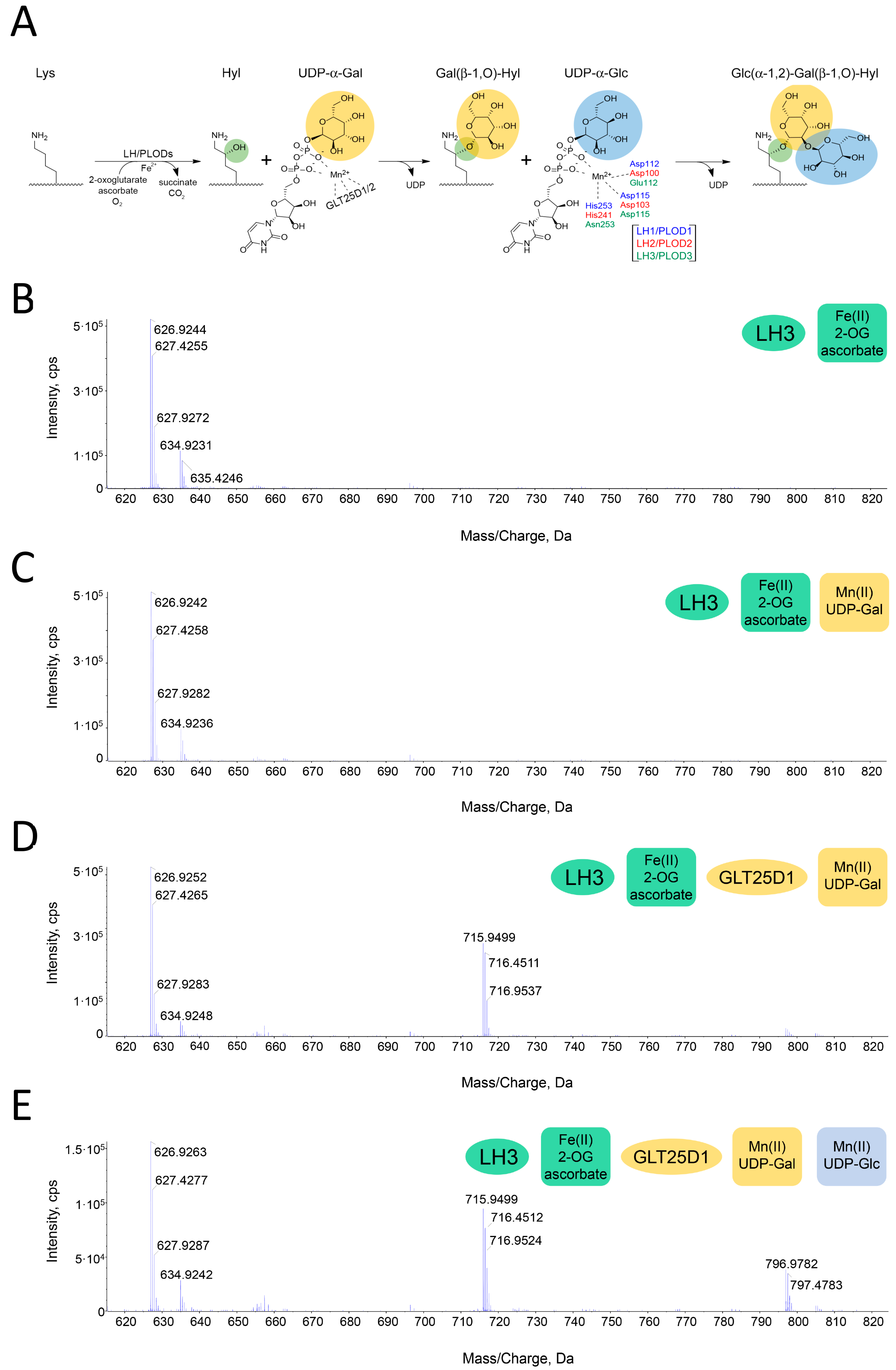
2.1. A Direct MS-Based Assay to Evaluate Lys-to-Glc-Gal-Hyl Conversion
2.2. The Amino Acid Residues Shaping the UDP Binding Site Are Essential for LH3/PLOD3 Glc-T Activity
2.3. The LH3/PLOD3 Glc-T Activity Is Affected by the Long-Range Rearrangement of Trp92 and Trp75
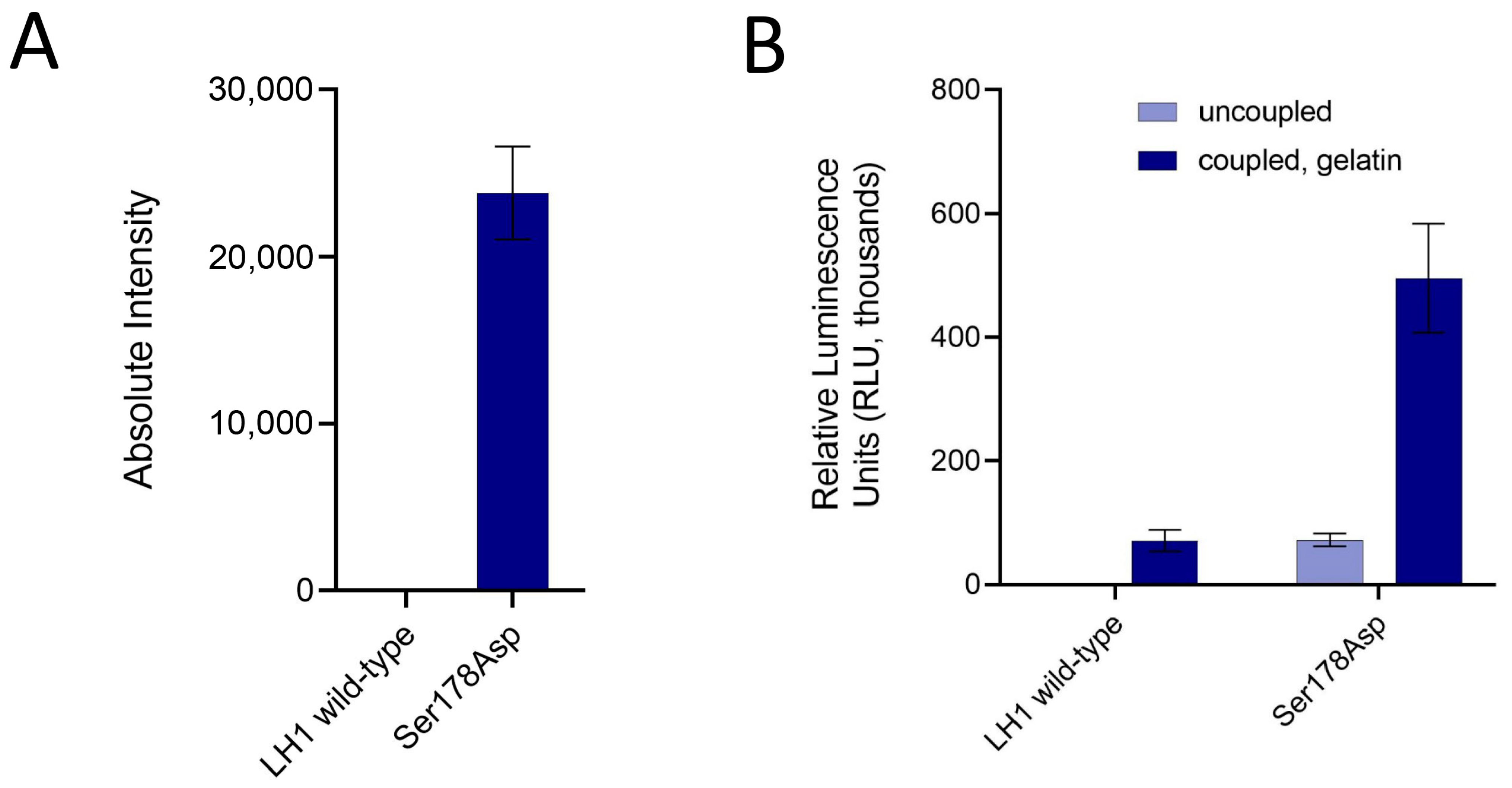
2.4. A Poly-Asp Sequence near the Donor Sugar Binding Site Is Essential for Glc-T Activity in LH1/PLOD1 and in LH3/PLOD3
2.5. Two Gating Trp Residues Modulate Glc-T Activity by Affecting Acceptor Substrate Binding
2.6. Additional Residues Facing Both Donor and Acceptor Substrates Affect the LH3/PLOD3 Glc-T Activity
2.7. Pathogenic Mutations in the LH3/PLOD3 GT Domain Affect Protein Folding
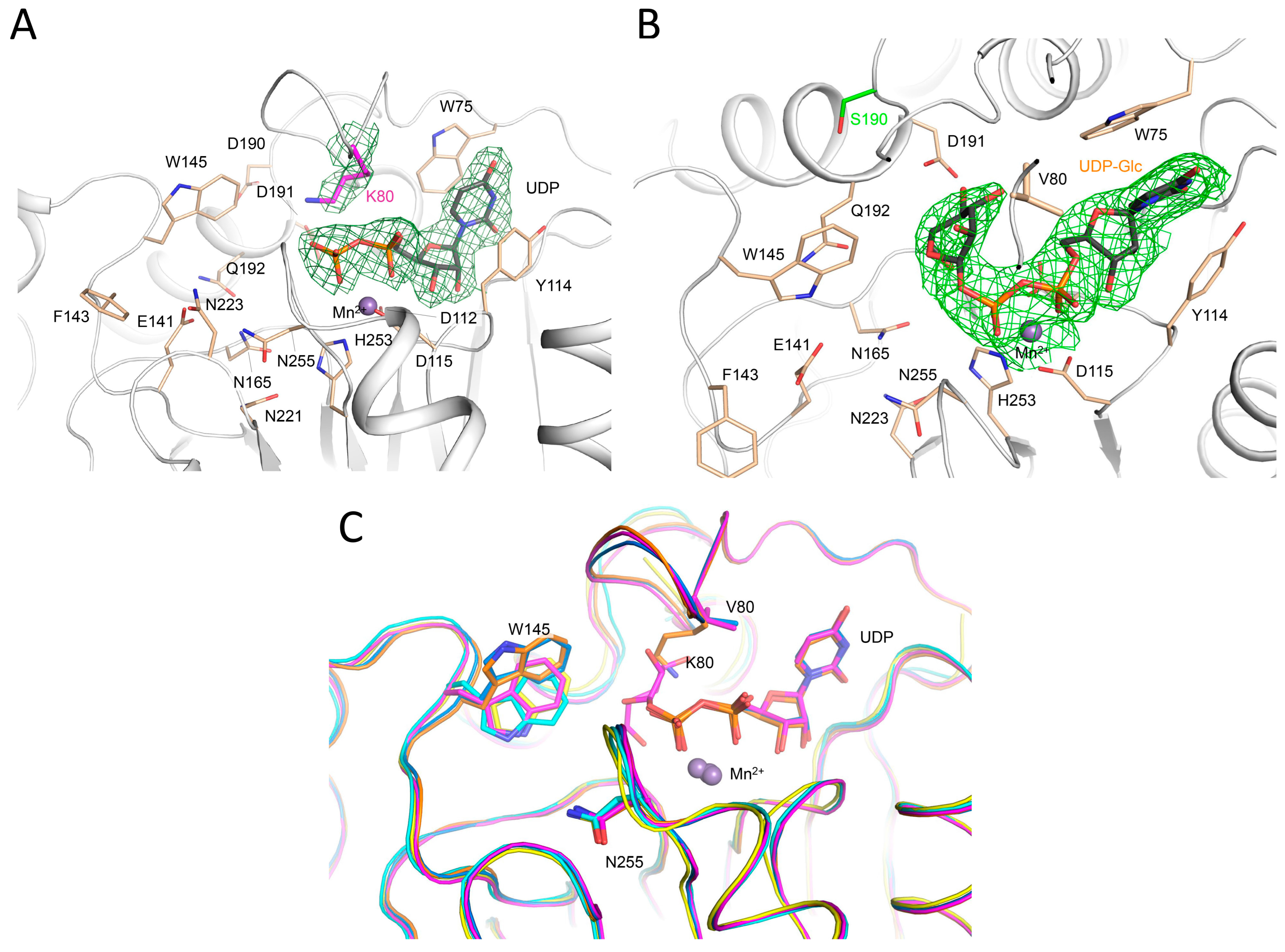
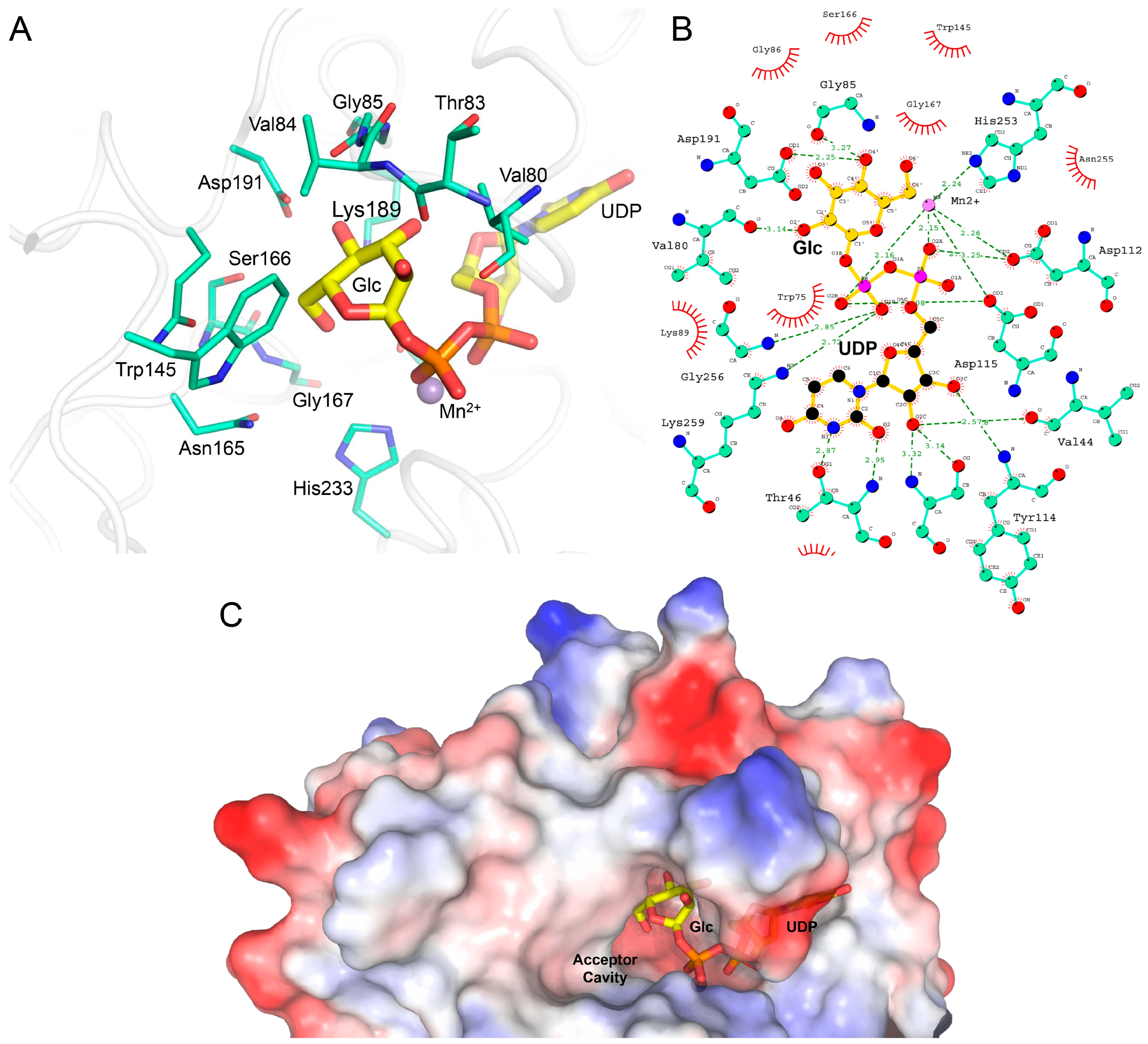
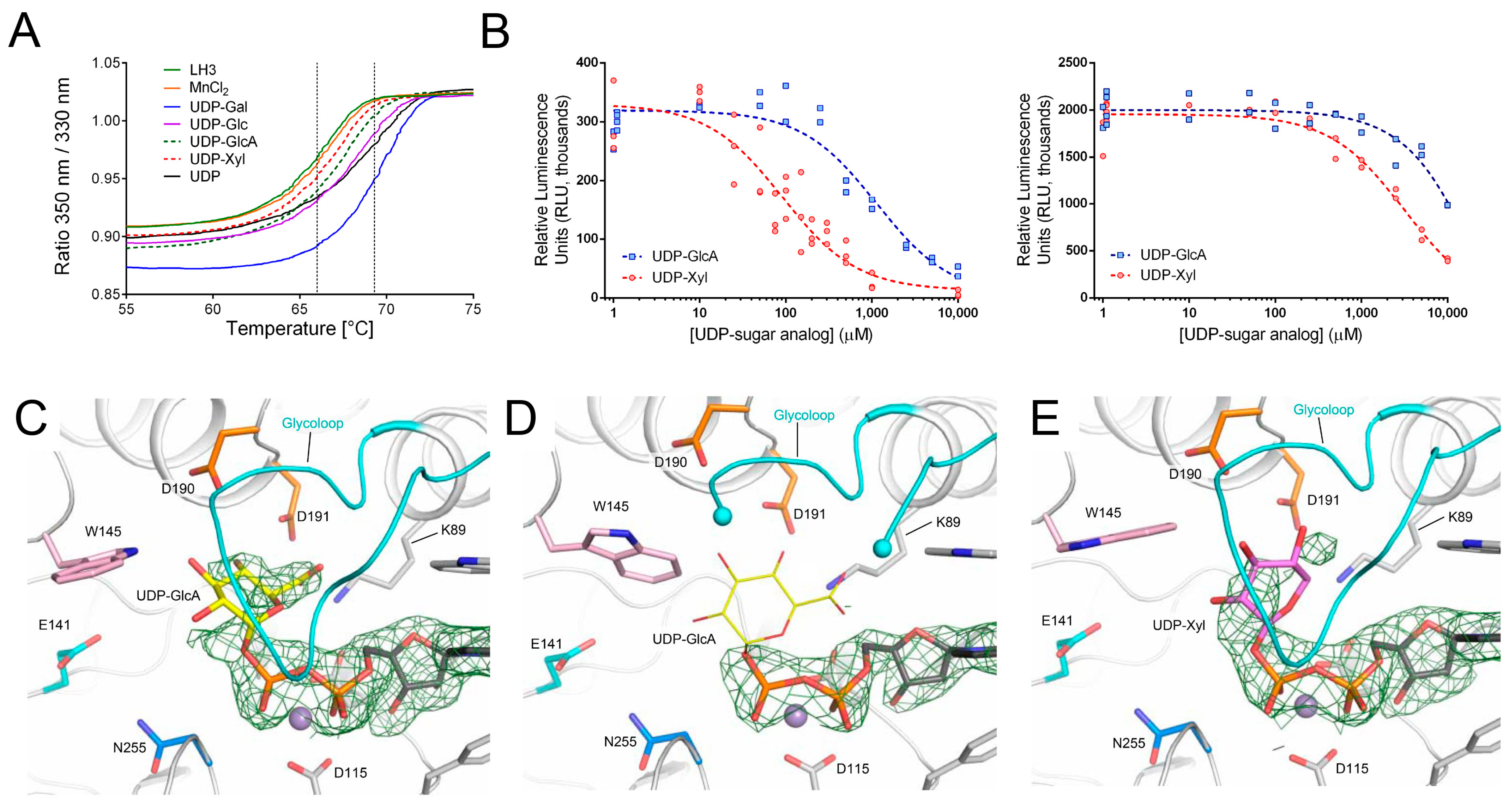
2.8. The Molecular Structures of LH3/PLOD3 in Complex with UDP-Sugar Analogs Provide Insights into the Processing of Glycan Moieties in the Catalytic Cavity
3. Discussion
4. Materials and Methods
4.1. Chemicals
4.2. Molecular Cloning and Site-Directed Mutagenesis
4.3. LH/PLOD Recombinant Expression and Protein Purification
4.4. GLT25D1 Recombinant Expression and Protein Purification
4.5. Direct Mass Spectrometry Activity Assays
4.6. Indirect Luminescence-Based Activity Assays
4.7. Differential Scanning Fluorimetry (DSF)
4.8. Crystallization, Data Collection, Structure Determination, and Refinement
Supplementary Materials
Author Contributions
Funding
Data Availability Statement
Acknowledgments
Conflicts of Interest
References
- Myllyharju, J.; Kivirikko, K.I. Collagens, modifying enzymes and their mutations in humans, flies and worms. Trends Genet. 2004, 20, 33–43. [Google Scholar] [CrossRef] [Scilit]
- Luther, K.B.; Hulsmeier, A.J.; Schegg, B.; Deuber, S.A.; Raoult, D.; Hennet, T. Mimivirus collagen is modified by bifunctional lysyl hydroxylase and glycosyltransferase enzyme. J. Biol. Chem. 2011, 286, 43701–43709. [Google Scholar] [CrossRef] [Scilit]
- Cummings, R.D. The repertoire of glycan determinants in the human glycome. Mol. Biosyst. 2009, 5, 1087–1104. [Google Scholar] [CrossRef] [Scilit]
- Spiro, R.G. Characterization and quantitative determination of the hydroxylysine-linked carbohydrate units of several collagens. J. Biol. Chem. 1969, 244, 602–612. [Google Scholar] [CrossRef] [Scilit]
- Spiro, R.G. The structure of the disaccharide unit of the renal glomerular basement membrane. J. Biol. Chem. 1967, 242, 4813–4823. [Google Scholar] [CrossRef] [Scilit]
- Spiro, M.J.; Spiro, R.G. Studies on the biosynthesis of the hydroxylsine-linked disaccharide unit of basement membranes and collagens. II. Kidney galactosyltransferase. J. Biol. Chem. 1971, 246, 4910–4918. [Google Scholar] [CrossRef] [Scilit]
- Hamazaki, H.; Hamazaki, M.H. Catalytic site of human protein-glucosylgalactosylhydroxylysine glucosidase: Three crucial carboxyl residues were determined by cloning and site-directed mutagenesis. Biochem. Biophys. Res. Commun. 2016, 469, 357–362. [Google Scholar] [CrossRef] [Scilit]
- Sternberg, M.; Spiro, R.G. Studies on the catabolism of the hydroxylysine-linked disaccharide units of basement membranes and collagens: Isolation and characterization of a new rat-kidney alpha-glucosidase of high specificity. Ren. Physiol. 1980, 3, 1–3. [Google Scholar] [CrossRef] [Scilit]
- Sternberg, M.; Grochulski, A.; Peyroux, J.; Hirbec, G.; Poirier, J. Studies on the alpha-glucosidase specific for collagen disaccharide units: Variations associated with capillary basement membrane thickening in kidney and brain of diabetic and aged rats. Coll. Relat. Res. 1982, 2, 495–506. [Google Scholar] [CrossRef] [Scilit]
- Bornstein, P.; Sage, H. Structurally distinct collagen types. Annu. Rev. Biochem. 1980, 49, 957–1003. [Google Scholar] [CrossRef] [Scilit]
- Terajima, M.; Perdivara, I.; Sricholpech, M.; Deguchi, Y.; Pleshko, N.; Tomer, K.B.; Yamauchi, M. Glycosylation and cross-linking in bone type I collagen. J. Biol. Chem. 2014, 289, 22636–22647. [Google Scholar] [CrossRef] [Scilit]
- Moro, L.; Romanello, M.; Favia, A.; Lamanna, M.P.; Lozupone, E. Posttranslational modifications of bone collagen type I are related to the function of rat femoral regions. Calcif. Tissue Int. 2000, 66, 151–156. [Google Scholar] [CrossRef] [Scilit]
- Schofield, J.D.; Freeman, I.L.; Jackson, D.S. The isolation, and amino acid and carbohydrate composition, of polymeric collagens prepared from various human tissues. Biochem. J. 1971, 124, 467–473. [Google Scholar] [CrossRef] [Scilit]
- Toole, B.P.; Kang, A.H.; Trelstad, R.L.; Gross, J. Collagen heterogeneity within different growth regions of long bones of rachitic and non-rachitic chicks. Biochem. J. 1972, 127, 715–720. [Google Scholar] [CrossRef] [Scilit]
- Rautavuoma, K.; Takaluoma, K.; Sormunen, R.; Myllyharju, J.; Kivirikko, K.I.; Soininen, R. Premature aggregation of type IV collagen and early lethality in lysyl hydroxylase 3 null mice. Proc. Natl. Acad. Sci. USA 2004, 101, 14120–14125. [Google Scholar] [CrossRef] [Scilit]
- Sipila, L.; Ruotsalainen, H.; Sormunen, R.; Baker, N.L.; Lamande, S.R.; Vapola, M.; Wang, C.; Sado, Y.; Aszodi, A.; Myllyla, R. Secretion and assembly of type IV and VI collagens depend on glycosylation of hydroxylysines. J. Biol. Chem. 2007, 282, 33381–33388. [Google Scholar] [CrossRef] [Scilit]
- Lehmann, H.W.; Wolf, E.; Roser, K.; Bodo, M.; Delling, G.; Muller, P.K. Composition and posttranslational modification of individual collagen chains from osteosarcomas and osteofibrous dysplasias. J. Cancer Res. Clin. Oncol. 1995, 121, 413–418. [Google Scholar] [CrossRef] [Scilit]
- Salo, A.M.; Cox, H.; Farndon, P.; Moss, C.; Grindulis, H.; Risteli, M.; Robins, S.P.; Myllyla, R. A connective tissue disorder caused by mutations of the lysyl hydroxylase 3 gene. Am. J. Hum. Genet. 2008, 83, 495–503. [Google Scholar] [CrossRef] [Scilit]
- Tenni, R.; Valli, M.; Rossi, A.; Cetta, G. Possible role of overglycosylation in the type I collagen triple helical domain in the molecular pathogenesis of osteogenesis imperfecta. Am. J. Med. Genet. 1993, 45, 252–256. [Google Scholar] [CrossRef] [Scilit]
- Hennet, T. Collagen glycosylation. Curr. Opin. Struct. Biol. 2019, 56, 131–138. [Google Scholar] [CrossRef] [Scilit] [PubMed]
- De Giorgi, F.; Fumagalli, M.; Scietti, L.; Forneris, F. Collagen hydroxylysine glycosylation: Non-conventional substrates for atypical glycosyltransferase enzymes. Biochem. Soc. Trans. 2021, 49, 855–866. [Google Scholar] [CrossRef] [Scilit] [PubMed]
- Wang, C.; Luosujarvi, H.; Heikkinen, J.; Risteli, M.; Uitto, L.; Myllyla, R. The third activity for lysyl hydroxylase 3: Galactosylation of hydroxylysyl residues in collagens in vitro. Matrix Biol. 2002, 21, 559–566. [Google Scholar] [CrossRef] [Scilit] [PubMed]
- Koenig, S.N.; Cavus, O.; Williams, J.; Bernier, M.; Tonniges, J.; Sucharski, H.; Dew, T.; Akel, M.; Baker, P.; Madiai, F.; et al. New mechanistic insights to PLOD1-mediated human vascular disease. Transl. Res. 2022, 239, 1–17. [Google Scholar] [CrossRef] [Scilit] [PubMed]
- Guo, H.F.; Bota-Rabassedas, N.; Terajima, M.; Leticia Rodriguez, B.; Gibbons, D.L.; Chen, Y.; Banerjee, P.; Tsai, C.L.; Tan, X.; Liu, X.; et al. A collagen glucosyltransferase drives lung adenocarcinoma progression in mice. Commun. Biol. 2021, 4, 482. [Google Scholar] [CrossRef] [Scilit]
- Savolainen, E.R.; Kero, M.; Pihlajaniemi, T.; Kivirikko, K.I. Deficiency of galactosylhydroxylysyl glucosyltransferase, an enzyme of collagen synthesis, in a family with dominant epidermolysis bullosa simplex. N. Engl. J. Med. 1981, 304, 197–204. [Google Scholar] [CrossRef] [Scilit]
- Ewans, L.J.; Colley, A.; Gaston-Massuet, C.; Gualtieri, A.; Cowley, M.J.; Mccabe, M.J.; Anand, D.; Lachke, S.A.; Scietti, L.; Forneris, F.; et al. Pathogenic variants in PLOD3 result in a Stickler syndrome-like connective tissue disorder with vascular complications. J. Med. Genet. 2019, 56, 629–638. [Google Scholar] [CrossRef] [Scilit]
- Ruotsalainen, H.; Sipila, L.; Vapola, M.; Sormunen, R.; Salo, A.M.; Uitto, L.; Mercer, D.K.; Robins, S.P.; Risteli, M.; Aszodi, A.; et al. Glycosylation catalyzed by lysyl hydroxylase 3 is essential for basement membranes. J. Cell. Sci. 2006, 119, 625–635. [Google Scholar] [CrossRef] [Scilit]
- Schegg, B.; Hulsmeier, A.J.; Rutschmann, C.; Maag, C.; Hennet, T. Core glycosylation of collagen is initiated by two beta(1-O)galactosyltransferases. Mol. Cell. Biol. 2009, 29, 943–952. [Google Scholar] [CrossRef] [Scilit]
- Perrin-Tricaud, C.; Rutschmann, C.; Hennet, T. Identification of domains and amino acids essential to the collagen galactosyltransferase activity of GLT25D1. PLoS ONE 2011, 6, e29390. [Google Scholar] [CrossRef] [Scilit]
- Sricholpech, M.; Perdivara, I.; Nagaoka, H.; Yokoyama, M.; Tomer, K.B.; Yamauchi, M. Lysyl hydroxylase 3 glucosylates galactosylhydroxylysine residues in type I collagen in osteoblast culture. J. Biol. Chem. 2011, 286, 8846–8856. [Google Scholar] [CrossRef] [Scilit]
- Yamauchi, M.; Sricholpech, M. Lysine post-translational modifications of collagen. Essays Biochem. 2012, 52, 113–133. [Google Scholar] [PubMed]
- Baumann, S.; Hennet, T. Collagen Accumulation in Osteosarcoma Cells lacking GLT25D1 Collagen Galactosyltransferase. J. Biol. Chem. 2016, 291, 18514–18524. [Google Scholar] [CrossRef] [Scilit] [PubMed]
- Scietti, L.; Chiapparino, A.; De Giorgi, F.; Fumagalli, M.; Khoriauli, L.; Nergadze, S.; Basu, S.; Olieric, V.; Cucca, L.; Banushi, B.; et al. Molecular architecture of the multifunctional collagen lysyl hydroxylase and glycosyltransferase LH3. Nat. Commun. 2018, 9, 3163. [Google Scholar] [CrossRef] [Scilit] [PubMed]
- Wang, C.; Risteli, M.; Heikkinen, J.; Hussa, A.K.; Uitto, L.; Myllyla, R. Identification of amino acids important for the catalytic activity of the collagen glucosyltransferase associated with the multifunctional lysyl hydroxylase 3 (LH3). J. Biol. Chem. 2002, 277, 18568–18573. [Google Scholar] [CrossRef] [Scilit]
- Scietti, L.; Campioni, M.; Forneris, F. SiMPLOD, a structure-integrated database of collagen lysyl hydroxylase (LH/PLOD) enzyme variants. J. Bone Miner. Res. 2019, 34, 1376–1382. [Google Scholar] [CrossRef] [Scilit]
- Laskowski, R.A.; Swindells, M.B. LigPlot+: Multiple ligand-protein interaction diagrams for drug discovery. J. Chem. Inf. Model. 2011, 51, 2778–2786. [Google Scholar] [CrossRef] [Scilit]
- Lairson, L.L.; Henrissat, B.; Davies, G.J.; Withers, S.G. Glycosyltransferases: Structures, functions, and mechanisms. Annu. Rev. Biochem. 2008, 77, 521–555. [Google Scholar] [CrossRef] [Scilit]
- Ardevol, A.; Iglesias-Fernandez, J.; Rojas-Cervellera, V.; Rovira, C. The reaction mechanism of retaining glycosyltransferases. Biochem. Soc. Trans. 2016, 44, 51–60. [Google Scholar] [CrossRef] [Scilit]
- Gloster, T.M. Advances in understanding glycosyltransferases from a structural perspective. Curr. Opin. Struct. Biol. 2014, 28, 131–141. [Google Scholar] [CrossRef] [Scilit]
- Albesa-Jove, D.; Sainz-Polo, M.A.; Marina, A.; Guerin, M.E. Structural Snapshots of alpha-1,3-Galactosyltransferase with Native Substrates: Insight into the Catalytic Mechanism of Retaining Glycosyltransferases. Angew. Chem. Int. Ed. Engl. 2017, 56, 14853–14857. [Google Scholar] [CrossRef] [Scilit]
- Coutinho, P.M.; Deleury, E.; Davies, G.J.; Henrissat, B. An evolving hierarchical family classification for glycosyltransferases. J. Mol. Biol. 2003, 328, 307–317. [Google Scholar] [CrossRef] [Scilit] [PubMed]
- Lombard, V.; Golaconda Ramulu, H.; Drula, E.; Coutinho, P.M.; Henrissat, B. The carbohydrate-active enzymes database (CAZy) in 2013. Nucleic Acids Res. 2014, 42, D490–D495. [Google Scholar] [CrossRef] [Scilit] [PubMed]
- Kivirikko, K.I.; Myllyla, R. Collagen glycosyltransferases. Int. Rev. Connect. Tissue Res. 1979, 8, 23–72. [Google Scholar] [PubMed]
- Myllyla, R.; Anttinen, H.; Risteli, L.; Kivirikko, K.I. Isolation of collagen glucosyltransferase as a homogeneous protein from chick embryos. Biochim. Biophys. Acta 1977, 480, 113–121. [Google Scholar] [CrossRef] [Scilit]
- Gomez, H.; Lluch, J.M.; Masgrau, L. Essential role of glutamate 317 in galactosyl transfer by alpha3GalT: A computational study. Carbohydr. Res. 2012, 356, 204–208. [Google Scholar] [CrossRef] [Scilit]
- Patenaude, S.I.; Seto, N.O.; Borisova, S.N.; Szpacenko, A.; Marcus, S.L.; Palcic, M.M.; Evans, S.V. The structural basis for specificity in human ABO(H) blood group biosynthesis. Nat. Struct. Biol. 2002, 9, 685–690. [Google Scholar] [CrossRef] [Scilit]
- Lairson, L.L.; Chiu, C.P.; Ly, H.D.; He, S.; Wakarchuk, W.W.; Strynadka, N.C.; Withers, S.G. Intermediate trapping on a mutant retaining alpha-galactosyltransferase identifies an unexpected aspartate residue. J. Biol. Chem. 2004, 279, 28339–28344. [Google Scholar] [CrossRef] [Scilit]
- Raghunath, M.; Bruckner, P.; Steinmann, B. Delayed triple helix formation of mutant collagen from patients with osteogenesis imperfecta. J. Mol. Biol. 1994, 236, 940–949. [Google Scholar] [CrossRef] [Scilit]
- Studier, F.W. Protein production by auto-induction in high density shaking cultures. Protein Expr. Purif. 2005, 41, 207–234. [Google Scholar] [CrossRef] [Scilit]
- Kabsch, W. XDS. Acta Crystallogr. D Biol. Crystallogr. 2010, 66, 125–132. [Google Scholar] [CrossRef] [Scilit]
- Evans, P.R.; Murshudov, G.N. How good are my data and what is the resolution? Acta Crystallogr. D Biol. Crystallogr. 2013, 69, 1204–1214. [Google Scholar] [CrossRef] [Scilit]
- Tickle, I.J.; Flensburg, C.; Keller, P.; Paciorek, W.; Sharff, A.; Vonrhein, C.; Bricogne, G. STARANISO; Global Phasing Ltd.: Cambridge, UK, 2018. [Google Scholar]
- Mccoy, A.J.; Grosse-Kunstleve, R.W.; Adams, P.D.; Winn, M.D.; Storoni, L.C.; Read, R.J. Phaser crystallographic software. J. Appl. Crystallogr. 2007, 40, 658–674. [Google Scholar] [CrossRef] [Scilit]
- Emsley, P.; Lohkamp, B.; Scott, W.G.; Cowtan, K. Features and development of Coot. Acta Crystallogr. Sect. D 2010, 66, 486–501. [Google Scholar] [CrossRef] [Scilit]
- Adams, P.D.; Afonine, P.V.; Bunkoczi, G.; Chen, V.B.; Davis, I.W.; Echols, N.; Headd, J.J.; Hung, L.W.; Kapral, G.J.; Grosse-Kunstleve, R.W.; et al. PHENIX: A comprehensive Python-based system for macromolecular structure solution. Acta Crystallogr. D Biol. Crystallogr. 2010, 66, 213–221. [Google Scholar] [CrossRef] [Scilit]
- Chen, V.B.; Arendall, W.B., 3rd; Headd, J.J.; Keedy, D.A.; Immormino, R.M.; Kapral, G.J.; Murray, L.W.; Richardson, J.S.; Richardson, D.C. MolProbity: All-atom structure validation for macromolecular crystallography. Acta Crystallogr. D Biol. Crystallogr. 2010, 66, 12–21. [Google Scholar] [CrossRef] [Scilit]



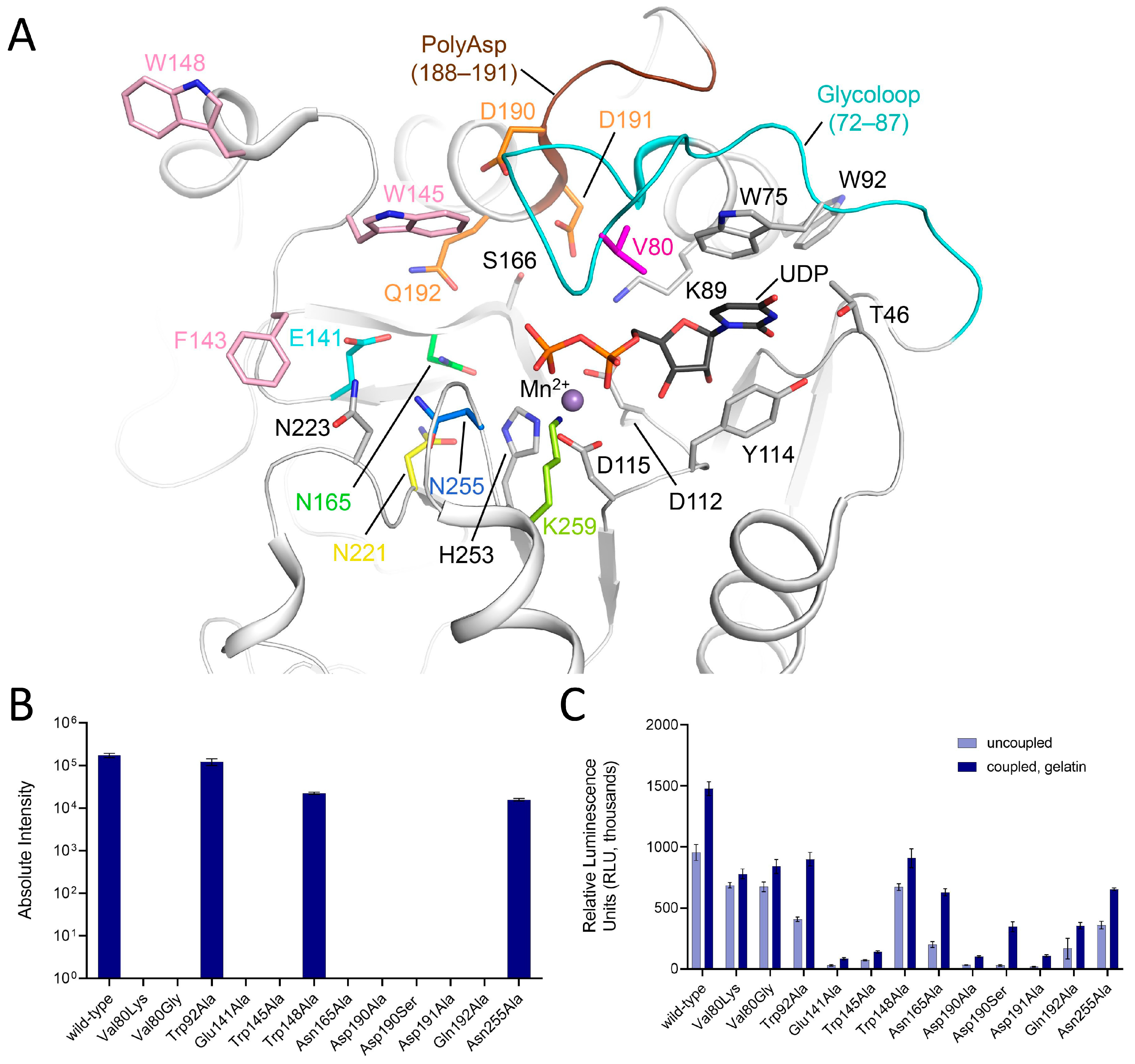
| Mutation | Localization | Folding State/ LH Activity | Glc-T Activity (MS) (%) | Glc-T Activity (Luminescence) (%) | |
|---|---|---|---|---|---|
| Uncoupled | Coupled, Gelatin | ||||
| wild-type | N/A | Yes | 100 | 100 | 100 |
| Val80Lys | glycoloop | Yes | N.D. | 72 ± 2 | 53 ± 3 |
| Val80Gly | glycoloop | Yes | N.D. | 70 ± 4 | 54 ± 4 |
| Trp92Ala | UDP-binding cavity | Yes | 71 ± 14 | 43 ± 2 | 60 ± 4 |
| Asp190Ala | poly-Asp helix | Yes | N.D. | 3 ± 0.27 | 7 ± 0.5 |
| Asp191Ala | poly-Asp helix | Yes | N.D. | 2 ± 0.3 | 7 ± 0.6 |
| Asp190Ser | poly-Asp helix | Yes | N.D. | 2 ± 0.4 | 17 ± 2 |
| Trp145Ala | acceptor substrate cavity and gates | Yes | N.D. | 8 ± 0.5 | 9 ± 0.6 |
| Trp148Ala | acceptor substrate cavity and gates | Yes | 13 ± 2 | 70 ± 3 | 61 ± 5 |
| Asn165Ala | region proximate UDP-sugar | Yes | N.D. | 21 ± 3 | 42 ± 2 |
| Gln192Ala | region proximate UDP-sugar | Yes | N.D. | 17 ± 9 | 24 ± 2 |
| Glu141Ala | region proximate UDP-sugar | Yes | N.D. | 3 ± 0.6 | 6 ± 0.6 |
| Asn255Ala | region proximate UDP-sugar | Yes | 9 ± 0.5 | 38 ± 3 | 44 ± 0.7 |
| Pro270Leu | interface of AC and GT domains | No | N.D. | N.D. | N.D. |
| Inhibitor | UDP-Gal (IC50, μM) | UDP-Glc (IC50, μM) |
|---|---|---|
| wild-type + UDP-GlcA | 1130 ± 370 | >10,000 |
| wild-type + UDP-Xyl | 91 ± 23 | 3170 ± 211 |
Disclaimer/Publisher’s Note: The statements, opinions and data contained in all publications are solely those of the individual author(s) and contributor(s) and not of MDPI and/or the editor(s). MDPI and/or the editor(s) disclaim responsibility for any injury to people or property resulting from any ideas, methods, instructions or products referred to in the content. |
© 2023 by the authors. Licensee MDPI, Basel, Switzerland. This article is an open access article distributed under the terms and conditions of the Creative Commons Attribution (CC BY) license (https://creativecommons.org/licenses/by/4.0/).
Share and Cite
Mattoteia, D.; Chiapparino, A.; Fumagalli, M.; De Marco, M.; De Giorgi, F.; Negro, L.; Pinnola, A.; Faravelli, S.; Roscioli, T.; Scietti, L.; et al. Identification of Regulatory Molecular “Hot Spots” for LH/PLOD Collagen Glycosyltransferase Activity. Int. J. Mol. Sci. 2023, 24, 11213. https://doi.org/10.3390/ijms241311213
Mattoteia D, Chiapparino A, Fumagalli M, De Marco M, De Giorgi F, Negro L, Pinnola A, Faravelli S, Roscioli T, Scietti L, et al. Identification of Regulatory Molecular “Hot Spots” for LH/PLOD Collagen Glycosyltransferase Activity. International Journal of Molecular Sciences. 2023; 24(13):11213. https://doi.org/10.3390/ijms241311213
Chicago/Turabian StyleMattoteia, Daiana, Antonella Chiapparino, Marco Fumagalli, Matteo De Marco, Francesca De Giorgi, Lisa Negro, Alberta Pinnola, Silvia Faravelli, Tony Roscioli, Luigi Scietti, and et al. 2023. "Identification of Regulatory Molecular “Hot Spots” for LH/PLOD Collagen Glycosyltransferase Activity" International Journal of Molecular Sciences 24, no. 13: 11213. https://doi.org/10.3390/ijms241311213
APA StyleMattoteia, D., Chiapparino, A., Fumagalli, M., De Marco, M., De Giorgi, F., Negro, L., Pinnola, A., Faravelli, S., Roscioli, T., Scietti, L., & Forneris, F. (2023). Identification of Regulatory Molecular “Hot Spots” for LH/PLOD Collagen Glycosyltransferase Activity. International Journal of Molecular Sciences, 24(13), 11213. https://doi.org/10.3390/ijms241311213