


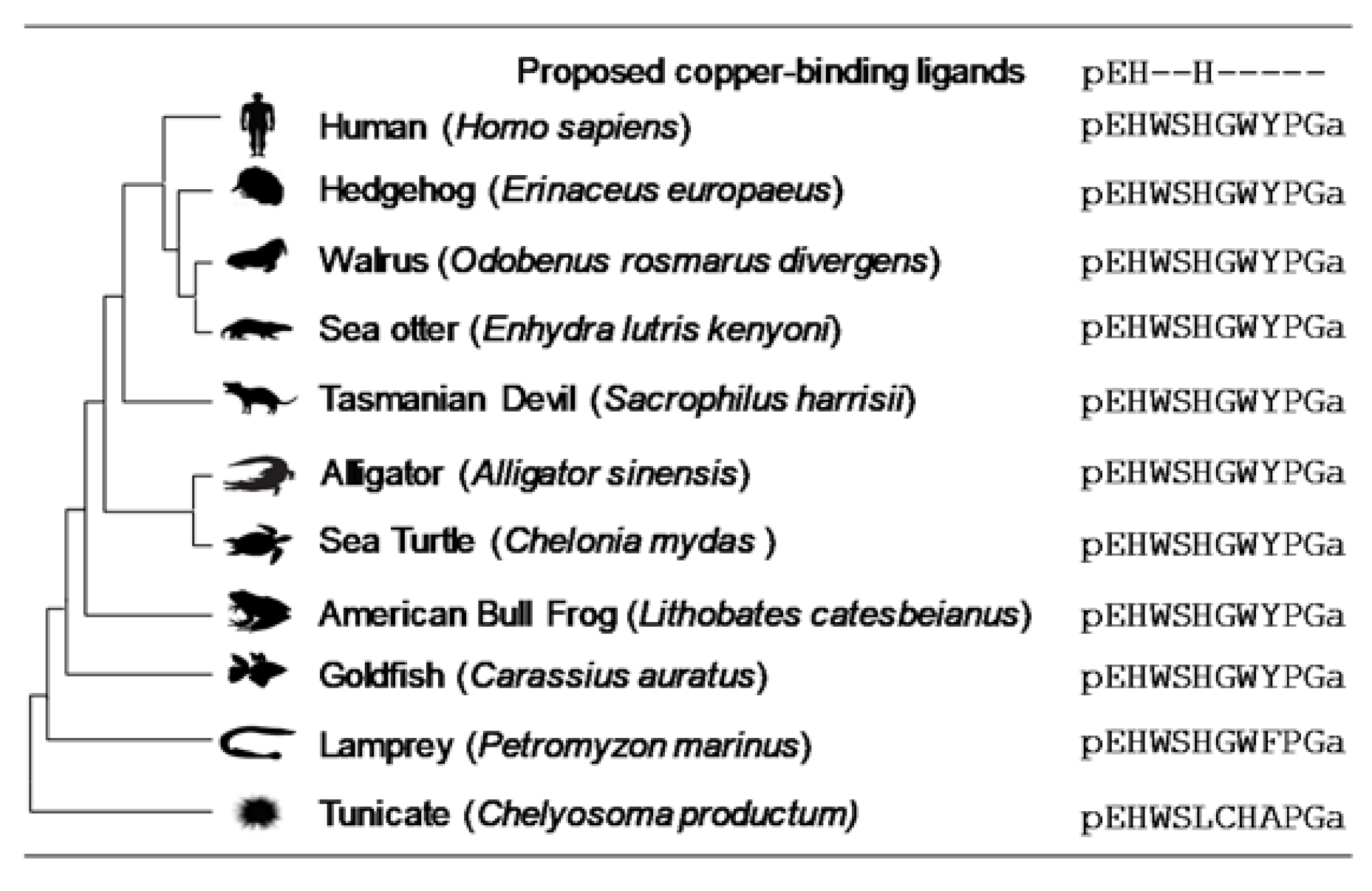
The authors wish to make the following correction to this paper [1]. Due to an incorrect phylogenetic tree, Figure 5 should be replaced with the following figure (Figure 1).
Figure 1.
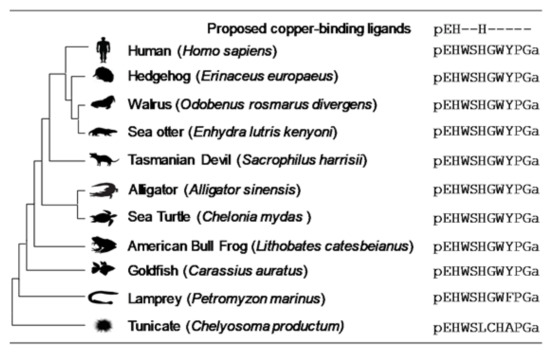
Diagram showing GnRH-II sequences from deuterostomes. All vertebrate GnRH-II peptides contain the pEHxxH sequence proposed to be the copper-binding site. The site is invariant in vertebrates and is not observed in deuterostome invertebrates such as the tunicates. The peptides are all amidated at the C-terminus, denoted by an ‘a’ in the primary sequence.
The correction does not change the scientific conclusions of the article in any way.
The authors would like to apologize for any inconvenience caused to the readers by these changes.
Acknowledgments
We thank Maurice Elphick (Queen Mary, University of London) for helpful advice.
Conflicts of Interest
The authors declare no conflict of interest.
References
- Peacey, L.; Peacey, C.; Gutzinger, A.; Jones, C.E. Copper(II) Binding by the Earliest Vertebrate Gonadotropin-Releasing Hormone, the Type II Isoform, Suggests an Ancient Role for the Metal. Int. J. Mol. Sci. 2020, 21, 7900. [Google Scholar] [CrossRef] [Scilit] [PubMed]
Publisher’s Note: MDPI stays neutral with regard to jurisdictional claims in published maps and institutional affiliations. |
© 2021 by the authors. Licensee MDPI, Basel, Switzerland. This article is an open access article distributed under the terms and conditions of the Creative Commons Attribution (CC BY) license (http://creativecommons.org/licenses/by/4.0/).