


Abstract
Aryl halides are important intermediates for chemical synthesis. However, the negative reduction potential up to −2.7 V (vs. SCE) makes photoredox conversion of aryl halides by reductive dehalogenation to aryl radicals for chemical transformations difficult. Inspired by the outstanding photophysical properties of deazaflavin and triphenylamine, as well as results of theoretical calculations, we attached the diphenylamino group to C8 of deazaflavin, and the resulting compounds look fabricated by “fusing” deazaflavin and triphenylamine (TPA) together by sharing the benzene ring. We also introduced alkyl and aryl moieties to C5 and afforded a series of deazaflavin derivatives (dFLs), namely 10-butyl-8-(diphenylamino)-3,5-dimethylpyrimido[4,5b]quinoline-2,4(3H,10H)-dione (TPAdFlMe), 10-butyl-8-(diphenylamino)-3-methyl-5-(trifluoromethyl)pyrimido[4,5-b]quinoline-2,4(3H,10H)-dione(TPAdFlTF) and 10-butyl-8-(diphenylamino)-3-methyl-5-phenylpyrimido[4,5-b]quinoline-2,4(3H,10H)-dione (TPAdFlPh), and investigated their photophysical properties and performance as sensitizers in the photodehalogenation of aryl halides. We showed that the photophysical properties are significantly improved in these dFLs. The absorption bands of dFLs are redshifted and the absorbance is more than double that of riboflavin tetraacetate (RFTA). The singlet oxygen quantum yields of TPAdFlMe, TPAdFlTF and TPAdFlPh are 0.42, 0.25 and 0.39, respectively, and the corresponding redox potentials are −1.75, −0.75 and −1.71 V vs. Ag/Ag+, respectively, comparable to known deazaflavin-based sensitizers. Originating from these properties, TPAdFlMe and TPAdFlPh are capable of sensitizing the full photodehalogenation of 0.038 mmol p-iodoanisole, and the yields of the photodehalogenation of 0.038 mmol p-bromoanisole are 67 and 69%, respectively. They also demonstrate exceptional performance in the photodehalogenation of halides of polycyclic aromatics with yields in the range of 73% for 1-benzhydryl-3-bromobenzene to 100% for 1-bromonapthalene in 18 h runs. The performance of TPAdFlMe and TPAdFlPh in photodehalogenation are already comparable to recently reported deazaflavin-based sensitizers, and we propose the transformation would proceed though the consecutive photo-induced electron transfer (conPET) mechanism with consecutive excitation of charged deazaflavin-based radicals under light irradiation as the key step to generating the aryl radicals, and the vital role of sensitizer-based radicals is further confirmed by mechanistic investigations. We expect the findings will help to design novel flavin-based triplet sensitizers for photoredox catalytic organic transformations.
1. Introduction
Synthetic chemists have long strived to develop chemical processes for the formation and scission of bonds, processes involving radical intermediates that are highly desired. Designed radical intermediates are highly active species with unpaired electrons, capable of reacting with a broad range of chemicals efficiently and selectively, enabling lots of chemical transformations that are difficult to achieve with conventional species and processes where electrons are paired, in an expedient fashion [1,2,3,4,5,6]. Owning to these advantages, the metal-free generation and utilization of radical intermediates at moderate conditions for chemical transformation is drawing considerable attention and becoming a new frontier in synthetic chemistry. Radical arylation is a typical reaction of this kind, involving the generation of aryl radicals and their further evolution by reactions with various substrates. Compared to conventional protocols for the generation of aryl radicals—which suffer from the usage of hazardous stoichiometric reagents, costly and toxic transition metals, harsh operating conditions and the use of strong bases, etc. [7]—the recently discovered photocatalytic protocols are more eco-benign, energy efficient and easy to realize, especially those utilizing visible light, and are of fundamental importance with significant practical value [5,6,7,8,9,10,11,12]. As not all precursors of aryl radicals or substrates can absorb the energy of light to generate radicals, photosensitizers (PSs) are commonly used in the photocatalytic protocols to harvest the energy of light radiation, and to transfer it into chemical energy through electron (ET) and/or energy transfer (EnT) with substrates, forming reactive intermediates (RIs), etc., to keep the chemical transformations efficient. As the decay of PS from triplet excited states (Tn) to the ground state (S0) is spin-forbidden, triplet PSs are more efficient for EnT/ET with substrates, triggering cleavage of chemical bonds for the generation of desired radicals. Tremendous efforts are devoted to developing novel PSs for efficient chemical transformations (Scheme 1A,B). Though the redox potential of aryl halides can be up to −3 V vs. SCE (saturated calomel electrode), their direct photodehalogenation has been reported to proceed through conPET use, and aryl radicals were proposed as RIs (Scheme 1B) [13,14,15,16,17,18]. The semiquinone of dazaflavin as the radical species are formed by ET from the diisopropyl (ethyl) amine (DIPEA) donor to the PS at T1 [2,19,20,21,22,23,24,25]. The generated aryl radicals may be trapped chemically for further chemical transformations. Currently, the PSs available for the photodehalogenation of aryl halides via consecutive photo-induced electron transfer (conPET) are limited (Scheme 1A,B) [13,14,15,23,26,27,28,29]. Hence, photocatalysts for mild and efficient aryl radical generation from the wide range of aryl halides are of particular interest.
Scheme 1.
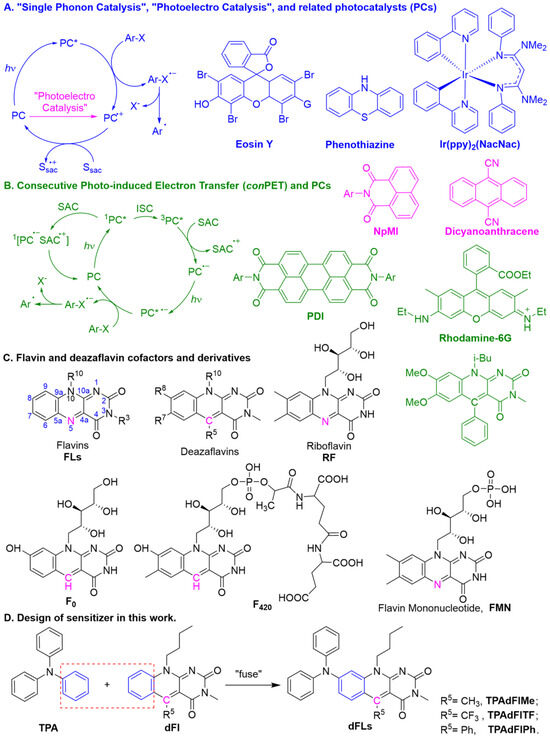
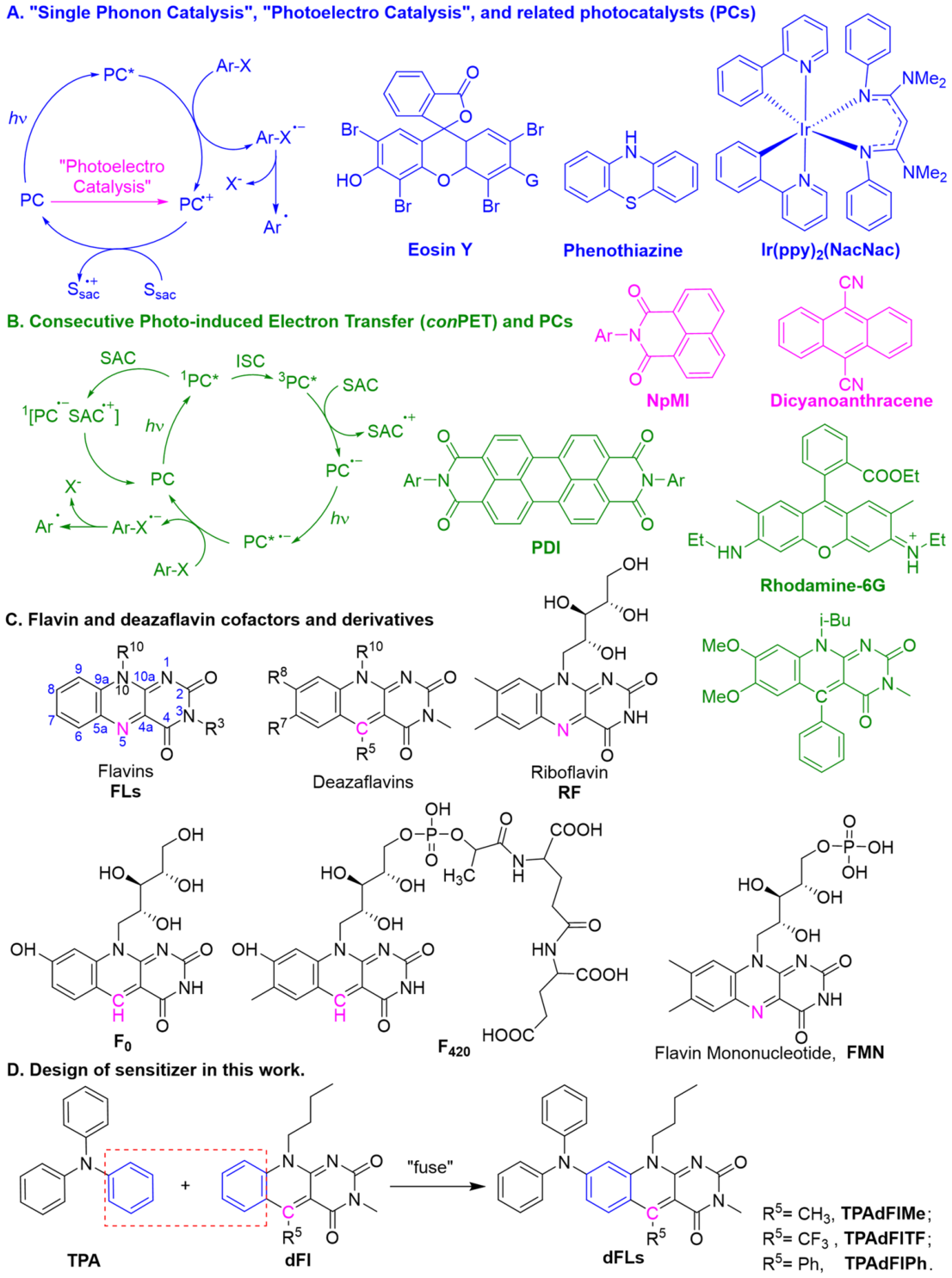
(A) Dehalogenation of aryl halides through “single-photon catalysis” (blue) and “photoelectro catalysis” (pink) pathways and typical PCs; (B) dehalogenation of aryl halides through consecutive photo-induced electron transfer and the reported PCs (green); (C) structures of the backbone of flavin and deazaflavin, and some naturally available flavin cofactors, namely RF, F0, F420, and FMN; (D) design of efficient deazaflavin-based sensitizers in this work. “*” stands for excited state, “·” stands for radical.
Flavin and its derivatives (FLs) are a family of compounds with a backbone of isoalloxazine that naturally exist as blue light receptors and cofactors in enzymes [30,31,32,33] and are the active sites of many biochemical processes in biological systems (Scheme 1C) [30,34,35,36]. Many FLs are efficient in sensitizing the oxidation of hydroxyl, amine, alkyl, alkoxy, ester, sulfide, hydrazine, phosphine moieties, etc., in organic compounds [37,38,39,40]. These transformations were proposed to initiate with the formation of RIs sensitized by FL-based PSs through ET, EnT or both [41,42,43]. The substitution of N5 of isoalloxazine with a C atom forms 5-deazaflavin that also acts as a coenzyme in organisms (Scheme 1C) [44,45]. Similar to FLs, deazaflavin also absorbs strongly in the visible light range, and fluoresces strongly at ~470 nm [15,46]. Deazaflavin derivatives are also eligible as photocatalysts, efficient in sensitizing the formation of ROSs [47,48,49] and cycloaddition of olefins [38,50,51], etc. The partially reduced deazaflavins are highly reactive [44,52,53,54], but are stable and function mainly as two-electron carriers when fully reduced [44,54,55,56,57,58], and can be synthesized or generated in situ [58,59,60]. The phenyl at C5 was found to be beneficial for lowering the redox potential of deazaflavin to ~−2.0 eV, making 5-phenyldeazaflavin superior reductants in photosynthesis [13,14,15,29]. Excited partially reduced deazaflavin derivatives are also capable of donating electrons for reductive the photodehalogenation of aryl halides via conPET (Scheme 1B) [13,14,15,29].
In principal, the efficiency of PS-sensitized transformations was determined by many factors, such as the light-harvesting ability, triplet quantum yields, stability of related intermediates, lifetime and the redox potential of the excited PSs, etc. [61,62,63]. Many attempts have been made to tailor the molecular structure of FLs and deazaflavin derivatives for application as sensitizers in photocatalysis [37,38,39]. Using [Ru(bpy)3]2+ as heavy atom-containing moieties attached to FL, we enhanced the ISC rates of FL and observed the phosphorescence emission from FL moieties [64,65]. We utilized the heavy atom effect of Br to boost the ISC from S1 in 7,8-dibromoflavin, more than doubling 1O2 quantum yield (ΦΔ) and achieving 2–5 times performance enhancement in the photooxidation of sulfides with respect to FL [66]. This PS also outperformed FL, 9-bromoflavin and 10-phenylflavin in sensitizing the photooxidative coupling of benzylic amines [67]. Amidation and alkylation at N5 and N10 were also found to be efficient at improving the performance of PSs with an alloxazine backbone [68,69]. We “fused” FL with naphthalimide, affording us NI-FL, with double the UV-Vis absorption and an elongated T1 lifetime that is capable of sensitizing the photooxidation of sulfide by ET and is 1–5 times more efficient than FL [70]. We recently attached -COOCH3 to C7, C8 and both FLs and found the resulting FL derivatives are efficient at sensitizing the oxidative coupling of various benzylic amines to imines [71]. These findings, and the reported photocatalytic organic transformations using FLs and deazaflavin derivatives, suggest the feasibility of improving the efficiency of PSs by tailoring the molecular structure rationally.
As inspired by the previous attempts to improve the efficiency of FL-based PSs by tailoring the molecular structure rationally, and the recent findings on deazaflavin derivative-sensitized the photodehalogenation of aryl halides as well, we designed several deazaflavin-based sensitizers (dFLs, Scheme 1D). Previously, 5-aryl and 7,8-methoxy substitution on benzene ring were proposed to have a positive effect on the photocatalytic activity/reduction potential of deazaflavins [13,14,15,16,17,18]. We attached diphenylamino to C8, so that the resulting deazaflavin derivatives look fabricated by “fusing” triphenylamine (TPA) that is commonly used as a donor in photovoltaic applications and strongly absorbs deazaflavin by sharing the benzene ring. We expect such a design would benefit the absorption of the resulting dFLs in the visible light range and their performance as reductants when converted to excited semiquinone radicals. We also introduced alkyl and aryl moieties to C5. These led to a series of dFLs afforded in this work, namely TPAdFlMe, TPAdFlTF and TPAdFlPh (Scheme 1D). We expected these would impact the reduction potential, photophysical properties and performance in photodehalogenation of aryl halides of these dFLs. Their photophysical properties and performance as sensitizers in the photodehalogenation of various aryl halides of these dFLs were investigated, combining experimental and theoretical efforts. We expect the findings will benefit the development of PSs for future photosynthesis.
2. Results and Discussions
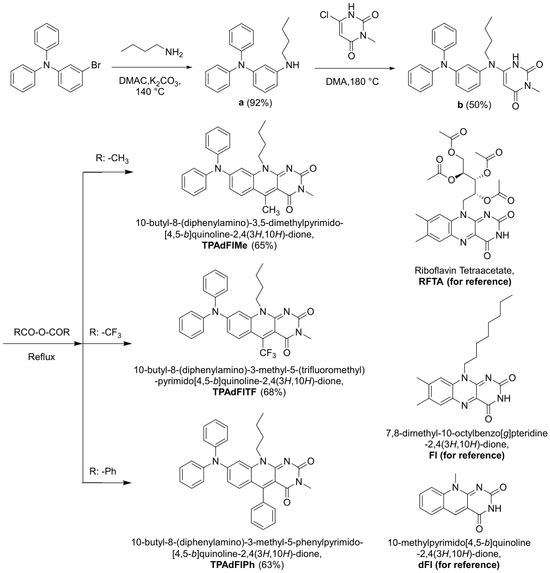
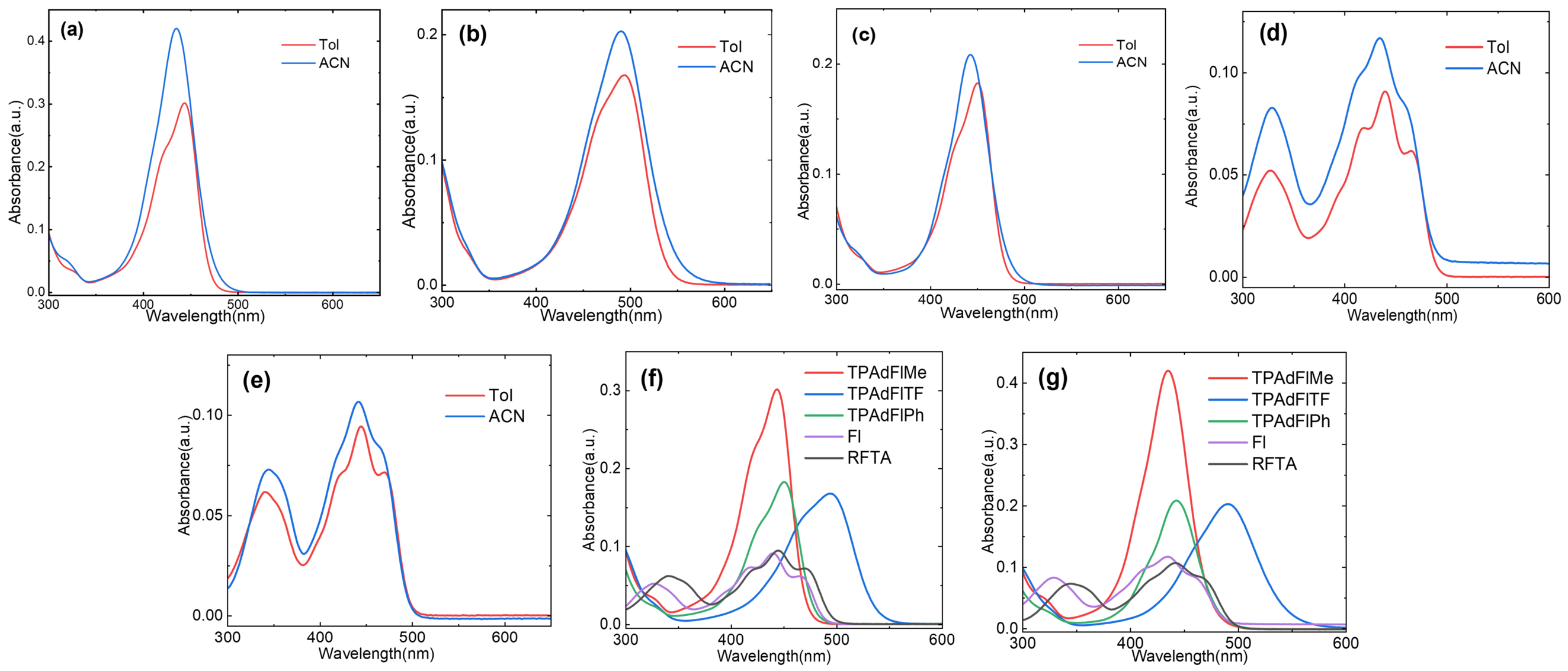
The designed dFLs, namely TPAdFlMe, TPAdFlTF and TPAdFlPh, were afforded (Scheme 2 and Figures S3-1–S3-13 and S4). The absorption properties of these dFLs were investigated in toluene (Tol) and acetonitrile (ACN) first (Figure 1 and Table 1). There is only one absorption band in the range of 300 nm on the absorption spectra of dFLs (Figure 1a–c), while there are two absorption bands on the spectra of Fl and RFTA (Figure 1d,e). The absorption of these dFLs are stronger in ACN than in Tol. Furthermore, the absorption of TPAdFlMe is the strongest among these dFLs independent of the solvent used. The measured first absorption maxima (λabs) of TPAdFlMe, TPAdFlTF, TPAdFlPh, Fl and RFTA in Tol are at 444, 490, 450, 439 and 447 nm, respectively, and are blue-shifted to 435, 490, 443, 434 and 442 nm, respectively. In this sense, the absorption properties of these dFLs are weakly solvent-dependent.
Scheme 2.
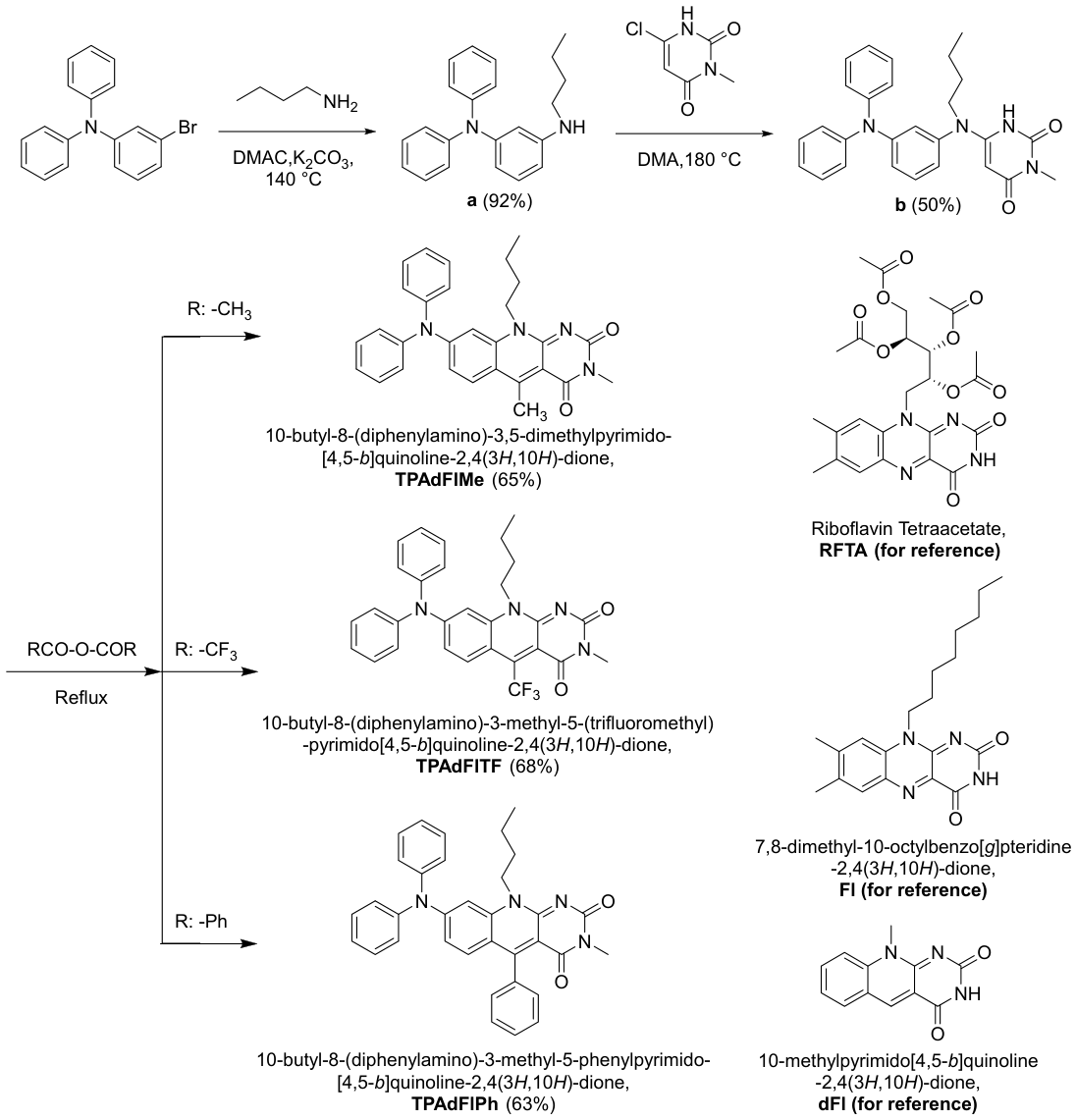
The structures and synthesis of TPAdFLMe, TPAdFlTF, and TPAdFlPh, and the structures of reference compounds for comparison, namely RFTA, Fl and dFl.
Figure 1.
The experimental absorption spectra of TPAdFlMe (a), TPAdFlTF (b), TPAdFlPh (c), Fl (d) and RFTA (e) in Tol (red) and ACN (blue), and comparison of the experimental absorption spectra of all dFLs in Tol (f) and in ACN (g). (1 × 10⁻⁵ M, 25 °C).
Table 1.
Electronic transitions involved in UV-Vis spectra of dFLs a.
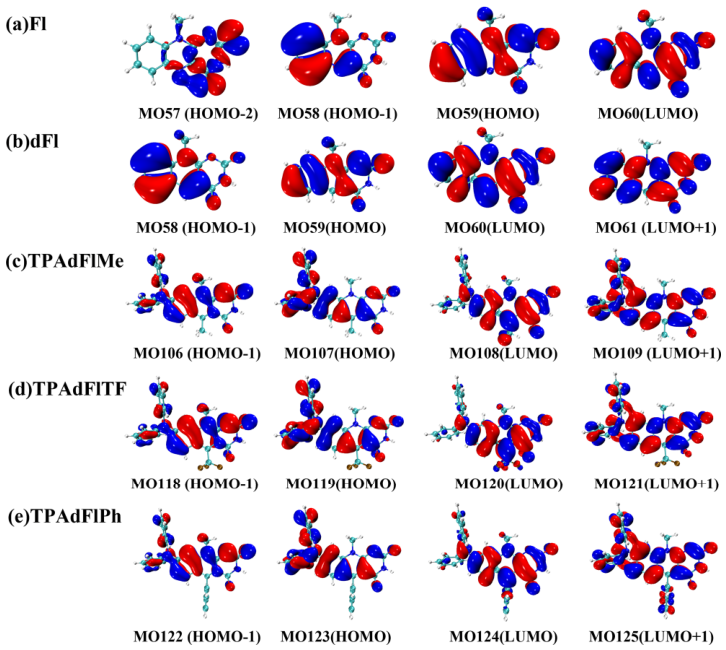
According to results of TD-DFT-based calculations, λabs can be assigned to the S0→S1 transition of corresponding dFLs. For Fl in Tol, one absorption band with shoulders appears at 439 nm and another one is at 328 nm. These would shift to 435 and 329 nm, respectively, in ACN. The first two TD-DFT-calculated absorption maxima of Fl are at 410 and 331 nm, respectively. These two bands can be assigned to S0→S1 and S0→S4 transitions of π→π* and n→π* character, respectively. The S0→S1 transition is contributed by MO59 and MO60, which are the highest occupied molecular orbital (HOMO) and lowest unoccupied orbital (LUMO), respectively, while the S0→S4 transition is contributed by MO58 and MO60 (Table 1 and Table S6-1 and Figure 1, Figure 2 and Figure S6-1) [64,66,70]. The current results are consistent with those reported previously, suggesting the current theoretical approaches proposed are adequate to investigate the photophysics of dFLs (Figure 1) [72,73,74,75,76,77,78,79]. Benchmark calculations on vertical excitation energies of FL were also performed with range-separated CAM-B3LYP and ωB97XD, as well as the PBE hybrid (PBE0) functional, yielding essentially the same picture (Table S6-1 and Figure S6-1). The results of PBE0 functional are nearly the same with those of B3LYP functional. However, the vertical excitation energy obtained with CAM-B3LYP and ωB97XD functional are significantly different for predictive calculations [75,80,81,82]. With CAM-B3LYP functional, the S0→S1 and S0→S2 vertical excitation energies calculated are 3.43 (362 nm) and 4.29 eV (288 nm), respectively, and these are consistent with those from ωB97XD functional. As these are significantly different from theoretical and experimental results reported previously, CAM-B3LYP and ωB97XD functional are less eligible for predictive investigations [70,72,73,74,75,76,77,78,79]. This also agrees with the theoretical benchmark investigation [83]. Therefore, further calculations were performed with B3LYP functional.
Figure 2.
Isosurface plot of molecular orbitals contributing to low-energy electronic transitions corresponding to Fl (a), dFL (b), TPAdFlMe (c), TPAdFlTF (d) and TPAdFlPh (e). (C, O, N, and H atoms are in cyan, red, blue, and white, respectively. Isovalue: ±0.02 au). Isosurface plots of other frontier MOs can be found in Figures S6-1–S6-5.
The first two absorption bands of dFL are blue-shifted with respect to Fl, and can be assigned to S0→S1 and S0→S3 transitions of π→π* and n→π* character, involving MO58, MO59 and MO60 (Table 1 and Table S5-2, and Figure 2b and Figure S5-2) [84,85]. The consistency of the current results on Fl and dFL with those reported suggest the approaches used are adequate to investigate the photophysical properties of designed dFLs. The character of the HOMO and LUMO of Fl are well inherited by those of dFLs (Figure 2a,b). The attachment of the biphenylamino group to C8 and functional groups at C5 not only alter the energy levels and the spatial distribution of the MOs of dFLs, but also introduce new MOs and contribute to the electronic transitions. The absorption bands of TPAdFLMe, TPAdFLTF, and TPAdFlPh (Figure 1a–c) can all be assigned to the S0→S1 transition corresponding to transitions from the HOMO delocalized on TPA and the deazaflavin backbone, and the LUMO mainly contributed by the deazaflavin backbone (Figure 2c–e), so the absorption bands are redshifted with respect to dFl. In principle, the absorption intensity in terms of the molecular absorption coefficient (ε) is determined by the square of the dipole moment of the transition and the adiabatic excitation energy, while the oscillator strength, as the probability of the electronic transition taking place, is also directly proportional to both the square of the transition dipole moment and the adiabatic excitation energy. Therefore, the strong absorption TPAdFlMe, TPAdFlTF, and TPAdFlPh with respect to Fl and dFl can be explained with the more-than-tripled oscillator strength of the S0→S1 electronic transitions contributed by the TPA moiety (Table 1 and Figure 1).
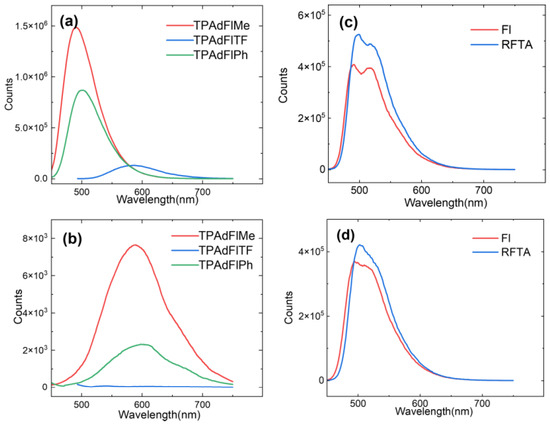
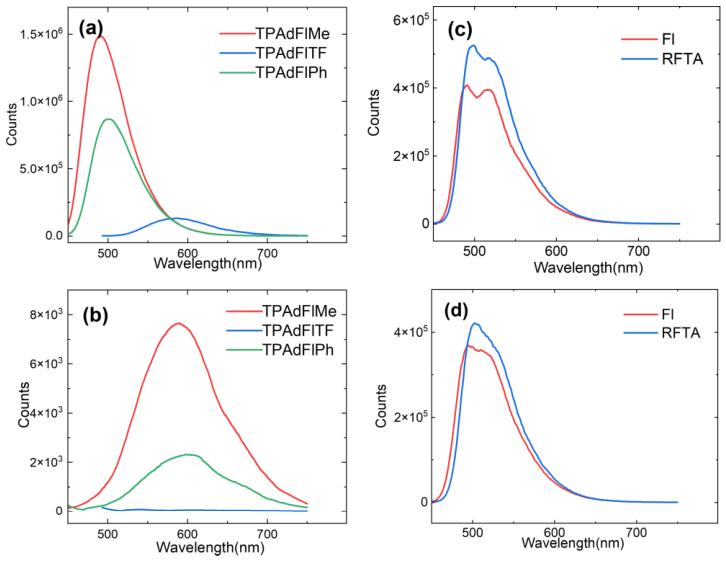
The fluorescence emission bands of deazaflavin derivatives exhibit a hypsochromic shift compared to Fl and RFTA (Figure 3 and Table 2). The effect of substitution at C5 on the fluorescence maxima follows the trends as aforementioned for the absorption spectra. The CF3- moiety causes a significant bathochromic shift in the fluorescence maxima to the value of 585 cm−1. The same change in λabs, λem and ΦF was reported in C5-substituted deazaflavin derivatives with variation in the group on C5 from methyl to trifluoromethyl [15]. Among the dFLs investigated, a high fluorescence quantum yield (ΦF) of 82% was observed for TPAdFlMe and the lowest ΦF of 17% was found for TPAdFlTF, considering that the ΦF of Fl and RFTA are 42% and 30%, respectively. The singlet oxygen quantum yield (Φ△) of RFTA is 76% and is the highest among the compounds investigated, and the Φ△ of TPAdFlMe, TPAdFlTF and TPAdFlPh are 42%, 25% and 39%, respectively. In this sense, TPAdFlMe and TPAdFlPh are promising PSs in sensitizing the formation of 1O2, already superior to the recently reported deazaalloxazines and deazaflavin derivatives, and would exhibit performance like those of Fl in photooxidation [13,14,15,29]. The measured redox potential (Ere) of dFLs falls in the range of −0.71 V for RFTA to −1.75 V for TPAdFlMe (Figure S4). In this sense, the Ere of TPAdFlMe and TPAdFlPh in ACN vs. SCE would be −1.40 and −1.36 V, respectively, and is comparable with those of the reported 5-aryl deazaflavins (Table 2). Therefore, we expect TPAdFlMe and TPAdFlPh would exhibit performance comparable or even superior to those deazaflavin derivatives reported before in the photodehalogenation of aryl halides.
Figure 3.
Emission spectra of TPAdFlMe, TPAdFlTF and TPAdFlPh in Tol (a) and ACN (b), and emission spectra of Fl and RFTA in Tol (c) and ACN (d). λex used for TPAdFlMe, TPAdFlTF, TPAdFlPh, Fl and RFTA are 443, 492, 450, 438 and 447nm, respectively. c = 10−5 mol/L, 25 °C.
Table 2.
The measured photophysical properties of dFLs.
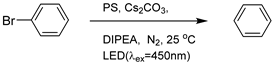
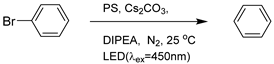
Inspired by the photophysical and electrochemical properties of TPAdFlMe, TPAdFlPh, Fl and RFTA, their performance in sensitizing the photodehalogenation of aryl halides was evaluated. In these reactions, Ce2CO3 and DIPEA were used as a halide trap and sacrificial electron donor, respectively [13,14,15,29]. We started with the optimization of various factors, such as PS, solvents, reaction time, etc., to improve the conversion of aryl halides (Table 3, Figures S5-1–S5-21). We adapted the reported amount of 8 mol% dFLs, which is enough to convert 0.038 mmol aryl halides in 24 h [13,14,15,29]. In parallel experiments using TPAdFlMe, TPAdFlPh, Fl and RFTA as the PSs, TPAdFlPh outperforms other PSs in the photodehalogenation of bromobenzene in 18 h and the yield is 82%. The yield with TPAdFlMe is slightly lower (80%). The yield is 0 when Fl and RFTA are used (Table 3, Entries 1–4) [13,14,15,29]. The photodehalogenation of bromobenzene using TPAdFlMe as the PS was then performed in different solvents, including toluene, dichloromethane, ACN, methanol and a mixture of ACN and methanol. The highest yield of 85% was found in ACN. Considering the similar performance of TPAdFlMe and TPAdFlPh in 18 h photodehalogenation runs, ACN was selected as the solvent for further investigation (Table 3, entries 5–9). The impact of the reaction duration was also investigated (Table 3, entries 1–2, 7, 10–18). When TPAdFlMe is used, the benzene yield is 79% in 15 h, and this further increases to 80% and 85% after 18 and 24 h, respectively. When TPAdFlPh is used, the benzene yield is 83% at 15 h, and this further changes to 82% and 88%, respectively, in 18 and 24 h runs. These suggest the reaction duration should be at least 18 h to get a significant yield, and further elongation would also be beneficial. Parallel experiments were also performed without PSs or light irradiation using bromobenzene, chlorobenzene and iodobenzene as the substrate in 24 h batch runs (Table 3, entries 19–22). However, no reaction takes place in these cases, suggesting the vital role of light irradiation and dFLs as PSs for the photodehalogenation of aryl halides.
Table 3.
Optimization of dFL-sensitized photodehalogenation of aryl monohalides a.
Considering the outstanding performance of TPAdFlMe and TPAdFlPh in the photodehalogenation of bromobenzene, they were also used to sensitize the dehalogenation of various aryl halides (Table 4 and Figures S5-22–S5-57). For most of the substrates considered, TPAdFlMe and TPAdFlPh are capable of converting a considerable amount of the aryl halide substrates, with yields larger than 60% in most cases. It is interesting to note that the yield when TPAdFlPh was used is always slightly better than that of TPAdFlMe in the conversion of most of the aryl halides, except for chlorobenzene and 1-benzhydryl-3-bromobenzene. This may be attributed to their slight difference in Ere. Previously, C-5 phenyl derivatives of deazaflavin were reported to exhibit better performance in the photodehalogenation of aryl halides than other deazaflavin derivatives [13,14,15,29]. The performance data of TPAdFlMe and TPAdFlPh are already superior to those recently reported for 10-unsubstituted 3,7,8-trimethylisoalloxazine anion [29], and are comparable to those reported for 10-butyl-7,8-dimethoxy-3-methyl-5-phenyl-deazaflavin that is capable of converting p-chloroanisole and p-bromoanisole with yields for both of 80% in 18 h runs, and 82% and 98% in 24 h runs [13,15]. The difference may be attributed to the different contribution of TPA and methoxy to the photophysical properties of the deazaflavin derivatives and the slight difference in the reaction setup. Furthermore, TPAdFlMe and TPAdFlPh demonstrate exceptional performance in the photodehalogenation of halides of polycyclic aromatics, such as 3-bromopyridine (entries 15–16), 1-bromonapthalene (entries 17–18), 4-bromopyrene (entries 19–20), 1-benzhydryl-3-bromobenzene (entries 21–22), etc., with yields in the range of 73% for 1-benzhydryl-3-bromobenzene to 100% for 1-bromonapthalene in 18 h runs.
Table 4.
dFL-sensitized dehalogenation of aryl halides a.
The performance of TPAdFlMe and TPAdFlPh in the dehalogenation of aryl polyhalides was also investigated (Table 5, Table 6 and Table 7 and Figures S5-58–S5-105). For the polyhalides investigated, it is rather general that monohalide intermediates are formed as the major product or the only product when the concentration of PS, DIPEA and Cs2CO3 are low in 18 h runs, and the yield of fully reduced aryl compounds increases with the concentration of PS, DIPEA and Cs2CO3 and the elongation of the reaction duration. The impact of the concentration of PS, DIPEA and Cs2CO3 and the reaction duration can be found for the photodehalogenation of 1,2-dichlorobenzene (Table 5, Entries 1–4), 1,3-dichlorobenzene (Table 5, Entries 5–10), 1,3-dibromobenzene (Table 5, Entries 11–14) and 4,4′-Diiodobiphenyl (Table 7, Entries 1–4), while 1,3-diiodobenzene and 3,3′-Dibromobiphenyl (Table 6) were completely converted to corresponding aryl compounds at the conditions investigated. This suggests that the photodehalogenation of aryl polyhalides depends strongly on the reaction duration, and the concentration of PS, DIPEA and Cs2CO3, and that it is possible to control the product selectivity by careful optimization of the operating conditions. Further to these, the product yields when TPAdFlPh was used are not always higher than those with TPAdFlMe, even when the reactions were performed in parallel with the same operating conditions, suggesting the measured performance of PSs is the overall effect of the interplay of many controlling factors, owing to the complicated conPET mechanism of deazaflavin-sensitized photodehalogenation that was proposed to solve the concern of the mismatch of the Ere of PS and the substrate [15,19].
Table 5.
dFL-sensitized dehalogenation of aryl dihalides a.
Table 6.
dFL-sensitized dehalogenation of 3,3′-Dibromobiphenyl a.
Table 7.
dFL-sensitized dehalogenation of 4,4′-Diiodobiphenyl a.
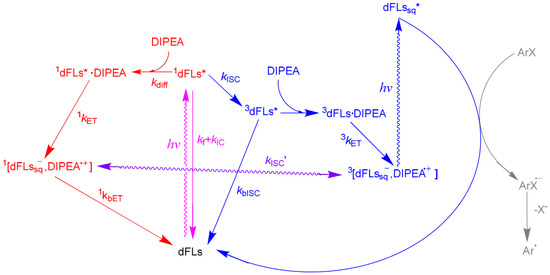
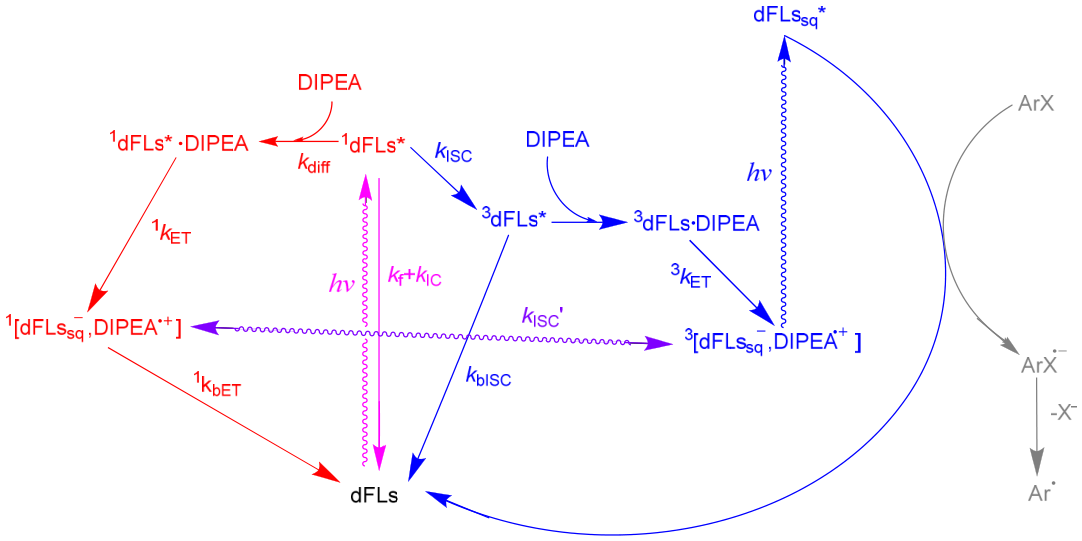
In the proposed conPET mechanism (Scheme 3) in the photodehalogenation of aryl halides sensitized by deazaflavin derivatives, DIPEA is the sacrificial electron donor and would initiate the catalytic cycle by ET to the PS at excited states. The ET with PS at singlet excited states is not productive due to the fast backward ET to DIPEA. However, the ET with PS at triplet states would form a radical pair, where the negatively charged PS radical interacts with the positively charged DIPEA radical. As the decay of the triplet radical pair to the ground state is spin-forbidden, it would be accumulated in the reaction system [84,86]. Further light irradiation would pop this PS-related species to the spin-allowed excited states, enabling a consecutive photo-induced electron transfer to the aryl halide substrate. The photocatalytic cycle is closed by the regeneration of PS to its ground state. The further evolution of the charged aryl halide leads to dehalogenation by the formation of an aryl radical and a halide ion. In parallel mechanism investigations, 2,2,6,6-tetramethylpiperidinyl-1-oxy (TEMPO) which is a radical scavenger was added to the reaction system to inhibit the photodehalogenation, considering the vital role of the negatively charged PS radical in conPET (Table 8). The gradual decrease in yield with the amount of TEMPO used confirms the vital role of the PS-related radical in photodehalogenation through the conPET mechanism [67,70,71]. Further mechanism investigations using time-resolved spectra and theoretical calculations are being performed to provide additional evidence to support the conPET mechanism and to guide the design of PSs for the efficient photodehalogenation of aryl halides. The results will be published when available.
Scheme 3.
Potential pathways for the photodehalogenation of aryl halides with dFLs as sensitizers. dFLs would absorb energy of photon and get populated to its singlet excited state (1dFLs*) and the excited dFLs also decay radiatively or by internal conversion to its ground state (pink). DIPEA, as a sacrificial electron donor, reacts either with the excited singlet (1dFLs*) or triplet (3dFLs*) state of the dFLs to initiate the pathways. On the less productive 1dFLs* pathway (red), a radical pair, 1[dFLssq−, DIPEA•+], is formed after ET and would recombine faster than its formation. On the 3dFLs* pathway (blue), ET forms 3[dFLssq−, DIPEA•+] would accumulate, considering the stability of dFLssq. This would enable the adsorption of a second photon by dFLssq and a consecutive photo-induced electron transfer from dFLssq* to the aryl halide substrate, restoring dFLs to the ground state and closing the photocatalytic cycle, and initiating dehalogenation for formation of aryl radicals for further reactions (gray).
Table 8.
dFL-sensitized dehalogenation of bromobenzene a.
The dehalogenation of ArX is initiated by the formation of ArX−• as RIs by ET from dFLssq* to ArX substrate. The energy level of dFLssq* must match that of ArX to facilitate efficient ET (redox potential), and this is vital for dehalogenation. Considering this, the performance data indicates the ArX converted with the lowest redox potential is p-chloroanisole (Ere = –2.88 eV); this may set the lower limit for ArX to be converted with designed dFLs. Furthermore, higher concentrations of dFLssq* would benefit the efficiency of ET. A high concentration of Cs2CO3 as the halide trap would promote the formation of Ar•. The lifetime of dFLssq should be long enough to get accumulated and populated to dFLssq* by a second phonon. dFLssq is formed by ET from DIPEA. Apart from the energy level requirement for the ET (redox potential), high triplet quantum yield and slow radiative and non-radiative of 3dFLs may promote the efficiency of dFLssq formation. Slow fluorescence emission and internal conversion, and fast intersystem crossing to energy allowed 3dFLs and slow phosphorescent emission and non-radiative decay of 3dFLs may help to increase the triplet quantum yield of dFLs and benefit the subsequent ET for dFLssq formation. The strong adsorption of dFLs in the visible light range and redshifted adsorption may make the conversion utilizing sunlight possible. For the dFLs designed in this work, the non-zero conversion of p-chloroanisole confirms their effectiveness for the photodehalogenation of ArX. Higher triplet quantum yields and reasonable fluorescence quantum yields of TPAdFlMe and TPAdFlPh with respect to reported PSs are found, and are vital in dFLssq formation. These factors may act together with other factors, such as operating conditions, etc., in determining the performance of the dFLs in the photodehalogenation of ArX.
3. Materials and Methods
3.1. Materials and Synthesis
The designed dFLs (Scheme 2) were afforded and characterized (Figures S3-1–S3-13 and S4).
3.2. Theoretical Methods
Density functional theory (DFT) and time-dependent DFT (TD-DFT)-based calculations were performed to investigate the absorption properties of dFLs (Scheme 1). We used methyl to simplify the alkyl moieties. We fully relaxed the dFLs at B3LYP/6-311G(d) level of theory to get their ground state (S0) structures [87,88,89,90]. In the calculations, we used Polarizable Continuum Model (PCM) to treat the acetonitrile (CH3CN) solvent [91]. The absorption properties of dFLs were investigated with TD-DFT-based calculations at the same level of theory. Frequency calculations were performed for all reported structures to insure the nature of minima on the potential energy surface (PES). All the DFT and TD-DFT-based calculations were performed with Gaussian 16 [92].
4. Conclusions
Stimulated by the significant role of aryl radicals in organic synthesis, and the recent pioneer works on the photodehalogenation of aryl halides, we designed and afforded TPAdFlMe, TPAdFlTF and TPAdFlPh, and investigated their photophysical properties and performance as sensitizers in the photodehalogenation of aryl halides. The attachment of diphenylamino to C8 does enhance the absorption of these dFLs in the visible range, and benefits the intersystem crossing to triplet states. The absorption bands of these dFLs are redshifted and the absorbance is more than doubled compared with that of RFTA. The redox potentials of TPAdFlMe, TPAdFlTF and TPAdFlPh are more negative than RFTA. The performances of TPAdFlMe and TPAdFlPh are already comparable to recently reported deazaflavin-based sensitizers in the photodehalogenation of aryl halides. We propose that dFL-sensitized photodehalogenation would proceed though the conPET mechanism, with consecutive excitation of charged PS-based radicals under light irradiation as the key step to generating aryl radicals. We expect the current findings will help to design novel flavin-based triplet sensitizers for photoredox catalytic organic transformations. Further mechanistic investigations combining time-resolved spectra and theoretical calculations are being performed in our lab to provide additional evidence to support the conPET mechanism and to guide the design of PSs for the efficient photodehalogenation of aryl halides. The results will be published when available. The performance of a triplet PS in photocatalysis depends on many factors, such as the long triplet lifetime, suitable redox potential, and reasonable stability and binding with substrate molecules to facilitate efficient ET and the future evolution of the molecular composites, etc. We will work continuously to generalize the strategies for tailoring chromophores for application as heavy atom-free triplet sensitizers in photocatalysis.
Supplementary Materials
The following supporting information can be downloaded at: https://www.mdpi.com/article/10.3390/molecules31091400/s1, 1. General Information; 2. Synthesis and Molecular Structure Characterization Data; 3. NMR and MS spectra; 4. Electrochemical measurements; 5. GC spectra; 6. DFT/TD-DFT Results; 7. References.
Author Contributions
H.G. designed this research and drafted the manuscript. H.G. acquired the funding and provided resources and research tools. X.G. performed the experimental research and analyzed the results with the guidance of H.G. H.L. performed the theoretical calculations and analyzed the results with the guidance of H.G., X.G. and H.L. are responsible for the results presented. H.G. and W.G. commented on the manuscript. H.G. finalized the manuscript. All authors have read and agreed to the published version of the manuscript.
Funding
This work was financially supported by the National Key Research and Development Program of China (No. 2023YFE0197600) and the National Natural Science Foundation of China (NSFC, Nos: 21573034, 21771029, 11811530631, 21373036 and 21103015).
Institutional Review Board Statement
Not applicable.
Informed Consent Statement
Not applicable.
Data Availability Statement
The original contributions presented in this study are included in the article/Supplementary Materials. Further inquiries can be directed to the corresponding author(s).
Acknowledgments
We thank HZWTECH for providing the computation facilities. We also thank the anonymous reviewers for their time and efforts on reviewing the manuscript and the kind and constructive comments.
Conflicts of Interest
The authors declare no competing financial interest.
References
- Majek, M.; Jacobi von Wangelin, A. Mechanistic Perspectives on Organic Photoredox Catalysis for Aromatic Substitutions. Acc. Chem. Res. 2016, 49, 2316–2327. [Google Scholar] [CrossRef] [Scilit]
- Neumeier, M.; Sampedro, D.; Majek, M.; de la Pena O’Shea, V.A.; Jacobi von Wangelin, A.; Perez-Ruiz, R. Dichromatic Photocatalytic Substitutions of Aryl Halides with a Small Organic Dye. Chem.-Eur. J. 2018, 24, 105–108. [Google Scholar] [CrossRef] [Scilit]
- Yan, M.; Lo, J.C.; Edwards, J.T.; Baran, P.S. Radicals: Reactive Intermediates with Translational Potential. J. Am. Chem. Soc. 2016, 138, 12692–12714. [Google Scholar] [CrossRef] [Scilit] [PubMed]
- Studer, A.; Curran, D.P. Catalysis of Radical Reactions: A Radical Chemistry Perspective. Angew. Chem.-Int. Ed. 2016, 55, 58–102. [Google Scholar] [CrossRef] [Scilit] [PubMed]
- Ghosh, I.; Marzo, L.; Das, A.; Shaikh, R.; Konig, B. Visible Light Mediated Photoredox Catalytic Arylation Reactions. Acc. Chem. Res. 2016, 49, 1566–1577. [Google Scholar] [CrossRef] [Scilit] [PubMed]
- Hari, D.P.; Konig, B. The Photocatalyzed Meerwein Arylation: Classic Reaction of Aryl Diazonium Salts in a New Light. Angew. Chem.-Int. Ed. 2013, 52, 4734–4743. [Google Scholar] [CrossRef] [Scilit]
- Kvasovs, N.; Gevorgyan, V. Contemporary methods for generation of aryl radicals. Chem. Soc. Rev. 2021, 50, 2244–2259. [Google Scholar] [CrossRef] [Scilit]
- Ghosh, T.; Santra, S.; Zyryanov, G.V.; Ranu, B.C. Recent advances in visible light mediated photoinduced aryl radical generation and its application in synthesis. J. Photochem. Photobiol. 2023, 16, 100192. [Google Scholar] [CrossRef] [Scilit]
- Mo, F.Y.; Dong, G.B.; Zhang, Y.; Wang, J.B. Recent applications of arene diazonium salts in organic synthesis. Org. Biomol. Chem. 2013, 11, 1582–1593. [Google Scholar] [CrossRef] [Scilit]
- Wu, X.Y.; Gao, P.; Chen, F. Synthetic Applications of Sulfonium Salts as Aryl Radical Precursors. Eur. J. Org. Chem. 2023, 26, e202300864. [Google Scholar] [CrossRef] [Scilit]
- Luo, L.; Tang, S.; Wu, J.Y.; Jin, S.W.; Zhang, H. Transition Metal-Free Aromatic C-H, C-N, C-S and C-O Borylation. Chem. Rec. 2023, 23, e202300023. [Google Scholar] [CrossRef] [Scilit] [PubMed]
- Hari, D.P.; Schroll, P.; Konig, B. Metal-Free, Visible-Light-Mediated Direct C-H Arylation of Heteroarenes with Aryl Diazonium Salts. J. Am. Chem. Soc. 2012, 134, 2958–2961. [Google Scholar] [CrossRef] [Scilit] [PubMed]
- Pavlovska, T.; Lesny, D.K.; Svobodova, E.; Hoskovcova, I.; Archipowa, N.; Kutta, R.J.; Cibulka, R. Tuning Deazaflavins Towards Highly Potent Reducing Photocatalysts Guided by Mechanistic Understanding-Enhancement of the Key Step by the Internal Heavy Atom Effect. Chem.-Eur. J. 2022, 28, e202200768. [Google Scholar] [CrossRef] [Scilit] [PubMed]
- Weisheitelová, I.; Varma, N.; Simková, L.; Chudoba, J.; Pavlovska, T.; Gulaczyk, I.; Burdzinski, G.; Ludvík, J.; Sikorski, M.; Cibulka, R. Deazaalloxazines-Flavin Derivatives That Provide Reductive Photoredox Catalysis with Inert Substrates. Chem.-Eur. J. 2025, 31, e202502897. [Google Scholar] [CrossRef] [Scilit]
- Graml, A.; Nevesely, T.; Jan Kutta, R.; Cibulka, R.; Koenig, B. Deazaflavin reductive photocatalysis involves excited semiquinone radicals. Nat. Commun. 2020, 11, 3174. [Google Scholar] [CrossRef] [Scilit]
- Cibulka, R. Strong chemical reducing agents produced by light. Nature 2020, 580, 31–32. [Google Scholar] [CrossRef] [Scilit]
- Tay, N.E.S.; Lehnherr, D.; Rovis, T. Photons or Electrons? A Critical Comparison of Electrochemistry and Photoredox Catalysis for Organic Synthesis. Chem. Rev. 2022, 122, 2487–2649. [Google Scholar] [CrossRef] [Scilit]
- Liu, J.J.; Lu, L.X.; Wood, D.; Lin, S. New Redox Strategies in Organic Synthesis by Means of Electrochemistry and Photochemistry. ACS Cent. Sci. 2020, 6, 1317–1340. [Google Scholar] [CrossRef] [Scilit]
- Ghosh, I.; Ghosh, T.; Bardagi, J.I.; Koenig, B. Reduction of aryl halides by consecutive visible light-induced electron transfer processes. Science 2014, 346, 725–728. [Google Scholar] [CrossRef] [Scilit]
- Ghosh, I.; Koenig, B. Chromoselective Photocatalysis: Controlled Bond Activation through Light-Color Regulation of Redox Potentials. Angew. Chem.-Int. Ed. 2016, 55, 7676–7679. [Google Scholar] [CrossRef] [Scilit]
- Marzo, L.; Ghosh, I.; Esteban, F.; Konig, B. Metal-Free Photocatalyzed Cross Coupling of Bromoheteroarenes with Pyrroles. ACS Catal. 2016, 6, 6780–6784. [Google Scholar] [CrossRef] [Scilit]
- Bardagi, J.I.; Ghosh, I.; Schmalzbauer, M.; Ghosh, T.; Koenig, B. Anthraquinones as Photoredox Catalysts for the Reductive Activation of Aryl Halides. Eur. J. Org. Chem. 2018, 2018, 34–40. [Google Scholar] [CrossRef] [Scilit]
- MacKenzie, I.A.; Wang, L.; Onuska, N.P.R.; Williams, O.F.; Begam, K.; Moran, A.M.; Dunietz, B.D.; Nicewicz, D.A. Discovery and characterization of an acridine radical photoreductant. Nature 2020, 580, 76–80. [Google Scholar] [CrossRef] [Scilit] [PubMed]
- Xu, J.H.; Cao, J.L.; Wu, X.Y.; Wang, H.; Yang, X.N.; Tang, X.X.; Toh, R.W.; Zhou, R.; Yeow, E.K.L.; Wu, J. Unveiling Extreme Photoreduction Potentials of Donor-Acceptor Cyanoarenes to Access Aryl Radicals from Aryl Chlorides. J. Am. Chem. Soc. 2021, 143, 13266–13273. [Google Scholar] [CrossRef] [Scilit] [PubMed]
- Chmiel, A.F.; Williams, O.P.; Chernowsky, C.P.; Yeung, C.S.; Wickens, Z.K. Non-innocent Radical Ion Intermediates in Photoredox Catalysis: Parallel Reduction Modes Enable Coupling of Diverse Aryl Chlorides. J. Am. Chem. Soc. 2021, 143, 10882–10889. [Google Scholar] [CrossRef] [Scilit]
- Cowper, N.G.W.; Chernowsky, C.P.; Williams, O.P.; Wickens, Z.K. Potent Reductants via Electron-Primed Photoredox Catalysis: Unlocking Aryl Chlorides for Radical Coupling. J. Am. Chem. Soc. 2020, 142, 2093–2099. [Google Scholar] [CrossRef] [Scilit] [PubMed]
- Kim, H.; Kim, H.; Lambert, T.H.; Lin, S. Reductive Electrophotocatalysis: Merging Electricity and Light To Achieve Extreme Reduction Potentials. J. Am. Chem. Soc. 2020, 142, 2087–2092. [Google Scholar] [CrossRef] [Scilit]
- Cole, J.P.; Chen, D.F.; Kudisch, M.; Pearson, R.M.; Lim, C.H.; Miyake, G.M. Organocatalyzed Birch Reduction Driven by Visible Light. J. Am. Chem. Soc. 2020, 142, 13573–13581. [Google Scholar] [CrossRef] [Scilit]
- Prukala, D.; Zubova, E.; Svobodová, E.; Simková, L.; Varma, N.; Chudoba, J.; Ludvík, J.; Burdzinski, G.; Gulaczyk, I.; Sikorski, M.; et al. Introduction of flavin anions into photoredox catalysis: Acid-base equilibria of lumichrome allow photoreductions with an anion of an elusive 10-unsubstituted isoalloxazine. Chem. Sci. 2025, 16, 11255–11263. [Google Scholar] [CrossRef] [Scilit]
- Heelis, P.F. The photophysical and photochemical properties of flavines (Isoalloxazines). Chem. Soc. Rev. 1982, 11, 15–39. [Google Scholar] [CrossRef] [Scilit]
- Heelis, P.F.; Hartman, R.F.; Rose, S.D. Photoenzymic repair of UV-damaged DNA-A chemists perspective. Chem. Soc. Rev. 1995, 24, 289–297. [Google Scholar] [CrossRef] [Scilit]
- Guo, H.M.; Kottke, T.; Hegemann, P.; Dick, B. The Phot LOV2 domain and its interaction with LOV1. Biophys. J. 2005, 89, 402–412. [Google Scholar] [CrossRef] [Scilit]
- Kaim, W.; Schwederski, B. Cooperation of metals with electroactive ligands of biochemical relevance: Beyond metalloporphyrins. Pure Appl. Chem. 2004, 76, 351–364. [Google Scholar] [CrossRef] [Scilit]
- Walsh, C. Flavin Coenzymes-At the crossroads of biological redox chemistry. Acc. Chem. Res. 1980, 13, 148–155. [Google Scholar] [CrossRef] [Scilit]
- Bruice, T.C. Mechanisms of Flavin Catalysis. Acc. Chem. Res. 1980, 13, 256–262. [Google Scholar] [CrossRef] [Scilit]
- Murakami, M.; Ohkubo, K.; Fukuzumi, S. Inter- and Intramolecular Photoinduced Electron Transfer of Flavin Derivatives with Extremely Small Reorganization Energies. Chem.-Eur. J. 2010, 16, 7820–7832. [Google Scholar] [CrossRef] [Scilit]
- Iida, H.; Imada, Y.; Murahashi, S.I. Biomimetic flavin-catalysed reactions for organic synthesis. Org. Biomol. Chem. 2015, 13, 7599–7613. [Google Scholar] [CrossRef] [Scilit]
- Konig, B.; Kummel, S.; Svobodova, E.; Cibulka, R. Flavin photocatalysis. Phys. Sci. Rev. 2018, 3, 20170168. [Google Scholar] [CrossRef] [Scilit]
- Rehpenn, A.; Walter, A.; Storch, G. Molecular Editing of Flavins for Catalysis. Synthesis 2021, 53, 2583–2593. [Google Scholar] [CrossRef] [Scilit]
- Korvinson, K.A.; Hargenrader, G.N.; Stevanovic, J.; Xie, Y.; Joseph, J.; Maslak, V.; Hadad, C.M.; Glusac, K.D. Improved Flavin-Based Catalytic Photooxidation of Alcohols through Intersystem Crossing Rate Enhancement. J. Phys. Chem. A 2016, 120, 7294–7300. [Google Scholar] [CrossRef] [Scilit]
- Megerle, U.; Wenninger, M.; Kutta, R.J.; Lechner, R.; Konig, B.; Dick, B.; Riedle, E. Unraveling the flavin-catalyzed photooxidation of benzylic alcohol with transient absorption spectroscopy from sub-pico- to microseconds. Phys. Chem. Chem. Phys. 2011, 13, 8869–8880. [Google Scholar] [CrossRef] [Scilit]
- Dad’ova, J.; Svobodova, E.; Sikorski, M.; Konig, B.; Cibulka, R. Photooxidation of Sulfides to Sulfoxides Mediated by Tetra-O-Acetylriboflavin and Visible Light. ChemCatChem 2012, 4, 620–623. [Google Scholar] [CrossRef] [Scilit]
- Nevesely, T.; Svobodova, E.; Chudoba, J.; Sikorski, M.; Cibulka, R. Efficient Metal-Free Aerobic Photooxidation of Sulfides to Sulfoxides Mediated by a Vitamin B-2 Derivative and Visible Light. Adv. Synth. Catal. 2016, 358, 1654–1663. [Google Scholar] [CrossRef] [Scilit]
- Greening, C.; Ahmed, F.H.; Mohamed, A.E.; Lee, B.M.; Pandey, G.; Warden, A.C.; Scott, C.; Oakeshott, J.G.; Taylor, M.C.; Jackson, C.J. Physiology, Biochemistry, and Applications of F-420- and F-o-Dependent Redox Reactions. Microbiol. Mol. Biol. Rev. 2016, 80, 451–493. [Google Scholar] [CrossRef] [Scilit] [PubMed]
- Walsh, C. Naturally-occuring 5-deazaflavin coenzymes-Biological redox roles. Acc. Chem. Res. 1986, 19, 216–221. [Google Scholar] [CrossRef] [Scilit]
- Kiontke, S.; Gnau, P.; Haselsberger, R.; Batschauer, A.; Essen, L.O. Structural and Evolutionary Aspects of Antenna Chromophore Usage by Class II Photolyases. J. Biol. Chem. 2014, 289, 19659–19669. [Google Scholar] [CrossRef] [Scilit]
- Salzmann, S.; Martinez-Junza, V.; Zorn, B.; Braslavsky, S.E.; Mansurova, M.; Marian, C.M.; Gartner, W. Photophysical Properties of Structurally and Electronically Modified Flavin Derivatives Determined by Spectroscopy and Theoretical Calculations. J. Phys. Chem. A 2009, 113, 9365–9375. [Google Scholar] [CrossRef] [Scilit]
- Golczak, A.; Insinska-Rak, M.; Davoudpour, A.; Saeed, D.H.; Menova, P.; Mojr, V.; Cibulka, R.; Khmelinskii, I.; Mrowczynska, L.; Sikorski, M. Photophysical properties of alloxazine derivatives with extended aromaticity-Potential redox-sensitive fluorescent probe. Spectrochim. Acta Part A-Mol. Biomol. Spectrosc. 2022, 272, 120985. [Google Scholar] [CrossRef] [Scilit]
- Insinska-Rak, M.; Golczak, A.; Gierszewski, M.; Anwar, Z.; Cherkas, V.; Kwiatek, D.; Sikorska, E.; Khmelinskii, I.; Burdzinski, G.; Cibulka, R.; et al. 5-Deazaalloxazine as photosensitizer of singlet oxygen and potential redox-sensitive agent. Photochem. Photobiol. Sci. 2023, 22, 1655–1671. [Google Scholar] [CrossRef] [Scilit]
- Mojr, V.; Pitrova, G.; Strakova, K.; Prukala, D.; Brazevic, S.; Svobodova, E.; Hoskovcova, I.; Burdzinski, G.; Slanina, T.; Sikorski, M.; et al. Flavin Photocatalysts for Visible-Light 2+2 Cycloadditions: Structure, Reactivity and Reaction Mechanism. ChemCatChem 2018, 10, 849–858. [Google Scholar] [CrossRef] [Scilit]
- Mojr, V.; Svobodova, E.; Strakova, K.; Nevesely, T.; Chudoba, J.; Dvorakova, H.; Cibulka, R. Tailoring flavins for visible light photocatalysis: Organocatalytic 2+2 cycloadditions mediated by a flavin derivative and visible light. Chem. Commun. 2015, 51, 12036–12039. [Google Scholar] [CrossRef] [Scilit] [PubMed]
- Goldberg, M.; Pecht, I.; Kramer, H.E.A.; Traber, R.; Hemmerich, P. Structure and properties of 5-deazaflavin radicals as compared to natrual flavosemiquinones. Biochim. Biophys. Acta 1981, 673, 570–593. [Google Scholar] [CrossRef] [Scilit] [PubMed]
- Jirapanjawat, T.; Ney, B.; Taylor, M.C.; Warden, A.C.; Afroze, S.; Russell, R.J.; Lee, B.M.; Jackson, C.J.; Oakeshott, J.G.; Pandey, G.; et al. The Redox Cofactor F-420 Protects Mycobacteria from Diverse Antimicrobial Compounds and Mediates a Reductive Detoxification System. Appl. Environ. Microbiol. 2016, 82, 6810–6818. [Google Scholar] [CrossRef] [Scilit] [PubMed]
- Hemmerich, P.; Massey, V.; Fenner, H. Flavin and 5-deazaflavin-Chemical evaluation of modified flavoproteins with respect to mechanism of redox biocatalysis. FEBS Lett. 1977, 84, 5–21. [Google Scholar] [CrossRef] [Scilit]
- Holtmann, D.; Hollmann, F. The Oxygen Dilemma: A Severe Challenge for the Application of Monooxygenases? ChemBioChem 2016, 17, 1391–1398. [Google Scholar] [CrossRef] [Scilit]
- Su, Q.; Boucher, P.A.; Rokita, S.E. Conversion of a Dehalogenase into a Nitroreductase by Swapping its Flavin Cofactor with a 5-Deazaflavin Analogue. Angew. Chem.-Int. Ed. 2017, 56, 10862–10866. [Google Scholar] [CrossRef] [Scilit]
- Taglieber, A.; Schulz, F.; Hollmann, F.; Rusek, M.; Reetz, M.T. Light-driven biocatalytic oxidation and reduction reactions: Scope and limitations. ChemBioChem 2008, 9, 565–572. [Google Scholar] [CrossRef] [Scilit]
- Zilly, F.E.; Taglieber, A.; Schulz, F.; Hollmann, F.; Reetz, M.T. Deazaflavins as mediators in light-driven cytochrome P450 catalyzed hydroxylations. Chem. Commun. 2009, 45, 7152–7154. [Google Scholar] [CrossRef] [Scilit]
- Link, P.A.J.; Vanderplas, H.C.; Muller, F. Photoreduction of 5-deazaflavins 1,3,9-triaza-anthracene-2(3H), 4(10H)-diones. J. Chem. Soc.-Chem. Commun. 1986, 1385–1387. [Google Scholar] [CrossRef] [Scilit]
- van Schie, M.; Younes, S.H.H.; Rauch, M.C.R.; Pesic, M.; Paul, C.E.; Arends, I.; Hollmann, F. Deazaflavins as photocatalysts for the direct reductive regeneration of flavoenzymes. Mol. Catal. 2018, 452, 277–283. [Google Scholar] [CrossRef] [Scilit]
- Zhao, J.Z.; Wu, W.H.; Sun, J.F.; Guo, S. Triplet photosensitizers: From molecular design to applications. Chem. Soc. Rev. 2013, 42, 5323–5351. [Google Scholar] [CrossRef] [Scilit]
- Bell, J.D.; Murphy, J.A. Recent advances in visible light-activated radical coupling reactions triggered by (i) ruthenium, (ii) iridium and (iii) organic photoredox agents. Chem. Soc. Rev. 2021, 50, 9540–9685. [Google Scholar] [CrossRef] [Scilit] [PubMed]
- Feldmeier, C.; Bartling, H.; Magerl, K.; Gschwind, R.M. LED-Illuminated NMR Studies of Flavin-Catalyzed Photooxidations Reveal Solvent Control of the Electron-Transfer Mechanism. Angew. Chem.-Int. Ed. 2015, 54, 1347–1351. [Google Scholar] [CrossRef] [Scilit] [PubMed]
- Guo, H.; Zhu, L.J.; Dang, C.; Zhao, J.Z.; Dick, B. Synthesis and photophysical properties of ruthenium(ii) polyimine complexes decorated with flavin. Phys. Chem. Chem. Phys. 2018, 20, 17504–17516. [Google Scholar] [CrossRef] [Scilit]
- Guo, H.; Dang, C.; Zhao, J.Z.; Dick, B. Lighting the Flavin Decorated Ruthenium(II) Polyimine Complexes: A Theoretical Investigation. Inorg. Chem. 2019, 58, 8486–8493. [Google Scholar] [CrossRef] [Scilit] [PubMed]
- Dang, C.; Zhu, L.J.; Guo, H.M.; Xia, H.Y.; Zhao, J.Z.; Dick, B. Flavin Dibromide as an Efficient Sensitizer for Photooxidation of Sulfides. ACS Sustain. Chem. Eng. 2018, 6, 15254–15263. [Google Scholar] [CrossRef] [Scilit]
- Guo, H.; Qiu, Y.; Liu, S.; Zhang, X.; Zhao, J. Tailoring Flavin-based Photosensitizers for Efficient Photooxidative Coupling of Benzylic Amines. Phys. Chem. Chem. Phys. 2024, 26, 161–173. [Google Scholar] [CrossRef] [Scilit]
- Guo, H.; Xia, H.Y.; Ma, X.L.; Chen, K.P.; Dang, C.; Zhao, J.Z.; Dick, B. Efficient Photooxidation of Sulfides with Amidated Alloxazines as Heavy-atom-free Photosensitizers. ACS Omega 2020, 5, 10586–10595. [Google Scholar] [CrossRef] [Scilit]
- Guo, H.; Ma, X.L.; Lei, Z.W.; Qiu, Y.; Zhao, J.Z.; Dick, B. Photophysical properties of N-methyl and N-acetyl substituted alloxazines: A theoretical investigation. Phys. Chem. Chem. Phys. 2021, 23, 13734–13744. [Google Scholar] [CrossRef] [Scilit]
- Guo, H.; Lei, Z.W.; Ma, X.L.; Liu, S.Y.; Qiu, Y.; Zhao, J.Z. Boosting sulfides photooxidation by fusing naphthalimide and flavin together. Phys. Chem. Chem. Phys. 2022, 24, 15255–15264. [Google Scholar] [CrossRef] [Scilit]
- Guo, H.; Xie, Z.; Li, H.; Zhao, J. COOCH3-Modified Flavin as a Heavy-Atom-Free Sensitizer for Efficient Photocatalytic Oxidative Coupling of Benzylic Amines. J. Phys. Chem. C 2025, 129, 12927–12937. [Google Scholar] [CrossRef] [Scilit]
- Weigend, F. Accurate Coulomb-fitting basis sets for H to Rn. Phys. Chem. Chem. Phys. 2006, 8, 1057–1065. [Google Scholar] [CrossRef] [Scilit] [PubMed]
- Weigend, F.; Ahlrichs, R. Balanced basis sets of split valence, triple zeta valence and quadruple zeta valence quality for H to Rn: Design and assessment of accuracy. Phys. Chem. Chem. Phys. 2005, 7, 3297–3305. [Google Scholar] [CrossRef] [Scilit] [PubMed]
- Choe, Y.-K.; Nagase, S.; Nishimoto, K. Theoretical study of the electronic spectra of oxidized and reduced states of lumiflavin and its derivative. J. Comput. Chem. 2007, 28, 727–739. [Google Scholar] [CrossRef] [Scilit] [PubMed]
- Kar, R.K.; Chasen, S.; Mroginski, M.A.; Miller, A.F. Tuning the Quantum Chemical Properties of Flavins via Modification at C8. J. Phys. Chem. B 2021, 125, 12654–12669. [Google Scholar] [CrossRef] [Scilit]
- Etz, B.D.; DuClos, J.M.; Vyas, S. Investigating the Photochemistry of C7 and C8 Functionalized N(5)-Ethyl-flavinium Cation: A Computational Study. J. Phys. Chem. A 2020, 124, 4193–4201. [Google Scholar] [CrossRef] [Scilit]
- Ai, Y.J.; Zhao, C.F.; Xing, J.L.; Liu, Y.; Wang, Z.X.; Jin, J.R.; Xia, S.H.; Cui, G.L.; Wang, X.K. Excited-State Decay Pathways of Flavin Molecules in Five Redox Forms: The Role of Conical Intersections. J. Phys. Chem. A 2018, 122, 7954–7961. [Google Scholar] [CrossRef] [Scilit]
- Wang, J.Y.; Liu, Y.J. Vibrationally resolved absorption and fluorescence spectra of flavins: A theoretical simulation in the gas phase. J. Chin. Chem. Soc. 2023, 70, 669–679. [Google Scholar] [CrossRef] [Scilit]
- Vdovin, A.; Slenczka, A.; Dick, B. Electronic spectroscopy of lumiflavin in superfluid helium nanodroplets. Chem. Phys. 2013, 422, 195–203. [Google Scholar] [CrossRef] [Scilit]
- Yanai, T.; Tew, D.P.; Handy, N.C. A new hybrid exchange-correlation functional using the Coulomb-attenuating method (CAM-B3LYP). Chem. Phys. Lett. 2004, 393, 51–57. [Google Scholar] [CrossRef] [Scilit]
- Chai, J.D.; Head-Gordon, M. Systematic optimization of long-range corrected hybrid density functionals. J. Chem. Phys. 2008, 128, 084106. [Google Scholar] [CrossRef] [Scilit] [PubMed]
- Adamo, C.; Barone, V. Toward reliable density functional methods without adjustable parameters: The PBE0 model. J. Chem. Phys. 1999, 110, 6158–6170. [Google Scholar] [CrossRef] [Scilit]
- Kabir, M.P.; Ghosh, P.; Gozem, S. Electronic Structure Methods for Simulating Flavin’s Spectroscopy and Photophysics: Comparison of Multi-reference, TD-DFT, and Single-Reference Wave Function Methods. J. Phys. Chem. B 2024, 128, 7545–7557. [Google Scholar] [CrossRef] [Scilit] [PubMed]
- Guo, H.; Liu, S.; Liu, X.; Zhao, J. Improving Photophysical Properties of Deazaflavin Derivatives by Acrylaldehyde Bridging: A Theoretical Investigation. ChemPhotoChem 2024, 8, e202400053. [Google Scholar] [CrossRef] [Scilit]
- Koziolowa, A.; Visser, N.V.; Koziol, J.; Szafran, M.M. Phototautomerism of 5-deazalumichrome (in the presence of acetic acid). J. Photochem. Photobiol. A-Chem. 1996, 93, 157–163. [Google Scholar] [CrossRef] [Scilit]
- Guo, H.; Liu, S.; Liu, X.; Zhang, L. Lightening Flavin by Amination for Fluorescent Sensing. Phys. Chem. Chem. Phys. 2024, 26, 19554–19563. [Google Scholar] [CrossRef] [Scilit]
- Becke, A.D. Density-functional thermochemistry. III. The role of exact exchange. J. Chem. Phys. 1993, 98, 5648–5652. [Google Scholar] [CrossRef] [Scilit]
- Francl, M.M.; Pietro, W.J.; Hehre, W.J.; Binkley, J.S.; Gordon, M.S.; Defrees, D.J.; Pople, J.A. Self-Consistent Molecular-Orbital Methods. 23. A Polarization-Type Basis Set for 2nd-Row Elements. J. Chem. Phys. 1982, 77, 3654–3665. [Google Scholar] [CrossRef] [Scilit]
- Binning, R.C.; Curtiss, L.A. Compact Contracted Basis-Sets For 3rd-Row ATOMS-GA-KR. J. Comput. Chem. 1990, 11, 1206–1216. [Google Scholar] [CrossRef] [Scilit]
- Lee, C.T.; Yang, W.T.; Parr, R.G. Development of the Colle-Salvetti Correlation-Energy Formula into a Functional of the Electron-Density. Phys. Rev. B 1988, 37, 785–789. [Google Scholar] [CrossRef] [Scilit]
- Tomasi, J.; Mennucci, B.; Cammi, R. Quantum mechanical continuum solvation models. Chem. Rev. 2005, 105, 2999–3093. [Google Scholar] [CrossRef] [Scilit]
- Frisch, M.J.; Trucks, G.W.; Schlegel, H.B.; Scuseria, G.E.; Robb, M.A.; Cheeseman, J.R.; Scalmani, G.; Barone, V.; Petersson, G.A.; Nakatsuji, H.; et al. Gaussian 16 Rev. A.03; Gaussian, Inc.: Wallingford, CT, USA, 2016. [Google Scholar]





Disclaimer/Publisher’s Note: The statements, opinions and data contained in all publications are solely those of the individual author(s) and contributor(s) and not of MDPI and/or the editor(s). MDPI and/or the editor(s) disclaim responsibility for any injury to people or property resulting from any ideas, methods, instructions or products referred to in the content. |
© 2026 by the authors. Licensee MDPI, Basel, Switzerland. This article is an open access article distributed under the terms and conditions of the Creative Commons Attribution (CC BY) license.