


Abstract
Cobalt disulfide (CoS2) features highly active catalytic sites and is regarded as a promising candidate for electrocatalytic hydrogen evolution. In this study, molybdenum-doped cobalt disulfide (CoS2:Mo) was synthesized via a facile hydrothermal approach. XRD analysis confirms that the obtained samples crystallize in a cubic pyrite structure, with diffraction peaks consistently shifting towards lower angles. SEM characterization reveals that the samples exhibit microrod-like morphologies with an average size of approximately 1 μm. Integrated analyses from XRD, XPS, and EDS mapping demonstrate that Mo is uniformly distributed across the surface and successfully doped into the CoS2 lattice. Electrochemical measurements indicate that the CoS2:Mo sample delivers a low overpotential of 122 mV and a Tafel slope of 128 mV dec−1 at a current density of 10 mA cm−2 in alkaline media, significantly surpassing the performance of pure CoS2 and MoS2. Moreover, the CoS2:Mo exhibits an enhanced double-layer capacitance, with a Cdl value of 2.72 mF cm−2, superior to that of pure CoS2 (1.63 mF cm−2) and MoS2 (0.31 mF cm−2). Mo doping enhances conductivity and active sites, thereby boosting electrocatalysis. This work presents an effective strategy for the development of cost-efficient and high-performance non-precious metal electrocatalysts.
1. Introduction
Amid the dual challenges posed by the global energy crisis and environmental pollution, the advancement of efficient hydrogen production technologies has garnered widespread attention from both the scientific and industrial communities, as hydrogen is recognized as a clean and renewable energy carrier capable of replacing conventional fossil fuels [1,2,3,4]. Currently, there are numerous methods for hydrogen production, such as conventional hydrogen generation from fossil fuels, hydrogen production using modern, inexpensive, and non-toxic photocatalysts [5,6,7,8], and hydrogen release via the decomposition of hydrogen carriers [9,10,11]. Among these technologies, the hydrogen evolution reaction (HER) via water electrolysis is considered a highly promising approach for the future hydrogen economy due to its environmentally benign nature. Nevertheless, the commercialization of water electrolysis remains hindered by the lack of catalytic materials that are simultaneously efficient, stable, and cost-effective. As such, the development of high-performance electrocatalysts is at the core of this technology [12,13,14,15,16,17,18]. The HER process typically requires an additional overpotential to overcome sluggish water dissociation kinetics and thermodynamic limitations [19,20,21,22]. Therefore, electrocatalysts capable of facilitating high reaction rates and achieving elevated current densities at low overpotentials are essential [23,24,25]. Currently, platinum-based catalysts exhibit the highest performance; however, their large-scale application is restricted by limited availability and high cost [26,27,28,29]. To address this, considerable efforts have been directed toward exploring non-precious metal-based alternatives, including transition metal sulfides [30,31,32,33,34], selenides [35,36,37], phosphides [38,39,40], and carbides [41,42]. Among these non-precious metal HER catalysts [43,44,45], pyrite (CoS2) has emerged as a prominent candidate owing to its low cost, environmental compatibility, and abundance of active sites [46,47].
Despite its advantages, pure CoS2 still exhibits limitations in catalytic performance due to its relatively wide band gap, inadequate electrical conductivity, and suboptimal adsorption energy for reaction intermediates. To address these issues and enhance the HER activity of cobalt disulfide, various modification strategies have been explored. For example, Liu et al. [48] fabricated a hybrid heterojunction electrode with dual interfaces (MoS2/CoSAs-NS-CNTs@CoS2/CC) on carbon cloth, enabling vectorial electron transport pathways to improve electrocatalytic efficiency. Myung-In Kim et al. [49] synthesized a heterostructure comprising 1T/2H-phase MoS2 and CoS2 on nitrogen-doped carbon nanofibers (1T/2H-MoS2/CoS2@NCNF) via electrospinning and hydrothermal methods. Chen et al. [50] embedded CoS2 into nitrogen-doped carbon nanotubes (CoS2/NCNHP), thereby increasing the specific surface area and enhancing electrical conductivity. Although these methods substantially improved HER performance, they generally involved complex synthesis procedures and relatively high costs. To simplify the process, Sankar Sekar et al. [51] prepared an rGO-CoS2 nanocomposite using a facile one-pot hydrothermal approach. The resulting material exhibited an overpotential of 377 mV and a Tafel slope of 121 mV·dec−1 at 10 mA·cm−2 in 1 M KOH electrolyte. He et al. [52] developed Sn-doped CoS2 nanowire arrays (Sn-CoS2/CC) on carbon cloth, achieving an overpotential of 161 mV at 10 mA·cm−2 in 1 M KOH, thereby simplifying the preparation process while still offering room for performance enhancement.
In this study, Mo-doped CoS2 (CoS2:Mo) was synthesized via a simple and cost-effective hydrothermal method, Mo doping not only enhances water molecule adsorption capacity and significantly boosts catalytic activity, but also improves the stability of sulfides [53,54], significantly reducing synthesis complexity while improving HER catalytic activity. The resulting catalyst demonstrates a low overpotential of 122 mV and a Tafel slope of 128 mV·dec−1 at a current density of 10 mA·cm−2 in 1.0 M KOH, indicating a notable enhancement in hydrogen evolution electrocatalytic performance.
2. Results
2.1. Analysis of Structure and Composition via XRD
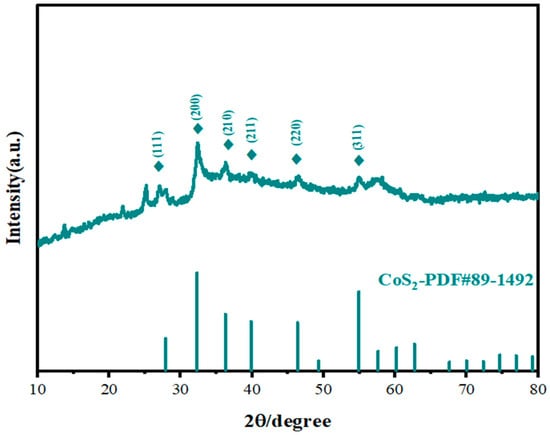
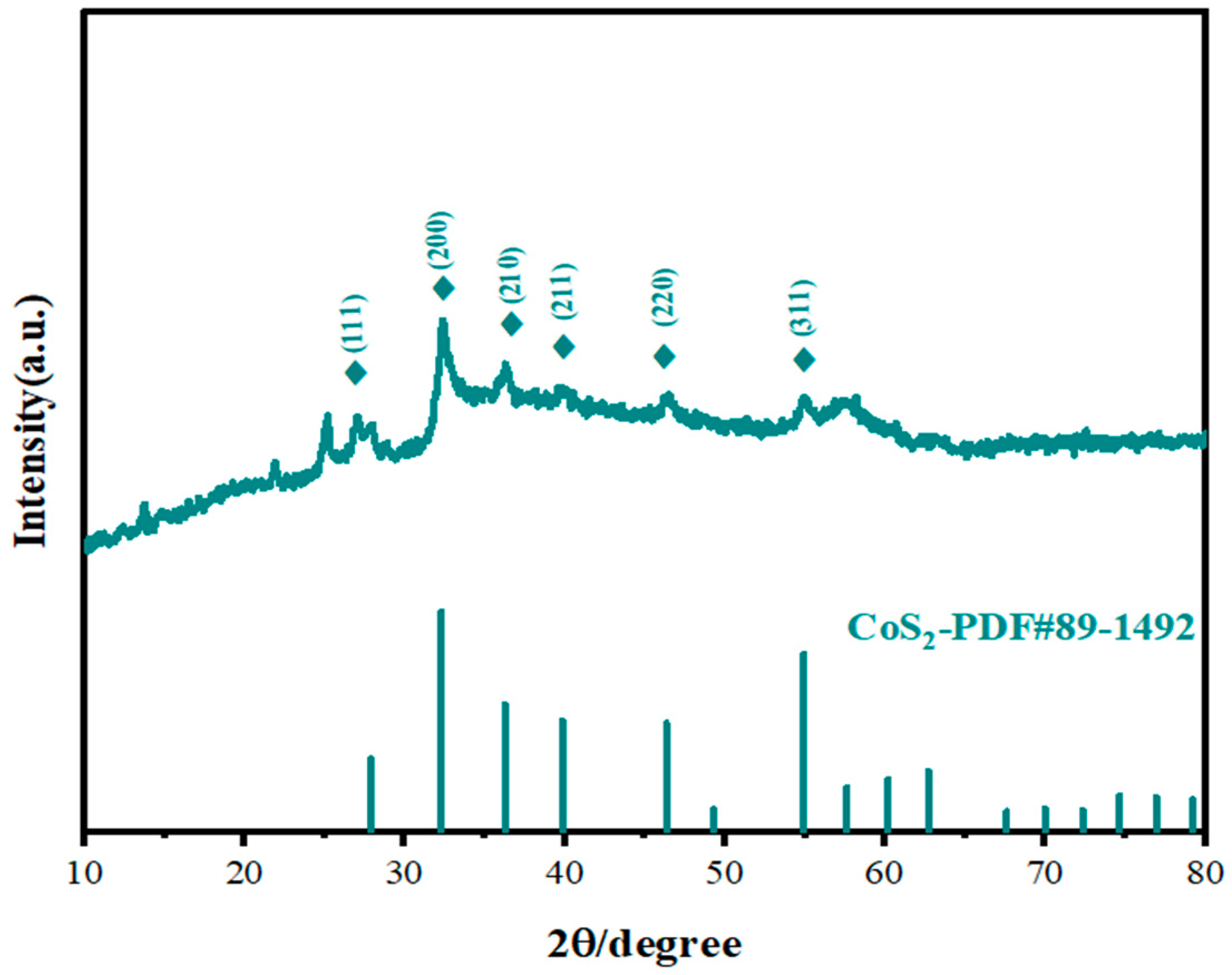
Figure 1 displays the XRD pattern of the CoS2:Mo sample. The diffraction peaks located at 27.1°, 32.3°, 36.2°, 39.9°, 46.3°, and 55.1° correspond to the (111), (200), (210), (211), (220), and (311) planes of CoS2 (PDF#89-1492), respectively. These results confirm the successful formation of crystalline CoS2 following gas-phase sulfidation at 450 °C. Compared with the standard CoS2 pattern, a slight shift in diffraction peaks toward lower angles is observed, indicating lattice expansion due to Mo incorporation. This shift is attributed to the larger atomic radius of Mo relative to Co [55]. Notably, no diffraction peaks associated with MoS2 are detected, suggesting that Mo doping does not introduce any secondary crystalline phase.
Figure 1.
XRD pattern of CoS2:Mo.
2.2. Raman Analysis
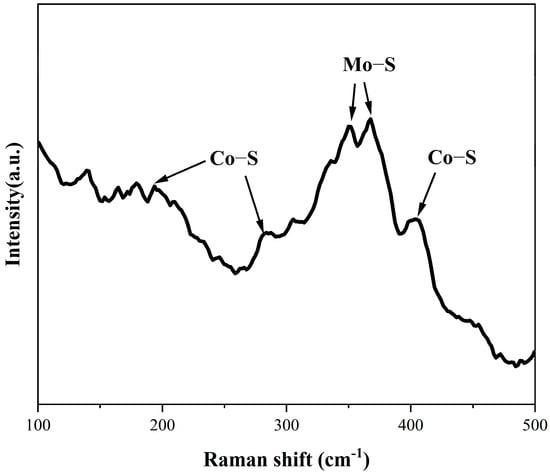
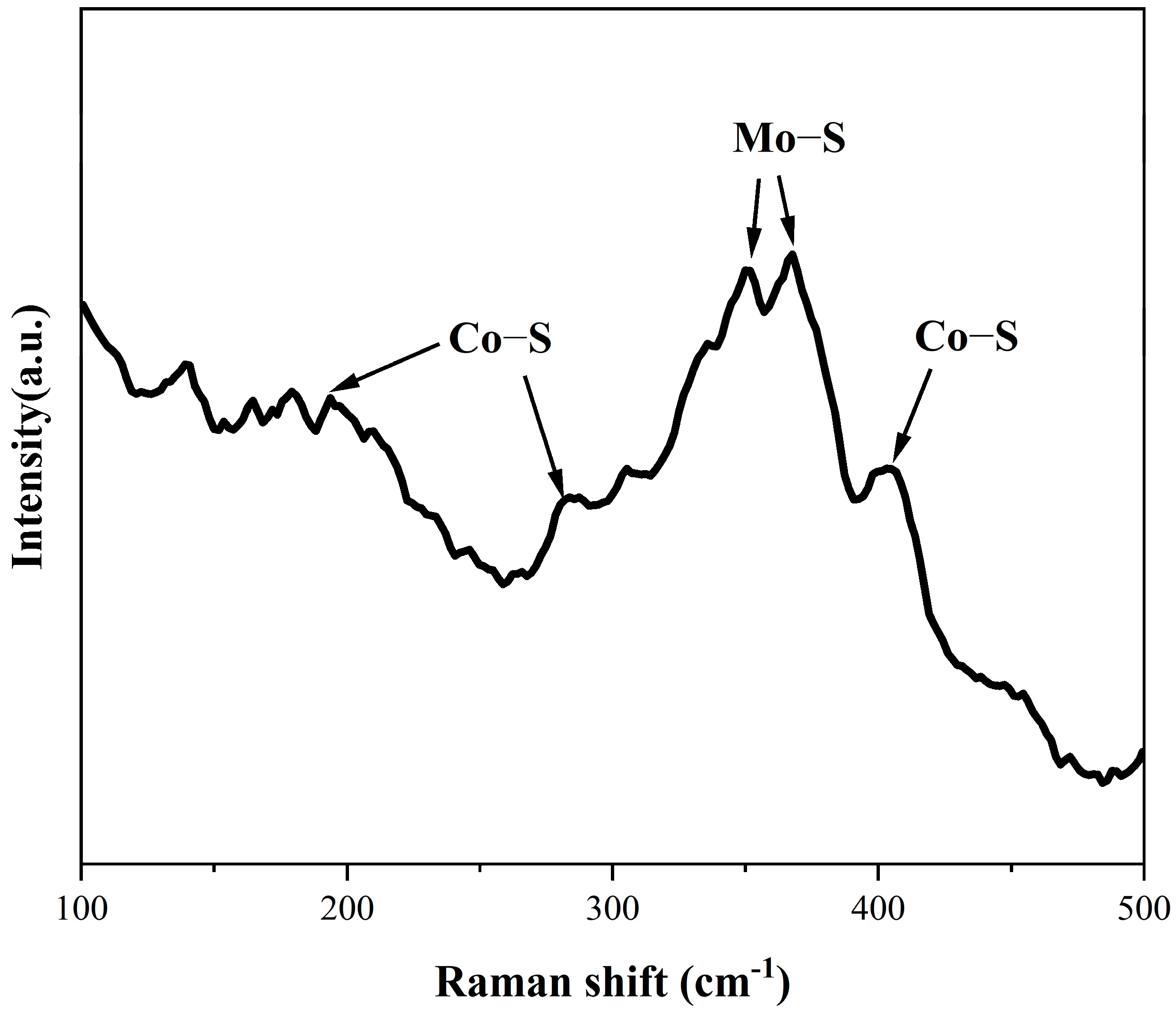
To further analyze the crystal structure, Raman spectroscopy was conducted (Figure 2). The characteristic Raman bands near 282 cm−1 and 400 cm−1 are assigned to the E9 and A9 vibrational modes of Co-S bonds, respectively [56]. A peak observed at approximately 190 cm−1 is also attributed to CoS2 vibrations [57]. In addition, peaks near 349 cm−1 and 367 cm−1 are associated with Mo-S vibrations [41,57], supporting the incorporation of Mo into the CoS2 matrix.
Figure 2.
Raman pattern of CoS2:Mo.
2.3. Elemental Analysis of the Catalysts by XPS
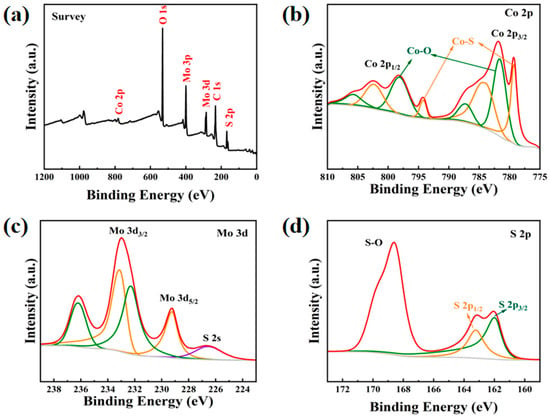
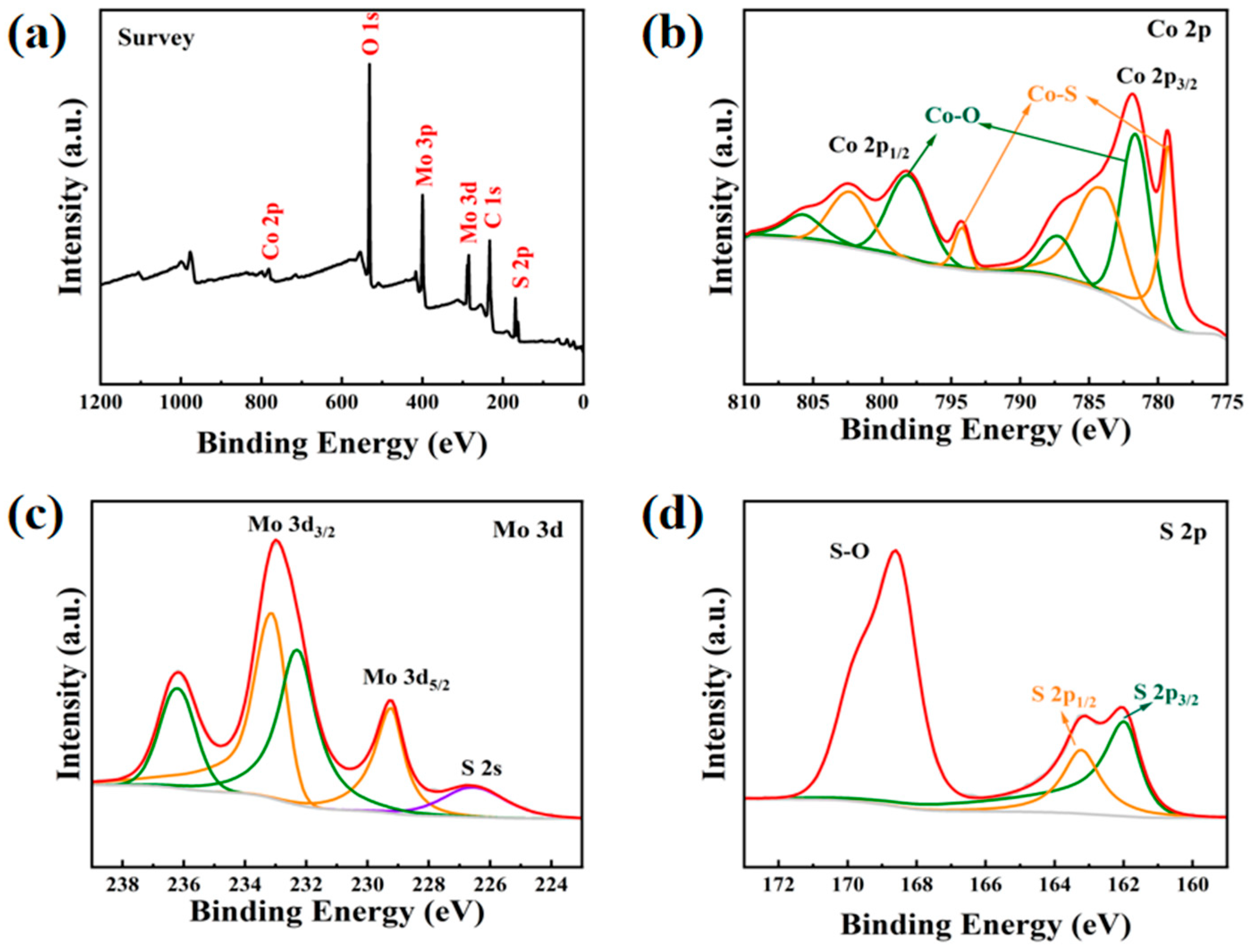
XPS was employed to investigate the elemental composition and valence states of CoS2:Mo. As shown in Figure 3, the full survey spectrum (Figure 3a) reveals the presence of C, O, S, Co, and Mo. The Mo signal at approximately 400 eV confirms successful Mo incorporation, while the O signal originates from surface-adsorbed oxygen and oxidation during air exposure [41]. The high-resolution Co 2p spectrum (Figure 3b) exhibits peaks at 781.6 eV and 798.2 eV, along with their satellite peaks, which are attributed to Co-O bonding [58]. The Mo 3d spectrum (Figure 3c) shows peaks at 229.3 eV and 233.1 eV, corresponding to Mo4+ 3d5/2 and Mo4+ 3d3/2, respectively. Additional peaks at 232.3 eV and 236.2 eV are assigned to Mo6+, indicating the coexistence of Mo4+ and Mo6+ oxidation states, with Mo4+as the dominant species. The presence of Mo6+ is ascribed to surface oxidation upon air exposure [58]. A characteristic peak at 226.6 eV corresponds to the S 2s orbital. The S 2p spectrum (Figure 3d) shows peaks at 162.0 eV and 163.2 eV, attributed to S 2p3/2 and S 2p1/2, respectively, confirming the formation of metal–sulfide bonds. Peaks at 168.5 eV and 169.7 eV are associated with S-O bonds, further indicating surface oxidation [58,59].
Figure 3.
Elemental analysis of the catalysts. (a) XPS survey spectra and high-resolution spectra of (b) Co 2p (c) Mo 3d, and (d) S 2p of CoS2:Mo.
2.4. Morphological Characterization
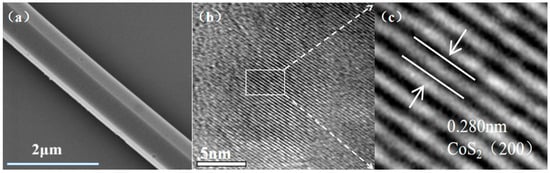
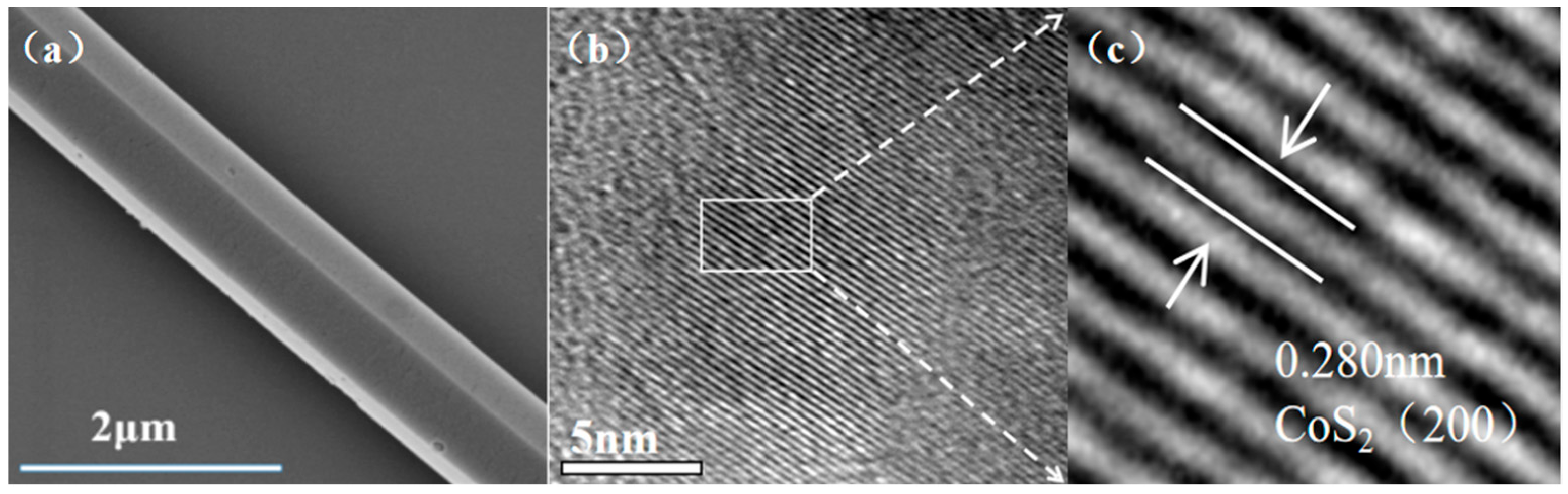
Figure 4 presents the SEM and TEM images of the CoS2:Mo sample. As illustrated in Figure 4, the sample exhibits a rod-like morphology with a typical length of approximately 1 μm. The high-resolution TEM image in Figure 4 reveals well-defined lattice fringes, with an interplanar spacing of approximately 0.280 nm, corresponding to the (200) plane of CoS2. This observation is consistent with the XRD results.
Figure 4.
(a) SEM and (b,c) HRTEM images of CoS2:Mo.
2.5. EDS Analysis
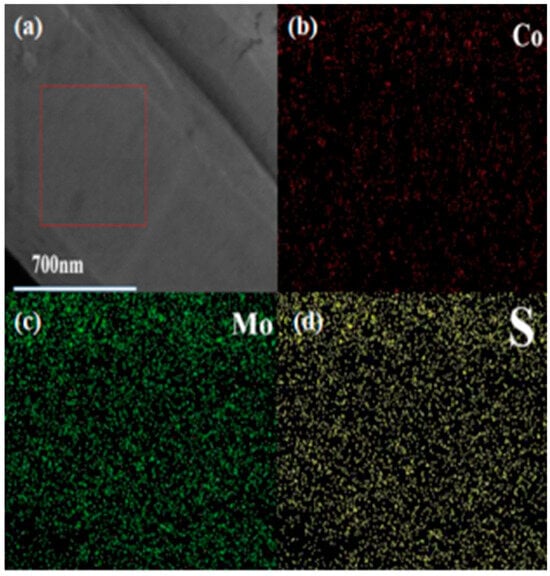
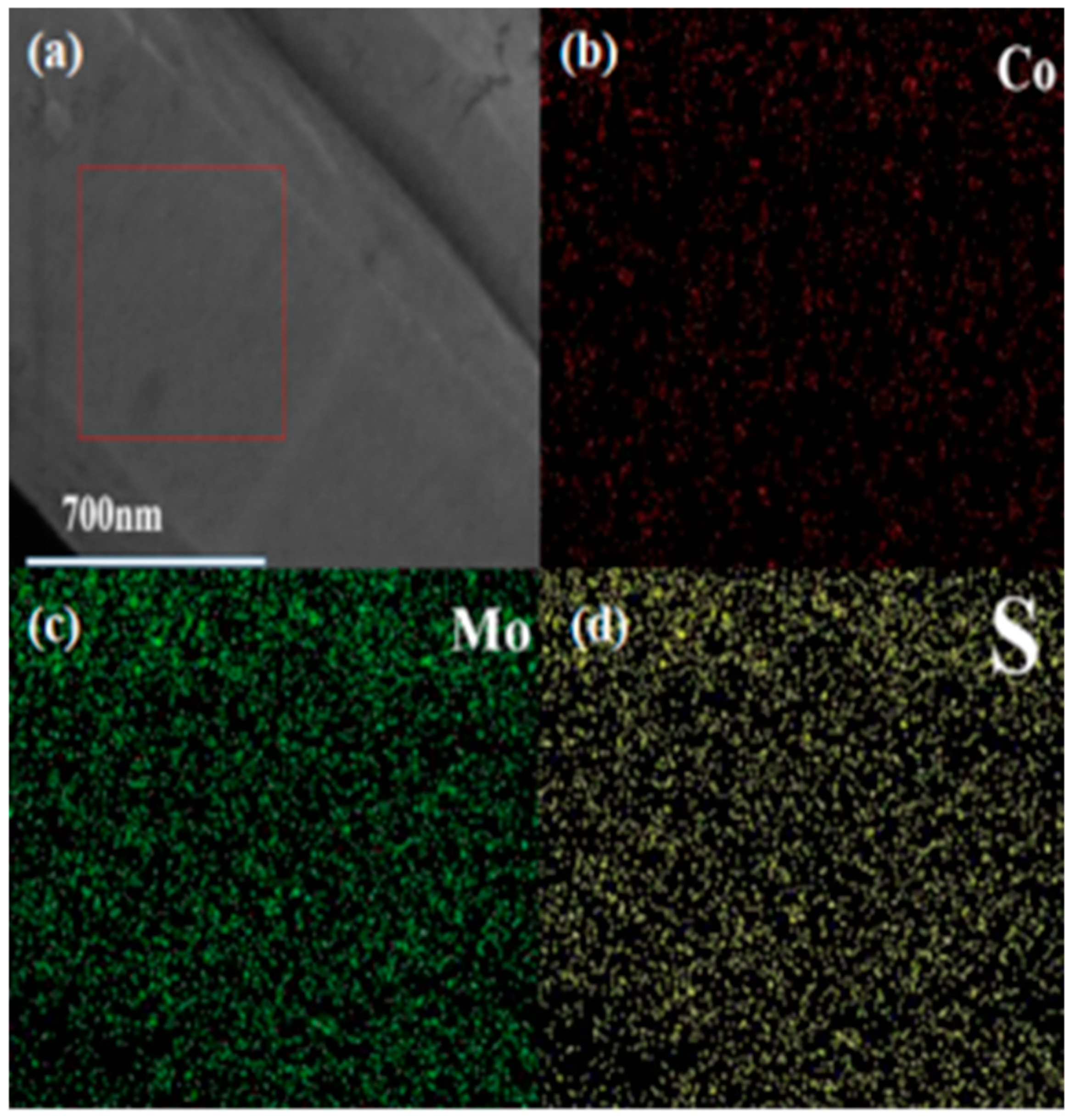
Figure 5a–d show the EDS elemental mapping images of CoS2:Mo. The results confirm the uniform distribution of Co, Mo, and S throughout the sample, indicating successful and homogeneous Mo doping within the CoS2 lattice.
Figure 5.
EDS mapping images of CoS2:Mo. (a) The selected location. The elemental distribution map of (b) Co, (c) Mo and (d) S.
3. Discussion
3.1. Electrochemical Measurements in Alkaline Electrolytes
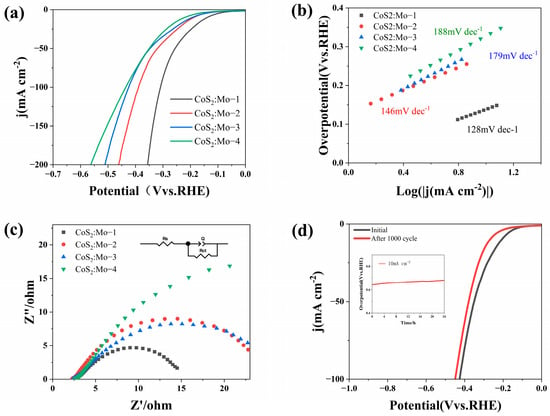
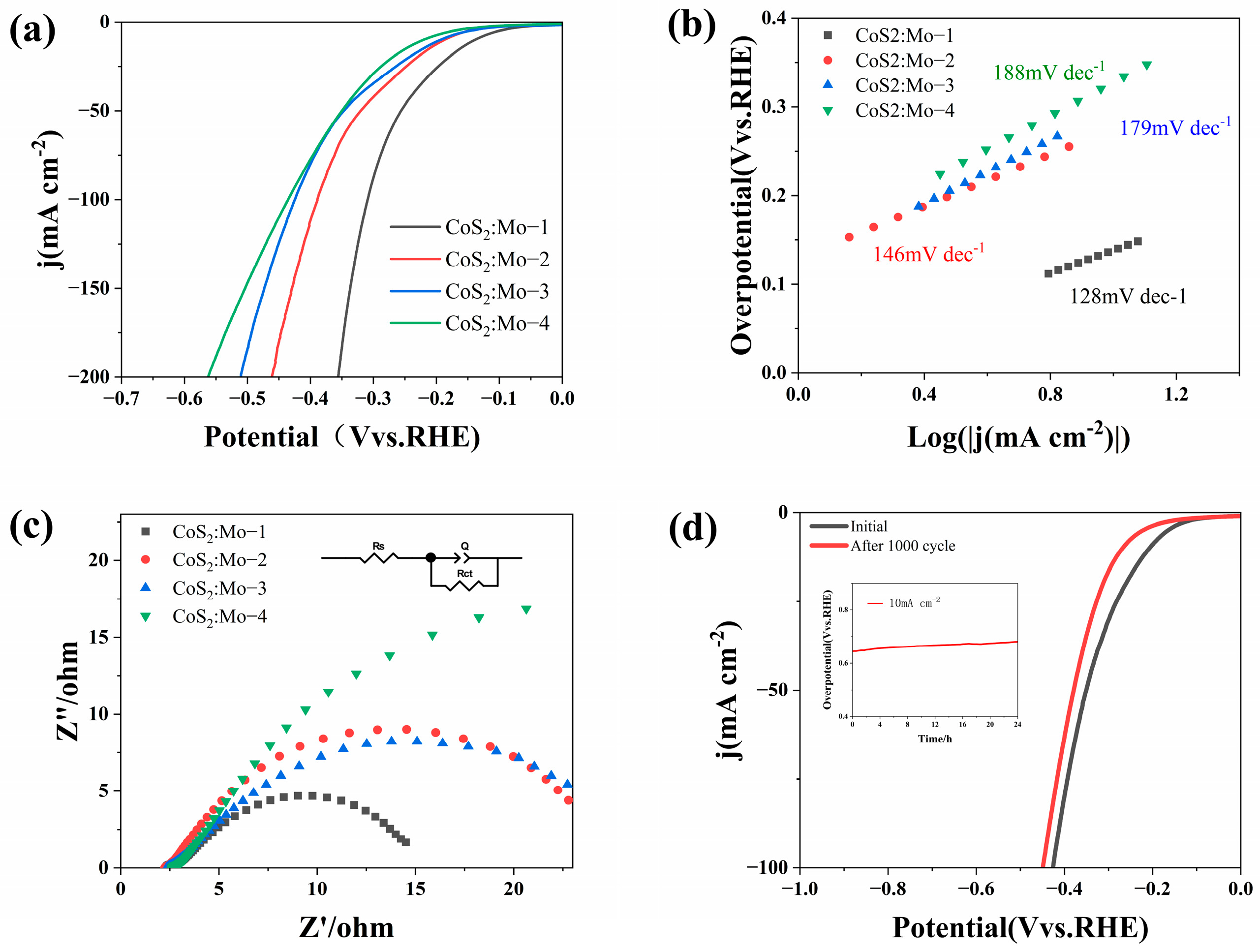
To evaluate the electrochemical performance of the synthesized materials, a series of tests were conducted. For comparison, MoS2 and CoS2 were synthesized using the same hydrothermal method. The HER performance of the catalysts was assessed in an alkaline medium (1 mol/L KOH) using a standard three-electrode system with 90% iR compensation. Figure 6a presents the linear sweep voltammetry (LSV) curves of samples with different Co:Mo doping ratios. As shown in Figure 6a, at a current density of 10 mA cm−2, CoS2:Mo-1 exhibits the lowest overpotential (η10 = 122 mV), which is significantly lower than those of CoS2:Mo-2, CoS2:Mo-3, and CoS2:Mo-4, indicating that the sample with a Co:Mo doping ratio of 1:1 achieves the best hydrogen evolution performance. Figure 6b shows the Tafel slopes of the samples. It can be seen from Figure 6b that CoS2:Mo-1 has the smallest Tafel slope, implying that under the same applied potential, CoS2:Mo-1 exhibits the fastest increase in current density. Figure 6c displays the electrochemical impedance spectroscopy (EIS) Nyquist plots. As evident from Figure 6c, CoS2:Mo-1 possesses the smallest semicircle diameter, indicating the lowest charge transfer resistance and thus the highest electrical conductivity among all samples. These results indicate that the electrochemical performance of the sample is enhanced as the doping ratio increases. Furthermore, the stability of the CoS2:Mo-1 sample was evaluated. Figure 6d presents the LSV curves before and after 1000 cycles of cyclic voltammetry testing, with the inset showing the chronoamperometry curve recorded over 24 h at a constant current density of 10 mA cm−2. The LSV curves exhibit negligible change after 1000 cycles, and the operating potential remains stable throughout the 24 h test, confirming the excellent long-term stability of the CoS2:Mo-1 catalyst.
Figure 6.
Electrochemical performance of the catalysts toward the HER in 1 M KOH. (a) Linear sweep voltammetry curves of CoS2:Mo-1, CoS2:Mo-2, CoS2:Mo-3, and CoS2:Mo-4. (b) Tafel slopes and (c) EIS spectra. (d) Linear sweep voltammetry curves of CoS2:Mo-1 before and after 1000 CV cycles, with the inset showing the chronopotentiometry curve of CoS2:Mo-1 tested at a current density of 10 mA cm−2 for 24 h.
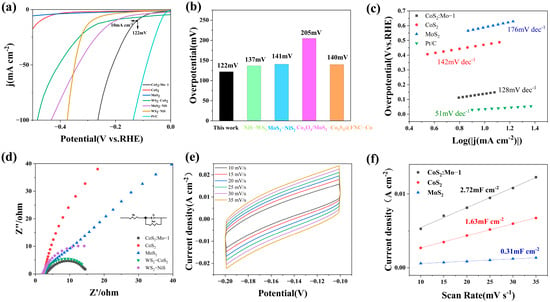
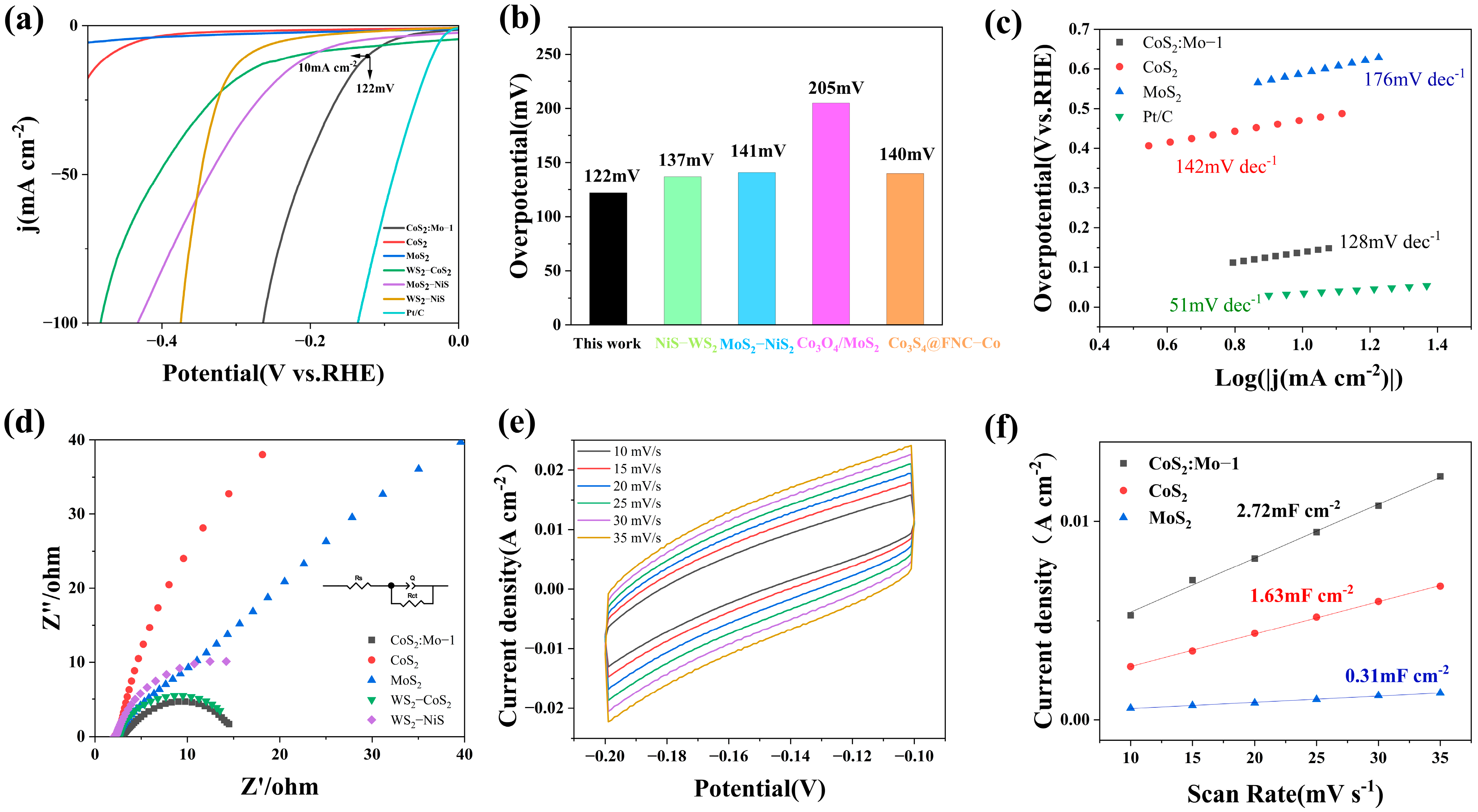
Figure 7a presents the linear sweep voltammetry (LSV) curves of the samples. As shown in Figure 7a, the CoS2:Mo material exhibits a low overpotential of 122 mV at a current density of 10 mA cm−2 in 1 M KOH. Although this is higher than the overpotential of 36 mV for commercial Pt/C, it is significantly lower than those of MoS2 and CoS2. Additionally, its performance surpasses that of WS2-CoS2 (η10 = 218 mV), MoS2-NiS (η10 = 199 mV), and WS2-NiS (η10 = 285 mV), which were also prepared using the same hydrothermal method. Furthermore, the CoS2:Mo sample was compared with other non-precious metal catalysts. Figure 7b shows a comparison with various non-precious metal catalysts, demonstrating that the CoS2:Mo sample outperforms them under identical conditions [59,60,61,62]. These results clearly indicate that Mo doping significantly enhances the alkaline HER performance of CoS2 catalysts. Table 1 compares the overpotential of the catalyst developed in this work with other reported Co-, S-, and Mo-based catalysts. As shown in Table 1, our catalyst exhibits the lowest overpotential at a current density of 10 mA cm−2, indicating its superior hydrogen evolution performance.
Figure 7.
Electrochemical performance of the catalysts toward the HER in 1 M KOH. (a) Linear sweep voltammetry (LSV) curves of Pt/C, CoS2:Mo, MoS2, CoS2, and other sulfur-based catalysts for hydrothermal synthesis. (b) Comparison of HER performance with recently reported TMDs. (c) Tafel slope and (d) EIS curves for different catalysts (inset: equivalent circuit diagram). (e) CV curves of CoS2:Mo at different scan rates. (f) Cdl for different catalysts.
Table 1.
Comparison with Other Co-, S-, and Mo-Based Catalysts.
The dynamic process associated with the Tafel slope also provides insights into the enhanced HER performance. The Tafel slope was determined using the following equation
where b is the Tafel slope and j is the current density, to investigate the hydrogen evolution reaction kinetics. Figure 7c presents the Tafel curves of the samples. As shown in Figure 7c, except for Pt/C (51 mV·dec−1), the Mo:CoS2 sample exhibits the smallest Tafel slope of 128 mV·dec−1, which is lower than those of MoS2 (176 mV·dec−1) and CoS2 (142 mV·dec−1). This indicates that the CoS2:Mo material follows the Volmer mechanism [63]. Around a current density of 10 mA·cm−2, the current density of CoS2:Mo exhibits the most rapid change with respect to the overpotential. A lower Tafel slope corresponds to a faster increase in current, significantly enhancing the electrocatalytic hydrogen evolution reaction rate. These findings further demonstrate that CoS2:Mo possesses the fastest HER kinetics and the best HER catalytic performance among the prepared materials. Moreover, Mo doping improves the Tafel slope of the material, suggesting enhanced charge transfer efficiency and accelerated reaction kinetics following Mo incorporation, which results in the most pronounced catalytic reaction kinetics under the same mechanism.
η = b log (j) + a
Electrochemical impedance spectroscopy (EIS) measurements were employed to assess the electrocatalytic kinetics at the electrolyte–electrocatalyst interface [64,65,66,67,68,69,70]. Figure 7d presents the electrochemical impedance spectra of the samples. The smaller charge transfer resistance, as indicated by the smallest semicircle diameter for this catalyst, suggests faster electron transfer kinetics following doping. The significant enhancement in conductivity demonstrates that Mo doping effectively reduces charge transfer resistance, promotes electron transport, and thereby optimizes catalytic activity.
The electrochemical surface area (ECSA) of the electrocatalysts was evaluated via electrochemical double-layer capacitance (Cdl) measurements. The Cdl values were derived from CV tests conducted at varying scan rates. Figure 7e,f display the cyclic voltammetry curves and the corresponding fitted double-layer capacitance curves for the samples, respectively. The results reveal that the Mo-doped sample exhibits a Cdl value of 2.72 mF·cm−2, which is higher than those of MoS2 (0.31 mF·cm−2) and CoS2 (1.63 mF·cm−2). This suggests that Mo doping effectively enhances the electrochemical active surface area, thereby exposing more HER active sites, which is in agreement with the improved HER catalytic activity shown in Figure 7a.
3.2. Electrochemical Measurements in Acidic Electrolytes
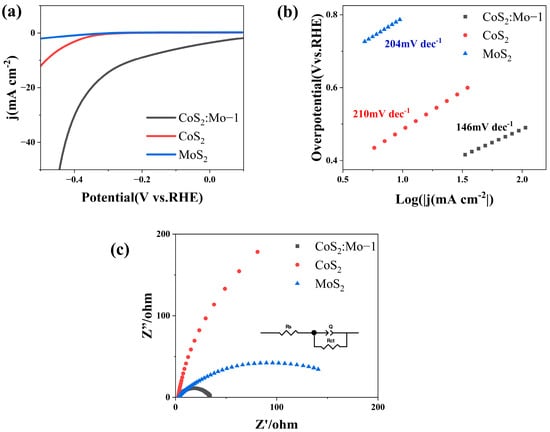
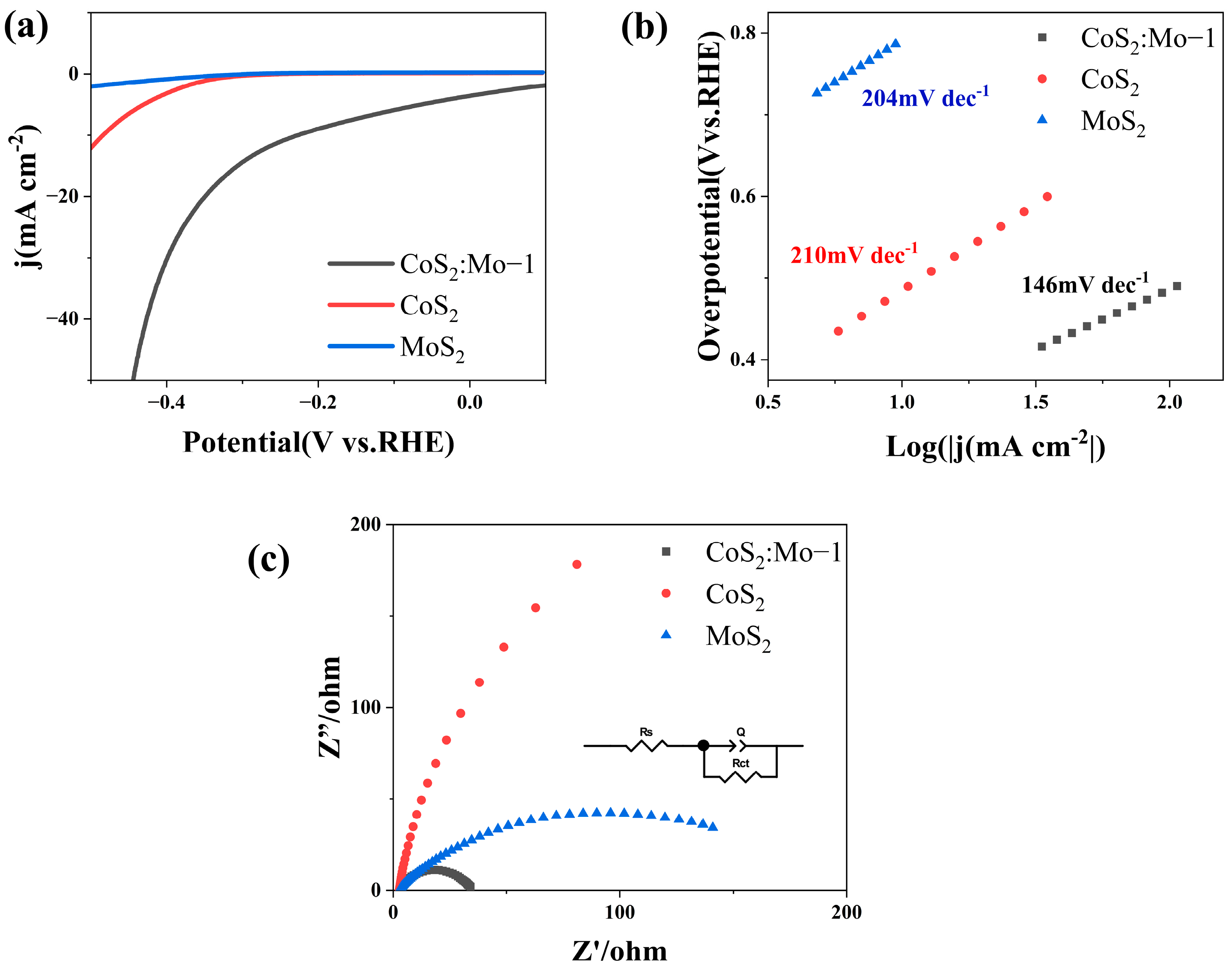
The HER performance of the CoS2:Mo sample and reference catalysts was further evaluated in an acidic electrolyte (0.5 mol/L H2SO4). As shown in Figure 8a, the linear sweep voltammetry (LSV) curves reveal that CoS2:Mo exhibits superior electrocatalytic activity, achieving a low overpotential of 227 mV at a current density of 10 mA cm−2, outperforming both MoS2 and CoS2. The linear regions of the LSV curves were fitted using the Tafel equation to derive the corresponding Tafel slopes. Figure 8b presents the resulting Tafel plots, indicating that CoS2:Mo displays a Tafel slope of 146 mV·dec−1, which is substantially lower than those of MoS2 (204 mV·dec−1) and CoS2 (210 mV·dec−1), suggesting enhanced catalytic kinetics.
Figure 8.
Electrochemical performance of the catalysts toward the HER in 0.5 M H2SO4. (a) LSV curves. (b) Tafel slope and (c) EIS curves for different catalysts (inset: equivalent circuit diagram).
The interfacial charge transfer kinetics were investigated using EIS. Figure 8c presents the electrochemical impedance spectra of the samples under acidic conditions. All three curves exhibit similar profiles, characterized by semicircles in the high-frequency region. Notably, CoS2:Mo presents the smallest semicircle diameter, indicating the lowest charge transfer resistance, which reflects faster HER kinetics at the electrocatalyst–electrolyte interface. The improved HER activity of CoS2:Mo is primarily attributed to the enhanced electrical conductivity induced by Mo incorporation.
4. Materials and Methods
4.1. Experimental Reagents
Cobalt nitrate hexahydrate (Co(NO3)2 ·6H2O, 99%, Macklin, Shanghai, China), ammonium molybdate tetrahydrate ((NH4)6Mo7O24·4H2O, AR, Sinopharm Chemical Reagent, Shanghai, China), thiourea (99%, Aladdin, Shanghai, China), hydrochloric acid (HCL, Xilong Scientific, Shenzhen, China), anhydrous ethanol (C2H5OH, Xihua, Shenzhen, China), platinum-on-carbon catalyst (Pt/C, 20% Pt, Macklin, Shanghai, China), carbon cloth, and Nafion solution (5%, DuPont, Wilmington, DE, USA) were used as received without further purification.
4.2. Synthesis of CoS2:Mo-Doped Materials
Under continuous stirring, a mixture of 2.5 mmol of Co(NO3)2·6H2O and varying amounts (0.35 mmol, 0.18 mmol, 0.07 mmol, and 0.035 mmol) of (NH4)6Mo7O24·4H2O was gradually dissolved in 30 mL of deionized water. After 10 min of stirring, the resulting solution was transferred into a 50 mL Teflon-lined stainless-steel autoclave and maintained at 150 °C for 6 h.
Upon completion of the reaction, the resulting precipitate was collected and repeatedly washed with deionized water and ethanol to remove impurities. The washed precursor was then dried in an oven at 60 °C for 12 h. Subsequently, a defined amount of the dried precursor was thoroughly mixed and ground with thiourea powder, followed by thermal treatment in a tube furnace. Under an N2 atmosphere, the temperature was increased to 450 °C at a heating rate of 5 °C/min and held for 120 min. After calcination, CoS2:Mo was obtained. Samples were designated as CoS2:Mo-1, CoS2:Mo-2, CoS2:Mo-3, and CoS2:Mo-4 based on the varying amounts of ammonium molybdate used.
4.3. Materials Characterization
The morphology and microstructure of the synthesized materials were characterized by scanning electron microscopy (SEM, HITACHI SU8010, 1.0 nm at15 kV, Hitachi, Tokyo, Japan) and transmission electron microscopy (TEM, FEI Tecnai G2 F20, 200 kV, FEI Company, Hillsboro, OR, USA). The crystal phase structure and chemical composition were analyzed using X-ray diffraction (XRD, Ultima IV, Rigaku Holdings Corporation, Tokyo, Japan) and X-ray photoelectron spectroscopy (XPS, K-Alpha, Thermo Fisher Scientific Inc., Waltham, MA, USA).
4.4. Electrochemical Measurements
The electrochemical performance was evaluated using a CHI660 (CH Instruments, Shanghai, China) electrochemical workstation in a standard three-electrode configuration, consisting of a platinum sheet as the counter electrode, a reference electrode, and a working electrode. A saturated Ag/AgCl electrode was used as the reference in 0.5 M H2SO4 electrolyte, while a Hg/HgO electrode served as the reference in 1.0 M KOH solution. The catalyst ink was prepared by ultrasonically dispersing 5 mg of catalyst in a mixture of 150 μL ethanol, 350 μL deionized water, and 10 μL Nafion solution (0.5 wt%). Subsequently, 0.1 mL of the resulting suspension was drop-cast onto a carbon cloth (CF) electrode and dried at room temperature. All measured potentials were converted to the reversible hydrogen electrode (RHE) scale using the following equations:
E(RHE) = E(Hg/HgO) + 0.098 V + 0.059 × pH (pH = 14)
E(RHE) = E(Ag/AgCl) + 0.0592 × pH + 0.197 (pH = 0),
Linear sweep voltammetry (LSV) was performed at a scan rate of 1 mV s−1 with 90% iR compensation. Cyclic voltammetry (CV) was conducted in the potential range of 0 to 0.2 V (vs. RHE) at scan rates from 10 to 35 mV s−1. Electrochemical impedance spectroscopy (EIS) measurements were carried out over a frequency range of 105 to 0.1 Hz with an AC amplitude of 5 mV. The double-layer capacitance (Cdl) was calculated from the CV curves recorded at various scan rates (10–35 mV/s) within the non-faradaic potential window of 0–0.2 V (vs. RHE). The electrochemically active surface area (ECSA) was estimated using the following equation:
ECSA = Cdl/Cs,
5. Conclusions
In this study, Mo-doped CoS2 (CoS2:Mo) microrods were successfully synthesized via a simple hydrothermal method, and their electrocatalytic hydrogen evolution reaction (HER) performance was systematically evaluated. Structural characterization confirms the successful incorporation of Mo into the CoS2 crystal lattice and the resulting lattice expansion. The material exhibits a uniform microrod morphology with homogeneous elemental distribution and no detectable impurity phases. Electrochemical tests show that under alkaline conditions (1.0 M KOH), CoS2:Mo requires an overpotential of only 122 mV to achieve a current density of 10 mA cm−2, significantly outperforming undoped CoS2 and MoS2. Tafel slope analysis further indicates improved reaction kinetics. Additionally, cyclic stability tests and chronopotentiometry measurements demonstrate good stability of the sample. Moreover, the material also exhibits favorable HER activity in acidic media. The performance enhancement is mainly attributed to the improved electrical conductivity, enlarged electrochemical active surface area, optimized charge transfer, and increased exposure of catalytic active sites resulting from Mo doping. This work not only presents an efficient non-precious metal HER electrocatalyst but also provides a feasible strategy for designing low-cost, high-performance HER catalysts through elemental doping. In future work, in situ characterization and theoretical calculations will be carried out to gain deeper insights into the dynamic structural evolution and reaction mechanisms at the doping sites during HER. Furthermore, the application of the material in overall water splitting or its integration with other renewable energy systems (such as photovoltaics-coupled electrolysis) will be investigated to evaluate its practical potential and facilitate its transition from laboratory research to industrial applications.
Author Contributions
Conceptualization, S.S., W.Y. and L.M.; Methodology, S.S.; Software, S.S.; Validation, S.S., W.Y. and H.P.; Formal Analysis, S.S.; Investigation, S.S.; Resources, S.S.; Data Curation, S.S.; Writing―Original Draft Preparation, S.S.; Writing―Review and Editing, S.S., X.L. and P.L.; Visualization, S.S.; Supervision, H.P.; Project Administration, S.Z.; Funding Acquisition, S.Z. All authors have read and agreed to the published version of the manuscript.
Funding
Please add: This research was supported by the National Natural Science Foundation of China (Grant No. U1704145), the Hainan Provincial Natural Science Foundation of China (Grant No. 522MS062), and the Special Research Fund of the Innovation Platform for Academicians of Hainan Province (Grant No. YSPTZX202207). The authors sincerely thank these organizations for their generous financial support.
Institutional Review Board Statement
Not applicable.
Informed Consent Statement
Not applicable.
Data Availability Statement
The original contributions presented in this study are included in the article. Further inquiries can be directed to the cor-responding author.
Conflicts of Interest
The authors declare no conflicts of interest.
References
- Sun, T.; Tang, Z.; Zang, W.; Li, Z.; Li, J.; Li, Z.; Cao, L.; Dominic Rodriguez, J.S.; Mariano, C.O.M.; Xu, H.; et al. Ferromagnetic single-atom spin catalyst for boosting water splitting. Nat. Nanotechnol. 2023, 18, 763–771. [Google Scholar] [CrossRef] [Scilit]
- Baek, J.; Hossain, M.D.; Mukherjee, P.; Lee, J.; Winther, K.T.; Leem, J.; Jiang, Y.; Chueh, W.C.; Bajdich, M.; Zheng, X. Synergistic effects of mixing and strain in high entropy spinel oxides for oxygen evolution reaction. Nat. Commun. 2023, 14, 5936. [Google Scholar] [CrossRef] [Scilit]
- Li, G.; Jang, H.; Liu, S.; Li, Z.; Kim, M.G.; Qin, Q.; Liu, X.; Cho, J. The synergistic effect of Hf-O-Ru bonds and oxygen vacancies in Ru/HfO2 for enhanced hydrogen evolution. Nat. Commun. 2022, 13, 1270. [Google Scholar] [CrossRef] [Scilit]
- Lei, Z.; Cai, W.; Rao, Y.; Wang, K.; Jiang, Y.; Liu, Y.; Jin, X.; Li, J.; Lv, Z.; Jiao, S.; et al. Coordination modulation of iridium single-atom catalyst maximizing water oxidation activity. Nat. Commun. 2022, 13, 24. [Google Scholar] [CrossRef] [Scilit] [PubMed]
- Impemba, S.; Provinciali, G.; Filippi, J.; Salvatici, C.; Berretti, E.; Caporali, S.; Banchelli, M.; Caporali, M. Engineering the heterojunction between TiO2 and In2O3 for improving the solar-driven hydrogen production. Int. J. Hydrogen Energy 2024, 63, 896–904. [Google Scholar] [CrossRef] [Scilit]
- Ji, R.; Liu, J.; Zhang, T.; Peng, Y.; Li, Y.; Chen, D.; Xu, Q.; Lu, J. Construction of a ternary Z-scheme In2S3@Au@P3HT photocatalyst for the degradation of phenolic pollutants under visible light. Sep. Purif. Technol. 2021, 272, 118787. [Google Scholar] [CrossRef] [Scilit]
- Zheng, X.; Song, Y.; Liu, Y.; Yang, Y.; Wu, D.; Yang, Y.; Feng, S.; Li, J.; Liu, W.; Shen, Y.; et al. ZnIn2S4-based photocatalysts for photocatalytic hydrogen evolution via water splitting. Coord. Chem. Rev. 2023, 475, 214898. [Google Scholar] [CrossRef] [Scilit]
- Impemba, S.; Provinciali, G.; Filippi, J.; Caporali, S.; Muzzi, B.; Casini, A.; Caporali, M. Tightly Interfaced Cu2O with In2O3 to Promote Hydrogen Evolution in Presence of Biomass-Derived Alcohols. Chemnanomat 2024, 10, e202400459. [Google Scholar] [CrossRef] [Scilit]
- Erdemir, D.; Dincer, I. A quicker route to hydrogen economy with ammonia. Int. J. Hydrogen Energy 2024, 82, 1230–1237. [Google Scholar] [CrossRef] [Scilit]
- Coşkuner Filiz, B.; Civelek Yörüklü, H.; Açıkalın, K.; Demirci, U.B.; Kantürk Figen, A. Boron-based hydrogen storage materials towards Power-to-X technology on the path to carbon neutrality. Int. J. Hydrogen Energy 2023, 48, 39389–39407. [Google Scholar] [CrossRef] [Scilit]
- Diglio, M.; Contento, I.; Impemba, S.; Berretti, E.; Della Sala, P.; Oliva, G.; Naddeo, V.; Caporali, S.; Primo, A.; Talotta, C.; et al. Hydrogen Production from Formic Acid Decomposition Promoted by Gold Nanoparticles Supported on a Porous Polymer Matrix. Energy Fuels 2025, 39, 14320–14329. [Google Scholar] [CrossRef] [Scilit]
- Popczun, E.J.; McKone, J.R.; Read, C.G.; Biacchi, A.J.; Wiltrout, A.M.; Lewis, N.S.; Schaak, R.E. Nanostructured Nickel Phosphide as an Electrocatalyst for the Hydrogen Evolution Reaction. J. Am. Chem. Soc. 2013, 135, 9267–9270. [Google Scholar] [CrossRef] [Scilit] [PubMed]
- Kibsgaard, J.; Chen, Z.; Reinecke, B.N.; Jaramillo, T.F. Engineering the surface structure of MoS2 to preferentially expose active edge sites for electrocatalysis. Nat. Mater. 2012, 11, 963–969. [Google Scholar] [CrossRef] [Scilit]
- Khasim, S.; Pasha, A.; Badi, N.; Lakshmi, M.; Mishra, Y.K. Expression of concern: High performance flexible supercapacitors based on secondary doped PEDOT–PSS–graphene nanocomposite films for large area solid state devices. RSC Adv. 2024, 14, 21654. [Google Scholar] [CrossRef] [Scilit]
- Qin, H.; Zhou, G. Advancements in transition metal nitride-based electrocatalysts for seawater electrolysis. Catal. Sci. Technol. 2025, 15, 6581–6602. [Google Scholar] [CrossRef] [Scilit]
- Wu, Y.; Sun, Z.; Chen, Y.; Liu, D.; Meng, Y.; Yan, Z. Assembly and Valence Modulation of Ordered Bimetallic MOFs for Highly Efficient Electrocatalytic Water Oxidation. Molecules 2024, 29, 5845. [Google Scholar] [CrossRef] [Scilit]
- Hamaguchi, T.; Iseki, Y.; Ishikawa, R.; Mishima, A.; Kawata, S. Structure of Ni(II) Inclusion Complex in Solid/Solution States and the Enhancement of Catalytic Behavior in Electrochemical Hydrogen Production. Molecules 2024, 29, 5858. [Google Scholar] [CrossRef] [Scilit]
- Mataev, M.; Sarsenbaeva, Z.; Keskin, B.; Nurbekova, M.; Meldeshov, A.; Tursyn, Z.; Seitbekova, K. Synthesis, Structure, and Electrophysical and Electrochemical Properties of Novel Composite La0.9MnO3-LaFeO3. Molecules 2025, 30, 132. [Google Scholar] [CrossRef] [Scilit]
- Ge, J.; Zhang, D.; Qin, Y.; Dou, T.; Jiang, M.; Zhang, F.; Lei, X. Dual-metallic single Ru and Ni atoms decoration of MoS2 for high-efficiency hydrogen production. Appl. Catal. B Environ. 2021, 298, 120557. [Google Scholar] [CrossRef] [Scilit]
- Li, J.; Zhang, Y.; Liu, C.; Zheng, L.; Petit, E.; Qi, K.; Zhang, Y.; Wu, H.; Wang, W.; Tiberj, A.; et al. 3.4% Solar-to-Ammonia Efficiency from Nitrate Using Fe Single Atomic Catalyst Supported on MoS2 Nanosheets. Adv. Funct. Mater. 2022, 32, 2108316. [Google Scholar] [CrossRef] [Scilit]
- Fei, B.; Chen, Z.; Liu, J.; Xu, H.; Yan, X.; Qing, H.; Chen, M.; Wu, R. Ultrathinning Nickel Sulfide with Modulated Electron Density for Efficient Water Splitting. Adv. Energy Mater. 2020, 10, 2001963. [Google Scholar] [CrossRef] [Scilit]
- Xu, W.; Zhao, R.; Li, Q.; Sun, B.; Wu, J.; Zhong, W.; Gao, Y.; Nan, X.; Huang, Q.; Yang, Y.; et al. Overall Water Splitting on The NiS/NiS2 Heterostructures Featuring Self-Equilibrium Orbital Occupancy. Adv. Energy Mater. 2023, 13, 2300978. [Google Scholar] [CrossRef] [Scilit]
- Chufarov, M.; Vassilyeva, Y.Z.; Zhang, X.; Li, S.; Pak, A.Y.; Han, W. Design of a long-lived Mo2C-MoO2@GC-N electrocatalyst by the ambient DC arc plasma for the hydrogen evolution reaction. iScience 2024, 27, 110551. [Google Scholar] [CrossRef] [Scilit]
- Li, D.; Wang, B.; Zheng, K.; Chen, H.; Xing, Y.; Xia, Y.; Long, X. Precisely tuning the electronic states of organic polymer electrocatalysts via thiophene-based moieties for enhanced oxygen reduction reaction. iScience 2025, 28, 112007. [Google Scholar] [CrossRef] [Scilit]
- Gazzari-Jara, S.; Cortés-Arriagada, D.; Chigo-Anota, E.; Miranda-Rojas, S. Boron-nitrogen fullerenes as electrocatalysts for nitrogen reduction: A computational study of affinity and reaction mechanism. iScience 2025, 28, 112326. [Google Scholar] [CrossRef] [Scilit] [PubMed]
- Helm, M.L.; Stewart, M.P.; Bullock, R.M.; DuBois, M.R.; DuBois, D.L. A synthetic nickel electrocatalyst with a turnover frequency above 100,000 s−1 for H2 production. Science 2011, 333, 863–866. [Google Scholar] [CrossRef] [Scilit]
- Debe, M.K. Electrocatalyst approaches and challenges for automotive fuel cells. Nature 2012, 486, 43–51. [Google Scholar] [CrossRef] [Scilit]
- Sun, L.; Gao, M.; Jing, Z.; Cheng, Z.; Zheng, D.; Xu, H.; Zhou, Q.; Lin, J. 1 T-Phase Enriched P doped WS2 nanosphere for highly efficient electrochemical hydrogen evolution reaction. Chem. Eng. J. 2022, 429, 132187. [Google Scholar] [CrossRef] [Scilit]
- Ma, M.; Xu, J.; Wang, H.; Zhang, X.; Hu, S.; Zhou, W.; Liu, H. Multi-interfacial engineering of hierarchical CoNi2S4/WS2/Co9S8 hybrid frameworks for robust all-pH electrocatalytic hydrogen evolution. Appl. Catal. B Environ. 2021, 297, 120455. [Google Scholar] [CrossRef] [Scilit]
- Voiry, D.; Yamaguchi, H.; Li, J.; Silva, R.; Alves, D.C.B.; Fujita, T.; Chen, M.; Asefa, T.; Shenoy, V.B.; Eda, G.; et al. Enhanced catalytic activity in strained chemically exfoliated WS2 nanosheets for hydrogen evolution. Nat. Mater. 2013, 12, 850–855. [Google Scholar] [CrossRef] [Scilit] [PubMed]
- Li, Y.; Yin, J.; An, L.; Lu, M.; Sun, K.; Zhao, Y.-Q.; Gao, D.; Cheng, F.; Xi, P. FeS2/CoS2 Interface Nanosheets as Efficient Bifunctional Electrocatalyst for Overall Water Splitting. Small 2018, 14, 1801070. [Google Scholar] [CrossRef] [Scilit] [PubMed]
- Kuang, P.; He, M.; Zou, H.; Yu, J.; Fan, K. 0D/3D MoS2-NiS2/N-doped graphene foam composite for efficient overall water splitting. Appl. Catal. B Environ. 2019, 254, 15–25. [Google Scholar] [CrossRef] [Scilit]
- Jia, Y.; Zhang, Y.; Xu, H.; Li, J.; Gao, M.; Yang, X. Recent Advances in Doping Strategies to Improve Electrocatalytic Hydrogen Evolution Performance of Molybdenum Disulfide. ACS Catal. 2024, 14, 4601–4637. [Google Scholar] [CrossRef] [Scilit]
- Pan, M.; Zhang, X.; Pan, C.; Wang, J.; Pan, B. Identification of Co–O–Mo Active Centers on Co-Doped MoS2 Electrocatalyst. ACS Appl. Mater. Interfaces 2023, 15, 19695–19704. [Google Scholar] [CrossRef] [Scilit]
- Maia, L.B.; Maiti, B.K.; Moura, I.; Moura, J.J.G. Selenium—More than Just a Fortuitous Sulfur Substitute in Redox Biology. Molecules 2024, 29, 120. [Google Scholar] [CrossRef] [Scilit]
- Wang, F.; Li, Y.; Shifa, T.A.; Liu, K.; Wang, F.; Wang, Z.; Xu, P.; Wang, Q.; He, J. Selenium-Enriched Nickel Selenide Nanosheets as a Robust Electrocatalyst for Hydrogen Generation. Angew. Chem. Int. Ed. 2016, 55, 6919–6924. [Google Scholar] [CrossRef] [Scilit]
- Liu, K.; Wang, F.; Shifa, T.A.; Wang, Z.; Xu, K.; Zhang, Y.; Cheng, Z.; Zhan, X.; He, J. An efficient ternary CoP2xSe2(1−x) nanowire array for overall water splitting. Nanoscale 2017, 9, 3995–4001. [Google Scholar] [CrossRef] [Scilit]
- Guo, Y.; Tang, J.; Wang, Z.; Sugahara, Y.; Yamauchi, Y. Hollow Porous Heterometallic Phosphide Nanocubes for Enhanced Electrochemical Water Splitting. Small 2018, 14, 1802442. [Google Scholar] [CrossRef] [Scilit]
- Khodayar, N.; Noori, A.; Rahmanifar, M.S.; Moloudi, M.; Hassani, N.; Neek-Amal, M.; El-Kady, M.F.; Mohamed, N.B.; Xia, X.; Zhang, Y.; et al. An ultra-high mass-loading transition metal phosphide electrocatalyst for efficient water splitting and ultra-durable zinc–air batteries. Energy Environ. Sci. 2024, 17, 5200–5215. [Google Scholar] [CrossRef] [Scilit]
- Liu, W.; Hu, E.; Jiang, H.; Xiang, Y.; Weng, Z.; Li, M.; Fan, Q.; Yu, X.; Altman, E.I.; Wang, H. A highly active and stable hydrogen evolution catalyst based on pyrite-structured cobalt phosphosulfide. Nat. Commun. 2016, 7, 10771. [Google Scholar] [CrossRef] [Scilit]
- Yuan, S.; Xia, M.; Liu, Z.; Wang, K.; Xiang, L.; Huang, G.; Zhang, J.; Li, N. Dual synergistic effects between Co and Mo2C in Co/Mo2C heterostructure for electrocatalytic overall water splitting. Chem. Eng. J. 2022, 430, 132697. [Google Scholar] [CrossRef] [Scilit]
- Wan, C.; Regmi, Y.N.; Leonard, B.M. Multiple phases of molybdenum carbide as electrocatalysts for the hydrogen evolution reaction. Angew. Chem. Int. Ed. Engl. 2014, 53, 6407–6410. [Google Scholar] [CrossRef] [Scilit] [PubMed]
- Xia, Y.; Wang, P.; Wang, X.; Chen, F.; Yu, H. Directional electron transfer from CoS2 to Mo2C for weakening Mo–H bonds toward boosting photocatalytic H2 production. Catal. Sci. Technol. 2025, 15, 6067–6075. [Google Scholar] [CrossRef] [Scilit]
- Sugawara, Y.; Uchiyama, T.; Shishkin, M.; Yamaguchi, T. Electrochemical oxygen evolution catalysis of metal sulfides: A systematic study of electronic effects. Catal. Sci. Technol. 2025, 15, 5004–5013. [Google Scholar] [CrossRef] [Scilit]
- Wan, S.; Liu, Y.; Li, G.-D.; Li, X.; Wang, D.; Zou, X. Well-dispersed CoS2 nano-octahedra grown on a carbon fibre network as efficient electrocatalysts for hydrogen evolution reaction. Catal. Sci. Technol. 2016, 6, 4545–4553. [Google Scholar] [CrossRef] [Scilit]
- Lin, J.; Wang, P.; Wang, H.; Li, C.; Si, X.; Qi, J.; Cao, J.; Zhong, Z.; Fei, W.; Feng, J. Defect-Rich Heterogeneous MoS(2)/NiS(2) Nanosheets Electrocatalysts for Efficient Overall Water Splitting. Adv. Sci. 2019, 6, 1900246. [Google Scholar] [CrossRef] [Scilit]
- Jia, H.; Meng, L.; Lu, Y.; Liang, T.; Yuan, Y.; Hu, Y.; Dong, Z.; Zhou, Y.; Guan, P.; Zhou, L.; et al. Boosting the efficiency of electrocatalytic water splitting via in situ grown transition metal sulfides: A review. J. Mater. Chem. A 2024, 12, 28595–28617. [Google Scholar] [CrossRef] [Scilit]
- Liu, B.; Cheng, Y.; Cao, B.; Hu, M.; Jing, P.; Gao, R.; Du, Y.; Zhang, J.; Liu, J. Hybrid heterojunction of molybdenum disulfide/single cobalt atoms anchored nitrogen, sulfur-doped carbon nanotube /cobalt disulfide with multiple active sites for highly efficient hydrogen evolution. Appl. Catal. B Environ. 2021, 298, 120630. [Google Scholar] [CrossRef] [Scilit]
- Kim, M.-I.; Lim, T.; Shin, S.H.; Suk, J.W. Synthesis of 1T/2H-MoS2 nanosheets on dome-shaped CoS2 particles embedded in carbon nanofibers as free-standing electrodes for alkaline water splitting. J. Taiwan Inst. Chem. Eng. 2025, 106260. [Google Scholar] [CrossRef] [Scilit]
- Liu, Z.; Chen, M.; Feng, W.; Lin, Y.; Liu, W.; Liu, Y. CoS2/N-doped carbon nanotubes hollow polyhedron derived from core-shell ZIF-8@ZIF-67 for efficient hydrogen evolution reaction. Int. J. Hydrogen Energy 2023, 48, 9362–9370. [Google Scholar] [CrossRef] [Scilit]
- Sekar, S.; Brindha Devi, S.; Maruthasalamoorthy, S.; Maiyalagan, T.; Kim, D.Y.; Lee, S.; Navamathavan, R. One-step facile hydrothermal synthesis of rGO-CoS2 nanocomposites for high performance HER electrocatalysts. Int. J. Hydrogen Energy 2022, 47, 40359–40367. [Google Scholar] [CrossRef] [Scilit]
- Liu, F.; He, W.; Li, Y.; Wang, F.; Zhang, J.; Xu, X.; Xue, Y.; Tang, C.; Liu, H.; Zhang, J. Activating sulfur sites of CoS2 electrocatalysts through tin doping for hydrogen evolution reaction. Appl. Surf. Sci. 2021, 546, 149101. [Google Scholar] [CrossRef] [Scilit]
- Du, X.; Ma, G.; Zhang, X. Mo-doped Co9S8 nanorod array as a high performance electrochemical water splitting catalyst in alkaline solution. Int. J. Hydrogen Energy 2019, 44, 27765–27771. [Google Scholar] [CrossRef] [Scilit]
- Wang, L.; Duan, X.; Liu, X.; Gu, J.; Si, R.; Qiu, Y.; Qiu, Y.; Shi, D.; Chen, F.; Sun, X.; et al. Atomically Dispersed Mo Supported on Metallic Co9S8 Nanoflakes as an Advanced Noble-Metal-Free Bifunctional Water Splitting Catalyst Working in Universal pH Conditions. Adv. Energy Mater. 2020, 10, 1903137. [Google Scholar] [CrossRef] [Scilit]
- Yang, F.; Ma, R.; Zhang, H.; Shang, J.; Li, C. Tensile mechanical properties and modulation of orderly-doped transition-metal dichalcogenides. Phys. B Condens. Matter 2025, 719, 417935. [Google Scholar] [CrossRef] [Scilit]
- Lyapin, S.G.; Utyuzh, A.N.; Petrova, A.E.; Novikov, A.P.; Lograsso, T.A.; Stishov, S.M. Raman studies of nearly half-metallic ferromagnetic CoS2. J. Physics. Condens. Matter Inst. Phys. J. 2014, 26, 396001. [Google Scholar] [CrossRef] [Scilit]
- Feng, Y.; Zhang, T.; Zhang, J.; Fan, H.; He, C.; Song, J. 3D 1T-MoS2/CoS2 Heterostructure via Interface Engineering for Ultrafast Hydrogen Evolution Reaction. Small 2020, 16, 2002850. [Google Scholar] [CrossRef] [Scilit]
- Zhang, J.; Liu, Y.; Sun, C.; Xi, P.; Peng, S.; Gao, D.; Xue, D. Accelerated Hydrogen Evolution Reaction in CoS2 by Transition-Metal Doping. ACS Energy Lett. 2018, 3, 779–786. [Google Scholar] [CrossRef] [Scilit]
- Wang, L.; Lv, J.; Li, Y.; Hao, Y.; Liu, W.; Zhang, H.; Xu, X. One-step synthesis of nanowoven ball-like NiS-WS2 for high-efficiency hydrogen evolution. Chin. Chem. Lett. 2025, 36, 109597. [Google Scholar] [CrossRef] [Scilit]
- Lonkar, S.P.; Pillai, V.V.; Alhassan, S.M. Scalable solid-state synthesis of MoS2–NiS2/graphene nanohybrids as bifunctional electrocatalysts for enhanced overall water splitting. Mater. Adv. 2020, 1, 794–803. [Google Scholar] [CrossRef] [Scilit]
- Muthurasu, A.; Maruthapandian, V.; Kim, H.Y. Metal-organic framework derived Co3O4/MoS2 heterostructure for efficient bifunctional electrocatalysts for oxygen evolution reaction and hydrogen evolution reaction. Appl. Catal. B Environ. 2019, 248, 202–210. [Google Scholar] [CrossRef] [Scilit]
- Zhu, X.; Dai, J.; Li, L.; Zhao, D.; Wu, Z.; Tang, Z.; Ma, L.-J.; Chen, S. Hierarchical carbon microflowers supported defect-rich Co3S4 nanoparticles: An efficient electrocatalyst for water splitting. Carbon 2020, 160, 133–144. [Google Scholar] [CrossRef] [Scilit]
- Wei, J.; Zhou, M.; Long, A.; Xue, Y.; Liao, H.; Wei, C.; Xu, Z.J. Heterostructured Electrocatalysts for Hydrogen Evolution Reaction Under Alkaline Conditions. Nano-Micro Lett. 2018, 10, 75. [Google Scholar] [CrossRef] [Scilit]
- Sadat, M.N.; Rahman, M.A.; Roy, D.C.; Rahman, M.A.; Hasan, M.Z.; Ahmad, I.; Chowdhury, S.; Hasan, W.; Ferdous, R.; Aktar, T.; et al. Study of the physical aspects of Pt3T (T = Mn, Ni) intermetallic compounds using first principles method. Phys. B Condens. Matter 2024, 672, 415402. [Google Scholar] [CrossRef] [Scilit]
- Ghobadi, N.; Daqiq, R. Tunnel-magneto resistance of double-barrier tunnel junctions in the presence of spin-orbit coupling within spin-filter barriers. Phys. B Condens. Matter 2024, 673, 415464. [Google Scholar] [CrossRef] [Scilit]
- Itas, Y.S.; Razali, R.; Khandaker, M.U.; Tata, S.; Boukhris, I. Structural, mechanical, electronic and optical properties of Si decorated zinc oxide nanotube photocatalyst for hydrogen evolution via overall water splitting: A DFT study. Phys. B Condens. Matter 2024, 673, 415493. [Google Scholar] [CrossRef] [Scilit]
- Chaudhary, A.K.; Sharma, P.; Rana, A.; Jain, S.; Saini, S.K.; Kumar, K.; Kuldeep; Singh, R.K.; Goswami, L.; Tanwar, P.K.; et al. Exploring charge transfer mechanisms and optical properties in vdW heterostructures of MoS2 and Bi2Se3 at nanoscale regime. Phys. B Condens. Matter 2024, 674, 415569. [Google Scholar] [CrossRef] [Scilit]
- Jia, X.; Lou, M.; Wang, Y.; Wang, R. Construction of Ni2P-MoC/Coal-Based Carbon Fiber Self-Supporting Catalysts for Enhanced Hydrogen Evolution. Molecules 2024, 29, 116. [Google Scholar] [CrossRef] [Scilit] [PubMed]
- Zhao, G.; Liang, H.; Xu, H.; Li, C.; Tan, Q.; Zhang, D. Correction: Catalytic wet peroxide degradation of acrylonitrile wastewater by ordered mesoporous Ag/CeO2: Synthesis, performance and kinetics. RSC Adv. 2024, 14, 3731. [Google Scholar] [CrossRef] [Scilit]
- Tong, Y.; Alsalama, M.; Berdiyorov, G.R.; Ahmad, S.I.; Hamoudi, H. Correction: Nanoarchitectonics of molecular self assembled monolayers by transition metal ion intercalation for enhancement of molecular junction conductivity. RSC Adv. 2024, 14, 23661. [Google Scholar] [CrossRef] [Scilit]

Disclaimer/Publisher’s Note: The statements, opinions and data contained in all publications are solely those of the individual author(s) and contributor(s) and not of MDPI and/or the editor(s). MDPI and/or the editor(s) disclaim responsibility for any injury to people or property resulting from any ideas, methods, instructions or products referred to in the content. |
© 2026 by the authors. Licensee MDPI, Basel, Switzerland. This article is an open access article distributed under the terms and conditions of the Creative Commons Attribution (CC BY) license.