


Abstract
CO2 cycloaddition with epoxides offers a sustainable route for CO2 utilization, yet the simultaneous activation of both substrates remains challenging. Herein, using UiO-66(Zr)-NH2 (denoted as UZN) as a model system, we illustrate that dual-active sites consisting of unsaturated Zr4+ centers and amine groups can efficiently accelerate CO2 fixation with epoxides under visible light. The unique ensemble in UZN optimizes light harvesting, promotes charge carrier separation, and enriches bifunctional active sites for efficient adsorption and activation of epoxides and CO2. Consequently, UZN exhibits significantly improved CO2-epoxide cycloaddition performance compared to UiO-66(Zr)-H (denoted as UZH), achieving a PC yield of 99.5%, with a production rate of 9.97 mmol·g−1·h−1. This work establishes a clear coordination–photocatalytic synergy in MOF-based systems and provides fundamental insights and a generalizable strategy for designing advanced catalysts for CO2 transformation.
1. Introduction
Global industrialization and rapid urban expansion have led to excessive fossil fuel consumption, accelerating both global warming and ocean acidification. Among various carbon-mitigation strategies, the chemical conversion of CO2 into high-value chemicals has been considered an effective means for CO2 resource utilization. Chemical fixation of CO2 with epoxides to produce cyclic carbonates is an ideal pathway due to its 100% atom economy. The resulting cyclic carbonates, which serve as lithium battery electrolytes, low-toxicity solvents, and pharmaceutical intermediates, have therefore attracted widespread attention.
Mechanistically, the ring-opening of the epoxide, typically initiated by nucleophilic attack of a halide anion, is often regarded as the rate-determining step (RDS). However, the activation of CO2 is equally essential to the overall catalytic efficiency. Owing to its linear geometry, high C=O bond energy (+805 kJ·mol−1) and thermodynamic inertness, CO2 activation requires substantial input energy, thereby limiting reaction efficiency under conventional thermal conditions. In recent years, photocatalysis has emerged as an appealing strategy to address this challenge because photogenerated electrons and holes can activate small molecules, such as CO2, NO, N2O, CH4, and benzyl alcohols, by lowering kinetic barriers and enabling energetically challenging transformations under mild conditions [1,2,3,4]. These photophysical advantages make photocatalysis an ideal approach for promoting CO2− epoxide cycloaddition reactions in an energy- and cost-effective manner. To date, various catalysts featuring Lewis acidic sites (e.g., Zn-loaded porous carbon, Al-loaded porous carbon and W18O49/g-C3N4) have been designed and demonstrated appreciable catalytic performance toward the activation of individual reactants [5,6,7]. Nevertheless, most of these systems focus on activating either CO2 or epoxides alone, while studies explicitly addressing the synergistic activation of both substrates via Lewis acid–base cooperation remain scarce.
Metal–organic frameworks (MOFs), owing to their multifunctional sites and architectural versatility, have emerged as promising catalysts for chemically converting CO2 into cyclic carbonates [8,9]. Especially UiO-66-NH2 (denoted as UZN), a representative Zr-based MOF constructed from hexanuclear Zr6O4(OH)4 secondary building units connected by 2-aminoterephthalate (ATA) linkers, has been widely reported as a visible-light-responsive photocatalyst for CO2 reduction and selective organic transformations. More importantly, the Zr6 nodes in UZN can generate coordinatively unsaturated Zr3+ sites upon defect formation, which function as strong Lewis acidic centers for CO2 adsorption and activation. Simultaneously, the -NH2 groups on the ATA linkers serve as intrinsic Lewis basic sites capable of interacting with epoxide substrates and facilitating charge localization under light irradiation.
Among various MOFs, UiO-66-NH2 (denoted as UZN), a representative Zr-based MOF constructed from hexanuclear Zr6O4(OH)4 secondary building units connected by 2-aminoterephthalate (ATA) linkers, stands out as a potential photocatalyst for the effective cycloaddition of CO2 owing to the following reasons: (1) Exposed Zr metal centers in UZN may act as Lewis acid sites for selective adsorption and coordination activation of CO2. The highly coordinated and compact inorganic secondary building units of UZN facilitate preferential CO2 uptake. (2) Meanwhile, the amine groups assist in epoxide polarization and act as hole accumulation sites for Br− oxidation, thereby accelerating the epoxide ring-opening. It is noteworthy that a perylene-3,4,9,10-tetracarboxylic diimide-UiO-66-NH2 composite (denoted as PDI-UZN) was previously developed by our group [10], in which the built-in electric field between exposed Zr sites and PDI significantly enhanced catalytic performance by promoting charge separation and carrier dynamics. However, although CO2 adsorption on unsaturated Zr sites was demonstrated, a more detailed understanding of epoxide activation and the cooperative roles of dual-active sites under visible light remains to be explored. Therefore, a systematic investigation of the cooperative adsorption and activation roles of the dual-active sites in UZN is necessary.
Herein, UZN was synthesized and identified as an efficient photocatalyst for visible-light-driven cycloaddition of CO2 with epoxides. Combining in situ EPR and in situ infrared spectroscopy, the distinct roles of the dual-coordination sites are uncovered. The unsaturated Zr4+ nodes act as Lewis acid centers, selectively adsorbing CO2 and generating •CO2− species via electron transfer. Meanwhile, the amino ligands promote epoxide adsorption, where the interaction is primarily governed by weak non-covalent interactions consistent with van der Waals forces. Density functional theory (DFT) calculations provide adsorption energies and reaction pathways consistent with the proposed dual-site interaction, contributing to a better understanding of the coordination-assisted catalytic process and providing deeper insight into the coordination activation–catalysis pathway.
2. Results
2.1. Characterizations
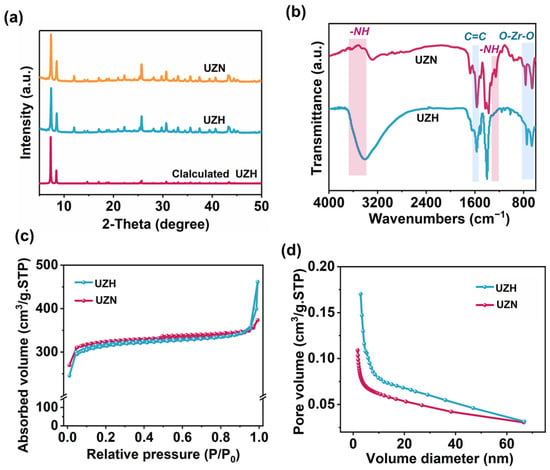
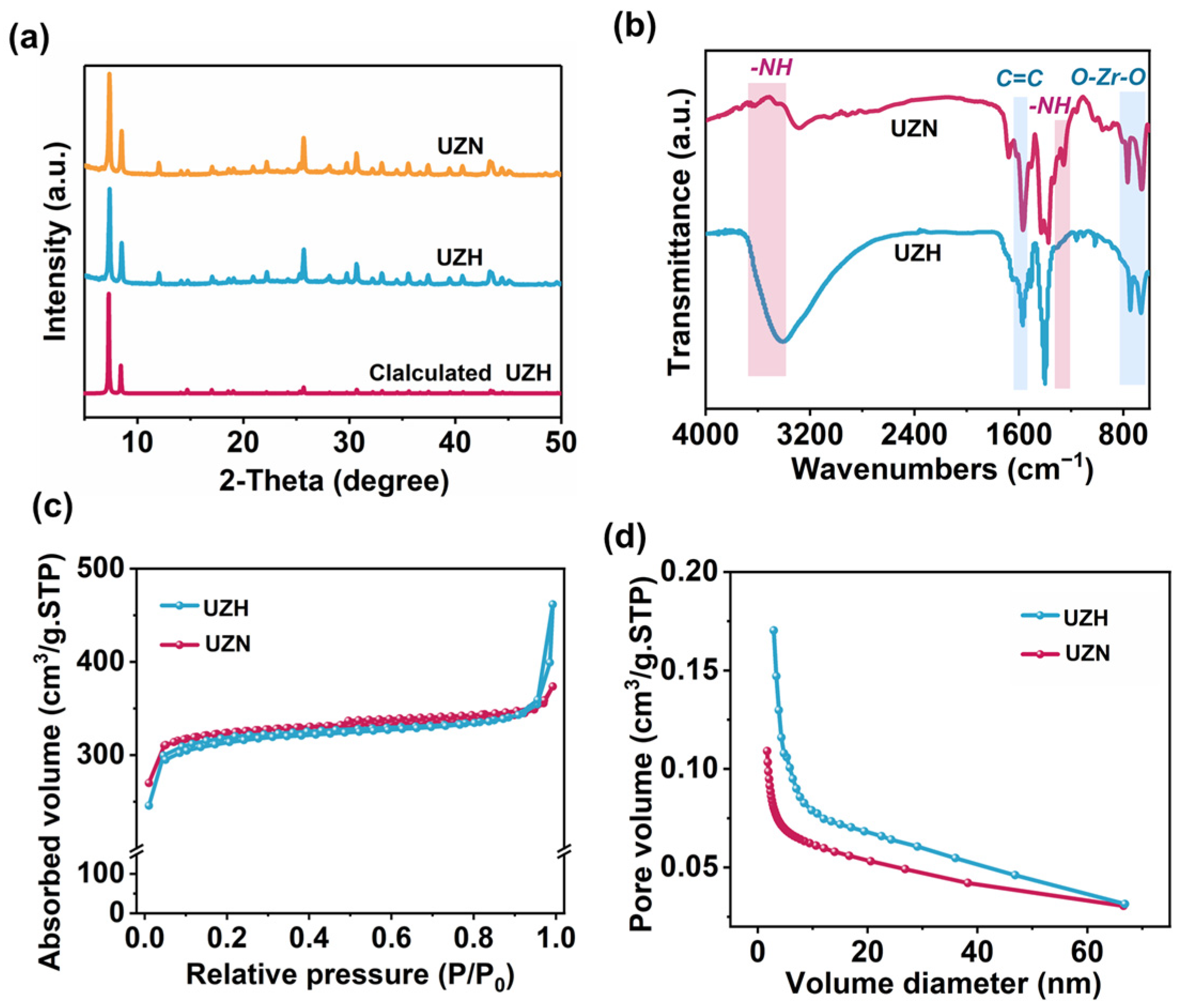
The X-ray diffraction (XRD) pattern of UZN shows well-defined peaks consistent with the simulated UiO-66(Zr) structure (Figure 1a), indicating its high crystallinity. The nearly identical diffraction profiles of UZN and UZH further indicate that introducing -NH2 groups does not alter the framework topology [11,12,13]. FTIR spectra (Figure 1b) also verify the successful incorporation of -NH2 functionalities [14,15,16]. Specifically, the symmetric and asymmetric N-H vibrations at 3623 and 3423 cm−1 are characteristic of NH2 groups. The band at 1265 cm−1 can be ascribed to the stretching vibration of N-C, while the peak at 1578 cm−1 is attributed to the stretching of the C=C bond in the aromatic ring, and the strong bands at 769 and 658 cm−1 are attributed to the O-Zr-O bonds, further supporting the successful synthesis of UZN. In addition, scanning electron microscopy (SEM), transmission electron microscopic (TEM), nitrogen adsorption, and XPS analyses collectively support the successful synthesis of UZN with the expected morphology, porosity, and surface chemical composition (Figures S1–S3).
Figure 1.
(a) XRD patterns, (b) FT-IR spectrum, (c) N2 adsorption–desorption isotherms of the samples, and (d) pore size distribution curves of the photocatalysts.
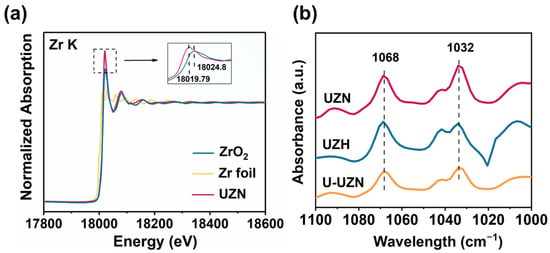
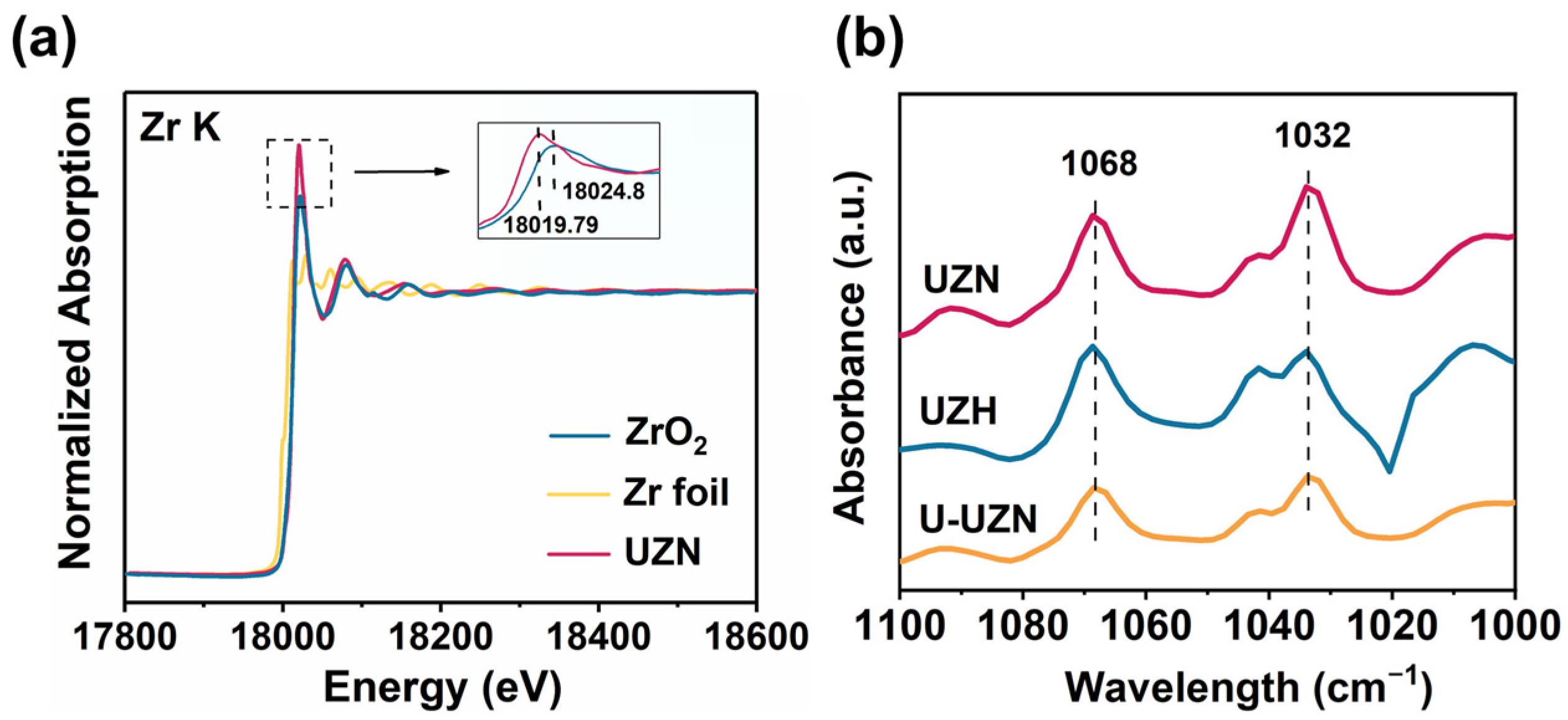
The coordination environment of Zr centers in UZN was investigated by X-ray absorption near-edge structure (XANES) spectroscopy using Zr foil and ZrO2 as references. As shown in Figure 2a, the absorption edge position of UZN, determined from the maximum of the first derivative of the XANES spectrum, is located at 18,013.9 eV, which lies between that of Zr foil (17,977.8 eV) and ZrO2 (18,019.0 eV), and is closer to that of ZrO2. This result indicates that Zr in UZN predominantly exists in a high-valence state, with possible contributions from a mixed Zr3+/Zr4+ environment. The intense white line feature observed in the inset of Figure 2a can be assigned to the dipole-allowed 1 s → 5 p transition, which is consistent with previous reports on Zr-based carboxylate MOFs [17,18]. The absorption edge and intensity of the white line in UZN (18,019.9 eV) are relatively lower than those of ZrO2 (18,020.2 eV), suggesting a loss of ligands in the first coordination shell around Zr [18,19,20]. Fitting of the Fourier-transformed extended X-ray absorption fine structure (FT-EXAFS) data may provide insight into the structural parameters such as coordination number (CN), bond distance, and local disorder (Debye–Waller factor) (Table S1). As can be seen, UZN mainly contains first-shell Zr-O coordination and second-shell Zr-Zr coordination, in which the total coordination number of Zr-O in the first shell is approximately 6.6, lower than the full coordination number of 8. This is consistent with the unsaturated coordinate structure of Zr. The unsaturated sites provide abundant active sites for the adsorption and activation of reactants. Utilizing probe molecules, such as pyridine or ammonia, in combination with spectroscopic techniques has become a well-established methodology to titrate active sites [19,21,22]. To experimentally probe the Lewis acidity associated with the unsaturated Zr sites, pyridine adsorption Fourier-transform infrared spectroscopy (Py-FTIR) was employed (Figure 2b). Although the characteristic pyridine bands associated with Lewis acid sites typically appear in the 1400–1600 cm−1 region, these signals are often masked in MOF materials due to strong carboxylate and aromatic ring vibrations [23,24,25,26]. According to previous work, signal peaks in the range of 1000–1100 cm−1 can also be used as a reference [27]. The intensity of Lewis acid strength in the three samples can be determined from two major signal peaks at 1032 and 1068 cm−1, which can be assigned to pyridine coordinated to Zr sites. To verify this conjecture, controlled experiments were conducted, and unactivated UZN (U-UZN, meaning it contains a less unsaturated metal center) was adopted as the contrast sample. As shown in Figure 2b and Table S2, UZN exhibits significantly stronger absorption bands at 1032 and 1068 cm−1 compared with U-UZN, indicating a higher density of accessible Lewis acidic Zr sites. These results are in good agreement with the EXAFS analysis and collectively confirm the presence of abundant unsaturated Zr coordination sites in UZN.
Figure 2.
(a) XANES spectra for UZN, (b) Py-FTIR spectra for UZH, UZN, and U-UZN.
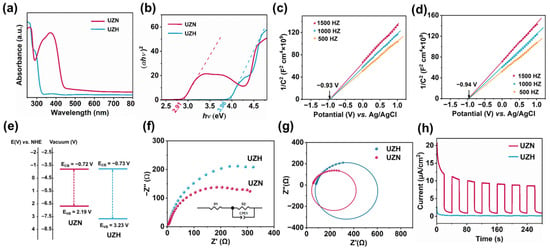
As shown in Figure 3a,b, UZN exhibits an optical band gap (Eg) of 2.91 eV with a pronounced absorption edge extending into the visible-light region, indicating its strong potential for solar energy utilization. To further elucidate the electronic band structure, the flat-band potentials of UZN and UZH were estimated from the Mott–Schottky plots (Figure 3c,d). Both samples display positive slopes, characteristic of n-type semiconductor behavior. The flat-band potentials were determined to be approximately −0.93 V and −0.94 V vs. Ag/AgCl (pH = 7) for UZN and UZH, respectively. The potentials measured versus Ag/AgCl were converted to the NHE scale according to ENHE = EAg/AgCl + 0.21 V (298 K). Since both samples exhibit typical n-type semiconductor behavior, the flat-band potentials are approximately equal to the conduction band minimum. Accordingly, the CB positions of UZN and UZH were estimated to be −0.72 V and −0.73 V vs. NHE, respectively. Based on the relationship EVB-NHE = ECB-NHE + Eg, the valence band (VB) positions of UZN and UZH were calculated to be 2.19 and 3.23 eV, respectively (Figure 3e). This indicates that the introduction of the amino group reduced the redox potential of the VB of UZN. As a result, the photoabsorption edge of UZN shifts to the visible-light region.
Figure 3.
(a) UV-vis DRS spectra and (b) Tauc plots of the resulting samples; (c) Mott–Schottky plot of UZH; (d) Mott–Schottky plot of UZN; (e) band structures of UZH and UZN; (f) electrochemical impedance spectroscopy (EIS) Nyquist plots of the samples, the inset shows the equivalent circuit diagram; (g) fitted circle from the EIS Nyquist plots; and (h) transient photocurrent representations of UZH and UZN.
Electrochemical impedance spectra (EIS) investigation was used to reveal the electrical conductivity of the samples [28,29]. The impedance data were fitted with Z-view 2.6.0.11 software to draw an equivalent circuit model [30,31]. Figure 3f shows the electrochemical impedance spectroscopy (EIS) results, which reflect that UZN shows a smaller impedance arc radius (Figure 3g), proving excellent photoexcited carrier transport and separation in UZN. A similar result can also be found in the photoelectric response tests, which were recorded over several on–off cycles of intermittent irradiation. Furthermore, as shown in Figure 3h, a stable and strong short-circuit photocurrent response has been observed for the UZN photoelectrode under visible-light irradiation. However, no obvious circuit photocurrent has been detected for UZH, which is consistent with the UV-vis DRS results.
2.2. Photocatalytic CO2 Fixation with Epoxides
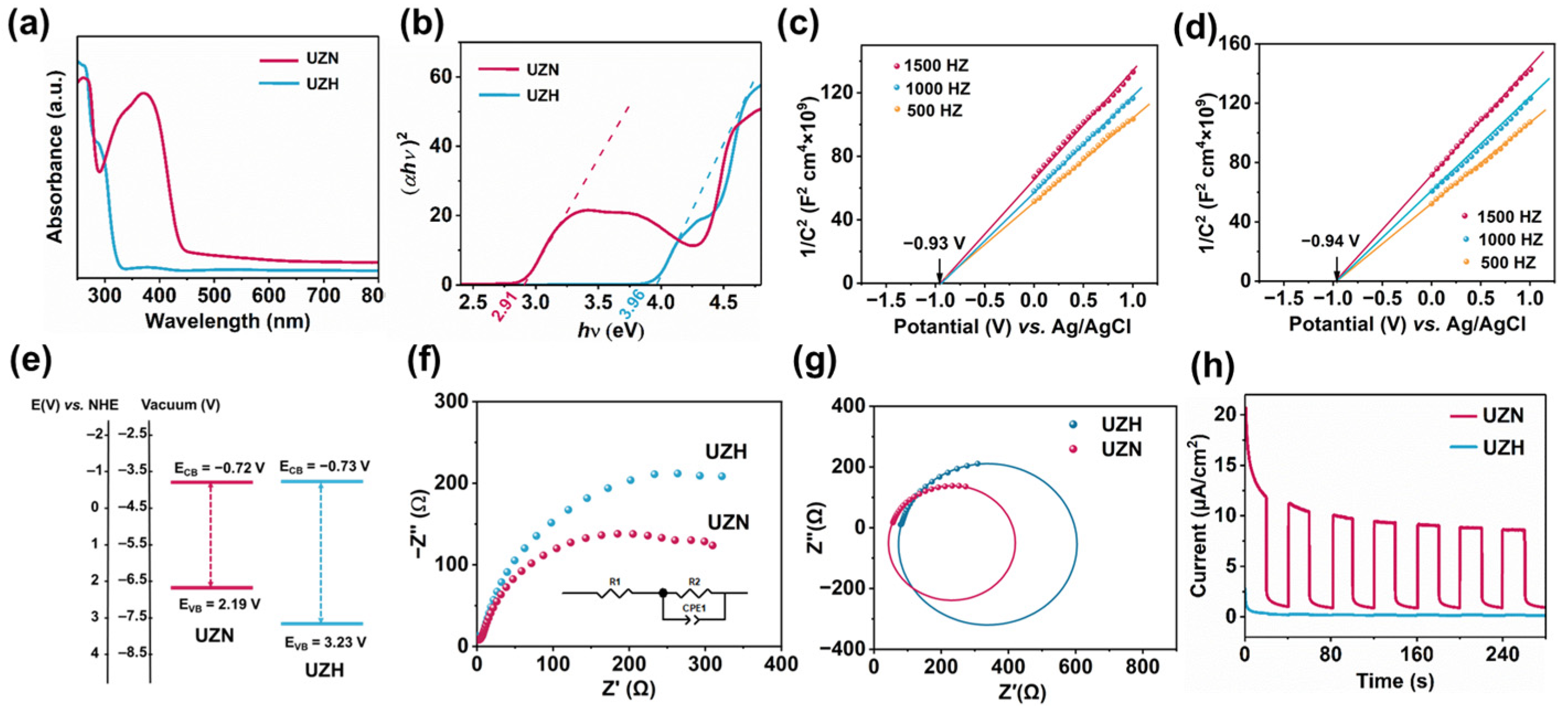
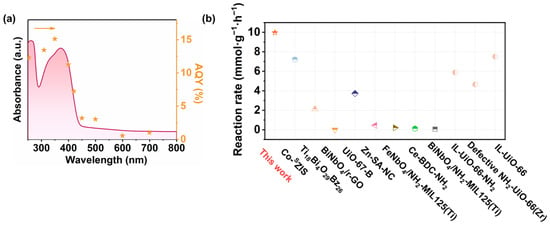
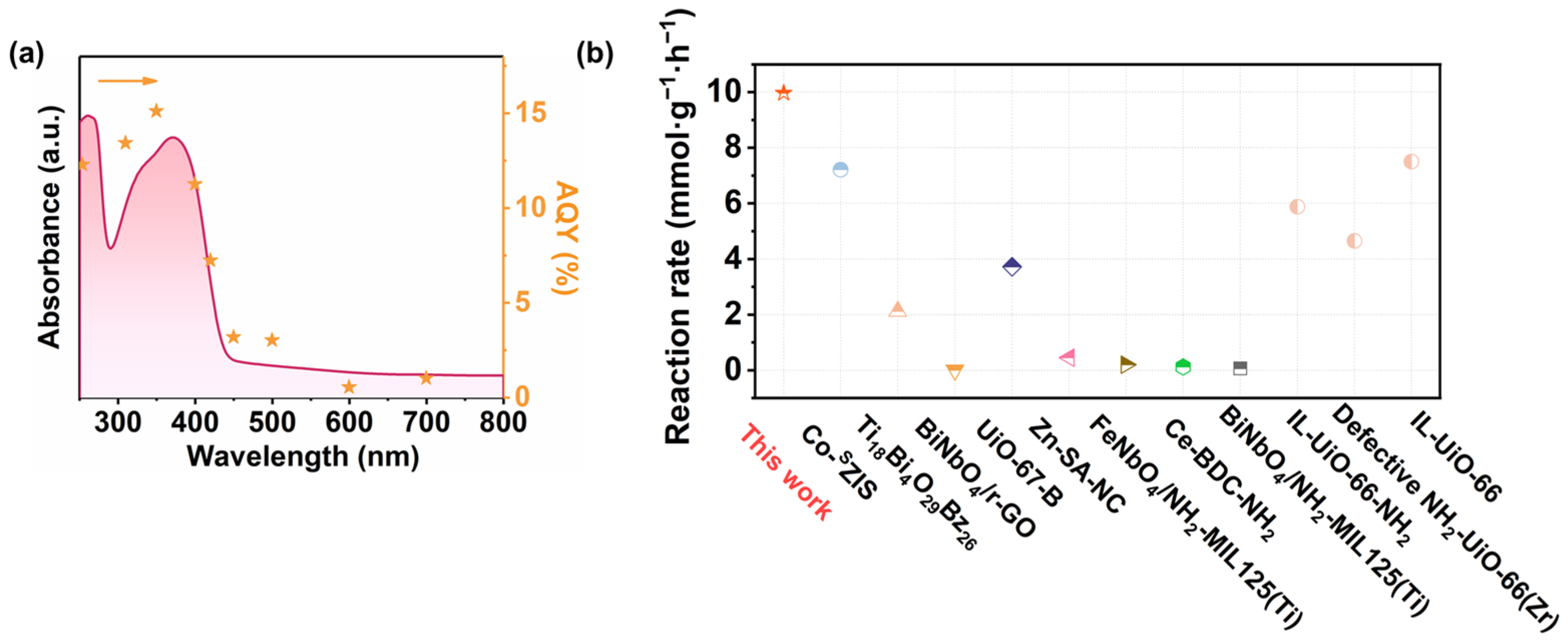
The photocatalytic activities samples were evaluated via CO2 cycloaddition with PO under visible-light irradiation. As shown in Figure 4a (Table S3, Entry 1–2), negligible PC formation was observed in the absence of the photocatalyst, indicating that the catalyst is essential for the reaction. Furthermore, a control experiment was performed under identical temperature (300 K) conditions in the dark (Table S3, Entry 3). Under dark conditions, the reaction rate was only 0.59 mmol·g−1·h−1, which is approximately 17 times lower than that under visible-light irradiation (9.97 mmol·g−1·h−1). This pronounced difference clearly demonstrates that light irradiation plays a decisive role in promoting the reaction, confirming the photocatalytic nature of the system. In addition, when TBAB was excluded from the reaction system, only a trace amount of PC was produced (3.5% yield, Table S3, Entry 4), highlighting the essential role of the co-catalyst. Upon introducing TBAB, UZN exhibited remarkable photocatalytic performance, achieving a PC yield of 99.5% with a reaction rate of 9.97 mmol·g−1·h−1 after 10 h of visible-light irradiation (λ ≥ 420 nm) (Table S3, Entry 6). In contrast, pristine UZH delivered much lower activity under identical conditions (Table S3, Entry 5). The superior performance of UZN can be attributed to its enhanced visible-light absorption and the coordination activation capability arising from unsaturated Zr4+ sites. To further identify the nature of the active sites, controlled experiments were conducted using an unactivated UZN sample (U-UZN), which contains fewer coordination-unsaturated Zr centers. As shown in Table S3 (Entry 7), U-UZN exhibits a significantly reduced reaction rate (5.26 mmol·g−1·h−1), confirming that the exposed Zr4+ centers play a critical role as Lewis acidic active sites for CO2 activation during the photocatalytic cycloaddition process [32]. The apparent quantum yield (AQY) was determined at different wavelengths, and a benchmark AQY of 15.1% was obtained at 350 nm. The wavelength-dependent AQY trend closely follows the DRS absorption profile of UZN. These results indicate that the reaction rate correlates with photon absorption, supporting the photon-driven nature of the process.
Figure 4.
Photocatalytic CO2 fixation with PO over UZN under various conditions: (a) blank experiments, (b) different co-catalysts, (c) co-catalyst dosage, (d) reaction time, (e) photocatalyst dosage, and (f) CO2 pressure. Reaction conditions: solvent CH3CN (16 mL), visible light (100 mW·cm−2, λ ≥ 420 nm). The product yields were quantified by GC-FID with CFCl3 as an internal standard.
As shown in Figure S4a,b, GC-MS analysis of the product exhibits a characteristic fragment peak at m/z = 87.1, corresponding to the -C3H3O3 fragment of PC. Moreover, the 13C NMR spectrum (Figure S5) further confirms the formation of PC. The involvement of CO2 in the cycloaddition reaction was further verified by isotopic labeling experiments using 13CO2 (Figure S4c,d). As expected, when 13CO2 was introduced, the m/z value of the target product changes to 88.1 (-13CC2H3O3), confirming the direct incorporation of CO2 into the carbonate product. Furthermore, no carbonate species were detected when CO2 was replaced by Ar (Figure S6), unambiguously demonstrating that all cyclic carbonate products originate from CO2.
Co-catalyst effects were also investigated in this series of reactions, and it was determined that the PC yield decreased in the order tetrabutylammonium bromide (TBAB) > tetrabutylammonium iodide (TBAI) > tetrabutylammonium fluoride (TBAF) > zinc bromide (ZnBr2) (Figure 4b and Table S4). This trend can be rationalized by the combined influence of nucleophilic strength and leaving-group ability of the co-catalysts, which directly affect the epoxide ring-opening step. Among them, TBAB exhibits the most favorable balance, highlighting a pronounced synergistic effect between TBAB and UZN in promoting CO2 cycloaddition.
The influence of reaction parameters, including catalyst dosage, TBAB dosage, reaction time, and CO2 pressure, was further examined (Figure 4c,f and Table S6). In all cases, volcano-shaped trends were observed, indicating that excessive amounts of catalyst or co-catalyst, or prolonged reaction times, lead to decreased activity. This phenomenon is likely attributed to partial blockage or occupation of active sites by carbonate species, resulting in reduced accessibility of the Lewis acidic Zr sites and gradual catalyst deactivation.
To clarify this discrepancy, the catalyst subjected to different light wavelengths was systematically characterized. XRD patterns show that although the crystal structure remains identifiable after UV exposure, the diffraction intensity decreases markedly, suggesting partial structural degradation (Figure S8). SEM and TEM images further reveal pronounced morphology distortion under UV irradiation, including local lattice collapse and particle fusion (Figures S9 and S10). This instability is likely associated with ligand photolysis or photo-oxidation of the Zr-oxo nodes, resulting in reduced active site density and accelerated charge carrier recombination [33,34,35]. These results collectively indicate that while UZN is photoactive across the UV-visible region, excessively high-energy UV light induces structural damage, thereby suppressing its intrinsic photocatalytic activity.
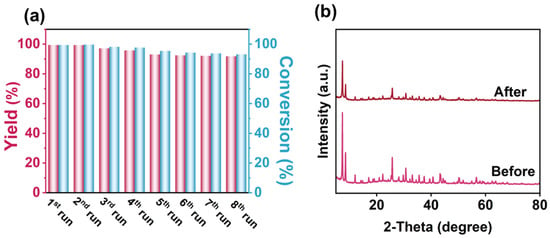
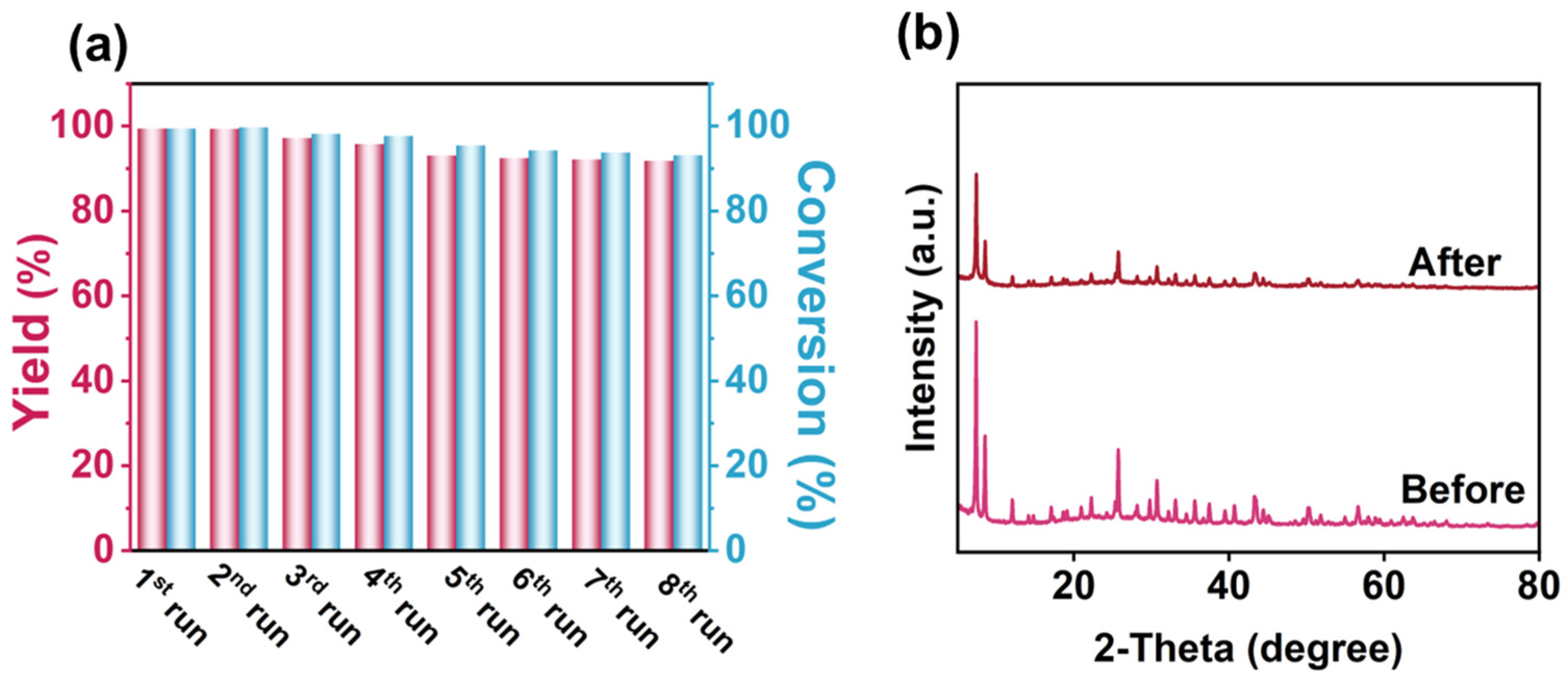
Owing to the excellent photocatalytic performance of CO2 fixation with PO, a variety of epoxides bearing different substituents were evaluated under identical reaction conditions. The products were confirmed by GC-MS (Figures S11 and S12). Taking a view of the results summarized in Table 1, high yields were obtained for less sterically hindered epoxides, such as those substituted with -Cl, -CH2CH3 and -(CH3)2), likely due to the higher electrophilicity of the epoxide carbon. In contrast, epoxides bearing long-chain alkyl substituents exhibited lower yields (17–18%) because steric hindrance slowed the nucleophilic ring-opening step. For comparison, Figure 5b and Table S8 summarize the performance of photocatalysts reported to date for PC generation. To the best of our knowledge, UZN ranks among the most active organic semiconductor-based photocatalysts, outperforming several previously reported systems, such as UiO-67-B (reaction rate: 3.72 mmol·g−1·h−1), Ce-BDC-NH2 (reaction rate: 0.12 mmol·g−1·h−1), and BiNbO4/NH2-MIL125(Ti) (reaction rate: 0.062 mmol·g−1·h−1) [6,36,37]. In addition, UZN exhibits good catalytic stability, retaining over 90% of its initial activity after six consecutive reaction cycles (Figure 6a). XRD, BET, and TEM analyses further support that the crystalline structure, porosity, and morphology of UZN are largely maintained after eight catalytic cycles, with XRD patterns showing no significant peak shifts, BET surface area decreasing by less than 10%, and TEM images indicating preserved particle morphology. (Figure 6b and Figure S13), demonstrating its structural robustness under similar photocatalytic reaction conditions.
Table 1.
Substrate scope for conversion of epoxides.
Figure 5.
(a) AQY of the catalyst under different monochromatic light conditions, (b) comparisons of recent studies on photocatalytic CO2 fixation to produce PC.
Figure 6.
(a) Cycled experimental results and (b) XRD patterns of UZN before and after the reaction.
2.3. Theoretical Study of CO2 Cycloaddition over UZN
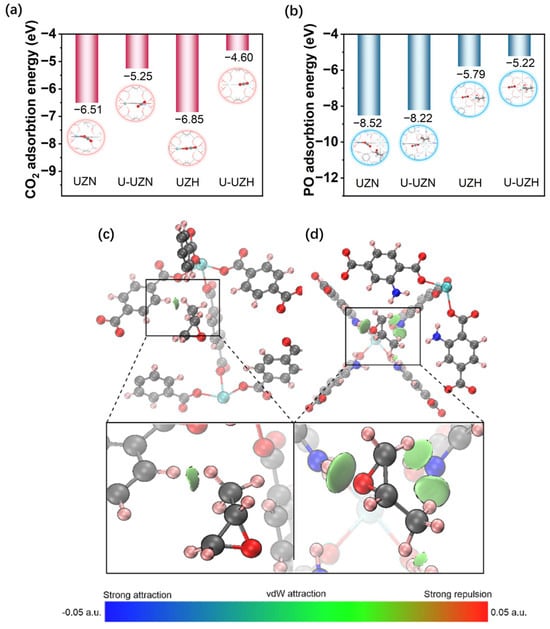
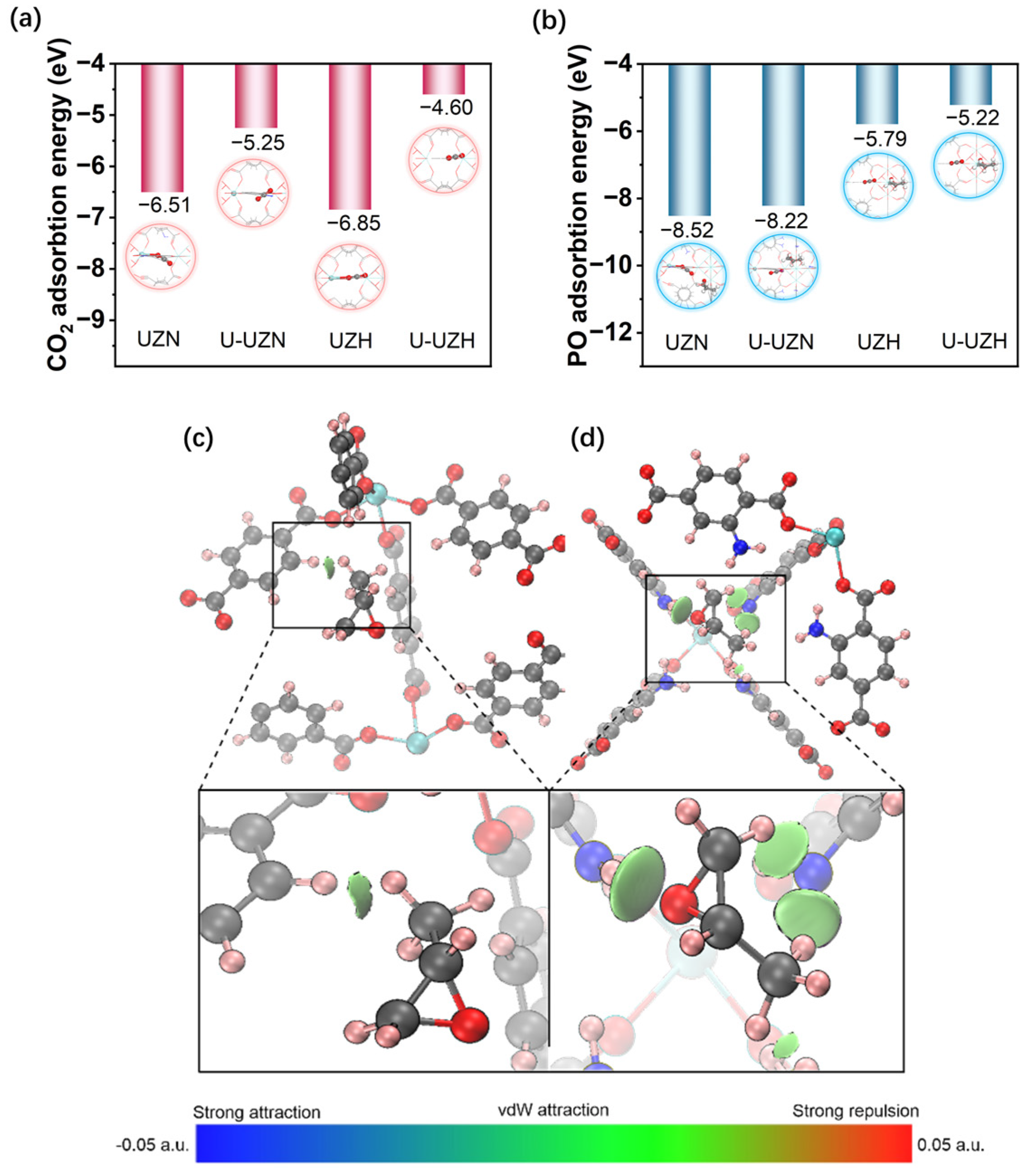
To shed light on the origin of the excellent performance of UZN in photocatalytic CO2 cycloaddition, density functional theory (DFT) calculations were performed. The adsorption energies of isolated CO2 and PO on UZN, U-UZN, UZH, and U-UZH were calculated, as shown in Figure 7a,b. The calculated CO2 adsorption energies on UZN and U-UZN are −6.51 and −5.25 eV, respectively, indicating a stronger interaction between CO2 and the exposed Zr sites in UZN. These results suggest that Lewis acidic Zr4+ centers may facilitate CO2 activation through enhanced adsorption. Upon removal of amino groups, both UZH and U-UZH exhibit substantially weaker CO2 adsorption, further underscoring the crucial role of exposed zirconium sites in CO2 activation. In contrast, PO adsorption is more strongly affected by the presence of amino groups. The adsorption energies on UZN and U-UZN (−8.52 and −8.22 eV) are significantly lower than those on amino-free UZH and U-UZH (−5.79 and −5.22 eV), implying enhanced PO–surface interactions mediated by the -NH2 functionality.
Figure 7.
Calculated adsorption sites and adsorption energies of (a) CO2 and (b) PO on various catalyst models. IGMH analysis of (c) UZH and (d) UZN around PO (isovalue = 0.02 a.u.). Green regions indicate weak non-covalent interactions consistent with van der Waals forces (weaker than a standard hydrogen bond), while the cyan regions denote a more substantial level of attraction, albeit still less intense than conventional hydrogen bonds.
To further elucidate the molecular origin of this enhanced PO binding, we employed the Independent Gradient Model based on Hirshfeld partitioning (IGMH) to analyze the real-space non-covalent interaction regions between PO and the catalyst surface [38,39,40]. Unlike traditional models based on atomic coordinates, IGMH leverages wavefunction-derived electron density and its gradient, enabling high-resolution visualization of weak intermolecular forces through isosurface mapping. As shown in Figure 7c, the unfunctionalized UZH exhibits only a single, faint interaction region with PO, indicating weak van der Waals contact. In contrast, upon amino functionalization, UZN presents three pronounced interaction lobes between PO and the -NH2 sites, revealing a synergistic stabilization effect (Figure 7d). These results are consistent with the adsorption energy calculations and support the role of amino functionalization in enhancing PO adsorption strength while also promoting its polarization, thereby facilitating subsequent ring-opening steps. This cooperative dual-site activation rationalizes the experimentally observed superior activity of UZN in photocatalytic cyclic carbonate formation.
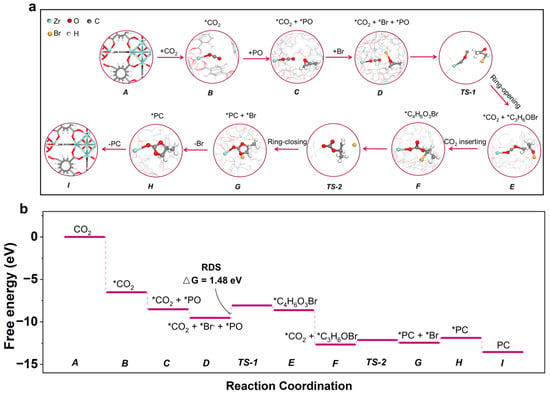
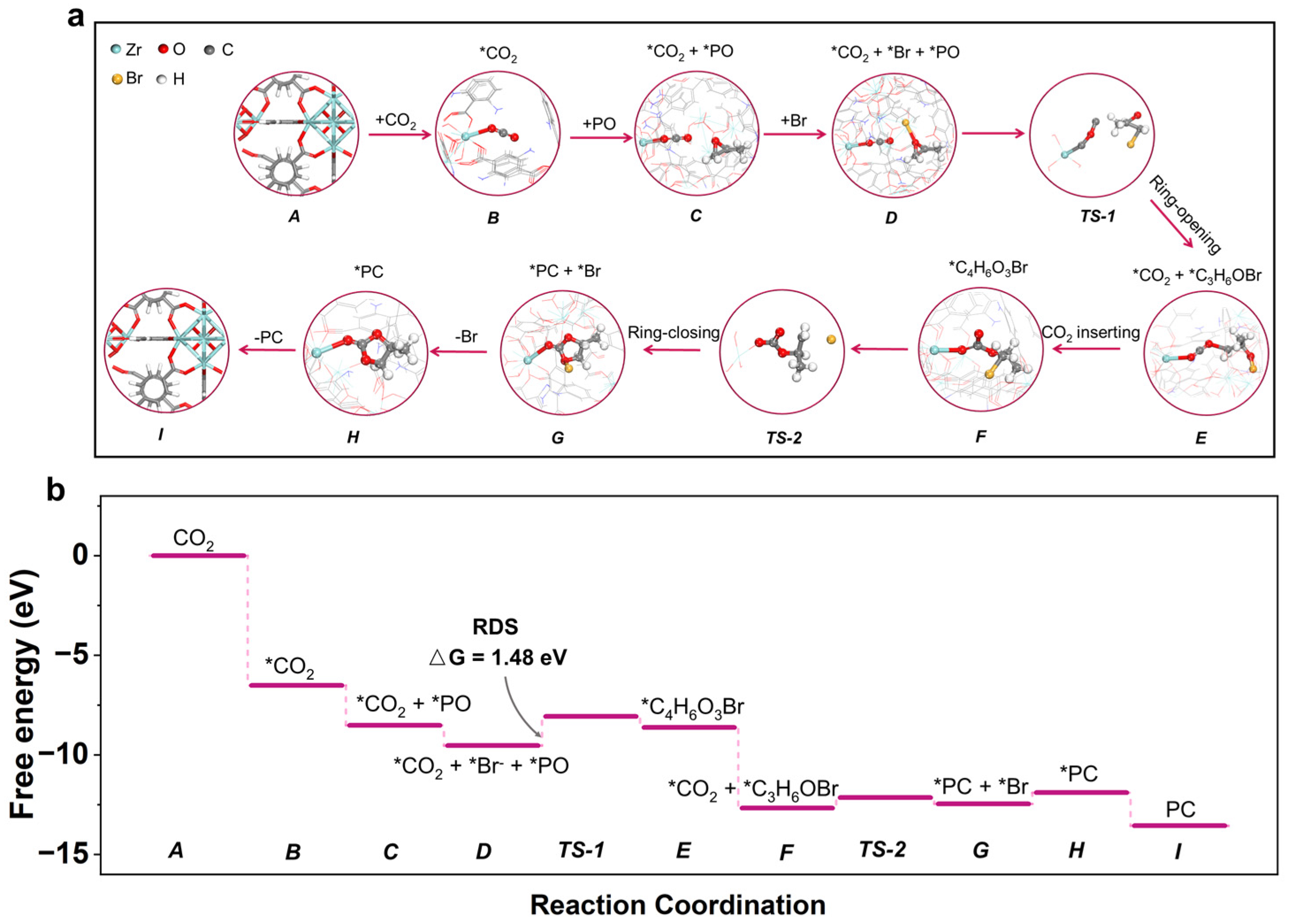
Having established how UZN activates both CO2 and PO, the complete reaction pathway of CO2 cycloaddition over UZN is illustrated in Figure 8a and Figure S15. By anchoring the oxygen atom of CO2, UZN (A) tends to form a Zr···OCO2 coordination state (B) between exposed Zr sites and CO2. PO is preadsorbed near the -NH2 groups through strengthened non-covalent interactions (C). Subsequently, Br is co-adsorbed to generate activated *Br (D), which participates in the ring-opening step to form the intermediate *C3H6OBr (E). Because this PO ring-opening step has the highest energy barrier among all steps, it is likely the rate-determining step under the calculated conditions for CO2 photofixation over UZN, consistent with the observed elongation and weakening of the C-O bond in PO. The ring-opened intermediate (C3H6OBr) is detected via GC-MS analysis when the reaction is operated in the absence of CO2 (Figure S14). After that, *CO2 is inserted into *C3H6OBr to form the alkyl carbonate intermediate *C4H6O3Br (F). *C4H6O3Br eventually undergoes a ring-closing step (G) to release Br (H) and PC (I).
Figure 8.
(a) Calculated configuration for CO2 cycloaddition and (b) potential energy diagrams of CO2 cycloaddition paths over UZN.
2.4. Mechanistic Insights into Photocatalytic CO2 Fixation with Epoxides
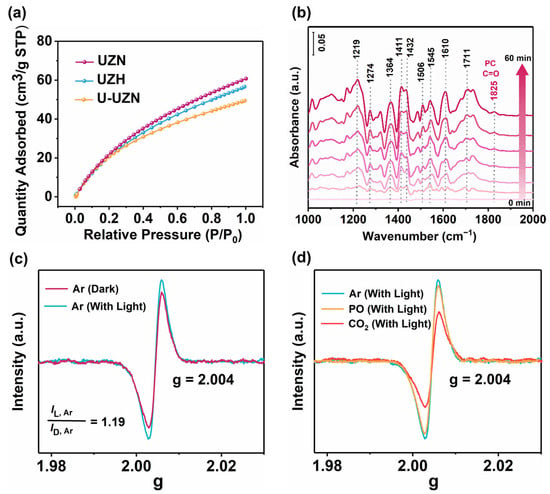
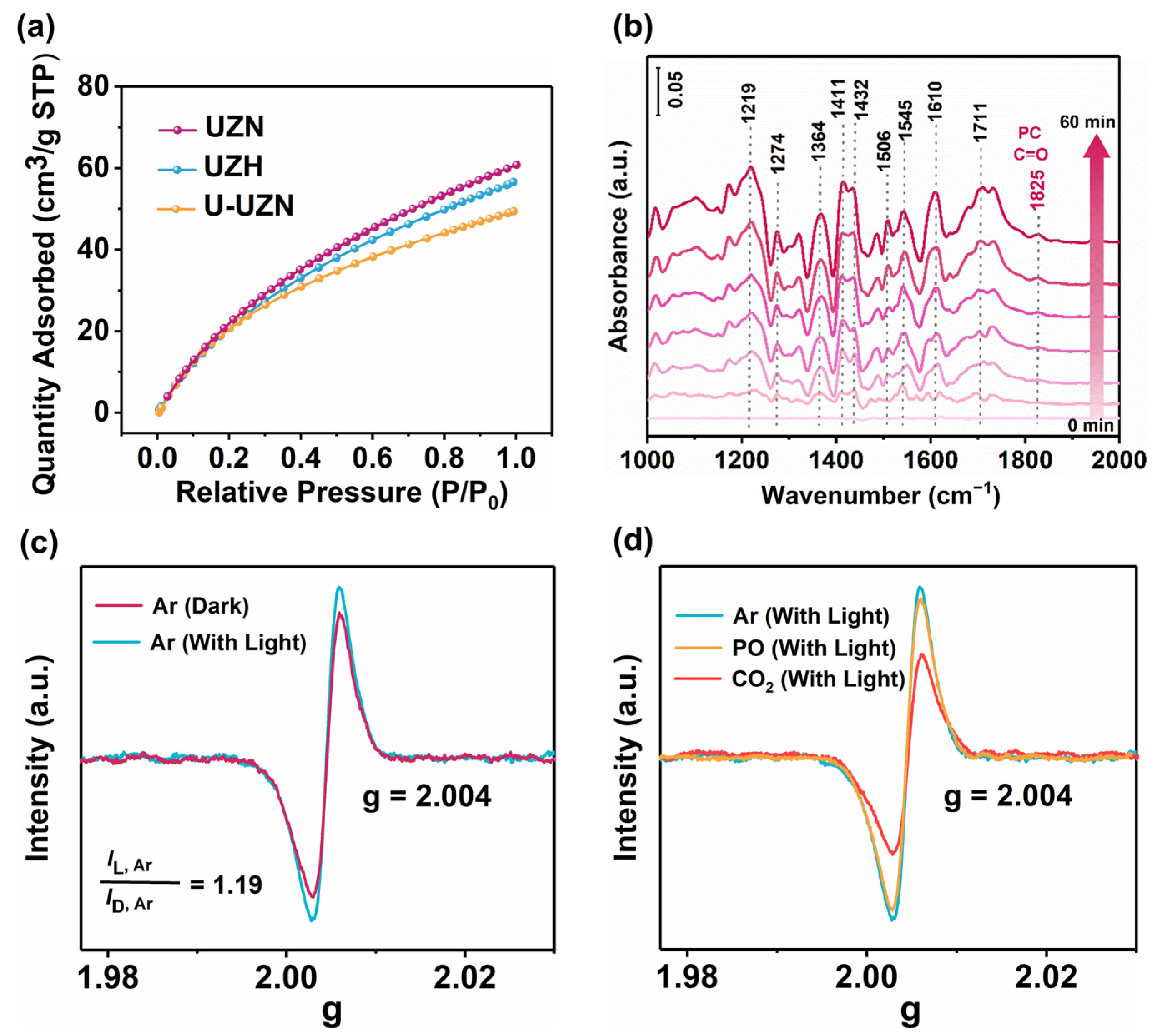
Since unique uncoordinated octahedral Zr4+ sites are observed in UZN, it is of interest to examine whether these sites provide unique advantages for the selective adsorption and activation of CO2 molecules. To address this, CO2 adsorption measurements were investigated, and the results are displayed in Figure 9a. Analysis of the CO2 adsorption isotherms shows that UZH exhibits a maximum CO2 uptake of 58.3 cm3/g, while UZN reaches 61.6 cm3/g, suggesting that the contribution of -NH2 groups to CO2 adsorption is minor. By contrast, the saturated coordination U-UZN sample exhibits a significantly reduced adsorption capacity of 44.5 cm3/g, supporting that exposed Zr4+ centers contribute to enhanced CO2 adsorption. This also ensures high-efficiency CO2 cycloaddition over UZN [41,42].
Figure 9.
(a) CO2 adsorption isotherms at 298 K for UZN, UZH, and U-UZN; (b) in situ FTIR spectra of PC photosynthesis over UZN; (c) EPR spectra of UZN under CO2 in an Ar atmosphere; (d) EPR spectra of UZN under different atmospheres.
Time-dependent in situ DRIFT spectra was conducted to identify and dynamically monitor the surface-bound intermediate species during CO2 photoconversion on UZN. The detected surface species are labeled in Figure 9b. Absorption bands at 1219 and 1274 cm−1 are assigned to •CO2− species, which serve as key intermediates for CO2 insertion to form the alkyl carbonate anion, and their intensities increase over time [10,43]. The significantly enhanced bands at around 1400–1800 cm−1 are ascribed to the contribution of the carbonate intermediate. In particular, the bands at 1506 and 1557 cm−1 are attributed to the twisting and scissoring vibrations of -CH2, respectively, while the bands appearing at 1610 and 1711 cm−1 belong to the C=O vibration of carbonate intermediates after CO2 insertion. Additional carbonate-related peaks at 1432 and 1364 cm−1 are assigned to the asymmetrical stretching vibration of O-C-O and the stretching vibration of C-O, due to the formation of R-OCOO on UZN. Furthermore, the product, i.e., PC, can be detected via C=O symmetric stretching at 1825 cm−1.
The in situ EPR spectra were employed to further recognize the reaction mechanism. Lorentzian lines with g values around 2.004 are attributed to Zr3+ in the 7%PDI-UZN. As evidenced in Figure S16, when H2ATA was irradiated with visible light, an ESR signal with a g value of 2.004 was observed, which can be attributed to spatially confined amino groups [44,45,46,47]. However, when UZN was irradiated, the above signal disappeared and a new ESR signal at g = 2.004 emerged. According to previous studies, the new signal can be ascribed to Zr3+, suggesting the ligand-to-metal charge-transfer (LMCT) process [48,49]. On the contrary, no ESR signal is observed over UZH under visible-light irradiation. As illustrated in Figure 9c, the ESR intensity of UZN in an inert argon atmosphere (IL,Ar) upon light irradiation is slightly higher than that in the dark condition (ID,Ar), suggesting effective charge separation of photogenerated electrons (IL,Ar/ID,Ar = 1.19). In contrast, when CO2 is injected into the system, the intensity of the Zr3+ signal obviously declines (Figure 9d). The decrease in Zr3+ signal intensity upon CO2 introduction indicates that photoexcited electrons are efficiently transferred from UZN to CO2, which is consistent with the possible formation of •CO2−-derived radical intermediates and the regeneration of EPR-silent Zr4+. This finding is also congruent with the in situ FTIR results, where a considerable •CO2− signal is detected. However, in a PO atmosphere, the intensity of the ESR signal was apparently higher than that in the CO2 atmosphere, suggesting that photogenerated electrons are not the primary active species responsible for PO ring-opening.
Radical-trapping experiments were conducted to probe the active species responsible for epoxide ring-opening. Traditionally, photogenerated holes are considered to polarize epoxides, enabling Br− from nBu4NBr (TBAB) to attack and open the activated epoxide rings [50,51]. Considering the relatively low oxidation potential of TBAB in organic solvents (EBr−/•Br = +0.92 V vs. NHE), oxidation of Br− is thermodynamically more favorable than direct oxidation of the epoxide. To validate this, phenol was employed as a •Br scavenger (Figure S17), which significantly suppressed PC formation. To the best of our knowledge, the detection of the brominated product 4-bromophenol provides evidence consistent with the oxidation of Br- by photogenerated holes to generate •Br species (Figure S18), which participate in ring-opening of PO adsorbed on the -NH2 site. The PO ring-opening intermediate, C3H6OBr, is also obtained when the reaction is operated in the absence of CO2 (Figure S19). Importantly, the exclusive formation of cyclic carbonates and the detection of C3H6OBr, together with the absence of observable C-C bond cleavage products within analytical limits, suggest that a C-C fragmentation pathway of PO is unlikely under the present conditions. Moreover, no 4-bromophenol is detectable in dark, further supporting that visible-light irradiation is essential for radical generation (Figure S18).
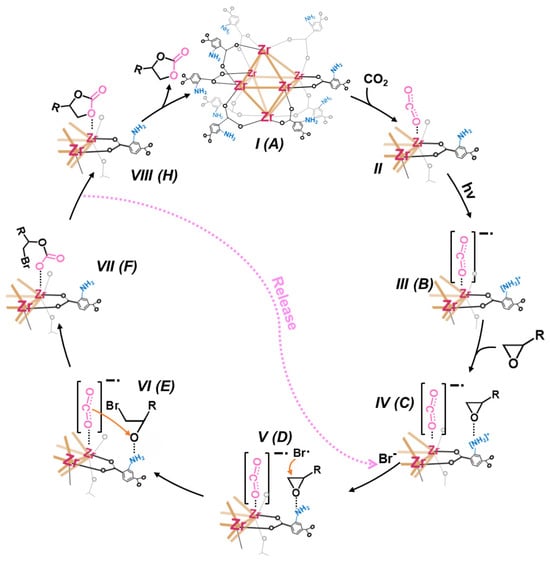
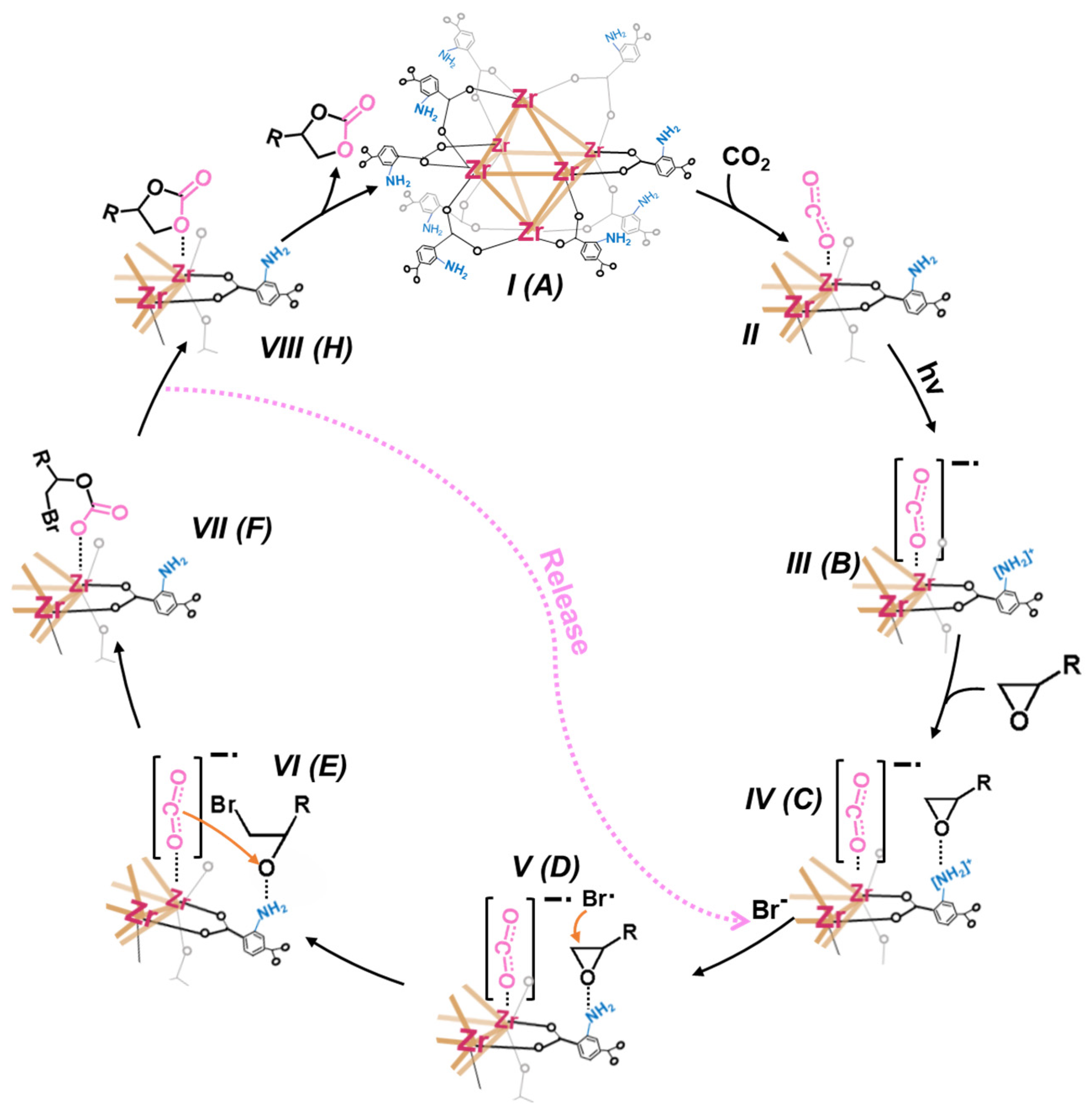
Based on the above results, a possible photocatalytic pathway for CO2 fixation over UZN is proposed (Figure 10). Under visible-light irradiation, the -NH2 functional ligand acts as a light-harvesting antenna and initiates LMCT, producing electron–hole pairs. The photoexcited electrons migrate to the unsaturated Zr centers, where CO2 is adsorbed and activated via Lewis acid coordination. Although the CB potential (−0.72 V vs. NHE) is insufficient to reduce free linear CO2 in solution (ECO2/•CO2− = −1.9 V vs. NHE), the coordination-induced activation of CO2 lowers the interfacial electron transfer barrier, enabling the formation of surface-bound •CO2− species (steps II, III). Photogenerated holes localize on the amine sites and oxidize Br− to •Br radicals (steps IV, V), which selectively attack the β-carbon of adsorbed PO, opening the ring. The reactive •CO2− species subsequently insert into the ring-opened intermediate (step VI) to generate the CO2-PO adduct (step VII), which subsequently undergoes intramolecular ring closure to yield PC and regenerate Br− for the next cycle (step VIII). Overall, the enhanced catalytic performance is associated with the synergistic coupling between Lewis acidic Zr sites for CO2 activation and Lewis basic -NH2 sites for hole accumulation and Br− oxidation, wherein Lewis acid/base-mediated substrate activation cooperates with photoinduced electronic effects to enable efficient photocatalytic cycloaddition.
Figure 10.
Mechanistic details of photocatalytic PC generation, where the alphabet in the brackets refer to the models in Figure 8. (The orange arrow indicates the chemical attack process and the brown line represents the Zr-Zr chemical bond).
3. Materials and Methods
3.1. Preparation of UZN
UZN and UZH were prepared according to the reported studies [52,53], and detailed synthesis and characterization procedures can be found in the electronic Supporting Information. To further confirm the critical roles of the exposed Zr centers in coordination activation, unactivated UZN (UA-UZN, containing a less unsaturated metal center) was also prepared.
3.2. Evaluation of Photocatalytic Activity
A 100 mL high-pressure stainless-steel autoclave was used as the reactor for cycloaddition reaction, equipped with a magnetic stirrer and a temperature control system. A 300 W xenon lamp (PLS-SXE 300D, Beijing Perfectlight Co., Ltd., Beijing, China) with bandpass filters was used as the light source. A mixture of propylene epoxide (PO, 10 mmol), catalyst (10 mg), and 0.01 mmol co-catalyst (TBAB) was dissolved in acetonitrile (16 mL). The above mixture was transferred to the high-pressure stainless-steel autoclave, filled with molecular CO2 at a pressure of 1.0 MPa, and maintained for 10 h. After that, the reactor was cooled down to room temperature, and then the residual carbon dioxide pressure was gradually reduced. The catalysts were separated by filtration. The reaction mixtures were analyzed on a gas chromatograph (GC-2012, Shimazu, Tokyo, Japan) equipped with a capillary column and flame ionization detector (see the Supplementary data for details).
The yield of propylene carbonate (PC) and the selectivity for PC were defined as follows:
where C0 is the initial concentration of benzyl alcohol, and CPO and CPC are the concentrations of PO and PC, respectively, at a certain time after the photocatalytic reaction. The recovered catalyst was separated by centrifugation and washed with methanol three times. After centrifugation and drying under vacuum at 373 K overnight, cyclability experiments were carried out.
Conversion (%) = [(C0 − CPO)/C0] × 100
Yield (%) = CPC/C0 × 100
Selectivity (%) = [CPC/(C0 − CPO)] × 100
4. Conclusions
In summary, this work provides an in-depth understanding of visible-light-driven CO2 cycloaddition with epoxides over an amino-functionalized UiO-66(Zr) photocatalyst. The unsaturated Zr4+ centers act as Lewis acids to facilitate CO2 activation, while -NH2 groups serve as Lewis basic sites that enhance epoxide adsorption and polarization, thereby collaboratively lowering the activation barriers. As a result, UZN exhibits markedly enhanced photocatalytic performance compared with UZH, achieving an impressive PC yield of 99.5% with near-unit selectivity and a production rate of 9.97 mmol·g−1·h−1, with a benchmark apparent quantum efficiency of 15.1% at 350 nm. In situ spectroscopy, radical-trapping experiments, and DFT calculations reveal a synergistic mechanism in which CO2 activation at Zr4+ centers couples with amine-assisted epoxide adsorption, demonstrating a dual-active site-induced catalytic mechanism. This work represents substantial progress in designing efficient photocatalytic platforms based on MOF photocatalysts, offering new insights and methodologies toward high-value-added CO2 conversion.
Supplementary Materials
The following supporting information can be downloaded at: https://www.mdpi.com/article/10.3390/molecules31050902/s1. Refs. [21,41,54,55,56,57,58,59,60,61,62,63,64,65,66,67,68,69,70,71] are cited in the Supplementary Materials.
Author Contributions
Conceptualization, S.Z., D.S., L.Y., X.L. and R.L.; Investigation, H.Y., Y.L. (Yajing Lv), W.Y., J.C. and Y.L. (Yutong Lin); Writing—Review and Editing, Y.L. (Yajing Lv), W.Y. and R.L. All authors have read and agreed to the published version of the manuscript.
Funding
This work was supported by the National Natural Science Foundation of China (22372085) and the Natural Science Foundation of Fujian Province (2024J019029 and 2024J01348).
Institutional Review Board Statement
Not applicable.
Informed Consent Statement
Not applicable.
Data Availability Statement
The original contributions presented in this study are included in the article/Supplementary Materials. Further inquiries can be directed to the corresponding authors.
Conflicts of Interest
The authors declare no conflicts of insterst.
References
- Folli, A.; Bloh, J.; Armstrong, K.; Richards, E.; Murphy, D.; Lu, L.; Kiely, C.; Morgan, D.; Smith, R.; Mclaughlin, A.; et al. Improving the Selectivity of Photocatalytic NOx Abatement through Improved O2 Reduction Pathways using Ti0.909W0.091O2Nx Semiconductor Nanoparticles: From Characterization to Photocatalytic Performance. ACS Catal. 2018, 8, 6927–6938. [Google Scholar] [CrossRef] [Scilit]
- Hao, Y.; Zhao, Y.; Jun, M.; Han, X.; Wang, Y.; Chen, P.; Hu, D.; Liu, Y.; Wei, W.; Sun, N. Unconventional Carrier Transfer Enabled Direct O2 Reduction by Oxygen Vacancies for Efficient Photooxidation of CH4. ACS Appl. Mater. Interface 2025, 17, 29799–29812. [Google Scholar] [CrossRef] [Scilit]
- Khavar, A.; Khazaee, Z.; Mahjoub, A.; Nejat, R. TiO2 Supported-reduced Graphene Oxide Co-doped with Gallium and Sulfur as an Efficient Heterogeneous Catalyst for the Selective Photochemical Oxidation of Alcohols; DFT and Mechanism Insights. J. Photochem. Photobiol. A Chem. 2022, 431, 114020. [Google Scholar] [CrossRef] [Scilit]
- Zhao, Y.; Shao, Z.; Cui, Y.; Geng, K.; Meng, X.; Wu, J.; Hou, H. Guest-Induced Multilevel Charge Transport Strategy for Developing Metal-Organic Frameworks to Boost Photocatalytic CO2 Reduction. Small 2023, 19, 2300398. [Google Scholar] [CrossRef] [Scilit]
- Cheng, R.; Wang, A.; Sang, S.; Liang, H.; Liu, S.; Tsiakaras, P. Photocatalytic CO2 Cycloaddition over Highly Efficient W18O49-based Composites: An Economic and Ecofriendly Choice. Chem. Eng. J. 2023, 466, 142982. [Google Scholar] [CrossRef] [Scilit]
- Yang, Q.; Peng, H.; Zhang, Q.; Qian, X.; Chen, X.; Tang, X.; Dai, S.; Zhao, J.; Jiang, K.; Yang, Q.; et al. Atomically Dispersed High-Density Al-N4 Sites in Porous Carbon for Efficient Photodriven CO2 Cycloaddition. Adv. Mater. 2021, 33, 2103186. [Google Scholar] [CrossRef] [Scilit] [PubMed]
- Li, L.; Liu, W.; Shi, T.; Shang, S.; Zhang, X.; Wang, H.; Tian, Z.; Chen, L.; Xie, Y. Photoexcited Single-Electron Transfer for Efficient Green Synthesis of Cyclic Carbonate from CO2. ACS Mater. Lett. 2023, 5, 1219–1226. [Google Scholar] [CrossRef] [Scilit]
- Ma, W.; Yu, L.; Kang, P.; Chu, Z.; Li, Y. Modifications and Applications of Metal-Organic-Framework-Based Materials for Photocatalysis. Molecules 2024, 29, 5834. [Google Scholar] [CrossRef] [Scilit]
- Liang, R.; Wang, S.; Xia, Y.; Wu, L.; Huang, R.; He, Z. Frustrated Lewis Pair Boosting Photocatalytic Antibacterial Activity on PDI-bridged Bimetallic UiO-66-NH2. Dalton Trans. 2023, 52, 6813–6822. [Google Scholar] [CrossRef] [Scilit]
- Liang, R.; Zhang, C.; Wang, Y.; Wu, L.; Zhao, Y.; Liang, S.; Yan, G.; Long, J. Efficient Halogen Radical-mediated Photosynthesis of Cyclic Carbonates Over Perylene Diimide-grafted Zirconium Metal-organic Frameworks under Visible Light Irradiation. J. Am. Chem. Soc. 2026, 148, 6167–6177. [Google Scholar] [CrossRef] [Scilit] [PubMed]
- Pham, H.; Phan, A.V.N.; Phan, A.N.T.; Nguyen, V.; Nguyen, K.; Nguyen, H.N.; Nguyen, T.M.; Nguyen, M.V. Engineering of Efficient Functionalization in a Zirconium-hydroxyl-based Metal-organic Framework for an Ultra-high Adsorption of Pb2+ ions From an Aqueous Medium: An Elucidated Uptake Mechanism. Mater. Adv. 2024, 5, 5118–5133. [Google Scholar] [CrossRef] [Scilit]
- Katz, M.; Brown, Z.; Colon, Y.; Siu, P.; Scheidt, K.; Snurr, R.; Hupp, J.; Farha, O. A Facile Synthesis of UiO-66, UiO-67 and Their Derivatives. Chem. Commun. 2013, 49, 9449–9451. [Google Scholar] [CrossRef] [Scilit] [PubMed]
- Butova, V.; Burachevskaya, O.; Muratidi, M.; Surzhikova, I.; Zolotukhin, P.; Medvedev, P.; Gorban, I.; Kuzharov, A.; Soldatov, M. Loading of the Model Amino Acid Leucine in UiO-66 and UiO-66-NH2: Optimization of Metal-organic Framework Carriers and Evaluation of Host—Guest Interactions. Inorg. Chem. 2021, 60, 5694–5703. [Google Scholar] [CrossRef] [Scilit] [PubMed]
- Chakarova, K.; Strauss, I.; Mihaylov, M.; Drenchev, N.; Hadjiivanov, K. Evolution of Acid and Basic Sites in UiO-66 and UiO-66-NH2 Metal-organic Frameworks: FTIR Study by Probe Molecules. Microporous Mesoporous Mater. 2019, 281, 110–122. [Google Scholar] [CrossRef] [Scilit]
- Gayathri, K.; Vinothkumar, K.; Teja, Y.N.; Al-Shehri, B.; Selvaraj, M.; Sakar, M.; Balakrishna, R. Ligand-mediated Band Structure Engineering and Physiochemical Properties of UiO-66 (Zr) Metal-organic Frameworks (MOFs) for Solar-driven Degradation of Dye Molecules. Colloids Surf. A Physicochem. Eng. Asp. 2022, 653, 129992. [Google Scholar] [CrossRef] [Scilit]
- Li, M.; Dai, X.; Li, A.; Qi, Q.; Wang, W.; Cao, J.; Jiang, Z.; Liu, R.; Suo, H.; Xu, L. Preparation and Characterization of Magnetic Metal-Organic Frameworks Functionalized by Ionic Liquid as Supports for Immobilization of Pancreatic Lipase. Molecules 2022, 27, 6800. [Google Scholar] [CrossRef] [Scilit]
- Valenzano, L.; Civalleri, B.; Chavan, S.; Bordiga, S.; Nilsen, M.; Jakobsen, S.; Lillerud, K.; Lamberti, C. Disclosing the Complex Structure of UiO-66 Metal Organic Framework: A Synergic Combination of Experiment and Theory. Chem. Mater. 2011, 23, 1700–1718. [Google Scholar] [CrossRef] [Scilit]
- Xu, J.; Feng, K.; Zhang, W.; Venkatesh, A.; Hung, I.; Liu, Y.; Liu, J.; Li, S.; Battiston, G.; Gan, Z.; et al. A Local Structure Analysis of Defects in UiO-66: Insights from Solid-State Nuclear Magnetic Resonance and X-ray Absorption Fine Structure. J. Am. Chem. Soc. 2025, 147, 44200–44215. [Google Scholar] [CrossRef] [Scilit]
- Jodłowski, P.; Kurowski, G.; Dymek, K.; Oszajca, M.; Piskorz, W.; Hyjek, K.; Wach, A.; Pajdak, A.; Mazur, M.; Rainer, D.; et al. From Crystal Phase Mixture to Pure Metal-organic Frameworks-Tuning Pore and Structure Properties. Ultrason. Sonochem. 2023, 95, 106377. [Google Scholar] [CrossRef] [Scilit]
- Zavorotynska, O.; Asland, A.; Dietzel, P.; Chavan, S. Exploring Cluster Formation in Zr-MOF Synthesis in Situ using X-ray Absorption Spectroscopy. Phys. Chem. Chem. Phys. 2024, 26, 27019–27033. [Google Scholar] [CrossRef] [Scilit]
- Lomachenko, K.; Jacobsen, J.; Bugaev, A.; Atzori, C.; Bonino, F.; Bordiga, S.; Stock, N.; Lamberti, C. Exact Stoichiometry of CexZr6-x Cornerstones in Mixed-Metal UiO-66 Metal-Organic Frameworks Revealed by Extended X-ray Absorption Fine Structure Spectroscopy. J. Am. Chem. Soc. 2018, 140, 17379–17383. [Google Scholar] [CrossRef] [Scilit]
- Kim, J.; Kang, J.; Cha, S.; Kim, H.; Kim, D.; Kang, H.; Choi, I.; Kim, M. Stability of Zr-Based UiO-66 Metal-Organic Frameworks in Basic Solutions. Nanomaterials 2024, 14, 110. [Google Scholar] [CrossRef] [Scilit] [PubMed]
- Zakharova, M.; Kleitz, F.; Fontaine, F. Lewis Acidity Quantification and Catalytic Activity of Ti, Zr and Al-supported Mesoporous Silica. Dalton Trans. 2017, 46, 3864–3876. [Google Scholar] [CrossRef] [Scilit] [PubMed]
- Cherniienko, A.; Kossakowski, K.; Zaprutko, L.; Lesyk, R.; Olender, D.; Pawelczyk, A. A Novel Method of Coupling in Situ Time-Resolved FTIR and Microwave Irradiation: Application to the Monitoring of Quinoxaline Derivatives Synthesis. Molecules 2025, 30, 3875. [Google Scholar] [CrossRef] [Scilit]
- Liang, R.; Zhang, C.; Yan, G. Enhancing CO2 Cycloaddition Through Ligand Functionalization: A Case Study of UiO-66 Metal-organic Frameworks. Chin. J. Struct. Chem. 2024, 43, 9–12. [Google Scholar] [CrossRef] [Scilit]
- Emeis, C. Determination of Integrated Molar Extinction Coefficients for Infrared Absorption Bands of Pyridine Adsorbed on Solid Acid Catalysts. J. Catal. 1993, 141, 347–354. [Google Scholar] [CrossRef] [Scilit]
- Hasan, Z.; Tong, M.; Jung, B.; Ahmed, I.; Zhong, C.; Jhung, S. Adsorption of Pyridine over Amino-Functionalized Metal–Organic Frameworks: Attraction Via Hydrogen Bonding Versus Base-Base Repulsion. J. Phys. Chem. C 2014, 118, 21049–21056. [Google Scholar] [CrossRef] [Scilit]
- Bisquert, J. Theory of the Impedance of Electron Diffusion and Recombination in a Thin Layer. J. Phys. Chem. B 2001, 106, 325–333. [Google Scholar] [CrossRef] [Scilit]
- Li, X.; Yu, J.; Low, J.; Fang, Y.; Xiao, J.; Chen, X. Engineering Heterogeneous Semiconductors for Solar Water Splitting. J. Mater. Chem. A 2015, 3, 2485–2534. [Google Scholar] [CrossRef] [Scilit]
- Wang, W.; Tade, M.; Shao, Z. Research Progress of Perovskite Materials in Photocatalysis- and Photovoltaics-related Energy Conversion and Environmental Treatment. Chem. Soc. Rev. 2015, 44, 5371–5408. [Google Scholar] [CrossRef] [Scilit]
- Li, Y.; Qian, J.; Zhang, Y.; Zeng, T.; Wan, Q.; Yang, N. Intergradation of UiO-66 Nanoparticles with Expanded Graphite for Electrocatalytic Determination of Nitrite and L-Cysteine. Adv. Sens. Res. 2023, 2, 2200014. [Google Scholar] [CrossRef] [Scilit]
- Bagherpour, B.; Dehghanpour, S. Highly Efficient Visible-light Photocatalytic Nitrogen Fixation Via Single-atom Iron Catalyst Site and Synergistic Effect of Zr-cluster in Zirconium-Based Porphyrinic Metal-organic Frameworks (PCN-222). J. Solid State Chem. 2023, 324, 124079. [Google Scholar] [CrossRef] [Scilit]
- Wu, Z.; Hou, L.; Li, W.; Chen, Q.; Jin, C.; Chen, Y.; Wei, Q.; Yang, H.; Jiang, Y.; Tang, D. Application of a Novel Biomimetic Double-ligand Zirconium-based Metal Organic Framework in Environmental Restoration and Energy Conversion. J. Colloid Interface Sci. 2022, 610, 136–151. [Google Scholar] [CrossRef] [Scilit] [PubMed]
- Moore, S.; Hubble, I.; Ritchie, A.; Barzach, J.; Sarazen, M. UiO(Zr)-based MOF Catalysts for Light-driven Aqueous Pollutant Degradation. React. Chem. Eng. 2024, 9, 2333–2344. [Google Scholar] [CrossRef] [Scilit]
- Xie, Z.; Zhang, Y.; Li, J.; Liu, S. D1-A-D2 Conjugated Porous Polymers Provide Additional Electron Transfer Pathways for Efficient Photocatalytic Hydrogen Production. Molecules 2025, 30, 2190. [Google Scholar] [CrossRef] [Scilit]
- Wang, Y.; Liu, H.; Shi, Q.; Miao, Z.; Duan, H.; Wang, Y.; Rong, H.; Zhang, J. Single-Atom Titanium on Mesoporous Nitrogen, Oxygen-Doped Carbon for Efficient Photo-thermal Catalytic CO2 Cycloaddition by a Radical Mechanism. Angew. Chem. Int. Ed. 2024, 63, e2404911. [Google Scholar]
- Ahmed, S.; Bakiro, M.; Ahmed, A. Photocatalytic Activities of FeNbO4/NH2-MIL-125(Ti) Composites Toward the Cycloaddition of CO2 to Propylene Oxide. Molecules 2021, 26, 1693. [Google Scholar]
- Lu, T.; Chen, Q. Independent Gradient Model Based on Hirshfeld Partition: A New Method for Visual Study of Interactions in Chemical Systems. J. Comput. Chem. 2022, 43, 539–555. [Google Scholar] [CrossRef] [Scilit]
- Dey, P.; Hossain, A.; Seth, S. On the Importance of Unconventional Cu⋯π Interaction in Tetrachloro-bis(1,10-phenanthroline)-dicopper(II) Complex: Insights from Experiment and Theory. J. Mol. Struct. 2024, 1295, 136642. [Google Scholar] [CrossRef] [Scilit]
- Sun, X.; Zheng, C.; Wang, D. Microwave-assisted Solvent-free Synthesis, Hirshfeld Surface Analysis and DFT Studies of 1-(hydroxymethyl)-pyrazoles. J. Mol. Struct. 2024, 1295, 136736. [Google Scholar] [CrossRef] [Scilit]
- Liu, X.; Hu, C.; Wu, J.; Cui, P.; Wei, F. Defective NH2-UiO-66 (Zr) Effectively Converting CO2 into Cyclic Carbonate Under Ambient Pressure, Solvent-free and Co-catalyst-free Conditions. Chin. J. Chem. Eng. 2022, 43, 222–229. [Google Scholar] [CrossRef] [Scilit]
- Zhu, J.; Wu, L.; Bu, Z.; Jie, S.; Li, B. Polyethyleneimine-Modified UiO-66-NH2 (Zr) Metal-Organic Frameworks: Preparation and Enhanced CO2 Selective Adsorption. ACS Omega 2019, 4, 3188–3197. [Google Scholar] [CrossRef] [Scilit] [PubMed]
- Zhang, P.; Sui, X.; Wang, Y.; Wang, Z.; Zhao, J.; Wen, N.; Chen, H.; Huang, H.; Zhang, Z.; Yuan, R.; et al. Surface Ru-H Bipyridine Complexes Grafted TiO2 Nanohybrids for Efficient Photocatalytic CO2 Methanation. J. Am. Chem. Soc. 2023, 145, 5769–5777. [Google Scholar] [CrossRef] [Scilit] [PubMed]
- Li, Y.; Fang, Z.; Feng, L.; Liu, F.; Shi, Y.; Li, J.; Zhao, C. Study of Mesoporous Zr-TiO2 Catalyst with Rich Oxygen Vacancies for N-Methylmorpholine Oxidation to N-Methylmorpholine-N-oxide. Molecules 2024, 29, 3812. [Google Scholar] [CrossRef] [Scilit]
- Wang, H.; Li, Q.; Chen, J.; Chen, J.; Jia, H. Efficient Solar-Driven CO2 Methanation and Hydrogen Storage over Nickel Catalyst Derived from Metal-Organic Frameworks with Rich Oxygen Vacancies. Adv. Sci. 2023, 10, 2304406. [Google Scholar] [CrossRef] [Scilit]
- Xing, W.; Li, Y.; Dong, X.; Zang, S. Robust Multifunctional Zr-based Metal-organic Polyhedra for High Proton Conductivity and Selective CO2 Capture. J. Mater. Chem. A 2018, 6, 7724–7730. [Google Scholar] [CrossRef] [Scilit]
- Ugirinema, V.; Odei-Addo, F.; Frost, C.; Tshentu, Z. Biospeciation of Oxidovanadium(IV) Imidazolyl-Carboxylate Complexes and Their Action on Glucose-Stimulated Insulin Secretion in Pancreatic Cells. Molecules 2024, 29, 724. [Google Scholar] [CrossRef] [Scilit]
- Xia, L.; Zhou, W.; Xu, Y.; Xia, Z.; Wang, X.; Yang, Q.; Xie, G.; Chen, S.; Gao, S. Ferrocene-boosting Zr-MOFs for Efficient Photocatalytic CO2 Reduction: A Trade-off Between Enhancing LMCT and Frustrating Lewis Acid. Chem. Eng. J. 2023, 451, 138747. [Google Scholar] [CrossRef] [Scilit]
- Yang, M.; Wu, X.; Wang, H.; Young, D.; Ren, Z.; Lang, J. Novel Silver-phosphine Coordination Polymers Incorporating a Wurster’s Blue-like Radical Cation with Enhanced Photoelectric Properties. Chem. Commun. 2019, 55, 6599–6602. [Google Scholar] [CrossRef] [Scilit]
- Albéniz, A.; Espinet, P.; López-Fernández, R.; Sen, A. A Warning on the Use of Radical Traps as a Test for Radical Mechanisms: They React with Palladium Hydrido Complexes. J. Am. Chem. Soc. 2002, 124, 11278–11279. [Google Scholar] [CrossRef] [Scilit]
- Li, B.; Pratt, D. Methods for Determining the Efficacy of Radical-trapping Antioxidants. Free Radic. Biol. Med. 2015, 82, 187–202. [Google Scholar] [CrossRef] [Scilit] [PubMed]
- Zhang, Y.; Md, A.; Bidyut, B. Experimental Investigation of CO2 Adsorption Capacities in Bimetallic-doped UiO-66 and UiO-66-NH2 Frameworks. Colloids Surf. A Physicochem. Eng. Asp. 2025, 713, 136524. [Google Scholar]
- Yu, C.; Zhang, X.; Song, C.; Wang, Y.; Lin, J.; Guo, Z.; Zhang, Y.; Liu, Z.; Li, C.; Sun, Y.; et al. Development of Ce-doped NH2-UiO-66(Zr) Photocatalysts for Efficient CO2 Reduction in an Aqueous System. Chem. Eng. J. 2024, 499, 156088. [Google Scholar] [CrossRef] [Scilit]
- Finzel, J.; Gutierrez, K.; Hoffman, A.; Resasco, J.; Christopher, P.; Bare, S. Limits of Detection for EXAFS Characterization of Heterogeneous Single-atom Catalysts. ACS Catal. 2023, 13, 6462–6473. [Google Scholar] [CrossRef] [Scilit]
- Su, Z.; Miao, Y.; Zhang, G.; Miller, J.; Suslick, K. Bond Breakage under Pressure in a Metal Organic Framework. Chem. Sci. 2017, 8, 8004–8011. [Google Scholar] [CrossRef] [Scilit]
- Ricka, R.; Přibyl, M.; Kočí, K. Apparent Quantum Yield-Key Role of Spatial Distribution of Irradiation. Appl. Catal. A Gen. 2023, 658, 119166. [Google Scholar] [CrossRef] [Scilit]
- Musa, E.; Yadav, A.; Smith, K.; Jung, M.; Stickle, W.; Eschbach, P.; Ji, X.; Stylianou, K. Boosting Photocatalytic Hydrogen Production by MOF-Derived Metal Oxide Heterojunctions with a 10.0% Apparent Quantum Yield. Angew. Chem. Int. Ed. 2024, 63, e202405681. [Google Scholar] [CrossRef] [Scilit]
- Kresse, G.; Hafner, J. Ab Initio Molecular Dynamics for Liquid Metals. Phys. Rev. B 1993, 47, 558–561. [Google Scholar] [CrossRef] [Scilit]
- Blöchl, P.E. Projector Augmented-Wave Method. Phys. Rev. B 1994, 50, 17953–17979. [Google Scholar] [CrossRef] [Scilit]
- Frisch, M.J.; Trucks, G.W.; Schlegel, H.B.; Scuseria, G.E.; Robb, M.A.; Cheeseman, J.R.; Scalmani, G.; Barone, V.; Petersson, G.A.; Nakatsuji, H.; et al. Gaussian 16, Revision A.03; Gaussian, Inc.: Wallingford, CT, USA, 2016. [Google Scholar]
- Lu, T.; Chen, F.W. Multiwfn: A Multifunctional Wavefunction Analyzer. J. Comput. Chem. 2012, 33, 580–592. [Google Scholar] [CrossRef] [Scilit]
- Humphrey, W.; Dalke, A.; Schulten, K. VMD: Visual Molecular Dynamics. J. Mol. Graph. 1996, 14, 33–38. [Google Scholar] [CrossRef] [Scilit]
- Tan, C.; Qi, M.; Tang, Z.; Xu, Y. Isolated Single-Atom Cobalt in the ZnIn2S4 Monolayer with Exposed Zn Sites for CO2 Photofixation. ACS Catal. 2023, 13, 8317–8329. [Google Scholar] [CrossRef] [Scilit]
- Liu, C.; Niu, H.; Wang, D.; Gao, C.; Said, A.; Liu, Y.; Wang, G.; Tung, C.; Wang, Y. S-Scheme Bi-oxide/Ti-oxide Molecular Hybrid for Photocatalytic Cycloaddition of Carbon Dioxide to Epoxides. ACS Catal. 2022, 14, 8202–8213. [Google Scholar] [CrossRef] [Scilit]
- Bakiro, M.; Ahmed, S.; Alzamly, A. Efficient Visible-Light Photocatalytic Cycloaddition of CO2 and Propylene Oxide Using Reduced Graphene Oxide Supported BiNbO4. ACS Sustain. Chem. Eng. 2020, 8, 12072–12079. [Google Scholar] [CrossRef] [Scilit]
- Li, Y.; Zhai, G.; Liu, Y.; Wang, Z.; Wang, P.; Zheng, Z.; Cheng, H.; Dai, Y.; Huang, B. Synergistic Effect Between Boron Containing Metal-organic Frameworks and Light Leading to Enhanced CO2 Cycloaddition with Epoxides. Chem. Eng. J. 2022, 437, 135363. [Google Scholar] [CrossRef] [Scilit]
- Gong, L.; Sun, J.; Liu, Y.; Yang, G. Photoinduced Synergistic Catalysis on Zn Single-atom-loaded Hierarchical Porous Carbon for Highly Efficient CO2 Cycloaddition Conversion. J. Mater. Chem. A 2021, 9, 21689–21694. [Google Scholar] [CrossRef] [Scilit]
- Payra, S.; Roy, S. From Trash to Treasure: Probing Cycloaddition and Photocatalytic Reduction of CO2 over Cerium-Based Metal-organic Frameworks. J. Phys. Chem. C Nanomater. Interfaces 2021, 125, 8497–8507. [Google Scholar] [CrossRef] [Scilit]
- Bakiro, M.; Ahmed, S.; Ahmed, A. Cycloaddition of CO2 to Propylene Oxide using BiNbO4/NH2-MIL-125(Ti) Composites as Visible-light Photocatalysts. J. Environ. Chem. Eng. 2020, 8, 104461. [Google Scholar] [CrossRef] [Scilit]
- Wu, Y.; Xiao, Y.; Yuan, H.; Zhang, Z.; Shi, S.; Wei, R.; Gao, L.; Xiao, G. Imidazolium Ionic Liquid Functionalized UiO-66-NH2 as Highly Efficient Catalysts for Chemical Fixation of CO2 into Cyclic Carbonates. Microporous Mesoporous Mater. 2021, 310, 110578. [Google Scholar] [CrossRef] [Scilit]
- Kurisingal, J.; Rachuri, Y.; Pillai, R.; Gu, Y.; Choe, Y.; Park, D. Ionic-Liquid-Functionalized UiO-66 Framework: An Experimental and Theoretical Study on the Cycloaddition of CO2 and Epoxides. ChemSusChem 2019, 12, 1033–1042. [Google Scholar] [CrossRef] [Scilit]



Disclaimer/Publisher’s Note: The statements, opinions and data contained in all publications are solely those of the individual author(s) and contributor(s) and not of MDPI and/or the editor(s). MDPI and/or the editor(s) disclaim responsibility for any injury to people or property resulting from any ideas, methods, instructions or products referred to in the content. |
© 2026 by the authors. Licensee MDPI, Basel, Switzerland. This article is an open access article distributed under the terms and conditions of the Creative Commons Attribution (CC BY) license.