


Abstract
The synthesis of novel twin monomers is reported, comprising phosphonate-, thiol- and styrene-substituted derivatives of 4H-1,3,2-benzodioxasiline. Functional groups are introduced via the fluoride-catalysed transesterification of appropriately functionalized methoxysilanes with salicyl alcohol. Additionally, a salicyl alcohol-derived phosphonate is employed as a model compound to demonstrate the synthesis of aryl-functionalized twin monomers. The polymerization behaviour of the monomers was studied by differential scanning calorimetry (DSC) and thermogravimetric analysis (TGA). Organic–inorganic hybrid materials were obtained by thermally induced twin polymerization under solvent- and catalyst-free conditions. The formation of a phenolic resin network alongside functionalized polysiloxanes was confirmed by solid-state 13C, 29Si and 31P NMR spectroscopy.
1. Introduction
The integration of constituents with distinct chemical and physical properties remains a major challenge in the development of advanced materials. In this context, organofunctional silanes are among the most widely used adhesion promoters for the bonding of dissimilar materials. Notable applications include the compatibilization of polymers and inorganic components in rubbers, sealants, coatings and lightweight composites [1,2]. Alkoxysilanes are easily hydrolysed in aqueous media to their respective silanols, which readily bond to chemically similar metal oxide surfaces and simultaneously undergo condensation reactions to form crosslinked polysiloxanes. Meanwhile, the adhesion towards organic materials is enhanced through additional functionalities alongside the side chain of the silicon moiety [3,4]. The functional groups of commercially available alkoxysilanes, such as (3-aminopropyl)triethoxysilane (APTES) and (3-glycidyloxypropyl)trimethoxysilane (GLYMO), are typically introduced via the nucleophilic substitution of chlorosilanes or hydrosilylation of Si–H compounds with alkenes [5,6]. The functionalities generated by these methods can then be used for subsequent reactions and thereby modify the molecular precursor with regard to its specific application. In particular, amino- and thiol-functionalized compounds have served as versatile building blocks for the synthesis of alkoxysilane libraries, providing access to a wide range of organic functionalities through well-established coupling reactions [7,8].
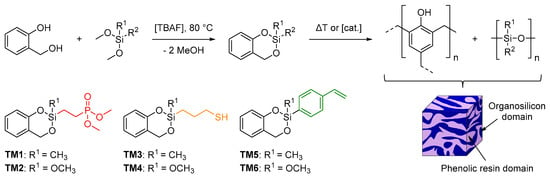
Furthermore, alkoxysilanes are prominent precursors for the synthesis of organosilicon hybrid materials [9,10,11,12]. This type of composite combines at least two constituents on the nanoscale and is commonly prepared via sol-gel processes or a building block approach [13]. The concept of twin polymerization provides an alternative route to hybrid materials by employing a single-source monomer comprising two or more polymerizable moieties covalently bound to each other in a so-called twin monomer [14,15]. 4H-1,3,2-benzodioxasilines are typical examples of silicon-based twin monomers derived from salicyl alcohol and a multifunctional alkoxysilane. Polymerization of these precursors results in an interpenetrating network of a phenolic resin and polysiloxanes, as shown in Figure 1 [14,15,16,17,18]. Both polymers are formed at the same time in mechanistically coupled reaction steps, thereby inhibiting a thermodynamically favoured phase separation and resulting in domain sizes below 3 nm. This is a key difference compared with the homopolymerization of multifunctional monomers, in which the reactive chain ends propagate independently. In general, twin polymerization can be thermally initiated at elevated temperatures and does not require additional reactants, catalysts and/or solvents. However, acid or base catalysts can be applied for a curing process at lower temperatures or to alter the morphology of the resulting hybrid material. The detailed reaction mechanisms have been studied extensively and are presented in the literature [19,20,21,22,23]. Apart from silicon-based precursors, twin polymerization is applicable to various other metal-based precursors, offering a convenient route to nanoscale metal oxides for functional materials [24,25,26,27].
Figure 1.
Organosilicon hybrid materials obtained by twin polymerization of side-chain functionalized 4H-1,3,2-benzodioxasilines.
In the past, several twin monomers bearing various functional groups have been synthesized. Notable examples include the amino-functionalized derivatives reported by Göring et al. [28] and the epoxide-functionalized monomers described in our recent study [29]. Here, we expand the library of 4H-1,3,2-benzodioxasilines by using phosphonate-, thiol- and styrene-functionalized methoxysilanes as starting materials. Phosphonate groups were chosen due to their widespread application as flame retardants and their strong affinity towards metal oxides [30,31]. Traditionally used as anchoring groups for noble metal surfaces, thiols have more recently gained renewed attention in materials science as linkers in thiol–click reactions [32,33]. The synthesis of styrene-functionalized monomers was investigated with the aim of incorporating hybrid materials into commodity plastics based on polyolefins. The thermally induced polymerization of the monomers was studied by differential scanning calorimetry (DSC) and thermogravimetric analysis (TGA). Molecular characterization of the as-prepared hybrid materials was performed by solid-state 13C and 29Si nuclear magnetic resonance (NMR) spectroscopy. Within this work, we expand the portfolio of known twin monomers and highlight their potential for future applications.
2. Results and Discussion
2.1. Synthesis and Molecular Design
Functionalized 4H-1,3,2-benzodioxasilines can be synthesized in a one-step cyclization of halo- or alkoxysilanes with salicyl alcohol. However, the use of highly moisture-sensitive halosilanes in the presence of an acid scavenger is often considered an undesirable approach in terms of scalability and atom economy. The novel twin monomers TM1–TM6 were instead prepared via the fluoride-catalysed transesterification of methoxysilanes, using tetra-n-butylammonium fluoride (TBAF) as a soluble fluoride source (see Figure 1). The thiol-functionalized silanes used for this reaction are commercially available and are by themselves commonly used coupling agents for sulphur-vulcanized rubbers and composite manufacturing [3]. Likewise, trimethoxy(4-vinylphenyl)silane is commercially available, whereas dimethoxymethyl(4-vinylphenyl)silane was prepared by a Grignard reaction of 4-bromostyrene with trimethoxysilane. The phosphonate-functionalized methoxysilanes were synthesized by radical-induced hydrosilylation of vinylmethoxysilanes with dimethyl phosphonate [34]. All twin monomers presented were obtained as high-boiling, colourless oils. Similar to other alkoxysilanes, they are susceptible to hydrolysis under ambient conditions. Nevertheless, the monomers are overall easy-to-handle compounds and exhibit negligible decomposition over prolonged periods of time [29].
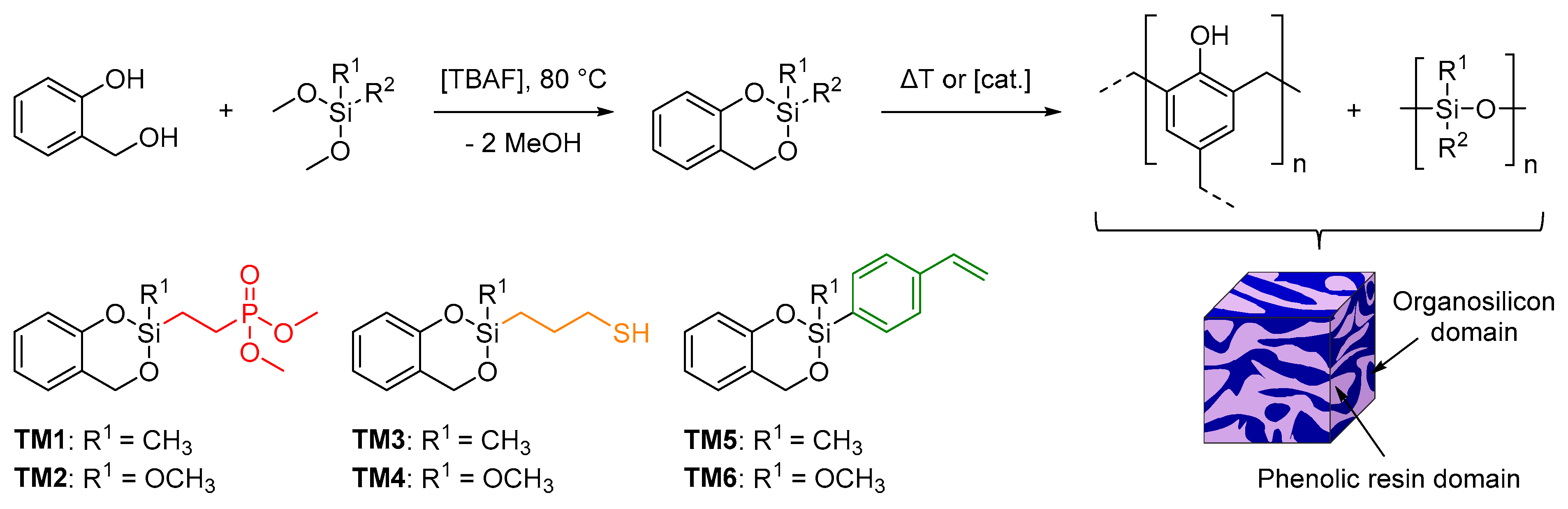
Alternatively, functional groups can be introduced through the phenolic component of the monomer. Following this approach, several alkyl and (pseudo)halogen derivatives of 2,2′-spirobi [4H-1,3,2-benzodioxasiline] have previously been synthesized from substituted salicyl alcohols and tetramethoxysilane [23]. To date, however, twin monomers bearing functional groups on the phenolic moiety have not been reported. In this study, the synthesis of such monomers was exemplified for a phosphonate-functionalized compound using an acetonide protecting group for 5-iodosalicyl alcohol. The Tavs reaction of intermediate 1, followed by acid-catalysed deprotection of 2, afforded salicyl alcohol 3, which allowed the preparation of TM7 (see Figure 2). This route was found to be superior to the cross-coupling of halophenols and their subsequent ortho-hydroxymethylation, since the latter is hindered by the introduction of electron-withdrawing substituents like the phosphonate group.
Figure 2.
Synthesis of a phosphonate-functionalized 2,2-dimethyl-4H-1,3,2-benzodioxasiline.
Notably, 2,2-dimethyl-4H-1,3,2-benzodioxasiline does not undergo non-catalysed twin polymerization and instead evaporates around 220 °C due to its comparatively low molecular weight [22]. The high-boiling derivative TM7 therefore also served as a model compound to demonstrate the polymerizability of this class of monomers. Additionally, the electron-withdrawing properties of the para-substituent might also decrease the activation energy required for twin polymerization [23].
2.2. Thermal Properties
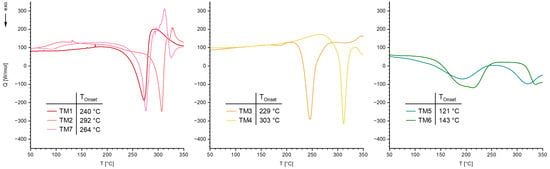
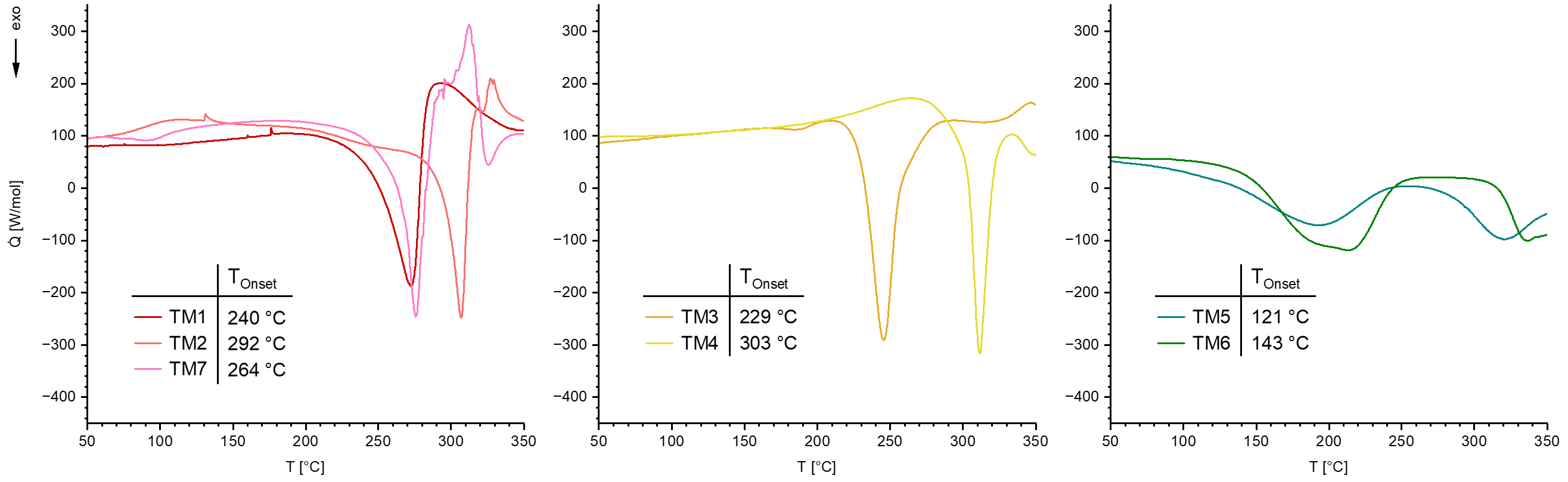
As evidenced by the DSC thermograms given in Figure 3, the twin monomers presented do not volatilize upon heating under ambient pressure but instead undergo thermally induced polymerization. The phosphonate- and thiol-functionalized monomers TM1–TM4 and TM7 show a single exothermic reaction with peak temperatures ranging from 270 °C to 310 °C. These peaks can be attributed to the ring opening and subsequent twin polymerization of the 4H-1,3,2-benzodioxasiline moiety [22]. In contrast, the styrene-functionalized monomers TM5/TM6 exhibit two distinct peaks. The broad peak around 200 °C arises from the homopolymerization of the styrene group, which is known to undergo thermal self-initiated reaction at elevated temperatures [35]. The second peak at 300 °C can therefore be assigned to the polymerization of the silicon moiety, as supported by the presence of siloxanes in hybrid material HM5 (see SI2). Furthermore, the irregular endothermic DSC profiles observed after the exothermic peaks of TM1/TM2 and TM7 may originate from a (partial) decomposition of the phosphonate esters, as these compounds are susceptible to dealkylation at temperatures around 300 °C [31,36]. This process is accompanied by the release of volatile byproducts and likely accounts for the foamy appearance of the respective polymers. The proposed dealkylation would result in the formation of phosphonic acids, the condensation of which can contribute to additional crosslinking within the material.
Figure 3.
DSC thermograms of phosphonate- (TM1/TM2, TM7), thiol- (TM3/TM4) and styrene-functionalized twin monomers (TM5/TM6) under inert atmosphere.
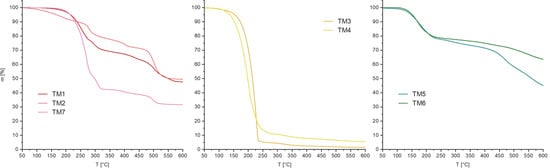
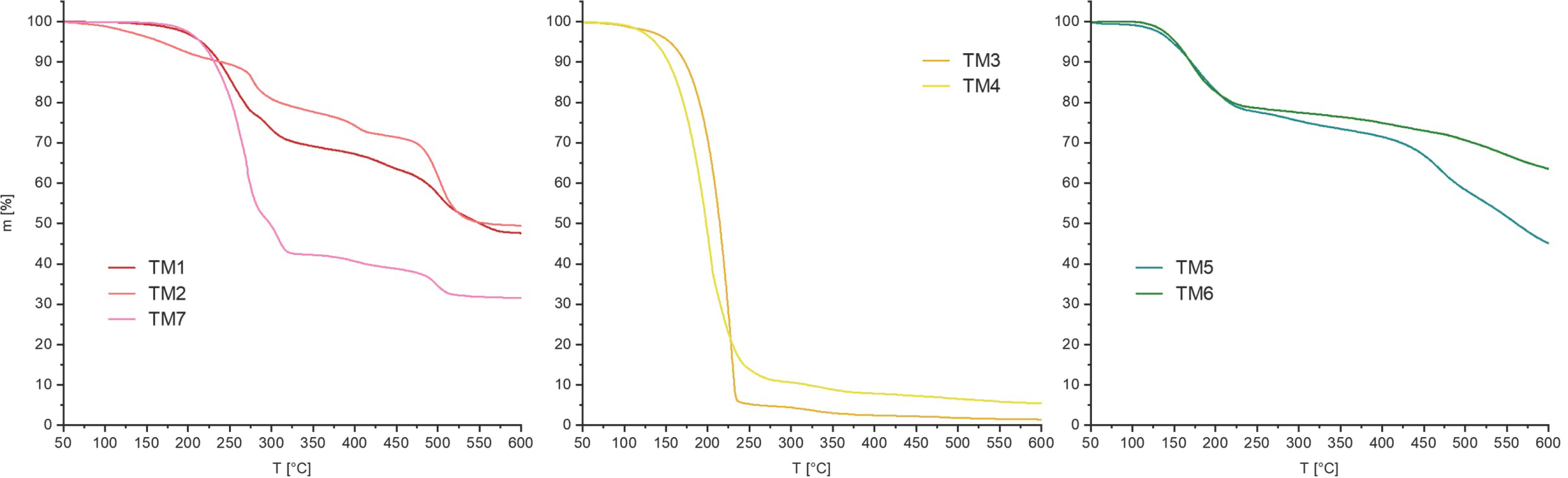
The TGA thermograms also provide insights into precursor reactivity by highlighting the mass loss during polymerization. Above approx. 250 °C, the methoxy-substituted monomers TM2, TM4 and TM6 exhibit a lower mass loss due to condensation reactions of the methoxy group and the subsequent formation of a three-dimensional network, whereas their methyl-substituted analogues TM1, TM3 and TM5 polymerize to give linear polysiloxanes. This is particularly evident for TM7, whose non-functionalized silicon moiety undergoes ring opening to form rather volatile dimethylsiloxanes. Consequently, TM7 shows a comparatively large mass loss, despite having a higher molecular mass and boiling point than TM1/TM2. On the other hand, the thiol groups of TM3/TM4 do not provide additional crosslinking opportunities and lead to a higher volatility of these monomers. The respective hybrid materials are overall softer, and HM3 is notably obtained as a yellowish rubber Additionally, it should be noted that the volatilization shown in Figure 4 is strongly facilitated by the gas flow conditions and small sample sizes used for TGA measurements. The results are therefore not representative of the bulk polymerization of the twin monomers, for which only negligible mass losses are observed after curing.
Figure 4.
TGA thermograms of phosphonate- (TM1/TM2, TM7), thiol- (TM3/TM4) and styrene-functionalized twin monomers (TM5/TM6) under inert atmosphere.
2.3. Characterization of Hybrid Materials
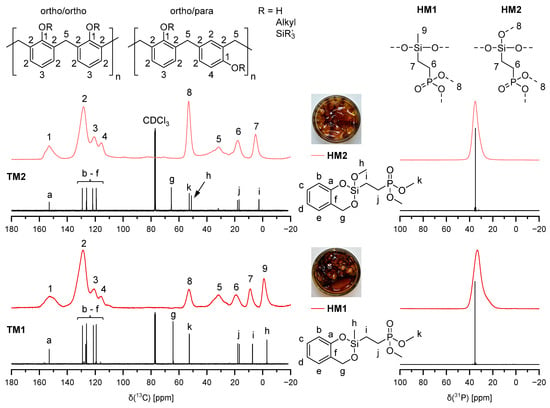
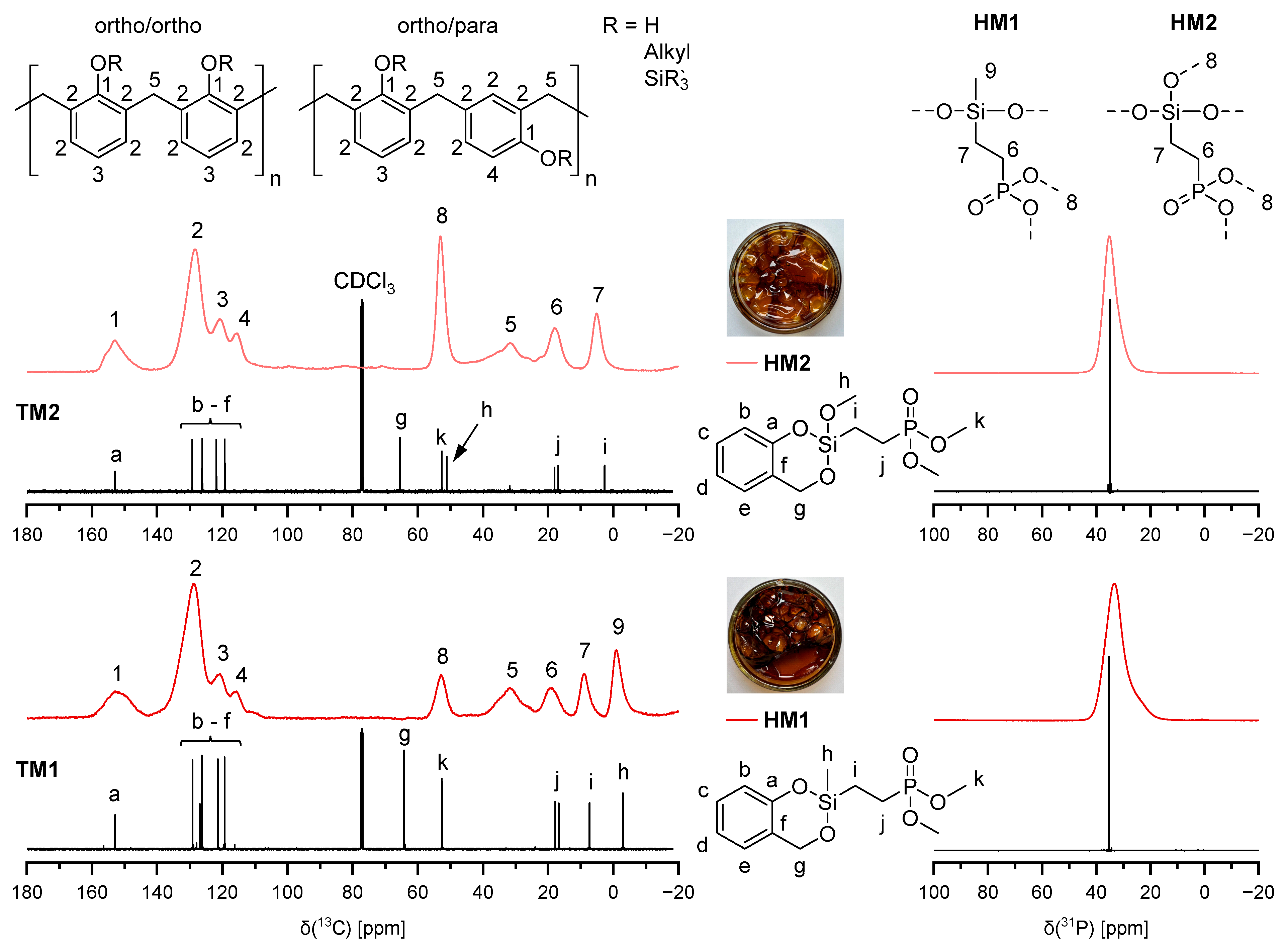
Isothermal curing of the monomers at 240 °C for 2 h under ambient atmosphere afforded transparent hybrid materials. Detailed information on their structural properties was obtained by CP-MAS-NMR spectroscopy. The spectra of HM1/HM2 are shown exemplarily in Figure 5, while those of the other hybrid materials are discussed in the Supporting Information (see SI2). The 13C NMR signal of phenoxy carbons appears around 156 ppm, although the presence of Caryl–OH and etherified Caryl–OR groups cannot be distinguished by the signal shape alone [37]. The other signals in the aromatic region between 100 ppm and 140 ppm also originate from the phenolic resin and can be used to determine the substitution pattern within the network [38]. The unsubstituted carbons in the ortho-position relative to the OR-Group experience greater deshielding than those in the para-position. Hence, the signal of ortho/ortho linked phenols appears at 120 ppm, while ortho/para linkages are observed at approx. 116 ppm. Although the signals of the bridging methylene groups at 32 ppm also provide information on the substitution pattern, a high degree of crosslinking and the resulting signal overlap render an unambiguous assignment difficult [38].
Figure 5.
13C{1H}- and 31P{1H}-CP-MAS NMR spectra of hybrid materials HM1/HM2 obtained by isothermal-induced twin polymerization of TM1/TM2.
For HM1/HM2, complete ring opening of the 4H-1,3,2-benzodioxasiline can be inferred from the absence of signal g corresponding to the original benzyloxy group at approx. 64 ppm. The aliphatic signals of the silicon moiety between −10 ppm and 30 ppm are consistent with the liquid-state NMR spectra of the respective precursors. They appear nearly identical among all investigated hybrid materials, since Si–C bonds of (poly)siloxanes are considered thermally stable up to 300 °C and thus remain largely unchanged during polymerization [39]. The signal of the phosphonate ester appears at 53 ppm and, in the case of HM2, overlaps with the signal of the silicon-bound methoxy group.
In the 31P NMR spectra, a single signal is observed around 33 ppm. Any phosphonic acids formed through the presumed dealkylation of the respective methyl esters are therefore not readily distinguishable, given that their chemical shifts often differ by only 1–3 ppm [40]. As such, the broad signals in the solid-state 31P NMR spectra may include different phosphonate species from an incomplete ester decomposition.
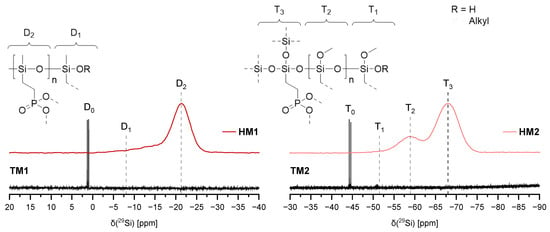
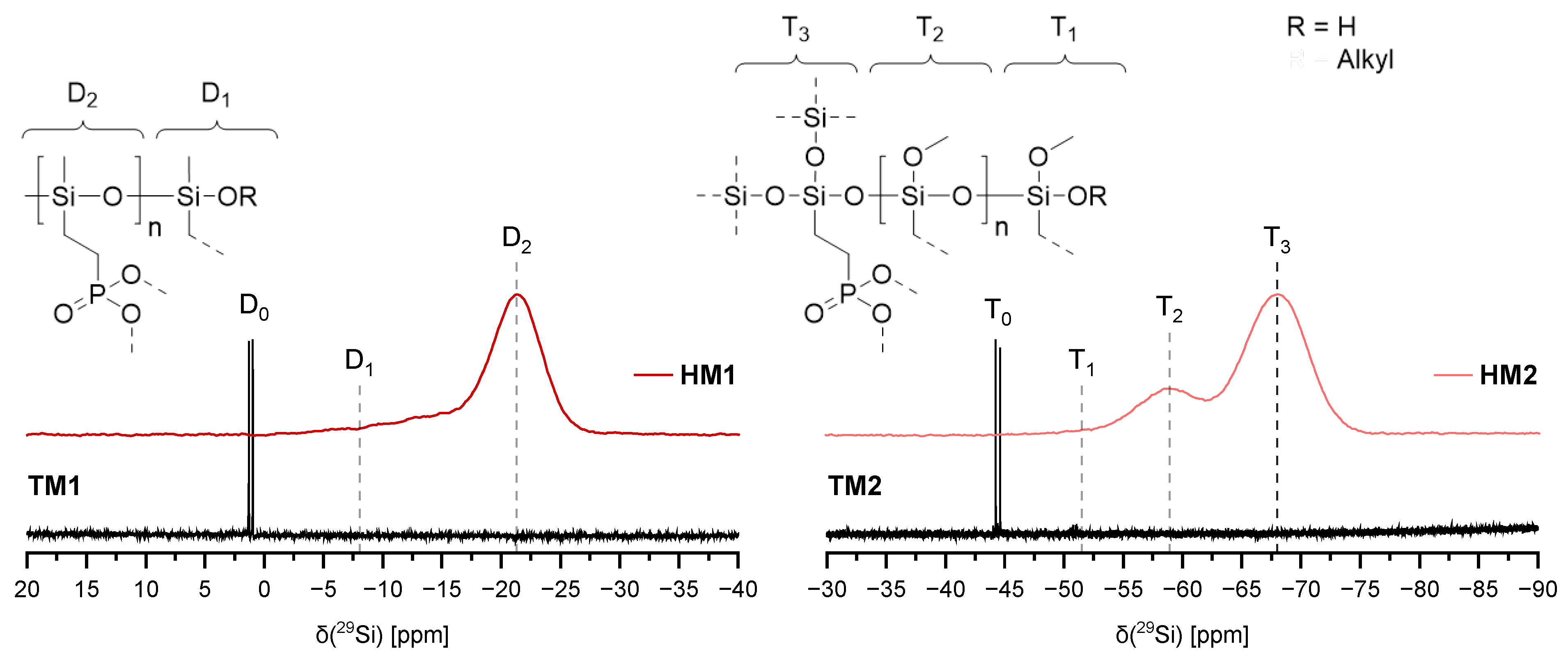
The 29Si{1H}-CP-MAS NMR spectrum of HM1 in Figure 6 shows the formation of polydialkylsiloxanes with signals ranging from −10 ppm to −28 ppm. Depending on the number of neighboring siloxane units per silicon atom, they can be classified into terminal D1- and intermediate D2-signals [41]. The D0-signal of the unreacted or hydrolysed monomer TM1 is not detected, thereby confirming a complete conversion of the precursor. A high degree of siloxane polymerization is apparent by the high intensity of D2-signals relative to D1-signals, in contrast to the hybrid materials obtained from styrene-functionalized monomers (see SI2). Similarly, the formation of a highly crosslinked polysiloxane network is observed for HM2, resulting from the condensation of the precursor methoxy groups. The T2-signal corresponding to unreacted methoxy groups is in line with the high intensity of signal 8 in the respective 13C{1H}-CP-MAS NMR spectrum. The hybrid materials also likely contain cyclic (D2-signals) and cage-like polysiloxanes (T3-signals). However, these are difficult to differentiate from other siloxane structures due to the overlap of the broad 29Si NMR signals [41].
Figure 6.
29Si{1H}-CP-MAS NMR spectra of hybrid materials HM1/HM2.
3. Experimental
3.1. Materials
All chemicals were received from commercial sources and were used as obtained if not stated otherwise. Toluene was dried using standard methods. Salicyl alcohol was purified before use via column chromatography on silica with an eluent mixture of ethyl acetate/n-hexane (20/80, v/v) and was obtained as a colourless crystalline solid. Air-sensitive reactions were conducted under argon atmosphere. The purification of all liquid compounds was performed by short-path vacuum distillation at 1∙10−3 mbar using a B-585 Glass Oven (Büchi Labortechnik AG, Flawil, Switzerland). The reported boiling points correspond to the temperatures at which the liquids were obtained as product fractions.
3.2. Methods
Liquid-state NMR spectra were collected at 11.7 T on a Avance III 500 spectrometer (Bruker, Billerica, MA, USA). The chemical shifts of 1H and 13C{1H} NMR spectra were referenced internally to the solvent CDCl3 (δ = 7.26 ppm, 77.16 ppm) relative to Si(CH3)4 (δ = 0.00 ppm). 29Si{1H} NMR spectra were referenced externally to Si(CH3)4 (δ = 0.00 ppm).
Solid-state NMR spectra were collected at 9.4 T on a Avance 400 spectrometer (Bruker, Billerica, MA, USA) equipped with double-tuned probes capable of magic angle spinning (MAS). The powdered samples were densely packed into 3.2 mm ZrO2 rotors. The spectra were measured with a MAS frequency of 8 kHz (29Si NMR) or 15 kHz (1H, 13C and 31P NMR). Cross polarization (CP) with a contact time of 2 ms (13C NMR) or 3 ms (29Si NMR) was used to enhance sensitivity. A shaped 1H contact pulse ramping with power inputs of 50–100% was applied to achieve a more robust match of the Hartmann–Hahn condition. 1H decoupling of all spectra was performed using a two-pulse phase modulation sequence during data acquisition. The chemical shifts of 13C{1H}- and 29Si{1H}-CP-MAS NMR spectra were referenced externally to Si(CH3)4 (δ = 0.00 ppm) with Si(SiMe3)4 (δ(13C) = 3.55 ppm; δ(29Si) = −9.5, −134.8 ppm) being a secondary standard. 31P{1H}-CP-MAS NMR spectra were referenced to (NH4)H2PO4 (δ = 0.80 ppm).
CHNS elemental analyses were conducted on a vario MICRO cube (Elementar Analysensysteme GmbH, Langenselbold, Germany). DSC measurements were conducted up to 350 °C on a DSC1 calorimeter (Mettler Toledo, Columbus, OH, USA) using sealed 40 μL aluminium crucibles and a heating rate of 10 K/min−1. TGA measurements were performed up to 600 °C on a TGA/DSC1 in uncapped 70 µL aluminium oxide crucibles with a heating rate of 10 K min−1. Nitrogen gas was used for both measurements.
3.3. Synthesis
3.3.1. 6-Iodo-2,2-dimethyl-4H-benzo[d][1,3]dioxine (1)
Synthesis was performed following a procedure by Meier et al. [42]. A mixture of 5-iodosalicyl alcohol (4.00 g, 16.0 mmol), 2,2-dimethoxypropane (8.33 g, 80.0 mmol), p-toluenesulfonic acid monohydrate (0.37 g, 1.9 mmol) and anhydrous Na2SO4 (10.00 g) in 100 mL acetone was stirred overnight at 40 °C. The mixture was concentrated in vacuo and partitioned between 150 mL H2O and EtOAc (2 × 60 mL). The combined organic layers were dried over MgSO4, filtered off and concentrated in vacuo. The residue was purified by column chromatography (silica, 100% n-hexane) and then vacuum distilled to afford the product as a colourless oil.
Yield: 4.18 g (90%) bp.: 110 °C 1H NMR (500.3 MHz, CDCl3): [δ] δ [ppm] (dd, 3Jortho = 8.7 Hz, 4Jmeta = 2.2 Hz, 1H), 7.28 (d, 4Jmeta = 2.2 Hz, 1H), 6.59 (d, 3Jortho = 8.7 Hz, 1H), 4.79 (s, 2H), 1.52 (s, 6H) 13C{1H} NMR (125.8 MHz, CDCl3): δ [ppm] 151.3, 137.0, 133.5, 122.2, 119.6, 100.0, 82.4, 60.3, 24.8.
3.3.2. Diethyl(2,2-dimethyl-4H-benzo[d][1,3]dioxin-6-yl)phosphonate (2)
A mixture of compound 1 (4.18 g, 14.4 mmol) and anhydrous NiBr2 (0.19 g, 0.9 mmol) was heated to 170 °C. Triethyl phosphite (3.59 g, 21.6 mmol) was added dropwise until the reaction started, as indicated by a colour change to green. The remaining triethyl phosphite was added rapidly, and the mixture was stirred at 170 °C for 40 min. The mixture was filtered through a pad of silica gel, which was subsequently washed with Et2O (2 × 100 mL). The filtrate was concentrated in vacuo and purified by vacuum distillation. The product was obtained as a colourless oil.
Yield: 2.29 g (53%) bp.: 160 °C 1H NMR (500.3 MHz, CDCl3): δ [ppm] 7.56 (ddd, 3JH-P = 12.6 Hz, 3Jortho = 8.4 Hz, 4Jmeta = 2.0 Hz, 1H), 7.47 (dd, 3JH-P = 13.4 Hz, 4Jmeta = 2.0 Hz, 1H), 6.87 (dd, 3Jortho = 8.4 Hz, 4JH-P = 3.6 Hz, 1H), 4.85 (s, 2H), 4.16–4.00 (m, 4H), 1.54 (s, 6H), 1.31 (d, 3J = 7.1 Hz, 6H) 13C{1H} NMR (125.8 MHz, CDCl3): δ [ppm] 155.0 (d, 4JC-P = 3.6 Hz), 131.9 (d, 2JC-P = 10.4 Hz), 129.4 (d, 2JC-P = 11.8 Hz), 119.7 (d, 3JC-P = 15.9 Hz), 119.4 (d, 1JC-P = 194.4 Hz), 117.5 (d, 3JC-P = 15.4 Hz), 100.5, 62.1 (d, 2JC-P = 5.4 Hz), 60.7, 24.9, 16.5 (d, 3JC-P = 6.8 Hz) 31P{1H} NMR (202.5 MHz, CDCl3): δ [ppm] 19.5.
3.3.3. Diethyl(4-hydroxy-3-(hydroxymethyl)phenyl)phosphonate (3)
A solution of 0.1 mL conc. HCl in 100 mL CH3CN/H2O (7:3, v/v) was added to compound 2 (2.29 g, 7.6 mmol). The mixture was stirred for 3 days at room temperature and then concentrated in vacuo. The residue was partitioned between 100 mL H2O and EtOAc (2 × 50 mL). The combined organic layers were dried over MgSO4, filtered off and concentrated in vacuo. The product was obtained as a viscous, colourless oil.
Yield: 1.97 g (99%) 1H NMR (500.3 MHz, CDCl3): δ [ppm] 9.41 (s, 1H), 7.50 (ddd, 3JH-P = 12.9 Hz, 3Jortho = 8.4 Hz, 4Jmeta = 2.0 Hz, 1H), 7.40 (dd, 3JH-P = 13.2 Hz, 4Jmeta = 2.0 Hz, 1H), 6.93 (dd, 3Jortho = 8.4 Hz, 3JH-P = 3.8 Hz, 1H), 4.78 (s, 2H), 4.08–3.91 (m, 4H, H-9), 1.27 (t, 3J = 7.1 Hz, 6H) 13C{1H} NMR (125.8 MHz, CDCl3): δ [ppm] 160.8 (d, 4JC-P = 3.6 Hz), 132.9 (d, 2JC-P = 10.9 Hz), 131.7 (d, 2JC-P = 12.3 Hz), 126.4 (d, 3JC-P = 15.9 Hz), 117.1 (d, 1JC-P = 196.2 Hz), 116.7 (d, 3JC-P = 16.3 Hz), 63.5 (C-7), 62.4 (d, 2JC-P = 5.4 Hz), 16.4 (d, 3JC-P = 6.8 Hz) 31P{1H} NMR (202.5 MHz, CDCl3): δ [ppm] 20.4.
3.3.4. Diethyl(2,2-dimethyl-4H-1,3,2-benzodioxasiline-6-yl)phosphonate (TM7)
A solution of compound 3 (1.97 g, 7.6 mmol) in toluene (100 mL) was heated to 80 °C, and 10 µL of TBAF (1M solution in THF) was added via a micro-scale pipette. Dimethoxy(dimethyl)silane (0.91 g, 7.6 mmol) was added, and the solution was stirred for 20 h. Then, the solvent mixture of toluene/methanol was slowly evaporated under reduced pressure at 80 °C. The residue was purified by vacuum distillation to afford the product as a colourless oil.
Yield: 1.01 g (42%) bp.: 170 °C 1H NMR (500.3 MHz, CDCl3): δ [ppm] 7.61 (ddd, 1H, 3JH-P = 12.8 Hz, 4Jortho = 8.4 Hz, 4Jmeta = 2.0 Hz, 1H), 7.45 (dd, 3JH-P = 13.1 Hz, 4Jmeta = 2.0 Hz, 1H), 6.93 (dd, 3Jortho= 8.4 Hz, 4JH-P = 3.7 Hz, 1H), 4.93 (s, 2H), 4.15–3.96 (m, 6H), 1.30 (t, 3J = 7.1 Hz, 6H), 0.33 (s, 6H) 13C{1H} NMR (125.8 MHz, CDCl3): δ [ppm] 157.0 (d, 4JC-P = 3.6 Hz), 133.0 (d, 2JC-P = 10.9 Hz), 130.5 (d, 2JC-P = 11.8 Hz), 127.1 (d, 3JC-P = 15.4 Hz), 112.0 (d, 1JC-P = 193.9 Hz), 119.7 (d, 3JC-P = 15.9 Hz), 63.5, 62.1 (d, 2JC-P = 5.4 Hz), 16.4 (d, 3JC-P = 6.4 Hz), −1.4 31P{1H} NMR (202.5 MHz, CDCl3): δ [ppm] 19.4 29Si{1H} NMR (99.4 MHz, CDCl3): δ [ppm] 6.1 EA: C13H21O5PSi calc.: [%] C 49.36, H 6.69 found.: [%] C 48.45, H 6.89.
3.3.5. General Procedure for the Synthesis of Phosphonate-Functionalized Methoxysilanes
The synthesis was performed following a procedure by Maddala et al. [34]. A solution of dimethyl phosphonate (53.90 g, 489.8 mmol) and di-tert-butyl peroxide (DTBP, 7.30 g, 49.9 mmol) was heated to 130 °C. Then, trimethoxyvinylsilane or dimethoxy(methyl)vinylsilane (400.0 mmol) was added dropwise over a period of 3 h. After an additional 2 h, DTBP (1 mL) was added, and the mixture was refluxed overnight at 130 °C. The reaction mixture was then purified by vacuum distillation. All products were obtained as colourless oils.
Dimethyl (2-(dimethoxy(methyl)silyl)ethyl)phosphonate (4)
Yield: 68.81 g (71%) bp.: 100 °C (10−3 mbar) 1H NMR (500.3 MHz, CDCl3): δ [ppm] 3.72 (d, 3JH-P = 10.6 Hz, 6H), 3.49 (s, 6H,), 1.77–1.67 (m, 2H), 0.89–0.80 (m, 2H), 0.11 (s, 3H) 13C{1H} NMR (125.8 MHz, CDCl3): δ [ppm] 52.6 (d, 2JC-P = 6.8 Hz), 50.4, 17.8 (d, 1JC-P = 141.7 Hz), 5.0 (d, 2JC-P = 8.2 Hz), −6.1 29Si{1H} NMR (99.4 MHz, CDCl3): δ [ppm] −3.3 (d, 3JSi-P = 33.3 Hz) 31P{1H} NMR (202.5 MHz, CDCl3): δ [ppm] 36.0.
Dimethyl (2-(trimethoxysilyl)ethyl)phosphonate (5)
Yield: 70.25 g (68%) bp.: 110 °C 1H NMR (500.3 MHz, CDCl3): δ [ppm] 3.69 (d, 3JH-P = 10.6 Hz, 6H), 3.52 (s, 9H), 1.77–1.67 (m, 2H), 0.87–0.79 (m, 2H) 13C{1H} NMR (125.8 MHz, CDCl3): δ [ppm] 52.5 (d, 2JC-P = 6.4 Hz), 50.7, 17.7 (d, 1JC-P = 142.6 Hz), 1.3 (d, 2JC-P = 8.2 Hz) 29Si{1H} NMR (99.4 MHz, CDCl3): δ [ppm] −44.3 (d, 3JSi-P = 36.3 Hz) 31P{1H} NMR (202.5 MHz, CDCl3): δ [ppm] 35.6.
3.3.6. Dimethoxy(methyl)(4-vinylphenyl)silane (6)
A Grignard solution prepared from 4-bromostyrene (20.00 g, 109.3 mmol) and magnesium turnings (2.92 g, 120.2 mmol) in 40 mL THF was added dropwise to a solution of methyltrimethoxysilane (14.90 g, 109.4 mmol) in 100 mL THF at 0 °C. The mixture was then stirred overnight at room temperature. After the reaction, magnesium salts were precipitated by addition of 150 mL n-hexane. The solids were filtered off, and the filtrate was concentrated in vacuo. The residue was purified by vacuum distillation to afford the product as a colourless oil.
Yield: 10.05 g (44%) bp.: 65 °C (10−3 mbar) 1H NMR (500.3 MHz, CDCl3): δ [ppm] 7.59 (d, 3Jortho = 8.2 Hz, 2H), 7.44 (d, 3Jortho = 7.9 Hz, 2H), 6.73 (dd, 3J = 17.7 Hz, 3J = 10.9 Hz, 1H), 5.81 (dd, 3J = 17.5 Hz, 2J = 0.9 Hz, 1H), 5.29 (dd, 3J = 10.9 Hz, 2J = 0.9 Hz, 1H), 3.57 (s, 6H), 0.36 (s, 3H) 13C{1H} NMR (125.8 MHz, CDCl3) δ [ppm] 139.4, 136.9, 134.4, 133.4, 125.9, 114.9, 50.7, −5.0 29Si{1H} NMR (99.4 MHz, CDCl3): δ [ppm] −14.3.
3.3.7. General Procedure for the Synthesis of Twin Monomers TM1–TM6
A solution of salicyl alcohol (10.0 g, 80.6 mmol) in toluene (200 mL) was heated to 80 °C, and 20 µL of TBAF (1M solution in THF) was added via a micro-scale pipette. The respective trimethoxy- or dimethoxymethylsilane (80.6 mmol) was added, and the solution was stirred for 20 h. Then, the solvent mixture of toluene/methanol was slowly evaporated under reduced pressure at 80 °C. The residue was purified by vacuum distillation. All products were obtained as colourless oils.
Dimethyl (2-(2-methyl-4H-1,3,2-benzodioxasiline-2-yl)ethyl)phosphonate TM1
Yield: 20.95 g (86%) bp.: 150 °C 1H NMR (500.3 MHz, CDCl3): δ [ppm] 7.20–7.14 (m, 1H), 6.95 (dd, 3Jortho = 7.6 Hz, 4Jmeta = 2.0 Hz, 1H), 6.92–6.85 (m, 2H), 4.94 (d, 2J = 14.0 Hz, 1H), 4.89 (d, 2J = 14.0 Hz, 1H), 3.70 (d, 3JH-P = 10.7 Hz), 1.79–1.69 (m, 2H), 1.06–0.97 (m, 2H), 0.32 (s, 3H) 13C{1H} NMR (125.8 MHz, CDCl3): δ [ppm] 152.9, 129.1, 126.9, 126.2, 121.3, 119.3, 64.2, 52.6 (d, 2JC-P = 6.4 Hz), 17.3 (d, 1JC-P = 142.6 Hz), 7.4 (d, 2JC-P = 7.7 Hz), −3.0 31P{1H} NMR (202.5 MHz, CDCl3): δ [ppm] 35.3 29Si{1H} NMR (99.4 MHz, CDCl3): δ [ppm] 1.1 (d, 3JSi-P = 32.1 Hz) EA: C12H19O5PSi calc.: [%] C 47.67, H 6.33 found: [%] C 47.72 H 6.60.
Dimethyl (2-(2-methoxy-4H-1,3,2-benzodioxasiline-2-yl)ethyl)phosphonate TM2
Yield: 13.08 g (51%) bp.: 150 °C 1H NMR (500.3 MHz, CDCl3): δ [ppm] 7.23–7.18 (m, 1H), 7.00–6.97 (m, 1H), 6.96–6.91 (m, 2H), 5.07 (d, 2J = 14.0 Hz, 1H), 4.97 (d, 2J = 14.0 Hz, 1H), 3.71 (d, 3JH-P = 10.7 Hz), 3.59 (s, 3H), 1.85–1.73 (m, 2H), 1.10–1.00 (m, 2H) 13C{1H} NMR (125.8 MHz, CDCl3): δ [ppm] 152.9, 129.3, 126.3, 126.1, 121.8, 119.2, 65.4, 52.6 (d, 2JC-P = 6.4 Hz), 51.1, 17.5 (d, 1JC-P = 143.5 Hz), 2.7 (d, 2JC-P = 7.7 Hz) 31P{1H} NMR (202.5 MHz, CDCl3): δ [ppm] 34.9 29Si{1H} NMR (99.4 MHz, CDCl3): δ [ppm] −44.4 (d, 3JSi-P = 37.5 Hz) EA: C12H19O6PSi calc.: [%] C 45.28, H 6.02 found: [%] C 45.10, H 6.14.
3-(2-Methyl-4H-1,3,2-benzodioxasiline-2-yl)propane-1-thiol TM3
Yield: 11.23 g (58%) bp.: 120 °C 1H NMR (500.3 MHz, CDCl3): δ [ppm] 7.23–7.17 (m, 1H), 6.98 (dd, 3Jortho = 7.5 Hz, 4Jmeta = 2.0 Hz, 1H), 6.94–6.88 (m, 2H), 4.96 (d, 2J = 13.9 Hz, 1H), 4.92 (d, 2J = 13.9 Hz, 1H), 2.53 (dt, 3J = 8.0, 3J = 7.1 Hz, 2H), 1.78–1.69 (m, 2H), 1.32 (t, 3J = 8.0 Hz, 1H), 0.93–0.86 (m, 2H), 0.32 (s, 3H) 13C{1H} NMR (125.8 MHz, CDCl3) δ [ppm] 153.1, 129.1, 127.1, 126.3, 121.2, 119.3, 64.1, 27.6, 27.1, 14.5, −2.6 29Si{1H} NMR (99.4 MHz, CDCl3): δ [ppm] 2.7 EA: C11H16O2SSi calc.: [%] C 54.96, H 6.71, S 13.34 found: [%] C 54.43, H 6.69, S 12.85.
3-(2-Methoxy-4H-1,3,2-benzodioxasiline-2-yl)propane-1-thiol TM4
Yield: 7.64 g (37%) bp.: 140 °C 1H NMR (500.3 MHz, CDCl3): δ [ppm] 7.24–7.19 (m, 1H), 7.02–6.98 (m, 1H), 6.97–6.92 (m, 1H), 5.08 (d, 2J = 13.9 Hz, 1H), 4.98 (d, 2J = 13.9 Hz, 1H), 3.60 (s, 3H), 2.53 (dt, 3J = 8.0 Hz, 3J = 7.1 Hz, 2H), 1.80–1.70 (m, 2H), 1.31 (t, 3J = 8.0 Hz, 1H), 0.95–0.89 (m, 2H) 13C{1H} NMR (125.8 MHz, CDCl3) δ [ppm] 153.1, 129.2, 126.5, 126.1, 121.6, 119.2, 65.3, 51.0, 27.4, 27.1, 9.3 29Si{1H} NMR (99.4 MHz, CDCl3): δ [ppm] −42.8 EA: C11H16O3SSi calc.: [%] C 51.53, H 6.29, S 12.50 found: [%] C 51.12, H 6.27, S 12.04.
2-Methyl-2-(4-vinylphenyl)-4H-1,3,2-benzodioxasiline TM5
Yield: 7.13 g (33%) bp.: 130 °C 1H NMR (500.3 MHz, CDCl3): δ [ppm] 7.63 (d, 3Jortho = 8.1 Hz, 2H), 7.44 (d, 3Jortho = 8.1 Hz, 2H), 7.26–7.20 (m, 1H), 7.02 (dd, 3Jortho = 7.5 Hz, 4Jmeta = 2.0 Hz, 1H), 6.99 (dd, 3Jortho = 8.0 Hz, 4Jmeta = 1.3 Hz, 1H), 6.97–6.93 (m, 1H), 6.72 (dd, 3J = 17.6 Hz, 3J = 11.0 Hz, 1H), 5.82 (dd, 3J = 17.6 Hz, 2J = 1.0 Hz, 1H), 5.32 (dd, 3J = 10.9 Hz, 2J = 1.0 Hz, 1H), 5.03 (s, 2H), 0.62 (s, 3H) 13C{1H}-NMR (125.8 MHz, CDCl3): δ [ppm] 153.2, 140.0, 136.7, 134.1, 133.0, 129.1, 127.1, 126.3, 126.0, 121.3, 119.5, 115.3, 64.3, −3.0 29Si{1H} NMR (99.4 MHz, CDCl3): δ [ppm] −11.0 EA: C16H16O2Si calc.: [%] C 71.60, H 6.01 found: [%] C 71.55, H 6.10.
2-Methoxy-2-(4-vinylphenyl)-4H-1,3,2-benzodioxasiline TM6
Yield: 2.06 g (9%) bp.: 150 °C 1H NMR (500.3 MHz, CDCl3): δ [ppm] 7.67 (d, 3Jortho = 8.2 Hz, 2H), 7.43 (d, 3Jortho = 8.0 Hz, 2H), 7.26–7.21 (m, 1H), 7.05 (dd, 3Jortho = 7.6 Hz, 4Jmeta = 1.9 Hz, 1H), 7.01 (dd, 3Jortho = 8.0, 4Jmeta = 1.3 Hz, 1H), 6.99–6.95 (m, 1H), 6.71 (dd, 3J = 17.5, 3J = 10.9 Hz, 1H), 5.81 (dd, 3J = 17.5 Hz, 2J = 0.9 Hz, 1H), 5.31 (dd, 3J = 10.9 Hz, 2J = 0.9 Hz, 1H), 5.19 (d, 2J = 14.0 Hz, 1H), 5.10 (d, 2J = 14.0 Hz, 1H), 3.73 (s, 3H, H-8) 13C{1H} NMR (125.8 MHz, CDCl3): δ [ppm] 153.3, 140.4, 136.7, 135.1, 129.2, 127.6, 126.6, 126.2, 125.9, 121.7, 119.4, 115.5, 65.5, 51.4 29Si{1H} NMR (99.4 MHz, CDCl3): δ [ppm] −56.1 EA: C16H16O3Si calc.: [%] C 67.58, H 5.67 found: [%] C 67.73, H 5.38.
3.4. Preparation of Hybrid Materials
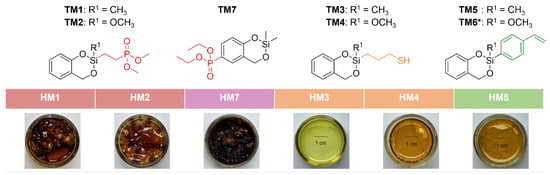
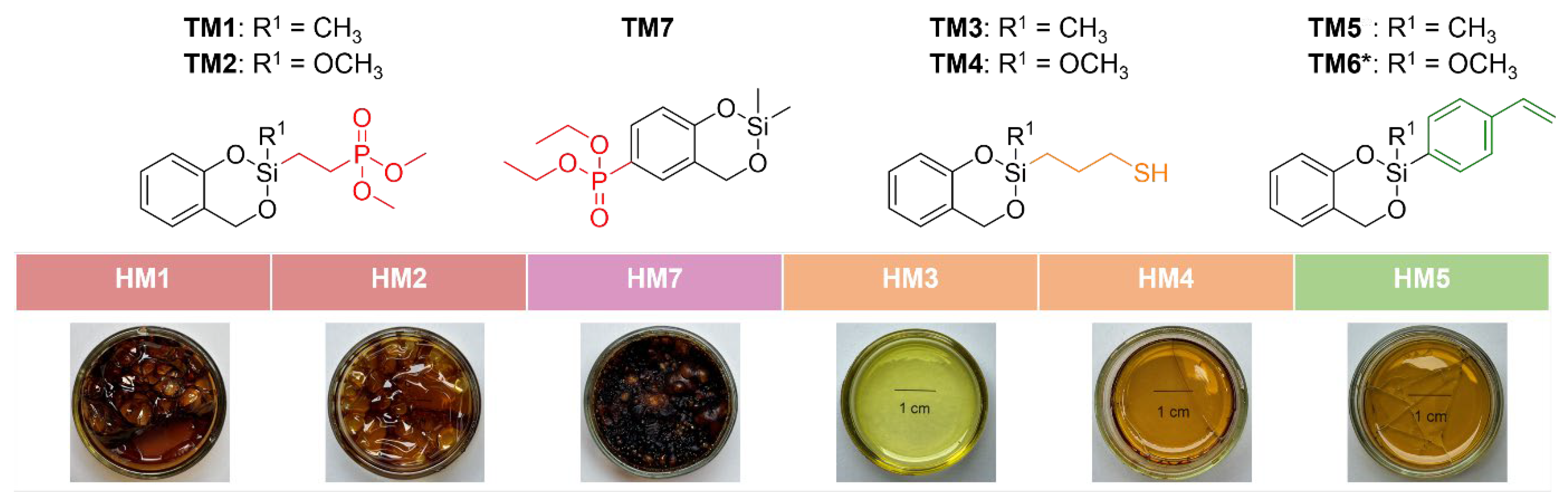
Bulk polymerization of pristine twin monomers was conducted in a preheated furnace under ambient atmosphere. For this purpose, 1.5 g of liquid monomer was placed in a closed 30 mm glass dish and isothermally heated for 2 h at 240 °C. Samples for solid-state NMR spectroscopy were prepared by grinding the polymers in a stainless-steel jar using a MM300 mixer mill (Retsch GmbH, Haan, Germany). For better distinction between the twin monomer precursors (TM1–TM7) and the cured hybrid materials, the latter are designated as HM1–HM7 (Figure 7).
Figure 7.
Photographs of the as-obtained hybrid materials. * Due to the low synthesis yield, the styrene-functionalized monomer TM6 was not obtained in sufficient quantities for the fabrication of hybrid material HM6.
4. Conclusions
In this study, we synthesized a series of sidechain-functionalized 4H-1,3,2-benzodioxasilines by transesterification of phosphonate-, thiol- and styrene-functionalized methoxysilanes with salicyl alcohol. The novel monomers TM1–TM5 proved suitable for thermally induced twin polymerization, affording organosilicon hybrid materials composed of a crosslinked phenolic resin and appropriately substituted polysiloxanes. Similarly, the polymerization of TM7 gave access to a phosphonate-functionalized resin and dimethylsiloxanes. The thiol-containing monomers TM3 and TM4 yielded solid hybrid materials, albeit with incomplete ring opening. Due to the high reactivity of the styrene group, TM5 afforded a material composed mainly of a polystyrene-based polymer and would therefore most likely require a catalyst to promote condensation reactions of the organosiliconmoiety. In future works, we aim to showcase the accessibility of the functional groups in post-curing reactions and thereby to present the twin monomers as a promising addition to the field of organosilicon adhesion promoters.
Supplementary Materials
The following supporting information can be downloaded at: https://www.mdpi.com/article/10.3390/molecules31234350/s1.
Author Contributions
A.M.: conceptualization (lead), writing—original draft (lead), data curation (lead), investigation (lead), validation (lead), visualization (lead) A.S.: data curation (equal), investigation (equal), formal analysis (equal) M.M.: resources (lead), supervision (lead), writing—review and editing (lead), data curation (supporting). All authors have read and agreed to the published version of the manuscript.
Funding
Funding of this publication by TU Chemnitz is acknowledged.
Institutional Review Board Statement
Not applicable.
Informed Consent Statement
Not applicable.
Data Availability Statement
All data supporting this article are provided as part of the manuscript or Supplementary Information (SI). Additional data will be made available upon reasonable request.
Acknowledgments
We thank Michael Sommer (Polymer Chemistry Group) for granting access to his group’s solid-state NMR spectrometer. The authors also thank Anja Veit (Coordination Chemistry Group) for her technical assistance.
Conflicts of Interest
The authors declare no conflicts of interest.
References
- Walker, P. Organosilanes as Adhesion Promoters. J. Adhes. Sci. Technol. 1991, 5, 279–305. [Google Scholar] [CrossRef] [Scilit]
- Pape, P.G. Adhesion Promoters: Silane Coupling Agents. In Applied Plastics Engineering Handbook; Elsevier: Norwich, UK, 2017; pp. 555–572. [Google Scholar]
- Plueddemann, E.P. Silane Coupling Agents; Springer: Boston, MA, USA, 1991. [Google Scholar]
- Pape, P.G.; Plueddemann, E.P. Methods for Improving the Performance of Silane Coupling Agents. J. Adhes. Sci. Technol. 1991, 5, 831–842. [Google Scholar] [CrossRef] [Scilit]
- Crucho, C.I.C. Synthesis of Organoalkoxysilanes: Versatile Organic–Inorganic Building Blocks. Compounds 2023, 3, 280–297. [Google Scholar] [CrossRef] [Scilit]
- Troegel, D.; Stohrer, J. Recent Advances and Actual Challenges in Late Transition Metal Catalyzed Hydrosilylation of Olefins from an Industrial Point of View. Coord. Chem. Rev. 2011, 255, 1440–1459. [Google Scholar] [CrossRef] [Scilit]
- Genest, A.; Portinha, D.; Fleury, E.; Ganachaud, F. The Aza-Michael Reaction as an Alternative Strategy to Generate Advanced Silicon-Based (Macro)Molecules and Materials. Prog. Polym. Sci. 2017, 72, 61–110. [Google Scholar] [CrossRef] [Scilit]
- Tucker-Schwartz, A.K.; Farrell, R.A.; Garrell, R.L. Thiol–Ene Click Reaction as a General Route to Functional Trialkoxysilanes for Surface Coating Applications. J. Am. Chem. Soc. 2011, 133, 11026–11029. [Google Scholar] [CrossRef] [Scilit] [PubMed]
- Schottner, G. Hybrid Sol−Gel-Derived Polymers: Applications of Multifunctional Materials. Chem. Mater. 2001, 13, 3422–3435. [Google Scholar] [CrossRef] [Scilit]
- Gomez-Romero, P.; Pokhriyal, A.; Rueda-García, D.; Bengoa, L.N.; González-Gil, R.M. Hybrid Materials: A Metareview. Chem. Mater. 2024, 36, 8–27. [Google Scholar] [CrossRef] [Scilit] [PubMed]
- Sanchez, C.; Julián, B.; Belleville, P.; Popall, M. Applications of Hybrid Organic–Inorganic Nanocomposites. J. Mater. Chem. 2005, 15, 3559. [Google Scholar] [CrossRef] [Scilit]
- Judeinstein, P.; Sanchez, C. Hybrid Organic–Inorganic Materials: A Land of Multidisciplinarity. J. Mater. Chem. 1996, 6, 511–525. [Google Scholar] [CrossRef] [Scilit]
- Kickelbick, G. Hybrid Materials—Past, Present and Future. Hybrid Mater. 2014, 1, 39–51. [Google Scholar] [CrossRef] [Scilit]
- Spange, S.; Mehring, M. Twin Polymerization: New Strategy for Hybrid Materials Synthesis; De Gruyter: Berlin, Germany, 2018. [Google Scholar]
- Scharf, S.; Notz, S.; Lang, H. Twin Polymerization: A Unique Strategy towards Versatile Functional Materials. Eur. J. Inorg. Chem. 2024, 27, e202300406. [Google Scholar] [CrossRef] [Scilit]
- Grund, S.; Kempe, P.; Baumann, G.; Seifert, A.; Spange, S. Nanocomposites Prepared by Twin Polymerization of a Single-Source Monomer. Angew. Chem. Int. Ed. 2007, 46, 628–632. [Google Scholar] [CrossRef] [Scilit] [PubMed]
- Ebert, T.; Seifert, A.; Spange, S. Twin Polymerization—A New Principle for Hybrid Material Synthesis. Macromol. Rapid Commun. 2015, 36, 1623–1639. [Google Scholar] [CrossRef] [Scilit] [PubMed]
- Spange, S.; Grund, S. Nanostructured Organic-Inorganic Composite Materials by Twin Polymerization of Hybrid Monomers. Adv. Mater. 2009, 21, 2111–2116. [Google Scholar] [CrossRef] [Scilit]
- Hoffmann, K.H.; Prehl, J. Modeling the Structure Formation Process of Twin Polymerization. React. Kinet. Mech. Catal. 2018, 123, 367–383. [Google Scholar] [CrossRef] [Scilit]
- Auer, A.A.; Bistoni, G.; Kitschke, P.; Mehring, M.; Ebert, T.; Spange, S. Electronic Structure Calculations and Experimental Studies on the Thermal Initiation of the Twin Polymerization Process. ChemPlusChem 2017, 82, 1396–1407. [Google Scholar] [CrossRef] [Scilit] [PubMed]
- Auer, A.A.; Richter, A.; Berezkin, A.V.; Guseva, D.V.; Spange, S. Theoretical Study of Twin Polymerization—From Chemical Reactivity to Structure Formation. Macromol. Theory Simul. 2012, 21, 615–628. [Google Scholar] [CrossRef] [Scilit]
- Kempe, P.; Löschner, T.; Auer, A.A.; Seifert, A.; Cox, G.; Spange, S. Thermally Induced Twin Polymerization of 4H-1,3,2-Benzodioxasilines. Chem.—Eur. J. 2014, 20, 8040–8053. [Google Scholar] [CrossRef] [Scilit] [PubMed]
- Kitschke, P.; Auer, A.A.; Löschner, T.; Seifert, A.; Spange, S.; Rüffer, T.; Lang, H.; Mehring, M. Microporous Carbon and Mesoporous Silica by Use of Twin Polymerization: An Integrated Experimental and Theoretical Approach to Precursor Reactivity. ChemPlusChem 2014, 79, 1009–1023. [Google Scholar] [CrossRef] [Scilit]
- Kitschke, P.; Auer, A.A.; Seifert, A.; Rüffer, T.; Lang, H.; Mehring, M. Synthesis, Characterization and Twin Polymerization of a Novel Dioxagermine. Inorganica Chim. Acta 2014, 409, 472–478. [Google Scholar] [CrossRef] [Scilit]
- Leonhardt, C.; Brumm, S.; Seifert, A.; Cox, G.; Lange, A.; Rüffer, T.; Schaarschmidt, D.; Lang, H.; Jöhrmann, N.; Hietschold, M.; et al. Tin Oxide Nanoparticles and SnO2/SiO2 Hybrid Materials by Twin Polymerization Using Tin(IV) Alkoxides. ChemPlusChem 2013, 78, 1400–1412. [Google Scholar] [CrossRef] [Scilit] [PubMed]
- Böttger-Hiller, F.; Lungwitz, R.; Seifert, A.; Hietschold, M.; Schlesinger, M.; Mehring, M.; Spange, S. Nanoscale Tungsten Trioxide Synthesized by In Situ Twin Polymerization. Angew. Chem. Int. Ed. 2009, 48, 8878–8881. [Google Scholar] [CrossRef] [Scilit] [PubMed]
- Leonhardt, C.; Brumm, S.; Seifert, A.; Lange, A.; Csihony, S.; Mehring, M. Tin Nanoparticles in Carbon/Silica Hybrid Materials by the Use of Twin Polymerization. ChemPlusChem 2014, 79, 1440–1447. [Google Scholar] [CrossRef] [Scilit]
- Göring, M.; Schreiter, K.; Schuberth, A.; Windberg, T.; Jung, H.; Anders, S.; Müller, P.; Nickel, D.; Nestler, D.; Kroll, L.; et al. Amino Group Bearing Organic–Inorganic Hybrid Materials for Joining Aluminum Alloys and Thermoplastic Fiber-Reinforced Parts. Adv. Mater. Interfaces 2017, 4, 1601115. [Google Scholar] [CrossRef] [Scilit]
- Maistrovoi, A.; Seifert, A.; Zopp, C.; Kroll, L.; Lampke, T.; Mehring, M. Organosilicon Hybrid Materials Derived From Epoxide-Functionalized Twin Monomers: Novel Adhesion Promoters for Composites. J. Appl. Polym. Sci. 2025, 142, e57788. [Google Scholar] [CrossRef] [Scilit]
- Queffélec, C.; Petit, M.; Janvier, P.; Knight, D.A.; Bujoli, B. Surface Modification Using Phosphonic Acids and Esters. Chem. Rev. 2012, 112, 3777–3807. [Google Scholar] [CrossRef] [Scilit] [PubMed]
- Price, D.; Cunliffe, L.K.; Bullett, K.J.; Hull, T.R.; Milnes, G.J.; Ebdon, J.R.; Hunt, B.J.; Joseph, P. Thermal Behaviour of Covalently Bonded Phosphate and Phosphonate Flame Retardant Polystyrene Systems. Polym. Degrad. Stab. 2007, 92, 1101–1114. [Google Scholar] [CrossRef] [Scilit]
- Hoyle, C.E.; Bowman, C.N. Thiol–Ene Click Chemistry. Angew. Chem. Int. Ed. 2010, 49, 1540–1573. [Google Scholar] [CrossRef] [Scilit] [PubMed]
- Lowe, A.B. Thiol–Ene “Click” Reactions and Recent Applications in Polymer and Materials Synthesis: A First Update. Polym. Chem. 2014, 5, 4820–4870. [Google Scholar] [CrossRef] [Scilit]
- Maddala, S.P.; Velluto, D.; Luklinska, Z.; Sullivan, A.C. Large Pore Raspberry Textured Phosphonate@silica Nanoparticles for Protein Immobilization. J. Mater. Chem. B 2014, 2, 903–914. [Google Scholar] [CrossRef] [Scilit] [PubMed]
- Bengough, W.I.; Park, G.B. The Thermal Polymerization of Styrene at Temperatures up to 250°. Eur. Polym. J. 1978, 14, 889–894. [Google Scholar] [CrossRef] [Scilit]
- Durig, J.R.; Smith, D.F.; Barron, D.A. Thermal Decomposition Studies of Some Organophosphorus Compounds. J. Anal. Appl. Pyrolysis 1989, 16, 37–48. [Google Scholar] [CrossRef] [Scilit]
- Weißhuhn, J.; Mark, T.; Martin, M.; Müller, P.; Seifert, A.; Spange, S. Ternary Organic–Inorganic Nanostructured Hybrid Materials by Simultaneous Twin Polymerization. Polym. Chem. 2016, 7, 5060–5068. [Google Scholar] [CrossRef] [Scilit]
- Bryson, R.L.; Hatfield, G.R.; Early, T.A.; Palmer, A.R.; Maciel, G.E. Carbon-13 NMR Studies of Solid Phenolic Resins Using Cross Polarization and Magic-Angle Spinning. Macromolecules 1983, 16, 1669–1672. [Google Scholar] [CrossRef] [Scilit]
- Grassie, N.; Macfarlane, I.G. The Thermal Degradation of Polysiloxanes—I. Poly(Dimethylsiloxane). Eur. Polym. J. 1978, 14, 875–884. [Google Scholar] [CrossRef] [Scilit]
- Quin, L.D.; Williams, A.J. Practical Interpretation of P-31 NMR Spectra and Computer Assisted Structure Verification; Advanced Chemistry Development: Toronto, ON, Canada, 2004. [Google Scholar]
- Sato, Y.; Hayami, R.; Gunji, T. Characterization of NMR, IR, and Raman Spectra for Siloxanes and Silsesquioxanes: A Mini Review. J. Sol-Gel Sci. Technol. 2022, 104, 36–52. [Google Scholar] [CrossRef] [Scilit]
- Meier, C.; Ducho, C.; Jessen, H.; Vukadinović-Tenter, D.; Balzarini, J. Second-Generation Cyclo Sal-d4TMP Pronucleotides Bearing Esterase-Cleavable Sites—The “Trapping” Concept. Eur. J. Org. Chem. 2006, 2006, 197–206. [Google Scholar] [CrossRef] [Scilit]
Disclaimer/Publisher’s Note: The statements, opinions and data contained in all publications are solely those of the individual author(s) and contributor(s) and not of MDPI and/or the editor(s). MDPI and/or the editor(s) disclaim responsibility for any injury to people or property resulting from any ideas, methods, instructions or products referred to in the content. |
© 2026 by the authors. Licensee MDPI, Basel, Switzerland. This article is an open access article distributed under the terms and conditions of the Creative Commons Attribution (CC BY) license.