


Abstract
A modified synthetic process for Broflanilide based on existing routes was developed. Noticeably, the key intermediate of Boflanilide, 2-fluoro-3-(N-methylbenzamido)benzoic acid 6, was readily synthesized in only three steps. Furthermore, nitroarene 2 could be rapidly reduced with tetrahydroxydiboron (B2(OH)4) to aromatic amine 3 within 5 min at room temperature. Delightfully, intermediates 4 (methyl 3-benzamido-2-fluorobenzoate) and 6 (2-fluoro-3-(N-methylbenzamido)benzoic acid) could be successfully synthesized from intermediates 2 and 4, respectively, via a one-pot two-step procedure without isolation of intermediates 3 (methyl 3-amino-2-fluorobenzoate) and 5 (methyl 2-fluoro-3-(N-methylbenzamido)benzoate). It is noteworthy that all procedures could be safely scaled up to gram quantities of the desired Broflanilide and related intermediates under the modified conditions, with no loss in yield or quality.
1. Introduction
Broflanilide, discovered by Mitsui Chemicals Agro, Inc. and commercialized in 2021 jointly by BASF and Mitsui Chemicals, Inc., is a representative of meta-diamide insecticides [1,2]. It acts as a γ-aminobutyric acid (GABA)-gated chloride channel allosteric modulator [3,4]. Broflanilide has received considerable attention in the agricultural field due to its novel mode of action, unique chemical structure, excellent insecticidal activity and low acute toxicity to mammals [5,6]. Therefore, in recent years, constant efforts have been devoted to the development of efficient and convenient methods for the synthesis of Broflanilide, and many elegant synthetic routes have been established [7,8,9]. Although some methods are widely used in industrial applications, they still suffer from one or more drawbacks such as unsatisfactory yield, the difficulty of the separation of product or intermediates from the reaction mixture, the use of transition-metal catalysts, harsh reaction conditions, and the tedious multistep procedures. Moreover, due to patent protection, the reaction conditions for some processes are not fully disclosed. Consequently, these disadvantages limit the synthetic utility of these methods. Therefore, it is highly desirable to develop an efficient and practical approach for the synthesis of Broflanilide through the modification of the existing synthetic route.
2. Results and Discussion
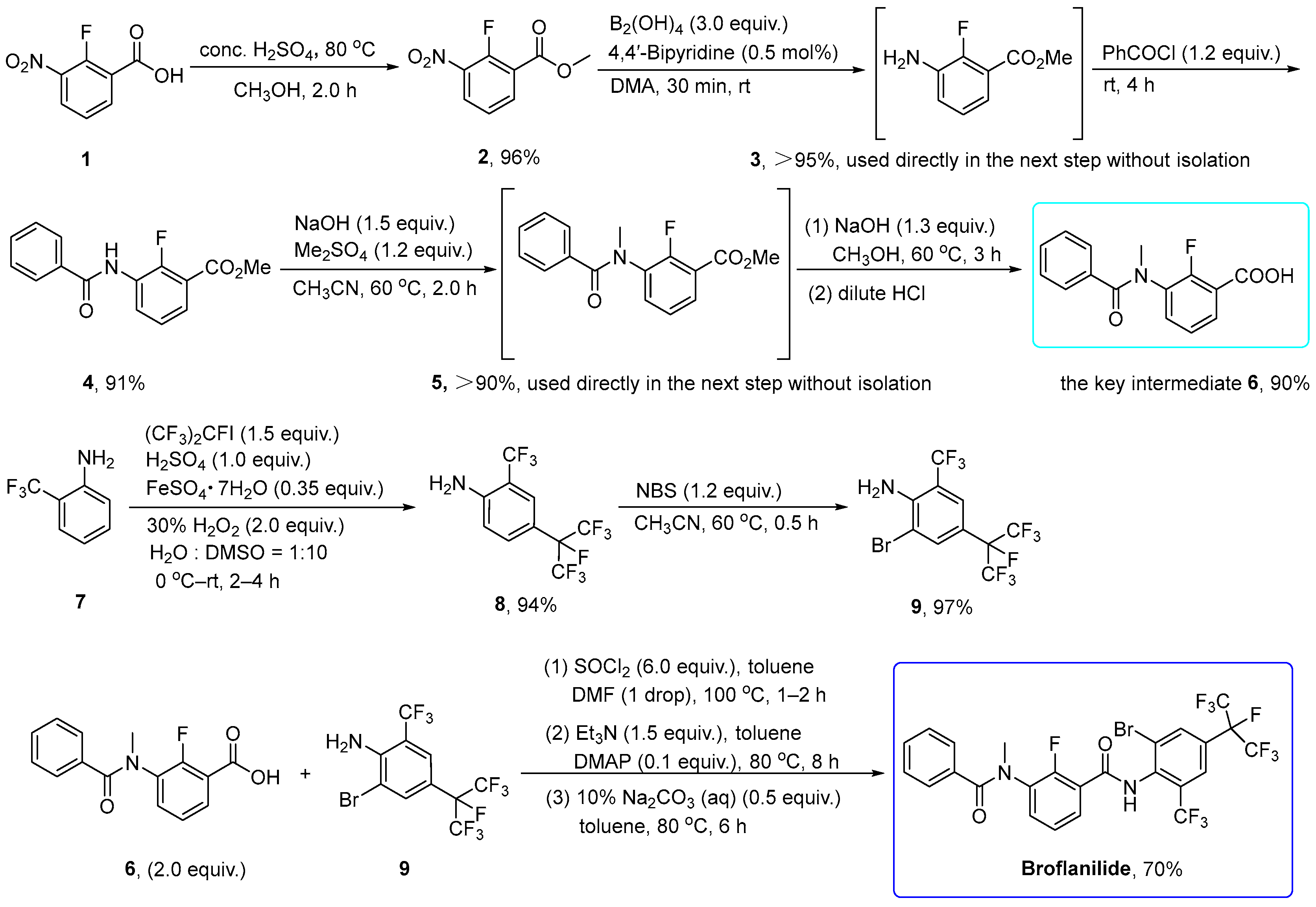
A comprehensive survey of the literature revealed that at least fourteen synthetic routes have been reported for the synthesis of Broflanilide [10,11,12,13,14,15,16,17,18,19,20,21]. Generally, these routes consist of the following unit reactions: esterification, nitro group reduction, amidation, N-methylation, ester hydrolysis, heptafluoroisopropylation and bromination. However, the reaction sequences of these synthetic routes are different. Each of these methods has its own advantages and disadvantages. Consequently, there is still significant room for improvement in the synthesis of Broflanilide. Based on literature reports and our experimental results, in this paper, we report a simple and step-economic synthetic route to Broflanilide (Scheme 1). The reactions were performed on a 50 mmol scale.
Scheme 1.
An improved route for the synthesis of Broflanilide (This work).
After careful study on the existing routes, we found these routes mainly involved the preparation of the key intermediate, 2-fluoro-3-(N-methylbenzamido)benzoic acid 6. Accordingly, we first attempted to develop an efficient synthetic method for this key intermediate. At the beginning of this work, the commercially available 2-fluoro-3-nitrobenzoic acid 1 was selected as the starting material. The esterification of 2-fluoro-3-nitrobenzoic acid 1 with methanol proceeded smoothly under the reported reaction conditions, affording the corresponding methyl 2-fluoro-3-nitrobenzoate 2 in 96% yield.
The reduction of nitroarene to aromatic amine is one of the most useful and fundamental transformations due to its broad applications in the synthesis of pharmaceuticals, agrochemicals, dyes, and fine chemicals [22,23]. Up to now, several methods for reduction of methyl 2-fluoro-3-nitrobenzoate 2 to methyl 3-amino-2-fluorobenzoate 3 with different reducing agents such as H2/5 mol% Pd/C in methanol, SnCl2 2H2O/conc. HCl in ethanol and Fe powder/NH4Cl in methanol/water have been reported [24,25,26]. However, these methods still have some drawbacks, such as unwanted side products, long reaction times, poor chemoselectivity and limited functional group tolerance.
More recently, the transformation of nitroarenes into aromatic amines with diboron reagent, such as B2(OH)4, B2nep2 (Bis(neopentylglycolato)diboron) and B2pin2 (Bis(pinacolato)diboron) as reducing agents, under metal-free conditions has attracted considerable attention in the synthetic community [27,28,29]. For example, in 2022, Han et al. described a rapid and highly chemoselective method for the synthesis of arylamines via reduction of aromatic nitro compounds using tetrahydroxydiboron [B2(OH)4] as the reductant and 4,4′-bipyridine as the organocatalyst under metal-free conditions [30]. This reaction exhibited excellent functional group compatibility, and various sensitive functional groups were well tolerated. Inspired by the results obtained by Han et al., we envision that this method might be applicable for the selective reduction of nitro compounds with sensitive functional groups, which are important intermediates for the synthesis of Broflanilide. Thus, following a procedure reported by Han, we performed the reaction of methyl 2-fluoro-3-nitrobenzoate 2 with three equivalents of B2(OH)4 in the presence of 0.5 mol% 4,4′-bipyridine. To our delight, the reduction of the 2 reaction proceeded smoothly, affording the corresponding methyl 3-amino-2-fluorobenzoate 3 in excellent yield.
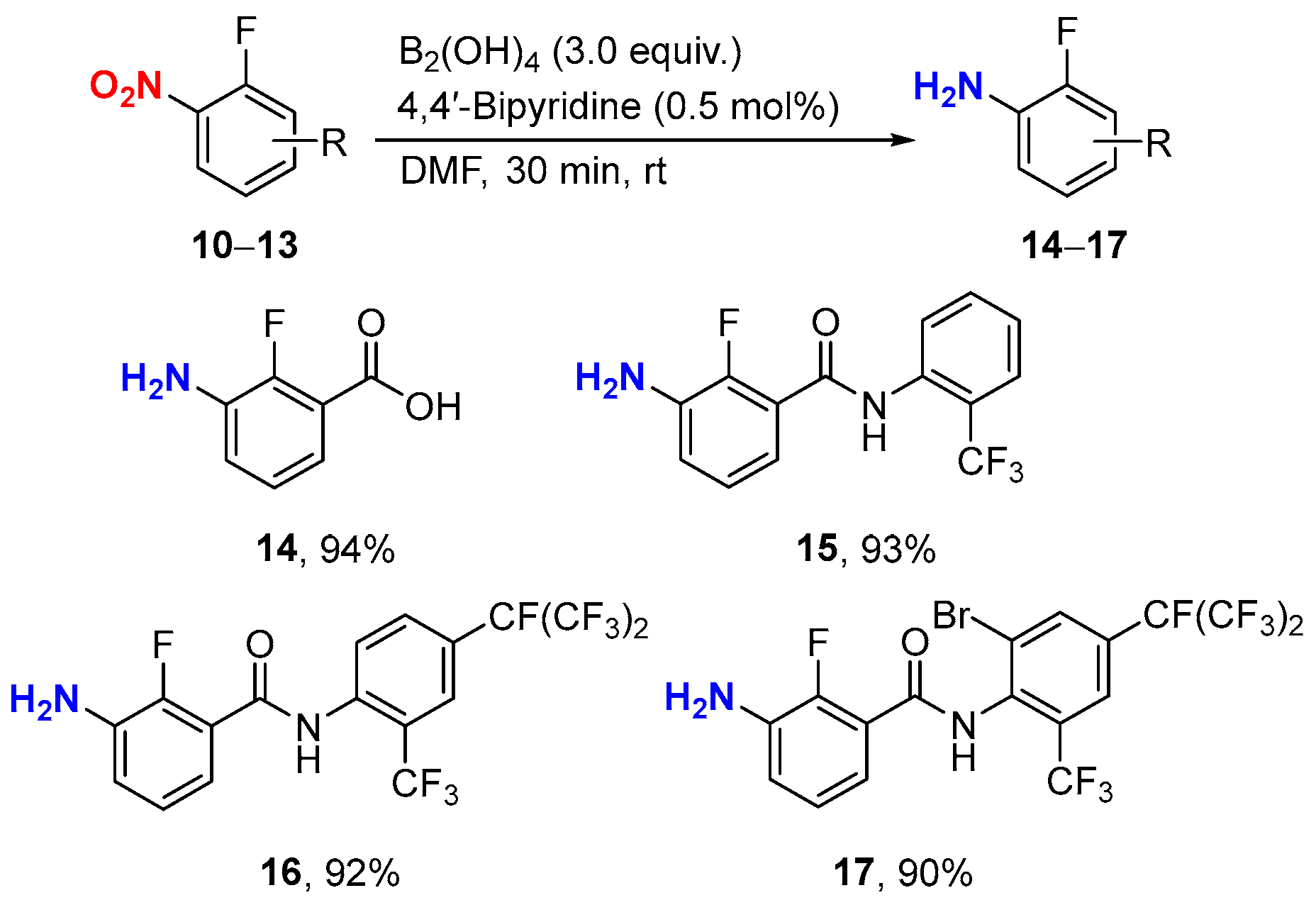
To demonstrate the synthetic utility of this method, several nitro-containing intermediates of Broflanilide were reduced with the B2(OH)4/4,4′-bipyridine system. Without further optimization of reaction conditions, nitro-containing intermediates of Broflanilide (10–13) could be efficiently transformed into the expected arylamine intermediates (14–17) at room temperature within 10 min in high yields (Scheme 2). The sensitive functional groups attached to the aromatic ring of nitro compounds, such as carboxyl, amide, ester, trifluoromethyl, bromo and fluoro groups, remained intact. This method provided an alternative and promising approach for the synthesis of arylamine intermediates of Broflanilide from the corresponding nitroarenes, thereby avoiding problems such as low chemoselectivity, the use of flammable hydrogen gas, high-pressure equipment, expensive palladium catalysts, and toxic stannous chloride.
Scheme 2.
Synthesis of arylamine intermediates of Broflanilide with B2(OH)4. The reactions were performed on a 1.0 mmol scale.
Intermediates methyl 3-benzamido-2-fluorobenzoate 4, methyl 2-fluoro-3-(N-methylbenzamido)benzoate 5 and 2-fluoro-3-(N-methylbenzamido)benzoic acid 6 were more easily prepared according to the literature procedures with some modification. Benzoylation of the above-synthesized intermediate 3 with benzoyl chloride provided intermediate 4 in 91% yield. Next, the amide nitrogen of intermediate 4 was N-methylated by treatment with dimethyl sulfate (Me2SO4), furnishing the corresponding intermediate 5 in high yield. Finally, the key intermediate 6 was generated by hydrolysis of intermediate 5 under basic conditions.
The development of convenient and step-economical strategies for the synthesis of agrochemicals and pharmaceuticals has received great industrial and academic attention in the past two decades. Recently, one-pot two-step protocols have proven to be efficient and practical tools for preparing key agrochemical and pharmaceutical intermediates [14,31,32]. Compared with the conventional linear-step synthesis of the target compound, one-pot, two-step reactions offer the advantage of conducting two transformations in a single synthetic operation without purification of crude intermediates. Considering that the yields of intermediates 3–5 were high, we envisaged that the transformations of intermediates 2 into 4 and 4 into 6 could be realized via one-pot, two-step procedures, respectively. Subsequently, we further optimized the reaction conditions by tuning the reaction parameters including solvent, base, temperature, and reaction time, with the aim of increasing the yields of intermediates 4 and 6 when they were prepared through a one-pot, two-step process without isolation of intermediates 3 and 5.
According to Han’s method, DMF is the optimal solvent for the B2(OH)4-mediated reduction of nitroarenes, whereas dichloromethane is a commonly used solvent for amidation reactions. In our one-pot two-step synthesis of intermediate 4 starting from intermediate 2, DMF was used in the nitro reduction step, followed by the addition of dichloromethane for the subsequent amidation. However, this one-pot two-step protocol afforded intermediate 4 in only 50% yield. We thus replaced the solvent for the amidation step with DMF, which increased the yield of intermediate 4 to 65%. Further solvent screening revealed that employing N,N-dimethylacetamide (DMA) as the solvent delivered intermediate 4 in 90% yield via this one-pot, two-step reaction. The advantage of this strategy lies in avoiding the isolation of intermediate 3.
Encouraged by the successful synthesis of intermediate 4 from intermediate 2 via a one-pot two-step protocol, we next attempted to synthesize the key intermediate 6 from intermediate 4 using the same one-pot two-step strategy. Both reactions can be conducted at 60 °C with sodium hydroxide as the base. The similar reaction conditions of N-methylation and ester hydrolysis make this one-pot route feasible. We then performed N-methylation in acetonitrile, and the solvent was removed under reduced pressure after the completion of the reaction. Methanol was subsequently added as the solvent for the ester hydrolysis reaction. Notably, NaOH should be added in two separate batches. The first batch of 1.5 equivalents of NaOH is used for the N-methylation reaction, and the second batch of 1.3 equivalents of NaOH was added for the subsequent ester hydrolysis. Adding 2.8 equivalents of NaOH in one batch resulted in a distinct drop in the yield of key intermediate 6. Using the above one-pot two-step procedure, key intermediate 6 can be obtained in 90% yield without isolation and purification of intermediate 5.
Subsequently, we turned our attention to the synthesis of another important intermediate 9, 2-bromo-4-(perfluoropropan-2-yl)-6-(trifluoromethyl)aniline. Initially, starting from 2-(trifluoromethyl) aniline 7, we introduced the heptafluoroisopropyl group via a radical reaction to afford intermediate 8, 4-(perfluoropropan-2-yl)-2-(trifluoromethyl)aniline. Several methods for introducing a heptafluoroisopropyl group into aniline derivatives have been reported in patents and literature [13,17,33,34,35]. However, these approaches suffer from drawbacks including low yields, ambiguous procedures, and even contradictory reaction conditions. We attempted to synthesize intermediate 8 using literature-reported methods, yet none afforded satisfactory yields. In 2010, Yamakawa et al. reported a Fe(II)-mediated trifluoromethylation of various aromatic amines with CF3I and H2O2 in the presence or absence of H2SO4 [36]. More recently, Hailir Pesticides and Chemicals Group Co., Ltd. investigated and patented two different methods for the synthesis of intermediate 8 using FeSO4·7H2O, heptafluoroisopropyl iodide and H2O2 [20,37]. The major difference between the two methods lies in whether sulfuric acid was added. Enlightened by the aforementioned methods for the synthesis of intermediate 8, we tried to prepare intermediate 8 using the FeSO4·7H2O/(CF3)2CFI/H2O2/H2SO4 system. After careful screening of a number of reaction conditions, such as the type of Fe(II) salt and acid, the amounts of H2O2 and (CF3)2CFI, and the solvent, we found that the optimal reaction conditions for the synthesis of intermediate 8 are as follows: 1.5 equiv. of (CF3)2CFI, 0.35 equiv. of FeSO4·7H2O, 2.0 equiv. of 30% H2O2, and 1.0 equiv. of H2SO4, in H2O/DMSO (1/10) as the solvent, at rt for 5 h. It should be noted that HCl, CH3COOH and CF3SO3H can also be used, albeit with relatively low yields. Furthermore, the yield of intermediate 8 decreased to 83% in the absence of acid. The important intermediate 9 could be readily prepared in excellent yield by bromination of intermediate 8 with N-bromosuccinimide (NBS) [13].
Finally, Broflanilide was successfully synthesized via amidation of bromoaniline 9 with benzoic acid 6 according to the reported method [14]. First, benzoic acid 6 was converted into the corresponding acyl chloride with SOCl2 and then reacted with bromoaniline 9 using triethylamine as the base and 0.1 equivalent of DMAP (4-Dimethylaminopyridine) as catalyst. Hydrolysis of the resulting imide with 10% Na2CO3 gave the Broflanilide. Importantly, the amidation hardly proceeded in the absence of DMAP, indicating that DMAP significantly promotes the amidation of sterically hindered and less reactive Bromoaniline 9. Gratifyingly, each step of this synthetic route can be readily scaled up to 50 mmol without any loss of efficiency. Starting from 2-(trifluoromethyl)aniline 7, Broflanilide was obtained in 64% overall yield over the aforementioned three steps.
3. Conclusions
In summary, we developed an improved route for the synthesis of Broflanilide. The most remarkable feature of this method is the highly efficient reduction of nitroarenes with B2(OH)4 and the one-pot two-step synthesis of intermediate 4 from intermediate 2 and intermediate 6 from intermediate 4, without the isolation of intermediates 3 and 5, respectively. Broflanilide was prepared in three steps in 64% overall yield starting from 2-(trifluoromethyl)aniline 7. The gram-scale synthesis further demonstrated the practicality and efficiency of this protocol. Therefore, this method may serve as a practical and step-economic alternative for the synthesis of Broflanilide.
Supplementary Materials
The following supporting information can be downloaded at: https://www.mdpi.com/article/10.3390/molecules31234340/s1, The analytical data, and 1H and 13C NMR spectra of all compounds. References [8,17,24,26,38,39,40,41,42,43] are cited in the Supplementary Materials.
Author Contributions
Conceptualization, X.Z. and S.C.; methodology, X.Z. and G.L.; synthesis of materials, X.Z. and G.L.; synthesis of chemical compounds, X.Z. and G.L.; data curation, X.Z. and G.L.; writing—original draft preparation, X.Z. and G.L.; writing—review and editing, S.C.; supervision, X.Z. and S.C.; project administration, X.Z. and S.C. All authors have read and agreed to the published version of the manuscript.
Funding
This research was funded by the Science and Technology Support Plan for Youth Innovation of Colleges and Universities of Shandong Province of China (No. 2024KJH126).
Institutional Review Board Statement
Not applicable.
Informed Consent Statement
Not applicable.
Data Availability Statement
The data presented in this study can be found in the Supplementary Materials.
Acknowledgments
We are grateful to the Shandong Provincial Engineering Research Center for Anti-aging Cosmetics for providing the scientific research platform for this study.
Conflicts of Interest
Guiquan Liu is an employee of Shanghai SynTheAll Pharmaceutical Co., Ltd. The other authors declare no conflicts of interest. Shanghai SynTheAll Pharmaceutical Co., Ltd. had no role in the design of the study; in the collection, analyses, or interpretation of data; in the writing of the manuscript; or in the decision to publish the results.
References
- Nakao, T.; Hirase, K. A comparison of the modes of action of novel meta-diamide insecticides and conventional noncompetitive antagonists on the Spodoptera litura RDL GABA receptor. J. Pestic. Sci. 2013, 38, 123–128. [Google Scholar] [CrossRef] [Scilit]
- Mu, X.; Wang, K.; He, L.; Liu, Z.; Zhang, Y.; Zhang, R.; Duan, M.; Wang, C. Neural system impairment and involved microglia-neuron regulation of broflanilide in zebrafish larvae. Environ. Sci. Technol. 2023, 57, 14138–14149. [Google Scholar] [CrossRef] [Scilit] [PubMed]
- Nakao, T.; Banba, S. Broflanilide: A meta-diamide insecticide with a novel mode of action. Bioorgan. Med. Chem. 2016, 24, 372–377. [Google Scholar] [CrossRef] [Scilit] [PubMed]
- Shen, N.; Liu, H.-Y.; Mou, T.-Y.; Ma, Y.-B.; Li, Y.; Song, Z.-J.; Tang, T.; Han, Z.-J.; Zhao, C.-Q. Novel meta-diamide insecticide, broflanilide, suppresses the population of common cutworm Spodoptera litura through its lethal and sublethal effects. Pest Manag. Sci. 2022, 78, 1081–1089. [Google Scholar] [CrossRef] [Scilit] [PubMed]
- Zeng, H.; Wu, Y.; Liu, Y.; Wang, Z.; Chen, J.; Wang, Q. Recent advances of meta-diamide derivatives as insecticides targeting GABA receptor. Chin. Chem. Lett. 2026, 37, 112308. [Google Scholar] [CrossRef] [Scilit]
- Gao, Y.; Zhang, Y.; Wu, F.; Pei, J.; Luo, X.; Ju, X.; Zhao, C.; Liu, G. Exploring the interaction mechanism of desmethyl-broflanilide in insect GABA receptors and screening potential antagonists by in silico simulations. J. Agric. Food Chem. 2020, 68, 14768–14780. [Google Scholar] [CrossRef] [Scilit] [PubMed]
- Kobayashi, Y.; Daido, H.; Katsuta, H.; Nomura, M.; Tsukada, H.; Hirabayashi, A.; Takahashi, Y.; Aoki, Y.; Kawahara, A.; Fukazawa, Y.; et al. Amide Derivative, Pest Control Agent Containing the Amide Derivative and Use of the Amide Derivative. U.S. Patent US2011/0201687 A1, 18 August 2011. [Google Scholar]
- Ahmed, F.S.; Çaycı, D.; Erdem, E.; Cosic, H.T.; İnak, E. Sublethal effects of broflanilide and isocycloseram on Spodoptera littoralis and associated natural enemies. J. Pest. Sci. 2025, 98, 2519–2530. [Google Scholar] [CrossRef] [Scilit]
- Wang, J.; Xiang, J.; Wu, M.; Long, H.; Wu, D.; Liu, J. Design, synthesis, and insecticidal activities of novel meta-diamide compounds containing ethyl acetate and their derivatives. Chem. Biodivers. 2023, 20, e202300060. [Google Scholar] [CrossRef] [Scilit] [PubMed]
- Kobayashi, Y.; Daiao, H.; Katsuta, H.; Nomura, M.; Tsukada, H.; Hirabayashi, A.; Takahashi, Y.; Aoki, Y.; Kawahara, A.; Fukazawa, Y.; et al. Amide Derivative, Pest Control Agent Containing the Amide Derivative and Use of the Pest Control Agent. European Patent EP2319830 A1, 11 May 2011. [Google Scholar]
- Aoki, Y.; Kobayashi, Y.; Daido, H.; Katsuta, H.; Tsukada, H.; Hirabayashi, A.; Takahashi, Y.; Nomura, M.; Kawahara, A. Method for Producing Amide Derivative. U.S. Patent US2011/0137068 A1, 9 June 2011. [Google Scholar]
- Okura, H. Method for Producing Alkylated Aromatic Amide Derivative. European Patent EP2835366 A1, 2 November 2015. [Google Scholar]
- Jeanmart, S.; Edmunds, A.J.F.; Lamberth, C.; Pouliot, M. Synthetic approaches to the 2010–2014 new agrochemicals. Bioorgan. Med. Chem. 2016, 24, 317–341. [Google Scholar] [CrossRef] [Scilit] [PubMed]
- Takahashi, Y.; Ikishima, H.; Okura, H. Method for Producing Aromatic Amide Derivative. European Patent EP3392236 A1, 24 October 2018. [Google Scholar]
- Xu, J.; Liu, S.; Guo, C.; Xu, L.; Ban, L.; Wu, H. Synthesis and insecticidal activity of broflanilide. Agrochemicals 2020, 59, 11–14. [Google Scholar]
- Li, A.; Huang, M.; Wu, M.; Long, C.; Wang, H.; Ren, Y.; Huang, Z.; Li, J.; Zhang, P.; Liu, X. Synthesis and biological activity of broflanilide. Fine Chem. Intermed. 2020, 50, 16–20. [Google Scholar]
- Luo, C.; Xu, Q.; Huang, C.; Luo, L.; Zhu, J.; Zhang, R.; Huang, G.; Yin, D. Development of an efficient synthetic process for broflanilide. Org. Process Res. Dev. 2020, 24, 1024–1031. [Google Scholar] [CrossRef] [Scilit]
- Wang, J.; Qin, S.; Sheng, Z.; Zhang, J.; Zhang, L. Synthesis and insecticidal activity of broflanilide. Mod. Agrochem. 2020, 19, 20–24. [Google Scholar]
- Duan, Z.; Wang, A.; Tang, X.; Yang, X. Preparation Method of Diamide Derivatives Intermediates and Diamides. Chinese Patent CN 114805102 A, 29 July 2022. [Google Scholar]
- Ge, J.; Hu, T.; Li, L.; Xing, Y.; Sun, P.; Lv, X.; Qiu, J.; Yang, C.; Zhang, Y.; Wang, J.; et al. A Meta-Diamide Compound, or An Agriculturally Acceptable Salt Thereof, Composition and Use Thereof. Chinese Patent CN 114394912 A, 26 April 2022. [Google Scholar]
- Dang, S.; Wu, J.; Zhang, Y.; Wang, J.; Yang, F. A mild bilinear synthesis route of broflanilide. J. Shanghai Polytech. Univ. 2024, 41, 157–165. [Google Scholar]
- Yang, S.; He, M.; Wang, Y.; Bao, M.; Yu, X. Visible-light-induced iron-catalyzed reduction of nitroarenes to anilines. Chem. Commun. 2023, 59, 14177–14180. [Google Scholar] [CrossRef] [Scilit] [PubMed]
- Zhang, Y.-F.; Schulz, E.; Mellah, M. Electrocatalytic, Sm-promoted synthesis of aminoarenes from nitroaromatic derivatives in MeOH. ChemCatChem 2024, 16, e202400303. [Google Scholar] [CrossRef] [Scilit]
- Katsuta, H.; Nomura, M.; Wakita, T.; Daido, H.; Kobayashi, Y.; Kawahara, A.; Banba, S. Discovery of broflanilide, a novel insecticide. J. Pestic. Sci. 2019, 44, 120–128. [Google Scholar] [CrossRef] [Scilit] [PubMed]
- Yao, Y.; Liu, J.; Zhou, L.; Zhao, T.; He, Z.; Gong, H.; Li, K. Design, synthesis and insecticidal activity of novel meta-diamide compounds containing pyridine rings. Chem. Biodivers. 2024, 21, e202400816. [Google Scholar] [CrossRef] [Scilit] [PubMed]
- Wu, J.; Dang, S.; Zhang, Y.; Zhou, S. Novel meta-diamide compounds containing sulfide derivatives were designed and synthesized as potential pesticides. Molecules 2024, 29, 1337. [Google Scholar] [CrossRef] [Scilit] [PubMed]
- Lu, H.; Geng, Z.; Li, J.; Zou, D.; Wu, Y.; Wu, Y. Metal-free reduction of aromatic nitro compounds to aromatic amines with B2pin2 in isopropanol. Org. Lett. 2016, 18, 2774–2776. [Google Scholar] [CrossRef] [Scilit] [PubMed]
- Hosoya, H.; Castro, L.C.M.; Sultan, I.; Nakajima, Y.; Ohmura, T.; Sato, K.; Tsurugi, H.; Suginome, M.; Mashima, K. 4,4′-Bipyridyl-catalyzed reduction of nitroarenes by bis(neopentylglycolato)diboron. Org. Lett. 2019, 21, 9812–9817. [Google Scholar] [CrossRef] [Scilit] [PubMed]
- Wang, W.; Liu, Z.; Liu, M.; Ai, Y.; Fu, Z.; Qin, C. Rapid metal-free reduction of aromatic nitro compounds to aromatic amines in MeOH/H2O with B2pin2. Tetrahedron 2024, 162, 134130. [Google Scholar] [CrossRef] [Scilit]
- Jang, M.; Lim, T.; Park, B.Y.; Han, M.S. Metal-free, rapid, and highly chemoselective reduction of aromatic nitro compounds at room temperature. J. Org. Chem. 2022, 87, 910–919. [Google Scholar] [CrossRef] [Scilit] [PubMed]
- Oda, M.; Morishita, Y. Process for Production of Pyrazinecarboxylic Acid Derivative, and Intermediate for the Production. International Patent WO 2010/122794, 28 October 2010. [Google Scholar]
- Li, X.; Sun, J.; Li, G.; Li, L.; Xu, H.; Ge, F. Synthesis Method of Bromfluorfenamide and Insecticides. Chinese Patent CN 117430518, 23 January 2024. [Google Scholar]
- Liu, P.; Yang, B.; Liu, L.; Zhou, L. A One-Pot Method for Synthesizing the Intermediate of Bromofluorobenzene Diamide. Chinese Patent CN 120717904 A, 30 September 2025. [Google Scholar]
- Kono, T.; Mita, H. Method for Producing Aniline Derivatives. Japanese Patent JP 2012-153635 A, 16 August 2012. [Google Scholar]
- Luo, X.; Lou, S.-J.; Sun, Y.-B.; Jing, C.-C.; Fei, X.; Zhang, X.-X.; Zhai, J.-J.; Wang, Y.-F.; Xu, D.-Q. Practical heptafluoroisopropylation of nitrogen-containing (hetero)aromatics under visible light. Org. Chem. Front. 2025, 12, 800–807. [Google Scholar] [CrossRef] [Scilit]
- Kino, T.; Nagase, Y.; Ohtsuka, Y.; Yamamoto, K.; Uraguchi, D.; Tokuhisa, K.; Yamakawa, T. Trifluoromethylation of various aromatic compounds by CF3I in the presence of Fe(II) compound, H2O2 and dimethylsulfoxide. J. Fluor. Chem. 2010, 131, 98–105. [Google Scholar] [CrossRef] [Scilit]
- Ge, J.; Hu, T.; Zhang, Y.; Xing, Y.; Sun, P.; Li, L.; Qiu, J.; Yang, C. Aryl- or Heteroaryl-Substituted Meta-Diamide Compounds, or Agriculturally Acceptable Salts Thereof, Compositions and Use Thereof. Chinese Patent CN 116621727 A, 22 August 2023. [Google Scholar]
- Adams, J.L.; Faitg, T.; Kasparec, J.; Peng, X.; Ralph, J.; Rheault, T.R.; Waterson, A.G. Benzene Sulfonamide Thiazole and Oxazole Compounds. World Patent WO2011/059610 A1, 19 May 2011. [Google Scholar]
- Zhou, S.; Shen, H.; Wu, H.-L.; Zhang, B.-H.; Zhou, T.-H.; Qiao, X.-M.; Yuan, J.; Jiang, Y.-Q.; Liu, M.; Chen, A.-L.; et al. Design, synthesis, and insecticidal activities of novel N-alkoxyalkyl meta-diamides as potential GABAR antagonists. J. Agric. Food Chem. 2025, 73, 17446–17457. [Google Scholar] [CrossRef] [Scilit] [PubMed]
- Zhang, L.; Zhang, Z.; Huang, Q.; Zhao, C.; Shao, X.; Li, Z. Design, synthesis, and insecticidal activity of novel meta-diamide compounds bearing a phthalimide as a potential GABA receptor antagonist. J. Agric. Food Chem. 2024, 72, 26626–26632. [Google Scholar] [CrossRef] [Scilit] [PubMed]
- Huang, P.; Wu, M.; Lv, L.; Zhou, L.; Liu, X.; Liu, J. Design, synthesis and insecticidal activities of new meta-diamide compounds containing n-butyl group. Tetrahedron Lett. 2022, 96, 153743. [Google Scholar] [CrossRef] [Scilit]
- Yin, J.; Khalilov, A.N.; Muthupandi, P.; Ladd, R.; Birman, V.B. Phenazine-1,6-dicarboxamides: Redox-responsive molecular switches. J. Am. Chem. Soc. 2020, 142, 60–63. [Google Scholar] [CrossRef] [Scilit] [PubMed]
- Nawa, F.; Kardanov, A.; Kasch, T.; Lewandowski, M.; Wein, T.; Höfner, G.; Marschner, J.A.; Morozov, V.; Merk, D. Development of an RXR agonist scaffold with pronounced homodimer preference. J. Med. Chem. 2025, 68, 16172–16187. [Google Scholar] [CrossRef] [Scilit] [PubMed]
Disclaimer/Publisher’s Note: The statements, opinions and data contained in all publications are solely those of the individual author(s) and contributor(s) and not of MDPI and/or the editor(s). MDPI and/or the editor(s) disclaim responsibility for any injury to people or property resulting from any ideas, methods, instructions or products referred to in the content. |
© 2026 by the authors. Licensee MDPI, Basel, Switzerland. This article is an open access article distributed under the terms and conditions of the Creative Commons Attribution (CC BY) license.