


Abstract
Nanomaterial-based sensors provide several routes for detecting hazardous contaminants in food and environmental samples. Their response depends on how target binding is connected to signal generation and on the fraction of the sample that reaches the sensing interface. This review examines these relationships across optical, electrochemical, and photoelectrochemical platforms, covering pesticide and antibiotic residues, toxic metals, biological toxins, pathogens, selected organic pollutants, and hazardous gases. PFAS and microplastics extend the discussion to discrimination within closely related molecular families and to particle collection and identification. Surface binding, biological receptors, and imprinted sites govern recognition, while adsorption, confined transport, and optical or electronic processes control access to the reporter and the resulting signal. Sample preparation and matrix effects influence the species and concentration measured. Calibration solutions, spiked extracts, and naturally contaminated samples are considered in this context to relate nanomaterial design to sensing in complex media.
1. Introduction
The need to detect hazardous contaminants arises in food production, water management, and exposure monitoring [1,2,3], but the sample is rarely as simple as the solution used to calibrate a sensor. Pesticides may remain on a vegetable surface or become distributed through the tissue, while metals in water can be dissolved, bound to organic matter, or associated with particles. A measured concentration therefore depends on what was collected and how the target was released from the sample [4,5]. Laboratory chromatographic and spectrometric methods remain important for identifying compounds and confirming a screening result, yet the transport and preparation involved can limit how frequently and where samples are tested. Portable sensors can support repeated or local measurements, provided that their results are interpreted in relation to the complete procedure [6,7]. Portable measurements often remain coupled to extraction or cleanup, particularly when residues are retained in a complex food matrix [8]. Microfluidic platforms can bring extraction or mixing closer to the readout, although analyte loss during loading and transport still affects the amount ultimately measured [9]. Together, these steps connect the sensor response in solution to contaminant levels in the original sample.
Nanomaterials are used in sensors because they can influence target access as well as the measured signal. Metal nanoparticles and semiconductor nanocrystals provide optical responses, while the fluorescence of carbon dots and graphene quantum dots can be adjusted through surface modification [10,11]. Carbon nanotubes, graphene derivatives, and MXenes offer conductive paths and sites for attaching receptors [12]. Combining a conductive interface with a receptor allows target binding to be translated into an electrical response [13]. Porous solids may concentrate dilute targets [14,15] or restrict access by interfering species, but stronger uptake does not necessarily mean better discrimination. Work on biochar and related carbon sorbents also shows that precursor choice and preparation history can change the surface properties relevant to environmental analysis [16]. Recognition elements range from imprinted sites for small molecules [17] to biological receptors that bind larger targets such as bacterial cells [18]. Their accessibility depends on how they are incorporated into the sensing layer and on the surrounding sample.
Recognition and amplification are closely linked at the working interface. Aptamers and imprinted layers can distinguish structurally related residues, but salts, organic matter, or extraction solvents may change receptor folding and target availability [19]. Metal sensing raises a related question of chemical form [20]: total elemental content after digestion is different from the fraction accessible to a ligand or available for electrodeposition [21]. For gas sensors, transport and humidity influence the response alongside reactions at the sensing surface [22]. Signal amplification can then be introduced through plasmonic coupling, catalytic product formation, or a change in photocurrent. A second optical or electrical output may be useful if it responds differently to matrix interference, but two readouts derived from the same aggregation step can share a common bias [23,24]. The sample itself can alter the optical background; food fluorescence, for instance, varies with both composition and measurement wavelength [25,26]. The resulting signal reflects both the nanomaterial architecture and the chemical environment surrounding the target.
Recent assays extend the discussion from a response to one compound toward identification in mixed or unfamiliar samples. PFAS sensors may have to discriminate closely related molecules, microplastic assays must first collect particles and then identify their composition, and arrays for metals or gases often rely on response patterns rather than one exclusively selective channel. Spectral and electrical measurements are increasingly combined with data analysis to distinguish mixed contaminants and classify particles [27,28,29]. The reliability of these approaches depends on both the information captured by the sensor and the ability of the model to generalize to independent samples [30,31,32]. Earlier reviews have surveyed nanomaterial-enabled contaminant sensing and the broader use of nanomaterials in detection and remediation [33,34]. This review therefore follows the chemical processes that connect target recognition with signal amplification and sample analysis. It examines how surface binding, confined transport, and optical or electronic responses work together in different sensing platforms and how extraction and matrix composition influence the species and concentration measured. This perspective links nanomaterial design to the interpretation of signals in complex samples (Figure 1).
Figure 1.
Relationships between sample collection, contaminant recognition, signal generation, and analytical validation.
Relevant studies were identified primarily through Web of Science, without a fixed publication-year restriction. Selection focused on recognition mechanisms, signal amplification, and real-sample analysis, including recent advances and earlier foundational studies.
2. Target Recognition at Nanomaterial Interfaces
2.1. Surface Chemistry and Direct Recognition
The surface of a nanomaterial determines which species reach the sensing region and how they interact there [35]. Oxygen-containing groups on carbon materials can coordinate metals, while nitrogen- or sulfur-containing sites can alter binding preferences [36]. These interactions are affected by protonation, ionic strength, and competing ligands. A response attributed to a metal ion in a simple salt solution may change when the same ion is complexed by organic matter. Surface characterization helps explain the binding behavior observed under the selected measurement conditions. Adsorption increases the local target concentration [37], whereas selective recognition depends on differences in affinity or reactivity among coexisting species [38,39,40,41]. These processes overlap on a functionalized surface: a ligand can promote target uptake, but the response also depends on whether the adsorbed target remains accessible to the reporter or electrode [42,43,44]. Strong binding may concentrate a metal while slowing its subsequent electrochemical conversion. Increased uptake can therefore contribute to sensitivity, alongside the efficiency with which the bound target produces a signal.
The working pH helps determine this balance because it changes the surface and target simultaneously. Protonation can weaken ligand binding, while metal hydrolysis alters the species available for adsorption. Changes in reporter emission or redox behavior can contribute to the same response curve [45,46]. A measured pH optimum may therefore reflect several coupled processes [47,48]. Buffering stabilizes these conditions during analysis, although buffer components can themselves compete for surface sites or bind the target. Competition becomes particularly important when the preferred target is much less abundant than the matrix components. Even a weakly adsorbing species can occupy many surface sites when it is present at a sufficiently high concentration. Carbon surfaces and porous oxides often contain heterogeneous binding environments, so the effect need not follow a single binding constant [49,50]. Layered rare-earth hydroxide/fluorescein composites and functionalized layered double hydroxides offer other examples of how a host and an incorporated fluorophore jointly shape Fe(III) detection [51,52,53]. The balance of these interactions shapes the response of the coating in both standards and sample extracts.
Arsenic sensing shows why the solution conditions and the surface chemistry need to be considered together. Yang et al. combined Au nanoparticles with CeO2-ZrO2 in a system designed to operate near groundwater pH, linking adsorption with electrocatalytic detection [54]. The near-neutral operating conditions are relevant to the arsenic species encountered in groundwater and to their adsorption on the composite. Other metal-detection systems distribute adsorption and signal conversion in different ways [55]. Oxygen-vacancy-rich ruthenium-loaded ceria has been applied to Hg(II) electrochemical detection, while semiconducting polymer dots containing a rhodamine spirolactam unit provide a fluorescent route to mercury sensing [56,57]. A layered rare-earth hydroxide composite offers another fluorescence configuration for Hg(II), in which the support and emitting component have to be considered together [58,59]. A photoelectrochemical Cu(II) sensor illustrates another conversion pathway [60], while a Cu2O@Cu2S/COF heterojunction places electrochemical and photoelectrochemical readouts on one interface for Hg(II) detection [61]. Colorimetric Cu(II) detection offers a further route, with selectivity influenced by competing ions and solution conditions [62]. Together, these systems couple metal binding to different reporting processes [63], so their responses reflect both the sensing material and the measurement medium. For electroactive organic contaminants, oxidation or reduction can itself generate the analytical signal. Simultaneous electrochemical detection of catechol and hydroquinone depends on separating their oxidation signals, as demonstrated with Fe-N-S-doped multiwalled carbon nanotubes [64]. The doped nanotube interface affects both adsorption and electrode kinetics, while peak separation allows the two isomers to be resolved in a shared measurement.
2.2. Biological Recognition and Molecular Imprinting
Biological receptors provide molecular discrimination that is often absent from an unmodified nanomaterial. Aptamers translate binding into changes in conformation, surface association, or probe accessibility [65,66,67]. Antibodies couple contaminant capture to optical or electrochemical labels, whereas enzymes can provide catalytic specificity or an inhibition-based response [68,69]. Enzyme-based nanobiosensors extend these combinations to chemical contaminants and biological hazards [70]. Their performance depends on receptor activity after attachment and during exposure to the sample [71]. For protein-based recognition, electrolyte composition can affect more than charge screening. Nanopore measurements of BSA in NaCl and LiCl revealed cation-dependent conformational changes [72], connecting the ionic environment with the protein structure available for binding. Receptor attachment introduces a balance between the number of binding sites and their accessibility. On a densely functionalized particle, neighboring aptamers can interfere with folding, while a thick antibody layer can hinder diffusion toward the underlying electrode. Random antibody attachment may conceal the binding region, and surface passivation can restrict access even as it reduces nonspecific adsorption. The useful receptor density consequently depends on target size and on the route by which binding changes the signal. The role of the receptor is apparent in mercury detection: one assay used a structure-switching electrochemical aptasensor for dairy products, while another coupled aptamer-functionalized upconversion nanoparticles with gold nanoparticles for fluorescence recovery [73,74]. These architectures place selectivity and reporting in different components [75,76,77,78,79]. The two examples show how the same type of receptor can be paired with distinct nanomaterial readouts.
Molecularly imprinted polymers provide binding environments formed around a template [80,81]. The cavities left after its removal vary in accessibility and local chemistry, and a polymer shell also sets a diffusion path toward any embedded reporter [82,83,84]. Wang et al. coated tomato-stalk-derived carbon dots with a silica imprinting layer for tetracycline [85]. Rebinding decreased fluorescence over 1.00 × 10⁻⁷–5.00 × 10⁻⁴ mol L−1, with a reported detection limit of 9.33 × 10⁻⁸ mol L−1. The carbon dots supplied the emission, while the coating provided much of the binding environment. The imprinted shell brought tetracycline into the vicinity of the fluorescent carbon dots. Comparison with non-imprinted materials helps distinguish the contribution of the templated shell from binding to the silica and carbon-dot surfaces [86].
Sun et al. placed a guanidine-BODIPY indicator in a molecularly imprinted shell around ruthenium-doped silica nanoparticles [87]. PFOA binding increased the green emission, while the orange core emission provided an internal reference. Filtered surface water was acidified to pH = 2 and extracted before measurement, giving a reported detection limit of 0.11 μM. In the interference experiment, PFOA and PFOS were each tested at 3 μM. The response was ΔS/S0, where S is the integrated BODIPY emission at 530–624 nm divided by the core emission at 625–750 nm, and S0 is the corresponding blank ratio. PFOS produced approximately 75% of the PFOA response under this extraction protocol (Figure 2). The imprinted environment and acid–receptor interactions both contribute to discrimination within the PFAS family. Unlike the tetracycline probe, which records fluorescence loss in one channel, this particle uses a second emission to normalize the response [88,89,90]. In both designs, the shell controls access to the reporter as well as binding. Figure 2 shows the spectra and calibration in Figure 2a and individual-analyte responses in Figure 2b, obtained with 480 nm excitation and a particle concentration of 62.5 mg L−1 [87].
Figure 2.
Fluorescence response of molecularly imprinted dual-emission nanoparticles after extraction of PFOA from surface water (a) and responses to selected analytes and interferents (b) (reproduced from [63]).
Huang et al. separated zearalenone recognition in solution from electrochemical readout at a silica nanochannel film [91]. An aptamer and a cationic ruthenium reporter were assembled on graphene oxide [92]. Target binding released the reporter, which could enter the mesoporous film on an indium tin oxide electrode; the larger graphene oxide assembly was excluded. The authors reported 96.0–105% recovery after preparing maize and chestnut extracts. This design links the measured current to both reporter release and charge-selective enrichment at the film. It therefore differs from an imprinted fluorescent particle, where target diffusion and reporter emission occur within the same shell. This separation of steps allows the aptamer assembly and the charge-selective film to be adjusted independently.
3. Signal Generation and Amplification
3.1. Fluorescence and Colorimetric Sensing
Fluorescence sensing can respond to changes in excited-state relaxation [93,94,95,96], association [97], or optical transmission. These processes may produce similar intensity changes but have different analytical consequences [98,99]. Dynamic quenching affects excited-state lifetime, whereas static association [100] and absorption of excitation light require different controls [101,102]. Spectral overlap, absorbance correction, and lifetime measurements help distinguish energy transfer from other causes of fluorescence change [103,104]. Carbon-dot emission is sensitive to the chemical environment of the emitting species, including surface-associated states and molecular products retained after synthesis. This sensitivity makes carbon dots responsive probes but also connects their calibration to precursor selection and purification. Nitrogen-doped carbon dots have been used for metronidazole determination in milk [105]. In this type of assay, a change in fluorescence can originate from an interaction near the emitting region or from attenuation of the excitation and emission beams [106,107]. A colored extract can attenuate the measured signal even when target binding is unchanged [108,109].
A quenched initial state offers another way to translate target binding into a visible change [110,111,112]. In the graphene oxide/upconversion nanoparticle system for zearalenone, the optical response was coupled to the association between the recognition assembly and the quenching surface [113]. An upconversion-MnO2 architecture was also reported for carbendazim [114]. Both systems produce fluorescence recovery, but they use quenching components with different surface chemistry and optical absorption. This contrast illustrates several ways to couple target binding to an emissive probe. When the amount of probe or excitation intensity varies, a reference emission can reduce part of the resulting variation [115,116,117]. Copper nanoclusters combined with nitrogen-doped carbon quantum dots were used for ratiometric lead detection in porphyra [118]. The two components allow the analytical response to be expressed as an emission ratio [119]. This is useful when a disturbance affects both channels proportionally [120,121]. The individual emission channels can also show whether an extract affects the two components differently [122,123].
Colorimetric systems commonly rely on nanoparticle aggregation or catalytic product formation. Aggregation changes interparticle plasmon coupling, and the sample composition influences the colloidal environment in which the color develops. Catalytic colorimetry introduces another dependence on substrate concentration and reaction time [124,125]. A darker endpoint can result from a faster reaction, longer incubation, or altered optical background. Zhu et al. incorporated functionalized gold nanoparticles into a paper device for deltamethrin analysis [126]. Nanoparticle aggregation changed the optical response of the reaction zone, which was quantified through image grayscale intensity. The reported detection limit was 0.584 mg L−1, and recoveries were 92.8–104.3%. The paper confined the reaction to an imageable region, while the gold nanoparticles generated the aggregation-dependent color. Quantification thus depended on liquid spreading and local particle distribution as well as the image readout. The reported solution concentration can be related to the original sample through the extraction and dilution steps. In the paper assay, functionalization governs how deltamethrin interacts with the particles, and aggregation produces the color response. Receptor-based fluorescent probes distribute these functions between binding sites and an emissive reporter. Target affinity and the optical response can therefore be adjusted through different parts of the sensing material.
Combining optical channels can provide information beyond an intensity ratio [127]. Carbon quantum dots and gold nanoparticles were used for fluorescence/colorimetric malathion detection in cabbage, while a carbon-dot/neutral-red system provided two responses to nitrite in ham [128,129]. Such combinations allow the same reaction to be observed through different optical properties. The relationship between the channels follows from their underlying signal-generation steps [130,131,132]. If a matrix component attenuates fluorescence while leaving the color reaction relatively unchanged, disagreement between the channels can help identify the disturbance. The benefit of a second channel thus depends on its relationship to the first. Common variation in probe amount may be corrected by a ratio [133], whereas a wavelength-dependent sample background can affect that ratio unevenly. These examples show how combining optical modes can reveal different aspects of a recognition event and its surrounding sample.
3.2. Electrochemical and Photoelectrochemical Sensing
Electrochemical sensors convert target-dependent changes into current, potential, or impedance. Nanomaterials can increase active area, concentrate a species, or modify interfacial kinetics [134]. These contributions are often grouped as improved conductivity, although a porous coating can increase current without reducing charge-transfer resistance. The contributions of these components can be examined through their effects on accessible area, target accumulation, and charge-transfer behavior. Ratiometric electrochemistry combines two resolved redox signals. In a ctDNA assay, Cas12a activity regulated a DNA gate on ferrocene-containing UiO-66-NH2 carriers, with methylene blue supplying a second reporter [135]. Their current ratio linked nucleic acid recognition to reporter release and electrochemical readout. In stripping measurements, deposition accumulates an analyte before readout [136,137]. Sensitivity depends on deposition time and potential as well as electrode chemistry [138,139]. Deposition time and potential determine how much analyte reaches the electrode before stripping, while coexisting ions can influence that accumulation. Wu et al. used stepwise electrodeposition to prepare a reduced graphene oxide/gold nanoparticle/MnO2 coating on a screen-printed carbon electrode for As(III) analysis [140]. The reported working range was 25–200 μg L−1, with a detection limit of 2.4 μg L−1. The authors associated the response with the combined adsorption and electrochemical functions of the coating and evaluated spiked tap, spring, and mineral water after filtration and acidification. Reduced graphene oxide supplied a conductive framework, while the metal and oxide phases formed the interfacial environment for accumulation and conversion. Because these functions occur in the same deposited layer, changing composition can affect the accessible area as well as local electron transfer. The case illustrates a surface-controlled assay in which selectivity is determined jointly by the coating and the electrochemical measurement conditions.
Photoelectrochemical detection adds light absorption and carrier transport to this interfacial problem. A target may change photocurrent through blocking, sensitization, catalytic consumption, or modulation of a recognition layer [141,142]. A useful photoelectrochemical design connects light-generated charge with a target-dependent change at the interface. Co-doped Bi2MoO6 and a perovskite heterojunction have separately been used for profenofos detection in milk and cabbage [143,144]. These studies illustrate lattice and interface modification as approaches to readout design. Nitrogen deficiency and cyano groups were combined in two-dimensional carbon nitride for atrazine aptasensing [145]. These modifications influence absorption and carrier dynamics, while the recognition element determines how target binding affects the photocurrent [146,147,148,149]. A Ti3C2-based Schottky junction was used for self-powered chlorpyrifos sensing in fruits and vegetables [150]. Three-dimensional carbon nitride combined with carbon-based metal–organic frameworks was applied to tetracycline in milk and water [151], while taxifolin-modified porous carbon nitride was reported for sulfadiazine aptasensing [152]. These examples show that changes in the semiconductor and in the recognition layer can both affect photocurrent [153,154,155]. Here, self-powered describes the electrical arrangement of the illuminated sensing device.
Charge transport through a composite coating depends on its connection to the underlying electrode. Adding a conductive phase can connect otherwise isolated regions of a coating, but too much material forms a thick layer that slows target diffusion. The best electrochemical response may consequently occur at an intermediate loading. Film thickness and roughness can also influence current, alongside the electronic interactions at the interface. For photoelectrochemical systems, the illumination conditions deserve the same care as the electrode potential. Wavelength, photon flux, illuminated area, and geometry influence the baseline and target response. These conditions shape photon absorption and carrier generation, and thus the way an interface modification appears in the photocurrent. The recognition layer can also alter photophysics: binding may affect local charge, electron-donor access, or recombination without changing the semiconductor bulk [156,157]. The signal may still be analytically useful, and its mechanism becomes clearer when a band diagram is considered alongside evidence of how binding changes the measured photocurrent.
3.3. SERS and Catalytic Amplification
SERS depends strongly on where the target is located relative to the enhanced electromagnetic field [158]. Nanoparticle size and spacing influence local amplification [159], while surface ligands affect whether molecules occupy those regions [160,161,162]. A substrate with high enhancement for a standard reporter may not perform similarly for a weakly adsorbing contaminant. Surface access is therefore as important as the nominal enhancement factor. Activated carbon/silver nanoparticle conjugates have been used to capture malathion for SERS analysis [163]. In this arrangement, enrichment and the plasmonic substrate are linked [164]. A recyclable TiO2-based silver-containing substrate has also been applied to prohibited fish drugs [165]. In these platforms, adsorption, optical enhancement, and regeneration contribute separately to the measured response. Regeneration couples the removal of adsorbed analyte with restoration of the plasmonic surface. SERS quantification is particularly vulnerable to heterogeneity between measurement positions [166]. Mapping across a substrate and across prepared batches describes how the target signal varies with hotspot distribution. Colloidal assays also need control over mixing order and aggregation time because these determine the evolving distribution of hotspots.
Catalytic amplification increases the number of detectable events associated with recognition. Nanozymes can replace or complement enzymes, but their activity is sensitive to pH, ligands, and surface coverage [167,168,169]. A receptor coating may improve target specificity while blocking catalytic sites [170,171]. Reviews of nanozyme-enhanced electrochemical detection and signal amplification provide useful context for these trade-offs [172,173]. Amplification strategies developed for biomarkers also provide useful design principles [174], although their application to contaminants involves different sample conditions. A sea-urchin-like Au@Pt nanozyme on a gold nanowire was reported for dual-mode organophosphorus pesticide detection [175]. This architecture combines catalytic and plasmonic elements. The nanozyme controls the rate of signal formation [176], while the target-dependent assay chemistry determines which pesticide interaction is converted into that signal. A carbon-nanotube-assisted chemiluminescence microarray for aminoglycoside antibiotics provides another form of amplification, in which the support and assay organization affect the analytical output [177]. Catalytic amplification also depends on reaction time, because a target can affect catalyst access, turnover, or the stability of the colored product [178,179,180]. Their relative contributions depend on reaction time and the surface coating present during the assay. The activity of an unfunctionalized nanozyme may not represent activity after receptor conjugation. Nucleic acid circuits provide amplification by regenerating a target or producing multiple reporter strands. A FEN1-assisted DNA walker coupled target recycling with hairpin assembly to release methylene-blue-labeled fragments [181], while MOF-DNA biobarcodes were combined with rolling-circle amplification and G-quadruplex formation for extracellular-vesicle detection [182]. These biomarker assays illustrate how nanocarrier loading and nucleic acid reactions contribute at different stages of signal amplification.
In electrochemiluminescence, increasing the population of excited emitters requires charge injection to remain compatible with co-reactant conversion [183,184]. Fang et al. introduced Au-N-associated shallow traps into carbon nitride and examined the resulting changes in electron-transfer timescales [185]. Kinetic measurements and calculations supported the proposed relationship between trap-mediated transfer and enhanced emission. The importance of the shallow states was therefore linked to when electrons became available during the light-generating sequence, rather than simply to their presence in the material (Figure 3). The modified electrode was then applied to nitrite sensing, with a reported 1 fM–1 nM calibration interval and a calculated detection limit of 0.21 fM; the calculated limit reflects the assay calibration. The sensing result links the engineered shallow traps to a nitrite-dependent electrochemiluminescence response. The kinetic evidence provides a more specific basis for the material design than an emission-intensity increase alone. Related contaminant assays use nitrogen-doped graphene quantum dots with a ruthenium/silica luminophore for zearalenone, a 0D/2D homojunction for deoxynivalenol, and ssDNA/carbon nitride sheets for hydrogen peroxide [186,187,188]. The same co-reactant chemistry that enhances emission also determines how nitrite changes the measured signal. In Figure 3, Figure 3a depicts nitrite-dependent quenching, Figure 3b,c) compare the modified and unmodified electrodes, and Figure 3d,e show the calibration and visible emission. The calibration uses the intensity difference I0 − I, where I0 and I are the signals before and after nitrite addition [185].
Figure 3.
NO2−-induced ECL quenching mechanism (a), ECL signals of Aux-CN photoelectrode (b), CN nanosheet photoelectrode (c), calibration curves for NO2− detection on Aux-CN and CN electrodes (d), ECL photographs of Aux-CN photoelectrode with different NO2− levels (e). (reproduced from [142]).
4. Detection of Hazardous Contaminants
Target availability varies with contaminant chemistry and sample type. Pesticides and antibiotics often require extraction from plant or protein-rich material, metal ions undergo speciation and ligand exchange, and biological targets introduce capture and lysis steps. Particle collection and gas permeation further influence which targets reach the sensing interface. Table 1 compares recognition and readout mechanisms, while Table 2 describes sample preparation and validation for the same sensors.
Table 1.
Recognition and signal conversion in representative sensors.
Table 2.
Sample preparation and analytical context for the sensors in Table 1.
4.1. Pesticides and Antibiotic Residues
Pesticides differ in charge, solubility, and reactive groups, so a general pesticide response is not equivalent to compound-specific detection [191,192,193]. Enzyme inhibition can indicate a class of inhibitors, whereas an aptamer or imprinted layer may offer narrower recognition [194,195]. The appropriate design depends on whether the intended result is preliminary screening or identification of a particular residue [196,197,198]. Pan et al. combined Ag/MOF-808(Zr) with a portable Raman instrument and a multiwell plate for indoxacarb and chlorfenapyr in prepared, pesticide-spiked ginger and spinach juices [199]. The device combines adsorption and spectral readout for the two pesticides in juices prepared from processed plant material. It provides a useful contrast to the single-analyte optical and photoelectrochemical systems considered above: mixture analysis requires resolving both target bands and matrix contributions [200,201,202]. This case connects adsorption on the Ag/MOF substrate with spectral discrimination of a pesticide pair.
Soil presents an additional challenge because a pesticide may be associated with minerals or organic matter before it reaches the sensing substrate. He et al. used citrate-reduced gold colloids for SERS analysis of deltamethrin and carbofuran in soil fortified before extraction [189]. The solution calibration covered 0.01–10 mg L−1, while the reported soil-based detection limits were 0.056 and 0.053 mg kg−1, respectively. The cleaned extracts were analyzed by both SERS and UHPLC, and the authors also examined partial least-squares prediction. In this workflow, extraction first transferred an accessible fraction of each pesticide into a phase that could interact with the colloid [203]. Adsorption near the gold surface then enabled the enhanced Raman response. The two stages control different parts of the result: extraction determines the amount recovered from soil, and the colloid determines the response of that recovered amount. Reporting both solution and soil concentration bases makes the connection between substrate performance and the sample procedure clearer.
Surface sampling and analysis of a homogenized fruit represent different amounts of material [204,205]. Studies of pesticide residues in apples illustrate the importance of stating whether the material was sampled at the surface or extracted before measurement [206,207]. A weighed, homogenized portion provides a different sample basis from a surface swab. These approaches describe complementary ways of accessing residues on and within fruit [208,209,210,211]. Regeneration and sample cleanup can improve repeated operation but can also change the target. A self-cleaning SERS chip combines detection with photocatalytic degradation of pesticides [212]. In this design, the SERS measurement and photocatalytic cleaning are distinct steps in a reusable substrate cycle.
Antibiotic sensors must also accommodate different molecular structures and sample interactions [213,214,215,216]. Tetracyclines can bind metal ions and associate with sample components [217], so extraction may alter both target recovery and receptor binding [218,219]. Bizinti et al. developed a microfabricated gold-chip aptasensor for oxytetracycline in milk; an antifouling linker also served to attach the aptamer [220]. Binding reduced access of a redox probe to the electrode, with a reported detection limit of 7 ng mL−1 and inter-sensor reproducibility of 13.7%. The reported variation between chips describes the fabrication contribution to the response, alongside the binding behavior of the immobilized aptamer. Situ et al. used gold-nanoparticle-labeled DNA switches on an optical fiber to detect tetracycline in milk [221]. These studies place sample compatibility and receptor organization at the center of antibiotic detection, rather than treating all tetracycline-family compounds as interchangeable [222,223,224,225]. Zeng et al. used carbon nanotubes as supports for quantitative centrifugation and qualitative filtration immunoassays for gentamicin in commercial milk [226]. The different formats make clear whether the intended result is a rapid screen or a quantitative measurement.
4.2. Toxic Metals and Inorganic Contaminants
Metal-ion sensing results depend on the chemical species represented by the measurement [21]. Digestion-based elemental analysis, dissolved-metal measurement, and receptor-accessible metal measurement are not interchangeable [227,228,229,230]. Filtration removes a particulate fraction, acidification can redistribute species, and strong ligands can change electrochemical deposition. Reporting the sample treatment is therefore necessary to define what the sensor measures [231,232,233,234]. A carbon-nanotube/MOF electrode applied to cadmium in meat [235] illustrates how a protein-rich extract differs from natural water: the same nominal metal concentration need not be equally available to the sensing layer. Whole-cell cadmium sensors based on evolved strains or the CadR regulatory system respond to accessible cadmium [236,237]. The whole-cell response reflects the cadmium fraction accessible to the biological recognition system.
Another route to multimetal analysis uses the recognition volume of a nanopore rather than a set of separately coated electrodes. Sun et al. introduced an iminodiacetic acid ligand at the constriction of a Mycobacterium smegmatis porin A nanopore [238]. Transient current-blockade events from ten divalent ions, including Pb2+ and Cd2+, were classified with machine learning, and the authors applied the method to natural-water samples. A single coordination environment thus produced distinct event distributions for ions with the same nominal charge. Binding kinetics and blockade signatures together supply information that distinguishes ions within one ligand-defined pore. This approach makes the recognition volume itself the basis for multianalyte classification.
Array-based measurements depend on the reproducibility of individual devices when they respond to mixed samples. Maity et al. addressed this in a large graphene transistor array [239]. They used impedance and noise measurements to screen devices during fabrication, then functionalized selected channels for Pb2+, Hg2+, and E. coli. In the flow experiment, the targets were added to tap water at controlled concentrations. The channels gave different response patterns, which were further used to train a model for identifying and estimating components in tested mixtures. The nominal Pb2+ channel also responded to Hg2+ at higher concentrations, which the combined readout had to accommodate. The flow setup and response traces are shown in Figure 4. The combined responses allow the targets to be distinguished in spiked tap water despite overlap between the Pb2+ and Hg2+ channels. Figure 4 shows the recirculating flow arrangement in Figure 4a–c, the Pb2+, Hg2+, and E. coli responses in Figure 4d–f, and cross-response tests in Figure 4g–i. These measurements were conducted at room temperature in tap water at approximately pH 7.4 [239].
Figure 4.
Flow-cell arrangement (a–c), target-response traces (d–f), and interference tests (g–i) for graphene transistor sensors in spiked tap water (reproduced from [239]).
Basnet et al. modified screen-printed carbon electrodes with a bismuth-reduced graphene–MoS2 composite for cadmium stripping analysis [240]. Under the optimized deposition and waveform conditions, detection limits were 0.06 ± 0.02 ppb in spiked deionized water and 0.61 ± 0.10 ppb in spiked lake water, with an 8% relative standard deviation reported for the device. The difference between deionized and lake water shows how cadmium availability and the deposition environment shape the response of the same composite electrode.
When metals are measured simultaneously, they may compete during deposition at the electrode. Nodehi et al. used a Co3O4/Au nanoparticle coating for stripping determination of As(III) and Hg(II) in environmental water samples [241]. The two signals were evaluated in the same electrochemical system, making mixed-ion behavior more relevant than two isolated calibrations. Even so, oxidation state and sample treatment still determine what fraction of arsenic or mercury is represented. This differs from a receptor response to a particular accessible species and from a total-metal result after digestion.
Nitrite is measured through several reaction pathways [242,243,244,245]. Sun et al. used Fe3O4-ZnO-MnO2 nanocomposites to catalyze a color reaction with TMB, which changed as nitrite was added [246]. Their food assay reports a detection limit of 0.022 mg L−1 under its stated conditions. This catalytic color response follows a different signal pathway from the trap-state-controlled electrochemiluminescence discussed in Figure 3 [247,248]. Hydrogen peroxide is another context-dependent target: MoS2 on carbon cloth and biomass-derived multimetal/carbon composites have been used for its detection [249,250]. The role of peroxide as a target depends on the sample and the analytical question [251].
4.3. Biological Toxins and Pathogens
Biological toxins are often present in matrices that affect both recognition and readout [252,253,254,255]. Mycotoxin extraction can require organic solvents, while affinity receptors may operate best in aqueous buffer; dilution then changes the original-sample detection limit [256,257,258]. Zhao et al. used Au-nanoparticle-modified screen-printed electrodes for zearalenone analysis in grain matrices [259]. The platform converts zearalenone oxidation into an electrical signal, distinct from receptor release in a quenched optical probe. Gold-silver nanocluster immunoassays and ZnO/graphene-quantum-dot photoelectrochemical sensing offer further comparisons [260,261]. Across these studies, extraction and solvent adjustment affect how the toxin reaches the sensing interface. The timing of fortification determines what a recovery experiment captures: addition to a prepared extract tests the response in the remaining matrix, while addition before extraction also includes toxin recovery from the grain (Table 2). Recognition in solution and at an immobilized electrode also place different demands on receptor stability [262].
For deoxynivalenol, Zhu et al. compared Cu2O nanoparticles of different morphologies as peroxidase mimics for a color-based biosensor [263]. Here, particle morphology was examined as a determinant of catalytic activity, while recognition and color formation remained separate parts of the assay. Related toxins and crop-specific mixtures provide relevant comparisons for evaluating this type of recognition [264]. Tetrodotoxin sensing based on gold-nanoparticle aggregation and hairpin conformational changes illustrates a different coupling between recognition and optical output [265]. Aggregation can support both colorimetry and SERS, but the two readouts may inherit a common colloidal instability.
Pathogen detection introduces sampling and biological interpretation that are less prominent in small-molecule assays [266,267,268,269]. Carbon-dot/COF fluorescence immunosensing has been reported for E. coli O157:H7, and orange-peel-derived carbon dots were used for E. coli detection in milk [270,271]. The target designation matters here because assays for E. coli and for the O157:H7 strain address different levels of identification. Papain-encapsulated Pt nanoclusters have also been used for Gram-positive bacterial identification [272], providing group-level information alongside the strain-specific information supplied by selective receptors. DNA detection, intact-cell capture, and viability measurement also answer different questions [273,274,275,276]. Guide architecture offers another way to tune nucleic acid recognition: split-crRNA/Cas12a assays enabled direct RNA detection and discrimination of related sequences [277]. This links sequence selection with reporter activation before the final optical or electrical measurement. Photoelectrochemical pathogen-sensing reviews provide context for the associated amplification designs [278]. Ghazy et al. combined magnetic-particle capture with gold-nanoparticle DNA readout for bacterial targets in bovine fecal samples [279]. The study included DNA from 38 naturally obtained samples and reported capture efficiencies of 99–100% in the magnetic-particle experiments. Magnetic capture and optical reporting addressed different stages of the assay: the former collected the biological target from the surrounding material, while the latter converted a DNA-associated event into a plasmonic response. The capture and optical tests therefore describe different parts of the assay. The obtained samples include variation in extraction and target abundance absent from a clean bacterial suspension. The study illustrates how magnetic capture and plasmonic detection can be combined for analysis of naturally obtained fecal material.
For microorganisms, a low cell concentration creates a sampling problem before any transduction occurs. The number of cells entering a small assay volume is discrete and variable. The tested volume, replication, and any enrichment step determine how a low reported concentration relates to the original sample. DNA-based and cell-based measurements represent different biological quantities. Even with adequate sampling, viability affects interpretation: DNA or antigen may remain after a cell can no longer grow, while a viable cell may be poorly captured or lysed. Rapid screening results can therefore describe target DNA, antigen, captured cells, or a viable population, depending on the assay. These differences affect comparison with culture and with molecular reference assays.
4.4. Organic Pollutants, Microplastics, and Hazardous Gases
Some small organic pollutants can be measured from their electrochemical response, provided that coexisting species can be resolved [280,281,282,283]. Ahmed et al. combined PEDOT with carbon nanotubes and graphene oxide to determine hydroquinone and catechol alongside nitrite in water [284]. Peak separation is central to this simultaneous assay [285,286,287]. Melamine assays based on nanoparticle interactions instead rely on a different recognition and readout process [288,289]. Luminescent metal–organic frameworks have also been examined for trinitrophenol, often alongside metal ions; the dual responses make their interference and target attribution particularly important [290,291,292].
PFAS detection is changing from the measurement of a few named compounds toward discrimination within chemically similar families [293,294]. Zuo et al. coupled a peptide-directed nanopore assay with analysis of single-molecule current events to identify and quantify several perfluoroalkyl carboxylic acids [295]. The probe helps capture the analytes, while the distribution of blockade features supplies information for the classification model. A detection limit of 0.1 nM was reported for trifluoroacetic acid in the authors’ workflow, and multiplexed measurements were examined in environmental matrices. In comparison with an imprinted fluorescence particle, this approach asks more of signal interpretation and event statistics [296,297]. The authors describe this as standard-free quantification across the investigated compounds. The feature–response relationship links the current signatures of captured molecules with concentration estimates, bringing capture behavior into the quantitative model [298,299]. The reported short-chain results and tests with coexisting compounds are especially relevant to this distinction.
The transition from dissolved PFAS to microplastics changes the sampling task: particles must first be collected and then identified. Guselnikova et al. prepared hierarchically porous silver foams that could enrich plastic particles and provide SERS spectra, then used a self-attention-based model to distinguish polymer-related signals in complex sample backgrounds [300]. The authors also tested mixtures containing humic substances, algae, and sediment, exposing the classification model to backgrounds absent from clean polymer standards. These constructed mixtures allowed particle collection and spectral classification to be examined in the presence of selected environmental components. The choice of result also changes: particle count, polymer mass, and Raman classification of particles interrogated on a substrate are not interchangeable. Collection efficiency and the probability that a particle occupies a SERS-active region must be considered before inferring an environmental concentration [301]. Unlike dissolved-molecule assays, this approach combines particle enrichment with identification, so both stages influence the final result.
For airborne contaminants, gas transport replaces liquid extraction as the route to the sensing interface, and humidity becomes part of the operating environment [302]. Gas sensing depends on adsorption and surface reaction under changing temperature and humidity [303]. A chemiresistor can respond strongly to several reducing gases because they perturb the same oxygen-related surface chemistry [304,305]. Selectivity must therefore be evaluated in gas mixtures and under humidity variation [306,307,308]. Measurements across humidity levels bring the gas-sensing response closer to the conditions of indoor and occupational monitoring. Jo et al. put a ZIF-7/poly(ether-block-amide) membrane over a TiO2 chemiresistor to distinguish formaldehyde from ethanol [190]. Under 365 nm illumination at 23 °C, bare TiO2 responded to both gases, whereas the optimized overlayer strongly reduced the ethanol response while allowing formaldehyde to reach the sensing film. A response S = Ra/Rg − 1 of 2.4 was reported at 25 ppb formaldehyde, where Ra and Rg are the resistances in air and the target gas. The authors also compared membrane loadings: a moderate amount of ZIF-7 improved transport through the polymer, but excessive loading weakened the response and selectivity. Their permeation model attributed this trend to changes in analyte transport through the composite membrane. Figure 5 compares responses before and after the membrane was added. The membrane controls relative gas transport, while illuminated TiO2 converts the transmitted gas exposure into a resistance change. The gas comparisons in Figure 5 used 5 ppm of each test gas; Figure 5a–c correspond to bare TiO2, the polymer-coated film, and the film coated with a membrane containing 5 wt% ZIF-7, respectively [190].
Figure 5.
Gas-response comparison of uncoated TiO2 (a), polymer-coated TiO2 (b), and ZIF-7/polymer-coated TiO2 (c) at 23 °C under 365 nm illumination (reproduced from [190]).
Jeon et al. used Pt-containing mesoporous Fe2O3 microcubes for formaldehyde sensing [309]. At 275 °C, a formulation with 0.2% Pt showed more than a 90% response increase at 50 ppb relative to the comparison material, with less degradation under the tested humidity conditions. The authors attributed the increase to catalytic sensitization by dispersed Pt. Unlike the membrane-coated TiO2 sensor, this design alters the oxide surface reaction but requires heating [310]. The membrane regulates gas access to TiO2, whereas Pt promotes reactions at the Fe2O3 surface.
Gas sensors used for pork freshness, wheat mildew volatiles, and polyaniline/protoporphyrin VOC sensing broaden the methodological comparison [311,312,313,314]. Their response can indicate a changing volatile profile without identifying a particular toxic gas. A CdS-TiO2 composite developed for 2-methoxyethanol vapor addresses a more defined airborne analyte, with selectivity assessed against the tested vapor panel [315]. A review of VOC measurement in food quality and safety helps place these assays within a wider analytical context [316]. These assays classify changes in a volatile mixture, whereas formaldehyde sensing aims to quantify a specified gas. In either setting, the measured response time includes gas delivery through the chamber as well as the surface reaction. Chamber volume and switching procedures contribute to this delivery time. Recovery in clean carrier gas also differs from recovery in an environment that continuously contains other adsorbing molecules. Humidity also affects the response [317,318]. Water changes adsorption, surface hydroxylation, and sometimes the electrical transport pathway. Models that include combined humidity and target-concentration conditions can describe this coupled behavior more closely than corrections derived at only one concentration.
5. Real-Sample Analysis and Sensor Performance
5.1. Sample Preparation and Matrix Interference
The sample presented to a sensor is often a fraction of the original food or environmental material [319,320,321]. Filtration, extraction, and dilution can make the measurement more stable, but they also determine how much of the target reaches the sensing interface [322]. Water analysis with a nanostructured electrochemical sensor and optical analysis of food extracts illustrate these different starting conditions [4,5]. In the latter, pigments and other absorbing components can change the background, while proteins or salts may alter surface adsorption and receptor behavior [323,324,325,326]. Matrix-matched calibration and standard addition can compensate for some of these effects, provided that the added analyte behaves similarly to the contaminant already present. Their value therefore depends on the sample and on the extent of preparation before the measurement.
Nanomaterial-assisted extraction offers a useful comparison because target enrichment and signal generation can be examined as separate steps. Ionic-liquid-functionalized ZnO nanoflowers were applied to aflatoxin extraction, whereas g-C3N4/Fe3O4 adsorbents were used before chromatographic determination of mycotoxins in maize [327,328]. In these studies, the nanomaterial contributed to sample preparation, and the subsequent instrument supplied the analytical readout. Graphene-like BN/SiO2 was similarly used to extract rhodamine dyes from food, while magnetic multiwalled carbon nanotubes were incorporated into QuEChERS cleanup for mycotoxins [329,330]. Magnetic Ni@ZIF-8 nanotubes combine antibiotic adsorption with magnetic recovery; π–π interactions with ZIF-8 contributed to tetracycline and ciprofloxacin adsorption [331]. Selective depletion offers a complementary route to cleanup. In a protein-separation study, Ni@PDA nanotubes captured histidine-rich hemoglobin through Ni2+ coordination [332], illustrating how surface chemistry can remove selected matrix components. The balance between cleanup and target recovery is important when such materials are transferred to a sensor workflow, since a cleaner extract may also contain less of the original analyte.
Extraction volume, sample mass, and dilution connect a solution concentration with the amount present in the original material [333]. For a solid sample extracted to a defined final volume, a simple mass balance gives Csample = Cmeas × Vext × D/(m × R), where Cmeas is the concentration in the measured solution, Vext is the final extract volume, D is subsequent dilution, m is the original sample mass, and R is fractional recovery. The same relation provides an estimated sample-based detection limit when a solution LOD is substituted for Cmeas, provided that the calibration has not already incorporated the extraction and recovery. For example, an illustrative solution LOD of 0.01 mg L−1, a 10 g sample, a 10 mL final extract, fivefold dilution, and 80% recovery correspond to 0.0625 mg kg−1. These values illustrate the mass balance. In the soil SERS study [189], 10 g portions underwent acetonitrile extraction and dispersive cleanup before analysis. Its reported soil limits of 0.056 and 0.053 mg kg−1 belong to that complete procedure. Experimental method LODs also depend on matrix-dependent blank variation and calibration slope. For air measurements, flow rate and collection time similarly define the amount presented to the sensor.
5.2. Analytical Validation
Sample experiments connect recognition chemistry with the material surrounding the target [334]. A standard added to a cleaned extract encounters residual salts, pigments, or proteins, allowing their effects on binding and readout to be examined. Fortification before extraction also follows losses during transfer and cleanup. In naturally contaminated samples, prior association with the matrix can influence target release and accessibility (Table 2). The soil SERS study [189], for example, examined fortified soil through a shared extraction procedure before UHPLC and SERS analysis, whereas the bovine fecal study [279] included DNA from naturally obtained material. Comparison with an established method is most informative [335] when the procedures represent the same chemical species or biological quantity [336]. A chromatographic result for total extracted toxin and a receptor response to its accessible fraction can otherwise differ for chemical reasons as well as instrumental ones.
Calibration near the concentration of interest connects a sensor response with its intended use. WHO gives a provisional drinking-water guideline of 10 μg L−1 for arsenic [337]. The rGO/AuNP/MnO2 electrode has a reported As(III) LOD of 2.4 μg L−1 and a linear range beginning at 25 μg L−1 [140]. These values describe detection and quantification over different concentration intervals. The guideline concerns arsenic in drinking water, whereas the electrode responds to As(III) under its assay conditions. For pesticide and mycotoxin residues, comparison with a residue limit also depends on the food commodity, the residue definition, and conversion from extract concentrations to a sample-mass basis.
Variation arises at several levels of sensor preparation. Repeated measurements on one electrode reflect short-term repeatability; different electrodes from the same batch reveal additional fabrication variation, and independently prepared batches include differences in material synthesis. These sources of variation matter when an assay moves from an optimized laboratory device to a series of measurements. Selectivity tests have a similar dependence on design: structurally related antibiotics, co-occurring toxins, and metals that can be deposited together pose different challenges from isolated interferents. Their concentration relative to the target also affects the result. Interference experiments with mixtures can reveal changes that are absent when each compound is added separately, particularly near a screening threshold.
Models trained on sensor arrays or spectral measurements learn from both the target response and the background present in the training samples [338,339,340]. Hyperspectral measurements can include many spectra or pixels from one physical specimen. Because these observations share preparation history and background, keeping them in the same data partition allows testing on independent specimens. Scaling, feature selection [341], and model tuning are fitted within the training data, with the test samples held aside. Measurements from later fabrication batches, collection sites, or sampling dates extend this comparison to new material and matrix conditions. This is relevant to the graphene array [239] and microplastic SERS platform [300], where classification draws on responses shaped by both the analyte and its surroundings. Validation across independent specimens helps determine how these responses carry over to new measurements; the cited platforms use different data-processing procedures.
5.3. Portable Devices and Field Measurements
Portable assays combine the transducer with sample handling and a compact readout [342,343,344]. Smartphone imaging can simplify readout, but illumination geometry and camera processing can alter the result [345,346]. Chen et al. integrated malic-acid-functionalized silver nanoparticles with a paper assay and smartphone readout for thiram [347]. The phone-based detection limit was higher than that of the solution assay, showing how integration of the readout affected the measured performance. Paper devices also depend on reagent distribution, storage, and wetting [348,349,350]. Microfluidic integration can reduce reagent use and organize sample mixing within a compact device [351,352,353]. A multichannel plasmonic fiber-optic platform enabled organized simultaneous measurements of several Alzheimer’s disease biomarkers [354]. This arrangement links spatially separated recognition regions with shared sample handling and optical readout.
Field analysis also extends to air, where a sensor may need to remain functional on clothing throughout an exposure period. Shehayeb et al. deposited conductive metal–organic frameworks on cotton threads and combined differently formulated threads into a four-component chemiresistive patch [355]. Under the reported exposures, the array differentiated H2S, SO2, NO, NH3, and CO; the authors also tested function after exposure to elevated humidity and repeated washing. The response pattern arises from the set of coated threads, rather than one thread responding exclusively to one gas. This architecture links materials choice to multivariate discrimination and to the physical demands of a garment. The reported detection limits and durability tests provide a basis for considering the patch in personal exposure monitoring. The result depends on gas transport to the threads, the combined response pattern, and the conditions in which the patch is worn.
As portable devices become more numerous, comparability between them becomes more important. Differences in coating, aging, and local temperature can otherwise be mistaken for differences in contamination [356,357]. Periodic checks against common standards and selected reference measurements can identify these effects. The sampling design also affects whether a localized event can be distinguished from a persistent exposure pattern. Such comparisons require calibration to remain stable during deployment, although baseline drift can arise from receptor degradation, surface oxidation, or deposition of sample material. Regeneration may restore part of a response while gradually changing the surface. Common standards and blank checks can help maintain consistent readout during deployment.
For an alarm-based sensor, variation in the blank and response slope affects how samples near the chosen threshold are classified. Stable coatings, reproducible wetting, and consistent reagent activity help preserve that classification during repeated use. Noble-metal loading, disposable substrates, and reagent shelf life also influence the materials and reagents required when an assay is produced in larger batches.
5.4. Material Retention and Environmental Considerations
The way a nanomaterial is incorporated into a sensor affects both the analytical interface and its possible release during use or disposal [358,359]. Immobilizing particles in an electrode, membrane, or paper coating can facilitate handling [360], although washing and regeneration may detach part of the coating [361]. For metal-containing quantum dots, core composition and shell stability influence the consequences of degradation, while noble-metal substrates introduce questions of material recovery. A closed assay cartridge limits direct contact between the sensing material and the sample environment, whereas coatings placed in water or on food have different routes for particle release. Retention therefore depends on how the material is incorporated and used.
Lower material loading, stable attachment, and recoverable supports offer ways to reduce waste while retaining the interfacial functions needed for sensing. Renewable precursors and aqueous synthesis can reduce selected inputs, but the overall environmental effect also depends on purification, solvent use, and the fate of the used device [359]. Regeneration of a SERS substrate removes adsorbed analyte but may also change particle spacing or surface ligands. Maintaining these surface features helps preserve the Raman response while allowing the substrate to be reused.
6. Conclusions and Perspectives
Nanomaterial-based sensors combine target binding, transport, and signal conversion within a shared interface. Imprinted cavities and biological receptors provide preferred binding environments, porous coatings regulate access, and conductive or emissive components generate the measured response. A plasmonic hotspot enhances Raman scattering from nearby molecules, a molecular-sieving layer controls gas permeation, and a nanozyme accelerates product formation. Combining these functions allows recognition and signal generation to be adjusted through the structure and chemistry of the material.
Further progress will come from designing receptor accessibility and signal conversion for the solvents, ionic strength, and competing species encountered in the intended sample. Extraction and dilution determine how the measured concentration relates to the original material. Fortified extracts provide information about matrix compatibility, while naturally contaminated samples and reference-method comparisons show how the assay responds to targets already associated with the matrix. For arrays and spectral platforms, independent specimens and later fabrication batches extend this work to changes in sample background and material preparation.
Reliable repeated measurements require control of batch-to-batch variation, receptor activity during storage, and calibration drift. Measurements near relevant guidelines or residue concentrations would connect these advances with the intended screening or quantitative task. Shared-sample comparisons between laboratories could then establish how consistently different devices measure the same material. Coating retention and regeneration deserve similar attention, since repeated handling changes the interface as well as the amount of waste. Addressing these factors alongside recognition and signal generation would support more consistent measurements in complex samples.
Author Contributions
Conceptualization, G.C.; investigation, Y.W., N.W., N.S. and S.W.; data curation, Y.W., N.W., N.S. and S.W.; formal analysis, Y.W., N.W. and N.S.; visualization, N.W., N.S. and S.W.; validation, Y.W. and N.W.; writing—original draft preparation, G.C.; writing—review and editing, G.C. All authors have read and agreed to the published version of the manuscript.
Funding
This research received no external funding.
Data Availability Statement
All the data cited in this paper are derived from the published literature, and no new experimental data were generated. During the preparation of this manuscript, the authors used Kimi 2.8 to improve the English language and readability.
Conflicts of Interest
The authors declare no conflicts of interest.
References
- Zheng, S.; Li, Y.; Chen, C.; Wang, N.; Yang, F. Solutions to the Dilemma of Antibiotics Use in Livestock and Poultry Farming: Regulation Policy and Alternatives. Toxics 2025, 13, 348. [Google Scholar] [CrossRef] [Scilit] [PubMed]
- Zheng, S.; Zhou, Q. Intoxication and biochemical responses of freshwater snail Bellamya aeruginosa to ethylbenzene. Environ. Sci. Pollut. Res. 2017, 24, 189–198. [Google Scholar] [CrossRef] [Scilit] [PubMed]
- Wen, S.; Qiu, L.; Wen, C.; Du, X.; Wei, X.; Xiao, L.; Sun, X.; Li, W.; Li, W.; Yu, P.; et al. Effect of permethrin insecticide on TRβ-mediated cone photoreceptor differentiation and spectral sensitivity in zebrafish larvae (Danio rerio). Environ. Res. 2026, 294, 123918. [Google Scholar] [CrossRef] [Scilit] [PubMed]
- Cao, Y.; Fan, L.; Wang, W.; He, Y. Machine learning-guided inverse design of biomass-derived MgO nanoparticles with targeted sizes: A case study on As(III) adsorption. Environ. Res. 2026, 305, 124866. [Google Scholar] [CrossRef] [Scilit]
- Shi, T.; Zhang, J.; Gao, F.; Cai, D.; Zhang, Y. A sharp and selective fluorescence paper-based sensor based on inner filter effect for ratiometric detection of four Sudan dyes in food matrix. Food Chem. 2024, 444, 138528. [Google Scholar] [CrossRef] [Scilit] [PubMed]
- Zhu, X.; Shi, S.; Jiang, Z. Photocatalytic nitrate reduction to ammonia: Mechanistic insights and catalyst design strategies toward sustainable nitrogen upcycling. Renew. Sust. Energy Rev. 2027, 243, 117384. [Google Scholar] [CrossRef] [Scilit]
- Miao, H.; Shi, S.; Yuan, Z.; Liu, J.; Mo, Z.; Chen, H.; Xu, H.; Zhu, X. ZnIn2S4-based photocatalysts for biomass valorization coupled with hydrogen evolution: Interfacial charge dynamics and structural regulation. Int. J. Hydrogen Energy 2026, 231, 154953. [Google Scholar] [CrossRef] [Scilit]
- Miao, H.; Zeng, G.; Wu, J.; Qi, H.; Yuan, Z.; Wang, H.; Zhu, X.; Mo, Z.; Chen, Z.; Xu, H. In situ construction of metal phosphide-anchored Zn0.5Cd0.5S Schottky junction photocatalysts for efficient hydrogen evolution via photocatalytic reforming of plastics. Int. J. Hydrogen Energy 2025, 102, 963–971. [Google Scholar] [CrossRef] [Scilit]
- Hassan, M.M.; Yi, X.; Zareef, M.; Li, H.; Chen, Q. Recent advancements of optical, electrochemical, and photoelectrochemical transducer-based microfluidic devices for pesticide and mycotoxins in food and water. Trends Food Sci. Technol. 2023, 142, 104230. [Google Scholar] [CrossRef] [Scilit]
- Qureshi, Z.A.; Dabash, H.; Ponnamma, D.; Abbas, M.K.G. Carbon dots as versatile nanomaterials in sensing and imaging: Efficiency and beyond. Heliyon 2024, 10, e31634. [Google Scholar] [CrossRef] [Scilit] [PubMed]
- Sharma, A.S.; Ali, S.; Sabarinathan, D.; Murugavelu, M.; Li, H.; Chen, Q. Recent progress on graphene quantum dots-based fluorescence sensors for food safety and quality assessment applications. Compr. Rev. Food Sci. Food Saf. 2021, 20, 5765–5801. [Google Scholar] [CrossRef] [Scilit] [PubMed]
- Ali, A.; Majhi, S.M.; Siddig, L.A.; Deshmukh, A.H.; Wen, H.; Qamhieh, N.N.; Greish, Y.E.; Mahmoud, S.T. Recent Advancements in MXene-Based Biosensors for Health and Environmental Applications—A Review. Biosensors 2024, 14, 497. [Google Scholar] [CrossRef] [Scilit] [PubMed]
- Almenhali, A.Z.; Kanagavalli, P.; Abd-Ellah, M.; Khazaal, S.; El Darra, N.; Eissa, S. Reduced graphene oxide-based electrochemical aptasensor for the multiplexed detection of imidacloprid, thiamethoxam, and clothianidin in food samples. Sci. Rep. 2025, 15, 10329. [Google Scholar] [CrossRef] [Scilit] [PubMed]
- Zhu, X.; Zhou, E.; Tai, X.; Zong, H.; Yi, J.; Yuan, Z.; Zhao, X.; Huang, P.; Xu, H.; Jiang, Z. g-C3N4 S-Scheme Homojunction through Van der Waals Interface Regulation by Intrinsic Polymerization Tailoring for Enhanced Photocatalytic H2 Evolution and CO2 Reduction. Angew. Chem. Int. Ed. Engl. 2025, 63, e202425439. [Google Scholar] [CrossRef] [Scilit] [PubMed]
- Sun, Z.; Chen, Z.; Chen, Y.; Tai, X.; Wang, S.; Lei, J.; Wang, Q.; Fan, F.; Ma, B.; Wang, X. Highly selective separation of uranium by biochar-based porous materials through sorption, precipitation, photocatalysis, and electrocatalysis strategies. Biochar 2026, 8, 119. [Google Scholar] [CrossRef] [Scilit]
- Li, X.; Jiang, Z.; Shi, S.; Yuan, Z.; Zhu, X. Constructing carbon nitride-based homojunction photocatalyst for enhanced hydrogen evolution and selective benzyl alcohol oxidation. J. Photoch. Photobio. A 2026, 471, 116709. [Google Scholar] [CrossRef] [Scilit]
- Zhou, J.W.; Zou, X.M.; Song, S.H.; Chen, G.H. Quantum Dots Applied to Methodology on Detection of Pesticide and Veterinary Drug Residues. J. Agric. Food Chem. 2018, 66, 1307–1319. [Google Scholar] [CrossRef] [Scilit] [PubMed]
- Abdelhamied, N.; Abdelrahman, F.; El-Shibiny, A.; Hassan, R.Y.A. Bacteriophage-based nano-biosensors for the fast impedimetric determination of pathogens in food samples. Sci. Rep. 2023, 13, 3498. [Google Scholar] [CrossRef] [Scilit] [PubMed]
- Li, H.; Bei, Q.; Zhang, W.; Marimuthu, M.; Hassan, M.M.; Haruna, S.A.; Chen, Q. Ultrasensitive fluorescence sensor for Hg2+ in food based on three-dimensional upconversion nanoclusters and aptamer-modulated thymine-Hg2+-thymine strategy. Food Chem. 2023, 422, 136202. [Google Scholar] [CrossRef] [Scilit] [PubMed]
- Miao, H.; Wu, J.; Luo, X.; Li, X.; Mo, Z.; Liu, J.; Jiang, Z.; Yi, J.; Zhu, X.; Xu, H. Mechanism Decoding of an S-Scheme ZnIn2S4/H2WO4 Heterojunction with Favorable Surface Electronic Potential for Enhanced and Anti-Corrosion Photocatalytic Hydrogen Evolution. Inorg. Chem. 2025, 64, 10290–10301. [Google Scholar] [CrossRef] [Scilit] [PubMed]
- Liu, M.; Zareef, M.; Zhu, A.; Wei, W.; Li, H.; Chen, Q. SERS-based Au@Ag core-shell nanoprobe aggregates for rapid and facile detection of lead ions. Food Control 2024, 155, 110078. [Google Scholar] [CrossRef] [Scilit]
- Liu, J.; Yang, F.; Tian, X.; Liu, Y.; Han, R.; Tian, Y.; Yuan, H. Construction of Hierarchical Conductive Metal-Organic Frameworks via Template-Directed Synthesis Strategy for Ultratrace H2S Sensing. ACS Sens. 2026, 11, 4600–4607. [Google Scholar] [CrossRef] [Scilit] [PubMed]
- Wang, L.; Haruna, S.A.; Ahmad, W.; Wu, J.; Chen, Q.; Ouyang, Q. Tunable multiplexed fluorescence biosensing platform for simultaneous and selective detection of paraquat and carbendazim pesticides. Food Chem. 2022, 388, 132950. [Google Scholar] [CrossRef] [Scilit] [PubMed]
- Rong, Y.; Ali, S.; Ouyang, Q.; Wang, L.; Li, H.; Chen, Q. Development of a bimodal sensor based on upconversion nanoparticles and surface-enhanced Raman for the sensitive determination of dibutyl phthalate in food. J. Food Compos. Anal. 2021, 100, 103929. [Google Scholar] [CrossRef] [Scilit]
- Zhang, L.; Cai, N.; Huang, X.; Fan, X.; Gao, J.; Gao, J.; Li, S.; Wang, Y.; Wang, C. Adulteration Detection and Quantification in Olive Oil Using Excitation-Emission Matrix Fluorescence Spectroscopy and Chemometrics. J. Fluoresc. 2025, 35, 1819–1832. [Google Scholar] [CrossRef] [Scilit] [PubMed]
- Khan, S.; Shakeri, A.; Monteiro, J.K.; Tariq, S.; Prasad, A.; Gu, J.; Filipe, C.D.M.; Li, Y.; Didar, T.F. Comprehensive fluorescence profiles of contamination-prone foods applied to the design of microcontact-printed in situ functional oligonucleotide sensors. Sci. Rep. 2024, 14, 8277. [Google Scholar] [CrossRef] [Scilit] [PubMed]
- Chen, Z.; Dong, X.; Liu, C.; Wang, S.; Dong, S.; Huang, Q. Rapid detection of residual chlorpyrifos and pyrimethanil on fruit surface by surface-enhanced Raman spectroscopy integrated with deep learning approach. Sci. Rep. 2023, 13, 19855. [Google Scholar] [CrossRef] [Scilit] [PubMed]
- Li, Y.; Zhu, Y.; Huang, J.; Ho, Y.-W.; Fang, J.K.-H.; Lam, E.Y. High-throughput microplastic assessment using polarization holographic imaging. Sci. Rep. 2024, 14, 2355. [Google Scholar] [CrossRef] [Scilit] [PubMed]
- Lahari, S.A.; Kumawat, N.; Amreen, K.; Ponnalagu, R.N.; Goel, S. IoT integrated and deep learning assisted electrochemical sensor for multiplexed heavy metal sensing in water samples. npj Clean Water 2025, 8, 10. [Google Scholar] [CrossRef] [Scilit]
- Zhou, X.; Sun, J.; Tian, Y.; Lu, B.; Hang, Y.; Chen, Q. Hyperspectral technique combined with deep learning algorithm for detection of compound heavy metals in lettuce. Food Chem. 2020, 321, 126503. [Google Scholar] [CrossRef] [Scilit] [PubMed]
- Sun, J.; Zhou, X.; Mao, H.P.; Wu, X.H.; Zhang, X.D.; Gao, H.Y. Identification of pesticide residue level in lettuce based on hyperspectra and chlorophyll fluorescence spectra. Int. J. Agric. Biol. Eng. 2016, 9, 231–239. [Google Scholar] [CrossRef]
- Zhou, X.; Sun, J.; Zhang, Y.; Tian, Y.; Yao, K.; Xu, M. Visualization of heavy metal cadmium in lettuce leaves based on wavelet support vector machine regression model and visible-near infrared hyperspectral imaging. J. Food Process Eng. 2021, 44, e13897. [Google Scholar] [CrossRef] [Scilit]
- Willner, M.R.; Vikesland, P.J. Nanomaterial enabled sensors for environmental contaminants. J. Nanobiotechnol. 2018, 16, 95. [Google Scholar] [CrossRef] [Scilit] [PubMed]
- Salazar Sandoval, S.; Bruna, T.; Maldonado-Bravo, F.; Jara, P.; Caro, N.; Rojas-Romo, C.; González-Casanova, J.; Rojas Gómez, D.; Yutronic, N.; Urzúa, M.; et al. Nanomaterials for Potential Detection and Remediation: A Review of Their Analytical and Environmental Applications. Coatings 2023, 13, 2085. [Google Scholar] [CrossRef] [Scilit]
- Tai, X.-S.; Yan, X.-H.; Wang, L.-H. Synthesis, Structural Characterization, Hirschfeld Surface Analysis, Density Functional Theory, and Photocatalytic CO2 Reduction Activity of a New Ca(II) Complex with a Bis-Schiff Base Ligand. Molecules 2024, 29, 1047. [Google Scholar] [CrossRef] [Scilit] [PubMed]
- Tai, X.-S.; Wang, L.-H.; Al-Resayes, S.I.; Azam, M. A new 3D Ba(II) coordination polymer based on 3-(3-carboxyphenyl)-isonicotinic acid: Structural studies and its catalytic role in benzylic alcohol oxidation. Polyhedron 2026, 289, 118009. [Google Scholar] [CrossRef] [Scilit]
- Sun, Z.; Liu, Y. Facile Fabrication of Flocculent Magnesium Silicate for the Adsorption of Oxytetracycline. ACS Omega 2020, 5, 19104–19110. [Google Scholar] [CrossRef] [Scilit] [PubMed]
- Xin, X.; Wang, J.; Gong, C.; Xu, H.; Wang, R.; Ji, S.; Dong, H.; Meng, Q.; Zhang, L.; Dai, F.; et al. Cyclodextrin-Based Metal-Organic Nanotube as Fluorescent Probe for Selective Turn-On Detection of Hydrogen Sulfide in Living Cells Based on H2S-Involved Coordination Mechanism. Sci. Rep. 2016, 6, 21951. [Google Scholar] [CrossRef] [Scilit] [PubMed]
- Liu, L.; Liu, S.; Han, D.; Meng, Q.; Niu, C.; Wang, Z.; Xin, X. A Multifunctional Cyclodextrin-based Metal-organic Material for the Visual and Selective Detection of Ag+ and Adsorption of Congo Red. Curr. Anal. Chem. 2026, 22, 851–860. [Google Scholar] [CrossRef] [Scilit]
- Wang, H.; Zhou, L.; Cai, F.Z.; Xu, Y.L.; Li, D.; Feng, D.X.; Wei, Y.; Feng, Z.J.; Gu, X.X.; Wu, Y.J. Novel water-soluble fluorescent probe for rapidly detecting SO2 derivatives. Chem. Pap. 2019, 73, 2737–2743. [Google Scholar] [CrossRef] [Scilit]
- Wang, C.F.; Zhang, X.J. Formaldehyde in biological systems: Involving sources, related diseases and reaction-based fluorescent detection. TrAC Trends Anal. Chem. 2023, 168, 117298. [Google Scholar] [CrossRef] [Scilit]
- Ding, R.; Liu, J.; Meng, Q.; Wang, T.; Zhang, X. Dual-functional flexible cationic porphyrin-based covalent organic frameworks for selective adsorption and sensitive detection of Cr (VI). Sep. Purif. Technol. 2025, 359, 130544. [Google Scholar] [CrossRef] [Scilit]
- Duan, B.; Liu, T.; Tian, J.; Bai, M.; Sun, X.; Lu, J.; Zhang, X. Ratiometric fluorescent sensors based on molecule@support hybrids for specific and sensitive detection of chromium(VI). Sens. Actuators B Chem. 2026, 458, 139773. [Google Scholar] [CrossRef] [Scilit]
- Xu, X.; Xu, D.; Lu, S.; Zhou, X.; Yang, S.; Zhang, Z. Atomically dispersed recognition unit for selective in vivo photoelectrochemical medicine detection. Nat. Commun. 2024, 15, 8827. [Google Scholar] [CrossRef] [Scilit] [PubMed]
- Jiao, C.; Pang, J.; Shen, L.; Lu, W.; Zhang, P.; Liu, Y.; Li, J.; Jia, X.; Wang, Y. A “weak acid and weak base” type fluorescent probe for sensing pH: Mechanism and application in living cells. RSC Adv. 2019, 9, 20982–20988. [Google Scholar] [CrossRef] [Scilit] [PubMed]
- Wang, L.-H.; Yan, X.-H.; Tai, X.-S.; Al-Resayes, S.I.; Azam, M. Design and Structural Investigation, Hirschfeld Surface Analysis, and Photoluminescent Behavior of a Cd(II) Coordination Polymer with 4-Acetylphenoxyacetic Acid Ligand. J. Spectrosc. 2026, 2026, 3903190. [Google Scholar] [CrossRef] [Scilit]
- Tai, X.-S.; Wang, L.-H.; Al-Resayes, S.I.; Azam, M. Synthesis, structural characterization, Hirschfeld surface analysis and catalytic application of a new Cd(II) complex bearing 1H-pyrazolo[3,4-b]pyridine-3-amine and pyridine carboxylic acid. Polyhedron 2025, 279, 117647. [Google Scholar] [CrossRef] [Scilit]
- Wang, L.-H.; Tai, X.-S.; Azam, M.; Sui, B.-L.; Wang, A.-L. Synthesis, structural characterization, and Hirschfeld surface analysis of a novel Mn(II) complex based on N-acetyl-L-phenylalanine ligand and its evaluation as a cytotoxic agent. Polyhedron 2025, 279, 117659. [Google Scholar] [CrossRef] [Scilit]
- Tai, X.-S.; Sui, B.-L.; Yan, X.-H.; Xue, H.-Z.; Al-Resayes, S.I.; Azam, M. A novel Co(II) complex with N, O-chelating 6-phenylpyridine-2-carboxylate ligand: Synthesis, structural characterization, DFT analyses, and cytotoxic activity. Polyhedron 2026, 300, 118410. [Google Scholar] [CrossRef] [Scilit]
- Srivastava, A.; Khan, Z.M.S.H.; Akhtar, M.S.; Khan, S.A. Nitrogen self-doped desiccated coconut-derived carbon dots as optical nanoprobe sensor for the detection of heavy metal ion Hg2+. Emergent Mater. 2024, 7, 1819–1829. [Google Scholar] [CrossRef] [Scilit]
- Liang, Z.; Su, F.; Guo, R.; Tang, Y.; Jin, S.; Yu, Z.; Li, J.; Ma, S. Photoluminescence Property of Layered Double Hydroxide Composite with Fluorescein and Detection Towards Fe3+. Chem. J. Chin. Univ. 2019, 40, 1352–1358. [Google Scholar] [CrossRef]
- Su, F.; Guo, R.; Yu, Z.; Li, J.; Liang, Z.; Shi, K.; Ma, S.; Sun, G.; Li, H. Layered rare-earth hydroxide (LRH, R = Tb, Y) composites with fluorescein: Delamination, tunable luminescence and application in chemosensoring for detecting Fe(III) ions. Dalton Trans. 2018, 47, 5380–5389. [Google Scholar] [CrossRef] [Scilit] [PubMed]
- Guo, R.; Li, J.; Chen, L.; Yu, Z.; Yao, H.; Shi, K.; Li, C.; Ma, S. SDC/OS-LDH composite for highly sensitive fluorescence detection of Fe3+ at a much lower concentration. Dalton Trans. 2020, 49, 10413–10420. [Google Scholar] [CrossRef] [Scilit] [PubMed]
- Yang, M.; Li, P.H.; Xu, W.H.; Wei, Y.; Li, L.N.; Huang, Y.Y.; Sun, Y.F.; Chen, X.; Liu, J.H.; Huang, X.J. Reliable electrochemical sensing arsenic (III) in nearly groundwater pH based on efficient adsorption and excellent electrocatalytic ability of AuNPs/CeO2-ZrO2 nanocomposite. Sens. Actuators B Chem. 2018, 255, 226–234. [Google Scholar] [CrossRef] [Scilit]
- Guo, R.; Su, F.; Wang, H.; Guo, Y.; Yao, H.; Huang, G.; Li, J.; Liang, Z.; Shi, K.; Ma, S. Luminescence Tuning of Layered Rare-Earth Hydroxides (LRHs, R = Tb, Y) Composites with 3-Hydroxy-2-naphthoic Acid and Application to the Fluorescent Detection of Al3+. Inorg. Chem. 2019, 58, 4979–4988. [Google Scholar] [CrossRef] [Scilit] [PubMed]
- Sun, Y.F.; Li, J.J.; Xie, F.; Wei, Y.; Yang, M. Ruthenium-loaded cerium dioxide nanocomposites with rich oxygen vacancies promoted the highly sensitive electrochemical detection of Hg(II). Sens. Actuators B Chem. 2020, 320, 128355. [Google Scholar] [CrossRef] [Scilit]
- Ding, Z.; Dou, X.; Wu, G.; Wang, C.; Xie, J. Nanoscale semiconducting polymer dots with rhodamine spirolactam as fluorescent sensor for mercury ions in living systems. Talanta 2023, 259, 124494. [Google Scholar] [CrossRef] [Scilit] [PubMed]
- Li, J.; Su, F.-F.; Guo, R.; Liang, Z.-P.; Ma, S.-L. Photoluminescence and Detection of Hg(II) Ions of Layered Yttrium Hydroxide Composite with Fluorescein. Chin. J. Inorg. Chem. 2018, 34, 1826–1832. [Google Scholar] [CrossRef]
- Li, J.; Xie, L.; Liang, Z.; Guo, R.; Liu, C.; Ma, S. Luminescence Property and Detection Capability Towards Hg2+ of LEuH Composites with MoS42− and OS− Anions. Chem. J. Chin. Univ. 2018, 39, 2154–2160. [Google Scholar] [CrossRef]
- Chen, J.; Zhao, G.C.; Wei, Y.; Feng, D.; Zhang, H. Construction of a novel photoelectrochemical sensor for detecting trace amount of copper (II) ion. Electrochim. Acta 2021, 370, 137736. [Google Scholar] [CrossRef] [Scilit]
- Yang, Y.; Niu, X.; Duan, B.; Lu, J.; Zhang, X. Dual-modal biosensor for mercuric ion detection based on Cu2O@Cu2S/D-TA COF heterojunction with excellent catalase-like, electrochemical and photoelectrochemical properties. Biosens. Bioelectron. 2024, 262, 116568. [Google Scholar] [CrossRef] [Scilit] [PubMed]
- Liu, M.; Wang, K.; Wang, H.; Lu, J.; Xu, S.; Zhao, L.; Wang, X.; Du, J. Simple and sensitive colorimetric sensors for the selective detection of Cu(ii). RSC Adv. 2021, 11, 11732–11738. [Google Scholar] [CrossRef] [Scilit] [PubMed]
- Wang, H.; Fang, B.; Zhou, L.; Li, D.; Kong, L.; Uvdal, K.; Hu, Z. A reversible and highly selective two-photon fluorescent “on-off-on” probe for biological Cu2+ detection. Org. Biomol. Chem. 2018, 16, 2264–2268. [Google Scholar] [CrossRef] [Scilit] [PubMed]
- Zhang, W.; Ma, T.; Li, M. Fabrication of an ultrasensitive electrochemical sensor using Fe-N-S tri-doped MWCNTs for simultaneous determination of catechol and hydroquinone. Microchem. J. 2025, 217, 114869. [Google Scholar] [CrossRef] [Scilit]
- Li, Y.; Meng, S.; Dong, N.; Wei, Y.; Wang, Y.; Li, X.; Liu, D.; You, T. Space-Confined Electrochemical Aptasensing with Conductive Hydrogels for Enhanced Applicability to Aflatoxin B1 Detection. J. Agric. Food Chem. 2023, 71, 14806–14813. [Google Scholar] [CrossRef] [Scilit] [PubMed]
- Zhou, Y.; Liu, J. Graphene Oxide-Assisted Aptamer-Based Fluorescent Detection of Tetracycline Antibiotics. Chemistry 2023, 5, 789–799. [Google Scholar] [CrossRef] [Scilit]
- Han, C.; Xiao, Y.; Liu, Z.; Du, D.; Li, M. Cascade amplifying aptasensor for positively correlated detecting OTA: Based on DNase I-assisted cyclic enzyme digestion and AgNPs@gel-enhanced fluorescence. Food Control 2023, 153, 109970. [Google Scholar] [CrossRef] [Scilit]
- Wang, P.; Li, H.; Hassan, M.M.; Guo, Z.; Zhang, Z.Z.; Chen, Q. Fabricating an Acetylcholinesterase Modulated UCNPs-Cu2+ Fluorescence Biosensor for Ultrasensitive Detection of Organophosphorus Pesticides-Diazinon in Food. J. Agric. Food Chem. 2019, 67, 4071–4079. [Google Scholar] [CrossRef] [Scilit] [PubMed]
- Rui, Y.; Wu, X.; Ma, B.; Xu, Y. Immobilization of acetylcholinesterase on functionalized SBA-15 mesoporous molecular sieve for detection of organophosphorus and carbamate pesticide. Chin. Chem. Lett. 2018, 29, 1387–1390. [Google Scholar] [CrossRef] [Scilit]
- Qu, L.; Zhang, X.; Chu, Y.; Zhang, Y.; Lin, Z.; Kong, F.; Ni, X.; Zhao, Y.; Lu, Q.; Zou, B. Research Progress on Nanotechnology-Driven Enzyme Biosensors for Electrochemical Detection of Biological Pollution and Food Contaminants. Foods 2025, 14, 1254. [Google Scholar] [CrossRef] [Scilit] [PubMed]
- Xin, C.; Wang, X.; Liu, L.; Yang, J.; Wang, S.; Yan, Y. Rational Design of Monodisperse Mesoporous Silica Nanoparticles for Phytase Immobilization. ACS Omega 2020, 5, 30237–30242. [Google Scholar] [CrossRef] [Scilit] [PubMed]
- Zhu, L.; Wu, H.; Xu, Z.; Guo, L.; Zhao, J. Analysis of the effect of cations on protein conformational stability using solid-state nanopores. Analyst 2024, 149, 3186–3194. [Google Scholar] [CrossRef] [Scilit] [PubMed]
- Zhang, X.; Huang, C.; Jiang, Y.; Jiang, Y.; Shen, J.; Han, E. Structure-Switching Electrochemical Aptasensor for Single-Step and Specific Detection of Trace Mercury in Dairy Products. J. Agric. Food Chem. 2018, 66, 10106–10112. [Google Scholar] [CrossRef] [Scilit] [PubMed]
- Liu, Y.; Ouyang, Q.; Li, H.; Chen, M.; Zhang, Z.; Chen, Q. Turn-On Fluoresence Sensor for Hg2+ in Food Based on FRET between Aptamers-Functionalized Upconversion Nanoparticles and Gold Nanoparticles. J. Agric. Food Chem. 2018, 66, 6188–6195. [Google Scholar] [CrossRef] [Scilit] [PubMed]
- Gao, R.; Zhang, L.; Yu, R. Detection of zearalenone in miscellaneous beans by functionalized SERS sensor based on sea urchin aptamer. Food Chem. 2024, 460, 140394. [Google Scholar] [CrossRef] [Scilit] [PubMed]
- Li, H.; Ahmad, W.; Rong, Y.; Chen, Q.; Zuo, M.; Ouyang, Q.; Guo, Z. Designing an aptamer based magnetic and upconversion nanoparticles conjugated fluorescence sensor for screening Escherichia coli in food. Food Control 2020, 107, 106761. [Google Scholar] [CrossRef] [Scilit]
- Yu, S.H.; Lee, C.S.; Kim, T.H. Electrochemical Detection of Ultratrace Lead Ion through Attaching and Detaching DNA Aptamer from Electrochemically Reduced Graphene Oxide Electrode. Nanomaterials 2019, 9, 817. [Google Scholar] [CrossRef] [Scilit] [PubMed]
- Bi, X.; Li, L.; Liu, X.; Luo, L.; Cheng, Z.; Sun, J.; Cai, Z.; Liu, J.; You, T. Inner filter effect-modulated ratiometric fluorescence aptasensor based on competition strategy for zearalenone detection in cereal crops: Using mitoxantrone as quencher of CdTe QDs@SiO2. Food Chem. 2021, 349, 129171. [Google Scholar] [CrossRef] [Scilit] [PubMed]
- Chu, M.; Zhang, Y.; Ji, C.; Zhang, Y.; Yuan, Q.; Tan, J. DNA Nanomaterial-Based Electrochemical Biosensors for Clinical Diagnosis. ACS Nano 2024, 18, 31713–31736. [Google Scholar] [CrossRef] [Scilit] [PubMed]
- Han, E.; Pan, Y.; Li, L.; Cai, J. Bisphenol A detection based on nano gold-doped molecular imprinting electrochemical sensor with enhanced sensitivity. Food Chem. 2023, 426, 136608. [Google Scholar] [CrossRef] [Scilit] [PubMed]
- Arjun, A.M.; Deshpande, S.; Dunlop, T.; Norman, B.; Oliviera, D.; Vulpe, G.; Moreira, F.; Sharma, S. Alzheimer’s diagnosis beyond cerebrospinal fluid: Probe-Free Detection of Tau Proteins using MXene based redox systems and molecularly imprinted polymers. Biosens. Bioelectron. X 2024, 20, 100513. [Google Scholar] [CrossRef] [Scilit] [PubMed]
- Xu, Y.; Huang, T.; Wang, S.; Yan, Y. Mesoporous silica-based molecularly imprinted fluorescence sensor for the ultrafast and sensitive recognition of oxytetracycline. J. Food Compos. Anal. 2022, 108, 104427. [Google Scholar] [CrossRef] [Scilit]
- Wei, X.; Lv, L.; Zhang, Z.; Guan, W. Preparation of molecularly imprinted fluorescence sensor based on carbon quantum dots via precipitation polymerization for fluorescence detection of tetracycline. J. Appl. Polym. Sci. 2020, 137, 49126. [Google Scholar] [CrossRef] [Scilit]
- Su, X.; Zheng, K.; Tian, X.; Zhou, X.; Zou, X.; Xu, X.; Sun, Z.; Zhang, W. An advanced ratiometric molecularly imprinted sensor based on metal ion reoxidation for indirect and ultrasensitive glyphosate detection in fruit. Food Chem. 2023, 429, 136927. [Google Scholar] [CrossRef] [Scilit] [PubMed]
- Wang, X.; Wang, J.; Ji, G.; Zhu, Y.; Shi, J.; Zhang, M.; Tang, C.; Duan, H.; Dong, X.; Ola, O.; et al. Tetracycline Molecularly Imprinted Fluorescent Sensor Based on Tomato Stalk-Derived Carbon Dots. Sensors 2025, 25, 6993. [Google Scholar] [CrossRef] [Scilit] [PubMed]
- Hussain, M.; Kotova, K.; Lieberzeit, P. Molecularly Imprinted Polymer Nanoparticles for Formaldehyde Sensing with QCM. Sensors 2016, 16, 1011. [Google Scholar] [CrossRef] [Scilit] [PubMed]
- Sun, Y.; Pérez-Padilla, V.; Valderrey, V.; Bell, J.; Gawlitza, K.; Rurack, K. Ratiometric detection of perfluoroalkyl carboxylic acids using dual fluorescent nanoparticles and a miniaturised microfluidic platform. Nat. Commun. 2025, 16, 10869. [Google Scholar] [CrossRef] [Scilit] [PubMed]
- Anirudhan, T.S.; Athira, V.S.; Chithra Sekhar, V. Electrochemical sensing and nano molar level detection of Bisphenol-A with molecularly imprinted polymer tailored on multiwalled carbon nanotubes. Polymer 2018, 146, 312–320. [Google Scholar] [CrossRef] [Scilit]
- Wei, Y.; Liu, H.; Wang, S.; Yu, K.; Wang, L. A portable molecularly imprinted polymer-modified microchip sensor for the rapid detection of perfluorooctanoic acid. Analyst 2023, 148, 3851–3859. [Google Scholar] [CrossRef] [Scilit] [PubMed]
- Ye, H.; Wang, X.; Xu, X.; Xu, H.; Yuan, R.; Cheng, P. Dual-Mode Detection of Perfluorooctanoic Acid Using Up-Conversion Fluorescent Silicon Quantum Dots-Molecularly Imprinted Polymers and Smartphone Sensing. Foods 2026, 15, 331. [Google Scholar] [CrossRef] [Scilit] [PubMed]
- Huang, Z.; Luo, X.; Yan, F.; Zhou, B. Homogeneous Electrochemical Aptasensor for Sensitive Detection of Zearalenone Using Nanocomposite Probe and Silica Nanochannel Film. Molecules 2023, 28, 7241. [Google Scholar] [CrossRef] [Scilit] [PubMed]
- Liao, X.; Liu, Y.; Qiu, L.; Cao, L.; Yang, X.; Hu, X. A quantum dot aptamer fluorescent sensor based on magnetic graphene oxide for the detection of zearalenone. Anal. Methods 2023, 15, 4946–4953. [Google Scholar] [CrossRef] [Scilit] [PubMed]
- Li, Y.; Zhou, X.; Gao, D.; Cheng, P.; Ma, J.-G.; Song, D. Impact of Ligands on the Properties of Lanthanide Metal-Organic Frameworks. Z. Anorg. Allg. Chem. 2023, 649, e202200379. [Google Scholar] [CrossRef] [Scilit]
- Zhang, Q.; Li, S.; Yuan, S.; Qiu, X.; Yang, C.-L. Tactfully regulating the ESIPT mechanism of novel benzazolyl-4-quinolones fluorophore by atomic electronegativity. Chem. Phys. 2025, 590, 112545. [Google Scholar] [CrossRef] [Scilit]
- Zhang, Q.; Li, S.; Qiu, X.; Yang, C.-L. Unraveling the Sensing Mechanism of an ESIPT-Based Ratiometric Fluorescent Probe for the Detection of Phosgene: A Theoretical Study. J. Fluoresc. 2025, 35, 11091–11101. [Google Scholar] [CrossRef] [Scilit] [PubMed]
- Li, H.; Guo, L.; Miao, W.; Wang, Z.; Kang, Z.; Wang, S.; Guo, X.; Yu, C.; Jiao, L.; Hao, E. Modular Assembly of B(III)-Coordinated Fluorophores with Quantitatively Predictable Photoinduced Electron Transfer for Chemosensing and Bioimaging. Angew. Chem. Int. Ed. 2025, 64, e202509567. [Google Scholar] [CrossRef] [Scilit] [PubMed]
- Cai, S.; Zhou, C.; Xue, C.; Huo, Y.; Liu, C.; Jing, Y.; Fan, Y.; Zhang, Y.; Zeng, X. A pyrene-derived fluorescence probe based on π-π stacking and excimer formation for DNA detection and intracellular visualization. Anal. Methods 2026, 18, 1751–1756. [Google Scholar] [CrossRef] [Scilit] [PubMed]
- Cai, S.; Liu, C.; Gao, X.; Zeng, X. A hydroxamate-functionalized naphthalimide fluorescent probe for highly sensitive and specific detection of hypochlorite in living cells. New J. Chem. 2026, 50, 11263–11269. [Google Scholar] [CrossRef] [Scilit]
- Cai, S.; Huang, Z.; Gao, X.; Liu, C.; Zeng, X. A novel naphthalimide-based fluorescent probe with an ortho-hydroxybenzoquinone-fused pyrazine ring for highly sensitive and selective detection of ClO− in living cells. Spectrochim. Acta A Mol. Biomol. Spectrosc. 2026, 364, 128533. [Google Scholar] [CrossRef] [Scilit] [PubMed]
- Wang, X.; Wang, Y.; Yin, L.; Zhang, Q.; Wang, S. Surfactant-free synthesis of fluorescent platinum nanoclusters using HEPES buffer for hypochlorous acid sensing and imaging. RSC Adv. 2022, 12, 10395–10400. [Google Scholar] [CrossRef] [Scilit] [PubMed]
- Dong, B.; Li, H.; Mujtaba Mari, G.; Yu, X.; Yu, W.; Wen, K.; Ke, Y.; Shen, J.; Wang, Z. Fluorescence immunoassay based on the inner-filter effect of carbon dots for highly sensitive amantadine detection in foodstuffs. Food Chem. 2019, 294, 347–354. [Google Scholar] [CrossRef] [Scilit] [PubMed]
- Liu, T.; Zhang, S.; Fan, X.; Yang, D.; Wang, M.; Shao, X.; Wang, S.; Yue, Q. Inner-filter Effect Induced Fluorescence Quenching of Carbon Dots for Cr(VI) Detection with High Sensitivity. J. Fluoresc. 2022, 32, 2343–2350. [Google Scholar] [CrossRef] [Scilit] [PubMed]
- Rong, Y.; Ali, S.; Ouyang, Q.; Wang, L.; Wang, B.; Chen, Q. A turn-on upconversion fluorescence sensor for acrylamide in potato chips based on fluorescence resonance energy transfer and thiol-ene Michael addition. Food Chem. 2021, 351, 129215. [Google Scholar] [CrossRef] [Scilit] [PubMed]
- Li, C.; Zheng, Y.; Ding, H.; Jiang, H.; Wang, X. Chromium(III)-doped carbon dots: Fluorometric detection of p-nitrophenol via inner filter effect quenching. Microchim. Acta 2019, 186, 384. [Google Scholar] [CrossRef] [Scilit] [PubMed]
- Du, J.; Wang, C.; Yuan, P.; Shu, Q.; Xu, N.; Yang, Y.; Qi, S.; Ye, Y.; Zhu, C. One-step hydrothermal synthesis of nitrogen-doped carbon dots as a super selective and sensitive probe for sensing metronidazole in multiple samples. Anal. Methods 2021, 13, 4652–4661. [Google Scholar] [CrossRef] [Scilit] [PubMed]
- Ding, X.; Ahmad, W.; Wu, J.; Rong, Y.; Ouyang, Q.; Chen, Q. Bipyridine-mediated fluorescence charge transfer process based on copper ion grafted upconversion nanoparticle platform for ciprofloxacin sensing in aquatic products. Food Chem. 2023, 404, 134761. [Google Scholar] [CrossRef] [Scilit] [PubMed]
- Wu, W.; Ahmad, W.; Hassan, M.M.; Wu, J.; Ouyang, Q.; Chen, Q. An upconversion biosensor based on inner filter effect for dual-role recognition of sulfadimethoxine in aquatic samples. Food Chem. 2024, 437, 137832. [Google Scholar] [CrossRef] [Scilit] [PubMed]
- Li, Y.; Luo, S.; Sun, L.; Kong, D.; Sheng, J.; Wang, K.; Dong, C. A Green, Simple, and Rapid Detection for Amaranth in Candy Samples Based on the Fluorescence Quenching of Nitrogen-Doped Graphene Quantum Dots. Food Anal. Methods 2019, 12, 1658–1665. [Google Scholar] [CrossRef] [Scilit]
- Qin, C.; Guo, W.; Liu, Y.; Liu, Z.; Qiu, J.; Peng, J. A Novel Electrochemical Sensor Based on Graphene Oxide Decorated with Silver Nanoparticles-Molecular Imprinted Polymers for Determination of Sunset Yellow in Soft Drinks. Food Anal. Methods 2017, 10, 2293–2301. [Google Scholar] [CrossRef] [Scilit]
- Bi, X.; Li, L.; Luo, L.; Liu, X.; Li, J.; You, T. A ratiometric fluorescence aptasensor based on photoinduced electron transfer from CdTe QDs to WS2 NTs for the sensitive detection of zearalenone in cereal crops. Food Chem. 2022, 385, 132657. [Google Scholar] [CrossRef] [Scilit] [PubMed]
- Vyshnava, S.S.; Dowlathabad, M.R. Quenching of Upconversion Nanoparticle Fluorescence for Tetracyclines Detection. BioNanoScience 2023, 14, 619–629. [Google Scholar] [CrossRef] [Scilit]
- Du, J.; Yang, Y.; Shao, T.; Qi, S.; Zhang, P.; Zhuo, S.; Zhu, C. Yellow emission carbon dots for highly selective and sensitive OFF-ON sensing of ferric and pyrophosphate ions in living cells. J. Colloid Interface Sci. 2021, 587, 376–384. [Google Scholar] [CrossRef] [Scilit] [PubMed]
- Li, Y.; Li, Y.; Zhang, D.; Tan, W.; Shi, J.; Li, Z.; Liu, H.; Yu, Y.; Yang, L.; Wang, X.; et al. A fluorescence resonance energy transfer probe based on functionalized graphene oxide and upconversion nanoparticles for sensitive and rapid detection of zearalenone. LWT 2021, 147, 111541. [Google Scholar] [CrossRef] [Scilit]
- Ouyang, Q.; Wang, L.; Ahmad, W.; Rong, Y.; Li, H.; Hu, Y.; Chen, Q. A highly sensitive detection of carbendazim pesticide in food based on the upconversion-MnO2 luminescent resonance energy transfer biosensor. Food Chem. 2021, 349, 129157. [Google Scholar] [CrossRef] [Scilit] [PubMed]
- Shi, B.; Zhang, X.; Li, W.; Liang, N.; Hu, X.; Xiao, J.; Wang, D.; Zou, X.; Shi, J. An intrinsic dual-emitting fluorescence sensing toward tetracycline with self-calibration model based on luminescent lanthanide-functionalized metal-organic frameworks. Food Chem. 2023, 400, 133995. [Google Scholar] [CrossRef] [Scilit] [PubMed]
- Liang, N.; Hu, X.; Zhang, X.; Li, W.; Guo, Z.; Huang, X.; Li, Z.; Zhang, R.; Shen, T.; Zou, X.; et al. Ratiometric Sensing for Ultratrace Tetracycline Using Electrochemically Active Metal-Organic Frameworks as Response Signals. J. Agric. Food Chem. 2023, 71, 7584–7592. [Google Scholar] [CrossRef] [Scilit] [PubMed]
- Wang, D.; He, J.; Sun, J. Two-photon ratiometric fluorescent probe based on NBD-amine functionalized semiconducting polymer nanoparticles for real-time imaging of hydrogen sulfide in living cells and zebrafish. Talanta 2021, 228, 122269. [Google Scholar] [CrossRef] [Scilit] [PubMed]
- Li, W.; Hu, X.; Li, Q.; Shi, Y.; Zhai, X.; Xu, Y.; Li, Z.; Huang, X.; Wang, X.; Shi, J.; et al. Copper nanoclusters @ nitrogen-doped carbon quantum dots-based ratiometric fluorescence probe for lead (II) ions detection in porphyra. Food Chem. 2020, 320, 126623. [Google Scholar] [CrossRef] [Scilit] [PubMed]
- Wang, Y.; Li, W.; Hu, X.; Zhang, X.; Huang, X.; Li, Z.; Li, M.; Zou, X.; Shi, J. Efficient preparation of dual-emission ratiometric fluorescence sensor system based on aptamer-composite and detection of bis(2-ethylhexyl) phthalate in pork. Food Chem. 2021, 352, 129352. [Google Scholar] [CrossRef] [Scilit] [PubMed]
- Long, L.; Han, Y.; Yuan, X.; Cao, S.; Liu, W.; Chen, Q.; Wang, K.; Han, Z. A novel ratiometric near-infrared fluorescent probe for monitoring cyanide in food samples. Food Chem. 2020, 331, 127359. [Google Scholar] [CrossRef] [Scilit] [PubMed]
- Gan, Z.; Zhang, W.; Arslan, M.; Hu, X.; Zhang, X.; Li, Z.; Shi, J.; Zou, X. Ratiometric Fluorescent Metal-Organic Framework Biosensor for Ultrasensitive Detection of Acrylamide. J. Agric. Food Chem. 2022, 70, 10065–10074. [Google Scholar] [CrossRef] [Scilit] [PubMed]
- Qin, Z.; Xu, J.; Cao, Y.; Liao, C.; Lan, T.; Shi, S. Visual detection of glyphosate by Al3+-regulated carbon dots/CdTe quantum dots ratiometric fluorescent sensing platform. Food Chem. 2025, 473, 143070. [Google Scholar] [CrossRef] [Scilit] [PubMed]
- Jia, P.; Yang, J.; Hou, J.; Yang, K.; Zhe, T.; Bu, T.; Wang, L. Innovative ratiometric optical strategy: Nonconjugated polymer dots based fluorescence-scattering dual signal output for sensing mercury ions. Food Chem. 2022, 374, 131771. [Google Scholar] [CrossRef] [Scilit] [PubMed]
- Liu, Y.; Wang, J.; Qin, X.; Liu, G.; Zhang, H. Biomimetic mineralization of alkaline phosphatase and horseradish peroxidase utilizing ultrastable Uio-66-F4 for rapid colorimetric detection of organophosphorus pesticide. Food Chem. 2025, 493, 145602. [Google Scholar] [CrossRef] [Scilit] [PubMed]
- Sarkar, U.; Ghosh, C.K.; Bera, D. Synthesis and Characterization of Pure Nanoceria for Enhanced Colorimetric Detection of Malathion as a Model Organophosphorus Pesticide. ChemistrySelect 2026, 11, e74590. [Google Scholar] [CrossRef] [Scilit]
- Zhu, J.; Yin, L.; Zhang, W.; Chen, M.; Feng, D.; Zhao, Y.; Zhu, Y. Colorimetric Measurement of Deltamethrin Pesticide Using a Paper Sensor Based on Aggregation of Gold Nanoparticles. Coatings 2021, 12, 38. [Google Scholar] [CrossRef] [Scilit]
- Zhu, A.; Ali, S.; Jiao, T.; Wang, Z.; Xu, Y.; Ouyang, Q.; Chen, Q. Facile synthesis of fluorescence-SERS dual-probe nanocomposites for ultrasensitive detection of sulfur-containing gases in water and beer samples. Food Chem. 2023, 420, 136095. [Google Scholar] [CrossRef] [Scilit] [PubMed]
- Liang, N.; Hu, X.; Li, W.; Mwakosya, A.W.; Guo, Z.; Xu, Y.; Huang, X.; Li, Z.; Zhang, X.; Zou, X.; et al. Fluorescence and colorimetric dual-mode sensor for visual detection of malathion in cabbage based on carbon quantum dots and gold nanoparticles. Food Chem. 2021, 343, 128494. [Google Scholar] [CrossRef] [Scilit] [PubMed]
- Hu, X.; Shi, J.; Shi, Y.; Zou, X.; Tahir, H.E.; Holmes, M.; Zhang, W.; Huang, X.; Li, Z.; Xu, Y. A dual-mode sensor for colorimetric and fluorescent detection of nitrite in hams based on carbon dots-neutral red system. Meat Sci. 2019, 147, 127–134. [Google Scholar] [CrossRef] [Scilit] [PubMed]
- Yang, X.; Yang, X.; Zhao, D.; Wang, R.; Xiao, X. Multifunctional iron carbon dots with multi-enzyme activity: Enabling dual-mode fluorescence-colorimetric detection of Hg2+. Carbon 2026, 255, 121537. [Google Scholar] [CrossRef] [Scilit]
- Wang, W.; Lu, J.; Jiang, H.; Han, P.; Ma, G.; Li, R.; Mao, H.; Ma, T.; Wang, J.; Chen, R.; et al. Dual-mode electrochemiluminescence and colorimetric detection of malathion based on a bifunctional rGO@ZnO/Zn-Fe3O4 nanozyme. Microchim. Acta 2026, 193, 596. [Google Scholar] [CrossRef] [Scilit] [PubMed]
- Meng, X.; Wang, J.; Diao, L.; Li, C. Construction of Multi-Mode Photoelectrochemical Immunoassays for Accurate Detection of Cancer Markers: Assisted with MOF-Confined Plasmonic Nanozyme. Anal. Chem. 2024, 96, 1336–1344. [Google Scholar] [CrossRef] [Scilit] [PubMed]
- Duan, G.T.; Gu, X.X.; Kan, X.W. Ratiometric electrochemiluminescence sensor for ultrasensitive and reliable detection of influenza A virus nucleoprotein. Sens. Actuators B Chem. 2025, 444, 138476. [Google Scholar] [CrossRef] [Scilit]
- Wang, C.; Zhao, X.; Gu, C.; Xu, F.; Zhang, W.; Huang, X.; Qian, J. Fabrication of a Versatile Aptasensing Chip for Aflatoxin B1 in Photothermal and Electrochemical Dual Modes. Food Anal. Methods 2022, 15, 3390–3399. [Google Scholar] [CrossRef] [Scilit]
- Dong, J.; Li, X.; Hou, C.; Hou, J.; Huo, D. A Novel CRISPR/Cas12a-Mediated Ratiometric Dual-Signal Electrochemical Biosensor for Ultrasensitive and Reliable Detection of Circulating Tumor Deoxyribonucleic Acid. Anal. Chem. 2024, 96, 6930–6939. [Google Scholar] [CrossRef] [Scilit] [PubMed]
- Xuan, X.; Park, J.Y. A miniaturized and flexible cadmium and lead ion detection sensor based on micro-patterned reduced graphene oxide/carbon nanotube/bismuth composite electrodes. Sens. Actuators B Chem. 2018, 255, 1220–1227. [Google Scholar] [CrossRef] [Scilit]
- Xing, H.; Zhang, X.; Zhai, S.; Mu, W.; Li, C.; Han, X. Screen-printed electrode containing bismuth/graphene oxide hybrid for simultaneous detection of cadmium and lead ions. J. Electroanal. Chem. 2024, 961, 118222. [Google Scholar] [CrossRef] [Scilit]
- Promsuwan, K.; Sanguarnsak, C.; Samoson, K.; Saichanapan, J.; Soleh, A.; Saisahas, K.; Wangchuk, S.; Limbut, W. Single-drop electrodeposition of nanoneedle-like bismuth on disposable graphene electrode for on-site electrochemical detection of cadmium and lead. Talanta 2024, 276, 126179. [Google Scholar] [CrossRef] [Scilit] [PubMed]
- Wang, Y.; Wu, X.; Sun, J.; Wang, C.; Zhu, G.; Bai, L.P.; Jiang, Z.H.; Zhang, W. Stripping voltammetric determination of cadmium and lead ions based on a bismuth oxide surface-decorated nanoporous bismuth electrode. Electrochem. Commun. 2022, 136, 107233. [Google Scholar] [CrossRef] [Scilit]
- Wu, Y.; Zhang, T.; Su, L.; Wu, X. Electrodeposited rGO/AuNP/MnO2 Nanocomposite-Modified Screen-Printed Carbon Electrode for Sensitive Electrochemical Sensing of Arsenic(III) in Water. Biosensors 2023, 13, 563. [Google Scholar] [CrossRef] [Scilit] [PubMed]
- Lyu, R.; Lei, Y.; Zhang, C.; Li, G.; Han, R.; Zou, L. An ultra-sensitive photoelectrochemical sensor for chlorpyrifos detection based on a novel BiOI/TiO2 n-n heterojunction. Anal. Chim. Acta 2023, 1275, 341579. [Google Scholar] [CrossRef] [Scilit] [PubMed]
- Yin, K.; Zhang, J.; Xue, Y.; Wang, A.J.; Mei, L.P.; Song, P.; Feng, J.J. Target-assisted self-powered photoelectrochemical sensor based on Ag2S/BiOCl heterojunction for ultrasensitive chlorpyrifos detection. Talanta 2025, 286, 127502. [Google Scholar] [CrossRef] [Scilit] [PubMed]
- Wei, J.; Zhang, Y.; Peng, W.; Huang, W.; Cao, Y.; Yang, W.; Xu, W. Co-doped Bi2MoO6 lattice distortion strategy-based photoelectrochemical sensors for highly sensitive detection of profenofos residues in milk and cabbage. J. Food Compos. Anal. 2025, 144, 107675. [Google Scholar] [CrossRef] [Scilit]
- Yang, W.; Gao, M.; Zhang, Y.; Dai, Y.; Peng, W.; Ji, S.; Ji, Y.; Huang, W.; Xu, W. Self-driven photoelectrochemical sensor based on Z-type perovskite heterojunction for profenofos detection in milk and cabbage. J. Food Compos. Anal. 2024, 136, 106738. [Google Scholar] [CrossRef] [Scilit]
- Yan, P.; Jin, Y.; Xu, L.; Mo, Z.; Qian, J.; Chen, F.; Yuan, J.; Xu, H.; Li, H. Enhanced photoelectrochemical aptasensing triggered by nitrogen deficiency and cyano group simultaneously engineered 2D carbon nitride for sensitively monitoring atrazine. Biosens. Bioelectron. 2022, 206, 114144. [Google Scholar] [CrossRef] [Scilit] [PubMed]
- Lai, J.; Ding, L.; Liu, Y.; Fan, C.; You, F.; Wei, J.; Qian, J.; Wang, K. A miniaturized organic photoelectrochemical transistor aptasensor based on nanorod arrays toward high-sensitive T-2 toxin detection in milk samples. Food Chem. 2023, 423, 136285. [Google Scholar] [CrossRef] [Scilit] [PubMed]
- Liu, S.; Meng, S.; Wang, M.; Li, W.; Dong, N.; Liu, D.; Li, Y.; You, T. In-depth interpretation of aptamer-based sensing on electrode: Dual-mode electrochemical-photoelectrochemical sensor for the ratiometric detection of patulin. Food Chem. 2023, 410, 135450. [Google Scholar] [CrossRef] [Scilit] [PubMed]
- Zhang, Z.; Ding, X.; Lu, G.; Du, B.; Liu, M. A highly sensitive and selective photoelectrochemical aptasensor for atrazine based on Au NPs/3DOM TiO2 photonic crystal electrode. J. Hazard. Mater. 2023, 451, 131132. [Google Scholar] [CrossRef] [Scilit] [PubMed]
- Fan, L.; Zhang, C.; Liang, G.; Yan, W.; Guo, Y.; Bi, Y.; Dong, C. Highly sensitive photoelectrochemical aptasensor based on MoS2 quantum dots/TiO2 nanotubes for detection of atrazine. Sens. Actuators B Chem. 2021, 334, 129652. [Google Scholar] [CrossRef] [Scilit]
- Du, X.; Du, W.; Sun, J.; Jiang, D. Self-powered photoelectrochemical sensor for chlorpyrifos detection in fruit and vegetables based on metal-ligand charge transfer effect by Ti3C2 based Schottky junction. Food Chem. 2022, 385, 132731. [Google Scholar] [CrossRef] [Scilit] [PubMed]
- Dai, Y.; Peng, W.; Ji, Y.; Wei, J.; Che, J.; Huang, Y.; Huang, W.; Yang, W.; Xu, W. A self-powered photoelectrochemical aptasensor using 3D-carbon nitride and carbon-based metal-organic frameworks for high-sensitivity detection of tetracycline in milk and water. J. Food Sci. 2024, 89, 8022–8035. [Google Scholar] [CrossRef] [Scilit] [PubMed]
- Mohammed, A.O.; Peng, W.; Shi, X.; Xu, Z.; Huang, W.; Yang, W.; Xu, W. Ultrasensitive photoelectrochemical aptasensor for sulfadiazine detection enhanced by taxifolin-boosted 3D porous g-C3N4. Biosens. Bioelectron. 2026, 304, 118600. [Google Scholar] [CrossRef] [Scilit] [PubMed]
- Niu, X.; Li, M.; Liu, T.; Yang, Y.; Lu, J.; Zhang, X. Three-dimensional DNA Walker-mediated polarity switching biosensor based on the heterostructure of COFs and CuO nanocube for the sensitive photoelectrochemical detection of silver. Sens. Actuators B Chem. 2025, 426, 137019. [Google Scholar] [CrossRef] [Scilit]
- Zhang, Q.; Chen, C.; Miao, R.; Liu, Y.; Liu, Q.; Wei, Q.; Shi, T. Self-powered photoelectrochemical aptasensor based on CHA-triggered G-quadruplex/hemin cascade for homogeneous detection of ochratoxin A in a separated-coupling electrolysis system. Biosens. Bioelectron. 2026, 307, 118763. [Google Scholar] [CrossRef] [Scilit] [PubMed]
- Meng, S.; Liu, D.; Li, Y.; Dong, N.; Chen, T.; You, T. Engineering the Signal Transduction between CdTe and CdSe Quantum Dots for in Situ Ratiometric Photoelectrochemical Immunoassay of Cry1Ab Protein. J. Agric. Food Chem. 2022, 70, 13583–13591. [Google Scholar] [CrossRef] [Scilit] [PubMed]
- Du, X.; Ji, X.; Hong, J.; Shao, J.; Shi, R.; Lu, Q.; Jiang, X.; Sun, J. A mediator and spatial-resolution induced dual-ratiometric self-powered photoelectrochemical aptasensor for accurate detection of antibiotics. J. Environ. Chem. Eng. 2024, 12, 113929. [Google Scholar] [CrossRef] [Scilit]
- Jiang, H.; Liu, Q.; Zhang, H.; Yang, P.; You, T. A self-powered photoelectrochemical oxytetracycline aptasensor: An integrated heterojunction photoanode of metal-organic framework derived ZnO nanopolyhedra/graphitic carbon nitride with high carrier density. J. Colloid Interface Sci. 2023, 632, 35–43. [Google Scholar] [CrossRef] [Scilit] [PubMed]
- Guo, Z.; Gao, L.; Jiang, S.; El-Seedi, H.R.; El-Garawani, I.M.; Zou, X. Sensitive determination of Patulin by aptamer functionalized magnetic surface enhanced Raman spectroscopy (SERS) sensor. J. Food Compos. Anal. 2023, 115, 104985. [Google Scholar] [CrossRef] [Scilit]
- Zheng, P.; Wu, L.; Raj, P.; Kim, J.H.; Paidi, S.K.; Semancik, S.; Barman, I. Multiplexed SERS Detection of Serum Cardiac Markers Using Plasmonic Metasurfaces. Adv. Sci. 2024, 11, e2405910. [Google Scholar] [CrossRef] [Scilit] [PubMed]
- Yin, L.; You, T.; Arslan, M.; El-Seedi, H.R.; Guo, Z.; Zou, X.; Cai, J. Dual-layers Raman reporter-tagged Au@Ag combined with core-satellite assemblies for SERS detection of Zearalenone. Food Chem. 2023, 429, 136834. [Google Scholar] [CrossRef] [Scilit] [PubMed]
- Guo, Z.; Gao, L.; Yin, L.; Arslan, M.; El-Seedi, H.R.; Zou, X. Novel mesoporous silica surface loaded gold nanocomposites SERS aptasensor for sensitive detection of zearalenone. Food Chem. 2023, 403, 134384. [Google Scholar] [CrossRef] [Scilit] [PubMed]
- Xu, Y.; Kutsanedzie, F.Y.H.; Hassan, M.; Zhu, J.; Ahmad, W.; Li, H.; Chen, Q. Mesoporous silica supported orderly-spaced gold nanoparticles SERS-based sensor for pesticides detection in food. Food Chem. 2020, 315, 126300. [Google Scholar] [CrossRef] [Scilit] [PubMed]
- Aheto, J.H.; Huang, X.; Tian, X.; Zhang, X.; Zhang, W.; Yu, S. Activated carbon@silver nanoparticles conjugates as SERS substrate for capturing malathion analyte molecules for SERS detection. J. Food Saf. 2023, 43, e13072. [Google Scholar] [CrossRef] [Scilit]
- Guo, Z.; Chen, P.; Wang, M.; Zuo, M.; El-Seedi, H.R.; Chen, Q.; Shi, J.; Zou, X. Rapid enrichment detection of patulin and alternariol in apple using surface enhanced Raman spectroscopy with coffee-ring effect. LWT 2021, 152, 112333. [Google Scholar] [CrossRef] [Scilit]
- Jiang, L.; Wei, W.; Liu, S.; Haruna, S.A.; Zareef, M.; Ahmad, W.; Hassan, M.M.; Li, H.; Chen, Q. A tailorable and recyclable TiO2 NFSF/Ti@Ag NPs SERS substrate fabricated by a facile method and its applications in prohibited fish drugs detection. J. Food Meas. Charact. 2022, 16, 2890–2898. [Google Scholar] [CrossRef] [Scilit]
- Aheto, J.H.; Huang, X.; Wang, C.; Tian, X.; Yi, R.; Yuena, W. Fabrication and evaluation of chitosan modified filter paper for chlorpyrifos detection in wheat by surface-enhanced Raman spectroscopy. J. Sci. Food Agric. 2022, 102, 7323–7330. [Google Scholar] [CrossRef] [Scilit] [PubMed]
- Yao, K.; Lu, J.; Wang, X.; Xu, X. Hollow nanozyme with improved peroxidase-like activity for nitrite detection. Microchim. Acta 2026, 193, 520. [Google Scholar] [CrossRef] [Scilit] [PubMed]
- Lu, J.; Zhang, H.; Li, S.; Guo, S.; Shen, L.; Zhou, T.; Zhong, H.; Wu, L.; Meng, Q.; Zhang, Y. Oxygen-Vacancy-Enhanced Peroxidase-like Activity of Reduced Co3O4 Nanocomposites for the Colorimetric Detection of H2O2 and Glucose. Inorg. Chem. 2020, 59, 3152–3159. [Google Scholar] [CrossRef] [Scilit] [PubMed]
- Wu, J.; Zhu, X.; Li, Q.; Fu, Q.; Wang, B.; Li, B.; Wang, S.; Chang, Q.; Xiang, H.; Ye, C.; et al. Enhancing radiation-resistance and peroxidase-like activity of single-atom copper nanozyme via local coordination manipulation. Nat. Commun. 2024, 15, 6174. [Google Scholar] [CrossRef] [Scilit] [PubMed]
- Chen, P.; Li, S.; Jiang, C.; Wang, Z.; Ma, X. A surface-enhanced Raman scattering aptasensor for output-signal detection of aflatoxin B1 based on peroxidase-like Cu2O@Au hybrid nanozyme. Food Biosci. 2023, 54, 102885. [Google Scholar] [CrossRef] [Scilit]
- Liu, J.; Chen, X.Y.; Chen, J. A bimetallic nanozyme with high peroxidase-like activity for visual detection of organophosphorus pesticides. Talanta 2025, 295, 128309. [Google Scholar] [CrossRef] [Scilit] [PubMed]
- Yang, Z.; Guo, J.; Wang, L.; Zhang, J.; Ding, L.; Liu, H.; Yu, X. Nanozyme-Enhanced Electrochemical Biosensors: Mechanisms and Applications. Small 2024, 20, 2307815. [Google Scholar] [CrossRef] [Scilit] [PubMed]
- Wang, M.; Liu, H.; Fan, K. Signal Amplification Strategy Design in Nanozyme-Based Biosensors for Highly Sensitive Detection of Trace Biomarkers. Small Methods 2023, 7, 2301049. [Google Scholar] [CrossRef] [Scilit] [PubMed]
- Niu, X.; Zheng, N.; Liao, M.; Zhu, Q.; Tian, H.; Lu, J.; Zhang, X. Cux+1O-mediated photo-nanozyme-integrated photoelectrochemical-colorimetric dual-readout biosensing for sensitive detection of MiRNA. Sens. Actuators B Chem. 2025, 444, 138383. [Google Scholar] [CrossRef] [Scilit]
- Zhou, Y.; Liu, X.; Xu, Y.; Jin, Y.; Wang, D.; Li, Y. Sea-urchin-like Au@Pt nanozyme-mediated sensing platform on single gold nanowire: Fabrication, cascade catalytic amplification and highly sensitive dual-mode detection of organophosphorus pesticides. Sens. Actuators B Chem. 2026, 459, 139881. [Google Scholar] [CrossRef] [Scilit]
- Wei, S.; Ma, W.; Sun, M.; Xiang, P.; Tian, Z.; Mao, L.; Gao, L.; Li, Y. Atom-pair engineering of single-atom nanozyme for boosting peroxidase-like activity. Nat. Commun. 2024, 15, 6888. [Google Scholar] [CrossRef] [Scilit] [PubMed]
- Zeng, K.; Zhang, Y.; Meng, H.; Chen, B.; Wu, Q.; Yang, J.; Gu, X. Chemiluminescence microarray immunoassay for multiple aminoglycoside antibiotics based on carbon nanotube-assisted signal amplification. Anal. Bioanal. Chem. 2022, 414, 1819–1828. [Google Scholar] [CrossRef] [Scilit] [PubMed]
- Yang, Q.; Xiong, J.; Duan, L.; Chen, S.; Peng, Z.; Liao, X.; Ning, Z.; Wang, D. Polydopamine@ZIFs with enhanced electrochemiluminescence quenching performance for mycotoxin detection. Food Chem. 2024, 439, 138058. [Google Scholar] [CrossRef] [Scilit] [PubMed]
- Tang, Y.; Zhang, X.; Huang, Y. Highly active Bi2O3/Co3O4 heterostructure peroxidase-mimicking nanozyme for the sensitive detection of ceftriaxone sodium antibiotic. Microchem. J. 2025, 209, 112902. [Google Scholar] [CrossRef] [Scilit]
- Wang, Y.; Sun, S. Amino acid regulation of peroxidase-like activity of Cu2O nanozyme for detection of tetracycline antibiotics. Anal. Bioanal. Chem. 2025, 417, 3813–3823. [Google Scholar] [CrossRef] [Scilit] [PubMed]
- Wang, D.; Zhou, H.; Shi, Y.; Sun, W. A FEN 1-assisted swing arm DNA walker for electrochemical detection of ctDNA by target recycling cascade amplification. Anal. Methods 2022, 14, 1922–1927. [Google Scholar] [CrossRef] [Scilit] [PubMed]
- Bi, W.; Cao, X.; Li, J.; Gao, Y.; Song, Y.; He, B. Ultrasensitive Detection of Extracellular Vesicles Based on Metal-Organic Framework DNA Biobarcodes Triggered G-Quadruplex Coupled with Rolling Circle Amplification Assay. ACS Sens. 2025, 10, 2136–2146. [Google Scholar] [CrossRef] [Scilit] [PubMed]
- Huang, X.; Li, H.; Hu, M.; Bai, M.; Guo, Y.; Sun, X. Effective Electrochemiluminescence Aptasensor for Detection of Atrazine Residue. Sensors 2022, 22, 3430. [Google Scholar] [CrossRef] [Scilit] [PubMed]
- Chen, Y.; Zhong, X.; Yang, Q.; Chen, H.; Hao, N.; Hu, S. A perovskite-based electrochemiluminescence aptasensor for tetracycline screening. Luminescence 2024, 39, e4717. [Google Scholar] [CrossRef] [Scilit] [PubMed]
- Fang, Y.; Yang, H.; Hou, Y.; Li, W.; Shen, Y.; Liu, S.; Zhang, Y. Timescale correlation of shallow trap states increases electrochemiluminescence efficiency in carbon nitrides. Nat. Commun. 2024, 15, 3597. [Google Scholar] [CrossRef] [Scilit] [PubMed]
- Luo, L.; Ma, S.; Li, L.; Liu, X.; Zhang, J.; Li, X.; Liu, D.; You, T. Monitoring zearalenone in corn flour utilizing novel self-enhanced electrochemiluminescence aptasensor based on NGQDs-NH2-Ru@SiO2 luminophore. Food Chem. 2019, 292, 98–105. [Google Scholar] [CrossRef] [Scilit] [PubMed]
- You, F.; Wen, Z.; Yuan, R.; Qian, J.; Long, L.; Wang, K. Sensitive and stable detection of deoxynivalenol based on electrochemiluminescence aptasensor enhanced by 0D/2D homojunction effect in food analysis. Food Chem. 2023, 403, 134397. [Google Scholar] [CrossRef] [Scilit] [PubMed]
- Liu, Z.; Wang, L.; Liu, P.; Zhao, K.; Ye, S.; Liang, G. Rapid, ultrasensitive and non-enzyme electrochemiluminescence detection of hydrogen peroxide in food based on the ssDNA/g-C3N4 nanosheets hybrid. Food Chem. 2021, 357, 129753. [Google Scholar] [CrossRef] [Scilit] [PubMed]
- He, Y.; Xiao, S.; Dong, T.; Nie, P. Gold Nanoparticles for Qualitative Detection of Deltamethrin and Carbofuran Residues in Soil by Surface Enhanced Raman Scattering (SERS). Int. J. Mol. Sci. 2019, 20, 1731. [Google Scholar] [CrossRef] [Scilit] [PubMed]
- Jo, Y.K.; Jeong, S.Y.; Moon, Y.K.; Jo, Y.M.; Yoon, J.W.; Lee, J.H. Exclusive and ultrasensitive detection of formaldehyde at room temperature using a flexible and monolithic chemiresistive sensor. Nat. Commun. 2021, 12, 4955. [Google Scholar] [CrossRef] [Scilit] [PubMed]
- Sun, Y.; Zhang, N.; Han, C.; Chen, Z.; Zhai, X.; Li, Z.; Zheng, K.; Zhu, J.; Wang, X.; Zou, X.; et al. Competitive immunosensor for sensitive and optical anti-interference detection of imidacloprid by surface-enhanced Raman scattering. Food Chem. 2021, 358, 129898. [Google Scholar] [CrossRef] [Scilit] [PubMed]
- Xu, Y.; Zhang, W.; Shi, J.; Li, Z.; Huang, X.; Zou, X.; Tan, W.; Zhang, X.; Hu, X.; Wang, X.; et al. Impedimetric aptasensor based on highly porous gold for sensitive detection of acetamiprid in fruits and vegetables. Food Chem. 2020, 322, 126762. [Google Scholar] [CrossRef] [Scilit] [PubMed]
- Zhang, W.; Liu, C.; Zou, X.; Zhang, H.; Xu, Y. A β-CD/MWCNT-modified-microelectrode array for rapid determination of imidacloprid in vegetables. Food Anal. Methods 2019, 12, 2326–2333. [Google Scholar] [CrossRef] [Scilit]
- Zhang, X.; Zhou, Y.; Huang, X.; Hu, X.; Huang, X.; Yin, L.; Huang, Q.; Wen, Y.; Li, B.; Shi, J.; et al. Switchable aptamer-fueled colorimetric sensing toward agricultural fipronil exposure sensitized with affiliative metal-organic framework. Food Chem. 2023, 407, 135115. [Google Scholar] [CrossRef] [Scilit] [PubMed]
- Yin, L.; Hu, X.; Hao, M.; Shi, J.; Zou, X.; Dusabe, K.D. Upconversion nanoparticles-based background-free selective fluorescence sensor developed for immunoassay of fipronil pesticide. J. Food Meas. Charact. 2023, 17, 3125–3133. [Google Scholar] [CrossRef] [Scilit]
- Li, H.; Hu, W.; Hassan, M.M.; Zhang, Z.; Chen, Q. A facile and sensitive SERS-based biosensor for colormetric detection of acetamiprid in green tea based on unmodified gold nanoparticles. J. Food Meas. Charact. 2019, 13, 259–268. [Google Scholar] [CrossRef] [Scilit]
- Xu, S.; Li, M.; Li, X.; Jiang, Y.; Yu, L.; Zhao, Y.; Wen, L.; Xue, Q. Engineering an Ag/Au bimetallic nanoparticle-based acetylcholinesterase SERS biosensor for in situ sensitive detection of organophosphorus pesticide residues in food. Anal. Bioanal. Chem. 2022, 415, 203–210. [Google Scholar] [CrossRef] [Scilit] [PubMed]
- Qin, G.X.; Wang, J.L.; Kong, Y.Q.; Wu, R.; Cao, D.J.; Li, X.Z.; Xu, X.Y. Ultrasensitive and Visualized Rapid Detection of Organophosphorus Pesticides Using Ultrathin 2D Eu3+@Cd-MOF Fluorescent Nanosheets. Appl. Organomet. Chem. 2025, 39, e70155. [Google Scholar] [CrossRef] [Scilit]
- Pan, H.; Zhang, W.; Jin, M.; Zhang, F.; Chen, X.; Meng, X.; Shao, H.; Song, L.; Zhang, Z.; Wang, C. Portable SERS device for rapid detection of indoxacarb and chlorfenapyr in vegetable juice. npj Sci. Food 2025, 9, 137. [Google Scholar] [CrossRef] [Scilit] [PubMed]
- Li, H.; Hassan, M.M.; He, Z.; Haruna, S.A.; Chen, Q.; Ding, Z. A sensitive silver nanoflower-based SERS sensor coupled novel chemometric models for simultaneous detection of chlorpyrifos and carbendazim in food. LWT 2022, 167, 113804. [Google Scholar] [CrossRef] [Scilit]
- Li, H.; Luo, X.; Haruna, S.A.; Zareef, M.; Chen, Q.; Ding, Z.; Yan, Y. Au-Ag OHCs-based SERS sensor coupled with deep learning CNN algorithm to quantify thiram and pymetrozine in tea. Food Chem. 2023, 428, 136798. [Google Scholar] [CrossRef] [Scilit] [PubMed]
- Ma, L.; Han, E.; Yin, L.; Xu, Q.; Zou, C.; Bai, J.; Wu, W.; Cai, J. Simultaneous detection of mixed pesticide residues based on portable Raman spectrometer and Au@Ag nanoparticles SERS substrate. Food Control 2023, 153, 109951. [Google Scholar] [CrossRef] [Scilit]
- Hassan, M.M.; Li, H.; Ahmad, W.; Zareef, M.; Wang, J.; Xie, S.; Wang, P.; Ouyang, Q.; Wang, S.; Chen, Q. Au@Ag nanostructure based SERS substrate for simultaneous determination of pesticides residue in tea via solid phase extraction coupled multivariate calibration. LWT 2019, 105, 290–297. [Google Scholar] [CrossRef] [Scilit]
- Hassan, M.M.; Zareef, M.; Jiao, T.; Liu, S.; Xu, Y.; Viswadevarayalu, A.; Li, H.; Chen, Q. Signal optimized rough silver nanoparticle for rapid SERS sensing of pesticide residues in tea. Food Chem. 2021, 338, 127796. [Google Scholar] [CrossRef] [Scilit] [PubMed]
- Lv, M.; Pu, H.; Sun, D.W. A durian-shaped multilayer core-shell SERS substrate for flow magnetic detection of pesticide residues on foods. Food Chem. 2024, 433, 137389. [Google Scholar] [CrossRef] [Scilit] [PubMed]
- Wei, X.; Song, W.; Fan, Y.; Sun, Y.; Li, Z.; Chen, S.; Shi, J.; Zhang, D.; Zou, X.; Xu, X. A SERS aptasensor based on a flexible substrate for interference-free detection of carbendazim in apple. Food Chem. 2024, 431, 137120. [Google Scholar] [CrossRef] [Scilit] [PubMed]
- Huang, X.; Zhang, N.; Li, Z.; Shi, J.; Tahir, H.; Sun, Y.; Zhang, Y.; Zhang, X.; Holmes, M.; Zou, X. Rapid Detection of Carbendazim Residue in Apple Using Surface-Enhanced Raman Scattering and Coupled Chemometric Algorithm. Foods 2022, 11, 1287. [Google Scholar] [CrossRef] [Scilit] [PubMed]
- Bhavya, M.B.; Prabhu, B.R.; Shenoy, B.M.; Bhol, P.; Swain, S.; Saxena, M.; John, N.S.; Hegde, G.; Samal, A.K. Femtomolar detection of thiram via SERS using silver nanocubes as an efficient substrate. Environ. Sci. Nano 2020, 7, 3999–4009. [Google Scholar] [CrossRef] [Scilit]
- Dao, T.C.; Luong, T.Q.N.; Cao, T.A.; Kieu, N.M. High-sensitive SERS detection of thiram with silver nanodendrites substrate. Adv. Nat. Sci. Nanosci. Nanotechnol. 2019, 10, 025012. [Google Scholar] [CrossRef] [Scilit]
- Saini, R.K.; Sharma, A.K.; Agarwal, A.; Prajesh, R. Label-free detection of Thiram pesticide on flexible SERS-active substrate. Mater. Chem. Phys. 2023, 295, 127088. [Google Scholar] [CrossRef] [Scilit]
- Chen, J.; Huang, M.; Kong, L.; Lin, M. Jellylike flexible nanocellulose SERS substrate for rapid in-situ non-invasive pesticide detection in fruits/vegetables. Carbohydr. Polym. 2019, 205, 596–600. [Google Scholar] [CrossRef] [Scilit] [PubMed]
- Xu, Y.; Hassan, M.M.; Ali, S.; Li, H.; Ouyang, Q.; Chen, Q. Self-Cleaning-Mediated SERS Chip Coupled Chemometric Algorithms for Detection and Photocatalytic Degradation of Pesticides in Food. J. Agric. Food Chem. 2021, 69, 1667–1674. [Google Scholar] [CrossRef] [Scilit] [PubMed]
- Mehedi Hassan, M.; He, P.; Xu, Y.; Zareef, M.; Li, H.; Chen, Q. Rapid detection and prediction of chloramphenicol in food employing label-free HAu/Ag NFs-SERS sensor coupled multivariate calibration. Food Chem. 2022, 374, 131765. [Google Scholar] [CrossRef] [Scilit] [PubMed]
- Li, H.; Geng, W.; Hassan, M.M.; Zuo, M.; Wei, W.; Wu, X.; Ouyang, Q.; Chen, Q. Rapid detection of chloramphenicol in food using SERS flexible sensor coupled artificial intelligent tools. Food Control 2021, 128, 108186. [Google Scholar] [CrossRef] [Scilit]
- Yang, Y.; Yan, W.; Guo, Y.; Wang, X.; Zhang, F.; Yu, L.; Guo, C.; Fang, G. Sensitive and selective electrochemical aptasensor via diazonium-coupling reaction for label-free determination of oxytetracycline in milk samples. Sens. Actuators Rep. 2020, 2, 100009. [Google Scholar] [CrossRef] [Scilit]
- Liang, N.; Hu, X.; Li, W.; Wang, Y.; Guo, Z.; Huang, X.; Li, Z.; Zhang, X.; Zhang, J.; Xiao, J.; et al. A dual-signal fluorescent sensor based on MoS2 and CdTe quantum dots for tetracycline detection in milk. Food Chem. 2022, 378, 132076. [Google Scholar] [CrossRef] [Scilit] [PubMed]
- Zheng, S.; Wang, Y.; Chen, C.; Zhou, X.; Liu, Y.; Yang, J.; Geng, Q.; Chen, G.; Ding, Y.; Yang, F. Current Progress in Natural Degradation and Enhanced Removal Techniques of Antibiotics in the Environment: A Review. Int. J. Environ. Res. Public Health 2022, 19, 10919. [Google Scholar] [CrossRef] [Scilit] [PubMed]
- Guan, F.; Dong, H.; Xiang, Y.; Zhang, M.; Huang, J.; Wang, G.; Shen, Z.; Xu, D.; Sun, X.; Guo, Y.; et al. Novel Electrochemical Aptasensor Based on Floral Zinc Oxide/Reduced Graphene Oxide/Colloidal Gold Composite for the Detection of Tetracycline, Doxycycline and Oxytetracycline in Milk. J. Electrochem. Soc. 2022, 169, 127501. [Google Scholar] [CrossRef] [Scilit]
- Jakab, K.; Szabó, T.; Bakos, I.; Chang, A.Y.; Wang, J.; Horváth, V.; Keresztes, Z. Integrated Electrochemical Aptasensor−Polymer Inclusion Membrane Platform for Detecting Oxytetracycline in Raw Milk. ACS Sens. 2026, 11, 4269–4274. [Google Scholar] [CrossRef] [Scilit] [PubMed]
- Bizinti, C.; Soulis, D.; Kourti, D.; Geka, G.; Kokkinos, C.; Thompson, M.; Nemtsov, L.; Speliotis, T.; Economou, A. Microfabricated electrochemical aptasensing chip modified with dual-function antifouling linker for single-drop label-free assay of oxytetracycline in milk. Microchim. Acta 2025, 192, 527. [Google Scholar] [CrossRef] [Scilit] [PubMed]
- Situ, X.; Li, J.; Zhang, Y.; Yan, H. An AuNP-labeled triple-helix molecular switch for ultrasensitive, on-site detection of tetracycline in milk via fiber-optic localized surface plasmon resonance biosensing. Food Chem. X 2026, 35, 103782. [Google Scholar] [CrossRef] [Scilit] [PubMed]
- Zhang, Y.; Mehedi Hassan, M.; Rong, Y.; Liu, R.; Li, H.; Ouyang, Q.; Chen, Q. An upconversion nanosensor for rapid and sensitive detection of tetracycline in food based on magnetic-field-assisted separation. Food Chem. 2022, 373, 131497. [Google Scholar] [CrossRef] [Scilit] [PubMed]
- Ouyang, Q.; Zhang, M.; Wang, B.; Riaz, T.; Chen, Q. One Stone Two Birds: An Upconversion Nanosensor for Sensitive Detection of Fluoroquinolones in Aquatic Products Based on Chelation Recognition. J. Agric. Food Chem. 2023, 71, 13114–13123. [Google Scholar] [CrossRef] [Scilit] [PubMed]
- Li, Y.; Pu, X.; Niu, M.; Fan, X.; Ding, Y.; Ma, W.; Gu, Y. Engineering an antifouling electrochemical aptasensor based on a designed zwitterionic peptide for tetracycline detection in milk. Food Control 2023, 153, 109929. [Google Scholar] [CrossRef] [Scilit]
- Li, H.; Geng, W.; Zheng, Z.; Haruna, S.A.; Chen, Q. Flexible SERS sensor using AuNTs-assembled PDMS film coupled chemometric algorithms for rapid detection of chloramphenicol in food. Food Chem. 2023, 418, 135998. [Google Scholar] [CrossRef] [Scilit] [PubMed]
- Zeng, K.; Wei, W.; Jiang, L.; Zhu, F.; Du, D. Use of Carbon Nanotubes as a Solid Support To Establish Quantitative (Centrifugation) and Qualitative (Filtration) Immunoassays To Detect Gentamicin Contamination in Commercial Milk. J. Agric. Food Chem. 2016, 64, 7874–7881. [Google Scholar] [CrossRef] [Scilit] [PubMed]
- Wang, J.; Ahmad, W.; Mehedi Hassan, M.; Zareef, M.; Viswadevarayalu, A.; Arslan, M.; Li, H.; Chen, Q. Landing microextraction sediment phase onto surface enhanced Raman scattering to enhance sensitivity and selectivity for chromium speciation in food and environmental samples. Food Chem. 2020, 323, 126812. [Google Scholar] [CrossRef] [Scilit] [PubMed]
- Guo, Z.; Chen, P.; Yin, L.; Zuo, M.; Chen, Q.; El-Seedi, H.R.; Zou, X. Determination of lead in food by surface-enhanced Raman spectroscopy with aptamer regulating gold nanoparticles reduction. Food Control 2022, 132, 108498. [Google Scholar] [CrossRef] [Scilit]
- Barimah, A.O.; Guo, Z.; Agyekum, A.A.; Guo, C.; Chen, P.; El-Seedi, H.R.; Zou, X.; Chen, Q. Sensitive label-free Cu2O/Ag fused chemometrics SERS sensor for rapid detection of total arsenic in tea. Food Control 2021, 130, 108341. [Google Scholar] [CrossRef] [Scilit]
- Yin, L.; Jayan, H.; Cai, J.; El-Seedi, H.R.; Guo, Z.; Zou, X. Development of a Sensitive SERS Method for Label-Free Detection of Hexavalent Chromium in Tea Using Carbimazole Redox Reaction. Foods 2023, 12, 2673. [Google Scholar] [CrossRef] [Scilit] [PubMed]
- Barimah, A.O.; Chen, P.; Yin, L.; El-Seedi, H.R.; Zou, X.; Guo, Z. SERS nanosensor of 3-aminobenzeneboronic acid labeled Ag for detecting total arsenic in black tea combined with chemometric algorithms. J. Food Compos. Anal. 2022, 110, 104588. [Google Scholar] [CrossRef] [Scilit]
- Hassan, M.M.; Ahmad, W.; Zareef, M.; Rong, Y.; Xu, Y.; Jiao, T.; He, P.; Li, H.; Chen, Q. Rapid detection of mercury in food via rhodamine 6G signal using surface-enhanced Raman scattering coupled multivariate calibration. Food Chem. 2021, 358, 129844. [Google Scholar] [CrossRef] [Scilit] [PubMed]
- Chen, P.; Yin, L.; El-Seedi, H.R.; Zou, X.; Guo, Z. Green reduction of silver nanoparticles for cadmium detection in food using surface-enhanced Raman spectroscopy coupled multivariate calibration. Food Chem. 2022, 394, 133481. [Google Scholar] [CrossRef] [Scilit] [PubMed]
- Xu, Y.; Kutsanedzie, F.Y.H.; Ali, S.; Wang, P.; Li, C.; Ouyang, Q.; Li, H.; Chen, Q. Cysteamine-mediated upconversion sensor for lead ion detection in food. J. Food Meas. Charact. 2021, 15, 4849–4857. [Google Scholar] [CrossRef] [Scilit]
- Wang, X.; Xu, Y.; Li, Y.; Li, Y.; Li, Z.; Zhang, W.; Zou, X.; Shi, J.; Huang, X.; Liu, C.; et al. Rapid detection of cadmium ions in meat by a multi-walled carbon nanotubes enhanced metal-organic framework modified electrochemical sensor. Food Chem. 2021, 357, 129762. [Google Scholar] [CrossRef] [Scilit] [PubMed]
- Shen, L.; Chen, Y.; Hu, L.; Zhang, C.; Liu, L.; Bao, L.; Ma, J.; Wang, H.; Xiao, X.; Wu, L.; et al. Development of a Highly Sensitive, Visual Platform for the Detection of Cadmium in Actual Wastewater Based on Evolved Whole-Cell Biosensors. ACS Sens. 2024, 9, 654–661. [Google Scholar] [CrossRef] [Scilit] [PubMed]
- Zhang, T.; Zhu, K.; Zhang, X.; Yu, X.; Shen, L.; Gao, D.; Chen, Y.; Wang, Q.; Chen, S.; Bao, L. Development of CadR-based cadmium whole cell biosensor for visual detection of environmental Cd2+. Anal. Chim. Acta 2024, 1330, 343299. [Google Scholar] [CrossRef] [Scilit] [PubMed]
- Sun, W.; Li, T.; Wang, Z.; Xiao, Y.; Zhang, P.; Wang, K.; Huang, S. Iminodiacetic acid modification enables nanopore identification of major divalent metal ions in natural water samples. Nat. Water 2026, 4, 58–67. [Google Scholar] [CrossRef] [Scilit]
- Maity, A.; Pu, H.; Sui, X.; Chang, J.; Bottum, K.J.; Jin, B.; Zhou, G.; Wang, Y.; Lu, G.; Chen, J. Scalable graphene sensor array for real-time toxins monitoring in flowing water. Nat. Commun. 2023, 14, 4184. [Google Scholar] [CrossRef] [Scilit] [PubMed]
- Basnet, D.; Boddu, R.; Liu, X.; Arumugam, P.U.; Siddiqui, S. Enhanced Cadmium Detection in Real Water Sources Using a Custom Nanocomposite-Modified Carbon Electrode and Optimized Square Wave Voltammetry. Sensors 2026, 26, 6112. [Google Scholar] [CrossRef] [Scilit] [PubMed]
- Nodehi, M.; Baghayeri, M.; arbabi, H.; Khosrojerdi, S. Electrochemical sensor based on Co3O4 and Au nanoparticles for simultaneous determination of As3+ and Hg2+ by stripping voltammetry. Sci. Rep. 2025, 15, 41317. [Google Scholar] [CrossRef] [Scilit] [PubMed]
- Li, W.; Shi, Y.; Hu, X.; Li, Z.; Huang, X.; Holmes, M.; Gong, Y.; Shi, J.; Zou, X. Visual detection of nitrite in sausage based on a ratiometric fluorescent system. Food Control 2019, 106, 106704. [Google Scholar] [CrossRef] [Scilit]
- Han, E.; Li, L.; Gao, T.; Pan, Y.; Cai, J. Nitrite determination in food using electrochemical sensor based on self-assembled MWCNTs/AuNPs/poly-melamine nanocomposite. Food Chem. 2024, 437, 137773. [Google Scholar] [CrossRef] [Scilit] [PubMed]
- Liu, J.; Chen, Q.; Meng, X.; Hu, C.; Fu, F.; Lin, Z. Bioinspired iron porphyrin covalent organic framework nanozyme with peroxidase-like activity for ratiometric colorimetric and portable swab-assisted detection of nitrite in food samples. Food Chem. 2026, 503, 147830. [Google Scholar] [CrossRef] [Scilit] [PubMed]
- Niu, X.; Wang, C.; Yang, T.; Shi, J.; Tang, Y.; Wu, Y. A novel colorimetric method for nitrite detection in food based on histidine-manganese nanozyme with laccase-mimicking activity. Anal. Chim. Acta 2026, 1412, 345659. [Google Scholar] [CrossRef] [Scilit] [PubMed]
- Sun, S.; Qiao, W.; Yin, F.; Mi, W.; Wang, L.; Jia, Y.; Wang, M.; Liu, X.; Wang, D.; Liu, D.; et al. Rapid detection of nitrite and Listeria monocytogenes in food based on multiple simulated enzyme activities of Fe3O4-ZnO-MnO2 nanocomposites. Food Chem. X 2024, 24, 101968. [Google Scholar] [CrossRef] [Scilit] [PubMed]
- Xu, X.; Shi, C.; Qu, X.; Pan, Y.; Cui, J.; Miao, P. A gold-palladium bimetallic nanozyme-based colorimetric sensor for nitrite assay. Analyst 2026, 151, 5236–5243. [Google Scholar] [CrossRef] [Scilit] [PubMed]
- Yue, X.; Hao, C.; Ji, J.; Zhang, H.; Peng, Y.; Bai, Y. Dual-mode colorimetric/fluorescence nitrite sensor enabled by CoFeMn hydroxide nanoflower nanozyme. Microchim. Acta 2026, 193, 196. [Google Scholar] [CrossRef] [Scilit] [PubMed]
- Zeng, W.; Pan, X.; Li, S.; Zhuang, Y.; Xu, H.; Pan, H.; Huang, S. MoS2 nanosheets vertically aligned on carbon cloth via electrodeposition for non-enzymatic H2O2 detection in food. Food Chem. 2026, 512, 148899. [Google Scholar] [CrossRef] [Scilit] [PubMed]
- Bu, Q.; Yu, F.; Cai, J.; Bai, J.; Xu, J.; Wang, H.; Lin, H.; Long, H. Preparation of sugarcane bagasse-derived Co/Ni/N/MPC nanocomposites and its application in H2O2 detection. Ind. Crops Prod. 2024, 211, 118218. [Google Scholar] [CrossRef] [Scilit]
- Cai, S.; Huang, Z.; Liu, C.; Liu, Q.; Cao, S.; Zeng, X. A NIR-emitting fluorescent probe based on se-substituted xanthene-cyanine for bioimaging endogenous H2O2 in autophagy and tumors. Spectrochim. Acta A Mol. Biomol. Spectrosc. 2026, 348, 127184. [Google Scholar] [CrossRef] [Scilit] [PubMed]
- Zhu, W.; Li, L.; Zhou, Z.; Yang, X.; Hao, N.; Guo, Y.; Wang, K. A colorimetric biosensor for simultaneous ochratoxin A and aflatoxins B1 detection in agricultural products. Food Chem. 2020, 319, 126544. [Google Scholar] [CrossRef] [Scilit] [PubMed]
- Zhu, C.; Liu, D.; Li, Y.; Chen, T.; You, T. Label-free ratiometric homogeneous electrochemical aptasensor based on hybridization chain reaction for facile and rapid detection of aflatoxin B1 in cereal crops. Food Chem. 2022, 373, 131443. [Google Scholar] [CrossRef] [Scilit] [PubMed]
- Yin, L.; You, T.; El-Seedi, H.R.; El-Garawani, I.M.; Guo, Z.; Zou, X.; Cai, J. Rapid and sensitive detection of zearalenone in corn using SERS-based lateral flow immunosensor. Food Chem. 2022, 396, 133707. [Google Scholar] [CrossRef] [Scilit] [PubMed]
- Kutsanedzie, F.Y.H.; Agyekum, A.A.; Annavaram, V.; Chen, Q. Signal-enhanced SERS-sensors of CAR-PLS and GA-PLS coupled AgNPs for ochratoxin A and aflatoxin B1 detection. Food Chem. 2020, 315, 126231. [Google Scholar] [CrossRef] [Scilit] [PubMed]
- Qiu, Y.; Liu, Z.; Mao, Y.; Teng, W.; Li, M. DNA-bridged double gold nanoparticles-based immunochromatography for dual-mode detection of ochratoxin A. J. Food Sci. 2023, 88, 4316–4326. [Google Scholar] [CrossRef] [Scilit] [PubMed]
- Huang, N.; Sheng, W.; Bai, D.; Sun, M.; Ren, L.; Wang, S.; Zhang, W.; Jin, Z. Multiplex bio-barcode based fluorometric immunoassay for simultaneous determination of zearalenone, fumonisin B1, ochratoxin A, and aflatoxin B1 in cereals. Food Control 2023, 150, 109759. [Google Scholar] [CrossRef] [Scilit]
- Huang, N.; Sheng, W.; Bai, D.; Sun, M.; Ren, L.; Wang, S.; Jin, Z. Multiplex fluorescence quenching immunoassay based on multicolor magnetic quantum dot and dual spectral-overlapped polydopamine nanospheres for ultrasensitive detection of aflatoxin B1, zearalenone, ochratoxin A, and fumonisin B1. Sens. Actuators B Chem. 2024, 414, 135968. [Google Scholar] [CrossRef] [Scilit]
- Zhao, L.; Zhou, L.; Dansou, D.M.; Tang, C.; Zhang, J.; Qin, Y.; Yu, Y. Ultrasensitive analyses of zearalenone in grain samples with a catalytic oxidation platform involving gold nanomaterials. Food Chem. X 2024, 23, 101666. [Google Scholar] [CrossRef] [Scilit] [PubMed]
- Liu, Z.; Wang, X.; Ren, X.; Li, W.; Sun, J.; Wang, X.; Huang, Y.; Guo, Y.; Zeng, H. Novel fluorescence immunoassay for the detection of zearalenone using HRP-mediated fluorescence quenching of gold-silver bimetallic nanoclusters. Food Chem. 2021, 355, 129633. [Google Scholar] [CrossRef] [Scilit] [PubMed]
- Luo, L.; Liu, X.; Ma, S.; Li, L.; You, T. Quantification of zearalenone in mildewing cereal crops using an innovative photoelectrochemical aptamer sensing strategy based on ZnO-NGQDs composites. Food Chem. 2020, 322, 126778. [Google Scholar] [CrossRef] [Scilit] [PubMed]
- Küçük, N.; Kaya, E.; Şahin, S.; Çağlayan, M.O.U. Structural switching aptamer-based electrochemical sensor for mycotoxin patulin detection. Toxicon 2024, 239, 107583. [Google Scholar] [CrossRef] [Scilit] [PubMed]
- Zhu, X.; Zhang, B.; Wang, J.; He, Y.; Chen, Z.; Chang, W.; Xie, X.; Zhu, H. Cu2O nanoparticles with morphology-dependent peroxidase mimic activity: A novel colorimetric biosensor for deoxynivalenol detection. Microchim. Acta 2024, 191, 588. [Google Scholar] [CrossRef] [Scilit] [PubMed]
- He, P.; Mehedi Hassan, M.; Yang, W.; Shi, Z.; Zhou, X.; Xu, Y.; Ouyang, Q.; Chen, Q. Rapid and stable detection of three main mycotoxins in rice using SERS optimized AgNPs@K30 coupled multivariate calibration. Food Chem. 2023, 398, 133883. [Google Scholar] [CrossRef] [Scilit] [PubMed]
- Peng, L.; He, H.; Ahmad, W.; Dong, C.; Zhu, A.; Wei, W.; Chen, Q.; Chen, X.; Wei, J.; Jiao, T.; et al. AuNP aggregation-triggered conformational changes in hairpin probes for dual-mode colorimetric and SERS detection of TTX. Food Chem. 2025, 493, 146085. [Google Scholar] [CrossRef] [Scilit] [PubMed]
- Liu, R.; Zhang, Y.; Ali, S.; Haruna, S.A.; He, P.; Li, H.; Ouyang, Q.; Chen, Q. Development of a fluorescence aptasensor for rapid and sensitive detection of Listeria monocytogenes in food. Food Control 2021, 122, 107808. [Google Scholar] [CrossRef] [Scilit]
- Liu, S.; Li, H.; Hassan, M.M.; Ali, S.; Chen, Q. SERS based artificial peroxidase enzyme regulated multiple signal amplified system for quantitative detection of foodborne pathogens. Food Control 2021, 123, 107733. [Google Scholar] [CrossRef] [Scilit]
- Zhu, A.; Ali, S.; Jiao, T.; Wang, Z.; Ouyang, Q.; Chen, Q. Advances in surface-enhanced Raman spectroscopy technology for detection of foodborne pathogens. Compr. Rev. Food Sci. Food Saf. 2023, 22, 1466–1494. [Google Scholar] [CrossRef] [Scilit] [PubMed]
- Chen, Z.; Lin, H.; Wang, F.; Adade, S.Y.S.S.; Peng, T.; Chen, Q. Discrimination of toxigenic and non-toxigenic Aspergillus flavus in wheat based on nanocomposite colorimetric sensor array. Food Chem. 2024, 430, 137048. [Google Scholar] [CrossRef] [Scilit] [PubMed]
- Wang, S.; Liang, N.; Hu, X.; Li, W.; Guo, Z.; Zhang, X.; Huang, X.; Li, Z.; Zou, X.; Shi, J. Carbon dots and covalent organic frameworks based FRET immunosensor for sensitive detection of Escherichia coli O157:H7. Food Chem. 2024, 447, 138663. [Google Scholar] [CrossRef] [Scilit] [PubMed]
- Hu, X.; Li, Y.; Xu, Y.; Gan, Z.; Zou, X.; Shi, J.; Huang, X.; Li, Z.; Li, Y. Green one-step synthesis of carbon quantum dots from orange peel for fluorescent detection of Escherichia coli in milk. Food Chem. 2021, 339, 127775. [Google Scholar] [CrossRef] [Scilit] [PubMed]
- Chang, X.; Gao, P.; Li, Q.F.; Liu, H.M.; Hou, H.H.; Wu, S.; Chen, J.; Gan, L.; Zhao, M.; Zhang, D.G.; et al. Fluorescent papain-encapsulated platinum nanoclusters for sensing lysozyme in biofluid and gram-positive bacterial identification. Sens. Actuators B Chem. 2021, 345, 130363. [Google Scholar] [CrossRef] [Scilit]
- Xia, X.; Zhang, B.; Wang, J.; Li, B.; He, K.; Zhang, X. Rapid Detection of Escherichia coli O157:H7 by Loop-Mediated Isothermal Amplification Coupled with a Lateral Flow Assay Targeting the z3276 Genetic Marker. Food Anal. Methods 2022, 15, 908–916. [Google Scholar] [CrossRef] [Scilit]
- Liu, R.; Ali, S.; Huang, D.; Zhang, Y.; Lü, P.; Chen, Q. A Sensitive Nucleic Acid Detection Platform for Foodborne Pathogens Based on CRISPR-Cas13a System Combined with Polymerase Chain Reaction. Food Anal. Methods 2023, 16, 356–366. [Google Scholar] [CrossRef] [Scilit]
- Zhao, J.; Chen, R.; Ma, A.; Dong, Y.; Han, M.; Yu, X.; Chen, Y. CuO2@SiO2 nanoparticle assisted click reaction-mediated magnetic relaxation biosensor for rapid detection of Salmonella in food. Biosens. Bioelectron. 2025, 273, 117188. [Google Scholar] [CrossRef] [Scilit] [PubMed]
- Güner, A.; Çevik, E.; Şenel, M.; Alpsoy, L. An electrochemical immunosensor for sensitive detection of Escherichia coli O157:H7 by using chitosan, MWCNT, polypyrrole with gold nanoparticles hybrid sensing platform. Food Chem. 2017, 229, 358–365. [Google Scholar] [CrossRef] [Scilit] [PubMed]
- Chen, Y.; Wang, X.; Zhang, J.; Jiang, Q.; Qiao, B.; He, B.; Yin, W.; Qiao, J.; Liu, Y. Split crRNA with CRISPR-Cas12a enabling highly sensitive and multiplexed detection of RNA and DNA. Nat. Commun. 2024, 15, 8342. [Google Scholar] [CrossRef] [Scilit] [PubMed]
- Xu, X.; Xu, Q.; Li, W.; Xiao, F.; Xu, H. From engineered photoactive materials to detection signal amplification strategies in photoelectrochemical biosensing of pathogens: New horizons and perspectives. Chem. Eng. J. 2024, 480, 147941. [Google Scholar] [CrossRef] [Scilit]
- Ghazy, A.; Nyarku, R.; Faraj, R.; Bentum, K.; Woube, Y.; Williams, M.; Alocilja, E.; Abebe, W. Gold Nanoparticle-Based Plasmonic Detection of Escherichia coli, Salmonella enterica, Campylobacter jejuni, and Listeria monocytogenes from Bovine Fecal Samples. Microorganisms 2024, 12, 1069. [Google Scholar] [CrossRef] [Scilit] [PubMed]
- Xue, Y.; Noroozifar, M.; Sullan, R.M.A.; Kerman, K. Electrochemical simultaneous determination of hydroquinone, catechol, bisphenol A, and bisphenol S using a novel mesoporous nickel-modified carbon sensor. Chemosphere 2023, 342, 140003. [Google Scholar] [CrossRef] [Scilit] [PubMed]
- Sá, A.C.D.; Barbosa, S.C.; Raymundo-Pereira, P.A.; Wilson, D.; Shimizu, F.M.; Raposo, M.; Oliveira, O.N. Flexible Carbon Electrodes for Electrochemical Detection of Bisphenol-A, Hydroquinone and Catechol in Water Samples. Chemosensors 2020, 8, 103. [Google Scholar] [CrossRef] [Scilit]
- Li, X.; Yang, J.; He, Z.; Li, Z.; Li, F. Micro and portable flexible electrochemical sensor using manganese oxide grafted carbon black for bisphenol A detection in outdoor water. Chem. Eng. J. 2026, 527, 171645. [Google Scholar] [CrossRef] [Scilit]
- Ming, S.S.; Gowthaman, N.S.K.; Lim, H.N.; Arul, P.; Narayanamoorthi, E.; Ibrahim, I.; Jaafar, H.; John, S.A. Aluminium MOF fabricated electrochemical sensor for the ultra-sensitive detection of hydroquinone in water samples. J. Electroanal. Chem. 2021, 883, 115067. [Google Scholar] [CrossRef] [Scilit]
- Ahmed, Y.M.; Eldin, M.A.; Galal, A.; Atta, N.F. Electrochemical sensor based on PEDOT/CNTs-graphene oxide for simultaneous determination of hazardous hydroquinone, catechol, and nitrite in real water samples. Sci. Rep. 2024, 14, 5654. [Google Scholar] [CrossRef] [Scilit] [PubMed]
- Vishwanath, M.S.; Swamy, B.E.K.; Vishnumurthy, K.A. Electrochemical detection of bisphenol A in presence of catechol and hydroquinone at copper oxide modified carbon paste electrode. Mater. Chem. Phys. 2022, 289, 126443. [Google Scholar] [CrossRef] [Scilit]
- Karami-Kolmoti, P.; Beitollahi, H.; Modiri, S. Electrochemical Sensor for Simple and Sensitive Determination of Hydroquinone in Water Samples Using Modified Glassy Carbon Electrode. Biomedicines 2023, 11, 1869. [Google Scholar] [CrossRef] [Scilit] [PubMed]
- Uzun, D. An electrochemical sensor for the rapid determination of hazardous phenol in real-life water samples. Int. J. Environ. Anal. Chem. 2019, 100, 1720–1736. [Google Scholar] [CrossRef] [Scilit]
- Hu, X.; Shi, J.; Shi, Y.; Zou, X.; Arslan, M.; Zhang, W.; Huang, X.; Li, Z.; Xu, Y. Use of a smartphone for visual detection of melamine in milk based on Au@Carbon quantum dots nanocomposites. Food Chem. 2019, 272, 58–65. [Google Scholar] [CrossRef] [Scilit] [PubMed]
- Mu, W.Y.; Huang, P.Z.; Chen, Q.Y.; Wang, W. Determination of melamine and melamine-Cu(II) complexes in milk using a DNA-Ag hydrocolloid as the sensor. Food Chem. 2020, 311, 125889. [Google Scholar] [CrossRef] [Scilit] [PubMed]
- Zhou, X.; Liu, L.; Wu, D.; Niu, Y.; Zheng, S.; Lu, J.; Feng, Y.; Tai, X.-S. A Luminescent Cd-MOF Used as a Chemosensor for High-Efficiency Sensing of Fe3+, Cr(IV), Trinitrophenol, and Colchicine. ACS Omega 2024, 9, 11339–11346. [Google Scholar] [CrossRef] [Scilit] [PubMed]
- Zhou, X.; Liu, L.; Kou, H.; Zheng, S.; Song, M.; Lu, J.; Tai, X. A Multifunctional 3D Supermolecular Co Coordination Polymer With Potential for CO2 Adsorption, Antibacterial Activity, and Selective Sensing of Fe3+/Cr3+ Ions and TNP. Front. Chem. 2021, 9, 678993. [Google Scholar] [CrossRef] [Scilit] [PubMed]
- Zhou, X.; Guo, X.; Liu, L.; Zhai, H.; Meng, Q.; Shi, Z.; Tai, X. Two d10 luminescent metal-organic frameworks as dual functional luminescent sensors for (Fe3+, Cu2+) and 2,4,6-trinitrophenol (TNP) with high selectivity and sensitivity. RSC Adv. 2020, 10, 4817–4824. [Google Scholar] [CrossRef] [Scilit] [PubMed]
- Sfragano, P.S.; Emanuele, A.; Laschi, S.; Ferraro, G.; Fratini, E.; Palchetti, I. Electrochemical sensing of perfluorooctanoic acid in wastewater: Characterization of a molecularly imprinted polymer-based sensor. Biosens. Bioelectron. X 2026, 28, 100726. [Google Scholar] [CrossRef] [Scilit]
- Zheng, L.; Zheng, Y.; Liu, Y.; Long, S.; Du, L.; Liang, J.; Huang, C.; Swihart, M.T.; Tan, K. Core-shell quantum dots coated with molecularly imprinted polymer for selective photoluminescence sensing of perfluorooctanoic acid. Talanta 2019, 194, 1–6. [Google Scholar] [CrossRef] [Scilit] [PubMed]
- Zuo, J.; Li, H.S.; Tang, W.; Zhao, X.; Cheng, M.Y.; Yang, Z.; Tian, S.; Li, P.; Xie, X.; Luo, D.; et al. Machine learning assisted single-molecule sensing towards standard-free quantification of per- and polyfluoroalkyl carboxylic acids. Nat. Commun. 2026, 17, 3923. [Google Scholar] [CrossRef] [Scilit] [PubMed]
- Xu, Y.; Zhou, P.; Cui, T. Laser-induced graphene sensors with electropolymerized molecularly imprinted polymer for the detection of ultra-low perfluorooctanoic acid. Sens. Actuators B Chem. 2025, 445, 138635. [Google Scholar] [CrossRef] [Scilit]
- Pitruzzella, R.; Arcadio, F.; Perri, C.; Del Prete, D.; Porto, G.; Zeni, L.; Cennamo, N. Ultra-Low Detection of Perfluorooctanoic Acid Using a Novel Plasmonic Sensing Approach Combined with Molecularly Imprinted Polymers. Chemosensors 2023, 11, 211. [Google Scholar] [CrossRef] [Scilit]
- Oseyemi, A.E.; Rezai, P. Detection of perfluorooctanoic acid in water using a microfluidic electrochemical sensor with a molecularly imprinted polymer membrane. Meas. Sci. Technol. 2026, 37, 415108. [Google Scholar] [CrossRef] [Scilit]
- Adaryan, S.; Porter, E.B.; Ardebili, H.; Verduzco, R. Organic Electrochemical Transistors with Molecularly Imprinted Polymer Electrodes for Rapid Detection of Perfluorooctanoic Acid. ACS Appl. Mater. Interfaces 2025, 17, 25582–25590. [Google Scholar] [CrossRef] [Scilit] [PubMed]
- Guselnikova, O.; Trelin, A.; Kang, Y.; Postnikov, P.; Kobashi, M.; Suzuki, A.; Shrestha, L.K.; Henzie, J.; Yamauchi, Y. Pretreatment-free SERS sensing of microplastics using a self-attention-based neural network on hierarchically porous Ag foams. Nat. Commun. 2024, 15, 4351. [Google Scholar] [CrossRef] [Scilit] [PubMed]
- Zhao, C.; Wang, Y.; Cheng, S.; You, Y.; Li, Y.; Xiu, X. Synergistically Enhanced Ta2O5/AgNPs SERS Substrate Coupled with Deep Learning for Ultra-Sensitive Microplastic Detection. Materials 2025, 19, 90. [Google Scholar] [CrossRef] [Scilit] [PubMed]
- Long, L.; Cao, S.; Jin, B.; Yuan, X.; Han, Y.; Wang, K. Construction of a Novel Fluorescent Probe for On-site Measuring Hydrogen Sulfide Levels in Food Samples. Food Anal. Methods 2019, 12, 852–858. [Google Scholar] [CrossRef] [Scilit]
- Cao, E.; Zhang, Y.; Sun, L.; Sun, B.; Hao, W.; Zhang, Y.; Nie, Z. WO3–LaFeO3 Nanocomposites for Highly Sensitive Detection of Acetone Vapor at Low Operating Temperatures. Chemosensors 2023, 11, 439. [Google Scholar] [CrossRef] [Scilit]
- Souri, M.; Salar Amoli, H.; Yamini, Y. Three-dimensionally ordered porous In-doped SmFeO3 perovskite gas sensor for highly sensitive and selective detection of formaldehyde. Sens. Actuators B Chem. 2024, 404, 135213. [Google Scholar] [CrossRef] [Scilit]
- Liu, M.; Sun, Q.; Zhu, Y.; Hu, P.; Wu, Z. Highly selective room-temperature formaldehyde gas sensor based on SnO2 nanoparticle-modified In2O3 microspheres. Appl. Surf. Sci. 2025, 695, 162856. [Google Scholar] [CrossRef] [Scilit]
- Zhang, Y.; Wang, M.; San, X.; Zhang, L.; Wang, N.; Wang, G.; Meng, D.; Shen, Y. Highly selective gas sensors for formaldehyde detection based on ZnO@ZIF-8 core-shell heterostructures. Sens. Actuators B Chem. 2024, 398, 134689. [Google Scholar] [CrossRef] [Scilit]
- Ye, W.; Li, J. Rod-flower-like ZnO@ZIF-67: A formaldehyde gas sensor material with high sensitivity and selectivity. J. Alloys Compd. 2025, 1026, 180321. [Google Scholar] [CrossRef] [Scilit]
- Li, Z. Supersensitive and superselective formaldehyde gas sensor based on NiO nanowires. Vacuum 2017, 143, 50–53. [Google Scholar] [CrossRef] [Scilit]
- Jeon, S.; Oh, K.; Choi, Y.; Park, J.; Park, H. Highly Dispersed Pt-Incorporated Mesoporous Fe2O3 for Low-Level Sensing of Formaldehyde Gas. Nanomaterials 2023, 13, 659. [Google Scholar] [CrossRef] [Scilit] [PubMed]
- Karmakar, S.; Sett, A.; Chandra Maity, P.; Sha, R.; Kanti Bhattacharyya, T.; Lahiri, I. A highly selective room-temperature formaldehyde gas sensor based on vertically aligned 1D NiCo2O4 nanoneedles. Mater. Lett. 2023, 350, 134927. [Google Scholar] [CrossRef] [Scilit]
- Li, Y.; Li, Y.; Shi, J.; Li, Z.; Wang, X.; Hu, X.; Gong, Y.; Zou, X. A Novel Gas Sensor for Detecting Pork Freshness Based on PANI/AgNWs/Silk. Foods 2022, 11, 2372. [Google Scholar] [CrossRef] [Scilit] [PubMed]
- Lin, H.; Kang, W.; Kutsanedzie, F.Y.H.; Chen, Q. A Novel Nanoscaled Chemo Dye-Based Sensor for the Identification of Volatile Organic Compounds During the Mildewing Process of Stored Wheat. Food Anal. Methods 2019, 12, 2895–2907. [Google Scholar] [CrossRef] [Scilit]
- Li, Z.; Zhou, X.; Shi, J.; Zou, X.; Huang, X.; Tahir, H.E. Preparation of conducting polyaniline/protoporphyrin composites and their application for sensing VOCs. Food Chem. 2019, 276, 291–297. [Google Scholar] [CrossRef] [Scilit] [PubMed]
- Zhai, X.; Li, Z.; Shi, J.; Huang, X.; Sun, Z.; Zhang, D.; Zou, X.; Sun, Y.; Zhang, J.; Holmes, M.; et al. A colorimetric hydrogen sulfide sensor based on gellan gum-silver nanoparticles bionanocomposite for monitoring of meat spoilage in intelligent packaging. Food Chem. 2019, 290, 135–143. [Google Scholar] [CrossRef] [Scilit] [PubMed]
- Cao, E.; Liu, X.; Sun, L.; Hao, W.; Sun, B. Optimized CdS-TiO2 nanocomposite for highly sensitive and selective detection of 2-Methoxyethanol vapor. Sens. Actuators B Chem. 2025, 426, 137101. [Google Scholar] [CrossRef] [Scilit]
- Lin, H.; Jiang, H.; Adade, S.Y.S.S.; Kang, W.; Xue, Z.; Zareef, M.; Chen, Q. Overview of advanced technologies for volatile organic compounds measurement in food quality and safety. Crit. Rev. Food Sci. Nutr. 2023, 63, 8226–8248. [Google Scholar] [CrossRef] [Scilit] [PubMed]
- Liu, W.; Si, X.; Chen, Z.; Xu, L.; Guo, J.; Wei, L.; Cheng, G.; Du, Z. Fabrication of a humidity-resistant formaldehyde gas sensor through layering a molecular sieve on 3D ordered macroporous SnO2 decorated with Au nanoparticles. J. Alloys Compd. 2022, 919, 165788. [Google Scholar] [CrossRef] [Scilit]
- Liu, C.; Yan, S.; Chen, D. The adsorption mechanism of formaldehyde molecules on ZnO-SAW sensor at a different relative humidity. Results Phys. 2021, 26, 104442. [Google Scholar] [CrossRef] [Scilit]
- Shen, Y.; Sui, X.; Yu, X.-Y. Review: Recent advances of ToF-SIMS for environmental analysis and imaging. Anal. Chim. Acta 2025, 1374, 344412. [Google Scholar] [CrossRef] [Scilit] [PubMed]
- Shen, Y.; Son, J.; Yu, X.-Y. ToF-SIMS evaluation of PEG-related mass peaks and applications in PEG detection in cosmetic products. Sci. Rep. 2024, 14, 14980. [Google Scholar] [CrossRef] [Scilit] [PubMed]
- Jiang, J.; Zhang, J.; Liu, B.; Huang, Y.; Bai, H.; Zhang, M.; Li, X.; Xu, M.; Jiang, Y. Adsorption properties and influencing factors of antibiotics on microplastics under simulated gastric fluid environment. Environ. Geochem. Health 2025, 47, 264. [Google Scholar] [CrossRef] [Scilit] [PubMed]
- Wang, C.; Huang, X.; Fan, X.; He, W.; Zhang, L. Characteristic and discrimination of unconventional oil samples by two-dimensional extraction combined with concentration-resolved fluorescence spectroscopy. Can. J. Chem. Eng. 2019, 97, 1568–1574. [Google Scholar] [CrossRef] [Scilit]
- Shi, Y.; Li, W.; Hu, X.; Zhang, X.; Huang, X.; Li, Z.; Zhai, X.; Shen, T.; Shi, J.; He, Y.; et al. A novel sustainable biomass-based fluorescent probe for sensitive detection of salicylic acid in rice. Food Chem. 2024, 434, 137260. [Google Scholar] [CrossRef] [Scilit] [PubMed]
- Han, E.; Gao, T.; Bao, M.; Cai, J. Tert-butylhydroquinone determination in food using electrochemical sensor based on polyaminobenzenesulfonic acid/gold nanoparticles-functionalized carbon black. J. Food Compos. Anal. 2025, 148, 108685. [Google Scholar] [CrossRef] [Scilit]
- Han, E.; Gao, T.; Wang, T.; Bao, M.; Cai, J. Synergy of yttrium single atom doped carbon nitride and nickel/cobalt spinel ferrites in electrochemical sensing: A novel sensor for simultaneous detection of antioxidants. J. Food Compos. Anal. 2025, 143, 107597. [Google Scholar] [CrossRef] [Scilit]
- Xin, Y.; Wang, Z.; Yao, H.; Dou, X.; Zhang, R.; Wang, H.; Miao, Y.; Zhang, Z. Oxygen Vacancies-Induced Antifouling Photoelectrochemical Aptasensor for Highly Sensitive and Selective Determination of α-Fetoprotein. Anal. Chem. 2024, 96, 3645–3654. [Google Scholar] [CrossRef] [Scilit] [PubMed]
- Zhu, A.; Jiao, T.; Ali, S.; Xu, Y.; Ouyang, Q.; Chen, Q. Dispersive micro solid phase extraction based ionic liquid functionalized ZnO nanoflowers couple with chromatographic methods for rapid determination of aflatoxins in wheat and peanut samples. Food Chem. 2022, 391, 133277. [Google Scholar] [CrossRef] [Scilit] [PubMed]
- Ma, S.; Pan, L.G.; You, T.; Wang, K. g-C3N4 /Fe3O4 Nanocomposites as Adsorbents Analyzed by UPLC-MS/MS for Highly Sensitive Simultaneous Determination of 27 Mycotoxins in Maize: Aiming at Increasing Purification Efficiency and Reducing Time. J. Agric. Food Chem. 2021, 69, 4874–4882. [Google Scholar] [CrossRef] [Scilit] [PubMed]
- Chao, Y.; Pang, J.; Bai, Y.; Wu, P.; Luo, J.; He, J.; Jin, Y.; Li, X.; Xiong, J.; Li, H.; et al. Graphene-like BN@SiO2 nanocomposites as efficient sorbents for solid-phase extraction of Rhodamine B and Rhodamine 6G from food samples. Food Chem. 2020, 320, 126666. [Google Scholar] [CrossRef] [Scilit] [PubMed]
- Ma, S.; Wang, M.; You, T.; Wang, K. Using Magnetic Multiwalled Carbon Nanotubes as Modified QuEChERS Adsorbent for Simultaneous Determination of Multiple Mycotoxins in Grains by UPLC-MS/MS. J. Agric. Food Chem. 2019, 67, 8035–8044. [Google Scholar] [CrossRef] [Scilit] [PubMed]
- Zhang, C.Q.; Cheng, X.M.; Zhao, R.R.; Fu, M.X.; Wang, M.F.; Chen, Z.M.; Zhang, C.F.; Li, X.Z. Enhanced antibiotic removal via magnetic Ni@ZIF-8 composite nanotubes: Synergistic adsorption, facile recovery and adsorption mechanism. Sep. Purif. Technol. 2025, 363, 131988. [Google Scholar] [CrossRef] [Scilit]
- Liu, C.; Dai, J.W.; Wang, J.Z.; Hu, C.M.; Fu, M.X.; Wang, M.F.; Lin, X.S.; Cheng, X.M.; Li, X.Z. Core-shell structured nickel@polydopamine magnetic composite nanotubes for chelator-free protein removal: Self-released Ni2+-mediated selective adsorption of histidine-rich proteins. Talanta 2026, 300, 129143. [Google Scholar] [CrossRef] [Scilit] [PubMed]
- Yang, J.; Geng, Q.; Zhou, Y.; Wang, Y.; Li, Z.; Liu, Y. Optimization of Experimental Procedure for Determining Azelaic Acid in Cosmetics by Gas Chromatography Derivatized through Ethanol. ACS Omega 2022, 7, 15647–15656. [Google Scholar] [CrossRef] [Scilit] [PubMed]
- Zhao, D.; An, Y.; Guo, T.; Xia, Y.; Yan, J. Manganese(II) coordination polymer based hypersensitive luminescence sensor for efficient detection of carcinoid biomarkers in urine samples. J. Mol. Struct. 2026, 1350, 143995. [Google Scholar] [CrossRef] [Scilit]
- Zhang, L.; Huang, X.; Fan, X.; He, W.; Yang, C.; Wang, C. Rapid fingerprinting technology of heavy oil spill by mid-infrared spectroscopy. Environ. Technol. 2021, 42, 270–278. [Google Scholar] [CrossRef] [Scilit] [PubMed]
- Zhao, X.; Guan, X.; Lu, Q.; Yan, X.; Zenobi, R. Rapid detection of aflatoxin B1, zearalenone and ochratoxin A in grains by thermal desorption dielectric barrier discharge ionization mass spectrometry. Analyst 2024, 149, 5034–5040. [Google Scholar] [CrossRef] [Scilit] [PubMed]
- World Health Organization. Arsenic. Available online: https://www.who.int/news-room/fact-sheets/detail/arsenic (accessed on 12 November 2026).
- Zhang, L.-J.; Huang, X.-D.; Wang, Y.; Wang, C.-Y.; Sun, Y.-Z. Discussion on dual-tree complex wavelet transform and generalized regression neural network based concentration-resolved fluorescence spectroscopy for oil identification. Anal. Methods 2019, 11, 4566–4574. [Google Scholar] [CrossRef] [Scilit]
- Wang, C.; Shi, X.; Li, W.; Wang, L.; Zhang, J.; Yang, C.; Wang, Z. Oil species identification technique developed by Gabor wavelet analysis and support vector machine based on concentration-synchronous-matrix-fluorescence spectroscopy. Mar. Pollut. Bull. 2016, 104, 322–328. [Google Scholar] [CrossRef] [Scilit] [PubMed]
- Huang, X.-D.; Wang, C.-Y.; Fan, X.-M.; Zhang, J.-L.; Yang, C.; Wang, Z.-D. Oil source recognition technology using concentration-synchronous-matrix-fluorescence spectroscopy combined with 2D wavelet packet and probabilistic neural network. Sci. Total Environ. 2018, 616–617, 632–638. [Google Scholar] [CrossRef] [Scilit] [PubMed]
- Zhang, L.; Du, F.; Wang, Y.; Li, Y.; Yang, C.; Li, S.; Huang, X.; Wang, C. Oil fingerprint identification technology using a simplified set of biomarkers selected based on principal component difference. Can. J. Chem. Eng. 2022, 100, 23–34. [Google Scholar] [CrossRef] [Scilit]
- Chen, Q.; Qu, H.; Li, X.; Xiong, Y.; Li, W. Portable modular biosensing platform for on-site colorimetric detection of organophosphorus pesticide residues. Microchem. J. 2026, 229, 119301. [Google Scholar] [CrossRef] [Scilit]
- Zhang, W.; Liu, C.; Liu, F.; Zou, X.; Xu, Y.; Xu, X. A smart-phone-based electrochemical platform with programmable solid-state-microwave flow digestion for determination of heavy metals in liquid food. Food Chem. 2020, 303, 125378. [Google Scholar] [CrossRef] [Scilit] [PubMed]
- Atta, S.; Zhao, Y.; Sanchez, S.; Vo-Dinh, T. A Simple and Sensitive Wearable SERS Sensor Utilizing Plasmonic-Active Gold Nanostars. ACS Omega 2024, 9, 38897–38905. [Google Scholar] [CrossRef] [Scilit] [PubMed]
- Yang, N.; Xie, L.L.; Pan, C.; Yuan, M.F.; Tao, Z.H.; Mao, H.P. A novel on-chip solution enabling rapid analysis of melamine and chloramphenicol in milk by smartphones. J. Food Process Eng. 2019, 42, e12976. [Google Scholar] [CrossRef] [Scilit]
- Zhang, Q.; Zhang, Z.; Xu, S.; Da, L.; Lin, D.; Jiang, C. Enzyme-free and rapid visual quantitative detection for pesticide residues utilizing portable smartphone integrated paper sensor. J. Hazard. Mater. 2022, 436, 129320. [Google Scholar] [CrossRef] [Scilit] [PubMed]
- Chen, K.H.; Wang, W.Y.; Hu, C.C.; Chiu, T.C. Highly Selective Colorimetric and Smartphone-Based Paper Assay Using Malic Acid-Functionalized Silver Nanoparticles for Thiram Detection. ACS Omega 2025, 10, 20435–20443. [Google Scholar] [CrossRef] [Scilit] [PubMed]
- Gan, Z.; Hu, X.; Xu, X.; Zhang, W.; Zou, X.; Shi, J.; Zheng, K.; Arslan, M. A portable test strip based on fluorescent europium-based metal-organic framework for rapid and visual detection of tetracycline in food samples. Food Chem. 2021, 354, 129501. [Google Scholar] [CrossRef] [Scilit] [PubMed]
- Ouyang, Q.; Rong, Y.; Wang, B.; Ahmad, W.; Liu, S.; Chen, Q. An innovative solid-phase biosensor for rapid on-site detection of N-nitrosodimethylamine incorporating zein film and upconversion nanoparticles. Food Chem. 2024, 430, 136981. [Google Scholar] [CrossRef] [Scilit] [PubMed]
- Garg, M.; Guo, H.; Maclam, E.; Zhanov, E.; Samudrala, S.; Pavlov, A.; Rahman, M.S.; Namkoong, M.; Moreno, J.P.; Tian, L. Molecularly Imprinted Wearable Sensor with Paper Microfluidics for Real-Time Sweat Biomarker Analysis. ACS Appl. Mater. Interfaces 2024, 16, 46113–46122. [Google Scholar] [CrossRef] [Scilit] [PubMed]
- Yang, N.; Zhou, X.; Yu, D.; Jiao, S.; Han, X.; Zhang, S.; Yin, H.; Mao, H. Pesticide residues identification by impedance time-sequence spectrum of enzyme inhibition on multilayer paper-based microfluidic chip. J. Food Process Eng. 2020, 43, e13544. [Google Scholar] [CrossRef] [Scilit]
- Liu, S.; Zhao, J.; Wu, J.; Wang, L.; Yao, C.; Hu, J.; Zhang, H. A microfluidic paper-based fluorescent sensor integrated with a smartphone platform for rapid on-site detection of omethoate pesticide. Food Chem. 2025, 463, 141205. [Google Scholar] [CrossRef] [Scilit] [PubMed]
- Doostmohammadi, A.; Huang, H.; Naushad, S.; Rezai, P. Portable cell imprinted polymer-based microfluidic sensor for bacteria detection in real water. Microchem. J. 2024, 206, 111611. [Google Scholar] [CrossRef] [Scilit]
- Zu, L.; Wang, X.; Liu, P.; Xie, J.; Zhang, X.; Liu, W.; Li, Z.; Zhang, S.; Li, K.; Giannetti, A.; et al. Ultrasensitive and Multiple Biomarker Discrimination for Alzheimer’s Disease via Plasmonic & Microfluidic Sensing Technologies. Adv. Sci. 2024, 11, e2308783. [Google Scholar] [CrossRef] [Scilit] [PubMed]
- Shehayeb, E.O.; Damacet, P.; McKenzie, F.J.; Mirica, K.A. Highly modular conductive threads for multiplexed detection of hazardous gases. Nat. Commun. 2026, 17, 5866. [Google Scholar] [CrossRef] [Scilit] [PubMed]
- Zhang, D.; Liu, J.; Jiang, C.; Liu, A.; Xia, B. Quantitative detection of formaldehyde and ammonia gas via metal oxide-modified graphene-based sensor array combining with neural network model. Sens. Actuators B Chem. 2017, 240, 55–65. [Google Scholar] [CrossRef] [Scilit]
- Chu, N.; Wang, Z.; Gu, F. Oxygen Vacancies Enabled MOF-Derived Tb-SnO2 Compound for a High-Response, Low Detection Limit, and Humidity-Tolerant Chemiresistive Gas Sensor of Formaldehyde. ACS Appl. Electron. Mater. 2025, 7, 3041–3054. [Google Scholar] [CrossRef] [Scilit]
- Zheng, S.; Zhou, Q.; Chen, C.; Yang, F.; Cai, Z.; Li, D.; Geng, Q.; Feng, Y.; Wang, H. Role of extracellular polymeric substances on the behavior and toxicity of silver nanoparticles and ions to green algae Chlorella vulgaris. Sci. Total Environ. 2019, 660, 1182–1190. [Google Scholar] [CrossRef] [Scilit] [PubMed]
- McCourt, K.M.; Cochran, J.; Abdelbasir, S.M.; Carraway, E.R.; Tzeng, T.-R.J.; Tsyusko, O.V.; Vanegas, D.C. Potential Environmental and Health Implications from the Scaled-Up Production and Disposal of Nanomaterials Used in Biosensors. Biosensors 2022, 12, 1082. [Google Scholar] [CrossRef] [Scilit] [PubMed]
- Zhao, Z.; Ke, X.; Huang, J.; Zhang, Z.; Wu, Y.; Huang, G.; Tan, J.; Liu, X.; Mei, Y.; Chu, J. Design and Synthesis of Transferrable Macro-Sized Continuous Free-Standing Metal-Organic Framework Films for Biosensor Device. Adv. Sci. 2024, 11, e2310189. [Google Scholar] [CrossRef] [Scilit] [PubMed]
- Yang, Y.; Zheng, S.; Li, R.; Chen, X.; Wang, K.; Sun, B.; Zhang, Y.; Zhu, L. New insights into the facilitated dissolution and sulfidation of silver nanoparticles under simulated sunlight irradiation in aquatic environments by extracellular polymeric substances. Environ. Sci. Nano 2021, 8, 748–757. [Google Scholar] [CrossRef] [Scilit]
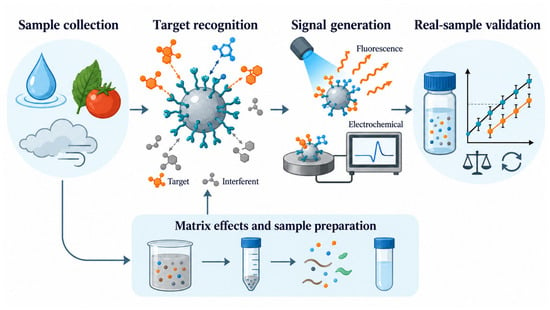
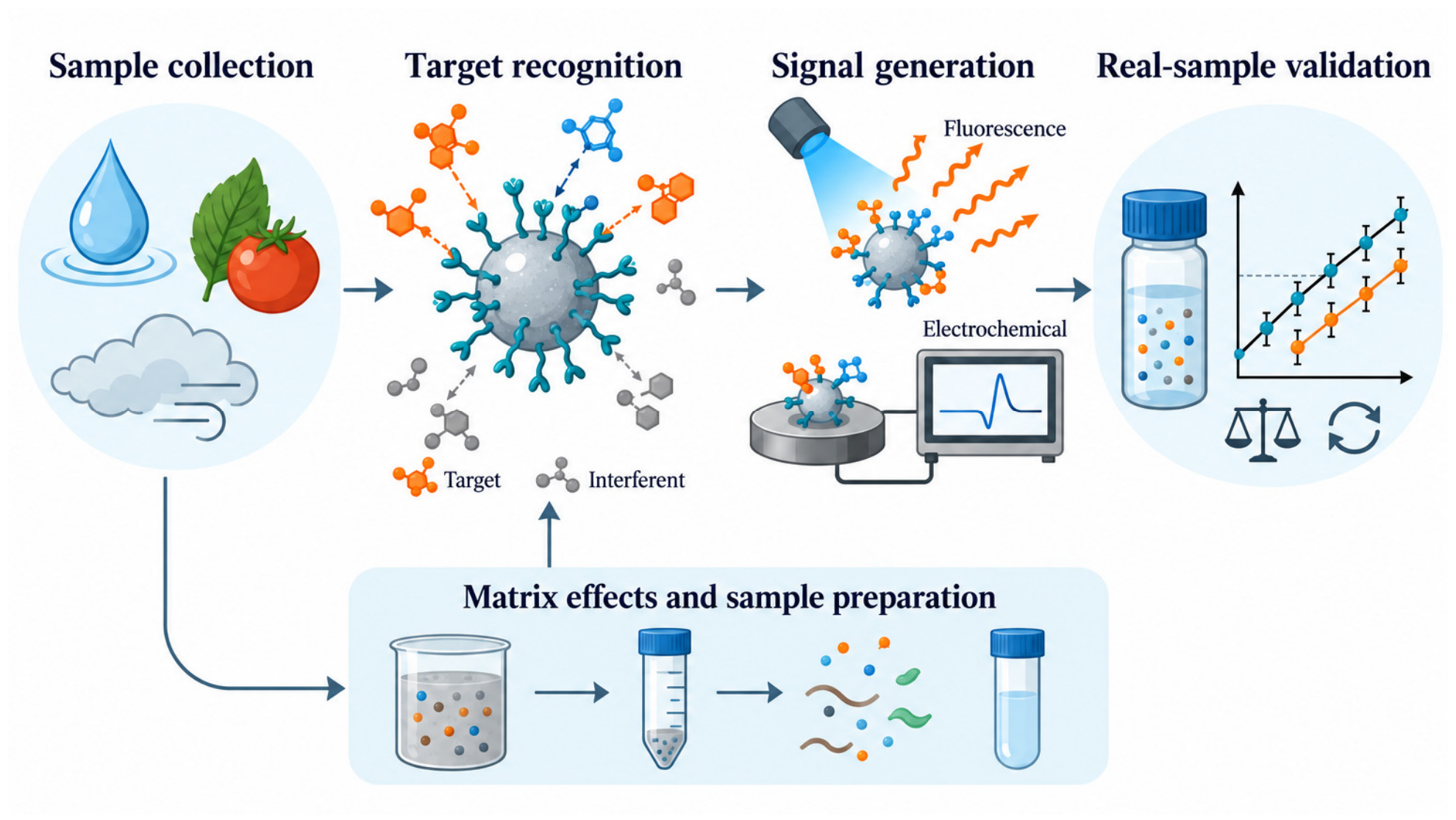
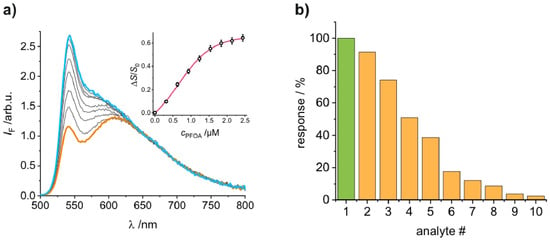
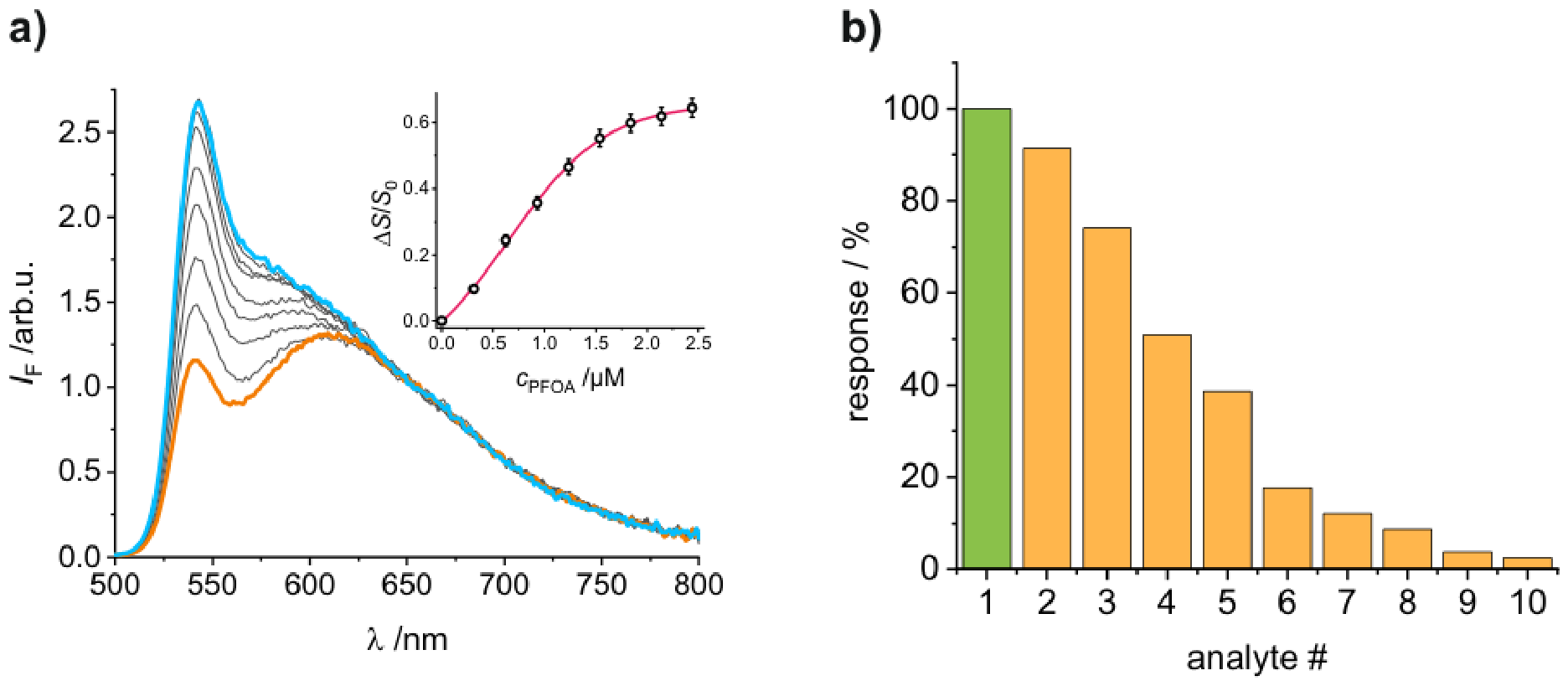
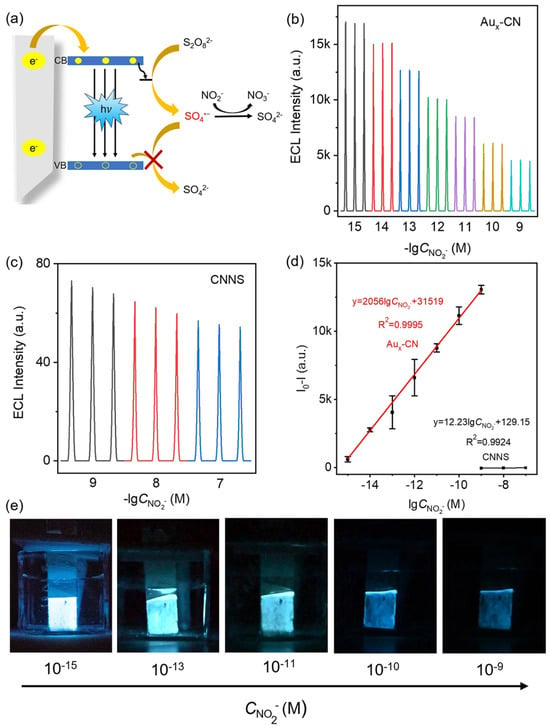
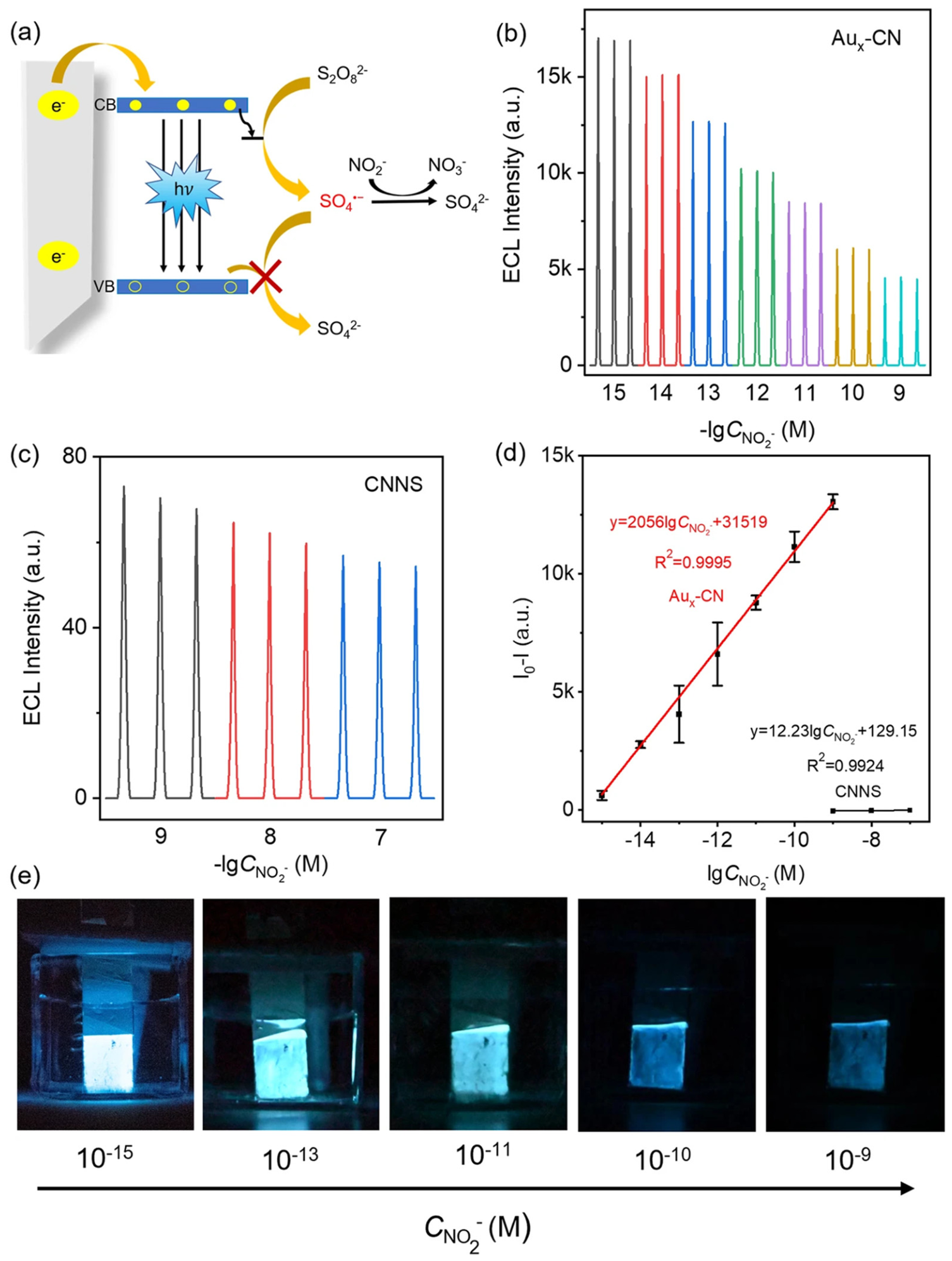
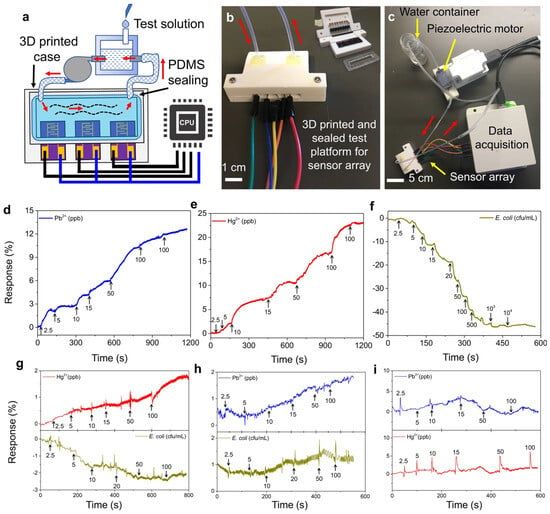
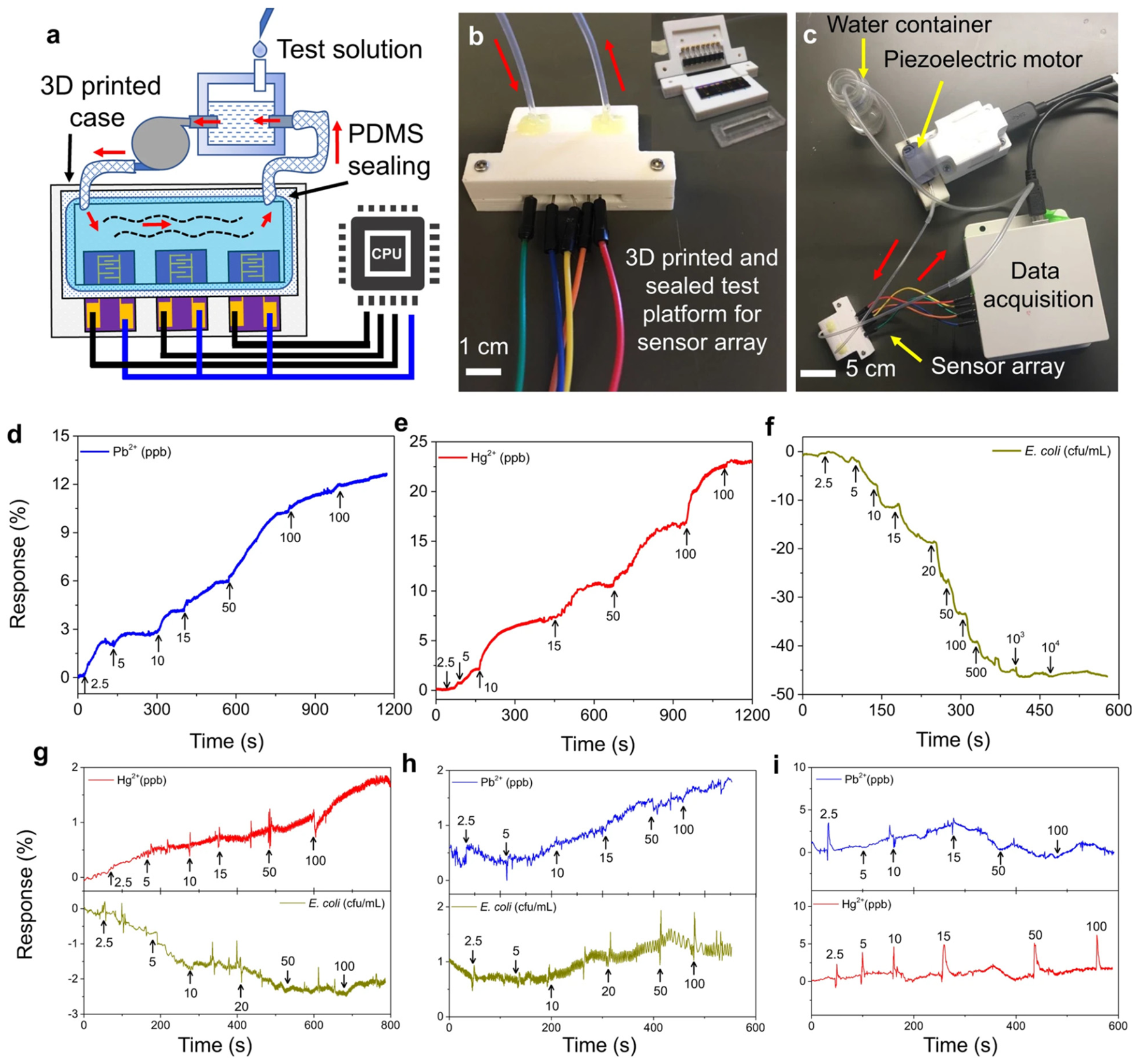
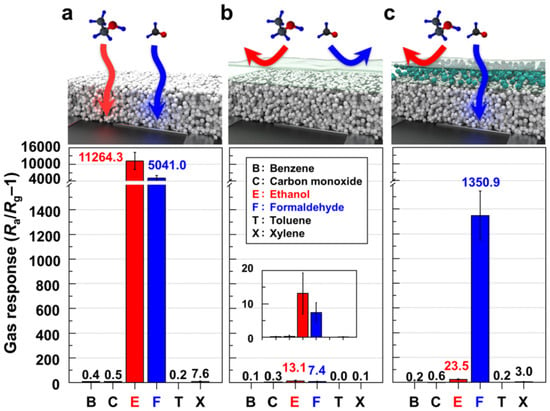
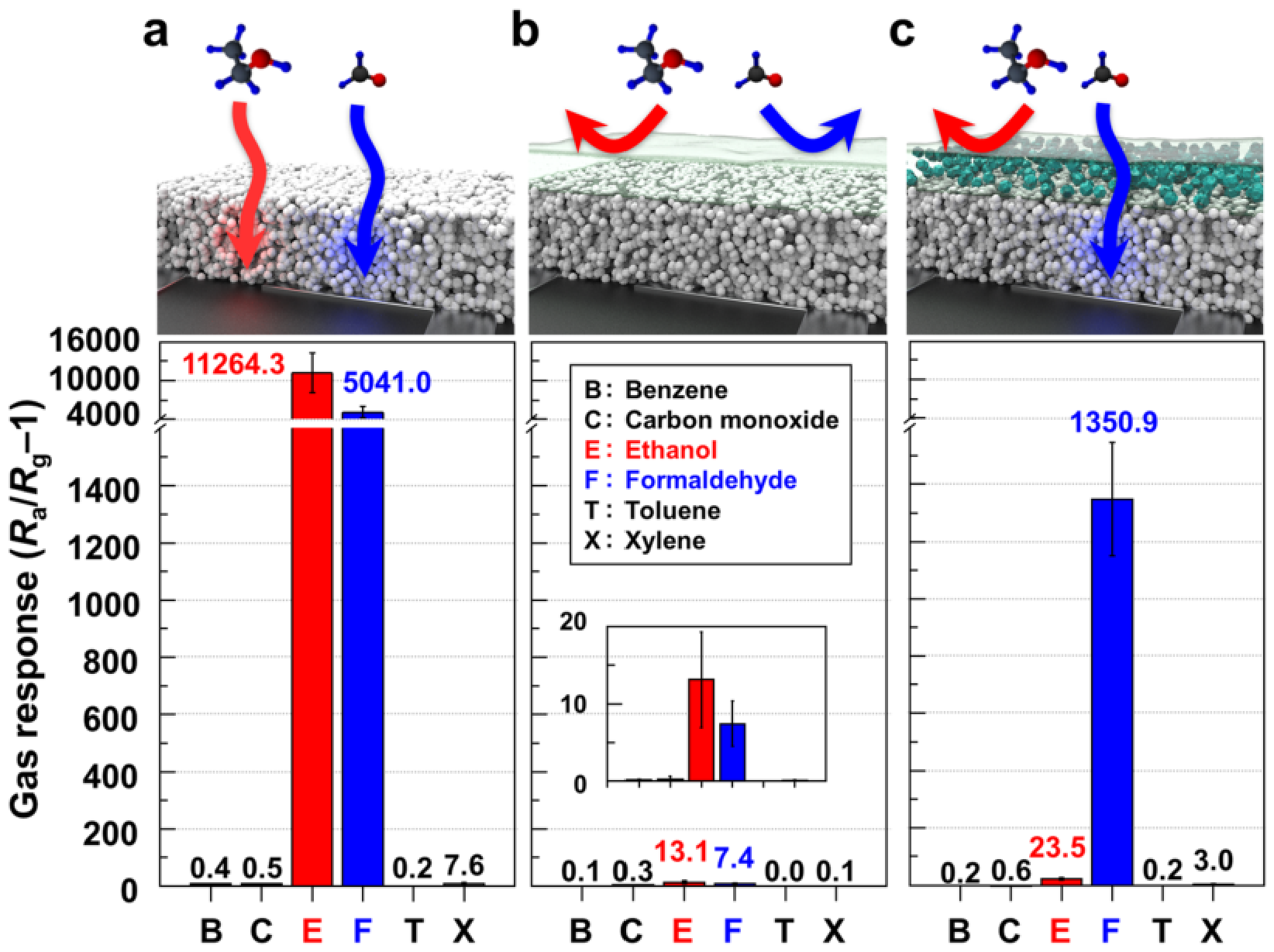

Disclaimer/Publisher’s Note: The statements, opinions and data contained in all publications are solely those of the individual author(s) and contributor(s) and not of MDPI and/or the editor(s). MDPI and/or the editor(s) disclaim responsibility for any injury to people or property resulting from any ideas, methods, instructions or products referred to in the content. |
© 2026 by the authors. Licensee MDPI, Basel, Switzerland. This article is an open access article distributed under the terms and conditions of the Creative Commons Attribution (CC BY) license.