


Abstract
Molecular generation models have made outstanding contributions to chemical space exploration and innovative drug discovery. Nevertheless, current models exhibit limited adaptability in small-data scenarios such as anticancer drug research, mainly due to their insufficient molecular structure representation capability and long-standing reliance on the SMILES (Simplified Molecular-Input Line-Entry System) representation. Herein, we present a novel molecular generation model, namely the dual-channel heterogeneous graph transformer variational autoencoder (DC-HGT-VAE), and integrate SELFIES to guarantee chemical validity and to augment the novelty and efficiency of molecular generation. Built upon the VAE framework, this model combines a Transformer VAE with a Graph Attention Network (GAT) component. The encoder employs a dual-channel graph processing architecture that captures bond-level interactions: on the basis of the conventional molecular graph, it treats bonds as secondary nodes and atoms as connecting edges, which significantly enhances the molecular representation capacity of the encoder and deepens the model’s understanding of molecular structures. Experimental results indicate that, after pre-training and evaluation on the MOSES benchmark dataset, DC-HGT-VAE remains capable of efficiently exploring the chemical structure space and generating novel drug candidates with potential activity, even in small-data scenarios such as the FGFR2-associated compounds. This study contributes to advancing the application of artificial intelligence in the field of molecular generation.
1. Introduction
Drug discovery and design have traditionally been time-consuming and resource-intensive. Generative models, a branch of AI, have the potential to revolutionize this field [1,2,3]. It has been estimated that the chemical space of drug-like small molecules comprises between 1023 and 1060, exceeding the size of any synthesized library [4]. Consequently, the traditional drug discovery pipeline is inherently ill-equipped to explore this combinatorial explosion adequately. There is an urgent need for computational methods that can efficiently and intelligently explore this vast chemical space. Generative models have the potential to address these challenges.
However, current molecular generative models are not perfect. They are limited by the need for a sufficient inhibitor dataset to learn the characteristics of specific inhibitors, and this limitation hinders de novo molecular generation under small-data regimes, especially for inhibitors of cancer-related targets. As a key therapeutic target for cholangiocarcinoma, FGFR2 has yielded multiple inhibitors approved by the U.S. FDA (e.g., lirafugratinib [5], pemigatinib [6], and futibatinib [6]).
Oncogenic alterations of FGFR2 primarily comprise gene fusions/rearrangements and activating point mutations. FGFR2 fusions represent the dominant driver events in intrahepatic cholangiocarcinoma, while activating missense mutations are more frequently detected in malignancies including endometrial and gastric cancers [7]. Current core research efforts focus on addressing the toxicity and drug resistance of pan-FGFR inhibitors in the treatment of cancer and related diseases. Most patients eventually develop acquired drug resistance driven by secondary FGFR2 mutations, such as N550K and V565F [8]. Clinical cohort data indicate that secondary kinase domain mutations are detected in approximately 60% of patients with FGFR2-altered cholangiocarcinoma who progress on FGFR inhibitor therapy. The most prevalent alterations affect the N550 molecular brake residue and the V565 gatekeeper residue, both of which confer on-target resistance by introducing steric hindrance to drug binding or increasing ATP binding affinity [8]. First-generation pan-FGFR inhibitors frequently necessitate dose reduction or treatment discontinuation in clinical practice due to adverse events including hyperphosphatemia and diarrhea [9]. This safety limitation is largely attributed to the high sequence homology of the kinase domains across FGFR isoforms, which complicates the development of highly selective inhibitors. Off-target inhibition of FGFR1, a key regulator of phosphate homeostasis, is the primary cause of dose-limiting hyperphosphatemia in clinical settings [9]. To address this challenge, a new generation of highly selective FGFR2 inhibitor dataset has been developed using molecular generative models, aiming to enable more precise and safer therapy.
In recent years, deep molecular generative models, such as variational autoencoders (VAEs) [10,11], generative adversarial networks (GANs) [12,13], and diffusion models [14,15,16] have emerged, offering a new paradigm for drug design [16,17]. These models learn implicit chemical rules and distributions from large-scale molecular data, enabling the generation of novel molecular structures with desirable physicochemical properties, biological activities, and drug likeness. Compared with traditional high-throughput screening, molecular generative models not only substantially expand the coverage of virtual screening but also enable target-directed generation, thereby accelerating hit identification and lead optimization. Recent advances have introduced a range of generative models for drug discovery. In particular, hybrid architectures have demonstrated superior performance in molecular generative modeling, such as RTGAN [18], LM-GAN [19], Transformer graph variational autoencoder (TGVAE) [20], SmilesGEN. Briefly, RTGAN integrates a GAN, a Transformer, and reinforcement learning to generate SMILES strings while optimizing molecular properties. LM-GAN combines a masked language model with a GAN, improving sample efficiency under small population sizes. TGVAE merges a Transformer, a graph neural network (GNN), and a VAE using molecular graphs as input, addressing both GNN over-smoothing and VAE posterior collapse. SmilesGEN is a dual-channel VAE that jointly models molecular structure and gene expression profiles in a shared latent space for phenotype-driven generation. STAR-VAE [21] introduces a SELFIES-encoded, Transformer-based autoregressive VAE pre-trained on 79 million PubChem molecules, demonstrating the value of large-scale pre-training and parameter-efficient fine-tuning for controllable generation. GPS-VAE [22] combined with Transformer-SELFIES integrates geometric pocket encoding with SELFIES-based decoding for structure-based de novo design, guaranteeing chemical validity by construction. FraHMT [23] takes a fragment-oriented approach, constructing heterogeneous graphs from molecular fragments to learn richer chemical rules for target-specific generation. Adapt-cMolGPT [24] addresses small-data fine-tuning by incorporating adapter modules into a pre-trained conditional GPT model with alternating weight updates. On the representation learning side, ALIGNN [25] performs message passing on both bond graphs and line graphs to explicitly capture bond-angle information, primarily for materials property prediction. KPGT [26] combines a graph transformer with knowledge-guided self-supervised pre-training and has been validated on molecular property prediction and FGFR1 inhibitor discovery.
Converting molecular structures and properties into model-readable molecular representations is fundamental to model operation. 2D Molecular graph representations are commonly used in graph neural network (GNN) architectures [27,28]. The conventional representation, where atoms are nodes and bonds are edges, propagates information between adjacent atoms in the network. However, bond–bond interactions (e.g., bond angles, torsion angles, hyperconjugation) are difficult to express directly under this paradigm, forcing the model to approximate them through indirect message passing. This limitation hinders neural networks from fully capturing the latent structural information within molecules, thereby affecting their expressive power and predictive performance [29,30]. To directly capture the key physicochemical information between adjacent chemical bonds, we propose a dual molecular graph representation in which each chemical bond serves as a node and the connection between two bonds sharing a common atom is treated as an edge (i.e., atoms act as edges). Compared with the conventional atom-as-node, bond-as-edge molecular graph, this representation offers several advantages [31]. (1) Natural encoding of bond–bond interactions. The geometric and electronic relationships between adjacent bonds are directly reflected in first-order adjacency, allowing graph neural networks to propagate the physicochemical information of neighboring bonds without additional feature engineering. (2) Simplified topological description of covalent skeletons. All bonds around a given atom form a complete subgraph in the bond graph, naturally capturing the local coordination geometry of the atom. (3) Suitability for bond-centric property prediction. This facilitates learning of properties dominated by bond characteristics, such as vibrational spectra, J coupling, and bond dissociation energies. (4) Enhanced expressive power in graph learning. As the line graph of the original molecular graph, this representation can distinguish certain isomorphic graphs that conventional graphs cannot and enables efficient encoding of chiral centers. In summary, this representation is not merely a dual counterpart but an explicit integration of multi-dimensional information from adjacent bonds into the graph structure, providing a more physically relevant input for subsequent graph neural network models.
In this paper, we propose a novel VAE-based hybrid architecture that integrates a graph neural network (GNN) with a Transformer. A key innovation lies in the encoder’s dual-channel graph processing, which captures molecular topology from both atom-centric and bond-centric perspectives—facilitating not only neighbor-to-atom message passing but also bond-to-bond information flow. This dual view significantly enriches the latent feature space. Additionally, the encoder uses a Transformer to handle SELFIES strings, leveraging their robustness for seamless integration of 2D graph and 1D sequential representations. Our model seamlessly bridges 2D graph and 1D string representations, learning structural and property distributions from molecular datasets to generate de novo molecules.
2. Results
2.1. Performance Comparison
After training for 100 epochs, the model parameters are loaded and the generator is used to produce 30,000 molecules. The proposed model is compared with several existing models on the MOSES benchmark based on five metrics: validity, uniqueness, novelty, internal diversity (IntDiv), and scaffold similarity to the scaffold test set. As shown in Table 1, the molecules generated by this model achieve excellent uniqueness and novelty, while also delivering the best validity score of 1.0 and the highest internal diversity evaluation, with an IntDiv1 value of 0.870 and an IntDiv2 value of 0.865. A validity score of 1.0 means that every generated SELFIES string can be successfully converted into a recognizable molecular structure, which is attributable to the integration of SELFIES. The scaffold similarity evaluation was benchmarked on the TestSF dataset filtered by MOSES. In this benchmark, DC-HGT-VAE achieved a score of 0.1139, which is higher than those of string-based models such as CharRNN, VAE, and JT-VAE, but lower than that of TGVAE, a model that combines graph-based and string-based representations, which scored 0.169. Generally, string-based models tend to perform better in terms of generating molecular scaffolds. Nevertheless, DC-HGT-VAE attained a scaffold similarity value close to that of a string-based model.
Table 1.
MOSES performance metrics for the baseline models and TGVAE 8H/M and DC-HGT-VAE.
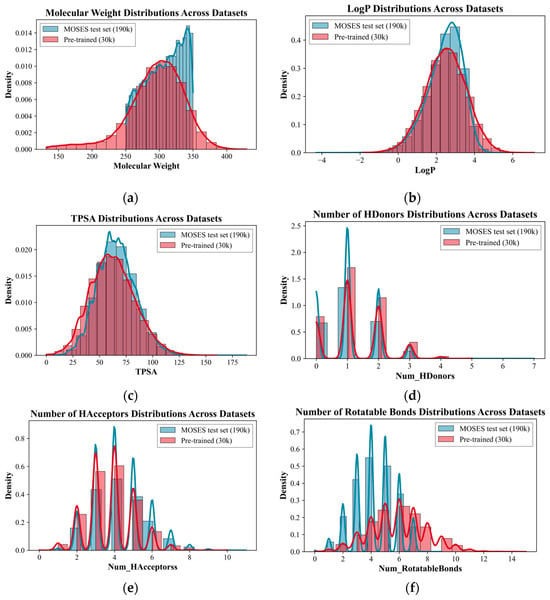
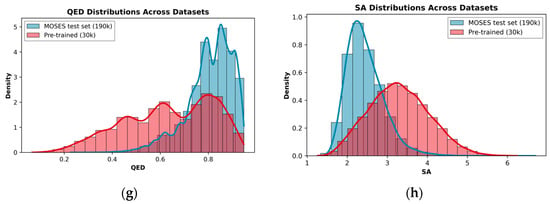
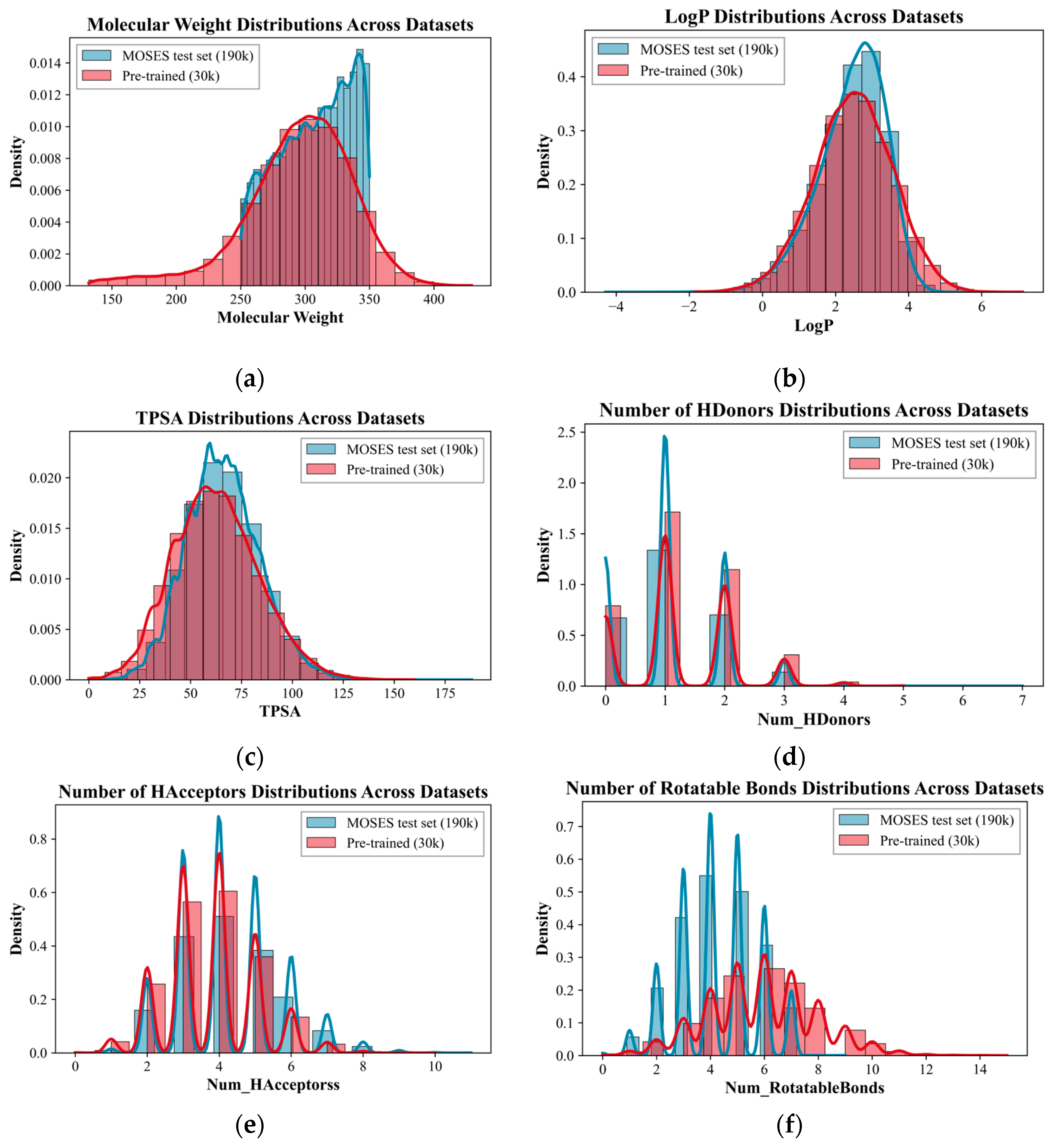
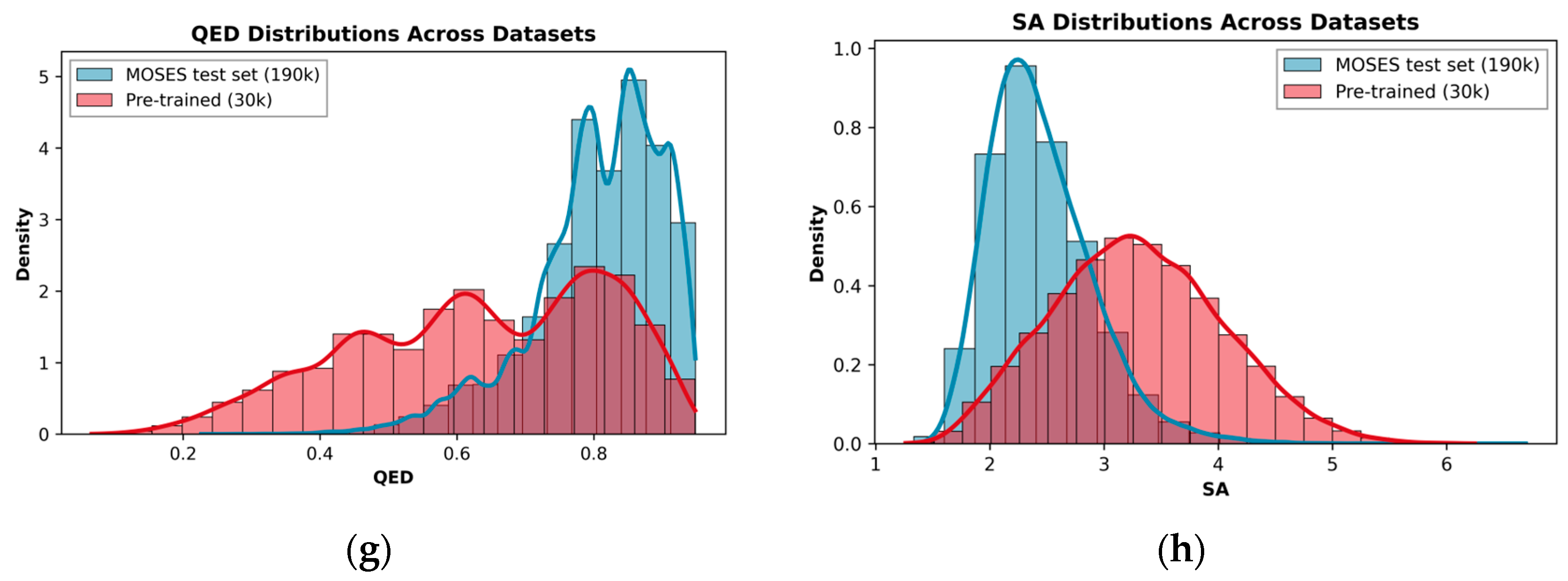
We evaluated the property distributions of the generated molecules and compared them with those of the training dataset, as shown in Figure 1. The goal of the model is to generate novel, drug-like small molecules with reasonable property profiles. We evaluated the property distributions related to drug-likeness. We assess drug-likeness using six physicochemical descriptors: molecular weight (MW), logP, hydrogen-bond donors (HBD), hydrogen-bond acceptors (HBA), rotatable bonds, and topological polar surface area (TPSA). These descriptors were selected as they form the core parameters of well-established drug-likeness criteria: MW, logP, HBD and HBA correspond to the four original parameters of Lipinski’s Rule of Five [32], whereas rotatable bonds and TPSA represent the two key parameters of Veber’s rules. Together, they characterize molecular size, lipophilicity, hydrogen-bonding capacity, molecular flexibility, and polar surface area. These descriptors are widely used in the MOSES benchmark and previous molecular generation studies, enabling direct comparability with existing work. Reporting each descriptor separately, rather than relying only on a composite score, allows dimension-level interpretation of how the generation process shapes drug-likeness. In addition, we report QED as a composite drug-likeness score and the SA score as an indicator of synthetic accessibility. QED provides an overall summary of drug-likeness, while the SA score quantifies the synthetic feasibility of generated molecules. These metrics complement the six individual physicochemical descriptors: QED delivers a global drug-likeness assessment, the SA score accounts for synthesizability, and the six descriptors support dimension-level interpretability. The property distributions of the generated molecules indicate that molecules produced by the DC-HGT-VAE model exhibit a Gaussian distribution in the chemical space and possess good drug-likeness potential.
Figure 1.
Comparison of chemical property distributions between the MOSES test set and molecules generated by the pre-training model, demonstrating the model’s ability to capture the underlying property landscape. (a) Molecular weight. (b) logP. (c) TPSA. (d) Number of hydrogen bond donors. (e) Number of hydrogen bond acceptors. (f) Number of rotatable bonds. (g) QED. (h) SA.
2.2. Model Training and Convergence Analysis
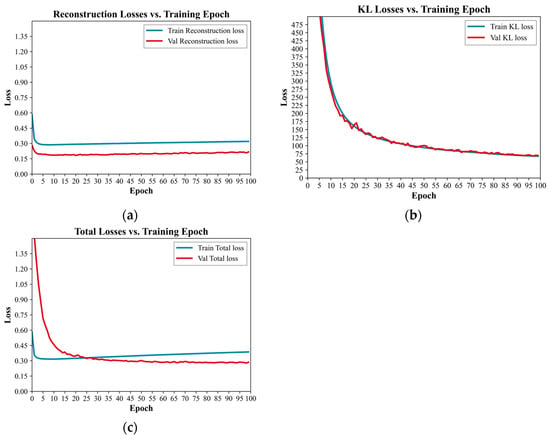
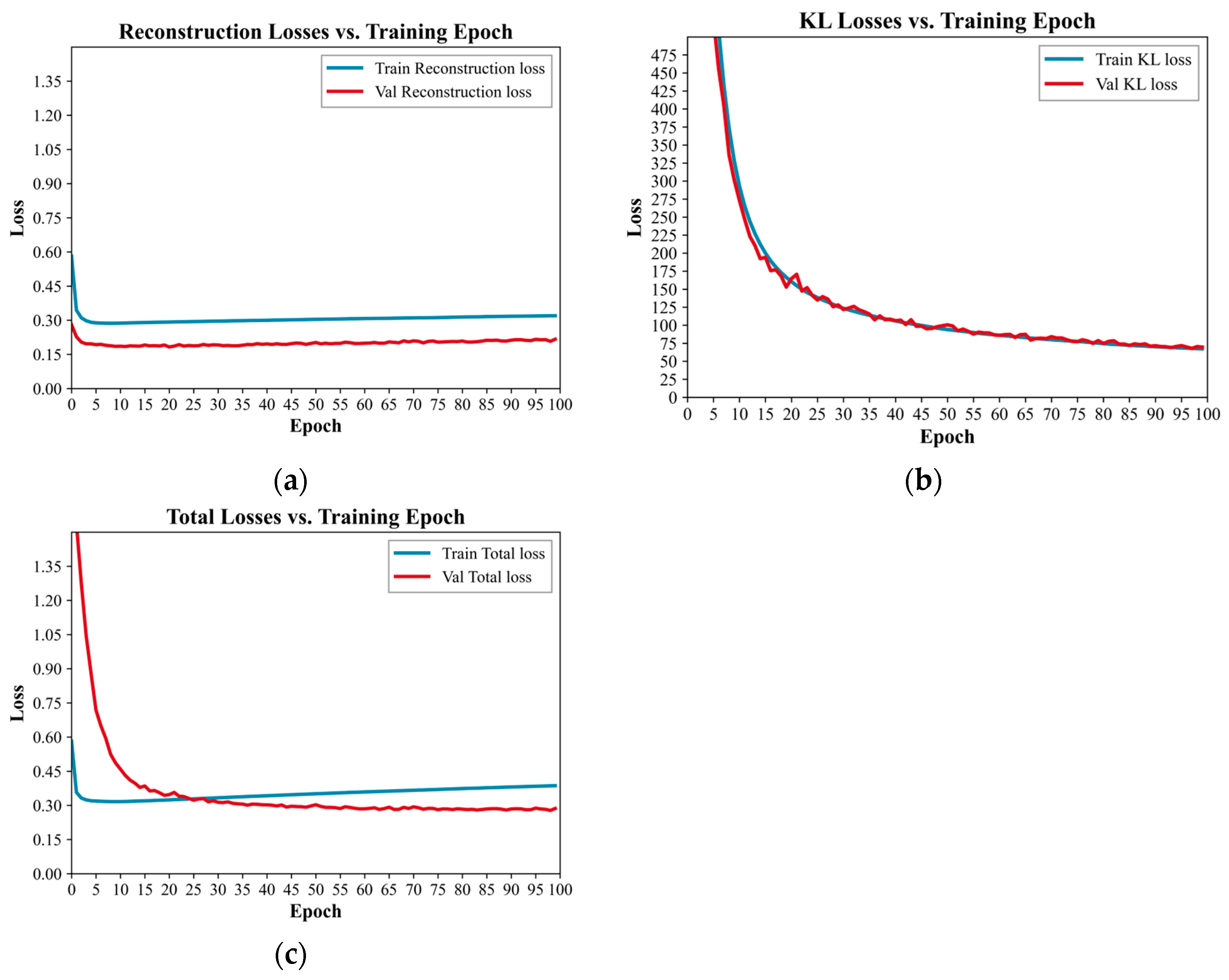
Figure 2 depicts the training and validation loss curves of DC-HGT-VAE over 100 epochs, covering reconstruction loss, KL divergence loss, and total loss, to characterize the model’s convergence dynamics and generalization capability.
Figure 2.
Training and validation loss curves of the DC-HGT-VAE model over 100 training epochs. (a) Reconstruction loss. (b) Kullback–Leibler (KL) divergence loss. (c) Total loss. The blue line denotes the training set, and the red line denotes the validation set.
2.2.1. Reconstruction Loss
As shown in Figure 2a, both training and validation reconstruction losses drop sharply within the first 10 epochs, then enter a slow convergence phase and eventually stabilize at approximately 0.32 (training set) and 0.21 (validation set). The validation reconstruction loss remains consistently lower than the training loss, indicating that the model captures generalizable molecular structural patterns instead of memorizing training samples, and achieves robust capability for molecular structure reconstruction.
2.2.2. KL Divergence Loss
The KL divergence loss, which quantifies the alignment between the latent posterior distribution and the standard normal prior, starts at a high value and declines continuously along the training process (Figure 2b). It gradually levels off after around 80 epochs, with the training and validation curves nearly overlapping. This trend reflects that the model’s latent space is progressively regularized toward the standard normal distribution, and the regularization effect is highly consistent between the training and validation sets.
2.2.3. Total Loss
The overall trend of total loss is generally consistent with the reconstruction loss (Figure 2c). Affected by the large initial KL divergence, the validation total loss starts at a high level, decreases rapidly in the early stage, intersects with the training total loss at approximately epoch 25, and then remains slightly lower than the training total loss while converging gradually. No persistent upward trend of validation loss is observed across the entire 100 epochs, confirming that no severe overfitting occurs during training. The stable convergence of total loss demonstrates that the model achieves a favorable balance between molecular reconstruction accuracy and latent space regularization.
2.3. Ablation Study
2.3.1. Experimental Setup
To verify the contribution of each core module in the proposed DC-HGT-VAE framework, we conducted ablation studies in two dimensions: heterogeneous graph modeling strategy and molecular representation form.
For the graph modeling dimension, three variant models based on SMILES representation were constructed for comparison:
- Atom-GT-VAE: a graph transformer VAE that only models atomic node features;
- Bond-GT-VAE: a graph transformer VAE that only models chemical bond edge features;
- DC-HGT-VAE (SMILES): the full dual-channel heterogeneous graph transformer VAE with both atomic and bond feature modeling.
For the molecular representation dimension, we replaced the SMILES input with SELFIES on the optimal DC-HGT-VAE architecture to explore the impact of string representation on generation performance.
All experiments were repeated in triplicate, and the results are reported as mean ± standard deviation. The evaluation metrics include validity (proportion of chemically valid molecules), Unique@10K (structural uniqueness calculated on 10,000 generated molecules), novelty (proportion of molecules not present in the training set), IntDiv1/IntDiv2 (internal structural diversity), Scaf (TestSF) (scaffold novelty relative to the test set scaffold library), Fréchet ChemNet Distance (FCD, similarity between generated and real molecular distributions), and SNN (similarity to the nearest neighbor in the training set).
2.3.2. Analysis of Heterogeneous Graph Modeling Strategies
Table 2 summarizes the performance of three graph modeling variants. Overall, Bond-GT-VAE achieved the worst performance across most metrics: it yielded the lowest validity (0.743), the highest FCD value (22.0476), and the poorest scaffold diversity (0.066). This result indicates that modeling only chemical bond edge information is insufficient to capture the complete topological and property features of molecules, leading to a high rate of chemically invalid structures and poor fitting to real molecular distributions.
Table 2.
MOSES Performance Metrics for Ablation Study.
Atom-GT-VAE achieved moderate performance, with validity improved to 0.822 and higher internal diversity than Bond-GT-VAE, confirming that atomic node features serve as the fundamental information for molecular structure generation.
The full DC-HGT-VAE (SMILES) model consistently outperformed the two single-channel variants on all metrics. Its validity reached 0.921, IntDiv1 and IntDiv2 rose to 0.861 and 0.857, respectively, scaffold diversity increased to 0.121, and FCD decreased to 9.8021. The improvements demonstrate that the dual-channel heterogeneous graph architecture can simultaneously integrate hierarchical information from atomic nodes and chemical bonds, which not only ensures the chemical validity of generated molecules but also enhances structural diversity and distribution alignment with real molecules.
2.3.3. Analysis of Molecular Representation Forms
When SELFIES was adopted as the input representation on the DC-HGT-VAE backbone, the model achieved a validity of 1.0, realizing zero syntax errors in molecular generation. Meanwhile, Unique@10K increased to 0.9997, and both IntDiv1 and IntDiv2 were further improved, verifying that the syntactic robustness of SELFIES effectively boosts the quality of generated molecules.
In terms of distribution and scaffold metrics, the SNN value increased from 0.3141 to 0.3754, indicating that molecules generated by the SELFIES-based model share higher structural similarity with the training set. However, the scaffold diversity (0.113) and FCD value (11.0402) of the SELFIES variant were slightly inferior to those of the SMILES version, suggesting that SELFIES has slightly weaker capability in exploring novel chemical scaffolds compared with SMILES.
2.3.4. Summary
The ablation study confirms that the dual-channel heterogeneous graph modeling mechanism is the core source of performance improvement for DC-HGT-VAE. The adoption of SELFIES representation can further significantly improve generation validity and structural uniqueness. After comprehensive consideration of generation diversity, distribution fitting and scaffold exploration capability, DC-HGT-VAE (SMILES) achieves the best overall performance, while DC-HGT-VAE (SELFIES) is more suitable for application scenarios with strict requirements on chemical validity.
2.4. Performance of the Fine-Tuned Model on FGFR2-Associated Compounds
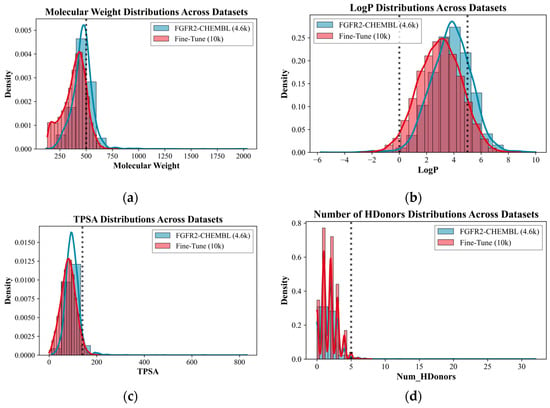
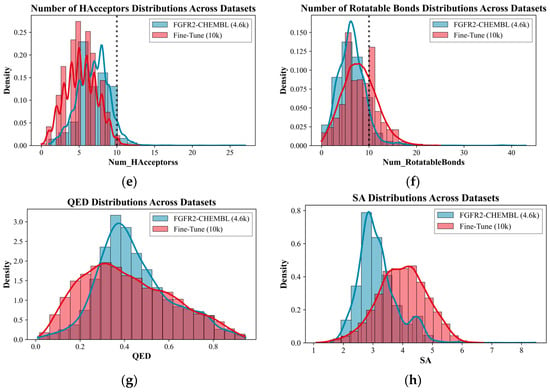
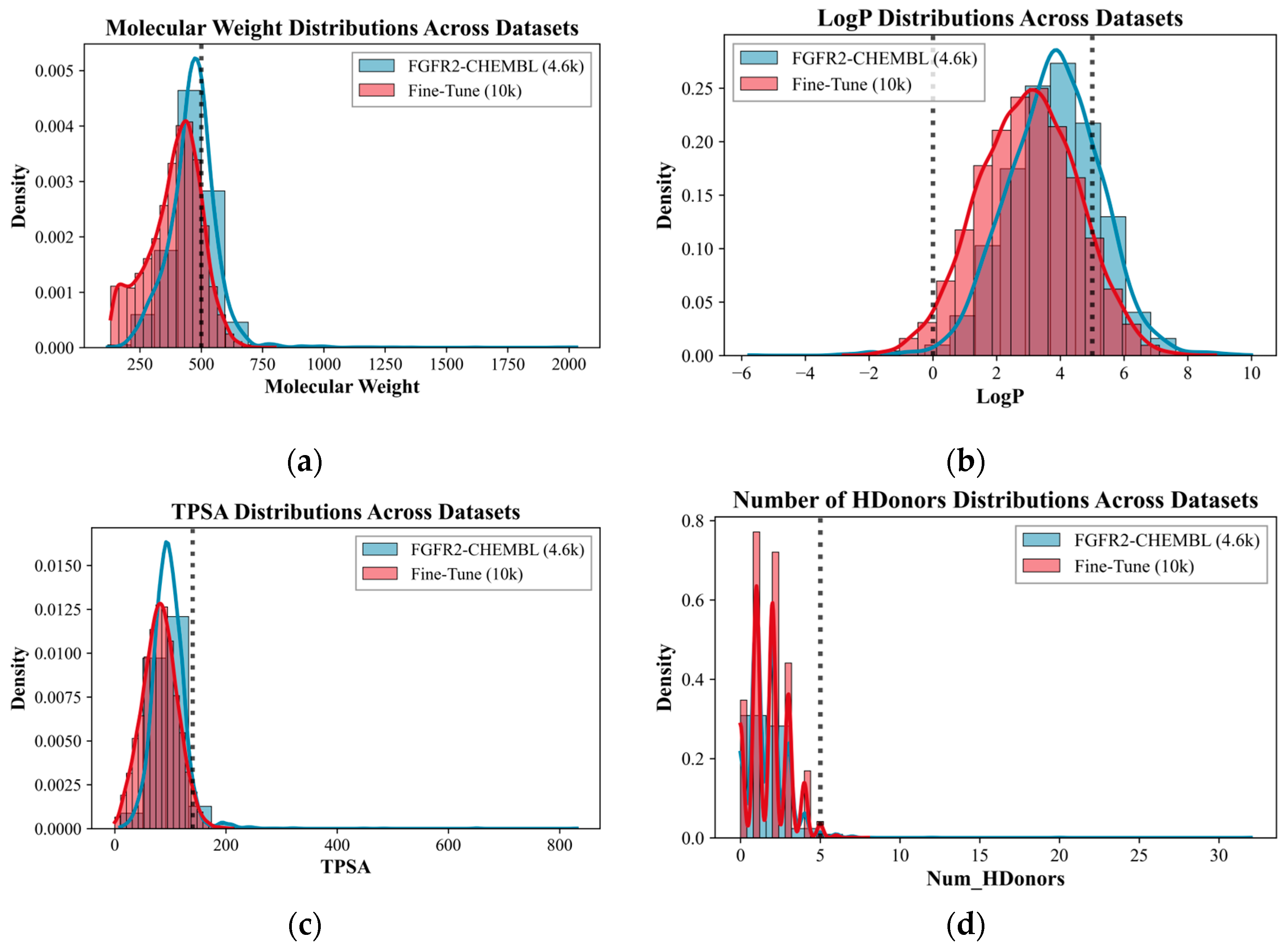
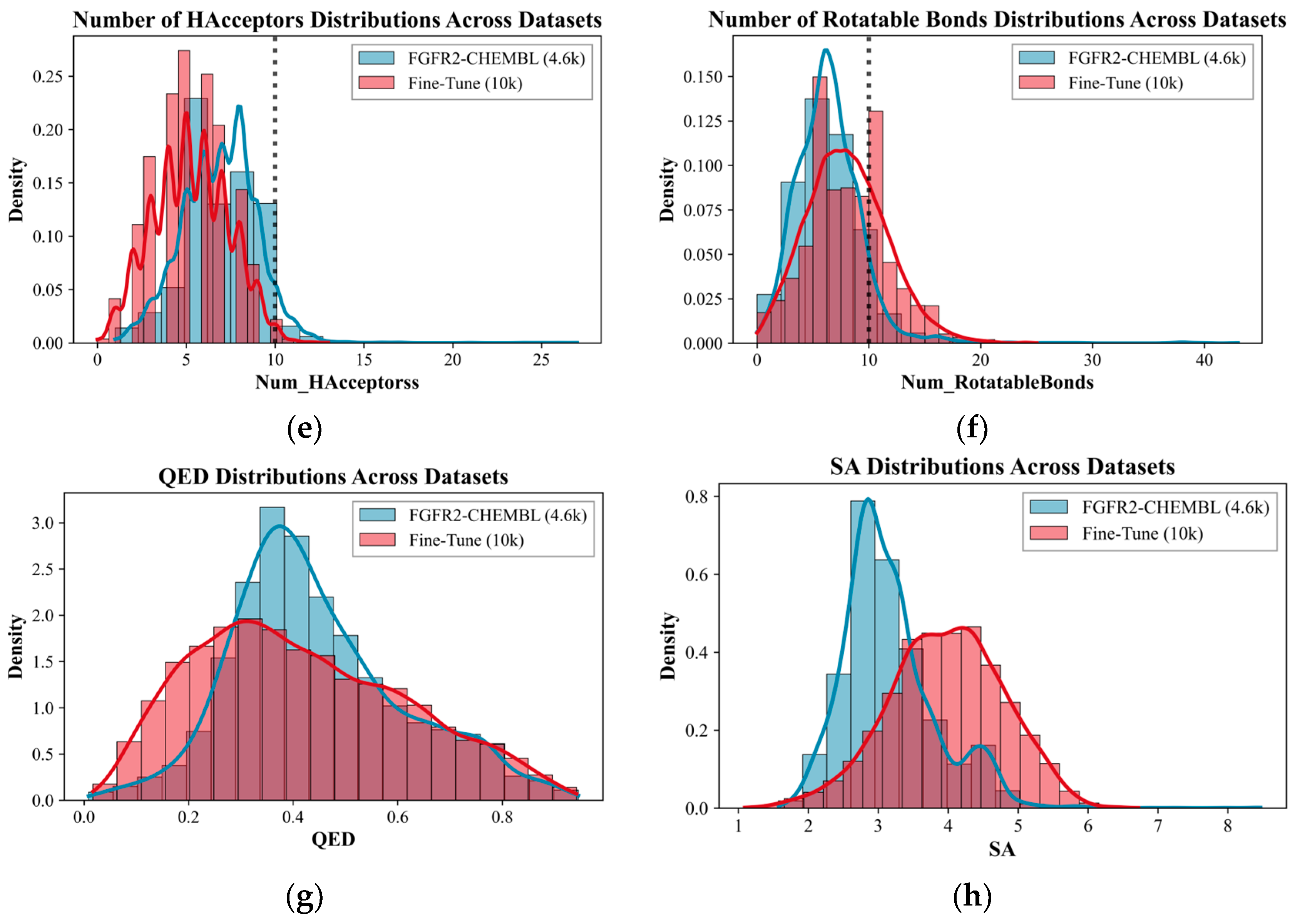
In this study, we also fine-tuned a pre-trained DC-HGT-VAE model using a dataset of 4674 structurally diverse FGFR2-associated compounds [33], which were screened from the ChEMBL [34] database. The goal was to generate novel and potential molecules suitable for future experimental settings. Using the fine-tuned model, we generated 10,000 novel molecular structures. Similarly, we evaluated the property distributions related to drug-likeness, as shown in Figure 3.
Figure 3.
Comparison of chemical property distributions between the FGFR2-associated compounds database and molecules generated by the fine-tuned model, demonstrating the model’s ability to capture the underlying property landscape. (a) Molecular weight. (b) logP. (c) TPSA. (d) Number of hydrogen bond donors. (e) Number of hydrogen bond acceptors. (f) Number of rotatable bonds. (g) QED. (h) SA.
The results indicated that, on this specific dataset, the molecules generated by the fine-tuned model maintained high novelty, while their relevant drug-likeness properties did not significantly deviate from the property distribution of the training dataset molecules. To enrich the pool with drug-like candidates suitable for production environments, we applied a set of physicochemical filters based on commonly accepted drug-likeness guidelines: molecular weight < 500, 0 < logP < 5, TPSA < 140 Å2, number of hydrogen bond donors <5, number of hydrogen bond acceptors <10, and number of rotatable bonds <10. This filtering process yielded 6242 molecules that satisfied all criteria.
To provide a simple and reproducible reference comparison, we evaluated the non-fine-tuned pre-trained model and the fine-tuned model using the FGFR2-associated fine-tuning training set as the reference set for FCD and SNN. Five sampling rounds were performed, with 2000 molecules per round and no replacement. As shown in Table 3, fine-tuning reduced FCD from 20.8668 ± 0.1262 to 14.5122 ± 0.1742 (approximately 30.4% relative reduction) and increased SNN from 0.2502 ± 0.0005 to 0.2788 ± 0.0017 (approximately 11.4% relative improvement). These results indicate that fine-tuning shifts the generated distribution toward the FGFR2-associated training set. Meanwhile, validity and uniqueness remained at 1.0000, novelty remained high at 0.9974, and internal diversity decreased by only about 10%. These results indicate that fine-tuning substantially improves the fit of the generated molecules to the FGFR2-associated training set chemical space while maintaining a reasonable balance between novelty and diversity. Although the post-fine-tuning FCD of 14.51 is clearly better than that of the non-fine-tuned model, its absolute value is still not very low, indicating that there remains room for further approximation to the FGFR2-associated training set distribution.
Table 3.
Comparison of performance metrics between the non-fine-tuned pre-trained model and the fine-tuned DC-HGT-VAE on the FGFR2-associated fine-tuning training set.
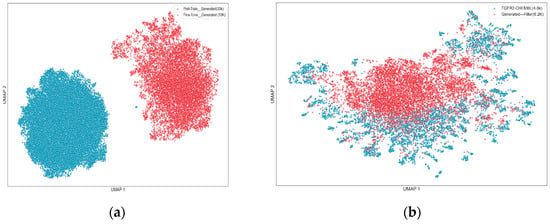
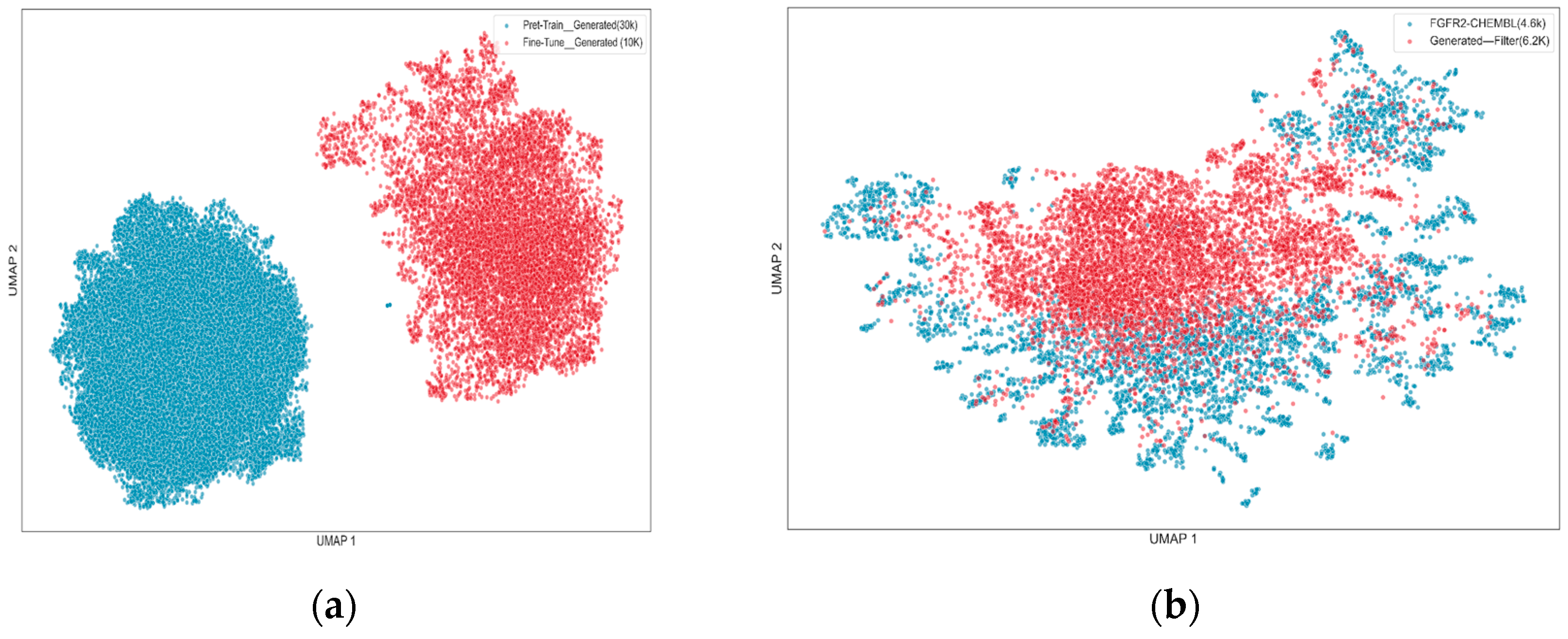
In addition, as a qualitative visualization, to further assess structural similarity and diversity, we compared the structural distributions of molecules generated by the fine-tuned model with those generated by the pre-trained model, as well as with known FGFR2-associated compounds. This was achieved using Morgan fingerprints (ECFP) [35] and Uniform Manifold Approximation and Projection (UMAP) [36] for dimensionality reduction (Figure 4). Before comparison, the pre-training dataset, fine-tuning dataset, and generated molecules were deduplicated and invalid molecules were removed. The UMAP projection is presented as a qualitative visualization only. The projection showed that the fine-tuned generated molecules exhibited negligible overlap with the pre-trained generated molecules, consistent with a substantial shift in chemical space. In contrast, the filtered fine-tuned generated molecules showed partial overlap with the FGFR2-associated compounds, with no obvious migration, consistent with fine-tuning shifting the generated chemical space toward FGFR2-associated reference space while maintaining reasonable coverage of the reference space. These qualitative observations are supported by the quantitative FCD and SNN results reported in Table 3, and should not be interpreted as direct evidence of biological relevance or equivalent chemical distributions. This comparison provided a qualitative view of how the generated chemical space overlaps with or diverges from the reference chemical space.
Figure 4.
UMAP projection. UMAP parameters were set to n_neighbors = 15, min_dist = 0.6, and metric = “jaccard”: (a) 30,000 molecules generated by the pre-trained model (blue) and 10,000 molecules generated by the fine-tuned model (red); (b) 6242 molecules retained after filtering the 10,000 fine-tuned generated molecules (red), together with 4674 known FGFR2-associated compounds from ChEMBL (blue).
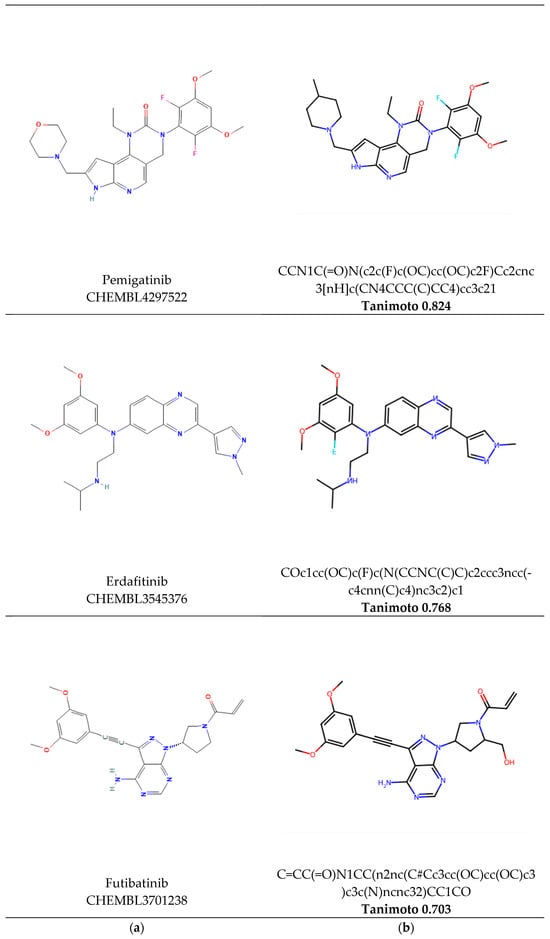
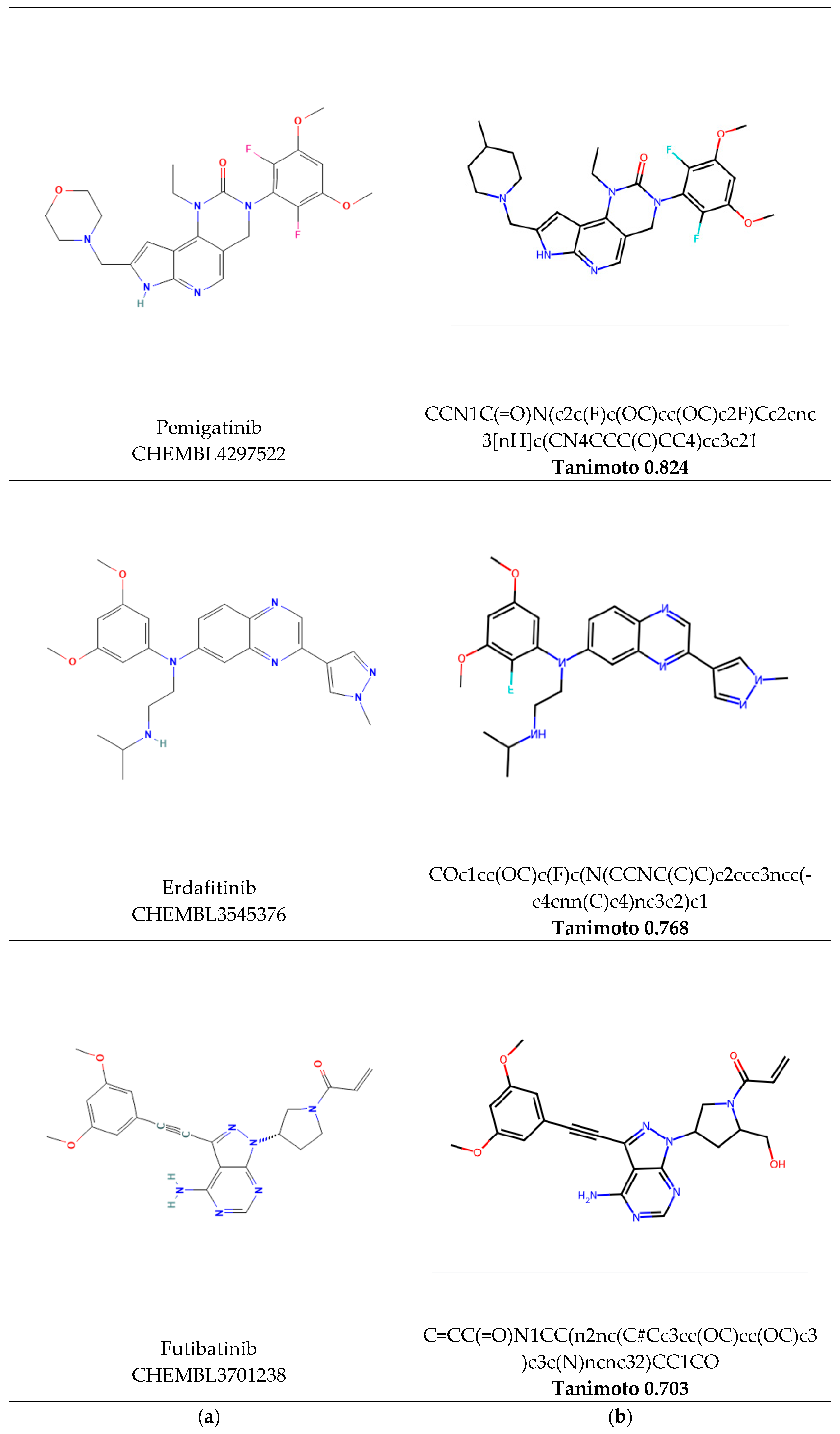
Figure 5 presents a structural comparison between FDA-approved FGFR2 inhibitors and representative molecules generated by the fine-tuned DC-HGT-VAE. Panel (a) shows three approved FGFR2 inhibitors—pemigatinib, erdafitinib, and futibatinib—which possess distinct chemical scaffolds. Panel (b) shows representative generated molecules together with their Tanimoto similarity to known FGFR2 inhibitors, computed using Morgan fingerprints (radius = 2, fpSize = 2048). The Tanimoto values indicate that the generated molecules retain partial structural relatedness to the approved FGFR2 inhibitors while remaining distinct.
Figure 5.
Structural comparison between FDA-approved FGFR2 inhibitors and molecules generated by the fine-tuned model. (a) Three FDA-approved FGFR2 inhibitor drugs (e.g., Pemigatinib, Erdafitinib, and Futibatinib). (b) Representative fine-tuned model-generated molecules and their Tanimoto similarity to known FGFR2 inhibitors. Tanimoto values were computed using Morgan fingerprints (radius = 2, fpSize = 2048).
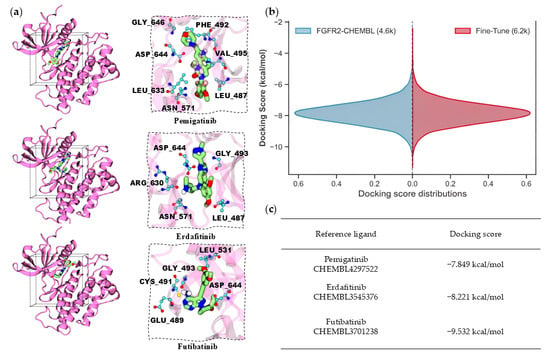
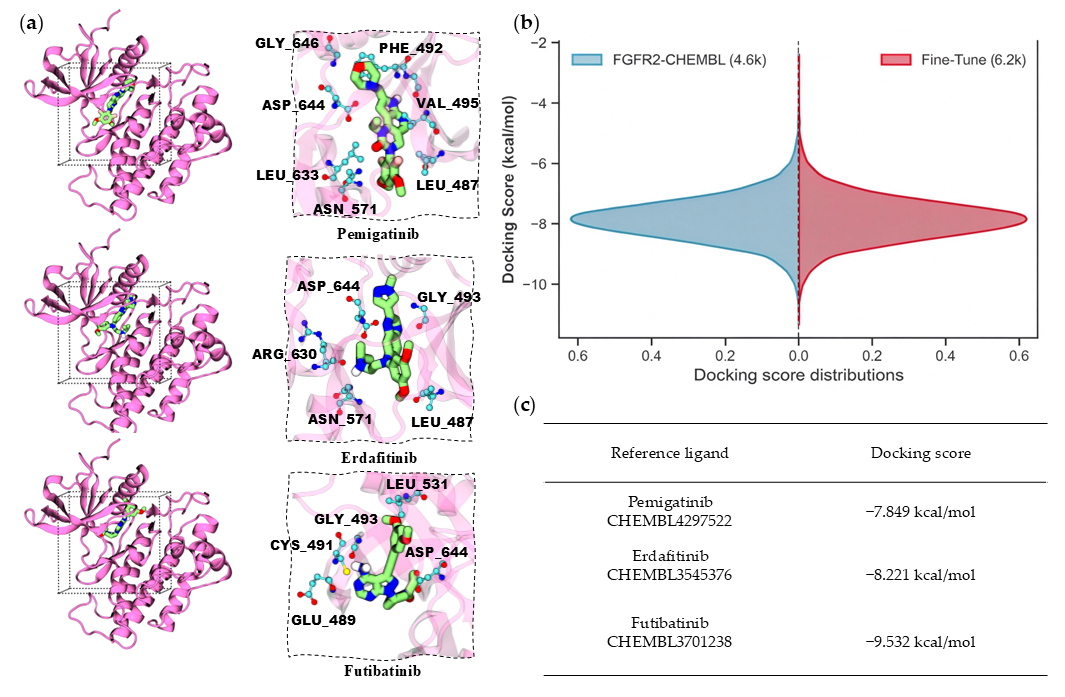
As an exploratory in silico assessment of predicted binding affinity—rather than as evidence of FGFR2 inhibitory activity—we performed molecular docking using AutoDock Vina v1.2.7 [37] against the ATP-binding pocket of the FGFR2 kinase domain (PDB ID: 9VLM). The fine-tuned generated molecules and the FGFR2-associated compounds retrieved from ChEMBL were docked under the same protocol, and their docking-score distributions were compared in Figure 6. The two distributions showed no obvious difference, with both peaking around −8 kcal/mol. We also docked three reference ligands with reported enzymatic activities—pemigatinib (0.5 nM) [38], erdafitinib (2.5 nM) [39], and futibatinib (1.4 nM) [40]—which yielded docking scores of −7.849, −8.221, and −9.532 kcal/mol, respectively, falling near the peak of the generated-molecule distribution. This comparison provides supplementary context for the range of predicted binding affinities, but it does not validate the docking protocol or establish FGFR2 inhibitory activity. In particular, the reference set consists of FGFR2-associated compounds rather than a uniformly curated collection of experimentally validated inhibitors, and the docking protocol was not validated with a full negative-control set. Accordingly, the similar docking-score distributions should not be interpreted as evidence that the generated molecules possess comparable FGFR2 inhibitory activity. Docking scores are computational predictions and do not replace experimental validation of binding affinity and inhibitory activity.
Figure 6.
(a) Docked structures of three reference molecules—pemigatinib, erdafitinib, and futibatinib—in the ATP-binding pocket of the FGFR2 kinase domain. (b) Docking-score comparison between 6242 valid molecules (red) obtained after filtering the 10,000 fine-tuned generated molecules and 4674 known FGFR2-associated compounds from ChEMBL (blue). (c) Docking scores of the three reference molecules pemigatinib, erdafitinib, and futibatinib. Docking scores are given in kcal/mol.
3. Discussion
Generative AI holds profound significance in propelling the discovery of novel drugs. Molecular generation models, whether functioning as an additional intelligent agent surpassing human perceptual capabilities or as an auxiliary tool for researchers, can expedite drug development in a revolutionary, cost-effective, and efficient manner. Our objective in exploring and developing model algorithms is to employ machine learning to unveil the underlying principles of drugs targeting various receptors that remain elusive to human comprehension, thereby facilitating the exploration of novel chemical spaces. The DC-HGT-VAE model developed herein represents a step forward in this direction. It combines a dual-channel graph neural network with a Transformer-based string encoder, enabling the integration of two-dimensional graph representations and one-dimensional string molecular representations. This hybrid design is intended to improve molecular representation learning and target-specific generation, particularly in small-data scenarios. The experimental results support the practical value of this design. On the MOSES benchmark, DC-HGT-VAE achieves stable performance in terms of uniqueness and novelty. In the FGFR2-associated fine-tuning setting, the model generates chemically valid and novel molecules.
Several findings warrant a more critical discussion. First, although fine-tuning improves the distributional similarity to the FGFR2-associated training set (FCD decreased from 20.8668 ± 0.1262 to 14.5122 ± 0.1742; SNN increased from 0.2502 ± 0.0005 to 0.2788 ± 0.0017), the absolute FCD remains not very low and the absolute SNN level is also limited. FCD is sensitive to global distribution shift, diversity coverage, and long-tail coverage, whereas SNN focuses on local nearest-neighbor similarity; therefore, a non-low FCD does not necessarily imply a lack of local structural similarity. A plausible but indicative interpretation is that the model tends to generate molecules with similar scaffolds but diverse side-chain or functional-group decorations; this interpretation requires further validation through scaffold analysis, side-chain diversity statistics, and ablation experiments.
Second, the SMILES and SELFIES variants exhibit a clear performance trade-off. The SELFIES variant is better in validity, uniqueness, IntDiv, and SNN, but worse in FCD (11.0402 ± 0.0721 vs. 9.8021 ± 0.0064), indicating a cost in overall distribution matching. This “better SNN but worse FCD” pattern suggests that SELFIES may make generated molecules locally closer to the reference set and slightly more diverse, while the overall distribution may be more concentrated or deviated. Because this study prioritizes syntactic validity, local scaffold similarity, and diversity over the lowest FCD, SELFIES was selected as the decoder generation method; this should be understood as a performance trade-off under the present experimental setting rather than a comprehensive advantage.
Third, this study did not conduct a systematic baseline comparison with other generative models fine-tuned on FGFR2-associated data, and therefore we do not claim a competitive advantage in FGFR2-targeted molecule generation. The reported FCD/SNN improvements should be interpreted as observed under the experimental setting of this study; future work should compare with multiple baselines on a unified FGFR2 benchmark.
Fourth, the FGFR2-associated fine-tuning training set may have limitations in size, chemical diversity, activity range, assay bias, and long-tail coverage, which may affect distribution matching and generalization. The current results therefore reflect improved chemical-space similarity under the dataset definition used here, rather than sufficient evidence for broader FGFR2 chemical space or biological relevance.
Finally, the ablation studies support improvements brought by specific architectural components, whereas broader claims regarding competitive molecular generation performance and target-specific drug discovery require external benchmarks, multi-target evaluation, and wet-lab validation. We therefore restrict our conclusions to the architectural level supported by the ablation experiments and avoid overclaiming target-specific drug discovery capability.
Several limitations should be acknowledged. First, the reported SA, QED, and Tanimoto values are computational indicators and do not replace experimental measurements of activity, safety, or developability; the generated molecules should therefore be regarded as hypothesis-generating candidates rather than confirmed drug candidates. Second, the benchmark results should be interpreted with attention to the different dimensions measured by different metrics. FCD and SNN quantify the closeness of the generated distribution to the real molecular distribution and the nearest-neighbor structural similarity to real molecules, respectively. DC-HGT-VAE shows a relatively higher FCD and a relatively lower SNN than some baselines, indicating that its generated distribution still deviates from the real distribution. At the same time, the model achieves high IntDiv1/IntDiv2 and a Novelty close to 1, indicating strong internal diversity and no obvious mode collapse. Combined with Scaf (TestSF) = 0.113 ± 0.0001, these results suggest that the model tends to generate structurally differentiated molecules in the vicinity of real molecular scaffolds—that is, “similar scaffolds, novel structures.” This pattern explains why distribution-level metrics are not advantageous while diversity, novelty, and scaffold-level metrics perform better. We therefore describe the model’s performance in balanced terms rather than claiming overall superiority. Third, the docking-score distributions of the generated molecules and the reference compounds were similar, with peaks around −8 kcal/mol. Because the docking protocol was not validated with a full negative-control set and the reference set consists of FGFR2-associated compounds rather than a uniformly curated set of experimentally validated inhibitors, this result is interpreted only as a supplementary characterization of the structural/property distribution of the generated molecules. It does not establish FGFR2 inhibitory activity or demonstrate comparable activity to known inhibitors; no additional docking-protocol validation or decoy molecules were included in this study, which is acknowledged as a limitation. Finally, the FGFR2-associated fine-tuning set was obtained from the ChEMBL “Associated Compounds” collection for CHEMBL4142. This collection contains mixed endpoint types (IC50, Kd, Ki) and heterogeneous experimental conditions, with the number of bioactivity entries per compound ranging from 1 to 800. Consequently, no uniform activity threshold was applied, and the compounds are referred to as “FGFR2-associated compounds” rather than experimentally validated FGFR2 inhibitors. This distinction is important because compounds associated with a target in ChEMBL are not automatically experimentally validated inhibitors. The biological interpretation of the fine-tuning and docking results should therefore be read with this limitation in mind.
Future work will proceed along several directions. First, the most promising generated molecules should be synthesized and experimentally validated for FGFR2 inhibitory activity, selectivity, and safety. Second, the model should be extended to larger and more diverse target-specific datasets, and to conditionally generated molecules that account for resistance mutations such as V564F and N549H. Third, future work will curate a dataset with experimentally supported activity criteria. Finally, ADMET properties, synthetic accessibility, and multi-objective optimization should be incorporated into the generation process so that developability is considered jointly with activity. We believe that these efforts will further strengthen the practical value of DC-HGT-VAE and contribute to the broader application of AI in molecular generation and drug discovery.
4. Materials and Methods
4.1. Dataset
The MOSES dataset [41], based on the ZINC Clean Leads database and filtered through strict criteria, is used for model training and evaluation. The dataset consists of 1,936,962 molecules, with 1,584,664 for training, 176,075 for testing, and 176,226 molecules designated as the scaffold test set (TestSF). Molecules in the dataset contain only C, N, S, O, F, Cl, Br, and H atoms, with fewer than eight atoms in cyclic ring, no charged atoms, molecular weight between 250 and 350 Da, rotatable bonds fewer no greater than 7, and LogP no greater than 3.5. Molecules in the dataset are represented in SMILES [42] format, which we then converted into SELFIES [43] strings using RDKit (version 2022.9.4) [44] and the SELFIES library.
The FGFR2-associated fine-tuning set was retrieved from ChEMBL release 37 using the CHEMBL4142 (Homo sapiens FGFR2) target page and the ChEMBL “Associated Compounds” collection. After download, duplicate entries were removed and salt forms were stripped.
4.2. Molecular Representations
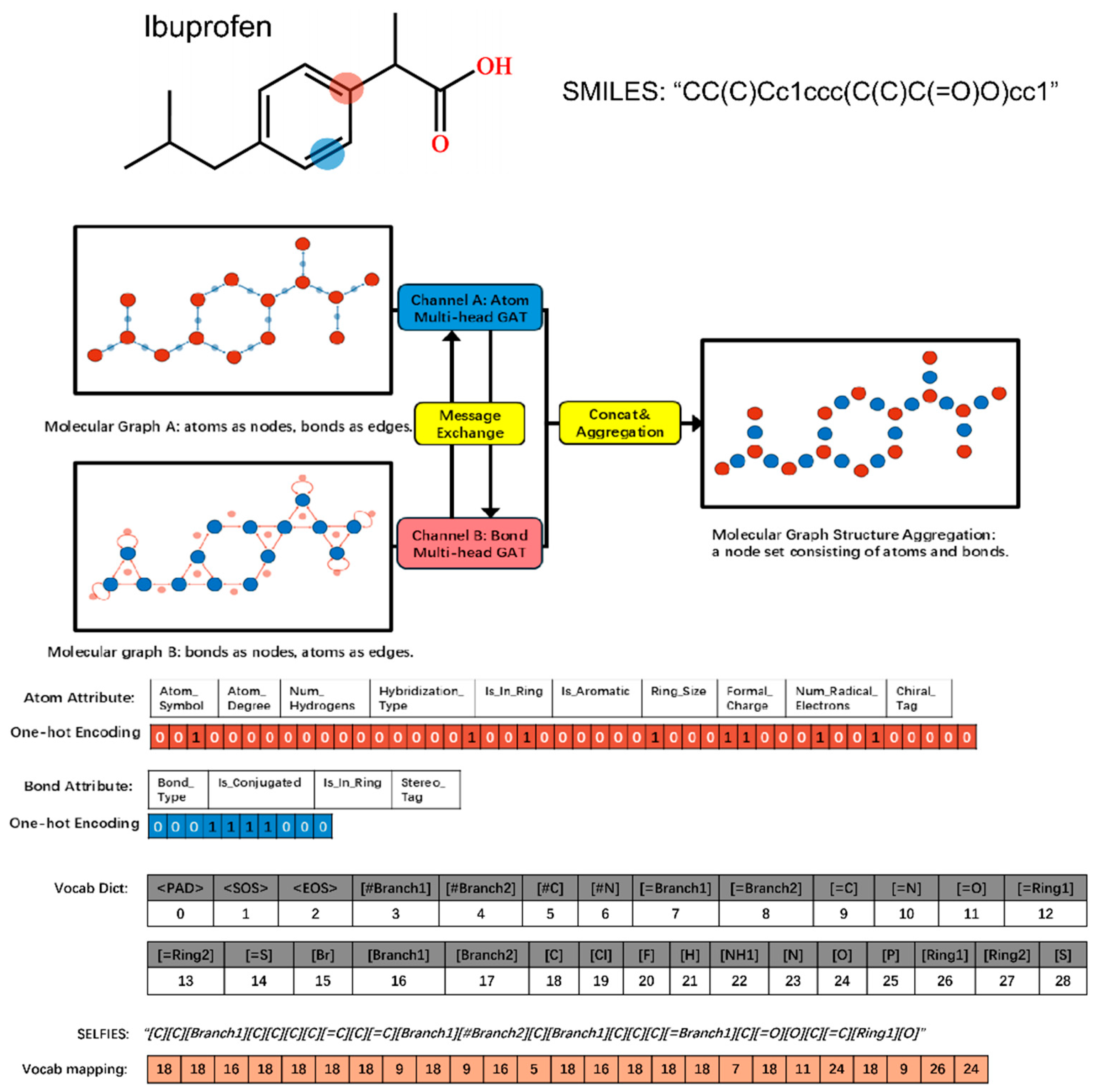
In the model, two types of molecular representations are used: one is the string- based representation, which will be used in the decoder, and the other is the molecular graph representation, which will be used in the encoder. For the string-based representation (SELFIES), word embedding encoding is applied. For the molecular graph structure, atomic and bond features are one-hot encoded based on their chemical and physical properties.
Here, we design two kinds of molecular graph representations: (a) atomic features as nodes and bond features as edges; (b) bond features as nodes and atomic features as edges. The two types of molecular graph representations will be processed into a graph structure G(U, E) and then fed to the encoder of the DC-HGT-VAE model. This means that, unlike conventional GNNs that only perform message passing between neighboring atoms, our dual-channel design enables simultaneous message passing between neighboring atoms and between neighboring bonds, thereby capturing the complex structural and property features of molecules more effectively.
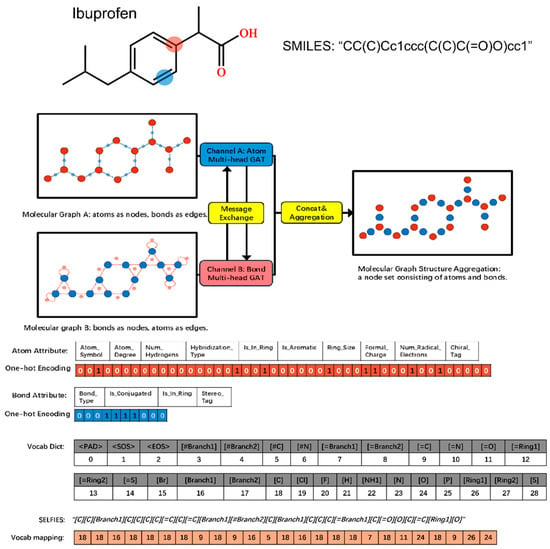
The specific data processing (feature engineering) is shown in Figure 7. Using the ibuprofen molecule as an example, we provide a detailed description of the processing of the molecular graph structure and the SELFIES string.
Figure 7.
Two types of molecular graph representations: (Molecular Graph A) atoms as nodes, bonds as edges; (Molecular Graph B) bonds as nodes, atoms as edges. They are one-hot encoded according to atomic and bond properties. Both representations propagate messages in the dual-channel GNNs and are fused into a complete graph via the encoder readout function. In the decoder, SELFIES strings are used and encoded as word embeddings.
4.3. Model Architecture
The DC-HGT-VAE is a VAE-based model that maps molecules to a continuous latent probability distribution via an encoder–decoder framework. In a typical forward propagation process, the encoder processes the molecular graph data and learns the latent distribution, and the decoder then samples from this latent distribution to generate new molecules.
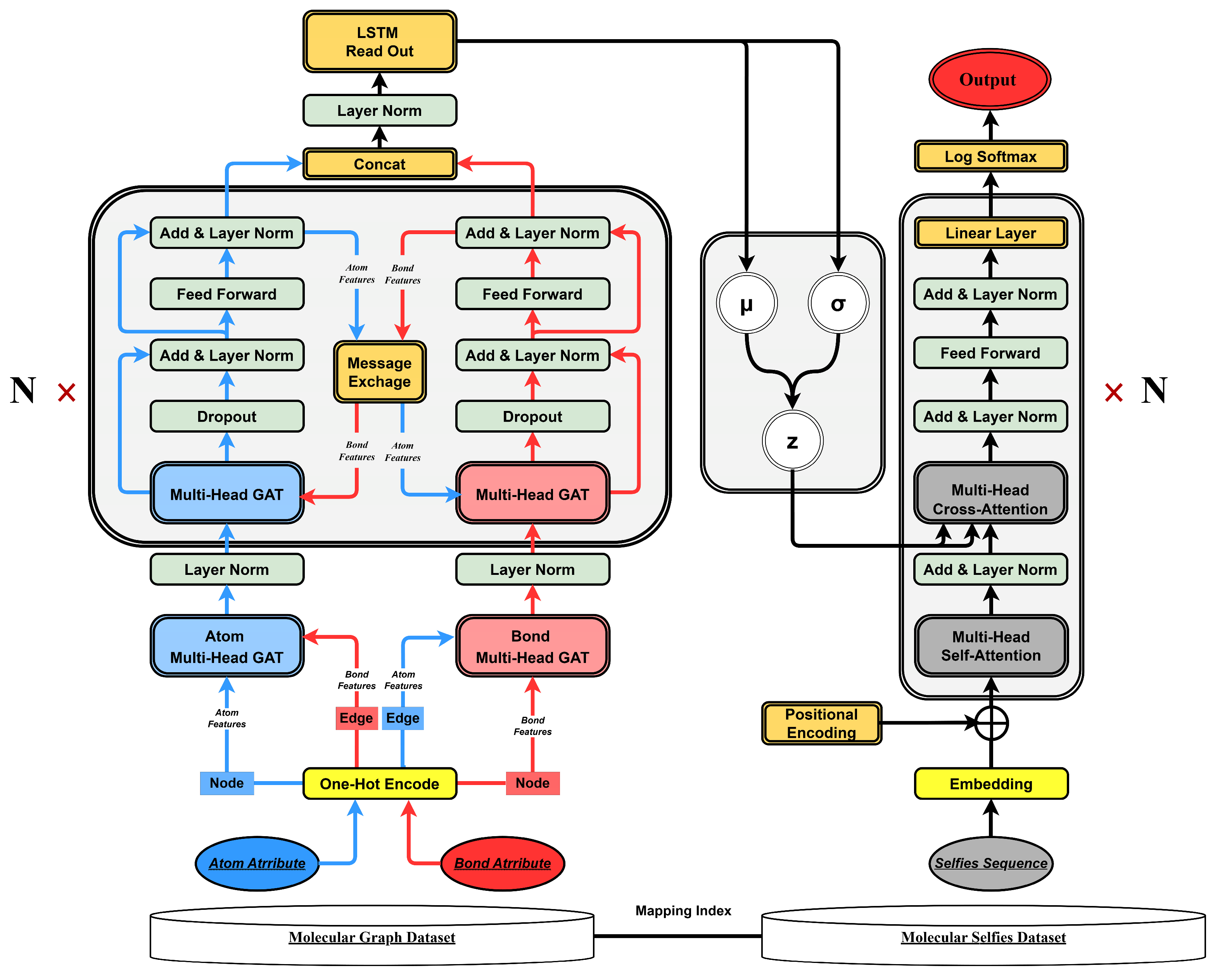
In the encoder, correctly capturing the complex structure of molecules is a prerequisite for achieving high-quality mapping from molecular graphs to a continuous latent space. To this end, we adopt a dual-channel graph processing pipeline: on one channel, message passing is performed with atoms as nodes and chemical bonds as edges to capture local bonding topology and the atomic properties; on the other channel, message passing is performed with bonds as nodes and atoms as edges to obtain inter-bond connectivity and the bond’s properties. After parallel propagation, the two channels are fused via an LSTM aggregation function [45], outputting a complete graph representation that contains multi-scale atomic-level and bond-level features.
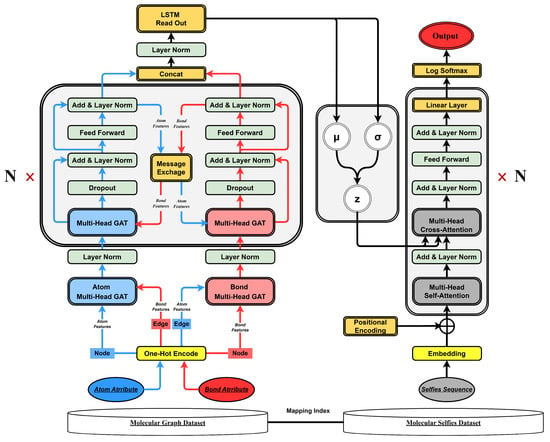
As shown in the model architecture (Figure 8), Ga and Gb are fed into a graph attention network (GAT) [46] to be transformed into same-dimensional vector representations. Then, within N multi-head GAT recurrent layers, high-dimensional node vectors are separately updated in two channels at each recurrent step, and simultaneously, the edge node vectors are exchanged between the two channels. After N multi-head GAT recurrent layers, the updated atom features and bond features will be concatenated, and then the data will be processed through an LSTM aggregation function to be read out as a new molecular graph representation. Additionally, to enable real-time interaction of updated node features and edge features between the two channels, we introduce a “Message Exchange” function layer between them, which exchanges node and edge features in real time according to their respective indices.
Figure 8.
Overview of the proposed model architecture. The encoder consists of a dual-channel GNN that transforms molecular graph representations into continuous latent vectors. The decoder, built upon a Transformer architecture, samples from the latent space and autoregressively generates SELFIES strings, thereby reconstructing molecules in a sequence-based chemical language.
Meanwhile, in the decoder, we introduce a Transformer to model global dependencies of SELFIES sequences and align the sequential latent states with the graph representation, thereby enhancing the encoder’s ability to jointly encode global molecular configuration and local chemical constraints. The encoder then projects the fused features into the mean and variance of continuous latent variables via the reparameterization trick, providing a smooth and structure-property-decoupled latent space for decoder generation and optimization.
Within the decoder, the SELFIES string embeddings, combined with positional encodings, are fed into a multi-head self-attention layer. After a residual connection and layer normalization, the output serves as the query for the multi-head cross-attention layer. The cross-attention layer takes the sampled latent variables as the key and value, enabling the fusion of molecular graph and string representations.
Our goal is to make the molecular representation map to a standard normal distribution. To achieve this, we design the latent space with the goal of making the molecular graph representation follow a standard Gaussian distribution, and we apply the reparameterization trick, which samples a latent vector z from (μ, σ2) while allowing gradient backpropagation [47].
where z is the latent vector, μ is the mean value, σ is the standard deviation, and ϵ is the random noise.
4.4. Loss Function
The VAE derivation maximizes the observed data likelihood, uses a variational posterior q(z∣x) to handle the intractable true posterior p(x∣z), and yields an optimizable objective. In the model’s latent space layer, we obtain the latent vector z via the reparameterization trick. Through a series of derivations, the classic VAE loss function is expressed as:
where the first term is the reconstruction loss, and the second term is the KL divergence (regularization term).
To overcome the posterior collapse problem during VAE training, we introduce a hyperparameter β into the loss function to balance the reconstruction loss and the KL divergence.
In this study, we employ cross-entropy loss as the reconstruction loss, as shown in the following formula:
where xt is the ground truth token at position t.
In VAEs, the KL divergence term measures the discrepancy between the encoder’s posterior qϕ(z∣x) and a prior distribution p(z). It is computed as:
where d is the latent dimension, and μj, are the mean and variance of the j-th latent variable.
The overall loss function of the model is defined as:
where the first term is the categorical cross-entropy reconstruction loss, and the second term is the KL divergence weighted by the hyperparameter β [48].
4.5. Message Exchange Layer
The Message Exchange module relies entirely on the graph adjacency indices constructed separately for the Atom channel and the Bond channel to perform direct feature gathering and concatenation. To maintain the symmetry of the dual-channel architecture, this module performs only cross-channel feature passing, followed by a linear layer for feature fusion. This linear layer projects the concatenated features back to the original dimension, ensuring that its output dimension matches both the Atom-channel and Bond-channel dimensions.
- Atom Channel to Bond Channel (node of the Atom channel → edge of the Bond channel).
The Atom channel treats atoms as nodes and bonds as edges. Based on the bond adjacency indices, the updated node features (atoms) from the Atom channel are directly gathered and concatenated to serve as the updated edge features in the Bond channel:
where denotes the original edge feature (atom) in the Bond channel, and denotes the node feature (atom) gathered from the Atom channel according to the bond adjacency indices.
- 2.
- Bond Channel to Atom Channel (node of the Bond channel → edge of the Atom channel).
The Bond channel treats bonds as nodes and atoms as edges. Based on the atom adjacency indices, the updated node features (bonds) from the Bond channel are directly gathered and concatenated to serve as the updated edge features in the Atom channel:
where denotes the original edge feature (bond) in the Atom channel, and denotes the node feature (bond) gathered from the Bond channel according to the atom adjacency indices.
The resulting and are then passed as updated edge features into the subsequent modules of their respective channels.
4.6. Molecular Docking Protocol
Molecular docking was performed using AutoDock Vina against the FGFR2 kinase domain crystal structure (PDB ID: 9VLM). The binding site was defined as the ATP-binding site within the kinase domain. Grid parameters were set as center_x = 32.437, center_y = 13.0405, center_z = 20.293, and size_x = 26.104, size_y = 27.269, size_z = 28.752 (Å). Ligands were optimised with MMFF94, and Gasteiger charges were assigned using AutoDockTools for AD4 scoring, consistent with the default charge model in AutoDock4. The receptor was prepared with AutoDockTools by removing crystallographic waters, adding hydrogens, and assigning protonation states corresponding to the default physiological-pH assumption. Docking used AutoDock Vina v1.2.7 with exhaustiveness = 8, num_modes = 10, and random seed = −1. Results were ranked by the best docking score.
4.7. Training and Parameter Settings
We set the hidden dimension of both the encoder and decoder to 512, and the feed-forward dimension to 1024. In the encoder, since the initial feature vectors of atomic properties and bond properties have relatively small dimensions (45 and 10, respectively), we conservatively transform them into 128-dimensional vectors in the “Atom Multi-Head GAT” layer and the “Bond Multi-Head GAT” layer. To control the dimensionality, a multi-head averaging method is applied in the encoder layers, where the number of heads is set to 8. The decoder module is constructed with a depth of 6 layers, which maintains architectural symmetry with the encoder to ensure stable reconstruction capability. The dimension of the latent representation space is fixed at 128. To overcome posterior collapse, the hyperparameter β is introduced into the loss function. After multiple rounds of training, a linearly increasing β value is adopted during training, ranging from 0.0001 to 0.001. For other settings, we use the Adam optimizer with a learning rate of 0.001 and a weight decay of 0.0001, apply a dropout rate of 0.2 in the dropout layer, set the batch size to 128, and train for 100 epochs. All hyperparameters adopted in the fine-tuning phase are identical to those used in the original training process, including but not limited to learning rate, batch size, optimizer type, and weight decay coefficient. This setting eliminates extra hyperparameter search bias and ensures consistency across training stages.
All training and inference experiments of our model are conducted on a computing server equipped with multiple NVIDIA GeForce RTX 3090 Ti GPUs, which provides sufficient computing power and video memory to support stable model training. Under the above hardware configuration and our default experimental hyperparameters, the full training process of the proposed model takes approximately 3 days to reach stable convergence.
Author Contributions
Conceptualization, X.Z. (Xianyang Zeng); methodology, X.Z. (Xianyang Zeng); software, R.N.; validation, X.Z. (Xianyang Zeng); formal analysis, R.N.; investigation, X.Z. (Xianyang Zeng); resources, X.Z. (Xi Zhao); data curation, X.Z. (Xianyang Zeng); writing—original draft preparation, X.Z. (Xianyang Zeng); writing—review and editing, X.Z. (Xi Zhao); visualization, X.Z. (Xianyang Zeng); supervision, X.Z. (Xi Zhao); project administration, X.Z. (Xi Zhao); funding acquisition, X.Z. (Xianyang Zeng). All authors have read and agreed to the published version of the manuscript.
Funding
This research received no external funding.
Institutional Review Board Statement
Not applicable.
Informed Consent Statement
Not applicable.
Data Availability Statement
The dual-channel heterogeneous graph transformer variational autoencoder (DC-HGT-VAE) for molecular generation is available at https://github.com/zhengqc00/Dual_Channel_GTVAE. (accessed on 31 Augest 2026)
Acknowledgments
The authors acknowledge Qiancheng Zheng for his testing of DC-HGT-VAE code.
Conflicts of Interest
The authors declare no conflicts of interest.
Abbreviations
The following abbreviations are used in this manuscript:
| DC-HGT-VAE | dual-channel heterogeneous graph transformer variational autoencoder |
| GAT | Graph Attention Network |
| VAE | Variational Autoencoder |
| FCD | Fréchet ChemNet Distance |
| SNN | Similarity to Nearest Neighbor |
| SCAF (Scaf) | Scaffold Similarity |
References
- Chen, Y.; Xue, W. Machine Learning for De Novo Molecular Generation: A Comprehensive Review. ACS Chem. Neurosci. 2026, 17, 666–680. [Google Scholar] [CrossRef] [Scilit] [PubMed]
- Martinelli, D.D. Generative machine learning for de novo drug discovery: A systematic review. Comput. Biol. Med. 2022, 145, 105403. [Google Scholar] [CrossRef] [Scilit] [PubMed]
- Pang, C.; Qiao, J.; Zeng, X.; Zou, Q.; Wei, L. Deep Generative Models in De Novo Drug Molecule Generation. J. Chem. Inf. Model. 2024, 64, 2174–2194. [Google Scholar] [CrossRef] [Scilit] [PubMed]
- Bohacek, R.S.; McMartin, C.; Guida, W.C. The art and practice of structure-based drug design: A molecular modeling perspective. Med. Res. Rev. 1996, 16, 3–50. [Google Scholar] [CrossRef]
- Hollebecque, A.; Borad, M.J.; Lu, P.; Meng, X.; Ryan, K.; Alexander, L.; Liu, J.; Oh, D.-Y.; Kim, R.D. Efficacy and safety of lirafugratinib in FGFRi-naïve cholangiocarcinoma (CCA) patients harboring FGFR2 fusions/rearrangements (FGFR2 f/r). J. Clin. Oncol. 2026, 44, 476. [Google Scholar] [CrossRef] [Scilit]
- Kim, J.; Kim, H.S.; Nam, M.; Chae, Y.K. Tissue-agnostic biomarkers in solid tumors: Current approvals and emerging candidates. Cancer Metastasis Rev. 2025, 44, 58. [Google Scholar] [CrossRef] [Scilit] [PubMed]
- Krook, M.A.; Reeser, J.W.; Ernst, G.; Barker, H.; Wilberding, M.; Li, G.; Chen, H.Z.; Roychowdhury, S. Fibroblast growth factor receptors in cancer: Genetic alterations, diagnostics, therapeutic targets and mechanisms of resistance. Br. J. Cancer 2021, 124, 880–892. [Google Scholar] [CrossRef] [Scilit] [PubMed]
- Wu, Q.B.; Ellis, H.; Siravegna, G.; Michel, A.G.; Norden, B.L.; de la Cruz, F.F.; Balasooriya, E.R.; Zhen, Y.L.; Silveira, V.S.; Che, J.W.; et al. Landscape of Clinical Resistance Mechanisms to FGFR Inhibitors in FGFR2-Altered Cholangiocarcinoma. Clin. Cancer Res. 2024, 30, 198–208. [Google Scholar] [CrossRef] [Scilit] [PubMed]
- Subbiah, V.; Sahai, V.; Maglic, D.; Bruderek, K.; Touré, B.B.; Zhao, S.P.; Valverde, R.; O’Hearn, P.J.; Moustakas, D.T.; Schönherr, H.; et al. RLY-4008, the First Highly Selective FGFR2 Inhibitor with Activity across FGFR2 Alterations and Resistance Mutations. Cancer Discov. 2023, 13, 2012–2031. [Google Scholar] [CrossRef] [Scilit] [PubMed]
- Jin, W.; Barzilay, R.; Jaakkola, T. Junction Tree Variational Autoencoder for Molecular Graph Generation. arXiv 2018, arXiv:1802.04364. [Google Scholar] [CrossRef] [Scilit]
- Gómez-Bombarelli, R.; Wei, J.N.; Duvenaud, D.; Hernández-Lobato, J.M.; Sánchez-Lengeling, B.; Sheberla, D.; Aguilera-Iparraguirre, J.; Hirzel, T.D.; Adams, R.P.; Aspuru-Guzik, A. Automatic Chemical Design Using a Data-Driven Continuous Representation of Molecules. ACS Cent. Sci. 2018, 4, 268–276. [Google Scholar] [CrossRef] [Scilit] [PubMed]
- De Cao, N.; Kipf, T. MolGAN: An implicit generative model for small molecular graphs. arXiv 2018, arXiv:1805.11973. [Google Scholar]
- Lane, E.; Asadulaev, A.; Ivanenkov, Y.; Aladinskiy, V.; Sanchez-Lengeling, B.; Aspuru-Guzik, A.; Zhavoronkov, A. Reinforced Adversarial Neural Computer for de Novo Molecular Design. J. Chem. Inf. Model. 2018, 58, 1194–1204. [Google Scholar] [CrossRef] [Scilit] [PubMed]
- Alakhdar, A.; Poczos, B.; Washburn, N. Diffusion Models in De Novo Drug Design. J. Chem. Inf. Model. 2024, 64, 7238–7256. [Google Scholar] [CrossRef] [Scilit] [PubMed]
- Guo, Z.; Liu, J.; Wang, Y.; Chen, M.; Wang, D.; Xu, D.; Cheng, J. Diffusion models in bioinformatics and computational biology. Nat. Rev. Bioeng. 2024, 2, 136–154. [Google Scholar] [CrossRef] [Scilit] [PubMed]
- Abbasi, K.; Razzaghi, P.; Gharizadeh, A.; Ghareyazi, A.; Dehnad, A.; Rabiee, H.R.; Mofrad, M.R.K. Computational drug design in the artificial intelligence era: A systematic review of molecular representations, generative architectures, and performance assessment. Pharmacol. Rev. 2026, 78, 100065. [Google Scholar] [CrossRef] [Scilit] [PubMed]
- Anstine, D.M.; Isayev, O. Generative Models as an Emerging Paradigm in the Chemical Sciences. J. Am. Chem. Soc. 2023, 145, 8736–8750. [Google Scholar] [CrossRef] [Scilit] [PubMed]
- Wang, Y.; Cai, H.; Jiang, L.; Shen, B.; Wan, B.; Hu, P.; Xiong, X. RTGAN: An Novel GAN-Based Rule Transfer Learning Method for Scalable Industrial Inference Engine. In Proceedings of the 2022 IEEE International Conference on e-Business Engineering (ICEBE), Bournemouth, UK, 14–16 October 2022; pp. 24–25. [Google Scholar]
- Valença, L.; Maquignaz, I.; Moazen, H.; Madan, R.; Hold-Geoffroy, Y.; Lalonde, J.-F. LM-GAN: A Photorealistic All-Weather Parametric Sky Model. arXiv 2023, arXiv:2302.00087. [Google Scholar]
- Nguyen, T.; Karolak, A. Transformer graph variational autoencoder for generative molecular design. Biophys. J. 2025, 124, 3867–3875. [Google Scholar] [CrossRef] [Scilit] [PubMed]
- Kwon, B.C.; Shapira, B.; Raboh, M.; Sethi, S.; Murarka, S.; Morrone, J.A.; Asai, M.; Wissow, S. STAR-VAE: Latent Variable Transformers for Scalable and Controllable Molecular Generation. In Proceedings of the AAAI 2026 Workshop, Singapore, 20–27 January 2026. [Google Scholar]
- Han, S.; Shen, Y.; An, H.; Wang, J. A geometry-aware generative framework integrating GPS-VAE and Transformer-SELFIES for structure-based de novo drug design. J. Mol. Model. 2026, 32, 183. [Google Scholar] [CrossRef] [Scilit] [PubMed]
- Wang, S.; Liang, D.; Wang, J.; Dong, K.; Zhang, Y.; Liang, H.; Xu, X.; Song, T. FraHMT: A Fragment-Oriented Heterogeneous Graph Molecular Generation Model for Target Proteins. J. Chem. Inf. Model. 2024, 64, 3718–3732. [Google Scholar] [CrossRef] [Scilit] [PubMed]
- Yoo, S.; Kim, J. Adapt-cMolGPT: A Conditional Generative Pre-Trained Transformer with Adapter-Based Fine-Tuning for Target-Specific Molecular Generation. Int. J. Mol. Sci. 2024, 25, 6641. [Google Scholar] [CrossRef] [Scilit] [PubMed]
- Choudhary, K.; DeCost, B. Atomistic Line Graph Neural Network for improved materials property predictions. npj Comput. Mater. 2022, 8, 221. [Google Scholar] [CrossRef] [Scilit]
- Li, H.; Zhang, R.; Min, Y.; Ma, D.; Zhao, D.; Zeng, J. A knowledge-guided pre-training framework for improving molecular representation learning. Nat. Commun. 2023, 14, 7568. [Google Scholar] [CrossRef] [Scilit] [PubMed]
- Zhang, O.; Lin, H.; Zhang, X.; Wang, X.; Wu, Z.; Ye, Q.; Zhao, W.; Wang, J.; Ying, K.; Kang, Y.; et al. Graph Neural Networks in Modern AI-Aided Drug Discovery. Chem. Rev. 2025, 125, 10001–10103. [Google Scholar] [CrossRef] [Scilit] [PubMed]
- Boiko, D.A.; Reschützegger, T.; Sanchez-Lengeling, B.; Blau, S.M.; Gomes, G. Advancing molecular machine learning representations with stereoelectronics-infused molecular graphs. Nat. Mach. Intell. 2025, 7, 771–781. [Google Scholar] [CrossRef] [Scilit]
- Ren, G.-P.; Yin, Y.-J.; Wu, K.-J.; He, Y. Force field-inspired molecular representation learning for property prediction. J. Cheminform. 2023, 15, 17. [Google Scholar] [CrossRef] [Scilit] [PubMed]
- Sangala, S.A.R.; Raghunathan, S. Graph Neural Network for 3-Dimensional Structures Including Dihedral Angles for Molecular Property Prediction. J. Comput. Chem. 2025, 46, e70121. [Google Scholar] [CrossRef] [Scilit] [PubMed]
- Mao, Z.; Hu, C.-S.; Li, J.; Liang, C.; Das, D.; Sumita, M.; Xia, K.; Tsuda, K. Molecule Graph Networks with Many-Body Equivariant Interactions. J. Chem. Theory Comput. 2025, 21, 7954–7966. [Google Scholar] [CrossRef] [Scilit] [PubMed]
- Lipinski, C.A.; Lombardo, F.; Dominy, B.W.; Feeney, P.J. Experimental and computational approaches to estimate solubility and permeability in drug discovery and development settings. Adv. Drug Deliv. Rev. 2012, 64, 4–17. [Google Scholar] [CrossRef] [Scilit]
- ChEMBL. Compound STATE_ID:Fibroblast Growth Factor Receptor 2. Available online: https://www.ebi.ac.uk/chembl/explore/compounds/STATE_ID:U6mRG2ulVTQ_-uCol_-EsA%3D%3D (accessed on 31 August 2026).
- Gaulton, A.; Bellis, L.; Bento, A.P.; Chambers, J.; Davies, M.; Hersey, A.; Light, Y.; McGlinchey, S.; Michalovich, D.; Al-Lazikani, B.; et al. ChEMBL: A Large-Scale Bioactivity Database for Chemical Biology and Drug Discovery. Nucleic Acids Res. 2011, 40, 1100–1107. [Google Scholar] [CrossRef] [Scilit] [PubMed]
- Rogers, D.; Hahn, M. Extended-Connectivity Fingerprints. J. Chem. Inf. Model. 2010, 50, 742–754. [Google Scholar] [CrossRef] [Scilit] [PubMed]
- McInnes, L.; Healy, J.; Melville, J. UMAP: Uniform Manifold Approximation and Projection for Dimension Reduction. arXiv 2018, arXiv:1802.03426. [Google Scholar] [CrossRef] [Scilit]
- Trott, O.; Olson, A.J. AutoDock Vina: Improving the speed and accuracy of docking with a new scoring function, efficient optimization, and multithreading. J. Comput. Chem. 2010, 31, 455–461. [Google Scholar] [CrossRef] [Scilit] [PubMed]
- Liu, P.C.C.; Koblish, H.; Wu, L.X.; Bowman, K.; Diamond, S.; DiMatteo, D.; Zhang, Y.; Hansbury, M.; Rupar, M.; Wen, X.M.; et al. INCB054828 (pemigatinib), a potent and selective inhibitor of fibroblast growth factor receptors 1, 2, and 3, displays activity against genetically defined tumor models. PLoS ONE 2020, 15, 16. [Google Scholar] [CrossRef] [Scilit] [PubMed]
- Perera, T.P.S.; Jovcheva, E.; Mevellec, L.; Vialard, J.; De Lange, D.; Verhulst, T.; Paulussen, C.; Van De Ven, K.; King, P.; Freyne, E.; et al. Discovery and Pharmacological Characterization of JNJ-42756493 (Erdafitinib), a Functionally Selective Small-Molecule FGFR Family Inhibitor. Mol. Cancer Ther. 2017, 16, 1010–1020. [Google Scholar] [CrossRef] [Scilit] [PubMed]
- Sootome, H.; Fujita, H.; Ito, K.; Ochiiwa, H.; Fujioka, Y.; Ito, K.; Miura, A.; Sagara, T.; Ito, S.; Ohsawa, H.; et al. Futibatinib Is a Novel Irreversible FGFR 1-4 Inhibitor That Shows Selective Antitumor Activity against FGFR-Deregulated Tumors. Cancer Res. 2020, 80, 4986–4997. [Google Scholar] [CrossRef] [Scilit] [PubMed]
- Polykovskiy, D.; Zhebrak, A.; Sanchez-Lengeling, B.; Golovanov, S.; Tatanov, O.; Belyaev, S.; Kurbanov, R.; Artamonov, A.; Aladinskiy, V.; Veselov, M.; et al. Molecular Sets (MOSES): A Benchmarking Platform for Molecular Generation Models. Front. Pharmacol. 2020, 11, 565644. [Google Scholar] [CrossRef] [Scilit]
- Weininger, D. SMILES, a chemical language and information system. 1. Introduction to methodology and encoding rules. J. Chem. Inf. Comput. Sci. 1988, 28, 31–36. [Google Scholar] [CrossRef] [Scilit]
- Krenn, M.; Häse, F.; Nigam, A.; Friederich, P.; Aspuru-Guzik, A. Self-referencing embedded strings (SELFIES): A 100% robust molecular string representation. Mach. Learn. Sci. Technol. 2020, 1, 045024. [Google Scholar] [CrossRef] [Scilit]
- RDKit: Open-Source Cheminformatics. Available online: https://rdkit.org (accessed on 2 July 2026).
- Hamilton, W.L.; Ying, Z.; Leskovec, J. Inductive Representation Learning on Large Graphs. arXiv 2017, arXiv:1706.02216. [Google Scholar]
- Velickovic, P.; Cucurull, G.; Casanova, A.; Romero, A.; Liò, P.; Bengio, Y. Graph Attention Networks. arXiv 2018, arXiv:1710.10903. [Google Scholar]
- Kingma, D.; Welling, M. Auto-Encoding Variational Bayes. arXiv 2014, arXiv:1312.6114. [Google Scholar]
- Higgins, I.; Matthey, L.; Pal, A.; Burgess, C.P.; Glorot, X.; Botvinick, M.M.; Mohamed, S.; Lerchner, A. beta-VAE: Learning Basic Visual Concepts with a Constrained Variational Framework. In Proceedings of the 4th International Conference on Learning Representations, San Juan, Puerto Rico, 2–4 June 2016. [Google Scholar]

Disclaimer/Publisher’s Note: The statements, opinions and data contained in all publications are solely those of the individual author(s) and contributor(s) and not of MDPI and/or the editor(s). MDPI and/or the editor(s) disclaim responsibility for any injury to people or property resulting from any ideas, methods, instructions or products referred to in the content. |
© 2026 by the authors. Licensee MDPI, Basel, Switzerland. This article is an open access article distributed under the terms and conditions of the Creative Commons Attribution (CC BY) license.